




Abstract
This study addresses the heterogeneity of family firms in their engagement with corporate social responsibility (CSR). We build on stewardship theory and socioemotional wealth to explore the foundations of CSR in family firms and to examine whether the extent of engagement is based on values, and how and why this happens. We use the interpretative method of grounded theory to address these questions. Based on 12 case studies of Spanish family firms, this article illustrates the patterns of influence of family involvement and values in explaining the extent and scope of CSR.
Introduction
Corporate social responsibility (CSR) is a strategy of increasing importance for any organization (Carroll & Shabana, 2010). However, in the field of family business, different authors have indicated a lack of studies about CSR (Berrone, Cruz, Gomez-Mejia, & Larraza-Kintana, 2010; Debicki, Matheme, Kellermans, & Chrisman, 2009). The first studies on this topic illustrated the differences between family and nonfamily firms in relation to their CSR practices (Craig & Dibrell, 2006; Graafland, Ven van de, & Stoffele, 2003), mostly arguing that family firms are more likely to behave ethically for reasons of identity, image, reputation (Dyer & Whetten, 2006), and identification (Gallo, 2004; Godfrey, 2005). Only a few works found that family firms were less responsible than nonfamily firms (Morck & Yeung, 2003), arguing that family firms may be highly self-interested and merely want to protect their own interests. Finally, other studies, like that conducted by Adams, Taschian, and Shore (1996), concluded that family firms have similar socially responsible attitudes to nonfamily firms.
More recently, research has shifted to studying the conditions and mechanisms that influence CSR within family firms (Bingham, Dyer, Smith, & Adams, 2011). Some suggested sources of heterogeneity regarding CSR engagement in family firms have been family characteristics, values, and culture (Déniz-Déniz & Cabrera-Suárez, 2005), manager’s personal characteristics (Niehm, Swinney, & Miller, 2008), identification (Berrone et al., 2010), or founder’s participation (Bingham et al., 2011). But a critical source proposed is family involvement (Dyer, 1986; O’Boyle, Rutherford, & Pollack, 2010), which is considered to be a determinant of stakeholder salience (Mitchell, Agle, Chrisman, & Spence, 2011; Neubaum, Dibrell, & Craig, 2012), which, in turn, can explain differences in the engagement and nature of CSR, in order to satisfy different stakeholders. We will thus consider family involvement in this analysis.
To further address the heterogeneity of family firms in terms of CSR, this article offers a different perspective by analyzing the differences in family firm values, grounded on the theoretical views of stewardship (e.g., Davis, Schoorman, & Donaldson, 1997) and socioemotional wealth (SEW; e.g., Gomez-Mejia, Haynes, Núñez-Nickel, Jacobson, & Moyano-Fuentes, 2007). In particular, we address the following research question: What are the patterns of CSR engagement within family firms in terms of values? The originality of this article is the in-depth exploration of the connections between values and CSR engagement, and the article addresses an existing gap, namely, the joint consideration of the set of values derived from theory to explain CSR behavior. From a wider perspective, this study helps explain how and why family firms are heterogeneous in relation to CSR and may offer ideas that will help reconcile some differing assumptions and conflicting findings. In particular, we argue for the relevance of family involvement—in the sense of participation, as compared with ownership—and the importance of the scope—areas of preference—for CSR in family firms.
Our article proceeds as follows. The first section starts with the analysis of the values underlying the stewardship and SEW perspectives and argues for their connection with CSR. It continues with a review of CSR research within the field of family business. Second, we describe the methodology used and the case studies carried out. The next section presents the empirical results, which are followed by a discussion. A final section concludes the article and summarizes its contribution, implications, and limitations.
Theoretical Background
CSR Definition and Scope
The European Union definition of CSR states that CSR is “a concept whereby companies integrate social and environmental concerns in their firm operations and in their interaction with their stakeholders on a voluntary basis” (European Commission [EU], 2009). Nevertheless, as there is no globally accepted definition (Weber, 2008), it is generally accepted that CSR refers to a company’s activities, processes, and status in connection with its related stakeholder obligations (Hsu & Cheng, 2012; Wood, 1991).
There is also a variety of proposals for the components or the scope of CSR (e.g., Carroll, 1996), but with a firm-oriented approach the one proposed by the European Union is the most general (EU, 2009): workplace, marketplace, environment, and society. Workplace CSR refers mainly to the CSR activities in human resources management within an organization; marketplace CSR includes the activities, processes, and status with their suppliers, customers, and competitors; environmental CSR refers to the actions and concerns about the impact of the companies’ activities on the environment; and finally, community CSR affects the relationships that organizations build among the citizens and communities they affect.
Although all firms have all scopes of responsibilities, not all firms demonstrate CSR equally (Hsu & Cheng, 2012). The variety and depth of CSR actions is the result of the CSR strategies of companies, with varying degrees of formality. CSR actions are thus ultimately the result of the decisions and management of firm leaders, who act on behalf of their principals, the shareholders. This view introduces the role of managers as agents of the firm owners that we address in the following section.
CSR Under the Stewardship and SEW Perspectives
Several authors have suggested that stewardship theory may be helpful for understanding the ethical and social behavior of individuals in family firms (Corbetta & Salvato, 2004; Kellermanns & Eddleston, 2007). The stewardship theory basically argues that the principles of agency theory (Jensen & Meckling, 1976) do not apply to all situations and that noneconomic behavioral premises should be considered (Donaldson & Davis, 1991). In particular, stewardship theory defines situations in which managers are not motivated merely by individual goals, since for them pro-organizational and collectivistic conduct has a higher utility than an individualistic and self-centered one (Chrisman, Chua, Kellermanns, & Chang, 2007). The rationale for this difference is that there are different psychological factors (e.g., motivation, identification, and use of power) and situational factors (e.g., management philosophy, culture, and power distance) at work in an organization, which may lead to the alignment of the goals of managers (stewards) with the goals of shareholders (Davis et al., 1997).
Under the stewardship view there are the works of Sorenson, Goodpaster, Hedberg, and Yu (2009); O’Boyle et al. (2010); and Bingham et al. (2011) that analyze the involvement of family members with the firm as the trigger to undertake socially responsible practices. Stewards who have similar values to those of their firms are more likely to be more involved and to behave more responsibly in a family firm (O’Boyle et al., 2010).
Another approach that is gaining attention in explaining the CSR behavior of family firms is the SEW perspective (e.g., Berrone et al., 2010; Gomez-Mejia, Cruz, Berrone, & De Castro, 2011). SEW suggests that family are typically motivated and committed to the preservation of their SEW, defined as the “affective endowments” of family owners (Berrone, Cruz, & Gomez-Mejia, 2012). SEW is a general extension of behavioral agency theory which states that family owners take decisions based on how they will affect their socioemotional endowment (Gomez-Mejia et al., 2007). A recent study proposes five dimensions of SEW, labeled as FIBER, which stands for Family control and influence, Identification of family members with the firm, Binding social ties, Emotional attachment to the firm, and Renewal of family bonds to the firm through dynastic succession (Berrone et al., 2012).
Several authors (e.g., Berrone et al., 2010; Bingham et al., 2011) use this view to propose that among family firms, increased levels of family involvement would reveal a corresponding increase in CSR activity because these family members show an emotional attachment to the firm and this would possibly lead them to exhibit greater social concern. Furthermore, Cennamo, Berrone, Cruz, and Gomez-Mejia (2012) argue that family firms are more prone to adopt proactive stakeholder engagement activities, which can be considered related to CSR, because by doing so they preserve and enhance their SEW. These authors propose that the different dimensions of SEW entail different efforts with stakeholders for two types of motives: instrumental, according to which greater care for other stakeholders is a means to maximize shareholder welfare; and normative, according to which giving a high priority to the satisfaction of stakeholders’ demands “is the right thing to do.” In summary, the stewardship and SEW perspectives suggest that compared with their nonfamily firm counterparts, family firms are more likely to initiate socially responsible firm practices. Yet it is still relevant to examine the evidence on the sources of heterogeneity of family firms’ behavior regarding CSR, as we address in this article.
Values From the Stewardship and SEW Perspectives
Values can be defined as “enduring beliefs that a specific mode of conduct or end-state is personally or socially preferable to an opposite or converse mode of conduct or end-state” (Rokeach, 1973, p. 5) and in organizational settings values are considered to be the preferences that individuals have for behaviors and outcomes in work settings (Glew, 2009).
A systematic review of the literature on stewardship in the family business field reveals that it has been quite explicitly building on some common values (Simon, Marques, Bikfalvi, & Muñoz, 2012), which are the grounds for our analysis. The most cited value is identification (Miller & LeBreton-Miller, 2006; Vallejo, 2008). According to Davis et al. (1997), identification occurs when managers define themselves in terms of their membership of the organization by accepting the organization’s mission and vision. Under the SEW approach, identification is directly one of the FIBER dimensions proposed by Berrone et al. (2012) and refers to the sense of belonging, the personal attribution of the firm’s success, and the pride of participating in the firm. The value of identification clearly also underlies the personal meaning of the family firm for family members, and the fact that being a family member can help define who they are.
Identification in turn reinforces another value, which is altruism, since when managers identify with their organization they more readily engage in altruistic and spontaneous unrewarded citizenship behaviors (Davis et al., 1997). Altruism is relevant in the stewardship literature for family firms (Miller & LeBreton-Miller, 2006; Zahra, Hayton, Neubaum, Dibrell, & Craig, 2008) and can be defined as the unselfish concern and devotion to others without an expected return for oneself (Corbetta & Salvato, 2004). Within an SEW view, altruism can be the ground of binding social ties (Berrone et al., 2012), associated with promoting social activities at the community level and building strong relationships outside the family firm with other institutions and suppliers, based on trust and reciprocity.
Altruism, however, has two sides in family firms (Eddleston & Kellermans, 2007): the positive side of encouraging stewards to place the firm’s objectives ahead of their own (Zahra, 2003), and the negative side, which leads to agency type of decisions that benefit family members at the expense of the firm (e.g., Schulze, Lubatkin, & Dino, 2003; Schulze, Lubatkin, Dino, & Bucholtz, 2001). In this article, since it deals with CSR, altruism will be understood to apply beyond the family, toward other stakeholders.
The second most cited value in stewardship is collectivism (e.g., Eddleston & Kellermans, 2007; Miller & LeBreton-Miller, 2006), which is defined as the subordination of personal goals to the goals of the collective (Triandis, 1995), when the self is defined as part of the group (Davis et al., 1997). The value of collectivism underpins the overall FIBER scale of the SEW approach (Berrone et al., 2012), since it mostly refers to the common vision, goals, preferences, and actions of the family and the family firm. Also, consideration of employees as part of the family can be considered to enlarge the collective, and make managers consider employees’ goals and interests as well in decision making.
Another common value is commitment (Eddleston & Kellermans, 2007; Vallejo, 2008), which is the willingness to do one’s best for the owning family and the organizational collective (Miller &Le Breton-Miller, 2006). Organizational commitment can be considered a multidimensional construct consisting of continuance commitment and value commitment (Mayer & Schoorman, 1992). Continuance commitment refers to the desire to remain in the organization, and value commitment refers to the acceptance of the organization’s goals, which makes it closely related to the concept of identification (Davis et al., 1997). From the SEW perspective, family members are described as highly committed to the survival of the firm because of their strong emotional attachment to the family firm (Gomez-Mejia et al., 2007). In the FIBER dimensions (Berrone et al., 2012), the wish to protect the welfare of family members and the preference not to sell the family firm can be considered as commitment to the family and the firm. Achieving a successful transfer of the family firm can also be considered a continuance commitment to the firm.
From the stewardship perspective, there has also been special reference to the value of perpetuation, in the sense that a steward protects and maximizes the long-term wealth of shareholders, because by doing so, the steward’s utility functions are also maximized (Davis et al., 1997). Perpetuation has been defined as the wish of family firms to succeed over generations (Lansberg, 1999; Ward, 2004). From the SEW perspective, the value of perpetuation is central to the fifth dimension of the FIBER scale (Berrone et al., 2012), which refers to continuing the legacy, the long-term horizon, and the wish to transfer the firm to the next generation. This value is also implicit in the first dimension, family control, and influence, in the sense that preservation of family control and independence are important goals for family firms.
The last distinctive value found in the stewardship literature is obligation, meaning the feelings of responsibility and of burden sharing for the organization (Eddleston & Kellermans, 2007; Pierce, Kostova, & Dirks, 2001). According to Miller and LeBreton-Miller (2006), stewardship promotes responsible decisions because of emotional and financial attachment to the firm. The sense of obligation can be the response of a steward who feels that they are responsible for the fate of the organization (Davis et al., 1997). Within the SEW approach, the value of obligation is underlying the dimension of binding social ties, referring to strong, enduring, and trustful relationships with stakeholders (other companies, institutions, government, etc.).
We have revealed the main values underlying stewardship theory and argued that they are closely aligned to the values found in the SEW approach. We argue that values have already been connected with CSR policies in the literature, where it is widely recognized that values influence behavior. By definition, values are considered preferences about behaviors and outcomes, so they can be expected to influence behavior (Glew, 2009; Rokeach, 1973). For example, collectivists define their goals in terms of their group membership, subordinating their personal goals to those of the collective, and they prefer harmony to confrontation (Davis et al., 1997). Thus, collectivism affects goals, means, and decision processes. The value of perpetuation introduces the importance of long-term effects of decisions and explains why family businesses may have a different approach to long-term strategies (Craig & Dibrell, 2006).
On the whole, the values described above have been associated to the particularistic behavior of family firms, that is to family firms’ strategies, and some of them with CSR, within the stewardship literature or the SEW approach. Most studies have not treated them as empirical objects, but instead have described them as the rationale behind observed behaviors. Some exceptions are presented in Ciocirlan (2008), who reviews the research on the values of the owner or top managers in family firms and finds that the concern for the employees’ health and welfare, pride, altruism, and the responsibility to give back to the society influence whether a family-owned firm will engage in socially responsible practices and to what extent. Apart from this work, to the best of our knowledge, there is no joint consideration of these values to explain CSR behavior. Therefore, the present study aims to analyze this set of values together to explore how they relate to CSR in family firms.
Sources of Heterogeneity in Family Firms’ CSR Behavior
A review of the literature on CSR in family firms shows that family firms do not form a homogeneous group in terms of their orientation toward CSR, although the reasons for such heterogeneity have not been much studied (Déniz-Déniz & Cabrera-Suárez, 2005). In this sense, different elements have been analyzed as critical antecedents of CSR in family firms by different authors and with different approaches (e.g., Bingham et al., 2011; O’Boyle et al., 2010; Sorenson et al., 2009).
Empirical investigations about CSR behavior within family firms include, among others, Déniz-Déniz and Cabrera-Suárez (2005) who analyze a sample of 112 Spanish family firms and conclude that the heterogeneity of family firms’ CSR behavior in different types of family firms can be due to families’ characteristics, values, and culture, although they do not explore the specific values that generate this heterogeneity. Niehm, Swinney, and Miller (2008) explore firm operator’s age, educational level completed, and whether firm operators live in the same community as the firm’s location as possible antecedents of the CSR orientation of the firm. Finally, several authors (e.g., Bingham et al., 2011; Niehm et al., 2008; O’Boyle et al., 2010) propose that family firms may have diverse perspectives on CSR due to a different family involvement. According to Bingham et al. (2011), family firms are unique as a result of family member involvement in decisions regarding CSR and the management of the main stakeholders. They propose that among family firms, increased levels of family involvement will reflect in a corresponding increase in CSR activity. This is because firms with higher family involvement may display greater concern for the broader collective’s welfare and therefore adopt a more collectivistic rather than individualistic stakeholder orientation. In the same direction, O’Boyle et al. (2010) state that higher levels of family involvement will be associated with higher levels of ethical focus because firms that have a high degree of family involvement are likely to have members who identify closely with the firm and thus are likely to view the firm as an extension of the family and themselves and engage in behaviors that would reflect favorably on the firm. In fact, according to Ciocirlan (2008), family-owned firms are more likely to engage in CSR initiatives when top management support is higher. Moreover, the high involvement of family members in their firms often conditions their behavior concerning the degree to which managers prioritize competing stakeholder demands (Mitchell et al., 2011). Family firms need to balance their stakeholders’ demands and prioritize which ones will give them more benefits (Neubaum et al., 2012). According to these authors, this is a source of competitive advantage for family firms, which can more easily leverage the importance of critical internal stakeholders. Because of their unique organizational system, this attention will turn into more potential benefits than in nonfamily firms.
Bingham et al. (2011) suggest that the founder may also play a significant role in having the family firm adopt a collectivistic stakeholder orientation and, in so doing, participate more proactively in CSR.
A shortcoming of these studies is that they do not use empirical methods to take into account the different types of firms and their level of family involvement, which may have implications for social performance. Altogether, the overview of prior literature on the determinants of CSR in family firms points to the need for a study on the distinctive CSR behaviors within family firms, as there are strong theoretical and empirical reasons to argue that family involvement in a firm may directly and indirectly affect the choice of CSR intensity and its content (e.g., Campopiano, 2012).
Methodology
Interpretative and Case Study Approaches
This study analyzes the patterns of CSR engagement within family firms in terms of values, to understand how and why values may influence CSR. To explore this question empirically, we used the interpretative approach of grounded theory based on case study data. According to Nordqvist, Hall, and Melin (2009), the interpretative approach is particularly useful when analyzing insights into family firms because the complex realities of these firms must be interpreted as comprehensible.
In our research process, we first explored CSR engagement for the family firm by using a questionnaire developed on the basis of the CSR literature. After this process we identified the usefulness of stewardship values to characterize heterogeneity and explain patterns of relationships that led us to organize a wave of face-to-face, semistructured interviews. After the fieldwork, we started the open coding of data and continued with a process of concurrent data generation. Later, when editing the written article, we became aware of the possibilities of integrating the SEW approach. The last step is the advanced coding where we revisited the theory and literature to contrast our findings and integrate them.
Case Selection and Data Collection
This study is based on Spanish family firms. According to the Instituto de la Empresa Familiar (the Spanish Institute of Family firms), in 2012, Spanish family firms accounted for 85% of the total firms in the country and generated approximately 70% of Spanish gross domestic profit and employment.
To select our cases, we used a theoretical sampling method (Eisenhardt & Graebner, 2007), selecting family firms with a dominant ownership within the family from a limited population of 30 companies participating in a European project on CSR. Family firms were defined as the ones where a family had a controlling part of shares and at least one person of the family was in management or governance, to ensure that a family was influential in the decision making and operations of the firm (Chrisman, Chua, & Zahra, 2003). A dominant ownership was understood as a very high percentage of total shares and empirically defined as 80% or more of shares within the family. This was meant to reduce the importance of agency considerations and to make the family the dominant group in the firm and therefore allowed for the SEW preferences of the family to be the most salient.
Participation in the project was based on only two conditions: being in the province of the project and agreeing to participate. Candidate companies were contacted looking for diversity of industries and being a family firm was not a precondition. Participating companies were not supposed to have any threshold level of CSR. Actually, some companies revealed during interviews that they were unsure of whether they were practicing CSR at all.
We used a data saturation strategy (Eisenhardt, 1989; Suddaby, 2006), which indicates that when the inclusion of a new case study did not add knowledge to the study, we knew we had the necessary number of cases. We gathered data from 16 family firms, but saturation was reached with 12 cases, and the additional four cases were eventually disregarded.
The level of analysis was the individual CEO with regard to values, concerns, and preferences related to CSR, gathered by means of interviews. This level of analysis is coherent with the theoretical backgrounds eventually used, stewardship (Davis et al., 1997) and SEW (Berrone et al., 2012). The interviews followed a guideline with open questions about motivation, purpose, impact, priorities, and competitiveness importance of CSR, the role of the family in CSR, and stakeholder importance. To validate and supplement the findings provided by the interviews, a questionnaire eliciting Likert-type responses was used to measure the relative importance of alternative motivations and views on CSR, stakeholder importance, and especially the priority of CSR among other company goals. The interviews were transformed into a report and the results were analyzed and discussed with the firms afterwards.
To measure CSR engagement and actions, the level of analysis was the firm, and the information was obtained by means of a CSR-dedicated questionnaire answered by either the same CEO or another manager or board member responsible for or knowledgeable about the company’s CSR strategy. The questionnaire was developed by the expert group of the aforementioned European project (Krambia-Kapardis & Huntingford, 2012) containing closed questions on CSR actual policy (quantity and type of actions, management, motivations, objectives and perceived enablers, barriers, and risks). We visited companies two or three times, organized in two waves, one in the beginning of 2011 to gather data on CSR policies and the other at the end of 2012, to carry out the interviews to assess values, concerns, and preferences. This resulted in approximately 50 hours of meetings. We also gathered data from two workshops where most of the companies in this study participated, as part of the activities of the above-mentioned European project on CSR. Secondary sources of information from the Internet, press releases, and media were collected by examining the corporate websites, annual reports, and various documents of the participating companies.
Data Analysis
Family involvement in this research is based on the definition of O’Boyle et al. (2010), representing the degree of family presence in ownership, governance, management, and employment in the firm. It has been operationalized with five variables: (a) percentage of family ownership; (b) proportion of family members active in the company, considering management, and governance; (c) family or nonfamily character of the CEO; (d) presence of other relatives as employees; and (e) number of generations actively involved in the firm. However since companies were selected on the basis that they had very high family ownership, differentials in family involvement between cases were mainly due to the other variables. This information is presented in Table 1. The boundaries of the family included owners and their children (from the legal age of 18 years). Only in one case did we have also to consider the grandchildren (Case A7).
Main Descriptive Statistics of the 12 Companies.
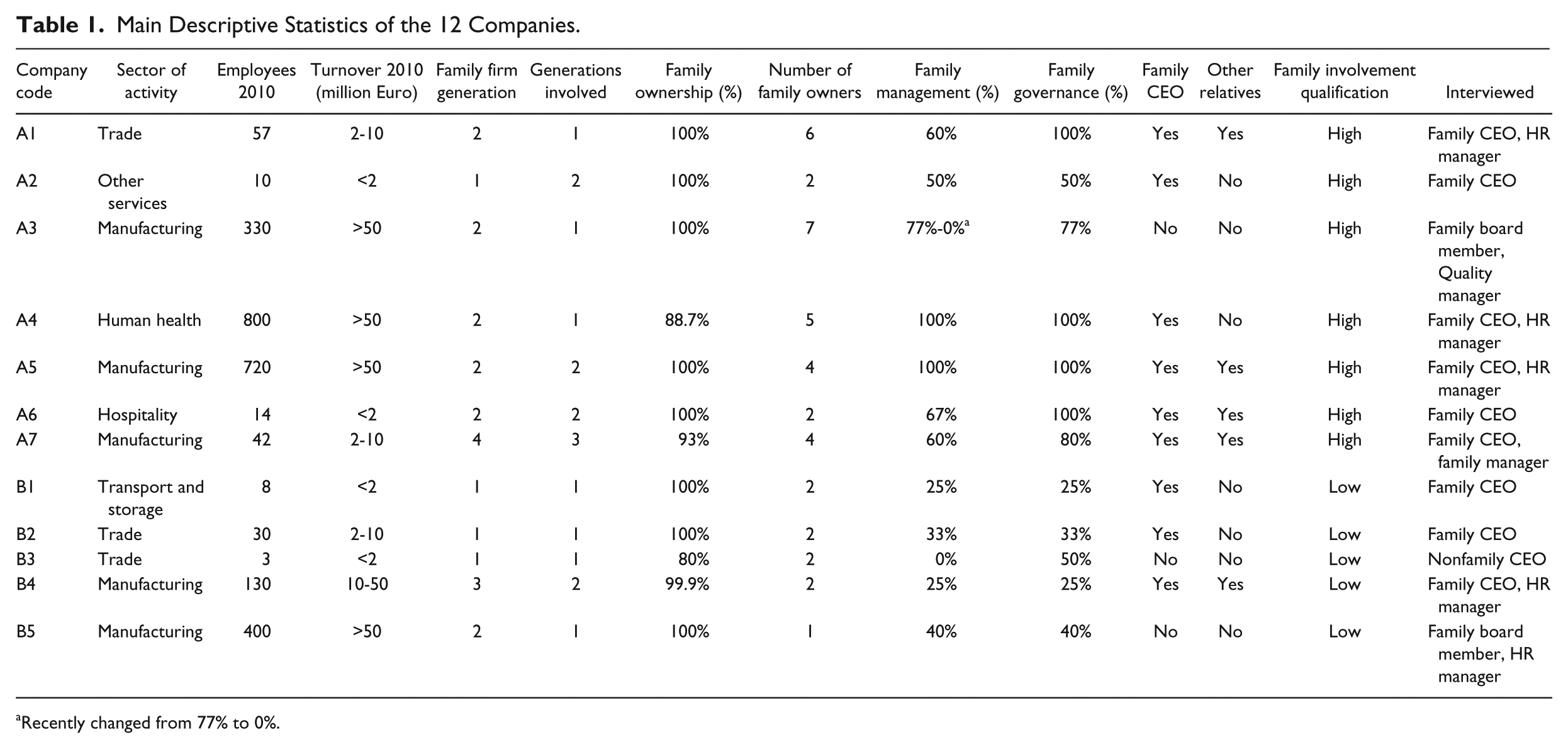
Recently changed from 77% to 0%.
Thus, family involvement could vary from a single family member participating in the company, in the position of a CEO, for example, to all members participating, either in governance, management, or among employees. All these dimensions of participation were summarized qualitatively to classify companies into two groups of family participation: high family involvement (Group A) and low family involvement (Group B). This grouping is created for theoretical reasons and to simplify the analysis of results. The high involvement family firms have at least 50% of family members within governance and management, and mostly have a family CEO and some other relatives are employees. They also tend to have more of different generations involved. The other companies, with less proportion of family members in governance, management, or as employees, are classified as low family involvement firms.
Regarding validity and reliability, the present study meets the requirements of internal validity (Gibbert & Ruigrok, 2010) by using three types of strategy: first, we base the research on existing literature and theories; second, we use pattern matching (Eisenhardt, 1989); and third, we use theory triangulation (Yin, 1994). Construct validity is pursued with different triangulations in the data collection, combining interview transcripts, direct observation, and the analysis of the secondary data. To pursue external validity, or “analytical generalizability” (Eisenhardt, 1989), we build on a considerable number of cases and we report the sample characteristics extensively. To ensure reliability, we use some of the widely accepted methods (Gibbert & Ruigrok, 2010), such as digitally recorded interviews and transcription.
Results
The research question of this study is about the patterns of CSR engagement within family firms in terms of values. To present the results we proceed first to identify the values underlying CSR and second, to assess the CSR level and scope.
As most of the theory predicted, more family involvement in the family firm is found to be associated to more CSR engagement, as will be described later. The results are presented with firms divided into two groups of different family involvement, and this also facilitates the synthesis of results. The first group includes the 7 cases with high family involvement, numbered from A1 to A7. The second group has 5 cases with low family involvement, with codes B1 to B5. The main descriptive data of these companies are presented in Table 1, together with the details of family involvement.
Values Underlying the CSR Discourse
As described in the section on the theoretical background, the main values identified in the literature are identification, altruism, collectivism, commitment, perpetuation, and obligation. With regard to family involvement, the results indicate that identification and commitment are more frequent in the discourse of family firms with high family involvement (the most relevant quotations are presented in the appendix). Actually we found that interviewees referred to identification and commitment in only one of the five low involvement family firms. Identification is sometimes strictly personal for the family CEO: “In the current situation, I need to lead the quest for sustaining sales. . . . The family firm is part of my life” (A1), or it is sometimes more collective: “In the website, you can see a picture of the family members involved in the company. Three generations!” (A7).
All the discourse on identification is directly connected with the SEW approach, because identification is one of its dimensions, but also there is a frequent reference to the founder’s legacy, especially in the high-involvement family firms, such as: “The search for excellence is a must for us. It was already stated in the founder’s values. I mean that it is a true belief, associated to our own values and from these grounds we deploy our action; we seek to progress and grow in these values” (A3), “My father has taught me . . .” (A5), “The company has always been sensitive to CSR. It has been an engine for the company, since the founder’s times” (B5). The importance of family ownership and control is sometimes visible: “Buying the remaining part of the company was a family decision . . .” (A4).
With regard to the value of commitment, respondents point to higher ambitions for CSR: “We are revising our strategy and CSR will become most important” (A1), “There is a commitment to excellence . . .” (A3), “. . . we want to sustain a high level of CSR, but we need to formalize our policies” (B5). The commitment very frequently refers to the employees: “We have a main commitment with our team, they are like a family” (A6), “We have committed to improve the welfare of employees . . .” (A7). It is thus giving importance to the internal binding social ties, that the SEW approach considers. The family commitment is also highlighted: “The family feels committed to CSR and satisfied with what we achieve” (A3); “. . . people know the family. So they make suggestions to them; actions where the company can collaborate” (A5). The value of commitment was only found in one of the low involvement family firms (see the appendix).
Altruism is present in their discourse on CSR in both groups and it tends to transcend the firm’s boundaries and refer to society: “Some of our CSR actions aim at contributing to the economy . . .” (B5), “But what we are certain is that with social issues and society, I can assure you that we will continue with CSR in the future” (A4), “The goal of CSR is social benefit . . .” (A5), “We consider that firms have a very important social role . . .” (B1). All companies refer to the binding social ties they have with society: “. . . we want to build networks” (A6); “. . . the company has to be very involved with society . . .” (B2) and use a discourse of “good citizenship” as the stewardship perspective considers.
Collectivism basically refers to employees and managers, that is, to internal stakeholders: “The most important asset for a firm is its human capital. We look for the participation and well-being of our employees because loyalty is a key element” (A1), “The first motivation for CSR is that we are a team and have to be long hours together; this is why it is important that we feel good together” (A6). Furthermore, collectivism is associated with the success of CSR or other strategies: “. . . we need to go all in the same direction . . . otherwise CSR actions are not satisfactory” (B4), “CSR actions need to be coordinated . . . CSR is managed as a global issue, involving many departments” (A3), “An important lesson is that cooperation is very good, not only inside the company but along the supply chain” (B3).
Perpetuation is underlying the discourse on CSR in reference to firm survival, with different degrees of importance: “CSR in the future will be important but it probably won’t be crucial for survival” (A5), “(CSR) . . . is useful for the future, because we need strategies and tools that improve management” (A7), “I do believe that in the future only companies that go a step further in CSR will socially survive” (B1). This concern for firm survival is in accordance with the SEW perspective with the intention of respondents to survive as a family firm and to continue the legacy (“After the death of the founder, the company starts a new stage . . . combining the essence and tradition of the family firm with the vocation to be a large company . . .”, B5) and the importance of external binding social ties (“The lesson learnt with CSR is that it helps us create links with people . . .”, A6; “We’re investing in value added based on this responsibility . . . and in the short run we gain trust from our customers,” B2).
The values where external stakeholders are more involved are altruism, as we have mentioned before, with reference to society as a beneficiary of CSR, and obligation. Family firms with both low and high involvement express their concern and adaptation to the current economic situation and reveal their sense of obligation for their actions: “In the current crisis I believe that we are changing our minds and human aspects become even more important; values are more important and CSR becomes more highly considered” (A5), “We could consider offshoring but we want to contribute to our region” (A7); “CSR is facilitated by the current firm and social environment . . . firms must be responsive to this” (B3). All these references can be considered binding social ties with internal and external stakeholders under the SEW approach.
Obligation is also expressed as an upgraded self-demand such as: “Often when I think about CSR I think about ethics; it is a principle for us. So anything against ethics isn’t allowed” (A4), “We are very strict with recycling . . . we promote an environmentally respectful culture” (B4); “CSR is a self-demand for us; it was already in the founder’s principles . . .” (A3). In the latter case, there is again a reference to the founder’s legacy.
On the whole, the discourse of respondents reveals references to the values derived from the stewardship theory and also found underlying the SEW approach. This confirms the association of CSR with the system of values proposed. The collection of quotations reveals that there is a different profile for the high involvement family firms compared with the low involvement family firms. As stewardship theory predicts, family firms with higher family involvement have a stronger sense of identification, commitment, and a wider sense of obligation, in terms of making more references to these values than family firms with low family involvement (see the appendix). For the other values, namely, altruism, collectivism, and perpetuation, there are no clear differences, since references to these values are common for both high and low involvement family firms.
The aspects related to the SEW approach that occurred most frequently in the quotations selected are identification, which was considered one of the values, followed by binding social ties, both with internal and external stakeholders, and the importance of the founder’s legacy (see Table 2). There are also some less frequent references to the importance of family ownership and control, and to dynastic succession. The least explicit dimension from the FIBER dimensions (Berrone et al., 2012) is the emotional attachment of family members, which is not captured in the transcriptions of interviews. However, we were able to observe the emotional attachment, mainly through nonverbal expression and communication off-the-record. The emotional and affective considerations are present, but not referring to the family links but to the firm, especially in those quotations that were classified under the value of “identification,” where family CEOs expressed their emotional attachment to the firm. There was also an affective charge in the references to employees, sometimes considered “like a family.” Furthermore, many interviewees conveyed the obligation of their firms toward society, with the references to the current economic situation in the country—Spain—and the emotional bonds with their local communities.
Socioemotional Factors.

The stock of affect-related value that respondents derive from the family firm (Gomez-Mejia et al., 2007) seems to be related in their CSR discourse to their controlling position in relation to the welfare of some stakeholders, whether employees or society, the main cited beneficiaries. The attachment to the family firm is quite visible in the strong identification, especially in the case of the high family involvement group. The role of family tradition (Sharma & Irving, 2005; Zellweger, Sieger, & Halter, 2011) is mainly visible through the references to the founders’ legacy, often by means of the wish to preserve the founder’s values. Table 2 presents the main SEW-related references made by respondents and indicates the larger presence of these SEW references for the high involvement family firms.
CSR Level and Scope
The level and types of CSR actions carried out by the family firms were categorized by means of a detailed questionnaire covering the relevant aspects of CSR. The results of this evaluation are summarized in Table 3. The main conclusion is that family firms with high family involvement tend to have a higher level of CSR performance on most of the variables and have a more proactive attitude toward CSR. In particular, they are more likely to have a person responsible for CSR, they carry out more formal evaluations of their CSR policy, and they have a higher number of different CSR actions in place. Furthermore, they give a higher priority to CSR in comparison with other present challenges of the company and they have used support—consultancy or tools—to engage in CSR. They perceive that CSR enablers and barriers are basically internal, such as lack of time, human resources or budget, and therefore actionable. In contrast, family firms with low involvement pointed more to external enablers and barriers, such as the presence or absence of public support or incentives for CSR, or competitive pressures. With regard to risks, risks to CSR engagement are perceived in fewer cases of the high family involvement group. All these positive characteristics for an increased engagement in CSR are shown in Table 3. More cases carry out CSR for internal reasons—shareholders’ or managers’ preferences—than for external reasons—for example, customer demands. With regard to the objective of CSR, high family involvement family firms present more cases where goals are both internal—firm benefit reasons—and external—for the benefit of the community, society, or the environment.
Descriptions of CSR a .

Grey-shaded cells indicate higher levels of CSR engagement.
The scope of CSR for each of the cases studied is assessed by analyzing the quantity and depth of the CSR actions cited by each of the companies. As mentioned before, four dimensions of CSR scope were defined according to the EU Competitiveness Report (EU, 2009): workplace, marketplace, environmental, and community CSR. The results are also presented in Table 3. The four last columns indicate the ranking of the strength of each type of CSR within each family firm, 1 being the best performing area, and allowing for tied values if CSR areas were addressed in approximately similar depths. The first conclusion is that workplace CSR is the most widely mentioned area in almost all family firms, followed by community CSR. The least developed area is marketplace CSR. Environmental CSR has a medium level of intensity, between community and marketplace.
The reasons why family firms prioritize workplace CSR are seen in many references to employees (more than 12 direct mentions in the selected quotations presented in the appendix) as human capital, critical assets, team, collaborators, or family. It can be said that family firms believe that employees are essential for their firm. Actually, during interviews, workplace CSR was generally the first type of CSR that interviewees chose to address. The importance of employees is also coherent with the stewardship view.
The importance of community-related CSR (with 10 quotations containing the words society or social and many others meaning it) is also coherent with their values. Many companies referred to society when they were using altruistic sentences, or making reference to their commitment or sense of obligation. Furthermore, some companies mentioned that community CSR accorded with proposals or preferences of employees, not only of family owners or managers. This means that community CSR is an indirect tool for increasing employee satisfaction. The low importance attached to marketplace CSR is coherent with the small number of references to customers (only six) or to the supply chain (only two) in the CSR discourse of most family firms.
Discussion
Family Involvement and Values
The analysis of values underlying the discourse of family firms reveals that the different values have a different prevalence. The most easily found values were altruism and collectivism in general. Furthermore, and more interestingly, the results reveal the association of a higher family involvement with some of the values—and not others: it is the case that identification and commitment are easily found in the high involvement family firms and difficult to identify in the low involvement group. Also, these values—identification and commitment—are more connected with references to the family, verbalizing the identification and commitment of the family with the family firm. The more intense association of family involvement to identification and commitment reveals a possible mediating role of these two values, in the sense that it is not directly family involvement that produces more CSR, but it is the existence of a high level of identification and commitment that increases CSR engagement. This is accordance with the reasoning of previous research on CSR within family firms (e.g., Bingham et al., 2011; Déniz-Déniz & Cabrera-Suárez, 2005). The novelty of our approach is that it directly assesses the relevance of identification and commitment in relation to CSR. An implication of this finding is that the values of identification and commitment should therefore be considered as a relevant source of heterogeneity among family firms to explain different CSR performance, and might also be explanatory for other types of performance.
Family Involvement and CSR
As most of the literature has found, our results indicate that family involvement is associated with more CSR engagement (e.g., Wiklund, 2006). Also, family involvement appears to have an effect on having a more balanced investment in CSR, in the sense of having more similar intensities for all types of CSR. The interpretation of the influence of family involvement on CSR engagement can be achieved through different lenses. Stewardship theory argues that family involvement creates better psychological and situational factors to promote a pro-CSR stewardship behavior. Based on the SEW approach, we could argue that higher family involvement leads to higher SEW concerns and more loss-aversion behavior, that eventually promotes CSR—to avoid losses in SEW because of not attending to the demands of stakeholders. We could also use the lens of the stakeholder salience approach (Mitchell et al., 2011): in high family involvement companies the dominant logic is more clearly that of the family, since more family members are involved in the company, and this simplifies the prioritization of stakeholder demands. This in turn makes decision making easier (Déniz-Déniz & Cabrera-Suárez, 2005) and hence family firms with high family involvement can be more effective in CSR action.
With regard to altruistic views, our results indicate that there is a continuum of interpretations, spreading from the real “altruistic view” of giving to others without expected return, to considering that altruism is satisfying all stakeholders, including society. We also often encountered the reasoning in interviews that CSR eventually pays back, and, therefore, would not be truly altruistic. Therefore, our results are partly in accordance with the arguments against altruistic motives (e.g., Schulze et al., 2001), except that the self-interest of family CEOs is not their personal satisfaction or the satisfaction of the family, but firm survival. Thus, they can be considered stewards of their family firms. This motive contradicts or at least moderates the arguments that would predict a lower social performance of family firms (McGuire, Sundgren, & Schneeweis, 1988).
The discourse of the high family involvement companies relates to firm sustainability, such as: “socially survive,” “results in the long run,” “crucial for survival,” “long life for the firm,” “promising future.” We argue that firm sustainability is for them a means to family satisfaction and sustainability. This can be read in terms of the SEW approach (e.g., Gomez-Mejia et al., 2007), in the sense that preserving the firm is a way to preserve the status of the family firm, and ultimately satisfy the family as a collective and as individual members. These findings are thus quite in accordance with the proposals of authors who emphasize the long-term perspective of family firms and their desire to perpetuate their firm for future generations (Hoffman, Hoelscher, & Sorenson, 2006). The value of perpetuation is crucial to the move from self-interest to long-run sustainability for all stakeholders.
Family Involvement and Socioemotional Factors
The SEW approach shares common ground with the values underlying the stewardship view as explored in the theoretical section, but more importantly it introduces the role of socioemotional factors in decision making. The analysis of the discourse of interviewees revealed all the dimensions of the SEW approach (e.g., Berrone et al., 2012) with different levels of intensity. The most prominent were identification and binding social ties. Again the group of high family involvement companies presented clearer and more frequent references to socioemotional factors as visualized in Table 2. This indicates the need to consider family involvement in terms of family participation in the family firm, and not simply family ownership, in the application of the SEW principles.
Our results are partly aligned with the propositions of Cennamo et al. (2012), particularly, the importance of identification, emotional attachment, and binding social ties is highly associated to workplace and community CSR, but for different reasons. The underlying motivation for workplace CSR is more instrumental than normative, in the sense that employees are considered crucial collaborators within the family firms. Community CSR is due to normative motives, which can be found in the discourse associated with altruism and obligation, with many references to doing good to society. These normative motives also satisfy other external stakeholders such as customers and the environment. Our results find a low presence of the dimension of family ownership and control and thus we do not find evidence of its effect on internal stakeholders as proposed by Cennamo et al. (2012).
Answering a question raised within the SEW approach, the operationalization of the SEW dimensions and the possible overlap between them (Berrone et al., 2012), we find that emotional attachment in our research was embedded in identification and binding social ties, which are proposed as different dimensions of SEW. With a significant emotional attachment, we find a relevant influence of the founder’s legacy, in the discourse of identification and commitment. Previous studies have underlined the importance of the founder (e.g., Bingham et al., 2011) who is supposed to be a trigger of higher CSR engagement. But contrary to this, we do not find the founders engage more in CSR, what we find is that the founder’s legacy is present for subsequent generations.
Preferred CSR Scopes
The scope of CSR has also been analyzed and shows the importance of workplace CSR, which is consistent with the importance of employees in the discourse of interviewees. The second most active field of CSR is community-related CSR, which is consistent with references to society made by the managers interviewed. Thus, family firms seem to prefer people-related CSR, either internal—workplace CSR—or external—community CSR. Thus, apart from the good reputation that companies expect from community CSR, managers indicated that it was an indirect way to increase the satisfaction of employees; part of the community CSR was chosen according to the requests of employees.
Environmental CSR is the third type in importance. The CSR least frequently mentioned by managers and least often producing actions is marketplace CSR. We suggest a few reasons why marketplace CSR is less apparent. The first is that voluntary actions that benefit customers are not considered to be CSR but marketing. This was explicitly stated by some of the family managers, who said that there was not a clear delimitation. Second, marketplace CSR can be considered as additional value delivered to the customer. And the last reason is that family firms tend to collaborate with customers and suppliers and build trust and networks with them, probably more than nonfamily firms, as the stewardship and SEW approaches would also predict, and this collaboration might not be considered to be CSR. The use of informal collaboration could also reduce the need for formal marketplace CSR policies.
The relevance of considering the scope of CSR is to illustrate that a different pattern of values is more connected to some types of CSR than to others, and that family firms might be more likely to outperform nonfamily firms on some CSR dimensions, but not on others. This should be considered when attempting to reconcile conflicting evidence from past studies and when designing future research.
Conclusions
This study addresses the question of the heterogeneity of family firms in CSR engagement in terms of values, based on the theories of stewardship and SEW. We have reviewed the main contributions of research into family business and CSR and explained the interest and need for further research on the heterogeneity of family firms. We have empirically explored the prevalence of values, their connection with family involvement and socioemotional factors, and how and why this is related to the engagement and scope of CSR. We have discussed our results in view of the existing theoretical approaches, with the intention of advancing the integration of different views.
The main findings regarding values are that all the expected values are found in the discourse of family CEOs, but more frequently in the high family involvement family firms. This comment is particularly true for two values—identification and commitment—that are almost exclusively present in the high involvement family firms. We also find that values may have different areas of application or concern. For example, most values are defined at the firm level, and particularly refer to employees. This may explain the salience of workplace CSR. On the whole, we find a general preference for the “social” types of CSR, namely, workplace and community CSR, and we describe and analyze the complex consideration of marketplace CSR.
Implications for Practice
This article identifies the connection between family involvement and CSR engagement by means of the values that the family transfers to the family firm. For example, we find that higher family involvement entails higher presence of identification and commitment, which in turn are drivers of a higher CSR engagement. This means that managing CSR necessitates or is facilitated by the presence of these values that are in turn the consequence of family involvement. This underlines the importance of deciding and managing the role of family members in ownership, governance, management, and staff. Extending this reasoning beyond CSR, to other strategic decisions that imply a firm culture based on some specific values, this research points to the need for close involvement of the family in bringing the desired values into management. Values are part of the culture of the organization and any cultural change will probably be based on value changes, which in the case of a family firm are conditioned by the values of the owning family. Families should also search for coherence in the values that they wish to promote in the firm and alignment with the values that they live in their families. This is also relevant for advisors of family firms.
Altogether, the main practical implication of this research for the management of family firms is in visualizing how family involvement—not only in terms of ownership but also in terms of actual participation—is the way to transfer family values to the firm, and in this way to reinforce the possible virtues of family firm specific behavior that can lead to superior practices and performance. This research aimed to explore these mechanisms in relation to CSR practices.
This research reveals the perceived association of CSR with firm survival and that managers perceive that some types of CSR contribute very directly to better results. The best example is workplace CSR, which is found to be useful—instrumental—for better performance. But it also reveals indirect positive effects of other types of CSR, such as the community-related CSR, which seemed rather normative at first but was also considered to have a positive impact on internal stakeholders, especially employees. For example, funding social or charitable activities at the local level or according to the wishes of employees is a source of additional satisfaction and intrinsic motivation for employees. This illustrates the positive externalities of the different types of CSR practices—workplace, marketplace, environment, and society—although family firms show a preference for the social types of CSR, both internal—workplace—and external—community. This preference is legitimate and can also be part of the idiosyncrasy of family firms.
Limitations and Further Research
The main limitation of this study is the difficulty in generalizing the empirical findings gathered, because of the regional limitation of the case studies and the lack of representativeness of the sample. Nevertheless, the qualitative methodology used was meant to reveal new theoretical relationships that had previously been unexplored. The study has aimed to be rigorous and take advantage of the deep level of information available from case studies, which makes it possible to explore in detail how family firms understand and behave regarding CSR.
There is a possible bias in the sample selection because all family firms had agreed to participate in a CSR project. We could, therefore, expect participants to be quite positive toward CSR. However, some firms agreed to participate even though they were unsure of their CSR level. Also, the empirical assessment of the level of CSR revealed that some companies that were supposed to be deeply engaged were not so much, and others who were not strategically developing CSR had plentiful and committed CSR practices. This situation reduced our concerns about selection bias.
Although this study did effectively sow the links between family involvement with values and values with CSR outcomes, we realized that there was an issue on the scope of values, in the sense that managers understand each value in their own way, and apply them to specific areas. For example, if we take the value of altruism, if it is understood only within the context of the family it is very different from understanding it in a context that extends beyond the family (Eddleston & Kellermans, 2007), meaning that altruism can be directed toward the firm, and is even more different if it transcends the firm. This shows that values can be understood, and then applied, at different levels. This could have an effect on CSR practices, and possibly on other decisions, and should guide further research.
Stewardship theory argues that the model of man they propose is essentially similar to the one proposed by Argyris (1973), a self-actualizing man, in the sense that “humans have a need to grow beyond the current state and reach higher levels of achievement.” To observe this change, we would need a dynamic analysis of the preferences of family firm managers, but this is beyond the scope of this article. Based on the empirical results, we have the impression that CSR engagement increases as the family firm, or the entrepreneur (founder), matures. The entrepreneur can then implement his or her preferences and include more social and altruistic concerns as the firm develops successfully. This is in line with our findings that CSR engagement is generally lower for family firms in their first generation and higher in family firms of second and subsequent generations. We suspect that a study of the changing preferences of family firm managers or owners over time could be made adopting the life-cycle approach to individuals, or possibly to firms as well, but this is a subject for future research.
Originality and Contribution
The originality of this study is that it analyzes a set of values grounded in theory, the related socioemotional factors, and their relationship with CSR engagement and scope (multiple areas of CSR), which means discriminating among the different types of stakeholders. The main theoretical contribution is linking two theoretical approaches—stewardship and SEW—through the derivation of a common set of values. This raises the question of the relationship between these two approaches, whether they are complementary or contrasting theories, or whether there is a continuum between stewardship at one end and SEW at the other extreme. SEW concerns the nature of likely preferences of family members, identifying the stock of affect-related value that family derives from its position in the family firm as an important—social and emotional—value that the family obtains. Stewardship, in turn, is also concerned about the rationality of preferences, but basically focuses on the managers of firms, the possible “agents” that may prefer to be “stewards.” Stewardship preferences are explained by different psychological and situational factors, which are more likely to happen in family firms but that could occur in other firms also. These two factors share similarities with some of the FIBER dimensions of SEW. Both approaches thus explain preferences based on similar logics, but stewardship is more directed to managers and SEW is more concerned with the family in general, and derived from their ownership position. Furthermore, SEW has been specifically defined for family firms and its behavioral grounding goes a step further in causality, identifying the framing or perceived context for decisions—as gains or losses in SEW—as the ultimate reason for the particularistic behavior of family firms, explaining the preference for SEW preservation over economic maximization. We could say that when the SEW preservation preferences dominate in the family, we should expect family managers to behave more as stewards protecting family SEW. In summary, and with respect to the use of both stewardship and SEW in this article, the derivation of a common set of values for both theories underlines the compatibility and complementarity of the pair of theoretical foundations.
The empirical contribution of this study is the examination of all values together and directly. With regard to CSR, considering its scope is also quite original, especially taking into account both concerns about stakeholders and preferences revealed by managers gathered by means of interviews. This was linked with actual actions executed, assessed by means of a CSR questionnaire. The exploration of the socioemotional factors and their connection with other constructs such as values is also new in the literature. On the whole, and from a wider perspective, this study contributes to an explanation of how and why family firms are heterogeneous, especially in the field of CSR.
Footnotes
Appendix
Quotations From Firms
| Identification | Altruism | Collectivism | Commitment | Perpetuation | Obligation | |
|---|---|---|---|---|---|---|
| Definition | The definition of managers in terms of their membership in the organization, by accepting the organization’s mission, vision, and objectives (Davis et al., 1997) | The degree of unselfish concern and devotion to others without expected return to oneself (Corbetta & Salvato, 2004) | The subordination of personal goals to the goals of the collective (Triandis, 1995); the self is defined as part of the group (Davis et al., 1997) | The willingness to do the best for the owning family and the family business (Miller & Le Breton-Miller, 2006) | The wish of FFs to succeed over generations (Lansberg, 1999; Ward, 2004) | The feeling of responsibility and burden sharing for the organization (Eddleston & Kellermans, 2007) |
| Codes (keywords and meanings) | Acceptance of mission/vision/objectives; own definition as FB members; self-attribution of FB success or failure; sense of belonging; FB pride; FB personal meaning | Unselfish or spontaneous cooperation; citizenship behavior; dedication to others; self-interest (antonym) | Subordination of personal goals; FB goals; organizational focus/priority; benefit of the group/FB; collective; common good; stakeholder cooperation; participation; cooperation | Do the best for the family/FB; desire to remain in the organization; desire of firm success/performance; commitment | Family/FB survival; generations; legacy; long-term wealth/performance/sustainability; preservation of family control and ownership | Being answerable/accountable/responsible/responsive/respectful; responsible/long-term/enduring/trustful behavior with the FB/stakeholders |
| A1 | In the current situation, I need to lead the quest for sustaining sales . . . the FB is part of my life (A1, family CEO) | We have internal and external CSR . . . some for marketing reasons and some for generosity. . . . With our customers we also carry out a campaign about environmentally friendly working processes (A1, family CEO) | The most important asset for a firm is its human capital. We look for the participation and well-being of our employees because loyalty is a key element (A1, family CEO) | We are continuously revising our strategy and CSR will become most important . . . it is one of the keys for survival (A1, family CEO) | We have a history of more than 60 years of service to professionals, adapting to the needs or the market. This has been our goal: offering quality products and services to our customers with our long experience (A1, website) | Our goal is to offer a professional service to our customers, with the service guarantee that provides our experience (A1, family CEO) |
| A2 | The main motivation for CSR is to prepare for the future, to protect our staff, to save resource, and to improve the environment (A2, family CEO) | It is important to work on a network basis with suppliers or customers and exchanging information and learning (A2, family CEO) | ||||
| A3 | The search for excellence is a must for us. It was already stated in the founder’s values. I mean that it is a true belief, associated to our own values and from these grounds we deploy our action, we seek to progress and grow in these values (A3, family board member) | (CSR) . . . Is another firm value, an intrinsic value. . . . It provides welfare to society (A3, family CEO) | The CSR actions need to be coordinated. . . . CSR is managed as a global issue, involving many departments. (A3, family board member) | The family feels committed to CSR and satisfied with what we achieve. . . . . There is a commitment with excellence, in all dimensions. It is a strategic goal for the company (A3, family CEO) | CSR is a self-demand for us. . . . We are currently developing a new machine, very environmentally friendly . . . it is a proof of our respect with the environment and our direction. Sustainability is key to all our products . . . we care a lot about emissions, how can we reduce them (A3, family board member) | |
| A4 | Buying the remaining part of the company was a family decision. It was not my father who decided; my brothers and myself decided we wanted to be fully involved in the company (A4, family CEO) | We are not sure whether we will continue the same level of CSR actions that do not produce a return for us . . . but what we are certain is that with social issues and society, I can assure that we will continue with CSR in the future (A4, family CEO) | This year we have gone a step further in looking for the engagement of our personnel in CSR (A4, family CEO) | We want to consolidate as an ethical business, of course, sustainable in the sense of causing no damage to society and ultimately achieving success . . . it’s the belief of owners (the family) and managers (A4, family CEO) | Many times when I think about CSR I think about ethics; it is a principle for us. So anything against ethics is not allowed. This is very important in our HR practices (A4, family CEO) | |
| A5 | My father has taught me that our sales and profits are thanks to our customers . . . they must be my priority (A5, family CEO) | The goal of CSR is social benefit and also that this helps our company to be present and to be known in an informal or indirect way (A5, family CEO) | We plan to formalize more CSR to become more visible and strategic. This means increasing integration and cooperation (A5, family CEO) | Our company is well known by the local community and people know the family. So they make suggestions to them; actions where the company can collaborate. Then we decide whether we do it or not. Many CSR actions come from this channel . . . because people know someone from the family (A5, family CEO) | CSR in the future will be important but it won’t probably be crucial for survival (A5, family CEO) | In the current crisis I believe that we are changing our minds and human aspects become even more important; values are more important and CSR becomes more highly considered (A5, family CEO) |
| A6 | I don’t see any risks to the CSR policies. . . . I believe that they are very reasonable and sensible (A6, family CEO) | We wish to increase the consumption of local products, to contribute to the local economy, to our country; we want to build networks (A6, family CEO) | The first motivation for CSR is that we are a team and have to be long hours together; this is why it is important that we feel good together (A6, family CEO) | We have a main commitment with our team, they are like a family (A6, family CEO) | The lesson learned with CSR is that it helps us create links with people and this is useful for business survival (A6, family CEO) | |
| A7 | In the website, you can see a picture of the family members involved in the company. Three generations! (A7, family CEO) | Business success is dependent on the cohesion existing in the firm . . . we must all row in the same direction (A7, family CEO) | We have committed to improve the welfare of employees. We plan to introduce a new machine and a lightening system which improves working conditions and ergonomics (A7, family CEO) | (CSR) . . . is useful for the future, because we need strategies and tools that improve management. And we have all to collaborate to achieve a long life for the business, with the support of new tools available (A7, family CEO) | We could consider offshoring but we want to contribute to our region. We want to be true with our country (A7, family CEO) | |
| B1 | We consider that businesses have a very important social role . . . it creates jobs, provides services and pays taxes. . . . Despite the difficult business situation . . . we have continued our support to the Food Bank (B1, family CEO) | I do believe that in the future only companies that go a step further in CSR will socially survive (B1, family CEO) | ||||
| B2 | I think that the company has to be very involved with society; it should have a good reputation from society (B2, family CEO) | All of us adds value to the company; even the people at calling centers . . . maybe sales people have a more complicated job . . . we need to stay together (B2, family CEO) | We’re investing in value added based on this responsibility, and this is bringing results in the long run and in the short run we gain trust from our customers (B2, family CEO) | We invest in value added based on this responsibility; we get results in the long run. . . . Nowadays it is the duty of the entrepreneur to gain the trust of people. If you are responsible, people will see you as responsible. . . . I think that the business has to be engaged with society (B2, family CEO) | ||
| B3 | An important lesson is that cooperation is very good, not only inside the company but along the supply chain (B3, nonfamily CEO) | CSR is facilitated by the current business and social environment . . . firms must be responsive to this (B3, nonfamily CEO) | ||||
| B4 | Our company has supported the participation of two teams in this year’s Oxfam Trailwalker . . . in this way we support this NGO, which contributes to cooperation, humanitarian action, and fair trade (B4, website) | Changes are difficult and coherency is important . . . we need to go all in the same direction . . . otherwise CSR actions are not satisfactory (B4, family CEO) | We are very strict with recycling . . . we promote an environmentally respectful culture (B4, family CEO) | |||
| B5 | The company has always been sensitive to CSR. It has been an engine for the company, since the founder’s times. We continue with this sensitivity and with these values (B5, family board member) | Some of our CSR actions aim at contributing to the economy and preserve or create new jobs (B5, family board member) | We must ensure that people get involved in the projects of the firm. This is accomplished by having meetings, explaining why or why not we do things. . . . It is essential to promote communication, involvement, and participation of everyone (B5, family board member) | We can say that we want to sustain a high level of CSR but we need to formalize our policies. I believe that this is important for success (B5, family board member) | After the death of the founder, the company starts a new stage with the new generation . . . combining the essence and tradition of the family business with a vocation to be a large company . . . with a professional management . . . we see a promising future with the goals of quality, health, and the respect to the environment (B5, website) |

Declaration of Conflicting Interests
The author(s) declared no potential conflicts of interest with respect to the research, authorship, and/or publication of this article.
Funding
The author(s) disclosed receipt of the following financial support for the research, authorship, and/or publication of this article: (a) Spanish Ministry of Science and Innovation ECO2010-21242-C03-02 Research Funding (Pilar Marques); (b) Spanish Ministry of Science and Innovation Research aid program for the Formation of University Researchers (FPU) (Alexandra Simon); (c) Autonomous Government of Catalonia 2009 SGR 577 Research Funding (Pilar Marques, Alexandra Simon).
Author Biographies
References
Supplementary Material
Please find the following supplemental material available below.
For Open Access articles published under a Creative Commons License, all supplemental material carries the same license as the article it is associated with.
For non-Open Access articles published, all supplemental material carries a non-exclusive license, and permission requests for re-use of supplemental material or any part of supplemental material shall be sent directly to the copyright owner as specified in the copyright notice associated with the article.
