




Abstract
In this study, we identified and analyzed 75 articles in the family business (FB) literature between 2000 and 2014 as to the case study design they adopted. We found that the positivistic case study approach is the FB disciplinary convention. The two alternative approaches of critical realism and interpretivism are used to a significantly lesser extent. We anticipate that in the future the positivistic approach will continue to be used widely. The other two approaches can be employed to a higher extent since their use is likely to contribute to a scientific pluralism in FB case study research.
Keywords
Introduction
Case study has emerged as a prominent methodological approach for qualitative researchers interested in family business (FB). FB is a diverse area that may involve multiple theoretical lenses and levels of analysis, and this variety should be mirrored in the ways in which case study is employed (De Massis & Kotlar, 2014). However, very few FB articles have given attention to research methodologies and their appropriateness for different objectives and research settings (Nordqvist, Hall, & Melin, 2009). In seeking to develop knowledge and theory in FB research, we see it as important to have greater reflection on methodological choices, with a particular focus on the case study. Thus, the research questions posed for the present study were the following: (a) How has the case study been practiced in FB as a discipline up to now? (b) How could case study methodology be applied in the future? We emphasize case study research on the grounds that this methodology may provide the contextualization for important processual FB phenomena (e.g., how family involvement affects employee motivation).
To examine the practice of qualitative FB case studies, we undertook an in-depth qualitative content analysis of 75 qualitative FB case studies published between 2000 and 2014 in high-quality academic journals. We took the term case study to refer to qualitative research which “examines, through the use of a variety of data sources, a phenomenon in its naturalistic context, with the purpose of ‘confronting’ theory with the empirical world” (Piekkari, Welch, & Paavilainen, 2009, p. 569). Following customary research practice (Dubois & Gadde, 2002; Piekkari, Plakoyiannaki, & Welch, 2010; Welch, Piekkari, Plakoyiannaki, & Paavilainen-Mäntymäki, 2011; Yang, Wang, & Su, 2006), we used empirical methods to examine the use of case studies in the FB discipline. Our design included iterations between the existing methodological literature and a data set of published case studies.
Our findings suggest that most studies (n = 67) in the identified data set followed qualitative positivism, and very few (n = 8) interpretivism or critical realism. We acknowledge the prominence of positivistic approach, which draws on established theoretical assumptions and aims to answer specific sets of research questions. We nonetheless suggest that a more extensive application of interpretive and critical realist case study designs could encourage a plurality of case study approaches, and work against an overrestrictive perspective (Orlikowski & Baroudi, 1991). It may be that interpretative and critical realist designs would permit greater sensitivity to individual voices (e.g., those of family owners) and their contexts (e.g., FB organizational idiosyncrasies) within the FB literature. We argue that such alternative orientations, in conjunction with the positivistic approach, could allow researchers to capture more of the dynamics and complexities of FBs, and make qualitative case studies more applicable to FB theorizing (Dawson & Hjorth, 2012; Nordqvist et al., 2009).
The current article contributes to the FB field in a twofold manner. First of all, we identify, analyze and discuss case study practices in existing FB research, including their various philosophical orientations, and develop a stock of knowledge that could be used by qualitative researchers in the future. Second, while we recognize the importance of positivistic case designs, we point out the relevance of interpretivism and critical realism, seeing these as having the potential to enrich the discipline via deep and comprehensive theorizing on specific FB phenomena.
The current article is organized as follows: We begin by outlining some key concepts of the philosophy of science, which may facilitate the comprehension and flow of ideas in the article. In this same section, we present the dominant positivistic view of case study research in FB, which we complement with the two main alternative perspectives. A description of our analytic approach follows. Thereafter, we present our findings according to the three case study categories identified. We conclude by discussing the key findings and implications for FB case study researchers.
The Case Study Under Different Philosophical Assumptions
There are three case study approaches in FB research, namely “positivistic” (“qualitative positivist”), “interpretivist,” and “critical realist” types of research. These types reflect different philosophical assumptions regarding the nature of social reality and what it means to be human (ontology), and the nature and purpose of knowledge (epistemology; Järvensivu & Törnroos, 2010; Welch et al., 2011). The philosophical assumptions give rise to different paradigms, and can be placed along a continuum, ranging from objectivist to subjectivist perspectives (Järvensivu & Törnroos, 2010). These paradigms generate knowledge claims regarding reality, and inspire the conduct of scientific research. To begin with, objectivist assumptions linked to the positivistic approach take reality as a concrete given, something “external to, imposing itself on, and even determining individual behavior” (Cunliffe, 2011, p. 649), with empirical observation viewed as generating knowledge in the form of measurable regularities, laws, and patterns. In contrast, subjectivist assumptions associated with the interpretivist approaches support the notion that knowledge is socially constructed and a product of the human mind; hence notions of the “objective” observation of reality are viewed as meaningless. In the latter case, the existence of universal and general laws—or indeed, any form of authoritative knowledge—is denied. Critical realism, for its part, borrows from objectivist and subjectivist assumptions in that it views reality as existing, independently of our knowledge of it but as only imperfectly graspable through observations (Sayer, 1992).
The Positivistic Case Study
The positivistic case study imports assumptions from the natural sciences paradigm and seeks to provide rich qualitative evidence in the initial stages of the theorizing cycle. This would lead to generalizable inferences drawn from mainstream deductive research (Eisenhardt & Graebner, 2007). The most prominent authors within the group of qualitative positivists are Eisenhardt (1989) and Yin (2009). Their methodological treatments fall within an objectivist ontology and epistemology, in which there is a search for facts and observations that closely mirror reality. Their view of case research consists of a set of predetermined steps for data collection and analysis. The emphasis in Eisenhardt’s (1989) thinking is on the potential of case studies to generate new theory from empirical data in the form of theoretical frameworks and/or testable propositions (for FB examples, see Knapp, Smith, Kreiner, Sundaramurthy, & Barton, 2013, or Kotlar & DeMassis, 2013). This methodology is oriented to regularities rather than to the exploration of the reasons behind them.
Eisenhardt (1989) suggests that the strength of case research lies in replication logic and in the search for general patterns and descriptive constructs (Langley & Abdallah, 2011) rather than in idiosyncratic insights gained from particular settings. Cases can be selected according to whether similar (literal replication) or different (theoretical replication) findings may be predicted. Although the specifics of FB cases contribute considerably to the constructs generated from the data, the emphasis is on their common dimensions across cases (for FB examples, see Chirico & Nordqvist, 2010; Hall, Melin, & Nordqvist, 2001). The findings in this kind of case design are often triggered by research questions constructed through a gap-spotting strategy, whereby the research sets out to explore and fill a void in the extant FB literature (e.g., Pagliarussi & Rapozo, 2011; Tokarczyk, Hansen, Green, & Down, 2007).
The Interpretivist Case Study
The interpretivistic case study supports the idea that knowledge development concerning the social world relies on human interpretation. Qualitative researchers such as Dyer and Wilkins (1991), Stake (1995) and Gioia (2004) represent the constructionist/interpretive side of case study research, subscribing to subjectivist ontological assumptions. According to this view, reality is socially constructed by “humans through action and interaction” (Orlikowski & Baroudi, 1991, p. 14). Seen in this light, the theoretical purpose of the case is to develop an understanding of the phenomenon investigated, by appreciating its uniqueness, complexity, and interaction with its context. Researchers in the interpretative tradition embrace context, narratives, and the personal engagement of the investigator (Stake, 2005). Within the FB literature, interpretivists such as Michael-Tsabari, Labaki, and Zachary (2014) and Parada, Nordqvist, and Gimeno (2010) do not engage with the issue of generalizability; they take the view that the development of research propositions is not mandatory, since “qualitative research can and should be able to stand on its own” (Gioia, Corley, & Hamilton, 2013, p. 25).
Replication logic is replaced by the provision of deep idiographic accounts, and the single setting becomes the optimum form of FB case study research, given its capacity to generate persuasive and memorable stories and “thick” descriptions (for FB examples, see Thomas, 2002; Watson, 2009). The selection of instrumental and unique cases, or of critical, extreme, or revelatory cases, is seen as offering a high potential for FB theorizing. Thus, FB scholars espousing the interpretive approach—such as Hall and Nordqvist (2008)—tend to use the terms “explore/exploration” to indicate a means of gaining in-depth understanding of local, emic meanings, and of remaining open to alternative perspectives and tensions in the research setting of FB professional management.
The Critical Realist Case Study
The critical realist case study purports to describe the boundaries between the natural and social worlds, employing a causal language to describe phenomena. The ontology of critical realism lies in the notion of an existing independent reality, even though such a reality is only imperfectly apprehensible. The world can be posited as consisting of three different domains, namely the empirical, the actual, and the real (Bhaskar, 1978). The empirical domain is the domain of experienced events, notably actors’ impressions and perceptions of reality. The actual domain includes unobserved events, when these happen but are not transferred into the empirical domain by human agency. Researchers may identify events that have escaped actors’ perceptions, and this actual domain serves the purposes of theory building. The real domain is the deepest level of reality, notably the home of, first, underlying structures that constitute internally linked objects or practices such as a single organization and, second, causal powers that generate events. Critical realists (Bhaskar, 1998; Easton, 2010; Sayer, 1992) regard explanations of social phenomena as being both causal and interpretive, matching the positivist and constructivist/interpretive views, respectively. Critical realist case studies seek to identify causal mechanisms that do not function at a general level, being rather context based. This is the case in Kontinen and Ojala’s (2012) study, which identifies the internationalization pathways of FBs.
Rather than seeing a tension between the context and robust scientific explanations, the causal explanations generated by critical realism are required to account for both. The goal of a critical realist study is an “explanation of the mechanisms that generate a certain event, more so than the ability to make predictions about future events or to understand those social/cultural meanings behind the events” (Wynn & Williams, 2012, p. 793). For the purposes of setting out representations of the field, a critical realist account can employ retroduction, defined as “a mode of inference in which events are explained by postulating (and identifying) mechanisms, which are capable of producing them” (Sayer, 1992, p. 107). Retroduction is thus a “backwards” process, largely manifested in the reporting of the case evidence. In the process of retroduction, FB critical realists ask why, for instance, FBs internationalize the way they do (Kontinen & Ojala, 2012).
Comparing the Three Alternative Approaches
Qualitative positivist FB case research adheres to the principle of universalist methods of science, denying any fundamental difference between the natural and the social sciences. In contrast, both interpretive and critical realist case approaches affirm such a difference. With regard to the phenomenon of interest, interpretivist and critical realist case studies see as preeminent how FB agents meaningfully structure the world and their own experiences. This is the aspect that Watson (2009) describes in his exploration of entrepreneurial phenomena in rapidly changing FBs. Within interpretivism, the element of insight is primarily committed to achieving “local understandings closely connected to and appreciative of the lives of real people in real situations” (Alvesson & Deetz, 2000, p. 17). Critical realism can be viewed as sitting between the poles of positivism and interpretivism (Meyers & Klein, 2011; Orlikowski & Baroudi, 1991), providing case study FB researchers with an alternative approach to the study of complex organizational phenomena (Wynn & Williams, 2012). Its goal is primarily to explain the mechanisms that generate a certain event. In FB case research applying critical realism, the explanation of social phenomena involves both a causal explanation (as per the positivists), and interpretation and understanding (as per the constructivists; Sayer, 2004).
Analysis
To investigate case study practice in FB research, we conducted a qualitative content analysis of published journal articles. The review covered case studies published over a 15-year period (2000-2014). This was seen as an appropriate time period for arriving at an up-to-date understanding of case study practice in the FB domain. Such a time span is also in line with numerous methodological reviews (e.g., Piekkari et al., 2010; Welch et al., 2011; Yang et al., 2006). The selection of articles followed the systematic analytical procedure described by Kitchenham (2004).
First of all, the articles were identified via a systematic search of the main journals in the fields of FB and entrepreneurship. The journals identified were Entrepreneurship and Regional Development, Entrepreneurship Theory & Practice, Family Business Review, International Small Business Journal, Journal of Business Venturing, Journal of Small Business Management, and Small Business Economics. The most important source of FB research, namely Family Business Review, was reviewed manually. Second, in addition to these publications, we examined top management journals, namely Academy of Management Journal, Journal of Management, Journal of Management Studies, Management Science, Organizational Science, and Strategic Management Journal. We then conducted a keyword search using the keyword “famil”. This keyword had to occur in the title, within the set of keywords and/or in the abstract section of the articles.
Third, having identified these articles, we conducted a manual search to identify all works that reported employment of a case study method. The articles were categorized as case studies if they met the definition of Piekkari et al. (2009). We excluded teaching cases (such as Kontinen, 2014) since they have a different aim, lacking a theoretical orientation. We also excluded seven mixed-method articles as these had primarily a quantitative orientation, with survey as the main research method. Altogether, we identified 75 qualitative case studies for analysis in the present review.
As regards the coding and analysis methods, we followed a “directed” coding procedure, in that we benefited from existing theory in the initial coding scheme. Our coding system was both theory driven and data driven, meaning that new insights from the data were imported into our initial coding scheme. We employed a qualitative content analysis in accord with Cornelissen (2006) and Welch et al. (2011), and followed the following steps: First of all, each article was read and the content analyzed independently by the three authors of this article. Drawing on Langley and Abdallah (2011), we recorded and classified the articles along three key dimensions, namely the philosophical foundation of the case study (the assumptions, theoretical purpose, and research questions), the logical structure of the study (the rationale of the study, which had implications for the selection of the setting), and the rhetoric of the writing in the study (the language, structure, and style). We identified and categorized all the case articles in terms of their philosophical assumptions (qualitative positivism, interpretivism, and critical realism) and then sought to capture additional information, including the theoretical purpose and the research questions, plus the structure of the study and the rhetoric of the writing.
Second, we used the claims made by the authors to classify the articles within the coding categories. An important step in the content analysis was to pinpoint and highlight passages and extracts from the articles, using our predetermined codes. Any stretch of text that could not be categorized with our initial coding scheme would be given a new code. Thus, we refined the codes through successive iterations between theory and data (Berelson, 1971) when we observed that new and interesting insights had arisen.
As a third step, following the analysis of the articles, each of the authors worked to integrate the categories, seeking to bring them within workable analyzable units. Finally, the categories identified were set against each other and compared across the three authors. Any differences of opinion were discussed between the authors until a consensus was reached.
Findings
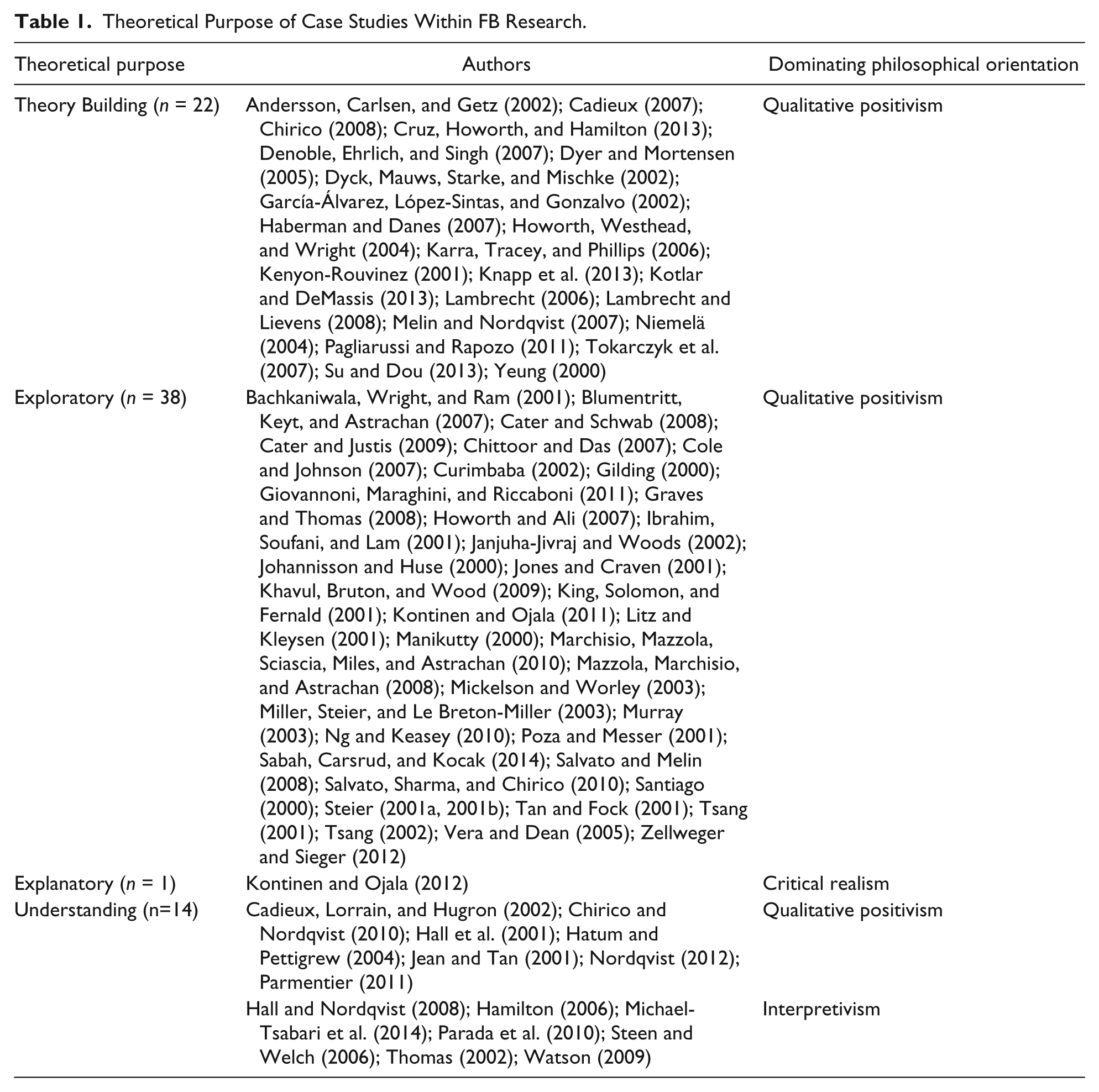
On the basis of the search criteria, we identified 75 qualitative case studies during the period 2000 to 2014. In total, we found 67 qualitative positivist studies. Alternative approaches to case research (n = 8) were present to a very limited extent, with seven interpretative studies, and only one critical realist case study. The philosophical assumptions of the case study authors—in conjunction with the information collected from the methodology section of the article in question—allowed us to identify four different theoretical objectives of case study research, namely exploration, theory building, understanding, and explanation. These occurred across the three dominating philosophical paradigms, namely qualitative positivism, interpretivism, and critical realism (see Table 1).
Theoretical Purpose of Case Studies Within FB Research.
The Positivist Case Study (n = 67)
The Philosophical Foundations of Positivist Case Studies
The authors who drew on the positivist approach largely framed the theoretical purpose of the study in accordance with the recommendations of Eisenhardt or Yin. Specifically, Eisenhardt (1989) considers case study research to be suitable for inductive theory building, while Yin (2009) mainly highlights the exploratory nature of case study research. The research questions were related to what takes place in FBs. The aspects covered included FB strategy formation, succession and daily routines, and the various processes by which family firms evolve. Note, however, that although researchers might mainly follow Eisenhardt and/or Yin, they could well borrow from other paradigms. For instance, Dyer and Mortensen (2005, pp. 248-249) combined grounded research with the methodology suggested by Eisenhardt: In creating our “theoretical sample” to explore how entrepreneurial firms survive in Lithuania (Eisenhardt, 1989) . . . we felt an indepth look into firm dynamics might yield more useful data to generate “grounded theory” (Glaser & Strauss, 1967).
It was sometimes problematic to define the theoretical purpose of the case studies, since the authors could well set out mixed purposes. Some authors employed a mixed rhetoric in indicating the purpose of the case study, treating synonymously terms such as “exploration,” “theory-building,” “understanding,” and “induction.” However, on the basis of the overall logic and structure of the studies, we were able to categorize them into works with explorative, theory-building, and understanding objectives.
Exploration was the most common theoretical purpose among positivist case studies, being included in 38 articles. These studies aimed at revealing which variables (such as personal traits, value systems, conditions, and contexts) were related to different phenomena among FBs (for instance success, succession, turnaround strategies, and the strategy process), and how these influence each other. They might also investigate how different processes (such as strategic renewal or succession) unfolded. This approach to theorizing, which was endorsed by Yin (2009), is exemplified in Giovannoni et al. (2011), who underline the need to explore management accounting practices among family firms as follows: Although some studies have explored financial accounting and auditing issues [ . . . ], the issues of changes in management accounting [ . . .] have been largely overlooked by the literature. [ . . . ] This study aims to contribute to the understanding of management accounting practices within family firms. (pp. 126-127)
Similarly, Miller et al. (2003) explore problems in succession: In many family businesses, intergenerational succession is predetermined by personal factors. The question becomes not who will be the best CEO, but how to identify and address problems with the succession. This exploratory inductive study looks into those problems in failing successions. (p. 513)
Theory building emerged as the second most common theoretical purpose of case study research, being included in 22 studies. Under this theoretical purpose, FB authors justified the theory-building role of case study research by showcasing the contribution of their research to the extant literature. Kotlar and DeMassis (2013) summarize the role of theory in their study as follows: In this study, we attempt to broaden and refine the extant theory in the area of organizational goals and goal formulation processes in family firms by addressing the following research question: “How do the individual goals of organizational members influence the organizational goals pursued by family firms?” (p. 1264)
Understanding was the most obvious theoretical objective in nine studies. For instance, Chirico and Nordqvist (2010) express the aim of understanding as follows: While some research on entrepreneurship in family businesses has focused on transgenerational value creation, a gap exists in understanding how such value is generated across generations. (p. 487)
Knapp et al. (2013) aimed to comprehend the organizational identity tactics in family firms through four case companies, ending up with recognition of 13 identity tactics: We contribute to a greater understanding of boundaries in family business research by directly identifying the identity work tactics used by individuals to negotiate the boundaries of family and business. (p. 333)
Interestingly, the term “understanding” was used primarily to signal an underinvestigated topic, rather than the development of contextual insights in the manner of interpretive case research. The case study was seen as offering insights based primarily on existing concepts and theories, positivist quality criteria, and so on.
The Logic of Positivist Case Studies
Here “logic” refers to aspects such as patterns, replication logic, and testable propositions. These case authors often referred to Eisenhardt and/or Ying, who represent the qualitative positivist stance in the case study approach. We encountered 18 single case studies and 49 multiple case studies. In the multicase design, the number of cases varied from 2 to 50. The influence of Eisenhardt (1989) can be seen, for example, in the article by Chirico (2008), which adopts the logic of having studies on multiple cases for the purposes of replication: Multiple cases permit a replication logic where each case is viewed as an independent experiment that either confirms or does not the theoretical background and the new emerging insights. A replication logic yields more precise and generalizable results compared to single case studies. (pp. 435-436)
Those FB researchers who followed Eisenhardt’s view of case research were not always consistent in engaging in inductive theory building through advancing propositions, as recommended in this approach. Indeed, out of the 25 articles that employed Eisenhardt’s theory-building approach, only 13 articles presented propositions (mainly) after presenting the findings, while there were 2 articles with theory-based propositions reported in the theoretical part of the study. Pagliarussi and Rapozo (2011) formulated propositions on the basis of earlier research, prior to presenting their findings. These propositions were intended to facilitate the investigation of Brazilian FBs, and appeared to contain mixed inductive and deductive elements: From the previous discussion, one can expect [ . . . ] Proposition 1: To mitigate agency conflicts between managers and shareholders, family firms in Brazil will choose governance mechanisms based on self-enforcing family contracting that extends beyond the nuclear family. [ . . . ] Proposition 2: Family control promotes agency conflicts between shareholder groups in Brazil. (pp. 174-175)
After presenting their findings, Pagliarussi and Rapozo (2011) engaged in a discussion emulating deductive theorizing: Overall, we conclude that (a) to mitigate agency conflicts between managers and shareholders, family firms in Brazil will choose governance mechanisms based on self enforcing family contracting extending beyond the nuclear family and (b) family control increases the potential for agency conflicts between shareholder groups in Brazil. (p. 180)
Altogether, the positivist studies had a structured manner of theorizing, often through propositions that lacked contextual sensitivity, with a search for regularities rather than the reasons behind them. Some authors had a separate section outlining the research setting, but the discussion remained at a descriptive rather than an analytical level. The authors aimed at robustness and credibility by having several cases confirming certain features.
The Rhetoric of Writing in Positivist Case Studies
The majority of the positivist case study articles in FB research had a separate methodology section, in which they explained why they used the case study method, how they selected the cases, how they collected the data, and in some of the articles, how the data were analyzed. This structure appeared to constitute the FB disciplinary convention.
In the majority (61 out of 67) of the articles, the findings of the case studies were reported under a series of themes. 1 Chronological reporting was used in eight, and narrative reporting in six articles. For example, Steier (2001a) applied a chronological presentation in a research report that laid out the evolution of trust via three different stories. The most common way of integrating theory with the empirical finding involved a discussion of the case study findings in relation to the theories mentioned—theories that had been presented at the beginning of the article. Interestingly, the majority of the cases reviewed were structured in a deductive manner, despite having an exploratory or theory-building purpose.
The authors who reported on their data analysis generally referred to prominent methodological authorities, mentioning that their findings were arrived at on the basis of the guidelines given by these authors. The context (organizational, industry, cultural, etc.) was discussed only to a very limited extent. An interesting feature was that the multiple case study design appeared to be more sensitive to contextual elements, often offering tables summarizing the features of the case firms, and possibly a paragraph on the cultural context of the study.
The majority of the case authors did not discuss the quality criteria applied to their case studies. Nevertheless, the authors often assumed that objectivity is the ultimate criterion for establishing scientific rigor within qualitative case study research. To this end, the use of Atlas, Nvivo, or Max was reported in more than ten articles as an element enhancing the objectivity of the data analysis. Moreover, the case study authors often sought objectivity by engaging team members in the analysis of the data, presenting findings to informants, pursuing triangulation, doubly processing the data plus sharing material with outsiders, and checking the congruence of the findings with the literature.
In relation to the quality criteria, most of the studies discussed the inability to generalize as the most significant, and often the only limitation. Some articles concluded on a note of apology, stating or implying that quantitative data would have advanced the generalizability of the research. In this vein, Miller et al. (2003) evaluated their findings as follows: Although the findings from this qualitative study are suggestive, they require significant follow-up work to establish their range, reliability, and validity. (p. 528)
Interestingly, among the data set of qualitative positivist case studies, prominent features included the use of statistical data, a-priori concepts, gap-spotting strategies, data tabulation, and reference to the researchers (authors) in the third person. In this way the practice was similar to that in other fields (such as international business, see Welch et al., 2011).
The Interpretivist Case Study (n = 7)
The Philosophical Foundations of Interpretivist Case Studies
The authors who applied the interpretivist case study design (n = 7) mainly followed the suggestions of Stake, but sometimes also borrowed ideas from the positivist approach. For instance, Michael-Tsabari et al. (2014) described the entrepreneurial behavior of a multinational family firm over generations via interpretation, yet they also borrowed from Eisenhardt for their ideas on theorizing: We follow an inductive process in building theories from case studies as recommended by Eisenhardt (1989) . . . this article presents an enlarged perspective that gives voice to those living an experience [ . . . ] This perspective focuses on building an emergent theory from an interpretive qualitative illustration. (pp. 162, 165)
The theoretical purposes of the interpretive studies were expressed in terms of developing an understanding on the basis of what one might call a softer, more contextualized type of theorizing. They embraced context and narratives. This stream of case studies was related to subjectivist assumptions, with knowledge seen as socially constructed. Hall and Nordqvist (2008), for example, saw it as important: [To] understand professional management in FBs in a way that more explicitly recognizes the special characteristics of these firms, originating in the influence of the family on the business. [ . . . ] A central aim of interpretive research is to challenge, extend, and provide novel ways of understanding a social phenomenon.
Similarly, an interpretive case study by Hamilton (2006) concentrated on FB narratives, seeking to reveal conditions under which patriarchy might be challenged: This article illuminates complex relationships in a family business context, putting the family at the heart of the research as opposed to an individual owner-manager [ . . . ] The narratives presented in this article point to alternative gender discourses and practices, and to evidence of clear resistance to patriarchy. (p. 253)
The Logic of Interpretivist Case Studies
The interpretivist case studies concentrated on creating an understanding of the case based on “local, emic meanings and remaining open to alternative perspectives” (Welch et al., 2013). Hamilton (2006), for instance, offered a thick account of how women challenged power relations and assumptions, as opposed to the general assumption that women were marginalized and held back by patriarchic power patterns. Hall and Nordqvist (2008) problematized and then extended the current dominant understanding of “professional management.” They added the concept of “cultural competence” to it, describing this as follows: The second level of cultural competence is more in-depth and context specific as it implied an understanding of how and why the specific culture of a family firm enables or restricts management practices. (p. 59)
Watson (2009) shed new light on the concept of entrepreneurial identity by demonstrating the discourses surrounding two intertwined aspects, notably a self-identity aspect and a social identities aspect: A case study is presented in which we see two principle figures in a growing family firm [ . . . ]. This fine-grained analysis [ . . . ] shows how people in entrepreneurial contexts use discursive resources in a negotiated, shifting, creative and nuanced but often ambiguous manner. (p. 251)
The Rhetoric of Writing in Interpretivist Case Studies
The interpretivist studies analyzed provided contextual accounts and did not strive for objectivity. Instead, they aimed to understand subjectivity by concentrating on participants’ multiple life-worlds and experiences, which are time and context bound. The researchers’ interpretations served to bring subjectivity to the fore, supported by rich contextual data and thick descriptions. This approach was exemplified in an article by Watson (2009) concerning entrepreneurial action, identity work, and the use of multiple discursive resources in a rapidly changing FB. Watson described the family members and the firm in considerable detail. He also elaborated fully on the history of the firm, fleshing out multiple voices. By including a conversation between two family members (Ali and Dina) he sought to describe the identity work operating in this single case. He used expressions such as the following: Dina said [ . . . ] Dina continued [ . . . ] At this point Ali interrupted to say . . . [ . . . ] “Well there you are” commented Ali. [ . . . ] “It wasn’t long things started to unravel,” Ali explained, continuing: [ . . . ] As Dina explained . . .”
Hence, the author presented data directly from his field notes and allowed readers to interpret the data and determine for themselves if the interpretation was adequate. In a similar vein, Hamilton (2006) described in considerable detail the differing views of family members in relation to gender issues and patriarchy, providing lengthy quotes and descriptions. Both these authors presented their findings while at the same time reflecting on the actual research process. Hall and Nordqvist (2009) employed a more conventional structure in their article, discussing the emerging findings under a number of themes. However, none of these authors sought to make generalizations, and all of them encompassed fairly thoroughly the contextual conditions applying to the research in question.
The Critical Realist Case Study (n = 1)
The Philosophical Foundations of the Critical Realist Case Study
The theoretical purpose of the single critical realist case study in our data, viewed as a more context-specific endeavor than a positivist case study, was expressed by Kontinen and Ojala (2012) as follows: [A] critical realist case study method was applied in this study. [ . . . ] Based on this and on an investigation of all possible secondary material on the case firms, the most important features related to their internationalization pathways could be identified and discussed. (p. 501)
The research questions posed by Kontinen and Ojala (2012) indicated the importance attached to causal aspects in this approach. The authors wished to determine (a) the kinds of internationalization pathways taken by family SMEs take, and (b) the types of features underlying different internationalization pathways. They examined the most important events and dimensions behind different internationalization pathways (traditional, born global, and born-again global), then, via the use of retroduction, selected the six dimensions that best encompassed the internationalization trajectories identified.
The Logic of the Critical Realist Case Study
In the critical realist study of Kontinen and Ojala (2012), the causal aspects influencing the internationalization pathways of family SMEs were identified: From our data analysis, we found that the dimensions that best encompass the various internationalization pathways are: (i) ownership structure, (ii) stewardship attitude, (iii) international opportunity recognition, (iv) attitude to psychic distance, (v) the development of networks, and (vi) product. (p. 506)
The authors selected the causal mechanisms most consistent with the data as a means of informing theory. Nevertheless, the authors could have explained in more detail the structure and context of foreign market entries, giving more emphasis to those in their analysis (see Wynn & Williams, 2012). Furthermore, they could have done more to explain why the proposed mechanisms had more causal and explanatory power than the alternatives.
The Rhetoric of Writing in the Critical Realist Case Study
Kontinen and Ojala (2012) used expressions of causation such as “lead to.” Their orientation thus drew then to use a retroductive method, which enabled them to move from internationalization pathways to the apparent underlying mechanisms, including fragmented ownership, a strong stewardship attitude, and an attitude to networking. These mechanisms could explain a variety of internationalization trajectories: “[F]ragmented ownership seemed to lead to cautious internationalization strategies. [ . . . ] A strong stewardship attitude seemed to lead to a traditional pathway, whereas a weak/moderate attitude was related to born global or born-again global pathways.” (p. 508)
Kontinen and Ojala (2012) followed a logic according to which one can rarely, if ever, identify a complete set of precedents that would always lead to an outcome. This situation holds true because of the possible interactions between structural entities and contextual factors in an open system (Wynn & Williams, 2012).
Discussion and Conclusions
We conducted an in-depth qualitative content analysis of 75 case studies from the FB discipline, iterating between the existing methodological literature and the data set of published studies. We found that the qualitative positivist type of case study is the de facto disciplinary convention: Most scholars (n = 67) in the data set followed qualitative positivism, and very few (n = 8) interpretivism or critical realism. Our contribution could suggest to scholars various strengths and alternatives in the use and conduct of FB case studies.
According to our evidence, the dominant positivistic case study method has been helpful in allowing contextual insights into important FB issues—especially regarding “what” questions, such as performance, succession, and internationalization. Given the centrality of such questions in the field, it will probably continue to be widely used. Nevertheless, our analysis suggests that the positivist case study has not always been conducted in its purest form, in other words, according to the recommendations of Eisenhardt (1989) and Yin (2009). We would recommend that FB scholars should seek greater consistency in their case study design, considering also the quality criteria they utilize. For instance, the theory-building approach of Eisenhardt entails propositions for further testing through deductive research, applying quality criteria inspired by a positivist perspective. We believe that greater consistency in adhering to this perspective would increase the value of FB studies.
The qualitative positivist perspective presented by Eisenhardt (1989) relies primarily on replication logic and the advancement of propositions, rather than on generating thick descriptions of deep contextualized data (Dyer & Wilkins, 1991). The provision of rich data is an advantage of interpretivism (Stake, 1995), and also of critical realism (Easton, 1995). We see the latter as a fruitful case study design for FB scholars, as it allows a search for underlying causal mechanisms. Interpretivism, for its part, encompasses possibilities for a rich and exhaustive investigation of FB topics, and can allow a deeper understanding of the dynamics of family firms. This approach seems well suited to providing insights concerning the specific features and idiosyncrasies of firms, rather than lumping FBs together and theorizing accordingly. Interpretivism could also permit researchers to understand how the integration of the family and the business operates (Astrachan, 2003), investigating the perceived dynamics of the relationships between family members, in addition to those between family members and nonfamily members (Ainsworth & Cox, 2003; Fletcher, 2002). Interpretive case studies could provide nuanced stories on family members in relation to different aspects of the FB, including how personal and family lives have been experienced by the people who own, manage, or work for a FB. In line with Nordqvist et al. (2009), interpretivist case studies would tackle especially why and how a FB phenomenon is what it is.
FB researchers in the critical realist tradition could do more to address the notion of Weick (1989), to the effect that the contribution of social science is strongly related to relationships and connections that have previously not been suspected. Given the complexity of dynamic phenomena (such as succession, internationalization, management of FBs, and socioeconomic wealth), the discovery of underlying explanations could advance knowledge in the field. Using realist case studies, scholars in the field may achieve a more nuanced understanding of, for example, the issues of succession or socioemotional wealth, via in-depth studies of individual agents in their causal contexts (Sayer, 1992). Here it should be noted that we do not seek to replace the qualitative positivist case study with interpretive or critical realist studies; rather we would hope to encourage a plurality of case study approaches to avoid an over-restrictive perspective (cf. Orlikowski & Baroudi, 1991).
On the basis of our analysis, we have some suggestions for improving case studies, irrespective of the perspective of the authors. First of all, FB researchers could do more to position their study in relation to its theoretical purpose (notably as exploratory, explanatory, theory building, theory testing, or understanding-seeking). To this end, language would become a reflexive instrument signposting the theorizing intentions of the authors (Welch, Plakoyiannaki, Piekkari, & Paavilainen-Mäntymäki, 2013). Reflexivity may assist qualitative researchers not only interpret and understand the accounts from the field but also to attend to multiple voices and to the broader context (Finlay, 2002) in which FB phenomena take place.
Second, and related to the previous point, we would highlight the importance of positioning any article in terms of its epistemological and ontological orientation. The discussion on ontology, epistemology, and methodology was very limited in the case studies reviewed, and the authors seemed to struggle to align themselves with a specific philosophical orientation. The authors we examined often brought disparate elements forcibly together without giving adequate justification for any of them. They appeared to blend different philosophical assumptions within a single article, even if they had very different ontological and epistemological starting points. It is indeed possible that—as posited by Shepherd and Challenger (2013)—such a paradigmatic interplay may enhance awareness of alternative paradigmatic assumptions, revisit the delineation of paradigmatic boundaries, and facilitate theorizing. However, this position is highly debatable if one accepts the Kuhnian approach to paradigms, which favors paradigmatic consistency and warns against integrating incompatible philosophical underpinnings.
Third, the reporting of the case study method appeared to lack transparency. Note, however, that in terms of criteria for evaluating research, unlike Chenail (2009), we do not see transparency as necessarily implying homogeneity. We would rather keep to a notion of contingent criteriology. We see it as unfruitful to seek universal criteria for all research methods, seeing it rather as important that the criteria should be in line with the philosophical paradigm adhered to (see also Johnson, Buehring, Cassell, & Symon, 2006). As regards the inadequate reporting in the case studies we reviewed, we acknowledge that space limitations make it difficult for authors to discuss in detail methodological choices, analytical procedures, and so on. Hence, in qualitative studies some flexibility in word limits may be needed to allow full rigor in the reporting of the research.
Fourth, FB case researchers could use data other than purely interviews in developing their accounts. The use of direct observation, focus group discussion, and secondary materials (including company archival data) was limited in the articles reviewed. Secondary materials can be helpful in FB research, assisting in understanding the history and products of each case, forming detailed case histories, and comprehending the circumstances behind certain events.
The case study methodology is likely to continue to play a significant role in the FB area. Case study is a powerful methodology that can be employed in an inventive and rigorous way to arrive at a more fine-grained contextual understanding of FB phenomena, and to advance research in the field. In this article, we have analyzed how case studies have been pursued in FB up to now, and have offered suggestions on how they may be used in the future so as to effectively capture the idiosyncrasies, dynamics, and processes of FBs. We anticipate that researchers pursuing the qualitative positive, interpretative, and critical realist paradigms would benefit from our suggestions for embarking on high-quality FB research.
Footnotes
Declaration of Conflicting Interests
The author(s) declared no potential conflicts of interest with respect to the research, authorship, and/or publication of this article.
Funding
The author(s) disclosed receipt of the following financial support for the research, authorship, and/or publication of this article: This study has been supported by the Foundation for Economic Education, Finland.
Notes
Author Biographies
References
Supplementary Material
Please find the following supplemental material available below.
For Open Access articles published under a Creative Commons License, all supplemental material carries the same license as the article it is associated with.
For non-Open Access articles published, all supplemental material carries a non-exclusive license, and permission requests for re-use of supplemental material or any part of supplemental material shall be sent directly to the copyright owner as specified in the copyright notice associated with the article.
