



Abstract
In a qualitative study of 19 family businesses, we examine the dynamics of successor teams, using insights from the family dynamics and succession literature and teams and conflict theory in family business. In-depth interviews with family firm leaders identified two major successor team performance outcomes, a positive track leading to team commitment and a negative track resulting in dissolution of the team and potentially the family firm. Our findings are encapsulated by 10 propositions and a model of successor team dynamics.
Introduction
The succession process is one of the most critical issues in the continued life of a family business, but succession problems often result in less than optimal solutions, placing the fortunes of the firm in danger (Mehrotra, Morck, Shim, & Wiwattanakantang, 2011; Mitchell, Hart, Valcea, & Townsend, 2009). In this study of family business succession, we examine scenarios in which family firms have multiple possible successors to the founder, incumbent, or predecessor. These successors possess relevant knowledge, skills, and abilities for the firm and are considered to be a group or team of owners and managers. We refer to these groups as successor leadership teams. These teams deviate from standard management practices, such as unity of command in which employees report to only one boss, not a team of bosses, and are a relatively new, underresearched trend (Aronoff, 1998; Astrachan, Allen, & Spinelli, 2002; Long & Chrisman, 2014). Family business scholars have shown a growing interest in this shared or team leadership (Cater & Kidwell, 2014; Cisneros-Martinez & Deschamps, 2012; Farrington, Venter, & Boshoff, 2012). Likewise, more than 40% of family business leaders have expressed interest in naming co-CEOs in the next generation of their businesses, a figure that is consistent with previous surveys of family firms (MassMutual, Kennesaw State, & Family Firm Institute, 2007).
Family firms are considered unique because the most important voice in firm governance often belongs to a group of people linked by blood or marriage, and thus power in the family, family governance institutions, interaction between family members and other stakeholders, as well as family dynamics are likely to determine the firm’s outcomes (Bennedsen, Perez-Gonzalez, & Wolfenzon, 2010). A working definition of family firm for this study is a
business governed and/or managed with the intention to shape and pursue the vision of the business held by a dominant coalition controlled by members of the same family or a small number of families in a manner that is potentially sustainable across generations of the family or families. (Chua, Chrisman, & Sharma, 1999, p. 25)
Succession is defined as a dynamic process involving the transfer of both the management and ownership of a family firm to the next generation (Cadieux, Lorrain, & Hugron, 2002). In family business studies, scholars view succession as vital to the survival of the firm (Rubenson & Gupta, 1996) and claim that family involvement with its emotions and nonbusiness concerns differentiates succession in family business from succession in publicly owned firms (Sharma, Chrisman, & Chua, 2003).
In larger, publicly traded organizations, the development of top management teams to meet the increasing demands of the competitive environment has been noted (Haleblian & Finkelstein, 1993; Hambrick, 1981; Hambrick & Mason, 1984). Similarly, in family business, having leadership teams of multiple family members has become a common practice (Cater & Justis, 2010). Trends toward team management, in which several family members are involved in the leadership of the firm, and multiple family members share ownership have been recognized as among the most significant changes occurring in family businesses (Aronoff, 1998), and these trends are expected to continue (Astrachan et al., 2002). However, there have been relatively few studies examining the dynamics of these successor leadership teams despite the fundamental importance of family business teams (Pearson, Bergiel, & Barnett, 2014; Schjoedt, Monsen, Pearson, Barnett, & Chrisman, 2013). Some suggest that choosing multiple successors is an easy way out for the incumbent leader who cannot make a difficult choice among possible successors (Poza, 2010). Alternatively, this decision may be a practical use of the family’s human resources as well as a conscious effort to maintain higher levels of harmony and continuity (Gilding, Gregory, & Cosson, 2015). This study considers the question: Why do some successor leadership teams work together successfully in family businesses and others do not? Thus, we address a key shortcoming in the literature: how the social dynamics among successor team members affect their performance as successor leadership teams as indicated by their continuity as a team, and how the continuity of the successor leadership team affects firm performance as indicated by long-run firm survival (cf. Long & Chrisman, 2014). By social dynamics among successor team members, we refer to behavioral interactions that either strengthen or loosen ties to the family firm. These interactions play an important role in the success or failure of the successor leadership team (Eddleston & Kidwell, 2012).
We employed a case study approach, examining 19 family firms with successor groups through detailed interviews of firm leaders. The transcribed interviews were analyzed through an iterative grounded theory approach, leading to a successor team dynamics model and 10 propositions. The key contribution of this study is a conceptualization of behavior among successor teams, which emanates from early family dynamics through team formation, into two possible behavior tracks—one negative leading to successor team dissolution and one positive leading to successor team commitment.
Conceptual Grounding
The next section of the article highlights current theory in two key areas of family business research: (1) family dynamics and succession and (2) teams and conflict in family business so as to provide a conceptual grounding for this study.
Family Dynamics and Succession
First, we report on family dynamics related to the succession process. Family firms differ from nonfamily businesses in that successors typically enter the family firm with a rich history of experience with their employers. The successors are assumed to be well known before they take any position in the company and their actions may be rooted in a long-standing set of family behavioral patterns (Eddleston & Kidwell, 2012). In this article, we use the term family dynamics to refer to this pattern of behavioral interactions among family members.
Family Dynamics
One element of family dynamics is the presence of altruism. Schulze, Lubatkin, and Dino (2003) proposed that agency relationships in family firms are embedded in parent–child relationships found in the household and are therefore characterized by a willingness of family firm leaders to help family members without expecting an external reward, that is, altruism. Self-interest explains only some aspects of human behavior, not all (Steier, 2003). In family firms, owner-managers may attempt to satisfy their own needs and the objectives of the firm together. In this sense, altruism can mean placing the objectives of the business ahead of the self-serving objectives of the individual. Moreover, this feeling of altruism compels parents to care for their children in the family firm, for family members to consider the feelings and desires of other family members, and for children to reciprocate with loyalty and commitment to the family firm (Schulze, Lubatkin, Dino, & Buchholtz, 2001).
Other issues associated with altruism are that successors in the family firm may develop an increased sense of entitlement (Lubatkin, Durand, & Ling, 2007). However, parents are often expected to provide for all of their potential successors equally, even though they may have a preference for one child over another (Eddleston & Kidwell, 2012). Furthermore, children may take advantage of their parents’ generosity by free riding (leaving work for others to do), shirking (failing to provide appropriate performance), squandering the family’s money, and remaining dependent on their parents (Schulze et al., 2003). The family firm leader may seek to establish a stewardship culture, which is designed to promote the welfare of all stakeholders, including future generations and nonfamily employees (Le Breton-Miller, Miller, & Lester, 2011) to pervade the entire company (Pearson & Marler, 2010). However, even for the parents in this context, generosity is to some extent motivated by the desire to enhance personal welfare.
Predecessors and Successors
A good working relationship between the predecessor (incumbent) and the successor(s) is vital to any transfer of power (Cabrera-Suarez, De Saa-Perez, & Garcia-Almeida, 2001). Additionally, the predecessor (incumbent) must be willing to let go of the control of the business (Dyer, 1986). The predecessor must delegate authority and allow the successor(s) to make decisions and mistakes (Handler, 1990). Although control of the succession process may still reside mainly with the predecessor generation, the readiness of successors is also important (Brun de Pontet, Wrosch, & Gagne, 2007). An interested and capable successor is necessary for successful succession to occur (Birley, 2002).
Stavrou and Swiercz (1998) grouped the reasons that children of family business owners enter the business into four categories: family, business, personal, and market dimensions. The family dimension refers to behavior relating to family membership, dynamics, needs, values, relationships, and desires. The personal dimension concerns behavior related to individual needs, goals, and abilities. The business dimension concerns behavior related to the business practices and operations of the firm. Finally, the market dimension concerns employment opportunities in the business community for the offspring of the family business owner.
Evidence exists that the presence of a trusted successor may push the incumbent family leader to plan for succession (Sharma et al., 2003). The successor(s) must demonstrate the necessary skills, performance, and experience for leading the firm (Barach & Gantisky, 1995; Barach, Gantisky, Carson, & Doochin, 1988). The successor(s) need a thorough training regimen to acquire firm-specific knowledge and to develop his or her capabilities (Morris, Williams, Allen, & Avila, 1997). Exposure at a young age to the company allows successors to learn about the people and processes involved (Ward, 1987). Furthermore, the successor(s) must be willing and fully committed to the process (Barach & Gantisky, 1995).
Researchers report that the most important attributes for successors are integrity and commitment to the business (Chrisman, Chua, & Sharma, 1998; Sharma & Rao, 2000). Successors become committed to the family firm through four bases: affective (perceived desire), normative (sense of obligation), calculative (perceived opportunity costs), and imperative (perceived need; Sharma & Irving, 2005). Shepherd and Zacharakis (2000) assert that incumbents should structure the succession so successors feel as though they have invested their own time and money in the family firm. This investment by successors will lead to assignation of a higher value of the business and a stronger desire to retain the firm, rather than to sell it.
The Succession Process
Succession is more of a lengthy process than an event in which there is a management and ownership change (Handler, 1994) unless circumscribed by early or unanticipated death or disability of the incumbent or successors. Family business scholars have hypothesized various models concerning the process of succession (Barach & Gantisky, 1995; Churchill & Hatten, 1987; Handler, 1990; Longenecker & Schoen, 1978). Handler (1990) and Churchill and Hatten (1987) favored a four-stage model, while Longenecker and Schoen (1978) proposed a seven-step process of succession that begins with childhood and is highlighted by the entry of the successor into the family business at a lower level of management and later the ascension of the successor to the leadership of the firm. Successors are prepared or groomed for many years to accept their role of responsibility in the family firm. Handler (1990) describes the process of succession as a mutual role adjustment between the members of the incumbent and successor generations. The incumbent must relinquish power, and the successor must demonstrate the ability and desire to assume control of the firm.
Cater and Kidwell (2014) proposed a model of stages of successor group development in family firms, identifying the roles of the incumbent family leader and the successors. In Stage 1, the incumbent begins planning for retirement and searches for possible successors, while the successors are identified as candidates. In Stage 2, the incumbent assesses possible successors and the successors enter the business, learn to manage, and may compete with each other. In Stage 3, the incumbent chooses the successor group and reduces his or her leadership role and the successors are identified and chosen. In Stage 4, the incumbent exits from company leadership by retirement or death and the successors operate as a leadership group.
Teams and Conflict in Family Business
Groups and teams have been major topics of management research for many years (Cordery, Mueller, & Smith, 1991; Hackman & Katz, 2010; Hackman, Pearce, & Wolfe, 1978). A group is a set of people usually numbering between 3 and 20 individuals (Orsburn & Moran, 2000) who have a degree of interaction, shared objectives, and common purpose (Sundstrom, de Meuse, & Futrell, 1990). Dyads are a type of group in which a pair of individuals maintains a sociologically significant relationship (“Dyad,” n.d.). Teams may be temporary with a specific beginning and ending in time or a long-term element of a business organization (Glassop, 2002). Teams are characterized by a higher degree of interaction among members, a stronger sense of personal responsibility for achieving desired outcomes, and a higher level of identification with the group (Sundstrom et al., 1990). Tuckman (1965) identified four stages in group and team development: forming, storming, norming, and performing. In the forming stage, group members get to know each other; in the storming stage, group members learn what is expected from them and how to relate to each other; in the norming stage, some amount of consensus is reached; and in the performing stage, the group is able to perform as a team and take action as an entity.
In terms of performance, teams may be evaluated in four important areas: context, composition, competencies, and change capabilities (the Four Cs; Dyer, Dyer, & Dyer, 2013). According to the authors (Dyer et al., 2013), context refers to the concept of appropriate organizational support for the team; composition refers to having team members who possess the right set of skills; competencies are the team’s ability to solve problems, communicate, make decisions, and manage conflict; and change involves the team’s ability to monitor its performance and make necessary changes.
Decision Making in Teams
Organizational research indicates that the decision making of groups or teams is often superior to that of individuals because groups contain a wider range of viewpoints, can accumulate more facts and knowledge, and can consider more alternatives (Harrison, 1975). Compared to individual decision making, groups typically move at a slower pace, requiring more time to make decisions than individuals, which may be problematic when a rapid response is needed (Ebert & Mitchell, 1975). Groups and teams may be characterized as homogeneous (having similar qualities) or heterogeneous (diverse or having dissimilar qualities). Diversity is typically measured in demographic variables, such as race, ethnicity, gender, and age, or attributes, such as knowledge, skills, values, or tenure (Jackson, May, & Whitney, 1995). Research suggests that as diversity in groups and teams increases, affective consequences such as satisfaction and identification with the group decrease and conflict increases. Cognitive consequences such as the quantity and quality of new ideas increase with greater diversity (Milliken & Martins, 1996; Pelled, Eisenhardt, & Xin, 1999).
Family Business Teams
One way family teams can influence the functioning of the family firm is through the establishment of teams of sibling owners (Pearson et al., 2014). For example, Cater and Justis (2010) found eight factors or conditions that affected team or shared leadership in multigenerational family firms. Positive factors enhancing shared leadership included long-term orientation, close communication and shared understanding among group members, timely succession planning, and higher decision quality. Factors inhibiting the implementation and development of shared leadership included resistance to change, failure to release control by incumbent leaders, reporting relationship confusion, and increased decision time. Employing a case study analysis of six family firms, Cisneros-Martinez and Deschamps (2012) examined teams of siblings in the succession process, identifying them as entrepreneurial teams. Farrington et al. (2012) reported three variables—physical resources, skills diversity, and strategic leadership—to be significant determinants for the success (measured by financial performance and family harmony) of sibling teams in family firms. Cater and Kidwell (2014) found that excessive competition among successor group members hindered group effectiveness, whereas a pattern of cooperation, unified implementation of decisions, mutual agreement to share power, and development of trust enhanced successor leadership group effectiveness. Cater and Kidwell (2014) probed the concept of successor group governance, recognizing four variations of sharing power and authority: (1) disagreement and group destruction, (2) a dominant leader in an unequal group, (3) first among equals, and (4) complete equals.
Conflict in Family Businesses
Davis and Harveston (2001) divided conflict in the family firm into two categories: substantive (task disagreements) and affective (emotional issues). In their study, Davis and Harveston found an increasing level of conflict as firms move into second- and third-generation involvement. Additionally, family members may feel as though they are locked into the firm, which makes conflict more personal (Schulze et al., 2003). Kellermanns and Eddleston (2004) identified family firm conflict in three areas: tasks, processes, and relationships. Task conflict revolves around differences concerning the goals and strategies of the firm. Process conflict involves disagreement concerning the manner in which work is accomplished in a family business and which family members should perform the tasks. Moderate levels of task and process conflict can help a firm succeed, while very high or very low levels of task and process conflict work against the firm. Relationship conflict includes personal animosity and issues of compatibility that may spill over into negative emotions, such as annoyance and irritation. These problems may result in personal threats, political actions, and the building of factions in the firm. Kellermanns and Eddleston (2004) propose that altruism—a moral value by which individuals act in a beneficial manner to others without expecting an external reward (Schulze et al., 2001)—helps reduce relationship conflict in the family firm. By gradually working younger family members into the firm, listening to their ideas, and fostering incremental change, incumbent leaders also may reduce relationship conflict in the firm.
A study by Sorenson (1999) found that a collaboration strategy helped family business leaders manage conflict most effectively. Collaboration refers to finding a “win–win” situation in which both parties achieve their goals and requires time, effort, and good interpersonal skills. Accommodation and compromise strategies worked well to manage family issues, but competitive strategies yielded negative results.
In summary, there is a solid theoretical foundation of research on family dynamics and succession, and teams and conflict in family business. There have been studies done in the specific area of successor leadership teams in family firms (Cater & Justis, 2010; Cater & Kidwell, 2014; Cisneros-Martinez & Deschamps, 2012; Farrington et al., 2012; Pearson et al., 2014). However, gaps exist in this literature, and we seek to add to existing evidence in regard to the entrance of multiple successors into the family business, the formation of successor leadership teams, the positive or negative performance of those teams as evidenced by their continuity in the family firm or dissolution, and the resulting outcomes for their respective firms—survival, failure, or the opening of new family firms.
Method
Using a qualitative case study approach, we examined the dynamics of successor leadership teams. Data from a series of in-depth, semistructured interviews were analyzed using grounded theory methodology (Corbin & Strauss, 2008; Strauss & Corbin, 1998). Our study was designed to build on existing theory in family firm succession.
The Case Study Approach
The line of inquiry suggested by the conceptual grounding discussed earlier requires a flexible research program to gain an understanding of the dynamics of successor team leadership. The case study approach allows for adaptability and is suitable for studies involving “how” and “why” questions (Eisenhardt, 1989) and highlights affected participants (Howorth & Ali, 2001). The case study investigator seeks to articulate global significance from localized findings (Chenail, 2009). A case study is “an empirical inquiry that investigates a contemporary phenomenon within its real-life context” (Yin, 2003, p. 13). Case studies may be used to explore such occurrences and to offer explanations leading toward theory building (Lambrecht, 2005).
Eisenhardt (1989) proposed that the case study researcher may purposively choose cases that are likely to replicate or extend the theory. The researcher may choose cases that illustrate appropriate concepts (Patton & Applebaum, 2003); thus, qualitative samples may have the objective of developing theory, rather than testing it (Eisenhardt & Graebner, 2007). Qualitative methods help researchers examine the complex interrelationships among elements in a particular case. In exploratory situations in which there is no clear, single set of outcomes, case studies may be useful in generating new theory in comparison to the natural science approach (Patton & Applebaum, 2003). Researchers may look for critical cases to prove their main findings or confirming cases, disconfirming cases, extreme cases, or typical cases (Siggelkow, 2007).
Until responses become repetitive, increasing the number of cases involved in a particular study adds confidence to findings. Yin (2003) compared the addition of cases to the addition of experiments, looking for replication. Eisenhardt (1989) proposed that researchers should continue adding cases in an iterative process until the incremental improvement is minimal.
Study Participants
At the beginning of this project, one of the authors acquired formal permission from their university’s internal review board to conduct research using human participants. All informants were advised of confidentiality and anonymity in their participation. All names of people, places, and companies have been disguised. The firms in the study are referred to as Company 1 through 19 with the numbers randomly assigned. We received assistance in finding respondents from local business leaders, university colleagues, friends, acquaintances, and students. The authors had no connection or involvement in any of the family firms contacted for this study. One of the authors has a background in a family business in the role of successor, which provided some insight in the research process. About 70 prospective firms were contacted to ascertain if the companies met the requirements of multigenerational family involvement, presence of a group of successors, and willingness and compatibility to participate in the study. We collected data in two rounds: The first round consisted of 15 respondent firms, and the second round included four failed family firms and individual follow-up interviews with additional respondents from the first 15 respondent firms. After the two rounds of data collection, we found a level of redundancy of responses (Merriam, 2009) with little new information forthcoming. A copy of the interview questions is available from the first author on request.
Firms from different industries participated in the study, including nine retail operations, five restaurant companies, three service companies, a ranch, and one manufacturing company. The number of employees in the respondent firms varied from 10 to 900, with a median of 35. The respondent businesses ranged in age from 12 years to 119 years, and generations of family participation from two to four. Each company involved from 4 to 35 family members in management and ownership. The firms were located in four U.S. states, but several have expanded beyond the local region or own multiple, but related, businesses (see Table 1).
Respondent Companies.
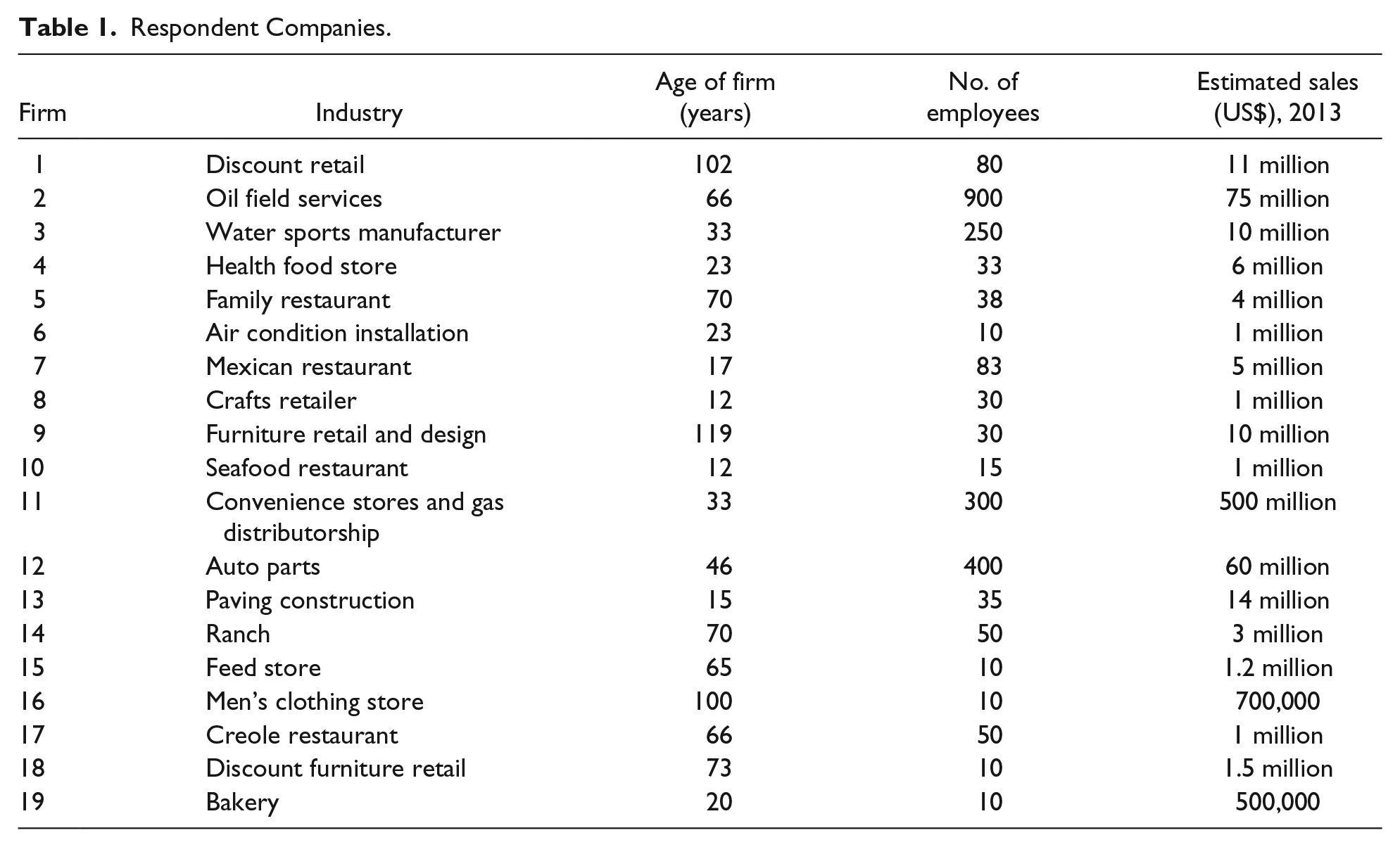
Because of the number of cases and interviews involved, the data collection extended over a 2-year period. We updated information on the earlier interviews through follow-up telephone conversations, e-mail, and news media articles. During the data collection period, the first company interviewed (Company 5) closed, and the owners liquidated the assets of the company. Five other businesses were already closed at the time of the interview, while the other 13 businesses remained in operation.
Among the 48 respondents, there were 37 family member owner/managers, and 11 family member managers, who had not yet received ownership in their businesses (see Table 2). This number exceeds the number of respondents suggested by Reay (2014). In grouping the 48 family member respondents, 10 were predecessors (senior generation) to the successor team, 31 were successor team members (26 had ownership and 5 did not yet have ownership), and 7 were next-generation family members (younger generation than successors—6 with no ownership yet and 1 with ownership). Of the respondents, 5 were in the first generation, 26 were in the second generation, 15 in the third generation, and 2 in the fourth generation.
Individual Respondents.

Of the successor teams in this study, nine were dyads, five consisted of three family members, two were made up of four family members, two had five family members, and one had seven family members. Except for Company 10 where the predecessors (parents) have made one unsuccessful attempt to establish the younger brother (successor team member) as a restaurant owner and have agreed to try again and for Company 8, all members of the successor teams in this study were owner-managers in their family businesses. As a matter of course, the successor team members viewed themselves as a team. For example, at Company 8, Respondent A stated, “I would describe us as a team. Things turn out better if we do them together.”
Data Collection
For this study, the research requirements were family involvement in management and ownership, at least one leadership succession, and multiple successors in the leadership group. We began with an exploratory interview of a senior family firm manager to obtain consent for participation in the study and determine appropriateness of the firm. Next, we interviewed all available top family managers in the organization. The interviews were semistructured and involved open-ended questions concerning the leadership in the firm. For example, one question was “Please describe your family business and the family members who are involved in it.” Qualitative interviews composed the majority of the data collected along with some company documents.
In-Depth Interviews
One of the authors conducted the in-depth interviews. These tape-recorded interviews were conducted individually with respondents at each family firm, totaling 48 participants. We transcribed about 36 hours of interviews, which varied in length from 30 minutes to 1½ hours, averaging 45 minutes each. The transcribed interviews totaled 487 pages, for an average of 10 pages per respondent.
Documents
The researchers asked respondents for company documents and requested newspaper and magazine articles, advertisements, and company catalogs. As necessary and appropriate, the authors gathered documentary information independently. Whereas observations and documents about each company were collected, these were supplemental in nature. The in-depth interview transcriptions formed the basis of the data analysis.
Data Analysis
The analytic techniques used in this study followed the procedures outlined by Strauss and Corbin (1998) as grounded theory analysis. First, in an extensive and time-consuming step, we analyzed each case separately by writing complete case histories of each company (available on request). Then, we engaged in content analysis of the data looking for insights and patterns across the cases (cross-case analysis). The transcribed interviews provided the basis for our study as we coded and analyzed the data, employing the NVivo 10 qualitative software program by “simultaneous coding of raw data and the construction of categories that capture relevant characteristics of the document’s content” (Merriam, 2009, p. 205). This involved separating important thoughts and phrases and labeling them as “references” and then “nodes” in the NVivo system. We liken this to unitizing methods described by Glaser and Strauss (1967) and Lincoln and Guba (1985). As the analysis proceeded, we developed an initial model to organize our thoughts in the project. Simultaneously as we progressed through the steps of coding, we refined and expanded our model through several iterations until we arrived at our final model (see Figure 1).
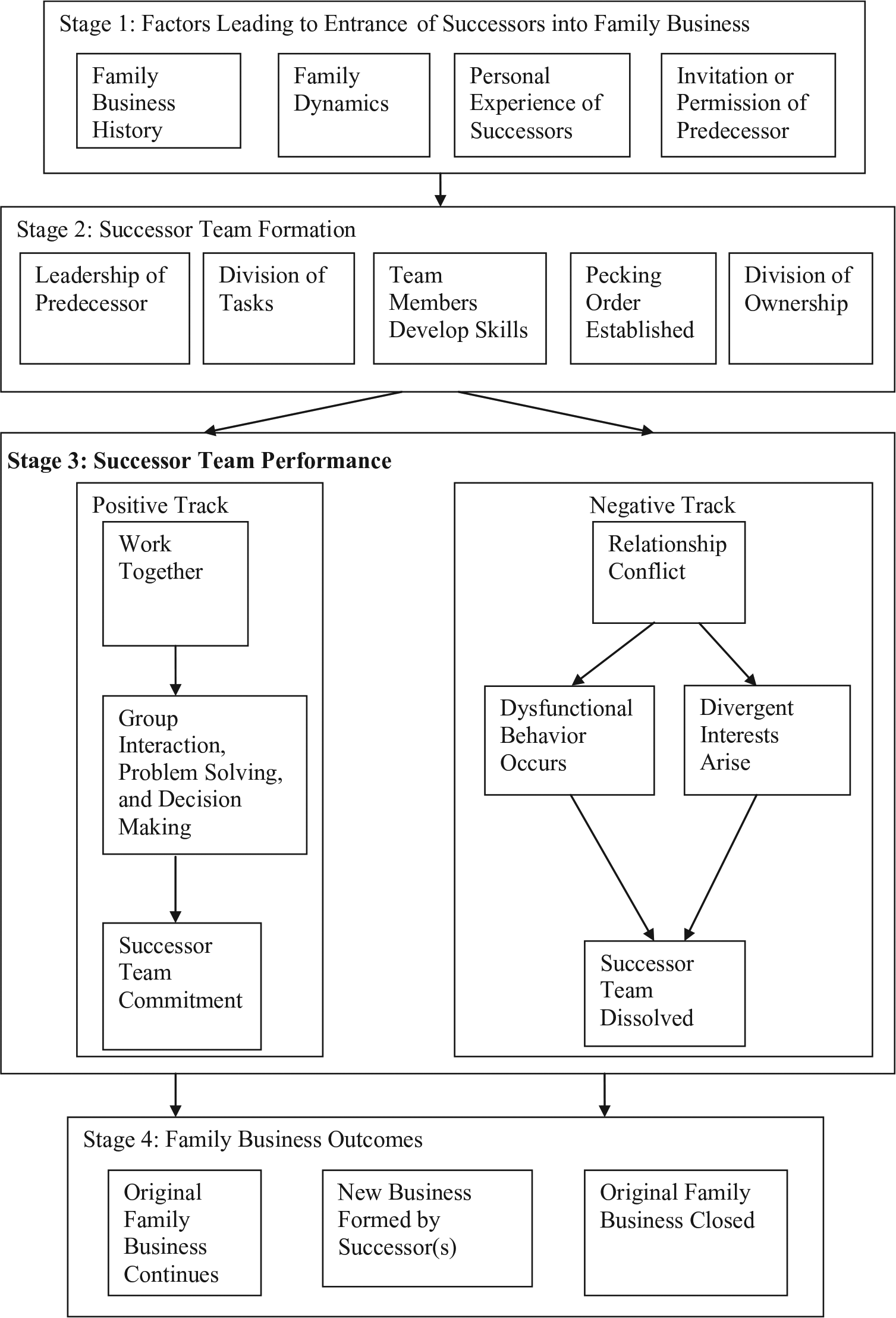
Model—Successor team dynamics in family firms Stage 3: Successor team performance.
In the first step of the process, called “open coding” by Strauss and Corbin (1998), we began with the 487 pages of transcripts and through a comparison process identified 1,024 “references” or incidences of significant, recurring expressions or thoughts, which we placed in 628 “nodes” or subcategories. Here is an example of open coding from respondent B at Company 5: “My father came in on a donkey and left in a Cadillac when he went back to visit in Mexico. He always sent my grandmother a little extra cash when he could. That is the way he was.”
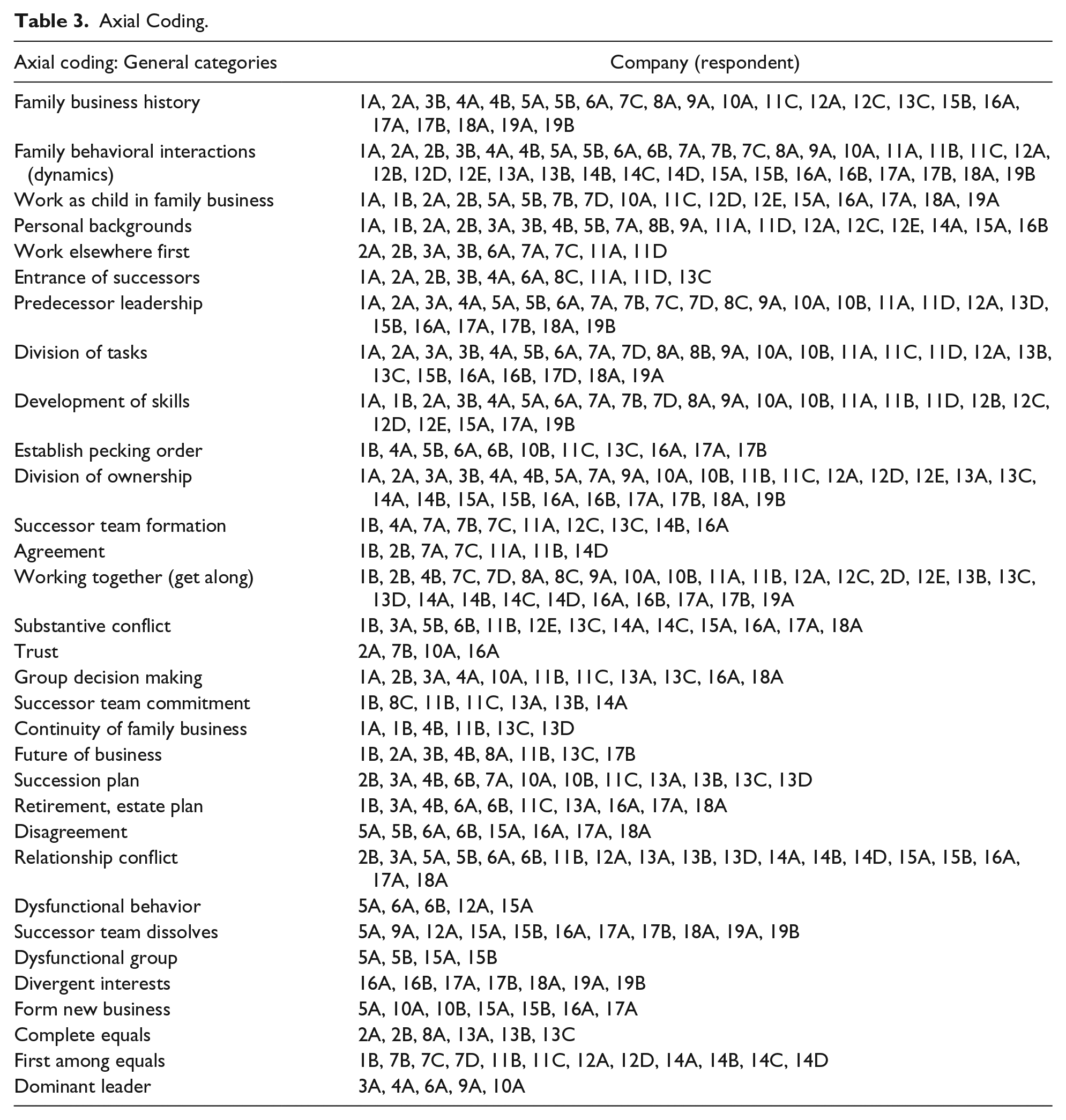
In the second step, “axial coding” (Strauss & Corbin, 1998), we placed the 628 “nodes” or subcategories into 428 categories, labeling the categories by company and respondent (1A-19B, see Table 3). This is the category level of analysis and the beginning of analysis of the data through interpretive lenses (Harry, Sturges, & Klingner, 2005).
Axial Coding.
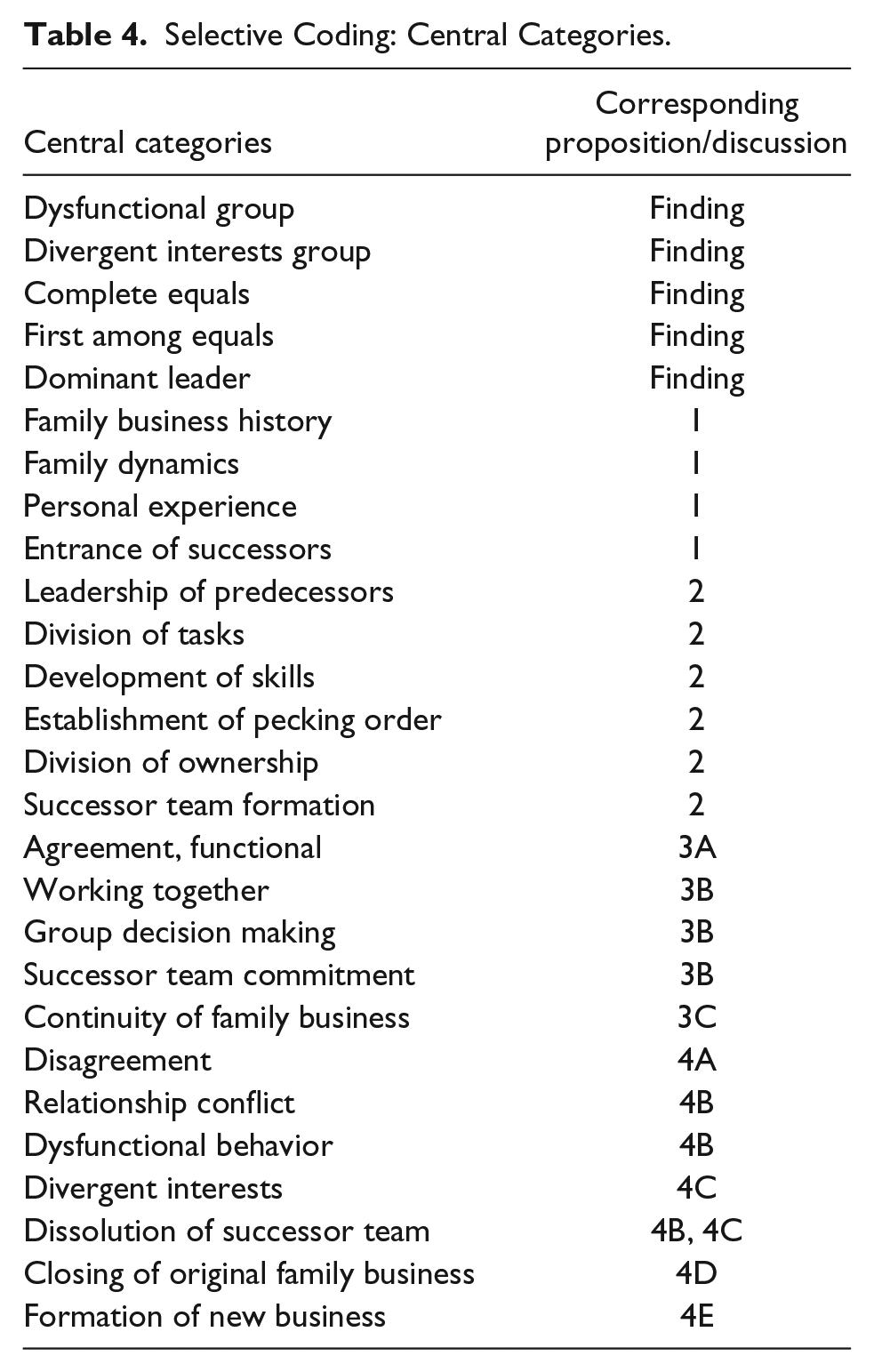
The third step of the process, termed selective coding by Strauss and Corbin (1998), involves the development of themes across the cases. In this step, we coded the data into 27 central categories (see Table 4). We built clusters of thoughts and phrases and looked for unifying phrases and connective language to construct a framework for analysis (Creswell, 1998). Among the differences in the 19 family businesses in the study, some recurring themes emerged. We traced these themes across the cases and built a theoretic base to understand successor team dynamics in family firms. According to Strauss and Corbin, 1998, this is Level 4 analysis—testing the themes. From this theoretical base, we developed 10 propositions and a model to explain the relationships of these propositions. Strauss and Corbin (1998) refer to these steps as Level 5—interrelating the explanations and Level 6—delineating the theory. In the rest of the article, we explain the 10 propositions then discuss the relationships of these propositions by introducing a model of successor team dynamics in family firms in a separate discussion section.
Selective Coding: Central Categories.
Findings and Propositions
In the initial firm level analysis of the study, we examined the types of successor groups following Cater and Kidwell (2014). The first category is dysfunctional successor groups. Two of our respondent companies (Companies 5 and 15) were characterized by dysfunctional behavior in the successor group (see Table 5). In these cases, we believe that disagreement spilling over from initial family behavioral interactions led to relationship conflict, dysfunctional behavior, dissolution of the successor team, and extremely negative consequences for the family firms. For example, the respondent at Company 5 described the breakdown of relationships among his siblings as follows: “I don’t talk with my sisters. . . . To me, it was a conspiracy theory or something. The girls saw this money if they could get rid of three or four of the boys.” These two cases involved lawsuits and negative publicity in the local media for the family businesses involved.
Type of Successor Groups.
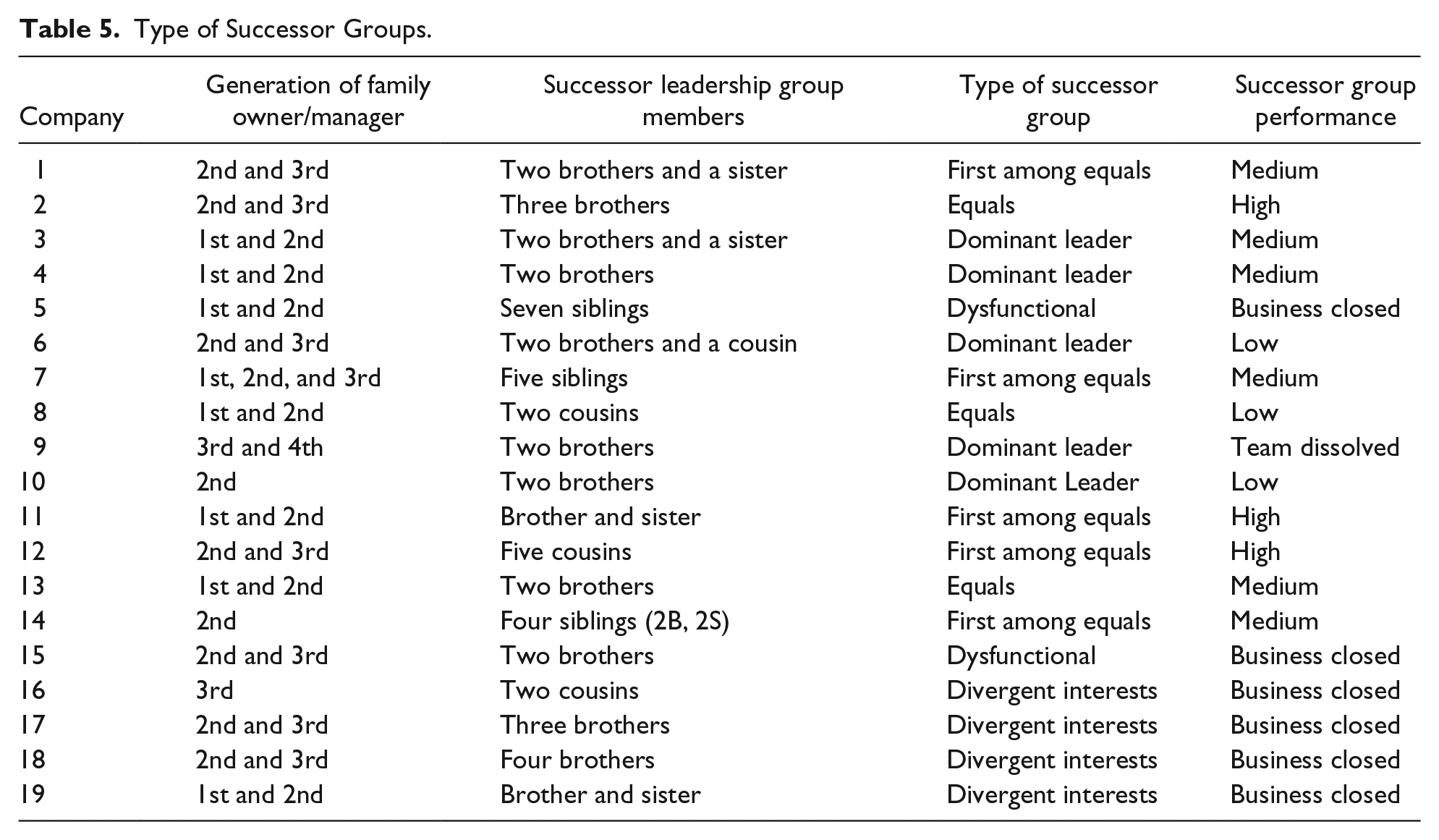
There were four respondent firms (Company 16, Company 17, Company 18, and Company 19) in which successor groups and their family firms failed in a less spectacular manner. In these cases, family members drifted apart, their interests and goals changed, their desire to operate the business waned, and they closed their businesses. For example, at Company 18 the respondent stated,
My dad passed away and it ended up being me and my brother and three uncles in the business. . . . Chain stores started coming into town and our sales started to drop off and then my uncles just basically said that they were ready to retire. . . . Yes, it was easy for them to say that they were getting into their 70s and to just shut it down.
We recognize this as a second type of failed successor group. Therefore, we add to Cater and Kidwell’s (2014) classification of successor leadership groups with an additional category that we term divergent interests groups.
The third category of successor teams—dominant leader groups—was characterized by unequal ownership and management authority among successor group members. At Companies 3, 4, 6, 9, and 10, one family member had a greater percentage of ownership than the other successor group members and operated as the CEO of the company. These dominant leader groups remain in operation, except for the successor group at Company 9, which was dissolved when the younger brother left the family business. This decision was not the result of dysfunction but a mutually accepted family decision. Company 4 typified the dominant leader groups. For example, at Company 4, Respondent A explained,
I have an older brother, four years older than me. He does not want to take a managerial/ownership role. He loves working with the family, but he does not want to be in charge of a lot of people and have all that responsibility. . . . My dad and I discussed this. I would own the business, but my brother would own the buildings. I would lease from him, so he would have a steady income for the rest of his life. He would still work for the company, but not as president. I am more of a leader and he is a follower. He would be higher than any other employee, but most decisions do not go through him.
The fourth category of successor leadership groups is called “first among equals,” from the ancient Roman practice of electing a Consul or leader from among the group of senators. In the family business context, this individual shares ownership equally with the other members of the successor team but is recognized as the leader or CEO of the company. We found “first among equals” leaders at Companies 1, 7, 11, 12, and 14. For example, at Company 11, Respondent B explained, “Here’s the thing. My brother and I have equal ownership, but he is considered the CEO. . . . There was no power struggle. . . . My brother does a better job. He is CEO material.”
The final category of successor teams is complete equals, meaning that the successors have equal ownership and management decision-making authority. We found complete equals at Companies 2, 8, and 13. At Company 13, Respondent B replied,
Yeah, as far as a leader. . . . We kind of are divided into our thing. I’m good with the plants and mechanical and I lead that and my brother is good on the paving and he leads that. . . . We are completely equal in status.
Getting a workable number of family members in the company was important. Some firms limited family members who could join the business (Companies 9, 11, 13, 14, 15, 16), other firms took in all interested family members (Companies 1, 2, 3, 4, 6, 7, 8, 12), and others had too many family members (Company 5). In our study, dyads were present among every type of successor team—dysfunctional, divergent interests, dominant leader, first among equals, and equals. Also, larger (three person or greater) successor teams were also present among each type of successor team.
After this analysis of each individual case, we move to our cross-case analysis results. Progressing from the 27 central categories of the selective coding stage, we developed 10 propositions that highlight our process model of Successor Team Dynamics in Family Businesses (see Figure 1). Taken together, these propositions combine findings from this study to enhance our understanding of successor teams.
Entrance of Successors Into the Family Business
In this study, we found four groups of factors that weighed heavily on the decisions of successors to enter the family business—family business history, personal experience of each successor, family behavioral interactions or dynamics, and invitation or permission of the predecessor. When these factors were indeed positive in nature, the family business became more attractive for successors. Many of the respondent firms had a rich history in the family business. For example, Respondent A at Company 1 remarked concerning the 100th anniversary of the company,
The store was opened in 1911, but we don’t know exactly which day. So, we had a big celebration in April and then in October we had bands and a tail-gating party in the parking lot one Sunday.
We believe that this celebration of family business history was attractive to the third generation of successors. A sense of positive family pride in the business as well as a certain amount of dutifulness may be compelling for successors. Mindful of the past, Respondent B at Company 1 stated, “If we could not agree with each other on how to run the business, we would be shut down in a year even after 100 years in business.”
As family members, the respondents were exposed to their family business from childhood. Respondent A from Company 15 stated, “I grew up in our family business. From the playpen on, I was there.” At Company 4, Respondent A recalled,
The business was started in the same year that I was born. I was born in January and the business was started in April. My mom would bring me to work as a baby. I can say that I have been there since the first day.
The respondents often worked as children in the family business with positive associations because of generous and fair treatment from incumbent family leaders. At Company 7, Respondent B recalled,
On weekends or after school, my mom would take us and they would set a case of tomatillos or jalapenos in front of us. Our job was to take off the stem and outer layer. Grandpa always kept us busy and he did pay us for it. . . . Once we were old enough to work in the restaurant, we started out at the bottom—cleaning tables, busing tables.
In this study, the typical pattern for successors was to work as a child in the family business during summers and after school, earn a college degree, and then return directly to enter the family business. We observed this pattern in all cases except for Companies 2, 3, 7, and 11, where successors were required to work elsewhere after college and then return to the family firm. At Company 11, Respondent D explained,
I still believe that it is a mistake to bring the next generation in without some outside experience because they don’t get other people’s expectations. They just have an extension of the family’s experience and that is not as healthy.
Family dynamics, a pattern of rich interaction of family members, sets the stage before entrance of the next generation into the family firm. At Company 12, Respondent C explained the situation,
Families have certain dynamics when you are growing up that spill over into the business. In any other job, it is from when you started. But growing up with these guys they know all about you from day one. They know all your characteristics.
Another family dynamic may be the expectation for successors to enter the family firm. At Company 6, Respondent A explained, “Where I came from near Chicago in the 60s, it was very common, if not expected, in almost any of the trade-related companies from concrete to carpentry to plumbing to come into the business.”
Family dynamics may also shape the working environment in a family business, making the company a more familiar and comfortable place for successors to work. At Company 11, Respondent B remarked as follows:
My parents had both grown up in conflicted households where there was fighting and arguing. . . . I think my parents said, “We don’t want any part of that.” . . . The consequence was that I did not grow up learning how to deal with conflict because I had no frame of reference for it. . . . So, we were not allowed to fight. . . . My parents disciplined us in terms of try to ignore the negative and encourage the positive. . . . So there are things even still in the company where people aren’t necessarily called out on things. My dad is a very understated kind of guy. I don’t think my dad has ever yelled. I’ve never heard my dad yell [laughter]. Not in 48 years have I ever heard that.
Incumbent leaders or predecessors also played an important role in the entrance of successors into the family firm. Predecessors may serve as gatekeepers to the family firm. They may invite successors to join the family firm or they may accept successors who seek to enter the firm. At Company 2, Respondent B explained that he wanted to invite his children into the family firm.
We told them that before joining our company that we expected them to have a college degree and consider going beyond that. We told them that there would be no job for them when they graduated from college. They were expected to find their own job and make their own way for a minimum of two years before joining the company. . . . Somewhere along the line my wife reminded me that I was so process oriented that I may not be communicating to our children that I wanted them to join the family business and would invite them to join the company. So in their later college years, I began to soften that up a little bit. I told them that it would be better if I was recruiting them than if they were asking for a job. We communicated to them to go make themselves so valuable that we would need them more than they needed us.
These findings lead us to propose the following:
Successor Team Formation
After the successors entered the family firm, processes carried over from their childhood continued as they learned to work together to form a team. In this successor team formation, we found five major elements in our study—the leadership of an incumbent family member, division of tasks, development of team members’ skills, establishment of a “pecking order,” and division of ownership. Our findings are in agreement with Cater and Kidwell (2014) that a predecessor or incumbent family business leader plays a key role in the assessment and choice of possible successor team members once they enter the family firm and oversees the process of successor team formation.
In some family firms, the predecessor may choose a single successor even when multiple successors have entered the business. The predecessor should assess the management skills of possible successors before and after they have entered the business. For example, at Company 2, Respondent B expressed the following to his children before they entered the family firm:
I told them that it would be better if I was recruiting them than if they were asking for a job. We communicated to them to go make themselves so valuable that we would need them more than they needed us.
At Company 2, three brothers have joined the family firm and comprise the successor team. It is possible that when multiple family member successors are present as viable candidates, competition among the candidates may occur. In cases of severe competition among possible successors, the predecessor may have to choose one candidate over another because he or she believes that the possible successors will not work together as a team. In other words, although the predecessor may choose among the possible candidates, the successors must agree to work together to develop a team.
Fortunately, such was not the case at Company 2. Respondent B explained how the successor team was formed:
After eight years and several assignments with Exxon, my third son began to talk about coming home. I was not sure what that meant, but I invited him. His two brothers were here. I made a pitch to him that we would really like him to come work for the family business. He spent a year with Exxon in the U.S. and then joined us three years ago. He brought a significant amount of experience to our management team. There was concern that with M. joining the company as the third one that two is company, but three is a crowd. Because of his background as a mechanical engineer and his experience in the oil and gas industry internationally, he had instant credibility in the company. It was a relatively easier transition than I anticipated. He had a great attitude about wanting to fit in and be a part of the team and he had the credibility. This is the path for them to come into the company and take over as the third generation.
As at Company 2, the predecessor should also consider challenges facing the company such as the complexity and size of the business. As the family business grows and success continues, the company may require greater knowledge, skills, and abilities from the leaders. When family member successors are present and possess the needed management skills, the choice of a successor team is most attractive and practical for the family firm.
Predecessor leadership may also serve to reduce conflict between the successors. For example, at Company 11, Respondent C described how his father directed the division of tasks, development of skills, and division of ownership between his children in the family business.
My father directed the training process for me. . . . The other thing that my father did for my sister and I is that we are in opposite ends of the building. I’m in the northwest and she is in the southeast. There is a Chinese wall between us. She does retail, stores, fast-food restaurants; and I do wholesale, so there is absolutely no overlap between our assignments. . . . We have gone through a series of stock gifts that currently both my parents own a third, my sister owns a third, and I own a third.
A common pattern reported by respondents was that on joining the family firm, successors were assigned a job consisting of tasks that the incumbent generation leaders believed they could perform or suited their personality based on years of family behavioral interactions. This was once again designed to reduce possible conflict between successors. At Company 10, Respondent B stated,
I man the grill and I prepare the shrimp—defrosting and peeling. I do food preparation and decorations. My father trained me about everything that needed to be done. I started as a host to learn basic working principles. I moved from there to dishwashing to cooking to food preparation. I work mostly in the kitchen and my brother handles customer-related things that go on out front.
Incumbent family business leaders managed the development of the successors’ skills by providing opportunities for advancement to better paying and more responsible jobs within the firm. At Company 11, Respondent C explained as follows:
I started in our sales department and worked for six months. Then, we bought a very small distributorship that was very much like ours—but, a tenth of our size. So, Dad put me over there. M L, who still works for me, was the one who taught me the business. . . . So, I did that for three years. Then, they brought me inside and started my education through the different chairs from everything from dispatch to accounting.
As the management skills of the successors grew, predecessors redesigned their jobs and changed the original division of tasks. At Company 2, the predecessor recognized the differing talents and personalities of his sons, placing the more creative son in sales development and the more detail-oriented son in operations. Respondent A at Company 2 explained as follows.
We just had a reorganization of duties recently. When I first came back to the company, I was a project manager in our construction division. Then, I led an operating division for a while. In 2008, my brother and I both became executive vice presidents and we began to take over the daily operation of the entire business. Everyone in the company reported to us and we reported to our dad. Recently, we reorganized so that my brother runs all of the operations and I have the business development, sales, and strategy side.
As the successors developed their skills inside the family firms, we observed that a process of socialization continued to take place among the group members. This socialization carried over from childhood, before their entry into the family business. To describe this socialization, we borrow a term, pecking order, from animal behavior. “Pecking order” refers to a social pattern among a flock of birds in which “each bird pecks another lower in the scale without fear of retaliation and submits to pecking by one of higher rank; broadly: a dominance hierarchy in a group of social animals” (“Pecking Order,” n.d.). So, in successor teams, is there a dominance hierarchy? At Company 12, Respondent A, the leader of the second generation of the family business, made the following comments about the third generation:
Respondent E, my sister’s oldest son, stands out and so does D— in certain departments. My son has been with the company full-time for 10 years, the other three have been with the company for 20 years. So, they have a lot more seniority. Respondent E and D— are the more natural leaders.
Within the third generation of Company 12, it became clearer that Respondent E is the leader. Respondent D from Company 12 explained,
For me, Respondent E is the leader. He is my older brother. That is always how it has been. I worked underneath him when he was a store manager and I was an assistant store manager. He was my district manager when I was a store manager. Now that I am a district manager, I still report to him.
At Company 12, as the third generation continues to grow and develop, we believe the pecking order will become even more clearly defined, and this socialization process is common in most successor leadership groups.
The fifth element that we observed in the formation of the successor team was the division of ownership among the successors, which may be equal as in the “complete equals” or “first among equals” teams or unequal as in the “dominant leader” group. The division of ownership issue may lead to conflict among the successors where perceptions of fairness may vary. However, positive track respondents did report equitable solutions to this issue. At Company 1, Respondent A stated,
It is hard to be fair to everybody in a family business. We need to come up with a reasonable solution for the next generation. What do you do with the family members who are in the business? What do you do with the family members who are not in the business? You want a fair and equitable solution, but sometimes there is no such solution.
At Company 2, Respondent A described his family’s solution to the dilemma of ownership division among siblings who do not work in the family business and those who do, “The nonworking siblings do not have voting rights. My brother and I do have voting rights as well as my dad. The other siblings have an equal share of ownership, but they do not have voting interests.”
Based on these observations, we propose the following:
At this point, we observed a divergence among the companies in our study. The majority of the successor teams continued on a positive and healthy track, but we observed dysfunctional behavior in Company 5 and Company 15 and divergent interests among successors at Companies 16, 17, 18, and 19, which followed what we term a negative and unhealthy track. We will first examine the positive track, exemplified by most of the companies in our study, and then we will describe the negative track, exemplified mostly by Companies 5, 15, 16, 17, 18, and 19.
Positive Successor Team Performance
Although we separated the respondent firms in our study into a positive track and a negative track, it is important to note that we observed variance in the performance of the successor teams. We carefully studied the successor teams in the positive track of our study and recognized variance of performance among them. We analyzed the successor teams in terms of the four Cs—context, composition, competencies, and change capabilities (Dyer et al., 2013) as well the size and growth of the respondent companies. On these bases, we categorized the surviving successor teams as high performance, medium performance, or low performance. Three respondent companies in our study stand out as possessing high-performing successor teams: Company 2, Company 11, and Company 12. Medium-performing successor teams were found at Company 1, Company 3, Company 4, Company 7, Company 13, and Company 14. Low-performing successor teams were present at Company 6, Company 8, and Company 10 (see Table 5).
Another issue is the length of time that a successor team works together. When we considered the three highest performing companies and their successor teams (Companies 2, 11, and 12), we found that the successor team at Company 11 has worked together for 25 years, but the successor teams at Companies 2 and 12 have had changes and additions in the past 3 years. Yet these are the highest performing successor teams in our study. In medium-performing teams in our study, the successor team at Company 1 has been working together for 30 years although one member has just retired. At Companies 3, 4, 7, and 9, there have been changes in the composition of the successor teams in the past 5 years as well. Therefore, while it makes sense that teams that have worked together for many years will perform better, the successor teams in our study are different from most management teams because they have known each other their entire lives, and this may mitigate the importance of time working together.
A functional successor leadership may be formed when the elements of division of tasks, development of team members’ skills, establishment of a pecking order, and division of ownership are correctly managed by the predecessor and accepted by the successors. Then, the family business may follow what we call a positive track. In the positive track, successors work together cooperatively, and the firm continues to operate successfully and survive as a family business. “Because of the family business, I feel more connected and responsible for its success. I put a lot more of myself into this than if I were working somewhere else in a desk job,” commented Respondent A at Company 8. Once the successors have entered the business and formed a group, they must learn to work together. We found that the terms working together and getting along were used repeatedly to describe family business operations (see Table 3).
At Company 12, Respondent C related his experience working with his cousins:
I work with (my cousin) D—– at the operational level, more than the other cousins. We all work in the same hallway. We’re all in the same building, same hallway. We’re all pretty close. We see each other. . . . We work pretty well together.
Respondent D at Company 12 confirmed this assessment, “We do work well together. . . . There are times that everybody has their ideas and sometimes we don’t always agree, but there’s never been a fight about it. So we get along pretty well.” With individuals having different ideas, substantive conflict exists even in close families that work together. The important factor is that the conflict focuses on business issues and does not spill over into relationship differences and personal conflict.
There may be differences in personality and management style among the successors, but the sum effect should be a complementary management team. For example, Respondent A at Company 11 described the second-generation management team as follows:
They are almost polar opposites. . . . My dad was kind of the rebellious teenager and my aunt was the dutiful daughter, and then after college, they kind of flipped. My aunt is the fun, crazy aunt and my dad is the obliged son. So, they are very different, but they and I think all of my family gets along surprisingly well. They just aren’t confrontational, so even if they were mad at each other, you’d never really know.
In the positive track, respondent companies found ways to turn their family situations into successful business operations. Company 7, which was characterized by heavy family involvement with three generations and 35 family members, served as an excellent example of problem solving and decision making. The 77-year-old founder and family patriarch is “the captain of the ship. I think what’s kept us prosperous and what’s kept us going is that there is still a captain in this ship and we all answer to the captain when it comes down to,” explained Respondent A at Company 7. The successor team is treated equally. “It is equal because we get the same salary, every single one (of the successor team). Respondent A makes the same money that I make. Equal pay for everyone, even if one of us sells more,” explained Respondent C in Company 7. The family patriarch left daily operation of the company to the successor team. “He is still the boss. At each of the three restaurants, it is divided. That way nobody gets into each other’s business. Each one makes their own decisions, but overall, my grandparents make the decisions, specifically my grandfather,” stated Respondent B at Company 7. Finally, the family patriarch did help resolve conflicts among the successor team members. The family patriarch listened to his successors with regard to major decisions, and the family members responded by supporting family decisions even if they individually disagreed at first. Respondent C at Company 7 gave an example of this as follows.
My oldest brother came and told my father that this property (for restaurant number 2) was available. Then, we held a family meeting to discuss it. . . . When we bought this place, the only ones who wanted to do it were my oldest brother and myself. The others did not want to do it. If it weren’t for me and my oldest brother, we would not have this one. It was just me and him against my brother-in-law, my sister, and my brother.
The interaction among successor team members, problem solving, and decision making at Company 8 was highlighted by shared responsibility. Here the cousins of the successor team worked harmoniously. Although they could both do all the jobs necessary for their store and they did divide tasks among themselves, Respondent A at Company 8 explained,
We’re there together if we need to work on something or things happen where it’s busy and we need more people. . . . We definitely touch base every day and we work behind the scenes on blogs and e-mail blasts and ordering because things turn out better if we do them together.
Similarly at Company 10, the family was very close. “We depend on each other (father, mother, and brother), not other people. We are with each other all the time,” explained the younger brother, Respondent B at Company 10. The two brothers of the successor team worked well together and exhibited little sibling rivalry even though their parents had given ownership of the seafood restaurant to the older brother. This brother, Respondent A at Company 10, described the situation, “My parents have put everything in my name. Eventually, they will open another place and put it in my brother’s name. My parents will start retiring.” The parents had made one unsuccessful attempt to open another restaurant for the younger brother, so he seemed content to wait for his opportunity. In the meantime, the brothers share an apartment, and the younger brother stated, “My brother is my best friend. We have been very close since we were very young. Now, we have a good working relationship.” This serves as a refreshing example of brotherly love overcoming sibling rivalry as well as highlighting positive interaction and trust between the two generations at Company 10.
Working cooperatively together is a key to success for the successor teams in problem solving and making decisions. At Company 13, Respondent B replied,
As far as business decisions, we talk about it and . . . it’s not a vote, really. If it’s not unanimous, we don’t do it basically. . . . Even though two of us could outvote the other, we don’t. . . . We wouldn’t. . . . We still have to deal with each other as a family.
In the positive track, successors work together, learn cooperative decision making, and become increasingly committed to the family business. At Company 14, Respondent D stated,
Everyone was expected to do their part. And everyone wanted to do their part because we felt like we were working toward a goal together. And it brought out that we need to recognize the other personalities so that we can work together.
At many of the respondent firms, strong commitment was reported among the successors. “I believe that there is a high level of commitment to our company among the family members,” reported Respondent A at Company 13.
These observations lead us to propose the following:
Negative Successor Team Performance
Strong founders may establish a solid foundation for their company on the business side but at the same time sow the seeds for the fall of their business on the family side. In this article, we refer to this situation as the negative track. In the negative track, successors do not work together cooperatively, the successor team collapses, and the family business is closed. In this study, we found two negative track variations—one variation characterized by anger and hostility among family members leading to a blow-up of family relations and another in which interests among the successors diverged and a burnout or loss of desire to remain engaged in the family business occurred. Both of these negative track variations led to the closing of the family firm.
First, we report on Variation 1, in which we found two cases of sad misfortune, neglect, deceit, and dishonesty—human failures written on the family business stage. We discovered two highly regarded longtime family firms that provided excellent products and services for many years in their local communities that have either closed their doors today or split into smaller, weaker parts because of family issues.
In the negative track Variation 1, the family businesses were able to continue to operate as successors entered the firm. Successor groups were formed, but personalities clashed and working conditions deteriorated as individuals did not work well together. For example, at Company 5, an immigrant to America made his dreams come true by opening and successfully running a restaurant business for over 30 years. However, this gentleman passed away suddenly in 1975, leaving behind a 44-year-old widow and seven children (four sons and three daughters) with a very popular two-restaurant business. Respondent A at Company 5 recalled,
When he passed away we were amazed about the front-page story and the radio and television stories that they did about him. He helped a lot of people that we didn’t know about because he remembered what it was to be poor. . . . It was an honor to be a part of his life, I mean it was an honor to be his son.
All of the children worked in the family restaurant business “washing dishes and peeling garlic,” and three out of seven graduated from college. Their mother, who had been a stay-at-home wife, ran the operation “more as a mother than a businesswoman.” There were problems with employee theft of food from the kitchen and lack of accountability among family members, including incidents of company money used for personal home repairs and too much drinking among the sons. Although the children had operational knowledge of the restaurant, the premature death of the founder left a power vacuum because no leader or leaders of the successor group had been chosen. Respondents A and B and their two brothers did step up and manage the two locations. Respondent B at Company 5 recalled,
For many years, it was me and my youngest brother at Number 1 (the original restaurant) and then Respondent A and my oldest brother at Number 2 (the second restaurant). Sometimes my youngest brother would go back to Number 2. I had people that I thought I could depend on.
The second generation was able to manage the restaurants successfully and operate profitably for 30 years with their mother as the majority owner. By treating her children as equals, their mother maintained the family and the business keeping the conflict among her children at bay, but then she came down with dementia, leading to Alzheimer’s disease. “Momma’s sickness has gone on for 4 or 5 years at a cost of about $7,000 a month. Nobody thought about buying a long-term care policy,” explained Respondent A at Company 5.
So, while there was a group of successors, there was no designated or chosen leader or leaders. The predecessors did not assign specific roles for the successors, and the successors did not agree among themselves about those roles after their mother became disabled. This mismanagement by the first generation (both father and mother) contributed to problems in the second generation. Relationship conflict grew among the siblings, and a power struggle for control of the family firm took place. The oldest sister took matters into her own hands, by surreptitiously obtaining a power of attorney for her mother’s estate. Respondent A at Company 5 stated,
My oldest sister has split the whole family apart. I don’t talk with my sisters. . . . I don’t know if it was greed, or if this guy (brother-in-law) wanted control. To me, it was a conspiracy theory or something. The girls saw this money if you get rid of three or four of the boys. . . . Unaware to me, there was a Power of Attorney. The Power of Attorney was brought up and the sisters have control. . . . When Momma passes away, there will be World War III . . . . It is a bloodbath with family business.
The original family restaurant closed down in 2012 as problems arose with tax liability issues. One of the sisters opened another restaurant, using a variation of the original family restaurant’s name. One of the brothers opened a restaurant on his own and then closed it. Respondent A also opened his own restaurant in the same city and continues to successfully operate within a few miles of his sister’s restaurant.
Company 15 was a retail feed store, started in 1940. The founder’s son took over the business after his father’s death in 1977 and ran the business with his wife and two sons. The older son worked in the family business after school and during the summers until his graduation from college. Then, he entered the business full-time in 1981 and enjoyed a close relationship with his father. The father was the glue that held the family together in the business. Both of his sons entered into the business as an expected matter of course. With the father in charge, the brothers cooperated with each other. Then, the father passed away in 1996, and majority ownership passed to the mother. However, the embedded relationship conflict between the two brothers flared. Respondent A at Company 15 recalled as follows:
My brother never got to work early and I always did, which was fine. I like to get up early, but I also wanted to leave early. That caused a lot of conflict. He was supposed to get there at 7:00 a.m. So, I said that however late you get there in the morning, I will leave that early in the afternoon. I would work in the store by myself. I had been up since 5:00 and had been working since 5:30 or 6:00, so I was ready to go home. That caused a lot of conflict. One of my sayings is that if you can work with your family, you can work with anybody.
The younger son did not share the same work ethic or sense of responsibility to the family business. Periodically, the younger son would leave the family store and go to work for friends or relatives in other states. As the years passed, the mother became more partial to her younger son and did not want him to leave. Respondent A at Company 15 explained,
She kind of made him come back in 1995. We had a good month or so and then everything went back to the crappy way it had always been. It is hard to work with your family. . . . After we were together for a short time, we were at each other’s throat. . . . I have no relationship with my brother. It has never been wonderful. It is worse now than it probably ever was.
After 32 years working in the family store, Respondent A moved about 30 miles away to another city and opened a second feed store along with his wife in April 2003. Respondent A felt that geographic separation would ease the conflict with his sibling. He stated,
We all agreed that that was fine and we would open store number 2 over here. So, we moved over here and got settled and got our son in school. Then, my mother and brother decided that we were not going to do store number 2. They did not consult me or ask and did not really care. So, I said that I would do it by myself. I was not going back then. We had sold everything we had.
The mother and younger brother did not want the older son to use the family name for the second store and filed a lawsuit to prevent this. The older son and his wife operated the second feed store for over 10 years. “Prices of feed skyrocketed and the economy got pretty bad. We built the store over here, so we had a lot of overhead. We just kept struggling with it until we ran out of money.” The older son closed the second feed store. The mother continues to operate the original store, and the younger son has part interest in that store and another store in the area.
In both cases in the negative track Variation 1, we find factors leading to downward operating spirals and less than optimal outcomes for the family members involved. The incumbent-generation leaders failed to clearly designate a leader or leaders of the successor generation. Unresolved conflict, although kept at bay for years, surfaced and led to negative results. Relationship conflict led to dysfunctional behaviors (from theft to mismanagement to absenteeism), which were harmful to the profitability and survival of the family businesses. Ultimately, the successor groups were dissolved as individuals left or were forced to leave the family businesses. The inability to work together as a group led to the closing of the original family business in one case and the opening and subsequent closing of new family firms in other situations.
In Variation 2 of the negative track, we also found relationship conflict among family members, although the conflict was less severe and did not result in extremely dysfunctional behavior as in Variation 1. For example, Respondent A at Company 16 described the mild to moderate level of conflict among family members in their men’s clothing store as follows:
Some families get along and some don’t. There’s this conflict. Some families have hot-headed family members. Some families have just got tempers. . . . I was low-key and my dad was low-key and my cousin was medium, but his dad was the highest strung one there. We knew how to skirt around right where his hot points were and we didn’t mess with him. So you’d stay away from him but every once in a while you couldn’t help but push him. You’d take your little laugh and say, well, I’m not going to do that again. Just leave those shirts where they are if that’s the way he wants them.
Rather than extremely dysfunctional behavior, such as legal coups and moving to cut off the inheritance of other family members, we found that successor team members in Variation 2 tended to grow apart and desired to pursue different interests outside their family firm. The level of conflict slowly grew and led successor team members to become uncomfortable. At Company 16, the two cousins in the third generation operated the business successfully for several years, but changes occurred as one cousin’s sons entered the family business. Respondent A at Company 16 further explained,
So, you had three (the cousin and his two sons), more or less, plus one. Not that it was like that, but I got a little bit alienated even though my second cousins did not have any shares (of stock). My cousin was helping them and supporting them because they couldn’t do much on their own. So, there was a little frustration there on his part. And then I could feel us not quite as comfortable as before and the men’s clothing business was slowing down a little, and his sons needed a little more money.
Then, Respondent A at Company 16 found a new business opportunity. Another family member wanted to sell his school uniform business, and the respondent recognized an excellent chance to leave the men’s clothing store.
I figured my cousin would want in on the school uniform business too, but he didn’t want to because he wasn’t getting along with (the other family member). So I’d thought he’d want to be a partner, but yet when I asked him, he said no thanks.
In Variation 2 of the negative track, relationship conflict led successor team members to consider divergent interests, such as buying another local business (Company 16), leaving town to open another business (Company 17), or deciding to retire and sell the family business (Company 18). Also, sales and profits at the family firms began to dwindle. At Company 16, Respondent B explained,
It is just not worth it to work so hard and make very little money. In the early years, we made real money and then we started making half of that. We just started thinking we should try different things because we just couldn’t make money.
Although Variation 2 firm members did not experience the anger and hostility of Variation 1, their actions ultimately led to the dissolution of the successor team and then the closing of the business. Therefore, we propose the following:
Discussion
The results of this study lead us to propose a model of successor team dynamics in family businesses in relation to the existing literature in family business succession, groups and teams, conflict theory, and family dynamics (see Figure 1). In proposing the model, we develop theory addressing the process-oriented elements of team-based family firm succession. The model contributes to ongoing efforts to better understand the why and the how of team succession in family businesses. We add to the existing succession literature by addressing the underresearched topic of multiple successors, looking at both successful (surviving) successor teams and unsuccessful (dissolved) successor teams, and the positive firm-level outcomes (continuance of the family business) and negative firm-level outcomes (closure of the family business) associated with successor leadership teams.
Following Handler (1990) and Churchill and Hatten (1987) from the family business literature and Tuckman (1965) from the groups and teams literature, we propose a four-stage model of successor team dynamics. The model begins with Stage 1—factors leading to the entrance of successors into the family business. In this study, we found external factors—positive associations with the history of the family firm and positive behavioral interactions or dynamics—and internal factors, such as personal experiences that lead to the entrance of eventual successor team members into the family business. The family business literature explains that successors must be ready to work in the family business (Brun de Pontet et al., 2007); interested and capable (Birley, 2002); willing and committed to the process (Barach & Gantisky, 1995); become trained, skilled, and experienced (Barach et al., 1988; Morris et al., 1997); and possess integrity (Chrisman et al., 1998).
When these factors are properly managed, fostered, and encouraged by incumbent family leaders, our findings indicate that eventual successors are more likely to enter into the family business by choice. Then, in Stage 2, tasks are divided, skills are developed, a pecking order is established, and ownership is divided. As each successor enters the business, the process of team formation is modified to include the entering individual. Over time, groups of successors may achieve higher levels of interaction and develop a greater sense of responsibility and group identification (Sundstrom et al., 1990). Our model echoes elements from Tuckman’s (1965) sequence of forming, storming, norming, and performing in that successor teams are formed, conflict occurs, positive or negative behavior results, and then groups may become committed to the company or be dissolved.
In Stage 3 of the model of successor team dynamics in family businesses, the team has been formed. In this stage, a positive track and a negative track develop. In the positive track, the successor group members worked together, focused more on substantive conflict, and reduced issues that caused relationship conflict. In the present study, either substantive conflict or relationship conflict among the successor teams was reported in every case (see Table 4). As noted earlier, Sorenson (1999) found that the best conflict management style was collaboration, working toward a “win–win” situation. When team members are focused on process and task issues (or substantive conflict according to Davis & Harveston, 2001), conflict may be more easily resolved. Kellermanns and Eddleston (2004) proposed that a moderate amount of process and task (substantive) conflict is good for a family firm. The end result of the positive track was successor team commitment in which the successors identified with their family business and understood the importance of working with their teammates. Organizational commitment is commonly referred to as the degree to which employees believe in and desire to remain in an organization (Kanter, 1968; Meyer & Allen, 1991). Likewise, commitment to the family firm is very important for successors (Chrisman et al., 1998; Sharma & Rao, 2000) and occurs in four ways: affective (perceived desire), normative (sense of obligation), calculative (perceived opportunity costs), and imperative (perceived need; Sharma & Irving, 2005). Most individual members of the successor teams in this study reported positive emotions with regard to their family firm.
In Stage 3 of the model, we also identify a negative track. When things go wrong with a group of successors, the focus turns to relationship conflict. Personality clashes and selfish desires and actions predominate. Eddleston and Kidwell (2012) refer to dysfunctional or deviant behavior as harmful behaviors such as theft, withholding job effort, violence, insubordination, sabotage, poor attendance, misuse of information, drug and alcohol use and abuse, and various types of harassment. We observed some of these behaviors at Companies 5 and 15 in our study. As noted, research in family firms has linked the intensity of relationship conflict among family members with negative effects on performance (e.g., Kellermanns & Eddleston, 2004, 2007). The relationship conflict and dysfunctional behavior at Companies 5 and 15 both resulted in major losses for those involved. Additionally, we found a second variation in the negative track in which family firms do not experience dramatically dysfunctional behavior, but rather the family members involved lose their zeal for the firm, develop divergent interests (e.g., retirement or another business opportunity), the successor leadership team is dissolved, and the family firm closes.
In Stage 4 of the model, we note the impact of the successor team on family business outcomes, including the continuation of the family business, new businesses formed by successors, and the closing of the original family firm. In all of the cases in this study except Companies 5, 16, 17, 18, and 19, the original family firm continued to operate. At Company 5, the family business was closed, but three successors opened new businesses (all similar type restaurants) with one failing and the other two still in operation. At Company 9, the successor team was dissolved, but one successor continued to work alone in the family business. At Company 12, one of the three successors in the second generation left the company and the remaining successors bought out his stock ownership. At Company 15, the successor team was dissolved and both successors entered other businesses with the older son’s company failing. At Company 16, the family business closed, one successor retired, and the other opened a new business. At Companies 17, 18, and 19, the family business closed and no new businesses have been opened.
Limitations and Future Research
In this study, we examined why some successor leadership teams work together successfully within family businesses and others do not. The findings presented here relate particularly to small family firms in a U.S. context. We recognize inherent limitations pertaining to cultural variations. For example, we cannot comment on the process of successor team dynamics outside of the United States. We also acknowledge limitations as to sample size and that data from a larger, representative sample obtained via survey work could be obtained. More specifically, it should be noted that there are other factors, especially external factors that affect family business outcomes, such as competition, economic conditions, and government regulations. We also note that family firms may overcome dysfunctional behaviors by successor team members. Conversely, successor teams with little dysfunctional behavior are not immune from negative outcomes and should guard against too much agreement and too little substantive conflict (Kellermanns & Eddleston, 2004). We do not claim to have covered all aspects of successor team dynamics but view our study as a part of a continuing stream of research. Additional studies are needed to better understand successor leadership group dynamics, longitudinally and across cultures, to further examine the role of the incumbent family leader in establishing successor teams and to differentiate among successor teams by size (dyads vs. larger groups). Future studies could also examine variance of performance among successor teams in greater detail.
Conclusion
Our study traces the development of successor teams in family firms using a case study approach. We propose that successor teams have their roots in family business history, family behavioral interactions or family dynamics—patterns of behavior that begin well before successors enter the family firm, and the personal experience of successors. We emphasized five important aspects of successor team formation—predecessor leadership, division of tasks, development of team member skills, establishment of a pecking order, and division of ownership. We recognized the existence of positive and negative tracks of interaction among successor team members, involving substantive and relationship conflict and ending in greater organizational commitment of the team members or the possible dissolution of the successor teams—and the firm. We also found two variations in the negative track—one variation in which family firms exploded do to dysfunctional behavior and closed and a second variation in which family firms burned out slowly over time as the successors developed divergent interests outside the family firm leading to its closure.
Our study contributes to the knowledge of succession in family firms in the following ways. First, we explore an underresearched topic in successor leadership teams. Second, we address successor team formation and performance using variables gleaned from our respondents in their own terminology. Third, we explicate the behavioral aspects of successor team formation and successor team performance. Fourth, we identify both positive and negative tracks of successor team member behavior, which to our knowledge has not been done before. Fifth, our propositions in alignment with the model provide a clearer picture of the complex issue of successor team dynamics.
Finally, for practitioners, successor leadership teams should be considered as a viable alternative to a single successor. The possibility of equal opportunity for all successors should be appealing for incumbent family firm leaders and may prove to be the best use of available family human resources.
Footnotes
Declaration of Conflicting Interests
The author(s) declared no potential conflicts of interest with respect to the research, authorship, and/or publication of this article.
Funding
The author(s) received no financial support for the research, authorship, and/or publication of this article.
Author Biographies
References
Supplementary Material
Please find the following supplemental material available below.
For Open Access articles published under a Creative Commons License, all supplemental material carries the same license as the article it is associated with.
For non-Open Access articles published, all supplemental material carries a non-exclusive license, and permission requests for re-use of supplemental material or any part of supplemental material shall be sent directly to the copyright owner as specified in the copyright notice associated with the article.
