




Abstract
Incumbents’ attitude toward intrafamily succession (IFS) is a critical individual-level determinant of family firms’ IFS intention, which is, in turn, an important component of family business essence. Knowledge about its antecedents, however, is fragmented and very limited. Drawing on the theory of planned behavior and general attitude literature, hypotheses about the situational and individual antecedents of family firm incumbents’ attitude toward IFS were developed and tested with a sample of 274 Italian family firm incumbents. Results show that incumbents’ attitude toward IFS is indeed influenced by both situational and individual antecedents as well as by their interactions.
Introduction
Intrafamily succession intention (IFSI) in leadership is of critical importance to the evolving theory of the family firm because it is used to differentiate, theoretically and empirically, the behaviors of family and nonfamily firms (Chua, Chrisman, & Sharma, 1999). For example, it has recently been shown to influence several aspects of family firm behavior such as the pursuance of noneconomic goals (Chrisman, Chua, Pearson, & Barnett, 2012) and valuation of the family business by family firm CEOs (Zellweger, Kellermanns, Chrisman, & Chua, 2012). The evidence suggests that these influences strongly affect family firm behavior regardless of whether intrafamily succession (IFS) actually takes place later on. Despite this importance, knowledge about the antecedents of IFSI is fragmented. Therefore, there is a great need to examine them in more depth.
For IFS of leadership to proceed, next-generation members must have the intention to take over (Sharma, Chrisman, & Chua, 2003; Sharma, Chrisman, Pablo, & Chua, 2001), and incumbents—defined as the family members who currently hold the top management position in the firm and who must relinquish that position before another family member can take over—must have the intention to transfer the leadership of the business to the next generation (De Massis, Chua, & Chrisman, 2008). Since incumbents largely control (Long & Chrisman, 2014; Rubenson & Gupta, 1996) and play a critical role in the succession process (e.g., Daspit, Holt, Chrisman, & Long, 2016; Davis & Harveston, 1998; De Massis et al., 2008; Handler & Kram, 1988; Kelly, Athanassiou, & Crittenden, 2000; Lansberg & Astrachan, 1994; Le Breton-Miller, Miller, & Steier, 2004; Marshall et al., 2006; Royer, Simons, Boyd, & Rafferty, 2008; Sonnenfeld & Spence, 1989), their individual-level IFSI should be just as, if not more, important than that of next-generation members.
Next-generation members’ IFSI has received considerable scholarly attention (Schroeder & Schmitt-Rodermund, 2013; Schroeder, Schmitt-Rodermund, & Arnaud, 2011; Zellweger, Sieger, & Halter, 2011), but researchers have so far overlooked that of the incumbents despite recent literature reviews calling for research on IFSI from incumbents’ perspective (Gagné, Sharma, & De Massis, 2014). Indeed, most prior studies examining family business succession from incumbents’ perspective have focused on the actual behavior (i.e., IFS) and dealt with the issues and challenges during the succession process (e.g., Sonnenfeld & Spence, 1989), with none of them taking a step back to focus on the intention toward such behavior.
To the best of our knowledge, the only empirical study explicitly focusing on this topic is the exploratory one by Chua et al. (1999), who argued for the important role played by incumbents’ IFSI in determining the distinctive behavior of the family firm and showed that the levels of family involvement in ownership, management, and governance are poor predictors of IFSI. That study did not probe deeper into the antecedents of IFSI, so we lack rigorous, systematic, and empirical investigations of the factors affecting this important determinant of family firm behavior.
This lack of attention is regrettable for several reasons. First, IFS is very rarely feasible in the nonfamily firm; therefore, IFSI is unique to the family firm. Second, although family involvement through ownership and management captures the family’s ability to influence firm decisions toward particularistic ends, ability alone does not ensure that the family firm will actually make those decisions and pursue the particularistic behavior (De Massis, 2012). Of equal if not greater importance is the family’s willingness to pursue idiosyncratic strategies and policies (Chrisman, Chua, De Massis, Frattini, & Wright, 2015; Chua et al., 1999), with IFSI contributing importantly to such willingness (De Massis, Kotlar, Chua, & Chrisman, 2014). Empirically, studies have shown that IFSI is associated with family influence and commitment to the business (Holt, Rutherford, & Kuratko, 2010), family firms’ access to debt financing (Chua, Chrisman, Kellermanns, & Wu, 2011; Koropp, Grichnik, & Gygax, 2013), and have identified IFSI as a key determinant of family-oriented particularistic behavior (Zellweger et al., 2012). To repeat, flowing out of this body of knowledge is the important fact that IFSI influences family firm behavior whether or not IFS actually takes place later. 1
One of the most important determinants of IFSI is attitude toward IFS. In fact, according to the theory of planned behavior (TPB) literature (Ajzen, 2001; Armitage & Conner, 2001), attitude toward a behavior is the most important antecedent of intention to engage in that behavior. Hence, our understanding about family firms in general, and IFS in particular, would have wide theoretical and empirical gaps if we did not gain more detailed insights into how incumbents’ IFSI is formed and, in particular, the situational and individual antecedents of its main determinant—incumbents’ individual-level attitude toward IFS. We aim to help close this gap by investigating family traits, firm characteristics, and incumbent attributes (De Massis et al., 2008) as possible situational and individual antecedents to incumbents’ attitude toward IFS.
To investigate the determinants of attitude toward IFS, we draw on the TPB and general attitude literature (Ajzen, 1991; Ajzen & Fishbein, 1980; Fishbein & Ajzen, 1975), which propose that an individual’s attitude toward a particular behavior is affected by her or his beliefs about whether the behavior in question will be positive or negative (Ajzen, 1991, 2001; Armitage & Conner, 2001). Using these insights, we develop hypotheses relating situational and individual antecedents to incumbents’ attitude toward IFS. Then, we test our hypotheses on a sample of 274 incumbents of Italian family firms. The results show that incumbents’ attitude toward IFS is indeed influenced by situational and individual antecedents that affect their beliefs about whether IFS will be positive or negative.
This study contributes to the literature in several ways. First, it provides a theoretically based and finer-grained understanding of incumbents’ attitude toward IFS. To the best of our knowledge, our study is the first to provide a conceptual model focusing on the incumbent and connecting incumbents’ attitude toward IFS with situational and individual antecedents. The model contributes to the theory of the family firm by enhancing our understanding of attitude toward IFS and thus, connectedly, IFSI, which has been proposed by many researchers to be central to the distinctiveness of the family firm (Chua et al., 1999). Second, we provide empirical evidence in support of the main contentions of the model. Third, our accompanying finding that the level of family involvement in ownership, management, and governance is a very weak predictor of incumbents’ attitude toward IFS adds to the growing evidence showing that family involvement is a necessary but insufficient condition for explaining how and why firms, even those with similarly extensive family involvement, may behave and perform differently (Chrisman et al., 2012; Chrisman, Fang, Kotlar, & De Massis, 2015; De Massis et al., 2014; Uhlaner, Kellermanns, Eddleston, & Hoy, 2012). Fourth, although our results are not directly related to the literature on whether a family ultimately follows a family-internal or family-external exit path (Dehlen, Zellweger, Kammerlander, & Halter, 2014; Wiklund, Nordqvist, Hellerstedt, & Bird, 2013), we do contribute by providing important insights related to one of the important determinants of the behavior.
Theory of Planned Behavior and Attitude Literature
In the TPB, individuals’ intention is conceived as “an indication of how hard people are willing to try, of how much of an effort they are planning to exert in order to perform the behavior” (Ajzen, 1991, p. 181). Due to the presumed stability and predictive value of intentions with regard to later behavior (Armitage & Conner, 2001; Chrisman, 1999; Kautonen, van Gelderen, & Fink, 2015), the intention model proposed by Ajzen (1991, 2002) has been used frequently as the theoretical framework for investigating intentional or planned behavior. Within family business research, the TPB has been used to examine potential successors’ intention to take over their family firms’ leadership (Zellweger et al., 2011) and family firms’ likelihood of engaging in succession planning (Sharma et al., 2003). If we consider handing over the leadership of one’s family firm to the next generation as an intentional or planned behavior, then using TPB as the theoretical framework for studying the antecedents of incumbents’ IFSI is most appropriate.
TPB proposes that the intention to engage in a particular behavior is a function of three factors: attitude toward the behavior, subjective norms about the behavior, and perceived behavioral control (see Ajzen, 1991; Krueger, Reilly, & Carsrud, 2000; Schlaegel & Koenig, 2014). Among them, attitude is considered the most important and has been the major focus of theoretical and empirical research on individuals’ intention (Ajzen, 2001; Armitage & Conner, 2001). Consequently, in attempting to understand the antecedents of incumbents’ IFSI in greater depth, we believe that researchers must focus first on their attitude toward IFS.
In the TPB, an individual’s attitude toward a behavior is affected by whether the individual believes that the behavior will be positive or negative (Ajzen, 2001; Armitage & Conner, 2001) or “the degree to which a person has a favorable or unfavorable evaluation or appraisal of the behavior in question” (Ajzen, 1991, p. 188). In the context of our research, TPB proposes that the incumbent would form beliefs about whether IFS will be positive or negative. These beliefs would then determine the incumbent’s attitude toward IFS. Hence, our hypotheses are based on the argument that any situational or individual antecedent that affects the incumbent’s belief about whether IFS will be positive or negative will then affect the desirability of IFS and, thus, the incumbent’s attitude toward IFS.
Development of Hypotheses
The overarching framework that we use to develop our hypotheses is illustrated by the model in Figure 1, which shows the TPB-based logical sequence from situational and individual antecedents to attitude, from attitude to intention (IFSI), and from intention to behavior (IFS). IFSI and IFS are not within the scope of this study and are included only to place our study and hypotheses in context. 2 The scope of our study falls within the dashed-lined box on the left. As shown, we hypothesize that incumbents’ attitude toward IFS is affected directly by situational and individual antecedents. It is also hypothesized to be affected by situational–individual antecedent interaction and situational–situational antecedent interaction. As mentioned previously, our hypotheses are based on the argument that any situational or individual antecedent affecting incumbents’ beliefs about whether IFS will be positive or negative will influence the desirability of engaging in IFS and, thus, incumbents’ attitude toward IFS.
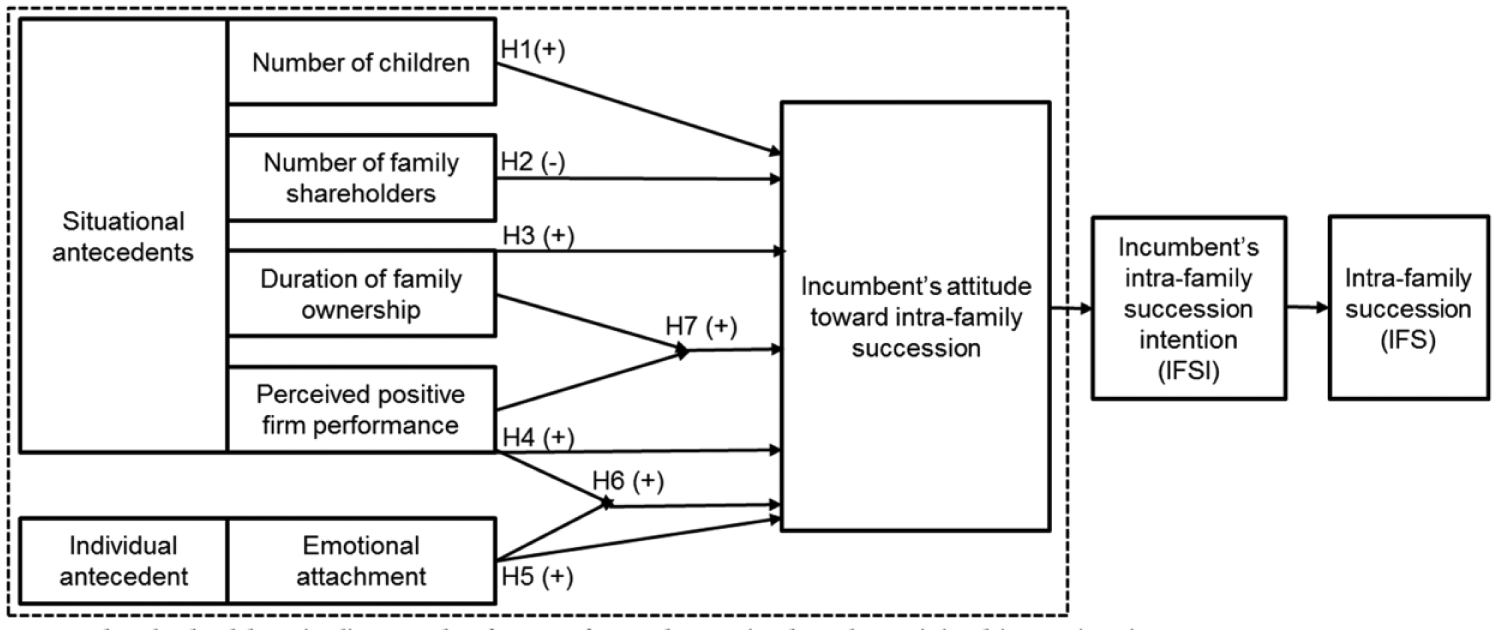
A model of incumbents’ attitude toward intrafamily succession.
The hypothesized situational and individual antecedents were chosen on the basis of a thorough review of extant family business succession literature and on our ability to develop rigorous arguments for them to favor a positive or negative attitude toward IFS. Situational antecedents are number of children (cf. De Massis et al., 2008), perceived positive firm economic performance (cf. Venter, Boshoff, & Maas, 2005), number of family shareholders, and duration of the family’s ownership of the business (Zellweger et al., 2012). The lone individual antecedent is the incumbents’ emotional attachment to the business (Lawler, 2001).
Situational Antecedent: Number of Children
It is commonly accepted that family members’ behavior may be motivated by altruism toward other family members (Schulze, Lubatkin, & Dino, 2003). Even economists have a long tradition of allowing this deviation from the purely economic person and are willing to add an altruistic term to the utility function of family members when they are transacting with other family members. One way the family firm incumbent may use the firm’s resources to harvest the utility generated by altruism is to provide family members with job opportunities in the firm. This will help family members establish their careers or sustain a standard of living commensurate with the family’s status in the community (Carter & Ram, 2003). Making sure that family members are able to do so will at the same time contribute to the family’s reputation. IFS will allow the family to keep its power to maintain the family’s altruistic policy past the incumbent’s tenure and the current generation. Thus, apart from helping secure the family’s utility derived from altruism, it is also consistent with the view of the family business as a legacy asset, created or further developed by the incumbent generation for the benefit of future generations.
The more children the incumbent has, the larger may be the number of family members who will need help in establishing their careers or in sustaining what the family deems to be an acceptable standard of living. The more family members that will be helped by IFS, the more positively the incumbent will evaluate IFS and the more desirable IFS would be.
On the other hand, it may also be argued that the higher the number of children, the more likely IFS will result in conflicts about who in the next generation is going to assume the leadership of the family firm (Barach & Ganitsky, 1995). This may negatively affect the incumbent’s evaluation of IFS and, consequently, the desirability of IFS (Handler, 1990; Handler & Kram, 1988; Sonnenfeld & Spence, 1989). However, sibling rivalry has its basis in children’s competition for parental love and attention (Adler, 1959; Cicirelli, 1982), a precious family resource whose distribution and expression is controlled by the incumbent. Thus, whether relationships among siblings become conflictual depends largely on parental responses (Friedman, 1991) and on the incumbent’s management of the competitive tendencies among children (Ward, 1987). For instance, when one of a sibling pair is seen as preferentially treated by the incumbent, both siblings express ill will toward each other (Bryant, 1982). If, conversely, the incumbent is able to allocate familial resources fairly by acknowledging differences or inequalities among one’s children, and avoid perceptions of preferential treatment, then sibling conflicts do not arise even in presence of a large number of children (Bryant, 1982; Ihinger, 1975). In sum, intragenerational conflict as a result of IFS when the number of children increases, although possible, cannot be established a priori as it occurs only in the presence of preferential treatment by the incumbent. For this reason, we postulate that the positive effect of number of children on IFS’ desirability to the incumbent will prevail. Hence, based on our argument that the number of children will increase incumbents’ positive beliefs about IFS in terms of the family harvesting the utility of altruism, enhancing family reputation, and preserving family legacy, we conclude that the more children incumbents have, the more positive will be their attitude toward IFS:
Situational Antecedent: Number of Family Shareholders
The number of family shareholders has the potential to influence the firm’s future economic performance and family harmony for the following reasons. First, it can affect future performance because, as agency theory (Jensen & Meckling, 1976) argues, the more dispersed the ownership the wider apart will be the interests of managers and owners and the greater the ability of managers to extract value from the business at the expense of owners even in the family firm (Singal & Singal, 2011). Higher agency costs will negatively affect the future economic performance of the business, especially from the perspective of the family owners who are not managers.
Second, the number of family shareholders can affect family harmony because the more family shareholders and, thus, the number of individuals potentially seeking and exercising influence over the firm, the more potentially incongruent will be their visions for the business plus their risk and cash flow preferences, and the greater will be the opportunity for disagreements that can easily lead to family disharmony. IFS can aggravate the problems because it would continue the lack of self-control problem pointed out by Schulze, Lubatkin, Dino, and Buchholtz (2001), by which the family is unable to control the self-serving behavior of family members. 3 In addition, IFS creates an opportunity for a new conflict over who in the next generation should take over the leadership (Barach & Ganitsky, 1995).
To summarize, the more family shareholders, the greater will be the incentive and opportunity for agency-related behavior that would affect the future performance of the business. The more family shareholders, the higher will be the possibility of disagreements leading to family disharmony. IFS will exacerbate the problems because of monitoring issues and the introduction of additional potential disagreements. Thus, in the presence of a larger number of family shareholders, the incumbent would negatively evaluate IFS, and the desirability of IFS will be lower. Therefore, we posit the following:
Situational Antecedent: Duration of Family Ownership
Based on the concept of univocal reciprocity (Wade-Benzoni, 2002), Zellweger et al. (2012) argue that the family firm accumulates a pool of reciprocity with unspecified payback type, source, and timing. They also argue that the pool will grow with the family’s duration of ownership because cultural norms and potential sanctions unique to family membership cause family members to have sufficient trust in the eventual payback such that they will continue to contribute to the pool. This is consistent with the view of a cumulative nature of this pool of reciprocity as the result of a longitudinal series of interactions among parties (Emerson, 1976) and social construction processes developing over time (Schneider & Reichers, 1983). The loss aversion effect of prospect theory (Kahneman & Tversky, 1979) then argues that the larger the pool, the greater will be the incumbent’s aversion to losing it. Since this pool of reciprocity will be under at least partial control of the family firm leader, the chance of reneging will be lower if the successor is a family member because of cultural norms against betrayal of family members and the family’s unique potential sanctions for family members.
Put differently, the longer the family has owned the business the larger will be the accumulated reciprocity pool and the more averse the incumbent will be to losing it or losing control of it. The chance of losing it or losing control of it is lower if the next leader is a family member. Therefore, the incumbent will perceive that IFS can help enlarge the reciprocity pool and preserve the continuing payback from the pool. This means that the longer the duration of the incumbent family’s ownership, the more desirable IFS will be. It will cause the duration of family ownership to have a positive relationship with the incumbent’s attitude toward IFS. Moreover, longer duration of family ownership also typically means being closer to the end of the human lifecycle for the family business owner-manager (Barnes & Hershon, 1976; Churchill & Hatten, 1997), which has been portrayed as having a positive effect on the incumbent’s beliefs, feelings, and behavioral tendencies toward IFS (Lansberg, 1988; Sonnenfeld & Spence, 1989). We thus state the following:
Situational Antecedent: Perceived Positive Firm Economic Performance
If the business is performing poorly under family leadership, the incumbent would hesitate to give a “poisoned gift” to his or her children to lead. In contrast, when the incumbent believes that the company’s performance has been good under family leadership, he or she will be more optimistic about the business’s future performance under continuing family leadership. Moreover, better economic performance can also be associated with higher compensation, social status, and power for the leader of the family firm (Stulz, 1990; Tosi, Werner, Katz, & Gomez-Mejia, 2000). IFS helps by sustaining the benefits past the incumbent’s term of office and the current family generation. IFS also helps by decreasing the potential of extraction of benefits by a nonfamily leader. Therefore, the better the perceived firm economic performance, the more positively the incumbent will evaluate IFS, and the more desirable IFS will be to the incumbent. This is consistent with the contingency view advanced by Pfeffer and Salancik (1978) who contend that contingencies in the environment such as economic performance can influence succession decisions. Besides, handing the leadership of the business that has been financially successful under family leadership to the next generation of family members will also satisfy the incumbent’s altruistic motivation to do something good for her or his children (Schulze et al., 2001). Put differently, IFS will be expected to produce continuing good performance and enable the incumbent to harvest the utility generated by altruism. Moreover, good economic performance may increase the possibility that an able family member would be more motivated to take over the leadership (Sharma et al., 2001; Stavrou, 1999), which would reinforce the incumbent’s beliefs about good future performance under family leadership. Thus, these positive beliefs about IFS should cause the incumbent’s attitude toward IFS to be more positive. In support of these arguments, researchers have argued that poor economic performance causes incumbents to be less enthusiastic about IFS (De Massis et al., 2008; Venter et al., 2005). Hence, we propose the following:
Individual Antecedent: Incumbents’ Emotional Attachment
Incumbents develop deep emotional attachment with the firm through their nurturing of the business (Le Breton-Miller et al., 2004; Sharma et al., 2001). This happens because the family business incumbent “unites with the enterprise” (Zaleznik & De Vries, 1985, p. 226) and the family business becomes an extension of herself or himself (de Vries, 1985). As a result, transferring leadership to a nonfamily member could engender the same feelings as giving up a “child” for adoption (Lansberg, 1988; Schein, 1985) and incur high emotional costs (Zellweger & Astrachan, 2008). Handing the leadership of the family firm over to the next generation of family members can minimize the emotional cost because the business would still be “in family hands.” Besides, the incumbent may be more easily accepted by the next-generation family leader than by a nonfamily CEO as a consultant, mentor, or symbolic leader after the succession, minimizing the emotional costs of separation.
However, Sonnenfeld and Spence (1989) argue that emotionally attached incumbents can respond to the pressures of IFS in different ways: “While some attempt to retain control until the end, only surrendering the leadership position through death or forced exit, others are able to reconcile their feelings about passing on the business” (p. 356). It is therefore true that some incumbents may often have difficulty giving up that which they have created or developed (Churchill & Lewis, 1983; de Vries, 1985; Dyer, 1986; Levinson, 1971) and may resist succession (Handler & Kram, 1988). Nevertheless, while succession might be an event that some incumbents are reluctant to think about, when they do think about it, it is quite reasonable to expect that IFS is still the best option in terms of minimizing the emotional costs of separation. Put differently, not thinking at all about succession would be quite irrational and the IFS option is the rational one that allows minimizing emotional costs when emotional attachment is high. Therefore, we postulate that the stronger an incumbent’s emotional attachment to the firm, the higher will be the emotional costs of handing the family firm’s leadership to a nonfamily member. To minimize the emotional costs, the incumbent would then prefer to keep the leadership in family hands. Thus, the incumbent would have a positive evaluation of IFS increasing the desirability IFS. Formally stated,
Interaction Effects
Hypothesis 4 proposes that perceived positive firm economic performance has a positive effect on the incumbent’s attitude toward IFS. This positive effect arises from being able to transfer something of greater value to the next generation. On the other hand, if the incumbent is emotionally attached to the business, not handing the business leadership to the next-generation family member would mean forgoing the utility from altruism, not benefiting from the future economic performance, plus incurring a loss of emotional value (Zellweger et al., 2012). Thus, the combination of the positive effects of a situational antecedent (perceived positive firm economic performance) and an individual antecedent (emotional attachment) should reinforce the incumbent’s positive evaluation of IFS and, consequently, the desirability of IFS. This is also consistent with the interactional psychology approach to the study of human behavior that emphasizes a continuous and multidirectional interaction between individual factors and situational factors (Ekehammar, 1974; Endler & Magnusson, 1976; Terborg, 1981).
There is also a parallel argument for the interactive relationship from the emotional attachment side. If the incumbent is emotionally attached to the family firm, better perceived positive firm economic performance should strengthen the influence of emotional attachment because of the firm’s higher financial value. Thus, the multiplicative effect can be interpreted as a positive moderation of perceived positive firm economic performance’s influence on incumbents’ attitude toward IFS by emotional attachment or a positive moderation of emotional attachment’s influence by perceived positive firm economic performance. In other words, the hypothesis could be stated two ways in terms of moderation. Thus, we do not state our hypothesis in terms of moderation but in terms of the relationship between the interaction and incumbents’ attitude toward IFS.
Based on the loss-aversion argument of prospect theory, we argued and hypothesized in Hypothesis 3 that the family’s duration of firm ownership could have a positive influence on incumbents’ attitude toward IFS because the duration of ownership would enlarge the univocal reciprocity pool. Perceived positive firm economic performance is likely to have an effect on this relationship. For example, if the business is failing, the reciprocity pool is already endangered and its potential loss would already be a sunk cost. Thus, the perceived incremental loss in the value of the reciprocity pool by not pursuing IFS would not be as high. Vice versa, the better the perceived positive firm economic performance, the greater will be the perceived loss. We therefore hypothesize that the better the perceived positive firm economic performance, the higher the perceived incremental loss in the value of the reciprocity pool and the stronger the incumbent’s predisposition for keeping control of it by appointing a family successor. Hence, the combination of the positive effects of a family’s duration of firm ownership and perceived positive firm economic performance should reinforce the incumbent’s positive evaluation of IFS and, consequently, the desirability of IFS. Formally stated,
Method
Sample and Data Collection
This is not a study to distinguish between the behaviors of family and nonfamily firms. Instead, it is about the incumbent’s attitude toward IFS in different firms with substantial family involvement. Therefore, we did not need a definition of the family firm and selected our sample by focusing on the type and level of family involvement. With this aim, we assembled a list of Italian businesses from the data set AIDA (“Analisi Informatizzata delle Aziende Italiane” by Bureau Van Dijk), which has been used in previous family business studies (e.g., Amore, Minichilli, & Corbetta, 2011; De Massis, Kotlar, Campopiano, & Cassia, 2015; Minichilli, Corbetta, & MacMillan, 2010). From this list, we selected those firms that had more than one family member involved in the firm’s upper-echelon team of top managers and board of directors, as reported in the “Principali Esponenti” section of AIDA. To identify family members we used surnames, which is a common approach in family business research (e.g., Rutherford, Kuratko, & Holt, 2008). Given the limitations of identifying family relations exclusively on the basis of surnames (De Massis et al., 2015), however, female upper-echelon members of the same firm with different surnames but the same address (assumed to be mother and daughter) plus male and female upper-echelon members with different surnames but the same address (assumed to be husband and wife or partners) were also considered family members. Firms without complete information were excluded. Then, we eliminated firms with lower than 25% family ownership and invited 1,165 family firms to participate in our online survey.
The questionnaire was prepared in English and then translated into Italian. An independent bilingual expert unfamiliar with the original document back-translated the items from Italian into English, together with a native English speaker, and the original English version of the scale was compared with the translation. No inconsistency was discovered. As in other family firm studies (e.g., Zellweger et al., 2012), a key informant approach was used (Kumar, Stern, & Anderson, 1993). We explicitly mentioned both in the contact e-mail and in the survey itself that the survey had to be filled out by the “incumbent,” defined as the family member who currently holds the top management position in the firm and who must relinquish that position before another family member can take over (De Massis et al., 2008). The online survey was conducted in Italy between September and November 2012. We received 303 completed questionnaires equivalent to a response rate of 28.5%. For each of the represented firms, we retrieved accurate ownership, management, and governance information from AIDA and, in addition, checked and complemented that data with hand-collected data from official public filings (Italian Chamber of Commerce). We included only incumbents who perceived their firms to be a family business (Westhead & Cowling, 1998) and answered “yes” to the question, “Do you consider this firm to be a family firm?” To make sure that IFS is possible, we included only those firms where the incumbent has at least one child. After excluding responses with incomplete data, the sample contained 274 incumbents, which is comparable in size to those in other family business studies (e.g., Zellweger et al., 2012).
The average incumbent is male (81%), is 51.9 years old, has two children, and personally owns 53.2% of the company shares. The combination of age and ownership suggests that our survey was indeed completed by incumbents as defined in the literature (De Massis et al., 2008). The annual sales range from EUR 1 million to EUR 500 million. The average duration of the families’ ownership is 36.5 years, while the average family ownership share is 85.6%. One third of the firms are manufacturing companies and 30% are active in the wholesale and retail trade sector. Other sectors include construction, architecture, engineering, and the primary sectors (agriculture, forestry, and fishing).
Measures
Dependent Variable
To measure incumbents’ attitude toward IFS, we draw on four items used by Linan and Chen (2009) to capture students’ attitude toward entrepreneurship (cf. Krueger et al., 2000; Schlaegel & Koenig, 2014). We adapted these items to the incumbent’s IFS. The items are “intrafamily succession is attractive to me”; “if I had the opportunity and resources, I would do an intrafamily succession”; “an intrafamily succession would give me great satisfaction”; and “transferring the leadership of the company to my children (intrafamily succession) will yield more advantages than disadvantages to me.” 4 If not mentioned otherwise, all items in our study used a 7-point Likert-type scale anchored at 1 = strongly disagree and 7 = strongly agree. Here, we interpret strong agreement as positive attitude and strong disagreement as negative attitude. Cronbach’s alpha is .89. The four items load on one factor with factor loadings between 0.77 and 0.92.
Independent Variables
Number of children (Hypothesis 1) was measured using the answers to two direct questions: “How many sons do you have?” and “How many daughters do you have?” The numbers were then added. The number of family shareholders (Hypothesis 2) was the answer to “How many of the company’s shareholders are members of the controlling family?” For duration of family ownership (Hypothesis 3) we used the question: “How many years has the firm been in the hands of the current owning family?” Perceived positive firm economic performance (Hypothesis 4) was measured with self-reported data on firm economic performance. We believe that for our purpose, economic performance as perceived by the incumbent is more appropriate than objective performance ratios because objective measures may be interpreted differently; some may view a 10% return on equity as high, others as low. In the end, it is the incumbent’s personal opinion that matters when it comes to the formation of her/his attitude toward IFS. Respondents were thus asked to rate their firm’s performance compared to competitors over the last 3 years in six areas: growth in sales, growth in market share, growth in profitability, return on equity, return on total assets, and ability to fund growth from profits (adapted from Dess & Robinson, 1984; Eddleston, Kellermanns, & Sarathy, 2008). The 7-point Likert-type scale ranged from 1 = much worse to 7 = much better; overall performance was the average of the six indicators. Cronbach’s alpha is .92. The six items load on one factor with factor loadings between 0.77 and 0.89. The lone affective factor, the incumbent’s emotional attachment to the business (Hypothesis 5), was based on the average of four items originally from Richins (1994) and Allen and Meyer (1990). These are “I am emotionally attached to the firm,” “the firm reminds me of who I am,” “if I were describing myself, the firm would likely be something I would mention,” and “if I lost the firm, I would feel like I had lost a little bit of myself.” Cronbach’s alpha was .85, and the four items load on one factor with factor loadings between 0.75 and 0.89.
Control Variables
Following previous empirical studies on family firm succession (Sharma et al., 2003; Zellweger et al., 2011), we controlled for additional factors that might affect the formation of the incumbents’ attitude toward IFS. At the individual level, we controlled for the incumbent’s age, gender (0 = male, 1 = female), founder status (0 = no, 1 = yes), marital status (0 = not married, 1 = married), as well as gender of the first-born child (0 = female, 1 = male). At the firm level, we account for succession proximity with a one-item question that asked incumbents for the number of years before the actual succession is likely to take place. Imminence of succession would likely make an incumbent’s attitude more concrete. In addition, we use a dummy variable that indicates if the firm has the same name (name identity) as the controlling family (0 = no, 1 = yes) since the family’s reputation and social status will be tied more closely to the firm in that case (Deephouse & Jaskiewicz, 2013). Furthermore, as it may be easier for families to sustain competitiveness generation after generation in certain industries, we use eight dummy variables as proxies for the industry sectors in which the sample firms were most active. Next to those variables, we explicitly controlled for family involvement in the firm. Involvement in terms of ownership increases the family’s ability to exercise influence through a dominant ownership position. We thus control for the controlling family’s ownership share (family ownership) in the firm as well as for the incumbent’s personal ownership share (personal ownership) of the firm. In addition, the more family members are active in the management of the firm, the more their career interests are tied to the firm (Schulze et al., 2001; Sharma et al., 2001) and the greater the family’s stake in transferring leadership across generations. To account for this aspect, we controlled for the number of generations operationally involved in the firm and family members’ share of the firm’s workforce (share of family employees). All this information was obtained through questions posed to our incumbents. In addition, information was checked and complemented with data from AIDA.
Means, standard deviations, and Pearson correlations appear in Table 1. As the standard deviations show, there is sufficient heterogeneity to not have to worry about the potential biases of homogeneous samples (Miller, Le Breton-Miller, Lester, & Cannella, 2007). The correlations of all our independent variables as well as the dependent variable are smaller than 0.4, which indicates no apparent shared variance concern (Hair, Black, Babin, Anderson, & Tatham, 2006).
Means, Standard Deviations, and Pearson Correlations.
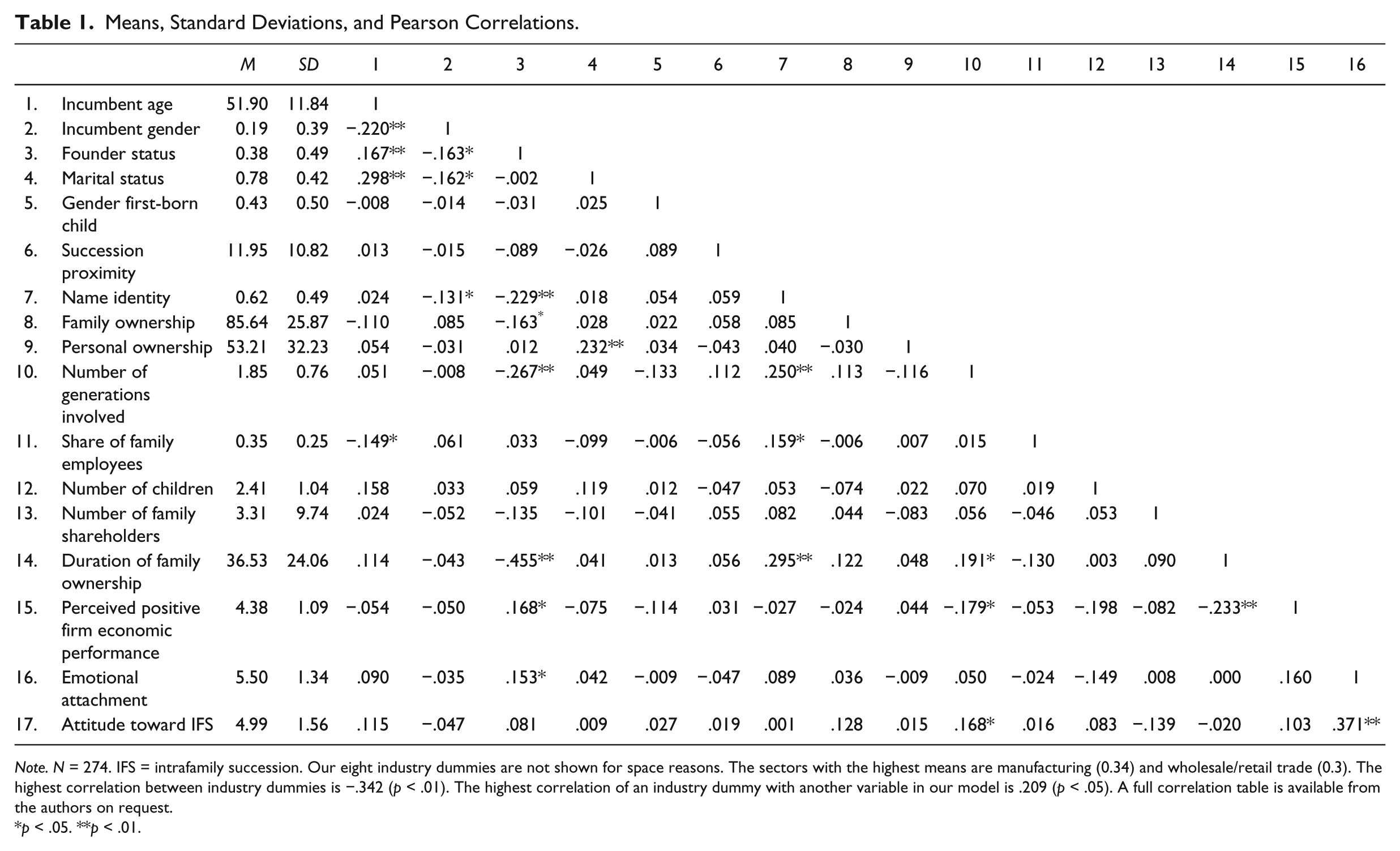
Note. N = 274. IFS = intrafamily succession. Our eight industry dummies are not shown for space reasons. The sectors with the highest means are manufacturing (0.34) and wholesale/retail trade (0.3). The highest correlation between industry dummies is −.342 (p < .01). The highest correlation of an industry dummy with another variable in our model is .209 (p < .05). A full correlation table is available from the authors on request.
p < .05. **p < .01.
Data Quality Tests
To test for nonresponse bias, we first compared early and late respondents using analysis of variance, assuming that late respondents are more similar to nonrespondents than early respondents. No statistically significant differences were found for all our study variables. Second, we compared respondents who answered all survey questions to those who only partially completed the survey. For those variables that were available in both groups, we detected no significant mean differences. Third, we applied Heckman’s two-step procedure to assess the potential of sample selection bias. We estimated a probit model where the binary dependent variable indicates whether responses were included in the final sample or had to be excluded due to theoretical reasons or missing values (0 = excluded, 1 = included). As independent variables we used our five individual-level control variables (incumbent’s age, gender, founder status, marital status, and gender of first-born child). With the predicted values of this probit model, we then calculated the inverse Mills ratio (IMR). Adding the IMR variable to our regression analyses did not change our results. Last, the demographic characteristics of our respondents and their firms make our sample representative. Altogether, this indicates that our results are unlikely to be affected by nonresponse bias.
To test the validity and distinctiveness of our measures, we first applied Harman’s (1967) one-factor test. We entered all our items into a factor analysis, extracting an 11-factor solution that accounts for 60.8% of total variance. The first factor explained 7.8% of the total variance. Second, we conducted a confirmatory factor analysis (Podsakoff, MacKenzie, Lee, & Podsakoff, 2003) with all our independent variables. The corresponding structure fits the data well (χ2[24] = 48.544, root mean square error of approximation [RMSEA] = .053, comparative fit index [CFI] = .969, p < .001). The results of a one-factor structure (χ2[35] = 210.924, RMSEA = .117, CFI = .781, p < .001) are significantly worse (difference in χ2 = 162.38, df = 11, p < .001). For our multi-item constructs, the item factor loadings in this analysis are between 0.65 and 0.92 for attitude toward IFS, between 0.65 and 0.9 for firm economic performance, and between 0.63 and 0.88 for emotional attachment. The average variances extracted are 0.64, 0.61, and 0.68, respectively, which is above the commonly suggested threshold of 0.5 (Fornell & Larcker, 1981). The composite reliabilities for the three multi-item variables are 0.89, 0.91, and 0.86, respectively, all above the suggested threshold of 0.7 (Hair, 1998). These results show that our measures are theoretically and empirically distinguishable and also provide preliminary evidence that common method bias is unlikely to be a major concern. To further reduce common method bias concerns, we note that items only included terms that were very easy to understand, and a careful translation–back-translation procedure was implemented in addition. Moreover, Siemsen, Roth, and Oliveira (2010) show that common method bias usually causes interaction effects to be deflated. Therefore, we carefully interpret the fact that we find a significant interaction effect as a possible signal that common method bias should not be a very serious concern.
Multicollinearity among our independent variables is not a major concern because none of the variance inflation factors exceeded 1.44, which is way below the critical cutoff of 10 (Hair et al., 2006). Referring to potential social desirability bias, we note that respondents were assured complete confidentiality, which enhances the probability of honest and well-reflected answers (Podsakoff et al., 2003). Also, the different variables were spread over the comprehensive survey, which reduces the probability that respondents anticipated the research questions and thus adapted their answers accordingly (Podsakoff et al., 2003).
Preliminary Test for Relevance of the Dependent Variable
For our dependent variable—incumbents’ attitude toward IFS—to be relevant to the development of a theory of the family firm, it must influence incumbents’ IFSI. Therefore, before testing our hypotheses, we tested the relationship between our measure of incumbents’ attitude toward IFS and incumbents’ IFSI. Based on previous studies about intentions in the entrepreneurship context (Laspita, Breugst, Heblich, & Patzelt, 2012; Zellweger et al., 2011), we measured the incumbents’ IFSI by asking them to select from a list of succession options the one that they intended to implement in their companies. If they chose “transfer the leadership of the company to one or several of my children (intrafamily succession)” the IFSI measure was coded “1” and “0” otherwise. A binary logistic regression found that incumbents’ attitude toward IFS was significantly and positively related to IFSI (coefficient = 0.935, p < .001), with the univariate Pearson correlation equal to 0.404 (p < .001). Therefore, the results suggest that our dependent variable is indeed an antecedent of IFSI.
Testing the Hypotheses
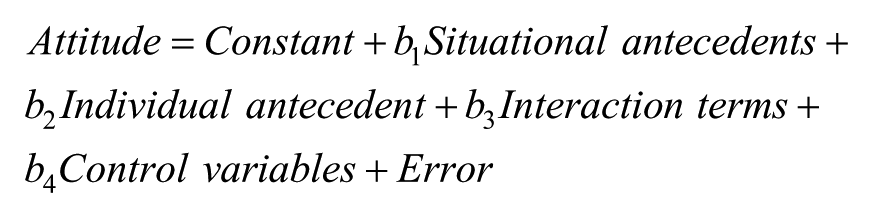
Hierarchical regression was used to separate the explanatory powers of the independent variables and the interaction terms from those of the control variables. We used the following model to test our hypotheses:
Results
The results of our hierarchical regression analyses are reported in Table 2. Model 1 includes only our control variables. Only family ownership and number of generations involved in the business have significant relationships (5% level) with incumbents’ attitude toward IFS. In Model 2, we added our independent variables, which led to a significant increase in the adjusted R2 from 0.02 to 0.168 (p < .001). For Hypothesis 1, number of children has a significant and positive relationship with our dependent variable as hypothesized (coefficient = 0.149, p < .05). Number of family shareholders is significantly and negatively related to incumbents’ attitude toward IFS (coefficient = −0.133, p < .05), supporting Hypothesis 2. Duration of family ownership (Hypothesis 3) is not significantly related to incumbents’ attitude toward IFS (p > .05). Neither is perceived positive firm economic performance (Hypothesis 4). Hypothesis 5, however, finds support as incumbents’ emotional attachment to the firm is positively and significantly related to their attitude toward IFS (coefficient = 0.357, p < .001). In Model 3, we added our interaction terms to test Hypotheses 6 and 7. The increase in adjusted R2 from 0.168 to 0.179 is only marginally significant (p = .069). The interaction between perceived positive firm economic performance and emotional attachment is not significant (p > .05), rejecting Hypothesis 6. However, the interaction between ownership duration and perceived positive firm economic performance is significant and negative (coefficient = −0.124, p < .05). The interaction plot for this relationship is shown in Figure 2, which confirms the negative effect of the interaction between duration of family ownership and perceived positive firm economic performance.
Results on Antecedents of Attitude Toward Intrafamily Succession.

Note. N = 274. SE = standard error. Standardized variables used. Unstandardized coefficients shown. Our eight industry dummies are not shown for space reasons. In Model 1, none of the industry dummies is significant at p < .05. In Model 2, the dummies for “manufacturing” and “health services” are significant at p < .05; in Model 3, this applies to the “health services” dummy only.
p < .1. *p < .05. **p < .01. ***p < .001.
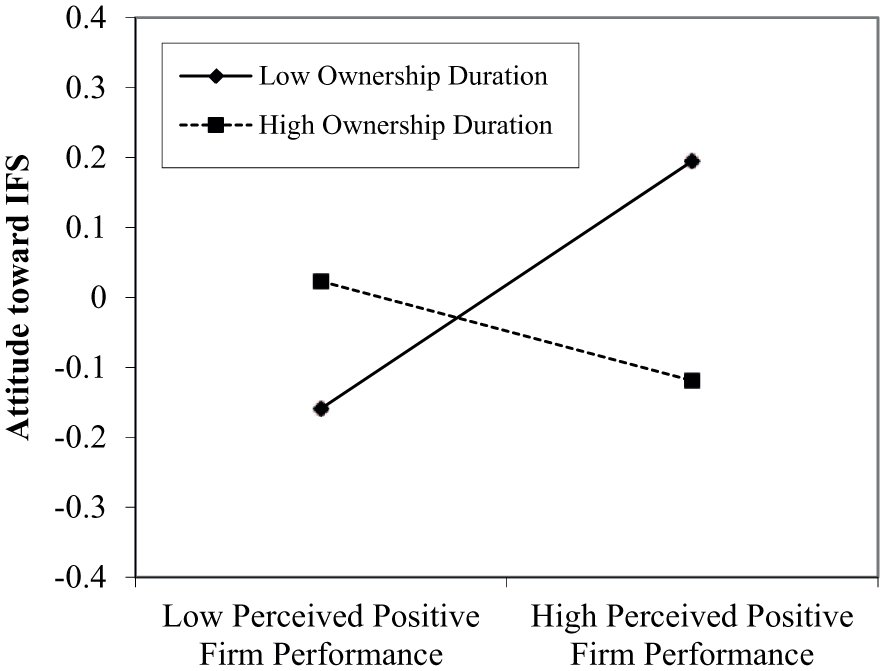
Perceived positive firm economic performance versus ownership duration interaction plot.
To test the robustness of our findings, we used a median split of the incumbents’ attitude toward IFS variable and ran binary logistic regression models with all our variables. The main pattern of our results did not change in all three models. Also, due to potential conflicts in families with many children, one could expect a nonlinear relationship between the number of children and attitude toward IFS. We thus added the squared term of the number of children variable to our models. This term was not significant in any of our models, indicating that a nonlinear effect does not exist. Overall, these tests enhance our confidence in the robustness of our results.
Discussion
Drawing on the TPB and general attitude literature, we investigated the situational and individual antecedents of incumbents’ attitude toward IFS. The main contentions of our investigation are that situational and individual antecedents as well as their interactions can influence incumbents’ beliefs about whether IFS will be positive or negative. Specifically, incumbents’ attitude toward IFS was hypothesized to be related to four situational antecedents, one individual antecedent, and two interaction effects. Our empirical evidence supported the hypothesized positive relationship (Hypothesis 1) between the number of children (a situational factor) and the incumbents’ attitude toward IFS. Altruistic considerations may indeed play a role when incumbents think about succession, as IFS would give the firm the potential to provide jobs and financial security for the next and subsequent generations. By this reasoning, the higher the corresponding demand (i.e., the higher the number of children), the more positive the attitude toward IFS will be.
We also confirm the hypothesized negative relationship between the number of family shareholders (a situational factor) and attitude toward IFS (Hypothesis 2). This supports our contention that the disadvantages associated with a more dispersed ownership structure (e.g., family disharmony and agency problems) can be aggravated by IFS. For instance, different family shareholders and family branches might have different opinions about who would be the best successor and separation between ownership and management may widen. Then, we find support for the hypothesized positive relationship between incumbents’ emotional attachment to the business (an individual factor) and attitude toward IFS (Hypothesis 5). This shows that, as expected, emotional considerations play a key role in the context of succession.
To sum up, the results support Hypotheses 1, 2, 5, and reject Hypotheses 3, 4, and 6. The relationship proposed in Hypothesis 7 was statistically significant but with the opposite sign. So, two situational factors (number of children, number of family shareholders), one individual factor (incumbent’s emotional attachment to the business), and one interaction between situational factors (perceived positive firm economic performance and ownership duration) are shown to have statistically significant influence on incumbents’ attitude toward IFS. Therefore, taken together, the empirical results support our main contention that situational and individual factors are important drivers of incumbents’ attitude toward IFS.
The rejection of duration of the incumbent family’s ownership as a positive influence on incumbents’ attitude toward IFS (Hypothesis 3) is an interesting “nonresult” (Bettis, Gambardella, Helfat, & Mitchell, 2014) because it suggests that the relationship is more complex than hypothesized. For example, incumbents may have other underlying considerations working in the negative direction. In fact, family business researchers generally believe that because the nonfamily managerial talent pool is larger than the family managerial talent pool, future economic performance may be better under a nonfamily leader (Wennberg, Wiklund, Hellerstedt, & Nordqvist, 2011). In addition, the longer a family has owned a business, the more likely that the organization will have been professionalized and the family will have learned how to benefit from nonfamily leadership despite the potentially higher agency costs. Put differently, the trade-off between the benefits from potentially more competent nonfamily leadership and those of maintaining full control over the pool of univocal reciprocity may be shifted over time through professionalization to favor the former. In that case, the net effect of duration of the incumbent family’s ownership on incumbents’ attitude toward IFS would be contingent on factors not considered in this study. Better understanding of the mechanisms by which the duration of the incumbent family’s ownership affects the incumbent’s attitude toward IFS is certainly an interesting and important subject for future research.
All three of our Hypotheses (4, 6, and 7) involving perceived positive firm economic performance were not supported and, in the case of Hypothesis 7, showed the opposite effect. Since economic performance is such an important consideration for all businesses, family and nonfamily, it behooves future researchers to dig deeper into its influence, perceived and actual, on incumbents’ attitude toward IFS. The main effect (Hypothesis 4) of perceived positive firm economic performance on incumbents’ attitude toward IFS (Hypothesis 4) is insignificant. Again, this could mean that incumbents have other considerations producing contrary influences. For example, maintaining ownership control gives the family the power and legitimacy to pursue IFS. Thus, although not necessarily the case, pursuing IFS will usually be accompanied by the family continuing to maintain ownership control of the firm. This means that IFS implies forgoing the immediate benefits of harvesting the financial value of the business. The better the economic performance of the firm, the higher will be the immediate benefits forgone. If the immediate benefits of selling the firm are important to the incumbent, the incumbent would then evaluate IFS negatively. As a result, perceived positive firm economic performance could also have a negative influence on attitude toward IFS. The positive influence that we proposed and this negative one may have combined to produce the insignificant net effect observed.
Although it is intuitively plausible that the incumbent’s emotional attachment to the business (especially since the results show that it has a highly significant positive effect on attitude toward IFS) should push the effect of perceived positive firm economic performance toward the positive side (Hypothesis 6), the push if it exists does not appear to be strong enough. In fact, the interaction term even has a negative coefficient, contrary to the hypothesis and to what interactional psychology would suggest (Terborg, 1981). Since perceived positive firm economic performance has a positive although insignificant coefficient and emotional attachment has a positive and highly significant coefficient, one should expect the interaction of two positive coefficients to be positive. Again, this indicates a much more complex relationship than what we proposed.
Contrary to Hypothesis 7, our results show that the interaction between duration of family ownership and perceived positive firm economic performance has a significant but negative effect. The proposed theoretical reasoning behind Hypothesis 7 seemed to be straightforward and logical, but this finding means that our logic must be reevaluated. Our main conjecture in this regard is that the combination of high duration of family ownership and strong firm economic performance may make the business more valuable and more liquid or easier to sell. Using the same conjecture previously used to explain the insignificant main effect of perceived firm positive economic performance, better economic performance leads to higher firm financial value. This may create a more acute trade-off between the incumbent’s positive evaluation of IFS in terms of preservation of the univocal reciprocity pool accumulated and the immediate benefits from selling the business. Put differently, the better the firm’s performance, the higher would be its financial value and the greater the sacrifice in immediate financial benefit by pursuing IFS. But a private family firm is illiquid if the business is totally or critically reliant on family leadership. As we argued, duration of ownership could give the family time to professionalize the firm and learn how to benefit from the larger nonfamily management talent pool (Colombo, De Massis, Piva, Rossi-Lamastra, & Wright, 2014) despite the higher agency costs. As a result, although not pursuing IFS would incur partial loss of control over the reciprocity pool, the improvement in economic performance may override the concerns over the reciprocity pool. If a longer duration of family ownership implies that the business will tend to be professionalized and is thus no longer critically dependent on family leadership, then the business would be both more valuable and more liquid. This means that IFS would be more negatively evaluated by the incumbent and the incumbent’s negative attitude toward IFS would be exacerbated. In terms of the statistics, the fact that the main effects of perceived firm economic performance and duration of ownership are both insignificant, the statistical significance of the interaction could be spurious. On the other hand, such an empirical finding may also be interpreted as each of the variables being insufficient by itself but the combination achieving sufficiency. Of course, further empirical testing is needed to assess whether our conceptual and statistical conjectures hold.
Emotion is often cited by family members and family business consultants as a particularly difficult-to-handle complicating factor in family business governance and management (Shepherd, 2016). Our results show that emotional attachment exhibits the strongest relationship with attitude toward IFS. This means that, through incumbents’ emotional attachment to the business, emotion plays an important role in incumbents’ attitude toward IFS. Conceptually, since attitude toward IFS affects IFSI and the latter is considered by scholars and practitioners to be an important distinguishing feature of family firms, it seems that more attention should be paid to emotion as a cause for differences in governance and management of a family firm vis-a-vis nonfamily firms as well as other family firms. For instance, next to rather formal indicators of family involvement, it might be valuable to capture the “emotional involvement” of the family more explicitly and to assess the relationships between formal and emotional involvement. That this research direction has so far been largely neglected by family business researchers means that there is a direction of research waiting for scholars to explore and deepen our understanding about family firm behavior.
Beyond testing our hypotheses, we verified that our measure for incumbents’ attitude toward IFS is significantly and positively related to IFSI. This is important because if such significant relationship between the two variables does not exist, then our dependent variable would be questionable and the entire study less reliable. Therefore, the test adds further credibility and predictive validity to our model and results. 5
Two control variables accounting for the family’s involvement in business (family ownership and number of generations involved) have significant relationships with incumbents’ attitude toward IFS. But they, together with the other control variables, can explain only 2% of the variance (adjusted R2 = 0.02). This highlights the weakness of using the controlling family’s involvement to predict family firm behavior in general and the controlling family’s intentions or goals in particular. It is consistent with the argument by De Massis et al. (2014) that family involvement in ownership, management, and governance is a necessary but insufficient condition for a firm to exhibit family-oriented particularistic behavior. Besides, it is difficult to empirically distinguish behavior due to family involvement from that due to concentrated ownership because most concentrated ownerships are held by families.
On the other hand, because the results of our preliminary test show that incumbents’ attitude toward IFS is significantly related to IFSI, these results do recommend a retest of Chua et al.’s (1999) exploratory findings that family involvement variables are poor direct predictors of the controlling family’s intentions. A more direct test is needed because intention, according to TPB, is influenced by more than attitude even though attitude is considered by researchers to be the most important driver. For example, family involvement may influence IFSI more strongly through subjective norms and perceived behavioral control.
To the best of our knowledge, we are the first to provide a systematic model of incumbents’ attitude toward IFS. Our theory-based theoretical and empirical investigation complements the existing literature on the determinants of potential successors’ intention to take over the leadership of the family business (e.g., Schroeder et al., 2011; Zellweger et al., 2011) and helps researchers and practitioners develop a fuller understanding of the two intentions that must exist for IFS to happen (De Massis et al., 2008). More specifically, our findings add to the family business literature on the role of the incumbent in the succession process (e.g., Daspit et al., 2016; Davis & Harveston, 1998; De Massis et al., 2008; Handler & Kram, 1988; Kelly et al., 2000; Lansberg & Astrachan, 1994; Le Breton-Miller et al., 2004; Marshall et al., 2006; Sonnenfeld & Spence, 1989). Whereas these studies predominantly focused on the actual behavior and dealt with the issues and challenges arising during the succession process (e.g., Davis & Harveston, 1998; Dyck, Mauws, Starke, & Mischke, 2002; Sonnenfeld & Spence, 1989), our study takes two steps back and focused on what drive incumbents’ toward pursuing the behavior. As such, we help advance our understanding about the role of some attitudinal mechanisms that promote or deter incumbents’ attitude toward IFS.
By showing that specific factors related to the incumbent and the situation she or he encountered affect her or his attitude toward IFS, we also contribute to prior works arguing that the succession process is influenced by characteristics of the individuals involved (Churchill & Hatten, 1987; Handler, 1990; Le Breton-Miller et al., 2004; Long & Chrisman, 2014; Rubenson & Gupta, 1996). By showing which situational and individual factors affect incumbents’ attitude toward IFS, our study also contributes to the development of a theory of the family firm conceptually and empirically because attitude toward IFS, through its influence on IFSI (which we confirmed in our separate analysis), could help explain the divergence between family and nonfamily firms and heterogeneity among family firms (Chua, Chrisman, Steier, & Rau, 2012; Nordqvist, Sharma, & Chirico, 2014). Moreover, our findings add to the number of frameworks that have been proposed to describe the process-oriented nature of family business succession (e.g., Le Breton-Miller et al., 2004; Royer et al., 2008) by exploring not just the “what” of IFS but the “why” of a key determinant of IFSI.
Attitude (e.g., Agarwal & Malhotra, 2005; Bodur, Brinberg, & Coupey, 2000; Zajonc & Markus, 1982) continues to be the major focus of theory and research on intention in the social and behavioral sciences (Ajzen, 2001). For that literature, our study makes a minor contribution by demonstrating further TPB’s applicability within the family business context.
Last, there is a growing body of research on the controlling family’s choice between family-internal and family-external exit routes. Examples are the influence of family structure and involvement on actual ownership transitions (Wiklund et al., 2013) and the role of information asymmetry in the choice of exit routes (Dehlen et al., 2014). We complement this literature by shedding a nuanced light on the antecedents of the incumbent’s attitude toward IFS.
Limitations and Future Research Directions
As with all studies, ours has limitations. First, the evidence presented only ties the lone outcome (incumbents’ attitude toward IFS) to the hypothesized antecedents. It does not present any empirical evidence for the mechanism or process by which the antecedents influence attitude. Instead, the gap is filled by theorizing based on arguments that we did not test. For instance, we argue that the number of family shareholders is an antecedent of incumbents’ attitude toward IFS through its potential influence on family disharmony and agency costs; that incumbents’ emotional attachment to the business positively influences their attitude toward IFS because leadership succession by a family member will cause less emotional costs; and that perceived firm positive economic performance can have both positive and negative effect on incumbents’ attitude toward IFS because of the trade-off between immediate financial benefit and long run reciprocity benefits. We clearly did not measure these economic (agency cost, financial benefits, reciprocity benefits) and noneconomic (family harmony, emotional cost) considerations; nor did we tie them directly to attitude at one end and the antecedents at the other. A more conclusive set of evidence would be, for example, one showing that the number of family shareholders indeed tends to negatively affect family harmony and tends to increase agency costs. In addition, the evidence then has to show that variations in incumbents’ attitude toward IFS are related to the pernicious effect on family harmony and the increase in agency costs. But this is a limitation shared with, for example, the entire literature about family business behavior based on theorizing about how the controlling family’s behavior will affect the family’s socioemotional wealth (SEW). No single SEW-based study has measured SEW and shown that the decision taken or behavior exhibited increased or decreased SEW let alone tie the changes in SEW to the decisions made or actions taken at one end and the outcome or performance at the other. In fact, we are unaware of a single study in the vast agency cost literature that has measured agency cost and tied the measured changes in agency costs to firm decisions or actions. Nevertheless, this is an evidentiary gap that requires attention in future research or else we will never be certain about the mechanisms and processes of influence that tie the independent variables to the dependent variables.
Second, we would expect that, by the very nature of the topic (IFS), only some family businesses incumbents have made up their mind and may hence have a higher or lower likelihood to offer answers. Given the applied methods of data collection, we cannot exclude such natural biases in our sample even after the statistical tests for bias. Relatedly, it should be noted that our study is cross-sectional in nature and relied on self-reported data obtained from a single informant, preventing us from drawing conclusions with regard to causality. However, our conceptual analysis makes us believe that causality may actually exist as proposed. Nevertheless, future research using different data collection methods, multiple data sources, and longitudinal designs would be valuable.
Third, we acknowledge that incumbents’ attitude toward IFS is likely influenced by a variety of internal and external situational and individual factors beyond the scope of our study. For instance, family attributes such as family structure and kinship networks (Bertrand, Johnson, Samphantharak, & Schoar, 2008) or family tradition (De Massis, Kotlar, Frattini, Petruzelli, & Wright, 2016) and the extent to which the firm’s profitability meets aspiration levels (Cyert & March, 1963) are internal factors while firm visibility, community embeddedness, demographic aspects, and competitors’ market power (Kotlar, De Massis, Fang, & Frattini, 2014) are external factors that may play important roles.
While we considered some dimensions of family firm heterogeneity in our control variables (Chua et al., 2012), there are undoubtedly other control variables that may influence incumbents’ attitude toward IFS and should be used to eliminate the alternative hypotheses. Moreover, some aspects of our set of control variables appear to be worthy of further investigation. For instance, founder status has been found to have a marginally significant and positive relationship with attitude toward IFS in Model 1. Its role in our context could be investigated in greater detail, as founder status is an important driver of the founder’s identification with the business (Boivie, Lange, McDonald, & Westphal, 2011; Cannella, Jones, & Withers, 2015), which is conceptually quite close to the concept of emotional attachment to the firm (cf. Berrone, Cruz, & Gomez-Mejia, 2012) but could nevertheless have unique effects on IFS considerations worth exploring.
Finally, we used data collected from Italian family firms. Thus, our findings may not generalize to family firms located in other countries. Although Italy is an interesting context due to the ubiquity of family firms and the great importance of the family unit in Italian culture, there may be relevant differences across countries in terms of cultural values, such as uncertainty avoidance or individualism, and the evolving definition of the family unit (Kamo, 2000). Thus, care should be taken in applying our results to firms based outside Italy and future research on family firms from other countries is needed.
In addition to studies that investigate the implications of our study for the theory of the family firm and IFS or that overcome this study’s limitations by extending the scope of inquiry in terms of sampling frames, variables, or research methods, additional research directions emanate from our findings. Future research may investigate how children’s attributes (e.g., education, skills and competence, preferences, commitment, age, gender) affect incumbents’ attitude toward IFS. More research is also needed to compare the incumbent’s attitude toward IFS with attitude toward other exit options (e.g., selling the business to another family, to a nonfamily firm, or to a financial company). Results showing that the positive antecedents for incumbents’ attitude toward IFS have the opposite influence on nonfamily succession or selling the business to nonfamily owners would add considerably to the reliability of the logic behind our hypotheses.
Moreover, as already discussed, we focused this study on only one of the three TPB antecedents of IFSI. Future research could investigate the factors affecting incumbent’s perceived behavioral control with respect to IFS and subjective norms about IFS, and whether there is variance in these constructs among family firms as well as between family and nonfamily firms. Subjective norms should ideally be studied in a cross-country investigation given that subjective norms may be relatively homogeneous within national institutional and cultural environments. Also, future empirical research could simultaneously investigate the entire TPB logical chain presented in Figure 1. Specifically, it could use longitudinal data to investigate how the individual and situational antecedents that we investigated affect actual IFS.
Finally, we have focused on leadership succession but not ownership succession. The two are clearly interrelated because of ownership’s implications for the property rights, legitimacy, and power needed to pursue IFS. Future research is needed in that direction as well.
Implications for Practice
Our findings are especially important for practice because succession is largely under the control of the family firm incumbent leader (Rubenson & Gupta, 1996). By adding to our understanding of the factors that lead to positive or negative attitude and through that to IFSI, our findings provide family business owners and consultants with a practical way to help shape incumbents’ attitudes toward IFS and manage one of the most agonizing experiences for any family firm (Barnes & Hershon, 1976). Along this vein, our study may even help the family overcome the frequently encountered incumbents’ “attitudinal or motivational” resistance to succession planning (Beckhard, 1975; Handler, 1990; Handler & Kram, 1988).
Our study also contributes to the ongoing discussion around the content and form of education programs intended to help business families manage the succession process (Sharma, Hoy, Astrachan, & Koiranen, 2007; Steier & Ward, 2006). Educators may use our findings to explain how a positive attitude of the incumbent toward IFS is formed. Family firm leaders, especially parents, may be sensitized to the positive and negative impacts that different factors might have on their attitude toward IFS. Finally, our novel insights could also help policy makers develop a system of supporting initiatives that increases the probability of IFS for a very ubiquitous and important form of business organization. We are very aware that IFS is not always the optimal option for family firms (Le Breton-Miller et al., 2004; Wennberg et al., 2011). So the new knowledge about attitude formation produced by our study could help “neutralize” the factors that could lead family firm incumbents to prefer IFS when this is not be the best alternative for the family firm’s future.
Conclusion
Drawing on the TPB and general attitude literature, and using insights from the family business literature, we addressed the critical knowledge gap related to incumbents’ attitude toward IFS by investigating the situational and individual antecedents of family firm incumbent leaders’ attitude toward IFS. Our theoretical model provides the motivation and factors influencing such attitude while our analysis of a sample of 274 Italian incumbents confirms our main contentions and opens up numerous avenues for future research.
Footnotes
Declaration of Conflicting Interests
The author(s) declared no potential conflicts of interest with respect to the research, authorship, and/or publication of this article.
Funding
The author(s) received no financial support for the research, authorship, and/or publication of this article.
Notes
Author Biographies
References
Supplementary Material
Please find the following supplemental material available below.
For Open Access articles published under a Creative Commons License, all supplemental material carries the same license as the article it is associated with.
For non-Open Access articles published, all supplemental material carries a non-exclusive license, and permission requests for re-use of supplemental material or any part of supplemental material shall be sent directly to the copyright owner as specified in the copyright notice associated with the article.
