




Abstract
The study of the roles, impact, and challenges associated with nonfamily members in family firms has generated considerable attention in the literature. To gain an appreciation of this body of knowledge, we systematically review 82 articles on nonfamily members in family firms that were published in 34 journals over the past three decades. We synthesize the literature according to three broad, yet overlapping themes: preemployment considerations, employment considerations, and outcomes of nonfamily employment. We then offer a future research agenda that integrates these themes to guide the advancement of knowledge on nonfamily members in family firms.
Introduction
Employees who fit a firm’s culture, strategy, and operational needs are essential for its survival (Dyer, 1989; Levinson, 1971). Family firms tend to look first within the family to fill these human capital needs (Chua, Chrisman, & Chang, 2004); however, employing nonfamily members often becomes necessary because family members are a finite resource. 1 Indeed, nonfamily members constitute approximately 80% of the labor force in family firms (Mass Mutual Financial Group, 2007). Recognized as important for family firm success (Carney, 1998; Chua, Chrisman, & Sharma, 2003; Sciascia & Mazzola, 2008), nonfamily members are often instrumental in strategic decision making (Mitchell, Morse, & Sharma, 2003), expansion into new markets (Chung & Luo, 2008; Graves & Thomas, 2006), increasing social capital (Sanchez-Famoso, Akhter, Iturralde, Chirico, & Maseda, 2015), raising financial capital (Stewart & Hitt, 2012), and improving the overall quality of a family firm’s labor force (Chrisman, Memili, & Misra, 2014). Despite these benefits, family firms often face challenges when employing nonfamily members due to informal organizational structures (de Kok, Uhlaner, & Thurik, 2006), inherent family biases (Barnett & Kellermanns, 2006; Verbeke & Kano, 2012), and idiosyncratic goals (Vandekerkhof, Steijvers, Hendriks, & Voordeckers, 2015).
The benefits and challenges associated with nonfamily members have made them an intriguing topic of scholarly inquiry for years. Published more than a decade ago, Klein and Bell (2007) reviewed the nonfamily manager literature using agency theory to describe the challenges of involving nonfamily managers in the family firm. Their review highlighted the adverse selection and moral hazard agency problems stemming from the information asymmetries and goal conflicts associated with their employment (cf. Chua et al., 2003; Gómez-Mejía, Larraza-Kintana, & Makri, 2003; Karra, Tracey, & Phillips, 2006). Their review also stressed a need to investigate nonfamily member involvement through other lenses, such as stewardship and resource-based theories, and to examine psychologically relevant characteristics of nonfamily members to provide a more balanced perspective of their relationships and contributions within family firms.
Since the publication of Klein and Bell (2007), numerous studies of nonfamily members have been published to address this need. However, these studies draw divergent conclusions about nonfamily members in family firms. For instance, some research suggests that family firms can foster a committed and motivated nonfamily workforce when altruistic behaviors, high-quality leader–member exchanges, and participatory management structures are applied (Bernhard & O’Driscoll, 2011; Karra et al., 2006; Patel & Cooper, 2014; Pearson & Marler, 2010). Other research, emphasizing justice imbalances, unique goals, and lack of pecuniary and nonpecuniary incentives, suggests quality nonfamily candidates may be deterred from joining the firm, leading to an attenuated labor pool (Chrisman, Devaraj, & Patel, 2017; Chrisman et al., 2014) and a low-quality and demotivated workforce (Barnett, Long, & Marler, 2012; Verbeke & Kano, 2012). Another set of studies suggests nonfamily members may have difficulty adapting to the informal structures and idiosyncratic cultures that often characterize family firms (Mitchell et al., 2003). Yet another stream emphasizes how family firms can utilize nonfamily members to improve firm performance, despite these challenges (Miller, Minichilli, & Corbetta, 2013; Sciascia & Mazzola, 2008).
The divergent nature and abundance of nonfamily literature since Klein and Bell (2007) suggest a new review and holistic integration is timely and necessary. As such, our objective is to comprehensively review, synthesize, and extend the literature on nonfamily members in family firms. In doing so, we make several contributions to the literature. First, given that a decade has passed since the last review, we cover a much broader swath of a literature that has been rapidly growing. Second, where Klein and Bell (2007) reviewed the nonfamily executive literature, we cover literature on all types of nonfamily members, regardless of their position in the family firm. Third, we offer guidance for future research and theory on nonfamily members in family firms. In particular, we note that researchers should consider the benefits and challenges associated with nonfamily members from a perspective that combines both preemployment and employment (posthire) considerations, owing to their interactive influence on the achievement of family owners’ economic and noneconomic goals.
Scope of the Review
To find relevant nonfamily research for our review, we comprehensively searched the literature using several approaches. Following the methodological approach of De Massis, Frattini, and Lichtenthaler (2013) and Madison, Holt, Kellermanns, and Ranft (2016), we started our search with the annotated bibliography of the 215 most influential family research articles from 1996 to 2011 (De Massis, Sharma, Chua, & Chrisman, 2012). By searching the bibliography using the keywords nonfamily member, nonfamily employee, nonfamily manager, nonfamily executive, nonfamily CEO, and outside CEO, we identified nine articles. We read these articles and determined that eight were fit for inclusion; one was excluded because it focused almost exclusively on family rather than nonfamily employees. Next, we followed the approach of Daspit, Holt, Chrisman, and Long (2016) by searching 34 prominent journals in management, finance, and economics for additional articles relevant to our review. We added Journal of Family Business Strategy to this list because of the family business focus of the journal. 2 Using the same aforementioned keywords, we identified and included 24 additional articles.
We then broadened our search to ensure we captured relevant articles before and after the period covered by the annotated bibliography and from journals not included on the established list. Using the same keywords, we electronically searched the content of articles in the EBSCOhost Business Source Complete database (Daspit et al., 2016). This search yielded 52 potential articles. After reviewing these articles, we included 31. We excluded the other 21 because they were either not about nonfamily members, or not about family firms.
To further ensure we had a comprehensive list of articles, we opened our electronic search to include the keywords of family firm, family enterprise, and family business in combination with corporate governance, professionalization, and outside manager. This second set of keywords identified five additional articles that were included in our review. We then broadened our search to include a combination of the keywords SME with other keywords such as applicants, employees, recruitment, selection, training, and turnover to ensure any additional articles related to nonfamily employment in family firms were included. Although this search identified 20 articles, only two more articles were added to our review because the others were not about family businesses. Next, we queried prominent authors in the family business field to see if they were aware of any other articles, forthcoming or otherwise, relating to nonfamily members. This step yielded four additional articles. Finally, we ran our searches again to identify any recently published articles, identifying eight articles in the process. In all, we found 82 articles published in 34 journals spanning nearly three decades, from 1989 through 2017.
We coded these articles in three phases, as illustrated in Figure 1. First, we engaged in an open-coding process by labeling each article with descriptive keywords that summarized its focus. Second, using the keywords from this open-coding process, we engaged in what Strauss and Corbin (1990) refer to as axial coding by consolidating similar keywords into categories. In so doing, we classified the 82 articles in eight categories: formalization, compensation, culture, nonfamily background and attraction, justice, socialization, firm performance, and family-centered goals. 3 Third, we consolidated these categories into three broad themes: preemployment considerations, employment considerations, and employment outcomes. 4 Additionally, we calculated percentage use indices (PUIs; Evert, Martin, McLeod, & Payne, 2016), defined as the ratio or percentage of articles on a given topic, to identify the theories used and to quantify the themes that emerged from the literature. We also documented the number of times each article was cited to highlight the notable studies in each theme. Table 1 displays the key characteristics and our categorization of each of the nonfamily articles, which we now review and synthesize by theme.
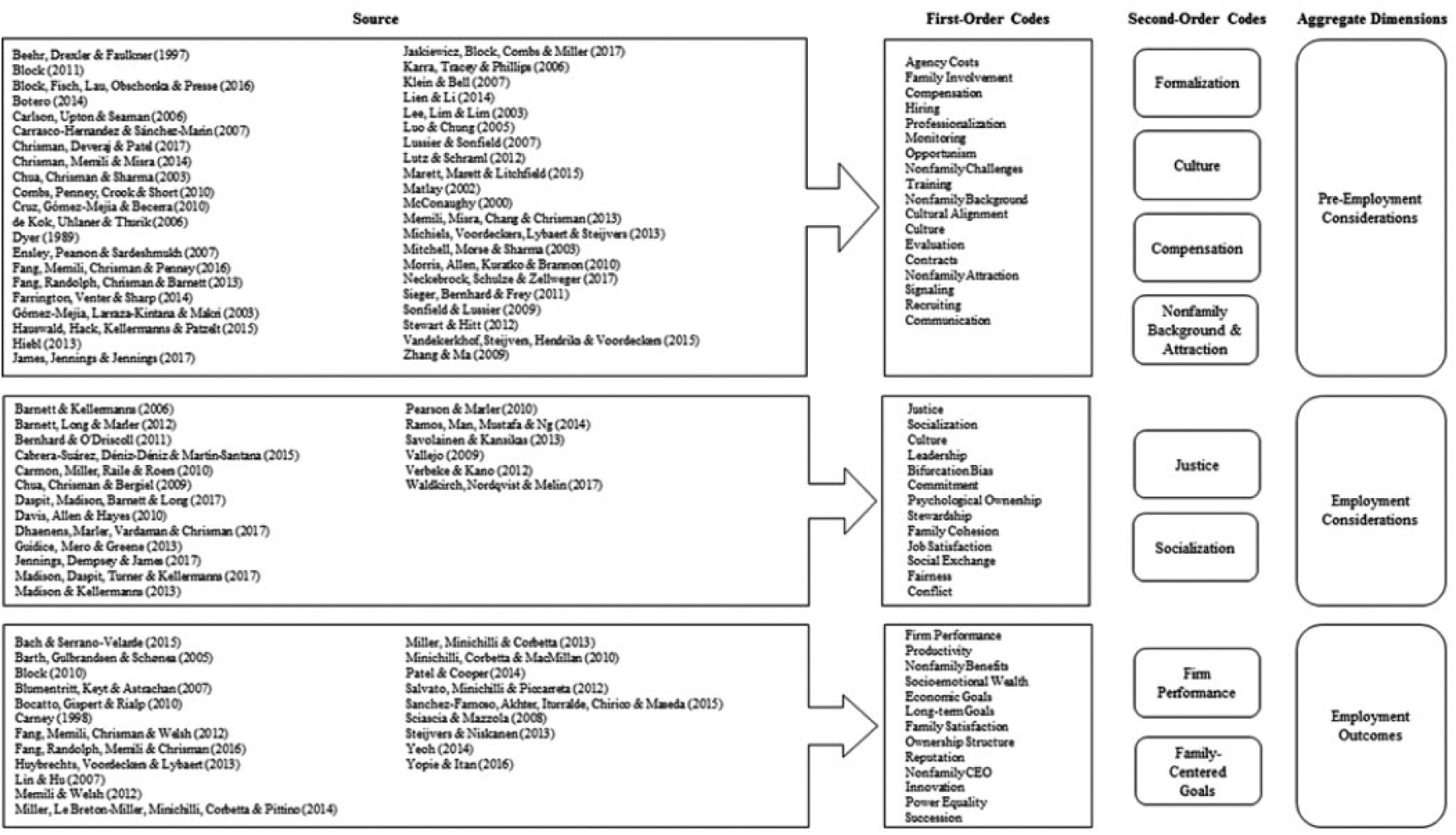
Structure of the nonfamily member literature.
Nonfamily Member Literature.

Note. NF = nonfamily firm; FF = family firm; RBV = resource-based view; TMT = top management team; SME = small- and medium-sized firm; SEW = socioemotional wealth; CFO = chief financial officer; IPO = initial public offering.
Preemployment Considerations
The hiring of nonfamily members is often a requirement for growth and expansion because families are limited both in size and in capabilities (Chrisman et al., 2014). Additionally, some family firms may prefer to hire nonfamily members because of the conflicts of interest that can arise when hiring family (Lubatkin, Schulze, Ling, & Dino, 2005). However, our review reveals unique challenges and considerations in hiring nonfamily members, which can affect the nature of their involvement as employees in family firms. We find this preemployment phase coalesces around four categories: formalization, culture, compensation, and nonfamily background and attraction.
Formalization
An important consideration for family firms before hiring nonfamily members is whether to formalize their governance structure (Zhang & Ma, 2009). Many of the studies we reviewed address this topic (PUI = .20), with agency theory being the most widely utilized theory within the category (PUI = .31). This research is based on the idea that firm owners and nonfamily members may have conflicts of interest due to divergent goals that may encourage nonfamily members to skirt their responsibilities (Chrisman et al., 2014). This issue is amplified when family firms have informal structures that fail to effectively monitor employees and equitably reward performance (Chua et al., 2009). Despite these issues, family firms often fail to develop formalized structures. Sonfield and Lussier (2009) and Lussier and Sonfield (2007) demonstrate there is little change in formalization activities at family firms when nonfamily are included, with the exception of the CFO role because of its focus on decreasing financial risks and instituting professional practices. The first nonfamily manager hired by many family firms is often the CFO, supporting the idea that improving financial management is frequently the initial target when family firms do professionalize (Hiebl, 2013; Lutz & Schraml, 2011).
Although some research indicates that becoming more formalized and bureaucratic facilitates the inclusion of nonfamily members and optimizes firm performance (Carlson et al., 2006; Madison et al., 2017), other studies suggest formalization is contingent on family firm circumstances. For instance, de Kok et al. (2006) find that small- to medium-sized Dutch family firms typically do not formalize because the daily involvement of the family makes formal practices less necessary, indicating that family firms rely on family members as a substitute for formalization. Fang et al. (2017) show that family firms operating in industries where monitoring is more difficult are less likely to employ nonfamily managers. Lien and Li (2014) find that family involvement is necessary for firm growth as a means of monitoring nonfamily employees in a country with weak legal structures. Furthermore, the ability of family firms to successfully utilize nonfamily managers is contingent on level of involvement of such managers (Chua et al., 2003). These findings indicate the need to formalize depends on both the number of family members in the firm and the context in which the firm operates (Chua et al., 2003; Fang et al., 2017).
Other research indicates that family firms do not formalize because of the potential costs. For example, Dyer (1989) asserted that qualified nonfamily managers are hired to transform the firm into a more professional business; however, their hiring may be costly due to the potential for conflicts of interest and a lack of cultural fit between the manager and the family. Family owners may also find it difficult to justify the economic and noneconomic costs of formalization since it may entail providing better career opportunities and compensation in order to hire high-quality nonfamily managers (Chrisman et al., 2014). Stewart and Hitt (2012) suggest that family firms tend to be reticent about formalizing, thereby making nonfamily member involvement potentially more difficult, because it can damage firm performance by impeding entrepreneurial capabilities and restraining the use of effective yet idiosyncratic methods.
Recent research indicates nonfamily members may need less monitoring than is commonly assumed. James et al. (2017) find that nonfamily managers display pro-organizational behaviors that make formalization less necessary, and that the goals of family owners and nonfamily managers are not as divergent as commonly thought. Indeed, Klein and Bell (2007) contend that formalization may discourage nonfamily members from joining the firm because it is the informal and less bureaucratic structures that they often find attractive. They further indicate that nonfamily members may align themselves with the goals of family owners to maintain these less formal environments. Perhaps more precisely, Cruz et al. (2010) find that family firms will use informal contracts with trusted nonfamily members but not with less trusted nonfamily members. Therefore, hiring trusted nonfamily may mitigate the assumed conflicts of interest between family owners and nonfamily managers. This supports the research of Luo and Chung (2005) that finds that family firms employing nonfamily members with whom they have preexisting social ties tend to outperform other family firms. They cite improved cooperation and the effects of the norm of reciprocity between family owners and nonfamily members as contributing factors. This indicates that hiring from within a social network may facilitate trust between nonfamily members and business families that mitigates the necessity of formal firm structures.
In sum, our review of the nonfamily research in this area highlights a debate in the literature about whether family firms benefit from formalization when employing nonfamily members. While some research indicates that conflicts of interest make it necessary (Chua et al., 2003; Fang et al., 2017), other research appears to question the extent to which conflicts of interest between family and nonfamily actually occur (James et al., 2017; Klein & Bell, 2007). Stewart and Hitt (2012) even suggest that family firms may elect to live with conflicts of interest rather than formalize their governance due to the negative impact formalization might have on their culture.
Culture
A small but meaningful set of studies discuss how culture influences the involvement of nonfamily members in the family firm (PUI = .09). The literature in this category applies a number of different theories, such as role theory, social identity, and stakeholder theory, with no single theory being used more than once. When considering whether to include nonfamily members, this literature suggests cultural fit is both important and challenging for family firms in the selection process (Mitchell et al., 2003). Research indicates family firms have cultures with positive, intangible features such as a favorable working environment that allows nonfamily employees to thrive (Miller & Le Breton-Miller, 2005; Milton, 2008; Stewart & Hitt, 2012). The more embedded a particular family’s values and vision, the more sensitive the firm will be to the needs of nonfamily employees, providing a climate of care and concern that can lead to stewardship behaviors (Barnett et al., 2012; Bernhard & O’Driscoll, 2011; Fang, Randolph, Chrisman, et al., 2013; Pearson & Marler, 2010). Even though these firm cultures may not be truly “family-like” because the interests of family members still may be prioritized over nonfamily (Lubatkin, Ling, & Schulze, 2007), these firms are recognized as producing a more compassionate and benevolent culture in comparison with nonfamily firms. Family firms may face a distinct advantage in recruiting certain nonfamily members because of their culture (Klein & Bell, 2007).
Our review also uncovers several articles that describe family firm culture in a more negative light. In particular, the literature recognizes significant challenges related to assimilating nonfamily members into a family firm’s culture. For instance, studies suggest nonfamily members may find navigating these idiosyncratic cultures difficult (Hall & Nordqvist, 2008; Lee et al., 2003). Mitchell et al. (2003) argue that nonfamily members require significantly higher cognitive abilities because they need to transact with stakeholders in the family system as well as the business system. Likewise, Morris et al. (2010) find that nonfamily members often struggle in family firms because of the ambiguity inherent in these smaller, more entrepreneurial firms. Research also suggests the relational familiarity between family members leads to idiosyncratic communication styles that can put nonfamily members at a disadvantage (Marett et al., 2015). Although less common than generally assumed, family conflict can also create additional challenges in recruiting, assimilating, and retaining nonfamily members (Beehr et al., 1997). Taking these issues together, nonfamily members may have difficulty adjusting to a family firm’s culture (Lee et al., 2003; Stewart & Hitt, 2012).
Another potential challenge for nonfamily members (and family members) is that these idiosyncratic cultures can make the firm-specific skills learned on the job difficult to transfer to other firms (Chrisman et al., 2014; Gómez-Mejía et al., 2003). This, combined with a general reluctance among family firms to invest in nonfamily employees (Matlay, 2002; Neckebrouck et al., 2017), means that the training provided to nonfamily employees may be limited in breadth as well as depth. On the other hand, while these firm-specific skills and lack of formal training may lessen the likelihood of turnover, Lee et al. (2003) caution that once nonfamily members have gained idiosyncratic knowledge they may be in a position to expropriate a disproportionate share of the value a family firm creates. Moreover, the intertwining of family firms’ economic and noneconomic goals with their idiosyncratic cultures can make these environments difficult for nonfamily members to understand (Fang, Randolph, Memili, et al., 2013). As such, a lack of investment in training may make family firms less attractive places to work and decrease the motivation and initiative of nonfamily members (Chrisman et al., 2014). In sum, although family firms may attract individuals preferring their more benevolent environment, idiosyncratic cultures may deter individuals who have concerns about successfully navigating these environments or who desire to further their career through generalized training or learning (Hauswald et al., 2016).
Compensation
Compensation is an important topic in the nonfamily literature (PUI = .16), with agency theory being the most prominent theoretical frame (PUI = .62). This literature asserts that one way for family firms to resolve the conflicts of interest between family owners and nonfamily members is through compensation. Our review highlights that positive perceptions of the compensation and pecuniary practices of family firms are linked with nonfamily employee organizational identification and psychological ownership (Ramos et al., 2014; Sieger et al., 2011) and that compensation is one of the primary determinants of nonfamily member job satisfaction (Farrington et al., 2014). However, when nonfamily members are paid less than family, the perception of bias may persuade nonfamily to seek employment elsewhere, as well as engender resentment that demotivates and fosters negative work performance and turnover (Chua et al., 2009; Ensley et al., 2007).
The literature indicates that family firms may need to pay nonfamily members more than they would family members in order to recruit and motivate them. Several articles suggest that higher incentive compensation in particular may be needed in family firms more than in nonfamily firms. Ensley et al. (2007) find that pay dispersion within the top management team will diminish cohesion because of the perception of family bias. Michiels et al. (2013) find that incentive compensation improves firm performance more for firms with a nonfamily CEO than for firms with a family CEO. In comparable studies, Chrisman et al. (2017) and Jaskiewicz et al. (2017) find that increases in nonfamily incentive compensation benefit family firms more so than nonfamily firms. They contend this is not just because of the increased motivation this will elicit in nonfamily members, but also because it signals that the firm is committed to improving firm performance and good governance. Drawing on different reasoning, Block (2011) recommends that family firms offer long-term incentive compensation to nonfamily managers in order to align the goal horizons between the business family and the nonfamily member. Despite the benefits of incentive compensation, Memili et al. (2013) find that family firms are less likely than nonfamily firms to offer it to nonfamily members. Their arguments suggest this may be due to the family’s hesitancy to relinquish control and influence over the firm or because family firms are better able to monitor nonfamily managers’ behavior.
Some research looks beyond incentive compensation to the overall wages paid to nonfamily members. However, this research yields mixed results. Neckebrouck et al. (2017), in a longitudinal study of over 14,000 Belgian firms, find that nonfamily employees are paid 7% less than employees at nonfamily firms. This comports with Carrasco-Hernandez and Sánchez-Marín (2007) that finds small family-managed firms offer lower compensation than small nonfamily firms. This study also demonstrates that professionally managed family firms pay employees the same as nonfamily firms, indicating that undercompensating nonfamily may not be prevalent among medium- or large-sized family firms. Furthermore, it finds that even though professionally managed family firms pay similar to nonfamily firms, they do so by offering higher incentive pay but lower base pay. This may be as much to reduce the risk of adverse selection as to reduce the risk of moral hazard (Chrisman et al., 2017).
Other research focuses on the compensation considerations regarding nonfamily managers and CEOs. Gómez-Mejía et al. (2003) find that family firms pay nonfamily managers more than family managers, particularly in firms with high family involvement. This may be because family managers are residual owners who already benefit from increases in firm value or because of a family handcuff that limits outside opportunities. Similarly, some research demonstrates that large family firms pay nonfamily CEOs more than family CEOs, and that nonfamily CEO pay is comparable with that of CEOs at nonfamily firms (Combs et al., 2010; McConaughy, 2000). In summary, our review documents that nonfamily members of family firms tend to be paid less than employees at smaller nonfamily firms, but this finding is attenuated by whether the firm is professionalized and the nature of the position. Accordingly, family firms must consider these compensation issues prior to the employment of nonfamily members.
Nonfamily Background and Attraction
The final category in the preemployment theme is nonfamily background and attraction (PUI = .08). One notable article in this area is Block et al. (2016), which finds, in an extensive multicountry analysis, that females and aspiring entrepreneurs are attracted to family firms while urban residents and highly educated or experienced individuals are disinclined to joining them. They argue these inclinations are at least partially explained by risk preferences wherein the increased job security at family firms make these organizations attractive to more risk-averse nonfamily candidates (Block, 2010) and to the more unique learning contexts these firms offer for those with self-employment intentions. Complementary findings by Hauswald et al. (2016) indicate individuals who aspire to success, power, and self-achievement are generally not attracted to family firms. Those valuing conservation and meaning in their work prefer the working conditions offered by family firms. They also conclude that individuals desiring security and stability prefer family firms whereas those valuing flexibility and change do not.
These findings align with the conceptual work of Chrisman et al. (2014) that asserts family firms attract candidates who are less ambitious or capable, whereas more ambitious and capable nonfamily candidates gravitate toward nonfamily firms that may offer better career opportunities. Similarly, Vandekerkhof et al. (2015) find the more committed a family firm is to their socioemotional wealth—the affective endowment extending from the family’s involvement in the firm (Gómez-Mejía, Haynes, Núñez-Nickel, Jacobson, & Moyano-Fuentes, 2007)—the less capable their nonfamily managers are with regard to innovation and internationalization. However, the mechanism through which family involvement itself leads career-oriented individuals to shun family firms is somewhat unclear. Botero (2014) finds that student candidates in the United States and China found small firms less attractive, but that the family’s involvement had little impact. This implies small nonfamily firms may face similar difficulties as small family firms in attracting top candidates, although other research discussed above (cf. Chrisman et al., 2014; Chrisman et al., 2017) suggests otherwise.
Our review reveals that relatively little is known about the attributes or characteristics family firms prefer in nonfamily members, but there are indications that they prefer nonfamily members with whom they have a cultural or social affinity. Luo and Chung (2005) find that family firms sometimes employed nonfamily members with whom they had a prior relationship as a means to ensure cooperation and trustworthiness. However, common demographic ties (e.g., nationality, ethnicity) between nonfamily and family members did not lead to improved firm performance (Luo & Chung, 2005). This contradicts the literature that suggests ties, such as religion, should bolster firm culture through shared values (Fang, Randolph, Chrisman, et al., 2013). In a case study, Karra et al. (2006) describe a Turkish family firm that employed nonfamily members with similar ethnic backgrounds to the business family as a means of maintaining the firm’s culture while expanding. The family CEO also tried to establish intra-firm norms of reciprocity by engaging in acts of altruism, cooperation, and trust. While this initially yielded firm performance benefits, over time it led to an adverse selection problem as it reduced the family owners’ ability and willingness to institute safeguards to prevent opportunistic agents from joining the firm, which ultimately impaired the firm’s culture and performance.
In conclusion, the preemployment literature indicates that family firms may opt for more informal, family-like environments rather than assume the risks and costs of formalization (Stewart & Hitt, 2012). These environments make family firms attractive to certain nonfamily members (Klein & Bell, 2007; Miller & Le Breton-Miller, 2005; Stewart & Hitt, 2012), especially those with similar attributes and values as the business family (Fang, Randolph, Memili, et al., 2013; Karra et al., 2006). Additionally, our review reveals that inadequate compensation may be a concern at smaller family firms but not at larger family firms. Likewise, the lack of training and career opportunities are reasons for nonfamily members to eschew joining family firms.
Employment Considerations
The next broad theme emerging from our review relates to the unique challenges that surface once nonfamily members are employed in the family firm. This literature includes studies that suggest preferential treatment of family members will undermine the successful integration and assimilation of nonfamily members into the family firm, and studies that contend the family’s involvement in the firm will generally produce better-quality treatment in family firms than in nonfamily firms. These studies center on topics of justice and socialization, respectively.
Justice
With a PUI of .12, our review documents that justice is an important topic in the nonfamily member literature. The literature in this category uses a wide variety of theories, such as fairness theory, social exchange theory, and social identity theory, with no dominant perspective emerging. Earlier studies address the unfairness or injustice nonfamily members may face when working in a family firm (Barnett & Kellermans, 2006; Chua et al., 2009). Recent articles further refine our understanding of justice in family firms.
Organizational justice refers to the subjective perceptions of fairness in the treatment of employees in an organization (Greenberg, 1990). Extended into the family firm context, Verbeke and Kano (2012) use the terminology bifurcation bias to describe the asymmetric treatment of family and nonfamily members in the family firm. They theorize that bifurcation bias exists when family owners and managers treat nonfamily members as short-term agents but family members as long-term stewards. When this occurs, family firms may not honor contractual obligations or may mistreat nonfamily members. Barnett and Kellermanns (2006) contend this injustice may be especially pronounced in smaller family firms that lack the necessary protocols and protective measures for nonfamily members. These firms often lack such processes because they can be costly and require formalization, both of which are contrary to the typical governance of family firms (Carney, 2005). Indeed, Chua et al. (2009) assert that family owners are motivated to maintain more subjective and informal practices to protect the privileges of family members.
Some of the literature reviewed describes and demonstrates the negative implications of perceived injustice. The perception of injustice or bifurcation bias can undermine the relationship between family owners and nonfamily members, creating perceptions that family members are not held accountable for their behaviors (Guidice et al., 2013). When injustice is perceived, nonfamily employee job satisfaction (Sieger et al., 2011) and organizational commitment (Carmon et al., 2010) are diminished. Additionally, the likelihood that intrafirm factions will emerge that undermine firm cohesiveness is increased (Minichilli et al., 2010). Research also demonstrates that the perception of injustice resulting from the bifurcated treatment of family and nonfamily members can negatively affect family firm performance (Madison et al., 2017).
Some literature implies that injustice in family firms may not be as prevalent or problematic as assumed. For instance, nonfamily members may be willing to accept some partiality toward family members because fairness norms may function differently in family firms (Kidwell, Kellermanns, & Eddleston, 2012; Lubatkin et al., 2007). Additionally, Jennings et al. (2017) indicate bifurcation bias is overstated because firm owners are unlikely to engage in practices that are perceived as unjust because they perceive nonfamily members as quasi-family. Recent research also notes that injustice perceptions are likely influenced by the health of the family itself. Barnett et al. (2012) assert business families with a strong family vision and who engage in generalized social exchange will inculcate more positive justice climates. Cabrera-Suárez et al. (2015) find that cohesive and supportive business families tend to generate firm controls that are favorable toward nonfamily members. Similarly, applying circumplex theory from the field of family studies, Daspit et al. (2017) maintain that cohesiveness and flexibility in the business family may reduce bifurcated human resource practices. Thus, although some family firms may engage in unfair treatment of nonfamily members, recent research questions whether these practices are widespread.
Socialization
A set of studies in this theme examines how the socialization of nonfamily members in family firms facilitates cultural and goal alignment (PUI = .11). The most commonly applied theory in this category is stewardship theory (PUI =.33). This literature considers the treatment of nonfamily members in family firms differently than the justice literature. While the justice literature emphasizes how the asymmetric treatment of family and nonfamily members may contribute to perceptions of injustice, the socialization literature emphasizes how business families, family leaders in particular, may engage in certain behaviors and practices that contribute to a positive work environment. These behaviors are what allow family firms to maintain their cultures even as they grow and professionalize (Miller & Le Breton-Miller, 2005).
A common theme in the socialization literature is that family firms are strongly influenced by active leadership styles that encourage commitment to firm values (Bernhard & O’Driscoll, 2011; Karra et al., 2006; Klein & Bell, 2007; Madison & Kellermanns, 2013; Pearson & Marler, 2010). This research is conceptualized in terms of leader–member exchange (Pearson & Marler, 2010), spiritual leadership (Madison & Kellermanns, 2013), mentoring (Dhaenens et al., 2017), and transformational leadership (Bernhard & O’Driscoll, 2011). Put simply, this research considers whether more positive treatment of nonfamily members can inculcate steward behaviors. An influential paper in this regard is Davis et al. (2010), which finds that altruistic leader behavior toward nonfamily members fosters their commitment to the organization, trust in leadership, and goal alignment. Pearson and Marler (2010) extend this research by theorizing that these altruistic leader behaviors may permeate throughout the firm, creating a more positive, committed firm culture. Furthermore, Waldkirch et al. (2017) suggest that multiple generations of the owning family engaging in altruistic behaviors can give rise to affective attachments to the family that reduce nonfamily turnover.
Some research in our review raises questions about the effectiveness of altruistic leadership. For instance, Madison and Kellermanns (2013) find that altruistic family leader behaviors lead family employees to engage in organizational citizenship behaviors but do not have the same effect on nonfamily employees. They indicate these leader behaviors may be limited in their effectiveness because nonfamily employees may have a lessened sense of purpose and meaning in their jobs at family firms than do family members. Karra et al. (2006) find that altruistic leader behaviors can become counterproductive by attracting opportunistic nonfamily members to the firm. Furthermore, Ramos et al. (2014), in a study of small Malaysian family firms, find that nonfamily employees are unlikely to experience significant organizational identification, making them less committed to their work and to the firm itself (cf. Vallejo, 2009). In contrast, Bernhard and O’Driscoll (2011) demonstrate that nonfamily employees develop a greater sense of organizational commitment and psychological ownership when family firm leaders engage in more active leadership styles. Savolainen and Kansikas (2013) indicate, however, that inducing psychological ownership among nonfamily may hinder family succession. Taken together, this research highlights that the extent to which positive leadership behaviors actually engender pro-organizational behaviors from nonfamily members is still unclear.
In sum, our review reveals two contrasting perspectives in the employment theme. The justice literature recognizes that nonfamily members may perceive their treatment as substandard in comparison with family members due to greater accountability, expectations, and demands (Chrisman et al., 2014; Guidice et al., 2013). The socialization literature contends that the benevolent and caring treatment typified at many family firms relative to other types of firms may weigh more heavily in the minds of nonfamily members. As the literature recognizes, much of this is dependent on the family unit itself and their perceptions of nonfamily members (Barnett et al., 2012; Cabrera-Suárez et al., 2015).
Employment Outcomes
The final broad theme emerging from our review of the nonfamily literature is the family firm outcomes resulting from the employment of nonfamily members. We synthesize this literature by its focus on either family firm performance or family-centered goals.
Firm Performance
Indicated by a PUI of .22, the relationship between nonfamily members and family firm performance is a major topic of study. This literature primarily uses agency theory (PUI = .56) to discuss the conditions or situations that determine if family or nonfamily leadership leads to optimal firm performance (Patel & Cooper, 2014; Sciascia & Mazzola, 2008). Our review indicates that nonfamily CEOs have a positive impact on family firm performance (Lin & Hu, 2007; Miller et al., 2013; Miller et al., 2014; Yeoh, 2014; Yopie & Itan, 2016). Furthermore, the involvement of nonfamily managers seems to be associated with a commitment by family owners for prioritizing economic firm performance. Bocatto et al. (2010) demonstrate that financially underperforming family firms are more likely to employ a nonfamily CEO than a family CEO. Researching Italian family firms, Salvato et al. (2012) find that family firms elect nonfamily CEOs more often than family CEOs. Finally, Fang, Randolph, Memili, et al. (2013) find that as growth opportunities improve, family firms are more inclined to hire nonfamily managers. Taken together, these studies suggest that family owners are more committed to financial performance than commonly assumed and believe a nonfamily CEO is often necessary for improved firm performance.
There is some indication in the literature that the benefits of employing nonfamily CEOs is contingent on context. For instance, family firms that hire a nonfamily CEO instead of a dynastic successor generally need to increase employee compensation to prevent workforce turnover, indicating that this decision hinders firm performance, at least short term (Bach & Serrano-Velarde, 2015). Lin and Hu (2007) and Miller et al. (2013) demonstrate that nonfamily CEOs at small firms or at firms with concentrated family ownership generally underperform when compared with family CEOs. Whereas family firms that are larger and/or have dispersed ownership benefit from employing a nonfamily CEO (Lin & Hu, 2007; Miller et al., 2013). Similar findings by Steijvers and Niskanen (2013) suggest family CEOs at firms with dispersed ownership may deplete cash reserves to benefit their own nuclear family, necessitating the hiring of a nonfamily CEO. Moreover, Villalonga and Amit (2006) show that a nonfamily CEO combined with a family chairman of the board optimizes performance, indicating that a combination of family and nonfamily is important at the top levels of the firm to optimize productivity and ensure effective monitoring. Miller et al. (2014), however, find that firms with family and nonfamily co-CEOs tend to underperform when compared with firms with only a nonfamily CEO.
There are similar findings with regard to nonfamily managers, with research generally indicating the inclusion of nonfamily managers improves family firm performance (Fang, Randolph, Memili, et al., 2013; Sciascia & Mazzola, 2008). In an early study, Carney (1998) finds Chinese family firms with fewer nonfamily managers tend to underperform in more competitive or asset-intensive industries. Sciascia and Mazzola (2008) demonstrate that nonfamily management leads to improved firm performance despite possible goal misalignment. Several notable studies add nuance to these findings, indicating that a proper balance of family and nonfamily members improves firm performance. Minichilli et al. (2010) report an inverse U-shape relationship between the ratio of family and nonfamily top managers and family firm performance, suggesting that an equal number of nonfamily and family managers may be optimal. Similarly, Patel and Cooper (2014) provide support that equal compensation, status, and representation between family and nonfamily managers contributes to better family firm performance.
The literature identifies several reasons for the positive link between the involvement of nonfamily managers and CEOs and family firm performance. Research suggests that nonfamily managers are typically more productive than their family counterparts (Barth et al., 2005). The inclusion of nonfamily managers in leadership roles may inspire other nonfamily members, inducing greater work effort and inculcating organizational identity among these members (Memili & Welsh, 2012). The perception that nonfamily members are valued may encourage nonfamily members to contribute their knowledge and ideas to strategic decision making (Patel & Cooper, 2014). Nonfamily members may augment a family firm’s social capital and innovation (Sanchez-Famoso et al., 2015; Yeoh, 2014). Salvato et al. (2012) assert that this improved social capital results from having a “boundary-less” career that, unlike family members, typically includes employment at other firms. Huybrechts et al. (2013) argue that the lower psychological ownership of nonfamily CEOs may induce greater risk tolerance and a willingness to engage in entrepreneurial activities. Nonfamily executives often provide legitimacy to the firm, which contributes to resource acquisition (Chung & Luo, 2013). Finally, nonfamily executives may be especially valuable when ownership is dispersed among multiple families because they can ensure that resources are not misappropriated (Lin & Hu, 2007; Miller et al., 2014; Steijvers & Niskanen, 2013). In summary, with few notable exceptions, our review shows that the involvement of nonfamily managers, combined with family involvement and oversight, generally improves firm performance.
Family-Centered Goals
Although much research argues the involvement of nonfamily members in the family firm is indicative of a prioritization of financial goals (Bocatto et al., 2010; Salvato et al., 2012; Vandekerkhof et al., 2015), some research indicates their involvement may be linked to family-centered noneconomic goal attainment (PUI = .04). The literature in this category utilizes agency theory, stewardship theory, institutional theory, and the resource-based view to support these claims.
Through interviews with family firm CEOs, Blumentritt et al. (2007) find that business families’ personal satisfaction with a nonfamily CEO is as important to the CEO’s perceived success as financial performance. The authors assert that many business families consider an emotional bond with the nonfamily CEO as vital to their relationship. They further state that successful nonfamily CEOs tend to the needs and concerns of business families. Although they indicate that the noneconomic expectations business families have for nonfamily CEOs will be unique to each family, also important is trust, cultural fit, and shared values. In contrast, Chrisman et al. (2014) argue that the pursuit of noneconomic goals makes family firm owners more reluctant to hire nonfamily managers and may lead to unrealistic and unfulfilled performance expectations.
There are also indications that nonfamily members are integral to the reputation of the family and the family firm. Fang et al. (2012) contend that hiring nonfamily members is often motivated by a desire for the social respectability of having a professionalized firm. This implies that some family firms hire nonfamily members in part to boost their reputation. Similarly, Block (2010) demonstrates that family firms are less willing to dismiss employees because of the potential reputational damage. In sum, our review of the nonfamily literature suggests that nonfamily members can contribute to both firm-centered performance goals and family-centered noneconomic goals.
Guidance for Future Research
The literature on nonfamily members in family firms covers a wide array of topics and has been studied through a variety of theoretical lenses. Moving forward, research should take a perspective that acknowledges the complexities associated with the involvement and influence of nonfamily members in family firms. To this end, we suggest that research linking the preemployment and employment of nonfamily members and a family firm’s unique economic and noneconomic goals can facilitate a more comprehensive understanding of the roles, impact, and challenges associated with nonfamily members in family firms. This will provide clarity on how prospective nonfamily members can be recruited and used most effectively. Specifically, future research is needed that sheds light on whom family firms can recruit, how the recruitment, selection, and retention of nonfamily members is both perceived and conducted by family firms, and the extent to which nonfamily member perceptions of family firms influence and are influenced by the behaviors, norms, and goals of these firms. This may also open new avenues for understanding family firm heterogeneity because the nature of the nonfamily candidate pool is likely to affect and be affected by the structures, cultures, compensation, altruistic leadership behaviors, family bias, performance, and noneconomic goals of family firms.
As summarized in Table 2, in the remainder of this article, we discuss how the different research foci of the extant literature interrelate and interact to shape and inform each other, as well as provide new avenues for future research.
Future Nonfamily Member Research Agenda.

Preemployment Considerations
A vital but unresolved issue is understanding how family firms can overcome the challenges associated with hiring qualified and motivated nonfamily members. Because family firms have informal governance structures and are liable to exhibit family bias, while offering fewer career opportunities, the pool and quality of nonfamily candidates is expected to be limited (Chrisman et al., 2014; Cruz et al., 2010). Hauswald et al. (2016) and Block et al. (2016) demonstrate that ambitious individuals valuing flexibility, change, and viable promotional prospects shun family firms, whereas more socially oriented individuals who desire security and stability are attracted to family firms. Put simply, those who are less concerned about career opportunities but prefer a family-like work environment tend to be attracted to family firms (Klein & Bell, 2007). Unfortunately, individuals who are more concerned about career opportunities tend to be those with higher abilities because they are the most likely to be able to capitalize on such opportunities. This implies that the most competent workers will be underrepresented among the nonfamily members who seek employment in family firms (Chrisman et al., 2014; Chrisman et al., 2017).
There are several possible ways to study how this obstacle can be overcome. Family firms can create an environment that will appeal to high-ability nonfamily job candidates by providing more attractive compensation packages and/or broader career opportunities. Furthermore, given that high-ability job candidates tend to be motivated to enhance their skill sets, the attractiveness of working in family firms that provide greater opportunities for learning through, for example, better training, might be higher than in family firms that fail to offer similar prospects for self-development. As an additional benefit, training can allow family firms to grow their own talent pool. Our review indicates there is little research on the ability of nonfamily members employed in family firms and how it can be enhanced in both the preemployment phase through recruiting and during the employment phase through various types of training.
Indeed, research that considers the ability of the nonfamily workforce is needed. For example, future research could employ upper echelon theory or agency theory to investigate how family firms assess the abilities of potential nonfamily employees and how those abilities influence family firm performance. To conduct such research, the education and work experience (e.g., management experience, industry experience, family firm experience) of nonfamily members can be used as proxies for ability (cf. Pérez-González, 2006). Additionally, research could investigate the extent to which firm-level characteristics, such as compensation systems, career development opportunities, and professionalization, influence the types of nonfamily recruits family firms are able to attract. To investigate the relationship between the abilities and individual performance of nonfamily members, as well as their impact on firm-level performance, longitudinal data and panel designs are needed. Likewise, longitudinal data are required to assess how firm-level characteristics influence the ability of family firms to recruit high-quality employees.
Applications of signaling theory (Spence, 1973) and attraction–selection–attrition theory (Schneider, 1987) may be useful to understand how family firms siphon off candidates who are disinclined or unfit to contribute to the family’s mix of economic and noneconomic goals while attracting those with the attributes and attitudes that are required for goal achievement (Ployhart, Weekley, & Baughman, 2006). Indeed, an important aspect of signaling is providing credible information that encourages and enables potential employees to engage in self-selection according to whether they possess the qualities that will lead to personal success and satisfaction in the firm. Little is known, however, about the specific signaling processes and mechanisms that are used by family firms and how they influence the recruiting, selection, and hiring of nonfamily members. Walker et al. (2013) provide a potential model for how such research can be conducted. Using time-lagged longitudinal data and a controlled experimental design, they demonstrate that injustice perceptions, mediated by relational certainty, negatively influences organizational attractiveness in recruitment. Future research could adapt this approach to determine how interactions with family members during the recruitment process influences nonfamily member perceptions of the attractiveness of family firms as potential employers.
Another potentially fruitful approach involves combining signaling theory with social identity theory. Because signaling deals with methods to attract individuals based on a matching of attributes and social identity refers to how individuals define themselves according to their relationship to a social entity (Dawson, Sharma, Irvin, Marcus, & Chirico, 2015; Pratt, 1998), linking these two theories may shed light on how aspects of social identity encourages employee–organizational fit and goal alignment in the family firm context. Research that considers such issues would contribute to the general management literature, as well as the family business literature, by determining how firms can overcome incentive limitations and injustice perceptions in the recruitment and selection process.
In addition, the possibility that the characteristics of the potential nonfamily labor pool or the composition of the nonfamily workforce in the firm might influence the goals and behaviors of family owners should be investigated. Indeed, it has long been noted that goals are sometimes adjusted to fit a firm’s resources and opportunities (cf. Cyert & March, 1963). Thus, if the anticipated productivity of the candidate pool is high, then family owners may be apt to emphasize economic goals because this will increase their expected utility. But if the nonfamily candidate pool is only of average quality, the family’s expected utility might be increased more by emphasizing noneconomic concerns, such as the reputational or cultural benefits of hiring from outside the family. However, past research suggests family firms are likely to shift their goal preferences when confronted with threats to their reputation or performance (e.g., Chrisman & Patel, 2012; Vardaman & Gondo, 2014). Thus, future research could make use of the mixed gamble derivative of prospect theory to better explain how family firm decision making shifts as changes to the potential and current composition of the nonfamily workforce alters perceptions of risk and return probabilities.
Employment Considerations
Similarly, the risk aversion of nonfamily members is thought to vary vis-à-vis that of family members (Block, 2011), which could have implications for firm and employee outcomes (Vardaman, Allen, Renn, & Moffitt, 2008). One way the risk preferences of nonfamily members could be investigated is through conjoint analysis, which has been widely used in both marketing and strategy research but seldom within the family firm literature despite its potential usefulness (Evert et al., 2016). This method involves tapping into the underlying preferences of individuals by gathering data as they make decisions using different risk scenarios (Lohrke, Holloway, & Woolley, 2010). Understanding the unique decision-making processes of nonfamily members could provide new insights not only into the characteristics of nonfamily members but also how the nonfamily workforce shapes and influences the goals of family firms. Provided as an exemplar, McMullen and Shepherd (2006) use conjoint analysis to investigate how the self-perceived competences of untenured tenure-track professors influenced their risk tolerance in the publication process. Family firm research can adapt this approach to determine the extent to which risk preferences of nonfamily members influence, and are influenced by, the behaviors and practices of family firms (e.g., Klein & Bell, 2007). Again, the mixed gamble approach might fit well as a theoretical lens for such research.
Our review illustrates that family bias has been an important focus of the nonfamily member literature. It is not clear, however, if family bias or injustice is a concern that family firms address during employment, or if they have unique hiring processes that allow them to employ nonfamily members who will more readily tolerate family bias. Research that considers the relationship between the preemployment and employment phases may reveal new insights that focusing on one alone may not bring. For instance, Lubatkin et al. (2007) suggest that nonfamily members have a zone of indifference or tolerance toward the preferential treatment of family members. But at a certain point, nonfamily members may become discouraged by family bias, activating perceptions of injustice. Little is known regarding the size of the zone of indifference or how it is created, fostered, or altered. Perhaps family owners are able to signal to candidates the importance of the family unit to generate this zone of difference, mitigating justice issues before nonfamily members join (Colquitt & Rodell, 2015). Alternatively, nonfamily members may come to accept their roles through their socialization in the firm. But how either approach is accomplished is unclear.
In general, future research is needed to understand how family firms socialize and train nonfamily members. Family firms with more informal and idiosyncratic structures and processes may need to engage in unique training practices that prioritize strong relational dynamics, cultural fit, and trust, whereas those with more formalized structures may need training that emphasizes productivity (e.g., Blumentritt et al., 2007; Cruz et al., 2010). Understanding how these idiosyncratic challenges are assessed and considered by both family owners and nonfamily members will provide clarity about nonfamily members’ role in family firms. Longitudinal data to assess how the different types of training and socialization influence employee productivity over time would be ideal for future research.
Socialization and justice implications of nonfamily involvement may shape or be shaped by the goals of the family firm. In particular, the socialization and training of nonfamily members may affect the aspiration levels of nonfamily members and family owners, the former because of learning and the latter because of an increased capacity of the workforce. Whether and how this occurs in practice requires future research. Likewise, if injustice leads to nonfamily member turnover, then family firms will have difficulty achieving long-term goals, making family firm owners less likely to emphasize them. Because of this, more understanding regarding nonfamily turnover and how it affects the goal horizons of family firms is needed. With informal governance structures making the formalization of firm knowledge less likely, and a family-like work environment dependent on shared values typifying many small to medium-sized family firms, turnover could have a greater negative affect on family firms than nonfamily firms. In that case, family firms would be dependent on the stability of their nonfamily workforce to achieve both their economic and noneconomic long-term goals (Cabrera-Suárez et al., 2015; Klein & Bell, 2007). Understanding how this dependence limits the extent to which family firms engage in family bias would be useful (Lubatkin et al., 2007). Research could use a social network approach to consider how nonfamily relationships with family members influence their turnover intentions. In sum, future research that describes more fully the relationship between long-term family goals, family bias, and nonfamily dependence will provide new clarity on the relational dynamics between family firms and nonfamily members.
Employment Outcomes
It is well-established that family firms have more idiosyncratic goals, particularly of a noneconomic nature, than nonfamily firms (e.g., Gómez-Mejía et al., 2007). Although economic goals may precipitate the hiring of nonfamily members (Salvato et al., 2012), their actual selection may in part be determined by noneconomic goals. Thus, due to the potential loss of socioemotional wealth, family firms may only hire nonfamily members when they expect increased economic returns from doing so (Chrisman et al., 2014; Fang, Randolph, Memili, et al., 2013; Gómez-Mejía et al., 2014). Therefore, noneconomic goals may indirectly explain why nonfamily members may be more productive than family members in some circumstances, particularly when considering upper-level management (cf. Lee et al., 2003; Pérez-González, 2006).
Little is understood, however, about the interaction between economic and noneconomic goals. For example, in some cases, nonfamily members may not be selected because of an expected productivity increase by itself, but because of the expected socioemotional wealth benefits that they will provide through contributions to the firm’s culture, reputation, or perceived amicability toward the business family’s continued control and influence. Future research could explore how nonfamily members respond to the socioemotional wealth expectations of family firms. This is an area where qualitative research using sensemaking and social identity perspectives may be needed.
Just as socialization influences goals, family firm goals may shape the socialization of nonfamily members. Specifically, if family firms have extended goal horizons, particularly because of the presence of a viable family successor, family firm leaders may believe that continued stability of the firm is necessary, increasing their concerns about turnover or the appearance of factions that could impede a successful succession process. Therefore, this may encourage family firms to be altruistic toward nonfamily members in ways that firms with shorter goal horizons may deem unnecessary or unhelpful. Likewise, goal horizons may shape compensation packages and hiring practices (Block, 2011) as well as shape the training of nonfamily members (e.g., Le Breton-Miller & Miller, 2006). Thus, future research is needed to understand how family firms can utilize nonfamily members in achieving their noneconomic and economic goals, and how these goals influence both the preemployment and employment phases of nonfamily member involvement.
Finally, a number of foundational variables associated with heterogeneity among family firms should be investigated with respect to the recruitment, training, compensation, and utilization of nonfamily members. These variables include descriptive and normative differences associated with firm size, firm age, industry, country, governance structure, firm performance, and extent of family involvement. For example, the respective studies by Fang et al. (2017) and Fang, Randolph, Memili, et al. (2013) indicate that industry and firm size have significant impacts on the perceived attractiveness of hiring nonfamily members to family owners. Although our review indicates that the size of a family firm may be a major determining factor of the extent and nature of the involvement of nonfamily members, such findings should be expanded. In addition, a finer grained distinction among the differing behaviors and roles associated with nonfamily CEOs, managers, and employees is needed.
Conclusion
Family firm researchers have made considerable contributions to the understanding of the benefits and challenges associated with the involvement of nonfamily members in family firms. We review and synthesize this body of research and present a guide for future research that encourages researchers to consider the interrelationships between family firm economic and noneconomic goals and the preemployment and employment phases of nonfamily member involvement. We believe this holistic approach to studying nonfamily members will shed further light on how family firms can best utilize them, without sacrificing the goals and culture that make these firms unique.
Footnotes
Declaration of Conflicting Interests
The author(s) declared no potential conflicts of interest with respect to the research, authorship, and/or publication of this article.
Funding
The author(s) received no financial support for the research, authorship, and/or publication of this article.