




Abstract

Introduction
As the field of family business continues to mature, it is not surprising that there is a growing recognition of the degree of heterogeneity among family firms. While many earlier studies focused on differences between family and nonfamily firms, more and more research is centered on identifying the sources and types of variance among family firms. Given the increasing need to better understand differences among family firms, we propose that a configurational approach, which is often reflected in typologies (which are conceptually developed) or taxonomies (which are empirically derived), is a particularly useful perspective to examine within-group heterogeneity. Thus, the goal of this special issue on “Typologies and Taxonomies of Family Business” is to (1) highlight the utility of using typologies and taxonomies in advancing family business research and (2) promote the use of these approaches in fostering a better understanding of the heterogeneity that exists among family firms, and how this heterogeneity might be linked to important organizational outcomes.
With these goals in mind, this commentary provides a review of articles in the extant family business literature that have used typologies or taxonomic classifications to describe family businesses. Our review lays the foundation for the subsequent presentation of a synopsis of each of the four articles contained within the special issue. Finally, we conclude with a discussion of suggestions for future research using typologies and taxonomies and their application to family firm heterogeneity. We start by discussing the most common approach used.
Typologies or Classification Schemes of Family Businesses
We started our search for published typologies and taxonomies of family businesses by searching ABI/INFORM for articles with different combinations of “family business*,” “family firm*,” “typology,” and “taxonomy” in abstracts, keywords, and full text. We supplemented our list with other articles identified as we conducted our review. Based on our review of the extant literature, we identified 23 articles that relied upon typologies or categorization schemes to classify different family firms. While typologies (e.g., Dyer, 2006; Li & Daspit, 2016) use a theoretical rationale to create groups in which to place family firms that appear to share common features or characteristics, classification schemes (Nordqvist, Sharma, & Chirico, 2014; Scholes & Wilson, 2014; Sharma, 2002) use specific decision rules based on a series of unique identifying characteristics to place family firms into mutually exclusive groups (Doty & Glick, 1994). A closer examination of the 23 typologies or classification schemes found in the literature enabled us to create several different groups of typologies or classification schemes, based on either the types of variables used to create them or the nature of the issue the typology intended to address. While Table 1 provides details about each of these 23 studies, we summarize a few of these groups of typologies below.
Typologies of Categorization Schemes of Family Businesses.

As one might expect, the largest category included eight typologies or classification schemes that attempted to classify “types” of family businesses across a number of common defining characteristics (e.g., Corbetta, 1995; Nordqvist et al., 2014; Scholes & Wilson, 2014; Shanker & Astrachan, 1996; Sharma, 2002). Most of these studies utilized family involvement characteristics to create groupings related to family ownership (Corbetta, 1995; Garcia-Castro & Sharma, 2011; Muntean 2016; Nordqvist et al., 2014, Shanker & Astrachan, 1996; Sharma, 2002), family involvement in governance (Corbetta, 1995; Garcia-Castro & Sharma, 2011; Scholes & Wilson, 2014; Shanker & Astrachan, 1996) or management (Diéguez-Soto, López-Delgado, & Rojo-Ramírez, 2015; Nordqvist et al., 2014; Shanker & Astrachan, 1996), the type of family trust (Scholes & Wilson, 2014), or generational involvement (Barontini & Bozzi, 2018; Westhead & Cowling, 1998). For example, Corbetta’s (1995) typology considered the dispersion of equity ownership, the influence of the family on the board of directors, and firm size. Corbetta argued that the pattern of these characteristics change as family firms evolve from domestic family businesses—represented by tight ownership and control of the firm—to open family businesses, which are medium-to-large firms with widely dispersed ownership and nonfamily involvement in the firm’s governance. Similarly, Shanker and Astrachan (1996) considered a number of dimensions which reflected the family’s involvement in the firm (i.e., strategic control, founder/family CEO, family involvement in management, multiple-generation involvement, control of voting stock, and succession intentions) to develop a three-category typology, ranging from little direct family involvement to high family involvement in the firm.
An example of a classification scheme is offered by Nordqvist et al. (2014), who used three mutually exclusive categories of family involvement in management (i.e., family operators, family supervisors, and family investor) and ownership (i.e., controlling ownership, sibling ownership, and cousin consortium) to develop a three-by-three categorization. Sharma (2002), Garcia-Castro and Sharma, (2011), Diéguez-Soto et al. (2015), and Barontini and Bozzi (2018) take a similar approach albeit with different sets of characteristics.
A common theme in family business research reflects on how family businesses balance the needs or interests of the family with those of the business (i.e., family first vs. business first). Three typologies model how family firms balanced these oft-times competing tensions. Holland and Boulton (1984) presented the first such typology based on initiating actions that naturally occur in the evolution of a family business. The four initiating actions (i.e., firm founding, entry of a family member into the management or ownership of the firm, ownership by nonfamily members, and liquidation of family holdings to an individual or another firm) reflect significant demarcations between one family business era and the next, each requiring the firm to alter the relative weight of family versus business considerations. Similarly, by examining the level of integration between family and business identities on six observable characteristics (i.e., association between the family and business image, culture, personnel, ownership and governance, contractual relationships with the family, and relationships between family and business finances), Sundaramurthy and Kreiner (2008) developed a three-category typology of family involvement in the business, ranging from little direct family involvement to high family involvement. Finally, Distelberg and Sorenson (2009) developed a typology of family businesses based on their value orientation in terms of the extent to which the family firms value either the businesses’ or the family’s interests, grounded at one end by a business depleting family business while the opposite end is grounded by the situation where the businesses’ goals are dominant.
Two typologies relied on the circumplex model from family systems theory. Daspit, Madison, Barnett, and Long’s (2018) typology shows how family firms’ balance between family cohesion and family flexibility has implications for their firms’ human resource practices and the level of symmetry of treatment between family and nonfamily employees. Similarly, Labaki, Michael-Tsabari, and Zachary’s (2013) typology integrated family systems, exchange, and emotional dissonance theories to model how the balance between family cohesion and independence can be used to capture how emotions bind the family and its business, affecting its emotional characteristics.
Five typologies considered innovation activities of family firms. Specifically, two examined how family firms’ long-term intentions, as manifest in either their socioemotional wealth (SEW) intentions or transgenerational succession intentions, had implications for the firms’ innovative strategies (Li & Daspit, 2016) or posture toward corporate entrepreneurship (Randolph, Li, & Daspit, 2017). Li and Daspit (2016) suggested that family firms with extended, long-term views on transgenerational wealth, along with having nonfamily members in the dominant coalition, would demonstrate the most aggressive innovation strategies. Conversely, those family firms with a restricted, short-term view toward wealth preservation, as well as having family members dominate the dominant coalition, were likely to be poor innovators and devote limited efforts towards innovation. Randolph et al.’s (2017) typology forwards that family firms with strong transgenerational succession intentions and expansive knowledge integration capabilities were most likely to pursue aggressive corporate entrepreneurship and innovation strategies. On the other hand, family firms with limited transgenerational succession intentions, and constrained knowledge acquisition capabilities, will pursue meager corporate entrepreneurship activities. Typologies developed by Rondi, De Massis, and Kotlar (2018) and De Massis, Frattini, Kotlar, Petruzzelli, and Wright (2016) considered how family tradition can influence family firm’s innovations while Sciascia, Clinton, Nason, James, and Riveria-Algarin (2013) highlight the effect of communication patterns and family dynamics on the innovation process.
Taxonomies of Family Businesses
As shown in Table 2, our review also includes 14 taxonomies identified in previous family business research. A taxonomic approach uses an empirical method for classification into groups or types (see the articles in this special issue for a much deeper discussion of taxonomies). As with the typologies, several of the taxonomies we identified captured the extent to which either family or business goals or values were dominant in the firm’s approach to business. For example, Basco and Perez Rodriguez (2009, 2011) considered how the family’s involvement in four management and governance issues (i.e., the strategic planning process, board of directors, human resource practices, and succession planning practices) meaningfully differentiate family firm practices and outcomes. Their empirical results from 732 privately owned Spanish firms identified four family business types: immature, business-first, family-first, or family enterprise–first family businesses. Basco (2017) considered how economic versus noneconomic orientations and family versus business orientations could be used to identify unique family business profiles. His empirical results identified six different family business types that reflected, in part, the extent to which family or business goals were emphasized in the firm. Although not specifically creating clusters of types of family businesses, Tagiuri and Davis (1992) empirically identified six significant dimensions of family business goals.
Taxonomies of Family Businesses.
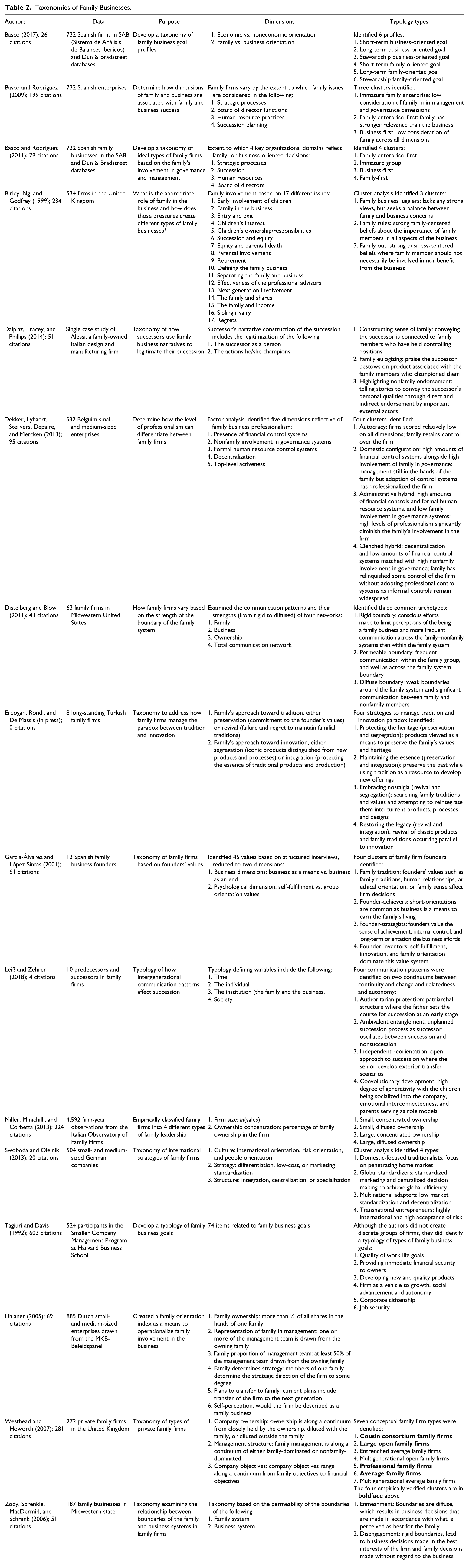
Similarly, Birley, Ng, and Godfrey (1999) measured family involvement based on 17 different issues, such as how children should be involved in the firm, how long parents should be involved in the firm, and how family shares in the business should be divided. Cluster analysis identified three distinct family business profiles, where the firms possess family-centered beliefs, business-centered beliefs, or family/business balanced beliefs. In their study of founders of family firms in Spain, García-Álvarez and López-Sintas (2001) found that family firms could be uniquely assigned to different clusters based on the values of the founder. Specifically, these authors identified four clusters of family firms based largely on the extent to which the founders viewed the business as an ends, or a means, and the extent to which group or self-fulfillment goals dominated the founders’ value set.
Taking a systems approach, two taxonomies considered the strength and permeability of the family and business systems. Distelberg and Blow’s (2011) three firm typology modelled how family firms vary based on the strength of the boundary of the family system. Specifically, these authors examined the communication patterns and strengths (i.e., rigid to diffused) of the family, business, ownership, and total communication networks. Multilevel analysis identified three distinct boundary strength categories: (1) rigid boundary firms making conscious efforts to limit perceptions of being a family business and more frequent communication across the family–nonfamily systems than within the family system; (2) permeable boundary firms, featuring frequent communication within the family group, well as across the family system boundary; and (3) diffuse boundary firms with weak boundaries around the family system and significant communication between family and nonfamily members. In a similar vein, Zody, Sprenkle, MacDermid, and Schrank (2006) developed a taxonomy modeling the permeability of the boundaries of the family and business systems, identifying two types.
Two recent typologies have been developed to consider how family firms approach the innovation and new product process. Specifically, Rondi, De Massis, and Kotlar (2018) consider how the family system is associated with the family firm’s innovative potential. Based on the firm’s risk taking propensity and the extent to which family is anchored in the past, these authors identify four types of family firm innovators. Similarly, De Massis et al. (2016) develop a typology of new product innovation strategies followed by family firms, based on the sources of past knowledge and the type of product innovation the firm. Thus, four types of innovation through tradition strategies were identified.
Miller, Minichilli, and Corbetta (2013) and Westhead and Howorth (2007) both used the concentration of family ownership as a key variable in their taxonomies. Miller et al. combined ownership concentration (i.e, concentrated or diffused) with firm size (i.e., small or large) to create a four-cluster taxonomy. Westhead and Howorth (2007) added family management (i.e., family- or nonfamily-dominated) and company objectives (i.e., family objectives to financial objectives) and empirically identified four clusters of family business types.
Two taxonomies have examined the relationship between communication and family business succession. Dalpiaz, Tracey, and Phillips (2014) highlight how communication patterns are used to legitimize the successors and the succession process, while Leiß & Zehrer (2018) consider how intergenerational communication patterns effect subsequent succession.
Dekker, Lybaert, Steijvers, Depaire, and Mercken (2013) created a four-cluster taxonomy reflecting the level of professionalization within family firms. These authors used factors such as the presence of financial control or formal human resource management systems, and nonfamily involvement in governance as indictors of increasing levels of professionalization.
Although not specifically forwarding a family business taxonomy, Uhlaner (2005) developed an index using several of the criteria frequently used in other family business taxonomies and typologies. Using Guttman scaling techniques, she sorted five family business orientation criteria (i.e., family representation in ownership, management and management team, family influence in strategy, and succession intentions) along a single continuum and created a family orientation index.
Articles in This Special Issue
In this special issue, we are pleased to present four articles which introduce new taxonomies to the literature. Two articles examined the role of innovation and entrepreneurship in family firms. Prior family firm research has identified a number of antecedents that either impede or foster innovation in those firms. In their article titled “A Configurational Approach to Family Firm Innovation,” Kosmidou and Ahuja (2019) take an important step to integrate and reconcile those extant findings. Building on survey responses from 277 small- and medium-sized, U.S.-based family firms and analyzing them using fsQCA (fuzzy set qualitative comparative analysis), they develop propositions about which configurations might lead to high levels of innovation in those firms. In particular, they investigate different combinations of emphasis put on SEW dimensions, generational involvement, professionalization, and environmental dynamism. Interestingly, when developing their taxonomy, the authors revealed that there is no necessary condition for achieving high levels of innovation in the sample they studied. The authors further reveal that SEW intention plays a key role for innovativeness of family firms, yet is in itself not sufficient; rather, it needs to be coupled with other contingencies in order to yield high innovation. Moreover, their analysis reveals that the presence of nonfamily managers is needed only for high levels of innovation when the emphasis of SEW is low in the family firm. Going beyond prior research, Kosmidou and Ahuja also identify configurations of environmental-, firm-, and family-level factors that lead to low levels of innovation in the respective firm.
In their study titled “A Typology of Family Firms: An Investigation of Entrepreneurial Orientation and Performance,” Stanley, Hernández-Linares, López-Fernández, and Kellermanns (2019) use five characteristics of family firms (i.e., ownership, generational management, CEO family member, firm size, and the presence of a board of directors) to create a taxonomy of family firm types. These authors argue that the prior inconsistent relationships found between family firms, entrepreneurial orientation (EO), and performance are due to the fact that previous researchers have not effectively modeled the heterogeneity of family firms by not considering the contingent relationships that exist between the variables used to define family businesses. Using latent profile analysis, they develop a taxonomy consisting of four different types of family firms, and then predict which types of family firms will be more likely to pursue an EO, as well as which will achieve higher levels of firm performance. Their results show that, for example, family firms with boards of directors, a family CEO, and at least 50% family ownership (which they labelled Tempered Family Firms), demonstrated higher levels of EO and performance than similar family firms without a board (Strong Family Influence firms). These same firms also demonstrated higher levels of proactivity and competitive aggressiveness than those in the Strong Family Influence group, a finding that affirms the importance of establishing a board of directors for the pursuit of EO. They also found that large and older family firms (labelled Dynasties) where more proactive than Strong Family Firms, and more aggressive than either family firms in the Strong Family Firms or Tempered Family Firms groups. Overall, this study sheds light on why some family firms are more entrepreneurially oriented and better performers than others. This study, as well as the Kosmidou and Ahuja study (2019), show how the professionalization of family firm can have a profound effect upon family firm outcomes. As suggested by Kellermanns et al., professionalization in the form of board of directors can provide family firms with valuable idiosyncratic resources, enabling them to make better decisions, achieve better outcomes, and increase financial performance.
The other two articles included in this special issue use taxonomic approaches to examine the important areas of family social capital and family values. In their article titled “Family Social Capital in the Family Firm: A Taxonomic Classification, Relationship With Outcomes, and Direction for Advancement,” Sanchez-Ruiz, Daspit, Holt, and Rutherford (2019) posit that family social capital is potentially a valuable resource for family firms will vary in configurations and levels across family firms. To better understand and identify these differences, the authors develop an empirical taxonomy of family social capital. Using a sample of 845 firms from the 2002 American Family Business Survey, three distinct clusters of family firms are identified: Instrumental (high), Identifiable (moderately low), and Indistinguishable (low). Notably, the authors took the extra step of replicating their analyses using 646 firms from the 2007 American Family Business Survey and in examining the association of the clusters with both economic and noneconomic outcomes. Overall, the analyses supported the three-cluster solution and demonstrated that the configurations of family social capital within clusters relate differently to economic and noneconomic outcomes. The study reinforces the idea that family social capital is an important source of heterogeneity among family firms and provides a deeper understanding of how it may manifest. Furthermore, their findings support the idea that different configurations of family social capital will likely result in trade-offs with respect to different performance outcomes and that equifinality may often arise. Thus, like many multidimensional resources, there will be varying levels, and the utility of the configuration will depend on the outcome of interest to the family firm. Finally, the authors build on the taxonomic approach used in their study to provide a helpful discussion of future research directions related to family social capital.
In their article titled “Family Firm Values Explaining Family Firm Heterogeneity,” Rau, Schneider-Siebke, and Günther (2019) argue that values are the idiosyncratic resources that differentiate family- from nonfamily firms (and family firms from each other) as family firm values are at the core of family firm behavior. Building on values theory, this article suggests that the value profiles of family firms will be distinctly different from nonfamily firms participating in the same industry. These authors also posit that the value profiles of family firms will display greater heterogeneity than the values profiles of nonfamily firms. Rau et al. make these assertions based on two reasons. First, while nonfamily firms are largely confronted by a single dominant institutional logic, that being the commercial logic (Jaskiewicz, Combs, & Rau, 2015), family firms face the commercial logic as well as the family logic, which will increase the relative heterogeneity of value profiles in family firms. Second, since the dominant coalition in family firms are likely to have shared experiences and overlapping value profiles as the result of being raised within the same family, and since their relative tenure on the top management team of the family business is likely to be longer than the typical executive’s in a nonfamily firm, the chance for their personal values to be institutionalized within the family firm increases. Thus, common value profiles, along with longer tenure, will increase the chance that family values will become ingrained in the family firm, which will make family firms’ value profiles more heterogeneous relative to nonfamily firms. Using data collected from websites of 170 family and 80 nonfamily firms in the German machine tool industry, Rau et al. (2019) conducted content analysis and cluster analysis to create a five-cluster taxonomy of family firms based on their value profiles. The value profiles they found were significantly different from the value profiles of nonfamily firms (which clustered around three value profiles), supporting their arguments. This study contributes to the literature by identifying unique value profiles upon which family firms can be classified, and shows that family firms’ value profiles are unique from those displayed by nonfamily firms.
In sum, the four articles selected for inclusion of this special issue all use taxonomic approaches to address what have been identified as important sources of heterogeneity among family firms. These articles highlight the heterogeneity and variety of configurations of family firms across several different important dimensions, while also providing useful classifications that can serve as a basis for future research, as we discuss below.
Future Research Areas
While early family firm research predominantly focused on identifying the idiosyncrasies of a seemingly homogeneous group of family firms, more recent academic endeavors acknowledge the heterogeneous nature of family firms (Chua, Chrisman, Steier, & Rau, 2012). Indeed, when looking at the often diverging findings on family firm outcome variables, such as entrepreneurship or firm performance, one could conclude that family firm behavior is characterized by more variance as compared to other forms of businesses. While some family firms are among the most innovative firms worldwide, others seem to have fallen out of time. While some family firms can be considered economic rockstars, others are among the walking dead, surviving merely through subsidies by the family. So what does this evidence imply for further research on taxonomies and typologies?
First, the significant heterogeneity found across family firms signals the importance of continued work to identify meaningful taxonomies and typologies. In general, family firms can vary along three basic dimensions: (1) the business family, (2) the family business, and (3) the nexus of business family and family business. As Rau et al. (2019) showed, business families can vary with regard to the values that they possess. Literature from family science (Constantine, 1983) offers typologies of families, such as the circumplex model (Olson, Sprenkle, & Russell, (1979) previously utilized by Daspit et al. (2018) and Labaki et al. (2013). Researchers might dig deeper into this issue, categorizing business families with regard to, for instance, their traditions, the size of the family, their geographical distribution, or their level of conflicts or (dis)agreements. With regard to the family business, the articles in this special issue developed categories for their EO or innovation, thereby considering, for instance, the role of nonfamily managers or environmental contingencies. Further studies are encouraged to focus on, among others, family firm strategic orientation or ownership professionalization. Some of the articles in this special issue have also touched upon the intersection of the business family and the family business, for instance, by considering the generational involvement in the business. Building especially on the willingness versus ability framework, further areas of worthwhile research emerge: What types of influence does the family have on the business—with regard to not only strength but also means (e.g., operational, board, or shares)—and what are the specific consequences of the different forms of influence? What would meaningful categorizations of family influence on the business look like? As noted above, prior research has commonly used easily identifiable characteristics to model the family’s potential influence on the firm (e.g., Barontini & Bozzi, 2018; Corbetta, 1995; Nordqvist et al., 2014; Shanker & Astrachan, 1996; Sharma, 2002). We encourage future researchers to develop taxonomies and typologies that go beyond publically available attributes of family firms and consider and characteristics and processes that are unique to family businesses (e.g., family dynamics, rivalry, conflict, or communication patterns).
Second, it would be worthwhile studying the antecedents of family firm types. Many of the articles in this special issue were very effective in illustrating the consequences of different family firm types. Studying the consequences of family firm types is important as such research reveals behavioral differences among firms, which might ultimately have important implications for both shareholders and stakeholders of family firms. However, we still lack a profound understanding of why business families and family businesses differ and how and why business families and family businesses self-select into the specific types of the taxonomies and typologies found in the literature. What factors, for instance, lead to different values that business families pursue? What drives a family’s willingness, or unwillingness, to exert substantial influence on their firm? Are these differences based on rational or emotional choice, or circumstance? Understanding those differences is important as they are key to consequential actions and behaviors. For example, if a founder is aware of how his or her decisions affect the strategic positioning and/or the path dependency of the family firm, he or she might act differently as compared to a case of ignorance of such mechanisms.
Third, families’ and firms’ positions in typologies and taxonomies are likely to change over time. This is good news for business families and family businesses as it allows them to affect their own fate and to move from more destructive to more constructive types. However, to date, we know surprisingly little about such dynamics. Indeed, prior research has mostly focused on path dependency of family firms, thereby emphasizing the stable nature of business family and family business types. Some of the early family business work has acknowledged the dynamic nature of family firm typologies (Corbetta, 1995; Holland & Boulton, 1984) by, for example, describing how family firms change from being controlled by founders, siblings, and ultimately cousin consortiums over time (Gersick, Lansberg, Desjardins, & Dunn, 1999). Yet those studies mostly refer to external triggers (e.g., time or growth) that affect a family firm’s change of position in a typology. While associated with considerable effort, it is notable that family firms are also able to change their position in a typology/taxonomy by themselves. By reconsidering who is part of the family, as well as by adapting structures and strategies, families might be able to substantially change who they are and what their family business is. Future work might study such change processes, focusing on how and why such changes occur. Family firms often transition over time, from being family firms to nonfamily firms and vice versa (Brigham & Payne, 2015). Typologies and taxonomies, such as those discussed in this article, would also be useful frameworks for studying how family firms transition (from a within-group perspective across family firm types) over time.
The articles in this special issue reveal that in order to develop an in-depth understanding of the family firm typologies, we need to combine different methodological approaches and integrate research from other disciplines. Large-scale fieldwork, based on survey and interviews, allows us to reveal which types of family firms are predominant in which context. This is particularly important since many taxonomies might be dependent on not only culture but also other formal and informal institutions. For example, are the value profiles found Rau et al.’s (2019) study of German machine tool industry generalizable to other cultures, or even other industries? Is the “business first” or “family first” question (Ward, 1987)—one of the earliest family firm typologies used in research—dependent on the nature of the culture (i.e, collectivist or individualist) in which the family and the business are embedded? As such, identified taxonomies should be replicated and potentially refined in other geographical or competitive contexts. Case studies, and in particular, longitudinal single case studies, might be helpful to reveal how and why family firms change their positioning with regard to taxonomies over time. As an emergent method of data analysis, configurational approaches, such as fsQCA and latent profile analysis, might help identify predominant patterns and thus contribute to identifying meaningful typologies.