




Abstract
This analysis provides a review of family business literature concerning the application of socioemotional wealth (SEW) and its extension through the FIBER framework. Specifically, we answer Brigham and Payne’s call by assessing the multidimensionality of the SEW construct, the interrelatedness of the dimensions, and its specificity to family firms. We contribute to the literature by conducting a systematic review of the SEW literature and examining the applications of the FIBER dimensions, noting the evolution of specific research themes. Last, using necessary condition analysis, we provide four conceptual inferences regarding the assumptions of SEW to provide a way forward.
Introduction
The family business field has seen tremendous growth over the past decade. Scholars attribute much of this growth to the introduction of socioemotional wealth (SEW) by Gómez-Mejía and colleagues, 1 heralding it as “one of the most important developments during this time period” (Brigham & Payne, 2019, p. 326). Drawing from prospect and behavioral agency theories (Wiseman & Gómez-Mejía, 1998), SEW is argued to be a unique factor differentiating family firms (Holt et al., 2018), as it describes the pursuit of noneconomic goals and influences strategic decision making with respect to the preservation or enhancement of existing endowments (Berrone et al., 2012).
SEW refers to the intentional pursuit of noneconomic objectives, such as control, transgenerational succession, social capital, emotional connection to the firm, and reputation (Berrone et al., 2012). Thus, SEW may serve as a point of reference for decision makers (Nason et al., 2019; Zellweger & Dehlen, 2012), such that principals of family businesses may be willing to accept levels of risk that result in economic loss to prevent reducing the SEW endowment (Gómez-Mejía et al., 2007). SEW has been applied to a variety of topics, including social responsibility (Berrone et al., 2010; Van Gils et al., 2014), corporate governance decisions (Bammens et al., 2011), acquisition behavior (Gómez-Mejía et al., 2018), CEO risk behavior (Gómez-Mejía et al., 2019), nonfamily employment decisions (Vandekerkhof et al., 2015), and R&D investments (Gómez-Mejía et al., 2014). Support for SEW’s tenets abound with regard to family business owners’ prioritization of objectives tied to SEW.
Although SEW continues to permeate the family business literature, scholars have voiced concerns about its broad application to family business topics (e.g., Chua et al., 2015; Newbert & Craig, 2017). In a recent editorial on SEW, Brigham and Payne (2019) call for additional research to address the “lack of clarity on the validity of SEW as a construct” (p. 326). More precisely, these authors propose multiple challenges concerning the application of SEW, including “Is the construct uni- or multidimensional?” “What are the dimensions and how are they related to the overall construct and to one another?” and “Is the construct family firm specific?” (pp. 327-328). Responding to these three challenges, we examine past SEW research through a systematic literature review to better understand how the original concept of SEW (Gómez-Mejía et al., 2007) has been captured through the FIBER framework: (F) family control and influence, (I) identification of family members with the firm, (B) binding social ties, (E) emotional attachment of family members, and (R) renewal of family bonds to the firm through dynastic succession (Berrone et al., 2012).
Our review suggests that not all SEW dimensions are the same, not all dimensions coexist, and there may be varying valence associated with each dimension. Therefore, we propose a shift in the assumptions related to the SEW construct by drawing upon necessary condition analysis (Dul, 2016b). We argue the SEW dimensions vary in terms of necessity and sufficiency, based on the notion that some dimensions must be present for an outcome (e.g., SEW endowment) to be achieved, although these dimensions may not be sufficient for achieving the outcome (Dul, 2016a, 2016b). Whereas other dimensions serve as peripheral variables that are sufficient but not necessary for SEW to exist. Our analysis and subsequent discussion augment the SEW literature by emphasizing the disparate ability and willingness of the dominant family coalition to preserve their SEW endowment (De Massis, Kotlar, et al., 2014), and lead us to derive four necessary and sufficient conditional inferences in order to provide greater conceptual clarity and to build out future research directions.
We address Brigham and Payne’s (2019) call through the following research questions:
In answering our research questions, we contribute to the family business domain in the following ways. First, using the FIBER framework, we review and evaluate the broad SEW literature in family business research. Second, we identify how each FIBER dimension relates to SEW as a multidimensional construct, and also highlight the variance and interrelatedness of each dimension. Next, based on the results of our review, we examine the necessity and sufficiency of each dimension and provide four conditional inferences to guide the application of SEW for future research. Third, we contribute to the SEW literature through our application of the ability and willingness framework to derive our conditional inferences, in order to account for the heterogeneity among family firms.
In the following sections, we begin our study with a brief review of SEW. We describe the assumptions of the construct and the assumptions of each FIBER dimension. Next, we describe the methods used for the review and report our findings. Last, leveraging extant research to understand how SEW and its dimensions have been studied, we apply necessary condition analysis to provide a critique and clarification of SEW assumptions to address our research questions and provide directions for moving research forward.
Literature Review
SEW and Family Business Research
All firms manage multiple objectives; however, for family-owned firms, the preservation of nonfinancial goals is thought to be a point of departure from their nonfamily peers (Sharma et al., 1997; Thomsen & Pedersen, 2000). One perspective highlighting this differentiation is the family’s motivation to preserve their SEW endowment (Berrone et al., 2012; Gómez-Mejía et al., 2011; Zellweger, Kellermanns, Chrisman, & Chua, 2012). As such, this affective endowment of SEW is assumed: (1) It is present among family business principals when there is an increasing degree of identity overlap between the family and firm, (2) it is sufficient enough to influence decision making; and (3) utility is derived from both financial wealth and SEW, but preference is often given to the latter (Berrone et al., 2012; Gómez-Mejía et al., 2011).
Scholars have offered a variety of ways in which to conceptualize SEW and its dimensions (e.g., Debicki et al., 2016; Jiang et al., 2018; Zellweger, 2017), but perhaps the most influential conceptualization of SEW dimensions is Berrone et al.’s (2012) multidimensional FIBER construct. With over 1,500 Google Scholar citations, as of July 2020, their article continues to be one of the most accessed SEW articles (Brigham & Payne, 2019; Odom et al., 2019). The “F” dimension represents the overall influence that family members exert on the organization. At its core, this dimension represents a fundamental assumption of SEW whereby the family’s control and influence serve as the means through which the family can preserve their SEW (Berrone et al., 2012). The “I” dimension refers to the family members’ identification with the firm (Berrone et al., 2012), which may often be tied to the family name (Deephouse & Jaskiewicz, 2013) or viewed as an extension of the family with both internal and external stakeholders (Vardaman & Gondo, 2014). The third dimension, “B,” denotes a firm’s “binding” social relationships developed through kinship ties and social capital (Berrone et al., 2012). These ties include relationships not just within the family but also with various stakeholders, such as employees who are frequently close or become “family-like” (Hauck et al., 2016). The “E” dimension refers to the role of emotions in family businesses, which includes the affective needs for belonging, cohesion, and security (Berrone et al., 2012). The fifth dimension, “R,” represents the renewal of family bonds through transgenerational succession, which reflects the family’s desire to maintain control of the business for multiple generations as well as maintaining the family legacy (Berrone et al., 2012; Hammond et al., 2016). The intentional commitment to succession has been argued as the essence of family business research (Chrisman et al., 2012) and has been used as a criterion in defining family firms (e.g., Chua et al., 1999). Together, these five dimensions emphasize the multidimensional nature of SEW and provide the family business domain with an alternative to the “predominantly applied distal proxies (e.g., family ownership and/or management)” that are often used to indirectly conceptualize and measure SEW (Hauck et al., 2016, p. 134).
Recent SEW Challenges and Calls to Action
SEW motivations incorporate several differentiating priorities for a family firm, including aspects such as family control of the firm, emotional attachments and preferences, and the accommodation of relatives in various strategic decisions. Accordingly, issues arise in linking the cause and effect of SEW when each of these varying and differentiating priorities for firms and their family members are grouped under “one SEW umbrella” (Miller & Le Breton-Miller, 2014, p. 714). Conversely, Martin and Gómez-Mejía (2016) suggest that some of the SEW components of FIBER may concurrently be either positively and/or negatively related to financial performance, as opposed to assuming an absolute value of SEW with uniform valence. Extending this logic, family firms may engage through different components of SEW, creating myriad results in relation to financial performance, suggesting that the components of the SEW construct are multidimensional and related, with the ability to be substituted for one another to either lessen or strengthen the SEW endowment of the family firm to the family.
In addition to explaining the differences between family and nonfamily firms, research has documented heterogeneity across family firms with regard to behavior and performance (Chua, Chrisman, Steier, & Rau, 2012). Past work has highlighted sources of family firm heterogeneity, such as firm characteristics (De Massis, Chirico, et al., 2014; Fang et al., 2016), geographic location (Chang et al., 2008), transgenerational succession intentions (Memili & Dibrell, 2019; Zellweger, Kellermanns, Chrisman, & Chua, 2012), generational control (Miller et al., 2007), family involvement in operations (Stewart & Hitt, 2012), and whether the CEO is family or nonfamily (Lin & Hu, 2007). In this regard, the tenets of SEW appear to have played an influential role in guiding this stream of research (Odom et al., 2019). However, because family firm heterogeneity may be associated with individual goals or some combination of interactive goals (Fang et al., 2019), SEW may be more poised to explain family firm heterogeneity than previously applied.
In addition to the previous issues raised, the recent editorial by Brigham and Payne (2019) highlights numerous challenges regarding the general nature of the SEW construct. Indeed, the authors point out a general lack of consensus regarding the construct’s definition, dimensionality, measurement, and nomological network. Specifically, the authors call for future research to address the dimensionality of the construct, noting that “conceptualizations of the dimensionality of SEW may necessarily require different definitions and measurement models” (p. 328). They also call for greater clarity regarding the dimensions of SEW and their relatedness to the overall construct and each other. Last, the authors call for clarity regarding the appropriate level of analysis and context specificity of SEW.
We respond to these calls by reviewing the large corpus of SEW literature and critically assessing the details of this extant work with respect to dimensionality and conceptual context. In summary, as our review of the literature shows, family business scholarship initially centered on the differences between family businesses and their nonfamily counterparts. As such, specific dimensions of the SEW concept were sufficient for comparing these theoretically distinct groups. The SEW literature continues to evolve and is now being applied to the nuances of family businesses, providing granular distinctions among family firms. Therefore, rough proxies (e.g., family ownership or management) are no longer sufficient for capturing these details. Moreover, prior research has seemingly overgeneralized the SEW construct and its multidimensional characteristics while omitting the additive, compensatory, or disjunctive nature of the dimensions (Debicki et al., 2016; Kellermanns et al., 2012; Kemmerer et al., 2012). Therefore, we argue that a systematic review is needed to further illuminate the multidimensionality of SEW and that family firm heterogeneity is better explained by examining specific dimensions and their interrelatedness.
Method
Systematic Review
In order to conduct our systematic literature review of SEW studies in the family business literature, we followed the guidelines and employed a similar approach provided by Andreini et al. (2020) and Thorpe et al. (2005). Our search was restricted to theoretical and empirical articles published only in peer-reviewed journals, as they have a strong impact and are poised to contribute strongly to the family business field (Xi et al., 2015). All books, book chapters, book reviews, erratum, and corrigenda were excluded from our search, since these may not be blind peer-reviewed.
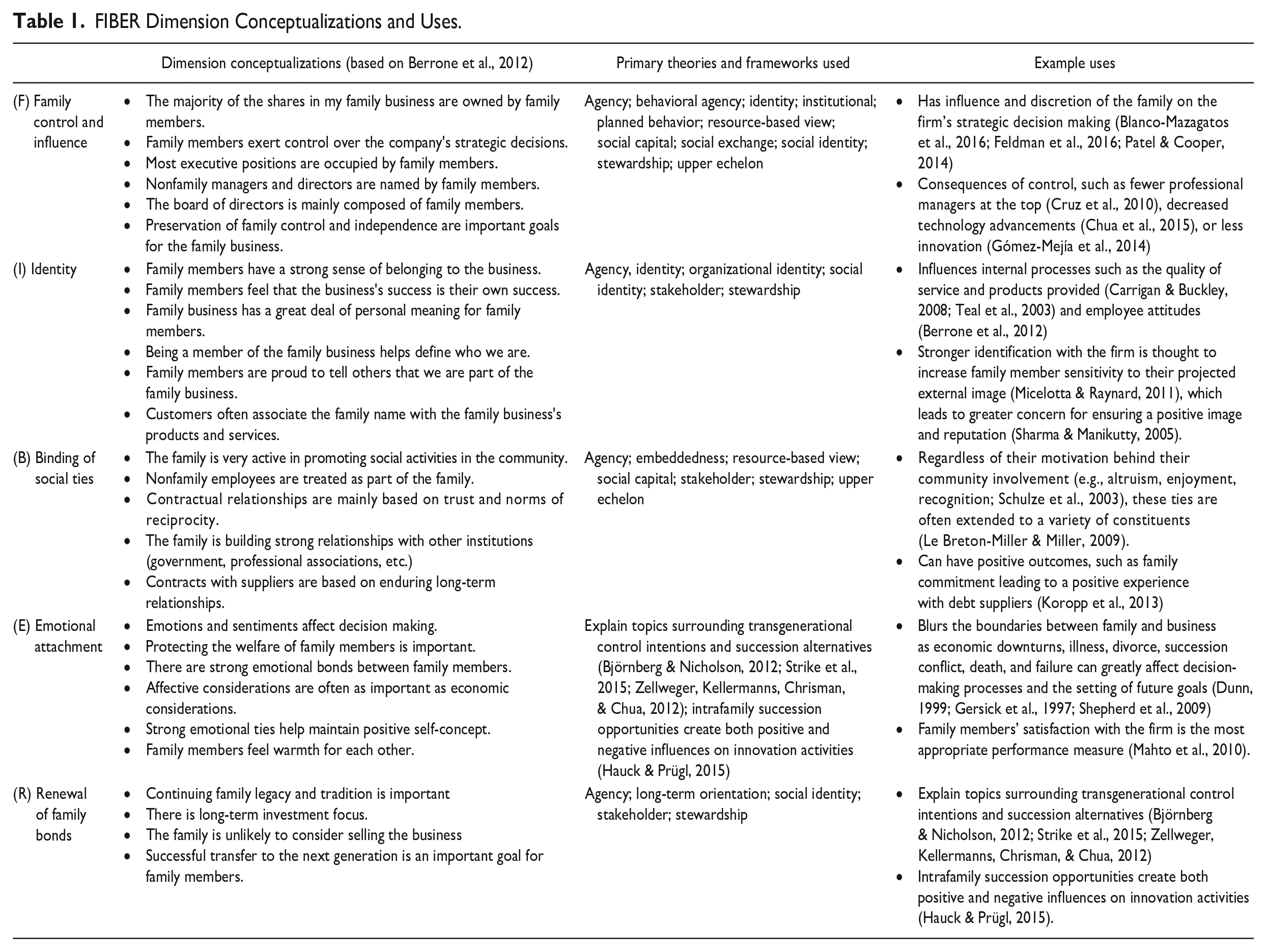
To identify relevant articles, we employed a four-step search process. First, adhering to journal recommendations by Debicki et al. (2009), we searched for the following keywords among article titles, keywords, and abstracts: “family firm” OR “family business” OR “family enterprise” OR “family control*” (Hiebl, 2013; López-Fernández et al., 2016; Worek, 2017). Second, we retained all articles citing Gómez-Mejía et al. (2007), resulting in 329 peer-reviewed articles. Third, two researchers manually reviewed each article to verify that the content focused on (1) family business and (2) SEW topics. Articles that did not place SEW as a primary research focus or used SEW as a platform for future research were excluded since these publications may not make novel SEW contributions (e.g., Verbeke & Kano, 2012; Zellweger & Sieger, 2012). The remaining articles were categorized and coded based on the FIBER dimensions (Berrone et al., 2012), which are summarized in Table 1. Fourth, to assess interrater agreement, a subsample of 50 papers were recoded and verified by two additional researchers. The interrater agreement among the coders was 97.5%, which is consistent with other family business studies (e.g., van Essen et al., 2015). Disagreements were discussed until consensus was achieved. This systematic, four-step approach resulted in 136 articles included in our SEW review.
FIBER Dimension Conceptualizations and Uses.
Results
A preponderance of the SEW articles were published in three journals: Entrepreneurship Theory and Practice, Family Business Review, and Journal of Family Business Strategy. Additionally, we find six articles were published in the Strategic Management Journal, three articles each in Academy of Management Journal and Organization Science, and one article each in the Academy of Management Review, Administrative Science Quarterly, and Journal of Management. Interestingly, there have been five or fewer published articles in entrepreneurship specific journals: Journal of Small Business Management (n = 5), Small Business Economics (n = 5), Journal of Business Venturing (n = 3), Strategic Entrepreneurship Journal (n = 2), and Entrepreneurship and Regional Development (n = 1).
As illustrated in Figure 1, we find that after the Gómez-Mejía et al. (2007) article was published, there was a slow but steady propagation of SEW research throughout the family business literature. The publication of SEW articles reached a peak in 2014 with 27 articles published. Although cumulative annual SEW publications are greater post 2014, there is a diminishing trend line as annual publication levels are decreasing, which could suggest greater expectations for SEW research by editors and reviewers (e.g., Brigham & Payne, 2019; Newbert & Craig, 2017).
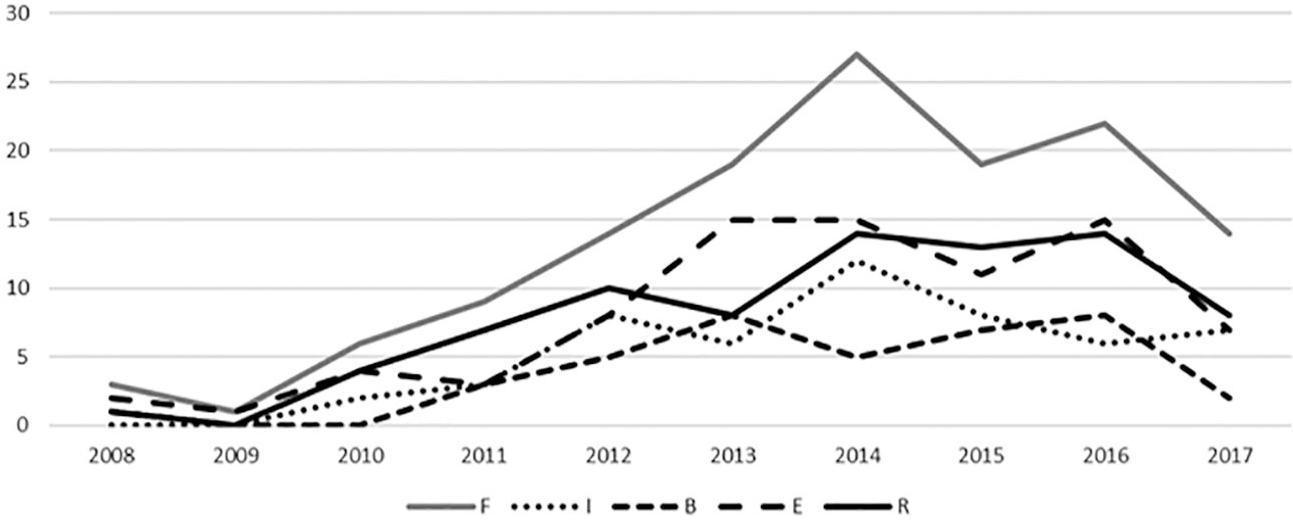
Yearly number of published SEW articles by topic.
Figure 1 also illustrates the popularity of each FIBER dimension over the sampling period. For example, F (family control and influence) has been at the forefront of research since SEW’s inception, much of which may be due to the use of agency and behavioral agency perspectives strongly espoused in the family business literature, and as such, we find a strong emphasis on the F dimension (n = 136) in each study. Similarly, R (renewal of family bonds through dynastic succession) appears to be one of the most stable topics in the SEW stream (n = 80), which may be because of its complementary nature to the F dimension. Highlighted in both Figure 1 and Table 2, the testing of the different dimensions remains unbalanced with a substantial number of studies examining emotional attachment of family members (n = 83) but a smaller body of work using the B (binding social ties; n = 41), or “I” (identification of family members) dimensions (n = 54).
FIBER Classification of SEW Peer-Reviewed Articles (2008-2017).

Note. The coding of each category is not mutually exclusive, meaning that one article may be coded for multiple dimensions. SEW = socioemotional wealth.
Through our analysis of each FIBER dimension, we additionally coded for the level of analysis of each study in our sample. As Brigham and Payne (2019, p. 328) lament, “Researchers must first determine where the socioemotional endowment resides (e.g., the appropriate level of analysis) to understand how decisions and/or behaviors may be influenced.” We found that all studies in our review conceptualized SEW arguments at the family, group, or firm level of analysis. Past work suggests that each dimension of SEW resides at the same level of analysis, thus overlooking potential differences between a firm-level dimension (e.g., F) and an individual-level dimension (e.g., E), which may influence the SEW endowment of family firms (Jiang et al., 2018). Due to the overwhelming presence of the family control and influence (F) dimension in the sample, our review of the literature strongly suggests that the SEW construct is unique to family firms. These results indicate that past research has used SEW as a family specific construct, and suggest that its application toward nonfamily firms may be limited, as they lack the familial control (i.e., ability) necessary to preserve an SEW endowment or pursue noneconomic goals.
To connect the SEW literature in our sample period (i.e., pre and post Berrone et al., 2012), and to illustrate how the FIBER dimensions of SEW are represented, we split the sample into two time periods. Period 1 represents the sample prior to the publication of Berrone et al. (2012) where we identified 54 articles. We then incorporated a 2-year lag to account for the dispersion of the FIBER framework across the field, since the initial citation often occurs within 2 years from publication date (Gupta, 1997). Therefore, in Period 2, we see that a total of 82 articles were published between 2014 and 2017 (see Table 2). This finding illustrates the growing interest in SEW, in general, and the potential significance of the FIBER framework on the robustness and application of SEW throughout the family business literature.
As demonstrated in Table 2, our review reveals that the SEW construct has primarily been treated, both theoretically and empirically, as a multidimensional construct. In response to Brigham and Payne’s (2019) second challenge concerning how the SEW dimensions are related to one another, our results indicate the dimensions are applied simultaneously and are thus additive in nature. Specifically, we find that the family control and influence dimension is present for all studies using SEW arguments and is frequently used in conjunction with other FIBER dimensions. In other words, dimensions of the SEW construct are frequently combined to generate arguments related to noneconomic goals and preserving the SEW endowment of the owning family. For instance, we find that changes in succession influence relationships among other SEW dimensions temporally, as the emotional attachment to the firm can change over generations (e.g., Schulze et al., 2001; Villalonga & Amit, 2006), influence the control of the firm when evaluating between internal versus external successors (e.g., Minichilli et al., 2014), or determine whether a firm trusts the family or professional business advisors most (Perry et al., 2015). This finding would suggest that reference points by the family to the prioritization of the respective FIBER dimensions are dynamic.
Relatedly, our review of the literature suggests that the valence of the SEW dimensions is mixed. Indeed, extant research has conceptualized SEW as both a positive and a negative influence on strategic decision making and related outcomes, whereby SEW can serve as both an asset and a liability for family firms (e.g., Naldi et al., 2013). For example, Leitterstorf and Rau (2014) contend that SEW negatively influences IPO proceeds, as family firms underprice their IPO in order to protect the SEW endowment of the family. However, specific SEW dimensions, such as identity, motivate family firms to develop a strong and positive reputation, indicating a positive valence (Deephouse & Jaskiewicz, 2013). Additionally, recent work advocates that different dimensions of SEW may coexist but result in different or countervailing influences (Hauck & Prügl, 2015; Martin & Gómez-Mejía, 2016). Particularly, Hauck and Prügl (2015) find that some SEW dimensions contribute positively to innovation activity, whereas other SEW dimensions act as a negative influence on the same outcome. Ultimately, the findings regarding the influence of SEW remain mixed.
Discussion
A Way Forward
Brigham and Payne (2019) call for researchers to further consider the SEW construct. Following their guidance, we focus on the dimensionality of SEW, particularly whether SEW is multidimensional and, if so, how the dimensions are related. Our findings indicate SEW is multidimensional, and support the work of other scholars who have modeled SEW as such (e.g., Berrone et al., 2012; Debicki et al., 2016; Hauck et al., 2016). Similarly, we see that SEW dimensions are interrelated and are a part of the fabric that makes family firms unique, as families place different emphases on noneconomic goals (Chrisman et al., 2012; Gómez-Mejía et al., 2007; Martin & Gómez-Mejía, 2016).
In contrast, the relationship between economic and noneconomic goals in family firms is not overly transparent and may be rather complex (Martin & Gómez-Mejía, 2016). Recent dialogue surrounding noneconomic goals in family firms assumes that each dimension of SEW (e.g., F, I, B, E, and R) carries equal importance or uniform weight across family firms. Or rather, when researching one dimension (e.g., identification with the firm or ‘I’), that the entire SEW construct is also present, such that each of the dimensions is prevalent when discussing SEW topics. This lack of specificity presents a concern for SEW research, as the topic is often applied in broad strokes despite the fact that the construct includes multiple dimensions, all of which have inherent variability (Brigham & Payne, 2019; Debicki et al., 2017). To achieve this way forward and gain greater specificity regarding SEW research, we propose the use of necessary condition analysis to reconceptualize the assumptions associated with the FIBER dimensions and the SEW construct, and as such, we propose four conditional inferences.
Integrating Necessary Condition Analysis With SEW Dimensions
We propose that the dimensions of the SEW construct vary in terms of necessity and sufficiency. As such, following the guidance of necessary condition analysis (Dul, 2016a, 2016b), we analyze the theoretical assumptions of the SEW construct. Necessary condition analysis allows researchers to analyze the theoretical assumptions of a construct and determine if a relation between two variables is consistent (Dul, 2016a, 2016b; Tynan et al., 2020). Specifically, necessary condition analysis refers to causality statements regarding the logics of necessary and/or sufficient determinants on various outcomes, making it a useful tool for untangling the dimensionality of SEW and enabling us to augment our understanding of the construct (Podsakoff et al., 2016).
Unlike traditional linear data approaches, necessary condition analysis distinguishes between necessary causes and sufficient causes, whereas the former suggests an additive causality where several factors produce an increase in outcome (Dul, 2016a). The purpose of necessary condition analysis is to distinguish what (if any) conditions must be present for an outcome to happen; however, these conditions are often not sufficient in producing an outcome (Dul, 2016b). In other words, a necessary condition represents a constraint that must occur in order for a particular outcome to transpire, but the necessary condition is not sufficient to achieve the outcome (Dul, 2016b; Dul et al., 2020). This line of reasoning implies that if the necessary condition is not present, the outcome will fail to exist. For example, an owning family may have the necessary control in a family firm to pursue noneconomic goals, but it does not mean that they will pursue noneconomic goals as other influences (i.e., economic goals) may also exist. Conversely, if an owning family lacks the necessary control, it is guaranteed that they cannot pursue particular goals, irrespective of other influences. Therefore, following the necessary condition analysis logic, we propose that family control is a necessary but not a sufficient condition for pursuing noneconomic goals.
Likewise, a sufficient condition guarantees that an outcome will occur as it is integral in producing the outcome (Dul, 2016b). Although necessary conditions are critical for an outcome, sufficient conditions are the mechanism that explain the occurrence of the outcome. For instance, a family firm may wish to engage in strategies aimed at increasing the reputation of the firm (the outcome), which is predicated on the necessary condition of familial control (F), but also relies on the family’s identity concerns (I) as a necessary condition, thus when F and I exist simultaneously these two conditions are jointly sufficient to produce the desired outcome.
Necessary condition analysis and related techniques have broad applicability and are leveraged across multiple disciplines (e.g., physics: Horodecki et al., 2001; economics: May, 1952; psychology: Rogers, 1957; education: Gajda et al., 2017; and organizational studies: Boon et al., 2019; Van der Valk et al., 2016). Indeed, recent work has evaluated whether entrepreneurial gestation activities are necessary for reaching profits (Arenius et al., 2017), whether intelligence is necessary for creativity (Karwowski et al., 2016), or whether success factors are necessary at different stages of implementation of lean practices in small and medium enterprises manufacturing (Knol et al., 2018). Therefore, by employing the necessary condition analysis logic outlined above we evaluate whether all FIBER dimensions are necessary conditions for SEW to exist in family firms. In doing so, we present four conditional inferences related to each SEW dimension.
Inferences Regarding Necessary and Sufficient Conditions for SEW in Family Firms
Chua et al. (1999) define family firms as a business governed and/or managed with the intention to share and pursue the vision of the business held by a dominant coalition controlled by members of the same family or a small number of families in a manner that is potentially sustainable across generations of the family or families. (p. 25)
This definition suggests that in order for a family firm to exist, F (family control) and R (renewal of family bonds through succession) must exist, as they are core assumptions that family firms are concerned with maintaining control and ownership across multiple generations (Chrisman et al., 2003; Chua et al., 1999; Sharma et al., 1997). On the other hand, if these components are absent, then a firm would, by definition, be considered a nonfamily firm. Our findings support this view as the F dimension was present in all 136 articles in our sample. While the R dimension was not explicitly present in all sampled articles, we argue that the transgenerational intention is implicitly assumed to be present in family firms but is more difficult to capture or measure than items related to familial control.
Although family ownership is typically operationalized in definitions of family firms, these components of involvement are not strong predictors of business intentions (Chua et al., 1999). Furthermore, family control is likely to vary based on the level or type of ownership held by the family (Anderson & Reeb, 2003), which suggests that family ownership or family control alone is not sufficient to explain family firm behavior. While the involvement or governance of family members is a necessary condition of family firms, it fails to adequately explain the pursuit of particular goals (i.e., economic vs. noneconomic) or the relative importance of SEW across families (Debicki et al., 2016; Martin & Gómez-Mejía, 2016).
Similarly, Chrisman and Holt (2016) argue that although economic and noneconomic goals are both utilities that family firms seek to attain, the differences lie in the family’s ability and willingness to pursue such strategies. Ability refers to the discretion of the ownership to make strategic decisions (De Massis, Kotlar, et al., 2014), where the family control and influence dimension reflects this ability. Indeed, it is through family involvement in management or ownership that the family has power and influence (i.e., the ability) to pursue noneconomic goals that may be related to preserving the SEW endowment of the family. Similarly, the willingness component represents the owning family’s attitudes or motivations that guide the direction of decision making (Chrisman et al., 2012; De Massis, Kotlar, et al., 2014). Taken together, the ownership structure (i.e., family control) positions the firm to have the ability to pursue noneconomic goals, though it does not imply that the owning family is willing to do so (Chrisman et al., 2012). In other words, “the ability of the dominant family coalition to pursue such wealth-producing outcomes through the discretion that comes from ownership control, or the capability of the firm to marshal the resources needed to achieve the desired results” (Chrisman & Holt, 2016, p. 281). For example, Berrone et al. (2010) discuss the desire for family firms to be make environmentally sound decisions, as this behavior is one way in which families can protect their SEW endowment. In order for the firm to make such decisions, it requires that the family have unconstrained control over other shareholders (La Porta et al., 1999).
Likewise, past research may have placed an undue emphasis on the desirability of family firms to maintain their control using SEW literature and risk aversion arguments. We agree that family firms are concerned with the continued control over the firm, and we posit that this alone is not sufficient to induce SEW arguments. The noneconomic goal of preserving family control is a relevant concern, but it alone does not constitute SEW. We argue that all families seek to maintain control and influence over their businesses because without it the family firm ceases to exist. So, while family control is fundamental to the family firm (Chua et al., 1999) and gives family owners the ability to pursue noneconomic goals related to preserving SEW (La Porta et al., 1999), the family control dimension alone does not indicate that family firms exhibit the willingness to pursue such goals (Chrisman et al., 2012; Chrisman & Holt, 2016). As such, we propose the family control and influence, or F, dimension is a necessary but not sufficient condition for SEW to exist in family firms.
Similarly, transgenerational aspirations, or renewal of family bonds through succession (Berrone et al., 2012), are commonly included in the definition of family firms (Chua et al., 1999). Such a notion suggests that family firms are managed in ways that support a transgenerational outlook. As Zellweger, Kellermanns, Chrisman, and Chua (2012) highlight, the intention for transgenerational control is critical in determining the salience of particular noneconomic goals. Together, the renewal of family bonds through succession (R) and renewal through family control and influence (F) are complementary explanations for firm behavior, as the former exists to preserve the latter and the latter cannot endure without the former (Zellweger, Kellermanns, Chrisman, & Chua, 2012). Furthermore, as Chrisman et al. (2012) explain, it is through the interaction of transgenerational control and family commitment that ultimately affects the goals the family pursues, suggesting that noneconomic goals are a reflection of the values, intentions, and attitudes of the owning family. “For family-owned firms, preserving the family’s socioemotional wealth, which is inextricably tied to the organization, represents a key goal in and of itself. In turn, achieving this goal requires continued family control of the firm” (Gómez-Mejía et al., 2007, p. 108). Therefore, we propose that the renewal of family bonds is a necessary but not sufficient condition for SEW to exist in family firms. As such, both family control and renewal of family bonds dimensions are necessary for SEW to exist. Our first two inferences are summarized as follows:
Family control and influence is a necessary condition but not a sufficient condition for SEW to exist in family firms.
Renewal of family bonds through dynastic succession is a necessary condition but not a sufficient condition for SEW to exist in family firms.
Gómez-Mejía et al. (2007) hypothesize that in contrast to nonfamily firms, family firms are more concerned with maintaining control of the firm. This initial hypothesis was fundamental in establishing the core differences between family and nonfamily firms by introducing new perspectives on risk aversion and strategic decision making. Thus, we agree, that when compared to nonfamily firms, family control is a relevant concern and succession is the means through which the owning family can sustain their control for multiple generations. However, as family business and SEW literatures have progressed since 2007, the focus has shifted toward arguments concerning heterogeneity across family firms, since there is a large variance of the goals and aspirations among families (Chrisman & Patel, 2012; Dibrell & Memili, 2019). So, while the F and R dimensions provide the early groundwork for researchers to examine differences between family and nonfamily firms, the field has since shifted to examine other criteria on which family firms differ.
The identity (I), binding ties (B), and emotional attachment (E) dimensions are often used to describe both internal and external motivations related to noneconomic goals. Our review illustrates that these three dimensions of SEW can exist independently of one another (e.g., Debicki et al., 2016) but also complement each other to explain SEW and the strategic decision making of family firms (e.g., Berrone et al., 2010; Boers et al., 2017). For instance, Berrone et al. (2012) suggest that the emotional attachment and identification of family members are likely to vary with changes in ownership. This suggests that the emotional and other dimensions are dependent on F and, furthermore, that control is an integral or necessary component because it enables family members to influence strategic decisions, whether they are financial or nonfinancial in nature. Consequently, as the F and R dimensions together are necessary but not sufficient to suggest that SEW exists within a family firm, we posit that the inclusion of at least one of the other three dimensions (I, B, or E) in the SEW construct is necessary for the presence of SEW.
Although these three dimensions (i.e., I, B, and E) are widely utilized to explain topics related to emotion (Bee & Neubaum, 2014), social ties within communities (Zellweger, Kellermanns, Eddleston, & Memili, 2012), firm identity (Akhter et al., 2016), and nonfamily employee relations (Pittino et al., 2016), these topics and theories are not exclusive to family firms. For instance, theories regarding identity and social ties have been leveraged across organizational research in a variety of contexts (e.g., Dokko et al., 2014). Unlike other areas of management research, the family firm context provides a unique opportunity to expound on the emotions, identity, and social ties literatures due to the overlap of the family and the firm as the values of the dominant coalition (e.g., the family) are extended to the firm (Rau et al., 2019).
As such, the I (identity), B (binding ties), and E (emotional attachment) dimensions play a crucial role in the family firm and SEW. Our research indicates that these dimensions are pertinent to SEW but must be coupled with the F (family control) and R (renewal of family bonds) dimensions. More precisely, we argue that the presence of at least one dimension (I, B, or E) is a necessary condition for the presence of SEW in family firms. In other words, although these three elements can coexist in many ways, not all three dimensions (I, B, and E) need to be present simultaneously for SEW to exist. The premise of our argument is the presence of F and R, and at least one of the other dimensions are necessary and jointly sufficient conditions for SEW to exist (cf. Podsakoff et al., 2016). Our arguments are summarized in the inferences below:
Identification, binding social ties, or emotional attachment (or some combination of the three) among family members is a necessary but not sufficient condition for SEW to exist in family firms.
Collectively, family control and influence and renewal of family bonds through dynastic succession in conjunction with either identification, binding social ties, or emotional attachment (or some combination of the latter three) are necessary and jointly sufficient conditions for SEW to exist in family firms.
Furthermore, we contend the crux of family firm heterogeneity likely lies in the I, B, and E dimensions, as each represents a potentially necessary condition of SEW but may exist together (i.e., additive and substitutable) or independently of one another. Indeed, we suggest that the heterogeneity of family firms is likely to emerge from differences among these dimensions (Chua et al., 2012; Nason et al., 2019) as a multitude of contingencies or unexplored antecedents may influence the noneconomic motives of family owners. For example, family control and concerns for family succession manifest in every family firm. Nonetheless, the I, B, and E dimensions are not expected to be uniform for all family members, which allows for discernable differences to emerge across family firms. In this sense, when combined with both F and R, an additive model would suggest that if one of the dimensions (i.e., I, B, or E) is zero, the overall SEW endowment would be reduced, but this effect can be offset by a greater presence in the other two dimensions. In effect, a family firm with a low level of emotional attachment (E), for instance, may be offset by higher levels of binding social ties (B). Relatedly, given that I, B, or E is a necessary condition for SEW in family firms, if all three dimensions are missing then SEW fails to exist, thus signaling a lack of willingness for family members to preserve their SEW endowment.
A Summary of the Integration of Conditional Analysis for SEW Within Family Firms
Taken together, our four conditional inferences and accompanying arguments support the multidimensional perspective of the SEW construct, as illustrated in Figure 2. Extending De Massis, Kotlar, et al.’s (2014) logic to the multidimensionality of SEW question of Brigham and Payne (2019), we argue the family control and influence (F) dimension combined with the renewal of family bonds (R) provide the dominant coalition the ability to pursue goals related to preserving the SEW endowment (i.e., ability of the family firm). While these two dimensions are directly related to SEW due to their necessary nature, as indicated by the solid line in our model (see Figure 2), they do not indicate whether the dominant coalition will behave in this particular nature (i.e., necessary but not sufficient for SEW). Similarly, the I, B, and E dimensions are necessary but not sufficient conditions of SEW and represent the willingness of the dominant coalition to pursue SEW. Although all three dimensions may simultaneously exist in some family firms, at least one dimension must be present to capture the willingness of the dominant coalition. Therefore, as we propose in our inferences, both ability (represented by F and R) and willingness (I, B, or E) are required to qualify as SEW.
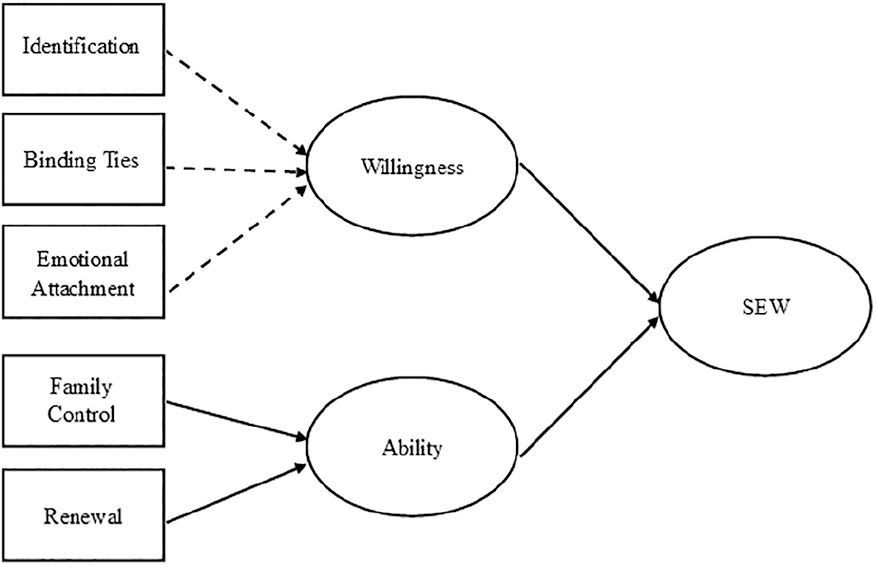
Four conditional inferences related to SEW.
Overall, our inferences add additional nuance to the SEW construct by emphasizing the variance and the interrelatedness of each dimension. The results of our systematic review as well as the inferences and accompanying discussion also reveal the multidimensionality of the SEW construct. We argue that the SEW construct is applicable to family business research because, as we have discussed, the dimensions of the construct are inherently intertwined and may interact in unique ways to form SEW and ultimately influence strategic decision making. Furthermore, the model depicted in Figure 2 also allows for heterogeneity arguments, as families or individual family members may differ on their willingness to pursue SEW-related objectives, thus leading to varying levels of SEW importance (Debicki et al., 2016). Last, our discussion concerning the necessity and sufficiency of each dimension contributes to the SEW literature by explicitly considering the differences that lie within the construct and suggest that future research should consider these inferences when employing SEW arguments.
Future Research in the Family Business Domain
Addressing Brigham and Payne’s Calls to Action
Throughout our review and discussion, we tackle the challenges addressed by Brigham and Payne (2019) and partially answer their call for additional clarification of the SEW construct. Specifically, by applying necessary condition analysis, we answer the following research questions: (1) Is the SEW construct uni- or multi- dimensional? (2) What do we know about the dimensions of SEW and (a) how are they related to the overall construct, (b) how are they related to one another, and (c) are they substitutable? (3) Is SEW family firm specific? In order for SEW literature to expand beyond its current state, we propose that researchers apply our inferences regarding necessary and sufficient conditions of the SEW dimensions. In the following sections, we provide avenues for future research based on the calls to action provided by Brigham and Payne (2019).
Is the Construct Uni- or Multidimensional?
First, Brigham and Payne (2019, p. 327) ask, “Is the construct uni- or multi-dimensional,” and based on our use of necessary condition analysis and our systematic review, we believe the SEW construct is multidimensional, and as such, researchers need to be intentional in which dimensions they are studying. Future research needs to be explicit on which dimensions they are referring to when referencing SEW. We propose that rather than just simply stating “noneconomic goals” or “SEW,” family business scholars should be more specific about whether it is, for example, an identity concern or an emotional concern, rather than a vague statement regarding noneconomic topics. As we show through our critique and way forward, not all dimensions are the same, not all dimensions coexist, and there may be varying valence associated with each dimension. Identifying these nuances is integral in the growth of family business literature and particularly the SEW construct. We mirror Berrone et al.’s (2012) call that “the SEW literature must reach beyond this oversimplification and explain the factors behind the varying sources and degrees of SEW” (p. 270). We caution against the use of archival data or secondary proxies as alternatives for measuring all SEW dimensions as these may fail to capture the nuances directly associated with families’ SEW endowment (e.g., emotions, identity, and binding social ties; Debicki et al., 2016). Indeed, the ownership and management control of family firms can be easily captured by secondary data sources; however, other dimensions of SEW require more defined measurement. Furthermore, as noted by Berrone et al. (2012, p. 268) “the use of ownership as a proxy of SEW requires the strong assumption that variables have an isomorphic behavioral and emotional counterpart.” Although we appreciate the challenges with obtaining primary data, relying on secondary data sources and firm characteristics (e.g., firm age) as proxies for all SEW dimensions could provide an incomplete assessment of SEW.
Moreover, based on our review of the literature and use of necessary condition analysis, we suggest the construct is multidimensional and that the observed indicators (e.g., family control, emotional attachment, transgenerational aspirations, etc.) form the latent variable (i.e., SEW). Although the measurement nature of the SEW construct has yet to be concretely defined in family business literature (Brigham & Payne, 2019; Chua et al., 2015; Hasenzagl et al., 2018), our inferences lead us to propose that SEW may be formed by its dimensions, making a formative measurement model more appropriate. Future research could test our assumptions and compare our model’s empirical fit to other measurement conceptualizations of SEW (e.g., Hauck et al., 2016) to reconcile misspecification issues related to the construct.
In addition, the assumption that noneconomic and economic goals are mutually exclusive may warrant further scrutiny. Past literature has assumed that economic considerations and SEW concerns are inversely related or that the preservation of SEW entails negative financial implications (Gómez-Mejía et al., 2007). Nevertheless, it may be the case that pursuing financial goals simultaneously increase the SEW endowment of the family (Martin & Gómez-Mejía, 2016) or that the unique family-centered goals may have wide-ranging impact on a variety of outcomes, both financial and nonfinancial in nature (Debicki et al., 2017; Holt et al., 2017). Such considerations suggest that the multidimensionality of SEW is rather complex, and it requires additional empirical examination to fully surmise the interrelatedness of each dimension as well as how each dimension relates to the financial motives of family firms.
What Are the SEW Dimensions and How Are They Related to the Overall Construct and to One Another?
Second, Brigham and Payne (2019) ask for clarification of the dimensions and their interrelatedness. Our use of necessary condition analysis suggests that the dimensions of SEW are related, but each has a unique relation to the overall construct (i.e., some are necessary while others are not). Furthermore, our review of past SEW literature indicates that the SEW dimensions have an additive/substitutable component, and therefore future work should focus on how multiple dimensions interact. Specifically, it appears that the dimensions of SEW may have countervailing influences on one another, since “SEW is intangible and psychological, its influence on firm behavior is largely a function of its importance to family members in terms of its preservation and acquisition” (Debicki et al., 2016, p. 47). As such, the importance of different aspects of SEW may vary widely across owning families. Or furthermore, the relative importance of one SEW dimension may outweigh other SEW concerns within a family. Consider, for instance, the incompatible dimensions related to corporate political activity, whereby a family may value political connections with local officials (i.e., binding social ties), but this may clash with the reputational concerns (i.e., identity) related to preserving the SEW endowment of the family (Combs et al., 2020).
Additionally, we urge researchers to consider the family firm heterogeneity that lies in the I, B, and E dimensions and examine the differences that exist across family firms. Given that literature streams related to I, B, and E exist in the broader management literature, we call for additional research to leverage more micro topics as this may aid in building more depth in research areas related to identity, binding social ties, and emotional attachment within SEW. By blending more micro topics with the F and R dimensions, future work may lead to additional insights into the micro foundations of family firms (De Massis & Foss, 2018; Jaskiewicz & Dyer, 2017). For example, though the E dimension of FIBER is broadly described as emotional attachment, there are various theoretical underpinnings that could inform such a broad dimension (e.g., harmony, family essence, positive and negative valence, affective ties, emotional support, etc.). Our analyses show that extant research in the emotional attachment dimension relies heavily on agency theory, but utilizing theories such as attribution theory or positive and negative affect may provide deeper insight in business families, as it pertains to their emotions. Researchers have proposed emotional constructs specific to family business, such as emotional capital (Sharma, 2004) and emotional returns and costs (Astrachan & Jaskiewicz, 2008). Behavioral economics may provide additional insights on how emotion affects rational decision making involving desires, beliefs, information, and action (Elster, 2009) in creating irrational decision making at both the firm and individual business family member levels of analysis. Emotions affect both the family and the firm, and as such, we propose the following research opportunities pertaining to emotions. Which emotions positively or negatively influence SEW formation? How does the emotional attachment underlying SEW differ between generations and family firms? How can alternative perspectives of emotions in decision making (Elster, 2009; e.g., interrelationships among emotions, desires, beliefs, information, and action) influence family dynamics and the dynamic value of SEW endowments?
Is the SEW Construct Family Firm Specific? What Is the Appropriate Level of Analysis?
Next, Brigham and Payne (2019) call for research to address the level of analysis of SEW and whether the construct is family firm–specific. Through our use of necessary condition analysis, we show that due to the F and R dimensions being necessary conditions that are unique to family firms, SEW is a family-specific construct. We suggest that future research could continue to explore the family specificity of the construct by examining changes in the SEW endowments over the lifecycle of family firms. For instance, Chua et al. (2015) discuss the ebbs and flows of resource endowments and link SEW to prospect theory. As such, SEW is considered an affective resource endowment that accrues to the business family through the family business. The tracking of these resource endowments in the form of inflows and outflows would be of great interest, as well as the extent these resource endowments change over time and generations, and the motivations to maintain or exploit the SEW endowment. Nason et al. (2019) argue that SEW is dynamic and is constantly changing as the reference points for SEW alter over time, based on the family dynamics and form of the family business (e.g., small family firms, long-lived family firms). In each instance, the inclusion of external and internal stakeholders will change the reference point for the business family and their motivation to increase or decrease their SEW endowment. Both articles propose ways in which SEW can influence goals, governance, and resources. Furthermore, these authors highlight the need for empirical studies to capture these resource flows and reference point changes. Therefore, we encourage the inclusion of qualitative studies over time that can adequately address the utility placed upon the SEW endowment and whether or not this utility changes, as is proposed. Also, it would be beneficial to measure the FIBER constructs, or other related SEW constructs, over a longitudinal period of time to assess the extent to which SEW endowment can be captured over time. For instance, Hammond et al. (2016) conceptually considered the role of generational legacy orientations (biological, material, and social) on strategic decision making. As such, how are the changing reference points, and ebbs and flows of SEW resources, such as legacy, affected over time and in relation to these different orientations?
Additionally, building on the calls from Brigham and Payne (2019), we suggest future work consider the levels of analysis within SEW research. Particularly, the dimensions may operate at different levels of analysis. For instance, the I, B, and E dimensions may exist at individual, clan (group/family), or firm level, whereas the F and R dimensions may exist exclusively at the firm level. We urge future research to consider the level of analysis when discussing SEW, as there may be misalignment among the dimensions. Additional research should be considered on an individual’s SEW endowment compared to the SEW endowment for the collective business family. If there is a misalignment of endowments at the individual and family group levels, is this a positive or negative for the family firm? Similarly, how are these SEW motivations affected by different generational perspectives?
Opportunities and Barriers to Applying Necessary Conditional Analyses
Necessary condition analysis supplements traditional data analyses by identifying conditions necessary to allow an outcome to exist, whereas traditional data focus on single sufficient conditions that can increase an outcome (Dul, 2016a). For example, traditional data may indicate that family control is positively related to a family’s SEW endowment, but necessary condition analysis allows us to identify the degree of necessary conditions relative to a level of an outcome. Therefore, future research could empirically test our necessary condition statements by examining varying degrees of family control and transgenerational aspirations that may produce varying levels of SEW. Given that outcomes in necessary condition analysis are constrained by necessary condition(s), future studies may wish to apply statistical significance tests on the necessary conditions (e.g., Dul et al., 2020) outlined in our discussion to explore the extent of the constraint family control and renewal of family bonds pose on SEW.
Relatedly, as noted, fuzzy-set qualitative comparative analysis (fsQCA) can also be leveraged to identify necessary conditions and sufficient conditions as it considers a variety of configurations that aid in producing an outcome (Dul, 2016a). This methodological approach could identify additional peripheral variables, not included in the FIBER framework, that may not be necessary but are sufficient for SEW to exist in family firms. To complement our analysis, we encourage future scholars to use fsQCA to test for additional sufficient conditions when studying the dimensionality of SEW (Dul, 2016a). Although this technique is being used by family business scholars (e.g., Kosmidou & Ahuja, 2019; Pittino et al., 2018; Pittino et al., 2020), we recommend further exploration of this analysis to better understand the SEW assumptions. Through the employment of fsQCA, we anticipate scholars will be able to further extend the assumptions associated with SEW and the applicability of SEW to contribute to other theories (e.g., stewardship, transaction cost economics) in family business. For instance, the examination of qualitative interviews by fsQCA could reveal how family business managers, who are also family members, balance the potentially paradoxical tensions between being a steward responsible for protecting and growing the family firm for future generations and engaging in altruistic behaviors that may economically and socially penalize the firm. How do these paradoxical tensions affect identity, binding ties, and emotional attachment, as well as the factors that make up stewardship (e.g., intrinsic motivation, organizational identification, use of personal forms of power, collectivism, involvement orientation, and low power distance; Davis et al., 1997; Neubaum et al., 2017). This type of research would provide additional insights related to the dimensionality of SEW, as well as to stewardship theory.
Practical Considerations
Our review suggests that the dimensions of SEW are additive in nature, whereby different elements (e.g., reputation, social activities, sense of belonging) may be combined to strengthen the SEW endowment. Family firms should be mindful of strong SEW endowments as this can alter the risk profile and decision making of family owners. In addition, family firms should be aware that changes in succession can influence relationships among other SEW dimensions temporally and should therefore be cognizant of the succession process and its impact on the SEW endowment. Furthermore, our results indicate that the valance of SEW dimensions remains mixed, and therefore, noneconomic and economic goals are not always trade-offs but rather can often complement one another. As such, family owners and family firm stakeholders should be aware that decisions related to economic goals can also reinforce noneconomic goals, and vice versa.
Additionally, our research may help to inform family firm managers regarding mechanisms for maintaining, acquiring, or otherwise managing the SEW endowment. For example, periodic assessments of the I, B, and E dimensions among family members could signal potential issues regarding succession and viability of the family firm. Family gatherings designed to build emotional attachment to the firm enable younger members to identify with the family firm (e.g., social legacy; cf. Hammond, et al., 2016), while strengthening social ties may be useful for maintaining or acquiring greater levels of SEW, thus buttressing the likelihood of familial renewal and continuity. On the other hand, understanding which dimensions are least important to current family members may help forecast the long-term survivability of the firm, perhaps enabling incumbent managers the opportunity to optimize the timing of an exit strategy.
Limitations
Our approach and analysis are not without limitations. First, we recognize our systematic literature review is potentially biased based on the criteria used in our search. While we follow previous search guidelines (e.g., Andreini et al., 2020; Thorpe et al., 2005), our review may be limited by the years, journals, and keywords operationalized. Additionally, other literature streams (i.e., family science or organizational behavior) may inform our knowledge on the SEW endowment in family firms, and future research should expand the topical areas to broaden the scope of SEW. Furthermore, we submit that useful work is not exclusive to peer-reviewed journals, and future work may wish to expand our search to include books and book chapters (e.g., Memili & Dibrell, 2019). Additionally, our coding and classification of SEW studies are not without subjective bias; although our interrater agreement was 97.5%, we are cognizant that there are a variety of ways to classify past work and that we may be limited by the subjectivity of our personal biases. We encourage scholars to further evaluate and refine these aspects of this study.
Our analysis may also be limited by the use of the theoretical FIBER dimensions, as this framework is not an exhaustive view of the SEW construct. Our review and subsequent conditional inferences focus on the broad details of the FIBER dimensions, and therefore may overlook more in-depth variance related to the construct. Relatedly, although our choice of the FIBER framework builds off relevant previous research, we understand there are a variety of other ways to examine the dimensions of SEW. We suggest that additional studies consider other conceptualizations of SEW, such as the SEWi scale by Debicki et al. (2016)—family prominence, continuity, and enrichment—or the SEW categories provided by Jiang et al. (2018)—social, motivational, cognitive, affective, and behavioral. For instance, the SEWi scale shares a variety of overlap with the FIBER dimensions but also has discernable differences. The SEWi “Family Prominence” factor captures aspects of Berrone et al.’s (2012) B and I dimensions; however, the “Family Enrichment” factor represents the needs and well-being of family members, which is not captured in the Berrone et al. (2012) conceptualization. These differences in SEW dimensions may produce other relevant research related to the SEW endowment as well as noneconomic goals of family firms, and we propose that future research consider these alternatives in future research.
Additionally, our four conditional inferences derived using necessary condition analysis (Dul, 2016b) have limitations related to the causal complexities of SEW in family firms. Necessary condition analysis specifies what conditions (e.g., family control) are required for an outcome (e.g., SEW), but it cannot specify all determinants of sufficiency related to the outcome. There may be an infinite amount of conditions for SEW to exist in family firms, but necessary condition analysis is not suited to identify all configurations (Dul et al., 2018). Given the prevalence of the FIBER framework in family business research, we chose to limit our analysis to the items captured in the original FIBER conceptualization (see Table 1), and we are cognizant that other configurations may exist outside our framework. Future research may wish to identify other possible relationships in conjunction with the necessary and sufficient conditions (i.e., family control and renewal of family bonds) we identify in our review.
Last, the research questions of our review are largely derived from the recent editorial by Brigham and Payne (2019), but we do not answer all of their calls to action. The scope of our review precluded us from answering the question, “Is the construct dispositional or behavioral?” (Brigham & Payne, 2019, p. 327). Extant work has expressed that SEW encompasses both dispositional elements as well as behavioral elements, and it remains unclear which is the more appropriate conceptualization. Therefore, we suggest that future research consider this research question as it is fundamental to the construct development and may provide even greater clarity on SEW theorizations.
Conclusion
Our systematic literature review examines the SEW construct and provides an in-depth analysis of its influence throughout family business research in our attempt to partially answer the call for additional clarification associated with SEW (e.g., Brigham & Payne, 2019). Employing the FIBER dimensions of the SEW construct (Berrone et al., 2012), we directly assess the multidimensionality, as well as how the individual dimensions of SEW are related to the overall construct. Through our review, we find evidence for the additive nature of SEW while also highlighting the heterogeneity across family firms. Additionally, we explore, based on past scholarship, how each FIBER dimension relates to SEW as a higher order construct, which led us to our four conditional inferences. We show that SEW exists within family firms that possess control and influence (F), as well as renewal through dynastic succession (R), as these dimensions must be present to be classified as a family firm; however, these conditions are not sufficient for SEW. Indeed, we argue that at least one of the elements related to identification of family members with the firm (I), binding social ties (B), and/or emotional attachment (E) of family members is also necessary for SEW to exist, in the presence of F and R. Taken together, these three necessary conditions are jointly sufficient to qualify as SEW. We anticipate our conditional inferences will provide more definitional clarity for the SEW construct and foster more robust research.
Footnotes
Acknowledgements
The author team wishes to thank our associate editor, Jon Carr, and our anonymous reviewers for providing valuable insights toward publication. We also thank Rebecca Long for her helpful feedback on previous versions of our manuscript.
Authors’ Note
The author team notes equal authorship for the article, though last names are listed in reverse alphabetical order.
Declaration of Conflicting Interests
The author(s) declared no potential conflicts of interest with respect to the research, authorship, and/or publication of this article.
Funding
The author(s) received no financial support for the research, authorship, and/or publication of this article.
