



Abstract
This study examines the interplay between two influential yet opposing shareholder types—family blockholders and hedge funds—in relation to corporate innovation output. Using panel data on U.S. publicly traded firms listed in the S&P 1500, we find that family blockholders have a negative effect on radical innovation output in the form of citation-weighted patents and that this negative effect is intensified in the presence of activist hedge funds. Our study advances insight into the implications of ownership heterogeneity for innovation output choices in family-influenced firms.
Introduction
Over the past decades, corporate ownership structures have become increasingly heterogeneous with multiple influential shareholder types often coexisting within firms (Connelly, Hoskisson, et al., 2010, Connelly, Tihanyi, et al., 2010; Hoskisson et al., 2013). While several studies have investigated the effect of individual shareholder types—such as family owners—on strategic choices and performance (e.g., Carney et al., 2015; Gomez-Mejia et al., 2011), the topic of ownership heterogeneity received scant attention and constitutes an important research area (Cirillo et al., 2019; Connelly, Hoskisson, et al., 2010). This is particularly true for the impact of ownership heterogeneity on corporate innovation. As highlighted by Wright (2017), the question how ownership configurations affect the extent and nature of innovation deserves more research attention as “ownership differences can influence the goals, time horizons, and governance mechanisms relating to innovation,” with a manifest need for “research to explore (. . .) the interaction between ownership types” (p. 74, emphasis added). How different shareholder types interact within heterogeneous ownership structures in shaping innovation dynamics warrants more conceptual and empirical research.
Concerning family-influenced firms, 1 some prior work suggests that the presence of other significant shareholders indeed influences corporate processes and outcomes (e.g., Sacristán-Navarro et al., 2011, 2015), with mainly private equity receiving heightened interest in recent years (e.g., Cirillo et al., 2019; Croce & Marti, 2016; Michel et al., 2020; Neckebrouck et al., 2021). Among this limited set of studies on the role of other major owners in family firms, however, very few have investigated innovation aspects. Pioneering work by Gomez-Mejia et al. (2014) and Cirillo et al. (2019) suggests that mutual and pension funds, as well as private equity funds, help mitigate the negative effect of family ownership on research and development (R&D) investments as an innovation input choice. Beyond that however, very little is known about the association between ownership heterogeneity and innovation in a family firm setting. We advance this line of inquiry by examining the effect of the interplay between family blockholders and activist hedge funds on radical innovation outputs.
The combination of family blockholders and strategic or activist hedge funds is particularly intriguing to study for two main reasons. First, they are quite opposite in terms of strategic objectives and tactics. Family blockholders are generally undiversified long-term owners with conservative preferences (Munari et al., 2010), whereas hedge funds are diversified short-term investors who often use aggressive investment tactics (Klein & Zur, 2011). Second, research suggests that both types of shareholders are highly influential in determining the strategic direction of a company (Gomez-Mejia et al., 2011; Brav et al., 2018). Thus, the coexistence of family blockholders and hedge funds within a single firm’s ownership structure presents a theoretically compelling setting to investigate the influence of ownership heterogeneity on corporate innovation.
Regarding the strategic implications of ownership heterogeneity, our study centers on the innovation output choice. 2 In addition to addressing the research gap on ownership heterogeneity (cf. Cirillo et al., 2019; Wright, 2017), we aim to shed further light on another gap in the family firm innovation field by examining such innovation output choices. Contrary to research on R&D investments as an innovation input choice, which has produced rather consistent results, prior work on how family influence shapes a firm’s innovation output is fraught with mixed findings (e.g., Block et al., 2013; Chirico et al., 2020; Duran et al., 2016; Matzler et al., 2015), leading scholars to call for more research on contingencies and boundary conditions. We frame the presence of strategic hedge funds in a family firm’s ownership structure as one such potentially significant contingency variable affecting innovation output choices.
Our study’s research question thus reads as follows: Within a heterogenous ownership structure consisting of family blockholders and strategic hedge funds with seemingly opposing risk and temporal preferences, what is the effect of the interplay between both shareholder types on the firm’s innovation output choice? As previously mentioned, earlier studies on the link between ownership heterogeneity and corporate innovation in family firms have examined the presence of shareholders such as mutual, pension, and private equity funds, which have very different profiles compared with those of hedge funds, 3 and these studies focused on innovation inputs rather than outputs (Cirillo et al., 2019; Gomez-Mejia et al., 2014). While those studies found that these external investors mitigate the negative effect of family ownership on R&D spending, we develop and test the novel idea that hedge fund activism (HFA) may actually exacerbate the negative family effect on radical innovation outputs.
To study this research question, we use a mixed gamble lens. An increasing number of family business scholars adopted a mixed gamble lens (e.g., Gomez-Mejia et al., 2014; Kotlar et al., 2018), for which they refer to the behavioral agency model (BAM; Martin et al., 2013; Wiseman & Gomez-Mejia, 1998) as the underlying theoretic anchor. The BAM itself is a fusion of prospect theory with agency theory. As we study the combined effect of family ownership and hedge funds, we will integrate prospect theory with insights from multiple agency theory as the latter pays explicit attention to the presence of multiple influential principals with diverging identities, preferences, and time horizons (Allcock & Filatotchev, 2010; Filatotchev et al., 2011; Hoskisson et al., 2002, 2013). Moreover, one of our goals is to develop a better understanding of the mechanisms driving the effect of family ownership and hedge funds on radical innovation output. To this end, we integrate insights from the prospect theoretic myopic loss aversion model, which to date were largely overlooked in BAM, namely on the role of the aggregation of mixed gamble returns in mental accounting (Benartzi & Thaler, 1995). We test our ideas using panel data on ownership and citation-weighted patents from S&P 1500 companies.
Our study makes several contributions. First, we advance knowledge on ownership heterogeneity in family-influenced firms. It is surprising that this topic received so little attention to date given that institutional investors now dominate equity markets in most developed economies (Connelly, Tihanyi, et al., 2010; Fernando et al., 2014; Hoskisson et al., 2002). With regard to hedge funds, their activism has been praised in recent literature as an effective sanctioning mechanism for corporate inefficiencies—such as suboptimal innovation strategies—that fail to maximize shareholder value (Brav et al., 2018; Gilson & Gordon, 2013). To the best of our knowledge, we are the first to examine the interplay of family blockholders and activist hedge funds in relation to corporate innovation. We show that in the context of family-influenced firms, HFA does not represent an effective governance mechanism but instead aggravates the negative effect of family ownership on radical innovation output. This complements the work by Gomez-Mejia et al. (2014) and Cirillo et al. (2019) which painted a more positive picture about the role of influential external investors. We thus reveal that when investigating the implications of ownership heterogeneity in family-influenced firms, the type of institutional investor (in our case, hedge funds) and the type of innovation choice (in our case, the innovation output choice) under consideration matter greatly.
Second, we provide deeper insights into the relationship between family ownership and corporate innovation output (Calabrò et al., 2019; Hu & Hughes, 2020). By describing the underlying mechanisms of cross-sectional and temporal aggregation in the assessment of high-risk, high-mean mixed gambles (Bammens et al., 2022; Thaler et al., 1997), we clarify why, among publicly traded firms, the drawbacks of family ownership likely dominate potential benefits in relation to radical innovation outputs, that is, innovations with significant economic and technological value for society (Block et al., 2013). Importantly, we reveal how these innovation output choices are affected by the presence of activist hedge funds who have a bearing on the aggregation rules used by family blockholders.
Third, in relation to theory development, we enrich the BAM perspective on family firms by integrating insights from the prospect theoretic myopic loss aversion model (Benartzi & Thaler, 1995, 1999) with multiple agency theory (Arthurs et al., 2008; Filatotchev et al., 2011; Hoskisson et al., 2013). Specifically, we explain how socioemotional considerations shape the aggregation rules adopted by family blockholders when evaluating mixed gambles dealing with radical innovation outputs, and we clarify how these aggregation rules are influenced by the presence of other influential investors with diverging interests. Combining insights from the myopic loss aversion model with multiple agency theory constitutes a valuable advancement of the BAM-based mixed gamble lens on family firm decision-making.
Theory and Hypotheses
Innovation Output Choices as Mixed Gambles
The corporate innovation process involves multiple stages and strategic choices (Röd, 2016). Many family business studies have examined the decision on the amount of money to invest in innovation (innovation input choice; e.g., Bammens et al., 2022; Brinkerink & Bammens, 2018; Chrisman & Patel, 2012; Gomez-Mejia et al., 2014), but a less-understood choice concerns the nature of the innovation outputs being targeted with the invested money (Calabrò et al., 2019). Family business research on innovation output is gaining momentum (e.g., Carney et al., 2019; Duran et al., 2016; Hu & Hughes, 2020) but remains characterized by inconclusive findings. Specifically, although some prior work suggests a positive association between family influence and patented innovation output (Duran et al., 2016; Matzler et al., 2015; Tsao & Lien, 2013), 4 others point to a negative association (Block et al., 2013; Cucculelli et al., 2016; Decker & Günther, 2017) or a nonlinear association (Chirico et al., 2020). Such mixed findings indicate that the institutional setting and other internal and external contingencies play a critical role (cf. Decker & Günther, 2017; Leppäaho & Ritala, 2022; Memili et al., 2015; Röd, 2016) and that the innovation output choice by family firms warrants further inquiry.
Targeted innovation output types vary considerably in their risk and return profile; here, the literature broadly distinguishes between incremental or routine innovations with relatively low risks and potential returns versus radical or breakthrough innovations which are more explorative in nature and involve higher risks and returns (Alexander & Van Knippenberg, 2014; Hu & Hughes, 2020; Nieto et al., 2015; Patel & Chrisman, 2014). As explained by Block et al., “[r]outine innovation that often is not very risky is far less likely to constitute the type of pioneering discovery that leads to new and influential patents” (p. 183), whereas radical innovations have greater economic and technological importance as reflected in patent citations (Block et al., 2013). When accounting for the level of R&D spending, a firm’s realized radical innovation output will thus reflect its strategic inclination toward pursuing radical innovations in lieu of more modest and less risky routine innovations.
We aim to model ownership-induced variance in companies’ innovation output choice, determining the extent to which radical innovations are pursued with a given R&D budget. This choice concerning the type of innovation output to target with their R&D investments crucially reflects a firm’s risk and temporal preferences (Bammens et al., 2022; Block et al., 2013; Patel & Chrisman, 2014). Specifically, this strategic choice on the pursuit of radical innovation outputs can be framed as a high-risk, high-mean mixed gamble: high risk because many radical innovation projects tend to fail, and high mean because, on average, (when aggregating across a sufficient number of such projects) returns tend to be substantial (Benartzi & Thaler, 1995; Bromiley, 2010; Tversky & Kahneman, 1992). Hence, if decision-makers find high-risk, high-mean gambles more attractive, we expect a stronger emphasis on the pursuit of radical innovation outcomes with a given R&D budget (Block et al., 2013).
The notion of mixed gambles hails from prospect theory. A key feature of prospect theory is the asymmetry in the experience of losses versus gains; individuals tend to dislike losses from gambles much more than they like equally sized gains (Kahneman & Tversky, 1979; Tversky & Kahneman, 1992). This loss aversion, where losses weigh more than gains, has a profound negative effect on the pursuit of projects with high-risk, high-mean returns (Bammens et al., 2022; Benartzi & Thaler, 1995). Grounded in prospect theory, the myopic loss aversion model clarifies how the negative impact of loss aversion on the pursuit of high-risk, high-mean mixed gambles (in our case, radical innovation projects) is curtailed as more cross-sectional or temporal aggregation occurs in decision-makers’ mental accounting (Benartzi & Thaler, 1995, 1999; Thaler et al., 1997). When multiple high-risk, high-mean gambles are aggregated at the same time or over time, then prospective losses incurred in one gamble can be compensated in other gambles, or “distributions of these gambles are more favorable due to statistical aggregation, which offsets the negative effect of loss aversion” (Bammens et al., 2022, p. 1499).
Cross-sectional aggregation in mental accounting takes place when multiple gambles are considered at the same time (Thaler et al., 1997). Many investors on the stock market reduce their risk position by having a large portfolio of different stocks instead of one large equity position in a single company, evaluating their securities as portfolios rather than one at a time. Cross-sectional aggregation of high-risk, high-mean bets reduces the likelihood of experiencing a sizable loss, thereby curbing the negative effect of loss aversion in the mixed gamble calculus (Benartzi & Thaler, 1999). Temporal aggregation takes place when there is a series of prospective gambles spread out over time (as is the case when considering current and future innovation projects), and the investor only assesses the overall outcome at the end, that is, uses a long evaluation period, without intermediate gamble outcome evaluations (Benartzi & Thaler, 1995). Akin to cross-sectional aggregation, when decision-makers operate under extended time horizons with longer gamble evaluation periods, losses incurred in initial gambles can be made up for by gains in later gambles (Bammens et al., 2022; Thaler et al., 1997). By implication, the pursuit of radical innovation outcomes—as high-risk, high-mean gambles—represents a less attractive strategic option when cross-sectional or temporal aggregation is limited.
Family Blockholders and Innovation Gamble Aggregation
We know from prior conceptual and empirical research that family ownership is associated with socioemotional considerations in decision-making (Brinkerink & Bammens, 2018; Gomez-Mejia et al., 2011). Here, we see potential benefits and drawbacks of actively involved family owners in relation to the pursuit of high-risk, high-mean radical innovations gambles.
On the one hand, an important part of families’ socioemotional wealth concerns their desire to maintain a substantial degree of family control over corporate affairs (Gomez-Mejia et al., 2007; König et al., 2013). This harms their capacity for cross-sectional aggregation of prospective gamble returns (Thaler et al., 1997). Indeed, keeping a major ownership stake (particularly in publicly traded firms) requires that the family concentrates a significant portion of its wealth in that particular firm (Duran et al., 2016). As a result, family blockholders hold relatively undiversified portfolios (Munari et al., 2010; Patel & Chrisman, 2014) and are not able to aggregate prospective returns from high-risk, high-mean radical innovation gambles across a portfolio of firms to the same extent as other investors. In comparison, institutional investors hold stock in hundreds or even thousands of firms (Porter, 1992), which allows for sizable cross-sectional aggregation of firm-specific risky gambles; for these diversified investors, their equity stake in any particular firm is unlikely to have an overriding influence on their gamble calculus as is the case with family blockholders.
On the other hand, family blockholders typically have a longer time window than other investors, in large part because of their socioemotional desire to continue the family dynasty by passing on their stake to future family generations (König et al., 2013; Le Breton-Miller & Miller, 2006; Lumpkin & Brigham, 2011). Family-influenced firms operating under a lengthened time horizon can, in principle, use extended evaluation periods when assessing prospective gamble returns (Bammens et al., 2022; Chrisman & Patel, 2012). This implies that they can aggregate a longer series of high-risk, high-mean gambles (i.e., radical innovation projects) into more favorable long-term distributions, which increases the attractiveness of playing such gambles (Benartzi & Thaler, 1999). That is, instead of evaluating radical innovation projects in isolation one at a time, family blockholders could consider, in aggregated form, the prospective returns from multiple radical innovation projects spread out over time. Their transgenerational time horizon may thus, in principle, lead to greater temporal aggregation of prospective returns with corresponding benefits in the pursuit of radical innovation outcomes.
We expect that family-based disadvantages in cross-sectional aggregation (due to family control concerns) outweigh temporal aggregation advantages (due to family dynasty concerns) because of two main reasons. First, although families’ dynastic outlook can make them more long-term minded (König et al., 2013), the associated temporal aggregation benefits may be restricted in relation to radical innovation because of dynastic families’ inherent conservative nature. As such, family dynasty also has a dark side that may partly suppress temporal aggregation benefits. Because dynastic family owners are concerned with preserving the family legacy across generations, the “worst-case scenario”—in which accumulated failed radical innovation projects would threaten the survival of the business—may be salient in their gamble calculus.
5
In the words of Bammens et al. (2022), when the realization of (. . .) losses from failed innovation projects would cause a family firm to default on its credit obligations and to file for bankruptcy, families with [transgenerational intentions] experience a substantially larger SEW loss since bankruptcy also erases the possibility of a desired dynastic transfer. (p. 1504)
The above-discussed temporal aggregation benefit, anchored in family dynasty, may thus be rather limited. This aligns with the idea that family influence is generally negatively associated with the pursuit of discontinuous technologies and radical innovations (e.g., König et al., 2013; Nieto et al., 2015; Patel & Chrisman, 2014).
Second, we claim that family-based benefits in temporal aggregation are even less likely to materialize in our setting—namely that of publicly traded corporations—than in the setting of, for instance, privately-held firms (cf. Le Breton-Miller et al., 2011; Miller et al., 2008). While family blockholders in publicly traded firms tend to hold their stock for a long time (often across generations), their gamble evaluation period, that is, the time over which they actually aggregate prospective gamble returns (Benartzi & Thaler, 1995), will be restricted by external pressures for short-term performance from transient investors, market analysts, and reporting requirements. Many publicly listed corporations operate under a logic of short-termism (Bushee, 1998; Graves & Waddock, 1990; Jacobs, 1991; Porter, 1992), and this severely lowers (although not necessarily fully erases) family-influenced firms’ ability to act in line with their inherently longer transgenerational time horizon through greater temporal aggregation. 6
In summary, we drew on the prospect theoretic myopic loss aversion model (Benartzi & Thaler, 1995) to uncover two key mechanisms—cross-sectional aggregation and temporal aggregation (also referred to as “broad framing”; Bammens et al., 2022) in mental accounting—that help explain choices on radical innovation gambles. We argue that family-based benefits in temporal aggregation are probably rather modest and that family blockholders’ drawbacks in cross-sectional aggregation likely prevail. This results in our first baseline hypothesis, which can be read as a replication of prior work sampling similar firms (Block et al., 2013):
The Moderating Effect of HFA
Strategic (activist) hedge funds represent, just like family blockholders, a shareholder type with substantial influence yet with very different preferences in relation to diversification and time horizon. According to Brav (2009), the most common hedge fund tactics are concerned with realizing efficiency gains, reducing excess cash, increasing leverage and shareholder payouts, selling business units, and imposing changes in corporate governance. While there appears to be consensus on the relationship between HFA and performance increases, the impact of hedge funds on corporate innovation is less conclusive. Challenging public opinion and critical voices among scholars (Klein & Zur, 2009, 2011), most empirical research suggests a positive association between the involvement of hedge funds and more radical (patent-based) innovation output measures because of improvements in innovation efficiency (cf. Brav et al., 2018; Wang & Zhao, 2015).
Brav et al. (2018) discuss several efficiency-enhancing mechanisms through which target firms may experience higher innovation outputs after HFA. For instance, by selling inefficient business units (that do not belong to a firm’s core competency; Brav, 2009), target firms can refocus on their core competencies, leading to efficiency gains in innovation output. Also, after the intervention, target firms hire and fire a significantly higher number of innovators than their matched peers; after “redeployment,” retained and new innovators tend to exhibit a higher efficiency in both patents filed and citations received as “personnel are matched or re-matched to work environments where they can be more productive” (Brav et al., 2018, p. 239). Furthermore, after the intervention, the chief executive officer's (CEO) share of ownership increases, and more directors are added to the board, “showing that general improvement in management and governance makes firms more innovative” (p. 239). However, the significant goal incongruence between hedge funds and family blockholders, in terms of diversification and time horizon, gives us a reason to believe that HFA will interact with family blockholder involvement in shaping the focal firm’s radical innovation choices.
Compared with family blockholders, hedge funds hold much more diversified portfolios and use shorter investment horizons (Berrone et al., 2012; Klein & Zur, 2011). The associated differences in strategic preferences create an agency setting with high potential for principal–principal conflicts. When analyzing conflicts among principals, multiple agency theory (Hoskisson et al., 2013) offers a useful theoretic lens. Multiple agency theory pays explicit attention to ownership heterogeneity and the involvement of multiple (large) principals with diverging identities, preferences, and time horizons (Allcock & Filatotchev, 2010; Hoskisson et al., 2002, 2013; Filatotchev et al., 2011). As pointed out by Hoskisson et al. (2013), some principals can even hold a dual identity in the sense that next to being a shareholder of the focal firm, they serve as agents to other principals beyond the focal situation, and “[t]his dual identity creates an implicit tension for the actor and can generate conflicting interests” (p. 9). Hedge fund managers, for instance, serve as principals in the focal firm but as agents to their clients who invested in the fund. This dual identity can create goal incongruence between hedge fund managers, who aggressively seek to maximize short-term returns for their clients (Klein & Zur, 2011), and other shareholders of the firm such as family blockholders. Anchored in multiple agency theory, we propose that when hedge funds intervene in family-influenced firms, their divergent preferences cause the interaction of family ownership and HFA in relation to radical innovation outcomes to be negative.
Multiple agency theory offers a useful general framework for analyzing principal–principal conflicts (Hoskisson et al., 2013), but it does not detail the specific conflicts and interactions between our focal principals, hedge funds and family blockholders, regarding the firm’s radical innovation output. To flesh out these behavioral microprocesses, and their implications for innovation output choices, we complement multiple agency theory with the earlier described prospect theoretic insights on temporal and cross-sectional aggregation (Thaler et al., 1997). As such, multiple agency theory can be viewed as an overarching framework for studying ownership heterogeneity issues and the prospect theoretic myopic loss aversion model as a behavioral theoretic “plug-in” to work out the particular principal–principal dynamics under consideration. Based on this myopic loss aversion model (Benartzi & Thaler, 1995), we previously clarified how greater aggregation of prospective gamble returns increases the attractiveness of pursuing more radical high-risk, high-mean innovation projects.
First, most hedge funds are relatively short-term oriented, seeking to obtain returns on their investments rather quickly (Klein & Zur, 2011). This implies that only limited temporal aggregation of prospective innovation gamble returns is possible for these hedge funds, who will actively try to enforce their efficiency-oriented short-term preferences on their target firms. By doing so, they further undermine any potential temporal aggregation advantage of family-influenced firms, which originates from family blockholders’ inherent longer time horizon (Le Breton-Miller & Miller, 2006). While we already argued that temporal aggregation benefits of family ownership are not likely to fully materialize (especially in the setting of publicly listed corporations), we claim that this is even less the case when hedge funds are active in the family firm’s ownership structure and aggressively push for short evaluation periods (Benartzi & Thaler, 1995; Klein & Zur, 2011). That is, the evaluation period used by family blockholders in their mental accounting of gamble returns, is expected to be further shortened when they have to consider, and partly accommodate, the preferences of short-term-minded activist hedge funds. As per the myopic loss aversion model, shorter evaluation periods lead to fewer high-risk, high-mean gambles being aggregated over time (Thaler et al., 1997), thereby further lowering the attractiveness of pursuing such radical innovation outputs.
Second, as institutional investors, hedge funds tend to diversify their investments and thus benefit from greater cross-sectional aggregation. Yet, hedge funds’ heightened cross-sectional aggregation is unlikely to mitigate the negative effect of a family blockholders’ undiversified holdings on their cross-sectional (i.e., cross-firm) aggregation of gamble returns (Duran et al., 2016). Indeed, to uphold family control, family blockholders face limitations in the extent to which they can diversify their stockholdings (Duran et al., 2016; Gomez-Mejia et al., 2011), and the presence of an activist hedge fund does not affect this structural limitation in cross-firm aggregation from the family blockholders’ perspective. 7 In contrast to the extent that hedge funds push for efficiency-oriented actions such as divestitures of noncore business assets and units (Brav, 2009; Lerner, 1994; Pástor & Veronesi, 2009), they may even increase unsystematic firm risk and limit within-firm cross-sectional aggregation possibilities (i.e., across different business lines) for family owners. This would harm their ability to cross-sectionally aggregate prospective returns across radical innovation projects, and thus the overall attractiveness of pursuing such projects (Thaler et al., 1997). Furthermore, families’ concern for reputation, tradition, and identity likely leads them to oppose efficiency-oriented actions by hedge funds involving divestitures and personnel layoffs, thereby undermining some of the innovation efficiency benefits ascribed to HFA (Brav et al., 2018).
In short, earlier we explained how active family ownership in listed corporations may have a negative impact on firm-level engagement in radical innovation due to drawbacks in cross-sectional aggregation, which are unlikely to be compensated by (limited) family-based benefits in temporal aggregation. Based on the above, we propose that this negative effect of family ownership is exacerbated in the presence of activist hedge funds who have substantially different strategic preferences, leading to severe principal–principal conflicts. Hedge funds are expected to further undermine family blockholders’ (already limited) benefits in temporal aggregation and to potentially worsen their drawbacks in cross-sectional aggregation. This results in our second hypothesis on the combined effect of active family blockholders and hedge funds on the pursuit of radical high-risk, high-mean innovation projects:
Sample and Methods
The final sample used in this study covers 772 firms representing 2,601 firm-year observations, and it was obtained after merging several secondary data sources (e.g., Compustat, FactSet, Governance Metrics International [GMI] ratings, the United States Patent and Trademark Office [USPTO]) covering U.S. firms listed in the S&P 1500. The covered time period is limited by the availability of the family firm variable and patent data and ranges from 2002 to 2009. We use a time lag of 4 years to account for the time difference between our dependent and independent variables; the rationale behind this time lag is presented in the “Data Analysis” section. This designated time period covers both the beginning and recent developments in the HFA era (Zenner et al., 2010, 2015). The S&P 1500 index represents a solid basis for our research for several reasons: First, the frequency of HFA campaigns per year is limited, which may constrain the ability to make robust statistical inferences. Previous research identified between 50 (Klein & Zur, 2009) and 176 (Brav et al., 2008) HFA campaigns per year between 2003 to 2005 and 2001 to 2006, respectively. To identify most HFA events, an index that covers 90% of the U.S. stock market capitalization appears reasonable. Second, although family firms represent the dominant organizational form globally, they are mostly small or medium in terms of size. Among public corporations, family firms make up around 10% of all firms based on the strict definition employed in this study (cf. Gomez-Mejia et al., 2014, 2019). Again, the broad focus facilitates the aggregation of a solid sample size, especially in light of the fact that we also need to identify firms that not only qualify as a family firm but are targeted by hedge funds too. Third, focusing on listed U.S. firms allows for comparability with most other studies on the impact of activism (cf. Brav et al., 2008; Clifford, 2008; Klein & Zur, 2009).
Accounting firm data were retrieved from Compustat, and data on HFA from SharkRepellent, which is part of FactSet’s comprehensive database with a focus on corporate activism, takeover defense, and proxy-related issues. Governance Metrics International ratings provided the identification of family-influenced firms (Gomez-Mejia et al., 2014, 2019), and the necessary records on patents were retrieved from the publicly available data set by Kogan et al. (2017).
To ensure comparability and consistency with prior literature on hedge funds, family firms, and innovation, several industry sectors have been excluded from the sample (cf. Anderson et al., 2012; Matzler et al., 2015): enterprises from the financial sector (Standard Industrial Classification; SIC 60 and 61), brokers (SIC 62), insurance firms (SIC 63 and 64), real estate firms (SIC 65), holdings and investment offices (SIC 67), as well as utilities (SIC 46, 48, and 49). In a similar vein, foreign subsidiaries were excluded as “their accounting and their regulation standards are different from other sectors, and government regulations may potentially affect firms’ investment choices and equity ownership structure” (Matzler et al., 2015, p. 324). This procedure resulted in the removal of 320 firms on average. 8
After performing all necessary data-cleaning steps, which are described in more detail below, the data sets were merged, which resulted in a sample of 957 distinct firms for the time period between 2002 and 2009, of which 99 firms comply with our family firm definition. As a result of missing data points, the final model estimates are based on a sample of 772 firms, including 72 family firms, representing 2,601 firm-year observations.
Dependent Variable
In this study, patenting activity serves as a proxy for innovation output. Despite some criticism in the past, the use of this proxy has become a best practice in the literature (cf. Acharya & Subramanian, 2009; Aghion et al., 2013). Specifically, we use a citation-weighted patent measure rather than relying on a simple patent count variable. Patents, in the traditional sense, are used to protect know-how, yet patenting activity may also result from other motives such as blocking competitors or entering cross-licensing agreements. Defensive patenting or exchange-motivated patenting does not adequately capture the radical nature of innovation outcomes and, hence, may lead to distorted results given the focus of our study (Dahlin & Behrens, 2005; Grabowski and Vernon, 1990; Jaffe et al., 1993). As these patents carry less economic and technological importance, they receive significantly fewer forward citations (Blind et al., 2009). To ensure that our measure captures strategic motives toward more radical innovation outputs, we combine patent stock data with the number of forward citations received per patent, which is a common practice to assess the economic and technological importance of innovations and helps alleviate most shortcomings mentioned above (e.g., Brav et al., 2018; Harhoff et al., 1999; Katila, 2000).
The patent data used in our analysis were compiled by Kogan et al. (2017). The data cover patents issued by the USPTO between the year 1926 and February 2010, which extends the commonly used National Bureau of Economic Research patent-citation data set (Hall et al., 2001) by covering 11 more years in the new millennium while maintaining matching accuracy. Since HFA saw its main surge from the year 2000 onwards (Zenner et al., 2015), it is reasonable to focus on this time frame to make sound inferences about the underlying principal–principal conflict between family owners and hedge funds. The citation-weighted patent metric was constructed as follows,

where
Independent Variable and Moderator
Family Firm
To date, there is no consensus on the operational criteria used to identify family firms (Gomez-Mejia et al., 2011). Most scholars agree, however, that the family should be the dominant coalition within the firm, with an active voice in determining the firm’s vision (Chua et al., 1999), for example, by holding board positions to exercise their influence (Bammens et al., 2011). In line with the core motive of this study to investigate the effect of active ownership positions, we follow the recent work by Gomez-Mejia et al. (2014, 2019) and adopt the family firm categorization by GMI, which includes the Corporate Library. Governance Metrics International defines a family-controlled firm as “a company where family ties, most often going back a generation or two to the founder, play a key role in both ownership and board membership. Family members may not have full control of the shareholder vote (greater than 50%), but will generally hold at least 20%” 9 (cf. Gomez-Mejia et al., 2014, 2019). Although measures based on a family’s ownership ratio may carry a certain advantage in gauging voting power, they do not account for the direct control family members have via board positions. Governance Metrics International's definition, in contrast, precludes passive family ownership, which caters to our focus on active ownership.
Moreover, in recent years, there has been an increasing effort to distinguish founder firms from true family firms, which involve family members from later generations (Le Breton-Miller et al., 2011). The literature suggests that family and founder firms differ in their strategic objectives because of divergent socioemotional preferences and agency issues affecting firm-level corporate innovation (Block et al., 2013; Kotlar et al., 2018; Miller et al., 2013). As a result, founder firms are not part of our family firm measure. 10 Our family firm dummy equals 1 if a firm is identified as a family firm in more than 75% of its observations. 11
Hedge Fund Activism
Most prior studies exploited 13D filings to identify activism events. The 1934 Security Exchange Act requires investors holding more than 5% beneficial ownership in any given public firm with the intent to influence corporate control to disclose their identity and the intention behind the investment. To date, most hedge fund research in the United States makes use of these 13D filing dates to identify the start of an activism event (Boyson & Mooradian, 2011; Brav et al., 2008, 2018; Clifford, 2008; Klein & Zur, 2009).
However, this identification method has shortcomings as most activism tools used by hedge funds do not require a 5% ownership. For a hedge fund, it is neither necessary nor desirable to accumulate a 5% ownership stake to exercise activism as this constitutes a major investment of capital and time. Rather, prior research reveals that informal activism is a cost- and time-effective alternative that precedes formal activism, which is only pursued if informal activism attempts fail (Bauer et al., 2015). Informal activism takes place behind closed doors by directly engaging in communication with the management and/or board or by exerting pressure through critical public letters or public media campaigns. Should these informal activism attempts fail, hedge funds may acquire additional shares to have all formal activism tools at their disposal (e.g., initiate a proxy fight to replace management and board members). Following this logic, the classical identification method (via 13D filings) fails to accurately capture the beginning of activism, leading to temporal deferrals in the data which distort panel data estimates.
To address these identification issues, we build on the proposition that cost-efficient informal activism generally precedes formal activism events (cf. Bauer et al., 2015; Becht et al., 2009). This approach is also in line with the study of McCahery et al. (2016) and with the findings of Becht et al. (2009) in their study on private activists, demonstrating that most activism events are informal in nature. Hence, it is reasonable to assume that hedge funds that frequently engaged in formal activism in their recent past (13D filings) also frequently engage in informal activism. Therefore, we classify a firm as a target if a hedge fund holds a position of any given size and has engaged in significant formal activism in the past year. Toward this end, we investigated activists listed in the SharkWatch50 hedge fund database, which covers the 50 most active hedge funds. To account for the increased pressure on management in the focal firm by multiple activists, we calculate the number of hedge funds that have simultaneously invested in a given firm. This identification procedure resulted in the identification of 1,525 HFA events between the years 2002 and 2009.
Control Variables
Expenses in R&D are associated with increased innovation output, and hence should be controlled for (Block et al., 2013). Prior work also indicates that innovation output is dependent on the life cycle stage of the firm (Craig & Moores, 2006) and on their size because of the availability of resources (Baysinger & Hoskisson, 1989; Chen & Hsu, 2009). We measure age by years since establishment (Lee & O’Neill, 2003) and size by sales (Chen & Hsu, 2009). Owing to the skewness of R&D expenses, firm age, and firm sales, we used log-transformations for these variables (David et al., 2008). Moreover, the variables R&D expenses and sales have been winsorized at the 1% level to prevent significant outliers from driving our model estimates. In line with Securities and Exchange Commission (SEC) rules, Compustat data do not include very small R&D amounts that are not material to a firm’s decision-making. Because of that, about 30% of the R&D expenses on Compustat are missing. Because they are not missing at random, omitting these observations would introduce a bias. Hence, we follow previous studies and imputed a zero for firms with negligibly low R&D expenses (cf. Chang & Dasgupta, 2009; Coles et al., 2006; Gomez-Mejia et al., 2014). 12
We also control for other factors such as performance and liquidity, which have been identified by prior literature to impact corporate innovation. A firm's overall performance controls for the influence of the firm’s performance on innovation-related strategic choices (Barker & Mueller, 2002; Chaney & Devinney, 1992). We proxy for this with two different measures: Tobin’s Q represents a forward-looking performance measure (Anderson & Reeb, 2003) and return on assets (ROA) measures prior performance of the firm (Barker & Mueller, 2002). The current ratio is a commonly used proxy for the liquidity of a company, which allows firms to readily seize new strategic innovation opportunities (Baysinger & Hoskisson, 1989). Finally, we account for interindustry differences and yearly effects by including dummies for two-digit SIC codes and for years. This is necessary because patenting strategies and activities vary not only across industries but also across years because of macroeconomic developments (e.g., financial crisis).
Data Analysis
To test our hypotheses, we exploit both time series and cross-sectional information contained in our panel data set by estimating a random-effects model (Greene, 2012). Although a fixed-effects model assumes that individual effects are time-invariant variables possibly correlated with other independent and control variables, the underlying assumption of a random-effects model is that individual effects are part of the error term structure and are independently drawn from a normal distribution. Our choice for a random-effects model is also driven by the need to estimate the effect of our time-invariant family firm variable, which is at the heart of our theoretical argumentation. Hence, we adopted a random-effects model to test how family firm status affects innovation output, and how the presence of activist hedge funds moderates this relationship. The random-effects estimations are based on the following models:


where CWPi,t represents the citation-weighted patents for firm i in year t calculated based on formula (1). The variable FF, which is time-invariant, stands for the family firm status of firm i. The variable HFA indicates the level of HFA in firm i lagged by t–4 periods.
13
For ease of notation, Controls summarizes the control variables for firm i lagged by t–4 periods. Finally, Yeart and Industryi summarize the dummies for the respective year and two-digit SIC code. The usual composite error term,
After testing for both serial correlation and heteroscedasticity with the Breusch–Godfrey test and the Breusch–Pagan test, we estimated our model with a robust covariance matrix. Variance inflation factors are low for all variables, with 3.7 being the highest value. This is well below the proposed threshold of 10, and hence, multicollinearity should not be an issue (Kutner et al., 2005).
Results
Table 1 presents the means, standard deviations, and correlations of the variables used in our model. Bold formatting indicates significance at the 5% level. Citation-weighted patents have been calculated according to formula (1). The HFA variable is a discrete variable measuring the number of highly active hedge funds in a given period. The family firm dummy equals one if a firm was identified as a family firm in at least 75% of its observations or zero if otherwise. The variable R&D represents the log-transformed R&D expenditure. Age represents the number of years a firm is in existence, which was also log-transformed. The size was measured by the log-transformed and mean-centered firm sales. The two performance measures Tobin’s Q and ROA were not transformed, and neither was the current ratio.
Means, Standard Deviations, and Pearson Correlation Matrix.

Note. In this table, we present the means, standard deviations, and correlations. Bold formatting indicates significance at the 5% level. The variables R&Dt–4, aget–4, and salest–4 were log-transformed. The variable salest–4 was also mean-centered per firm. The remaining control variables were not transformed. R&D = research and development.
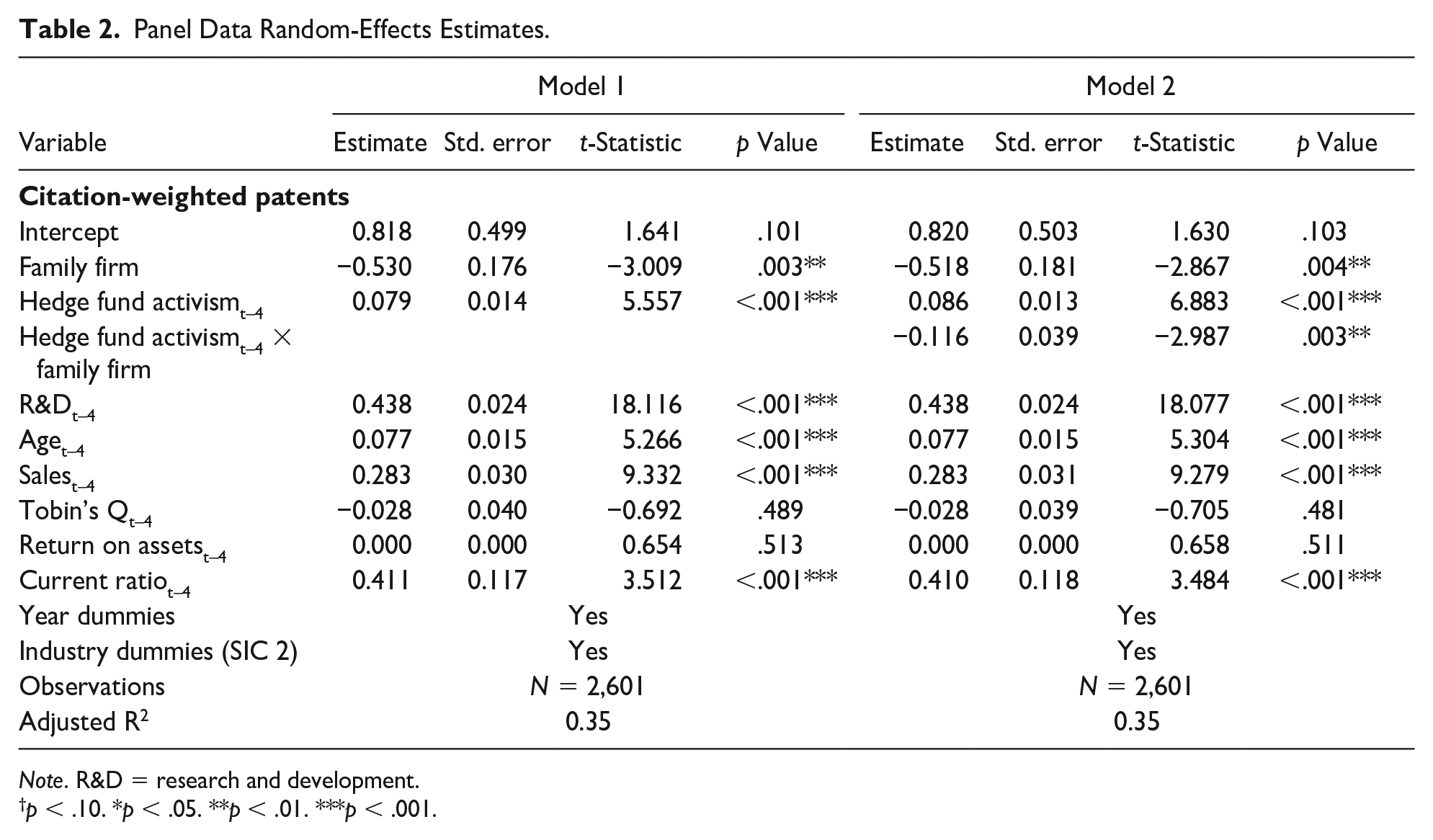
Table 2 contains the empirical results of our random-effects estimation in two model specifications. Model 1 includes all controls as well as the variables HFA and family firm status. In line with Hypothesis 1, we find that family firm status has a strong negative and significant effect (coefficient = –.530; p = .003) on citation-weighted patents. We also find that HFA has a positive and significant effect (coefficient = .079; p < .001) on innovation output after 4 years. This positive effect on innovation may appear surprising at first glance given the short-term oriented nature of hedge funds. Yet, given the high market visibility of patents and the suggested positive effect of hedge funds on innovation outputs proclaimed by previous scholars (cf. Brav et al., 2018; Wang & Zhao, 2015), our data support the notion of achieved innovation efficiency gains. This is in line with previous empirical findings demonstrating a positive effect of HFA on innovation output proxied by patent quantity and quality (Brav et al., 2018; He et al., 2014; Wang & Zhao, 2015).
Panel Data Random-Effects Estimates.
Note. R&D = research and development.
p < .10. *p < .05. **p < .01. ***p < .001.
Model 2 includes the interaction term FF × HFA in addition to the variables mentioned above for Model 1. In support of Hypothesis 2, we find a strong negative and significant interaction effect (coefficient = –.116; p = .003) four periods after hedge fund intervention. As illustrated in Figure 1, while hedge funds have a positive effect on the innovation output in nonfamily firms, their effort to increase innovation does not materialize among family-influenced firms. This finding suggests the presence of additional principal–principal costs after intervention. 14 Both models (Model 1 and Model 2) were also estimated with standard errors clustered over years and industries. The unreported results are very similar to the reported results and do not qualitatively affect any conclusion.
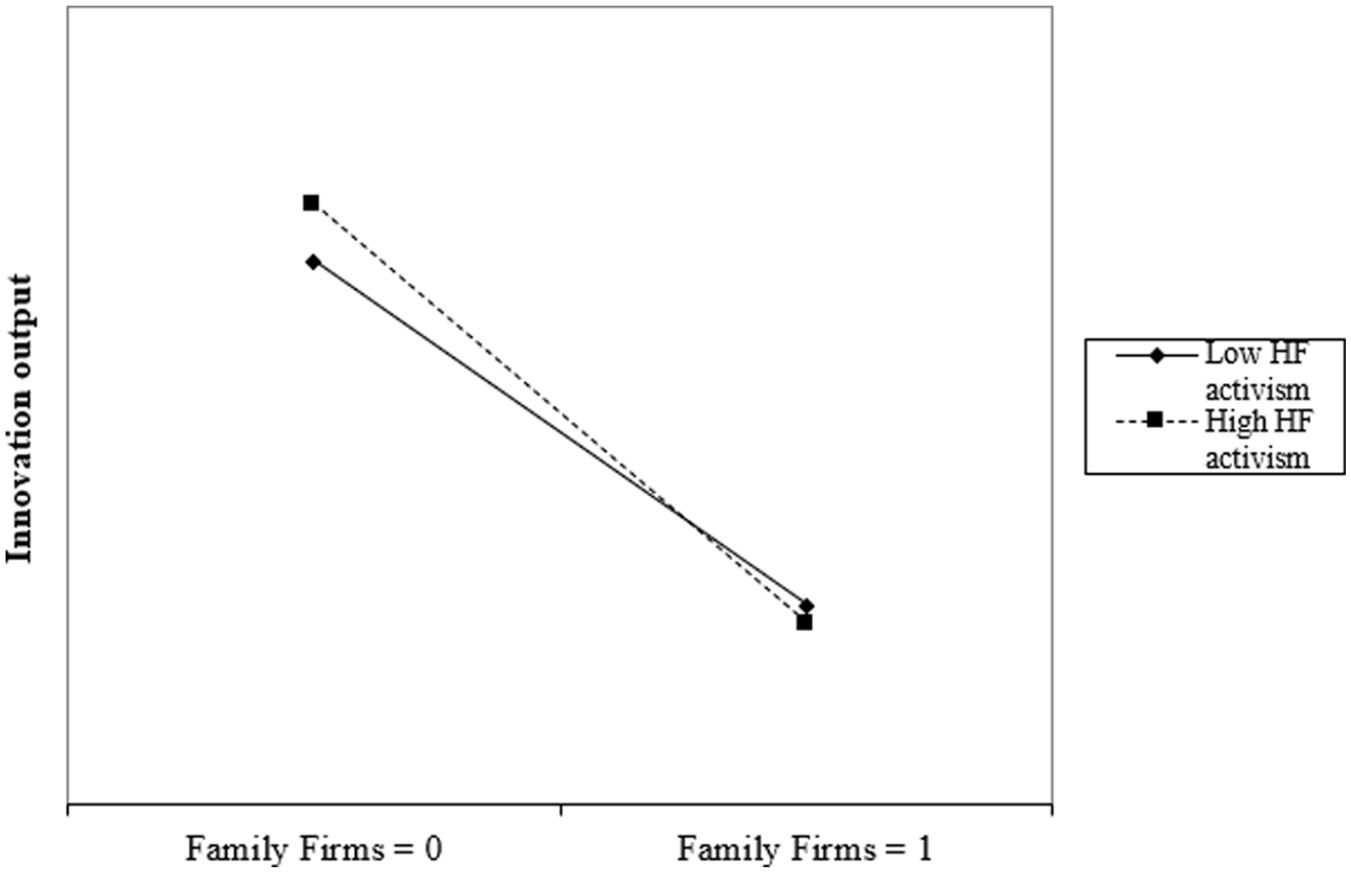
Interaction of Family Blockholders and Hedge Fund Activism on Innovation Output.
Adjusting for Possible Reversed Causality
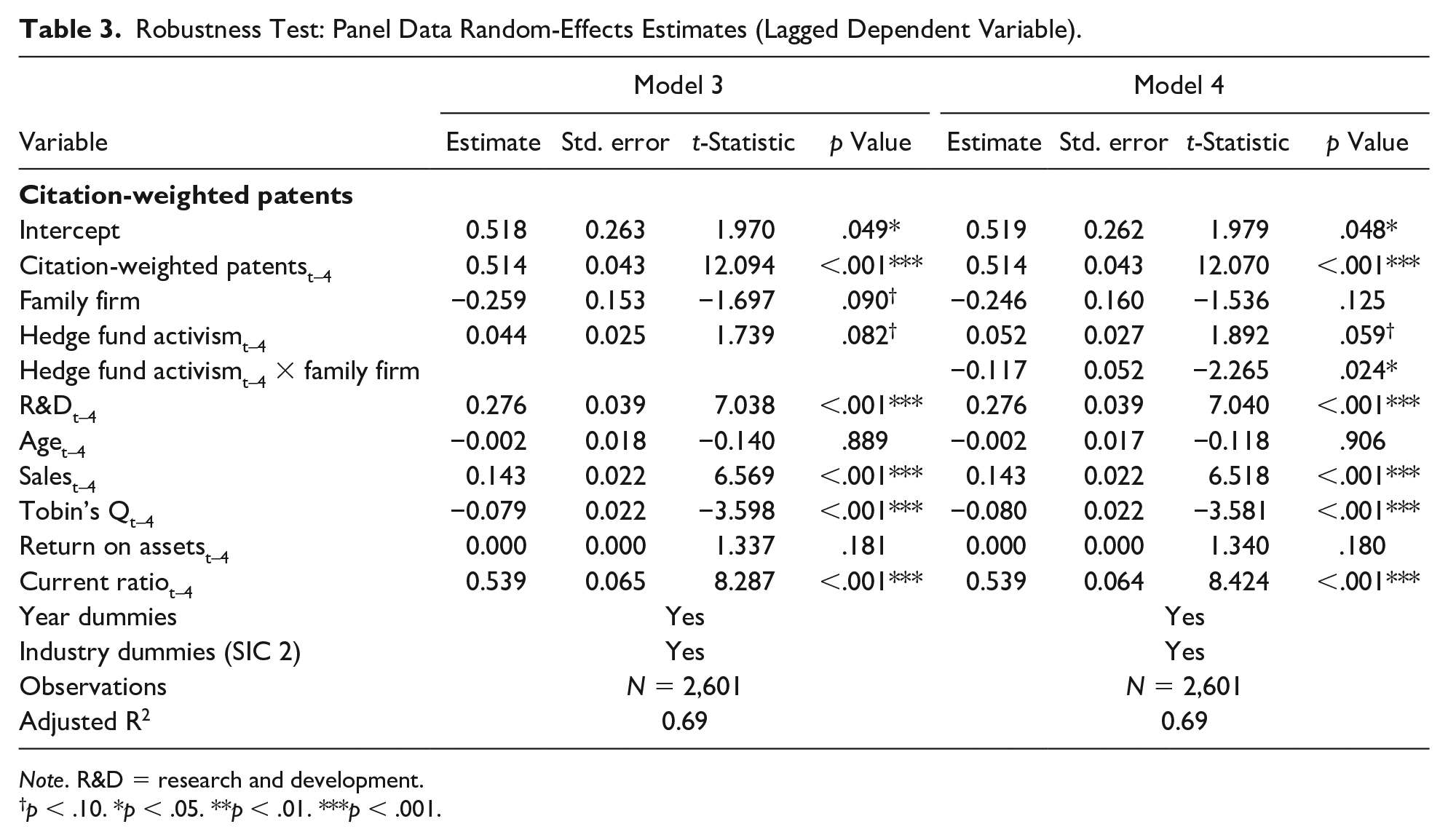
Although Model 1 and Model 2 reveal that family firm status and HFA have a significant impact on innovation output, estimates might suffer from endogeneity due to reverse causality. This is especially true for the variable HFA as their target choice may depend on our patent-related proxy. In case our dependent variable shows persistency, this form of reverse causality will lead to an asymptotic bias of our estimates. To account for this possibility of reverse causality, we estimated Model 3 and Model 4, including the lagged dependent variable (t–4) in addition to the variables contained in Model 1 and Model 2. The inclusion of previous values of the dependent variable is characteristic of a Granger causality procedure. A mathematical demonstration of how the inclusion of a lagged dependent variable functions as a first-order correction to potential reversed causality can be found in the study by Carree et al. (2019). As can be seen in Table 3, the lagged dependent variable has a substantial impact and is highly significant (coefficient = .514; p < .001). When accounting for reverse causality, the coefficients presented in support of Hypothesis 1 remain similar in Model 3 (coefficient = –.259; p = .090). Moreover, the interaction term between family firm status and HFA remains significantly negative (coefficient = –.117; p = .024), providing additional support for Hypothesis 2. We report a robustness test with 5-year lags in Table 4, and with R&D spending not winsorized in Table 5.
Robustness Test: Panel Data Random-Effects Estimates (Lagged Dependent Variable).
Note. R&D = research and development.
p < .10. *p < .05. **p < .01. ***p < .001.
Robustness Test: Panel Data Random-Effects Estimates (Lag 5).

Note. R&D = research and development.
p < .10. *p < .05. **p < .01. ***p < .001.
Robustness Test: Panel Data Random-Effects Estimates (R&D Not Winsorized).

Note. R&D = research and development.
p < .10. *p < .05. **p < .01. ***p < .001.
Additional Robustness Checks
First, in our main analyses, we relied on the binary GMI indicator for family firm status (cf. Gomez-Mejia et al., 2014, 2019). As a robustness check, we manually collected data on the voting power (as a percentage) of the owning family for each of these family firms and respective firm-year observation. These data are based on the SEC proxy statements and complementary online sources when needed. 15 Using these family voting percentages as a continuous measure, we reran our random-effects model, which gave very similar results to those of our main analyses (see Table A1 panel a in Appendix A). 16 Next, recent research based on investor’s reactions to traded stocks in France proposes that threshold effects of family ownership exist (Sekerci et al., 2022). As a result, we also created new family voting share dummies where, instead of the 20% threshold used in the GMI indicator, we worked with a 30%, 40%, and 50% thresholds. When working with the 40% and 50% thresholds, the number of family firms became too small to run reliable analyses (only 34 and 19 family firms, respectively). 17 When working with the 30% threshold (48 family firms), results were again similar to those reported earlier using the GMI indicator (see Table A1 panel b in Appendix A).
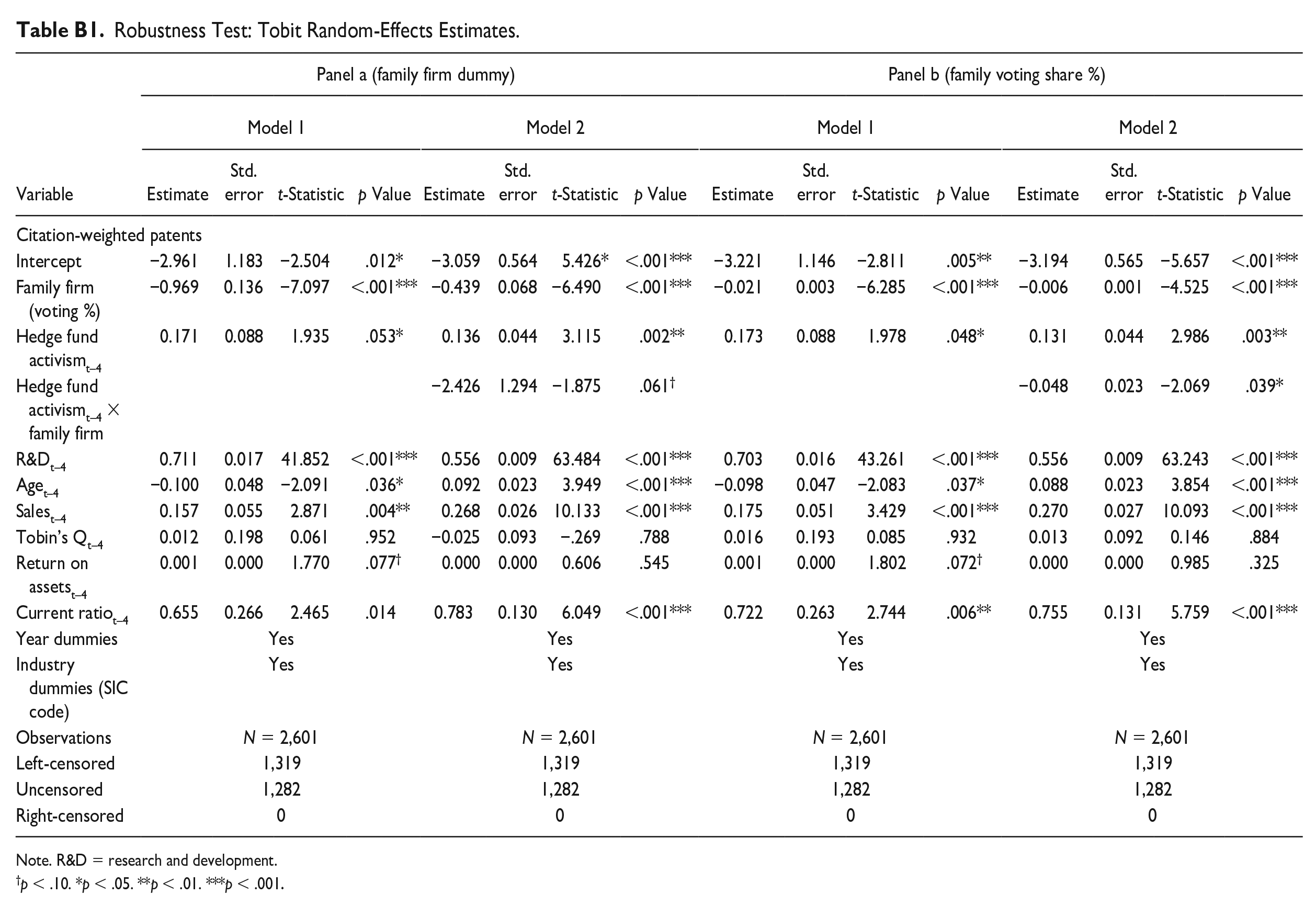
Second, many of the firm-year combinations in fact had no patenting activity. About half of the observations are left-censored at zero. Therefore, it could be argued that an estimation technique that takes this into account could improve upon the linear panel regression results. Using the censReg package in R, we have estimated a Tobit random-effects panel data model. The Tobit model can deal with (left) censoring, and results are presented in Table B1 in Appendix B, panel a for the family firm dummy and panel b for the family ownership percentage. The results as presented for the effect of the family firm variable and for the interaction term with hedge fund activity are in line with the results presented above using linear panel regression techniques.
Finally, we reran our analyses on a subsample of firms considering the sector’s R&D intensity. Radical innovation may be less of a strategic issue in very traditional low-tech sectors, such that principal–principal conflicts in relation to radical innovation choices may be less relevant. Toward this end, we adopted the industry-based R&D ranking proposed by the OECD (2015). This classification is representative for Western economies, and the sample is largely based on U.S. and EU data. We introduced five dummy variables: high R&D intensive sectors, medium-high R&D intensive sectors, medium R&D intensive sectors, medium-low R&D intensive sectors, and low R&D intensive sectors. We then created a subsample containing only high R&D intensive sectors; this sample contained no family firms. Subsequentially, we added medium-high, medium, and medium-low R&D intensive sectors in consecutive steps to see how many family firms are present in each subsample. The respective sample sizes were as follows: 16, 23, and 66. Accordingly, we assessed that reliable estimates are only viable if low R&D intensive sectors are excluded and the other sectors are retained. When using this subsample of high to medium-low R&D intensive sectors, results are again very similar to those obtained previously (see Table C1 panel a using the GMI family firm dummy and Table C1 panel b using the family’s voting percentage in Appendix C).
Discussion
Building on multiple agency theory and the prospect theoretic myopic loss aversion model (Benartzi & Thaler, 1995; Hoskisson et al., 2013), our study advances knowledge on the interrelationship between ownership heterogeneity and radical innovation output choices. Our empirical findings reveal that publicly traded firms with active family ownership, on average, put significantly less strategic emphasis on radical high-risk, high-mean innovation outcomes, which tend to be of greater technological and economic importance for the society (cf. Block et al., 2013). Importantly, our findings highlight the value of considering ownership heterogeneity in this setting by demonstrating that HFA aggravates the negative effect of family ownership. Hence, our study reveals that it is not sufficient to model strategy-related outcomes based on the analysis of a single (dominant) ownership group but that the broader ownership configuration should be considered in strategic and innovation management research.
Family-influenced firms demonstrate lower radical innovation output levels as reflected in citation-weighted patents; however, among publicly traded corporations, firms pursuing high-risk, high-mean innovation strategies would offer their investors greater potential for maximizing shareholder value as unsystematic risk can be eliminated through diversification according to the modern portfolio theory (Markowitz, 1952). From this perspective, family firms’ strategic innovation behavior and resulting below-average radical innovation output levels represent a form of wealth expropriation from diversified investors. Ownership structures of most publicly traded firms are dominated by influential institutional investors who may increase monitoring and reduce private wealth expropriation (Maury & Pajuste, 2005), and this role has also been ascribed to activist hedge funds (Brav, 2009; Brav et al., 2018). It appears, however, that more effective tools are necessary to alleviate the problems associated with family blockholders. We, therefore, provide nuances to the idea of institutional shareholder activism—HFA in particular—as a panacea for corporate governance problems (Brav et al., 2008; Briggs, 2007). Indeed, our study reveals that the presumptive positive effect of HFA on innovation outcomes does not materialize among family-influenced firms.
Academic Implications
Our study contributes to the literature on the effect of family ownership on corporate innovation output (e.g., Calabrò et al., 2019; Chrisman et al., 2015; Duran et al., 2016). We explained how the family-based socioemotional considerations of family control and family dynasty can be tied to cross-sectional and temporal aggregation, respectively, in decision-makers’ mental accounting of radical innovation gambles. We clarified how, particularly in the setting of publicly listed corporations facing short-term market pressures, family-based disadvantages in cross-sectional aggregation likely outweigh any potential temporal aggregation benefit. As such, ours is a contextualized approach that aligns with calls made by scholars like De Massis et al. (2013) who pointed out that “potential differences between small and private versus large and public family firms may provide major challenges to our ability to generate cumulative knowledge in this area” (p. 21). We also modeled HFA as a moderator in the relation between family ownership and radical innovation, which advances prior work on the heterogeneity of family firm innovation behavior (e.g., Decker & Günther, 2017; Memili et al., 2015; Patel & Chrisman, 2014). In short, by detailing aggregation decision mechanisms and considering the institutional context as well as the hitherto overlooked contingency of HFA, we advance the understanding of family firms’ innovation output behavior.
Our study also contributes to the research stream of ownership heterogeneity in family-influenced firms (e.g., Cirillo et al., 2019; Fernando et al., 2014; Sacristán-Navarro et al., 2011). To date, most family business studies examined the effect of family ownership in isolation, and those few studies that considered the role of other influential shareholders mainly found a positive moderation effect (e.g., Gomez-Mejia et al., 2014 and Cirillo et al., 2019 who looked at R&D intensity). Our study highlights the importance of differentiating between investor types and points to the possibility of negative interaction effects. To the best of our knowledge, we are the first to analyze the interplay between family blockholders and hedge funds in relation to firm-level innovation output. To advance our understanding of this topic, we complemented the myopic loss aversion model with insights from multiple agency theory on principal–principal conflicts (Arthurs et al., 2008; Hoskisson et al., 2013). By investigating family blockholders and hedge funds, which represent “perfect antipoles,” we were able to show that HFA is not universally positive in its effect and may aggravate the innovation weaknesses associated with family blockholders. As such, our study answers to calls for more research on strategic decision-making and innovation processes in today’s changed ownership landscape (Connelly, Hoskisson, et al., 2010; Wright, 2017).
Finally, we enrich the behavioral agency lens on family firm decision-making, and the mixed gamble approach in particular, which recently gained popularity (e.g., Gomez-Mejia et al., 2018, 2019; Kotlar et al., 2018). Specifically, in this study, we connect insights on mixed gamble aggregation rules from the prospect theoretic myopic loss aversion model (Benartzi & Thaler, 1995, 1999; Thaler et al., 1997) to ideas on principal–principal agency problems from the multiple agency model (Arthurs et al., 2008; Hoskisson et al., 2013). Thus far, mental accounting aggregation rules received little attention among family business scholars (for exceptions, see Bammens et al., 2022; Chrisman & Patel, 2012), and principal–principal problems among influential shareholders remained largely overlooked in behavioral agency studies on family firms. We clarified how family-based socioemotional considerations affect the temporal and cross-sectional aggregation of prospective innovation gamble returns in divergent ways and how the involvement of hedge funds undercuts the aggregation rules adopted by family blockholders. By integrating myopic loss aversion and multiple agency concepts, we were able to develop a deeper understanding of innovation output choices and, in doing so, enriched the behavioral agency lens on family firm decision-making.
Practical Implications
Our results provide valuable insights for practice. We investigated ownership-induced variance in innovation output in the form of citation-weighted patents. From a societal perspective, as well as for most (diversified) investors, the pursuit of radical innovation outcomes is generally desirable given their technological and economic impacts (Block et al., 2013). In view of our finding on the negative effect of family ownership on this innovation output measure, policy-makers concerned with spurring radical innovation in the business sector may consider putting limits on the power and influence of family blockholders in listed firms; for instance, the use of dual-class shares by family blockholders, which is quite common, may be restricted or made contingent on innovation-relevant provisions.
Furthermore, prior work highlights that external governance in the form of HFA sanctions corporate misbehavior and renders companies more efficient and shareholder-value minded (Brav et al., 2008; Gilson & Gordon, 2013). Interestingly, our study reveals that in the setting of corporations with active family ownership, such HFA is largely ineffective in boosting radical innovation because of the offsetting principal–principal conflicts it engenders. This implies that family firm stakeholders interested in raising innovation performance cannot rely on this external governance vehicle and need to resort to other governance tools such as appointing influential external board members affiliated with leading innovative firms (Bammens et al., 2011; Cannella et al., 2015).
Limitations and Future Research
Our model uses several behavioral concepts and mechanisms without measuring family-based socioemotional considerations (family control and family dynasty) and the associated aggregation rules applied in mental accounting (cross-sectional and temporal aggregation). While family influence is commonly used as a proxy for socioemotional decision considerations when analyzing panel data on publicly traded firms (e.g., Gomez-Mejia et al., 2014, 2018; Kotlar et al., 2018), we encourage future work to include direct measures of these explanatory behavioral constructs. One promising route for these types of firms would be to perform a text analysis on documents that are disclosed across time, such as annual reports with CEO letters, to verify the relative frequency of words that correspond with particular socioemotional and aggregation mechanisms or to use more sophisticated machine learning techniques for such text analysis.
The inferences drawn from our study are based on a sample of U.S. publicly traded firms, which has an impact on the generalizability of our findings as the regulatory standards in the United States are favorable for hedge fund activists (Clifford, 2008). Although this was desirable to analyze the impact of ownership heterogeneity in our study, future research would benefit from studying the impact of ownership heterogeneity in other institutional contexts. A comparative study between the United States and the European Union, for example, would inform the debate regarding the impact of legislation. Moreover, the short-term market pressures that are so characteristic of U.S. listed firms may influence our empirical findings; indeed, firms listed on a stock exchange in another institutional setting may be less subject to short-term pressures.
In addition, our study focused on activism exercised by hedge funds, with strategic objectives and incentive structures that are quite different from those of other (institutional) investors. We provide evidence that the impact of ownership cannot be adequately modeled in isolation, and more work is needed to develop a holistic framework capable of accounting for the complex distribution of power among multiple influential shareholder types (e.g., pension funds, mutual funds, corporate investors, state ownership), which characterizes the ownership landscape in many economies. Especially for studying the impact of family ownership on radical innovation choices, it is important to have a clearer understanding of how behavioral decision mechanisms are affected by the broader ownership configuration beyond hedge funds. This promises to be a fruitful avenue for future research.
We used a binary indicator of active family ownership and did not assess the family’s involvement in the management team. The adopted operational GMI definition of family firms (which also covers board membership of family owners; see above) aligns well with our prime interest in analyzing how the presence of large and active family blockholders, in combination with other active investors, shapes the innovation output choice, and various prior family business studies have used a similar binary approach (e.g., Cannella et al., 2015; Gomez-Mejia et al., 2003, 2014, 2019; Keasey et al., 2015; Kotlar et al., 2018). Our reported robustness test using family voting percentages was reassuring, but we did not measure family vote shares for those firms that were identified as nonfamily firms by GMI (zero values were imputed for those firms), resulting in measurement error. It would also be interesting to be able to differentiate between the role of family ownership (our main interest) and that of family management. We, therefore, encourage future work, with more sophisticated measures of family ownership and management, to perform such robustness and follow-up tests.
Similarly, it would be interesting to account for the business family’s investment portfolio beyond the focal firm. In this piece, we argued that families typically have disadvantages in cross-sectional aggregation because of their concentrated ownership position, but they also have potential benefits in temporal aggregation due to their long holding period and dynastic ambitions. This suggests that, in relation to radical innovation outputs, there may be an optimal balance—one in which the family can aggregate innovation gambles across a sufficiently large number of firms while maintaining adequate control and involvement in these firms to be able to pursue a meaningful dynastic agenda (i.e., without becoming a transient retail investor). This requires future research to look beyond the level of a single firm and instead to analyze the broader investment portfolio of business families.
Citation-weighted patents have become a best practice measure among scholars studying innovation output (Acharya & Subramanian, 2009; Aghion et al., 2013), yet the measure comes with limitations. Although this measure addresses many of the shortcomings of mere patent counts as a proxy for economically and technologically important innovation output, it fails to cover radical innovations that are protected by other means than patenting such as secrecy or first-mover advantage. For family firms, socioemotional considerations may affect the use of intellectual property as a protection mechanism (Chirico et al., 2020). If family firms are more inclined to protect their innovations by means of secrecy, for example, we likely underestimate their impact on radical innovation output. Thus, we believe that future research would benefit from the use of complementary measures of radical innovation output.
Finally, we aimed to investigate variance in firm-level strategic choices (intentions) to pursue radical high-risk, high-mean innovations while accounting for R&D budgets; that is, the extent to which R&D investments are targeted at radical innovation outputs with greater economic and technological importance (Block et al., 2013). This strategic choice perspective is anchored in our BAM theoretic lens, combining insights from prospect theory and multiple agency theory. However, we cannot rule out that our results partly capture differences in firms’ abilities to attain radical innovation outputs. When controlling for R&D spending, realized radical innovation outcomes (or lack thereof) can reflect both a firm’s strategic choice to pursue high-risk, high-return projects and its in-house capabilities to achieve those outcomes with the allocated budget. Past choices (e.g., on hiring particular R&D profiles) also shape current capabilities. We call for future research, for example, using a resource-based or dynamic capabilities lens (Barney, 1991; Teece, 2014), to extend our study by untangling these choice versus capability processes.
Footnotes
Appendix A
Robustness Test: Panel Data Random-Effects Estimates.

| Variable | Panel a (family voting share %) | Panel b (30% voting share threshold) | ||||||||||||||
|---|---|---|---|---|---|---|---|---|---|---|---|---|---|---|---|---|
| Model 1 | Model 2 | Model 1 (threshold 30%) | Model 2 (threshold 30%) | |||||||||||||
| Estimate | Std. error | t-Statistic | p Value | Estimate | Std. error | t-Statistic | p Value | Estimate | Std. error | t-Statistic | p Value | Estimate | Std. error | t-Statistic | p Value | |
| Citation-weighted patents | ||||||||||||||||
| Intercept | 0.832 | 0.493 | 1.687 | .092 † | 0.832 | 0.492 | 1.690 | .091 † | 0.856 | 0.488 | 1.753 | .080 † | 0.853 | 0.488 | 1.747 | .081 † |
| Family firm (voting %) | −0.008 | 0.002 | −3.714 | <.001*** | −0.008 | 0.002 | −3.422 | <.001*** | −0.285 | 0.134 | −2.132 | .033* | −0.277 | 0.138 | −2.001 | .046* |
| Hedge fund activismt–4 | 0.079 | 0.014 | 5.663 | <.001*** | 0.085 | 0.014 | 5.966 | <.001*** | 0.079 | 0.014 | 5.723 | <.001*** | 0.084 | 0.014 | 5.948 | <.001*** |
| Hedge fund activismt–4 × family firm | −0.002 | 0.000 | −4.526 | <.001*** | −0.114 | 0.041 | −2.745 | .006** | ||||||||
| R&Dt–4 | 0.438 | 0.024 | 18.115 | <.001*** | 0.438 | 0.024 | 18.014 | <.001*** | 0.440 | 0.026 | 17.053 | <.001*** | 0.440 | 0.026 | 17.077 | <.001*** |
| Aget–4 | 0.072 | 0.012 | 6.037 | <.001*** | 0.072 | 0.012 | 6.142 | <.001*** | 0.066 | 0.013 | 4.909 | <.001*** | 0.066 | 0.013 | 5.011 | <.001*** |
| Salest–4 | 0.286 | 0.031 | 9.231 | <.001*** | 0.285 | 0.031 | 9.278 | <.001*** | 0.284 | 0.030 | 9.374 | <.001*** | 0.284 | 0.030 | 9.384 | <.001*** |
| Tobin’s Qt–4 | −0.032 | 0.040 | −0.783 | .434 | −0.032 | 0.040 | −0.806 | .420 | −0.033 | 0.036 | −0.914 | .361 | −0.033 | 0.036 | −0.927 | .354 |
| Return on assetst–4 | 0.000 | 0.000 | 0.648 | .517 | 0.000 | 0.000 | 0.650 | .516 | 0.000 | 0.000 | 0.655 | .513 | 0.000 | 0.000 | 0.658 | .511 |
| Current ratiot–4 | 0.405 | 0.119 | 3.411 | <.001*** | 0.406 | 0.119 | 3.400 | <.001*** | 0.397 | 0.123 | 3.218 | .001** | 0.399 | 0.124 | 3.212 | .001** |
| Year dummies | Yes | Yes | Yes | Yes | ||||||||||||
| Industry dummies (SIC code) | Yes | Yes | Yes | Yes | ||||||||||||
| Observations | N = 2,601 | N = 2,601 | N = 2,601 | N = 2,601 | ||||||||||||
| Adjusted R2 | 0.35 | 0.35 | 0.35 | 0.35 | ||||||||||||
Note. R&D = research and development.
p < .10. *p < .05. **p < .01. ***p < .001.
Appendix B
Robustness Test: Tobit Random-Effects Estimates.
| Variable | Panel a (family firm dummy) | Panel b (family voting share %) | ||||||||||||||
|---|---|---|---|---|---|---|---|---|---|---|---|---|---|---|---|---|
| Model 1 | Model 2 | Model 1 | Model 2 | |||||||||||||
| Estimate | Std. error | t-Statistic | p Value | Estimate | Std. error | t-Statistic | p Value | Estimate | Std. error | t-Statistic | p Value | Estimate | Std. error | t-Statistic | p Value | |
| Citation-weighted patents | ||||||||||||||||
| Intercept | −2.961 | 1.183 | −2.504 | .012* | −3.059 | 0.564 | 5.426* | <.001*** | −3.221 | 1.146 | −2.811 | .005** | −3.194 | 0.565 | −5.657 | <.001*** |
| Family firm (voting %) | −0.969 | 0.136 | −7.097 | <.001*** | −0.439 | 0.068 | −6.490 | <.001*** | −0.021 | 0.003 | −6.285 | <.001*** | −0.006 | 0.001 | −4.525 | <.001*** |
| Hedge fund activismt–4 | 0.171 | 0.088 | 1.935 | .053* | 0.136 | 0.044 | 3.115 | .002** | 0.173 | 0.088 | 1.978 | .048* | 0.131 | 0.044 | 2.986 | .003** |
| Hedge fund activismt–4 × family firm | −2.426 | 1.294 | −1.875 | .061 † | −0.048 | 0.023 | −2.069 | .039* | ||||||||
| R&Dt–4 | 0.711 | 0.017 | 41.852 | <.001*** | 0.556 | 0.009 | 63.484 | <.001*** | 0.703 | 0.016 | 43.261 | <.001*** | 0.556 | 0.009 | 63.243 | <.001*** |
| Aget–4 | −0.100 | 0.048 | −2.091 | .036* | 0.092 | 0.023 | 3.949 | <.001*** | −0.098 | 0.047 | −2.083 | .037* | 0.088 | 0.023 | 3.854 | <.001*** |
| Salest–4 | 0.157 | 0.055 | 2.871 | .004** | 0.268 | 0.026 | 10.133 | <.001*** | 0.175 | 0.051 | 3.429 | <.001*** | 0.270 | 0.027 | 10.093 | <.001*** |
| Tobin’s Qt–4 | 0.012 | 0.198 | 0.061 | .952 | −0.025 | 0.093 | −.269 | .788 | 0.016 | 0.193 | 0.085 | .932 | 0.013 | 0.092 | 0.146 | .884 |
| Return on assetst–4 | 0.001 | 0.000 | 1.770 | .077 † | 0.000 | 0.000 | 0.606 | .545 | 0.001 | 0.000 | 1.802 | .072 † | 0.000 | 0.000 | 0.985 | .325 |
| Current ratiot–4 | 0.655 | 0.266 | 2.465 | .014 | 0.783 | 0.130 | 6.049 | <.001*** | 0.722 | 0.263 | 2.744 | .006** | 0.755 | 0.131 | 5.759 | <.001*** |
| Year dummies | Yes | Yes | Yes | Yes | ||||||||||||
| Industry dummies (SIC code) | Yes | Yes | Yes | Yes | ||||||||||||
| Observations | N = 2,601 | N = 2,601 | N = 2,601 | N = 2,601 | ||||||||||||
| Left-censored | 1,319 | 1,319 | 1,319 | 1,319 | ||||||||||||
| Uncensored | 1,282 | 1,282 | 1,282 | 1,282 | ||||||||||||
| Right-censored | 0 | 0 | 0 | 0 | ||||||||||||
Note. R&D = research and development.
p < .10. *p < .05. **p < .01. ***p < .001.
Appendix C
Robustness Test: Panel Data Random-Effects Estimates—Excluding Low R&D Intensive Industries (OECD).

| Variable | Panel a (family firm dummy) | Panel b (family voting share %) | ||||||||||||||
|---|---|---|---|---|---|---|---|---|---|---|---|---|---|---|---|---|
| Model 1 | Model 2 | Model 1 | Model 2 | |||||||||||||
| Estimate | Std. error | t-Statistic | p Value | Estimate | Std. error | t-Statistic | p Value | Estimate | Std. error | t-Statistic | p Value | Estimate | Std. error | t-Statistic | p Value | |
| Citation-weighted patents | ||||||||||||||||
| Intercept | −3.358 | 0.671 | −5.006 | <.001*** | −3.306 | 0.692 | −4.778 | <.001*** | −2.067 | 0.941 | −2.198 | .028* | −2.070 | 0.940 | −2.202 | .028* |
| Family firm (voting %) | −0.101 | 0.009 | −11.100 | <.001*** | −0.070 | 0.010 | −7.223 | <.001*** | −0.005 | 0.002 | −2.470 | .014* | −0.005 | 0.002 | −2.309 | .021* |
| Hedge fund activismt–4 | 0.021 | 0.020 | 1.036 | .300 | 0.045 | 0.019 | 2.370 | .018* | 0.061 | 0.033 | 1.854 | .064 † | 0.065 | 0.032 | 2.044 | .041* |
| Hedge fund activismt–4 × family firm | −0.321 | 0.106 | −3.026 | .003** | −0.001 | 0.000 | −3.533 | <.001*** | ||||||||
| R&Dt–4 | 0.555 | 0.008 | 72.866 | <.001*** | 0.555 | 0.007 | 74.371 | <.001*** | 0.404 | 0.014 | 28.061 | <.001*** | 0.403 | 0.015 | 27.795 | <.001*** |
| Aget–4 | 0.125 | 0.015 | 8.461 | <.001*** | 0.127 | 0.015 | 8.499 | <.001*** | 0.140 | 0.046 | 3.045 | .002** | 0.141 | 0.046 | 3.072 | .002** |
| Salest–4 | 0.366 | 0.040 | 9.238 | <.001*** | 0.364 | 0.041 | 8.890 | <.001*** | 0.305 | 0.047 | 6.448 | <.001*** | 0.305 | 0.047 | 6.476 | <.001*** |
| Tobin’s Qt–4 | 0.024 | 0.077 | 0.309 | .757 | 0.023 | 0.079 | 0.292 | .770 | −0.133 | 0.083 | −1.596 | .111 | −0.132 | 0.083 | −1.596 | .111 |
| Return on assetst–4 | 0.000 | 0.000 | 0.668 | .504 | 0.000 | 0.000 | 0.656 | .512 | 0.000 | 0.000 | .906 | .365 | 0.000 | 0.000 | 0.902 | .367 |
| Current ratiot–4 | 0.913 | 0.086 | 10.605 | <.001*** | 0.878 | 0.093 | 9.459 | <.001*** | 0.370 | 0.252 | 1.470 | .142 | 0.369 | 0.256 | 1.443 | .149 |
| Year dummies | Yes | Yes | Yes | Yes | ||||||||||||
| Industry dummies (SIC code) | Yes | Yes | Yes | Yes | ||||||||||||
| Observations | N = 1,192 | N = 1,192 | N = 1,192 | N = 1,192 | ||||||||||||
| Adjusted R2 | 0.66 | 0.66 | 0.30 | 0.30 | ||||||||||||
Note. OECD = Organization for Economic Cooperation and Development; R&D = research and development.
p < .10. *p < .05. **p < .01. ***p < .001.
Declaration of Conflicting Interests
The author(s) declared no potential conflicts of interest with respect to the research, authorship, and/or publication of this article.
Funding
The author(s) received no financial support for the research, authorship, and/or publication of this article.

Research questions:
• Does the interplay between two influential yet opposing shareholder types, namely family blockholders and hedge funds, influence corporate innovation processes?
• Does the presence of a family blockholder in a publicly listed firm’s ownership structure affect the firm’s radical innovation output?
• Can hedge fund activism serve as an effective external governance mechanism to enhance radical innovation output in listed family controlled firms?
Practical implications:
• In U.S. listed firms, family blockholders have a negative effect on radical innovation output. Policy-makers concerned with stimulating growth through radical innovation in the business sector may consider putting limits on the power of family blockholders (e.g., by putting restrictions on the use of dual-class shares).
• The positive effect of hedge fund activism on radical innovation output disappears in the presence of family blockholders. This implies that stakeholders interested in raising innovation performance cannot rely on this external governance mechanism and instead need to resort to other governance tools (e.g., through new board appointments).