



Abstract
Learning and development are taking up a central role in the human resource policies of organizations because of their crucial contribution to the competitiveness of those organizations. The present study investigates the relationship of work motivation, perceived workload, and choice independence with employees’ approaches to learning at work. Participants in this study were 358 Belgian employees who completed the Approaches to Learning at Work Questionnaire, the Workplace Climate Questionnaire, and the Motivation at Work Scale. Results show that both autonomous and controlled motivation relate positively to employees’ deep approaches to learning. In addition, an interaction effect of perceived workload and choice independence on a deep approach to learning was found. The results concerning a surface-disorganized approach to learning showed a negative relationship with autonomous motivation and a positive relationship with perceived workload. None of the predictors related significantly to a surface-rational approach.
Today’s economy changes continuously. Phenomena such as continuing globalization and technological innovation force organizations to constantly innovate and reinvent themselves in order to stay competitive (Burke & Ng, 2006). Savickas (1997) has articulated the need for employees to be adaptable in their careers due to these more rapid changing technology and economy. Continuous learning has been considered as a way of enhancing employees’ career adaptability (Hall & Mirvis, 1995). These evolutions have resulted in an increasing awareness that learning at work is a crucial factor, which expresses itself in rising concepts such as lifelong learning, learning organizations, learning climate, and so on. (Kyndt, Dochy, Michielsen, & Moeyaert, 2009; Pillay, Boulton-Lewis, & Wilss, 2003). For organizations, it is therefore important to know how employees learn and which factors contribute to a stimulating learning environment. However, learning is not only a hot topic from the organizational perspective; employees also increasingly value personal development. Recent research showed, for example, that a stimulating learning climate was an important factor in predicting employee retention. Employees who perceive a stimulation to learn and who are offered learning opportunities are more likely to remain with their current employer (Kyndt et al., 2009). When an employee does not experience a real learning opportunity or perceives no choice, it can influence learning outcomes. Furthermore, not only organizational factors but also personal factors can influence learning (Baeten, Kyndt, Struyven, & Dochy, 2010).
Learning and development are considered to have a crucial contribution to the competitiveness of organizations (Kyndt et al., 2009). Although this has lead to the fact that several human resource departments are focusing on learning and development, few studies have focused on “how” employees actually learn (Bernsen, Segers, & Tillema, 2009; Kyndt et al., 2009). Kirby, Knapper, Evans, Carty, and Gadula (2003) argue that, because of the rapidly changing context in which organizations operate, a necessity arises for employees to learn in a way that involves integrating materials from different sources, relating new information to prior knowledge, applying knowledge differentially according to the situation. In other words, a need for a deep approach to learning comes to the fore (Kirby et al., 2003). This study expands the research conducted by Kirby et al. (2003) and investigates the relationships between approaches to learning at work, workload, choice independence, and work motivation. In particular, it will focus on the contribution of workload and choice independence (at the organizational side), and work motivation (at the personal side) in employees’ choice to adopt a particular approach to learning. Further, differences among different groups of employees regarding learning approaches will be investigated. Since a vast majority of prior research on approaches to learning is conducted with students, the academic setting will be used as a starting point.
Theory and Literature
Approaches to Learning
The concept of approaches to learning includes both the intentions persons hold toward a learning task as well as the congruent strategies they use to fulfill that intention (Biggs, 2001; Entwistle & Ramsden, 1983). Marton and Säljö (1976) conceptualized approaches to learning as the combination of a student’s intentions toward a learning task and the processes they use to fulfill that intention. Three approaches to learning are distinguished: a deep approach, a surface approach, and an achieving approach. Students who adopt a deep approach have the intention to understand the learning task out of an intrinsic interest in the task (Kirby et al., 2003). It is associated with strategies such as gathering new information, relating new knowledge to previous knowledge, and searching for underlying arguments (Biggs, 1987; Entwistle & Ramsden, 1983). A surface approach is characterized by an intention that is extrinsic to the task. Students foremost want to avoid failure. Therefore they use a reproductive strategy, which comes down to limiting the learning task to the bare essential and focusing on reproduction by rote learning (Biggs, 1987). Students adopting an achievement approach are motivated by competition, obtaining good grades and looking good in the eyes of others. The achieving strategy describes how students organize their learning, with regard to time and space (i.e., when, how long, where they learn; Baeten et al., 2010; Biggs, 1987).
In the academic context, it has been well established that approaches to learning are influenced by several context variables (e.g., learning environment, feedback, interactivity, scaffolding, etc.) and the perception of context variables (e.g., perceived workload, assessment, teaching, etc.; Baeten et al., 2010; Kember, 2004). In addition, several researchers were able to connect students’ approaches to learning to characteristics of the students such as intellectual ability, motivation, and age (Furnham, Swami, Arteche, & Chamorro-Premuzic, 2008).
While a lot of knowledge has been gathered about students’ learning, the learning of employees has been studied less extensively. Several authors claim that there are considerable differences between academic and workplace learning (Candy & Crebert, 1991; Knapper, 2001; Resnick, 1987). Candy and Crebert (1991) state that the learning processes at university are generalized, often decontextualized, focus on elegant answers and are individually competitive. Learning processes at work on the other hand are specialized, contextualized, focus on practical solutions, and are collaborative. In addition, Resnick (1987) stated that academic learning focuses on individual cognition, whereas learning at work concentrates on socially shared knowledge and skills (Resnick, 1987). However, in reality, these extreme opposites do not occur (Candy & Crebert, 1991). Hodkinson (2005) and Tynjälä (2008) argued that the differences between academic learning and workplace learning are exaggerated. Several universities are implementing practices such as field trips, project work, problem-based learning, and internships (Candy & Crebert, 1991). To meet today’s challenges of change and complexity employees will increasingly need to use learning approaches that enable conceptual understanding and integrating of new knowledge with prior knowledge in order to come up with creative solutions to solve novel problems (Knapper, 2001). Therefore, it is equally important to know which factors may encourage deep learning approaches of employees.
Kirby et al. (2003) adapted Biggs’ conceptualization of learning approaches to investigate learning approaches in the workplace and identified three factors. The deep approach emerged also in the workplace. It concerns employees who are eager to understand the learning task. They use integrative strategies that contribute to personal understanding (Bernsen et al., 2009; Delva, Kirby, Schultz, & Godwin, 2004). The achievement approach, on the contrary, could not be replicated. The surface factor separated into two distinct approaches, a surface-rational one and a surface-disorganized one. The surface-rational approach reflects a preference for orderly, accurate, and detailed work, thereby making use of surface strategies such as memorization, and a methodical, step-by-step approach (Bernsen et al., 2009; Kirby et al., 2003). Contrary to a student’s surface approach, the surface-rational has little to do with fear of failure or extrinsic motives (Kirby et al., 2003). The surface-disorganized approach reflects a nonacademic orientation in combination with surface motives. It is associated with feeling overwhelmed, dissatisfaction with one’s work environment, and a sense of incompetence when executing tasks (Bernsen et al., 2009). Kirby et al. (2003) noted that it is rather a reaction to work than an actual approach to it.
Work Motivation
Why do people do a particular job? Some people will acknowledge that they go to work mainly because of instrumental reasons, that is, to attain an outcome that is separable from the work itself (e.g., income, good working conditions, reputation, etc.). Their motivation stems from external aspects, consequences of the job. Others will state that they go to work mainly because they enjoy doing the work itself, their motivation stems from inherent aspects of the job (such as autonomy, skill variety, etc.). The latter is traditionally known as intrinsic motivation, the former as extrinsic; a commonly used categorization (Gagné & Deci, 2005). Vroom’s expectancy-valence theory (1964), and Porter and Lawer’s motivation model (1968) assume that intrinsic and extrinsic motivation are additive, that is, that the total motivation is the sum of intrinsic and extrinsic motivation. Many theories assume that the total amount of motivation is crucially independent of the type of motivation (Gagné & Deci, 2005). In contrast, Deci (1971) found that money decreased intrinsic motivation while verbal rewards increased it. This implies that intrinsic and extrinsic motivation can be both positively/negatively interactive rather than being additive (Gagné & Deci, 2005). Moreover, instead of portraying intrinsic and extrinsic motivation as dichotomous, the idea of gradations in extrinsically motivated behavior grew. This resulted in a more refined analysis of extrinsic motivation according to the degree of self-determination or autonomy, which is based on a continuum of internalization (Ryan & Deci, 2000). Internalization is defined as people taking in values, attitudes, or regulatory structures, in a way that the initial external regulation of a behavior is transformed into an internal regulation that no longer requires the presence of an external contingency (Gagné & Deci, 2005). With the distinction of several types of extrinsic motivation the focus changed from intrinsic versus extrinsic motivation to autonomous versus controlled motivation, as postulated in the self-determination theory (SDT; Deci & Ryan, 2004; Ryan & Deci, 2000). In general, two types of motivation are distinguished in SDT. Autonomous motivation involves acting from a sense of volition and the experience of choice. The locus of causality (reason why one does something) is perceived to be internal. In contrast, controlled motivation involves acting with a sense of pressure, a sense of having to engage in the action. The locus of causality is perceived to be external (Deci & Ryan, 2004).
SDT poses that autonomous motivation is qualitatively better than controlled motivation. Controlled motivation implies acting under pressure that leads to stress, undermines creativity and innovation, and demands more energy. At the same time, the advantages of autonomous motivation in the work context are well documented: it is positively related to employees’ well-being in terms of job satisfaction, life satisfaction, organizational commitment, total health, and diminished burnout (e.g., Fernet, Guay, & Senécal, 2004; Ryan & Deci, 2000). Within the academic context, it has been shown that autonomous motivation for learning is associated with better cognitive processing, indicated by more deep-level learning (Vansteenkiste, Simons, Lens, Soenens, & Matos, 2005). A recent study concluded that autonomous motivation is positively related to a deep approach to learning and negatively related to a surface approach to learning when the induced workload is high (Kyndt, Dochy, Struyven, & Cascallar, 2011a). In addition, it was found that students who are characterized by autonomous motivation consistently adopt more deep approaches than their fellow students.
Workload and Choice Independence
Prior research has shown that not only personal factors (such as motivation) but also contextual factors can influence learning approaches (e.g., Baeten et al., 2010; Delva et al., 2004, Kirby et al., 2003). Prior research has shown that a positive organizational learning climate is important for employees’ participation in learning (Armstrong-Stassen & Schlosser, 2008). Considering today’s rapidly changing business environment, the question that arises asks which factors of the work environment contribute to a stimulating learning environment. A first contextual factor that is considered is workload. The research within the academic context is relatively consistent in its finding that perceived workload relates positively to a surface-learning approach and negatively to a deep approach to learning (e.g., Diseth, Pallesen, Hovland, & Larsen, 2006; Wilson, Lizzio, & Ramsden, 1997). The research in the organizational context is however less clear-cut. When looking at the limited number of studies on approaches to learning at work, the results show that perceived workload is mainly positively related to a surface-disorganized approach (Delva et al., 2004; Kirby et al., 2003; McManus, Keeling, & Paice, 2004). The theoretical framework of Frese and Zapf’s (1994) “action theory” supports this relationship. Workload is a hindering factor, since it requires time, time that is needed for behaviors such as reflecting, experimenting, and exploring. When employees are experiencing high workload, they feel that they do not have the time available for critical learning activities and fall back on automated behaviors (van Ruysseveldt & van Dijke, 2011). However, the job demands control model of Karasek (1979) suggests an opposite relationship between workload and learning. This theoretical framework indicates that high demands challenge employees and induce the need for more effective work strategies and behaviors to achieve their goals. Therefore, high job demands, such as high workload, can promote learning activity; the results are however not always clear-cut (van Ruysseveldt & van Dijke, 2011). In this regard, Karasek (1998) noted that workload can be stimulating as long as it is not overwhelming.
The second perceived characteristic of the workplace that this study considers is choice independence. Kirby et al. (2003) described choice independence as choice and independence in the workplace. It is also interpreted as the perception of control over what one does and how one does it (Delva et al., 2004; McManus et al., 2004). Delva et al. (2004), Kirby et al. (2003), and McManus et al. (2004) all found that choice independence related positively to a deep learning approach and negatively to a surface-disorganized approach. In line with these results, Vansteenkiste, Simons, Lens, Deci, and Sheldon (2004) reported a significant effect for autonomy-supportive work contexts on the quality of self-reported depth of processing. Deep processing was significantly higher in an autonomy-supportive context compared with a controlling context in which individuals experience no independence or choice. In addition, van Ruysseveldt and van Dijke (2011) found that job autonomy moderates the influence of workload. Jobs with high workload and high autonomy (without being overwhelming) best promote learning, whereas a mismatch between workload and autonomy has detrimental effects on the learning process.
Present Study
The aim of this study is to investigate the relationship of organizational and personal factors on learning approaches at work. Three approaches to learning at work have been distinguished and will be taken up in this investigation as the dependent variables. For the first research question What is the relationship of workload, choice independence and work motivation to employees’ approaches to learning? several clear hypotheses can be formulated based on prior research. It is hypothesized that autonomous motivation and choice independence will relate positively to a deep approach (Delva et al., 2004; Heikkilä & Lonka, 2006; Kirby et al., 2003, Kyndt et al., 2011a; McManus et al., 2004). Since the research was most consistent about these relationships, these variables will be entered into the model in the second step after including the control variables in the first step. Following, workload and controlled motivation are hypothesized to demonstrate a negative relationship with a deep approach to learning (Baeten et al., 2010; Heikkilä & Lonka, 2006; Kyndt et al., 2011a). Given the results of van Ruysseveldt and van Dijke (2011), the interaction between perceived workload and choice independence will be entered in a final step. Since the research in educational contexts does not differentiate between a surface-rational and surface-disorganized approach, the hypotheses for both surface approaches are similar. It is hypothesized that perceived workload would have a positive relationship with both surface approaches (Baeten et al., 2010; Delva et al., 2004; Kirby et al., 2003; McManus et al., 2004). Autonomous motivation is hypothesized to have a negative relationship with both surface approaches to learning (Heikkilä & Lonka, 2006; Kyndt et al., 2011a). Controlled motivation is hypothesized to have a positive though less strong relationship with both surface approaches to learning (Heikkilä & Lonka, 2006; Kyndt et al., 2011a). The interaction between perceived workload and choice independence will also be entered in a final step (Van Ruysseveldt & van Dijke, 2011).
To determine which control sociodemographic variables should be included as control variables. The analyses will start by examining the differences between groups of employees in terms of gender, age, level of education, type of contract (full time, part time, other) and the sector (profit, social profit, nonprofit) in which one is employed. Regarding sector, it is interesting to distinguish the difference between the profit and social profit sectors. Organizations in the social profit sector also strive for (financial) profits however unlike the profit sector they serve a social purpose within society. Organizations in the social profit sector are for example: (private) hospitals or nursing homes. These relationships will be explored since prior findings on these employee characteristics are nonexisting or inconclusive. For example the research on gender differences: some educational researchers found that men scored higher on the surface approach while others found the opposite (Kyndt, Dochy, Struyven & Cascallar, 2011b). In addition, the relationship between age and seniority, and approaches to learning will be investigated. Regarding age, Delva et al. (2004) observed a positive association between age and a deep approach. When growing older, employees make more use of a deep learning approach (Delva et al., 2004). It is expected that both age and seniority will be positively related to a deep approach and negatively to both surface approaches to learning.
Method
Participants
To recruit participants, we had access to the customer contact list of an organization offering training for employees. The HR departments of these customers were contacted and asked to spread the questionnaire (online or hard copy) to their employees. In total, 358 Belgian employees from diverse company sizes, industry branches, and sectors participated. Regarding gender, 59% was female and 41% was male. In terms of sector, 52% was employed in profit organizations including independent professions, 20% was employed in nonprofit organizations including education, 18% in the social profit sector (health care, care for the elderly, etc.), and 10% was employed in the public sector (government). Most respondents had a full-time contract (83%); only 14% worked part time, and 3% had a temporary contract. Regarding level of education, 1% did not obtain a diploma or finished elementary school, 25% obtained a secondary degree, 40% obtained a bachelor’s degree (professional or academic), and 34% obtained a master’s degree. The age boundaries almost span the full working life, ranging from age 20 to 64 with a mean age of 37.85 years (SD = 10.64). Participants had on average 11.22 years of seniority (SD = 10.16).
Instruments
The questionnaire used in this study consisted of three instruments with validated scores and was completed on a voluntary basis. In total, it comprised 52 items that were translated from English to Dutch, the participants’ mother tongue, according to the guidelines of the International Test Commission (2010). Concretely, the translation was performed by one researcher and checked by two other researchers whose native language was also Dutch. An employee comparable to the participants in this research also checked the language and clarity of the questions. Participants scored the items on a 5-point Likert-type scale: strongly disagree (1), rather disagree (2), neutral (3), rather agree (4), and strongly agree (5).
To measure the approaches to learning the Approaches to Learning at Work Questionnaire (AWQ) was used (Kirby et al., 2003). The AWQ is based on the Approaches to Studying Inventory from Entwistle and Ramsden (1983). Kirby et al. (2003) adapted these questions so that they concerned relevant workplace experiences. The AWQ exists out of 30 items equally divided over three scales: deep, surface-rational, and surface-disorganized approach. The research of Kirby et al. (2003) showed acceptable results in terms of internal consistency: deep (α = .72), surface-disorganized (α = .72), and surface-rational (α = .74).
To gather information on the perceptions of the work environment, items from the Workplace Climate Questionnaire (WCQ; Kirby et al., 2003) were used. The WCQ is an adaptation by Kirby et al. (2003) of the Course Perceptions Questionnaire from Entwistle and Ramsden (1983) applied to the workplace. It consists of 15 items equally divided over three scales: Workload scale, Choice-Independence scale, and Good Supervision scale (Kirby et al., 2003). For the present study, only the Workload scale and the Choice-Independence scale were used. In the study of Kirby et al. (2003), both scales had good reliabilities (both α = .80). The Good Supervision scale was not taken up, since it did not lie within the focus of this study.
Work motivation was measured by means of the Motivation at Work Scale (MAWS; Gagné et al., 2010) and focuses on the reasons why one does a particular job. It comprises four subscales in accordance with the multidimensional conceptualization of motivation in SDT. The English version of the questionnaire has acceptable (to good) reliabilities ranging from .69 to .89. Despite that the different subscales are lying on a continuum, research has shown that there is a clear break in the middle, distinguishing between autonomous and controlled behavior. Depending on the research question, one can use the different types or the aggregates (Gagné et al., 2010). For comprehensive reasons, the aggregates will be used.
The calculation of the Cronbach’s α reliability coefficients showed that all scales in this study have an acceptable internal consistency: deep (α = .69), surface rational (α = .74), and surface-disorganized approach (α = .64), perceived workload (α = .75), choice independence (α = .81), autonomous (α = .79), and controlled motivation (α = .76).
Analyses
The analyses were started with the calculation of the correlations between the different variables to explore the relationship between the variables. Next, the scales were standardized in order to investigate the interaction effect of workload and choice independence. Subsequently, analysis of variance (ANOVA) was used to compare the means on the three learning approaches for different groups of employees. Finally, multiple hierarchical linear regressions were performed to investigate the relationship between the dependent variable (learning approaches) and the independent variables (workload, choice independence, and work motivation). In total, three hierarchical regression analyses were performed. The first step of all regression analyses included the significant demographic variables as control variables. To predict a deep approach to learning, autonomous motivation and choice independence were entered in the model in Step 2, Step 3 comprised controlled motivation and workload, and in the final step, the interaction between workload and choice independence was entered. The two hierarchical regression analyses predicting, respectively, the surface-rational and surface-disorganized approach followed the following steps: Step 2 comprised autonomous motivation and workload, Step 3 entered controlled motivation and choice independence in the model, and again the interaction was added in the final step.
Results
Differences Between Groups of Employees Regarding Learning Approaches
The first series of ANOVAs focused on gender. Results indicated a significant difference regarding a deep learning approach (F = 5.727, df = 1,355, p < .05). Men scored higher on the deep approach scale than women. However, the effect size of this difference was rather small (η2 = .016). No significant differences were found for the surface approaches. With respect to the type of sector, significant differences were found only for the deep approach (F = 3.792, df = 1,355, p < .05, η2 = .032). A post hoc Bonferroni analysis showed that a significant difference for the deep approach lies between the nonprofit sector on the one side and the profit and social profit sector on the other side. Employees employed in the nonprofit sector scored significantly higher on the deep approach than employees employed in the profit sector as well as in the social profit sector. No significant differences were found for the surface approaches. Next, type of contract did not yield significant differences for the three learning approaches. Regarding level of education, results indicated a significant difference for the deep approach (F = 8.888, df = 5,345, p < .001, η2 = .114), the surface-rational approach (F = 11.723, df = 5,345, p < .001, η2 = .145) and the surface-disorganized approach (F = 3.087, df = 5,345, p < .05, η2 = .043). A post hoc Bonferroni analysis showed that the significant difference for the deep approach lies between the master’s degree level on one hand and the secondary degree level and professional bachelor’s degree level on the other hand: Employees who obtained a master’s degree scored significantly higher on the deep approach scale compared to employees who obtained a secondary degree or professional bachelor’s degree. Concerning the surface-rational approach, Bonferroni analyses revealed that employees with a master’s degree scored significantly lower than employees with no degree, a secondary or a professional bachelor’s degree. With regard to the surface-disorganized approach, Bonferroni analysis showed that employees with no degree scored significantly higher than all other groups of employees.
Relationship Between Age and Seniority, and Learning Approaches
The results of the correlations showed a significant (but rather low) positive association between age and a surface-rational learning approach (r = .164, p < .01). Between seniority and a surface-rational approach, a significant positive correlation was also found (r = .271, p < .01). These results mean that the older employees are or work longer within their organization their surface-rational approach is higher. However, since a large significant correlation (r = .804, p < .01) was found between age and seniority, which is logical, it is unclear if it is merely the age or rather the work experience that forms this positive association. For the deep and surface-disorganized approach, no significant correlations were found.
Relationship of Workload, Choice Independence, and Work Motivation With Approaches
To answer the following research question, the analyses were started with calculating the correlations between the different variables (Table 1). The demographic variables that yielded significant results in the prior analyses were included as control variables.
Correlations Standardized Scales.
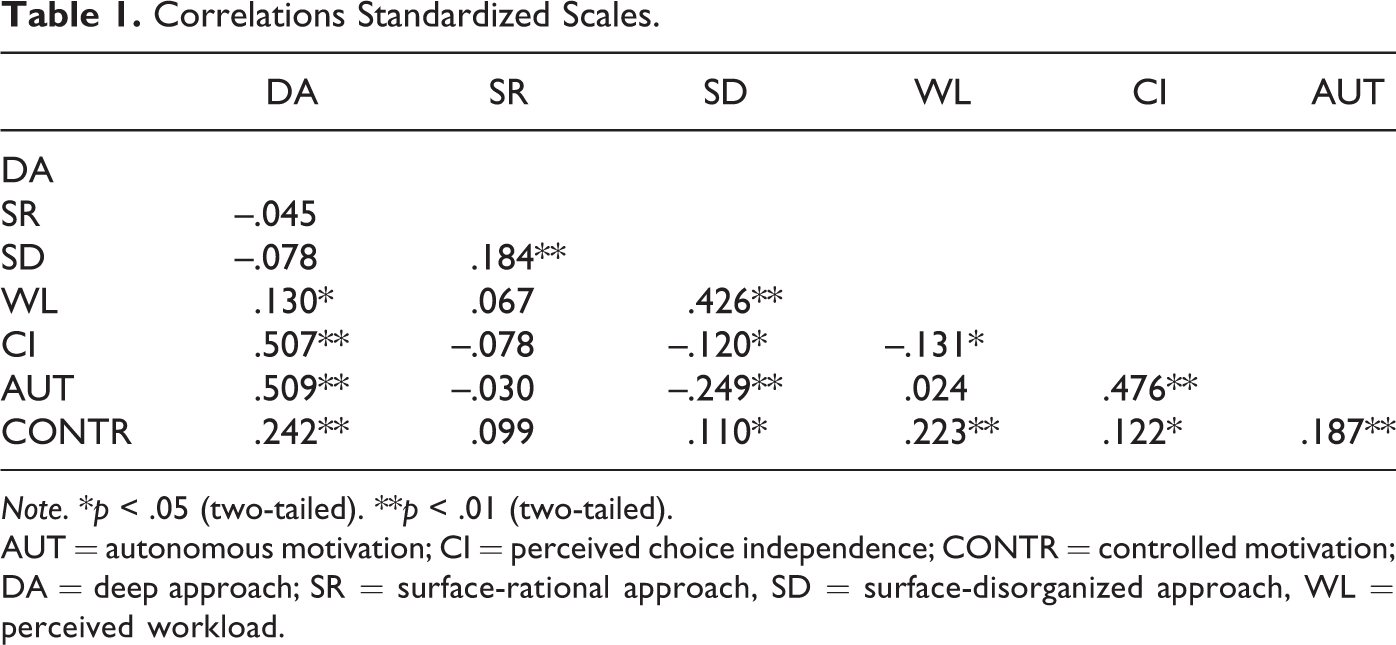
Note. *p < .05 (two-tailed). **p < .01 (two-tailed).
AUT = autonomous motivation; CI = perceived choice independence; CONTR = controlled motivation; DA = deep approach; SR = surface-rational approach, SD = surface-disorganized approach, WL = perceived workload.
Deep approach to learning
Results of the correlational analyses show that a deep approach correlates significantly positive with perceived choice independence and autonomous motivation. Unexpectedly, a deep approach to learning also correlates positively with perceived workload and controlled motivation but these correlations are less strong. Next, a multiple hierarchical regression analysis was performed to predict “a deep approach to learning.” Each step added a significant amount of variance (Table 2). The resulting model contained all entered predictors. In total, the model explained 42.8% of the variance. Especially autonomous motivation and choice independence were good positive predictors. Workload and controlled motivation showed a less strong but significant positive contribution in the prediction of a deep approach to learning of employees. The interaction between workload and choice independence was a significant negative predictor for a deep approach. Post hoc tests of simple slopes revealed that the slope of both lines is different from zero. These analyses were conducted at different levels of the moderator workload: 1 SD below the mean (t = 8.33, p < .001) and 1 SD above the mean (t = 4.60, p < .001). As shown in Figure 1, both higher choice independence and higher workload are associated with a greater reliance on a deep approach to learning; however, the relation between choice independence and a deep approach to learning is especially strong when workload is low.
Hierarchical Regression Predicting Deep Approach.

Note. *p < .05. **p < .01. ***p < .001.
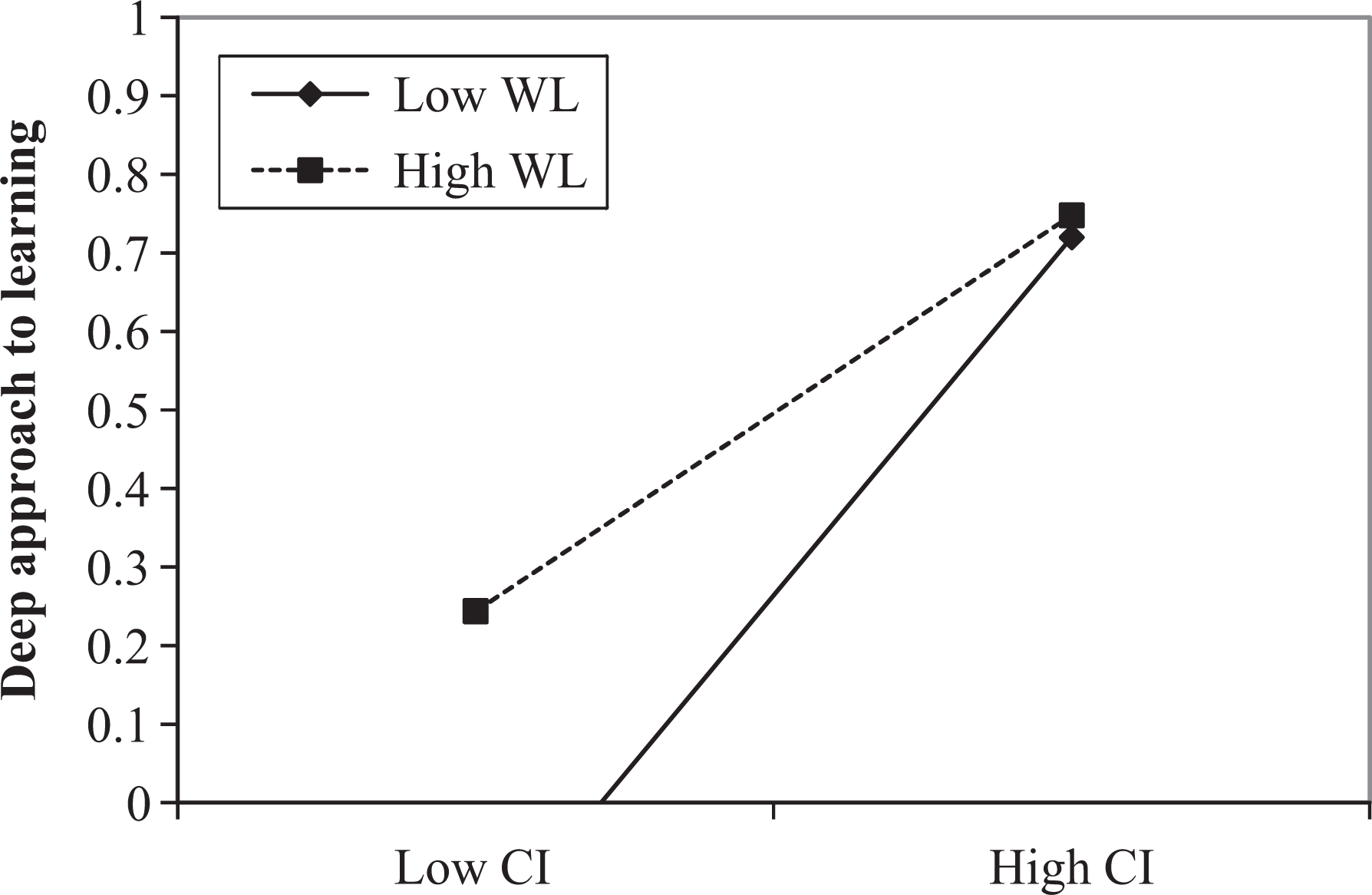
Interaction effect workload and choice independence on deep approach to learning.
Surface-disorganized approach
The surface-disorganized approach to learning correlates positively with perceived workload and controlled motivation, on one hand. On the other hand, it shows a negative correlation with perceived choice independence and autonomous motivation. The hierarchical regression analyses predicting the surface-disorganized approach, included three steps that accounted for a significant increase in variance (Table 3). The first step including the control variables accounted for less than 3% of the variance. Adding workload and autonomous motivation to the model lead to a significant increase in explained variance. In a third step, controlled motivation and choice independence were added. Despite of the significant increase in variance, neither workload nor choice independence was significant. Level of education did become a significant negative predictor in this step. Adding the interaction effect in Step 4 did not lead to an increase in variance.
Hierarchical Regression Predicting Both Surface Approaches.
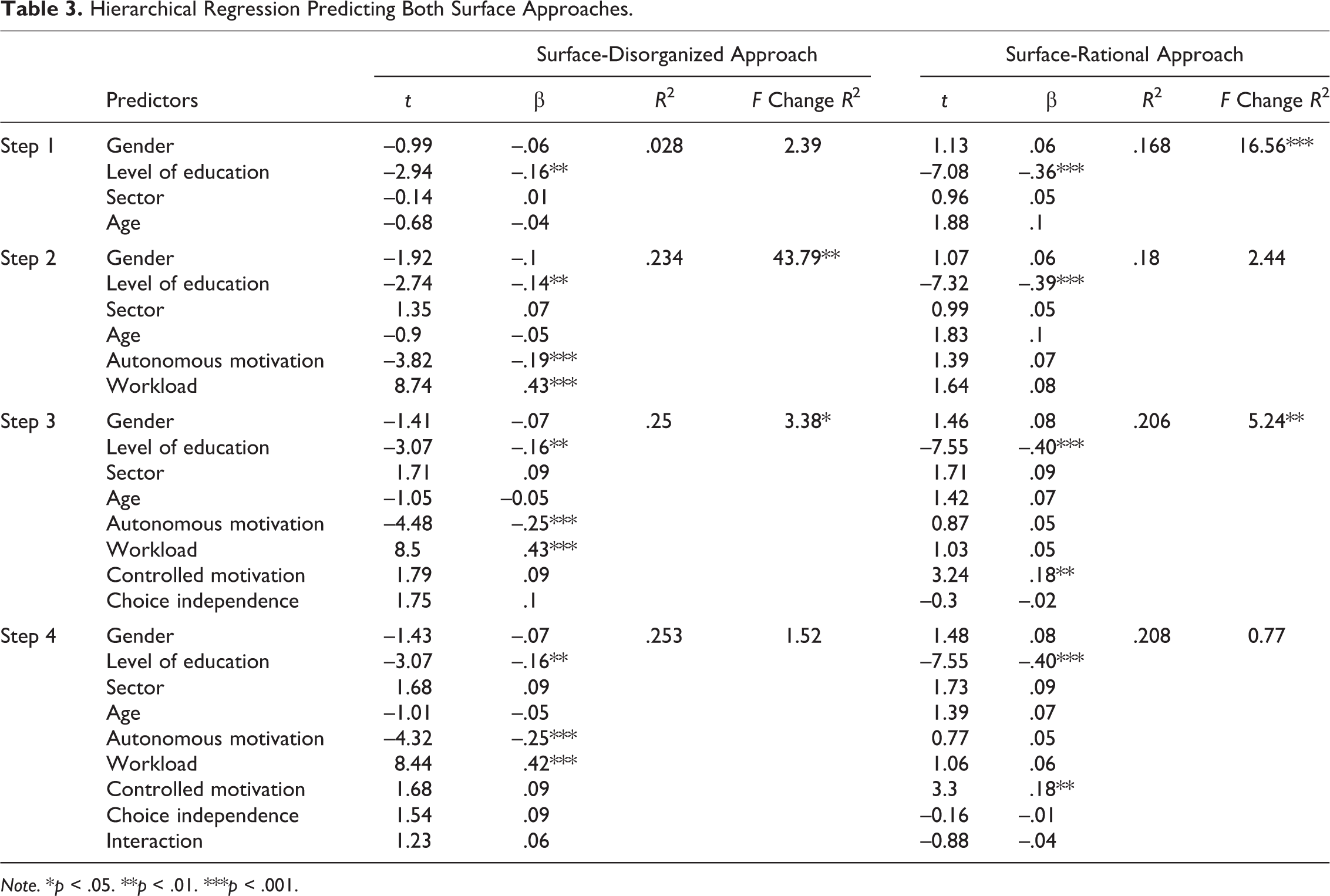
Note. *p < .05. **p < .01. ***p < .001.
Surface-rational approach
No significant correlations were found for the surface-rational approach. The steps entered in the hierarchical regression analysis predicting a surface-rational approach were the same as the analysis predicting a surface-disorganized approach. In the first step, the control variables explained only 1.7% of the variance. Step 2 including controlled motivation and workload did not result into a significant increase in variance. During Step 3, controlled motivation and choice independence were added, resulting into a small but significant change in R 2. Controlled motivation was a significant positive predictor of a surface-rational approach while level of education was a significant negative predictor. Step 4, including the interaction did not yield a significant increase in explained variance.
Discussion
This study investigated the role of organizational factors and personal factors on employees’ learning approaches. In line with prior research, autonomous motivation related positively to a deep approach to learning (Delva et al., 2004; Kirby et al., 2003; McManus et al., 2004). This means that exerting one’s job from a sense of volition facilitates the adoption of a deep learning approach. Moreover, this variable appeared to have a high predictive value concerning a deep learning approach, in comparison with controlled motivation.
A remarkable finding of this research is the positive relationship of controlled work motivation with deep learning approaches. Consequently, it seems that not only autonomous work motivation but also controlled motivation can have a positive relationship with learning approaches. SDT, on the contrary, argues that controlled motivation can have an undermining effect, leading to lower quality outcomes (Deci, 1971). But these findings seem to suggest that autonomous and controlled work motivation are additive, an assumption made in Vroom’s expectation-valence theory (1964) and Porter and Lawer’s motivation model (1968). However, autonomous motivation still has a more prominent positive contribution compared to controlled motivation. The results of this study should rather be placed in the perspective of Vansteenkiste, Lens, and Deci (2006), who showed that extrinsic motivation does not necessarily undermines intrinsic motivation, but can enhance it.
When predicting a deep approach to learning, a significant interaction effect of workload and choice independence was found. This significant interaction effect means that the effect of workload differs depending on the level of choice independence. The deep approach to learning is the highest when both workload and choice independence are high. As choice independence decreases, so does a deep approach to learning, particularly when workload is low. Thus, a deep approach to learning is predicted to be lowest when both choice independence and workload are low. This finding is in line with Karasek’s (1979) Job Demands Control model. This model states that the demands of the job can induce learning in employees because they experience a need for different, more effective work methods and strategies. However, the results on the relationship between workload and a surface-disorganized approach indicate some caution when it comes to interpreting the relationship with workload. As expected, the perception of workload has a substantial positive relationship with a surface-disorganized learning approach, which is associated with a feeling of being overwhelmed, dissatisfaction, and a sense of incompetence in executing work tasks (Kirby et al., 2003). This result is in line with the research on students’ approaches to learning that found that high and inappropriate perceived workload is related to the adoption of surface-learning approaches (Baeten et al., 2010). These combined results indicated that maintaining a balance between enough and not too much workload is important for the learning of employees; workload can be positive (i.e., relationship with a deep approach) but also detrimental when its overwhelming (i.e., relationship with a surface-disorganized approach).
Besides looking at work motivation as a personal factor, the relationships between other employee characteristics and learning approaches were considered. Concerning gender, results showed that men made significantly more use of a deep learning approach compared with women. A possible explanation could be that more men than women exert high-level or knowledge intensive jobs, which demand more deep learning activities. As a result, men more often adopt a deep approach. Prior research has already found that differences in participation in formal work-related education between men and women can be explained by occupational segregation (Oosterbeek, 1996; Simpson & Stroh, 2002); meaning that some occupations are typically practiced by men or females and that those occupations also differ in terms of training participation. Future research might investigate whether this can also explain differences in approaches to learning between men and women. Concerning level of education several differences were found. Employees who obtained a master’s degree scored significantly higher on the deep approach scale compared to employees who obtained a secondary degree or a professional bachelor’s degree. The nature of work exerted by employees could explain this result. In particular, it can be suggested that employees with a higher educational level execute jobs that demand more deep learning activities, whereas employees with a lower educational level might not need deep learning processes in their job and therefore adopt a deep approach less often. In addition, it is probable that employees with a higher initial level of education have had more experience with adopting a deep approach to learning during their studies in comparison with lower educated employees. Age as well as seniority was positively associated with a surface-rational approach. This means that the older employees are, or the more seniority they have, the more they will use a surface-rational learning approach. This finding is inconsistent with the positive relationship between age and a deep learning approach mainly found in educational research (Baeten et al., 2010) and the finding of Delva et al. (2004) that employees scored higher on a deep approach with increasing age. In addition, it needs to be mentioned that because age and seniority are strongly associated, it is unclear which of the two forms the basis for the association with a surface-rational approach.
Regarding the surface-rational approach, it was found that controlled motivation as a positive predictor. The more employees exert their job out of external reasons the more they will apply a surface-rational approach. However, it can be noticed that this variable was only able to explain a limited amount of variance. The need remains to explore other possibly stronger predictor for this approach to learning (Bernsen et al., 2009). Considering the fact that a surface-rational approach entails a detailed step-by-step approach to solving problems, it might be plausible that certain personality traits of individuals relate to a surface-rational approach. More specifically, we would expect that the personality trait conscientiousness and neuroticism would relate positively to a surface-rational approach; conscientiousness because of the association with accurate, and detailed work and neuroticism because of a possible preference for a methodical step-by-step approach that offers a certainty and predictability of the outcome (e.g., Swanberg & Martinsen, 2010; Zhang, 2003).
Limitations
A first limitation is that data for this study were gathered on a voluntary basis. Consequently, one should be cautious with the generalization of results because the sample may not fully represent the labor force. On average, the participants were higher educated than the average in the entire labor force (Steunpunt WSE, 2009). A second limitation concerns the cross-sectional nature of this research. Cross-sectional research is widely viewed as prone to common method variance bias and incapable of making causal inferences (Rindfleish, Malter, Ganesan, & Moorman, 2008). It would be interesting for future research to examine the study sample at different moments in time, which would reduce the common method variance bias and allow causal inferences. Finally, these data did not allow a multilevel approach of the analyses. But we would encourage future research to collect sufficient data within each organization and from a sufficient number of organizations so that differences between organizations and the organizational predictors of these differences can be considered.
Implications for Research and Practice
As mentioned above, it would be interesting for future research to investigate the role of occupational segregation in explaining the differences between men and women on one hand, and employees with different levels of initial education, on the other. Another suggestion for future learning comes from the perspective of individual differences. Differences between individuals might explain why workload, for example, has a positive and negative effect on how employees learn when looking at the entire group. Future research can investigate whether different employee profiles can be identified in terms of efficiency, support, and resources, and whether these different profiles differ in the way that their learning is affected by workload and other contextual factors. A final suggestion, pertains to importance of the organizational learning climate for employees’ participation in learning (Armstrong-Stassen & Schlosser, 2008), it would be interesting if future research investigated if a relationship between the organizational learning climate and how employees learn exists.
The results of this study also allow us to formulate some recommendations for career counselors focusing on personal career development. It shows that both the personal motivation for exerting a job and elements in the working environment contribute to the quality of learning of an employee. First, results showed the importance of motivation. Career counselors should discuss this motivation or the reasons for people to choose a certain profession; with the (future) employee, and point out that it is important to choose a profession out of interest and a sense of personal fulfillment. This will not only benefit the employees’ learning but also affect the way employees will experience their workload. Besides the main focus of this study, results also showed that controlled motivation correlated positively with the perception of workload, meaning that higher feeling of working out of obligation or a sense of guilt are associated with higher perceptions of workload. Second, the degree of perceived workload and choice independence also play an important role. Career counselors can advice employers and employees to maintain a balance between the amount of work and the amount of choices that have to be made.
Footnotes
Declaration of Conflicting Interests
The author(s) declared no potential conflicts of interest with respect to the research, authorship, and/or publication of this article.
Funding
The author(s) received no financial support for the research, authorship, and/or publication of this article.