




Abstract
This study asserts a theoretical model of academic and work socialization within the family setting. The presumed associations between parents’ work valences, children’s work valences and valence perceptions, and children’s academic interest and achievement are tested. The results suggest that children’s perceptions of parents mediate the relationship between parents’ and children’s self-reported work valences and children’s work valences are, in turn, associated with academic interest and achievement. The results also demonstrate the moderating role of gender, with an indication of parental socialization to work occurring within same-sex parent–child dyads that is not reflected in cross-sex dyads. Implications and limitations of this study are discussed with a special emphasis on the relatively weak association between parents’ self-reported work valence and their children’s perception of them.
Theory and research spanning several disciplines and literatures show that children are appreciably influenced by their parents. This work was used to derive a theoretical model demonstrating how children are socialized to work within the family context and how children’s socialization to work may serve to affect their current academic lives. The model was then applied to the concept of work valence to show how parents’ work valences serve to shape their children’s work valences, which in turn are associated with indicators of academic engagement.
Children’s Socialization to School and Work in the Family Context
Children are socialized to adult roles within their families (Putney & Bengtson, 2002). Research on work and family, parental involvement and socialization, and child academic and vocational development led to the ongoing development of a socialization model that is manifested in two basic forms. The first form centers on how children are socialized to work through their parents’ work experiences and has been termed the occupational linkage hypothesis (Bryant, Zvonkovic, & Reynolds, 2006; Kohn & Schooler, 1983; Lueptow, McClendon, & McKeon, 1979; Mortimer & Kumka, 1982). The second form of the model aims to explain how children are socialized to school within the family setting (Gonida, Voulala, & Kiosseoglou, 2009; Schickedanz, 1995; Taylor, Clayton, & Rowley, 2004). The union of these two literatures suggests that children are socialized to school and work in a family context bound to work and school contexts situated within a community.
The historical perspective on children’s socialization to work was appreciably advanced by Kohn (1969) and his colleagues (Kohn & Schooler, 1983) through the occupational linkage hypothesis (Lueptow et al., 1979; Mortimer & Kumka, 1982). This model suggested that work is conceived as a socializing force in parents’ lives contributing to their understanding of how their society functions and shapes the human and social capital they use to raise their children. In broader terms, the linkage hypothesis assumes that lives in a family are linked (Elder, 1998) and structuration (society) and socialization (internalized society) interact to yield ongoing behavior, adaptation, and development in context (Moen & Orrange, 2002).
Parents who have unfavorable work experiences (e.g., perceive their work to be a barrier to their family responsibilities, have inflexible and extended work schedules, and/or have insecure jobs that demand simple and repetitive tasks) tend to have children who exhibit lower academic achievement, less prestigious career aspirations, and decreased confidence in their future (Barling & Mendelson, 1999; Cinamon, 2001; Galinsky, 1999; Menaghan & Parcel, 1995). Grade-school children’s expectations about the emotions and experiences they will have at work are correlated with the perceived favorable or unfavorable emotions and experiences their parents have at work and both affect children’s motivation to engage in their school and future work settings (Porfeli, Wang, & Hartung, 2008). The net of the linkage hypothesis and related research is that aspects of work and family either directly or indirectly enhance each member’s social-emotional and cognitive repertoire and others tax it.
Parents are believed to establish beliefs about the school setting and academic achievement through a history defined by their culture, social class, and childhood school experiences (Taylor et al., 2004). This history interacts with the school experiences parents have with and through their children. The past and the present merge to shape parents’ ongoing beliefs about school, which influence how they interact with their children concerning school matters, what they tell them, and ultimately the beliefs that children adopt toward school and their school performance (Gonida, Voulala, & Kiosseoglou, 2009). Assertions and findings like these support a trend of establishing socialization models of school achievement (Seginer, 2006; Taylor et al., 2004; Weiss et al., 2003) derived from ecological theory applied to the family setting (Bronfenbrenner, 1986; Bronfenbrenner & Crouter, 1982).
The tie between socialization to school and work can be explained by models of human and social capital (Coleman, 1987). Parents’ work (Parcel & Menaghan, 1994) and educational attainment (Schnabel, Alfeld, Eccles, Koller, & Baumert, 2002) represent forms of human capital that children draw from as they navigate their school lives and later make the transition from school to work. The mechanisms explaining how parents’ work is manifested into social capital that shapes children’s socialization experiences and how children’s socialization experiences contribute to career and academic development and achievement across the childhood and adolescent years are not well understood (Whiston & Keller, 2004).
The literatures reviewed here imply a theory of vocational and academic socialization and development that begins as early as the childhood period. Figure 1 contains a theoretical model of children’s socialization to work within the family context. The model allows for associations among most variables contained therein, but also suggests a general causal sequence with curved arrows exhibiting weaker associations than straight arrows connecting adjacent constructs. The model assumes that parents’ work experiences and beliefs are primarily made manifest and shared vicariously through socialization experiences (e.g., parent–child interactions) that serve to shape children’s beliefs. The model also assumes the presence of a bidirectional relationship between parent socialization efforts and academic and vocational development. This relationship is rooted in feedback and feedforward mechanisms suggesting that parental efforts to promote their children’s academic achievement influence and are influenced by children’s academic performance. While the emerging theory appears promising, only limited research exists supporting the link between vocational and academic progress (Blustein, Phillips, Jobin-Davis, Finkelberg, & Roarke, 1997) and no known research examines the influence of parents’ work experiences and beliefs on children’s work beliefs and their academic progress in one model.

Socialization of children to school and work in the family setting.*Note. For parsimony sake, presumed moderating relationships are not depicted. The gray boxes represent the literatures that tend to focus on the constructs and processes therein.
The Concept of Work Valence and Its Link to Children’s Academic Achievement
With the exceptions of work interests (Holland, 1997) and values (Elizur, Borg, Hunt, & Beck, 1991; Ros, Schwartz, & Surkiss, 1999; Super, 1962), the cognitive structure of work content has received little attention in the literature. Children appear to obtain and assimilate work content as it pertains to work experiences and emotions transmitted from family (Kniveton, 2004; Larson & Almeida, 1999; Otto, 2000; Perry-Jenkins, Repetti, & Crouter, 2000; Young, Paseluikho, & Valach, 1997), school (Bowers & Hatch, 2005), and media sources (King & Multon, 1996; Potts & Martinez, 1994). Progress toward integrating this work content may begin during the grade school years and extend into adolescence and adulthood (Porfeli et al., 2008).
Previous research (Porfeli, Lee, Vondracek, & Weigold, 2011) has asserted that the Expectancy-Valence theory (Vroom, 1964) may be used to model aspects of work content pertaining to affective and cognitive appraisals of work. Valences spring from anticipated outcomes and the degree to which outcomes satisfy personal interests, desires, or needs. Valences fuel behavior with positive valences promoting goal-oriented behavior toward an outcome (e.g., seeking career preparation tasks) and negative valences inhibiting such behavior (e.g., avoiding career preparation tasks). Vroom suggested that sufficiently complex outcomes (e.g., entering the world of work or succeeding at work) may promote the development of positive and negative valences with both acting together to yield a net gain or loss in the motivational force prompting behavior toward an outcome. Choosing, preparing, securing, and engaging in work are presumed to be complex outcomes that promote the concurrent establishment and maintenance of positive and negative work valences (Porfeli et al., 2011).
School is a significant context for vocational development (Blustein et al., 1997). This point of view was argued by Erikson (1959, 1964) who asserted that the essential life task of establishing an industrious orientation toward work occurred within the school context during the grade school years. To the extent that children perceive their academic lives as a prelude to and as a means of preparing for work, an emerging work valence may serve to promote or inhibit academic engagement. This argument was tested previously (Porfeli et al., 2008) and the results indicated that work valence content (i.e., anticipated work experiences and emotions) was associated with the motivation to work in the future, which in turn was associated with the motivation to engage in current school work. Such a pattern of associations suggested that work valence may also be associated with academic achievement, but this was not tested previously.
A Path Model of Children’s Work Valence as a Product of Parental Socialization
In the present study, we examine the associations between (a) parents’ self-reported work valence (i.e., parents’ beliefs), (b) self-reported, (c) children's perception of their parents' work valence (i.e., children's beliefs about parents), and (d) children's self-reported work valence (i.e., children's beliefs about the self-in-work), and (e) children's academic interest and achievement. Consistent with Figure 1, we predict that children’s beliefs about their parents will mediate the relationship between parents’ work valence and children’s work valence. We also predict children’s work valence will mediate the relationship between children’s perceptions of their parents’ valence and children’s academic interest and achievement.
The Potential Moderating Role of Gender in the Proposed Path Model
Research suggests that a child’s gender appears to be a moderator of the parental socialization process. Mothers seemingly have a greater influence on daughters and fathers on sons as compared to the cross-gender relationships (Domene, Arim, & Young, 2007). Crespi’s (2003) review of the literature reinforces this pattern by findings that adolescent girls tend to have more problematic relationships with fathers (e.g., incomprehension) and more favorable relationships with mothers, while boys exhibit the reverse pattern. Females tend to report greater parental involvement in their career than do males (Trusty, 1996; Trusty, Watts, & Erdman, 1997). Other research shows that mothers tend to communicate more and use more supportive language with their children than do fathers (Leaper, Anderson, & Sanders, 1998). This is supported by data from Italy suggesting that 89% of mothers versus 56% of fathers are the primary caretakers of their children (Istituto Nazionale di Statistica, 2004). Mothers also tend to communicate more with daughters than with sons (Leaper et al., 1998). These findings suggest that models distinguishing between mother’s and father’s influence should include the child’s gender as a potential moderator. The hypothesis, applied to the present study, is that daughters’ valence perceptions will demonstrate stronger associations with mothers’ valence than with fathers’ valence and the opposite pattern is expected for sons. This research also suggests that mothers’ work valences will demonstrate stronger associations with children perceptions of their work valences and children’s self-reported work valences than will fathers’ valences.
Method
Participants
Of all the 326 families that participated in the study, 189 of them included both parents in the household and provided complete data for all the variables employed in the present study. Within this subsample, the children were typically about 11 years old (SD = 1.34), 52% female, and attending the fourth (29%), fifth (36%), sixth (22%), seventh (12%), or eighth (12%) grades. Mothers and fathers were approximately 42 (SD = 4.87) and 45 (SD = 5.43) years old, respectively. The parents’ jobs were classified into one of the three occupational categories. Those in the low-skilled category occupied jobs like laborer and low-skilled artisans, those in the medium-skilled group occupied office jobs, and those in the high-skilled group had managerial positions and other jobs necessitating a university degree. Mothers most typically held jobs that were classified as medium skilled (44%) followed by low skilled (32.5%) while fathers’ jobs were most commonly classified as low skilled (56%) and medium skilled (39.3%). Those families included and excluded in the present study were compared on all of the demographic and occupational characteristics reported above and no statistically significant differences were found. In light of the sampling frame and selection criteria, the generalizability of the results is limited to Italian families of similar demographic characteristics to include being limited to two-parent households who may be more inclined toward receiving vocational counseling services.
Procedure
Data used in the present study sources from a vocational guidance project that involved two pairs of elementary and middle schools located in northern and central regions of Italy. The project was first presented to the school (principal and teachers) and then to the parents and children attending the classes involved. Participation was on a voluntary basis. After informed consent was obtained from the children’s parents and assent from the children, both groups were asked to complete questionnaires to include the measures employed in the current study. Data obtained from these questionnaires were used in this study. After the surveys were completed, parents and children were offered an individual counseling session focusing on vocational issues as compensation for their participation.
Measures
Work Valence Scale (WVS)
The WVS contains four subscales, with 7 items each, assessing favorable and unfavorable work experiences and emotions. Each item included a 5-point scale, where 1 indicated never and 5 always and scale anchors for values in between. Favorable work experience items included, “be treated fairly by your boss” and “get really interested in your work” and unfavorable item included, “get really tired at work” and “get treated badly at work.” Favorable work emotions items included “happy” and “proud” and examples of unfavorable items are “disgusted” and “defeated.” Previous research supports the factor structure and internal consistency of the WVS (Porfeli et al., 2011). The items were translated into Italian by the second author using translation and back-translation methods.
The stimulus for the items differed for parents and children. Children were asked to complete the WVS in relationship to their expected future work life and then they completed the WVS in terms of their perceptions of their parents’ work. Parents were asked to complete the WVS in relationship to their current future work life. This approach yielded three sets of WVS responses with parents reporting about their work lives and children reporting about themselves and their perceptions of their parents.
WVS scores were computed by averaging the positive items, averaging the negative items, and then computing the difference of the two averages. This yielded a scale score that could range from −4 to +4 with negative values reflecting a general unfavorable work valence and positive values suggesting a general favorable work valence. Parent valence was computed as an average of mothers’ and fathers’ valence estimates. The skewness and kurtosis values for all variables across all participant groups were within an acceptable range (e.g., ±1) with the exception of academic achievement. In the latter case, the skewness ranged from .89 to 1.11 and .87 to 1.39 for the boys and girls, with all items conforming or almost conforming to established standards (e.g., in the range of ±1). The reliability estimates (see diagonals of Table 1) computed for all participants and then separately for boys and girls support the use of the WVS with parents and their children across both genders.
Construct Means, Standard Deviations, and Correlations.
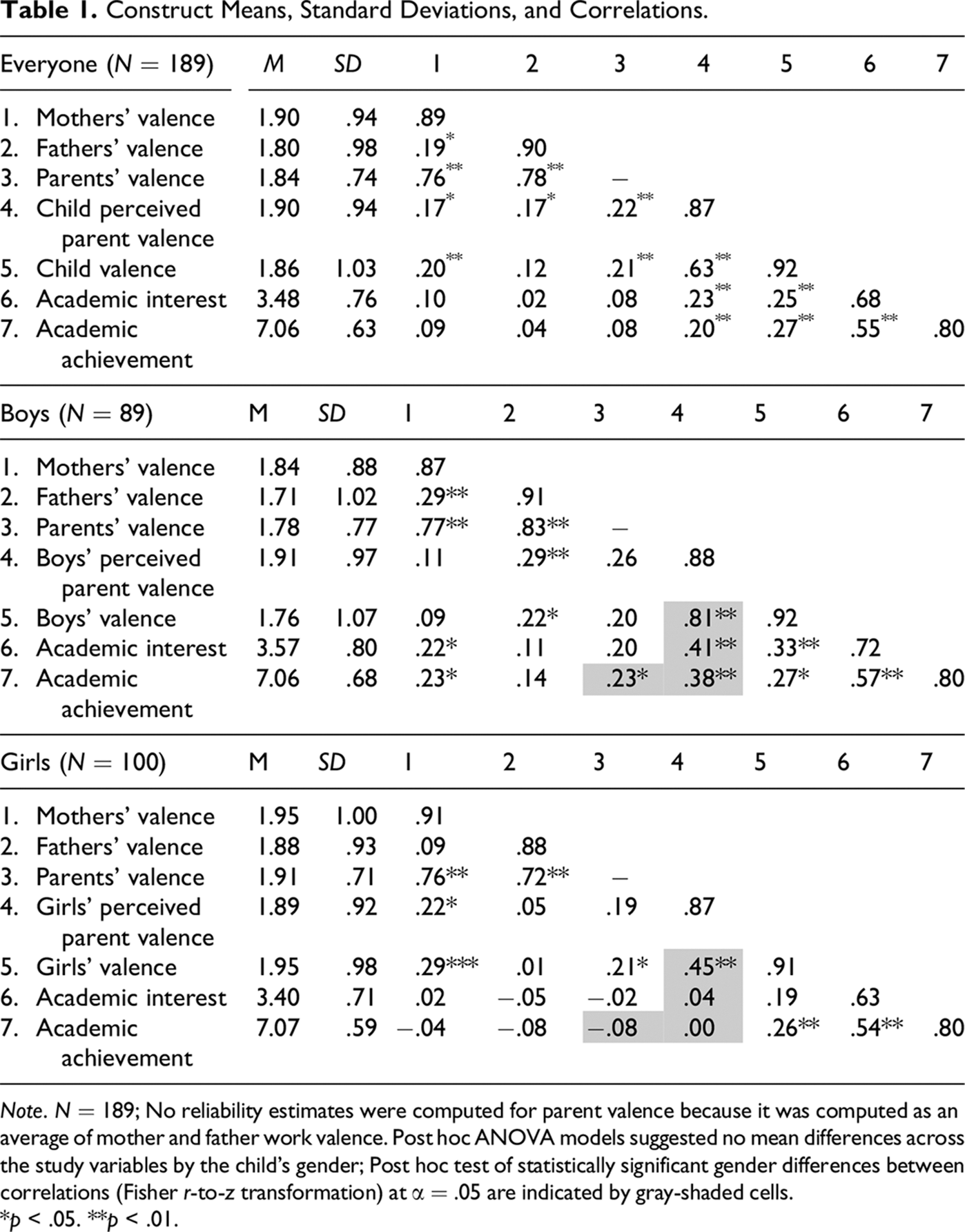
Note. N = 189; No reliability estimates were computed for parent valence because it was computed as an average of mother and father work valence. Post hoc ANOVA models suggested no mean differences across the study variables by the child’s gender; Post hoc test of statistically significant gender differences between correlations (Fisher r-to-z transformation) at α = .05 are indicated by gray-shaded cells.
*p < .05. **p < .01.
Academic Interest and Achievement
Children indicated their interest in language, math, and other academic topics employing a 5-point Likert-type scale from 1 = not interested at all to 5 = really interested. The internal consistency for this 3-item measure of interest was deemed to be acceptable (α = .68) given the limited number of items. Academic interest was computed as the average of these 3 items. Academic achievement was estimated on the basis of students’ grades. Grades range incrementally from a low of 4 to a high of 8 with higher scores reflecting better grades. Grades were recorded for language, math, and other school topics. Academic achievement was computed as an average of the three grades. This 3-item scale exhibited acceptable to excellent internal consistency (α = .80) in light of the very limited number of indicators.
Results
Univariate statistics and correlations (see Table 1) were computed to test for assumptions of path modeling and the results suggested that the variables conformed to the assumptions. The base model is depicted in Figure 2 and includes all children. Standardized βs are reported for all pathways. Aside from βs designated with “NS” (nonsignificant), all pathways were statistically significant at α = .05. Contrary to predictions, this path model demonstrates that parents’ self-reported valence is not associated with children perceptions of their parents’ valence. Consistent with predictions, children’s perceptions of parents’ work valence is strongly associated with children’s self-reported work valence. Children’s self-reported work valence is, in turn, weakly associated with their academic achievement but not their academic interest.
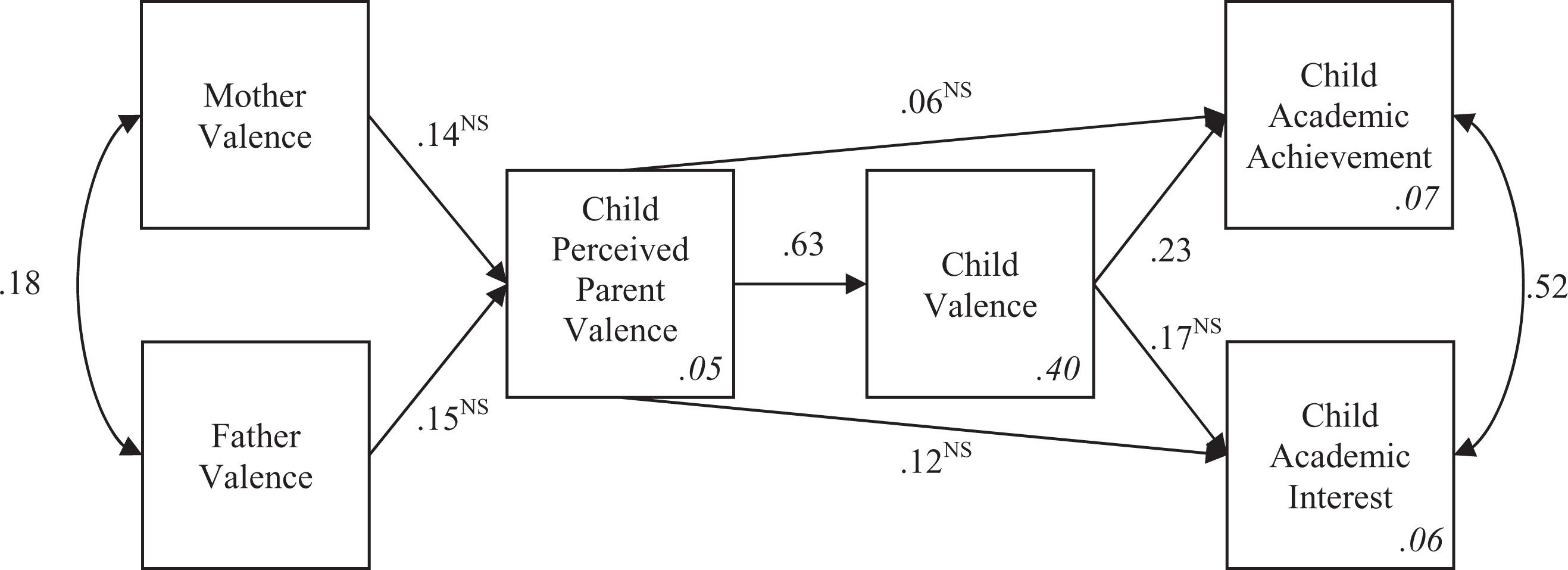
Path model of the intergenerational transmission of work valence for all children.
The results for the gender-combined path model suggest excellent model fit (Cheung & Rensvold, 2002; Hu & Bentler, 1999), but several path coefficients were statistically different when the model was tested separately across gender as indicated by “†” in Table 2. These differences were confirmed in the bivariate correlations using the Fisher r-to-z transformation at α = .05 (gray boxes in Table 1). Path model equivalence across gender was tested by fixing path models to be equal across gender and the results suggested gender differences in the fit of the path models (Δχ2 = 32.4; Δdf = 6; p ≥ .05). These results suggested that the models should be estimated separately for boys and girls. The fit statistics for the gender-specific models also suggested acceptable to excellent fit (All children: χ2 = 3.83, p = .70, Comparative Fit Index [CFI] = 1.00, root mean square error of approximation [RMSEA] = .00; Boys: χ2 = 5.51, p = .48, CFI = 1.00, RMSEA = .00; Girls: χ2 = 6.82, p = .34, CFI = .99, RMSEA = .037). Fathers’ and mothers’ work valences were uncorrelated with their children’s perceptions of parents’ work valence, but same-sex associations existed when the model was computed for boys and girls separately. Children’s perception of their parents’ work valence exhibited a moderate-to-strong correlation with children’s work valence, with boys exhibiting a statistically stronger association than girls. Girls’ work valence was weakly related to their academic achievement but unassociated with their academic interest. Neither academic variable was associated with boys’ work valence. Conversely, children’s perceptions of their parents’ work valence was moderately associated with boys’ academic interest and achievement, but was uncorrelated for girls.
Standardized Estimates of the Path Model and the Trimmed Pat Model of the Intergenerational Transmission of Work Valence.

Note. Unless noted, all βs are statistically significant at α = .05. NS= not statistically significant; †Betas are statistically different between boys and girls.
The path models depicted in Figure 2 were reestimated with nonsignificant pathways removed. For all children, perceptions of parents’ valence were related to child’s valence, which was related to their academic achievement. For boys, father’s valence was related to child’s perceived parent valence, which was related to child’s valence, academic achievement, and academic interest. For girls, mother’s valence was related to child’s perceptions of parent’s valence, which was related to child’s valence. Child’s valence was related to child’s academic achievement. Fit indexes for the trimmed model were acceptable for all children, χ2 = .38, p = .54, CFI = 1.00, RMSEA = .00 and boys, χ2 = .97, p = .97, CFI = 1.00, RMSEA = .00, but not for girls, χ2 = 6.82, p = .34, CFI = .99, RMSEA = .037. As a consequence, this model was reestimated on the basis of modification indices suggesting the inclusion of a pathway from mother’s work valence to children’s work valence (β = .20). This additional pathway resulted in a meaningful improvement in the fit statistics, χ2 = 3.01, p = .22, CFI = .97, RMSEA = .07.
While these models largely affirm the previous results, they also demonstrate gender differences in the model. They specifically reveal possible gender differences in how parents’ work lives are associated with children’s work valence and their academic engagement.
Discussion
The results of the present study provide some affirmation of previous research (Porfeli et al., 2008) and models of socialization suggesting how parents’ work is associated with children’s current academic interest and performance. These results extend and refine the nature of the general association linking parents’ lived experience at work and children’s expectations for the future through its inclusion of parents’ self-reported work valences. Children’s perceptions of their parents’ work valence appear to be a mediator linking parents’ work valences and children’s work valences. As expected, the influence of this mediator seems to hinge on the gender of the parent and child, with children’s perceptions of their parents being weakly aligned with their same-sex parent and not aligned with their opposite-sex parent. The strength of the relationship between children’s perceptions of their parents and children’s personal work valences affirms that parents serve as powerful role models for their children as their children establish conceptions of the working world (Gibson, 2004). The relative weakness of the relationship between parents’ self-reported work lives and children’s perceptions of them is perhaps one of the most intriguing and unexpected results of the present study. This result suggests that children’s perceptions are almost completely unrelated to parents’ reports of their work and, therefore, deserves further consideration and discussion.
This unexpected finding may be due to a limitation of the present study. The present study omitted a key construct proposed within Figure 1, namely socialization. In the present study, socialization is depicted as the arrow connecting parents’ work valences to children's perceptions of parents’ valences. The linkage hypothesis was advanced by the recognition that ties between work and family are complex (Bryant et al., 2006; Crouter & Helms-Erikson, 1997; Rosenzweig, 2001; Taylor et al., 2004; Whiston & Keller, 2004). Recent reviews suggest that children tend to exhibit more favorable development in school and work domains when their parents (a) hold high aspirations and expectations, (b) are engaged with their children, (c) act as gatekeepers to extracurricular activities, (d) employ an authoritative parenting style (Park & Bauer, 2002), (e) encourage their children to be autonomous, (f) offer emotional support in times of need, (g) foster an academically enriching family setting that fosters a link between life and learning, (h) are engaged in school activities, and (i) demonstrate a motivation to succeed at work (Bryant et al., 2006; Crosnoe, 2004; Rosenzweig, 2001; Taylor et al., 2004; Watson & McMahon, 2005). The union of this research suggests that socialization efforts serve as the linkage between parents’ and children’s experiences and beliefs pertaining to school and work. The differences in the path model across gender suggest the possibility of differences in socialization (e.g., communion and communication) within same-sex parent–child dyads relative to opposite-sex dyads as it pertains to work has received mixed support (Roest, Dubas, & Gerris, 2010). These differences may be influencing the fidelity of children’s perceptions of their parents’ work experiences. Future research could employ the nature of the parent–child relationship as a moderator of the fidelity of children’s perceptions of parent’s work. Presumably, children demonstrating close relationships with their parents may demonstrate greater fidelity in work perceptions than those who exhibit more distant relationships and poorer communication.
The weak relationship between parents’ self-reported work lives and children’s perceptions of them may also be moderated by the extent to which parents actively attempt to color their work experience in the family context. Parents may depict a rosy work life in an effort to engender their children with a more favorable work valence than parents actually hold. Conversely, parents with highly favorable work valences may temper those experiences in the fear that their children may feel that work is more important or meaningful than them (Galinsky, 1999). Future research could draw the concepts of surface and deep acting from the emotional labor literature and employ them as potential moderators in the context of this proposed work valence socialization model. The presumption here is that decreases in both, and particularly deep acting, will increase the association between parents’ self-report and children’s perceptions. Research could also survey spouses about their perceptions of their partner’s work valence along with children’s perceptions of each to determine the degree of associations among all members. Coupling this with indicators of emotional labor and possibly the amount of communication centering on work in the family context could further clarify the nature of the relative disconnect between family perceptions and the lived experiences of those who work.
Finally, the weak relationship may also be partly due to children coloring their perceptions of their parents’ work valences to support and protect a more favorable outlook for children. Research from cognitive psychology suggests that children’s expectations for the future shape their recall of previous events associated with expectations (Greenhoot, Tsethlikai, & Wagoner, 2006). Children tend to recall more from the past when the content is more consistent with their expectations. In other words, ideas about the future may shape recollections of the past. Should children be biased to maintain a more favorable orientation toward work, then their perceptions of parents’ work may be shaped by this bias, particularly when parents’ valences are increasingly unfavorable. Such a bias could reduce the linear relationship between parents’ self-reported valences and children’s perceptions of parents as children increasingly color their unfavorable perceptions. Such a pattern could even lead to a curvilinear relationship with an increasingly negative association as parents’ valences become more unfavorable and an increasingly positive association as parents’ valences become more favorable. Testing these potentially complex curvilinear relationships could be the subject of future research.
Continued elaboration of research testing linkages between vocational and academic development could aid in reinvigorating the field of vocational psychology (Blustein et al., 1997). This study aligns with this agenda by testing the gender-varying nature of the relationships leading from parents’ work valences to children’s academic variables. The stronger associations between work valence (both self and parent perceptions) and the academic indicators for boys suggests that Italian boys may see a clearer link between school and work within the Italian context that partly sources from perceptions of their parents’ work lives. On a more general level, the pattern of associations suggests that Italian parents and children may tend to exhibit a traditional gendered view of school and work. Previous research finds that Italian males tend to view school success as a means of securing economic advantages and females tend to view it as a means of obtaining psychological advantages like personal satisfaction (Ferrari, Nota, & Soresi, 2008; Ferrari et al., 2009). While historical and cultural changes trend toward work and family roles becoming more gender neutral in western cultures (Gerson, 2009, 2010), the results here suggest that gender differences in children’s socialization to school and work remain active within the Italian context.
The present study suggests that parents serve as role models in the construction of their children’s conceptions of working/work. Parent training interventions could be enhanced if they help parents to consider how their work lives and their depictions of work shape children’s conceptions of work and their school performance. Encouraging parents to express hope, optimism, and time perspective during times of deep economic crisis may yield a climate for their children to develop of a favorable work valence. Of course, the downside risk may be that children establish a Pollyanna conception of work. Programs should, therefore, also encourage a realistic conception of work as containing both positive and negative aspects so as to prepare children for the reality and the needs of today’s work context. In fact, promoting an articulate concept of work in one’s children seems to be especially significant to the extent that it has been shown to foster higher investment in training in Italian adolescents (Ferrari et al., 2009).
Limitations
This study must be considered in light of several limitations. First, this study employed data from dual-parent households in the northern and central regions of Italy. Italy may have cultural uniqueness as it pertains to the socialization of children to school work. Moreover, the socialization of children may differ across dual and single-parent household. The sampling frame, therefore, limits the generalizability of the findings to other populations outside of these regions in Italy and to other family structures.
Second, the measurement characteristics reported elsewhere (Porfeli et al., 2011) and in this study suggest that the WVS is appropriate for Italian parents and children, but more research is needed to confirm the appropriateness of this measure. Unfortunately, the sample size needed to conduct confirmatory factor analysis and to test measurement invariance across parents and children or across boys and girls is likely insufficient in this study. Conventional guidelines suggest that 5–20 participants are needed for each estimate in a confirmatory factor model and other research finds that measurement model quality and solution propriety must be considered as well (Gagne & Hancock, 2006). The WVS confirmatory model would have 60 estimates. This suggests that a minimum sample size of 300 would be needed to test a confirmatory factor model of the WVS and multiples of this number for tests of measurement invariance across groups (e.g., a comparison of boys and girls would need a minimum of 600). Future research, employing much larger samples, is needed to test this important issue.
Second, the socialization model proposed in this study inferred a causal sequence that was tested with cross-sectional data. Hume (1888) asserted that tests of causality must include a temporal sequence with the cause occurring before the outcome. The temporal nature of cause and effect was not incorporated into the present study; therefore, cause and effect cannot be inferred within the present study. The interpretation of the findings should be limited to the language of associations. The associations found in the present study can be used to support the pursuit of research employing longitudinal data.
Third and discussed at length above, the nature of the parent–child relationship was not included in the model tested in the present study. In light of the weak relationship between children’s perceptions of their parents work and parents self-reports even within same-sex dyads, future research should include core relationship qualities like communication about work in the family setting and the degree of intimacy between parents and children as potential moderators.
Footnotes
Declaration of Conflicting Interests
The author(s) declared no potential conflicts of interest with respect to the research, authorship, and/or publication of this article.
Funding
The author(s) received no financial support for the research, authorship, and/or publication of this article.