



Abstract
According to Kram’s mentor role theory, satisfaction with mentoring and mentorship quality are key indicators of effective and successful mentoring. We contribute to mentoring research by demonstrating the relative importance of mentorship quantity, mentorship quality, and satisfaction with mentoring to the prediction of job satisfaction, affective commitment, and turnover intentions. Survey data from 472 faculty members revealed the importance of that satisfaction with mentoring in that it mediated the effect of mentorship quality on job satisfaction and turnover intentions, and it explained variance in three job attitudes above and beyond mentorship quantity and quality. Implications for organizational mentoring are discussed.
Keywords
Research on workplace mentoring has established that mentoring results in multiple benefits for both the protégé (Eby et al., 2013) and the mentor (e.g., Allen, Poteet, & Burroughs, 1997). As indicated in Eby et al.’s process-oriented model of mentoring, outputs include job performance, motivation, as well as numerous attitudinal, behavioral, career-related, and health-related outcomes. In addition to these distal criteria, there are a number of mentorship-specific outcomes that could be assessed including the quality of the mentoring (Allen & Eby, 2003) and satisfaction with the mentoring (Ragins, Cotton, & Miller, 2000). These more proximal criteria may be important explanatory mechanisms for why mentoring leads to so many important work-related outcomes. In this study, we begin to examine the relationships between proximal and distal mentoring outcomes testing both direct and indirect relationships. We also determine the relative importance of and possibly interactive effects of quantity and quality of mentoring on mentoring-specific outcomes as well as three job attitudes (job satisfaction, affective commitment, and turnover intentions).
Quantity of Mentors
Traditional or hierarchical mentoring is a one-on-one relationship between a younger, more junior person and an older, more senior person for the purpose of helping and developing the protégé’s career (Kram, 1985). However, the concept of mentoring has been broadened; mentoring is not limited to one dyadic relationship. For instance, Kram (1985) advocated for protégés having “constellations” of developmental relationships. Likewise, Higgins and Kram (2001) introduced the term “developmental network” or a set of mentors a protégé names as taking an active interest in and action to advance the protégé’s career by providing developmental assistance. They argue that diverse developmental networks are important, because these networks reduce the amount of redundant information that a protégé receives and facilitate the protégés’ career development. In a competitive workplace, a protégé may need more than one mentor to meet his or her diverse and changing needs (de Janasz, Sullivan, & Whiting, 2003; Kram, 1985; Mezias & Scandura, 2005). By having more than one mentor, protégés are exposed to different perspectives and expertise. This broadens the knowledge and skills they have the opportunity to acquire, enhancing what they stand to gain (Baugh & Scandura, 1999; Higgins, 2000; Kram & Isabella, 1985). Corresponding to this newer conceptualization of mentoring, mentoring scholars have called for more research on the effect of multiple mentors on mentoring outcomes (de Janasz & Sullivan, 2004) and our study responds to this call.
Historically, mentoring is most frequently operationalized as a dichotomous variable such that employees either have/had a mentor or not (e.g., Lankau & Scandura, 2002; Wallace, 2001). To date, research has demonstrated that having a mentor is better than not having a mentor. For instance, protégés tend to have higher levels of job satisfaction, affective commitment, and lower turnover intentions than nonmentored individuals (Baugh & Scandura, 1999; Lankau & Scandura, 2002; Payne & Huffman, 2005; Ragins et al., 2000). However, only assessing the presence of a mentor is a short-sighted view of mentoring that ignores the fact that some protégés have more than one mentor. As the number of mentors increases, the influence of mentoring may have incremental gains, asymptote, or divert from a positive trajectory. Correspondingly, mentoring should be operationalized as a continuous variable, as this is a richer and more valid quantification of the amount of mentoring protégés have received. In the present study, we assessed mentorship quantity using a continuous variable (i.e., number of mentors one has had since he or she joined the organization) rather than a dichotomous variable.
The mentoring literature indicates that individuals tend to develop more than one mentorship over the course of their career (Kram, 1983; Ornstein & Isabella, 1993). For example, Henderson’s (1985) public service manager sample reported an average of more than two mentors and 18% of Egan’s (1996) sample of broadcasting personnel had three or more mentors. A handful of studies have examined the effect of having multiple mentors on protégés’ career outcomes and some of this research has demonstrated that having more than one mentor is better than one mentor. For example, as the number of mentors increases, protégés report higher job satisfaction, weaker turnover intentions (Baugh & Scandura, 1999; Higgins & Kram, 2001; Wasserstein, Quistberg, & Shea, 2007), and more objective and subjective career success (Peluchette & Jeanquart, 2000).
On the other hand, there may be some disadvantages to having more than one mentor. Having multiple mentorships requires time and emotional energy to initiate and maintain these relationships. Further, each mentor may have a different work style and personality that the protégé needs to consider when interacting with that mentor (de Janasz & Sullivan, 2004). Some research has revealed that as the number of mentors increases, role conflict (Baugh & Scandura, 1999) and job burnout (Fagan & Walter, 1982) increase, and general satisfaction decreases (Riley & Wrench, 1985). Thus, one purpose of the present study is to test the relationship between quantity of mentors, measured as a continuous rather than dichotomous variable, and job attitudes, in order to determine whether having multiple mentors contributes incrementally beyond the benefits provided by a single mentor. Given the mixed empirical findings concerning multiple mentors, we do not offer a directional hypothesis:
Mentorship Quality
Although assessing the number of mentors a protégé has is better than assessing mentoring as an all or none phenomenon, number of mentors only conveys quantity. It does not provide a complete picture of a protégé’s mentoring relationships (Kram, 1985; Ragins et al., 2000). Kram’s (1985) seminal work on mentoring suggests that not all mentoring relationships are constructive. Kram further proposed that mentorships vary in terms of quality which is the basis for more effective and successful mentorships. Mentorship quality has been defined as a specific form of relationship quality that captures relational processes between the mentor and protégé (Kram, 1985; Ragins, 2010). Consistent with Kram’s theory, mentoring scholars have demonstrated that mentorships can be characterized on a continuum of quality that reflects a full range of positive and negative experiences, processes, and outcomes (Eby, 2007; Fletcher & Ragins, 2007; Ragins & Kram, 2007). Consistent with the interpersonal relationship literature (Hinde, 1981), mentorship quality is a specific form of relationship quality that captures relational processes between the mentor and protégé (Kram, 1985; Ragins, 2010) and an important indicator of relationship effectiveness or success (Goldner & Mayseless, 2009; Kram, 1985). In Eby et al.’s (2013) process-oriented model of mentoring, mentoring support (both instrumental and psychosocial) is reciprocally related to relationship quality and serves as mediators between various mentoring inputs and outputs. However, this model does not directly address quantity of mentors or the possibility of more than one mentor.
Conventional wisdom says quality trumps quantity. We argue quality of mentorship captures additional important information about the relationship beyond its mere existence (quantity). Correspondingly, we expect mentorship quality is more important than quantity of mentors to protégé’s job attitudes, and mentorship quality accounts for incremental variance above and beyond quantity of mentors in these outcomes.
Perhaps the influence of mentorship quantity depends on mentorship quality. Given the variability in relationship quality conveyed in the research literature, additional mentorships may only add value to the extent that they are of high quality. Ragins, Cotton, and Miller (2000) speculated post hoc that the effect of the presence of a mentor depends on mentorship quality. That is, the positive outcomes that are associated with the presence of one or more mentors occurred primarily when the mentorship is of high quality.
Satisfaction With Mentoring
Kram (1985) observed that mentorship is an intense complex and multifaceted interpersonal relationship. Mentorship can be characterized by both positive and negative experiences over time. The varying amounts of positive and negative mentoring experiences result in varying degrees of satisfaction with mentoring. Satisfaction with mentoring is defined as the protégés’ overall evaluation of and affective reactions to the mentoring relationship (Ragins et al., 2000; Scandura & Pellegrini, 2007) and is an important indicator of mentoring success. Despite conceptual distinctions between the constructs, some mentoring scholars treat satisfaction with mentoring as a dimension of mentoring quality. In a recent interdisciplinary meta-analysis of protégé perceptions of mentoring, Eby et al. (2013) lamented that they were “unable to disentangle specific aspects of perceived relationship quality, such as trust, respect, liking, and satisfaction, due to limited research on the topic” (p. 447). Correspondingly, by separating the relational process aspects of mentorship quality from the affective reaction to the mentorship (satisfaction), we examine them as separate constructs.
When assessing one’s satisfaction with mentoring, a protégé will evaluate the relationship relative to his or her expectations and/or needs (Ensher & Murphy, 1997; Feldman, 1999; Ragins & Cotton, 1999). That is, the mentorship will be viewed as dysfunctional or dissatisfying if it frustrates the major needs of either protégé or the mentor (Ensher & Murphy, 1997; Feldman, 1999; Ragins & Cotton, 1999). Thus, researchers propose that satisfaction with mentoring is an important factor to the success and effectiveness of mentoring and a reliable indicator of the effectiveness of mentorship (Kram, 1985; Ragins et al., 2000). Ragins et al.’s (2000) study demonstrated that satisfaction with mentoring related positively to job satisfaction and organizational commitment and negatively to intentions to quit.
Quantity of Mentors, Mentorship Quality, and Satisfaction With Mentoring
In order to compare the relative contribution of satisfaction with mentoring, quantity of mentors, and mentorship quality on three job attitudes, we speculate first about the interrelationships among these variables. Generally, we anticipate positive correlations among the mentoring constructs. We expect that protégés who report high-quality mentoring are likely to report being more satisfied with their mentoring. Based on interpersonal relationship theory (Hinde, 1981) and research that has demonstrated more empirical support for quality as predictor of satisfaction (e.g., Crosby & Stevens, 1987; Rust & Oliver, 2000), we conceptualize mentorship quality is an antecedent of satisfaction with mentoring and one factor on which satisfaction with mentoring is based. There is some evidence to support this in the relationship-marketing literature. For instance, relationship quality is one antecedent of customer service satisfaction and is one factor on which satisfaction is based (Rust & Oliver, 2000).
The pioneering work of Kram (1985) on mentorships suggests that mutual liking, identification, and attraction are key interpersonal processes associated with the development and sustenance of mentorships. These psychological processes lead to satisfaction with the mentoring relationship (Kram, 1985). Further, interpersonal theory suggests satisfaction with a relationship is critical to its success (Hinde, 1981). Thus, protégés’ satisfaction with the mentoring is theoretically more important than the presence of a mentor. Consistent with these theories, Ragins et al. (2000) demonstrated that satisfaction with mentoring accounted for more variance in job attitudes than the mere presence of a mentor. We extend this research by taking into consideration that a protégé may have more than one mentor; thus treating mentorship quantity as a covariate. Taken together, we expect mentorship satisfaction to account for more variance in job attitudes than both mentorship quantity and quality.
Consistent with our theorizing above that mentorship quality is an antecedent of satisfaction with mentoring, we propose the influence of mentorship quality on protégés’ job attitudes is partially mediated by satisfaction with mentoring.
Method
Participants and Procedure
Over 3,000 (N = 3,133) faculty members at a southwestern university were invited by the Dean of Faculties to participate in a faculty climate survey in November of 2009. Surveys were administered online and linked to e-mail addresses of faculty member; thus, responses were confidential but not anonymous. A total of 741 faculty members responded for a 24% response rate. Among these respondents, 472 (64%) responded to the quantity of mentors question. We speculate that some respondents skipped this question because it was more cognitively demanding than the multiple choice questions as it required them to identify colleagues, classify them as a mentor, and then count them. Consistent with the broader population, the majority of these 472 respondents were White (235, 85.5%) and male (153, 55.6%). On average, respondents had been at the university for 11.4 (standard deviation [SD] = 10.6) years.
Among the 472 respondents, 284 (60%) reported that they had at least one mentor. Because quality of mentoring and satisfaction with mentoring are contingent on respondents reporting that they had at least one mentor, all of the hypotheses were tested on this sample of 284 respondents, except our research question about mentorship quantity that was tested on the sample of 472 respondents, because a value of zero mentors was meaningful to that analysis. Again, the majority of respondents were White (241, 85%) and male (157, 55%). On average, respondents had been at the university for 11.5 (SD = 10.5) years.
Measures
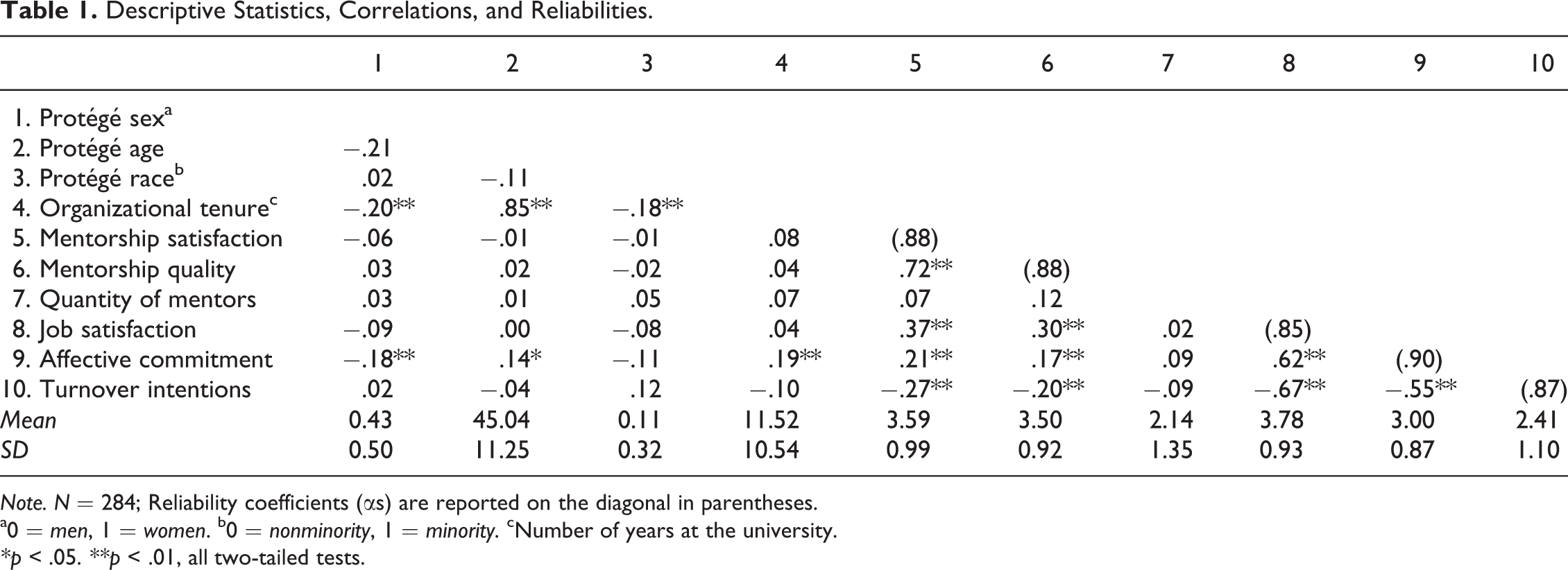
Unless otherwise indicated, all survey items were responded to on a 5-point agreement scale. Coefficient αs are reported in Table 1.
Descriptive Statistics, Correlations, and Reliabilities.
Note. N = 284; Reliability coefficients (αs) are reported on the diagonal in parentheses.
a0 = men, 1 = women. b0 = nonminority, 1 = minority. cNumber of years at the university.
*p < .05. **p < .01, all two-tailed tests.
Mentorship quantity
The following definition of a mentor was provided to the respondents: “Mentoring has been traditionally defined as a developmental relationship between an older, more experienced mentor and a younger, less experienced protégé for the purpose of helping and developing the protégé’s career.” Similar to other mentoring studies (Baugh & Scandura, 1999), respondents were asked the open-ended question: “How many mentors have you had since you started working at <name of the university>?” Response options ranged from 0 to 10.
Mentorship quality
Three items from Allen and Eby’s (2003) 5-item mentorship quality measure were tailored to measure the mentorship quality from protégés’ perspective. Two of the original items were not included because one was a more global assessment of the effectiveness of mentoring and the other an assessment of satisfaction with mentoring. The items read: “My mentor(s) and I have benefitted from our relationship,” “I have effectively used mentoring,” and “I have enjoyed high quality mentoring relationship(s).”
Satisfaction with mentoring
Satisfaction with mentoring was measured with a 3-item scale adapted from Ragins et al.’s (2000) 4-item satisfaction with mentor measure. Items were revised to focus on mentoring rather than the mentor and 1 item was excluded because it assessed the effectiveness of the mentor. The items read: “I am/have been satisfied with my mentoring,” “Mentoring has disappointed me” (reversed-scored), and “Mentoring has failed to meet my needs” (reversed-scored).
Job satisfaction
Two items adapted from Cammann, Fichman, Jenkins, and Klesh (1983) were administered: “All things considered, I am satisfied with my job” and “Overall, I like working at <university name>.”
Affective commitment
Allen and Meyer’s (1990) 8-item affective commitment scale was slightly modified for the intended audience (i.e., “organization” was replaced with “university”). A sample item read, “I would be very happy to spend the rest of my career with this university.”
Turnover intentions
Turnover intentions were measured with 3 items. Two items were borrowed from Cammann et al. (1983): “I often think about quitting this job” and “I will probably look for a new job during the next year.” Another item came from Mayfield and Mayfield’s (2007) “intentions to stay” scale: “I am actively looking for another job.”
Initial Analyses
The values of variance inflation factor (VIF) and tolerance (Cohen, Cohen, West, & Aiken, 2002) demonstrated that limited multicollinearity existed among the predictors and covariates (all VIF < 10 and tolerance > .10). No significant interaction among predictors suggested that the homogeneity of the regression assumptions was met for covariance analyses.
All of our data were self-report and collected at the same time period. To address concerns about common method bias and provide evidence for discrete constructs, we conducted a series of confirmatory factor analyses with Mplus 6.0. The results indicated that the scale items loaded onto their respective constructs (i.e., a five-factor model) with good model fit (comparative fit index [CFI] = .91; root mean square error of approximation [RMSEA] = .09; standardized root mean square residual [SRMR] = .06). Further, the measurement model had significantly better fit than a model with a latent “common method factor” (Podsakoff, MacKenzie, Lee, & Podsakoff, 2003; Δχ2(9) = 136, p < .05; CFI = .87; RMSEA = .11; SRMR = .17), Taken together, these results suggest that common method bias is not a pervasive problem.
Results
Descriptive statistics and correlations for all variables are displayed in Table 1.
Research Question: Influence of Quantity of Mentors
Among the 472 faculty members who responded to the number of mentors question, 188 (40%) reported no mentors, 99 (21%) reported only one mentor, and 185(39%) reported more than one mentor. That is, as noted earlier, about 60% of the respondents reported that they had at least one mentor. This percentage is comparable to those found in previous mentoring studies of faculty members (e.g., Wasserstein et al., 2007). For the respondents who reported they had at least one mentor (N = 284), each faculty member had an average of 2.14 (SD = 1.35, mode = 2) mentors. The distribution of responses was positively skewed with a few extreme responses (i.e., seven respondents reported having six or more mentors). Correlation analysis indicated that the total number of mentors (i.e., quantity of mentors) did not correlate significantly with any of the three job attitudes, suggesting that the mere presence of one or more mentors is not sufficient to alter one’s job attitudes. 1
Hypothesis 1: Quantity Compared to Quality
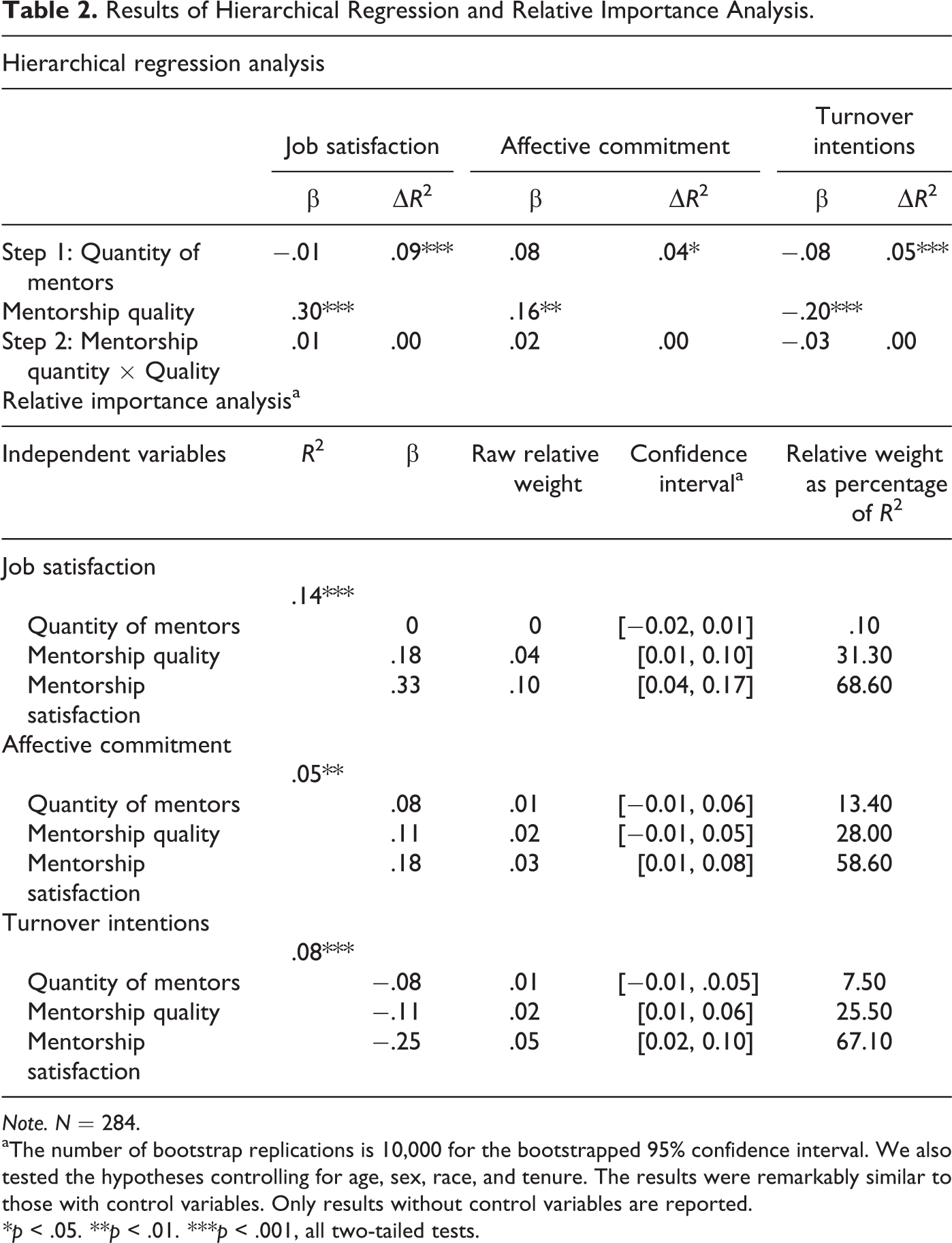
To test whether mentorship quality accounted for more variance in the three job attitudes than quantity of mentors, we conducted a relative importance analysis. Relative importance refers to the contribution a predictor variable makes to the prediction of a criterion variable by itself and in combination with other predictor variables. In some situations in which the primary purpose is to examine the relative importance of several predictors to the prediction of the same criteria, or in which the purpose is to test a question concerning whether certain variables matter more than others in predicting the criteria, relative importance analysis has advantages over multiple regression (e.g., how overlapping variance for intercorrelated predictors is attributed; Tonidandel & LeBreton, 2011). Considering we were interested in determining which predictor variable (i.e., quantity or quality) matters most to the prediction of job attitudes, relative importance analysis is the most appropriate analysis to test this hypothesis (Tonidandel & LeBreton, 2011). As shown in Table 2, mentorship quality accounted for more variance in the three job attitudes than quantity of mentors supporting Hypotheses 1a, 1b, and 1c (even when controlling for mentoring satisfaction). Further, as displayed in Table 3, hierarchical regression analyses also revealed that quality of mentoring accounted for incremental validity in all three job attitudes over and above quantity of mentors.
Results of Hierarchical Regression and Relative Importance Analysis.
Note. N = 284.
aThe number of bootstrap replications is 10,000 for the bootstrapped 95% confidence interval. We also tested the hypotheses controlling for age, sex, race, and tenure. The results were remarkably similar to those with control variables. Only results without control variables are reported.
*p < .05. **p < .01. ***p < .001, all two-tailed tests.
Incremental Validity of Satisfaction With Mentoring on Job Attitudes.

Note. N = 284. We also tested the hypotheses controlling for age, sex, race, and tenure. The results were remarkably similar to those with control variables. Only results without control variables are reported.
*p < .05. **p < .01. ***p < .001, all two-tailed tests.
Hypothesis 2: Interaction Between Quantity and Quality
Hierarchical regression analyses were conducted to test the interaction between quantity and quality in predicting job attitudes. All categorical variables were dummy coded and all continuous variables were centered before they were entered into the regression model. As depicted in Table 2, quantity of mentors and mentorship quality were entered into the model in the first step and the interaction term between quantity of mentors and mentorship quality (the product of the centered quantity of mentors and the centered mentorship quality) was entered in the second step. Hierarchical regression analyses indicated that the interaction terms were not significant for any of the three job attitudes (all ps > .05), suggesting that the effect of quantity of mentors on job attitudes was independent of mentorship quality, failing to support Hypothesis 2.
Hypothesis 3: Quantity, Quality, and Satisfaction With Mentoring
We also conducted relative importance analysis to compare the relative value of the three independent variables (quantity of mentors, mentorship quality, and satisfaction with mentoring) on the three job attitudes. Across all three job attitudes examined, satisfaction with mentoring mattered more than either mentorship quality or quantity, as evidenced by mentorship satisfaction having the greatest relative weight and explained variance among the three independent variables (see Tables 2 and 3), supporting Hypotheses 3a, 3b, and 3c.
Hypothesis 4: Mediating Effect of Satisfaction With Mentoring
We used bootstrapping with the Statistical Package for the Social Sciences (SPSS) macros from Preacher and Hayes (2008) to test the mediation effect of satisfaction with mentoring on the three outcome variables (see Table 4). The results indicated that the indirect effect of mentorship quality on job satisfaction through satisfaction with mentoring was .24, and the confidence interval did not overlap with zero, suggesting that satisfaction with mentoring was a significant mediator between mentorship quality and job satisfaction. Also, the indirect effect of mentorship quality on turnover intentions through satisfaction with mentoring was −.21, and the confidence interval did not overlap with zero, suggesting that satisfaction with mentoring significantly mediated the relationship between mentorship quality and turnover intentions. However, the indirect effect of mentorship quality through satisfaction with mentoring on affective commitment was .11, with the confidence interval overlapping with zero, suggesting that satisfaction with mentoring was not a significant mediator between mentorship quality and affective commitment. Taken together, these results supported that the effects of mentorship quality on job satisfaction and turnover intentions were mediated by satisfaction with mentoring, supporting Hypotheses 4a and 4c.
Bootstrapping Results for Indirect Effects of Satisfaction With Mentoring on the Mentorship Quality-Outcomes Relationships.

Note. aThe lower and upper level for bias corrected 95% confidence intervals (CIs) and 95% bias corrected and accelerated CIs were almost the same as those for percentile 95% CIs, so we did not include them in the table. The number of bootstrap resampling is 10,000. Data = the indirect effect calculated in the original sample; boot = the mean of the indirect effect estimates calculated across all bootstrap samples, bias: The difference between data and boot, SE = the standard deviation of the bootstrap estimates of the indirect effect. This standard deviation could be used as a bootstrap-derived estimate of the standard error of the indirect effect.
Discussion
This study contributes to the mentoring literature in many ways. First, we demonstrated the relative value of quantity of mentors, mentorship quality, and satisfaction with mentoring to the prediction of job satisfaction, affective commitment, and turnover intentions. Results were remarkably consistent across all three job attitudes in that mentorship quality accounted for more variance than quantity of mentors and satisfaction accounted for more variance than either quantity or quality. That is, quality of mentoring consistently accounted for incremental validity in the three outcomes over and above quantity of mentors and satisfaction with mentoring accounted for incremental validity in the studied outcomes over and above quantity and quality. Clearly, this demonstrates the importance of satisfaction with mentoring to job attitudes and the distinctiveness of all three mentoring variables.
Second, we provide initial support for mentorship quality as an antecedent of satisfaction with mentoring. Our research design does not permit causal inferences; thus, additional studies are needed to establish the temporal precedence of mentorship quality and whether protégés can still be satisfied with a low-quality mentorship. It would also be helpful to know whether quality and satisfaction have unique antecedents in order to design interventions that facilitate both.
Third, the effect of mentorship quality on job satisfaction and turnover intentions was mediated by satisfaction with mentoring. This provides an explanation for why mentorship quality is related to job attitudes, extending research on the explanatory mechanisms for patterns of relationships revealed in the mentoring literature (e.g., Eby et al., 2013). It also suggests that mentoring in the workplace likely results in multiple layers of outcomes with quality being a more proximal outcome, followed by satisfaction with mentoring, which is followed by job satisfaction. Longitudinal research measuring outcomes over an extended period of time could further substantiate the temporal distinctions between mentoring-specific outcomes and reveal even more distal outcomes like promotion and engagement in mentoring behavior of someone else in an effort to maintain a continuous cycle of mentoring.
This study replicated Ragins et al.’s (2000) findings that satisfaction with mentoring is more important to the prediction of job satisfaction and turnover intentions than the mere presence of a mentor. We extended these findings by testing the influence of satisfaction with mentoring relative to more than one mentor (quantity of mentors) and controlling for mentorship quality. Our study revealed there were no incremental benefits in job attitudes from having more than one mentor. It may be that the benefits of more than one mentor are more likely to be revealed in other dependent variables like knowledge acquired or self-efficacy.
Our results did not support any interdependence between the effects of quantity and quality of mentorship. In our data, quantity of mentors did not have a significant impact on the outcomes and quality had an independent effect. Thus, the effect of quality of mentoring does not depend on quantity (nor vice versa). In fact, quantity had minimal influence on the outcomes assessed. Quality was much more important to job satisfaction, affective commitment, and turnover intentions than quantity. Detailed assessments of each mentorship reported may elucidate more complex relationships between quantity and quality of mentoring.
The present study has several implications for organizations. First, as our study indicated that mentorship satisfaction was the most powerful predictor of various job attitudes relative to both mentorship quantity and quality, it may be important to enhance protégés’ mentorship satisfaction to ensure the benefits of mentoring. Also, the evaluation of the mentorships or mentoring programs in organizations should include assessments of protégés’ satisfaction with the mentorships or programs. Second, organizations should have realistic expectations about the outcomes associated with the mentoring, because our study further confirmed that the presence of a mentor or even multiple mentors may not necessarily lead to positive outcomes (i.e., either null or negative). It may be worthwhile to help protégés and mentors to develop realistic expectations for the mentorships in order to enhance their mentorship satisfaction. Further, recognition of protégés’ dissatisfaction with their mentorships may help them to make sound decisions about whether and when to end an ongoing mentorship. Finally, understanding protégés’ dissatisfaction with specific facets of their mentorships may provide the organization with information about the types of interventions that might be effective to develop sustainable mentorships and thereby improving the effects of mentoring.
Limitations and Future Directions
The respondents in this study were faculty members; it is unclear whether our results will generalize to other occupations. However, our predictions are based on theories that apply to individuals in mentoring relationships regardless of their occupations and the results are consistent with previous empirical research with respondents from other occupations. Thus, we have no reason to believe our results are not generalizable.
We did not distinguish between formal and informal mentorships. Mentoring researchers have demonstrated that informal mentoring is more effective than formal mentoring (e.g., Ragins et al., 2000). Future studies are needed to examine the quantity and quality of formal and informal mentorships to determine the ideal combination of the two.
The measures used in our study were not always as precise as we might have liked for them to be. Quantity of mentoring can be conceptualized as (a) having multiple mentors at one time (concurrent mentorships), (b) having more than one mentor over an extended period of time (sequential mentorships), or (c) a combination of both. In our study, mentorship quantity was assessed with a single item asking the number of mentors one has had since they had started working at the university. Our assessment did not distinguish between concurrent mentorships and sequential mentorships. Mentoring scholars speculate that concurrent mentorships or developmental networks benefit protégés more than sequential mentorships (Higgins & Kram, 2001) and mentorships will continue to influence protégés beyond the initial mentoring phases (Kram, 1985). Additional research is needed to test these propositions.
Alternatively, mentorship quantity could be assessed by the amount of time the protégé spends with each mentor, how frequently he or she interacts with each mentor, and/or the duration of each mentorship. However, interaction frequency may also capture mentorship quality (Allen & Eby, 2003; Kram, 1985), so the distinction between mentorship quantity and quality constructs may need further refinement. Also, the relationship between mentorship quantity and other outcomes not examined in this study, like self-efficacy and knowledge acquisition, would further determine the value of multiple mentors.
In order to have less contaminated measures of the focal constructs, we used modified measures of Allen & Eby’s (2003) quality of mentoring and Ragins et al.’s (2000) satisfaction with mentoring measures, dropping items with overlapping content (Conway & Lance, 2010). These measures displayed high levels of internal consistency (.88 for both) and similar relationships with demographic and job attitude measures as the full measures (e.g., Allen & Eby, 2003; Ragins et al., 2000). We encourage mentoring researchers to scrutinize measures closely to maximize content-related and construct-related validity and when possible avoid having all variables measured with the same method from the same source.
With regard to the assessment of mentorship quality, ideally the quality of each mentorship would be assessed individually. Additional work is needed on the development and validation of a comprehensive mentorship quality measure that includes all aspects of relationship quality. One important hallmark of relationship quality (Kram, 1985) that has not been assessed in the mentoring research is relationship depth which is a key component of close relationships (Allen & Eby, 2003; Allen, Eby, Poteet, Lentz, & Lima, 2004). Future research should explore how this dimension of quality relates to various mentoring outcomes. Another element that has been included in quality and satisfaction measures is the effectiveness of mentoring. On the other hand, quality of mentoring has been described as an important indicator of relationship effectiveness or success (Goldner & Mayseless, 2009; Kram, 1985). The value and distinction of mentoring effectiveness from quantity and quality of mentoring remain to be assessed. Alternatively, maybe these variables are so interrelated, they should be combined into an overall assessment of relationship quality as they were in Eby et al.’s (2013) meta-analysis.
In conclusion, the present study extends previous research demonstrating satisfaction with mentoring explains unique variance in job attitudes beyond the presence of one or more mentors. This study also reveals that the effects of mentorship quality on job attitudes were mediated by satisfaction with mentoring.
Footnotes
Acknowledgment
We thank Jeff Froyd for his assistance with collecting the survey data and Mindy Bergman, Kathi Miner, and Becky Thompson for their comments on an earlier version of the article.
Authors’ Note
Paper presented at the 71st annual meeting of the Academy of Management Conference, San Antonio, TX, August 2011.
Declaration of Conflicting Interests
The author(s) declared no potential conflicts of interest with respect to the research, authorship, and/or publication of this article.
Funding
The author(s) received no financial support for the research, authorship, and/or publication of this article.