



Abstract
Little is known about the career development of youth with a history of criminal activity and the factors that influence their career development. The ability to secure employment is important in predicting successful outcomes for this population, but unfortunately youth who have been involved in crime are likely to face a myriad of obstacles to obtaining secure employment. This qualitative study used the enhanced critical incident technique to explore the incidents that 16 male and female youth with a history of criminal activity perceived as helping and hindering their short-term career goals and things that they did not experience but wish they had. Results revealed that criminally involved youth have career expectations of relatively low prestige and that their experiences with crime and the justice system have contributed to the development and achievement of these career goals in unique ways. The implications of these findings for career counseling and youth outreach programming are discussed.
Adolescence is an important period of time during which individuals form their values, interests, and abilities and develop informed ideas about their future occupations (Sharf, 2010; Super, 1955). The formation of realistic career aspirations and the development of career maturity are not uniform processes, and although some adolescents are able to successfully navigate it, others are not. The career development of adolescents who successfully develop and pursue vocational aspirations is a well-understood topic, but what of youth whose social contexts and individual characteristics lead them to become involved in crime? Becoming involved in crime and the juvenile justice system can have a profound impact on every aspect of an adolescent’s future, including his or her career (Carroll, 1995; Davey, 1993; Rojewski & Hill, 1998; Zabel & Nigro, 2007). However, it is precisely these marginalized populations that have been underrepresented in the career development literature. This exploratory study investigated the career development of adolescents who have been involved in crime, specifically examining their occupational expectations and the influence of criminal involvement on these expectations. For the purposes of this article, the term “criminally involved” refers to youth who have been criminally active either presently or in the past, including theft, violence, and drug use.
Occupational aspirations generally represent an individual’s career goals and career-related choices, based on ideal circumstances (Brown & Lent, 2005). According to Super (1990), career aspirations are viewed as a component in an individual’s occupational self-concept. Similarly, Gottfredson’s (1981) theory of career circumscription and compromise states that occupational aspirations reflect an individual’s occupational self-concept and are based on both compatibility and accessibility. These aspirations become expectations when they are realistic goals and the individual has an understanding of obstacles and opportunities that may present themselves along the way. However, it should be noted that occupational aspirations are not always realistic. Occupational expectations differ from occupational aspirations in that they reflect the likelihood of entering or achieving a particular career goal (Rojewski, 2005). There may be discrepancies between an individual’s occupational aspirations and expectations (Davey, 1993; Rojewski & Hill, 1998). Adolescents’ goals for future work tend to be ones that they actually hope to achieve, rather than unrealistic aspirations (Young et al., 2010). Consequently, by focusing on the short-term vocational goals of youth with a history of criminal activity, this study can be thought of as an exploration of the career expectations of this population.
Influences on the Occupational Expectations of Youth Who Have Been Involved in Crime
The systems theory framework (STF) of career development postulates that there are three key systems which influence all aspects of career development, including the formation and pursuit of vocational goals (a) the individual system, (b) the social system, and (c) the environmental and societal system (McMahon, 2005; Patton & McMahon, 1999, 2006). Within STF, the individual system is theorized to be affected by various interpersonal influences, such as gender, age, and personality. The individual also exists within and is influenced by larger contextual systems. An individual’s social system includes other people in their life, such as family, peers, and educators. Both the individual and social systems exist within the environmental and societal system, which includes factors such as socioeconomic status and geographic location. From the perspective of STF, there are a myriad of factors that influence career development, including vocational goal development, in adolescence (Patton & McMahon, 1999). These factors include environmental factors such as homelife and peer networks and individual factors such as identity, knowledge, and interests. All of these systems interact and influence one another in a multidirectional fashion, and the degree of influence that these systems have on career development may change over time (McMahon, 2005).
The various systems that exert an influence on the career development of adolescents who successfully formulate and pursue vocational goals are relatively well understood, but what of youth whose social contexts and individual characteristics lead them to become involved in crime? This marginalized population has been underrepresented in the career development literature, despite evidence that becoming involved in crime can have a profound impact on every aspect of an adolescent’s future (Davey, 1993; Rojewski & Hill, 1998; Tanner, Davies, & O’Grady, 1999; Zabel & Nigro, 2007).
In 2010, in the United States, approximately 652,000 youth aged 16 and above were involved in delinquent or criminal activity, and approximately 219,000 youth were released from incarceration (National Center for Juvenile Justice, 2007). Similarly, there were approximately 43,600 youth admitted to correctional services in Canada in 2010 (Canadian Center for Justice Statistics, 2012). These numbers, combined with the social and financial cost of youth incarceration and the high rates of recidivism in this population, make it crucial to gain a better understanding of career development among youth with a history of criminal activity.
In one of the few studies examining the career aspirations of youth who have been involved in crime, Zabel and Nigro (2007) found that the most popular categories of employment were those that involve physical performance, protective services, and artistic skill. More specifically, males tended to choose careers that involve physical performance, whereas females pursued humanitarian careers. Youth who have been involved in crime have also been found to have a wide gap between their career aspirations and expectations, which may reflect unrealistic expectations for themselves, insufficient work skills or experience, and a lack of the necessary educational qualifications (Davey, 1993; Rojewski & Hill, 1998). Additionally, one of the strongest motivators for continued criminal activity upon release is the need for resources, such as clothing, food, and money (Carroll, 1995). Taken together, these findings suggest that upon release, youth may be facing failure or disappointment when searching for employment and may consequently resort to criminal activity to obtain the necessary resources for survival.
Involvement in crime may have a negative impact on educational and occupational attainment (Tanner et al., 1999). For example, gang membership has been associated with a lack of engagement in school or work (Bullis & Yovanoff, 2002). However, several factors have been found to increase the likelihood that youth will become engaged in school or work following release from incarceration: first involvement in criminal activity after the age of 14, receiving mental health services, and completing vocational education while incarcerated (Bullis & Yovanoff, 2002). There are also a number of factors that appear to promote success postrelease, namely family support; support from nonparental adults; engaging in school, work, or related activities; avoidance of drugs; and involvement with nondelinquent peers (Todis, Bullis, Waintrup, Schultz, & D’Ambrosio, 2001). Therefore, although involvement in crime and the juvenile justice system may have many negative influences on youths’ career development, the literature also suggests that some factors can have a positive, facilitating effect on career development in this population.
The Present Study
Little is known about the career development of youth who have been involved in crime, their goals for the future, or the factors that can positively or negatively influence their success in pursuing these goals. The enhanced critical incident technique (ECIT; Butterfield, Borgen, Amundson, & Maglio, 2005; Butterfield, Borgen, Maglio, & Amundson, 2009) was used to qualitatively explore the future career goals of youth in conflict with the law and experiences that have contributed to or taken away from their progress in reaching these goals, from the perspective of the youth themselves. The following research questions guided the study: What goals do youth who have been involved in crime have for their futures? What kinds of experiences are perceived by these youth to (a) facilitate and (b) interfere with the achievement of their goals for the future? What kinds of experiences do these youth believe could have been helpful in accomplishing their goals, but which they did not experience?
Method
Participants
Participants consisted of 11 males and 5 females aged 16–21 (15 European Canadian and 1 Aboriginal Canadian). All participants self-identified as being criminally active at some point during their adolescence. Whether or not they were involved in criminal activity at the time of their research involvement was not systematically assessed, although some participants spontaneously disclosed that they remained involved in crime. Their criminal involvement included theft, engagement in violence, and use and distribution of drugs. Six of the 16 participants had been incarcerated as youth, with the remainder of the participants having been placed on probation, being diverted away from the Canadian Juvenile Justice System and into alternate social programming or being arrested but not convicted.
According to the youth criminal justice act in Canada, the interventions and consequences that criminally involved youth face are dependent on the seriousness of the crime committed (Canadian Department of Justice, 2013). Youth who commit more serious crimes are oftentimes subjected to the court process which may result in prosecution for their crimes (Canadian Department of Justice, 2013). However, efforts are often made to divert youth away from the court system whenever possible. Youth may be diverted from formal prosecution by way of informal measures such as issuing warnings and referring youth to community-based programs (Canadian Department of Justice, 2013).
Given the nature of their criminal involvement, the participants represented low- to moderate-risk young offenders with a history of criminal activity. At the time of the interviews, 44% of participants were in high school and 25% of participants were working toward their General Educational Development (GED) diploma. Participants were recruited from alternative schooling programs and youth outreach programs by reaching out to program staff members who made contact with eligible participants. Eligibility criteria consisted of being between the ages of 16 and 21 and having engaged in illegal activity as youth. Alternative schooling programs provide an alternate method of learning to the traditional educational system. These programs allow youth to earn their high school diplomas by providing smaller class sizes, more individual attention from teachers, and a more flexible schedule allowing youth to tailor their education to their individual needs. The alternative schooling program we recruited from is part of the public school system, is located at a public high school site, and is run by the provincial ministry of education. A US$10 gift card to a national coffee chain was offered as an incentive for participation.
Procedures
Data collection and analysis were conducted using the ECIT, a systematic approach to qualitative research. ECIT is a particularly useful method for exploratory research, because it allows participants to provide detailed descriptions of specific helping and hindering factors that contribute to or prevent the realization of certain goals or experiences (Butterfield et al., 2005). The scope of the discussion is defined by the participants but within a specific framework provided by the researcher.
Individual semistructured interviews, lasting between 12 and 60 min, were conducted by the first author with participants at the program from where they were recruited. The interview protocol began with preliminary questions asking participants to project themselves 5 years into the future to describe what they see themselves doing and how they plan to earn money. Follow-up questions were asked to address the specifics of participants’ vocational goals, including what did and did not interest them about these plans. Participants were then asked to discuss how they perceive crime and the juvenile justice system to have influenced their ability to achieve their career goals.
Existing ECIT interview protocols (see Butterfield et al., 2005, 2009) were then used to elicit information on what assisted participants to move toward their career goals by asking them to identify and describe specific incidents from their life when something or someone helped them to achieve their goals: Participants were asked to continue describing helping incidents until they were unable to identify any more. The process was then repeated but with a focus on incidents where something or someone interfered with or hindered the achievement of their career goals. Finally, participants were asked to identify and describe their “wish list” (WL; Butterfield et al., 2009); that is, things that they did not personally experience, but which they believed could have been helpful in achieving their goals if they had been able to experience it.
Data analysis was conducted by the first author. It involved identifying critical incidents (CIs) and WL items from each interview and generating summary descriptions of each incident, including information on what preceded it, its outcomes, who or what contributed to it, and what was helpful/hindering about the incident. This process was repeated for the WL items. Following standard practice in ECIT research, descriptions were generated from what was directly expressed by participants. These summaries were then closely examined in order to group together items that were similar in their nature and content to form categories. Finally, a label and summary description, reflecting the content of all the CIs/WLs in the group, was created for each CI/WL category that emerged.
Five credibility checks, suggested by Butterfield et al. (2005, 2009), were conducted to assess and establish the credibility of the findings. First, a confirmatory identification of CIs and WLs was independently conducted by a reviewer who was blind to the original analysis. There was a 100% agreement rate between the original and the confirmatory identification of CIs/WLs. Second, incidents were independently placed into categories by a blind reviewer, which also yielded a 100% agreement rate. Third, only categories that were mentioned by at least 25% of participants were retained as valid results to ensure that CIs and WLs were not unique to specific individuals (Borgen & Amundson, 1984). Fourth, follow-up participant validation interviews were conducted to clarify information that was confusing or incomplete and to ensure that participants’ experiences were accurately accounted: 10 participants reviewed the CI/WL categories and provided their feedback on the accuracy of the initial analysis. They mostly agreed with the researchers’ interpretations, although one participant suggested an additional category that was not in the original summary of findings (being a Status Indian). Finally, two experts in the field conducted a review of the findings to assess the fit of the categories back to the original data. They verified the categories with 89% and 100% agreement rates.
Findings
In terms of career goals for the following 5 years, seven participants wanted to be in labor and trades work (e.g., construction and auto mechanic), three in a military career, and one in the music industry. Three participants expected to be attending community college. Finally, two participants reported that they did not know what they wanted to do. These participants identified possible career goals based on their interests, but their ideas were transient and they were unable to settle on a career goal. Participants who were unable to identify career goals were interviewed according to the same protocol and were asked the same questions as all other participants. The participants described a total of 98 helping and hindering CIs and WLs. There were 47 helping CIs organized into eight categories (Table 1), 36 hindering CIs organized into six categories (Table 2), and 15 WLs. Only the valid CIs and WLs (i.e., described by at least 25% of participants) will be elaborated upon.
Categories of Critical Incidents That Were Perceived to Facilitate the Achievement of Career Goals.

Note. PA = participants (n = 16); IN = incidents (n = 102); % = percentage of participation rate. Boldface indicates categories with participation rates of 25% or greater.
Categories of Critical Incidents That Were Perceived to Interfere With the Achievement of Career Goals.
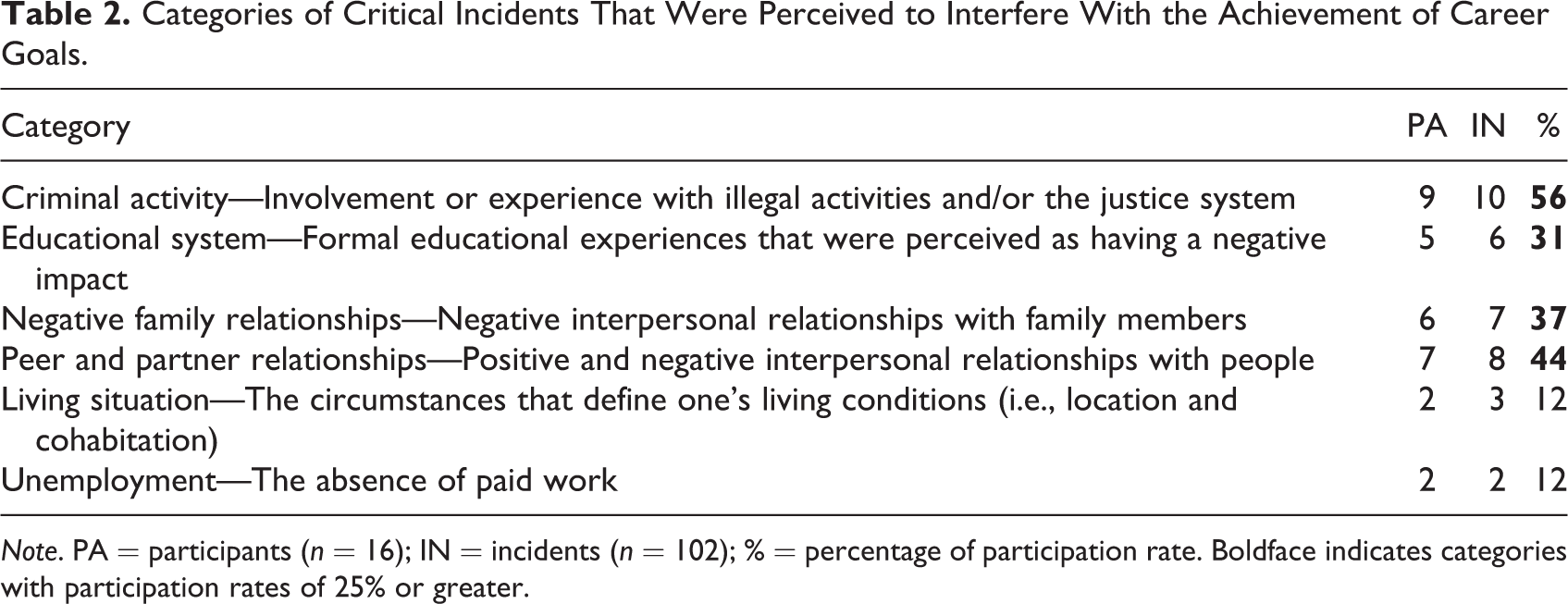
Note. PA = participants (n = 16); IN = incidents (n = 102); % = percentage of participation rate. Boldface indicates categories with participation rates of 25% or greater.
Helping Incident Categories
Family systems was the helping CI category with the greatest participation rate, with nine participants (56%) identifying 11 helping incidents. This category was defined as positive and negative interpersonal relationships with family members. Even for apparently negative experiences (e.g., lack of support from family members and conflictual relationships), participants perceived them as having a positive outcome. Several participants reported that negative family experiences helped them to reach their career goals by motivating them to strive harder. Positive experiences included receiving support from family members or having a strong bond with family members. For example, My brother always helped me. We went through a lot. Someone to lean on or cry on. Mom, dad, sister, grandmother.… He’s that, all in one package. He’s everything. He’s never left my side yet when everyone else did. He’s the one that stayed.
Criminal activity was defined as involvement in illegal activities, which sometimes also included becoming involved in the juvenile justice system. This category had a participation rate of 44%, with seven participants identifying seven helping incidents. Most incidents in this category involved experiences such as drug abuse and incarceration, which subsequently resulted in some positive outcome. One participant’s description of his experience with drug abuse illustrates this: But in a way it was helpful. Right after you recover, you enjoy the little things, how spoiled and ungrateful people were. It made me grateful for life. It got me out of my shell.
Living situation CIs involved experiences living outside of the family home that resulted in increased independence and responsibility and had a participation rate of 31% with five participants identifying five helping incidents. This category included experiences of homelessness and living in transitional housing programs. As one participant explained, Living on my own since I was young made me have to grow up fast. I moved to a homeless shelter when I was 12. It made me a stronger person. I realized I can’t rely on anyone else; I was stuck to myself. I had to be independent. I didn’t really have a choice.
Mental health system was a category that consisted of CIs related to receiving mental health treatment such as counseling, medication, and drug rehabilitation. It had a participation rate of 31%, with five participants identifying six helping incidents. One participant described the positive aspects of a drug rehabilitation program that he experienced: I’m still in touch in everyone from rehab. I know everything about them, they know me. We cried in their arms. I knew boys who sucked dick for drugs, who were raped. Tough guys break down and cry in rehab. I figured out why I went into drugs, how my life affected me. I felt that pain in rehab for the last 6 months. I cried like a little baby, it brought it out of me. It made my life 10 times smarter. At the end of the 6 months, you pass. You do a lot of shit to get past. People are real in there. Out here, everyone’s fake.
Relationships outside of the family was defined as positive and negative interpersonal relationships with individuals outside of one’s family and had a participation rate of 25% with four participants identifying six helping incidents. These incidents involved receiving support from peers and discontinuing unhealthy peer relationships, for example: My ex was never there for me. He was an asshole to me. Getting him out of my life was very helpful for me. Probably one of the best things that I have ever done. He really affected me emotionally. I have been more happy these last few weeks than the whole time I was with my ex.
Career exploration and practical experience included incidents related to having obtained practical or hands-on experience in a particular field of work, obtained information relevant to particular fields of work and/or having explored career options. It also included being provided with structured learning opportunities while in youth outreach programs: The youth program saved my life many times. It hooked me up with a job. The boss is a really good support, he helps us a lot. We learned different job skills, how to budget money, and we volunteer a lot. It gives me a routine, going to work every day.
This category had a participation rate of 37%, with six participants identifying eight helping incidents.
Hindering Incident Categories
The most frequently cited category of hindering CIs was criminal activity, which had a participation rate of 56%, with nine participants identifying 10 hindering incidents. Similar to the helping category titled criminal activity, this category was defined as involvement in illegal activities or the juvenile justice system. However, in these incidents, participants focused on the ways that criminal activity interfered with their ability to reach their career goals. The specific incidents described by participants involved substance abuse, theft, violence, and being sentenced to probation. The following quotation illustrates the hindering impact of drug use: I started when I was young, my mother was doing it. I smoked when I was 13, cigarettes, and right after that started smoking pot. At 15, I started taking pills. Then I moved onto the rocks, crack, crystal meth. Never shot up, but I used cocaine. My mother died from shooting up. My brother did it first, so I obviously did it. He started smoking pot, I didn’t really know what it was, so I did it. It ruined my life. Took my soul, took everything from me. Just took everything, I was crazy, I was a street bum. Did everything for drugs. That was my God.
Peer and partner relationships had a participation rate of 44%, with seven participants identifying eight incidents. This category was defined as relationships with people in the participants’ peer group, including romantic partners, that hindered participants’ pursuit of their goals. Most of these CIs related to unhealthy romantic relationships that had a negative influence on participants’ lives. As one young woman stated, I couldn’t do anything with my life. It was always about him. I never had any encouragement from him or my mom. I thought I wouldn’t be able to live without him but, believe it or not, I’m doing better without him.
The negative family relationships category consisted of incidents involving negative interpersonal relationships with family members, particularly a lack of support or negative experiences within one’s family. It had a participation rate of 37%, with six participants identifying seven hindering incidents. The following quote is from a participant who went through foster care: Foster parents didn’t want me so I would bounce from one person to the next. I hated seeing new people all the time. I hated moving so much. It sucked. Everything about the foster care sucked.
Educational system was a category of CIs defined by aspects of participants’ experiences with education and the educational system that were perceived to hinder participants’ career development. It had a participation rate of 31%, with five participants identifying seven hindering incidents. Examples of CIs from this category included dropping out of school, failing to learn the necessary knowledge for future work, and receiving a lack of support from educational authority figures. For example, The teacher took me outside of class and asked me what I wanted to do in my life. I said I don’t know, don’t care. The teacher told me I was going to be a high school drop-out and get nowhere in life.
WL Items
Many participants were not able to envision any specific things that they believed would have made a positive difference in helping them to achieve their career goals. Only one category of WL items reached the validity threshold, different family circumstances, which had a participation rate of 25%, with four participants identifying 5 WL items. This category was defined by a desire for family members, especially parents, to have been present or to have acted differently. The majority of the incidents in this category involved a desire for support or a better relationship with family. For example, one participant described her wish as: A family. A model family. A mom and a dad and a sister. Just sitting around the table and eating dinner. There is not a day that I don’t think about “what if I had a mom and a dad?” I think I would have been happy. Just watching and seeing families together—it makes me think, “I wish it could have been me.”
Discussion
Youth who were involved in crime in this study identified four kinds of career goals, reflecting their short-term career expectations: labor and trades work, the military, pursuing community college, and the music industry. Consistent with previous research findings showing that delinquency has a negative impact on the level of education and occupational prestige that such youth obtain (Tanner et al., 1999), all of these goals were for relatively low-prestige occupations. Although it is difficult to determine why participants chose to pursue low-prestige occupations, with the exception of the three participants who described wanting to pursue community college, it should be noted that none of the careers identified by the participants required high academic achievement.
Family System
Addressing the second and third research questions, and supporting the propositions of STF about what social systems exert an influence on career development (Patton & McMahon, 1999, 2006), the family system emerged as one of the most important helping and hindering influences on these youths’ vocational goals. Our findings reveal that the family system is one of the most important influences on the development of career goals in youth with a history of criminal involvement, supporting STF’s postulation that the social system is one of the three key systems involved in youth career development (McMahon, 2005). The most frequently reported helping incidents involved participants’ need and appreciation of family support and positive family relationships. Similarly, the negative impact of the absence of family support and poor family relationships emerged as an important category of hindering factors, and different family circumstance (e.g., supportive parents and no substance abuse) was the only category of WL items that emerged as valid. In combination, these findings reveal the crucial positive and negative roles that the family system appears to play in the career development for youth involved in crime.
The importance of familial support in career development and success after incarceration is well documented in the literature (Abrams, 2006; Brown, Killian, & Evans, 2003; Shivy et al., 2007). Additionally, family communication and involvement in youths’ lives is one of the several factors that may discourage continued criminal activity following release (Todis et al., 2001). This suggests that youth who lack a supportive family system and familial engagement may be less likely to obtain an education and more likely to obtain an occupation of lower prestige.
One surprising finding that emerged was that several participants perceived negative experiences associated with their family system to be helpful for pursuing their career goals. These experiences were perceived as being helpful because they served as learning experiences, allowing participants to understand their family’s circumstances and providing motivation for change. The finding that the family system can serve as a cautionary tale and as a motivator in the sense of refuting family members’ negative predictions advances the existing state of knowledge on the phenomenon and suggests that even negative family circumstances (e.g., family members being discouraging and nonsupportive, witnessing parental promiscuity, abuse, and substance use by family members) can have positive longer term effects, depending on the meaning that youths construct around the event.
Criminal Activity
Another important part of the answer to the second research question is involvement in criminal activity itself. Youth who were involved in the juvenile justice system believed that having a criminal record would hinder their ability to find work in the future. Youth who were involved with drugs and alcohol felt it was a hindrance due to the resulting addiction, social isolation, and destructive impact on their relationships with others. Criminal activity and involvement in the juvenile justice system is encompassed within SFT’s broader societal system of influences on career development (McMahon, 2005). The findings of the present study confirm this aspect of the theory and reveal that, for at least some youth, the specific societal influences of the criminal and juvenile justice systems play a key role in shaping their career. The findings also advance SFT by delineating the ways in which these specific aspects of a youth’s social system can positively influence their career development. The hindering functions of criminal activity and the juvenile justice system are well documented in the literature and require no further elaboration. A more intriguing finding, which appears to contradict previous research, is that some participants reported criminal activity and the juvenile justice system to be helpful in achieving their career goals by having an influence on the motivational aspect of their individual system and by leading them to become connected with the social system that assisted them. Specifically, participants identified these experiences as “wake-up calls” that motivated change in their lives. Being involved in criminal activity was perceived to be both directly and indirectly helpful. Some youths’ criminal activity was experienced as extreme and negative, which triggered a desire to make life changes to avoid future criminal activity. These experiences also allowed them to gain an understanding and appreciation for life. For others, involvement in crime is what led them to become involved with certain individuals or programs within their social system, which provided an opportunity for beneficial change. These findings suggest that it is not the criminal acts themselves that facilitate pursuit of career goals, but the new perspectives and life changes that stem from these experiences. Regardless, criminal activity as helping and hindering categories had similar participation rates, suggesting that there are both advantages and disadvantages to involvement in the criminal and juvenile justice system, depending on its consequences. For example, if criminal activity leads to legal diversion into a social service that provides vocational training and guidance, it may have a positive influence on adolescents’ occupational expectations. On the other hand, if it leads to greater exposure to other criminals (e.g., through incarceration or gang involvement), it may have a deleterious effect on their career development.
Educational System
Participants also reported several incidents related to their educational system; specifically the hindering impact of dropping out of school and having negative, unsupportive relationships with educators. It should be noted that better educational experiences were also identified as a helping category by two participants and a WL item category by three participants, although these categories failed to meet the validity threshold. This pattern of findings suggests that some youth involved in criminal activity may be aware of the potential of the educational system as a resource in attaining their future career goals but also suggests that their educational needs may differ from those of other adolescents. Most participants were enrolled in an alternative schooling or a GED program that offered flexibility, individual support, and the ability to work at their own pace. These characteristics within the educational system may be particularly important to the educational success of this population.
In addition to confirming these findings and the applicability of STF, specifically the influence of the educational system on the population of youth who have been involved in crime, the results of this study shed additional light on this issue by revealing that negative relationships with educators may be an additional important factor to consider in understanding why youth who have been involved in crime struggle with the education system. However, it is important to acknowledge that the negative relationship that many youth involved in crime appear to have with educators and the education system may be bidirectional. That is, it is possible that negative relationships developed as a result of their criminal activity, problem behavior within the school system, or lack of commitment to education.
Career Exploration and Practical Experience
All CIs in this category of experiences were perceived to be helpful to youths’ career development. Career exploration and practical experience are components of youths’ social system, as these experiences were directly linked to their relationships with family members, mentors, or educators. This finding further illustrates the significance of the social system in career development, particularly for youth who have been involved in crime. This particular aspect of youths’ social system may also contribute to the development of their environmental and societal systems by promoting career development, socioeconomic status, and quality of life.
Living Situation
An individual’s living situation exists within the context of the greater environmental and societal system (McMahon, 2005). Within this category, transitional housing programs were repeatedly described as being helpful because of the learning opportunities and supportive environment found in these settings. In addition to providing shelter, youth reported that transition housing programs provided them with important skills that are relevant to the pursuit of their goals, including social skills, anger management, employment skills, and money management.
Participants also reported that being homeless or living on their own from a young age was helpful to the pursuit of their vocational goals by forcing them to become independent and responsible and was a better alternative to the dysfunctional home environments that they left. This finding provides a concrete illustration of how aspects of people’s environmental and social systems (i.e., living situation) can interact with aspects of their individual system (i.e., sense of independence and responsibility). As such, these findings also support Patton and McMahon’s (1999, 2006) proposition that different systems interact with each other in shaping an individuals’ career development.
Mental Health System
The mental health system category revealed the positive impact that mental health professionals can have on the lives of youth who have been involved in crime. Within this system, drug rehabilitation and methadone programs were identified as helpful for increasing youths’ ability to function without drugs, helping them work toward overcoming their addictions, and allowing them to connect with and relate to other addicts. Participants who received mental health counseling and medication identified these experiences as helpful as they increased emotional and mental stability, self-awareness, and ultimately helped them change their lives for the better.
Relationships Outside of the Family/Peer and Partner Relationships
The relationships outside of the family helping category and the peer and partner relationships hindering category combine to reveal another important aspect of the SFT social system that must be considered in understanding the vocational goals and career development of youth who have been involved in criminal activity. The nature of these relationships determines whether the social system is being perceived as helping or hindering. For example, the hindering category included relationships characterized by physical and emotional abuse, drug use, manipulation, and deceit. In contrast, the helping category included receiving support and mentoring from peers and adult community members. The benefits of the peer system for this population are not well understood and should be further researched to fully grasp its impact on youth career development.
Implications for Career Practice
This study has provided some insight into the career goals and key contributing factors to the development of these goals among youth who have been involved in crime. The findings provide new insight into the types of short-term vocational goals these youth may aspire toward and increased understanding of what kinds of life experiences they perceive to be important in helping and hindering the attainment of their goals. This knowledge may benefit counselors and social programs by suggesting potential factors that can be promoted to facilitate positive career development and factors that should be reduced or eliminated. Three particularly crucial factors to consider with this population are family support, career exploration, and criminal activity.
The findings related to family support suggest that one of the focuses of programming and counseling for youth who have been involved in crime could be on the family unit as a whole and the relationships that exist within. It may be useful for counselors, social workers, and youth outreach workers to work toward helping youth connect and improve their relationships with family members and encourage family to become more actively involved in youths’ lives, with particular emphasis on career exploration. In some cases, family therapy may be beneficial to both youth and the family unit.
Concrete and practical career exploration is understood to be a crucial component of career development programming (Michael, 2005; Moody, Kruse, Nagel, & Conlon, 2008). The present findings suggest that practitioners should encourage youth who have been involved in crime to engage in practical career exploration activities, such as facilitating individual exploration of their personal and work-related interests, encouraging information gathering on different options for their futures, and providing hands-on experience in various fields of work. Hands-on experience was identified by participants as one of the most valuable exploratory activities and can be gained in a number of ways, such as a part-time job, volunteer work, or joining a youth group that will introduce youth to new ideas and opportunities.
Criminal activity appears to contribute to career development in unique ways. Youth who described negative encounters with the law as having a positive outcome were able to derive meaning or learn lessons from these experiences, which ultimately had a positive influence on their career development. Whether youth identify crime as a helping or hindering experience, it may be beneficial for counselors and youth workers to guide youth through the process of reflection, learning and creating change from these experiences.
Although jobs, volunteer work, youth programs, and family therapy may be beneficial to the career development of youth who have been involved in crime, it is important to consider the issue of access to these services. Youth may be uninformed about the importance of these factors or unaware of how to obtain the various services they need. Therefore, it is important that these services are systematically coordinated to better serve the individuals who need them most. This coordination of services may be achieved through youth advocacy. Advocates can help youth navigate the judicial system, access any services they may require, and serve as a guide for youth in what may be considered an overwhelming process of change. Regardless of the individual needs of youth, both coordination of services and advocacy may be important elements to consider in facilitating the career development of low- to moderate-risk youth in conflict with the law.
Limitations
There are several limitations that must be considered when interpreting the findings of this study. These findings are based on an exploratory qualitative study based on self-report data. Causal relationships and factors are difficult to determine through self-report data and as such, this study was not designed to identify causality. Therefore, these findings and relationships should be interpreted with caution.
Exhaustiveness of data was not achieved in this study. The ECIT method ideally requires that recruitment and interviewing of new participants continue until new participants’ interviews yield only the same categories of incidents that are already in the data (Butterfield et al., 2005). Time constraints required data collection to be discontinued before reaching this point of exhaustiveness. Consequently, although the study revealed many categories of incidents that influence youth who have been involved in crimes’ pursuit of career goals, there may be additional important helping and hindering factors that have yet to be uncovered. Therefore, these findings should be thought of as representing some of the things that can influence the career development of youth who have been involved in criminal activity.
Six of the 16 participants were not available for the participant validation interview, which meant that the interpretations and structure of categories could not be verified for all participants. It is possible that the researcher may have misinterpreted or misunderstood some of what the participants were attempting to communicate. However, follow-up interviews were conducted with 62% of the participants, and no concerns were identified in these interviews.
Participants were recruited from several different programs (alternative school and youth programs) in Atlantic Canada. Efforts to access regional corrections centers were unsuccessful. Therefore, from among the full range of youth who have been involved in criminal activity, the participants in this study were low- to moderate-risk young offenders who were in educational and outreach programs, rather than youth who were incarcerated at the time of the study (although it must be noted that some participants had previously been incarcerated). As such, the findings may apply primarily to this subgroup of youth who have been involved in crime, and the recommendations that stem from these findings may not be applicable to high-risk offenders or youth during their incarceration.
Future Directions
This study confirmed existing research and brought new insight into different factors that facilitate and hinder these youths in their pursuit of short-term career goals. However, future research should replicate and extend this study with a larger sample representing a wider range of youth involved in criminal activity, including incarcerated youth. Research should also attain exhaustiveness of data in order to obtain more conclusive results.
Some of the findings that extend or contradict the existing knowledge base deserve more in-depth exploration. For example, the question of why youth who have been involved in criminal activity tend to aspire to lower prestige careers that require relatively little education needs to be addressed in greater depth. Additionally, studies could be designed to specifically examine how and why criminal activity itself is perceived by some youth to be beneficial to their career development. Similarly, how youths’ career goals are impacted by living away from parents or being homeless during adolescence is an important issue to examine in future research
Finally, the various suggestions for service delivery that were generated from these findings need be studied systematically to develop an evidence base for how to promote the career development of youth who have been involved in crime and the youth justice system. This study was designed to be exploratory. As such, it is useful for generating ideas for how to assist youth who have been involved in criminal activity to achieve their career goals. Further research is required to establish whether the suggestions made in this study are actually effective for promoting the career development of this population.
Footnotes
Declaration of Conflicting Interests
The author(s) declared no potential conflicts of interest with respect to the research, authorship, and/or publication of this article.
Funding
The author(s) received no financial support for the research, authorship, and/or publication of this article.