



Abstract
This study addresses the role of career growth in the turnover process among Chinese new employees. Based on reviews of the background of Chinese new employee combined with the Theory of Work Adjustment, we focus on career growth, person–organization fit (P-O fit), and job satisfaction as potential predictors. We examined career growth’s mediating effect between P-O fit and job satisfaction and its role in predicting turnover intention. Questionnaires were sent out through e-mail to Chinese new employees graduated within the past 3 years. Results of 323 valid cases showed that (1) career growth was positively correlated to job satisfaction and negatively correlated to turnover intention, (2) job satisfaction fully mediated career growth’s effect on turnover intention, (3) P-O fit positively predicted career growth, (4) career growth fully mediated P-O fit’s effect on job satisfaction, (5) P-O fit, career growth, and job satisfaction jointly explained 40% of the turnover intention’s total variance. Implications for individuals and organizations are discussed.
Introduction
Turnover in Chinese New Employees
With the rapid technological advancement, financial meltdowns, and flattened hierarchies, the western employee–organization relationships have engendered substantial changes (Volmer & Spurk, 2011). As a result, organizational change, or employee turnover, has become omnipresent (Jacobs, Arjen, & Christe-Zeyse, 2013). As companies normally invest a considerable amount of capital in acquiring and developing human resources (Harris, Harris, & Harvey, 2008), the cost associated with the resultant increases in employee turnover could be detrimental (Eriksen, 2012; Loi, Hang-Yue, & Foley, 2006). As such, employee turnover continues to be the topic of interest to Western scholars and practitioners (Long & Perumal, 2014). In contrast, in China, turnover barely drew any attention until recently when the turnover rate has increased steadily. According to the Chinese College Graduates’ Employment Annual Report (Wang & Guo, 2011), 59% of the graduates with a bachelor’s degree and 78% of the junior college graduates changed jobs at least once within the first 3 years after graduation, and the average working length of their first employment was only 20 months. This subpopulation—Chinese new employees who have entered the job market for less than 3 years—will gradually become the major part of the new Chinese workforce. Also from a global perspective, this generational cohort signals a modernization of China’s workforce that benefits not only China’s but also the global economy as well. Considering the high turnover but a comparative lack of research on Chinese new employees, this study attempted to better understand their turnover mechanism.
Another reason for focusing on the Chinese new employee is that this generation’s upbringing coincided with significant socioeconomic changes in China which may have greatly influenced their career attitudes toward independence, competition, and individuality (Chen, Bian, Xin, Wang, & Silbereisen, 2010). Two most relevant changes in particular are the Reform and Opening-up policy in 1978 and the One-Child policy in 1979. On one hand, the market reform made lifelong employment no longer guaranteed (Xiang, Ribbens, & Morgan, 2010). So instead of focusing on being loyal, new Chinese employees tend to be more self-reliant and thus base their choices/changes of jobs more on how the work fits their values (Wang & Zhang, 2010) and whether career growth and promotion are foreseeable (Hu, Weng, & Yang, 2008). Moreover, entering into the global marketplace necessitated a competitive spirit in the workforce that operated at odds with the cooperation norms of the past (Chen et al., 2010). On the other hand, as the only child in the family, the increasing parental attentions and expectations for achievement and social–economic status also encouraged them to be competitive and individual orientated (Ren, Zhao, & Wei, 2009; Yang, 2008). In sum, such individualistic career expectations and growth-driven career attitudes have impacted their relationships with organizations and have set this cohort apart from past Chinese employee cohorts.
Given the above, this study aimed to better understand how career attitudes associated with turnover intentions. Specifically, we examined how career growth, person–organization fit (P-O fit), and job satisfaction predicted turnover intentions and the specific role of career growth in Chinese new employees. We selected these variables because they represent common individualistic pursuits of current Chinese new employees and are of theoretical importance. A specific illustration follows.
Theory of Work Adjustment: P-O fit, Job Satisfaction, and Turnover Intentions
Applying the Theory of Work Adjustment (TWA) that evolved from earlier trait-and-factor counseling and may be described as a “matching” model (Swanson & Schneider, 2013), we first test the predictive power of P-O fit on job satisfaction and turnover intentions in Chinese new employees. Although TWA’s proposition about P-O fit, job satisfaction, and turnover intention has received considerable support, cross-cultural validation of the model is still needed (Swanson & Schneider, 2013). P-O fit and job satisfaction both address an individualistic perspective and it is not certain if these variables will have similar effects on turnover intention in Chinese new employees as in the west. As illustrated previously, Chinese new employees were from a generally collectivistic culture but have experienced dramatic social, economic, and cultural changes toward individualistic perspectives regarding their career development. This unique combination of general cultural background and specific upbringing contexts of Chinese new employees may enable an examination of TWA’s cross-cultural generalizability to diverse populations.
TWA primarily focuses on work adjustment represented by good level of job satisfaction and satisfactoriness. And the key to good work adjustment lies in the concept of congruence or person–environment fit (P-E fit). Among different types of fit, P-O fit was reported to have the most salient impact on employee turnover intention (Wang & Zhang, 2010). P-O fit was defined as the compatibility between an individual and the organization that occurs when their characteristics are well matched (Kristof-Brown, Zimmerman, & Johnson, 2005). According to TWA, when there’s good fit or congruence, individuals are more likely to be satisfied and well adjusted thus less likely to leave the organization (Dawis, 2005). P-O fit is also empirically supported to be positively related to job satisfaction (Bretz & Judge, 1994; Kristof-Brown et al., 2005) and negatively related to turnover intention (Kristof-Brown et al., 2005). Consistent with TWA and the reviewed empirical findings, we maintained that in Chinese new employees: (1) P-O fit would predict job satisfaction positively and turnover intention negatively and (2) job satisfaction would predict turnover intention negatively.
TWA, however, did not specify how P-O fit would lead to higher job satisfaction and lower turnover intention. Is it because a well-matched environment in itself satisfies the individual employee thus directly decreasing the turnover or is it because the high P-O fit primarily facilitates other factors (e.g., career growth) which in turn further relate to weaker turnover intentions? We try to address this unresolved question by incorporating the variable of career growth into the original TWA model of P-O fit, job satisfaction, and turnover intention (referred to as original TWA model hereafter). Specifically, we contend that P-O fit does not only directly predict job satisfaction but also indirectly through the mediation of career growth. Our proposed model is displayed in Figure 1. The theoretical bases and rationale for the specific paths concerning career growth are illustrated subsequently.

The overall hypothetical model.
Career Growth, Job Satisfaction, and Turnover Intentions
Career growth is a multidimensional construct consisting of meeting career goals, developing one’s professional abilities, and receiving promotions and compensation commensurate with those abilities (Weng, McElroy, Morrow, & Liu, 2010). According to TWA, individual’s satisfaction is greatly influenced by the environment’s capacity to provide his or her favorable reinforcement. Meanwhile, career growth is reported to be one of the most important concerns rated by Chinese graduates facing job decisions (Hu et al., 2008), and the lack of career growth experience in one organization might damage the exchange relations between employees and organizations therefore lead to turnover later on (Weng et al., 2010). This suggests that for Chinese new employees in the current volatile context, the importance of employees’ career growth, as a kind of favorable organizational reinforcement in the new economy, is more salient than before. Therefore, career growth is hypothesized to predict job satisfaction and turnover intention.
Preliminary support for the associations between career growth and turnover intention (Weng & McElroy, 2012), career growth and organizational commitment (Weng et al., 2010) has been found in a sample of Chinese managers. And this study further builds on these findings in several regards. First, our target sample of new employees are in their early career stage that is characterized by strong desire to establish themselves financially and to fulfill their potentials for career promotion (Savickas, 2002). Therefore, the role of career growth may be more salient for them than the managers who are more likely well established already in their occupation. Second, the relationship between career growth and job satisfaction and job satisfaction’s mediating role has not been examined before in Chinese populations. Third, researchers argued that the reinforcement in TWA’s term may also change considering the current work environments and TWA’s predictive value needs to be validated and adjusted to current circumstances (Heppner & Jung, 2013). Hereby examining career growth as a reinforcement of the organization, this study also has the potential to update the knowledge of TWA today. In sum, we inferred that:
Existing theoretical arguments and empirical evidence also suggested a mediating role of job satisfaction between career growth and turnover intention. Originally defined by Hoppock (1935), job satisfaction is the subjective affective reaction of the worker toward the job. According to TWA, job satisfaction is the indicator of work adjustment and is the crucial determinant of turnover intention and actual turnover. And job satisfaction has also been empirically supported to be an effective mediators between various predictors and turnover intention (Griffeth, Hom, & Gaertner, 2000; Price, 2001). Furthermore, given that job satisfaction shares with the construct of affective occupational commitment the component of affective attitudinal responses to work, and that affective occupational commitment was found to be a mediator between career growth and turnover intention (Weng & McElroy, 2012), we inferred that:
P-O Fit and Career Growth
By far, we have illustrated how career growth may associate with job satisfaction and turnover intention in the original TWA model, we then turn to probe how career growth could relate to P-O fit and operate between P-O fit and job satisfaction. Weng and Hu (2009) claimed that although there had been much attention on the influencing factors of career growth, few of them have taken a P-O fit perspective given that P-O fit might be a potentially crucial predictor of career growth. TWA posits that “successful” work relationships are the result of adjustments that are intended to achieve fit (Dawis & Lofquist, 1984). Thus, a reasonable extension of the TWA suggests that individuals who fit with the organizational environment might, over time, achieve better work performance, more job promotions, and salary increase (Bretz & Judge, 1994), and thus higher levels of success than those who do not fit with the organization (Bretz & Judge, 1994; Dawis, 2005; Porter & Steers, 1973). Meta-analysis showed that fit also has positive impact on facilitative factors of career growth like supervisor evaluation, trust in manager, and organizational identification and attraction (Kristof-Brown et al., 2005). These results suggested that good fit might be both a motivator and an advantage for individual to achieve better performance which in return would be rewarded by the organization as better career advancement and smoother career growth. Likewise, employees with better fit may achieve more career growth. Therefore, we hypothesize:
Career Growth as a Mediator Between P-O Fit and Job Satisfaction
The mediating role of career growth is implied in the theoretical arguments and empirical findings. On one hand, most studies refer to psychological need fulfillment to explain how P-O fit affect job satisfaction (Arthur, Bell, Villado, & Doverspike, 2006). Empirically, psychological need fulfillment partially mediates the impact of value congruence on job satisfaction (Cable & Edwards, 2004) and affective commitment (Greguras & Diefendorff, 2009). On the other hand, career growth as consisting of both objective and subjective career goals to be met in the organization is a career-specific psychological need of importance for the Chinese new employee. Therefore, obtaining better career growth is a form of need fulfillment from an individual view or a form of organizational reinforcement from an organizational stance as mentioned earlier. Therefore, we propose that:
In all, this study is based on the TWA and attempts to incorporate the important variable of career growth into the P-O fit, job satisfaction, and turnover model as originally suggested by TWA. It is expected (1) to address the mechanism of how P-O fit influences job satisfaction, which has not been answered in TWA; (2) to further our understanding of predictors of career growth from a P-E fit perspective and the mediation role of career growth between P-O fit and turnover; and (3) to test the cross-cultural applicability of the integrated model by targeting on a population of Chinese new employees, who are currently the crucial workforce and have a unique contextual background at the intersection of traditional Chinese cultures and current individualistic values.
Method
Participants and Procedure
The invitation letter with an introduction of research objectives, the instrument package including four scales (54 items) and a short demographic information form were sent via e-mail to new employees who had graduated from university in less than 3 years by the Beijing University Career Guidance Center which is a public institution affiliated to the Beijing City Board of Education. Six hundred packages were sent out and we sent another reminder e-mail 1 week later to those who did not reply for the first time. At last, we received 502 responses which were replied through e-mail directly and anonymously to the researcher to avoid any interference by relevant individuals (e.g., colleagues or supervisors). Responses with missing data for more than 10% of the total items were deleted from the database (109 responses which only filled out the P-O fit scale and the other 3 responses missing out on the turnover intention scale were hereby deleted). Further data screening found no significant difference between the removed and the remained cases on the four investigated variables. Among the remaining 390 cases, 67 cases were further deleted because respondents with less than 6 months of working experience in the current organization may not have enough opportunities to deeply involve into the organization and experience career growth, thus may affect the validity of career growth measure. The response rate was 53.8% (16.3% completely not responding and 18.7% had substantially missing data and another 11.2% was dropped by consideration of working lengths), thus we analyzed data from 323 cases out of the 600 participants initially recruited for the study.
These respondents’ age ranged from 21 to 35 (M = 25.78, SD = 2.23), and 45.8% were male with the rest 54.2% female. Among all participants, 5.2% had only finished their college courses without getting a diploma, 66.9% had bachelor’s degree, 23.8% had master’s degree, and 4.3% had doctorate degree. The average working length was 25.71 months (SD = 12.53) and only 18.3% were married. They were from various job positions, including technical (36.5%), administrative and supportive (20.7%), managerial (13.0%), production or service (10.2%), sales (7.4%), and other (12.2 %) positions.
Measures
All the four measures used in this study are 5-point Likert-type scales, where participants were instructed to score according to their extent of agreement with the statements and using scores from 1, as total disagreement, to score 5, as total agreement.
Career growth (CG)
The Career Growth Scale was originally developed by Weng and Hu (2009) in Chinese. It contains 15 items consisting four dimensions, namely, career goal progress, professional ability development, promotion speed, and remuneration growth. Higher scores indicate higher level of career growth. Weng and Xi (2010), using a Chinese employee sample, reported that the four-dimension model had the best factor structure and αs of the four subscales were .86, .85, .80, and .78. Since this scale is newly developed and has not been frequently used, we first tested its structural validity before further analyses. The results of confirmatory factor analysis suggested Item 4 (due to double loading) and Item 11 (due to low communality) should be eliminated. The revised version (13 items) showed good model fit for the four-dimensional model (χ2/df = 3.79, goodness of fit index = .92, adjusted goodness of fit index = .88, root mean square error of approximation [RMSEA] = .08, non-normed fit index = .97, comparative fit index [CFI] = .98) and was consistent with the scale structure hypothesized by Weng and Xi (2010). The coefficient αs for the four subscales in our revised version were .84, .89, .87, and .87, respectively, with an α of .92 for the total scale.
Job satisfaction (JS)
Job satisfaction was measured using the Chinese version (Li & Bao, 2006) of the 5 items that Hochwarter, Kacmar, Perrewe, and Johnson (2003) took from Brayfield and Rothe’s (1951) index of overall job satisfaction. Example items are “I feel fairly satisfied with my present job” and “Most days I am enthusiastic about my work.” This scale has been translated and used in Chinese samples previously and the coefficient α was .91 in Chinese employees. It also demonstrated satisfactory concurrent validity, given its significant correlation with perceived organizational support, organizational commitment, and stay intention (Li & Bao, 2006). In this study, the coefficient α for the total scale was .70.
P-O fit (POF)
The P-O Fit Scale developed by Bretz and Judge (1994) assesses fit from four aspects, namely, fit between individual values and organizational culture, between individual personality and organizational image/personality, between individual needs and organizational reinforcement structure, and between individual knowledge, skills, and abilities and job requirements. This inclusive measure is more likely to capture a holistic assessment of fit and therefore will reveal a stronger effect size than the studies that only assess the value congruence (Kristof-Brown et al., 2005). We used the Chinese version (Yang, Wang, Wang, & Song, 2004) of the P-O fit Scale. This version demonstrated a coefficient α of .86 in Chinese employee sample and showed good concurrent validity, given its significant correlation with job satisfaction (Wang & Zhang, 2010). The coefficient α for the total scale was .89 in this study.
The scale contained two corresponding questionnaires, and each is composed of 15 items depicting the same content from two different perspectives—the individual and the organizational perspectives. For example, 1 item in the individual preference questionnaire reads “I believe people should be paid on the basis of their individual performance,” where respondents were asked to indicate how well it described them personally; the counterpart of this item on the job/organization perception questionnaire reads “This organization pays on the basis of individual performance,” where the respondents were asked to indicate how it described their current organizational environment. Fit was operationalized as the averaged difference (using the absolute difference of corresponding rates on 1 item) between responses on the individual preferences and the corresponding organizational characteristics. To indicate better fit with higher score, we took the opposite sign of this difference score as the indicator of the level of P-O fit.
Turnover intention (TI)
The Turnover Intention Scale was composed of 4 items based on previous studies by Mobley, Horner, and Hollingsworth (1978) and Weng and Xi (2010). The 4 items describe the tentative attempt to leave the current organization, namely, (1) I will search for other alternative job opportunities, (2) I often want to quit my current job, (3) I plan to develop a long-term career in the current organization (reversed), and (4) I will probably leave the current organization in the next 6 months. These items have been previously translated to Chinese and validated with the Chinese sample (Huang & Liao, 2004; Weng & Xi, 2010). In these two studies, the authors reported coefficient αs of .76 and .73, respectively. In this study, the coefficient α was .84. The English version of this measure was significantly correlated with actual turnover 1 year later (Mobley, Horner, & Hollingsworth, 1978), and the Chinese version was significantly and negatively correlated with career growth (Weng & Xi, 2010). Thus, the validity of this measure was validated in both English and Chinese formats.
Data Analysis
Given that the data in this study were collected from a single source, we first tested for potential common method bias before formal analysis. Using Harman’s single factor technique (Podsakoff, MacKenzie, Lee, & Podsakoff, 2003), we loaded all items onto one single method factor in a confirmatory factory analysis model and examined the model fit indices. A poor fit was found (χ2 = 6,621.31, df = 1,377, p < .001, RMSEA = .11, CFI = .45, Tucker–Lewis index [TLI] = .43), indicating that the variance in the data could not be accounted for by a single method factor. We tested the hypothesized model using path analysis. This statistical technique was adopted over traditional multiple regression analysis because separately testing each of the many paths of the whole model using multiple regression analysis would incur a great inflation of Type I error. All the variables in the hypothesized model were entered into Mplus 5.1 (Muthén & Muthén, 2008) at once as manifest variables, and the standardized path estimates are shown in Figure 2. We incorporated the total length of work as a control variable in the path analysis, because it was significantly associated with career growth (r = .15, p < .01) with a small effect size of R 2 = .02 (Cohen, 1988).
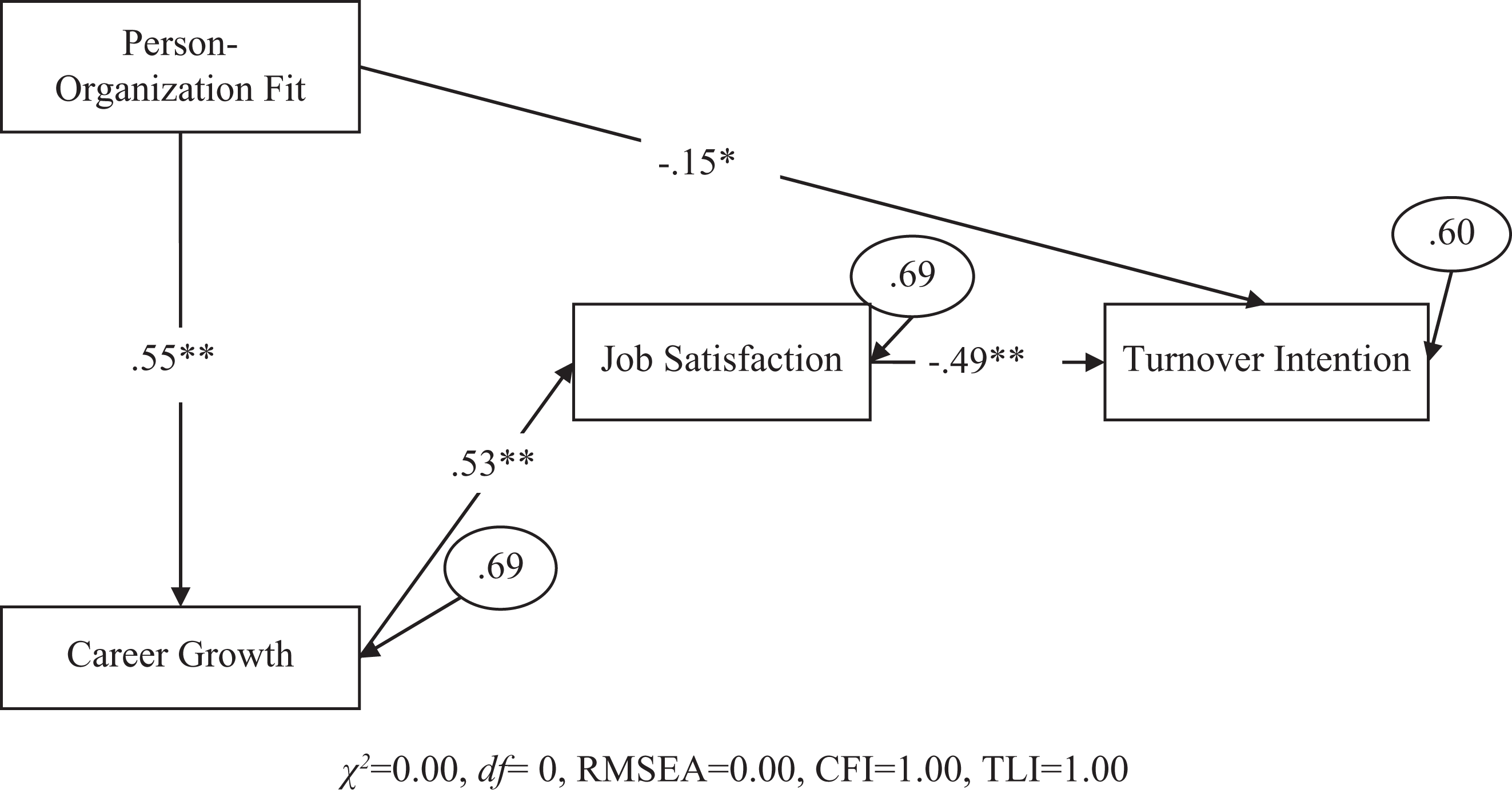
Standardized path estimations of the overall hypothetical model.
Results
Means, standard deviations, and correlations of all measured variables were displayed in Table 1. The significant correlations between the previously investigated variables suggested the existence of the hypothesized underlying mediating mechanisms (Wen, Hau, & Chang, 2005). Results indicated that turnover intention was negatively associated with P-O fit (r = −.40, p < .01), career growth (r = −.51, p < .01), and job satisfaction (r = −.60, p < .01), while job satisfaction was positively correlated with P-O fit (r = .34, p < .01) and career growth (r = .59, p < .01). Also, P-O fit demonstrated a positive relationship with career growth (r = .50, p < .01).
Means, Standard Deviations, and Correlations for All Variables.

Note. N = 323. Fit = P-O fit; CG = career growth; JS = job satisfaction; TI = turnover intention. Education level was recoded as 1 = less than a college education, 2 = bachelor’s degree, 3 = master’s degree, 4 = doctorate degree; Length of work (in the current organization): total work month.
*p < .05. **p < .01.
As shown in Figure 2, because the whole model had only one solution it was perfectly fitted (χ2 = .00, df = 0, RMSEA = .00, CFI = 1.00, TLI = 1.00). The control variable of total months of work was not significantly associated with any of the four investigated variables. P-O fit and career growth could jointly explain 31% (by subtracting .69, which was the unexplained variance of job satisfaction, from 1) of the variance of job satisfaction. And P-O fit, career growth, and job satisfaction could jointly predict 40% (subtracting .60 from 1) of the variance of turnover intention. P-O fit and job satisfaction all significantly (p < .01) and negatively predicted turnover intention, with direct effect of −.15 and −.49, respectively.
Career Growth as a Predictor for Turnover Intention and Job Satisfaction
To test the mediation effects of Hypotheses 2 and 4, the bootstrap method outlined by Preacher and Hayes (2008) was adapted for its advantages over Sobel test (Hayes, 2009). The total, direct, and indirect effects of the path analysis was shown in Table 2. Combing results from Figure 2 and Table 2, career growth showed strong positive effect (β = .53, p < .01) on job satisfaction and it also showed a total effect of −.37 (p < .01) on turnover intention (see Table 2). Although its indirect effect through job satisfaction’s mediation was −.26 (p < .01), career growth did not show a significant direct effect on turnover intentions. Correlation analysis results showed that career growth was strongly correlated with turnover intentions (r = −.51, p < .01). These results suggested that career growth did have critical negative effect on turnover intentions, yet this impact was fully mediated by job satisfaction. Therefore, Hypothesis 1 (effects of career growth) was partly supported and Hypothesis 2 (mediation of job satisfaction) was fully confirmed.
Total, Indirect and Direct Effects of the Path Analysis Model.
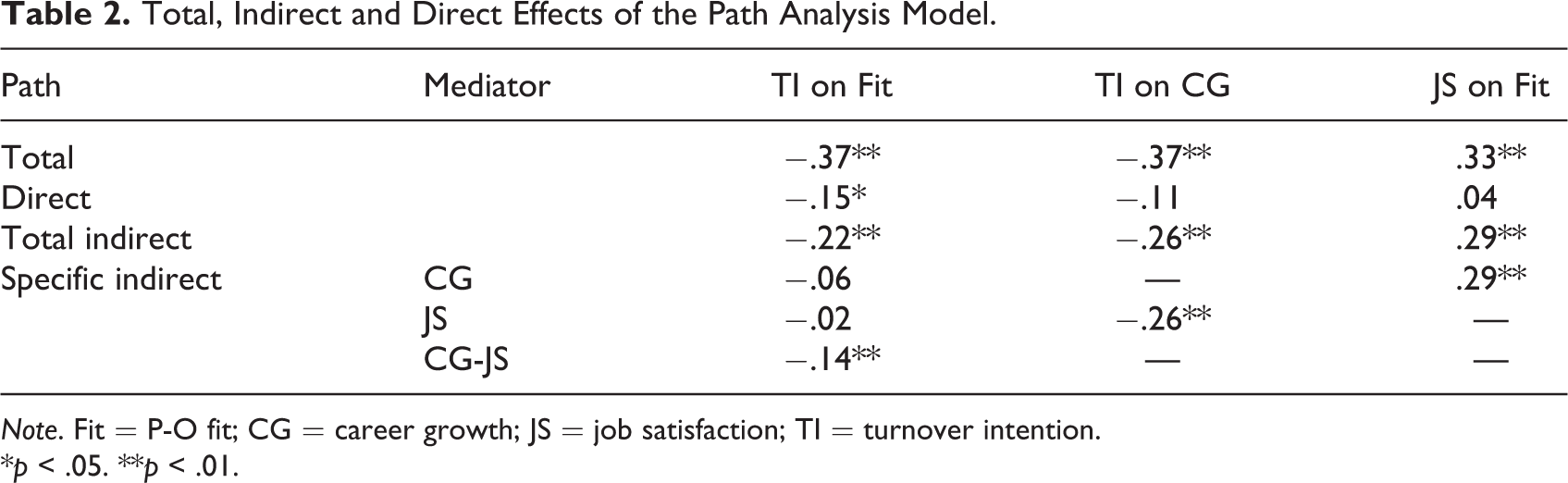
Note. Fit = P-O fit; CG = career growth; JS = job satisfaction; TI = turnover intention.
*p < .05. **p < .01.
P-O Fit as a Predictor for Turnover Intentions
As shown in Table 2, P-O fit had a high total effect on turnover intentions (β = −.37, p < .01). Its direct effect was −.15 (p < .05) that constituted 41% of the total effect, with the left 59% as indirect effect (β = −.22, p < .01). Figure 2 also illustrated the mediating mechanism that career growth and job satisfaction jointly mediated the influence of P-O fit on turnover intentions.
Career Growth as a Mediator
P-O fit had a strong positive impact on career growth (β = .55, p < .01), which confirmed Hypothesis 3. Also, as mentioned previously, career growth positively predicted job satisfaction (β = .53, p < .01). Moreover, the bootstrap estimation confirmed that the indirect effects (via career growth) of P-O fit on job satisfaction was significant (β = .33, p < .01), and P-O fit did not show significant direct effect on job satisfaction. Therefore, P-O fit enhanced job satisfaction mainly through its indirect positive impact through career growth. So far, our exploratory Hypothesis 4 was supported that career growth fully mediated the influence of P-O fit on job satisfaction. In addition, bootstrap estimation showed that the specific indirect effect of P-O fit on turnover intention through first career growth’s full mediation and then job satisfaction’s full mediation was significant (β = −.14, p < .01, see Table 2).
Discussion
This study centered on the role of career growth fitting into the original framework of TWA to promote understanding of the turnover process of Chinese new employees. First, results revealed the significant impact that career growth had on new employees’ job satisfaction. Job satisfaction, according to TWA, could reflect how well the organization has satisfied the employee’s need (Dawis, 1994). And career growth, as achieving career goals, promoting professional abilities, and gaining rewards, reflects one’s subjective evaluation of how promising one’s career growth desire could be fulfilled by the organization. In this sense, if career growth is well accomplished, it is reasonable that employees tend to be more satisfied with their current job, thus having weaker intention to leave the organization. Otherwise, the benefit of better career growth outlook to other organizations would easily surpass the cost of leaving the current organizations and thus lead to turnover.
Second, this study also demonstrated the complete mediation of career growth in the original TWA model, which helped to further our understanding about how P-O fit predicts job satisfaction which was not originally hypothesized in TWA. Our findings supported the claims in motivational theories that employees who have congruent characteristics with their organizations will expect a greater likelihood that their efforts be recognized and rewarded by the organization thus achieve better career growth (Bretz & Judge, 1994; Dawis & Lofquist, 1984). Moreover, in comparison to previous studies which included only objective criteria like actual promotion or pay raise as mediation variables and only found a small marginal effect (Bretz & Judge, 1994), the use of career growth in this study captures both the objective and the subjective aspects of career success and thus provided a more comprehensive account of the various effects.
Combing the previous two points, career growth’s key role as both predictor and mediator justified for its importance to Chinese new employee. They serve their organizations and in return, they expect to be facilitated with personal career goal progress, professional ability development, and be recognized in terms of promotion and pay rise. This individualist perspective of keeping an economical balance between benefit of career growth and cost of turnover revealed the transactional nature of the employ–employer relationship and is quite similar to the situation that Western employees’ psychological contracts also have shifted toward more transactional (vs. relational) forms (Rousseau, 2003). Moreover, career growth suggested a self-fulfillment emphasis of the Chinese new employees in their early careers. Their need for growth and self-reliance is similar to the Western employees’ protean career attitude which emphasizes individual control and skills development above and beyond organizational career management (Volmer & Spurk, 2011). From the protean career perspective, being more self-reflective and having strong internal compass to grow, achieve, and reach one’s full potential is conducive to flourish in a volatile environment (Hall, 2004). Therefore, for Chinese employees who might share with protean careerist’s view, seeking career growth might also be a functional manner to adapt and to adjust to the fast changing career context in China. Understanding the career attitudes of the Chinese new employees is crucial for both Chinese and global organizations in order to create mutual beneficial work relationships with this population.
Third, results showed that job satisfaction fully mediated the effect of career growth on turnover intention of Chinese new employees. This could be better understood by comparing job satisfaction and affective occupational commitment which showed partial mediation in a general Chinese employee sample between career growth and turnover intentions (Weng & McElroy, 2012). Affective occupational commitment by its definition as the “psychological link between a person and his or her occupation that is based on affective reaction to that occupation” (Lee, Carswell, & Allen, 2000, p. 800) emphasizes more on employee’s attachment specific to their occupation, while job satisfaction is more general. For Chinese new employees in their early careers, occupational commitment is typically lower (Goulet & Singh, 2002) than those with longer working experience; thus, overall job satisfaction may play a more crucial role in one’s early career stage.
Finally, to our surprise, career growth’s direct impact on turnover intention was insignificant, which appears inconsistent with previous findings showing that career growth was directly associated with turnover intentions (Weng & Hu, 2009; Weng & McElroy, 2012). After accounting for the salient mediation of job satisfaction, this may also suggest possible moderators between career growth and turnover intentions. For instance, research reported that for employees with higher career commitment and higher perceived opportunities, career growth manifested a stronger predicting power on turnover intention (Weng & Xi, 2010). Moreover, other research of Asian population found that careerist orientation and career growth opportunities had interactional effects on turnover intentions (Chay & Aryee, 1999). For those employees with attitudes resemble careerist orientation, career growth may have stronger impact on turnover intention, whereas for those with lower careerist orientation, they may prefer organizational reward other than career growth, such as job security or stability (Fatimah, Noraishah, Nasir, & Khairuddin, 2012). With possible moderators unclear, the different impacts of career growth on turnover intention of different subgroups may be confounded thus to dilute career growth’s effect.
Implications
The above-mentioned findings have implications for both individual and organization. For organizations, first, they could enhance employees’ job satisfaction and then retain new employees by addressing their need for career growth. Communicating with new employees on personal career goals and progress expectations and then accommodating their goals with the organization’s mission could help build a mutual beneficial relationship. Organizational rewards and career planning service or training opportunities that aims to help employees achieve goals and grow professional ability would also enhance employees’ perceived career growth. When new employees are guided with clear and attainable career growth plans within the organization and provided with a variety of continuous learning opportunities, they would feel more satisfied with their job, and become more motivated to grow within the organization rather than try to change organizations for such growth.
To promote employee’ career growth, P-O fit could be one possible way that organization should be aware of. Assessment of fit during selection stage would surely benefit later organization socialization strategies. However, since P-O fit would also develop over time with the change of employees in the organization (Schneider, 1987), keeping a certain level of cultural openness that could incorporate new employees’ personal value or even coconstruct organizational culture with core employees would help build good fit in the long run. Taking one step back, even if promoting P-O fit is not feasible within a short term, human resource managers could still use career growth as leverage for intervention to minimize the negative effects that poor fit exerted on new employees’ turnover intentions while gaining more time to improve fit. Improving employees’ perception of career growth would be a timely method compared to changing organizational culture to achieve better fit. Moreover, since both P-O fit and career growth’s influence on turnover intention rely heavily on job satisfactions, managers should also explore strategies aiming at increasing employee job satisfaction. As long as organizations could keep a good level of employee satisfaction, the negative impact caused by lack of fit or career growth could be well managed.
As for the new employees in their career exploration and initial establishment stage, it is wiser to choose an organization that respects their employees on who they are and is supportive about whom they want to be in the future. A good level of fit would set base for better career growth and promote one’s subjective well-being in the workplace. Even if fit is not yet achieved, individuals could still seek career growth as a work-adjustment strategy. Individual factors like proactive traits (Van Veldhoven & Dorenbosch, 2008) and human and social capital (Metz & Tharenou, 2001) could also benefit one’s career growth. Individuals, striving to attain career growth, would be more satisfied with their job and organization while also keeping up their employability in face of environment uncertainty.
Limitations and Future Research Directions
The results of this study should be viewed in light of its limitations. First, the results of this study are based on the Chinese new employee sample that is specifically limited in age, tenure, and cultural background variation. In addition, we only collected data from new employees in Beijing. This sample might be a biased representation of the new employee group since Beijing is one of the most competitive and modernized cities in China. Employees in Beijing would have more job alternatives and endure fiercer competition and tougher employer requirements than that of other cities in China. Future research should sample from places with various levels of economic and social development to check for possible context influences. Also, by including subjects of various age or tenure periods and retesting whether the results here are only specific to the new employee sample, future research could expand the knowledge of career growth’s role across different career stages. Moreover, although we argue that the important role of career growth suggests similarity between Chinese and Western employees, we did not directly compare career attitudes using cross-cultural samples, so cultural generalizability of the results still calls for further examination.
Second, the cross-sectional nature of our data raises doubts about the directionality of variables. We emphasized how P-O fit would affect career growth in the current model, yet a bidirectional relationship could be expected as well in that the employees who have achieved better career growth (e.g., being rewarded by higher salary or better promotion chances) are motivated to adjust themselves to fit into the organization, resulting in a better fit. This possibility calls for longitudinal data collection or experimental manipulation that could shed more light on the directionality of correlated variables.
Third, the P-O fit measure in our study was a single-dimensional integrative construct including both complementary and supplementary conceptualizations of fit (Bretz & Judge, 1994), and recent research showed that different types of fit have different predictive value on job outcomes (Greguras & Diefendorff, 2009). In our study, we intended to grasp the general impact of P-O fit and career growth so we use the general measure of fit and did not differentiated among specific dimensions of career growth therefore could not provide details about specific mechanism within the concept of P-O fit or career growth. This may render the risk of confounding potential differences. Given our primary support on P-O fit’s positive impact on career growth, it would be interesting to probe into the specific mechanism that different conceptualizations of fit has on career growth, or to clarify the specific role of different dimensions of career growth on related work outcomes.
Fourth, we made general claims of the Chinese new employee population’s career attitudes as a whole and left potential individual differences within this population to be examined next. For example, different career commitment levels or perceived opportunities (Weng & Xi, 2010), careerist orientation (Chay & Aryee, 1999), risk-aversion, and need for achievement (Turban, Lau, Ngo, Chow, & Si, 2001) may affect career growth’s effect on turnover intention. Lack of considerations of personal factors may conceal potential individual differences within the population thus calls for future research to add personal factors like protean career attitude or work value orientation to promote understanding of this population.
Conclusions
This study examined Chinese new employees’ turnover mechanism in the new career era. First, the important role of career growth of predicting job satisfaction and turnover intentions suggested a self-growth and self-improvement emphasis for the Chinese new employees in their early career. Second, the complete mediation effect of career growth between P-O fit and job satisfaction expanded TWA’s knowledge by providing a possible explanation on how P-O fit predicts job satisfaction and turnover intentions and by suggesting career growth as a possibly important reinforcement factor of TWA in the new career era. Finally, the positive effect of P-O fit on career growth enhanced understanding of the determinants of career growth under the P-E fit framework of TWA.
Footnotes
Declaration of Conflicting Interests
The author(s) declared no potential conflicts of interest with respect to the research, authorship, and/or publication of this article.
Funding
The author(s) received no financial support for the research, authorship, and/or publication of this article.