



Abstract
The purpose of this study was to examine the main and interactive effects of four dimensions of professional commitment on strain (i.e., depression, anxiety, perceived health status, and job dissatisfaction) for a sample of 176 law professionals. The study utilized a two-wave design in which professional commitment and strain were measured at Time 1 and strain was measured again at Time 2 (T2), 2 months later. A significant two-way interaction indicated that high affective commitment was related to less T2 job dissatisfaction only for lawyers with low accumulated costs. A significant four-way interaction indicated that high affective professional commitment was only related to fewer symptoms of T2 anxiety for lawyers with high normative professional commitment and both low limited alternatives and accumulated costs. A similar pattern of results emerged in regard to T2 perceived health status. The theoretical and practical implications of these results for career counselors are discussed.
Vocational psychology has long been interested in the influence of individual characteristics on career outcomes (Conklin, Dahling, & Garcia, 2013). One such variable is commitment. Commitment has been defined as “a force that binds an individual to a course of action of relevance to one or more targets” (Meyer & Herscovitch, 2001, p. 301). While commitment can take various forms (e.g., commitment to organizations; Meyer & Allen, 1991; Mowday, Porter, & Steers, 1982), the study of professional commitment (PC; or occupational or career commitment) has become an increasingly important focus of study. PC has been defined as “one’s attitude towards one’s profession or vocation” (Blau, 1985, p. 278); “the relative strength of identification with and involvement in one’s profession” (Morrow & Wirth, 1989, p. 41); “one’s motivation to work in a chosen vocation” (Carson & Bedeian, 1994, p. 240); and “the loyalty an employee holds towards their professional career” (Wallace, 1997, p. 229).
PC is intertwined with the development of a professional identity (Nägele & Neuenschwander, 2014). Commitment creates a link between the individual and a social structure and plays a central role in the connection between the individual and the society (Burke & Reitzes, 1991). Accordingly, commitment may be seen as connecting an individual to a stable set of self-meanings (i.e., identity; Burke & Reitzes, 1991). It has been asserted that an individual with a strong PC will more strongly identify with the occupation than will one with weak PC (Lee, Carswell, & Allen, 2000). Occupational identity has been defined as the “clear perception of occupational interests, abilities, goals and values, and the structure of the meanings that link these self-perceptions to career roles” (Hirschi, 2012, p. 480). Occupational identity is considered a core component of identity, and the occupation is viewed as a means of social integration and developing and expressing one’s identity in general (Skorikov & Vondracek, 2011).
Occupational identity stems from Social Identity Theory (Tajfel & Turner, 1986), which maintains that individuals draw a sense of self from their affiliations with others. Social identity is defined in many ways; however, a common component is inclusion of group membership as part of one’s self-concept (Riketta, 2005). Tajfel (1978) defined social identity as “that part of an individual’s self-concept which derives from his knowledge of his membership of a social group (or groups) together with the value and emotional significance attached to that membership” (p. 63). Employee identity and commitment accordingly form two aspects of attachment (Meyer, Becker, & van Dick, 2006). Attachment to a profession arises from repeated engagement in specialized activates, skills building, and intensive and exclusive socialization processes (Lammers, Atouba, & Carlson, 2013). Individuals can form multiple social identities and social identities consist of cognitive, affective, and evaluative components (Meyer et al., 2006).
There is little consensus regarding the nature of the relationship between social identities and commitment (Meyer et al., 2006). It has been argued that identification is tantamount to commitment (Ellemers & Rink, 2005), a greater whole of which commitment is a part (Ashmore, Deaux, & McLaughlin-Volpe, 2004; Ellemers, De Gilder, & Haslam, 2004), or a precursor to commitment (Ashforth & Mael, 1989; Meyer, Becker, & Vandenberghe, 2004). However, there is empirical evidence social identities are antecedents to commitment (Bergami & Bagozzi, 2000; Foreman & Whetten, 2002). It has further been argued that occupational identity is an important influencer of occupational commitment (Baruch & Cohen, 2007). In addition, recent research indicates perceived person–occupation fit is an important predictor of occupational commitment (Nägele & Neuenschwander, 2014). Nägele and Neuenschwande conceptualized fit perception as a result of value congruence between the individual and the profession, established during the vocational choice process.
Main Effects of PC for Employees
There is accumulating evidence that strong affective PC, that is, a strong emotional attachment to, and identification with, one’s occupation is beneficial for employee’s well-being. In their meta-analytic review, Lee, Carswell, and Allen (2000) found that affective occupational commitment was positively related to job satisfaction and negatively related to burnout. Miller, Ellis, Zook, and Lyles (1990) found that affective PC was negatively correlated with burnout for hospital workers, and Yeh, Ko, Chang, and Chen (2007) found that affective PC was negatively correlated with nurse stress. Multiple regression analyses have found that affective PC is directly related to reduced tension (Cohen, 1998) and burnout (Reilly, 1994) in nurses. Research further indicates that career commitment (i.e., “an affective or emotional attachment to a defined line of work”; Carless & Bernath, 2007, p. 185) is related to job satisfaction (Duffy, Dik, & Steger, 2011).
PC: A Multidimensional Construct
Research indicates that commitment is a multidimensional construct (Meyer & Allen, 1991). Meyer, Allen, and Smith (1993) found empirical support for a three-dimensional structure of PC comprising affective, normative, and continuance dimensions. Normative PC refers to an employee’s sense of obligation to remain in their occupation; and continuance PC is an employee’s evaluation of the costs of leaving their occupation. Each form of commitment is accompanied by differing psychological states or mind-sets (Meyer & Herscovitch, 2001). Employees with strong affective PC are deeply involved with their profession and have a strong desire to continue their professional association and engage in supportive behavior. In contrast, employees with strong normative PC base their association and any accompanying behaviors on a felt obligation. Last, employees with strong continuance PC are aware of the potential high costs of discontinuing the association with one’s profession (Meyer, Maltin, & Thai, 2012). There is some disagreement about whether continuance commitment is a unidimensional construct (e.g., McGee & Ford, 1987; Vandenberghe & Panaccio, 2012). Indeed, Blau (2003) found support for two dimensions of continuance PC, namely, accumulated costs PC (i.e., the perceived sacrifices and costs associated with leaving one’s profession) and limited alternatives PC (i.e., a lack of available professional alternatives).
Interactive Effects of PC
Meyer and Allen (1997) proposed that, if commitment is a multidimensional construct, employees could experience more than one mind-set simultaneously, for example, both a desire (affective PC) and an obligation (normative PC) to remain in a profession (Gellatly, Meyer, & Luchak, 2006). Further, Meyer and Herscovich (2001) proposed that, because only one form of commitment is necessary to influence focal behavior, the relationship between one form of commitment and behavior would be strongest when the other forms of commitment are weak. For example, in examining occupational withdrawal intentions among human resource management specialists, Snape and Redman (2003) found that normative PC was only related to withdrawal cognitions at low levels of continuance PC. Further, Blau and Holladay (2006) found that higher levels of normative PC were only related to lower professional withdrawal intentions at low levels of accumulated costs or limited alternatives PC.
Subsequent research has indicated that the way in which a particular dimension of commitment relates to behavior is influenced by the context created by the other dimensions (Gellatly et al., 2006; Meyer, Stanley, & Parfyonova, 2012). This research has typically examined commitment to other foci, such as the organization (organizational commitment [OC]). In a study of Turkish employees, Wasti (2005) found that employees with strong affective OC, and strong combined affective and normative OC, experienced less job stress than employees with strong continuance OC and employees with weak commitment on all three dimensions. In a study of U.S. nurses, Somers (2009) found that strong combined affective and normative OC was related to lower levels of job stress and carryover stress. In a study of Greek public sector employees, Markovits, Davis, and van Dick (2007) found the highest level of job satisfaction among employees with high affective OC, high combined affective and normative OC, and high commitment on all three dimensions. Recently, Meyer, Stanley, and Parfyonova (2012) found the highest levels of well-being (positive affect, work engagement, lower negative affect, and fewer physical health complaints) among human service employees with strong combined affective and normative OC. Gellately et al. (2006) proposed that when strong normative commitment was combined with strong affective commitment, it might be experienced as a moral imperative (a desire to do the right thing), whereas when combined with strong continuance commitment it might be experienced as an indebted obligation (something an employee has to do to meet obligations).
Research relating to continuance commitment has focused on the organization and suggests that the mind-set and outcomes associated with continuance OC can vary with the context created by the other dimensions of commitment. Meyer, Stanley, & Parfyonova (2012) found that strong continuance OC was associated with improved well-being when combined with strong affective and normative OC compared to when combined with weak affective and normative OC. This finding is consistent with earlier studies (e.g., Somers, 2009; Wasti, 2005) indicating a strong continuance OC does not necessarily mitigate the effects of strong affective OC (Meyer, Stanley, & Parfyonova, 2012). Meyer et al. proposed that when combined with weak affective OC and normative OC, continuance OC might be experienced as a threat of losing economic benefits; however, when combined with strong affective OC and normative OC, it might be experienced as a loss of valued opportunities or resources.
Overall, previous OC research suggests that, when combined with strong affective OC, normative OC is experienced as a “moral imperative” and is associated with more positive outcomes than when combined with strong continuance OC (Gellatly et al., 2006; Meyer & Parfyonova, 2010). Further, the way continuance OC is experienced can have important consequences for employees (Meyer, Stanley, & Parfyonova, 2012). Collectively, the findings suggest that conclusions based upon the direct relationships between the individual dimensions of commitment and the outcome variables may be misleading, and the combined influence of all dimensions must be examined (Meyer, Maltin, & Thai, 2012).
The Present Study
The purpose of the present study was to examine the interactive effects of PC on a variety of different indicators of strain (operationalized as depression, anxiety, perceived health status, and job dissatisfaction) for a sample of lawyers using a two-wave design in which baseline levels of Time 1 (T1) strain were controlled for in the prediction of Time 2 (T2), thereby controlling for other factors that influence distress, and strengthening causal inferences (Breslin & Mustard, 2003).
Lawyers were selected as participants for the present study, as the legal profession is a distinct professional group, loyal to a particularly powerful professional body that defines its training requirements, sets professional standards, controls admission, and is able to discipline its members (Gunz & Gunz, 1994). Commitment reportedly intensifies for established and prestigious professions such as the law, where members possess socially valued and unique knowledge and skills (Loi, Hang-yue, & Foley, 2004). Indeed, previous research indicates that lawyers are more committed to their careers and professions than their employing organization (Wallace, 1995). Further, Irving, Coleman, and Cooper (1997) propose that, when individuals undertake a significant amount of education and/or training in acquiring a skill set, such as in the legal profession, they might feel more bound to the profession due to their greater personal investments.
Lawyers were further selected due to the reported elevated levels of strain within the legal profession. A recent study of 17,980 Australian professionals indicated that lawyers were the most likely to have experienced symptoms of anxiety (34%) and depression (49%; beyondblue, 2011). This research mirrors U.S. research reporting that lawyers are the most depressed of 105 professions (Eaton, Anthony, Mandel, & Garrison, 1990). Thus, the legal profession is a professional group to which PC and its relationship with stress reactions may have important significance.
The present study utilized a two-dimensional measure of continuance PC (examining accumulated costs PC and limited alternatives PC) to provide a more complete understanding of lawyers’ continuance commitment to their profession. Accordingly, the purpose of the present study is 2-fold, first to examine the unique contributions of affective, normative, accumulated costs, and limited alternatives PC in predicting strain (i.e., depression, anxiety, perceived health status, and job dissatisfaction) for a sample of lawyers (Hypothesis 1), and second, because the utility of some dimensions of PC may be dependent on the context created by the others, to examine the interactive effects among affective, normative, accumulated costs, and limited alternatives PC in predicting strain (Hypothesis 2).
Method
Design, Procedure, and Participants
The sample was composed of lawyers from five Australian states and territories. A two-wave research design was used in which the predictor and outcome variables were measured via an online self-report questionnaire at T1, and the outcome variables were assessed again at T2, approximately 2 months later, which will enable baseline levels of T1 strain to be controlled for in the prediction of T2 strain.
Five Australian Law Societies agreed to include a link to the T1 questionnaire in their monthly electronic newsletters to members, and participants who indicated they would like to participate again at T2 were directly e-mailed the follow-up questionnaire. A total of 447 participants completed the T1 questionnaire. Cases were removed from the sample if they were identified as a trainee lawyer (n = 6 trainees; n = 3 did not specify) and/or their current employment status was not full time (n = 47 part time; n = 7 casual; n = 8 did not specify). The study focused on full-time employees due to findings that part-time employees are less committed than their full-time colleagues (Conway & Briner, 2002). In total, 61 cases that fell into one or more categories were removed, leaving 386 T1 participants.
Of the 386 eligible T1 participants, 197 completed the T2 questionnaire. Cases were removed if they could not be matched to T1 data (n = 21), leaving N = 176 participants who completed both the T1 and T2 questionnaire for the final analysis (representing 45.60% of the eligible T1 sample). Analyses were conducted to establish if there were any significant differences between participants who completed the T1 questionnaire and participants who completed the questionnaire at both time points. Chi-square analyses revealed no significant differences between the two groups for gender, χ2(1, 385) = 0.13, p = .399, or type of workplace (i.e., small, medium, or large private practice; government department; in-house counsel; and other), χ2(5, 386) = 6.95, p = .224. Independent groups t-tests indicated there were no significant differences between the two groups for age, tenure with current employer, or the T1 PC variables. However, analyses of the T1 outcome variables indicated that participants who completed only the T1 questionnaire experienced higher T1 anxiety, t(383) = 2.44, p = .015, and poorer T1 perceived health status, t(377) = 2.14, p = .033, compared to participants who completed both questionnaires.
To summarize, participants were 176 full-time Australian lawyers (108 females and 68 males). Mean age was 38.61 years (SD = 11.72). Participants were from small private practices (36.36%), medium private practices (19.32%), large private practices (21.02%), government departments (9.66%), in-house counsel (5.68%), and 7.95% in “other settings.” Participants had been practicing law for an average of 13.23 years (SD = 10.96) and had been working for their current employer for an average of 7.46 years (SD = 8.18).
Measures
Professional Commitment was assessed using 20 items from Blau’s (2003) four-dimensional PC scale, with the occupational referent being changed to “legal profession.” Participants indicated the extent to which they agreed with statements relating to their views on being a member of the legal profession on a 7-point scale with anchors of 1 = strongly disagree to 7 = strongly agree. Sample items include: “The legal profession is important to my self-image” (affective PC; 6 items); “I feel an obligation to remain in the legal profession” (normative PC; 6 items); “I have too much time invested in the legal profession to change occupations” (accumulated costs PC; 4 items); and “Given my background and experience, there are other attractive alternatives available to me in other professions” (limited alternatives PC; 4 items). For each dimension, items were averaged to create a scale score, with higher scores indicating greater commitment. All limited alternatives PC items were reverse scored so that higher scores indicated fewer available alternatives. Four accumulated costs PC items from the original 8-item scale which related to emotional costs (e.g., “leaving [occupation] would cause emotional trauma for me”) were removed due to Blau (2003) reporting that these items had lower variance estimates and that two of these items were ambiguous. Accordingly, the accumulated costs PC scale in the present study focused on the occupational investment made by lawyers. Previous psychometric analyses by Blau (2003) indicated acceptable fit for the four-factor model, and reliabilities of .91, .90, .88, and .93, respectively. Cronbach’s αs in the present study were .90, .91, .83, and .92, respectively.
The dimensionality of the 20-item PC scale (particularly accumulated costs PC and limited alternatives PC) was examined using confirmatory factor analysis (CFA) and the maximum likelihood method of estimation. A model including the four commitment dimensions as distinct factors yielded modest fit to the data, χ2(164) = 402.52, p < .001; Tucker–Lewis index (TLI) = .90; comparative fit index (CFI) = .90; and root mean square error of approximation (RMSEA) = .09. A three-factor model that merged accumulated costs PC and limited alternatives PC into a single continuance PC factor (see Meyer et al., 1993) was run, indicating a significant decrement in fit, Δχ2(Δdf = 3) = 342.21, p < .001 and poorer fit indices: TLI = .78; CFI = .81; RMSEA = .13. These results suggest accumulated costs PC and limited alternatives PC are distinguishable factors within continuance commitment. The four-factor model was superior to a one-factor model, Δχ2(Δdf = 1) = 1447.48, p < .001; TLI = .15; CFI = .32; RMSEA = .24.
Depression was assessed with 7 items from the short-form Depression Anxiety Stress Scale (DASS-21; Lovibond & Lovibond, 1995) that assess dysphoric mood states, including lack of interest or involvement, hopelessness, anhedonia, and self-depreciation (Lovibond & Lovibond, 1995). A sample item is “I felt down-hearted and blue.” Respondents were asked how they felt over the past week on a 4-point scale with anchors of 0 = did not apply to me at all to 3 = applied to me very much or most of the time. The scale score was computed by summing scores on the 7 items, with higher scores indicating greater severity or frequency of depression symptoms. Previous research indicates the DASS-21 depression subscale evidences good convergent and discriminant validity when compared with other validated measures of depression and anxiety (e.g., the Hospital Anxiety and Depression Scale), and internal reliability in a nonclinical sample has been reported as .88 (Henry & Crawford, 2005). Cronbach’s α in the present study was .92 at both T1 and T2.
Anxiety was assessed with 7 items from the DASS-21 (Lovibond & Lovibond, 1995) that assess arousal states, including autonomic arousal, muscular tension, and anxious affect. A sample item is “I felt I was close to panic.” Respondents were asked how they felt over the past week on a 4-point scale with anchors of 0 = did not apply to me at all to 3 = applied to me very much or most of the time. The scale score was computed by summing scores on the 7 items, with higher scores indicating greater severity or frequency of anxiety symptoms. Internal reliability for the DASS-21 anxiety subscale in a nonclinical sample has been reported as .82 (Henry & Crawford, 2005). Cronbach’s α in the present study was .81 at both T1 and T2.
Perceived health status was assessed using an overall health evaluation item from the Short-Form Health Survey (Ware & Sherbourne, 1992). The item asked participants to rate their general health on a 5-point scale with anchor points of 1 = excellent to 5 = poor. Higher scores indicated poorer perceived health status. A large number of empirical studies have demonstrated that an individual’s own appraisal of his or her general health is a strong predictor of future morbidity and mortality, even after controlling for a range of physical, sociodemographic, and psychosocial factors (Eriksson, Undén, & Elofsson, 2001). Research further indicates that noncomparative, single-item measures of self-rated health display strong correlations with physical health conditions and are appropriate for use in longitudinal studies (Eriksson et al., 2001).
Job dissatisfaction was assessed with 1 item taken from Warr (1991) asking if participants were satisfied with their job on a 7-point scale with anchor points of 1 = strongly disagree to 7 = strongly agree, which was then reverse scored. Higher scores indicated greater job dissatisfaction. A meta-analysis conducted by Wanous, Reichers, and Hudy (1997) of single-item measures of overall job satisfaction found acceptable psychometric properties for such measures including convergent validity with other multi-item job satisfaction scales.
Results
Preliminary Analyses
Table 1 displays the means, SDs, score ranges, and correlations for the focal variables. Preliminary analyses indicated violations of normality, with depression and anxiety scores at both time points positively skewed toward the normal–mild range of severity, which is consistent with normative data for the DASS-21 (Henry & Crawford, 2005). In accordance with the recommendations by Tabachnick and Fidell (2007), square root transformations were applied and the analyses run with and without the transformations. Analyses on the original data were reported for ease of interpretation, as transformations did not alter the substantive interpretations of the results. With regard to the demographic variables, independent groups t-tests revealed no significant relationships of gender with PC dimensions or T1/T2 strain. An analysis of variance indicated no influence of type of workplace on any PC dimension or T1/T2 strain (cf. Wallace, 1995). Correlations indicated that older lawyers reported higher limited alternatives PC, r = .22, p = .004, as did those lawyers with longer tenure, r = .32, p < .001. Age was significantly negatively correlated with T2 anxiety, r = −.20, p = .008, and was, therefore, controlled for in subsequent analyses. Tenure was not controlled for due to the significant positive correlation between tenure and age (r = .82, p < .001) and missing data on the tenure variable (n = 36).
Means, Standard Deviations, Score Ranges, Reliabilities, and Correlations.
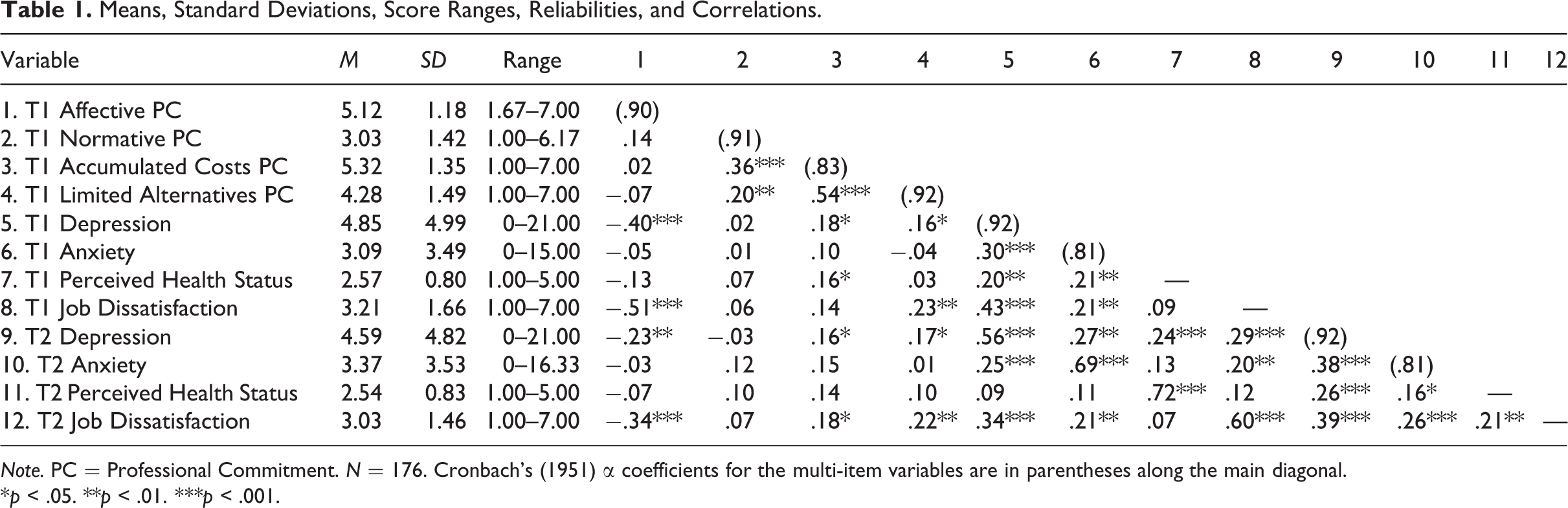
Note. PC = Professional Commitment. N = 176. Cronbach’s (1951) α coefficients for the multi-item variables are in parentheses along the main diagonal.
*p < .05. **p < .01. ***p < .001.
Data Analysis Overview
Four hierarchical multiple regression analyses were conducted for each T2 outcome variable (see Table 2). The corresponding T1 strain variable was controlled in Step 1 of each regression analyses so as to strengthen the argument that the predictor variables play a causal role in relation to T2 strain (Cohen, Cohen, West, & Aiken, 2003; Finkel, 1995). Predictor variables were expressed in mean deviation form and interaction terms were the product of these mean-centered variables (Aiken & West, 1991). Significant interactions were interpreted with simple slope analyses, using the unstandardized regression coefficients (B) for lawyers low (1 SD below mean) and high (1 SD above mean) on the moderator variable (Jaccard, Turrisi, & Wan, 1990).
Hierarchical Multiple Regression Analysis of the Professional Commitment Dimensions on T2 Strain.
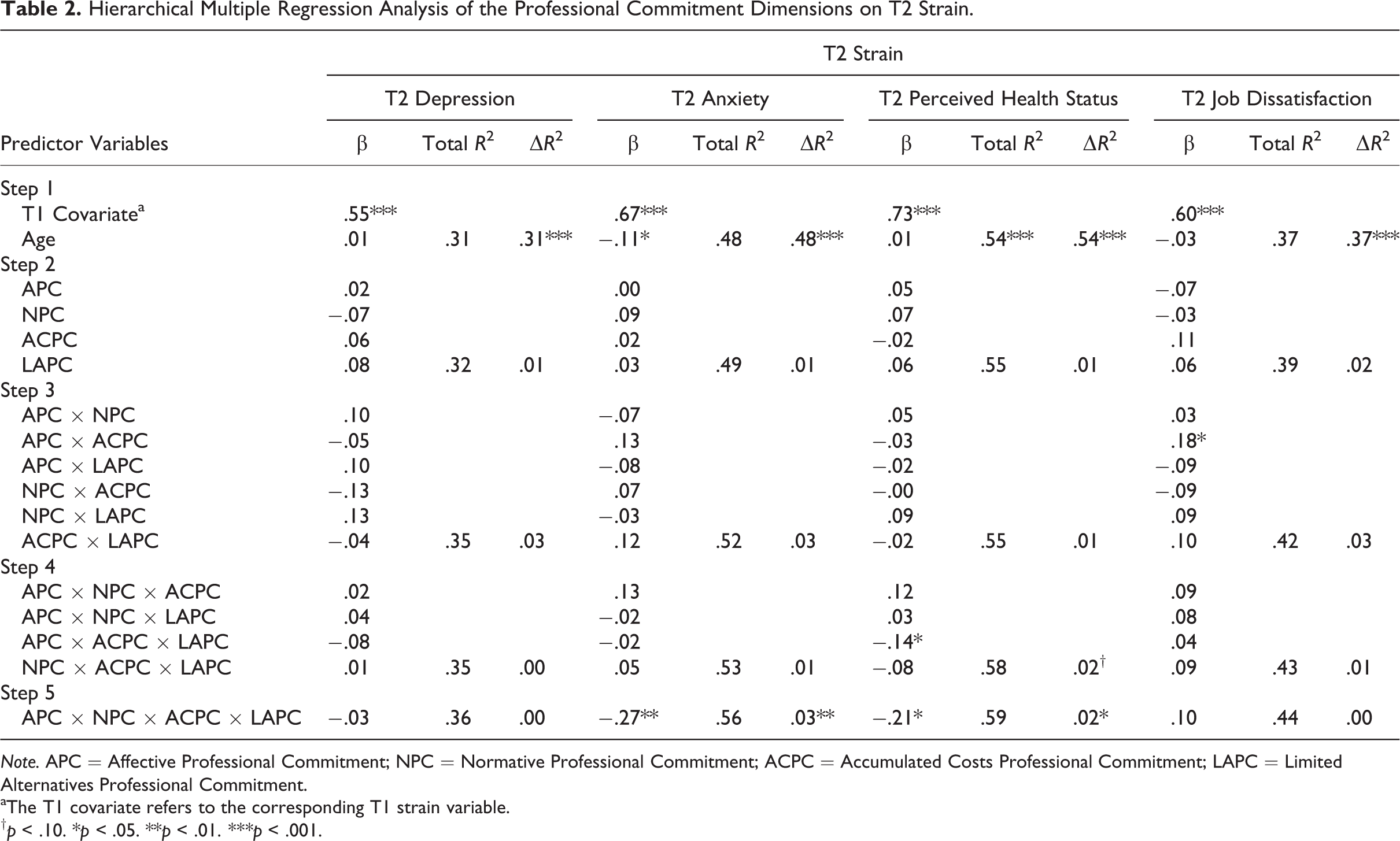
Note. APC = Affective Professional Commitment; NPC = Normative Professional Commitment; ACPC = Accumulated Costs Professional Commitment; LAPC = Limited Alternatives Professional Commitment.
aThe T1 covariate refers to the corresponding T1 strain variable.
†p < .10. *p < .05. **p < .01. ***p < .001.
Main and Interactive Effects
As to be expected, all four indicators of T1 strain predicted these outcomes at T2. Age had a significant negative main effect on T2 anxiety, indicating that older lawyers experienced fewer symptoms of anxiety. Entry of the four PC dimensions indicated that no PC dimensions had a significant main effect on T2 strain. Entry of the two-way interactions revealed a significant two-way interaction between affective PC and accumulated costs PC on T2 job dissatisfaction, β = .18, p = .015, R 2 ch = .03, F(6,156) = 1.34, p = .242 (see Step 3 of Table 2). Simple slopes analysis indicated that, for lawyers with low accumulated costs PC in the legal profession, increasing affective PC was related to less T2 job dissatisfaction, B = −.49, t(165) = −3.21, p = .002, whereas for lawyers with high accumulated costs PC, T2 job dissatisfaction remained the same regardless of levels of affective PC, B = .12, t(165) = 0.94, p = .347 (see Figure 1).
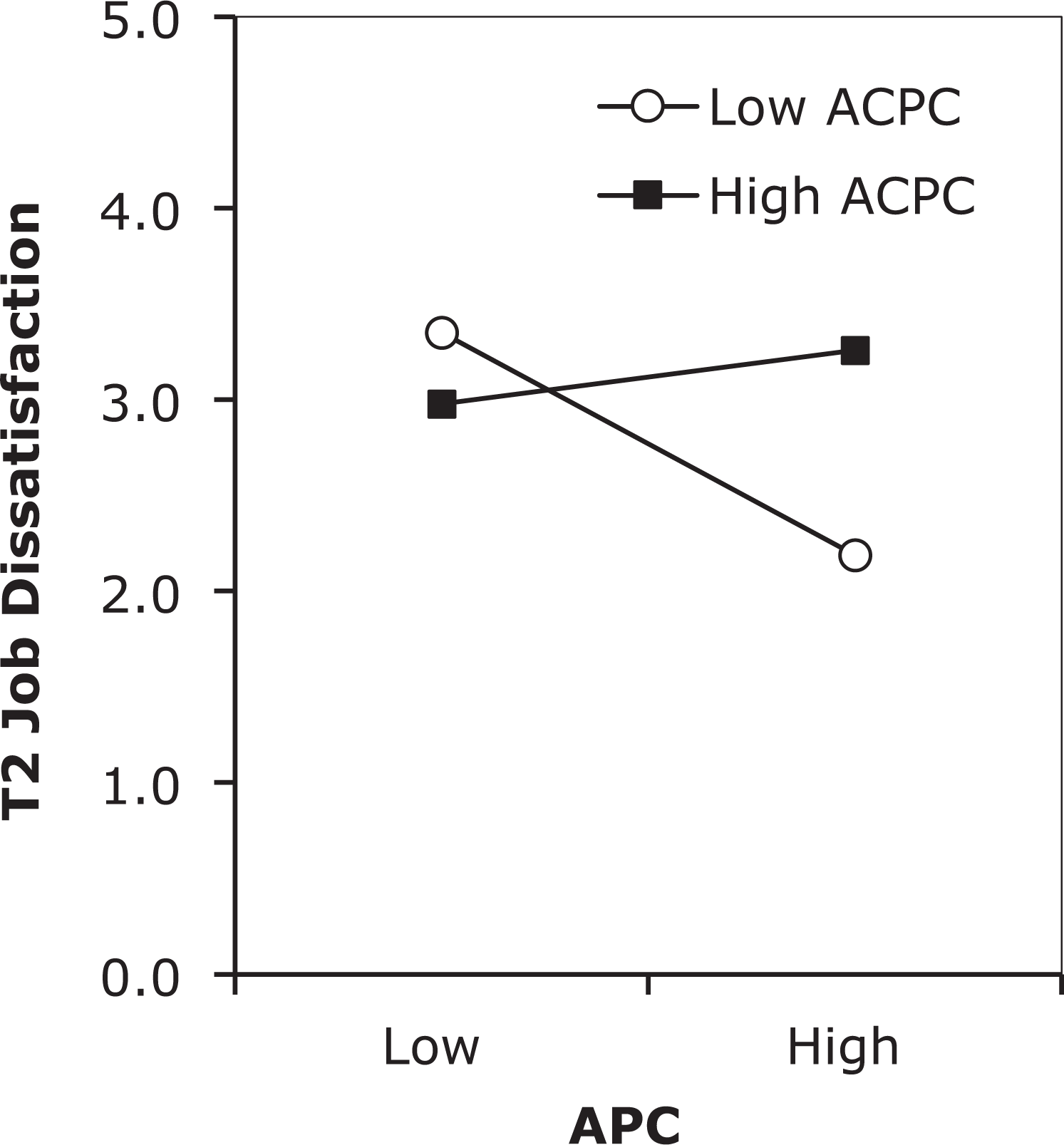
Two-way interaction of Affective Professional Commitment (APC) and Accumulated Costs Professional Commitment (ACPC) on T2 job dissatisfaction.
Entry of the three-way interactions revealed a significant interaction among affective PC, accumulated costs PC, and limited alternatives PC on T2 perceived health status, β = −.14, p = .045, R 2ch = .02, F(4, 152) = 2.13, p = .080 (see Step 4 of Table 2). This interaction is not interpreted as it is qualified by a subsequent four-way interaction.
Entry of the four-way interaction term revealed a significant interaction among the four PC dimensions on T2 anxiety, β = −.27, p = .003, R 2 ch = .03, F(1, 155) = 9.24, p = .003, and T2 perceived health status, β = −.21, p = .015, R 2 ch = .02, F(1,151) = 6.11, p = .015 (see Step 5 of Table 2). In order to clarify the nature of these interactions, high limited alternatives PC (n = 86) and low limited alternatives PC (n = 90) subgroups were created using the median of 4.25 (see Blau, 2009, for a similar approach). 1 The three-way interaction among affective PC, normative PC, and accumulated costs PC was then examined within the low and high limited alternatives PC subgroups using a hierarchical regression model for each outcome variable.
In the prediction of T2 anxiety, the three-way interaction among affective PC, normative PC, and accumulated costs PC was significant for the low limited alternatives PC subgroup, β = .28, p = .003, R 2 ch = .04, F(1, 77) = 9.10, p = .003, and not significant for the high limited alternatives PC subgroup, β = −.01, p = .915, R 2 ch = .00, F(1, 76) = 0.01, p = .915. Under the combination of low limited alternatives PC, low accumulated costs PC, and high normative PC, the relationship between affective PC and T2 anxiety was negative, B = −2.64, t(79) = −3.21, p = .002. The relationship between affective PC and T2 anxiety was nonsignificant under the combinations of low limited alternatives PC, low accumulated costs PC, and low normative PC, B = .32, t(79) = 0.67, p = .506; low limited alternatives PC, high accumulated costs PC, and low normative PC, B = .27, t(79) = 0.70, p = .486; and low limited alternatives PC, high accumulated costs PC, and high normative PC, B = .52 t(79) = 1.37, p = .174 (see Figure 2a and b).
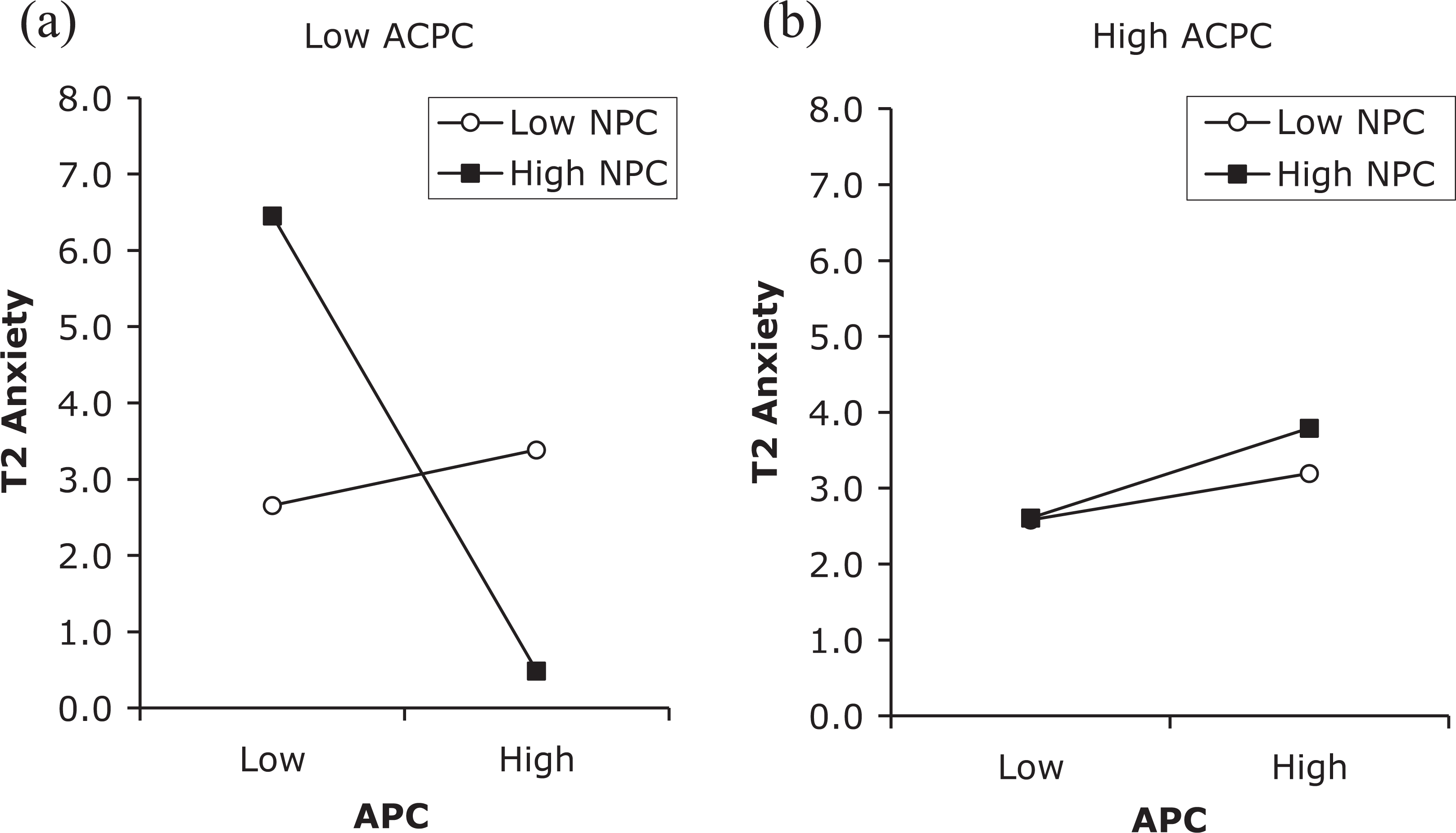
Three-way interaction of Affective Professional Commitment (APC), Normative Professional Commitment (NPC), and Accumulated Costs Professional Commitment (ACPC) on T2 anxiety for the low Limited Alternatives Professional Commitment subgroup at (a) low ACPC and (b) high ACPC.
A similar pattern of results emerged for T2 perceived health status in that the three-way interaction among affective PC, normative PC, and accumulated costs PC was not significant for the high limited alternatives PC subgroup, β = −.07, p = .515, R 2 ch = .00, F(1, 73) = 0.43, p = .515, and significant for the low limited alternatives PC subgroup, β = .21, p = .033, R 2 ch = .03, F(1, 76) = 4.73, p = .033. The negative relationship between affective PC and T2 poorer perceived health status was strongest under the combination of low limited alternatives PC, low accumulated costs PC, and high normative PC, B = −.33, t(78) = −1.71, p = .092. The relationship between affective PC and perceived health status was nonsignificant under the combinations of low limited alternatives PC, low accumulated costs PC, and low normative PC, B = .10, t(78) = 0.98, p = .328; low limited alternatives PC, high accumulated costs PC, and low normative PC, B = −.02, t(78) = −0.18, p = .855 and low limited alternatives PC, high accumulated costs PC, and high normative PC, B = .13, t(78) = 1.20, p = .232 (see Figure 3a and b).
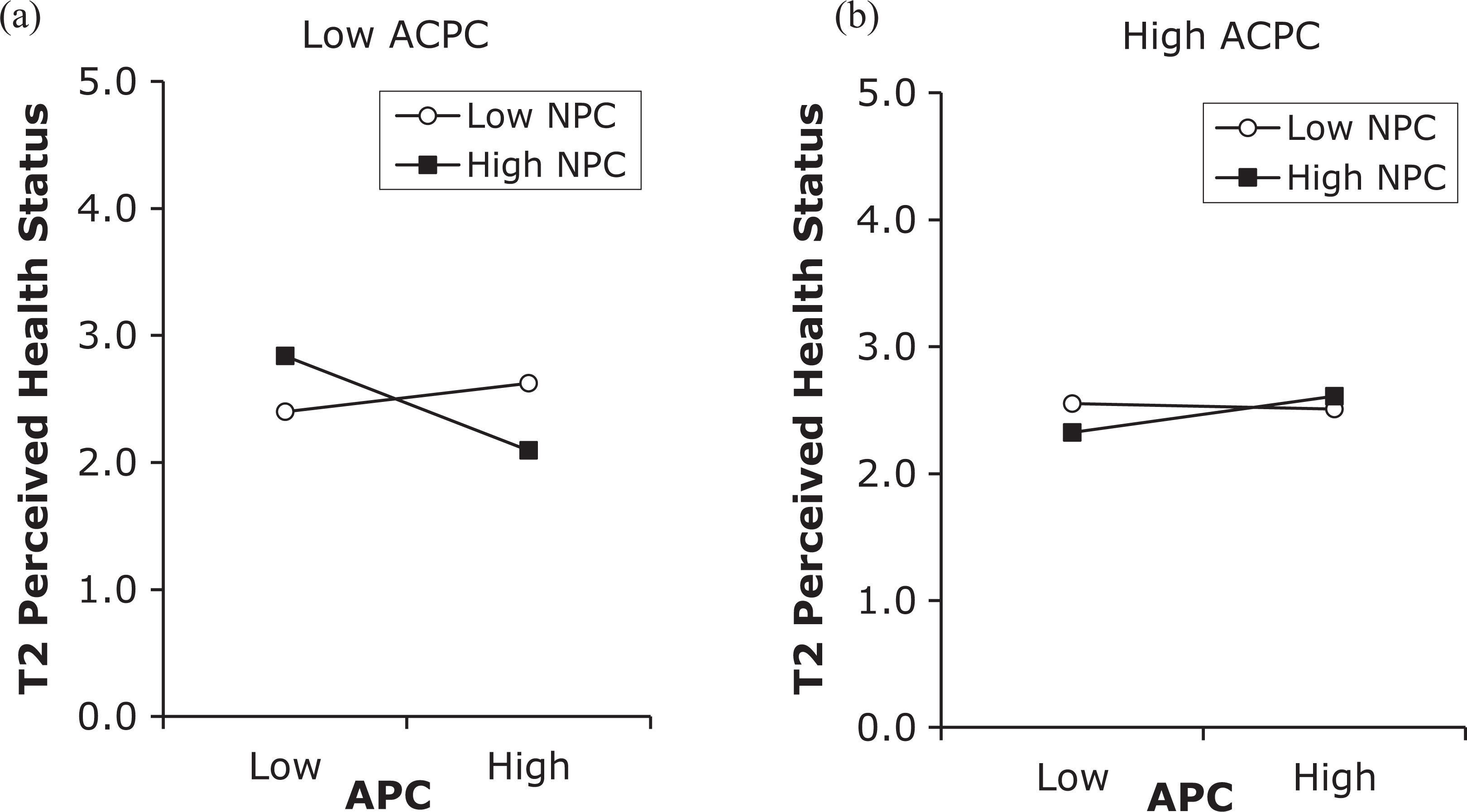
Three-way interaction of Affective Professional Commitment (APC), Normative Professional Commitment (NPC), and Accumulated Costs Professional Commitment (ACPC) on T2 perceived health status for the low Limited Alternatives Professional Commitment subgroup at (a) low ACPC and (b) high ACPC.
Discussion
The purpose of the present study was to examine the interactive relationships among four dimensions of PC and strain within the legal profession. The results indicated that affective PC was only related to increased job satisfaction when employees perceived low accumulated costs. Accordingly, high accumulated costs PC mitigated the otherwise positive effects of affective PC on T2 job satisfaction. Further, in contrast to Meyer and Herscovitch’s (2001) original proposition that a mind-set of obligation might mitigate the positive effects of the mind-set of desire, the findings suggest that the combination of affective PC and normative PC is associated with reduced strain, and normative PC added to, rather than mitigated, the benefits of affective PC on well-being. High levels of continuance PC (i.e., accumulated costs PC and/or limited alternatives PC) were, however, found to mitigate the positive effects of combined affective PC and normative PC.
Limitations
A major strength of the present study was that it utilized a two-wave design in which outcome variables were measured at two separate occasions, and T1 strain was controlled for in the prediction of T2 strain. Reverse causal effects could not be tested, however, as the predictor variables were not measured at T2. Accordingly, definitive conclusions regarding causality cannot be made. Issues of selective attrition were also apparent with the longitudinal design as preliminary analyses indicated that lawyers who were experiencing more strain were more likely to drop and not participate at T2. This may indicate a restriction of the range of these variables and a possible underestimation of the strength of associations (Taris & Kompier, 2003). Further, it may indicate that the study results are not generalizable to lawyers with higher strain levels. The possibility of floor effects because of the low depression and anxiety scores also is a limitation.
While the use of self-report measures might be considered a limitation due to common method variance (CMV), the following factors argue against the influence of CMV: the two-wave design (Podsakoff, MacKenzie, Lee, & Podaskoff, 2003), the CFA results indicating distinguishable dimensions of PC, and the significant interactions found (Evans, 1985). A large number of interactions were tested, and the possibility that significant findings may be due to Type 1 error must be noted. The measurement of perceived health status and job dissatisfaction with single items leads to inferior reliability and validity. However, Bergkvist (2014) argues that single items that fully represent the construct being assessed can be as psychometrically sound as multiple-item measures. Advantages to single-item scales include less CMV, reduced item redundancy, and improved participant response (Gosling, Rentfrow, & Swann, 2003).
Implications, Future Research, and Conclusions
The lack of direct relationships between PC and strain observed in the present study reinforces previous recommendations to examine interactive effects among dimensions of commitment (Meyer & Maltin, 2010) and provides additional support for the importance of “context” when examining commitment dimensions (Gellatly et al., 2006). Results indicated that strong affective PC and normative PC (i.e., a strong moral imperative) may only be negatively associated with strain when both limited alternatives PC and accumulated costs PC are low. When limited alternatives PC and/or accumulated costs PC were high, combined strong affective PC and normative PC were not related to reduced strain. As noted by Gellately et al. (2006), an awareness of the high costs associated with discontinuing with a profession may result in a “sense of entrapment.” Snape and Redman (2003) proposed that remaining within an occupation primarily to avoid the high costs of leaving might result in feelings of anger, resentment, helplessness, or simply “going through the motions.” Accordingly, while continuance PC alone may not have a negative impact on employees, the mind-set associated with high accumulated costs PC or limited alternatives PC may temper the benefits of a mind-set of desire and obligation to remain with a profession.
The study results challenge previous findings in relation to the context effects of continuance commitment, which have found that high levels of continuance OC combined with strong affective OC and normative OC (i.e., being fully committed) were associated with improved well-being (e.g., Meyer, Stanley, & Parfyonova, 2012). A potential explanation for the present findings is that continuance commitment to the profession may operate differently to continuance commitment to the organization. For example, if an employee feels limited alternatives outside their organization, they may feel thankful for their job and not experience conflict that results in strain. However, if an employee feels they have limited alternatives outside of their profession (in contrast to their organization), they may feel trapped as to other career options they have and, particularly in the case of lawyers, who have undergone significant education, training, and high costs, may have more serious implications for well-being. This may further explain the previously reported high rates of strain within the legal profession (e.g., beyondblue, 2011). The nonsignificant interaction between affective PC and limited alternatives PC, in contrast to affective PC and accumulated costs PC, further supports examination of subdimensions of continuance PC when examining dimensions of commitment.
With regard to practice implications, the results support the benefit for employees of having strong combined affective and normative PC, or a strong “moral imperative” to the profession (Gellatly et al., 2006; Meyer & Parfyonova, 2010), as well as low accumulated costs and limited alternatives PC. Accordingly, vocational psychologists and career counselors supporting those already working in their chosen profession should emphasize the importance of both an emotional and a normative basis for identifying with a profession in order to help individuals to achieve a sense of well-being. The results also suggest that academic advisors can support future well-being by stressing the importance of choosing professions with which an individual both emotionally attaches and feels a sense of obligation. Indeed, academics have recently called on law schools to support students in their development of an emergent sense of professional identity (Field, Duffy, & Huggins, 2013). Further, congruence between professional and individual values (i.e., person–occupation fit) is important for developing PC (Nägele & Neuenschwander, 2014).
For employees with low affective and normative PC, research suggests that a strong moral imperative to a profession might be fostered by encouraging ties with professional colleagues (Wallace, 1995); providing a supportive professional environment (e.g., attending professional activities such as conferences, and professionally valued rewards such as educational benefits; Lee et al., 2000); and promoting worthwhile professional values (e.g., community service values) and objectives (Meyer & Parfyonova, 2010). In addition, research suggests that practices designed to increase PC also may indirectly influence OC (Jørgensen & Becker, 2014). However, it is important to note the present study results suggest that affectively and normatively committing to a profession is not related to reduced strain unless employees also feel they do not have too much to lose by leaving the profession. Thus, career professionals should assist individuals to make realistic evaluations about their continuance commitment.
Future research could investigate the potential mediators between PC and well-being. One potential theoretical basis for investigating these mediators is Hall and Chandler’s (2005) approach to career success and goal-setting perspectives (Kanfer & Heggestad, 1997; Locke & Latham, 1990). This model proposes that higher goals stimulate motivational (i.e., work effort), behavioral (i.e., career strategies), and emotional (i.e., regulation) mechanisms that act as driving forces for well-being. Using this perspective, Praskova, Creed, and Hood (2014) found that work effort and emotion regulation mediated the relationship between career calling and life satisfaction. Accordingly, career commitment may be seen to reflect goal setting within the career domain, and future research may examine whether these self-regulatory mechanisms mediate the relationship between commitment and well-being. Further, there has been minimal research on the role of individual difference variables (e.g., personality) in career commitments workings (Vandenberghe & Ok, 2013). Future research may further consider how identities pertaining to PC might help to explain both the nature and strength of PC.
The present study reinforces the importance of examining the interactive effects of dimensions of PC in predicting strain outcomes for employees. In contrast to previous research, findings reveal that, for the legal profession (a profession that requires considerable education, training, and investment), high accumulated costs PC can temper the negative effects of affective PC on T2 job dissatisfaction. The present research extends previous research findings by suggesting that affective PC and normative PC (in the absence of accumulated costs and limited alternatives PC) may combine to produce a moral imperative to the profession that benefits employees. The results highlight the need for career professionals to assist individuals to increase affective and normative PC and address conflicting views employees may hold regarding commitment to their profession.
Footnotes
Declaration of Conflicting Interests
The author(s) declared no potential conflicts of interest with respect to the research, authorship, and/or publication of this article.
Funding
The author(s) received no financial support for the research, authorship, and/or publication of this article.