



Abstract
Perceived high-performance work systems (HPWS) have presented mixed results related to subjective well-being. Additionally, there remains a lack of an integrative analysis of the relationship between work–family balance and these practices. To explore this relationship more fully, we developed and tested a model that proposed work–family balance and well-being at work as mediators. Data gathered from 218 participants employed in a city council with different occupations indicated a positive relationship between perceived HPWS and work-to-family enrichment and a negative relationship between perceived HPWS and work-to-family conflict. More interestingly, based on Conservation of Resources theory and on Job-Demands Resources, the results also indicated the presence of a serial mediation model where work–family balance and well-being at work act as mediators of perceived HPWS and subjective well-being.
Keywords
Introduction
Although our understanding of the relationship between work and family domains has grown, there is still a gap in our in-depth knowledge of the process through which balance between work and family arises and affects employees’ well-being. There is evidence that suggests that models under the negative perspective (work–family conflict) and under the positive perspective (work–family enrichment) best capture the multidimensionality of work–family balance (WFB; Rantanen, Kinnunen, Mauno, & Tement, 2013). In this line, most studies have assumed that organizations will take all the necessary measures to ensure the prevention of work-to-family conflict (WFC) and the promotion of work-to-family enrichment (WFE; Carvalho & Chambel, 2014). Concerning the organizational support, work-to-family field studies usually analyze “family-friendly practices.” Nevertheless, the family-friendly practices have been criticized because they are exclusively created to reduce the WFC (Frye & Breaugh, 2004). In this way, these practices do not aim to promote WFE. In addition, some studies have demonstrated that, although the employers believe in family-friendly programs, the rates of their use remain very low (Allen, 2001). In fact, the use of family-friendly practices is dependent on a family supportive organizational culture that creates the conditions for their usage. This includes not only managers who recognize the advantage of such practices and support their usage but also a global communication about the usage of these practices (Allen, 2001; Thompson, Beauvais, & Lyness, 1999).
Simultaneously, a set of human resource practices, that is, high-performance work systems (HPWS), have been considered to be a key invention of modern management (Appelbaum, Bailey, Berg, & Kalleberg, 2000). However, we observe that, despite the organizational use of these practices, their possible effect on employees’ work–family relationship remains unknown. Only a few studies have established the relationship between HPWS and the work–family relationship (e.g., Carvalho & Chambel, 2014; White, Hill, Mcgovern, Mills, & Smeaton, 2003). Hence, there is a lack of integrative analysis of the effect of these practices in work–family balance. Furthermore, it is not unconditional or inevitable that these practices lead to the best well-being at work. In fact, the relationship between these high-performance practices an employees’ well-being at work has shown mixed results (Kroon, Voorde, & Veldhoven, 2009; Zhang, Zhu, Dowling, & Bartram, 2013). In contrast, the relationship between work–family and employees’ well-being at work is the most well established. Previous studies have demonstrated that WFE is related to positive well-being at work outcomes contrary to WFC, which was related to poor well-being at work (Rantanen et al., 2013).
Our purpose is to examine the relationship of perceived HPWS practices with well-being at work through work–family conflict and work–family enrichment. Further, we also intend to analyze the relationship between the well-being at work as a mediator between work–family balance and subjective well-being (i.e., satisfaction with life, health perceptions).
We conduct this study with a sample of Portuguese employees. Several reasons may be considered to vouch work–family issues receiving particular relevance in Portugal. First, Portugal has been considered a collectivistic culture and, consequently, family demands are prioritized against work domains (Vieira, Lopez, & Matos, 2014). Hence, individuals who spend a lot of time in work are viewed as contributing to serve the family needs. Second, compared to other European countries, Portugal has one of the highest rates of female activity in full-time work (Torres, 2004). However, the gender role asymmetries are prevalent in Portugal in a way that women have the family responsibilities and men have the work outside home role (Andrade & Matias, 2009). Third, Portugal is experiencing one of the worst economic crises in its long history as a sovereign state with an increase of grim austerity measures (e.g., freezing of public sector appointments and career progressions, salary cuts, and drastic holiday reductions; Ioakimidis, Santos, & Herrero, 2014). These measures create an insecure and unstable climate that is not in keeping with recent findings on the Portuguese work values showing employees to have higher expectations with regard to the security of employment and preferring high job stability (Chambel, 2013). Moreover, Vieira, Lopez, and Matos (2014) highlighted that family organizational support in Portugal is sparse and employees face a set of sources of conflict between work and family domains.
Literature Review and Hypothesis
Perceived HPWS and work-to-family balance
Although there is no precision definition of HPWS, some authors have conceptualized this set of practices as a group of separate but interconnected human resource practices that include comprehensive recruitment and selection procedures, incentive compensation and performance management systems, extensive employee involvement and training and which are designed to enhance employee and firm performance outcomes through improved workforce competence, attitudes, and motivation (Takeuchi, Lepak, Wang, & Takeuchi, 2007). A unitary perspective considered that this practice system benefits not only employers but also employees who can learn from colleagues, receive mental stimulation to accomplish personal development, develop new skills beyond the basic requirements to accomplish their tasks, and be involved in a more meaningful job, which may be conducted with a sense of achievement (Loughlin & Mercer, 2014).
A central proposition of the WFE, which is defined as the extent to which experiences in one domain improve the quality of life in another domain (Greenhaus & Powell, 2006), is that it occurs through two different paths: instrumental and affective. In the instrumental path, resources are directly transferred from one domain to another, which results in improved interaction with family members. In the HPWS environment, employees acquire new skills that may be helpful in their domestic sphere. For example, employees may learn how to be more organized in the work task, how to exert control over decisions, or how to develop an assertive interaction that would also be useful in the home context. Thus, this work environment may create a sense of self-esteem, self-efficacy, and self-confidence and create the psychological resources that can be transferred to the family domain (Greenhaus & Powell, 2006). Concerning affective path, Greenhaus and Powell (2006) claim that employees who develop a positive job affect could transfer this positive affect from work to family and that this leads to work enriching the family domain. HPWS is related to positive employee affects such as affective commitment (Takeuchi et al., 2007) and job satisfaction (e.g., Appelbaum et al., 2000). Hence, we expect that these positive affects may indirectly affect the family domain.
However, there is no consensus on what are the outcomes of high-performance practices and we may consider that this system also promotes WFC. A pluralist perspective claims a negative influence of high-performance work practices on employees (e.g., Ramsay, Scholarios, & Harley, 2000) with a division of interest between employers and employees (Zhang et al., 2013). This perspective is based on the “exploitation hypothesis” with an economic advantage for employers and work intensification for employees (Kroon et al., 2009) who demonstrate greater discretionary effort in pursuit of the organization’s goals (White et al., 2003). The work–family conflict theory is based on the scarcity hypothesis, which assumes that each individual has limited resources (e.g., time, energy, and attention) to spend on life roles (Goode, 1960) and occurs when individuals’ work participation conflicts with the family participation (Greenhaus & Beutell, 1985). Work characteristics are important factors to explain this work–family conflict, particularly workload (i.e., high demands; e.g., Byron, 2005). Therefore, it is possible that an HPWS implies high employee effort and work intensification which, in turn, evoke conflict in their family life. Given this assumption, White, Hill, Mcgovern, Mills, and Smeaton (2003) observed that some high-performance practices (i.e., appraisal systems, group-based forms of work organization, and individual incentives) interfere negatively with family life.
Based on the aforementioned, we concluded that high-performance work practices can have contradictory effects on employees’ balanced work–family relationship, namely, on work–family conflict and on work–family enrichment. In this way, we establish our first hypothesis:
Work–family balance and well-being at work as mediators between perceived HPWS and subjective well-being
We consider that these contradictory results might be explained if we consider the balance between work and family. As we established previously, high-performance practices are related not only to WFE but also to WFC. Additionally, WFE and WFC are related to well-being at work. We based our assumption of the relationship between work–family balance (i.e., WFC, WFE) and well-being at work on the conservation of resources theory (COR; Hobfoll, 2002). In this framework, “resources” is a concept that refers to objects, conditions, personal characteristics, and energies valued by the individual who serve as a means for attaining goals. COR theory predicts that those with greater resources are less vulnerable to strain and that those with fewer resources are more vulnerable to strain. Accordingly, strain occurs under one of three circumstances: (1) when resources are threatened, (2) when resources are lost, and (3) when individuals invest resources and do not gain the anticipated level of return. Threats to resource loss at the workplace are usually in the form of contextual demands and the energy and effort expended on satisfying such demands. Ten Brummelhuis and Bakker (2012) applied COR theory to work–home interface and explained that stressors help explain how WFC starts, and they add that stressors can be caused by contextual demands that require sustained physical and or mental effort. WFC reflects a process whereby demands in one domain reduce personal resources, which results in diminished outcomes in another domain. On the other hand, the authors suggested that WFE may be understood as the process whereby contextual resources from the work and family domains lead to the development of personal resources. The personal resources developed in each domain subsequently facilitate performance in the other domain (ten Brummelhuis & Bakker, 2012). The COR theory also emphasizes the resources are important to avoid burnout in general and exhaustion in particular (Maslach & Leiter, 2008). Contrariwise, Chen, Westman, and Eden (2009) claim that engagement can be conceptualized as a result of continuous resource gain. The authors argue that vigor, one of the engagement dimensions, expressed by “high levels of energy and mental resilience, willingness to invest effort, and persistence in the face of difficulties” (Chen, Westman, & Eden, 2009, p. 221), could be maintained through the resource gain spirals, that is, initial gains generate more gains and this continuous process generates high levels of vigor.
Moreover, other studies have related WFE to engagement (Hakanen, Peeters, & Perhoniemi, 2011) and WFC to burnout (Innstrand, Langballe, Espnes, Falkum & Aasland, 2008) based on COR theory. In this vein, we expect that the relationship between perceived HPWS and engagement might occur through WFE and that the relationship between perceived HPWS and burnout might occur through WFC.
On the other hand, work is an essential dimension of individuals’ lives, and it is known that perceived threat to employment can have consequences for people’s subjective well-being and their mental health. This fact can be understood through the JD-R model. This model postulates that job demands and job resources evoke two psychological processes (Schaufeli & Bakker, 2004): “health impairment” and “motivational process.” “Health impairment” is caused by chronic job demands (e.g., time pressure and emotional workload) that can produce high levels of WFC (Greenhaus & Beutell, 1985). Thus, WFC can act as a chronic job demand and may deplete employees’ mental and physical resources, which could lead to burnout and health deterioration (Schaufeli & Bakker, 2004). Consequently, burnout can lead to ill-health (Ahola & Hakanen, 2007) and to poor satisfaction with life (Demerouti, Bakker, Nachreiner, & Schaufeli, 2001). The second psychological process is the “motivational process,” which begins with the presence of suitable job resources (e.g., social support and instrumental support) that increase employees’ motivation (Schaufeli & Bakker, 2004). The WFE framework considers that various types of resources that might be acquired in one role improve performance in other roles (Greenhaus & Powell, 2006), and this process of WFE contributes to the presence of work engagement (ten Brummelhuis & Bakker, 2012). Furthermore, work engagement is a psychological state that contributes to enhance subjective well-being (Matthews, Mills, Trout, & English, 2014). That is, when employees develop work engagement, they are more globally satisfied with their lives (Diener, Emmons, Larsen, & Griffin, 1985) and develop positive health perceptions (Ware, Davies-Avery, & Donald, 1978). For these reasons, we believe that well-being at work (i.e., the avoidance of burnout, the presence of engagement) is also an important mechanism to explain the relationship between work-to-family balance and subjective well-being.
In this way, our purpose is also to analyze the relationship between work-to-family balance and subjective well-being through well-being at work (burnout, engagement). Thus, we establish our second hypothesis:
Method
Participants
The participants were employees of a city council of a Portuguese city. From a sample of 324 employees, we obtained 218 answered questionnaires (67.3%). The participants had various functions in the council: superior technician (N = 39, 17.9%), technical assistant (N = 40, 18.3%), operational assistance (N = 117, 53.7%), handler (N = 7, 3.2%), fireman (N = 7, 3.2%) and other functions (N = 5, 2.3%). Most of the respondents were females (130 = 59.6% vs. 88 = 40.4% male). Participants’ mean age was 44.29 years (SD = 9.6). As for organizational tenure, 2.3% have worked in the city council for less than 1 year, 13% have worked in the city council from 1 year to 5 years, 34% have worked in the city council from 5 years to 10 years, 31.2% have worked in the city council from 10 years to 20 years, and 19.5% have worked in the city council for over 20 years. In terms of schooling, 33.8% have up to ninth grade, 34.3% have completed secondary school education, 8.1% have attended university, 17.6% have graduated, and 6.2% have a postgraduate qualification. All participants are Portuguese.
Procedure
The research procedure involved different steps. After seeking permission from the president of the city council and the ethical committee of the Faculty of Psychology, we asked the supervisors of each department if they would be willing to voluntarily collaborate in the study. Second, a researcher met each supervisor to explain the purpose and requirements of the study. Third, each of the supervisors passed the questionnaires on to their subordinates. Each respondent was given a sealable envelope in which to deposit the completed survey. Finally, the researcher returned to the city council departments 1 week later to collect the surveys.
Instruments
Perceived HPWS
We measured the employees’ perceptions of human resources (HR) practices using 17 items from the scale developed by Takeuchi, Lepak, Wang, and Takeuchi (2007). Sample items include “Employees are involved in decision making” and “The performance evaluation is based on clear and objective criteria.” The items were scored on a 7-point rating scale that ranged from (1) totally disagree to (7) totally agree (a = 0.94). Responses were summed to provide a total score for the variable, with higher scores indicating a greater degree of perceived HPWS. Carvalho and Chambel (2014) used this scale for Portuguese employees and reported .94 of the Cronbach’s α. The internal consistency reliability coefficient among participants in the present sample was α = .94. This scale correlated with the other scales used in this study in the expected direction.
WFE
We measured WFE using a Portuguese version of a 9-item scale (Carlson, Kacmar, Wayne, & Grzywacz, 2006). Example items included “My involvement with my work helps me to understand different viewpoints, and this helps me be a better family member” and “My involvement in my work helps me to develop my skills, and this helps me to be a better family member.” This scale was previously translated and validated for the Portuguese population (Vieira et al., 2014). Responses were summed to provide a total score for the variable, with higher scores indicating a greater degree of WFE. The items were answered on a 5-point rating scale ranging from “totally disagree” (1) to “totally agree” (5). Carvalho and Chambel (2014) used this scale for Portuguese employees and reported .94 of the Cronbach’s α. The internal consistency reliability coefficient among participants in the present sample was α = .96. This scale correlated with the other scales used in this study in the expected direction.
WFC
We measured WFC using an extended Portuguese version of a 15-item scale (Carlson, Kacmar, & Williams, 2000). Example items included “After work I am too tired when I come home to do some of the things I’d like to do” and “My job takes time from me that I would like spend with my family/friends.” The items were answered on a 5-point rating scale that ranged from almost never (1) to almost always (5) and higher scores indicate greater interference with family. This scale was previously translated and validated for the Portuguese population (Vieira et al., 2014). Fiksenbaum (2014) used this scale and reported .90 of the Cronbach’s α. The internal consistency reliability coefficient among participants in the present sample was α = .88. This scale correlated with the other scales used in this study in the expected direction.
Well-being at work
We measured well-being at work with the assessment of Engagement and Burnout. Work Engagement was measured with a Portuguese version of a 9-item scale (Schaufeli, Bakker, & Salanova 2006). Example items included “When I wake up in the morning, I feel good about going work” and “My work inspires me.” The respondents answered the items on a 7-point scale that ranged from never (1) to every day (7). Responses were summed to provide a total score for the variable, with higher scores indicating a greater degree of work engagement. Sonnentag, Binnewies, and Mojza (2010) used this scale and reported .93 of the Cronbach’s α. The internal consistency reliability coefficient among participants in the present sample was α = .80. This scale correlated with the others scales used in this study in the expected direction. Burnout was assessed using a Portuguese translation of the Maslach Burnout Inventory (Maslach, Jackson, & Leiter, 1996). Example items included “I feel emotionally drained from my work” and “I doubt the significance of my work.” The respondents answered the items on the same 7-point scale as for engagement. Higher scores indicating high burnout levels. The psychometric soundness of the Maslach Burnout Inventory is well documented in the literature with internal consistencies usually well above .70 (Schaufeli, Salanova, González-Romá, & Bakker, 2002). The internal consistency reliability coefficient among participants in the present sample was α = .75. This scale correlated with the other scales used in this study in the expected direction.
Subjective well-being
We measured the employees’ subjective well-being with the Satisfaction with Life and Health Perceptions assessment. Satisfaction with life was assessed with the 5-item scale of Diener, Emmons, Larsen, and Griffin (1985). Sample items include “I am satisfied with my life” and “If I could live my life again, I wouldn’t change much.” The items were scored on a 7-point rating scale that ranged from totally disagree (1) to totally agree (7). Responses were summed to provide a total score for the variable, with higher scores indicating a greater degree of satisfaction with life. Carvalho and Chambel (2014) used this scale for Portuguese employees and reported .88 of the Cronbach’s α. Rantanen, Kinnunen, Mauno, and Tement (2013) also used this scale and reported .89 of the Cronbach’s α. The internal consistency reliability coefficient among participants in the present sample was α = .88. This scale correlated with the other scales used in this study in the expected direction. The Health Perceptions Questionnaire developed by Ware, Davies-Avery, and Donald (1978) was used to assess health perceptions. The scale is composed of 4-items, for example, “I am as healthy as others” and “My health is excellent.” The items were rated on a 5-point rating scale that ranged from definitively false (1) to definitively true (5). Responses were summed to provide a total score for the variable, with higher scores indicating a greater degree of health perceptions. Carvalho and Chambel (2014) used this scale for Portuguese employees and reported .90 of the Cronbach’s α. The internal consistency reliability coefficient among participants in the present sample was α = .92. This scale correlated with the other scales used in this study in the expected direction.
It is important to note that the HPWS (Takeuchi et al., 2007) and Health Perceptions Questionnaire (Ware et al., 1978) in the previous study (Carvalho & Chambel, 2014) were translated into Portuguese and then a translator was asked to provide a back translation of the Portuguese into English (Brislin 1980). The HR manager of the city council then read the questionnaire and confirmed the clarity and familiarity of all items.
Statistical Analysis
Our panel data were initially analyzed through a confirmatory factor analysis of all of the scales. Obtaining a good fit in a pretest of the measurement model is critical to establishing discriminant validity and to inspecting the risk associated with common method variance (Podsakoff, MacKenzie, Podsakoff, & Lee, 2003).
To evaluate our mediation model, we used the PROCESS macro developed by Hayes (2013) to test a mediation model with multiple mediators that operate in serial. To derive the direct and indirect effects, we first estimated all the path coefficients in the model of WFC and burnout as mediators (Model 1). Second, we estimated all the path coefficients in the model with WFE and engagement as mediators (Model 2).
Results
We tested two competing models to examine whether all the constructs are represented by a one factor model or by the seven research factors model. The one-factor model does not fit the data well, Chi-squared (1,393) = 7 955.74, p > .001; standardized root mean square residual [SRMR] = .07; Comparative fit index [CFI] = .92; Tucker–Lewis index [TLI] = .91; Root Mean Square Error of Approximation [RMSEA] = .05. In contrast, the seven-factor model fits the data well, Qui 2(1.393) = 7 955.74, p > .001; SRMR = .07; CFI = .92; TLI = .91; RMSEA = .05 and significantly better than the single-factor model, Δχ2(21) = 25 059.74, p < .001. Hence, it is concluded that the theoretical conceptualization, which determined seven variables, adequately represents the observed data.
The means, standard deviations, and correlations are generally consistent with the theorized pattern of relationships. Full results are available on request.
Concerning Hypothesis 1, as expected and as we can see through Figure 1 (coefficient = .26; p < .01) perceived HPWS present a positive relationship with WFE. However, contrary to our expectations, as we can also see through Figure 1 (coefficient = −.14; p < .01), perceived HPWS also present a negative relationship with WFC. Thus, Hypothesis 1 was partially supported.
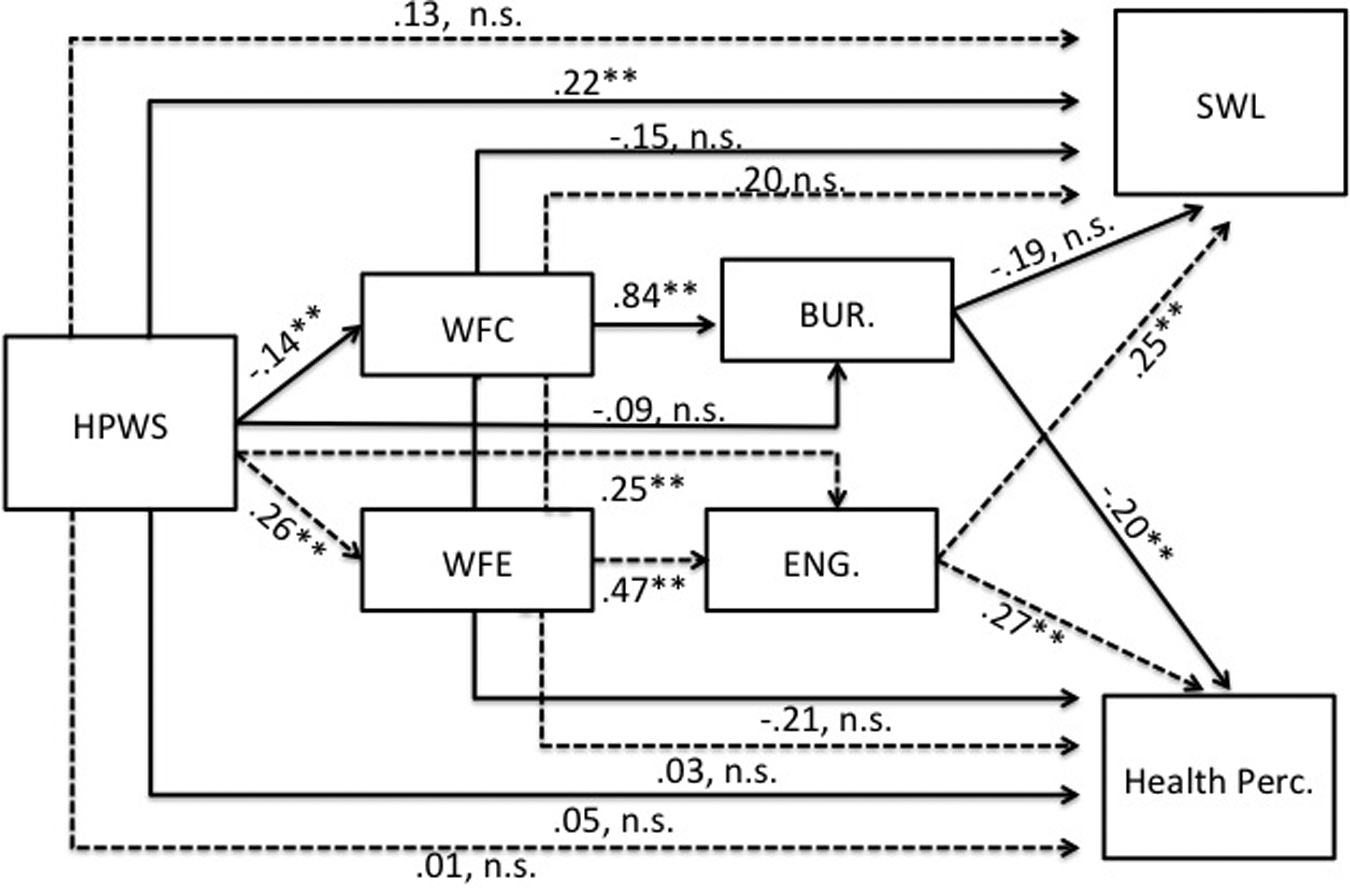
Model 1 and Model 2.
Our mediation hypothesis stated that work-to-family balance and well-being at work both account for a serial indirect effect in the relationship between individuals’ perceived HPWS and their subjective well-being. Specifically, Model 1 tests Hypothesis 2a and Model 2 tests Hypothesis 2b.
As shown in Table 1, to test Hypothesis 2a, concerning satisfaction with life as the dependent variable, a significant total indirect effect was observed (because the confidence intervals did not contain zero). The indirect effect could be broken down into three significant and unique effects via perceived HPWS and WFC, perceived HPWS and burnout, and in serial. Only the serial indirect effect was found to be significant. Concerning health perceptions as the dependent variable, a significant total indirect effect was also observed, and there are two indirect effects that are significant: the serial indirect effect and the indirect effect in which WFC mediates the relationship between perceived HPWS and health perceptions (see Table 1). However, once the mediators were included in the regression, the direct effects present different results (see Figure 1). Hence, whereas the model has no significant direct effects for the relationship between perceived HPWS and health perceptions, the direct effect remains significant for perceived HPWS and satisfaction with life. Together, these results provide a partial support of Hypothesis 2a.
Indirect Effects for Model 1.
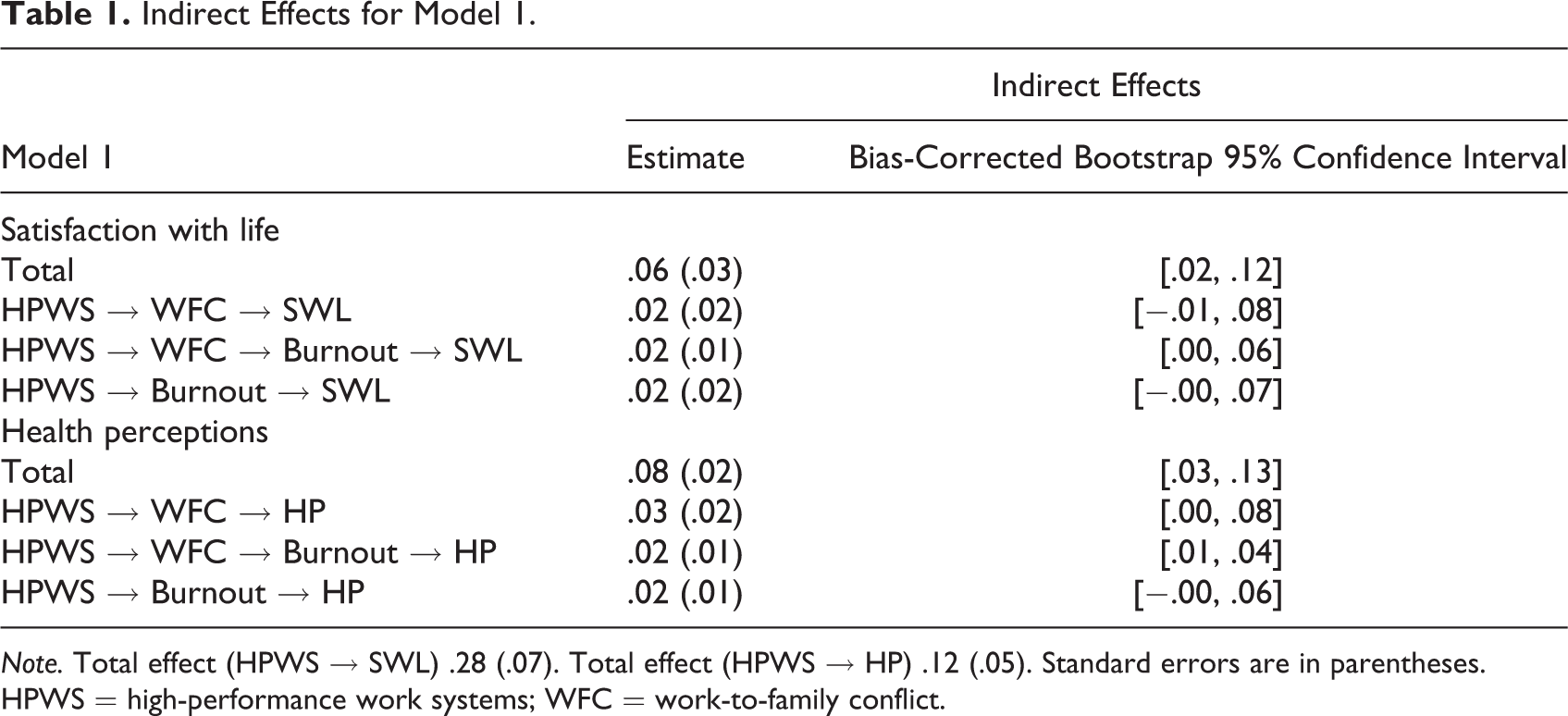
Note. Total effect (HPWS → SWL) .28 (.07). Total effect (HPWS → HP) .12 (.05). Standard errors are in parentheses. HPWS = high-performance work systems; WFC = work-to-family conflict.
As shown in Table 2, to test the Hypothesis 2b, a significant total indirect effect was observed concerning satisfaction with life as the dependent variable. The indirect effect could be broken down into three significant and unique effects via perceived HPWS and WFE, perceived HPWS and engagement, and in serial. There are two indirect effects that are significant: the serial indirect effect and the indirect effect in which engagement mediates the relationship between perceived HPWS and satisfaction with life (see Table 2). Concerning health perceptions as the dependent variable, a significant total indirect effect was also observed, and there are two indirect effects that are significant: the serial indirect effect and the indirect effect in which engagement mediates the relationship between perceived HPWS and health perceptions. Because no significant direct effects (see Figure 1) remained between perceived HPWS and satisfaction with life or between perceived HPWS and health perceptions once the mediators were included in the regression, it can be concluded that the relationships between perceived HPWS and satisfaction with life and between perceived HPWS and health perceptions were fully mediated by WFE and engagement. Additionally, the engagement partially mediated the relationships between perceived HPWS and satisfaction with life and between perceived HPWS and health perceptions. These results provided support of Hypothesis 2b. Because Hypothesis 2a is partially supported and Hypothesis 2b is totally supported, we conclude that WFB and well-being at work account for a serial indirect effect in the relationship between individuals’ perceived HPWS and their subjective well-being.
Indirect Effects for Model 2.
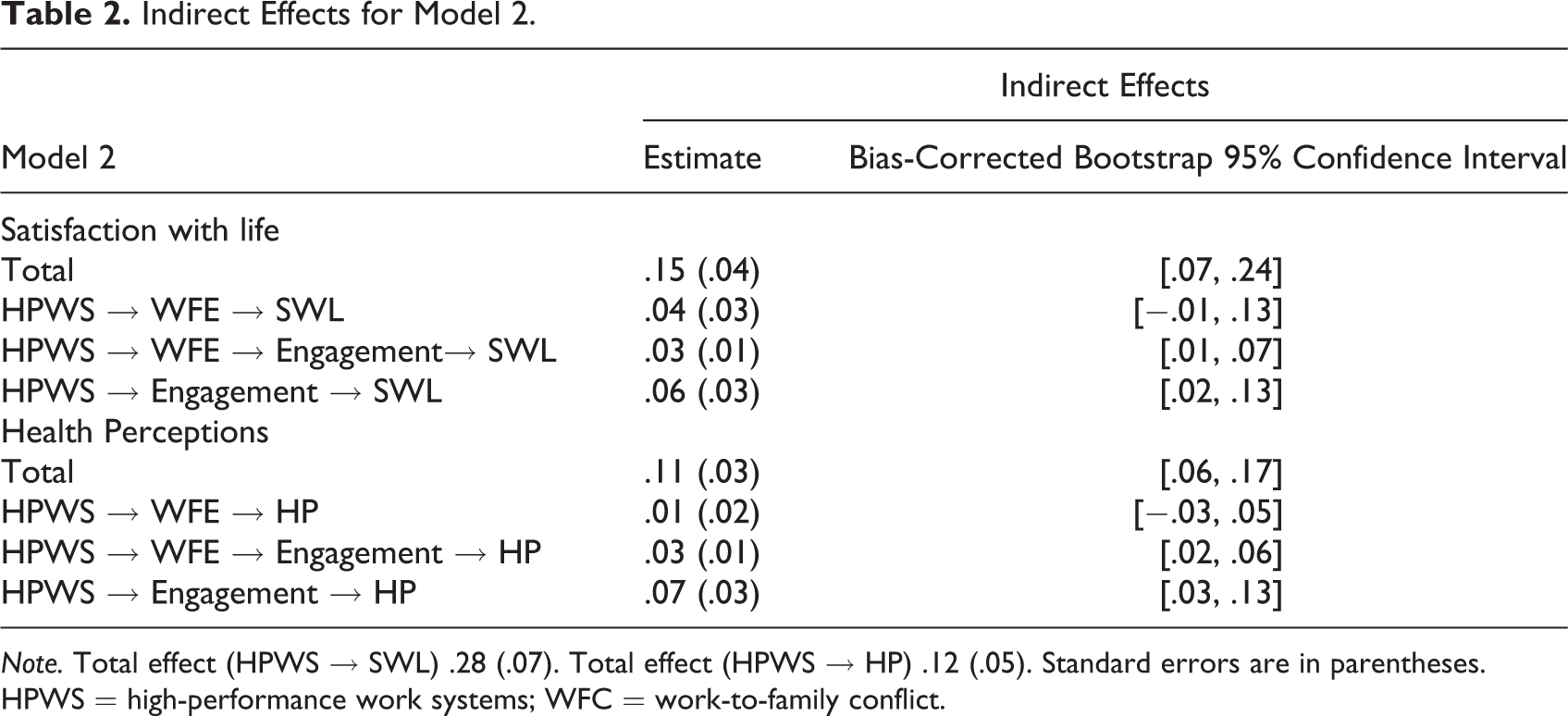
Note. Total effect (HPWS → SWL) .28 (.07). Total effect (HPWS → HP) .12 (.05). Standard errors are in parentheses. HPWS = high-performance work systems; WFC = work-to-family conflict.
Discussion
Our results showed that perceived HPWS were positively related to WFE and negatively related to WFC. Additionally, as expected, work–family balance and well-being at work were serial mediators of the relationship between individuals’ perceived high-performance work practices and their subjective well-being. Beyond our expectations, in the presence of work–family conflict and burnout as serial mediators, the relationship between perceived HPWS practices and satisfaction with life remained significant, and the relationship between burnout and satisfaction with life was not significant. The results of this analysis add important insights to the literature.
First, as expected, perceived HPWS showed a positive relationship with WFE. This result was in line with the affective and instrumental paths in which WFE occurs (Greenhaus & Powell, 2006). The first path suggests that employees who develop a positive job affect could transfer this positive affect from work to family and that work enriches the family domain for this reason. Previous studies have related HPWS with affective job variables such as affective commitment (Takeuchi et al., 2007) and job satisfaction (e.g., Appelbaum et al., 2000). Therefore, these positive affects may indirectly affect the family domain. On the other hand, in relation to the instrumental path and as postulated previously, the HPWS enhance a broad range of employees’ skills and competences that can be directly transferred to the family domain, which results in improved interaction with family members. As Edwards and Rothbard (2000) have suggested, skills obtained in one domain may be abstracted into general knowledge structures of scripts that apply across life domains. Thus, these results have provided support for the unitary perspective that claims that HPWS were related to positive effects for employees (Appelbaum et al., 2000; Carvalho & Chambel, 2014).
Second, contrary to our expectations, perceived HPWS showed a negative relationship with WFC. This result did not support the “exploitation hypothesis” grounded in the pluralist perspective that claims that these organizations’ practices promote job demands that have strong disadvantages for employees (Kroon et al., 2009). Nevertheless, we did not reject the possible intensification of job demands in organizations that apply HPWS (Ramsay et al., 2000), but we might consider that this intensification could be buffered by the presence of WFE (Greenhaus & Powell, 2006). In fact, we suggest that this negative relationship could be explained because the HPWS promote job resources (e.g., job control and support; Carvalho & Chambel, 2014), and this could in turn promote employees’ efficacy at work, which contributes to low WFC. Furthermore, we might also consider that the negative relationship between HPWS and WFC appear because employees who perceive that organizations that develop HPWS use more “family-friendly practices” (Wang & Verma, 2012), and the use of these work–family balance programs reduces WFC (Frye & Breaugh, 2004). Thereby, one of the contributions of this study is that it provides evidence that the implementation of HPWS could be a mechanism that contributes to a design of work–family balance when it is related positively with WFE and negatively with WFC.
Third, this study sought to better understand the process through which perceived HPWS and subjective well-being might be connected. We verified that WFC and burnout account for a serial indirect effect in the relationship between perceived HPWS and health perception. This result is in accordance with the theoretical framework of COR theory (Hobfoll, 2002). In other words, the employees with high WFC displayed high levels of burnout under an HPWS environment. For these employees, involvement in shared decision making or involvement in training systems might be related to investing many resources to address the contextual demands, for example, physical and mental effort, and stress will develop (Hobfoll, 2002). In accordance with ten Brummelhuis and Bakker (2012), WFC then reflects a process whereby work demands deplete personal resources, which results in reduced outcomes in the family domain. Thereby, a consequence of the presence of WFC is burnout that represents an “energy leakage,” which is a consequence of long-term stress at work (Innstrand et al., 2008). Furthermore, the mediated role of this negative psychological state between WFC and health perceptions is in line with the health impairment processes proposed by the JD-R model (Schaufeli & Bakker, 2004). In fact, this is in line with the mediated process from job demands (e.g., WFC) via burnout to ill-health (Ahola & Hakanen, 2007). Thus, we conclude that the presence of WFC is essential to increased burnout and that this psychological state is also a crucial mechanism for the establishment of the serial mediation model that establishes the relationship between employees’ perception of HPWS and their health perceptions. However, contrary to what we expected concerning satisfaction with life, we observed that burnout was not a predictor and that this indicator of employees’ subjective well-being depended directly on their perceptions of HPWS. These results could arise because perceived HPWS promote satisfaction for basic psychological needs such as competence, autonomy and relatedness, and employees feeling intrinsic motivation to do their work, which in turn relates to their subjective well-being, that is, satisfaction with life (Ryan & Deci, 2000).
Fourth, our results support the serial indirect effect of WFE and engagement in the relationship between perceived HPWS and subjective well-being. This pattern of results is also in line with COR theory (Hobfoll, 2002) applied to the work–home interface (ten Brummelhuis & Bakker, 2012). Hence, employees with high WFE displayed high levels of engagement under an HPWS environment. For example, for these employees, involvement in shared decision making or involvement in training systems seems to offer several opportunities to develop resources such as sense of competence, self-efficacy, and pursuing the goal of more challenging work. So, an HPWS environment may lead these individuals to develop personal resources that enrich the family domain (ten Brummelhuis & Bakker, 2012). It is also possible that positive affects such as enthusiasm and energy experienced at work may enhance positive appraisals of a work that enriches family life and that the presence of these resources and positive affect create work-engaged employees (Hakanen et al., 2011). Moreover, the mediated role of this positive psychological state between WFE and subjective well-being is in line with the motivational processes proposed in the JD-R model (Schaufeli & Bakker, 2004). In these processes, job resources (e.g., WFE) have been assumed to increase work engagement, which have been associated with positive outcomes such as subjective well-being (Matthews et al., 2014). Thus, we conclude that the presence of WFE is essential to increasing engagement and that this psychological state is also a crucial mechanism for the establishment of the serial mediation model that establishes the relationship between employees’ perception of HPWS and their subjective well-being.
These results also deserve some consideration under the Portuguese culture. These results strongly emphasize that with the adoption of HPWS practices the organizations value employees’ lives outside the work context. Thus, for a collectivistic culture such as the Portuguese, the adoption of these practices is a way of contributing not only to their work–family balance but also to their well-being outside the work context, thus, being in line with people’s values. Moreover, these results have particular relevance under the current work conditions that employees experience. As mentioned previously, Portugal is being governed under austerity measures which have brought negative consequences to the work context (Ioakimidis et al., 2014). Nevertheless, the high-performance work practices are an important set of practices for employees’ work–family balance that should buffer some of these negative consequences. This result underlines the importance of the implementation of these practices in Portugal.
Limitations, Strengths, and Future Directions
Our study has some weaknesses that must be recognized. First, the cross-sectional design of this study did not allow any causal relationships between the variables to be established. Thus, longitudinal studies are needed to test these hypotheses. Second, the exclusive use of self-report questionnaires could lead to problems such as common method bias. However, to minimize the impact of common method variance, we followed several of Podsakoff, MacKenzie, Podsakoff, and Lee’s (2003) methodological and statistical recommendations.
Nevertheless, this study has strengths that should be mentioned. First, it tests a mediation model that has not been tested in the HPWS field. In this way, this finding extends the previous theoretical framework of HPWS and suggests a more comprehensive model with the introduction of effects on work–family balance. Second, this study also focused on HPWS relationship with employees’ well-being, which is an area that has needed more empirical research (Kroon et al., 2009; Zhang et al., 2013). Third, this study allows us to conclude that perceived HPWS practices relate to WFE and foster to WFC. Future studies should analyze this model with the introduction of family-friendly practices to conclude whether the presence of HPWS is also important for creating a more family-friendly environment. Fourth, this study is in agreement with theories that are largely recognized in the literature (COR theory, Hobfoll, 2002; JD-R theory, Schaufeli & Bakker, 2004). Fifth, our study used a path analysis approach that allowed us to test our full conceptual model instead of testing pieces of our model separately. This methodology allows researchers to understand the relationships between all the aspects of the mediation role of work–family balance and well-being at work. In addition, this data analysis strategy allows us to test direct and indirect effects between the variables even when there is no association between the predictor and the outcome.
Footnotes
Declaration of Conflicting Interests
The author(s) declared no potential conflicts of interest with respect to the research, authorship, and/or publication of this article.
Funding
The author(s) disclosed receipt of the following financial support for the research, authorship, and/or publication of this article: We acknowledge Science and Technology Foundation that support this research under PhD Grant SFRH /BD / 76459 / 2011 to Vânia Sofia Carvalho.