




Abstract
Graduate higher education has done little to assess and understand graduate students’ needs and experiences beyond the classroom. Therefore, we conducted a phenomenological study using multiple data collection tools, including survey and focus groups from two different time periods to implement a multiphase needs assessment. The goal of the evaluation was to better understand graduate students’ overall needs and experiences related to professional development at a public Carnegie classified Doctoral Research University in the Rocky Mountain Region. Results revealed the following themes: perceptions of professional development in graduate school, finding balance is never ending, experiences of personal and professional barriers, and the importance of faculty and peer relationships. Discussion, implications, limitations, and a conclusion are provided.
In an era of rising accountability, retention rates of graduate programs and job obtainment outcomes have come under scrutiny, and student affairs professionals are being asked to devise programming to purposefully engage graduate students to aid in retention and overall student success (Pontius & Harper, 2006). Purposeful engagement activities in and outside the classroom have been heavily studied in the undergraduate population and have demonstrated positive impact on cognitive, social, psychological development, and academic persistence (Pontius & Harper, 2006). One way to purposefully engage graduate students is through meaningful professional development (PD) programming. PD and related concepts are discussed frequently, however, “there is little clarity about exactly what PD is and how it is achieved and enhanced” (Ducheny, Alletzhauser, Crandell, & Schneider, 1997, p. 87). Although there is no clear description of PD, Ducheny, Alletzhauser, Crandell, and Schneider (1997) noted three elements that are related to PD activities: (1) continuing education and staying up to date with relevant research, (2) peers and mentors, and (3) PD should be organized into stages, with each stage being characterized by the student’s advancement through the program. Attributes such as these are frequently referenced to as key characteristics of graduate students’ experiences, as students seeking advanced degrees have unique educational needs that are often associated with ongoing PD (e.g., Foote, 2010; Golde, 2000; Pontius & Harper, 2006; Tinto, 1975, 1993). PD activities such as those described earlier prepare graduate students for their future careers and help them develop professional skills to complement the discipline knowledge gained in their degree program such as job searching skills, financial management, writing skills, and so on. Thus, it is probable that a comprehensive understanding of PD is integral for improving the educational experiences and retention rates of graduate students.
According to Tinto (1975), college student retention is a longitudinal process involving individual student attributes and institutional variables that interact to comprise students’ levels of institutional integration. Generally, institutional integration is an ongoing cost–benefit analysis in which students determine if the gains of completing a college degree outweigh the cost of the substantive time and financial investments of an advanced degree (Tinto, 1975). According to this theory, students with higher levels of academic and social institutional integration are more likely to be successful in higher education (Golde, 2000; Tinto, 1975). Tinto (1993) expanded this theory of college student persistence further to reflect the unique experiences of doctoral students. As posited by Tinto, as doctoral students move through stages of transition, candidacy, and doctoral completion throughout their graduate programs, socialization and persistence are essential for successful completion. Although helpful for understanding the unique experiences of doctoral students, literature investigating graduate students’ experiences of PD at all degree levels remains limited in professional dialogues. Expanding research including master’s, certificate, and specialist-level student experiences is necessary, considering there were almost 3 times as many master’s, graduate-level certificate, and education specialist students enrolled as doctoral students in the Fall 2012 (Gonzales, Allum, & Sowell, 2013).
Literature has shown that undergraduate involvement has been positively linked to academic success variables such as higher satisfaction with the educational experience and higher retention rates (Tinto, 1993). Astin (1977) described involvement as “the time and effort expended by the student in activities that relate directly to the institution and its program” (p. 21). As previously mentioned, such involvement may occur academically and socially, both of which contribute to students’ perceived level of socialization within the academic arena (Gardner & Barnes, 2007; Tinto, 1975, 1993). However, few “studies have focused on the effects of graduate student involvement in the higher education setting” (Gardner & Barnes, 2007, p. 1). In order to examine the unique elements of graduate student involvement, Pontius and Harper (2006) interviewed 10 graduate students, supporting previous assertions that educational experiences at the graduate level are distinct from other educational experiences. The participants described networking, community connection, and PD activities as the most notable outcomes of graduate student involvement (Pontius & Harper, 2006). Referring to PD activities, participants “saw their graduate student involvement as direct preparation for their future careers, providing them with skills, connections, and better understandings of what is expected of them in these chosen careers” (Pontius & Harper, 2006, p. 381).
The narratives of 10 graduate students who did not complete their doctoral programs provided comparable insight, indicating that academic and social integration were integral in the educational experiences of participating students (Golde, 2000). According to Golde (2000), participants reported multiple variables that led to their decision to exit their graduate programs; however, it seemed both positive and negative faculty connections may have contributed significantly to the decision-making process. Schlemper (2011) reported similar findings, suggesting that departmental involvement and strong social connections to faculty and peers insulated graduate students from the challenges participants identified such as time management, academic demands, and financial concerns. In addition, Foote (2010) offered comparable suggestions for graduate student PD, emphasizing the importance of socialization and systematic PD opportunities that support community connections and increased understanding of the demands of new professionals.
Although there is a dearth of literature supporting the overall impact of PD on graduate students’ experiences as a whole, extant literature reflects increased awareness of the importance of PD activities in a variety of educational fields. For example, Dean, Woodard, and Cooper (2007) surveyed a sample of students and professionals in student affairs (n = 138), indicating participants believed structured PD activities were necessary and beneficial for remaining actively engaged in the field. Similarly, Diaconu, Radigan, Suskavcevic, and Nichol (2012) reported that participation in the Rice Model of Teacher PD resulted in improved content knowledge, professional leadership skills, and pedagogical strategies. Furthermore, organized PD activities have been associated with increased self-efficacy, confidence, and professional collaboration for educators in various content areas such as English as a foreign language teachers (Karimi, 2011) and early childhood education science teachers (Duran, Ballone-Duran, Bowling, & Beltyukova, 2009). Therefore, it is probable that systematic PD opportunities may positively influence the educational experiences of graduate students in various disciplines and professional environments.
In addition to discussions about graduate students’ educational experiences, various developmental theories (e.g., Fugate, Jaramillo, & Preuhs, 2001; Hall, 2002; Scott & Dixon, 2009; Super, 1980) have provided a foundation for graduate student PD models that are unique to educational institutions and programs. Authors of such developmental models and theories strive to achieve attainable PD programs that address the needs of graduate students. One such model designed by Scott and Dixon (2009) utilized a student-focused model for multidimensional PD in a university context. Scott and Dixon’s model focused on augmenting students’ learning experiences through the following constructs: systematic collection of student feedback, formal in-context PD, informal in-context PD support, and major curriculum review of the largest degree program (Scott & Dixon, 2009, p. 243). These four dimensions were developed to assist stakeholders in making sense of the complexities of the university context. They were designed to (1) place student perspectives at the core, (2) demonstrate that just one approach was not likely to be appropriate or effective, and (3) coordinate and ensure alignment of various proposed programs and initiatives (Scott & Dixon, 2009).
Fugate, Jaramillo, and Preuhs (2001) developed the Mentors of Political Science (MOPS) model. The authors stated the MOPS model facilitated a forum for incoming students to get involved by sponsoring a workshop series in which senior graduate students hold sessions for junior graduate students on topics ranging from writing grant proposals to comprehensive examination preparation. The authors found this type of supplemental PD programming to be successful among the students (Fugate et al., 2001).
Another approach that may have implications for graduate students is Donald Super’s (1980) life span, life space approach to career development. Super’s approach is described as a multidimensional process where life role, stage, personal, and social determinants influence involvement in career activity over time, unique to each person’s own pursuit of self-actualization. His revised Life-Career Rainbow depicted how each attribute contributes to the complexity of the career development experience and is a great tool to describe theoretically how the pursuit of career development influences graduate student participation in PD. Although Super’s life span, life space approach sheds light on contributing factors for PD participation, it does not give personal insight or perspective into what students desire or need from PD experiences.
In congruence with the aforementioned PD studies, the methodological approach used by the current authors was comparable for investigating PD programs within higher education. However, unlike the literature discussed earlier, the main purpose of the current research was to capture the overall essence of graduate students’ experiences of PD and career-related experiences in higher education. This study will expand the current literature on graduate student PD perceptions and experiences to improve understanding of the unique needs of this student population in order to facilitate improved programming and PD services within institutions of higher education.
As Pontius and Harper (2006) stated, the lack of literature on graduate student development may be a result of perceptions that graduate students are more accustomed to the culture of higher education, therefore, overlooking the unique developmental needs of graduate students. Furthermore, from an institutional perspective, active facilitation of students’ institutional integration and socialization is a multifaceted process and is likely to involve different elements for students at the graduate level. However, evidence suggests that integration may be an integral factor in determining successful retention and completion of graduate students (e.g., Foote, 2010; Golde, 2000; Pontius & Harper, 2006; Schlemper, 2011). To this end, the purpose of this study was to capture the overall essence of graduate students’ experiences of PD, to improve understanding of the unique needs of this student population in order to facilitate improved PD programming within institutions of higher education, and further elucidate whether or not PD activities are associated with increased integration.
Method
This study applied a developmental evaluation framework (Patton, 2012) that employed a multiphase design to support the development, adaption, and evaluation of the Graduate School Professional Development (GSPD) program (Creswell & Plano Clark, 2011). “Developmental evaluation is designed to be congruent with and nurture development, emergent, innovative, and transformative processes” (Patton, 2008, p. 137). This developmental perspective is based on the premise that such transformative processes are initiated by systemic changes, which influence one’s beliefs, perceptions, or behaviors in a reciprocal manner (Patton, 2008). This framework is efficacious for examining the complexity of graduate students’ experiences of the PD, while simultaneously allowing for opportunities for future program development.
The researchers utilized a phenomenological methodology for the focus groups to elicit thick descriptions (Creswell, 2007) of graduate students’ PD experiences, who enrolled in degree program(s) during the fall 2013 semester. These thick, detailed descriptions of participants’ experiences and perceptions allow the researchers to comprehensively describe the phenomena of interest that enables the readers to determine whether the findings can be transferred to other settings (Creswell, 2007). Phenomenological studies result in “descriptions of what people experience and how it is that they experience” (Patton, 1990, p. 71.). In addition, a phenomenological lens was used to analyze existing qualitative comments collected with the institutional survey conducted in the fall 2012.
Participants
This study used data from two different samples. The first sample consisted of qualitative comments from a previously conducted institutional survey that assessed graduate students’ opinions about their quality-of-life experiences at a public Carnegie classified doctoral/research university in the Rocky Mountain region. Of the 788 graduate students that responded to the survey, 689 (87.4%) students completed one or more of the open-ended questions. These students mainly consisted of females (75.5%) who were Caucasian (77.2%), 33 years of age (SD = 10.19), in-state residents (76.2%), working toward a master’s degree (65.3%), and enrolled full time (52.5%). Of all the respondents, 61% indicated that they took the majority of the classes on the main campus. Forty-six percent of the graduate students indicated that they had completed more than half of their degree program at the time of the survey. In addition, our findings indicated that 60.7% of the students took classes on the main campus and 39.3% took classes either online (26.7%) or at any of the off-campus centers (12.6%).
Focus group participants were recruited through purposeful sampling. “In focus group research the strategy to use is ‘purposeful’ sampling; whereby the researcher selects participants based on the ‘purpose of the study’” (Krueger & Casey, 2009, p. 204). We conducted a total of four of the six potential focus groups because two focus groups that were scheduled did not yield participants. Of the focus groups that were completed, one focus group was populated with students who attended at least one GSPD event, and the remaining groups were populated with students who had yet to attend a GSPD event and who represented the main campus (two focus groups) and online students (one group). The sample consisted of 13 participants enrolled in education, nursing, and science-related disciplines at various stages of their graduate school degrees. The majority of the focus group participants were female (61.5%), White (69.2%), 38 years of age (SD = 13.86), out-of-state residents (53.8%), working toward a master’s degree (53.8%), and enrolled full-time (53.8%). Seventy-seven percent of the respondents indicated that they took the majority of the classes on the main campus and 23.1% of the students took classes online (see Table 1 for more detail).
Comparison of Demographic Characteristics of Respondents From the Different Samples.
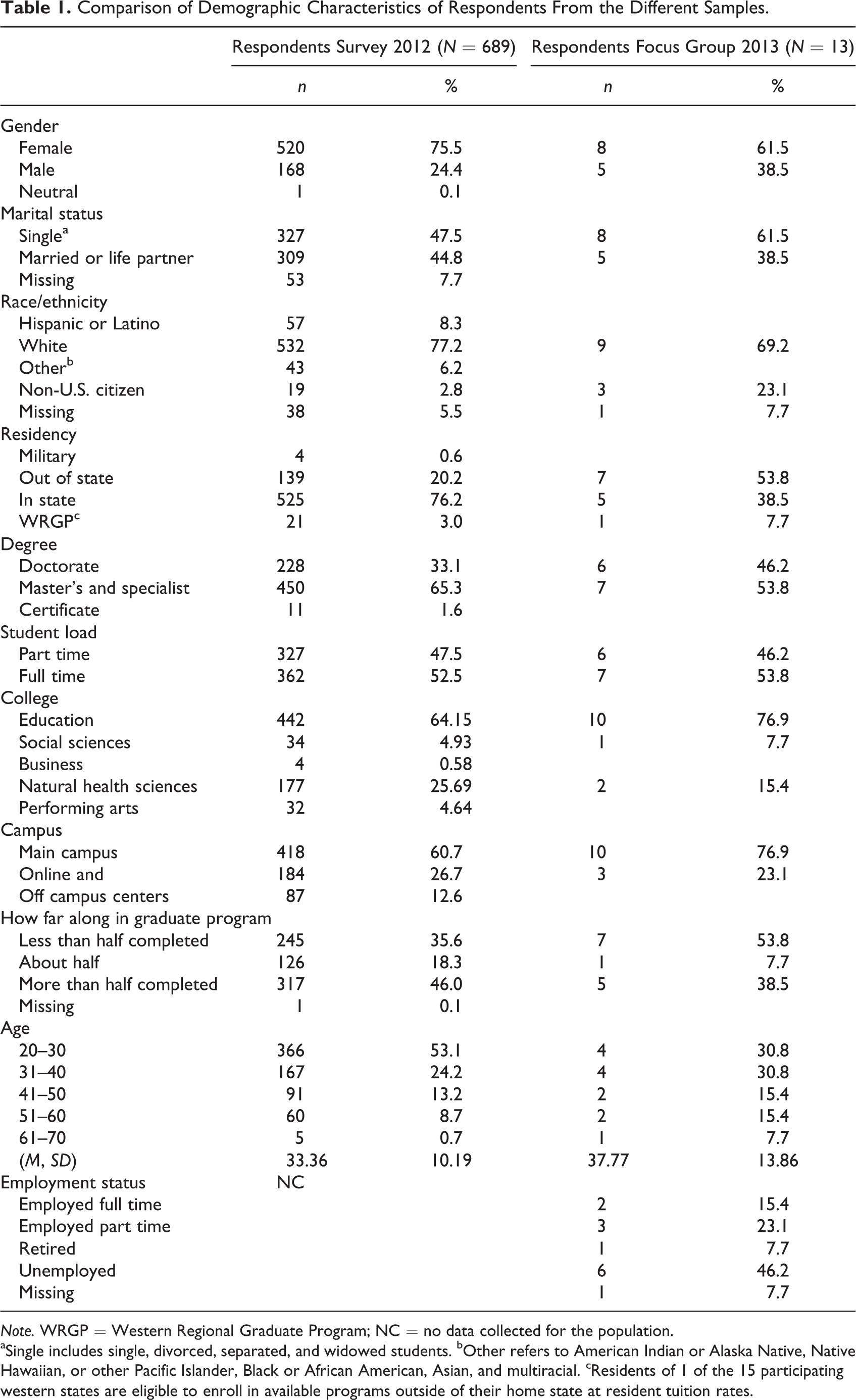
Note. WRGP = Western Regional Graduate Program; NC = no data collected for the population.
aSingle includes single, divorced, separated, and widowed students. bOther refers to American Indian or Alaska Native, Native Hawaiian, or other Pacific Islander, Black or African American, Asian, and multiracial. cResidents of 1 of the 15 participating western states are eligible to enroll in available programs outside of their home state at resident tuition rates.
Procedure
Separate institutional review board (IRB) approval was obtained prior to data collection for both the institutional survey and the focus groups. Surveys were administered online to all degree-seeking graduate students enrolled in classes during fall 2012. Respondents received an e-mail that generally described the survey, introduced the lead researchers, noted IRB approval, and provided a Qualtrics link for the next step. Interested respondents were directed to the university Qualtrics page with IRB disclaimer. Respondents were instructed to read the IRB statement and click yes to enter the survey. To increase the response rate, nonresponders were sent up to three reminder e-mails, and students could enter to win several incentives such as an iPad2, US$50 gift cards, and gift baskets containing university-themed items.
For the focus group study, institutional data were used to identify students who were enrolled in programs offered at various campus locations and who participated in any of the professional workshops offered to recruit participants. We reached out to those students through various means including e-mail, faculty, staff, and other students. To increase the response rate, students were offered a gift card for a free lunch. An e-mail describing the process as well as the logistics was sent to students who expressed interest. Confirmed participants received a reminder by e-mail 3 days prior and a reminder call the day before. Each participant was asked to complete a brief demographic questionnaire before the focus-group began as well as review and sign a consent form detailing the process and use of information collected. In addition to the information and short demographic form, demographic data such as age, gender, race, ethnicity, and so on were retrieved from the student information system. For the online focus groups, each participant was asked to complete the electronic consent and demographic form prior to the start of the focus group.
Data Collection
There was a significant amount of qualitative data gathered from graduate students about their experiences, needs, and barriers with regard to PD activities in the fall 2012 institutional survey’s opened-ended questions. Survey questions (see Appendix) were designed to explore graduate students’ PD interests, attendance barriers for PD opportunities, and stressors of graduate school. The qualitative comments collected in the 2012 institutional survey were exported from the survey and treated as an additional data source for the focus group study. In addition, focus groups were conducted with participants in a semistructured, 60- to 75-min format. All focus groups were digitally recorded and transcribed verbatim for data analysis. Participants were assigned pseudonyms to protect confidentiality. Interview questions (see Appendix) were used to elicit discussions about participants’ motivation for attending graduate school, current engagement, and participation in PD opportunities.
Data Analysis
The research team consisted of one White male and four White females, three of whom were doctoral students and two were higher education administrators. The team was multidisciplinary (i.e., backgrounds in higher education administration and student affairs, counselor education, and research methods) and all were trained in qualitative research methods.
Phenomenology analysis requires the researchers to organize the data and begin searching for significant statements and themes. At least three members of the research team independently reviewed the data and assigned responses across the various questions into themes using an open coding approach. After a general consensus was achieved, the data were sorted into themes and we began to develop a process of how to describe the observations, as Creswell (2007) stated, from a phenomenological lens frame. From this perspective, repeated rounds of analysis and interpretation fostered an understanding of the essence of graduate students’ experiences of PD. When disagreements arose, the responses were reexamined and the themes were revisited.
Focus group data were transcribed verbatim and analyzed using the constant comparative method (Glaser & Strauss, 1967). Nvivo qualitative software by QSR International (Version 10) was used to help analyze the data. The qualitative comments from the fall 2012 survey and the focus group transcripts were auto coded to create nodes that stemmed from the survey items and the focus group questions utilized and to associate demographic attributes to individual cases. Each survey and focus group question was then individually analyzed and coded. Results of both data sets were then compared to add to the breadth and depth of the research study.
Trustworthiness
In congruence with extant literature pertaining to increased rigor in qualitative research methodology (e.g., Krefting, 1991; Merriam, 1998; Shenton, 2004), a variety of intentional strategies were employed in order to enhance the trustworthiness of this study. According to Merriam (1998), triangulation may occur at a variety of levels, such as the inclusion of various data sources, investigators, and sites. The present study included information gleaned from focus group interviews as well as the data previously collected from the fall 2012 institutional survey, in order to consider multiple sources of data. To account for triangulation, the research team consisted of multiple investigators from multidisciplinary backgrounds with various educational and professional experiences. Furthermore, utilizing data collected from different types of students (i.e., master’s, doctoral, full-time, and part-time students) across multiple campuses (i.e., main campus, extended studies campus, and online learning) enhanced the consistency of the data (Krefting, 1991). In addition to data collection procedures, the research team intentionally selected both the theoretical foundation and the methodology of the study to align with the proposed research questions, thus contributing to increased trustworthiness throughout the design and implementation processes. Furthermore, the incorporation of intentional bracketing strategies, ongoing research journals, audit trails, and peer examination was utilized to reduce researcher bias throughout this study.
One aspect of phenomenological inquiry that bolsters trustworthiness is the integration of intentional bracketing strategies. Creswell (2007) described bracketing as a necessary function in which researchers record their prior assumptions, reflections, and thoughts about the potential findings of the current research in order to set aside any bias that may influence the researcher’s interpretations. Within the context of this study, once the research team was assembled and prior to data collection, each team member bracketed their assumptions about the current project. Bracketing examples from the research team included “graduate students are relatively unaware of what PD means beyond degree completion.” And, “they [graduate students] are much stronger connected to their program than to the university as a whole or the graduate school.” Researcher sentiments were collected and stored with the researcher journal. In addition, a researcher journal was used to help support trustworthiness in the current research project. Merriam (2009) contended that a researcher’s journal can serve as an audit trail and is meant to detail every step along the way such as the researcher’s decisions, problems, and ideas encountered throughout the research process. The first and second researchers in the present study kept and maintained a detailed researcher’s journal. The journal served as a highly detailed road map or audit trail that occasionally was referenced for clarity and guidance regarding the progression of the study.
Results
The results of the current study provided an emerging essence of graduate students’ experiences of PD. Four main themes emerged from survey and focus group data and are described in the following sections.
Perceptions of PD in Graduate School
The first theme, perceptions of PD in graduate school (endorsed by 68.36% of the survey and 84.61% of the focus group participants), illustrated the participants’ experiences and perceptions about PD development opportunities in graduate school. Two subthemes emerged from the data. (1) Participants described PD overall as activities that promote job readiness that included both academic (endorsed by 37.43% of the survey and 61.54% of the focus group participants) and (2) career preparation (endorsed by 58.35% of the survey and 30.77% of the focus group participants) related to their field of study. An example of an academic preparation activity was described by focus group Participant 31: I went to the dissertation series that was periodic, not the full day at one time, and being a first semester student here, it was very useful, and I know we walked in and they said, if you’re early in the program this may not really affect you right now, but I thought it was very good to take right away because it gives you an idea of what you’re going to have to do.
Both survey and focus group participants also expressed a desire for training that was field specific, that is, one music major asked for “master class presentations” and a counseling major requested “training in a specific counseling technique.”
In addition, the majority of survey respondents (58.35%) and about one third of focus group participants (30.77%) focused on career preparation activities, including topics such as “resume/vitae, job search, and preparing for interviews” workshops and applied experiences including research opportunities, assistantships, practicums, or internships. For example, survey Respondent 229 stressed a desire for more, “[PD] events for counselors in certain specialty areas (e.g., domestic violence and sex offender program providers),” and focus group Participant 13 stated, “I think, one of the biggest things for me … providing more opportunities and connecting to those community agencies and community supports for students to go into community and those partnerships.” Often both focus group participants and survey respondents expressed that more PD opportunities were important for overall career and academic goals, however, managing these needs in the larger context of life and other responsibilities was difficult. Sentiments of PD in graduate school were set in a contextual frame of reference and highlight the role of students’ commitment to utilize PD opportunities. Both studies indicated that balance and accessibility are common factors that impacted students’ access to various PD opportunities beyond the classroom.
Finding Balance Is Never Ending
The second major theme that emerged from survey and focus group data were the thoughts captured in participants’ continuous search for balance in all aspects of life. The majority of survey respondents (64.15%) and 38.46% of the focus group respondents indicated that various roles, such as being a parent, spouse, sibling, financial provider as well as being a working professional had complicated their participation in PD activities. Respondents expressed these roles often competed against each other and decisions to attend PD activities were considered within this life balance context. For example, focus group Participant 13 reflected: I’ve been a full-time GA from Day 1 essentially for my program, so I think balancing a GA and a doctoral program that demands that we do a million clinical hours and additional services it has been difficult to manage a social life outside of that with the grad school or anywhere else.
On behalf of most respondents, finding balance in professional and personal commitments were constant ongoing challenges. In part, participants’ sentiments highlighted most graduate students are working professionals with outside commitments that are juggled while working on a graduate degree. When participants expressed their quest to find and keep balance, they noted certain barriers that impeded their PD opportunities.
Experiences of Personal and Professional Barriers
Participants in Theme 3 shared reflections of personal and professional barriers they experienced while in graduate school. Both survey and focus group respondents revealed that time, location, accessibility (endorsed by 26.85% of the survey and 92.31% of the focus group participants), and finances (endorsed by 16.55% of the survey and 30.77% of the focus group participants) were the main barriers that hindered students’ engagement in PD opportunities. Participants shared that these barriers shaped overall perceptions and influenced levels of graduate school satisfaction. Speaking of time and timing as a salient barrier, focus group Participant 32 offered: Whereas I who work part-time had Tuesday, Wednesday, Thursday locked up, and so, nothing was offered Monday, Friday, Saturday, so I missed out on 2 full years of any PD because it was always at inconvenient times and then most of my classes, my face-to-face classes, were evenings, so I was like, oh, there’s this great thing on Wednesday, but you know, I’ve got stats, so it always became … things that I missed my first 2 years.
For most survey and focus group participants, finding time to attend PD-related events was commonly an unfulfilled desire due to scheduling and time availability conflicts. Most participants expressed a need and intention to attend PD opportunities but personal commitments were barriers. In addition, financial considerations were the second largest barrier that emerged from the data sets. Finances were regarded as monetary amounts required for gas, food, and attendance-related expenses. Focus group Respondent 13 went into considerable detail and expressed her struggle to make one program-related conference financially feasible and she expressed: I think for me the biggest one would be presenting at conferences and just attending different trainings that are additional. While conferences are most of it, you know, part is funded or some of it, I know a lot of trainings are not, which makes it really difficult because you’re literally paying out of pocket, like for example I just paid $500 to do a TFC training, which was out of my pocket, but it’s something that I really need … I think [it’s] so important and I think that often [it] gets, not really discussed or not really thought about as part of our professional development.
On behalf of most participants, the limitations of being a graduate student prevented them from making the best use of PD activities. As participants navigated around barriers and balanced convoluted lives, the nature of relationships emerged as another salient theme and further supports the essence of graduate students’ experiences.
The Importance of Faculty and Peer Relationships
The fourth and final theme, faculty and peer relationships, highlighted participants’ sentiments that relationships play a significant role in graduate student experiences (endorsed by 100% of the focus group participants). Experiences were set mostly within a classroom and goal-oriented framework. Focus group respondents offered examples that were generally regarded as positive and inclusive interactions that fostered meaningful relationships. In contrast, survey respondents contributed reflections that were more critical and evaluative, and 20.61% of the respondents indicated that faculty and academic support was not adequate. Speaking of positive relationships, focus group Respondent 22 offered her reflection of an experience working with a professor for an online project. She said: I think flexibility with the faculty that we’re working with is very important. Having enough time to be able to prepare for the content and the material and assignments that we’ll be tackling is important. A lot of it is about communication, knowing that there’s a strong line of communication and a lot of organization within the courses. I think that with the faculty that I’ve worked with I’ve been lucky that most have voiced that they understand we’re all coming from various time zones and different work environments so I think it is important that the faculty are flexible and that the program recognizes and stays in communication with us as changes occur or deadlines and important dates come up.
In contrast, survey respondents expressed frustrations and other forms of dissatisfaction with faculty members while in graduate school. Survey Respondent 47 captured the frustration and confusion that students generally spoke of when professors’ expectations were unclear: One of our instructors keeps changing the rules and adding assignments to our plate. She says one thing and does another. She does not teach us the curriculum, rather she has 3-hr class discussions that get offtrack and she does not steer us back to the course objectives. She is very strict with assignments and grading but does not offer specific instruction on how to do the assignments.
For most participants, the nature, degree, and depth of faculty relationships had a direct outcome on respondents’ perceptions of graduate school. Furthermore, participants’ experiences with faculty seemed to set degrees of positive or negative attitudes on career outlook beyond graduate school. While the nature of faculty relationships was pivotal, peer interactions emerged as another aspect of respondents’ experiences.
Peer-to-peer interactions rounded out the essence of graduate students’ experiences in graduate school and PD activities. Several participants expressed peer friendships were important across all dimensions of school. For example, Participant 13 expressed that most of her degree was online and she struggled to connect with peers in more meaningful ways. Participant 13 recounted her opportunities to build friendships during her in-person statistics courses were exciting and unexpected. Participant 13 recounted: I think the more that camaraderie and that support there is, hopefully that would reduce some of the scariness of what is graduate school and we are all going through the same thing … I think it is so powerful, some of the classes that I have enjoyed the most I feel like are the ones that people are coming from different departments because you just hear, you know, not only are they going through similar experiences but, I, as a scholar, find it really interesting to hear what somebody else’s research is, what somebody else’s challenges are, what are they doing here. I just find it really interesting and I think that can be very powerful even for later on in terms of collaboration and alumni networks.
Many participants echoed sentiments that reflected connection, insight, and trust were experienced through peer relationships in graduate school. The nature of these relationships, considered with the other major themes, begins to detail the salient elements of graduate students’ experiences, especially in relation to career and PD opportunities. The findings in the current study highlighted that graduate students live highly detailed lives and value relationships from faculty and peers while working on their degrees. The results in the current study begin to illustrate overall that graduate students consider PD activities as necessary and helpful opportunities and raises several points for discussion.
Discussion
The current study explored graduate students’ experiences of PD. A phenomenological approach was used to build a general understanding and illuminate the essence of graduate students’ professional and career-related experiences. The overall findings suggested the essence of graduate students’ experiences exists within four primary themes. The findings are discussed further in the following sections, followed by Implications, Limitations, and Conclusion sections.
Multilayered graduate student identities seemed to suggest that PD exists across several dimensions. As supported by the literature, PD involves a sense of community and networking (Golde, 2000) as crucial components of graduate students’ identities. The findings seem to suggest that among these salient dimensions, the nature and existence of positive relationships across all phases of graduate degrees (inception, middle, and completion) and levels of interaction (low, moderate, and high) were observed. Students’ feeling welcomed into their respective programs, working collectively with faculty throughout their degrees and establishing meaningful peer relationships were connected to student satisfaction. While the majority of the focus group participants expressed positive sentiments, survey data reflected more negative tones of faculty and peer interactions. This may reflect some differences in question design, variations in sample demographics (e.g., survey respondents were farther along in their program), some of the focus group participants participated in workshops prior to participation in the focus groups, and the presence of two researchers during the focus groups. In addition, the very nature of the focus group design is substantively different than that of the survey design due to a lack of anonymity and the possibility for social pressure to respond more favorably. However, the data illustrated that differing attitudes seemed to emphasize students’ desire and search for meaningful interactions within higher education.
The never-ending quest to achieve a positive and healthy life balance while attending graduate school raises additional points for discussion. The findings suggest the majority of graduate students lead demanding and multifaceted lives, supporting Schlemper’s (2011) findings. These multiple identities often competed against each other for time, interest, and accessibility across all professional and career development activities. Many graduate students in both samples expressed a desire to engage in more PD activities, yet felt conflicted by a constant state of cost–benefit analysis. This finding reinforces Golde’s (2000) and Tinto’s (1993) assertions that graduate students continuously weigh personal and professional commitments from an either-or analysis. Students expressed willingness to further aspects of their PD (e.g., interviewing skills), while constantly weighing their decisions against other competing roles. If graduate students needed to be at work or home parenting, the PD opportunities were typically set aside until the next opportunity emerged. At this point, graduate students engaged in the same cost–benefit analysis and chose accordingly based on their circumstances.
Implications
One significant area noteworthy of future research that emerged from this project is expanding studies on graduate students’ experiences of PD. Multiple locations and larger sample sizes could further the understanding of this understudied population and help support the essence of graduate students’ PD experiences. In-depth case and grounded theory studies could provide additional perspectives of graduate students’ experiences of PD from alternative qualitative approaches. A second implication would be to explore other institutions’ designs, implementation, and outcomes of PD activities for graduate students. Research that explores how administrators, trainers, and support staff utilize and implement PD across design, delivery, and assessment dimensions could bolster this line of professional inquiry. In addition, research that explores how student support professionals might reduce barriers that limit graduate students’ participation and satisfaction may support overall retention and higher graduation rates.
For higher education professionals who lead and organize PD activities, a more complete and rich understanding of graduate students’ lives and identity may inform how PD services are implemented. In light of the current findings, graduate students may benefit from PD opportunities with multiple delivery methods such as in person, live web, and recorded for later access (e.g., webcast) as options. Increased flexibility of PD opportunities may provide the balance and greater accessibility many graduate students identify as barriers inhibiting participation in PD activities. Further, increased participation may allow graduate students to become more aware of the services graduate schools and other student service offices offer and raise attendance at future events.
Graduate students have to compete with an overwhelmingly undergraduate culture where services are designed and staffed with professionals trained to serve the undergraduate population. If we wish to improve the graduate student experience, we must first think holistically about the graduate student. We need to align relevant services to include graduate students’ needs and increase communication. Programs are traditionally responsible for graduate student PD activities and are delivered throughout their program in conjunction with course work. However, program resources are limited and many of the university-funded opportunities for PD come at a high cost, for example, assistantships, faculty–student mentoring programs. We need to revise engagement strategies to include PD activities both in and outside the classroom. We must identify graduate education staff and faculty and increase collaborative efforts within our own system’s services related to graduate student PD that span across systems to include academic programs, graduate school, writing, research, and career centers, augmenting or developing relevant activities that will enhance academic courses, for example, workshops, internships, assistantships, and volunteer programs. In addition, considering the PD studies discussed previously (e.g., student mentor–mentee experiences and peer ran workshop series), there may be several ways to purposefully engage graduate students through PD with existing resources. Other innovative solutions include encouraging graduate students to get involved through student organizations to increase the exposure of graduate students to the undergraduate majority, potentially influencing resource allocation. Graduate students may also benefit from specific skill development activities, with clear learning outcomes that result in a measurable product that adds to the résumé and vitae. Furthermore, PD activities should be time considerate, applied, relevant, and directly applicable to career outcomes. In addition, career services can play a more active role in developing business relations or partnerships with program faculty to facilitate specific PD opportunities.
Limitations
The final focus group sample for this study resulted in several limitations based on a limited sample size and geographic region. The current researchers made numerous attempts to recruit focus group participants through multiple e-mails and rescheduling opportunities. In addition, the researchers adjusted off campus interviews from in person to online formats for greater flexibility and potential availability. In spite of the aforementioned recruitment efforts, the total sample of focus group participants was small, limiting the findings of the current research. In some areas, saturation across certain themes emerged and supported the essence of graduate students’ experiences, while other areas left graduate students’ PD experiences nebulous. Furthermore, this study was conducted in a relatively homogeneous area of the country. Researchers attempted to recruit participants from several locations, including two off campus sites with the intention of gathering a more robust and representative graduate student sample. Perspectives and experiences from participants in natural sciences, visual and performing arts as well as business and other disciplines would have added thicker and richer descriptions of graduate students’ PD experiences.
Conclusion
In summary, this research expands on a basic understanding of graduate students’ experiences of PD preparation in higher education. Most graduate students lead multifaceted lives that require many professional commitments balanced within social and personal contexts. Healthy positive relationships with faculty and peers appear important to students and informs their interest and PD development in higher education. This study highlights the exploration of graduate students’ experiences of PD in higher education and is an attempt to capture the essence of their lived experiences.
Footnotes
Appendix
Declaration of Conflicting Interests
The author(s) declared no potential conflicts of interest with respect to the research, authorship, and/or publication of this article.
Funding
The author(s) received no financial support for the research, authorship, and/or publication of this article.