




Abstract
We examined entrepreneurial role-model exposure (operationalized in terms of both the number of role models known and the intensity of interactions with one’s most influential role model) and self-efficacy as predictors of women’s entrepreneurial intentions. Among 620 female college students, self-efficacy and number of entrepreneurial role models were both associated with stronger entrepreneurial intentions. Among the 105 women who had at least one entrepreneurial role model, the intensity of interactions with the most influential of those role models was also associated with entrepreneurial intentions. Consistent with Social Cognitive Career Theory, self-efficacy mediated the relationships between both forms of role-model exposure and entrepreneurial intentions. Contrary to Bandura’s similarity hypothesis, the association between role-model exposure and self-efficacy was not stronger when access to female entrepreneurs was present. We discuss implications for future research and for career intervention.
Keywords
Entrepreneurship is a cornerstone of the U.S. workforce, as it drives innovation and is among the largest sources of new jobs (Kelly et al., 2012; Small Business Administration, 2012). In fact, new start-up businesses are viewed as essential for the nation’s economic recovery and growth (Hathaway & Litan, 2014; Patterson, 2011).
Entrepreneurship is fraught with risk, as half of new businesses fail within 5 years (Kelly et al., 2012). Nevertheless, when successful, entrepreneurship also holds potential as a rewarding career because it offers opportunities for flexible schedules, the possibility of home-based work, challenge, and autonomy (Kelly et al., 2012). These benefits were highlighted in a study that found entrepreneurs to have better physical health, fewer psychological problems, and higher well-being than other employed adults (Stephan & Roesler, 2010).
Perhaps because of the rewards that entrepreneurial careers offer, and in part because the struggling U.S. economy has resulted in the downsizing of large organizations, many young adults desire entrepreneurial careers. In fact, 54% of U.S. adults aged 18–34—the age-group most likely to start a new business (Conner, 2012)—reported they either wanted to start a business or had already done so (Mishory, Della Monica, & Graverson, 2011). Moreover, many young adults perceive opportunities for becoming entrepreneurs. Among those aged 18–24, 47% of women and 40% of men reported seeing opportunities for starting a business (Kelly et al., 2012).
Despite perceiving more opportunities for starting a business, women express fewer intentions to start a business than do men. For example, in 2012, 20% of men but fewer than 8% of women reported an intention to start a business in the next 3 years (Kelly et al., 2012). The lower intentions of women to become entrepreneurs are mirrored by their lower rates of participation in the workforce as entrepreneurs, and women comprise less than one third of small business owners (U.S. Department of Labor, 2010).
In addition to opening the door to potentially rewarding careers for more women, considering ways to increase the likelihood that women act on the opportunities they see for starting a business may be useful for at least three reasons. First, increasing female entrepreneurship may help reduce the persistent salary gap between women and men, as the gap in annual earnings between self-employed women and men is well below that for non-self-employed persons (U.S. Department of Commerce, 2010). Second, greater diversity among entrepreneurs may lead to increases in innovation (Welbourne, 2007). Finally, increasing the pool of potential entrepreneurs is critical for spurring the creation of new jobs and economic growth (Hathaway & Litan, 2014; Patterson, 2011).
Social Cognitive Explanation for Women’s Entrepreneurial Intentions
Women’s decreased likelihood of having entrepreneurial intentions and becoming small business owners compared to men is not attributable to inadequate training, as women and men are equally likely to have received training in how to start a business (Kelly et al., 2012). However, several studies (e.g., Scherer, Adams, Carley, & Weibe, 1989; Scherer, Brodzinski, & Weibe, 1990; Tolentino, Sedoglavich, Lu, Garcia, & Restubog, 2014; Wilson, Kickul, & Marlino, 2007) have suggested that some women may not act on opportunities to become entrepreneurs because, compared to men, they tend to have lower entrepreneurial self-efficacy (ESE; Kelly et al., 2012). ESE—beliefs about one’s ability to carry out tasks associated with starting and running a new business, such as marketing, managing employees, managing finances, and taking risks (Chen, Greene, & Crick, 1998)—is an empirically confirmed antecedent to entrepreneurial interests and intentions (BarNir, Watkins, & Hutchins, 2011; Chen et al., 1998;Wilson et al., 2007; Zhao, Seibert, & Hills, 2005). Self-efficacy beliefs are important determinants of whether a person attempts a behavior, such as launching a business, and whether one persists at the task when faced with challenges (Bandura, 1986), and they are also critical determinants of people’s career choices (Lent, Brown, & Hackett, 1994).
Women are also less likely than men to report knowing an entrepreneur (Kelly et al., 2012), which is another known antecedent to entrepreneurial aspirations and intentions (BarNir et al., 2011; Scherer et al., 1989, 1990; Van Auken, Fry, & Stephens, 2006). Role models may provide information, guidance, and support and are an important influence in career decision making in general (Buunk, Peiro, & Griffioen, 2007; Lent et al., 1994). Having a career role model has also been linked empirically to women’s decisions to pursue nontraditional careers (Greene & Stitt-Gohdes, 1997; Quimby & DeSantis, 2006).
ESE and entrepreneurial role-model exposure likely do not operate independently in the development of entrepreneurial intentions. Social Cognitive Career Theory (SCCT; Lent et al., 1994) suggests self-efficacy mediates the relationship between vicarious learning experiences acquired through the observation of role models and important outcomes, such as career interests and intentions. Thus, having entrepreneurial role models may increase the degree to which a person feels efficacious about starting a business because the model provides an example of mastery through exposure to his or her successes. Empirical support for this SCCT-based mediational model was recently obtained by BarNir, Watson, and Hutchins (2011) who confirmed that ESE mediates the relationship between exposure to entrepreneurial role models and people’s entrepreneurial career intentions. They also found the relationship between role-model exposure and ESE was stronger for women than for men, suggesting that entrepreneurial role models may be especially important in women’s decisions to become entrepreneurs.
Purpose of the Present Study
The BarNir et al. (2011) findings highlighted a process that may help account for women’s lower rates of participation as entrepreneurs in the workforce, but answering additional questions about this process would be useful in order to guide interventions designed to reduce barriers to women’s entrepreneurship. First, exposure to role models in the BarNir et al. study was operationalized in terms of affirmative responses to questions about whether one has parents who are entrepreneurs, whether one knows others who are entrepreneurs, and whether one has worked for a small or new company. The number of entrepreneurial role models known may be one indicator of influence, but theoretically a single role model could provide powerful learning experiences if he or she is very visible, has meaningful interactions with the observer or offers career guidance to the observer. From a career counseling perspective, it would be useful to know whether it is the sheer number of entrepreneurial role models one knows that is associated with increased ESE for women or whether the quality of interactions with role models might also be a determinant. Whereas the former would lead counselors to attempt interventions to widen prospective female entrepreneurs’ professional networks, the latter would instead warrant interventions designed to cultivate close relationships with one entrepreneur. We do not know of any prior research that has distinguished the number of one’s role models from the quality of interactions with those models and linked these variables to career-related outcomes, such as self-efficacy or intentions to pursue particular career. Doing so was the first purpose of our study.
Second, BarNir and colleagues did not account for the gender of the participants’ role models. Bandura’s (1986, p. 302) similarity hypothesis suggests vicarious learning experiences are particularly likely to be associated with increases in self-efficacy when a role model and learner are similar with respect to salient characteristics. When the model is dissimilar to the learner, the learner may discount her or his experiences as being irrelevant. For example, a woman may consider a male entrepreneur’s success as irrelevant in the predication of her own success as an entrepreneur if she endorses traditional stereotypes that men and women are differentially equipped to handle risks and aggressively market a product (Schiller & Crewson, 1997). Thus, access to and interactions with female entrepreneurs could, in theory, provide more powerful learning experiences for women than would interactions with male entrepreneurs.
Recent research has revealed that new entrepreneurs’ role models tend to be of their same sex (Bosma, Hessels, Schutjens, Van Praag, & Verheul, 2012), but whether demographically similar role models provide more powerful learning experiences has not, to our knowledge, been directly investigated. Two studies (Schiller & Crewson, 1997; Schoon & Duckworth, 2012) revealed that having a same-sex parent as an entrepreneur is associated with increased entrepreneurial behavior but that having an opposite-sex parent as an entrepreneur is not. This finding supports the idea that similarity may be an important aspect of the vicarious learning experiences provided by career role models, but whether the same trend holds among nonparent role models is unknown. We hoped to add to the social learning literature by examining the degree to which having a same-sex role model strengthens the association between the role model’s presence and vocationally relevant outcomes.
In this study, we sought to confirm with a new sample the SCCT-based hypothesis that ESE mediates the relationship between role-model exposure and women’s entrepreneurial interests. Consistent with the findings of BarNir and colleagues (2011), we expected positive relationships among the variables and that the relationship between role-model exposure and entrepreneurial intentions would be nonsignificant when controlling for self-efficacy. We operationalized role-model exposure in terms of both the number of entrepreneurial role models known and the intensity of interactions with one’s most influential entrepreneurial role model, which permitted us to assess whether it is the number of role models, quality of interactions, or both that is important. Finally, we assessed whether the relationship between role-model exposure and entrepreneurial self-efficacy is more strongly positive when a woman’s most influential role model is female. Consistent with Bandura’s similarity hypothesis, we predicted that exposure to female role models would be more strongly associated with ESE than would exposure to male role models.
Method
Participants
We obtained data from 688 female college students at a large, public Midwestern university. Sixty-eight participants did not respond to any items from the primary measures and could not be included in the analyses. Among the remaining 620 participants were 163 (26%) freshmen, 98 (16%) sophomores, 129 (21%) juniors, 125 (20%) seniors, and 104 (17%) graduate students; one woman did not report her year in school. Most (552; 89%) identified their race/ethnicity as White/European American, 23 (4%) as Black/African American, 16 (3%) as Asian/Asian American, 10 (2%) as Hispanic/Latina, and 7 (1%) as some other (unspecified) race, 4 (<1%) as American Indian/Alaskan Native, 3 (<1%) as multiracial, and 5 people did not report their race/ethnicity. The women ranged in age from 18 to 55, with a mean age of 21.73 (SD = 5.77) years. The women came from 93 different majors, with 26 students reporting an undeclared major. We solicited participants with a broad array of majors as opposed to only business majors because entrepreneurs can emerge from any field, and in some nonbusiness majors (e.g., Family and Consumer Sciences) more than half of the students have entrepreneurial intentions (Frazier & Niehm, 2006).
Only participants who had at least one entrepreneurial role model (n = 105) completed the measure assessing intensity of role-model interactions because its items ask specifically about interactions with an entrepreneur. Although we report bivariate correlations among some of the variables for the full sample of 620 participants, the analyses used to test the primary hypotheses are based only on the 105 women who had an entrepreneurial role model. Among those women, 20 (19%) were freshmen, 21 (20%) were sophomores, 26 (25%) were juniors, 26 (25%) were seniors, and 12 (11%) were graduate students. The majority (96; 91%) identified their race/ethnicity as White/European American, 4 (4%) as Black/African American, 2 (2%) as Hispanic/Latina, 1 (1%) as Asian/Asian American, and 1 (1%) as some other (unspecified) race; 1 person did not report her race/ethnicity. This subsample ranged in age from 18 to 53, with a mean age of 21.84 (SD = 5.65) years. These women were drawn from 72 different majors, and five students had undeclared majors.
Measures
Entrepreneurial self-efficacy
We assessed ESE using a scale developed by Chen, Greene, and Crick (1998). This measure contains 22 items that evaluate participants’ confidence in their ability to perform common entrepreneurial roles and tasks. The items ask about confidence with respect to marketing, innovation, management, risk taking, and financial control. Sample items include “set and meet market share goals” and “new venturing and new ideas.” Participants rated their perceptions of their ability to do each of the roles/tasks on a 5-point Likert-type scale with response anchors of 1 = completely unsure to 5 = completely sure. The total ESE score is the average of the responses to the items. In previous research, the Cronbach’s α reliability coefficient for ESE total scores was .89 (Chen et al., 1998). In the current study, α was .94. The ESE scores’ validity is supported by a highly significant correlation with another measure of entrepreneurial efficacy (Zhao et al., 2005) and by documenting that students enrolled in an entrepreneurship course scored significantly higher on the ESE measure than did students in an organizational behavior class (Chen et al., 1998).
Entrepreneurial intentions
We measured entrepreneurial intentions using Zhao, Seibert, and Hills’s (2005) 4-item scale. Participants indicated their intentions to start a business, acquire a small business, start and build a high-growth business, and acquire and build a company into a high-growth business over the next 5–10 years. Each of the items used a Likert-type response scale (1 = very little and 5 = a great deal). The total score was calculated as the average of the responses to the items. Zhao et al. (2005) reported Cronbach’s αs of .85 and .88 for this measure, and in the current research, α was .88. The validity of the entrepreneurial intentions measure is supported by a highly significant correlation with an alternative measure of entrepreneurial intentions (EI) developed by Chen et al. (1998). Zhao et al. (2005) also found that their measure of EI was strongly and significantly correlated with a measure of ESE.
Entrepreneurial role-model exposure
Because we wanted to operationalize entrepreneurial role-model exposure in terms of both the number of role models known and the intensity of interactions with role models, we used two measures for this construct.
Number of entrepreneurial role models
A 5-item scale developed by Hmieleski and Corbett (2006) assessed the number of entrepreneurs a respondent knows. The items ask participants whether they have friends and family members who are business-owner role models and whether they know many people who are entrepreneurs. Higher scores indicate a higher number of entrepreneurial role models. The items are answered using a “yes (coded 1)” or “no (coded 0)” format, and a total score is created by averaging the responses across the 5 items. Although this scale is best conceptualized as an index scale with responses that would not necessarily have a high degree of internal consistency (because a respondent may know entrepreneurs of some types but not others), the K-R 20 internal consistency estimate for this scale’s scores in previous research was reported to be .86 (Hmieleski & Corbett, 2006). In the current research, K-R 20 was .70. Scores from this measure of role-model exposure were highly correlated with entrepreneurial intentions in Hmieleski and Corbett’s (2006) research.
Same-sex entrepreneurial role model
If the participant responded to the Hmieleski and Corbett (2006) items by indicating that she had any entrepreneurial role models, she was asked to think about her most influential entrepreneurial role model and indicate that person’s sex. This information was necessary so that we could test Bandura’s (1986) similarity hypothesis. We created a dichotomous same-sex role-model variable scored 0 if the most influential model was male and 1 if the most influential model was female.
Intensity of role-model interaction
We then asked participants who had at least one entrepreneurial role model to respond to a 19-item scale created by Van Auken, Fry, and Stephens (2006) to measure the degree of perceived influence of their interactions with their most influential entrepreneurial role model. On this measure, participants respond using a 5-point Likert-type scale with response anchors of 1 = influenced a lot and 5 = no influence. The items assess the degree to which the respondent perceives the entrepreneurial role model to have been influential via personal involvement, professional involvement, providing mentoring, offering employment, providing opportunities for observation, and having discussions. For example, some of the items ask participants to rate perceived influence from frequent interactions in which their role model “taught you about managing a business,” “hired you in business when you were in high school/college,” and “included you in business discussions.” Van Auken et al. (2006) did not report information about the role-model interaction scores’ reliability, but they reported that scores were positively associated with respondents’ desire to own a business. In the current study, Cronbach’s α for the 17 items was .86.
Procedure
We sent an e-mail invitation for the study to all female students who had not opted out of receiving research invitations at their university. The invitation had a link to an Internet survey that contained each of the measures, which were administered in a counterbalanced order, except that the measure assessing the intensity of interaction with one’s most influential entrepreneurial role model was always administered after the questions about whether the participant had entrepreneurial role models because we only wanted to assess interactions with entrepreneurial role models. To thank them for their time, we entered participants into a drawing for a US$25 gift card.
Results
Among the full sample of 620 students, the proportion of missing data ranged from 0.2% to 11.3% for the ESE, entrepreneurial intentions, and number of entrepreneurial role models variables. Little’s missing completely at random (MCAR) test did not rule out the possibility that all missing values were MCAR, χ2(N = 688; df = 6) = 10.98, p = .09; therefore, missing values were imputed using the SPSS (Version 20) default procedure. Pooled correlations among those variables after multiple imputation are reported in Table 1. No missing data were present in the intensity of role-model interaction variable and same-sex role-model variable among the 105 students for whom those variables were relevant, so the Table 1 correlations involving those variables did not require imputation. All bivariate relationships were in expected directions except that having a same-sex role model was weakly and negatively associated with ESE and interests.
Means, Standard Deviations, Cronbach’s α Coefficients, and Intercorrelations Among the Measures.

Note. Same-sex role-model presence was coded such that 0 = No and 1 = Yes. Correlations among entrepreneurial intentions, entrepreneurial self-efficacy, and number of entrepreneurial role models are pooled correlations after multiple imputation, and means for those variables are estimated after imputation; SPSS does not provide estimated standard deviations after imputation.
*p < .05. **p < .01.
We used Mplus version 7.3 (Muthén & Muthén, 1998–2012) to test the moderated mediation model depicted in Figure 1. Entrepreneurial intentions was the dependent variable, ESE was the mediator, and number of entrepreneurial role models and intensity of role-model interactions were both independent variables. Having a same-sex role model was specified as a moderator of the relations between the two role-model exposure variables and ESE. Having a same-sex role model did not, in fact, moderate these relations (ps > .05; see Table 2). Thus, the data were not consistent with Bandura’s (1986) similarity hypothesis.
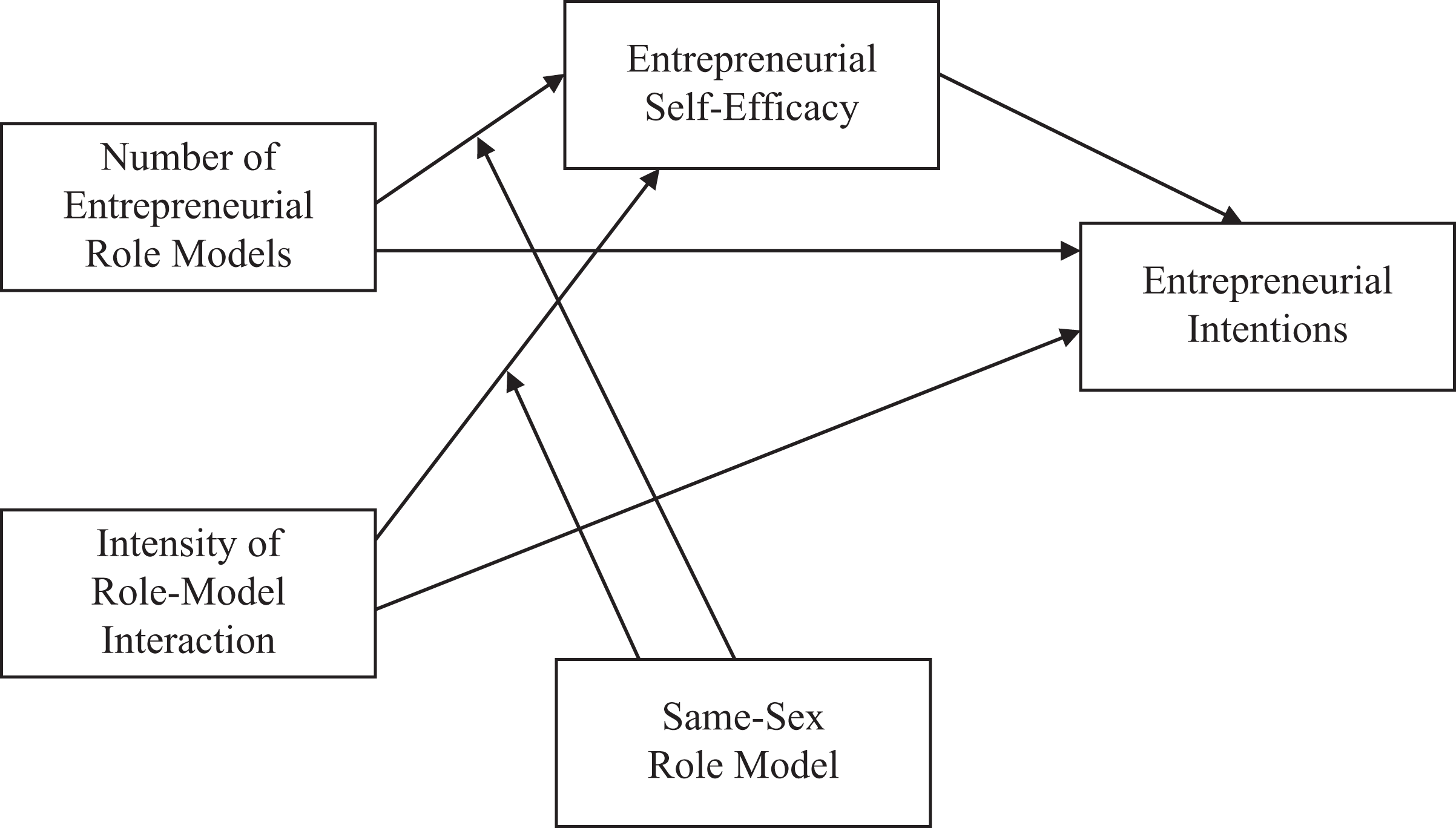
Social Cognitive Career Theory (SCCT)-based mediation model with same-sex role-model presence as a moderator of the associations between role-model exposure variables and entrepreneurial self-efficacy.
Parameter Estimates From Mediation Model With Same-Sex Role-Model Presence as a Moderator.
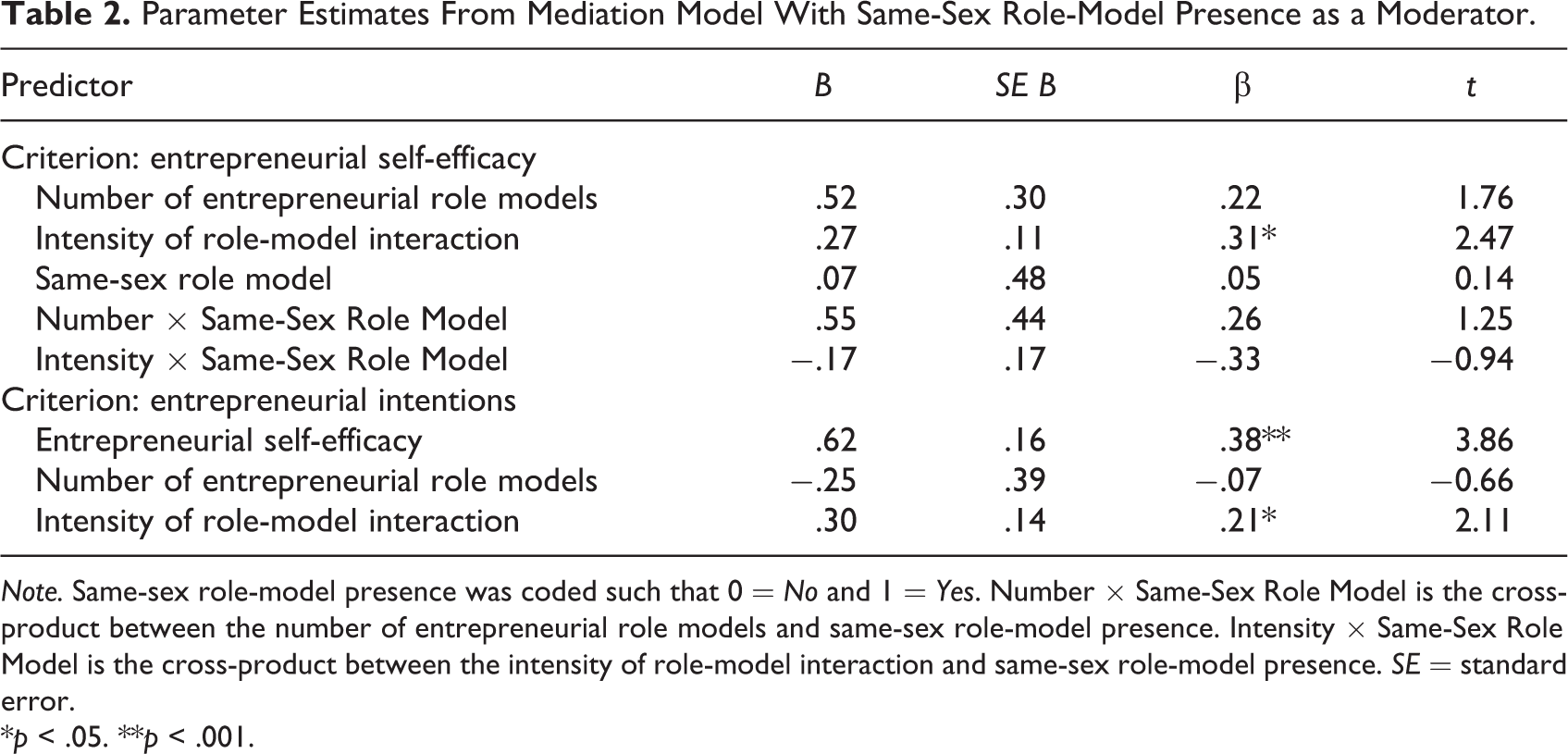
Note. Same-sex role-model presence was coded such that 0 = No and 1 = Yes. Number × Same-Sex Role Model is the cross-product between the number of entrepreneurial role models and same-sex role-model presence. Intensity × Same-Sex Role Model is the cross-product between the intensity of role-model interaction and same-sex role-model presence. SE = standard error.
*p < .05. **p < .001.
For simplicity, we therefore reestimated the mediation model, this time without the moderator (see Figure 2). The standardized coefficients presented in Figure 2 are consistent with the theorized model. Both role-model variables significantly predicted ESE, and ESE predicted intentions. While controlling for ESE, the number of entrepreneurial role models known did not significantly predict entrepreneurial intentions, although the intensity of role-model interaction variable did remain a significant predictor.
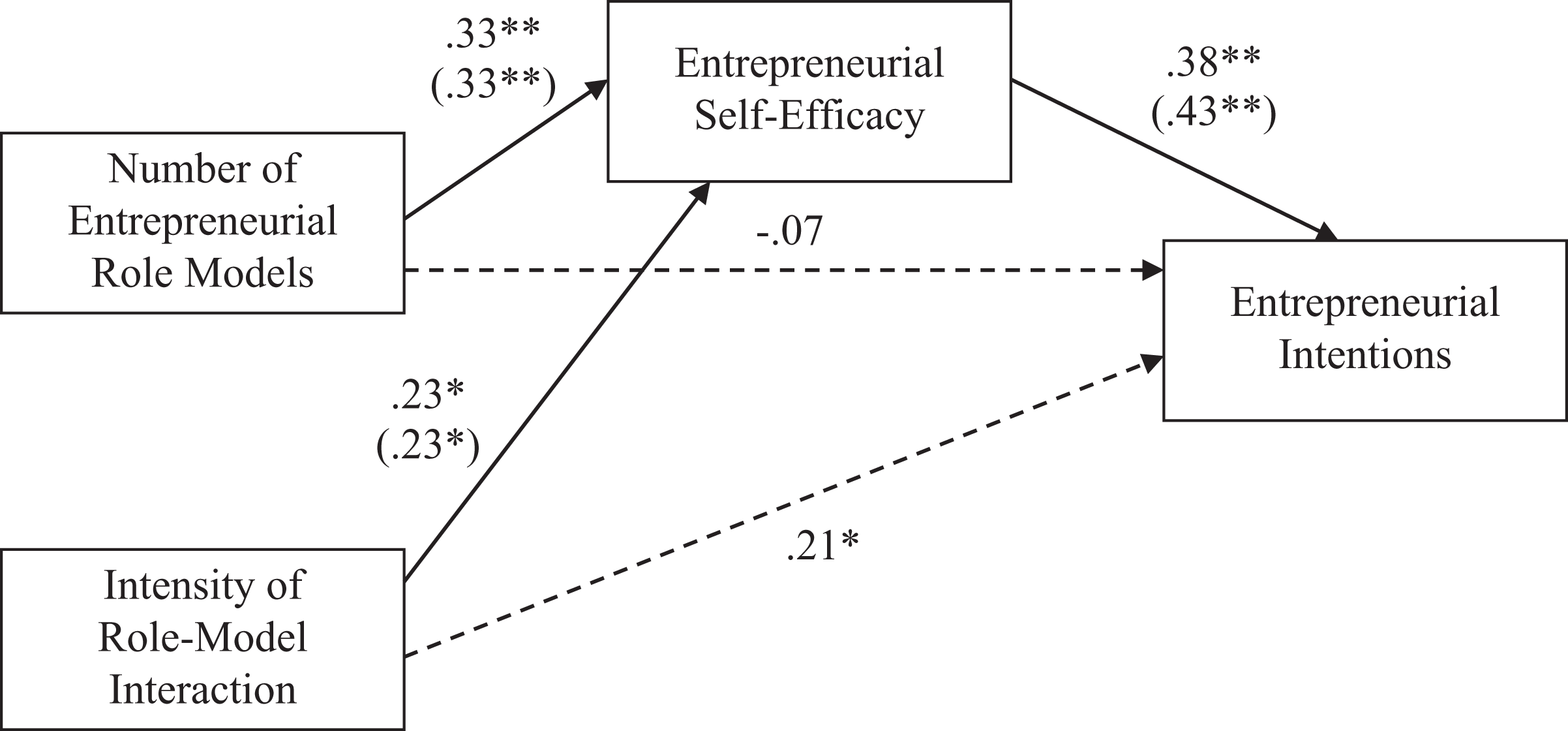
Simplified Social Cognitive Career Theory (SCCT)-based mediation model. Standardized path coefficients are displayed. Coefficients shown in parentheses are for the model with the dashed paths removed. *p < .05. **p < .001.
We then examined the fit of the model shown in Figure 2 with the direct paths between the role-model variables and entrepreneurial intentions (i.e., the dashed paths) removed. The comparative fit index (CFI) of .95 and the standardized root mean squared residual (SRMR) of .04 suggested that the model provided a good fit, χ2(2, n = 105) = 4.35, although the root mean square error of approximation (RMSEA) of .11 (90% confidence interval [CI] = [.00, .25]) was higher than the .08 cutoff typically used to indicate good fit (Hu & Bentler, 1999). We tested the significance of the indirect effects using 5,000 bootstrap samples to generate 95% CIs (Preacher & Hayes, 2004). The standardized indirect effects for number of role models (.14; 95% CI = [.04, .24]) and intensity of role-model interactions (.10; 95% CI = [.001, .20]) were both significant. Therefore, the data were consistent with the SCCT-based mediation hypothesis.
Of course, just because the theorized model provided a reasonably good fit to the data does not mean it is necessarily the best-fitting model. It is conceivable that women with entrepreneurial intentions actively seek contact with a large number of entrepreneurial role models and cultivate intense relationships with them, which in turn is associated with higher ESE. To rule out this possibility, we tested the fit of an alternate model in which ESE was the dependent variable, entrepreneurial intentions was the independent variable, and number of entrepreneurial role models and intensity of role-model interactions were mediators. All fit indices suggested this alternate model provided a poor fit to the data, CFI = .56, SRMR = .14, RMSEA = .38 (90% C.I. = .27, .50), providing further evidence for the veracity of the SCCT-based conceptualization of the relations among these variables depicted in Figure 2.
Discussion
Despite being a high-risk endeavor because of the high rates of small- and new-business failures, entrepreneurship holds potential as a rewarding career for women (Kelly et al., 2012; Stephan & Roesler, 2010). Increasing the degree to which women who have ideas for starting new businesses feel able to take action to begin such businesses, thus, is an important goal. An added benefit is that, if their businesses are successful and result in the hiring of new employees, they may stimulate economic growth (Mitchell, 2011). Moreover, new businesses created by female entrepreneurs may create new jobs with characteristics highly valued by female employees, such as those that offer work–life balance while also generating income (Marlow, 1997).
Because women’s lower rates of participation as entrepreneurs in the workforce cannot be attributed to inadequate training compared to men’s (Kelly et al., 2012), they may be due to lower self-efficacy. In fact, a number of studies have linked ESE to entrepreneurial interests and intentions (BarNir et al., 2011; Boyd & Vozikis, 1994; Zhao et al., 2005), typically using business students. The current study confirmed that the positive association between ESE and entrepreneurial intentions holds among college women in a wide variety of majors.
This study’s findings are also consistent with previous research documenting a positive association between entrepreneurial role-model exposure and entrepreneurial intentions (BarNir et al., 2011; Scherer et al., 1989, 1990; Van Auken et al., 2006), but our research extends our understanding of the association between role-model influence and entrepreneurial intentions in two ways. First, our findings suggest that greater entrepreneurial intentions tend to be present not only among those students who report knowing a greater number of entrepreneurs but also among those who have more frequent and intense interactions with their most influential entrepreneurial role model. This finding is consistent with the idea that a single entrepreneurial role model may provide powerful learning experiences via frequent and/or intense interactions.
Second, contrary to our expectation based on Bandura’s (1986) similarity hypothesis, our findings suggest that having a same-sex entrepreneurial role model as one’s most influential model is not necessarily associated with having stronger entrepreneurial intentions. In fact, we found a weak but significant negative association between having a female entrepreneurial role model and women’s entrepreneurial intentions. We can only speculate about the reason for this unexpected finding, but one possibility is that female and male entrepreneurs may tend to provide different types of learning experiences. It is possible, for example, that because women tend to engage in more self-disclosure than do men (Dindia & Allen, 1992), female entrepreneurs are more forthcoming with mentees about any career difficulties they are facing. This disclosure, while providing realistic information to the mentee, may also serve as a deterrent to her entrepreneurial intentions. Another possibility is that the businesses created by female entrepreneurs may tend to be qualitatively different from those created by men (Marlow & McAdam, 2013). Perhaps male entrepreneurs’ tendency to be more likely than female entrepreneurs to pursue business opportunities related to industry and technology allow their mentees to see the rewards of entrepreneurialism (e.g., lucrative benefits) particularly vividly. At any rate, our study’s findings are not consistent with Bandura’s (1986) similarity hypothesis with respect to gender, although it is possible that other dimensions of similarity between role models and mentees that we did not assess are more salient.
Finally, our study’s findings are consistent with the idea that SCCT is a useful means for conceptualizing the relationships among entrepreneurial role-model exposure, ESE, and entrepreneurial intentions. Consistent with the findings of BarNir et al. (2011), we found that self-efficacy mediated the association between the number of entrepreneurs known and women’s entrepreneurial intentions but extended this finding to a more general sample. Our results illustrate that self-efficacy also appears to be an important reason why the intensity of interactions with one’s most influential entrepreneurial role model is associated with entrepreneurial intentions.
Implications
Career services specialists are in a good position to help guide educational institutions’ and organizations’ efforts to increase the number of individuals who are considering entrepreneurial careers. The findings from this study suggest that, for women, mentor programs and internship opportunities that provide access to a greater number of and more frequent interactions with entrepreneur role models may have potential for increasing women’s entrepreneurial interests via increasing self-efficacy. The lack of support for the similarity hypothesis suggests that such programs need not be limited to providing access to female entrepreneurs.
A career counselor who is working with a female client who is debating whether to risk the pursuit of an entrepreneurial opportunity might also find these findings useful. Encouraging such a client to make contact with other entrepreneurs appears to be a reasonable form of intervention. If a client does not have a large number of known entrepreneurs, our findings suggest that intensive interactions with a single entrepreneur may be associated with some of the same self-efficacy and intention-enhancing benefits. Encouraging a client to pursue a part-time job or internship that would give her the opportunity to interact with a single entrepreneur on an ongoing basis would be a possibility.
Limitations
Our study’s findings need to be interpreted in light of its limitations. First, although we may ultimately be interested in determining how to increase the actual entrepreneurial behavior of women, our key outcome variable—entrepreneurial intentions—is only a proxy for such behavior. Entrepreneurial intentions assessed at age 16 have been shown to be associated with employment as an entrepreneur at age 34 (Schoon & Duckworth, 2012), so there is reason to believe that intention is an indicator of later behaviors. Nonetheless, it would be useful for future researchers to verify that entrepreneurial intentions culminating from entrepreneurial role-model exposure and self-efficacy do eventually translate into the pursuit of entrepreneurial careers.
Second, although our sample comprised female students from diverse majors, there was very limited racial/ethnic diversity in our sample. Research (e.g., Lent, Miller, Smith, Watford, Hui, & Lim, 2015) has found some of the associations in the SCCT model to be invariant across racial/ethnic groups, but until additional research verifies that the particular associations in the SCCT-based model we tested in this study are also race invariant, it would be wise to use caution when generalizing the results of our study to racial minorities. In addition, our college-age sample was fairly homogeneous with respect to life stage. Young adults are the demographic group most likely to actually start new businesses (Conner, 2012), but for some women the consideration of an entrepreneurial career may occur following professional or full-time work experience. Our study likely does not account for some antecedents of entrepreneurial intention that may be unique to participants in more advanced career stages.
Third, although our findings suggest that having a same-sex entrepreneurial role model is not necessarily an asset for women in terms of increasing their entrepreneurial intentions, it would be premature to dismiss Bandura’s (1986) similarity hypothesis altogether. We could only test this moderation hypothesis using the subsample of women who had at least one entrepreneurial role model, and this subsample may have been too small or select to generate sufficient power to detect the moderation effect (Aguinas & Gottfredson, 2010). Nevertheless, because having a same-sex role model was negatively associated with ESE and entrepreneurial intentions, we do not have good reason to suspect that a larger sample would confirm the similarity hypothesis with respect to gender. We had thought gender might be a salient characteristic for women considering entrepreneurial careers, given the perception that men are better equipped to handle risk-fraught careers like entrepreneurialism (Schiller & Crewson, 1997) but perhaps other dimensions of similarity are more salient. Future researchers could investigate the similarity hypothesis with respect to dimensions such as race, socioeconomic status, or even perceived personality traits, such as assertiveness which are perceived as relevant to entrepreneurialism.
Finally, our cross-sectional, correlational data do not allow us to draw conclusions about causation. Although our conceptualization of entrepreneurial intentions as stemming from role-model exposure and self-efficacy is consistent with the empirically well-supported SCCT, it would be useful to conduct experimental research to verify these associations. For example, researchers might test the effects of mentoring programs that are designed to increase women’s participation in the labor force as entrepreneurs. In testing the effects of such interventions, it would be useful to tease apart the exposure to a number of role models versus the intensity of the interactions with such models and compare both forms of intervention with no-treatment controls.
Conclusions
Although additional research is needed to verify the causal nature of these relationships, our study’s findings support an SCCT-based mediational relationship in which entrepreneurial role-model exposure is associated with female students’ increased likelihood of intending to become entrepreneurs via the increasing of self-efficacy. This finding was consistent with the results of BarNir et al. (2011), but it also extends the BarNir et al. findings by illustrating that the potential benefits of role-model exposure can occur through exposure to a large number of role as well as via more intense interactions with a single entrepreneurial role model. Our findings suggest that, for women, having access to female entrepreneurs in particular is not critical.
Footnotes
Authors’ Note
This study is based on the first author’s master’s thesis completed under the direction of the second author.
Declaration of Conflicting Interests
The author(s) declared no potential conflicts of interest with respect to the research, authorship, and/or publication of this article.
Funding
The author(s) received no financial support for the research, authorship, and/or publication of this article.