




Abstract
John Holland’s RIASEC theory of workplace personality posits that most people resemble a combination of six personality types. The Self-Directed Search® provides the user with a Summary Code that represents the three personality types to which they are most similar. The Leisure Activities Finder™ (LAF) includes a listing of leisure activities, with corresponding codes, which allows users to search for activities that match their Summary Code. During a recent revision of the LAF, the authors developed a list of new activities to be included and assigned codes to them. In a validation study, participants rated activities corresponding to their Summary Code and corresponding to their opposite code. Overall, they rated activities corresponding to their code to be relatable and interesting. Implications for career counseling are discussed, as well as the potential for use of the LAF across the life span.
John Holland’s RIASEC theory of workplace personality posits that most people and occupations resemble a combination of six personality types (realistic, investigative, artistic, social, enterprising, and conventional). According to Campbell and Borgen (1999), “Holland’s impact on vocational psychology in the past 30 years is unsurpassed” (p. 97). Numerous studies have been conducted to ascertain the psychometric strength of the Holland’s theory, and overall, it has been accepted as a fundamental model within vocational psychology for the past four decades.
From his theory, Holland and others have developed many assessment instruments (e.g., Self-Directed Search® [SDS]; Holland & Messer, 2013a), Vocational Preference Inventory (Holland, 1985), and resource materials (e.g., You and Your Career, Holland & Messer, 2013c; Occupations Finder [OF], Holland & Messer, 2013b; Educational Opportunities Finder, Messer, Holland, & PAR Staff, 2013; Leisure Activities Finder™ [LAF]; Messer, Greene, Kovacs, & Holland, 2013). These instruments and resource materials are direct products of Holland’s theory of personality types and environmental models, and they allow practitioners to utilize the theory when working with clients. Moreover, Taylor, Kelso, Cox, Alloway, and Matthews (1979) stated that their findings “suggest that Holland’s categories are sufficiently flexible to be applied not only to educational and vocational behaviors but also to the avocational domain” (p. 204). Therefore, the current study focuses on one of these vocational tools, the SDS, a self-administered career counseling tool based on Holland’s theory as well as a newly revised avocational resource, the LAF.
The SDS is a self-administered, self-scored, and self-interpreted career counseling tool. The SDS provides the user with a Holland Summary Code that represents the three personality types to which they are most similar. A significant amount of research has been conducted on Holland’s theory, the reliability and validity of code types, and the application and utility of Holland Codes in the real world (for a comprehensive review of literature on Holland’s theory, see Foutch, McHugh, Bertoch, & Reardon, 2014).
The LAF, a resource intended to be used in conjunction with the SDS, includes a listing of leisure activities that are arranged according to SDS-derived Summary Codes. With the LAF, only the first two letters of the Summary Code are used. For example, if an individual’s code is SER, SE would be used with the LAF. Two-letter codes are used for several reasons. First, it allows individuals using the SDS Form E (Holland, 1996; for use with individuals with limited reading skills) or SDS Career Explorer (Holland & Powell, 2000; for use with middle and high school students), which also provide a two-letter code, to utilize the LAF. It also allows users with a three-letter code to explore more options in the LAF. For instance, a user with a code of RIA is encouraged to search all permutations of that code in the LAF, such as RI, IR, RA, AR, IA, and AI.
The LAF, last updated in 1997, contained over 750 leisure activities—hobbies, sports, and other pastimes. Each leisure activity was identified with a category label, such as collecting, nature, or entertainment. The booklet contained two sections that allow the user to search by Summary Code or look up leisure activities in alphabetical order. Given the relationship between engagement in leisure activities and quality of life, social support and positive social interactions, the LAF is an important supplement to the SDS (Leung & Lee, 2005).
A study by Miller (1991) examined the validity of the LAF with a group of 70 graduate students and found a high level of congruence between the participants’ Summary Codes and their preferred leisure activities. Miller concluded that his study supported the validity of the LAF “as a procedure for helping clients to consider a large sample of leisure activities and identify activities consistent with their personality types” (p. 366). Recently, the LAF has been revised. The purpose of this article is to describe the revision process of the LAF and to replicate the study conducted by Miller with the goal of validating the revised LAF. Specifically, it is hypothesized that individuals will rate activities associated with their Summary Code as more interesting than activities associated with other Summary Codes.
Method
In the prior version of the LAF (Holmberg, Rosen, & Holland, 1997), Holland Codes (which represent the two personality types to which the activity is most similar) were assigned to activities in several ways. Some were taken from the SDS OF that provides three-letter Holland Codes for more than 1,400 occupations. The occupation corresponding to the leisure activity was then used to derive the code. For instance, the occupational code for Pastry Chef was used to derive the code for the leisure activity of Cake Decorating. In other cases, codes were generated by inference from similar occupations (e.g., Organizational Board Member was based on occupations such as Director, Community Organization and Director, Public Service). Codes were then reviewed by an expert panel of three judges with extensive experience in the Holland classification system.
Revision of the LAF
In 2013, several steps were taken to revise the LAF. The first step included having the authors of the LAF revision review the 1997 version. During this review, deletions of outdated activities and revisions to existing activities and categories were made. The author group then developed a list of 107 new activities that needed to be considered for inclusion, including hobbies pertaining to the Internet, computers and other electronic devices, and other areas. It is important to note that this list was not exhaustive. The authors attempted to include common activities that have become popular since the LAF was last revised in 1997.
Some categories were modified, added, or removed during the revision process. Some categories were combined so that similar activities would be listed together. For example, the Board Game and Table Game categories were combined to create the Board/Table Games category. Three categories (Friendship, Membership, and Spirituality) were combined to create the Membership and Social Engagement category. The Health category and the Physical Fitness category were combined to create the Health, Well-being, and Physical Fitness category. Endurance Sport and Strength Sport were combined into Strength/Endurance sport.
Some small categories were deleted, and their activities were moved to another, broader, category. During this revision, some categories were overhauled based on the emergence of new leisure activities since the previous revision. Three activities (microscopy, pyrotechnics, and telescope making) were added to the Science category, and one activity (astrology) was moved to the Entertainment category. A new category, Computers/Electronics, was created, containing six new activities such as computer programming and robotics.
The categories of Computer Games and Fantasy Games were reworked entirely because of the rapidly changing technology involved with gaming. Since chess is included under Board/Table Games, computer chess under Computer Games was removed as being redundant. Nintendo® was removed and instead incorporated into the broader title of Console Gaming. Similar to Nintendo, Dungeons and Dragons® was incorporated into the broader title fantasy role-playing games, with examples listed in parentheses next to this activity. The authors felt that the broad title better captured the nature of these activities, rather than naming out specific titles of games that may become outdated quickly. All other activities under this category were incorporated into a new overarching category, Gaming. In order to capture the full spectrum of gaming opportunities, computer gaming, Internet gaming, pinball, and trading card games were also added to the Gaming category.
A new category, Outdoor Group Games, emerged when the authors began adding activities to the Lawn Games category. It was decided that social group games, such as capture the flag, hide-and-seek, and tag, were distinct from Lawn Games such as cricket or horseshoes. In the end, Outdoor Group Games became its own category with eight new activities. Lawn Game remained unchanged, save for the addition of cornhole and disc golf.
Derivation of Two-Letter Holland Codes for New Activities
A rating form was devised that allowed each author to first decide whether the proposed activity should be included in the LAF. If they thought it should be, then they independently assigned a two-letter Holland Code and a category to each proposed activity. If they did not think it should be included in the LAF, a code was not assigned. The authors were encouraged to note a more appropriate title for the activity if needed as well as provide feedback on potential revisions to the categories. While assigning two-letter codes, the existing code assignments for the 1997 version of the LAF were referenced to ensure consistency. In addition, occupations related to the new leisure activity and the three-letter Holland Code found in the OF were reviewed to ensure consistency.
These results were compiled and assessed for agreement across the three authors. First, each author’s assessment of whether the leisure activity should be included was taken into account. An answer of “Yes” was assigned a weight of 1, and an answer of “No” was assigned a weight of 0. The answers were summed across all three authors. Activities with a score of 3 were automatically included in the LAF. Activities with a score less than 3 were discussed among the authors with the goal of making a final decision regarding inclusion in the LAF.
There was a high degree of agreement between the authors on most of the proposed activities. A total of 94 (87.9%) were rated to be included by all three authors, 9 (8.4%) were rated to be included by two of the three authors, and 4 (3.7%) were rated to be included by only one of the authors. Next, each author’s first letter rating, second letter rating, and category rating were compared to each other’s to make the final decision on the code and category for each new activity. Agreement of two of the three authors or three of the three was required for the letter/category to be assigned.
Interrater reliability refers to the amount of error attributed to rater variability in the assigning of codes. The correlation between those independent sets of ratings indicates the degree of agreement between raters. To assess this, the intraclass correlation coefficient (ICC) was calculated for the authors’ rating of the first letter of the code and the second letter of the code. To calculate the ICC, the two-way random effects model (consistency type) was used. For both the first and second letter ratings, the ICC was found to be high (.85 and .88, respectively), indicating a high degree of agreement between the authors’ ratings.
Another way to measure interrater reliability is to assess the degree of agreement between the codes assigned to each activity by each author. This was assessed using a modification of the Zener–Schuelle Index of Agreement (Zener & Schnuelle, 1976 ). Using this index, codes for each activity are assigned an agreement score ranging from 0 (no agreement) to 5 (perfect agreement, i.e., the codes match; see Table 1 for the specific criteria).
Zener–Schnuelle Index of Agreement Criteria.
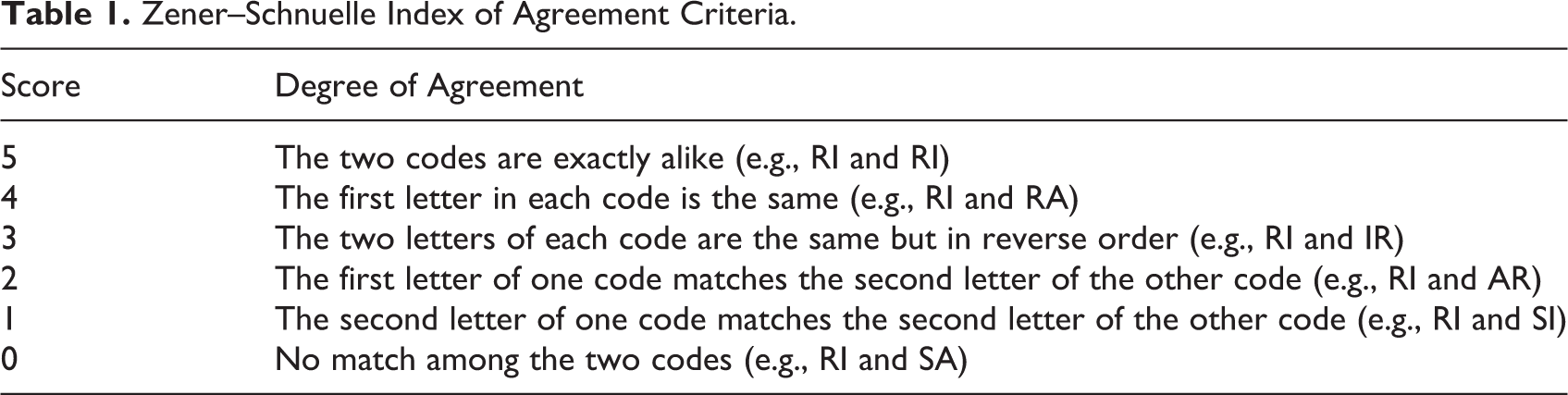
The Zener–Schuelle Index of Agreement was calculated for each activity to assess the agreement of the codes assigned by Author 1 and Author 2, Author 1 and Author 3, and Author 2 and Author 3. Next, the mean and standard deviation of the agreement across all activities were calculated. Author 1 and Author 2 had a mean agreement of 3.84 (SD = 1.62), while Author 2 and Author 3 agreed somewhat less frequently, with a mean agreement of 3.77 (SD = 1.66). Author 1 and Author 3 agreed most often with a mean agreement of 4.87 (SD = 0.59). These results indicate that all authors assigned codes in a very similar manner.
Of the 94 activities coded by all three authors, 49 activities (52.1%) were given the same code by all authors and 42 activities (44.7%) were assigned the same code by two of the three authors. In only three instances (3.2%), the authors each provided a unique code. However, in each case where there was no two-letter agreement, the authors agreed on one letter. These results indicate good agreement between the author’s ratings.
In instances where there was no agreement on either the two-letter code or the category, the authors met to discuss discrepancies and come to a consensus. During this meeting, 34 additional activities were added and coded based on discussion among the authors, bringing the total proposed activities up to 141. Of the list of 141 proposed activities, 6 were ultimately not included in the LAF for various reasons, such as being too similar to activities already included, or being so specific that most people would not find the activity relatable. Therefore, there were 135 new leisure activities added during the revision.
Based on the described revision process, the LAF (Messer et al., 2013) ultimately includes 54 categories and 842 leisure activities. The frequency of activities corresponding to each RIASEC code is presented in Table 2, with S (social) have the most activities at 30.4%, followed by R (realistic) with 28.7%. Table 2 also presents the frequency of each RIASEC code type in a large, census-matched population (N = 1,739). The census-matched sample was used to standardize the SDS, fifth edition (Holland & Messer, 2013a). The distribution of code types for activities in the LAF resembles the proportion of individuals falling into each code type, falling within 5–11% of each other. This adds to the LAF’s utility in that the distribution of activities resembles the distribution of codes in a large sample representative of the general population.
Distribution of Activities in the LAF Compared to a Census-Matched Population.
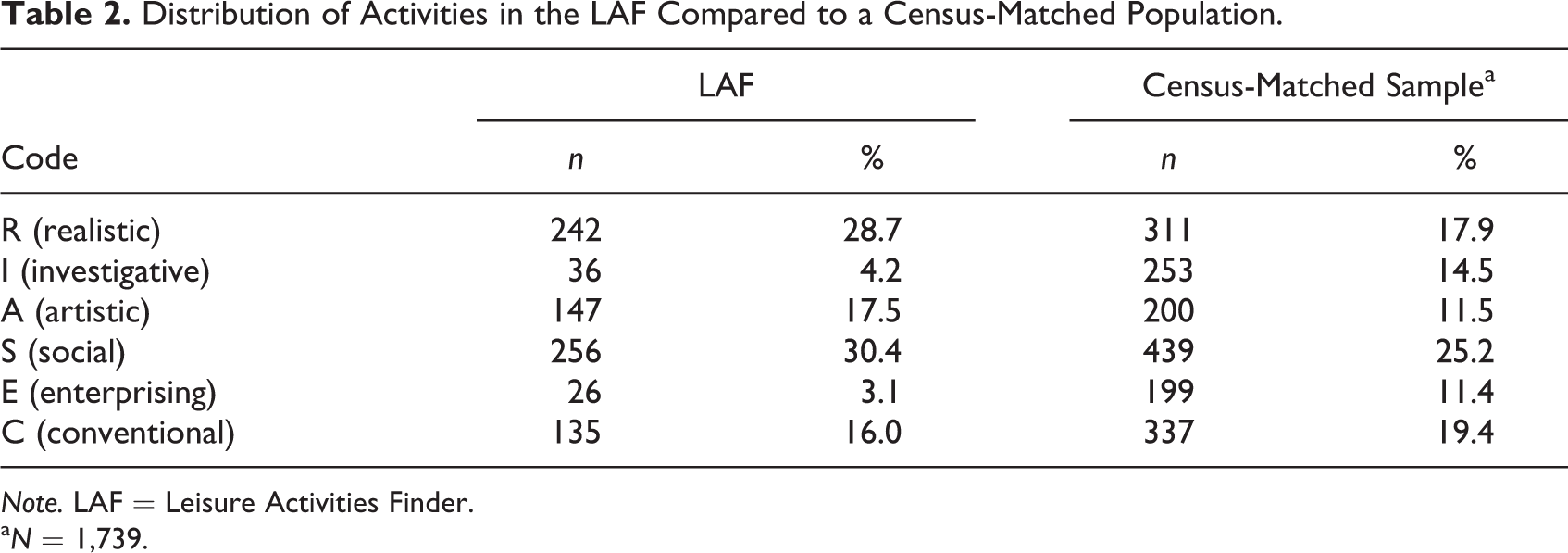
Note. LAF = Leisure Activities Finder.
aN = 1,739.
Validation Study
Similar to Miller’s (1991) study described earlier, a validation study was conducted with a sample of 103 participants. Individuals who took the SDS via www.self-directed-search.com were invited to participate in the LAF validation study. Informed consent was acquired from all participants. Each participant was asked to rate various leisure activities. They answered the following question, “How interested would you be in participating in this activity/collecting this item?” on a scale of 1 to 5 (1 = not at all interested, 2 = somewhat interested, 3 = interested, 4 = very interested, and 5 = extremely interested). Participants were asked to rate activities corresponding to their two-letter code as well as activities that were associated with their opposite code. Two-letter code refers to the individual’s two-letter Summary Code, that is, the two personality types they most closely resemble. This code is used because activities in the LAF are categorized with two-letter Holland codes, as mentioned previously. Opposite code refers to the letters that are opposite to the individual’s code on the RIASEC hexagon (see Figure 1). For example, the opposite code of SI would be RE since R is opposite of S on the hexagon and I is opposite of E. Participants were blind to which code the activities correspond to.
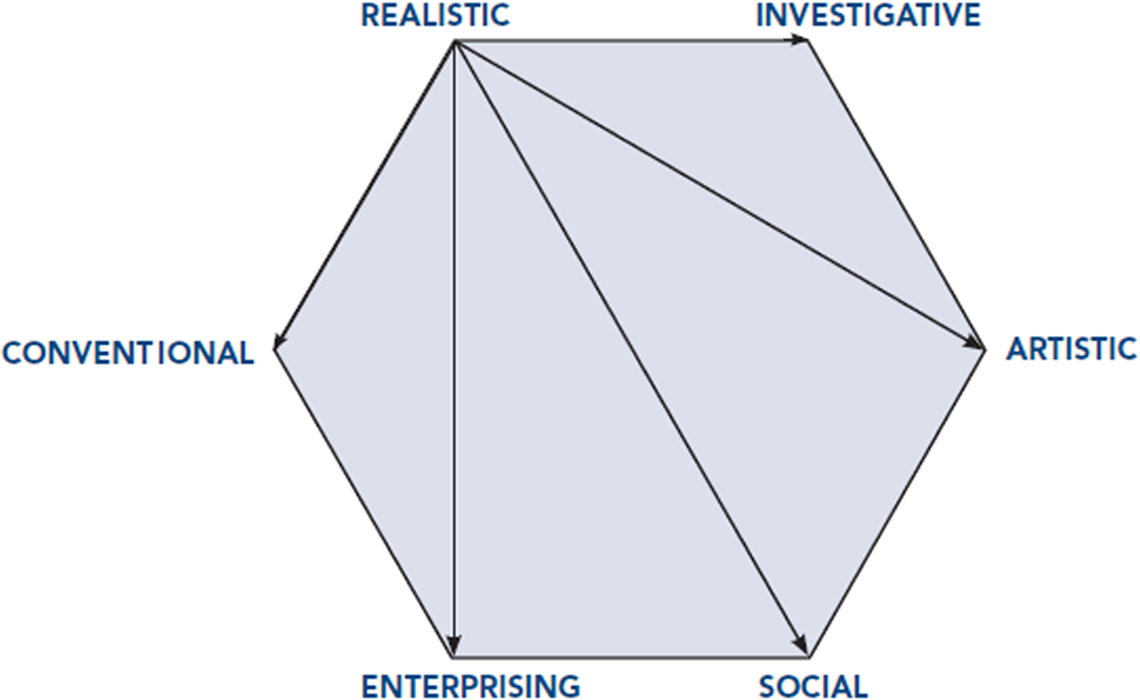
The hexagonal model.
For each participant, the mean rating was computed for (1) their two-letter code activities, (2) their opposite code activities, and (3) the difference between the mean ratings. The proportion of activities in which the participant was extremely interested in (score of 5) and not at all interested in (score of 1) were also computed for the two-letter code activities and the opposite code activities. Each of these comparisons was tested using a dependent samples t-test, and effect size (Cohen’s d; Cohen, 1988) was calculated. An effect size of .2 is considered small, .5 is considered medium, and .8 or higher is considered large (Cohen, 1988).
Results
Validation Study
Description of the sample
Participants were 103 individuals, aged 16–94 (M = 39.44, SD = 14.31). Table 3 presents the demographic characteristics of the sample. The sample was mostly female (67%) and ethnically diverse. The sample closely approximates the racial and ethnic composition of the United States (U.S. Census Bureau, 2013), with 61.2% Caucasian participants (U.S. population = 66.0%), 16% African American (U.S. population = 11.6%), 9.7% Hispanic (U.S. population = 15.0%), and 13.6% of other racial backgrounds (U.S. population = 7.5%).
Demographic Characteristics of the LAF Validation Sample.
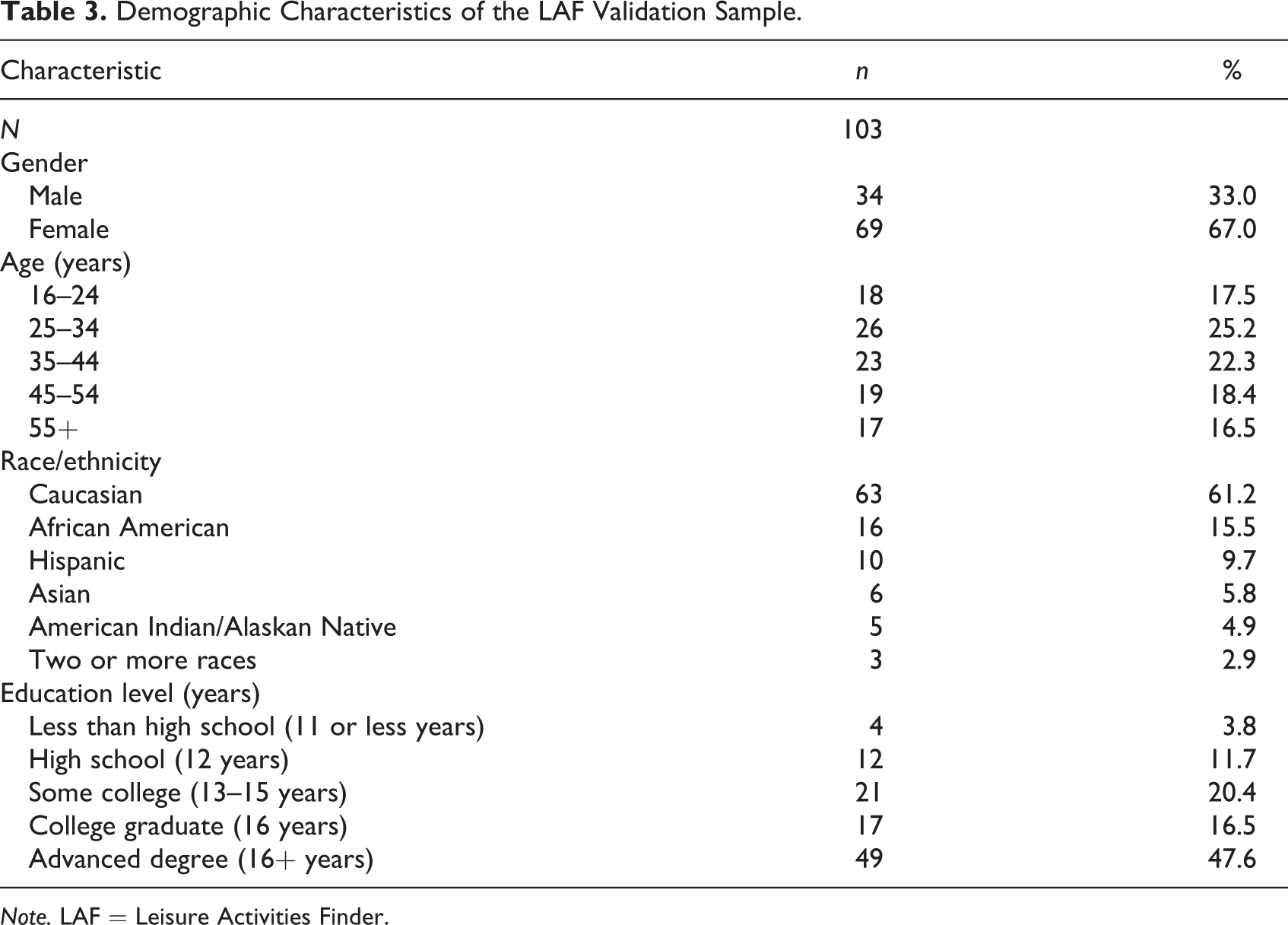
Note. LAF = Leisure Activities Finder.
Participants also had a range of attained levels of education, ranging from less than receiving a high school diploma to attaining an advanced degree. The sample approximates the educational composition of the United States, but less closely than race/ethnicity, with 3.8% of the sample receiving less than a high school diploma (U.S. population = 12.6%), 11.7% receiving a high school diploma (U.S. population = 29.5%), 20.4% completing some college (U.S. population = 29.0%), and 64.1% completing a college degree or advanced degree (U.S. population = 28.9%). Overall, the sample was more educated than the general U.S. population.
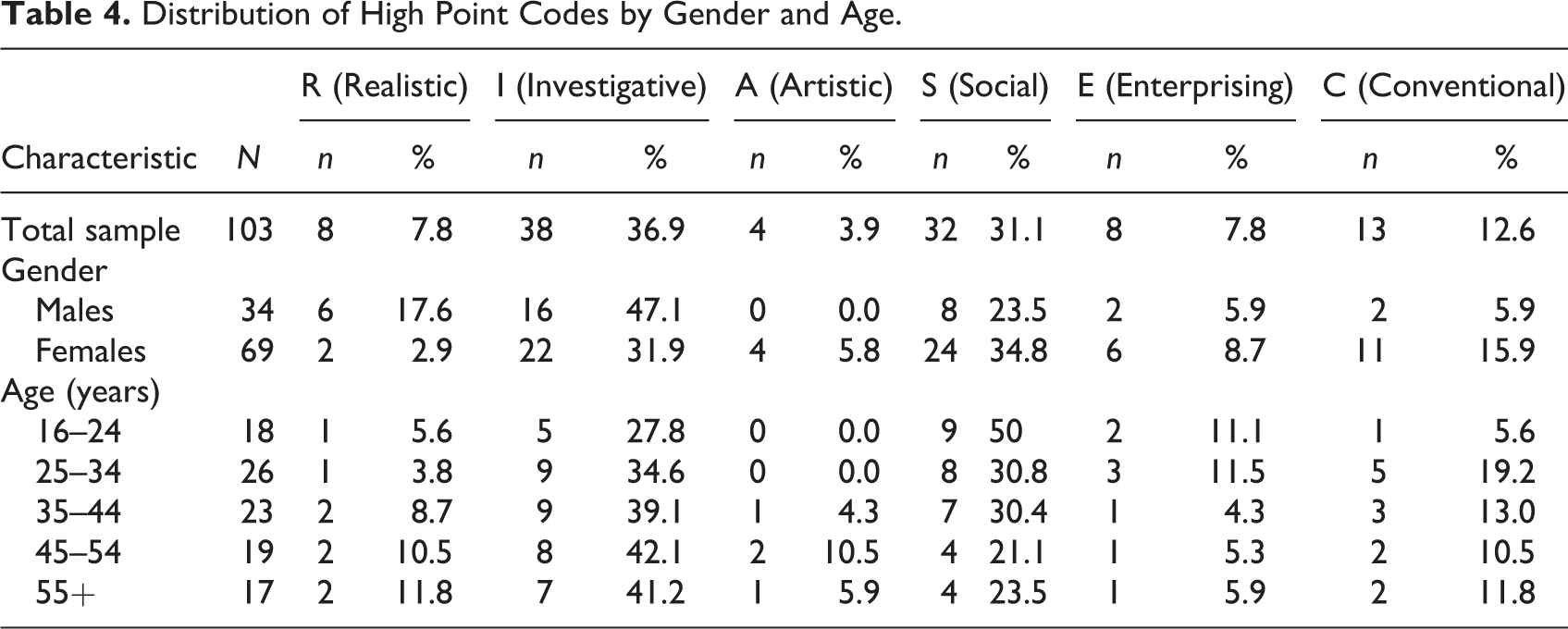
All RIASEC letters were represented as high point codes among this sample, ranging from 3.9% of all participants in the A (artistic) type to 36.9% in the I (investigative) type (see Table 4). Overall, this sample approximates the distribution of high point codes in the large (N = 1,739), census-matched sample used to standardize the SDS, fifth edition, falling within 4–10% of each other, with the exception of the investigative type, which was the high point code for only 14.5% of the census-matched standardization sample. Overall, the high point code distribution of this sample approximates the distribution that would be expected in the U.S. population.
Distribution of High Point Codes by Gender and Age.
Influence of age and gender on high point codes
Given previously noted gender differences (Holland, 1997) in the distribution of high point code types, the distribution of high point codes in the sample by gender was examined (see Table 4). When examining high point codes within gender, S (social), I (investigative), and C (conventional) were most common for females, and I (investigative), S (social), and R (realistic) are most common for males. This is similar to the distribution found in the census matched standardization sample, with S (social), C (conventional), and A (artistic) types most represented among females (n = 879), and R (realistic), I (investigative), and E (enterprising) most common among males (n = 860; Holland & Messer, 2013a).
The distribution of high point codes in the sample by age was also examined (see Table 4). There were no notable age differences in high point code frequency, with similar proportions of participants endorsing each high point code at all age levels (16- to 24-year-olds, 25- to 34-year-olds, 35- to 44-year-olds, 45- to 54-year-olds, and 55+ year-olds). This is consistent with previous findings that age is not significantly correlated with high point codes (Holland & Messer, 2013a).
Ratings of leisure activities
In all cases, participants rated the activities corresponding to their code (M = 2.08, SD = 0.84) as significantly more interesting than those corresponding to their opposite code (M = 1.67, SD = 0.59; t(102) = 5.88, p = .000). The effect size of the mean difference was .57, corresponding to a medium effect. Participants also rated activities corresponding to their code as extremely interesting (7.1% of rated activities) more often than those under their opposite code (3.7% of rated activities). This difference was significant, t(102) = 2.75, p = .007, and the effect size was .30, corresponding to a small to medium effect. Moreover, activities corresponding to one’s code were rated as “not at all interesting” (50.1% of activities) far less than one’s opposite code (65.2% of activities). This difference was also significant, t(102) = −5.50, p = .000, and the effect size was .50, corresponding to a medium effect. These results indicate that individuals find activities corresponding to their code to be interesting and, moreover, support the validity and accuracy of the assigned two-letter codes for each activity in the revised LAF.
Discussion
The revised LAF contains an extensive range of leisure activities, compared to the 1997 version, that apply to a broad range of individuals including adolescents/young adults through older adults. The activities themselves better represent activities that people generally engage in today, and the results of the validation study suggest that people find activities corresponding to their SDS Summary Code to be more interesting than those corresponding to their opposite code. Given the degree of significance and size of the effects, it is unlikely that these differences are due to error.
Despite these results, it is important to note some limitations to the study. First, the sample consisted of individuals who initiated taking the SDS of their own volition. Therefore, these individuals may not be representative of the general population. This seems evident by the fact that I (investigative) types were more frequent than would be expected in this sample, probably due to the fact that this personality type may be more interested in self- and career exploration. However, given the nature of this sample, it is reasonable that these results generalize to those seeking career counseling.
When using the LAF, career counselors should bear in mind the gender and age of their clients. Based on our data and past findings, males are more likely to have an R (realistic) or I (investigative) high point code, while females are more likely to have an S (social) or C (conventional) high point code. Findings regarding the differences between gender help highlight the need for career counselors to consider these gender differences and be familiar with the most common code types and the leisure activities associated with them.
In addition, although there are no significant differences in high point code types across the life span, age may be an important consideration when thinking about which types of leisure activities may be the best fit for a particular client. Some categories of activities may not be appropriate for all ages. For example, activities in the Shooting or Auto Sport categories may not be appropriate for younger children, while older adults may find it difficult to engage in some of the more physically demanding activities in the Adventure category. Career counselors should consider age as well as other social, biological, or economic characteristics of their clients when providing guidance about potential leisure activities.
Applications of the LAF Throughout the Life Span
At any age, leisure activities allow one to make connections with groups and people with similar interests and personalities. Regardless of age, engaging in leisure activities has the potential to relieve stress and boost coping abilities (Hutchinson, Loy, Kleiber, & Dattilo, 2003), develop friendships with others who participate in the same activities, and diversify and strengthen individuals’ skillsets. According to Overs (1977), activities become more meaningful to an individual the longer and more frequently it is pursued. It is for this reason choosing activities that are particularly enjoyable is so important.
Youth and young adults
Leisure activities in youth can promote friendship development and facilitate the acquisition of important social skills (Solish, Perry, & Minnes, 2010). Moreover, participation in structured leisure activities such as clubs and sports is linked to higher grades, higher levels of maturity, and academic and social competence. Getting an early start with involvement in these activities is important, as children who engage in these activities in elementary school are likely to continue into adolescence (Fletcher, Nickerson, & Wright, 2003). In practice, career counselors can encourage engagement in leisure activities by using the SDS Career Explorer (Holland & Powell, 2000) to help youth learn about themselves and explore their interests.
Young adults who are faced with important decisions of how to prepare for the college applications that loom before them are one of the many populations that could use the LAF to their benefit. Getting into college is becoming harder than ever. According to an article in the New York Times, 2013 college acceptance rates ranged between 5.69% and 65.58%, with as much as a 15% drop in acceptance from 2012 (Abrams, 2013). Abrams (2013) explains that not only are there more applicants, but colleges are also becoming more selective and increasing admission requirements. Young adults must find things that set them apart from other applicants, which often takes the form of extracurricular activities. The LAF allows them to narrow down the world of options to several that may be particularly interesting for them, thereby increasing their probability of excelling at the activities they choose.
Not only is there utility in enhancing college applications, but students are developing talents, skills, and interests early on. Many activities in the LAF (e.g., becoming a teaching aide, engaging in social activism organizations) have a civic/social service aspect to them, thereby encouraging young people to participate in such activities. Michalos (2010) noted that volunteering can aid in identity development and provide opportunities for career development from a young age. Overall, the LAF can provide youth with engaging activities that can have a large role in their progression into becoming proactive adults. The authors have attempted to update the LAF with new activities that may appeal to younger age-groups, while at the same time retaining activities that may be of interest to older generations.
Adulthood and older adults
Adults working in today’s demanding marketplace often feel that they do not have time for leisure activities or hobbies. A recent study confirmed that adults of age 25–44, when compared to younger and older age-groups, spend the least amount of time (approximately 4 hr a day) engaged in leisure activities (Bureau of Labor Statistics [BLS], 2014). Although they are spending the least amount of time engaging in these activities, the impact of engaging in these activities can be significant. Leisure activities have the potential to reduce stress, provide a sense of purpose, and increase sense of self-value (Hutchinson et al., 2003). The ability to assist with matching fulfilling leisure activities may be most important within this age-group, given the limited amount of time they have to spend doing these activities.
A recent report indicated that adults age 75 and older spend on average 7.5 hr a day engaged in leisure activities, which is more than any other age-group (BLS, 2014). Given the significant portion of the time older adults spend engaging in leisure activities, the implications for finding well-suited leisure activities appear to be very important for this age-group. In addition, there are over 40 million Americans aged 65 and older, making up about 24% of the U.S. population (U.S. Census Bureau, 2014). Although more and more people are retiring later, 65% of workers still retire by age 65. It is not uncommon for retirees to struggle with this transition. The use of the LAF may help them discover (or rediscover) possibilities that can connect one’s interests, passion, and goals with opportunities not considered while working. Michalos (2010) suggested that leisure activities and volunteering can be a significant source of purpose and meaning for this population as well as providing the sense of giving back to the community.
Resources
When using the LAF with clients, it is important to be able to provide additional resources to help continue their engagement in these new activities. First, nearly every leisure activity listed in the LAF has an organization, a magazine, or a website associated with it to which the curious client can be directed. In addition, clients can be directed to the Encyclopedia of Associations: National Organizations of the U.S. (2013), available in many public libraries, which can provide the address, phone number, or website of organizations that may interest them. With knowledge about common code types and resources available, career counselors and specialists can be well prepared to guide their clients through difficult life transitions. In addition, several websites (volunteermatch.org, discoverahobby.com) can help an individual find activities based on their preferences in the local area. Moreover, social media applications (e.g., Facebook, Twitter, and Meetup) can be used to communicate with other enthusiasts.
Footnotes
Declaration of Conflicting Interests
The author(s) declared no potential conflicts of interest with respect to the research, authorship, and/or publication of this article.
Funding
The author(s) received no financial support for the research, authorship, and/or publication of this article.