




Abstract
Data from a national survey are used to examine how individual characteristics and social structural factors may influence college graduates choosing an occupation that is congruent with their undergraduate field of study. Analysis is conducted separately for males and females and for students in science, technology, engineering, and mathematics (STEM) and non-STEM majors. Comparisons between the subgroups help to identify factors that may contribute to improving career outcomes and, in particular, lowering the attrition rates in STEM at transition from college to employment. The results suggest that positive career outcomes, such as better earnings and greater job satisfaction, are associated with individuals having an occupation congruent with their college major. STEM graduates have a lower unemployment rate than non-STEM graduates, but female presence in STEM majors remains low; and gender inequality (salary and employment status) in STEM occupations is significant from the very beginning of postbaccalaureate employment.
The objective of this study is to understand the career choices of college students from the perspective of whether they move on to a career path that is consistent with their academic training. Academic credential is believed to be the typical path to employment for college graduates (Langdon, McKittrick, Beede, Khan, & Doms, 2011), and empirical studies have identified both material (e.g., earnings) and nonmaterial advantages (e.g., job satisfaction) for individuals whose careers are congruent with their academic training (Melguizo & Wolniak, 2011; Wolniak & Pascarella, 2005; Xu, 2013). This study is different from previous research on career attainment because it pays special attention to female students in science, technology, engineering, and mathematics (STEM) majors. Past research has found that the transition from college to employment is one of the critical stages in which attrition take place, worsening female representation in nontraditional occupations (e.g., Griffith, 2010; Jacobs, 1995; Joy, 2000; Sax, 2001; Simpson, 2001; Xu, 2013). The nation is facing a growing demand for a workforce “strong in science and engineering” in order to maintain its role “at the forefront of the ‘new economy’” (Staniec, 2004, p. 549). Effective reduction in the attrition rates of women from STEM fields will improve gender equality as well as boost the labor supply in these occupations.
Within this context, a national data set of college graduates is used to inquire into how individual characteristics and sociostructural factors influence students’ occupational choices. With the goal to better understand the career development of women in STEM, comparisons are made between males and females and between STEM and non-STEM graduates. The primary contributions of this study include, first, the identification of factors that may effectively improve career outcomes using theoretically grounded analyses of a national data set; and, second, proposition of strategies that help lower women’s attrition in STEM fields at the transition from college to employment based on the empirical findings.
Review of Literature and Theoretical Framework
Previous studies have examined the career outcomes of college students from different vantage points (e.g., Ehrenberg, 1991; Joy, 2000; Keane & Wolpin, 1997), some of which focused on the consistency between college major and postgraduation occupational choices (Melguizo & Wolniak, 2011; Xu, 2013). The argument contained in such studies suggests that a career congruent with an individual’s academic training permits advantages such as systematic training and in-depth knowledge about the occupation along with greater chances to maximize the return on educational investment (Melguizo & Wolniak, 2011; Wolniak & Pascarella, 2005). A disconnection between one’s college major and occupation may result in material and nonmaterial disadvantages for both the individual and society.
Given that career development of college graduates can benefit from occupational choices that are consistent with their academic majors, one intriguing pattern is that women are far less likely to participate in STEM occupations than do men with comparable educational credentials (Xie & Shauman, 2003). According to Xie and Shauman (2003), the percentage of women in STEM labor force is disproportionally lower than their share in STEM bachelor’s degree completion. Researchers have proposed different explanations for women’s attrition from STEM fields at the transition from college to employment, but the effort has mostly remained either atheoretical or anecdotal (Rosser &Taylor, 2009; Xie & Shauman, 2003). To breach the gap, this study uses rational choice model as the theoretical framework to examine a national sample of college graduates in order to gain a deeper understanding of their career choices, especially the choices of women in STEM majors, as discussed in detail below.
Theoretical Perspectives
In the pertinent literature on individual differences in educational and career attainment, researchers have offered different theoretical perspectives (Baker, 1982; Goyette & Mullen, 2006; Keane & Wolpin, 1997; Melguizo & Wolniak, 2011; Mullen, Goyette, & Soares, 2003; Roksa & Levey, 2010; Smart, 1988; Staniec, 2004; Toutkoushian & Conley, 2005). Despite theoretical variations, the core argument between different frameworks is how individuals are influenced by and interact with existing social and structural norms during the process, leading to personal attainment. In this regard, the rational choice model in sociology appears to offer a more impartial and comprehensive theoretical approach. Rational choice model can be viewed as a marginal version of utility-maximization theory (Huber, 1997; Lloyd, Leicht, & Sullivan, 2008). It postulates that human action is goal directed and individuals’ actions are guided by cost-effective calculations. Nonetheless, this theoretical approach is not limited to the economic constraints on utility-maximizing decisions; rather, it is a “less restrictive model based on the assumption of purposive and conscious choice behavior” (Huber, 1997, p. 43). That is, it goes beyond the econometric formulation of material self-interest and theorizes that social and structural norms may affect individuals’ choices by providing incentives that can change their values and expectations (Huber, 1997; Marini, 1992).
Influential Factors on Career Choices
The extant literature has suggested a wide array of variables be regularly considered in studies of postcollege choices. Rational choice model accommodates these variables in a theoretically suitable manner through categorizing individual characteristics separately from social influences and modeling the interactions between the two (Huber, 1997; Marini, 1992). In studies based on rational choice model, the dominant variables are the financial costs and benefits related to realizing certain educational and career outcomes in the cost–utility calculation (e.g., DesJardins & Toutkoushian, 2005; Wells & Lynch, 2012). The costs are usually captured by a number of variables, including college tuition, parents’ financial support, and debts related to undergraduate education (Fox, 1992; Weiler, 1991). The economic gain is often quantified by individuals’ earnings after graduation. Past studies have found that financial concerns and economic factors exert strong influence on the educational and career choices of college students (Melguizo & Wolniak, 2011; Wells, Seifert, & Saunders, 2013; Xu, 2013). Moreover, when people try to make purposive and conscious choices, they are motivated by material as well as nonmaterial factors (Huber, 1997). In terms of career development, job satisfaction is one of the important nonmaterial factors to be considered in making job-related decisions. Job satisfaction is an individual’s comprehensive evaluation of the work environment, professional status and assets, and perceived level of fit between self and environment (Rosser, 2004; Smart, Elton, & McLaughlin, 1986). As a subjective evaluation of the employment conditions, job satisfaction is related to economic self-interest but remains a function of individual values and beliefs.
Gender, race, and cultural and socioeconomic background are often used to reflect the differences in individuals’ values and beliefs because these factors represent the social and structural norms that individuals internalize through their life experiences (Huber, 1997). For example, men and women may hold different values and expectations in their career planning given their gender-specific roles in bearing and raising children. As such, gender gaps have been observed in college major selections, earnings after graduation, and occupational choices (Perna, 2004; Zhang, 2008). Racial background overlaps with family and socioeconomic status in shaping individuals’ values and aspirations for educational and occupational pursuits. Empirical studies have consistently yielded findings that racial/ethnic minorities are disadvantaged in college access, academic achievement, and occupational outcomes (Perna, 2004; Zhang, 2008).
Academic performance is one of the critical factors in predicting educational and career outcomes. Rational choice model posits that academic performance, usually measured by standardized test scores or cumulative grade point average (GPA), is an indicator of self-assessed readiness and competitiveness. It is a factor consistently evaluated by individuals in their calculus of utility maximization in educational and occupational pursuits (e.g., Wells & Lynch, 2012). Further, academic performance may also constrain one’s selection of college major and the type of undergraduate institution; both have been found to have strong influences on postcollege earning and other occupational outcomes (Ethington & Smart, 1986; Goyette & Mullen, 2006; Stoecker & Pascarella, 1991; Zhang, 2008). Note that the occupational choices of college students are largely determined by academic major, which is part of the reason that major selection, in particular the recruitment of women and minorities into STEM disciplines, has been laboriously investigated by higher education researchers (e.g., Goyette & Mullen, 2006; Griffith, 2010; Hurtado et al., 2008). From the rational choice model perspective, characteristics of the attended undergraduate institution may be used as measures of social environment and are considered to be contributing factors to personal gain, pursuit of graduate education, and career attainment (Griffith, 2010; Pascarella & Terenzini, 2005; Stoecker & Pascarella, 1991; Xu, 2013).
Last, economic studies of college students suggest “self-selection bias”—individuals are prone to choose an academic major that leads to occupations of greater earnings (Melguizo & Wolniak, 2011; Montmarquette, Cannings, & Mahseredjian, 2002; Wolniak & Pascarella, 2005). Rational choice model easily explains the selection bias with the understanding that earning expectation is one of the critical factors in people’s calculation of costs and benefits. With that being said, this study separates students into STEM versus non-STEM majors as part of the effort to reduce the potential self-selection bias that can occur as a result of earning advantages within scientific and quantitatively oriented majors (i.e., STEM majors; Melguizo & Wolniak, 2011).
Women in STEM Occupations
Rational choice model may facilitate a better understanding of women’s occupational choices after their completion of college education in STEM disciplines. First, the literature supports that women make educational and occupational decisions based on goal-directed cost-effective calculations (Diekman, Brown, Johnston, & Clark, 2010; Rhoton, 2011; Xu, 2015). For instance, Xu (2015) suggested that women are less likely to pursue a career in STEM fields knowing that they may experience persistent earning disadvantages and a male-dominated unsupportive workplace culture. Also, another study found that the significantly lower likelihood of women choosing STEM majors disappeared when their expected low labor market returns were controlled in a model that contained individual and family characteristics (Staniec, 2004).
Second, women’s educational and career decision-making is strongly influenced by social and structural factors (Rhoton, 2011; Rosser & Taylor, 2009). Previous studies suggest that parental educational attainment and income level are positively related to females’ pursuit in STEM fields (e.g., Goyette & Mullen, 2006). Parents may exert their influence as role models as well as by providing support and guidance to their children (Taasoobshirazi & Carr, 2008). Once starting a career in STEM fields, women often struggle to balance family and professional responsibilities. Oftentimes, they are forced to sacrifice their career following the social expectation that they need to assume the primary responsibility in domestic life (Rosser & Taylor, 2009; Xu, 2015). In addition, women’s high attrition rate from STEM occupations is partly a consequence of gendered practice in male-dominated fields. Workplace cultures, structures, and practices often impose sets of masculinized expectations on women scientists that limit their range of professional behavior (Rhoton, 2011). Even though evidence suggests that women are as well prepared and committed to the field as their male counterparts, the sense of isolation and marginalization experienced by women scientists as numeric minority gradually leads to their low job satisfaction and high likelihood to depart (Zhao, Carini, & George, 2005).
Research Questions
In this study, career choice is defined as major/job congruence, that is, how closely a college graduate’s job was related to one’s undergraduate field of study. A recent national data set on college graduates was analyzed based on the rational choice model to answer three research questions: (1) What factors influence college graduates choosing a job that is congruent with their undergraduate major? (2) What are the systemic differences between genders and between STEM and non-STEM graduates in their choosing a job that is congruent with their academic major? (3) What could be done to improve women’s presence in STEM occupations based on findings of the first two questions?
Method
Data Source
This study used the restricted-use data from the Baccalaureate and Beyond Longitudinal Study 2008 (B&B, 2008). B&B is a survey sponsored by the National Center for Educational Statistics (NCES) that collected extensive information on students’ demographic background, undergraduate education, and work experiences after they received a bachelor’s degree during the 2007–08 academic year. The 2008 B&B cohort was a nationally representative sample of approximately 19,000 graduating seniors in all majors, a subgroup from the 118,610 undergraduate students in the National Postsecondary Student Aid Study 2008 (NPSAS:08). After the initial data collection in 2008, the same cohort was followed up in 2009 about their graduate study and employment.
Since B&B is a spin-off of the NPSAS:08, it is important to understand the sampling and data collection procedures of NPSAS:08. NPSAS:08 collected national data to examine how students pay for postsecondary education. A stratified sampling approach was taken to collect information from students enrolled in eligible postsecondary institutions throughout the United States and Puerto Rico during the 2007–08 academic year. To start, the institutional sample drew from all sectors (e.g., public, private not-for-profit, and private for-profit institutions at the 4-year and 2-year level). Of these institutions, 1,940 were found to be eligible for NPSAS:08 and 1,730 of the eligible institutions (90%, weighted) provided enrollment lists for the purpose of selecting the student sample. Next, the student sample was selected on a flow basis as the lists were received from institutions (NCES, 2010). Of the 132,800 students who were eligible for participation in NPSAS:08, roughly 19,000 were graduating seniors suitable for the B&B. Given the complex design and sampling procedures, in this study data were weighted for descriptive analysis and further adjusted for design effect in inferential analysis to ensure the validity and generalizability of the statistical findings (Thomas & Heck, 2001).
To answer the research questions about career choices, unemployed individuals were excluded from the inferential analysis of this study. Of the 16 variables used in the analysis, only 2 had missing date: roughly 7% of the weighted sample did not have cumulative GPAs reported separately in STEM and non-STEM courses. The data appeared to be missing at random because no systematic difference was found between students with and without separated GPAs by STEM and non-STEM courses. Fortunately, all of the students had a valid cumulative undergraduate GPA from their official transcripts. Thus, the missing data were imputed using regression models based on the undergraduate cumulative GPA and Scholastic Aptitude Test math score (when available). After data preparation, the weighted sample consisted of 15,048 college graduates; among them, only 2,147 (14.3%) indicated that they majored in STEM. Out of that 14.3%, female representation was only about 35.6% (weighted n = 764) in comparison to 61.3% of females for all college graduates in non-STEM fields (Table 1).
Employment Status by Gender and Major Fields.
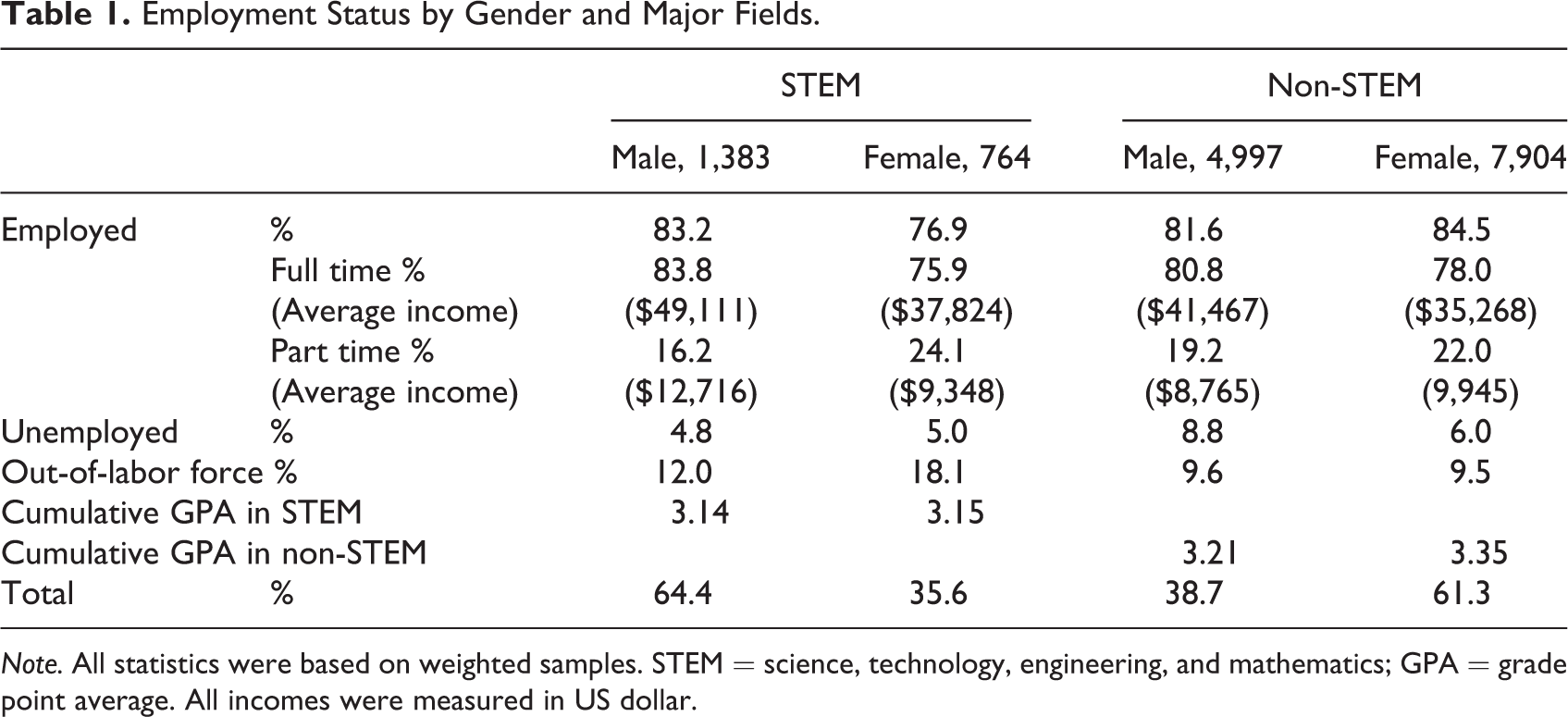
Note. All statistics were based on weighted samples. STEM = science, technology, engineering, and mathematics; GPA = grade point average. All incomes were measured in US dollar.
Variables
The outcome variable, job/major congruence, was the self-reported answer to the survey question regarding how closely related a respondent’s job in 2009 was with her or his undergraduate major. The variable was comprised of three outcome values: job closely related to college major, job somewhat related to college major, and job not related to college major. Following the rational choice model, the following independent variables were included: Financial costs are defined as the costs associated with completing college education. Limited by the secondary B&B data source, they were quantified by two proxy measures: expected monetary contribution from parents (2007–08) and net cost (total cost less total aid) in the 2007–08 academic year. Economic gain was quantified by pay rate, which was the ratio of annual income and the average number of hours worked per week reported by the participants in 2009. Job status (full-time vs. part-time) respondents’ self-rated satisfactions with pay, job challenge, and job security were used to measure nonmaterial benefits. Academic performance was measured by cumulative GPA in undergraduate STEM courses and in non-STEM courses; Family background, including parents’ highest educational attainment and family income in 2006, and two institutional variables, selectivity and Carnegie classification of undergraduate institution, were used as the proxy measures of social and structural influences. Race and age at bachelor’s degree completion were the two measures of demographic characteristics. Due to extremely small samples of some minority groups, race was coded into three groups: White, Asian American, and underrepresented minorities (URMs).
Analytical Approach
Descriptive analysis was first provided to show (1) employment status by gender and major (Table 1) and (2) how the level of job/major congruence was related to the independent variables that were later used in the regression analysis. For inferential analysis, multinomial logit regression was the primary statistical method, given the categorical nature of the outcome variable. A number of continuous variables were converted into ordinal scales due to severely skewed distribution. Converting a continuous predictor to a categorical variable is one of the model-building strategies to ensure that the predictor variable is linearly related to the dependent variable in logit units and to ease the interpretation of the regression coefficients and odds ratios (Hosmer & Lemeshow, 1989; Peng, So, Stage, & St. John, 2002). Given the drastic differences in the weighted sample sizes of the four subgroups, interpretations of the findings were guided by both statistical significance and the actual values of the odds ratios (i.e., indications of effect size).
Results
The descriptive information in Table 1 shows that when the sample was divided into four groups by gender and academic fields (STEM vs. non-STEM), female STEM graduates had the lowest employment rate (76.9%) and highest out-of-labor force (18.1%) rate (χ2 = 35.86, p < .001 when compared with men in STEM); of those employed, the same group had the lowest percentage of full-time employment (75.9%; χ2 = 45.97, p < .001, when compared with men in STEM). Also, 22.4% of women in STEM reported having a job unrelated to academic major in comparison to 15.7% of men in STEM ( p < .001). A gender gap in salary was evident, especially for the STEM graduates. With almost the same cumulative GPA in undergraduate major (male 3.14 and female 3.15), the average income of women who were employed full-time was slightly below US$38,000, which was over US$11,000 lower than the average income of their male counterparts in STEM occupations; their income was also approximately US$4,500 lower than that of the males in non-STEM occupations.
Preliminary analysis of the relationships between the dependent variable major/job congruence and the independent variables shows a few additional trends: (1) 56.8% of males in STEM had a job closely related to undergraduate major in comparison to only 40.8% males in non-STEM (p < .001); for females, the numbers were 53.5% and 46.9% in STEM and non-STEM majors (p < .001), respectively; (2) 47.4% of White students had a job closely related to undergraduate major in comparison to 41.1% of minority students (p = .004); (3) students with high GPAs as well as those with a full-time job seemed more likely to have jobs closely related to undergraduate major; (4) 60.2% of individuals with jobs closely related to their major fell into the high pay rate group in contrast to only 13.6% of those whose jobs were not related to undergraduate degree (p < .001); and (5) over 50% of individuals whose jobs were closely related to major reported satisfaction with pay (p < .001) and job security (p < .001), which was at least 30 percentage points higher than that of the group with low job/major congruence (table is omitted due to space limitation).
Nonetheless, when all the independent variables were simultaneously evaluated in the multinomial logistic regression models (Table 2), a more nuanced picture emerged. Using those having a job closely related to their academic major as the reference group, one outstanding pattern was the relationship between the pay rate and job/major congruence. That is, STEM individuals whose pay rates were in the bottom quartile were at least 11 times more likely to be in an occupation not related to their college major, relative to those whose pay rate was in the top quartile (odds ratio = 11.80 for females and odds ratio = 16.71 for males). This relationship was relatively weaker in magnitude for non-STEM graduates but remained statistically significant (odds ratio = 7.09 for females and odds ratio = 3.16 for males).
Multinomial Logistic Regression: Factors Related to College Graduates’ Career Choices.
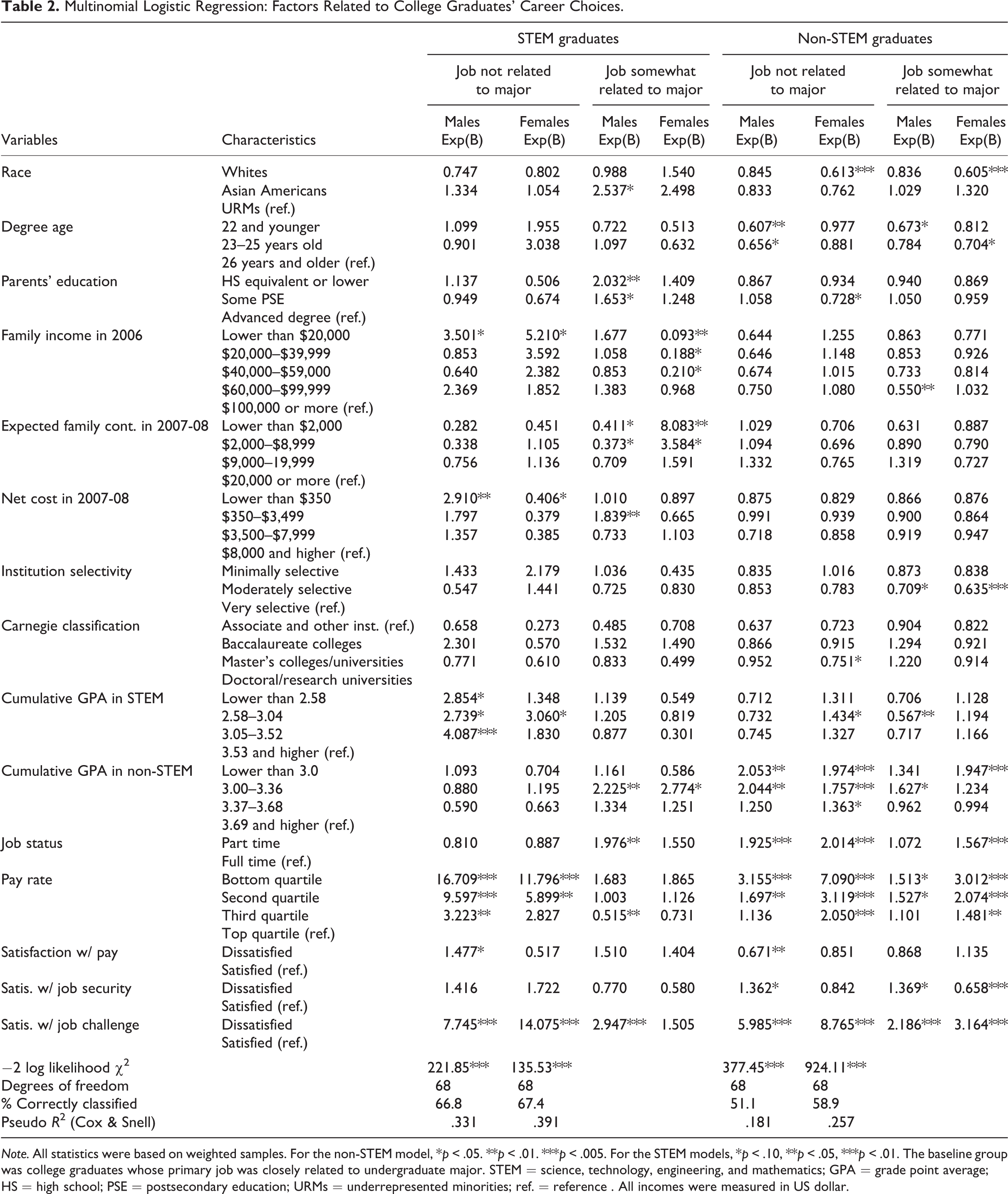
Note. All statistics were based on weighted samples. For the non-STEM model, *p < .05. **p < .01. ***p < .005. For the STEM models, *p < .10, **p < .05, ***p < .01. The baseline group was college graduates whose primary job was closely related to undergraduate major. STEM = science, technology, engineering, and mathematics; GPA = grade point average; HS = high school; PSE = postsecondary education; URMs = underrepresented minorities; ref. = reference . All incomes were measured in US dollar.
Costs of undergraduate education, measured by net attendance cost of the undergraduate institution and family contribution in the 2007–08 academic year, did not appear to have any significant relationship with job/major congruence for non-STEM graduates. Nonetheless, for male STEM graduates, lower family contributions (<US$8,000) significantly increased students’ odds of finding a job closely or somewhat related to undergraduate major, relative to those who had family contribution over US$20,000. However, for female STEM graduates, very low family contributions (<US$2,000) increased the odds of having a job closely related to undergraduate major (odds ratio = .451), relative to those who had family contributions over US$20,000; meanwhile, family contribution was negatively related to the likelihood of settling with a job somewhat related to academic major. Gender difference was also observed for STEM graduates with regard to the relationship between net cost and job/major congruence, with low attendance cost associated with decreased odds of having a job related to major for males and increased odds of having a job closely related to major for females (see Table 2 for details).
In terms of nonmaterial benefits, all college graduates reported significantly greater dissatisfaction with job challenge if their jobs were not related to, or were only somewhat related to, undergraduate major, relative to those in jobs closely related to their undergraduate major; the pattern was especially strong for STEM graduates with low job/major congruence increasing the likelihood of being dissatisfied with job challenges by more than sevenfold (odds ratio = 7.75 for males, odds ratio = 14.08 for females in job not related to major; odds ratio = 5.99 for males, odds ratio = 8.77 for females in jobs somewhat related to major). However, it is unclear if having a major-related job led to higher satisfaction with job challenge or if job challenge was a consideration when students were making career-related decisions. College graduates with jobs closely related to undergraduate major tended to be more satisfied with job security relative to those whose jobs were not related to major with the exception of females in non-STEM majors. Males in STEM were more likely to be dissatisfied with pay (odds ratio = 1.48) if they had a job that was not related to major in comparison to their counterparts in occupations closely related to major, but STEM females with high job/major congruence did not report better satisfaction with pay (odds ratio = 0.52). Except for males in STEM, high job/major congruence was associated with higher likelihood of securing full-time employment (odd ratios > 1.5).
Strong academic performance in major-related courses was another dominant factor that increased the likelihood of working in a more congruent occupation, but this relationship appeared a bit curvilinear for STEM graduates. STEM males with a cumulative GPA in the range of 3–3.5 and females in the approximate range of 2.5–3.0 in undergraduate STEM courses had the greatest odds of having a job not related to undergraduate major, relative to those whose GPA was higher than 3.5. Social influence from family, measured by family income and parental education, appeared to have a stronger influence on the career choices of STEM than non-STEM graduates. In particular, low family income was clearly related to increased likelihood of choosing a job not related to major but decreased likelihood of choosing a job somewhat related to major for females in STEM. For males in STEM, only those with a family income lower than US$20,000 in 2006 had a significantly reduced likelihood of having a job closely related to major in comparison to their counterparts with US$100 K or higher annual family income. If parents’ highest educational attainment was a bachelor’s degree or lower, female graduates had a lower likelihood of having a job closely related to major than those whose parents had advanced degrees (odds ratio < .68 for females in STEM, odds ratio = .73 for females non-STEM major). In terms of structural influence from the institution, STEM graduates from minimally selective institutions were more likely to settle with a job not related to undergraduate major in comparison to those who graduated from very selective institutions (odds ratio = 1.43 for males, odds ratio = 2.18 for females).
Finally, Asian American students who graduated from STEM majors were more likely to find a job unrelated to undergraduate major relative to URM students, whereas White females in non-STEM majors were significantly more likely than URM females to have a job closely related to their undergraduate major. Interestingly, completing college at age 25 or younger roughly doubled the likelihood that STEM females would have a job not related to major in comparison to their counterparts who graduated from college at 26 or older. The opposite pattern holds for males in non-STEM fields, with younger graduates being more likely to have a job closely related to their major than graduates of age 26 or older.
Discussion
Using the most recent national survey of college graduates, this study yielded findings that once more highlight some unpleasant realities: the number of college students choosing a STEM major remains low (<15%), female presence in STEM majors remains low (< 36%), and gender inequality (salary and employment status) in STEM occupations is significant from the beginning of postcollege employment. On a more positive note, the results also suggested that positive career outcomes are associated with having occupations closely related to college major, including better income profile and greater job satisfaction (Xu, 2013). On average, STEM graduates also have a lower unemployment rate than non-STEM graduates (Table 1).
Costs and Benefits for Utility Maximization
As predicted by the rational choice model, results of this study supported the importance of cost and benefit considerations in the career choices of college graduates. One significant pattern was the pay advantage for those whose jobs were closely related to academic degree, which held for all college graduates regardless of majors, but appeared to be much stronger for STEM students. This finding serves as additional evidence that major/job congruence helps to maximize the return on educational investment (Melguizo & Wolniak, 2011; Wolniak & Pascarella, 2005; Xu, 2013). Theoretically, it can be interpreted as individuals purposefully seeking an occupation to maximize return on their educational investments. This finding suggests that, regardless of gender, greater economic return is an important element in students’ utility calculation about educational and occupational decisions (Astin & Astin, 1993).
Cost factors were also related to the likelihood of STEM graduates having a major-related job. Low financial contribution from family (<US$2,000) was significantly associated with an increased likelihood of having a job closely related to undergraduate major for both genders in STEM majors. One speculation of this relationship is that STEM students with outstanding academic performance had greater chances of being awarded with scholarships and/or fellowships; in other words, the lowered financial dependence on family was a sign of academic success. Subsequently, individuals’ outstanding performance in their undergraduate major increased the likelihood of them choosing an occupation closely related to their major. In contrast, the relationship between net attendance cost and major/job congruence was different for STEM males and females. For females, lower net cost was related to increased likelihood of having a job closely related to major. This pattern could also be due to the availability of scholarships/fellowships to offset the net cost and encourage women’s participation in STEM majors; when low cost was due to academic success, females’ likelihood of pursuing a job closely related to undergraduate major increased.
Rational choice theory also posits that the goal-directed behaviors of individuals are influenced by nonmaterial factors. Findings on job satisfaction support this proposition. Across all majors, individuals were much more satisfied with job challenge if they were working in occupations congruent with their undergraduate training. Males in both STEM and non-STEM fields were more likely to be dissatisfied with job security if they reported low major–job congruence. Males in STEM were the only group that had significantly lower satisfaction with pay if their job were not related to undergraduate major. This pattern may be plausibly explained with the notion of self-selection bias, which suggests that college students entered into STEM majors with a strong expectation of higher income (Melguizo & Wolniak, 2011; Montmarquette et al. 2002; Wolniak & Pascarella, 2005). When such high expectations were encountered by relatively low incomes in nonmajor-related jobs following graduation, individuals were more likely to feel disappointed. In other words, variation in the personal expectations resulted in different subjective evaluations of and reported satisfaction with job earnings. In comparison, STEM females in occupations not related to major had significantly higher likelihood of feeling dissatisfied with job challenges, but less likely to be dissatisfied with pay in comparison to their counterpart in jobs closely related to undergraduate major. Given the significantly lower pay received by women in STEM shown in the descriptive analysis, it is speculated that women were underpaid and frustrated by salary inequity in both STEM and non-STEM occupations, as suggested by the literature (Joy, 2000; Toutkoushian & Conley, 2005; Xu, 2013, 2015).
Academic Factors and Occupational Choices
Besides cost–benefit factors, strong academic performance in major-related courses contributed to increased likelihood of individuals working in more congruent occupations. Theoretically, it is clear that individuals exhibit conscious choices in occupational behaviors. Those who were confident in self-assessed readiness and competitiveness in academic achievement were more likely to seek occupations with high major/job congruence as a way to maximize utility and gain. A difference between the STEM and non-STEM students is worth noting. For non-STEM graduates, a consistent pattern was that lower cumulative GPA in major-related courses was related to a significantly reduced likelihood of having a job closely related to undergraduate major, but the pattern was not so linear for the STEM group. With students separated into four levels based on their cumulative GPA in STEM courses, those who graduated with a moderate GPA (between 2.5 and 3.5) had the lowest likelihood of being in occupations closely related to undergraduate major when compared to those whose cumulative GPA was higher than 3.5. The lack of a linear relationship may be explained through the cognitive perspective: STEM students with a medium level of academic performance were more conscious of GPA than non-STEM students, given that academic trainings in STEM majors have stronger vocational specificity (Roksa & Levey, 2010). Most likely, they were more academically motivated and committed than those whose GPAs were 2.5 or lower. When their performance levels in undergraduate courses did not match the goals they had set for themselves, they might have had doubts about their readiness and chose to stay away from occupations closely related to their respective majors.
Social and Structural Influences and Occupational Choices
Rational choice model contends that social influences from parents and peers may impact individuals’ educational and occupational decisions through verbal communication and behavioral demonstration (Lloyd et al., 2008). Social influence was measured by family income and parents’ highest degree completed. On one hand, family income as a proxy of socioeconomic status had an obvious negative relationship with the likelihood of STEM students choosing a job related to academic major, and this pattern was especially strong for females in STEM but was absent for non-STEM students. It is possible that, due to more occupation-specific trainings in college, STEM graduates need more support and guidance in their career planning than non-STEM graduates and that such help was mostly absent in families of low income levels. On the other hand, parents’ highest educational attainment appeared to have a stronger influence on female graduates choosing a job related to academic training, regardless of major, when compared to male students. Together, these results confirms the general pattern suggested by the extant literature that STEM females may be more sensitive to social influences and need more support from parents and family members in their occupational choices and career development (Hazari, Tai, & Sadler, 2007; Taasoobshirazi & Carr, 2008).
Structural influences on college graduates were captured by Carnegie classification and selectivity of the attended undergraduate institution. Carnegie classification did not have a clear relationship with individual major/job congruence, except that the likelihood of STEM females having a job closely related to major was negatively related to the level of classification of their undergraduate institution. More clearly, STEM graduates from minimally selective institutions were significantly more likely to work in occupations unrelated to major relative to those who graduated from very selective institutions. Institutional selectivity is determined by student quality, academic rigor, and the level of commitment to research (Malcom & Dowd, 2012; Zhang, 2008). Why did the values and mission of the undergraduate institutions not impact the occupational choices of non-STEM students as strongly? The answer may lie in the structural norms of STEM disciplines, “Scientific work revolves on the cooperation of people and group” (Fox, 2001, p. 658). In other words, more teamwork and collaboration in the STEM organizational environment provide opportunities for frequent peer interactions and incentives for stronger competitions in educational and occupational pursuits.
Finally, a troublesome sign is that STEM females were 2–3 times more likely to choose an occupation not related to their academic major if they completed their college education by age 25 or younger in comparison to their counterparts with a degree completion at 26 or older. The younger generation grew up during a time when the national effort was gaining steam to increase female presence in STEM fields, and the message grew stronger and clearer that girls can be scientists and engineers. Thus, their high attrition rates from STEM occupations after college graduation are a warning sign that calls for further investigation.
Future Research
Due to the extremely small percentage of students who were married/partnered at the time of data collection, this study did not examine the impact of family circumstances on occupational choices. Given the importance of balancing home and work responsibilities for women in STEM fields (Rosser & Taylor, 2009; Xu, 2015), it would be important to collect longitudinal data and examine how changes in marital and family status may influence career-related decision-making for women in the long run. Also, it is puzzling that Asian Americans were found to be less likely to work in an occupation closely related to their STEM major relative to their URM counterparts in this study. Asian American students have been overrepresented in college STEM majors; their unexpected high attrition from STEM occupations warrants a closer examination in future research.
Limitations
First, employment data used in this study were collected within 1 year of college graduation, so the emerging patterns were limited to what has been observed at the initial employment stage. Longitudinal studies can definitely provide a more thorough understanding of college graduates’ career development over time. Nonetheless, a very low percentage of college graduates reported career changes within 10 years after graduation (Xu, 2013). Knowledge from this study regarding the transition from college to employment is valuable to guide timely and effective interventions. Second, individuals who continued on to graduate education as full-time students immediately after earning a college degree were not part of the regression analysis if they did not report any employment data. The absence of this group may slightly bias the findings. Finally, the secondary source limits the measurement accuracy. For instance, institutional selectivity and Carnegie classification may not be very accurate measures of structural influences, but they appeared to be the best choices given the available variables in the B&B. Also, all variables used in this study were based on single-item measurement. The reliability of the measures would be improved if multiple items were available.
Implications
The results of this study empirically verified the rational choice model with evidence to support the cost-effective calculations as well as purposive and conscious choice behavior in college graduates’ occupational choices (Huber, 1997). Consistent with conclusions of previous studies, greater economic return and utility maximization in both material and nonmaterial forms are the priorities in students’ decision-making (Austin & Austin, 1993; Melguizo & Wolniak, 2011; Sax, 2001). Academic success in college would increase the likelihood of having a rewarding career, regardless of major (Mullen et al., 2003; Xu, 2013). Still, there are systematic differences in the factors leading to different career options between STEM and non-STEM graduates. In particular, social and structural norms appeared to have a much more observable impact on the career choices of STEM students than on non-STEM students.
Based on the findings, three potential approaches are suggested for undergraduate institutions to improve the career outcomes of their graduates. First, it is important to help students fully understand that their academic engagement in college is one of the principal determinants of professional success (Hu & Wolniak, 2013; Mullen et al., 2003; Smart, 1986). Second, guidance in terms of career planning and orientation, information about career options, and the benefits a college degree can bring is important for encouraging students to pursue a future that is consistent with their academic training (Harris et al., 2004; Kekelis, Ancheta, & Heber, 2005). In particular, career offices need to take every opportunity to inform students that individuals having a career closely related to their academic major are more likely to have higher earnings and greater job satisfaction. Students’ knowledge about future earning advantages and better employment opportunities would also help reduce the attrition from STEM majors during the college years. And finally, offering more accessible financial aid and more major-specific career consulting services may be particularly helpful to STEM students with low family incomes.
The findings of this study call for more attention to be devoted to the conditions of women in STEM majors. First, there is a significant pay disadvantage for women in STEM occupations, as documented by empirical studies and national statistics (Joy, 2000; Toutkoushian & Conley, 2005; Xu, 2015). According to the findings in this study, for full-time employees only, women in STEM occupations reported an average annual income of US$37,824 in 2009, which was 23% lower than the income of their male counterparts in STEM and about 9% lower than males in non-STEM occupations. With the data indicating that women and men in STEM have comparable academic performance, the evidence is clear that gender-based inequity in STEM is substantial even at the entry to the labor market. As the finding of this study, and of plenty of others, supports the critical role of earnings in occupational and career choices (e.g, Melguizo & Wolniak, 2011; Xu, 2013, 2015), how likely is it that women’s presence in STEM fields will increase with the drastic salary disparity between men and women?
Second, women showed a high attrition rate from STEM fields at the transition from college to employment (Xie & Shaunman, 2003). Roughly one (22.4%) out of five women with a STEM degree worked in occupations not related to their undergraduate major, which was significantly higher than that of STEM men (15.7%). In addition, women who graduated from college at younger age were more likely to choose a job not related to their undergraduate STEM major. In the purposeful choices guided by cost-effective calculation, the lower earning status of women in STEM occupations, as discussed above, is believed to be one of the primary factors causing the attrition. Therefore, the low presence of women in STEM may remain an incurable problem until policy and regulatory enforcement can make gender-based salary equality a reality.
The lesson we learn is that the discussion about gender inequality and low presence of women in STEM needs to go beyond the academic community and get potential employers as well as policy makers involved (Xie & Shaunman, 2003). Employers play a critical role in the effort to prevent women’s attrition at the transition from college to employment; they need to be well informed about the long-term benefits of increasing women’s presence in STEM fields as well as in the overall STEM labor supply. Clearly, increased labor supply will reduce the costs associated with employee turnover, enable employers to hire and retain more qualified employees, and increase competitiveness of the company by having dynamic and diverse work environments. Once employers become willing to offer equally competitive salaries to both men and women, a break in the persistent patterns of gender inequality will become possible, and in the long run, gender disparity in career outcome can be alleviated and eventually eliminated. Consequently, increased presence of women in STEM workplaces will transform the culture and help attract and retain women in these occupations through a positive reinforcement cycle.
Last but not least, the results also suggest that women in STEM are more susceptible to social and structural influences in their occupational choices. In order to reduce their attrition from STEM fields, support from family and peers is important and academic institutions can also offer more effective interventions (Hazari et al., 2007; Taasoobshirazi & Carr, 2008). For instance, student affairs can organize regular events by inviting professional women in local STEM sectors to talk to female students in STEM majors. The opportunities to ask questions, share concerns, and build professional and supportive networks would be great assets for the future success of women in STEM.
Conclusions
This study used the rational choice model to understand the occupational choices of college graduates. It was found that positive career outcomes, including better earnings and greater job satisfaction, are associated with individuals having an occupation congruent with college major. Also, STEM graduates have a lower unemployment rate than non-STEM graduates. However, gender-based inequity in STEM majors and during the labor market entry stage is severe, and women experience clear disadvantages in salary and employment status. Potential interventions are suggested to improve the persistence of students in major-related career paths, particularly the direction to take in order to control the high attrition of women pursuing STEM career paths. As a final note, we need to continue to advance a concerted and collective effort by academic institutions, public and private employers, and local and national policy makers to reduce gender inequity and improve women’s participation in STEM fields.
Footnotes
Declaration of Conflicting Interests
The author(s) declared no potential conflicts of interest with respect to the research, authorship, and/or publication of this article.
Funding
The author(s) received no financial support for the research, authorship, and/or publication of this article.