



Abstract
Latina/os are members of the largest and also one of the fastest growing minority groups in the United States. However, they are disproportionately underrepresented in more highly compensated professional and leadership roles across corporate America. Recognizing the importance of cultural variables in their career development, this article advances a theoretical framework of how outcomes associated with the Latina/o acculturation–enculturation process may factor into different aspects of their career success. While Latina/os may encounter acculturative stressors in their careers as a result of their experiences with this process, many are well adapted and thrive due to the positive influence of bicultural supports, which can serve as a protective factor and provide positive career-related resources that facilitate Latina/o professionals’ objective and subjective career success. Through this lens, we offer important insight on how these cultural factors can help Latina/o professionals bridge the cultural divide of their corporate American workplaces.
Latina/os 1 are currently the largest and also one of the fastest growing ethnic or racial minority groups in this nation. At nearly 52 million people, this important demographic constitutes approximately 17.1% of the U.S. population (U.S. Census Bureau, 2015), with a purchasing power of US$1.5 trillion (Nielsen, 2014). Latina/os’ sizable and growing presence in this country is undeniable; however, some occupational indicators suggest that Latina/os have lower levels of career success as compared to other major racial and ethnic groups.
At 16% of the U.S. labor force, Latina/os accounted for one of the largest segments of employed workers in this country; however, they experienced the lowest level of earnings and are much more likely to be employed in lower wage jobs, such as agricultural workers, housekeepers, and ground maintenance workers as compared to other major racial and ethnicity groups (Bureau of Labor Statistics, 2015). Conversely, Latina/os in the U.S. workforce are disparately underrepresented in leadership, management, and professional roles (Blancero, DelCampo, & Marron, 2007; Cruz, 2011; Mundra, Moellmer, & Lopez-Aqueres, 2003). This is also reflected in the finding that only 21% of Latina/os worked in management or professional occupations, as compared with 51% of employed Asian Americans, 39% of employed Whites, and 30% of employed Blacks (Bureau of Labor Statistics, 2015). Moreover, they are not well represented in leadership roles in U.S. corporations as evidenced by the fact that a mere 3% of Fortune 500 corporate board seats are filled by Latina/os (Hispanic Association on Corporate Responsibility [HACR], 2013).
The underrepresentation of Latina/os in higher earning professional and leadership roles in large businesses and corporations in the United States, often referred to as “corporate America,” is especially problematic and calls for a closer examination of factors, especially those related to their status as racial and ethnically diverse immigrants, that may inhibit or facilitate their occupational opportunities and career advancement within professional roles in the United States. Recognizing the importance of cultural variables in the career development of Latina/os (Arbona, 1995; Flores, Hseih, & Chiao, 2011; Flores, Navarro, & Ojeda, 2006; Fouad & Byars-Winston, 2005; Miller & Kerlow-Myers, 2009), this article proposes a new framework for understanding how Latina/os’ career success may be affected by one aspect of their cultural identity—that is, the Latina/o acculturation–enculturation (LAE) process. This includes a theoretical examination of the stressors and supports associated with this process and how they may factor into different dimensions of their career success. Recommendations are offered to provide career development practitioners with strategies for helping Latina/o professionals and their constituent organizations better navigate this process to achieve more successful and satisfying professional careers.
Navigating the Cultural Divide
Latina/os are not a monolithic group; however, they often share common features related to their cultural identity, which is defined as “aspects of the self that are shaped and defined by one’s culture and feelings of belongingness to cultural groups” (Phinney & Ong, 2007, p. 413). This includes connections to the Spanish language and group-specific cultural values, including those related to collectivism (Hofstede, 1985). Key cultural values that may influence Latina/os’ vocational behaviors and perceptions include familismo, the importance of family and social groups and priority of group over individual goals (Arbona, 1995; Flores, Navarro, et al., 2006; Fouad, 1995), personalismo, the importance of harmonious and conflict-free interpersonal relationships (Ruiz, 2005), respeto, high power distance and deference to those in authority (Ruiz, 2005), and fatalismo, an external locus of control and belief that individuals have limited influence and power over life events (Anastasia & Bridges, 2015).
These and other traditional Latina/o cultural values often contrast with those reflected and reinforced within corporate American workplaces that emphasize individual achievement, self-agency, self-promotion, competition, and power equality (Anastasia & Bridges, 2015; Ruiz, 2005). As such, many Latina/o professionals working in corporate America may encounter a significant cultural divide between their heritage and mainstream worlds, whose values, norms, and behaviors are often incongruent.
LAE Process
A distinguishing facet of Latina/os’ cultural identity is related to their experiences with the acculturation process (Arbona, 1995; Gong, Takeuchi, Agbayani-Siewert, & Tacata, 2003; Smart & Smart, 1995), which we employ here as a framework for understanding how Latina/o professionals navigate the “corporate divide” between their individualistic and competitive corporate American workplaces where many of their cultural values are not similarly aligned.
Acculturation occurs when immigrants migrate into the new culture of the United States and integrate the values, beliefs, and practices of the Anglo-oriented culture, while also maintaining aspects of their own ethnic identity (Hernandez, Cohen, & Garcia, 2011; Siatkowski, 2007). Ethnic identity is a subcomponent of this process and is defined as the magnitude to which an individual appreciates and actively engages in his or her own cultural values, traditions, beliefs, and behaviors (Phinney, 2003). While the acculturation process tends to affect more recent Latina/o immigrants and those who are foreign born, outcomes of this process often continue to influence Latina/os who are native born and also of later generations (Mena, Padilla, & Maldonado, 1987; Padilla, 1985; Phinney & Flores, 2002).
The process of acculturation is often differentiated from that of enculturation in research with Latina/os (Castillo, López-Arenas, & Saldivarxys, 2010; Quintana & Scull, 2009). Specifically, while acculturation is viewed as the adoption of and adaption to new cultural patterns that occur when different cultural, ethnic, or racial groups come into contact with each other, enculturation is more centered on the maintenance of one’s own cultural heritage or traditions as a result of this cross-cultural contact or independent of it (Quintana & Scull, 2009). Acknowledging its bilinear nature, we incorporate the concept of enculturation in our examination and discussion of this phenomenon with this population. As such, we refer to this complementary and simultaneous process here as the “Latina/o Acculturation-Enculturation (LAE) process.”
The majority of existing career development and acculturation literature in the United States has focused narrowly on Anglo-oriented acculturation as a linear process (Hernandez et al., 2011; Miller & Kerlow-Myers, 2009). However, while researchers of Latina/o vocational behavior have begun incorporating the concept of enculturation in recent times, much of the acculturation-related literature to date has been directed at early career development behaviors and decisions related to self-efficacy, persistence intentions, and career choice (Flores, Ojeda, Huang, Gee, & Lee, 2006; Flores, Robitschek, Celebi, Andersen, & Hoang, 2010; Gushue, Clarke, Pantzer, & Scanlan, 2006; Gushue & Whitson, 2006; Ojeda et al., 2011; Risco & Duffy, 2010), as well as its role in early career-stage behaviors and decisions for Latina/o high school and college students (Duffy & Klingaman, 2009; Gushue, 2006; McWhirter & McWhirter, 2015; McWhirter, Valdez, & Caban, 2013; Ojeda, Castillo, Meza, & Piña-Watson, 2013).
While this and other research has laid the foundation for understanding how these and other cultural factors facilitate or circumscribe career choice and achievement for Latina/o youth, the body of research in this field has yet to examine how these and other cultural factors play a role in Latina/os’ actual career trajectories as they strive to become upwardly mobile and professionally successful within mainstream business economy, that is, largely White and middle class (Vallejo, 2009). Surprisingly, there is no known research that has specifically focused on how outcomes associated with LAE process factor into the success and satisfaction of Latina/os in professionals’ roles. Before describing this relationship, we provide a brief discussion of Latina/o career success.
Latina/o Career Success
Career success is a socially constructed reality. While some labor force indicators (see Bureau of Labor Statistics, 2015) suggest that Latina/os employed in this country have a relatively lower occupational standing as compared to other racial and ethnic groups, we recognize how aspects of their cultural identity may serve as a frame of reference for how career success is defined (DelCampo, Rogers, & Hinrichs, 2011; Judge, Cable, Boudreau, & Bretz, 1995). As such, we incorporate different conceptualizations of career success for Latina/o professionals in the United States.
Conceptualizing Career Success
Career success has been defined as the “positive psychological or work-related outcomes or achievements one has accumulated as a result of one’s work experience” (Judge et al., 1995, p. 486) and is comprised of both objective and subjective dimensions (Abele & Spurk, 2009; Heslin, 2005; Judge et al., 1995). Objective career success consists of concrete, specific, measurable, and observable career accomplishments attained during the course of one’s career (Heslin, 2005) including such measures as income, promotion rate, and positional level in the organizational hierarchy (Abele & Spurk, 2009; Judge et al., 1995; Ng, Eby, Sorensen, & Feldman, 2005; Seibert, Kraimer, & Liden, 2001).
While objective career success is associated with observable career accomplishments, subjective career success consists of affective aspirations involving an individual’s sense of pride and satisfaction with one’s career (Heslin, 2005; Ng et al., 2005) and is most often associated with one’s own perception of career success, organizational commitment, and job or career satisfaction (Abele & Spurk, 2009; Heslin, 2005; Judge et al., 1995; Ng et al., 2005).
Predictors of Career Success
Turner’s (1960) two systems of upward mobility, namely, contest mobility and sponsored mobility, provide a useful framework for examining the construct of career success in organizations as well as the barriers Latina/os often face in their career development. The contest-mobility perspective is a merit-based system, whereby advancement is much like a contest where workers compete for and win the “prize” of career advancement due to their own skills, abilities, motivation, and effort. Ng and his colleagues (2005) employed Turner’s framework of upward mobility to classify predictors of career success and found that human capital predictors are the most commonly associated with contest-mobility systems.
Human capital
Human capital refers to an individual’s educational, personal, and professional experiences (Becker, 1962) and is premised on the assumption that one’s human capital, including investments individuals make in themselves, improves one’s work-related skills and potential productivity. Through the lens of contest-mobility theory, increases in human capital investments should result in rewards from the employer, including higher organizational status and income (Wayne, Liden, Kraimer, & Graf, 1999). However, underlying this assumption is the belief that the contest is fair (i.e., free of discrimination) and accessible to anyone interested in devoting the required time and energy (i.e., equal opportunity).
Human capital factors are also important predictors of professional status among Latina/os. Educational level is one critical human capital factor in Latina/os’ access to professional roles; however, a significant amount of research on the career development of Latina/os has pointed to a lack of educational attainment as one of the most significant impediments to their access to professional positions (Fry, 2010; Gandara, 2015; Gloria, Castellanos, & Orozco, 2005; Mundra et al., 2003).
While the contest-mobility perspective emphasizes individual effort and merit, in contrast, Turner’s (1960) sponsored-mobility perspective adds that advancement is also in the hands of organizational elites. Analogous to the “old boys network” candidates are selected, and special status is granted based on some desirable qualities or criterion of supposed merit. To help sponsored candidates win the competition, organizational elites provide candidates favorable treatment and sponsoring activities to positively distinguish them from their peer group. To that end, Ng et al. (2005) found that within sponsored-mobility systems, variables related to organizational sponsorship and sociodemographic status were most predictive of career advancement.
Organizational sponsorship
Organizational sponsorship predictors are those resources and activities provided to employees that facilitate their career success, which can include developmental relationships, career sponsorship, supervisor support, training and development opportunities, and organizational resources (Ng et al., 2005). Mentoring is a key form of organizational sponsorship and positively associated with both forms of career success, especially subjective indicators (Ng et al., 2005). Some aspects of mentoring, especially sponsorship, exposure, and coaching, were significant predictors of career satisfaction and organizational commitment among professional and managerial employees (Aryee, Chay, & Chew, 1994). Furthermore, research with Latina/os has found mentoring relationships to be a key component to their advancement into management and professional roles (Blancero & DelCampo, 2005; Cruz, 2011; Mundra et al., 2003).
Sociodemographic moderators
While organizational sponsorship predictors illustrate how organizations sponsor employees (e.g., having access to more developmental networks, providing mentoring opportunities), sociodemographic variables are often used as the criteria to allocate sponsorship. Sociodemographic predictors are those related to an individual’s demographic and social background. As such, the sponsored-mobility perspective may perpetuate a cycle of differentiation based on race/ethnicity, such that Latina/os who may be viewed by organizational decision makers as “others” may not be afforded the special treatment, resources, and sponsorship that facilitate upward mobility and ultimate career success.
Previous research on predictors of career success has considered minority status (Judge et al., 1995) and even non-White race (Ng et al., 2005) as sociodemographic moderators negatively associated with some aspects of career success, especially objective indicators. However, variables related to one’s cultural identity, especially acculturation–enculturation constructs, have been largely overlooked in the vocational literature. Remarkably, there has been no known theory or empirical research that has considered how cultural factors associated with the acculturation–enculturation process affect the objective and subjective career success for Latina/os working in professional roles in the United States.
The LAE Process and Acculturative Stress
The acculturation–enculturation process can generate a number of physical, social, and cultural disruptions for many Latina/os as they attempt to navigate their way in an individualistic and competitive society, where many of their cultural values are not similarly valued (Ruiz, 2005). An important consideration in this regard is the variability among individuals in the degree of stress experiences, coping abilities, and outcomes of the acculturation experience (Lara, Gamboa, Kahramanian, Morales, & Bautista, 2005). Specifically, acculturative stress is often viewed as an important mediator between the acculturation–enculturation process and positive well-being for ethnic minorities (Chen, Benet-Martínez, & Harris Bond, 2008; Yoon, Hacker, Hewitt, Abrams, & Cleary, 2012), including Latina/os (Smart & Smart, 1995).
Acculturative Stress
Acculturative stress is a negative reaction or reduction in physical and psychological health due to the changes rooted in the acculturation–enculturation experience (Berry, 2003) and is associated with negative outcomes (Wang, Schwartz, & Zamboanga, 2010) especially in the area of psychological adjustment and adaption (Chen et al., 2008). Smart and Smart (1995) observe how acculturative stress often accompanies the acculturation–enculturation process for Latina/os because of their unique cultural and racioethnic characteristics. It also tends to have a lifelong duration and has a pervasive and intense influence on Latina/os’ psychological adjustment, physical health, decision-making abilities, and occupational functioning. The greater the level of acculturative stress, the more difficult and less likely an individual will develop the skills or accumulate the resources (e.g., human capital, organizational sponsorship) that are necessary for effective adaption, including optimal career performance. This suggests that the LAE process may contribute to significant stressors that can negatively impact Latina/os’ career success.
Predictors of Acculturative Stress
Acculturative stress is associated with multiple predictors, including, but not limited to, perceived discrimination (Berry, 2003; Haritatos & Benet-Martínez, 2002; Yoon et al., 2012), linguistic difficulties (Finch & Vega, 2003; Miranda & Matheny, 2000), cultural and social isolation for acculturating individuals (Chen et al., 2008; Haritatos & Benet-Martínez, 2002; Nguyen & Benet-Martínez, 2012), and even bicultural stress, which is associated with the conflict in attitudes, behaviors, and values between one’s ethnic identity and that of the majority group (Phinney, 1990).
Perceived discrimination
Discrimination and prejudice on the basis of racioethnicity is well documented and a significant acculturative stressor encountered by Latina/os in the United States (Arellano-Morales et al., 2015; Markert, 2010; Negi, 2012). One key factor in discrimination of ethnic minorities is visible or highly identifiable racial or phenotypical differences (Phinney, 2003). However, while some members of an ethnic group, especially Latina/os, may not carry the stereotypical physical characteristics of their ethnic group, they may still experience negative treatment and prejudice based on their accents, languages, names, among other ethnic markers (Mundra et al., 2003).
English-language difficulties
Lower levels of English-language acquisition and proficiency are also associated with acculturative stress for Latina/os. As explained by Miranda and Umhoefer (1998), the acquisition of a second language is an essential part of the acculturation–enculturation process, and, as such, the degree of language proficiency is determined by the extent to which a learner acculturates to the language of the host culture. Difficulties in the development of the host language may arise when there is significant social and psychological distance toward the target language and its speakers. As such, individuals who are separated or marginalized (Berry, 2003) or who view their cultures as different or conflicting (Benet-Martínez & Haritatos, 2005) may have more difficulties with English-language acquisition. In terms of career success, there is some evidence that one’s bilingual competence, as well as perceiving one’s cultural identities as integrated, is associated with more beneficial psychological outcomes including those related to career performance (Chen et al., 2008).
Cultural and social isolation
Given their collectivist orientation, one of the most significant aspects of acculturative stress for Latina/os is the lack of social support and family ties, which may result in a loss of self-esteem and sense of belonging (Smart & Smart, 1995) and lead to psychological distress in Latina/o immigrants (Negi, 2012). Research on Latina/os in the workplace underscores how Latina/os often feel culturally and socially distant from their non-Latina/o peers (see Cruz, 2011; Blancero et al., 2007). As such, we argue that the LAE process may also contribute to a sense of isolation and alienation for many who are often one of the few, if any, Latina/os within their organizations.
Bicultural stress
Individuals who participate in two cultures often maintain separate and sometimes conflicting identities (Phinney, 1990). This can serve as a significant acculturative stressor due to the need to constantly navigate the cultural divide between their heritage and mainstream worlds, whose values, norms, and behaviors are often incongruent.
The tension and stress of conflicting expectations associated with different cultural and mainstream values, traditions, and beliefs can feel overwhelming, consume unnecessary emotional energy, and impede career performance (Flores, Berkel, et al., 2006). Furthermore, this type of segregated identity may result in cultural dissonance, whereby the individual may experience “conflict between one’s own sense of culture and what others expect” (Torres, 2003, p. 540). While these individuals may pursue an integration strategy of acculturation (Berry, 2003), the internal conflict and difficulties may be rooted in their perception that these cultures are distant and incompatible rather than overlapping or compatible (Benet-Martínez & Haritatos, 2005).
Role of Acculturative Stressors in Career Success
We believe that the acculturation–enculturation experience is unique for Latina/os and may result in additional challenges for them in the workplace and their careers. In particular, experiences associated with perceived discrimination, linguistic difficulties, cultural and social isolation, as well as bicultural stress may result in increased acculturative stress for Latina/os. This heightened level of stress will directly and negatively impact objective and subjective career success due to the psychological maladaptation and suboptimal functioning (Chen et al., 2008; Smart & Smart, 1995) in many of their life domains, including their work roles.
Acculturative stressors such as perceived discrimination may result in both structural and attitudinal barriers that disadvantage Latina/os in their career advancement due to violations of contest-mobility arguments of an equitable meritocracy (Turner, 1960). Additionally, difficulties with English-language skills are considered a decrease in one’s human capital investments and have been shown to negatively affect work performance (Chen et al., 2008; Organista, Organista, & Kurasaki, 2003). Further, cultural and social isolation may contribute to experiences of isolation, alienation, tokenism, and outsider status that distance Latina/os from their peers, mentors, and other organizational sponsors that are critical to their advancement and satisfaction in their careers (Blancero et al., 2007; Cruz, 2011; Mundra et al., 2003). Finally, the cultural divide associated with different values and expectations related to power distance, self-agency, and individual versus group achievement may foster a heightened level of bicultural stress. As such, these acculturative stressors are proposed to negatively impact objective and subjective career success directly as well as moderate the relationships between human capital and organizational sponsorship variables on these career outcomes. Latina/o professionals who encounter these stressors will be negatively impacted in their objective career success due to limitations in human capital and organizational sponsorship. They will also have lower levels of subjective career success due to limitations in organizational sponsorship.
The LAE Process and Bicultural Supports
We have illustrated how the LAE process may contribute to acculturative stressors that negatively impact the lives and careers of Latina/o professionals in the United States; however, we offer an alternative view that Latina/o professionals who adopt adaptive acculturation strategies, or what we refer to as “bicultural supports,” including a compatible and overlapping bicultural and ethnic identity, bilingual fluency, and social and cultural connectedness with members of both mainstream and heritage groups, will not only contribute to positive career-related outcomes, but will also buffer many of the negative effects of these and other acculturative stressors on different dimensions of their career success.
Bicultural identity
Embracing a bicultural identity is one of the key pillars of successful acculturation-enculturation, which implies the ability to function in a manner that is congruent with the values, beliefs, customs, behaviors, and language of both the ethnic and host culture (LaFromboise, Coleman, & Gerton, 1993; Padilla & Perez, 2003). As such, adopting an identity that embraces this bicultural orientation is associated with favorable psychosocial outcomes such as greater well-being and cultural adaption (Benet-Martínez & Haritatos, 2005; Berry, 2003; Chen et al., 2008; LaFromboise et al., 1993; Schwartz, Unger, Zamboanga, & Szapocznik, 2010), as well as sociocultural adjustment, which “may include academic achievement, career success, and social skills” (Nguyen & Benet-Martínez, 2012, p. 3). Bicultural individuals are also believed to outperform monocultural peers in academic and vocational goals (LaFromboise et al., 1993).
Many Latina/os living and working in the United States consider themselves bicultural; however, oftentimes they develop a hybrid identity as a way to navigate the cultural divide of their corporate American workplaces. In this way, these individuals fundamentally endorse Berry’s (2003) acculturation strategy of integration; however, variations in one’s “bicultural identity integration” (Bicultural Identity Integration (BII); Benet-Martínez, Leu, Lee, & Morris, 2002) may influence their behavioral and cognitive functioning (Benet-Martínez & Haritatos, 2005). As such, we propose that Latina/os who view their heritage and host cultures as compatible and overlapping (high BII), rather than distant and incompatible (low BII), are better able to navigate and adapt to the dominant culture of their corporate American workplaces.
Much of the existing research to date connecting a bicultural identity and objective career success has been speculative (see Nguyen & Benet-Martínez, 2012); however, there is evidence that due to enhanced “integrative complexity,” individuals living abroad who identified with both host and home cultures demonstrated higher levels of creativity and objective career success in terms of experiencing higher promotion rates and more positive reputations (Tadmor, Galinsky, & Maddux, 2012). Furthermore, maintaining a bicultural identity may enhance subjective dimensions of career success because of the affective benefits associated with higher levels of psychological and sociocultural health, adjustment, and well-being (Benet-Martínez & Haritatos, 2005; Berry, 2003; Chen et al., 2008; LaFromboise et al., 1993; Schwartz et al., 2010). As such, the benefits accrued from more favorable adjustment and psychological well-being may ultimately contribute to higher levels of perceived career success as it relates to their career-related satisfaction and commitment.
Ethnic identity
Ethnic identity maintenance is a key component of Latina/os’ enculturation process and is defined as the magnitude to which an individual appreciates or actively engages in his or her own cultural values, traditions, beliefs, or behaviors (Phinney, 2003). As a subcomponent of having a bicultural identity, ethnic identity maintenance is of critical importance to the positive self-concept and psychological functioning of ethnic group members, especially those who may be disparaged, discriminated against, or who may struggle to maintain their own customs and traditions (Phinney, 1990). Higher levels of ethnic identity have been empirically linked with beneficial outcomes including positive well-being and self-esteem (Phinney, 2003), reductions in work–family conflict on job satisfaction (DelCampo et al., 2011), career-related attributes (Combs, Milosevic, Jeung, & Griffith, 2012), and even considered a source of “middle-class ethnic capital” for later generation Latina professionals (Vallejo, 2009).
Commitment to one’s ethnic identity may also moderate potential negative outcomes associated with certain acculturative stressors and subjective career success. Ethnic identity maintenance has been found to attenuate experiences of covert discrimination and Latina/o psychological distress (Torres, Yznaga, & Moore, 2011) and also appears to give Latina/os more confidence to counteract the negative outcomes of perceived discrimination (Ojeda, Navarro, Meza, & Arbona, 2012). For example, there is evidence that when racioethnic minorities, including Latina/os, encounter ethnic-related stressors, they often adhere more strongly to their ethnic identity (Berry, 2003; Smart & Smart, 1995) through the use of cognitive buffers or blinders to cope with its negative effects (Hakak, Holzinger, & Zikic, 2010).
Bilingual fluency
As an indicator of maintenance of ethnicity, bilingual fluency provides a means through which immigrants can accommodate to the linguistic demands of an English-speaking society while maintaining the beneficial aspects of their ethnic culture (Mouw & Xie, 1999). In terms of objective career success, fluency in English is found to be an important human capital predictor of career advancement for Latina/os employed in professional and managerial roles (Mundra et al., 2003). However, as compared to those who are English-language dominant, bilingual fluency in both Spanish and English has been linked to higher occupational prestige for Latina workers (Lee & Hatteberg, 2015) as well as enhanced cognitive performance and executive functioning in bilingual speakers, even with nonverbal tasks (Bialystok, 2011). Furthermore, in terms of subjective career success, there is some evidence that bilingual individuals enjoy significantly higher levels of life satisfaction and resilience than those who speak only Spanish or English (Marsiglia, Booth, Baldwin, & Ayers, 2013).
Social connectedness
Related to the enculturation-related benefits of ethnic identity, it is argued that Latina/os’ career success will benefit from social connectedness with both mainstream society and their ethnic communities and families. In the case of objective career success, while research has found that ethnic identity may negatively impact Latina/os’ career advancement due to their tendency to pursue more dense and less widely dispersed network structures (DelCampo, Van Buren, & Blancero, 2007), we argue here that establishing more widespread social ties with majority individuals, including professional colleagues inside and outside their organizations, can foster higher levels of objective career success by providing Latina/os with the mentoring and developmental opportunities that facilitate their career mobility. In fact, research has found that Latina/os believe that establishing and maintaining positive interpersonal connections, in particular networking and relationship building, are an essential aspect of their successful cultural navigation (Torres, Driscoll, & Voell, 2012).
In terms of subjective career success, social connectedness with their Latina/o families and communities can serve as a source of social affiliation, support, and well-being. For example, Wang, Schwartz, and Zamboanga (2010) found that for individuals in an ethnic enclave, support received from the heritage community contributed to enhanced feelings of satisfaction and self-worth.
Role of Bicultural Supports in Career Success
This article advances that many Latina/os are well adapted and thrive as a result of LAE process due to the positive influence of bicultural supports. In particular, we propose that having a bicultural identity will be positively associated with both objective and subjective career success due to the instrumental and affective benefits associated with higher levels of psychological and sociocultural health, adjustment, and well-being overall (Benet-Martínez & Haritatos, 2005; Berry, 2003; Chen et al., 2008; LaFromboise et al., 1993; Schwartz et al., 2010). These benefits accrued from increased sociocultural adjustment and psychological well-being are proposed to contribute to Latina/o professionals’ higher levels of career-related performance, adaption, satisfaction, and commitment.
Another bicultural support, ethnic identity, is predicted to result in higher levels of subjective career success for Latina/o professionals. Latina/os who closely identify with their culture of origin, including its values, behaviors, and norms, are hypothesized to experience higher levels of subjective career success, especially career satisfaction and organizational commitment, due to the positive impact of this cultural variable on their positive well-being, self-esteem (Phinney, 2003; Vallejo, 2009), and job satisfaction (DelCampo et al., 2011).
Maintaining close social connections with both ethnic and mainstream members may also support Latina/os' career success directly. Social ties with majority members and networks can provide Latina/os with greater access to a varied pool of potential mentors and developmental relationships that they often lack but critical to their career advancement and objective career success (Cruz, 2011; DelCampo et al., 2007; Mundra et al., 2003). Furthermore, maintaining relationships with individuals from their Latina/o communities and families may also provide the psychosocial support and comfort that can ease their cultural transition, which subsequently enhances their career satisfaction and commitment.
Many of these bicultural supports may also serve as protective factors in Latina/o professionals’ career development. Specifically, bicultural identity incorporates bicultural comfort, competence, and linguistic proficiency, which may counteract certain negative career outcomes associated with acculturation stressors, especially linguistic difficulties and bicultural stress. Moreover, a strong ethnic identity may attenuate the negative effects of perceived discrimination for Latina/o professionals, especially as it relates to their career satisfaction (Hakak et al., 2010; Ojeda et al., 2012; Torres et al., 2011). Furthermore, Latina/os who maintain strong connections with both their ethnic and mainstream communities may also be less likely to encounter the stress of isolation and alienation many experience as one of the few, if any, Latina/o professionals in their organizations.
Taken together, bicultural supports, including maintaining a strong bicultural and ethnic identity, bilingual fluency, as well as maintaining social connectedness to both mainstream and ethnic communities and families, are proposed to positively impact objective and subjective career success directly as well as moderate the negative effect of the acculturative stressors on both dimensions of career success.
Figure 1 presents a conceptual framework of our propositions above and how we believe both acculturation stressors and bicultural supports associated with the LAE process affect objective and subjective career success for Latina/o professionals’ in the United States (see Figure 1).
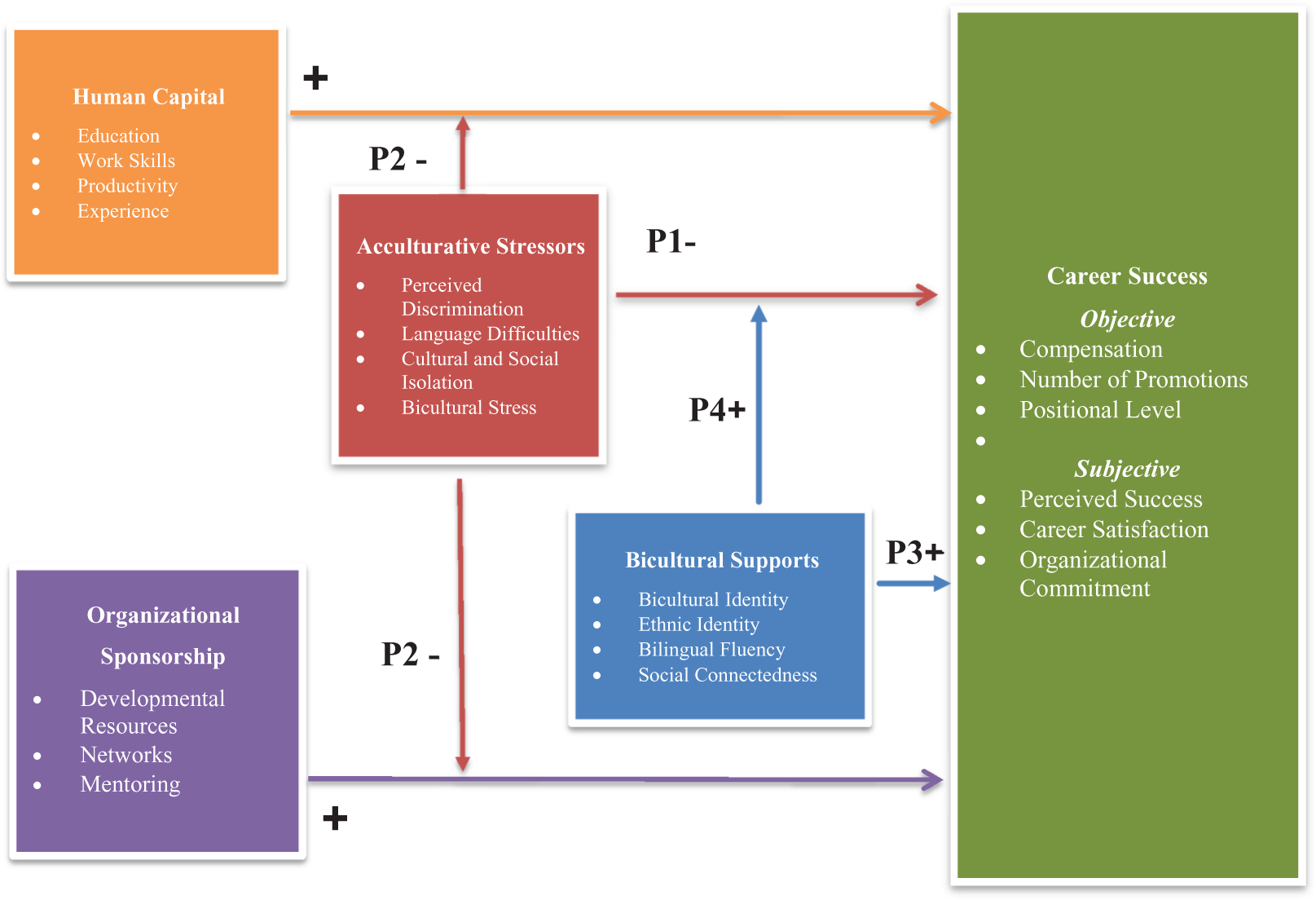
The role of Latina/o acculturation–enculturation process in Latina/o professionals’ career success.
Conclusion
It is well known that Latina/os in this country face many acculturative stressors, including, but not limited to, perceived discrimination, linguistic difficulties, cultural and social isolation, and the bicultural stress of having to navigate the significant cultural divide of their workplaces. These and other outcomes of the LAE process may serve as potential threats to Latina/o professionals’ career success and satisfaction. Despite this reality, we advance the notion that many Latina/os are able to bridge the cultural divide of their corporate American workplaces and lead successful and satisfying careers due, in part, to the positive benefits of bicultural supports. Specifically, developing and maintaining an overlapping and compatible bicultural identity, which encompasses ethnic identity, linguistic fluency, and social connectedness to both mainstream society and ethnic communities, is a critical component of the LAE process that is necessary for effective occupational functioning, advancement, and well-being.
Given Latina/o professionals’ relatively lower professional standing in this country (see Blancero & DelCampo, 2005; Bureau of Labor Statistics, 2015; Cruz, 2011; Mundra et al., 2003), this article adds to the body of knowledge by considering how their career success may be affected by stressors and supports associated with the LAE process. Our model builds on and extends previous frameworks and predictors of career success (Judge et al., 1995; Ng et al., 2005; Turner, 1960) by making them more culturally relevant. In this way, this model may be applicable for other migrant groups and settings (see Leong, 2001 for a discussion of acculturation and career adjustment for Asian Americans). However, one limitation of our model is that it has yet to be tested empirically. As such, future research should test these propositions with a variety of populations and workers classification, including Latina/os working in professional roles, to better understand if, and how, these and other factors affect different aspects of their career success.
Implications for Career Development Practitioners
The proposed model also has implications for career development practitioners working with Latina/o professionals. Given the proposed positive association between maintaining an integrated and overlapping bicultural identity with both dimensions of career success, it is recommended that practitioners help their Latina/o clients to develop an integrated self-concept that authentically combines their ethnic and mainstream identities in a compatible and mutually beneficial way. For example, practitioners can help Latina/os embrace and leverage their cultural values of familismo, personalismo, and respeto to achieve group goals and build and maintain network ties while simultaneously adopting the corporate American values associated with power equality, self-agency, and achievement to increase visibility and achieve organizational objectives.
Furthermore, given the beneficial role of social connectedness and organizational sponsorship to different aspects of their career success and satisfaction, it is recommended that practitioners help Latina/o professionals identify and establish a wide network of developmental relationships and mentors, both Latina/o and non-Latina/o, inside and outside their organizations. These individuals can serve as sponsors, protectors, and champions for Latina/o professionals to ensure that they have access to the challenging work assignments, networking, and professional development opportunities that lead to career advancement.
Alternatively, more subjective considerations of career success, especially career satisfaction and commitment, may be aided by the support and psychosocial benefits associated with Latina/o-based mentors and networks. However, while same-race mentorships can provide necessary psychosocial support, mentoring by non-Latina/o Whites has been found to be more beneficial to the careers of minorities (Blancero et al., 2007).
There is also a need for increased awareness and sensitivity of how Latina/o’s cultural values impact their own definitions of career success. As such, we believe that, in general, Latina/os may view success more subjectively and prioritize cultural values associated with their family roles, social ties, as well as a sense of pride and satisfaction with their careers, rather than objective dimensions of career success that are traditionally valued by the individualistic business culture of the United States. This requires a unique framework that does not conform to traditional career models because rather than vertical success, “the ultimate goal of the career is psychological success, the feeling of pride and personal accomplishment that comes from achieving one’s most important goals in life, be they achievement, family happiness, inner peace, or something else” (Hall, 1996, p. 8).
While career development practitioners can support Latina/o professionals at the individual level by helping them to authentically integrate aspects of their bicultural identity into their professional roles, they are also in a unique position to help the organizations they serve to value and leverage the bicultural strengths and skills Latina/o professionals bring to the corporate workplace. In today’s global economy, business matters often take on multinational and cross-cultural dimensions that require broader cultural awareness and linguistic proficiency. As such, practitioners can help their constituent organizations achieve a more optimal competitive and representative posture through helping corporate leaders and decision makers develop talent management strategies, reward systems, and diversity and inclusion programs that value and prioritize cultural diversity as a core value and competitive advantage in their organization and culture.
Footnotes
Declaration of Conflicting Interests
The author(s) declared no potential conflicts of interest with respect to the research, authorship, and/or publication of this article.
Funding
The author(s) received no financial support for the research, authorship, and/or publication of this article.