



Abstract
Drawing from self-determination theory, this study examines how does perceived parenting and psychological needs relate to identity development and psychosocial adjustment in Portuguese 12th-grade students (N = 462) who prepare the transition to higher education or to the job market. Path model results revealed two distinct pathways: a “growth-oriented pathway” from need-supporting parenting to integrated career exploration, commitment-making and well-being via need satisfaction and a “vulnerability” pathway from need-thwarting parenting to both diminished well-being and ill-being through need frustration. Findings suggest that perceived parental support is a protective factor, and parental thwarting a risk factor for career decision-making, but this relation is mediated by the adolescents’ subjective feelings of psychological need satisfaction and frustration. Altogether, they suggest the need to customize interventions with adolescents to address “bright” and “dark” trajectories of identity development and establish a supportive counseling climate that facilitates the exploration of different aspects of self-environment in career transition periods.
Keywords
In the Portuguese educational system, it is compulsory for 12th-grade students to decide for a career path in which they either proceed to higher education or enter the job market. When students decide to proceed to higher education, they are required to perform specific exams to access the preferred course. Making this choice is often difficult, involving complex—and sometimes ambiguous—processes of career exploration, decision-making and comfort with one’s decisions (e.g., Blustein, 1994; Blustein, Devenis, & Kidney, 1989; Cordeiro, Paixão, Lens, Lacante, & Luyckx, 2015; Erikson, 1968; Holland, 1985; Osipow, 1983; Super, 1957). Succeed at this task requires adolescents to develop a stable ego identity (Schwartz, Donnellan, Ravert, Luyckx, & Zamboanga, 2013) and the need to explore the career decision within primary socialization contexts, including the family, current relationships, and the community (e.g., Lofquist & Dawis, 1991; Vondracek, Lerner, & Schulenberg, 1986).
A Self-Determination Theory (SDT) Perspective on Identity Development
This individual-context matrix is implicit to SDT (Deci & Ryan, 1985, 2000). For SDT, identity development is impelled by an innate tendency for individuals to grow and move toward a more optimal and integrated functioning. This process develops in continuous interaction between dispositional integrative tendencies toward psychological development (Ryan, 1995) and social environmental influences, resulting in progressive differentiation and integration of identity structures (Soenens & Vansteenkiste, 2010).
The social environments, and particularly parents as primary socialization agents, may foster or undermine the development of an integrated identity in two ways (Deci & Ryan, 2000; Ryan & Deci, 2000). Firstly parents support the development of an integrated identity when they allow the child’s volitional functioning, provide positive informative feedback on achievement-related behaviors, and interact in warm and responsive ways (Deci & Ryan, 2000). Secondly parents thwart the development of an integrated identity when they actively control or pressure (i.e., thwart) the child to comply with their own standards and goals and reject or convey conditional regard whenever their demands or standards are not met (Skinner, Johnson, & Snyder, 2005; Soenens & Vansteenkiste, 2010).
In SDT, the relation between perceived parenting and identity development is possibly mediated by the individual’s perception of having his or her own psychological needs satisfied or frustrated (Deci & Ryan, 2000; Vansteenkiste & Ryan, 2013). Parental support would relate to an integrated identity through feelings of autonomy (need to experience self-determination, self-endorsement, volition, and choice in actions), competence (the need to feel effective and capable to achieve desired outcomes), and relatedness (the need to experience genuine, warm, supportive, and caring interpersonal relations) need satisfaction (Deci & Ryan, 1985, 2000; Ryan, 1995; Ryan & Deci, 2000). On the other hand, parental control would undermine the development of an integrated identity because controlling parental behaviors actively block or thwart the satisfaction of the child’s psychological needs (Vansteenkiste & Ryan, 2013). In this case, parental control would relate to the development of the subjective feelings of autonomy frustration (the perception of being internally and externally controlled and pressured), competence frustration (the experience of failure and doubts about personal efficacy), and relatedness frustration (the appraisal of being alone or excluded from meaningful relationships; Deci & Ryan, 1985, 2000; Vansteenkiste & Ryan, 2013).
Once structured, the perceptions of need satisfaction would energize the processes of identity integration and well-being because they are aligned with the individuals’ self-actualizing growth tendency (e.g., Deci & Ryan, 1985, 2000; Ryan, 1995; Ryan & Deci, 2000; Stebbings, Taylor, & Spray, 2015). In a different perspective, feelings of need frustration would relate to identity diffusion and to the experience of ill-being and psychopathology, once these undermine the individuals’ innate inclinations toward growth and integrated functioning (Costa, Ntounamis, & Bartholomew, 2015; Verstuyf, Vansteenkiste, Soenens, Boone, & Mouratidis, 2013).
Yet, to date, there are only a handful of studies examined the relations between parenting and psychological needs and identity development, and the ones available support these associations across cultures (Chirkov, 2009; Soenens & Vansteenkiste, 2010). For instance, in a study of Luyckx, Schwartz, Soenens, Vansteenkiste, and Goossens (2010; see also Luyckx, Soenens, Goossens, & Vansteenkiste, 2007), perceived autonomy-supportive parenting predicted the adolescents’ exploration and decision-making in identity-relevant domains, whereas psychologically controlling parenting was related to the development of an indecisive vocational orientation and to low commitment making. Gender seemed to play a role in this process. Girls reported higher support for their needs (Miklikowska, Duriez, & Soenens, 2011), exploration in depth, and ruminative exploration than boys (Luyckx, Soenens, Goossens, Beckx, & Wouters, 2008), whereas boys reported higher maternal psychological control than girls (Ahmad & Soenens, 2010).
In a different study, Luyckx and colleagues (Luyckx, Goossens, & Soenens, 2006; Luyckx, Goossens, Soenens, & Byers, 2006; Luyckx, et al., 2008; Luyckx, Vansteenkiste, Goossens, & Duriez, 2009) related the tripartite SDT-based model of need satisfaction to a model of identity development obtained by unpacking the dimensions of exploration and commitment. The identity model proposed encompassed five identity dimensions: (1) exploration in breadth: the proactive search for different options in goals, beliefs, and values before commitment making, (2) exploration in depth: the in-depth evaluation of identity-related choices and plans made and their alignment with the self, (3) ruminative exploration: the identity exploration processes characterized by indecisiveness and hesitation, (4) commitment making: the degree to which individuals make firm identity choices, and (5) identification with commitment: the degree to which one feels certain about and can identify with identity commitments. Findings showed that the total need satisfaction experienced in daily life energized positive identity-related investments associated with the proactive exploration of different identity issues (exploration in breadth and exploration in depth), as well as with the commitment to, and endorsement of specific identity options (dimensions of commitment making and identification with commitment). In opposition, the experiences of low need satisfaction were associated with endless worries and self-doubts about the identity options that best fit the individuals’ interests and experience (dimension of ruminative exploration; Luyckx et al., 2009).
Despite the notable findings, the research has not specifically contended whether the satisfaction and frustration of psychological needs uniquely mediate the relation between parenting and identity development. Examining these associations would be of extended value not only to clarify different possible pathways of identity development during career decision-making transitions but also to aid practitioners in the definition of more personalized career interventions.
Present Study
In this study, we test an integrated model of identity development and adjustment in 12th-grade students who prepare the transition to higher education or to the job market (Luyckx et al., 2009; Vansteenkiste & Ryan, 2013). In line with SDT (Deci & Ryan, 2000), we specifically examine whether psychological need satisfaction and frustration mediate the association between perceived parenting, the five dimensions of identity development, and well/ill-being.
We hypothesize that parental support positively predicts exploration in breadth, exploration in depth, commitment making and well-being through basic need satisfaction, whereas parental thwarting primarily predicts ruminative exploration and ill-being through the experience of basic need frustration (Hypothesis 1). This hypothesis is based on SDT theorizing, suggesting that experiences of basic need satisfaction give adolescents the necessary confidence to cope and to be satisfied with identity-related investments, whereas the experiences of basic need frustration lead individuals to develop fewer resources and confidence that they can effectively deal with the career challenges that lay ahead (Vansteenkiste & Ryan, 2013).
Method
Participants
We used a convenience sample of 462 Caucasian 12th-grade students attending five Portuguese secondary schools. The sample comprises 278 (60.2%) girls and 184 (39.8%) boys, aged between 16 and 19 years, with a mean age of 17.12 years (SD = 0.92). In the Portuguese educational system, high school students apply to higher education with a grade point average that is calculated using a score that is obtained from the mean of the classifications obtained from the 10th to 12th grades and the grade obtained in the national exams made after finishing the 12th grade. Therefore, we expect a high level of the students’ investment in identity exploration (in breadth and in depth) and career commitment making during this period because they must select the study area in higher education and perform the necessary exams to access that course. The (un)successful resolution of this task has important repercussions for psychosocial adjustment.
Procedure
The sample consists of five Portuguese secondary schools, covering four portuguese regions: north, center, Alentejo, and Algarve. Schools were contacted after the approval of the Portuguese Bureau of Basic and Secondary Education, from the ethical committee of the Faculty of Psychology and Educational Sciences of the University of Coimbra, and from the school principals. As recommended by the ethical committee at the University of Coimbra, prior to scale administration, we obtained the active informed consent from the adolescents and passive informed consent from parents of underage students (<18 years old). The questionnaires were administered within the classroom during daytime classes by the primary researcher. Participation was voluntary, anonymity guaranteed, and no credits were granted for participation. Students completed the questionnaires in about 20 minutes. Missing data (n = 6; 1%) were dealt by mean replacement.
Measures
Perceived parenting
We used the 18-item Portuguese version of the Parental Need-Support and Thwarting Scale (PNSTS; Cordeiro, Paixão, Lens, Lacante, & Sheldon, 2016, under review). The PNSTS measures, using two 3-item scales, the adolescents’ perception of their parents as supportive (three scales with 3 items, e.g., “Tried to understand my point of view”) or thwarting (three scales with 3 items each; e.g., “Pressured me to be the best at everything I do”) of their autonomy, competence, and relatedness needs. Items are rated in a 5-point Likert-type scale, ranging from 1 = no agreement to 5 = much agreement. The factorial validity of the scales was supported for a second-order two-factor structure measuring parental support (composite R = .86) and parental thwarting (composite R = .86). Findings showed that parental support was uniquely associated with subjective well-being and vitality, whereas parental thwarting positively predicted anxiety, depression, and somatization (Cordeiro, Paixão, Lens, Lacante, & Sheldon, 2016). In the current sample, good reliability scores were also found for the bidimensional structure of parental support (composite reliability [CR] = .84) and parental thwarting (CR = .86). A confirmatory factor analysis (CFA) on the two-factor model yielded a good fit to the data, χ2(118) = 216.08; p < .001; comparative fit index (CFI) = .98; root mean square error of approximation (RMSEA) = .04, p (RMSEA ≤ 0.05) < .001; standardized root mean square residual (SRMR) = .04.
Psychological needs
The 18-item Portuguese version of the Balanced Measure of Psychological Needs (BMPN; Cordeiro et al., 2016) Scale was used. The BMPN measures, using six subscales, perceived autonomy, competence, and relatedness need satisfaction (three scales: e.g., relatedness: “I feel a sense of contact with people who care for me and whom I care for”) and the perceived frustration of each of the three needs (three scales: e.g., autonomy: “I do things against my will”; Deci & Ryan, 2000). Items are rated on a 5-point Likert-type scale, ranging from 1 = no agreement to 5 = much agreement. Adequate internal consistency was reported for need satisfaction (α = .85) and for need frustration (α = .77). Scales were back-translated for the Portuguese language (Hambleton, 2001) and both the original and back-translated versions distinguished the components of need satisfaction and frustration as well as each of the six scales (see Cordeiro et al., 2016), thereby being considered equivalent.
Evidence of the construct validity of the scores was observed in past research. The composite score of need satisfaction was uniquely associated with subjective well-being (e.g., Sheldon & Hilpert, 2012), whereas the composite score of need frustration uniquely related to ill-being (e.g., Cordeiro et al., 2015). In the current study, we measure the three needs in a two-factor second-order measurement model of need satisfaction and need frustration (see Haerens, Aelterman, Vansteenskiste, Soenens, & Petegem, 2015 for a similar procedure), with each factor comprising three first-order factors of autonomy, competence, and relatedness needs. The CFA on the two-factor solution yielded a good fit to the data, χ2(291) = 513.81; p < .001; CFI = .94; RMSEA = .04, p (RMSEA ≤ 0.05) < .001; SRMR = .09. Good reliability was obtained for the need satisfaction (α = .80) and need frustration factors (α = .78).
Identity development
We used the 25-item Portuguese version of the Dimensions of Identity Development Scale (Cordeiro, Paixão, Lacante, & Luyckx, 2015) to assess exploration and commitment-making dimensions of identity formation. We used four of the five scales to measure the identity dimensions of (a) commitment making (“I have decided on the direction I am going to follow in my life”; α = .83), (b) exploration in breadth (“I think about different things I might do in the future; α = .75), (c) exploration in depth (“I talk with other people about my plans for the future”; α = .62), (d) and ruminative exploration (“I am doubtful about what I really want to achieve in life”; α = .82). Identification with commitment was not included as a separate dimension because, in previous U.S. research (Ritchie et al., 2013), a high correlation (r = .86) between commitment making and identification with commitment was found. Another reason was that in this study, we were interested in examining whether adolescents indeed commit to a career path and not so much how they identify with their decision. Items are rated on a 5-point Likert-type scale ranging from 1 = completely disagree to 5 = completely agree. Evidence of the construct validity of the scores has also been supported in past research (Luyckx et al., 2008). The score on ruminative exploration was uniquely associated with higher levels of self-rumination and depressive and anxiety symptoms and with lower levels of self-esteem, whereas the scores on exploration in breadth and exploration in depth were associated with higher levels of self-reflection. In the current study, a CFA on the four-factor solution yielded a good fit to the data, χ2(29) = 141.11; p < .001; CFI = .96; RMSEA = .07, p (RMSEA ≤ 0.05) < .001; SRMR = .04.
Well-Being
We used the 5-item Portuguese version of the Subjective Vitality Scale (Ryan & Frederick, 1997; Lemos, Gonçalves, & Coelho, 2011) to measure how alive and alert people have been feeling during the last 6 months (e.g., “I feel alive and vital”). In addition, we used the 6-item Portuguese version of the Satisfaction With Life Scale (Diener, Emmons, Larsen, & Griffin, 1985; Simões, 1992; α = .77) to assess the degree to which students feel satisfied with their lives (e.g., “I am satisfied with my life”). Both scales are rated in a Likert-type 5-point scale, ranging from 1 = completely untrue/not at all true to 5 = completely true/very true. In the current study, we used an average of well-being (α = .84). This option was conceptually guided by the premise that the eudaimonic (Ryan & Deci, 2000) and hedonic dimensions are complementary facets of well-being. The unidimensional model showed a good fit to the data, χ2(60) = 170.02; p < .001; CFI = .96; RMSEA = .06, p (RMSEA ≤ 0.05) < .001; SRMR = .06.
Ill-Being
We used the Portuguese version of the 18-item Brief Symptom Inventory (BSI; Derogatis, 2001; Canavarro, 2007) to assess the presence of psychological symptomatology ln ill-being. The BSI measures, for the past 6 months, the students’ symptoms of anxiety (e.g., “Feeling tense or keyed up”), depression (e.g., “Feeling lonely”) and somatization (e.g., “Pains in heart or chest”). Items are rated on a 4-point Likert-type scale of distress, ranging from 0 = not at all to 4 = extremely. The internal consistency reported for the scales ranged between .62 and .80. In the current study, we combined the three scales into a single latent construct of ill-being indicated by the 18 scale items (α = .84). A CFA on the unidimensional model showed a good fit to the data, χ2(60) = 170.02 p < .001; CFI = .96; GFI = .95; RMSEA = .06, p (RMSEA ≤ 0.05) < .001; SRMR = .06.
Statistics
For hypotheses testing, we performed path analysis with manifest variables in AMOS 20.0 (Amos Development Corporation, FL) with maximum likelihood estimation. Goodness of fit of every path model was judged from multiple fit indices (Hu & Bentler, 1999): the χ2 statistics, the SRMR, the CFI, and the RMSEA. The cutoff values defined for model fit are of .09 for SRMR, .06 for RMSEA, p (RMSEA ≤ .05) and .90, or above, for CFI (Hu & Bentler, 1999).
Results
Preliminary Analysis
Background variables
Prior to hypotheses testing, we examined the distribution of the variables and we found partial nonnormality of the data at the multivariate level (multivariate kurtosis). To correct the nonnormality of the distribution, we used in all further analyses 1,000 bootstrap samples with replacement based on the original sample (Preacher & Hayes, 2004). In subsequent analyses, we determined whether gender affected significantly the adolescents’ mean scores of the dependent measures. In doing so, we conducted a multivariate analyses of variance with gender as a between-subject variable and the study variables as dependent variables. Findings show the significant multivariate effect of gender on the outcomes, Wilks’ Λ = .931, F(1, 463) = 11.47, p < .01, multivariate η2 = .07. Follow-up univariate analyses indicate that girls (M = 1.90, SD = .69) score higher than boys (M = 1.64, SD = .55) on ill-being, but gender does not have a significant moderator effect on ill-being. Based on these findings, we statistically controlled the influence of gender on the outcomes by drawing paths from gender to ill-being in the structural model.
Primary Analyses
Model testing
Table 1 summarizes the descriptive statistics and correlations among the study variables. Table 2 summarizes the fit indices and Figures 1 and 2 the graphical portrait of the structural models tested. Four structural models were tested, following the analytic method recommended by Holmbeck (1997). In a first direct-effects model (Model 1; see Figure 1) we specified direct paths from parental support and parental thwarting to well-/ill-being, commitment making, exploration in depth, exploration in breadth, and ruminative exploration. Model 1 is graphically represented by the solid lines in Figure 1.
Correlations of the Study Variables.
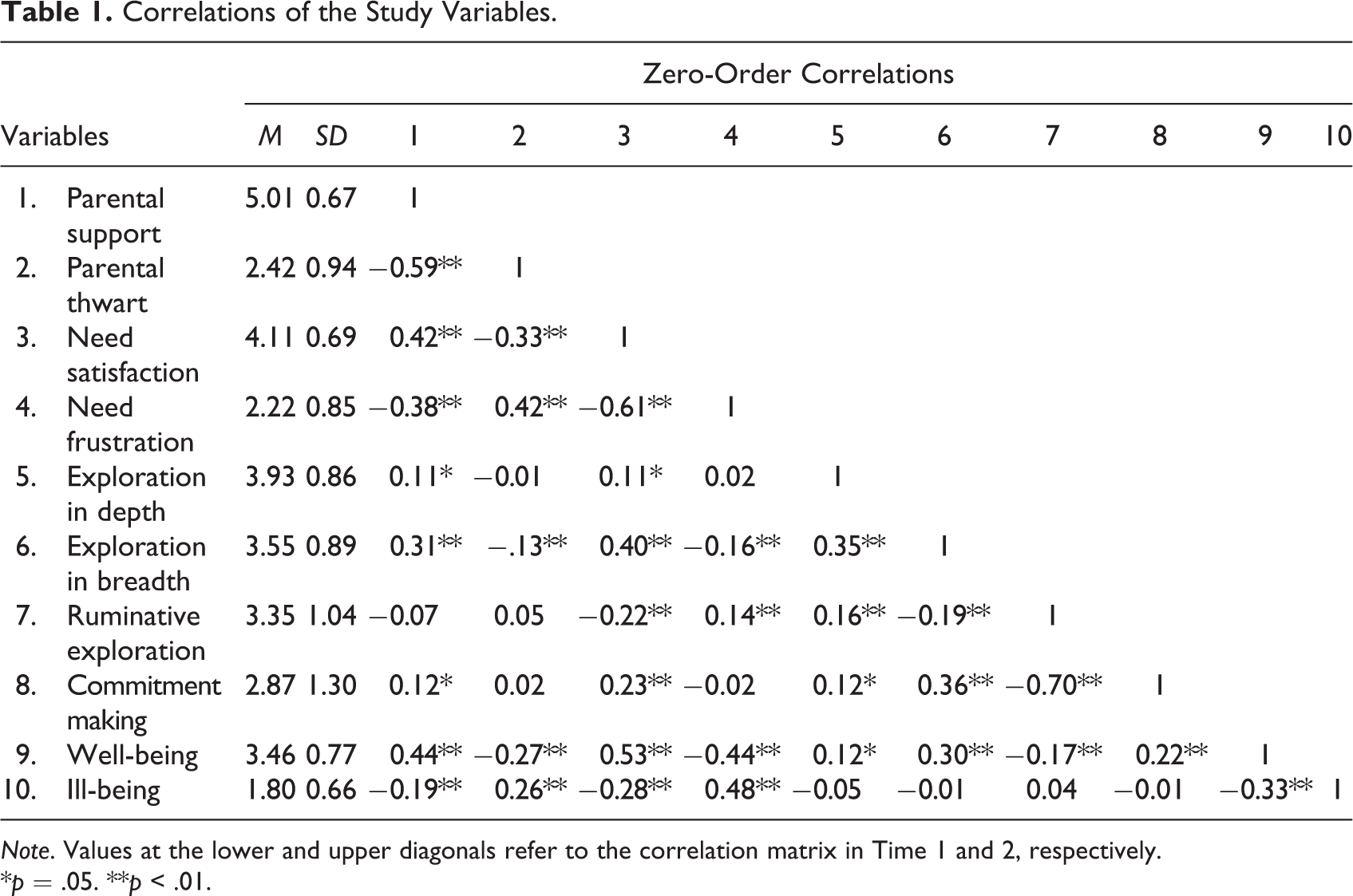
Note. Values at the lower and upper diagonals refer to the correlation matrix in Time 1 and 2, respectively.
*p = .05. **p < .01.
Goodness-of-Fit Index for the Hypothesized Models.

Note. CFI = comparative fit index; RMSEA = root mean square error of approximation; SRMR = standardized root mean square residual.

Graphic portrayal of the hypothesized Model 1. All standardized coefficients reported are significant at p < .001. Gender was left out for reasons of parsimony.
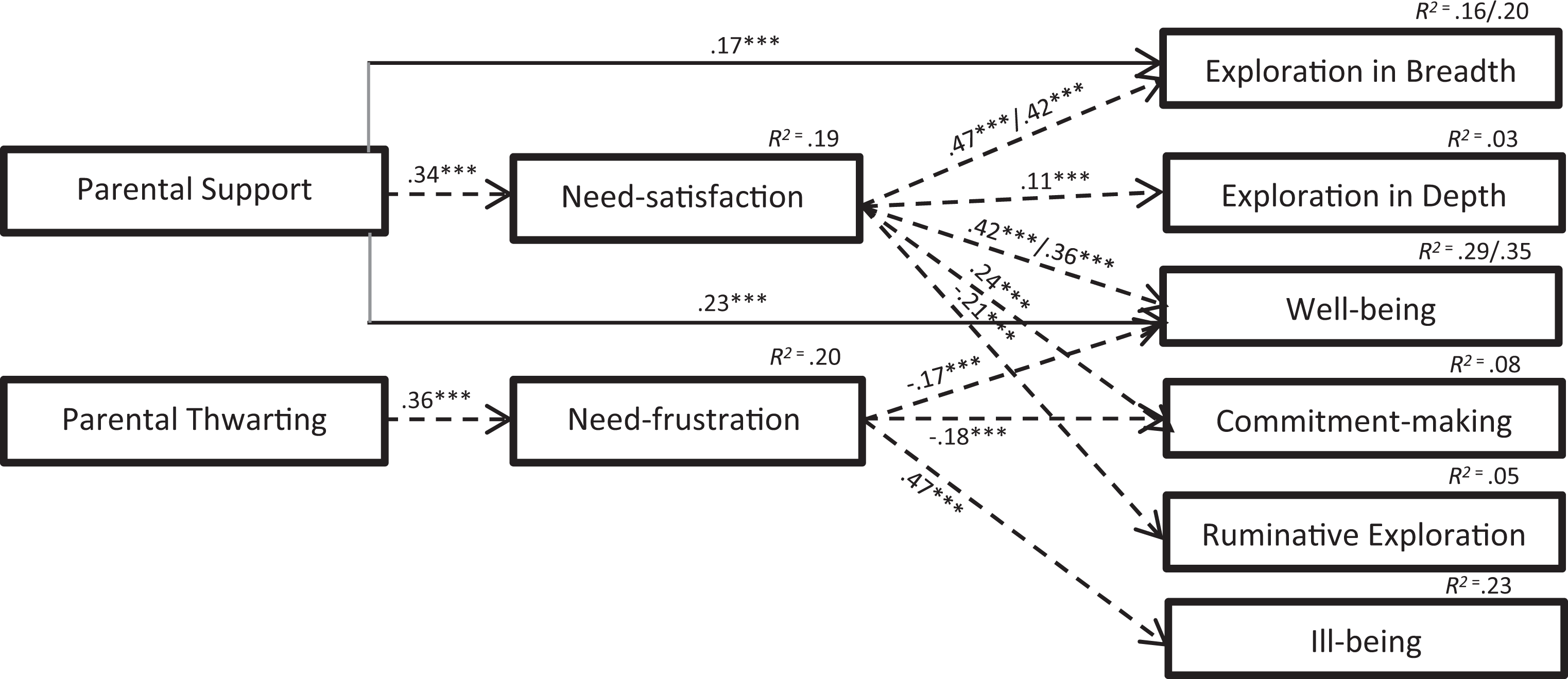
Graphic portrayal of the hypothesized Model 2 and Model 3. Dashed lines refer to Model 2; dashed lines plus solid lines refer to Model 3. Standardized coefficients reported are significant at ***p < .001. The first coefficient shown for exploration in breadth and well-being was obtained for Model 2, and the second was calculated for Model 3. For exploration in breadth and well-being, the first value presented on the upper right corner of the outcome variables corresponds to the values of explained variance obtained for Model 2 and the second corresponds to the values of explained variance in Model 3.
Model 1 showed a very good fit to the data, χ2(5) = 6.97; CFI = .99; RMSEA = .03; SRMR = .02. The standardized coefficients show that parental support significantly relates to exploration in breadth (β = .31, p < .001), exploration in depth (β = .30, p < .001), well-being (β = .44, p < .001), and commitment making (β = .11, p < .001), whereas parental thwarting uniquely relates to ill-being (β = .25, p < .001). In addition, both parental support and parental thwarting were unrelated to ruminative exploration (p > .05). In a final result, we found negative crossover associations between parental thwarting and well-being (β = −.15, p < .001) but also with exploration in breadth (β = −.11, p < .001). Altogether, the predictors explained 19% of the variance of well-being, 1% of commitment making, 1% of exploration in depth, 9% of exploration in breadth, and 8% of ill-being.
Subsequently, we tested a second, full-mediation model (Model 2) specifying parental support and parental thwarting as indirect predictors of the outcomes, with this relation being mediated by need satisfaction and frustration. The indirect paths are represented by dashed lines in Figure 2, and the standardized regression values correspond to the first of the two values represented on the top of each path. Model 2 yielded a good fit to the data, χ2(16) = 61.96; CFI = .97; RMSEA = .08; SRMR = .03. Parental support positively relates to need satisfaction (β = .34, p < .001), which, in turn, positively associates with exploration in breadth (β = .47, p < .001), exploration in depth (β = .11, p < .001), well-being (β = .42, p < .001), and commitment making (β = .24, p < .001) and negatively relates to ruminative exploration (β = −.21, p < .001). In addition, parental thwarting relates only to need frustration (β = .36, p < .001), which, in turn, positively relates to ill-being (β = .47, p < .001) and negatively relates to well-being (β = −.17, p < .001) and commitment making (β = −.18, p < .001).
To assess the significance of the indirect effects, we computed the bias-corrected bootstrap confidence intervals in AMOS 20.0 at a 95% confidence interval. Both effects were found significant. Parental support associates with exploration in breadth, exploration in depth, well-being, commitment making and ruminative exploration through basic need satisfaction, whereas parental thwarting relates to ill-being through basic need frustration (p < .01). Altogether, Model 2 variables explained 16% of exploration in breadth, 3% of exploration in depth, 29% of well-being, 8% of commitment making, 5% of ruminative exploration, and 23% of ill-being.
In a final analysis, we tested Model 3, which is a partial mediation model (see Figure 2) in all similar to Model 2, except that the direct and indirect effects were computed together. Model 3, χ2(13) = 25.58; CFI = .99; RMSEA = .05; SRMR = .02, yielded a significantly higher fit to the data than Model 2, Δχ2(3) = 36.4, p < .05.
The results show that after controlling for need satisfaction, the positive effect of parental support on exploration in depth, commitment making, and ruminative exploration becomes nonsignificant (p >.05), and the association with exploration in breadth (β = .17; p < .001) and well-being (β = .23; p < .001) is reduced to half size (p < .01). Likewise, when need frustration was controlled for, the associations between parental thwarting exploration in breadth, commitment making and ill-being became nonsignificant (all p >.05). Adding the direct paths to the model increases the explained variance of exploration in breadth to 20% and well-being to 35%. Taken together, the results on Model 3 support the mediation hypothesis outlined.
Despite the remarkable findings, the cross-sectional nature of the data makes it difficult to assert the directionality of the associations found. To overcome this limitation, we specified an alternative model (Model 4) in which we reversed the direction of the effects between the predictor and the criterion variables. Model 4 includes paths from proactive exploration, decision-making, and well-being to perceived parental support via need satisfaction and from ruminative exploration and ill-being to parental thwarting via need frustration. With Model 4 we test the alternative hypotheses that (a) adolescents scoring high on proactive exploration, decision-making, and well-being perceive their parents as highly supportive, because they feel that their basic needs are more satisfied, whereas (b) the students who score high on ruminative exploration and ill-being perceive their parents as highly thwarting because they feel that their basic needs are frustrated. Model 4 yielded a poor fit to the data, χ2(16) = 149.96; CFI = .89; RMSEA = .15; SRMR = .05, thus providing some support for the causal ordering proposed in Model 3.
Discussion
In this study, we follow recent theorizing on self-determination theory to validate an integrated model of the contextual (parenting styles) and personal (psychological needs) factors involved in the career decision-making processes that prepare the transition to higher education or to the job market. We also looked at whether these factors related to different patterns of adjustment, assessed as perceived well/ill-being.
In doing so, we specified three competitive structural models. In Model 1, we examined parental support and parental thwarting as direct predictors of career exploration, commitment making, and well/ill-being. In Model 2, we specified the indirect effects of parental support and parental thwarting on the same outcomes through need satisfaction and need frustration. Finally, in Model 3, we tested partial mediation by specifying both direct (Model 1) and indirect effects (Model 2). AMOS 20.0 path analysis with manifest variables was used to test the models.
The results show that Model 3 has a significantly better fit than Model 2 and accounts for more explained variance in exploration in breadth and well-being, thereby being considered the preferred model to interpret the structural relations among the variables. Furthermore, the standardized regression coefficients show that need satisfaction fully mediates the positive effects of parental support on exploration in depth and commitment making and partially mediates the associations with exploration in breadth and well-being. This is in line with previous research showing that the adolescents’ perception of their parents as need-supportive relates to experiences of basic need satisfaction (Soenens & Vansteenkiste, 2010), which, in turn, associate with higher confidence in proactive exploration and commitment making and with the experience of greater well-being during critical career transitions (Deci & Ryan, 1985; Farkas & Grolnick, 2010; Ryan, 1993; Soenens, Berzonsky, Dunkel, Papini, & Vansteenkiste, 2011).
The regression results also point out that parental thwarting was related to ruminative exploration through the experience of low need satisfaction (e.g., Luyckx et al., 2009). In other words, parental thwarting is associated with endless rumination in the exploration of identity options (see also Luyckx et al., 2008; Trapnell & Campbell, 1999) through subjective feelings of being less self-determined, competent, and supported in significant relations. These results indicate that need frustration mediates the effects of parental thwarting on proactive exploration and commitment making, undermine well-being and elicit ill-being during this critical period of career preparation.
Altogether, findings support the study hypotheses, and extend previous SDT-based research, by showing that need satisfaction and frustration uniquely mediate the associations between perceived parenting, identity development and adjustment when students prepare to make the critical transition to higher education/job market. Evidence also suggests that there is an asymmetrical effect of psychological need satisfaction and frustration on identity development and adjustment in which parental support play a significant role in the proactive exploration of career paths and well-being, whereas parental thwarting does not relate to ruminative exploration of career paths and ill-being. The latter effect is fully explained by need frustration. These findings unfold a correlation matrix in which both parental support and need satisfaction relate to proactive exploration and well-being, whereas parental thwarting and need frustration strongly relate to ill-being. Altogether, the results suggest that experiences of basic need satisfaction might be considered protective factors for positive identity development and well-being, and the subjective experience of need frustration might be taken as a risk factor for the development of less integrated identity processes at severe emotional costs.
The findings highlight the need to design customized psychoeducational interventions that differentiate students who benefit from preventive or universal career interventions from those needing more intensive career counseling interventions. We suggest that students with normative trajectories of identity development benefit more from universal preventive interventions that provide a continued support for the adolescents’ psychological need satisfaction.
The counselors have a key role in creating opportunities for the students to explore career options from self-endorsed, freely chosen, and personally valued goals (Ryan & Deci, 2007) as means to reinforce competence for successful goal attainment with structure and constructive feedback about career choices. Counselors should also interact with adolescents in warm, trustful, and caring ways, conveying acceptance of the adolescents’ constructions of their anticipated career paths. For adolescents who might be at risk of derailed trajectories of identity development, particularly those who perceive their needs frustrated by their parents and who experience need frustration, counselors should enforce more individualized or therapeutic-focused interventions devised to challenge students’ perceptions of being pressed or controlled by others as well as feelings of incompetence and loneliness in the process of making critical career-related choices. We expect this process to be more effective if counselors also help parents identify and refrain from using intrusive, pressuring, or controlling techniques that communicate excessive standards for achievement (Vansteenkiste, Simons, Lens, Soenens, & Matos, 2005), failure-oriented feedback (Soucy & Larose, 2000), and rejection (Assor, Roth, & Deci, 2004)
However, in the Portuguese context, most students receiving universal career interventions are not, except in extreme cases, signaled for individual interventions. This widespread model of career counseling interventions might have negative consequences for the adolescents’ adaptation and success in higher education or in the job market. Portuguese schools would benefit from the development of combined universal and selective career-related interventions based on the objective assessment of the protective and risk factors for career decision-making. In addition, Portuguese schools would benefit from the implementation of early warning systems that identify and refer adolescents’ with symptoms of low well-being and ill-being to specialized school services, especially when students are pressed by career-related achievement tasks that anticipate major ecological transitions. Furthermore research should examine whether combined promotional and preventive interventions facilitate movements toward a more coherent and synthetized sense of identity through feelings of basic need satisfaction.
There are several limitations in this research which are noteworthy. Firstly, this research relies exclusively on self-report instruments. Despite the adequacy of this procedure to examine internal states and perceived contexts, the use of self-report measures restricts the validity of the study due to shared methodological variance in all the assessed constructs and limits the generalizability of the findings (Podsakoff, MacKenzie, Lee, & Podsakoff, 2003). Secondly, conclusions are based on single informants, as we were interested to understand how the contextual and self-representational processes relate to predict identity-related processes and adjustment. To overcome this limitation, multiple informants should be used to control for possible self-fulfilling bias in the adolescents’ perception of the supportive or thwarting aspects of parenting. Thirdly, the current study target only the students who are preparing the transition to high school or to the job market. Future research should also examine the validity of the conclusions in earlier development periods and previous career transitions, especially the one that takes place by the end of the ninth grade (average age 15 years) when Portuguese students are asked to choose a major in higher education. Finally, due to its cross-sectional nature, our study does not allow to draw firm conclusions about the antecedent-consequent links modeled for the variables. Hence, despite the alternative model tested, which provided additional evidence for the directionality of the effects hypothesized, the model must be considered preliminary.
Conclusion
The present research supports the validity of an integrated model of the contextual–motivational antecedents of identity development and particularly of well-being when adolescents prepare the critical transition of entering higher education or the job market. Altogether the findings suggest that the supportive and thwarting dimensions of parenting have a differential impact on identity development and well (ill)-being, depending on whether they are associated to distinct experiences of need satisfaction and frustration. The findings have important implications for the development of more robust and systemic intervention programs that accurately target the contextual and motivational protective and risk factors associated with the (un)adaptive trajectories of identity development.
Footnotes
Authors’ Note
Willy Lens passed away on August 29, 2014, and this work represents one of his last contributions to the field.
Declaration of Conflicting Interests
The author(s) declared no potential conflicts of interest with respect to the research, authorship, and/or publication of this article.
Funding
The author(s) received no financial support for the research, authorship, and/or publication of this article.