



Abstract
Motives behind occupational choice of graduates in two tertiary training programs for Israeli ultraorthodox (Haredi) women, practical engineering (PE) and teaching (T), are explored. Five hundred and twelve participants (278 PEs and 234 Ts) answered a questionnaire referring to 13 potential work motives. The main findings are as follows: (a) factor analysis reveals that the 13 components cluster into the four composite factors of “intrinsic motive,” “calling motive,” “extrinsic motives relating to job conditions,” and “extrinsic motives relating to effect of choice on society”; (b) t tests show that PEs express higher intrinsic motives than Ts and Ts express a higher sense of “calling” than PEs; and (c) t tests further show that for the whole sample, intrinsic motives are ranked higher than extrinsic motives (relating to both job conditions and society). Discussion suggests counseling and public policy that can lead to more successful integration of Haredi women into the world of labor.
The current research offers an opportunity to explore issues of career choice among ultraorthodox (Haredi) women in Israel, in response to the need to expand career research across a wide range of cultural and social contexts (Blustein, 2006; Flores & Heppner, 2002; Herr, Cramer, & Niles, 2004). The Haredi society shares unique cultural and religious characteristics, which lead to distinctive labor market behavior effecting occupational choice of Haredi women. Jewish rabbinic tradition supports the existence of two separate distinctive sets of religious obligations, for the two genders. Men are expected to be fully devoted to the study of Torah (and of other religious scriptures), while women are exempt from this duty and distanced from it (Ross, 2004). Accordingly, the Haredi community is a “community of (male) scholars,” in which the majority of Haredi men spend most of their day studying in religious institutions (yeshiva for single men or kollel for married men), achieving fulfillment on a personal-religious level (Friedman, 1988), while women work and provide financial support for the family.
Women in the Haredi society believe that by taking on the role of a sole working parent, allowing the husband to devote himself to the study of Torah, they get a share in his spiritual reward: a feeling of protection and bliss and an equal share in the afterlife reward. Moreover, this is a female core role in life. A primary concern of the ultraorthodox education system is to persistently stress that a girl’s education is meant to serve the family, rather than personal needs or wishes for self-fulfillment (Almog & Perry-Hazan, 2011).
In the standard route for the young Haredi girl, upon completion of elementary Haredi schools, girls move on to study in seminars that are the Haredi version of high schools and higher education institutes (Lupu, 2003). Seminars combine classes of general education (strictly adjusted to their religious norms and lifestyle) and classes of professional education (mainly the profession of teachers) aimed to allow the graduates to find a job. Although Haredi women are encouraged to participate in the labor force, nonemployment rates among Haredi women are higher compared to non-Haredi women. In 2011, the nonemployment rate for Haredi women was 42.3%, compared to about 25% among Israeli non-Haredi women (Regev, 2013). The lower and disadvantaged participation in the labor market is the result of several factors: education that is less suitable for the labor market (Regev, 2013); high birth rates (Berman, 2000; Chernichovsky & Sharony, 2015); and various sociological, religious, and cultural barriers.
Over the years, most women in the Haredi society worked in the education sector, as teachers in kindergartens, elementary schools, and seminars of Haredi girls. This type of occupation matched their needs, both from an ideological perspective (the mother/woman being an agent of education and culture) and from a practical one (working within the community is adjusted to their values and way of life and is also convenient for raising their own children). Since the Haredi adult population has grown over the years, the number of graduating teachers increased, leading to an excess of supply over demand for teaching jobs. As a result, many women work in part-time jobs with low pay or are unemployed (Goldfarb, 2011).
Efforts to increase occupational opportunities (and consequently decrease poverty) were targeted at the Haredi population and made this unique group a focus of interest for policy makers (Neuman, 2014). Research from various perspectives supplemented these efforts: Gotliev (2007) addressed possible causes for poverty, presenting long-term procedures that might lead to its decrease. In particular, he emphasized the need to increase labor force participation rates of women. Lupu (2003) reviewed new fields of vocational training and of academic studies in the Haredi society and marked 1996 as a year of significant positive change in the Haredi attitude toward acquiring professional and academic education. Dahan (2004) applied a qualitative evaluation analysis of an experimental social work program for Haredi women at the Hebrew University. Dahan pointed out special innovative strategies for training Haredi women students, such as an extra role of cultural mediator, staffed by a Rabbi (a Jewish religious leader) who is also a trained therapist.
The efforts to offer Haredi women new professions led to the introduction of a curriculum for the practical engineering (PE) degree in Haredi seminars (Goldfarb, 2011). “PE” is a professional degree granted by technical colleges in Israel, upon completion of a curriculum that combines theoretical syllabi with practical training. The PE study track constitutes an intermediate level of training between engineers and technicians and is approved by the National Institute of Technological Training of the Ministry of the Economy (Horowitz & Sagi, 2013). Since 2004, a PE track was offered in a number of Haredi seminars, as an alternative to the teaching track. Several government agencies collaborated, with the involvement of potential employers willing to create a work environment customized to the religious/cultural needs of Haredi female workers (such as working in groups, minimal contact with male workers, and access to a strictly “kosher” kitchen). Due to a shortage in practical engineers in the Israeli labor market, employers agreed to comply with these restrictions, and some also identified with the national need to absorb Haredi workers into the labor market. An evaluation study of the program indicated that the program proved successful: PE graduates found a job faster than teaching graduates, their average salary was substantially higher (Goldfarb, 2013), and employers expressed satisfaction from productive workers who appreciated the new job opportunities and contributed to the company’s revenues (Goldfarb, 2011).
While research considers different perspectives of Haredi employment, studies that look at this phenomenon through the prism of career theories are still missing. Traditional career theories based on “person–environment fit” involve the identification of the individual’s skills, abilities, and interests and matching these variables with appropriate potential careers (Blustein, 2006). For Haredi women, individual interests or abilities may be assumed secondary to other motives, given their culture’s emphasis on supporting their husbands’ religious studies. Research revealing where elements of traditional theories fit in relation to Haredi women’s motives can help understand the relevance of person-environment fit (P-E) theories for this population. Understanding Haredi women’s motives behind occupational choice could provide an antecedent source for new career opportunities in high paying occupations, leading to practical implications supporting the goal of increasing labor force participation of Haredi women, and thereby also decreasing poverty. Addressing women’s personal motives and responding to them could also lead to elevated job satisfaction and better work performance that will be beneficial for both the worker and the employer. The current study can therefore contribute not only to an increase in labor market participation but could also boost work quality along with its positive outcomes.
The “calling” motive, one of the work motives discussed in the literature, seems to be dominant in a religious society such as the Haredi community. The word calling was originally used in a religious context (Wrzesniewski, McCauley, Rozin, & Schwartz, 1997) and the idea of work as a “call” or summon is centuries old and embedded in the word “vocation” that comes from the Latin word “vocātiō” which means call or summon. Today the concept of calling is also used in a nonreligious context, but the idea of an external summon (that can imply the form of a higher power monitoring the individual) is still an inherent part of the construct. A growing amount of research in recent years has focused on the concept of calling (e.g., Dik, Sargent, & Steger, 2008; Elangovan, Pinder, & McLean, 2010; Hunter, Dik, & Banning, 2010). However, empirical studies are fairly new (Duffy & Dik, 2013).
Dik and Duffy (2009) documented three main components of the concept of calling in the work domain: the feeling of being summoned by an external force (a superpower, god, society, a legacy, etc.); the association of work with a sense of purpose in life, meaning that through work the individual can express her or his ideas and morals; and a prosocial orientation being carried out through work, by using career to help others or do good. Dik and Duffy suggest that the sense of calling can be described along a spectrum, opposed to something that you either have or you don’t. The need to explore the construct of calling in diverse populations has been emphasized in order to substantiate its relevance within different cultures and societies (Duffy & Dik, 2013).
All three components documented by Dik and Duffy (2009) seem to be present regarding Haredi women: Fulfilling god’s will is a basic component that affects all spheres of life, including the work domain of females, female workers express through work their role and purpose of working to enable the spouse to avoid work and study Torah, and work is driven by a prosocial motive of contribution to family and society. Although workers from different occupations could view their work as a calling, and think of it as contributing to making the world a better place, a higher sense of calling among certain occupations (such as teaching) can be expected (Wrzesniewski et al., 1997). This leads to our first hypotheses:
While it is plausible that Haredi women follow some kind of religious/social calling, there are most probably also other motivational factors that drive their occupational behavior. Motivational perspectives cluster work motives into two categories: intrinsic and extrinsic motivation. Intrinsic motivation is defined as an engagement in work primarily for its own sake, because the work itself is satisfying and/or it gives the individual the opportunity to express personal interests (Amabile, Hill, Hennessey, & Tighe, 1994; Gagne & Deci, 2005). It represents an aspiration for self-fulfillment and self-definition in the world of work (Blustein, 2006; Super, 1970). Extrinsic motivation is defined as receiving something apart from the work itself, such as income and other benefits. The literature reports that workers motivated primarily by intrinsic needs were found to be more autonomous and reported higher levels of work performance and adaptation, compared to workers driven primarily by extrinsic motives (Baard, Deci, & Ryan, 2004).
Women in the Haredi community are encouraged to work in order to support their family. However, work per se does not carry any value (Caplan, 2007). Moreover, in qualitative interviews, Haredi women express negative attitudes toward the concept of career, stating that developing a career can harm the family and even that women who manage careers are compensating for an emotional or spiritual deprivation at home (Kulik, 2012). It, therefore, follows that the Haredi women’s motivation is expected to be primarily extrinsic, embedded in the spiritual and family spheres of life, and only weakly related to work roles. This leads to our second hypothesis:
If intrinsic motives are also at work, they are expected to be more meaningful for the PE students. The young women who chose to study PE represent a group of pioneers who chose an innovative and uncommon path. Making the uncommon choice could suggest that they were looking for self-fulfillment and felt a need to express themselves in the work arena. In support of this assumption, Shea-Van Fossen and Vredenburgh (2014) found a positive relationship between a proactive personality, defined as a stable dispositional tendency to take personal initiative across a range of activities and situations (Bateman & Crant, 1993), and career orientation, associated with intrinsic motives. The described connection supports the assumption that young women who chose the uncommon PE track will express higher intrinsic motives than those who preferred the teachers’ track. We therefore arrive at our third Hypotheses:
Method
Participants
The study presented in this article is based on data collected as part of a field study conducted in 2010–2011, set to evaluate PE alternative study programs (Goldfarb, 2011, 2013). A 93% response rate was reported for the evaluation study. Seminars that offered both the PE track and the teachers track were chosen for the current research. In these seminars, the survey addressed all PE graduates who began their first year of study between 2005 and 2008. Teaching graduates were randomly sampled from the same seminars. The final sample was composed of 512 women: 278 were graduates of the PE track and 234 were graduates of the teachers’ track who studied in the same seminars at the same time period.
The socioeconomic background information provided by the respondents indicates that the age range of the respondents is 21–25 (average age is 22.6). A majority of participants are either married or engaged (66.8%), and 59.8% of married participants have children. In accordance with the Haredi norms and way of life, a majority of husbands fully engage in the study of Torah at a kollel (95.4%) and do not have a formal educational degree, either secondary or postsecondary (91.3%). The average monthly income of all respondents is 3,938 NIS (SD = 1,842). The average income in the PE group (M = 4,534, SD = 2,021) is higher than in the teachers group (M = 3,305, SD = 1,380). Workers of both groups have an income that is significantly below the average income of Israeli women at the time of the survey—6,600 New Israeli Shekel (NIS) (Israel, Central Bureau of Statistics, Income Survey, 2011).
The parental occupational data indicate that male full engagement in studying Torah is not new and is not restricted to young males—more than half (51.1%) of the fathers of the sampled graduates are not employed and are fully engaged in the study of Torah at a Kollel. Only about one third (36.4%) are full-time employees and the rest are part-time employees or self-employed. The socioeconomic background within the family of origin seems to be somewhat more favorable in the families of PE graduates: a higher percentage of employed mothers and higher family income.
Measures
Motivation for vocational choice
The questionnaire listed 13 potential motives that may influence vocational choice. Subjects were asked to rate each of these 13 items on a scale of 1–5, according to the degree in which it influenced their vocational choice (1 = the item did not influence the decision at all and 5 = the item strongly influenced the decision). Nine items were taken from Pieser’s (1984) questionnaire and can be divided into intrinsic motives (interesting job/profession, challenge in work, and expression of abilities) and extrinsic motives (income, job stability, favorable job conditions, social status, and in line with expectations of the family and/or society). A unique item in the questionnaire related to the distinctive structure of the Haredi society is as follows: “a desire to enable my husband to study Torah.” The remaining 3 items are related to the feeling of calling. As a standard scale for assessing calling has not yet been developed during the time of the survey, items were phrased based on Dik and Duffy’s (2009) conceptualization. The first of these 3 items refers to the feeling of being summoned by an external force, the second relates to the sense of purpose in life, and the third to pro-social behavior (a desire to fulfill god’s will, a sense of destiny and purpose in life, and a desire to contribute to society).
Socioeconomic background
Subjects were asked to share details about average monthly income for the last 3 months of work, marital status, number of children, education and work status of parents and husbands, and level of income in their family of origin.
Procedure
Telephone interviews were conducted with seminar graduates, asked to answer a questionnaire related to study and work. The interviewers were all women, working in a professional survey center, familiar with the Haredi community and trained for cultural awareness of their norms. The interviewers started the conversation indicating that the answers will remain anonymous and will be used for research purposes only.
Results
Factor analysis was conducted to determine whether the items chosen to assess intrinsic, extrinsic, and calling motives do indeed cluster together as expected. We employed the principal axis extraction method, considered to be a relatively strict factor analysis method (Costello & Osborne, 2005). The Kaiser criterion was used for determining the number of factors (Kaiser, 1960). The “cutoff point” for the minimum loading of an item was set to 0.50, which is considered as an adequate threshold (Costello & Osborne, 2005). Table 1 presents the loadings of the four identified factors with eigenvalues larger than 1.0. The four factors account for 46.7% of the variance. Means and standard deviations of each of the items are also presented in Table 1.
Means, Standard Deviations and Factor Analysis of the 13 Work Motives: Item Content and Factor Loadings.

Note. The sample size used for the factor analysis is 450 women who graded all 13 incentives; factor loadings <0.5 are suppressed.
Four principal factors involved in vocational choice were identified, closely related to the types of motives defined in our study: an intrinsic factor, a calling factor, and two extrinsic factors—a factor composed of extrinsic motives that relate to work conditions and a factor composed of extrinsic motives relating to the effect of vocational choice on society’s views and expectations. The individual motives that are believed to relate to a calling concept are indeed components of the same factor: three motives that derive from the theoretical conceptualization (Dik & Duffy, 2009) and the fourth motive, unique to the Haredi community, that resembles calling in a spiritual sense.
Since the extrinsic motives split into two separate factors, only 2 items were included in each, and thus internal consistency reliability for each of the two extrinsic factors was found to be relatively low. Nevertheless, since the content of the two extrinsic factors is reasonably similar, we address them as meaningful factors.
In order to identify differences in PEs’ versus Ts’ motives at the factor levels, and test the hypotheses presented above, four t tests for independent samples were employed (see Table 2). A Bonferroni-adjusted α for all four comparisons was not necessary, because specific a priori hypotheses regarding differences between calling and intrinsic motivation factors were stated (Dunn, 1961).
Descriptive Statistics for Work Motives’ Factors and t Tests for Differences in Factor Scores of Ts Versus PEs.
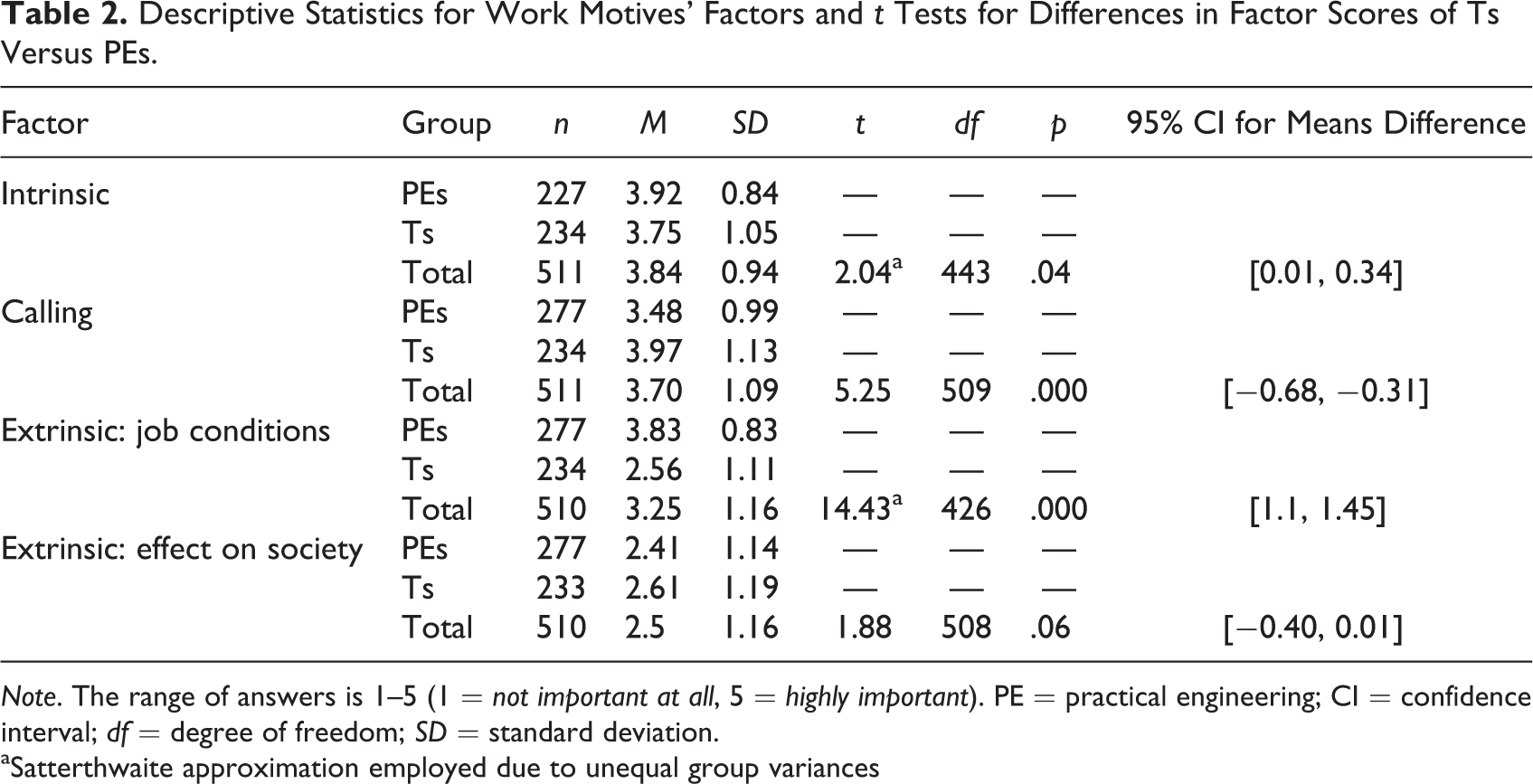
Note. The range of answers is 1–5 (1 = not important at all, 5 = highly important). PE = practical engineering; CI = confidence interval; df = degree of freedom; SD = standard deviation.
aSatterthwaite approximation employed due to unequal group variances
Findings support Hypothesis 1, which expects a higher evaluation of the calling motive within the group of Ts. Findings also lend support to Hypothesis 3, showing a significantly higher intrinsic factor average score for PEs compared to the parallel score of Ts, suggesting that PEs express a higher intrinsic motivation than Ts. A significant difference in extrinsic motivation for job conditions was also found, indicating that PEs express a higher extrinsic motivation for job conditions (stability and income) compared to Ts. While we did not have an a priori specific hypothesis related to this difference, results are also found to be significant using Bonferroni-adjusted α levels (Dunn, 1961) which are 0.013 per test (0.05/4). No significant difference was found between the two groups in extrinsic motives relating to effects on society.
In order to test Hypothesis 2, which states that extrinsic motives are expected to be more dominant than intrinsic motives (for the whole sample), two t tests for paired samples were conducted, comparing intrinsic motives (clustered by factor analysis) with each of the extrinsic motivation factors: job conditions and effect on society. Results show a significant difference between the scores of the intrinsic factor and the extrinsic factor related to job conditions, t(510) = 10.23, p < 0.001, but in the opposite direction: Contrary to the hypothesis, the score of the intrinsic motivation factor (M = 3.84, SD = 0.94) is significantly higher than the score of the factor of extrinsic motives relating to job conditions (M = 3.25, SD = 1.16). Results also show a significant difference between the respective scores of the factors of intrinsic motives and extrinsic motives related to effects on society, t(509) = 22.45, p < 0.001. Here too, the opposite direction is evidenced: The score of the intrinsic motives’ factor (M = 3.84, SD = 0.94) is significantly higher than the parallel score of the factor composed of extrinsic motives related to effect on society (M = 2.5, SD = 1.16). Hypothesis 2 is therefore rejected.
Discussion
The study presented in this article set out to shed light on motives that guide young Haredi women in choosing their work path. In the background is the very special nature of the community that sets the goal of the study of Torah (by males) high above any other life objective. Accordingly, when rankings of the 13 individual motives were examined, the motive that was ranked highest by both groups of women was the “desire to enable the husband to study Torah.” Interestingly, this motive, along with three other motives linked to the sense of calling (“a desire to fulfill god’s will,” “a sense of destiny,” and “a desire to contribute to society”—3 items phrased in line with the conceptualization of the calling motive by Dik & Duffy, 2009), indeed composed a principal factor within the set of 13 motives presented to the respondents.
The linkage between the motive of “enabling the husband to study Torah” and the sense of calling is interesting and calls for further exploration. The manifestation of the calling motive is somewhat different within the Haredi community: While typically calling is a personal wish to do good—the calling for women to support the study of Torah of their husbands can be fulfilled only through the cooperation and actions of the spouse. Moreover, classically, married women sometimes choose to enable their spouses to develop a career by taking on the role of wife and mother. Within the Haredi community, spiritual practice of the spouse replaces a career.
As expected, Hypothesis 1 was confirmed, indicating that the sense of calling is more dominant within the teachers’ group. The Haredi community assigns special ideological value to the profession of teaching, which entails the mission of educating the next generation and passing on the society’s values (Caplan, 2007). In the case of teachers, the desire to contribute to society seems to be manifested through the students they teach and coach.
Hypothesis 2, expecting extrinsic motives to be more dominant than intrinsic motives for all students, was rejected. Contrary to the assumption, intrinsic motives were rated higher than extrinsic motives, suggesting that intrinsic motives play a significant role in shaping Haredi women’s occupational choices. Religious/spiritual leaders of the Haredi society preach that work (in particular in a profession other than teaching) does not have any value of its own and is only a necessity that cannot be avoided, in order to facilitate the study of Torah by the husband (Caplan, 2007). This is, however, not what our respondents are telling us. They seem to highly value intrinsic motives like self-fulfillment and an interesting job. It appears that what is aired publicly is not what is valued personally, and Haredi employees do express personal interests in the world of labor. It is important to note that the values of supporting the husband by providing for your family and having a meaningful job can coexist and do not necessarily contradict.
Our findings complement and sometimes contradict Neriya-Ben Shahar’s (2015) research, which uses in-depth interviews with women, to examine the socioeconomic reality of the contemporary Haredi society in Israel. The majority of women emphasize that female work is important as financial support for the household and make it clear that it is not a target for itself. The term “career” is mentioned almost exclusively in a negative context. The contrast between this finding of Neriya-Ben Shahar (2015) and our quantitative findings further emphasizes the tension between intrinsic motives and the publicly voiced attitude that is considered socially acceptable. In face-to-face interviews, Haredi women might be more reluctant to express intrinsic (socially unaccepted) motives. These motives are revealed and identified in our study, based on data derived from anonymous phone interviews.
Hypotheses 3 (intrinsic motives expected to be stronger within the PE group) was confirmed. Intrinsic motives were indeed more pronounced within the group of PE’s compared to teachers. The PEs form a group of pioneers that decided not to choose the traditional teachers track and enroll in a new program. They probably have a somewhat revolutionary attitude, driven by an interest in the PE profession and by stronger intrinsic motives in general. Our findings are in line with Wilson (1996) who states that a person engaged in a job that fits his interests will express higher intrinsic motives. Findings also show that PE graduates express higher extrinsic motives related to job conditions than T graduates. Considering employment difficulties in the teaching profession for Haredi graduates (Goldfarb, 2011), the promising aspects of working in the PE profession also play a central role in these women’s career choice.
Limitations of the Present Study
A “retrospective bias” might be present, which can magnify the calling motive of teachers, as subjective compensation for inferior work conditions. Similarly, a challenging PE job can enrich a career work orientation (Wrzesniewski et al., 1997), expressed in higher declared intrinsic work motivations. It could well be the case that if respondents would have answered the questionnaire earlier—when they chose the track of study—that possible bias would have been eliminated. A longitudinal study that will follow the students from the early stage of choice of the study track, to the final stage of integration into the labor market, can validate our findings. Since results of the factor analysis indicated two different extrinsic factors, each factor includes only 2 items, a number which can be considered weak (Costello & Osborne, 2005), and internal consistency is relatively low. Since the items appear to have reasonably similar content we considered the factors meaningful, but further research that might elaborate the understanding of extrinsic motives might establish more stable and solid factors. In order to generalize the results, further research which will replicate the current study by using other different training tracks that were recently introduced in seminars (e.g., bookkeeping, accountancy, interior design, to name a few) is needed and suggested.
Conclusions, Implications, and Future Prospects
The study presented in this article looks into occupational choices of individuals within the distinct Haredi community, using the same methodological/statistical tools used by career psychologists to study more “common” societies/groups. Apparently, this application proves successful and leads to the unraveling of both expected and much less expected motives.
While the Haredi society tends to degrade the importance of self-fulfillment through work, our findings clearly show a desire to manifest ability and interest through work in the chosen profession. Since the needs to find an interest in a profession and express abilities were both found to play a central role in Haredi women’s career choice, counselors assisting Haredi women can find traditional theories addressing the match between skills and interests with potential careers (Blustein, 2006) highly useful. Within a society that culturally bans reference to career and self-fulfillment through the job, direct expression of these intrinsic motives could lead to some tension. Therefore, counselors should address these matters gently, with culturally appropriate terminology. An integrated perception of work should be presented, allowing religious and work motives to coexist, while reframing problematic concepts (like career) to more acceptable ones (like expressing God-given abilities or following a calling). Practical implications are already being taken into account in new vocational counseling programs for young Haredi women. Counselors are addressing the issue of interests and abilities, and the opportunity to express them through work, thereby encouraging a job decision that takes intrinsic motivations into account (Goldfarb, 2014).
The recognition of the important role of “intrinsic” motives in attracting Haredi women suggests that more new vocational programs should be designed and offered to Haredi students. These new tracks should cater to their (intrinsic) work motives and at the same time be culturally adjusted to their needs and limitations. First steps in this direction are already being carried out, offering new/unconventional tracks of accountancy, PE, social work, interior design, computer science, economics, and more (Neuman, 2014). Vocational training that responds to intrinsic motives also has better prospects of successful integration into the labor market and of higher satisfaction rates of both Haredi employees and their employers.
We focus in this study on women, who are the main providers in the Haredi community. Similar strategies can be applied for Haredi men. Unlike women who study general studies in the seminar, men study only Torah at the yeshiva. Occupational tracks can therefore not be part of their curricula at the yeshiva and new educational and training systems need to be established. Our background information suggests that in later stages of life more Haredi men work (expressed by the fathers’ work participation). In order to better cater to Haredi men’s job preferences and needs and facilitate successful integration into the labor market, it is important to unravel motives for male occupational choice, throughout different stages of life.
A similar approach of mapping motivation can be used for other low-employability population groups: either other ultrareligious female groups (e.g., Moslem Israeli-Arabs, Moslem female immigrants in Europe) or other groups with low attachment to the labor force (e.g., disabled individuals, the elderly). While working with culturally diverse populations, it is important that counselors address personal motives, beyond what might be the collective conventional cultural norm, allowing the vocational choice to be more productive and satisfying.
Footnotes
Author’s Note
The research was conducted as part of a thesis, submitted in partial fulfillment of the requirements for the MA degree, at the University of Haifa, Faculty of Social Sciences, Department of Psychology (November, 2011). The data were collected within the framework of the “Chen Program” (Women’s Wisdom—in Hebrew), a program supported by the Ministry of the Economy and the Joint Distribution Committee (JDC) institute, designed to encourage and support alternative vocational education and training for ultraorthodox women.
Acknowledgments
Thanks are due to my supervisor, Professor Ofra Nevo, for guidance and for very helpful comments on an earlier draft of this article.
Declaration of Conflicting Interests
The author(s) declared no potential conflicts of interest with respect to the research, authorship, and/or publication of this article.
Funding
The author(s) received no financial support for the research, authorship, and/or publication of this article.