



Abstract
This study revisits the parameters of authenticity, balance, and challenge in The Kaleidoscope Career Model (KCM) concerning gender differences in midcareer. Unemployed individuals were surveyed (n = 744) to determine gender differences in the three parameters across five segmented career stages. The results showed variance in the Authenticity, Balance and Challenge (ABC) parameters across career stages by gender, with balance increasingly important in full midcareer for women but of lesser importance for men. Authenticity showed a similar pattern for men and women, with authenticity rising for women and declining for men in very late career as predicted by the model. Challenge remained consistent for men and women, declining in importance over time. The study contribution offers sharper resonance of the KCM through closely segmented midlife career stages for an unemployed population undergoing career transitions.
Keywords
The work world of the 21st century, characterized by career interruptions, opt-outs, and temporary work assignments, has produced contemporary models of careers that describe a more fluid, flexible career landscape as opposed to traditional stage-based career models defined by 20th-century work patterns (Levinson, 1978; Super, 1957). For example, the “protean” career model (Hall, 1996; Hall & Chandler, 2005) suggests individuals determine their definition of career success based on personal values and self-referent psychological success (Heslin, 2005). The “boundaryless” career model (Arthur & Rousseau, 1996) refers to career mobility across different employers such that one’s marketability exists beyond the current employer and is sustained through external networks and exchanges of information. “Customized” careers (Valcour, Bailyn, & Quijada, 2007) include nonstandard employment relationships that are less institutionalized and involve a series of choices and negotiations with oneself, one’s family, and one’s occupational community, while “portfolio” careers describe those individuals who pursue a variety of assignments for different clients and employers while developing marketable skill sets (Cohen & Mallon, 1999; Gold & Fraser, 2002). The “life design” model, advocated by Savickas et al. (2009), considers not just the career but the full life of the individual and normalizes nonlinear progression, multiple perspectives, dynamic processes, and a developing sense of identity as part of the vocational career counseling process to recognize careers as fluid, flexible, and postmodern.
However, while these models capture some of the complexity associated with contingent employment, the critical variable of gender is largely ignored (Sullivan & Baruch, 2009). Women’s careers tend to be more discontinuous, laterally driven, and scattershot across multiple employers rather than representing upward advancement in a single firm (O’Neil, Hopkins, & Bilimoria, 2008; Shapiro, Ingolls, & Blake-Beard, 2008; Schneer & Reitman, 2002; Sullivan & Baruch, 2009). Men’s careers traditionally have followed linear careers of the 20th century (Levinson, 1978; Super, 1957), but now are more likely to reflect project-based work across multiple firms more common in the 21st century. Savickas (2003) and Hartung (2010) have called for new career approaches that expand beyond the vocational behavior of White, middle-class men to incorporate greater awareness of gender, sexual orientation, diversity, and global cultures. Scholars of the career literature have noted several gaps that need research attention, such as (1) how discontinuous work impacts one’s career over the life span; (2) how gender, identity, and culture impact career decision-making; (3) how career transitions combine into a coherent whole of a career; and (4) how midlife impacts career development in a changing career landscape (Savickas, 2003; Sullivan & Baruch, 2009).
The Kaleidoscope Career Model (the KCM) is a career model (Mainiero & Sullivan, 2005, 2006) that addresses these gaps. The KCM posits that needs for authenticity, balance, and challenge over the course of a career will be present but arise at different intensities across the life span. In times of career transition, one parameter will rise into the ascendency, driving decisions about whether to opt-in or opt-out of the workforce as individuals navigate work and nonwork domains (Mainiero & Sullivan, 2005, 2006). Gender impacts the model such that men and women prioritize different parameters at different career stages (Mainiero & Sullivan, 2005, 2006).
The KCM takes into consideration elements of both the protean model (Hall, 1996), which suggests that a career actor realizes that their career decisions mutate into new paths that may affect others around them, and the boundaryless career model (Arthur & Rousseau, 1996), which focuses on an individual’s career identity independent from an organization. The KCM also supports the concept of a customized career over the life span (Valcour et al., 2007) and the portfolio concept (Cohen & Mallon, 1999; Gold & Fraser, 2002) of developing marketable skills over time. The KCM is a variant of social cognitive career theory (Lent & Brown, 1996) in that it offers a set of cognitive reasons, or motives, that underscore career transitions. The KCM dovetails with the life design model (Savickas et al., 2009) by demonstrating fluidity and change across parameters throughout the life span. However, the KCM is unique in that it puts gender in the foreground, because gender is an influential explanatory variable as women’s careers often follow a different trajectory than men’s.
This study will revisit how men and women experiencing a career transition identify the salience of each of the KCM parameters at different career stages across the life span with special attention to the midlife career transition. Specifically, this study will examine how the parameters vary by career stage for people who are unemployed at midlife during a time of career transition, and how men and women may prioritize each of the three parameters in different career stages. As much of the vocational literature has centered on career choices in student and college-age populations (Gross-Spector & Cinamon, 2016), there is a recent call to examine midlife career transitions (Bullock-Howell, Andrews, McConnell, & Campbell, 2012; Herr, 2013) as a way of guiding career choices among a variety of populations. The contribution of the study is to (1) reinforce the KCM as a contributing career model that puts gender in the forefront as an explanatory variable associated with career transitions and (2) specifically focus on the midlife career transition in an unemployed population.
The Development of the KCM
To develop the KCM, Mainiero and Sullivan (2005, 2006) conducted a series of iterative, progressive qualitative studies (Study 1, n = 109; Study 3, n = 27; Study 5, n = 52) counterbalanced with empirical quantitative studies (Study 2, n = 1,647; Study 4, n = 1,525) designed to explore the reasons why men and women make career transitions. From this series of studies, three central parameters of career decision-making emerged that influence career decisions: the need for authenticity, balance, and challenge.
Authenticity is defined as an individual’s need to behave and demonstrate their attitudes in accordance with their genuine inner selves, which may be in contrast with the behavior they may need to exhibit (such as political actions) to survive in work surroundings (Mainiero & Sullivan, 2006). The parameter of authenticity represents the individual’s need to be true to oneself and one’s values. Often authenticity was displayed through behaviors resonant with personal or work strengths or involvement in activities for personal pleasure or that genuinely reflect the inner nature of that individual.
Balance refers to individuals’ wish to have quality experiences in both work and family domains. Balance, defined here as a parameter of the model, represents work–family management and integration efforts on the part of employees to create a work–life intersection that constantly adjusts attention to both work and nonwork domains (Greenhaus, Peng, & Allen, 2012). For example, to meet an increasing need for balance, individuals may choose certain career paths that allow them to restrict work hours or slow down their career progression (Byron, 2005). Mainiero and Sullivan (2006) identified several strategies to rebalance work–family management priorities, such as adjusting work time through part-time employment, opting out of the workforce temporarily, opting out by taking turns with spouses, arranging workloads in accordance with family situations, or trying to meet demands and expectations from both work and family domains simultaneously.
Finally, the parameter of challenge refers to the need on the part of the individual to participate in intrinsically motivating work, to grow and develop one’s skills, and to make progress in one’s career, through lateral progress, skill-based progress, or linear progress (Mainiero & Sullivan, 2005, 2006). Challenge refers to individuals’ need for stimulation, learning, and skill growth to increase personal capability. Challenge may be represented in an individual’s desire to climb the career ladder, by discovering opportunities to develop lateral skills to enhance one’s career portfolio, or ways to explore new job enhancing career possibilities. While challenge can be expressed in nonwork domains as well, the KCM focuses on challenges at work.
While all three parameters may remain active over the course of one’s career, the model suggests a dynamic, interactive, contextual paradigm such that one parameter may rise to ascendency at a given point when confronting a career transition. Individuals in the midst of career transitions might consider one parameter as a meaningful priority over the other two, as they determine their next career move. This does not mean that the other two remaining parameters have little influence; during times of transition, one parameter may rise to the forefront as a pivot to make a career decision at that time. That the parameters are dynamic and changeable casts a similar note to the life design paradigm of career construction (Savickas et al., 2009) in which careers are considered as part of a larger context, liquid, and dynamic and must be understood as part of a complex gestalt associated with one’s life as well as career.
Gender, Career Stages, and Alpha/Beta KCM Patterns
Mainiero and Sullivan (2005, 2006) found that the KCM was enacted differently by men and women. Two major patterns were identified: the alpha kaleidoscope career pattern and the beta kaleidoscope career pattern. The alpha kaleidoscope career pattern is characterized by the dominant need for challenge in the beginning of a career, followed by an emphasis on authenticity in the middle part of one’s professional life, followed by the need for balance and work–life integration in the later part of a career. This pattern was found to be more prevalent in men than in women. The beta kaleidoscope career pattern is characterized primarily by balance, especially in the middle years of a career, while challenge and authenticity vary. This pattern is widely found among women and some younger men, although some women also demonstrate the alpha pattern. Sullivan and Mainiero (2007) detailed these patterns by accessing qualitative information from interview and focus study participants, both men and women, who demonstrated unique relationships with each of the three parameters at different points in the career cycle.
To provide support for the KCM kaleidoscopic career patterns, Smith-Ruig (2009) conducted semistructured interviews with 59 accountants in Australia who worked in a variety of organizations and confirmed the alpha/beta pattern of the KCM (Sullivan & Mainiero, 2007). She found that men tended to exhibit alpha kaleidoscope career patterns while women had a stronger association with beta kaleidoscope career patterns. Furthermore, Smith-Ruig (2009) also found some younger men who represented Generation (Gen) X and Y who followed the beta career pattern. Compared to male baby boomers, the men from Gen X and Gen Y demonstrated, as a group, higher needs for balance (also see Sullivan, Forret, Carraher, & Mainiero, 2009).
The sharpest shaping of the fluid parameters of the KCM should theoretically occur at midlife, when individuals are forced to confront work–family life priorities. Gross-Spector and Cinamon (2016) noted that vocational exploration at midlife may involve greater layers of complexity and life roles as well as critical thinking about strengths and identity. While scholars have studied women and men at midlife beginning with Levinson (1978) and Levinson and Levinson (1997), Degges-White and Meyers (2006) note that women over age 40 charting life paths that are in stark contrast against existing adult development theories based on vocational counseling and career development predictions founded on the experience of past generations of men. There remains an open question about women at midlife; some women may increase investment in careers at midlife once nurturing responsibilities are reconciled, or women may decrease investment in career, following a more nurturing pattern (Roberts & Friend, 1998). In-depth interviews with 23 professional women showed that working mothers function “in-between” by working part-time or via home-based entrepreneurial endeavors (Grant-Vallone & Ensher, 2011).
Cabrera (2007) provided a qualitative test of the KCM parameters in 25 women by examining women at midlife. She explored the reason why women choose to leave or stay in the workforce and found that for women who were family oriented and in the middle of their professional life, their decision to leave the workforce pivoted on the balance parameter. Focusing on the balance parameter suggests an adaptation to the beta kaleidoscope career pattern in midlife. In the later part of their careers, the women she studied directed their career path to pursue their need for authenticity. Furthermore, she also found that 70% of the women who left the workforce returned to work, discounting the popular belief that women who leave the workforce remain out of the workforce.
August (2011) specifically studied women’s late life career development according to the KCM. She interviewed 14 women in a qualitative study and found all three of the KCM parameters—authenticity, balance, and challenge—had relevance for older working women. Participants described relatively consistent ideas about authenticity, balance, and challenge; however, several distinct meanings were associated with the parameter of authenticity. Authenticity was on the rise for older women in late career, reporting in the study, “women seem to have negotiated a new level of prominence for authenticity, that is, they were placing themselves and their own needs at the center of a decision and allowing others’ needs to recede into the background” (August, 2011, p. 228).
Generational expectations might influence the salience of the parameters of the KCM at different points in the career cycle. In a large survey study of 982 professionals, Sullivan, Forret, Carraher, and Mainiero (2009) confirmed that Gen Xers had higher needs for authenticity and for balance than baby boomers, who would be considered to be firmly in late career. However, there was no significant difference between the two generations in their need for challenge. The authors surmised that for baby boomers in midcareer, challenge in the form of continued stimulating work situations in which they could make a contribution and have an impact remained important. Generational research serves as a proxy for career stages in this research as the age ranges suggest key points in the life/career cycle that may have shaped attitudes and beliefs about the concept of “career” (Sullivan et al., 2009).
The purpose of this study is to examine in greater detail how the parameters of authenticity, balance, and challenge pivot across career stages to more sharply address the unique differences in midlife career transition for men and for women. To obtain sharper resonance for the three parameters in the early, mid, or late career stages, the sample used in this study was restricted to formerly employed or currently unemployed individuals. Scholars have noted that unemployment is a major life stressor (McKee-Ryan, Song, Wanburg, & Kinicki, 2005) that sharpens attention on future job and career choices. Studies such as Joseph and Greenberg (2001) and Konstam, Celen-Demirtas, Tomek, and Sweeney (2015) have used unemployed samples to examine subjective well-being and career adaptability as well as self-esteem and cognitive restructuring. Unemployed individuals cope with issues of self-esteem and self-worth associated with job loss (McKee-Ryan et al., 2005) and may sometimes pivot to a new career choice based on knowledge of their strengths as well as opportunities in the workplace. Unemployment may lead to realistic self-reflection on one’s future career choices among older adults given the job market (Bullock-Yowell et al., 2012). Robson, Hansson, Abalos, and Booth (2006) found older, more seasoned employees sought realistic occupational growth and focused on achievement and personal goals. Therefore, an unemployed sample was of interest as the unemployed at midcareer may seek continued career challenges while focusing on authenticity but simultaneously may be constrained by work–family management issues.
The hypotheses of this study closely follow anticipated directions of the model as originally proposed by the KCM (Mainiero & Sullivan, 2005, 2006) but with the unique contribution of focusing on an unemployed sample. This study focused upon a group of unemployed individuals, men and women, to ascertain the salience of the parameters at early, early midcareer, midcareer, late midcareer, and finally very later career stages just prior to retirement to capture some of the resonance of the KCM under conditions of unemployment when the stakes are highest predicating a career change.
In the original KCM (Mainiero & Sullivan, 2005), it was hypothesized that the parameters of authenticity, balance, and challenge would vary across career stages. Research on the KCM has supported this expectation (August, 2011; Cabrera, 2007; Shaw & Leberman, 2015; Sullivan et al., 2009). At different points in the career cycle, individuals may be more predisposed to seeking jobs that allow them more or less challenge, the ability to create a balanced work–home life in work and nonwork domains, and express a need to be genuine and authentic at work. The parameters are fluid, reflective, dynamic, and shift and change according to the needs of each individual.
But at midlife, differences across the parameters might sharpen considerably. The career decisions at midlife, to continue within one’s industry or to utilize one’s skills elsewhere, are complex, subject to market forces and trends, but also rely on the wisdom, experience, and perception of fit of each individual associated with the concepts of career identity and self-concept (Ibarra, Khapova, Arthur, & Wilderom, 2007). Job loss in midcareer can be devastating, leading to self-doubt, financial strain, and disrupted equilibrium (Latack & Dozier, 1986; McKee-Ryan et al, 2005). Levinson (1978) noted that middle-aged adults experience an intense period of self-evaluation and reflection on career choices, while other research shows early midlife regrets motivate career goal setting (Stewart & Vanderwater, 1999). Individuals who have financial means may view unemployment at midlife as an opportunity for career growth or a midcareer change (Eby & Buch, 1995; Zikic & Kiehe, 2006). An earlier study by Forret, Sullivan, and Mainiero (2010) associated with the KCM examined gender and unemployment issues, finding that women perceived unemployment as an opportunity while men experienced unemployment as a defeat.
To study this more effectively, we look closely as what is meant by “midlife.” Many researchers have defined midlife as a vast expanse of age ranges, sometimes beginning as early as 35 years of age and moving through one’s 60s (Schneer & Reitman, 1995). Other researchers have more tightly defined “midlife” similar to Levinson’s (1978) model, positing midlife specifically between ages 40 and 45. The concept of career stage has been studied largely through age ranges, using age as a proxy for stage. Mott (1998) has questioned what is meant by “midlife” and “midcareer,” articulating that midlife should be characterized into different subcategories with middle adulthood ranging from ages 40 to 65, young-old adulthood ranging from ages 65 to 75, and middle-old adulthood ranging in ages from 75 to 80. Staudinger, Bluck, and Herzberg (2003) suggest midlife is a period of life for which there are flexible boundaries and no single universal set of age parameters. Collin (2007) suggests that there needs to be newer, more interpretative methodologies that allow respondents to create their own constructions of whether or not they are in early, mid, or late career. For example, if an individual restarts a new career in his or her 40s, is this truly “midcareer” or should this be reconceptualized as “early career” in a new industry? Given the confluence of “midcareer” and “midlife,” we created multiple categories of “midcareer” stages—early midcareer, full midcareer, and late midcareer—to force a closer examination of the three parameters during the broad expanse of years generally called “midlife” in the literature. We hope an unemployed sample that is more precisely segmented at midlife will allow greater insight into how the three parameters of the KCM shift and vary, addressing gender differentials in the kaleidoscopic career patterns more sharply and with greater perspective.
While male-defined constructions of work and career success continue to dominate organizational research and practice, it is important that gender be examined as a separate variable in career research, as it is an influential explanatory variable. A great deal of research shows that women’s careers are characterized by discontinuous work and career interruptions, suggesting that women often “opt-out” of their careers in order to regain better work–family management and integration (Eby, Casper, Lockwood, Bordeaux, & Brinley, 2005; O’Neil et al., 2008). Men’s careers are typically continuous and organized around the concept of career centrality (Schneer & Reitman, 2002). Women’s career patterns may differ from men’s in a variety of ways, but the central paradigm against which women are judged, using language such as “opting out” or “mommy track,” assumes a deviation from an accepted norm (Shapiro et al., 2008). Women may have rejected the outdated career model based on stable employment and instead are on the leading edge of career self-agency, creating careers based on dynamic, agile, and contextual components (Shapiro et al., 2008).
This is not to say that men do not value family balance; as demonstrated by Greenhaus, Peng, and Allen (2012), many men do value their families and define their identities as “family men.” However, given the vast literature on work–family management and integration issues, it is clear that many more women than men opt out of careers or take a career interruption for a period of time than men due to family concerns (Mainiero & Sullivan, 2005; Schneer & Reitman, 2002). Therefore, in concurrence with previous research, we would expect a strong theme on the part of women to be more focused on the balance parameter overall than men. But midlife concerns may vary. For example, once women have answered the call for nurturing in midlife, is balance still preeminent in women’s lives and careers? Some research suggests the answer is yes (Cabrera, 2007); other research that defines “midcareer” at a later age range suggests otherwise (August, 2011). We offer sharp contrasts across multiple midcareer stages associated with years of employment rather than age to more closely examine this phenomenon.
Method
Research Sample and Administration
The survey used in this study was posted on the website of a large U.S. market research panel from Criticalmix, Inc., pro bono for research purposes. Criticalmix, Inc., draws on approximately 50,000 individuals of various ages, races, backgrounds, industries, and job titles who have agreed to participate in at least two surveys per month. Panel participants voluntarily choose which surveys to complete as per their convenience and interest. Participants are double blind; no identification information is available other than a coded number on the part of researchers as the information is confidentially contained within the panel population data set. Responses are confidentially reported; panel members must complete a lengthy privacy policy, rigorous documentation, and detailed set of terms in order to qualify for participation in the panel. Such documentation guards against “professional test takers” and assures the sample is certified for participation. Given the academic purpose of this research, the sample was further carefully culled to ensure the authenticity and objectivity of participants. We requested a representative sample of unemployed individuals in the United States. The firm reported the survey response rate at 35%, which they considered as “very good,” given typical response rates. Survey administration was completed within 2 weeks.
Of the 744 individuals who responded, 255 (34.3%) were men and 489 (65.7%) were women. While the sample was representative across all age categories, the sample skewed slightly older toward individuals at midcareer, with 93 participants (12.5%) under age 30; 120 participants (16%) between 30 and 40; 155 (21%) between age 40 and 50; 256 (34.5%) between 50 and age 60; and 120 (16%) between age 60 and 85. About 25% (187 respondents) reported they were single, 10.6% reported they had a partner, 42.3% reported they were married, and 21.9% reported they were divorced or widowed. About 15% of the sample offered diversity in race or ethnicity: 4.2% identified their race as Hispanic, 2.4% as Asian, 7.9% as Black or African American, 0.8% as native American, while the majority were identified as Caucasian. Household income was reported as 16% at 10,000 or less; 15.1% between 10 and 20,000; 32.4% between 20 and 40,000; 29.1% between 40,000 and 60,000; and 7.5% higher than 75,000. About half (51.1%) identified themselves as the primary breadwinner for their families. As we were interested in an unemployed sample only, we asked their reasons for unemployment. Fifty-four percent reported their unemployment was “not by choice” and only 5% reported their unemployment was “by choice.” The remainder of the sample offered a variety of reasons, such as “survival job,” “quit,” or laid off voluntarily as part of a furlough program associated with their firms.
Independent Variables
Gender (coded 1 = male, 2 = female) was measured by directly asking respondents to indicate their gender.
Career stage
In many studies, career stage is simply represented by age. We chose to take a different option. Respondents were asked, “How would you describe the stage of your career at the present time?” 1 = early career (defined as within the first 10 years of your working life), 2 = early midcareer (having worked at least 10–15 years), 3 = midcareer (having worked at least 15–25 years), 4 = late midcareer (having worked 25 plus years), and 5 = late career (within 5 years before projected retirement date). These segments were chosen to more accurately determine reactions to the parameters in early midcareer, full midcareer, and late midcareer, rather than using “midcareer” as a single segment of the data based on age ranges. Midcareer in this study is determined by length of employment defined as one’s working life rather than tenure in a single organization. We attempted to conceptualize career stage in the “eye of the beholder” by using a self-report variable in which respondents could indicate their tenure within a career rather than simply determine career stage by age range. Following Collin (2007) recommendation, this conceptualization is associated with newer 21st career models that suggest patterns of employment across multiple jobs, firms, and industries rather than tenure by a single employer or merely one’s age.
KCM parameters of authenticity, balance, and challenge
The three parameters of the KCM were measured using a series of items designed to capture these parameters identical to an earlier study by Sullivan et al. (2009) that demonstrated consistently reliable scales for the three parameters of authenticity, balance, and challenge. Using a 5-point scale ranging from 1 = this does not describe me at all to 5 = this describes me very well, individuals responded to 5 items per parameter, such as “I thrive on work challenges and turn work problems into opportunities for change” (challenge), “I constantly arrange my work around my family needs” (balance), and “I want to have an impact and leave my signature on what I accomplish” (authenticity). Coefficient αs for the authenticity, balance, and challenge scales were .84, .81, and .80, respectively. To further test these items as scales, an exploratory principal components factor analysis was performed. All 15 variables were entered into an exploratory factor analysis (principal axis with oblimin rotation) to determine the number of factors necessary to account for the variance in the variables. Table 1 presents the items used and the factor loadings for each parameter. Following Worthington and Whittaker (2006), the factor analysis revealed the presence of three distinct factors with eigenvalues greater than 1.0, rather than a single factor. The three factors together accounted for 55% of the total variance; the first (largest) factor did not account for a majority of the variance (37%). The Kaiser–Mayer–Olkin measure of sampling adequacy is appropriate (.911) and Bartlett’s test of sphericity was significant at the p < .0001 level, suggesting that the factor analysis was performed efficiently. The factor analysis revealed clean and distinct factors as can be seen in Table 1. Although the results of these analyses do not preclude the possibility of common method variance (Podsakoff, MacKenzie, Lee, & Podsakoff, 2003), they do suggest that common method variance is not of great concern.
Results of Exploratory Factor Analysis (Principal Axis, With Oblimin Rotation).
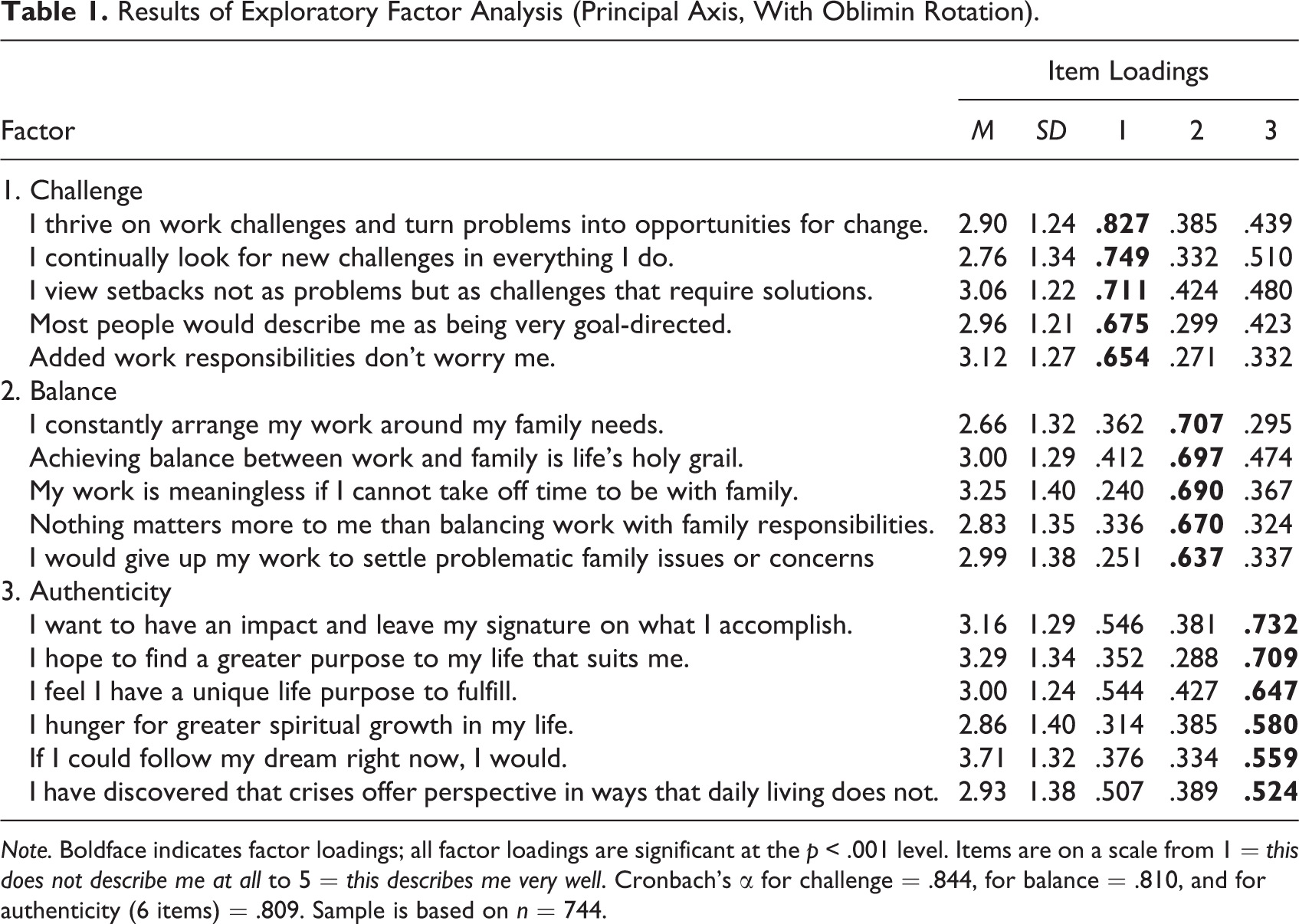
Note. Boldface indicates factor loadings; all factor loadings are significant at the p < .001 level. Items are on a scale from 1 = this does not describe me at all to 5 = this describes me very well. Cronbach’s α for challenge = .844, for balance = .810, and for authenticity (6 items) = .809. Sample is based on n = 744.
Control Variables
Demographic, family, and other background variables were selected for inclusion as control variables in the study, as they provide insight as to the resources and constraints that might influence individuals’ careers. The control variables consisted of age (measured as a continuous variable), race (1 = White, 2 = other), marital status (1 = married, 2 = not married), children (1 = yes, 2 = no responses to “are there children under age 18 living at home?”), and income (anchors ranged from 1 = up to US$20,000, 4 = US$60,000–US$80,000, to 8 = US$200,000 or greater). To measure income, respondents indicated their former income level, as this was an unemployed sample. We also controlled for whether respondents were unemployed by choice (1 = “quit work”; “laid off voluntarily”) or no choice (2 = “unemployed not by choice and looking for work”; “laid off involuntarily”).
Results
Table 2 contains the correlations, means, and standard deviations of the variables used in the study. Control variables were included to see whether demographic differences had an effect on the dependent variables of KCM authenticity, balance, and challenge. Correlations between the control and dependent variables were not significant, with the exception of some expected correlations, such as authenticity and challenge with income level (r = .08, p < .05; r = .18, p < .001) and balance with marriage and children (r = −.20, p < .001, r = −.18, p < .01; denoting a negative correlation with not being married/children).
Correlations and Descriptive Statistics.a

Note. N = 744. KCM = kaleidoscope career model.
aMen = 1, Women = 2.
bIn eight categories from “less than US$10,000” to “US$150,000 or more.”
c“Do you have any children under the age 18 living at home?” 1 = Yes, 2 = No.
d1 = early career (within the first 10 years of your working life), 2 = early midcareer (have worked at least 10–15 years), 3 = midcareer (have worked at least 15–25 years), 4 = late midcareer (have worked 25 plus years), 5 = late career (within 5 years before projected retirement date).
*p < .05. **p < .01. ***p < .001.
To test Hypothesis 1, analysis of variance (ANOVA) was used across the career stages represented by respondents to examine potential variation in the level of authenticity, balance, and challenge. The ANOVA results indicated there is significant variation across the career stages; KCM authenticity (F = 3.34, p < .05), KCM balance (F = 2.29, p < .06), and KCM authenticity (F = 3.336, p < .01). Figure 1a–c shows the pattern for KCM parameters. For this sample of unemployed workers, results of the KCM parameters followed a similar pattern, with low levels of authenticity, balance, and challenge in the early stage, a peak of emphasis in the early midcareer, a decline in emphasis in midcareer and late midcareer, followed in late career by a return to values similar to early career. There was one significant difference in the parameters in late career (Stage 5), with respondents indicating more emphasis on challenge than on authenticity, challenge, M = 2.98; authenticity, M = 2.85; difference t(238) = 2.21, p < .05.
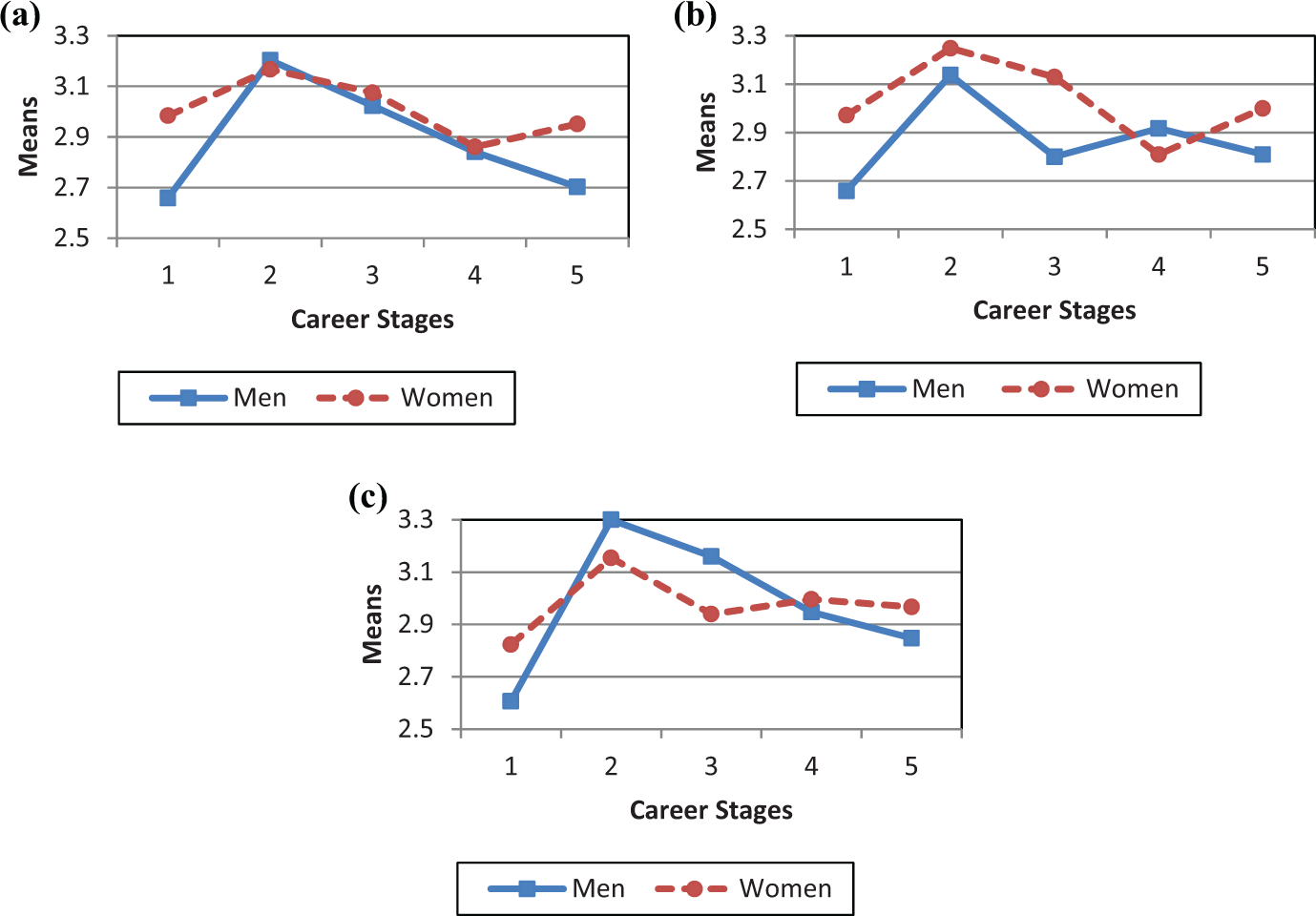
Kaleidoscope career model (KCM) parameters by career stages and gender. (a) KCM authenticity by gender. (b) KCM balance by gender. (c) KCM challenge by gender.
Hypothesis 2 predicted that there would be gender differences in the patterns of emphasis on parameters, and specifically, that balance would be stronger for women than for men in midcareer. We found support for this hypothesis. In terms of overall differences, women were higher than men on the parameters of balance and authenticity across the career span; balance: men M = 2.84, women M = 3.00; t(742) = −1.93, p < .05; authenticity: men M = 2.84, women M = 2.98; t(742) = −2.09, p < .05. For men, ANOVA results indicate there is variation across the career stages in KCM challenge, F(254) = 2.69, p < .05, and KCM authenticity, F(254) = 2.34, p < .05, but not in KCM balance, F(254) = 0.84, p = ns. For women, ANOVA results indicate there is significant variation across the career stages in KCM balance, F(488) = 2.58, p < .05, but not in KCM challenge, F(488) = 0.94, p = ns, or KCM authenticity, F(488) = 1.70, p = ns (see Figure 1a–c). Significant differences in early career emerged, with women placing more emphasis on authenticity, men M = 2.66, women M = 2.98; t(110) = −1.87, p < .05. In full midcareer (Stage 3), as predicted by Hypothesis 2, women placed more emphasis on balance, men M = 2.80, women M = 3.13; t(175) = −2.05, p < .05. There was a slight, nonsignificant inversion of gender and balance in Stage 4; this was assumed to be an artifact of the sample where some unemployed men were assessing the balance parameter while they remained unemployed. Finally, in late career just 5 years prior to retirement (Stage 5), women were marginally more likely to emphasize authenticity than were men, men M = 2.70, women M = 2.95; t(146) = −1.1, p < .10. Men and women shared very similar patterns for challenge, with emphasis peaking in early midcareer (10–15 years), but for women, this parameter dipped slightly in full midcareer but then showed an increase in late career. Challenge declined for men prior to retirement. The gender differences are striking (see Figure 1a–c).
Discussion
The contribution of this study is to (1) reaffirm the original tenets of the KCM with respect to gender, (2) examine how the three parameters of the KCM gain importance with respect to different career stages, and (3) closely explore the KCM parameters at midlife, defined with greater segmentation, to assess the parameters. The results were in the expected direction associated with the hypotheses of the model. Hypothesis 1, that there is variation across the segmented career stages of the model associated with the KCM parameters of challenge, balance, and authenticity, was supported. This indicates the KCM parameters are robust and that the salience of each parameter varies according to career stage. The original model hypothesized by Mainiero and Sullivan (2005) suggested the KCM parameters would vary, such that challenge would be preeminent in early career, balance in midcareer, and authenticity in late career, with individual variations as expected. In this study, the sharpest revelations were in Stage 3, full midcareer.
This research focused especially on a midlife sample of individuals in career transition who were unemployed at the time of the study. Within this group, the parameter of challenge remains strong throughout the career stages, with a slight drop on the part of men prior to retirement. The individuals in this sample were in the midst of a career transition and were looking for jobs that would challenge them. However, the parameters of balance and authenticity vary by gender in accordance with the model, with balance increasing in importance in midcareer significantly for women, and authenticity increasing in importance just prior to retirement, in Stage 5, for women. Challenge is the parameter that is most similar for men and women across the career stages; authenticity varies in the earliest (Stage 1) and latest (Stage 5) career stages. The pattern that most significantly varies for men and women is the inversion between balance and the other parameters of challenge and authenticity in Stage 3, right in the middle of the midcareer ranges. Individuals who find they lack balance in midcareer at about 15–25 years into the workforce may be prompted to seek an alternative job or career path to satisfy this need but challenge also remains active. Similar results were found by Sullivan et al. (2009) and Cabrera (2007), suggesting these trends by career stage across the parameters remain strong across multiple populations.
Hypothesis 2, that men are less likely to value balance in midcareer, while women are more likely to value balance in midcareer, was also supported by the results. The sharpest distinction between men and women occurred in Stage 3, defined in the sample as full midcareer, around 15–25 years of employment. In full midcareer, women were more likely to follow the beta kaleidoscope career pattern than men due to their increased priority and attention on the balance parameter. Women find the balance parameter to be more salient in their career decision than men. In addition, as noted by August (2011), women seek authenticity, as they age throughout their careers. Men also seek authenticity increasingly over time, but their desire for authenticity drops in late career.
This research underscores the point that at full midcareer, approximately 15–25 years in the workforce, individuals may shift their priorities as they contemplate career transitions. The value of the KCM is that it allows discussion of shifting parameters in a more fluid manner that may suit individual career needs at different points in the career cycle, similar to that of the life design model presented by Savickas et al. (2009) that incorporates dynamic processes, nonlinear progression, and multiple perspectives to examine the lifelong, holistic, and contextual decision-making made by individuals as they progress through their careers. It is difficult for researchers to capture some of the shifts and transitions of career decision-making over time; the research presented here is not based on a longitudinal design that can more accurately assess the fluidity of this model. However, the study allows a snapshot at a given point in time to assess which of the three parameters is paramount, while the others remain in attendance. We are reminded that careers are dynamic and operate in context, that gender as a variable in the foreground may be relevant, and that how midlife is defined may have meaning in context.
Implications for Practice
Several authors have written about the drain in women’s ambition over time (Fels, 2004; Hewlett & Luce, 2005), and a study by the Center for Talent Innovation (Hewlett, Forster, Sherbin, Shiller, & Sumberg, 2010) concluded there is a strong correlation between off-ramping and ambition levels. The authors suggest a vicious cycle created by women who are forced to choose between career and family obligations, such that women who accept jobs with fewer responsibilities or who off-ramp altogether are perceived as less committed, remain underchallenged or not promoted, and then redefine themselves in terms of lower confidence, ambition, and self-esteem (Hewlett et al., 2010, p. 28). This cycle contributes to the “brain drain” of competent, educated, and successful women who leave corporations to tend to family and personal needs (Hewlett & Luce, 2005).
The KCM describes this differently. According to the KCM, men and women seek challenge, balance, and authenticity over the course of their careers. But at midlife, while in transition, the differences between the parameters may be sharper, and more individuals (especially women) may prefer the beta kaleidoscope career pattern, with a focus on balance in midcareer, to the alpha kaleidoscope career pattern that supports challenge as well as authenticity in lieu of balance. This is not to say that there are not also alpha kaleidoscope women and beta kaleidoscope men at midlife. While gender remains an important contextual factor associated with career patterns, women face a double bind that is exacerbated by persistent socialized gendered schemas and may simply be enacting an updated self-employed, short-term horizon career model (Shapiro et al., 2008). Therefore, organizations should be mindful of the changing, dynamic, and fluid aspects of career development in the new age of portfolio careers, protean careers, and boundaryless careers that suggest that an individual may have different needs at different points of the career cycle (Hall & Chandler, 2005).
Human resource professionals should design career paths that allow people to pursue authenticity, balance, and challenge at different points in the career cycle. This suggests that on-ramping and off-ramping at different points in the career cycle should be naturally incorporated into such career paths. New ways of working in the 21st century require a fresh mind-set to create career paths that focus not only on work–family balance but work–life integration. Contemporary career paths should involve diagonal, lateral, upward, downward, enrichment, and exploratory moves at different points in the career cycle to alleviate stress, manage work–family balance, and encourage sustained ambition. At the present time, many women (and some men) abdicate their careers to transition into a less stressful or demanding job that best addresses work–family management and integration.
Vocational counselors should remain mindful of the three parameters of the KCM to discern which parameter rises into the ascendency at a given point in an individual’s career path to counsel individuals more appropriately before making a major career move. Arthur and Rousseau (1996), in their discussion of the “intelligent” career, describe three critical aspects to assess a career change: knowing why, how, and whom as part of a career change. The KCM can help clients discern why they want to make a career move. Vocational counselors can then focus on solving the how (specific actions associated with job exploration and seeking) and help clients identify with whom (developing a network). The three parameters can serve as signposts to offer guidance that addresses the most salient parameter to ensure a smooth career transition. Ronzio (2012) suggests that psychosocial development trajectories, the roles of family and relationships, the importance of underlying physical and mental health issues, and sociocultural and contextual stressors are relevant for women in the midst of a career transition. Further career coaching can specifically utilize the parameters of the KCM to determine whether a job prospect would lead to a more fulfilling career move during a time of career transition.
Limitations
The limitations of this study involve the sample and method of design. Career stage was self-report, where individuals indicated about how long they had been in the workforce (10 years or less, 10–15 years, 15–25 years, and beyond). Full midcareer in this study was defined as 15–25 years into the workforce, but other studies have defined it by age. This was an important definitional aspect of this study, as individuals often characterize where they are in their careers not necessarily by age but by tenure in an industry or organization. We did not collect information about switching industries or reinventing careers at midcareer; this variable was self-report. More specific information about respondents’ career paths at midlife would have enhanced the data.
A second major limitation of the study involves attributions made about the career stages and how the parameters pan out over time. A cross-sectional method was used for this study to assess the importance of each parameter for men and for women in each career stage; we are making assumptions about time through the cross-sectional results that were reported. To test which parameters are active at different points within each individual, a time-series longitudinal-based design is more appropriate and suggested for future research. The current cross-sectional design only allows us to look at groups of individuals in the aggregate at different career stages, so the assumptions we are making in this Discussion section require further tests that could be addressed through a longitudinal design.
Please note that alpha and beta kaleidoscope career patterns are assumed rather than directly tested in this study. There was no question asking whether or not an individual identified with the alpha pattern or the beta one. Assumptions of the career patterns are based on the aggregate of the sample and whether or not they prioritized the balance parameter, suggesting a beta kaleidoscopic pattern, versus prioritizing challenge and authenticity (see Sullivan & Mainiero, 2007, for a more detailed explication of the two kaleidoscope career patterns). Further research is suggested to directly test the kaleidoscopic career patterns as a longitudinal design to see if these initial cross-sectional results are supported. In addition, as it was not possible in this study, questions need to be asked whether or not individuals in the sample are primary caregivers for their children, as that may suggest a relationship between the kaleidoscopic career patterns and the three parameters of the KCM.
This study was not intended as a test of a social cognitive career theory model by examining gender as an explanatory variable. However, parallels to social cognitive theory, in which issues of self-efficacy and other explanatory variables focus an individual’s efforts and career decision-making at a time of transition, remain apparent. If the study had been designed to incorporate the actual career decisions individuals were making at midlife, rather than simply identify the parameters influencing their decision-making, it would have been a more direct test of social cognitive theory. In an ideal world, we would have had the opportunity to validate the study to determine whether participants ultimately found a job that echoed their three chosen parameters, but that opportunity did not exist. Further research is needed to ascertain the contribution of the KCM parameters as variables associated with social cognitive career models.
Conclusion
The primary contribution of this study is to (1) further detail, (2) provide support for, and (3) verify the three parameters of the KCM as applied to a specific group of unemployed individuals in career transition with a sharp focus on segmented midcareer (early, full, and late) and gender differences. The KCM provides a fruitful new way to engage individuals in conversation concerning the three parameters of authenticity, balance, and challenge as they plot a new career direction. It is most likely that individuals at the start of their careers will seek challenge, while more women than men in full midcareer will seek balance. As suggested by previous research, the need for authenticity for women will rise as the career stages mature and possibly for men as well.
Researchers examining careers should focus on gender issues as a variable in the foreground, rather than the background, of their research as the patterns between men and women may vary. Career counselors who examine the underlying parameters of the KCM may bridge the gap between theory and practice in ways that allow for discussions concerning a more fluid and dynamic career model that respects and validates gender differences. It is hoped that the KCM will point the way for career counselors to help individuals searching for new career directions discover a means of career expression more suited to the fluid 21st-century landscape of career reinvention over the course of one’s lifetime amid constant change.
Footnotes
Acknowledgments
The authors gratefully acknowledge Hugh Davis, who has supported large-scale survey research through his firm, CriticalMix, Inc., for faculty at Fairfield University, and the Charles F. Dolan School of Business Research Grant that supported the development of this article.
Declaration of Conflicting Interests
The author(s) declared no potential conflicts of interest with respect to the research, authorship, and/or publication of this article.
Funding
The author(s) received no financial support for the research, authorship, and/or publication of this article.