



Abstract
To explore the ways context may shape career choices, we used a qualitative approach to analyze interviews with college-oriented high school students from the rural Central Appalachia region of Virginia. Using social cognitive career theory, we analyzed pathways to career choices and relevant contextual factors, using data from 24 interviews. Results revealed that participants’ pathways partially matched the model, though we also found variant pathways triggered by significant environmental influences and incomplete pathways due to variations in possible career plans. Explanatory factors included status as prospective first-generation college student, outcome expectations that included remaining local and having job stability, and an emergent factor of continuing generation Appalachian. The patterns that emerged with respect to contextual factors and career choice pathways highlight the importance of culture and context when examining how students make career choices. This research extends prior research by examining career pathways using student’s own words as data. Moreover, the patterns offer insights career coaches, counselors, and educators can use in supporting students’ post–high school career planning.
Keywords
While there is considerable research on career choices in K–12 students (e.g., Betz, 2007; Brown et al., 2003; Fletcher, 2012; Fouad & Byars, 2005; Gordon, 1998; Kuh, Kinzie, Buckley, Bridges, & Hayek, 2006; Wahl & Blackhurst, 2000), resulting models, frameworks, and recommendations are often developed considering students from majority groups or high-enrollment areas such as low-income urban schools and omitting rural populations. Studies in rural regions are often more challenging because low enrollment limits quantitative modeling, and schools may be less accessible because of their locations. At the same time, neither generalized models nor research on other low-attainment groups (e.g., urban minority youth) are necessarily transferrable to rural contexts (Irvin, Byun, Meece, Farmer, & Hutchins, 2012) because of differences including geography, ethnic demographics, and cultural dynamics. Given the range of personal and cultural factors that affect students’ career choices, it is critical to study choice in context (Coladarci, 2007; Lent & Brown, 2006; Petrin, Schafft, & Meece, 2014).
Given this need, we use qualitative methods to explore career choice in one particular rural context: the Central Appalachia region of the United States. Based on graduation rates, Appalachians are underrepresented in higher education in general and specifically in engineering and other high-paying, in-demand fields. Though definitions of underrepresentation often refer to minority classifications of ethnicity, race, and gender, Appalachia as a cultural group is underrepresented with respect to educational attainment, job opportunities, and economic wealth though not race. As data from the U.S. Census Bureau and the Appalachian Regional Commission [ARC] demonstrate, Central Appalachia lags behind not only the United States as a whole but also most other portions of Appalachia with respect to educational attainment, employment, and economic wealth. Perhaps most notably, the college completion rates from 2009 to 2013 across the Central Appalachia subregion are the lowest in Appalachia, with county rates ranging from 5.6% to 13.6%, well below the U.S. average (28.8%) and Appalachian region average (21.6%) (Appalachian Regional Commission, 2015; U.S. Census, 2010). Even within a defined region such as Central Appalachia, variations such as state education policies, proximity to urban centers, and economies can influence career pathways. Despite such differences, little research has focused on career choice in rural Appalachia. The work that is available highlights the importance of local context with respect to typical Appalachian attitudes toward family, community, and work (Ali & Saunders, 2009; Irvin et al., 2012; Petrin et al., 2014; Tang & Russ, 2007). Developing a more contextualized understanding of career choice, we argue, can improve schools’ abilities to help rural Appalachian students make informed decisions about career goals and potentially improve regional educational and economic attainment.
To explore the role of context in career choice pathways, we frame our study using Lent, Brown, and Hackett’s social cognitive career theory (SCCT) (1994, 2000) and focus on a single state—Virginia. Because this study is part of a larger project exploring engineering as a potential career choice among Appalachian youth, our study is further limited to primarily self-identified college-oriented high school students. Using an exploratory qualitative case study approach (Yin, 2009), we addressed two research questions: (1) What are the postsecondary career choice pathways for college-oriented Central Appalachian high school students in Virginia? (2) What are the salient factors influencing these pathways?
Background
SCCT was developed to explain the processes by which individuals form interests, choose career choice goals and actions, and attain varying degrees of achievement in occupational and academic pursuits (Lent, Brown, & Hackett, 1994, 2000). SCCT encompasses a range of factors influencing career behavior, along with what Lent et al. (1994) refer to as “common, central pathways through which these diverse factors affect career behavior” (p. 81). SCCT posits that students base career choice goals on having (a) the necessary skills and knowledge, (b) expectations about rewards, (c) a commitment to do the relevant work, and (d) a supportive climate. Numerous studies have demonstrated the validity of SCCT’s constructs and relationships (e.g., Ali & Saunders, 2006; Lent, Sheu, et al., 2008), and SCCT has been used extensively to understand career choice goals in studies of K–12 students (e.g., Garriott, Raque-Bogdan, Zoma, Mackie-Hernandez, & Lavin, 2016; Gibbons & Borders, 2010), students in underrepresented groups (Flores & O’Brien, 2002; Gibbons & Borders, 2010; Kim & Seo, 2014; Lent et al., 2005; Tang, Fouad, & Smith, 1999), and, in a few cases, rural Appalachian students (Ali & McWhirter, 2006; Ali & Saunders, 2006, 2009; Bennett, 2008; Tang & Russ, 2007). The prior empirical research with Appalachian students relies on quantitative measures based on using variables identified in the SCCT model to predict career pathways at a broad level. For example, vocational school versus 4-year college versus direct to the workforce (Ali & McWhirter, 2006) and factors influencing expectations to attend college (Ali & Saunders, 2006). The model’s social constructs, particularly environmental influences and outcome expectations, make it well suited to studying the role of context. SCCT (Figure 1) thus provides both a framework for exploring career choice pathways and a means to compare our findings to existing literature.
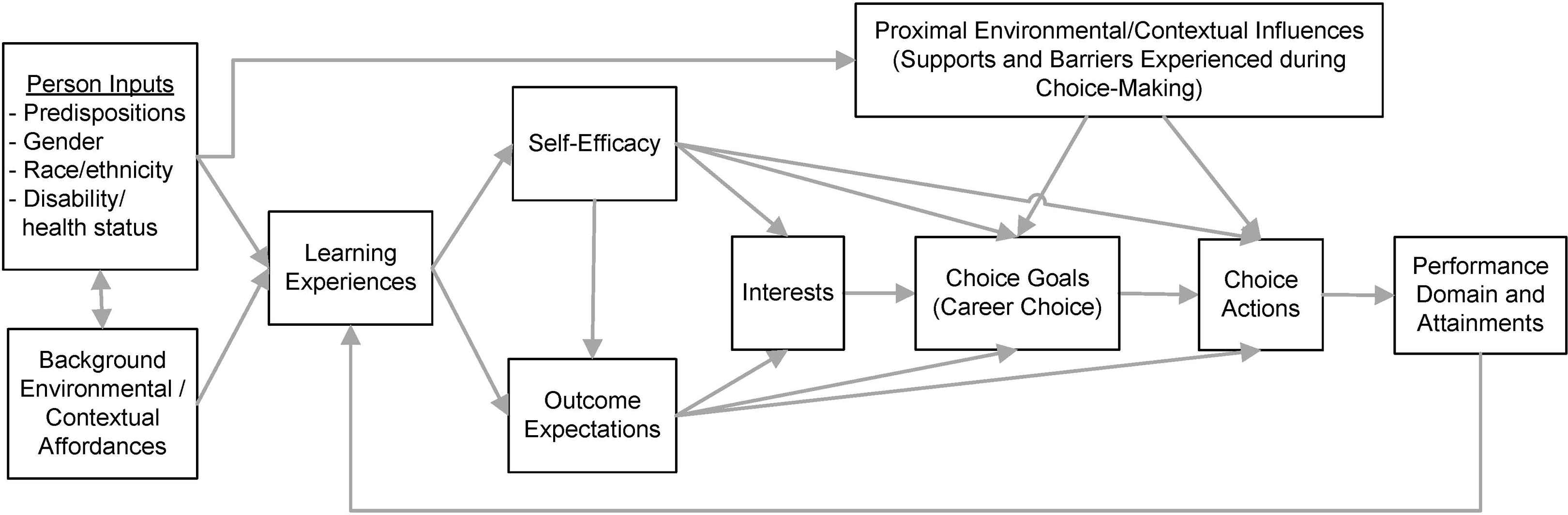
SCCT model (Lent, Brown, & Hackett (1994, 2000)).
Environmental influences can be proximal or distal to career choice decision-making. Proximal influences involve supports and barriers such as career contacts and money for college, while distal influences involve items such as family background and economic status. Both types can be objective (e.g., financial) or subjective (e.g., perceived family attitudes) and are affected by an individual’s interpretation (Lent et al., 2000). In rural Appalachia, strong family bonds form a primary environmental influence. These bonds are evident in the ways relatives (often several generations) live close to one another, the prominence of family members as role models, and the reliance on family and community for support (Azano, 2011). Low postsecondary degree attainment among family role models may limit students’ career aspirations (Ali & Saunders, 2009). Similarly, family and community loyalty may restrict how far students are willing to travel for college and may result in a preference for local educational and career options (Petrin et al., 2014). This loyalty, coupled with real or perceived availability of local jobs, may influence students toward or away from a given choice goal (Ali & McWhirter, 2006; Bennett, 2008; Sarnoff, 2003; Tang & Russ, 2007). The importance of environmental influences in rural Appalachia is consistent with broader research on underrepresented groups, suggesting that cultural ties may play the most important role in career decision-making—even more important than interest (e.g., Flores & O’Brien, 2002; Tang et al., 1999).
Learning experiences include performance accomplishments in subjects (e.g., mastery experiences, successful or not), verbal encouragement (or discouragement), and vicarious learning (e.g., watching role models succeed or fail; Lent & Brown, 2006). Within rural Appalachia, career-related learning experiences can be limited by school population size, distance, transportation difficulties, and quantity and variety of resources. Rural schools often have limited advanced course offerings (e.g., physics or calculus) due to their size; though online learning is becoming increasingly available, limitations in connectivity and scheduling remain potential barriers (Sundeen & Sundeen, 2013). In addition, research suggests in-person learning experiences have a stronger resonance with high school students in rural Appalachia (Boynton, 2014). Likewise, lower population densities and rural road structures require greater travel times for both students who want to participate in group activities and professionals who want to provide learning experiences such as career days or in-class demonstrations. Similarly, workplace visits are limited by the types of employment available and the lack of white-collar jobs (Seufert & Carrozza, 2004), which again may limit career choices (Ali & McWhirter, 2006; Bennett, 2008; Sarnoff, 2003; Tang & Russ, 2007).
Outcome expectations represent individuals’ beliefs about the consequences of their actions (Bandura, 1989) and can be social (e.g., family benefits), material (e.g., attractive salary), or functional (e.g., doing enjoyable work; Lent & Brown, 2006; Lent et al., 2005). They are shaped by environmental influences and learning experiences. Thus, rural Appalachian students who often perceive family members as role models may set outcome expectations accordingly; a student may choose to remain close to home and go to work directly after high school if that is a family pattern (Ali & McWhirter, 2006; Wallace & Diekroger, 2000), even when alternate careers would provide other desired outcomes (e.g., money or respect). Conversely, students with strong job-related outcome expectations may more readily leave the region in the short term when local opportunities do not meet those expectations (Petrin et al., 2014). However, as Petrin et al. (2014) note, such students may often have long-term aspirations to return home.
Interests refer to people’s likes, dislikes, or indifferences about career-related activities. For example, interest in a career may be based on interest in school subjects, hobbies, or perceived career-related prestige. Although SCCT posits interest as the direct precursor to choice goals, research results are mixed. Some studies support its prominence (Fouad & Smith, 1996; Jacobs, Finken, Griffin, & Wright, 1998; Lent et al., 2005; Lent, Sheu, et al., 2008). However, these and similar studies involved research based on “European American cultural values and thus failed to adequately address the intricacies of diverse populations,” as Kim and Seo (2014, p. 529) note. At the same time, research on underrepresented groups broadly in the United States suggests that factors such as degree of acculturation and nontraditional career choices (Garriott et al., 2016; Tang et al., 1999) may inhibit career goal formation via interest, while Jacobs et al. (1998) found parental support and access to science activities critical to girls’ interest in science careers. There is less data specific to Appalachians with regard to interest and how it interacts with other factors to influence career choices making the role of interest important to understand.
Career choice goals (referred hereafter as career choices) are the intentions, plans, or aspirations to engage in an activity or obtain an outcome; they are stated in terms of what one will do (Bandura, 1986; Lent et al., 1994). In this study, we focus on the content of career choices (i.e., type of activity) associated with the intention to pursue a career. Moreover, following Ali and McWhirter’s (2006) work for rural Appalachian students’ postsecondary plans, we include goals associated with a job, career, or vocation.
Method
Given the limited research on the role of context in career choice in rural Appalachia and our goal of understanding influential factors, we conducted a qualitative exploratory case study using interviews as the primary data source (Creswell, 2009; Yin, 2009). The case study approach was particularly well suited for our research because it enabled us to focus deeply on a single context to explore how students develop their career choices in a contemporary, nonexperimental setting (Yin, 2009); within this context, we relied on multiple student interviews to effectively capture variation and develop a rich “understanding the lived experiences of other people and the meaning they make of the experience” (Seidman, 2006, p. 9).
Case Site
Because the case study is exploratory, we bounded the case to support deep exploration of a single area. We focused on Central Appalachia (as defined by the ARC) because it has the greatest disparity with national averages in education, poverty, median income, and population density. We narrowed the case to a single state, Virginia, to minimize variations in state educational systems such as graduate credit requirements, types of diplomas, and testing (Corrente, 2013) that can impact career choice pathways. The Central Appalachian region of Virginia (CAV) typifies Appalachia in terms of rurality, mountains, and blue-collar/company towns. We further narrowed the site to the seven southwestern-most counties in Virginia which represent the three lowest (of five) socioeconomic classifications based on unemployment, per capita income, and poverty: distressed, at risk, and transitional. No counties in or adjoining the CAV were ranked as competitive or achievement (the two higher classifications) in 2011 (Appalachian Regional Commission, 2011) when the project was initiated. Finally, we identified four county school systems willing to support the project that also represented the breadth of the region’s demographics. Poverty rates in the four counties range from 122% to 138% of the national rate (13.8%); 2010 per capita income ranged from US$27,000 to $32,000, compared to almost $40,000 for the nation and $44,000 for the state. College completion rates were 27–67% of the national average (24.4%).
Recruitment Procedures and Participants
We followed institutional review board and county student recruitment policies and worked with the superintendents of the four counties to choose high schools that maximized variety in characteristics (e.g., size, location, and course offerings). Table 1 lists salient characteristics for each school.
High School Characteristics for Participating Schools in the Data Collection Year.
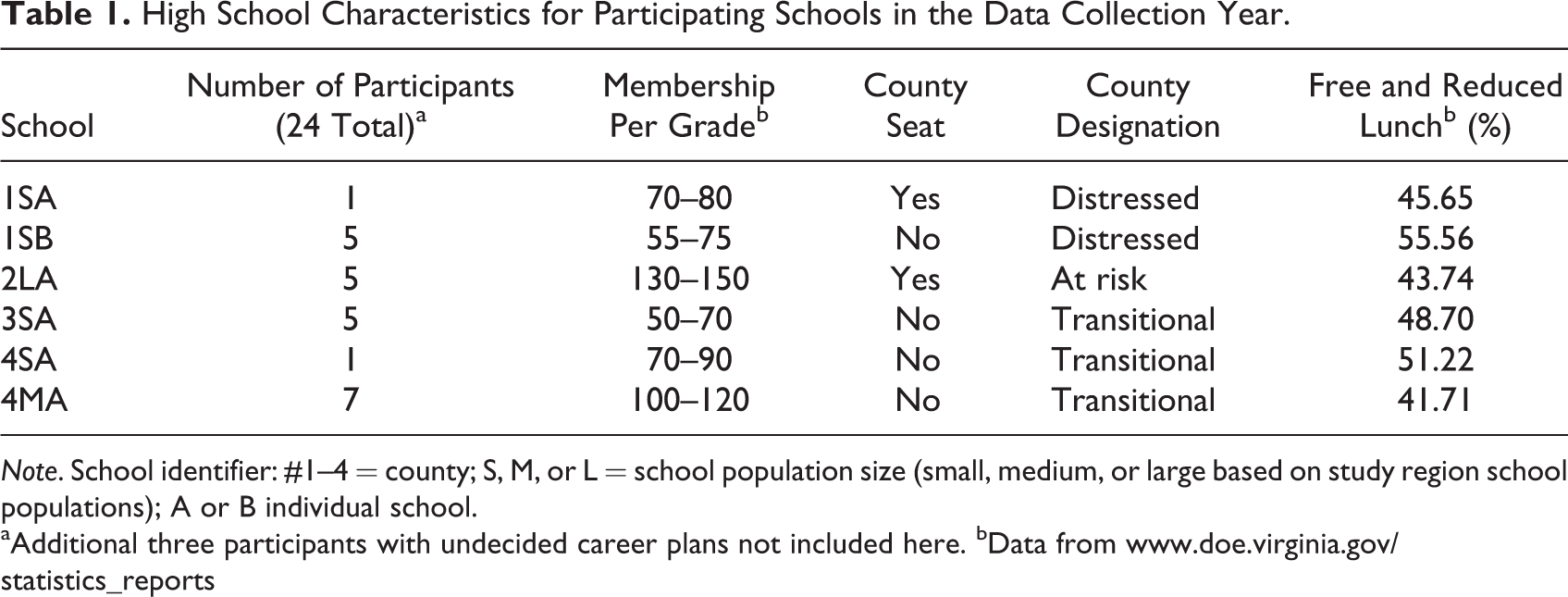
Note. School identifier: #1–4 = county; S, M, or L = school population size (small, medium, or large based on study region school populations); A or B individual school.
aAdditional three participants with undecided career plans not included here. bData from www.doe.virginia.gov/statistics_reports
The research team e-mailed the principals of each high school asking them to disseminate recruitment materials to all juniors and seniors in their school, regardless of career plans or postsecondary education plans. The recruitment materials included the student interview request and described the study’s purpose. Specifically, we asked for volunteers to be interviewed for a National Science Foundation funded research project on students’ decision-making regarding career choices. The purpose was noted as needing to understand the relatively low participation of Appalachian youth entering the engineering workforce and engineering careers. We specified our interest in all students, regardless of their post–high school plans, to ensure an accurate representation of the region. We did not specifically seek out college-orientated students. We interviewed all 24 students who volunteered, assented to participation, and provided parental consent. We included all 24 interviews in this analysis. Participants included 8 males and 16 females and 10 juniors and 14 seniors. All participants identified plans for postsecondary education. Future plans ranged from trade school certifications to doctoral degrees, with most describing plans to attend college (local community college or 4-year institution) immediately following high school and one student already enlisted in the military. Career choices included social work, health care, engineering, education, science, military, business, and unknown (Carrico & Matusovich, 2016). Family background varied with respect to parental education, parental occupations, family structure (i.e., raised by parent(s) or by legal guardian(s)), and status as continuing generation Appalachian (CGA; defined as a student and at least one parent born in Central Appalachian Virginia [CAV]; Carrico, 2013).
Data Collection Procedures
We used qualitative interviews with high school students as our primary data source, supplemented with publicly available high school, subregion, and county statistical data. We conducted the interviews during the 2012–2013 academic year and at each participant’s school in a meeting room; each lasted approximately one class period (45–60 min). All interviews were conducted jointly by one male and one female (the lead author) interviewer, both of whom were graduate students at the time. We developed the protocol based on the objectives of the larger research project. Relevant to this analysis, the protocol was informed by SCCT, literature on Appalachia, and data from previous interviews with college engineering students from rural Appalachia. The final protocol contained 16 questions, with supplemental probes for each question, and moved from participants’ current experiences to their community and finally to future plans (for a full description of the development process and the protocol itself, see Carrico, Boynton, Matusovich, & Paretti, 2013). Relative to a career pathways analysis, our interview questions addressed interests inside and outside school, potential jobs or careers, jobs to avoid, next steps, and influential people.
Although our analysis included the full interview transcript for each participant, several questions were particularly salient due to their alignment with career pathways. For example, responses to the questions, “What type of job are you considering? Why?” yielded information on career goals and insights about potential educational requirements. Follow-up questions such as “describe the reactions of others” then explored students’ perceptions of proximal influences and the role of outcome expectations, such as location or money. Similarly, the question “Is there a job or a career that you wish you could pursue, but can’t?” revealed potential broken pathways. Follow-up questions here explored participants’ reasons for rejecting potential careers to help make meaning of the experiences.
Analysis
We used a multistep approach to identify (1) salient variables influencing participants’ career choices and (2) the pathways leading to those choices. While we describe two discrete steps, the process was iterative as we checked findings within and between steps. The lead author was also the primary data analyst; Authors 2 and 3 participated in reviews of and contributed to the findings (individuals who provided intercoder reliability are noted in the Acknowledgments).
To identify salient variables, we began with a variable-centered approach (Miles & Huberman, 1994), analyzing transcripts using a priori coding informed by both SCCT and relevant prior research. For example, in identifying outcome expectations (the broad SCCT category), we looked for expectations such as remaining local; similarly, in identifying environmental influences, we looked for family background (e.g., parental educational attainment) and geographical restrictions (e.g., desire to live close to family or remain in the region for college). At the same time, we were attentive to emergent codes. For example, as participants described their background, many described roots in the area dating back several generations, and thus the concept of “continuing generation Appalachian” emerged. We then reviewed the transcripts holistically to explore relationships among variables and to identify pathways leading to each individual’s career choice. In all, five pathways emerged, two directly mapped to SCCT and three variants. Importantly, participants were not shown the SCCT model nor explicitly asked to map their pathway; instead, these pathways emerged from our analysis of the interview transcripts.
Research Quality
To ensure trustworthiness, we focused on accuracy of data collection and validity of interpretation or “accuracy of the findings” (Creswell, 2009, p. 190). In data collection, two interviewers were present for all interviews to ensure that we probed to elicit participant meaning rather than relying on assumed knowledge. During interpretation, the research team reviewed emerging findings and we used a formal process for intercoder reliability such that two researchers independently coded transcripts using common codebooks and negotiated final code definitions to consensus (Creswell, 2009). To improve the quality and reduce possible researcher bias, an external evaluator reviewed data collection, data analysis, and findings. In addition, we employed a form of member checking (Creswell, 2009) by having school district personnel representing all four counties meet with the research team to review preliminary findings; they provided positive feedback to confirm the findings.
Results
Career Choice Pathways
Our analysis revealed that 21 of the 24 participants followed one of five career choice pathways: Interest, Purposeful Delay, Behavior Altering, Major Life Event, or Supportive. The remaining three participants described a variety of possible pathways due to a variety of options described, and thus their pathways were labeled Unknown. Interest and Purposeful Delay pathways align directly with SCCT (Figure 1), while the remaining three identifiable pathway represent variations in the model. Notably, the variant pathways were all shaped by significant environmental influences in the form of people valued by the participants or major life events.
Interest
Six participants followed the SCCT pathway through interest to career choice. Participants in this category described long-term interests that directly influenced their career choice, and they provided multiple examples of that interest. These participants did not describe other people shaping their interests or helping them link interest to career. Some explicitly said they could not remember an event or person that led to their career choice, while others described their choice as something they always wanted.
Paul and Emily provided examples that described their interests in terms of an inherent personal trait and that linked their career choices directly to those interests. Paul is a junior, prospective first-generation college (PFGC), and CGA, while Emily, also a junior, is not CGA and is not PFGC. Paul exemplifies this category in that he repeatedly stated that he had always liked to make drawings and could not pinpoint when his interest started. He liked his computer-aided drafting (CAD) work, was taking CAD and drafting classes through the county trade school, and wanted to pursue architectural drafting. Asked if he had considered any other jobs, Paul responded, “Not really that I’ve looked into. This [architectural drafting] is the only one I’ve really looked into,” and he described choosing the career because “basically…I like to draw.” Similarly, although she did not have a specific job title in mind, Emily expressed interest in a career helping others conduct research because of her interest in the process: “One aspect of university libraries and other aspects of library science is you can help people do research, through historical documents and finding it on databases. I think that would be really interesting. I’m really interested in research.”
Purposeful delay
Three participants intentionally planned to use college to explore options and choose a career later. In terms of SCCT, this pathway represents the feedback loop from a choice action (enter college) to new learning experiences that will help develop interests and shape future goals. These participants articulated clear reasons for delaying their decisions as well as clear plans to use college to identify a career choice. Jessica, a junior but not CGA nor a PFGC, and Samantha, a senior and CGA but not PFGC provide examples. Jessica wanted to “know what I want to do before I get something that might not work for me.” Although concerned about lacking “the qualifications to do something I want to do,” she did not want to pursue a degree “then get out of college and be like, oh, no, this is not what I want to do.” As a result, she explained that selecting a career choice was “probably going to happen in college, to figure out, because right now I have no clue about it.” Where Jessica delayed her decision to avoid negative outcome expectations, Samantha delayed her decision to ensure that her career matched her interests: “[T]hat’s probably the most important thing for me is to have something that I really care about and that I’ll want to go to work every day.” She explained, “I’ve kind of left [the career decision] to whenever I go to college I’ll decide from there, because I don’t really have a clue.” These students recognized the value of additional learning experiences to identify or refine their interests and inform their career choices.
Behavior altering
Five participants, all seniors, were initially pursuing career choices based on interest, but a strong external influence, typically a family member, persuaded them to alter their behavior. This pathway varies from SCCT in that a proximal environmental influence (i.e., a person) disrupts the link between interest and career and redirects participants to different outcome expectations that lead directly to new career choices. In each instance, someone the participant valued persuaded him or her to change from a preferred career choice based on interest to a new choice based on an outcome expectation important to the influencer.
Participants in this category described the interests that led to their original career choice, what proximal influence (person) caused them to change, and why that person wanted the participant to change. Four of these participants cited parents as the primary influence and reported job stability or income level as the key parental outcome expectations driving the change. The fifth, Lisa, a senior and CGA and PFGC, cited her brother-in-law, whose military career seemed more likely to “make the big difference” (outcome expectation) than her original choice. Fred, a senior and CGA and PFGC, illustrated this pathway when he spoke of his interest in cars and his initial desire to work in the automotive industry. But Fred’s father talked to him about the decline in that industry and the lack of local jobs, describing that career as impractical. Instead, he suggested the medical field, which would always need workers and be stable. As Fred explained, Mostly my parents kind of pushed me into it because they, I mean, we both of us, me and dad, really like cars and everything, and he just, we both talked about it, how the auto industry is failing and how everything else is going up in the medical field so that was pretty much the deadline of how we pretty much chose it. (Fred, senior)
As a result, Fred planned to attend the local community college to become a nurse or a nurse practitioner. Noting that his career choice no longer involved cars, Fred did not expect to enjoy his job every day but indicated working on cars would continue as a hobby. Thus, like other participants in this category, Fred took on the outcome expectations of his influencer and reshaped his career choice accordingly, moving his interest to a “hobby” apart from work.
Major life event
Four participants, all CGA and PFCG, experienced a significant personal event that led directly to a career choice. In this SCCT variation, a distal environmental influence (the event) leads directly to the choice goal, bypassing the model’s intermediate factors. These participants did not change their career choice based on the event, as the Behavior Altering group did, nor did they cite career interests prior to the event. Instead, each explained how the event directly shaped their choice. For two participants, the event was the death of a parent; a third cited adoption by a grandparent; and the fourth cited medical issues.
Brian, a senior, exemplified the Major Life Event pathway: when he was in elementary school, his mother was studying for her pharmacy technician certification but died unexpectedly, which triggered his career choice. When asked if his mother was still thinking about becoming a pharmacist, Brian said, “Oh, no, she passed away, but, um—, but she was like going after her pharmacy degree or whatever. So it kind of inspired me to fill her shoes, to pursue that.” Notably, interactions with professionals (doctors and social workers) were often key components of these critical incidents. For example, Rachel, also a senior, was adopted at a young age by her grandfather and described her interaction with the adoption social worker as her inspiration to choose a career in social work; she wanted to help others in the same way she was helped.
Supportive
Three participants followed a pathway in which proximal environmental influences (a person) provide an essential bridge linking the participants’ interests to a potential career. Although this pathway closely resembles SCCT, the link between interest and career is not direct, as in the Interest group, but rather is mediated by the proximal influence. Without this supportive person, participants lacked the knowledge to move from interest to career choice.
Though each participant in this group had different interests and received support at different points, each one’s career choice was shaped when someone within the school system introduced them to a career that supported their interest. Ashley, a senior and neither CGA nor PFGC, who had moved to the area from a suburban Midwest environment as a sophomore, experienced her support through a teacher at her former school: We had a thing called Lego Robotics where we made robots with Legos, and I really liked that. And, um, when my teacher said, you know, there are people out there which actually do this for a job, and I was like, I would love to do this for a job. And, after I started researching what jobs out there had the same things around that, then I realized I wanted to go into an [chuckles] engineering major. (Ashley, senior)
Similarly, Donna a senior, CGA, and PFGC, had an interest in theater but also wanted a financially stable career, which she did not believe theater offered. A high school teacher showed her how to incorporate her interest in theater into a career in social work, a more financially stable path. As a result, Donna had spoken with a social worker about this idea, indicating that the proximal influence sparked both intention and action toward a career.
Unknown Career Path
Three participants, all male, one senior and two juniors, were uncertain of their future career and thus had Unknown career paths. All three participants were CGA, one intended on going to a 4-year college, one was uncertain, and one was considering either 4-year or 2-year college. Unlike the Purposeful Delay students, these participants were not purposely deferring a career choice. The Unknown participants vacillated between career choices and engaged in choice actions that would support a variety of career choices; in addition, they did not indicate their decision was limited to the options stated. No clear path within the SCCT framework, or that emerged from this research, captured the plans of these participants as different pathways existed for their different possible career choices. For example, at one point in his interview, Kyle reported consideration of architecture over engineering due to the difference in math requirements, yet during a different part of the interview he indicated that his decision was actually based on the potential for a scholarship. He said, “I was looking at engineering. I’m sort of leaning away from engineering to architecture and it’s really going to depend, I’m actually going to try to get a golf scholarship [to a regional liberal arts college]…. It’s really going to depend where I get a college scholarship.” When questioned how attending the liberal arts school may affect his career choice, he responded, “I’m not sure what they [the college] do [degrees], but I know they have a good business degree, so, I might actually get a business degree.” When probed on business versus architecture, he responded, “I haven’t really studied on it [the idea] that much yet because I’d actually just changed to architecture.” The other two participants, Gary and Kevin, had similar stories of indecision between possible career fields (e.g., business, law, and engineering for Gary), indicating additional fields may be considered, and not yet knowing or deciding what factors will determine a their career choice.
Career Choice Patterns
After identifying the pathways described above, we explored patterns between pathways and other variables. Table 2 summarizes the pathways and salient variables for participants in our study, including both a priori and emergent factors. The number in each column represents the number of participants with a “yes” response. (Note that Table 2 shows only variables for which we identified patterns; a full discussion of other variables considered in the larger study is available in Carrico, 2013).
Summary of High School Career Pathways and Factors.
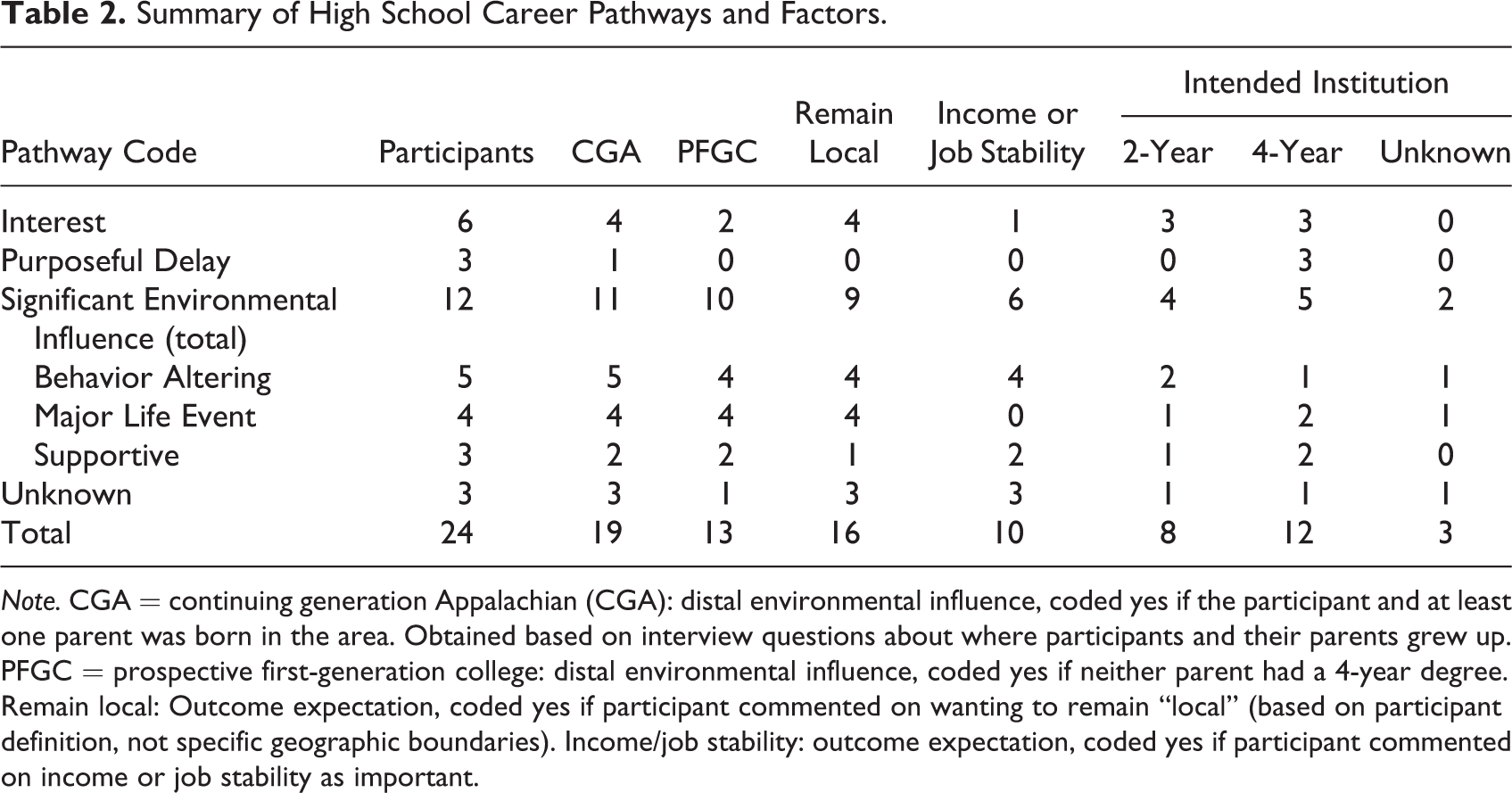
Note. CGA = continuing generation Appalachian (CGA): distal environmental influence, coded yes if the participant and at least one parent was born in the area. Obtained based on interview questions about where participants and their parents grew up. PFGC = prospective first-generation college: distal environmental influence, coded yes if neither parent had a 4-year degree.
Remain local: Outcome expectation, coded yes if participant commented on wanting to remain “local” (based on participant definition, not specific geographic boundaries). Income/job stability: outcome expectation, coded yes if participant commented on income or job stability as important.
The salient background environmental factors were PFGC-(neither parent had a 4-year college degree) and CGA status. CGA status emerged from the data and represents a student who was born and raised in the region and has at least one parent who was born in the region. The salient outcome expectations were income/job stability and a desire to remain local.
Four patterns emerged relative to background, outcome expectations, and pathways. First, 12 of the 24 participants reported a significant environmental influence relative to their career choice (all in Behavior Altering, Major Life Event, or Supportive pathways), and 11 of those were CGA and PFGC. Students in these three pathways tended to desire local employment and income or job stability. Second, four of the six participants in the Interest pathway were CGA, and these same four wanted to remain local but did not cite job stability as significant. Third, of the participants who had purposefully delayed choosing a career path, none were PFGC and none planned to remain local or cited job stability or income as salient. Instead, all wanted a career aligned with their interests. The Purposeful Delay group also differed from the other groups in that all stated intentions to attend a 4-year institution. Finally, with respect to CGA and outcome expectations, all participants who preferred to remain local were CGA, and only 3 of the 19 CGAs did not identify this preference. At the same time, none of the non-CGA participants cited a desire to remain local and none indicated income or job stability as important. All of the Unknown participants were CGA and preferred to remain local.
Discussion
The pathways and patterns identified in our analysis highlight two issues relative to career choice pathways for students in CAV pursuing postsecondary education. First, some pathways vary from SCCT in ways that suggest alternate routes through the major constructs. Second, several contextual factors proved salient to these pathways. This work highlights the importance of understanding the culturally relevant aspects of a study’s participants, as evidenced by studying rural Appalachian students. Because they do not fit standard definitions, Appalachian students are an atypical underrepresented group and have become an “invisible minority because they do not appear outwardly different from mainstream Americans” (Tang & Russ, 2007, p. 34). Importantly, it was the use of qualitative research methods that enabled us to explore Appalachian student career choice development and uncover new pathways.
Career Choice Pathways
While both the Interest and Purposeful Delay pathways align with SCCT, the 12 participants whose pathways were shaped by significant environmental influences did not follow the model’s path from interest to career choice. Although prior SCCT research supports interest as a prominent, direct influence on career choices (Lent et al., 2005; Lent, Lopez, Lopez, & Sheu, 2008; Lent, Sheu, et al., 2008; Morgan, Isaac, & Sansone, 2001), our results agree more closely with research on underrepresented groups that report breaks in the interest–career choice link based on context (Flores & O’Brien, 2002; Garriott et al., 2016; Tang et al., 1999). Our results also echo Kim and Seo’s (2014) work linking the prominence of interest to dominant U.S. and European cultural values. Where Kim and Seo highlight variations across national cultures, our work points to equally important variations within the United States. In this case, salient values included characteristically rural Appalachian attitudes toward family and community. These values resulted in pathways not predicted in the present SCCT model. Distal and proximal environmental influences, often family or close community members, rerouted the pathways of the Behavior Altering and Major Life Event groups and provided a key bridge for the Supportive group. Moreover, for the Behavior Altering and Major Life Event groups, interest in the career choice played little to no role; instead, environmental influences dominated participants’ career choices. The use of participants’ stories as data enabled concrete details of how environmental influences both support and hinder possible career choices. These data also allowed a deeper understanding that some students who are undecided or considering multiple possibilities may also be vacillating between different pathways through the SCCT model.
Participants in the Unknown category did not have a pathway through the model, as they lacked clarity and specificity of career goals and choice actions. The presence of this grouping of students highlights a potential gap in research that assumes goals are clear and under the control of the student (i.e., not hinged on a possible scholarship or other factor).
Salient Factors: Environmental Influences
The variant pathways and patterns highlight factors of CAV that play powerful roles in students’ career choice pathways. Whether proximal or distal, environmental influences directly shaped the career choices of more than half the study participants and resulted in career choices not directly linked to interest. These findings complement studies on other underrepresented groups that illustrated the role cultural and contextual factors play in career choices (Flores & O’Brien, 2002; Tang et al., 1999). In our case, these factors relate to the role of family and include family background (CGA), parental education, and family outcome expectations; they emerged most notably in participants’ desire for careers that would allow them to remain local (and thus close to family), their willingness to honor parental preferences regarding job choice, and their preferences for attending local colleges and universities.
Contextual factors were particularly evident in the Behavior Altering category. Four of the five Behavior Altering participants were PFGC, cited strong family influence on their outcome expectations and career choices, and identified outcome expectations associated with local employment and job/income stability. These factors reflect the strong community culture as well as local economic conditions. Interestingly, in contrast to Gibbons and Borders’s (2010) findings showing lower family support and lower positive outcome expectations for college among PFGC students, our findings point to strong family support and outcome expectations among the PFGC students in this study, albeit at the potential expense of interest. Similarly, participants in the Major Life Event group share characteristics found in Appalachian career choice literature: All were PFGC and wanted to remain local (Ali & McWhirter, 2006; Haaga, 2004; Petrin et al., 2014). However, unlike participants in other studies, our participants did not reference job stability or income. This pattern may indicate that while the strong community culture influences career choices, other factors may mitigate economic concerns. Finally, within the Supportive group, the patterns were more mixed; two of the three participants were PFGC and two cited income/job stability as important, suggesting some alignment with previous work.
While these characteristics of CAV are important to the three pathways shaped by significant environmental influences, they were notably unimportant for the Purposeful Delay group. These three participants stood in contrast to most others in that all planned to attend a 4-year institution, none were PFGC, only one was CGA, none wanted to remain local for school or work, and none cited job stability or income as key outcome expectations. And unlike the Behavior Altering group, who moved away from interest-related careers in response to family influence, all Purposeful Delay participants explicitly wanted a career related to their interests. This group also represents an understudied population. Prior work considers students who were deciding among the workforce, vocational, and postsecondary plans or addresses college students’ persistence toward career choices (Ali & McWhirter, 2006; Chenoweth & Galliher, 2004; Lent, Sheu, et al., 2008; Wettersten et al., 2005). Far less work considers students who plan to use college to shape career choice. One such study, Rowan-Kenyon, Perna, and Swan (2011), reported that students delaying a career decision until college typically were supported by their parents and were from high schools with average or high socioeconomic background and average or high student achievement—much like the Purposeful Delay group. The stark contrast between the Purposeful Delay group and those in the environmental influence pathways highlights the types of backgrounds that allow students to use college to make career choices and, importantly for this study, reinforces the role of family background and CGA status for students in rural Appalachia.
CGA status, in fact, emerged as a new factor from this study. Although literature on Appalachia reports the importance of family as part of the culture (Ali & McWhirter, 2006; Bennett, 2008; Sarnoff, 2003; Tang & Russ, 2007), such work typically does not distinguish CGA from non-CGA individuals. Yet, for this case study, status as a CGA was linked to the desire for local employment, which in turn strongly influenced career choices. This link may enrich Petrin et al.’s (2014) findings regarding the persistent desire to “stay local” among high-achieving rural youth nationally; depth of family roots in an area may also be significant in other locations. At the same time, while many participants provided information consistent with low socioeconomic status (SES), their marked preference to remain local suggests an important difference between rural Appalachia and low SES urban areas, where leaving is often a goal (Anderson, 1990). However, half of the CGA participants cited income and job stability as key factors, creating the same conflict seen in Petrin et al. (2014) between the desire to remain local and the local economic outlook. In contrast, none of the non-CGA participants mentioned staying local or job stability as salient to their career choices. In addition, none of the non-CGA participants were PFGC. Notably, the Unknown participants were all CGA and, compared to the other participants, their network of environmental influences and learning experiences may not be sufficient to assist them with adequate, specific information to make career choice decisions (Carrico & Matusovich, 2016; Matusovich, Carrico, Paretti, & Boynton, 2017).
Limitations
Two limitations in this study point toward future research. First, although the study explores career choice relative to postsecondary education, intention to attend college does not correspond to college enrollment (Executive Office of the President, 2014). The pathways found here may not apply equally to those who actually enroll in college, and their applicability to noncollege-bound students is unknown. Future work could expand the study population and include vocational occupations and longitudinal work to test planned versus actual pathways. Second, because we did not ask about family economic status, we cannot link findings directly to SES. However, where participants lived indirectly indicates SES, as did responses to questions about parental jobs and education. Future research would benefit from direct economic data to better understand this link.
Conclusions and Future Work
For the rural CAV counties studied, our findings demonstrate the ways in which environmental influences such as family and rurality may be primary drivers for career choices. These findings offer two contributions to research and practice relative to postsecondary career choice among college-oriented high school students in the region. Our findings also support the importance of qualitative research as a means to explore and explain the “why” of decision-making.
First, students’ pathways to career choices may deviate from frameworks developed from studies on other populations in ways that are context-specific. With respect to SCCT, distal background experiences, proximal supports, and outcome expectations were especially pertinent and resulted in variant pathways that diminished the role of interest and increased the salience of environmental influences. Further research on these variations in these counties and similar contexts could help educators support the development of career choices among rural Appalachian students. Such support may include professional development for counselors and career coaches as well as interventions with students and parents. At the same time, the importance of these factors has immediate practical implications for school personnel involved in supporting high school students’ career choices. By showing the breaks between interest and career choice, our findings point to the need to both provide students with clear, explicit links between interest and careers (as in the Supportive group) and to explore and leverage the local values that can supersede interest. That is, while the specific contextual influences identified in this study may not transfer to other contexts, the prominence of such influences suggests that counselors and others need to identify and work with the salient influences in their own contexts. Rural communities may offer ideal settings for such alignment because smaller populations often provide increased opportunities to know and understand their community values.
Second, these findings highlight the ways in which students with different backgrounds, even within the same context, use different approaches. Our findings emphasize the need for researchers and educators to adapt frameworks and methods to accommodate the perspectives and backgrounds of students. In particular, both groups should exercise care when considering generalized data, not just for CAV but for other rural students. Here, too, lower school enrollments may be an advantage, allowing counselors and teachers to more easily gather such knowledge. With respect to rural Appalachia in particular, both published data and future work should consider CGA status as a major mitigating factor. Given the marked differences in career choice patterns between CGA and non-CGA participants, our results highlight the need for researchers, school administrators, and educators to consider this distinction when conducting research, reporting findings, and working with students. Residency in Appalachia alone may not explain the effects of local culture and context on career choice pathways.
Our study confirmed that qualitative research, though not generalizable, is able to provide valuable insight into why and how local culture and context may cause alternative paths to those suggested by SCCT. Now that we know these pathways exist, our research lays the foundation for further studies into behavior altering or supportive pathways, how they form, and what they mean for future outcomes. Our research also suggests a need to further examine the importance of the environmental influences and specifically how family members or educators can better inform and support career choice pathways. Thus, our recommendations include adding specific questions related to encouragement to change a career choice (behavior altering) or exposure to new, previously unknown career options that meet a student’s outcome expectations. In addition, background questions to determine CGA status (or similar status for other areas).
Finally, because our research looked only at high school students, future work should explore longitudinal trends. Because high school students’ plans do not always fully materialize, longitudinal research is critical in exploring pathways, supports, and barriers for student persistence toward career choices. Nationally, as many as 20% of high school seniors who were accepted and planned to attend college failed to matriculate in the fall, and this phenomenon is more prevalent among low-income students (Executive Office of the President, 2014). In addition, gaps exist between students’ preferred career choices and their attained goals (Rowan-Kenyon et al., 2011), and some students may have unrealistic expectations about their career goals (Boden, 2011; Conroy, 1997). As our work shows, the career goals (and possibly uncertain goals) of rural students are shaped by local contexts in critical ways, and educators and researchers working with these students can benefit by increased attention to the nuances of salient environmental factors.
Footnotes
Acknowledgments
We wish to thank the school administrators and students who supported this work, Dr. Matthew Boynton of the research team for his assistance with data collection, and Dr. Rachel McCord for her role with intercoder reliability.
Declaration of Conflicting Interests
The author(s) declared no potential conflicts of interest with respect to the research, authorship, and/or publication of this article.
Funding
The author(s) disclosed receipt of the following financial support for the research, authorship, and/or publication of this article: This material is based upon work supported by the National Science Foundation under Grant No. EEC-1232629. Any opinions, findings, and conclusions or recommendations expressed in this material are those of the author(s) and do not necessarily reflect the views of the National Science Foundation. Human subject Institutional Review Board approval is through Virginia Tech IRB-12-444.