




Abstract
The purpose of this study is to explore the relationship among skill variety, autonomy, and job involvement with the mediating effect of informal learning in the South Korean business context. This study adopts a cross-sectional survey-based research design, drawing on the responses of 226 South Korean trainers to a survey regarding their facilitation experiences. Structural equation modeling is used in order to examine the influential relationship among the research variables. The results suggest that trainers exhibit higher levels of job involvement when they possess significant skill variety and high levels of autonomy and informal learning. Moreover, informal learning is shown to mediate the relationship between the job characteristics and job involvement. Recent changes in the knowledge economy have required professional trainers to expand their capabilities to lead organizations in the execution of business strategies. This study highlights the importance of informal learning to the trainers’ professional and career advancement.
In his comparison of individuals and organizations, Baruch (2006) posed the question: “Who is in charge of career development?” This question suggests the debate as to whether career development is a solely individual responsibility that should be planned and implemented by each employee or whether an organization should govern career development to support their employees’ long-term career goals (Clarke, 2013; Litano & Major, 2016; Sullivan & Arthur, 2006). Synthesizing two different aspects of career development, recent research has highlighted the importance of individuals and organizations’ mutual investment in career development (Herriot & Pemberton, 1996; Ye, Cardon, & Rivera, 2012). Today, it is less likely than ever that an employee stays in a single organization or performs a single job for his or her whole career; for that reason, each employee is said to take more serious responsibility in the establishment of his or her own career path (Sullivan & Arthur, 2006). Employers are also required to manage seamless talent pipelines that align with their firms’ rapidly shifting strategic goals as sources of competitive advantage (Thunnissen, Boselie, & Fruytier, 2013).
In line with this perspective, Weng and McElroy (2012) suggested the concept of organizational career growth, which focuses on one’s perception of career development within a single organization, rather than as part of a lifelong career path. The main focus of this concept is to explore the interactional relationship between each employee’s career-related ambitions and his or her organization’s proposed career growth opportunities. Weng, McElroy, Morrow, and Liu (2010) also suggested that career goal progress, professional ability development, promotion speed, and remuneration growth are major factors that mediate the relationship between individuals and organizations. Although this multidimensional framework provides the opportunity to understand critical determinants that influence employees’ career growth perceptions (Chen et al., 2016; Weng & McElroy, 2012; Weng, McElroy, Morrow, & Liu, 2010), little remains known about the specific underlying mechanisms explaining these relationships in various work contexts.
In this study, we aim to extend organizational career growth literature by focusing on professional ability development in light of emerging scholarly interest in the “new psychological contract,” a concept that highlights the importance of training and development for career development (Cavanaugh & Noe, 1999; Solberg & Dysvik, 2016). Research on how professionals learn suggests that informal learning within a realistic and relevant context is the most effective method of developing professional expertise (Cheetham & Chivers, 2001; Meyer & Marsick, 2003; Webster-Wright, 2009). Informal learning typically occurs within specific organizational contexts and focuses on acquiring and assimilating various clusters of knowledge and skills (Eraut, 2004; Garavan, Morley, Gunnigle, & McGuire, 2002). Employees exposed to informal learning are likely to be actively involved in their current jobs, since skills and knowledge that can be acquired through informal learning are marketable job competencies that accelerate their career advancement (Kanungo, 1979; Maurer, Weiss, & Barbeite, 2003).
This study sampled South Korean trainers as the collective representation of a highly skilled workforce whose members have been employed under nonpermanent labor contracts, rather than traditional regular and full-time contracts (Korean Human Resource Development Association, 2013). As flex professionals, trainers are not only interchangeably employed within an organization or as independent contractors, but they also leverage contingent work as a stepping stone toward career progression. At the same time, like Linde, Horney, and Koonce (1997) have argued, trainers have moved beyond their traditional role of mere course instructors, instead acting as change agents or performance consultants by guiding the execution of business strategies. In order to meet evolving expectations of the job market, trainers are keen to continuously enhance their facilitation skills (Meyer & Marsick, 2003).
To address the significance of professional ability development for trainer career growth, this study examines how skill variety and autonomy relate to job involvement through informal learning. These two job characteristics provide different values and challenges for trainers. The need for skill variety in today’s learning environment may lead trainers to more frequently engage in informal learning in order to enhance the effectiveness of their facilitation skills (Brinia & Kritikos, 2012; Chen, Shih, & Yeh, 2011). Likewise, trainers who have more autonomy experience greater motivation and stronger senses of accountability and may adopt creative delivery methods and materials, explore various viewpoints, and generate novel approaches to enhance their informal learning and job involvement (Volmer, Spurk, & Niessen, 2012; Wang & Cheng, 2010). This study thus suggests that job involvement among trainers can be significantly influenced by a combination of skill variety, autonomy, and informal learning.
Research Variables and Hypotheses
The literature review consists of three parts: (a) job involvement as a dependent variable, (b) skill variety and autonomy as independent variables, and (c) informal learning as a mediator.
Job Involvement
Job involvement is a key work-related attitude that describes employees’ cognitive belief systems about their jobs. While there have been various definitions and analogous concepts proposed, this study defines job involvement as a state of psychological identification with one’s job insofar as the job has the potential to meet and satisfy one’s expectations (Kanungo, 1982). Gorn and Kanungo (1980) have argued that this definition highlights employees’ involvement in particular rather than general jobs. Involvement in a general job is a normative belief that suggests employees make their jobs the center of their lives, so that their levels of involvement are unlikely to change depending on circumstances (Mannheim, Baruch, & Tal, 1997). Involvement in a particular job, on the other hand, is a belief that suggests employees’ levels of involvement vary according to their perceptions of situational factors that can be influenced by the combinations of job resources and demands in their present work-related states (Bal & Kooij, 2011). Put differently, highly involved employees are likely to invest greater time and energy into their work performances under certain circumstances. On the other hand, employees who experience low levels of involvement might exert less effort in their jobs (Kanungo, 1979).
Trainers are likely to be employed as individual contractors or fixed-term employees in the South Korean business context (Korean Human Resource Development Association, 2013). Compared to typical full-time employees of an organization, trainers choose career paths that they personally establish and negotiate, and they accumulate work experiences that extend beyond the boundaries of individual organizations (Nilsson & Ellström, 2012). At the same time, as flex professionals, trainers have more interest in engaging in challenging ad hoc projects that help them enhance their employability on the labor market and elevate their professional reputations in their professional communities as well as within single organizations (Kidd & Green, 2006).
Therefore, it is necessary to explore trainers’ involvement in particular jobs from the perspective of social exchange theory (SET). SET suggests that if employees feel their expected needs in their jobs or organization are met, they may feel similarly obligated to meet the jobs or organizations’ expectations of them (Cropanzano & Mitchell, 2005). This indebtedness may take the form of job involvement (Cohen, 2000; Rotenberry & Moberg, 2007). Specifically, when sufficient job resources are provided by trainers’ organizations, the trainers are able to use their intrinsic work motivation to reinvest these acquired resources. To balance given benefits and repayment, the trainers remain involved in their jobs (Lee, Kwon, Kim, & Cho, 2016; Saks, 2006). Thus, job involvement can be considered an important dependent variable that may influence the career growth of trainers.
Skill Variety
Hackman and Oldham (1975) have highlighted five job characteristics that affect work outcomes in modern organizations: skill variety, autonomy, task identity, task significance, and feedback. Among these characteristics, skill variety and autonomy have been shown to have positive relationships with professional ability development for job success and job involvement in meta-analytic studies (Brown, 1996; Morgeson & Humphrey, 2006). Morgeson and Humphrey (2008) also pinpointed that higher level of skill variety and autonomy affect employees’ job knowledge and technical skills improvement with a corresponding positive impact on professional ability development. In this regard, Kroon and Freese (2013) suggested that flex professionals prefer more challenging jobs in which they can use various skills to gain specialist recognition in their professional communities. The researchers also indicated that more autonomous and independent work designs contribute to stronger work motivation and performance. Therefore, this study focuses on skill variety and autonomy as the most important job characteristics in terms of trainers’ career growth.
Skill variety refers to “the degree to which a job requires a variety of different activities in carrying out the work, which involve the use of a number of different skills and talents of the employee” (Hackman & Oldham, 1975, p. 161). If trainers are required to expand their existing skill sets and stretch their work abilities, they may also engage in informal learning and become involved in their jobs (Humphrey, Nahrgang, & Morgeson, 2007). For example, the growing adoption of telecommunication technologies has triggered the development of a nonresidential learning environment. According to the Training Industry Report (2015), only 46% of training hours are delivered by trainers in a residential format, while the other 54% are delivered using blended, remote virtual-classroom, online, mobile, and social-learning formats. Trainers are required not only to physically use the hardware that is utilized by new learning technologies but also to successfully embed the new learning technologies into instructional design in order to maximize their trainees’ performance improvement (Slusarski, 1994). Furthermore, the Korean Human Resource Development Association (2013) has argued that workplace training topics can be put into 24 categories (e.g., customer service, team building, and leadership). The report found that trainers were covering four training categories on average. The growing number of training topics might be influenced by increasingly diverse needs (there were only 16 categories in the 1980s) of industries and particular employers. Trainers today are being asked to deliver more topics that subsequently need to be assimilated with previously taught topics.
Given these challenges, it is difficult to effectively oversee training with only a handful of skills; increasing demand for skill variety makes trainers learn new facilitation skills to manage various tasks that necessitate different methods or procedures for their proper execution (Langfred & Moye, 2004; Schwarz, 1994). Moreover, even though the thought of expanding one’s skill variety frequently causes anxiety and resistance to change, the challenging jobs that result from expanded skill sets are likely to be interesting, worthwhile, and rewarding and may provide psychological meaningfulness to promising trainers (Morgeson & Humphrey, 2006). Therefore, skill variety may increase informal learning activities and promote job involvement.
Autonomy
The definition of autonomy is the “extent to which employees have a major say in scheduling their work, selecting the equipment they will use, and deciding on procedures to be followed” (Hackman & Lawler, 1971, p. 265). Even though many studies have identified autonomy as a work-related characteristic that positively influences learning and motivation (Morgeson & Humphrey, 2006), other studies have discovered that autonomy alone does not always explain this positive relationship (Langfred & Moye, 2004). Autonomy is a sophisticated pattern of controls in ambiguous decision-making situations that requires employees to accept more accountability for their results. This means that autonomy within some occupations may generate uncomfortable decisions and psychological stress (Strain, 1999; Wageman, 1995). Thus, if employees perceive that the benefits of autonomy outweigh its expected costs, they will become more motivated; if not, autonomy may lead to negative outcomes (Langfred & Moye, 2004).
There are two types of autonomy important to trainers (Prichard & Moore, 2016). “General” autonomy is considered as a balance between top-down coercive control and individual freedom for members of an organization at work. Additionally, in a training situation, there is a tension between standardization and discretion in terms of “curricular” autonomy. This study assumes that as flex professionals, trainers prefer to autonomously implement their training modules and facilitation processes to achieve learning goals based on their trainees’ various needs (Mazmanian, Orlikowski, & Yates, 2013). There are multiple routes to achieving learning goals through content knowledge and delivery style in instructional design (Harris, Chung, Frye, & Chiaburu, 2014; Rangel et al., 2015). Trainers often need to create improvised facilitation activities during unscripted scenarios that arise while advising their trainees. Trainer autonomy can help trainers realize that they need to enhance their facilitation skills by working with others or seeking external sources. If trainers do not have enough autonomy, they will fail to develop the high-quality training expertise necessary for improving trainees’ work performance; the trainers will also experience exhaustion and anxiety. Autonomous job design can promote trainers’ job involvement by enabling trainers to freely manipulate the multiple dimensions of training in a way that helps them to achieve planned learning goals. That is, autonomy may result in the greater satisfaction of trainers’ informal learning needs and high levels of job involvement.
Informal Learning
Informal learning occurs when employees make sense of the experiences they have in their day-to-day jobs (Marsick & Volpe, 1999). Watkins and Marsick (1992) have argued that informal learning happens in the process of action and reflection and includes “self-directed learning, networking, coaching, mentoring, performance planning…and trial-and-error” (p. 291). Choi and Jacobs (2011) have captured three significant activities of informal learning that are more latent: (a) learning with others, (b) self-experimentation, and (c) external scanning. Learning with others refers to sharing and reflecting on job experiences while collaborating with colleagues, leaders, and subordinates (Choi, 2009; Lohman & Woolf, 2001). Self-experimentation refers to the critical reflection on one’s actions that occurs when one reviews previous events and links past memories with current situations (Choi, 2009; Eraut, 2004). Finally, external scanning refers to attempts to find novel knowledge from external sources, such as acquiring information from the Internet or gathering information via informal relationships with industry experts and communities of practice (Choi, 2009).
Trainers’ informal learning may occur in wider and more varied settings than formal learning; thus, it could elevate the quality of trainers’ skills and depth of understanding. Trainers can establish unique skill sets by combining new experiences with those they already possess during nonroutine problem-solving projects (e.g., a company-wide change management initiative; Kirk & MacPhail, 2002). Informal learning about businesses and organizations may cause trainers to recognize substantive issues that exist in those businesses and organizations. These enhanced training skills may accordingly provide insight that helps learners assimilate skills and knowledge more effectively (Marsick & Watkins, 2001). By accumulating these experiences of learning by doing, trainers develop greater occupational expertise and ultimately expand the scope of their jobs. Since informal learning happens in idiosyncratic work contexts, these job experiences can serve as proprietary training methods that can produce competitive career advantages for trainers. Therefore, informal learning can stimulate job involvement.
Finally, conservation of resources (COR) theory suggests that acquiring and accumulating resources is a prerequisite for the development of competent work behaviors and the maintenance of positive psychological states (Hobfoll, 2011; Leiter & Maslach, 2010). This study considers informal learning activities to be among the key resources connecting job characteristics and job involvement for trainers who value learning and growth. The facilitation skills that are acquired through informal learning thrust trainers into a gain spiral that amplifies loops of positive reciprocal association between job characteristics and job involvement (Lee et al., 2016; Salanova, Schaufeli, Xanthopoulou, & Bakker, 2010). The framework of this study connects trainers’ core job characteristics and job involvement with the partial mediating effect of informal learning.
Method
In order to rigorously address the research hypotheses according to the study’s theoretical framework and empirical evidence, this study adopted Kline’s (2011) suggestion of structural equation modeling (SEM).
Sample
This study used data collected from a self-reported survey based on the snowball sampling method to identify respondents. A total of 226 questionnaires were gathered through trainers’ social networks. Because this study used SEM to analyze the collected data, it followed the recommendation of 10 cases per observed variable (Bentler & Chou, 1987; Schumacker & Lomax, 2004). With 18 observed variables in the research model, the acceptable minimum sample size was at least 180. Thus, the model satisfied the range with an average of 12.6 cases per observed variable. In terms of the distribution of demographic variables in the sample, 68% of the respondents were female and 32% were male; 18% were under 30 years old, 48% were under 40 years old, and 35% were over 40 years old. Sixty-eight percent had fewer than 10 years of experience as professional trainers. The percentage of respondents who were labor contractors with organizations was 70%, while the percentage of respondents who were independent contractors or owned their own businesses was 30%. Only 7% had fewer than 3 years of college-level education. Ninety-three percent had over 4 years of university, including 34% who had graduate-level educations.
Measures
All items were measured using a 5-point Likert-type scale, ranging from 1 (strongly disagree) to 5 (strongly agree).
Skill variety and autonomy
Both skill variety and autonomy were measured using Hackman and Oldham’s (1975) 3-item scale (respectively, α = .755; α = .723) taken from the Job Diagnostic Survey. Two of the sample items were “The job requires me to use a number of complex or high-level skills” and “The job gives me considerable opportunity for independence and freedom in how I do the work.”
Informal learning
Informal learning was measured using Choi and Jacobs’s (2011) 11-item scale. The scale included three dimensions: learning with others (α = .810), self-experimentation (α = .742), and external scanning (α = .601). The sample items used in this study were “I collaborated with others who shared the need to solve a particular problem,” “I spent time reflecting on how I dealt with a challenging work situation,” and “I contacted someone outside the company to help solve a challenging work situation.” To decrease the number of parameters in the model and to keep a reasonable degree of freedom, the item-parceling method was used on the variables (Bandalos, 2002). The results of the confirmatory factor analysis (CFA) support the three-factor structure of informal learning, χ2(41) = 95.158, p < .001; comparative fit index (CFI) = .951; Tucker–Lewis index (TLI) = .934; root-mean square error of approximation (RMSEA) = .077; standardized root-mean square residual (SRMR) = .071.
Job involvement
The Job Involvement Questionnaire incorporated 2 items from Kanungo’s (1982) 9-item scale (α = .874). Two of the sample items were “The most important things that happen to me involve my present job” and “I have very strong ties with my present job which would be very difficult to break.”
Data Analysis Strategy
The objectives of this study were to investigate the relationships among autonomy, skill variety, informal learning, and job involvement and to assess the mediating effect of informal learning. SEM is able to simultaneously show the interactive influential relationships between proposed constructs. SEM was performed using SPSS 18.0 and LISREL 8.8. For a robust maximum likelihood (ML) estimation to treat the nonnormality of data, a covariance and asymptotic covariance matrix with a Satorra–Bentler (SB)-scaled χ2 was employed (Hu & Bentler, 1999; Kline, 2011). The fit of the first structural part of the model was examined by using the CFI, the TLI, the RMSEA, and the SRMR with cutoff criteria CFI > .95, TLI > .95, RMSEA < .06, and SRMR < .08. The procedure of model estimation using robust ML and model-fit indices was repeated for the second structural part of the model. The standardized path coefficient (SPC) was estimated with a t value to assess the overall magnitude of the interactive influential relationships among the constructs.
Results
Descriptive Statistics and Correlations
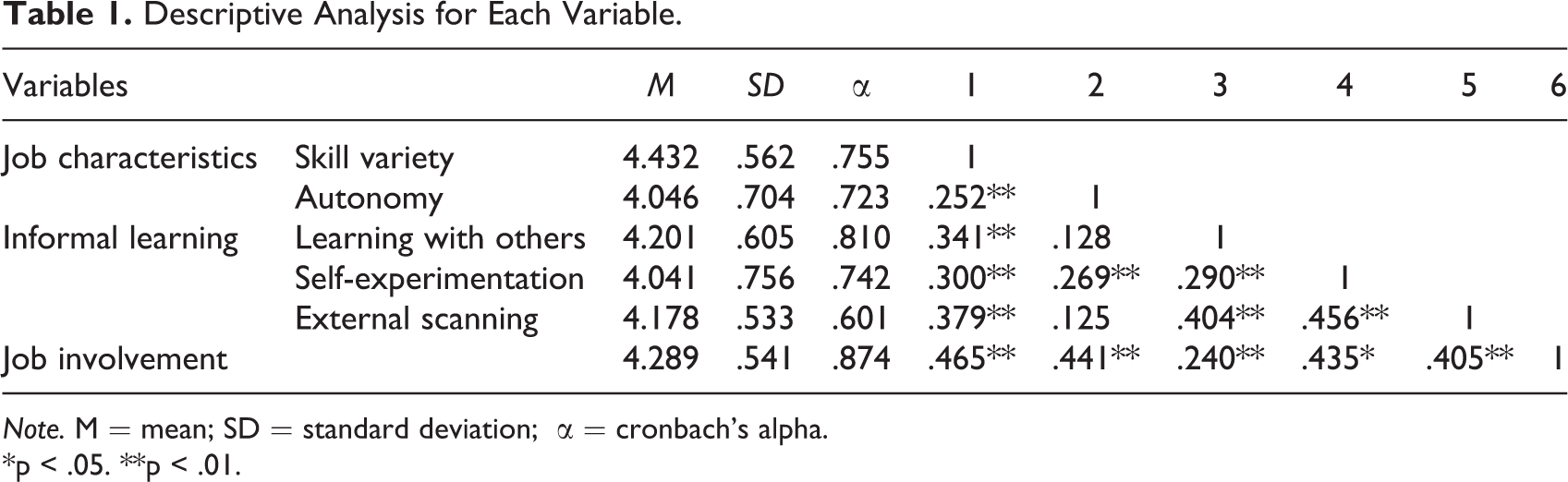
First, to check the reliability of the survey instrument, Cronbach’s α, which represents internal consistency, was measured (Table 1).
Descriptive Analysis for Each Variable.
Note. M = mean; SD = standard deviation; α = cronbach’s alpha.
*p < .05. **p < .01.
The values of Cronbach’s α were higher than .60. The reliability of the measurement was marginal but usable (Kline, 2011). To confirm the correlations among the variables in this study, Pearson’s product–moment correlation analysis was conducted. It was found that every pair of variables had correlations below .7. This means that there was no multicollinearity among the variables (Hair, Black, Babin, Anderson, & Tatham, 2006). Job involvement was significantly correlated with all variables. While skill variety was significantly correlated with the three dimensions of informal learning, autonomy had no correlation with learning with others (r = .128, p > .01) or external scanning (r = .125, p > .01).
To demonstrate the univariate and multivariate normality of all items, skewness and kurtosis were assessed. All skewness values were between −1.5 and 1.5, and all kurtosis values were between −1.3 and 7 (Schumacker & Lomax, 2004). This means that the gathered data exhibited a mild form of univariate nonnormality. In addition, the presence of relative multivariate kurtosis suggests that the data were inflated by 12.6% when compared to a perfectly normal distribution. The results of multivariate normality tests showed that the data did not have multivariate normality because all p values of skewness and kurtosis were significant (p < .05). In sum, the data had a mild form of nonnormality in both the univariate and multivariate normality tests.
Model Identification
The specified research model satisfied the necessary t-rule, which stipulates that there are more observations than free parameters. A two-step rule was subsequently applied to evaluate the validity of the structural regression model by testing both a measurement part and a structural part of the model (Kline, 2011). The first measurement part of model was identified according to the standard three-indicator rule. Because the structural model is a recursive model without a feedback loop, reciprocal relationship, or correlation between disturbances, it, too, was identified.
Measurement Part of the Model Assessment
In order to demonstrate the construct validity of the measurement part of the model, CFA was conducted between the latent variables and their subscale variables. Because multivariate nonnormality negatively affects results when ML estimation is performed, robust ML estimation (Satorra & Bentler, 1994) was used to handle the mild form of nonnormality exhibited by the data used for this research. This approach included the asymptotic covariance matrix as a treatment for high levels of skewness and kurtosis (Kline, 2011). The SB-scaled χ2 of the model did not appear to fit the data well, χ2(129) = 198.845, p < .001. Thus, the exact-fit hypothesis was rejected. However, since the χ2 test is extremely sensitive to sample size, the exact-fit hypothesis can often be rejected. The RMSEA was .049 and the SRMR was .063, both of which were less than the cutoff criteria. The CFI was .981 and the TLI was .977, both of which were greater than the desired criterion of .95. Thus, even though the model failed the SB-scaled χ2 test, it can be assumed that the model adequately fit the data due to the values of the identified-model fit indices.
Structural Part of the Model Assessment
Based on the acceptance of the measurement part of the model, the structural part of the model was developed to illustrate the relationships among the proposed research constructs and to examine the strength of those relationships. To identify the relationships among the research variables, SPC estimates were performed. An SPC estimate is considered statistically significant when its hypothesized path has a significant SPC and its t value is greater than |1.96| (Hair et al., 2006; Kline, 2011). The results show that all hypothesized paths had significant SPCs and t values greater than |1.96|. In Figure 1, the numbers adjacent to the lines indicate SPC data, which can be viewed as standardized regression coefficients for latent variables in relation to each other.

Structural equation modeling results based on standardized path coefficient estimates.
Hypothesis Testing
SPC estimates were used in order to prove the research hypotheses. The results indicate that skill variety had significantly positive relationships with informal learning and job involvement (SPC = .567, p < .01; SPC = .275, p < .01), as suggested by Hypotheses 1 and 2. Autonomy significantly affected informal learning and job involvement (SPC = .089, p < .01; SPC = .317, p < .01); therefore, Hypotheses 3 and 4 were supported as well. Informal learning impacted job involvement (SPC = .360, p < .01), thus supporting Hypothesis 5. As shown in Table 2, based on a comparison between direct and indirect SPCs, informal learning was found to be a significant mediator among skill variety, autonomy, and job involvement. Finally, Hypothesis 6 was supported.
Decomposition of Effects.
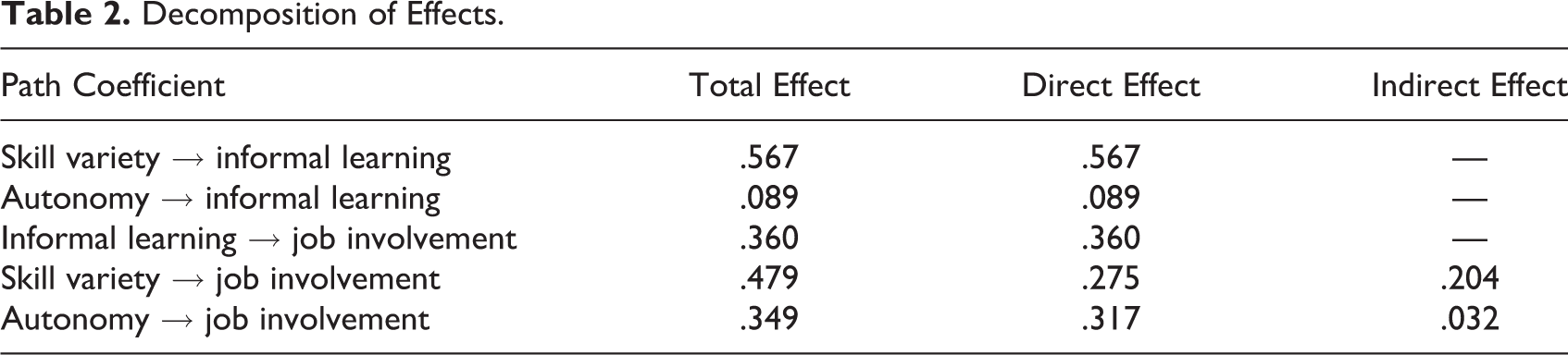
A Sobel test was conducted to identify the accurate mediating effect (Sobel, 1982). The mediating effect of informal learning on the relationship among skill variety (t = 2.098, p < .01), autonomy (t = 5.269, p < .01), and job involvement was statistically significant.
Discussion
In highlighting the importance of trainers’ professional ability development, this study aimed to investigate the influential relationship among skill variety, autonomy, informal learning, and job involvement for South Korean trainers. The reported outcomes of the SEM support all suggested hypotheses. The research results are also consistent with those of previous studies exploring the relationship among job characteristics, psychological state levels, and participation in learning and development opportunities (de Cuyper et al., 2010; Hosie, Jayashree, Tchantchane, & Lee, 2013; Morgeson & Humphrey, 2006; Volmer, Spurk, & Niessen, 2012).
The results of this study indicate that informal learning mediated the relationship among skill variety, autonomy, and job involvement. Volatile shifts in the corporate world have meant that trainers are no longer able to passively rely on canned training resources passed on from formal learning (Bachler, 1997). Rather, informal learning is necessary for trainers to prepare training sessions that more closely reflect real-world business practices and actionable models (Cho, 2009; McGuire & Gubbins, 2010). Situated learning theory provides an important means of explaining the results of this study in terms of how professionals learn. Situated learning can be defined as “learning through goal-directed activity situated in circumstances which are authentic, in terms of the intended application of the learnt knowledge” (Billett, 1996, p. 263). Situated learning is learning that occurs in the same context as that in which it would be applied; thus, learning and doing are interwoven (Lave & Wenger, 1991). The day-to-day application of knowledge enables individual learners to acquire, integrate, and shift the intersubjective meaning of knowledge through intrapersonal cognitive processes in the organizational context (Cook & Yanow, 1993). Cheetham and Chivers (2001) have found that many professionals emphasize the importance of deliberate practices in developing expertise, particularly during nonroutine problem-solving or task execution. By practicing skills in various settings over time, professionals are able to achieve high degrees of mastery based on “more intuitive forms of thought” or “technically grounded extemporization” (p. 381). Such tacit expertise is optimally situated for the work environment in which it has been articulated, and it is difficult to replicate by undertaking formal learning for a short period of time.
Likewise, trainers’ informal learning provides situationally dependent knowledge that is constructed through critical self-reflective work behaviors, as well as direct and indirect social interactions among learners and more experienced professionals within communities of practice (Billett, 1994; van Woerkom, Nijhof, & Nieuwenhuis, 2002). Individual development and achievement though informal learning provides individuals with multiple benefits. These benefits include intrinsic benefits like quality in workmanship and self-esteem from external recognition, as well as extrinsic benefits such as job security and financial gains (Rowden & Conine Jr., 2005). These benefits can strengthen internal motivation and cause employees to become more committed to their jobs (Chen & Chiu, 2009). Informal learning can also increase the value of a job, making it an important experience for further career advancement (van der Heijden & Bakker, 2010).
Another theoretical justification of the mediating effect of informal learning comes from SET. Previous organizational career growth studies have explained the importance of professional ability development based on the concept of the psychological contract to address social exchange mechanisms between employees and organizations: Employees may fulfill their psychological contract when they feel their career goals and provided professional ability development opportunities align and when they perceive that they are valued by their organizations (Rousseau, 2004; Weng & McElroy, 2012; Weng et al., 2010). A fulfilled psychological contract is connected to employees’ stronger commitment to their organizations and motivation to work for the organizations. In this study, we researched a group of trainers who have highly skilled and nonpermanent employment patterns. Since job security within an organization is less likely to fulfill a flex professional’s psychological contract than that of a full-time regular employee, professional ability development is a stronger trigger for job involvement for a flex professional. Informal learning in which trainers can practice marketable skills is a meaningful provision of professional ability development that can fulfill the trainers’ psychological contracts.
This study also found that informal learning is positively related to job involvement. This study focuses on the nature of flex professionals who value continuous meaningful work while moving from project to project (Kroon & Freese, 2013). COR theory highlights the importance of adequate job resources that can help employees to manage job demands (Demerouti & Cropanzano, 2010). Trainers’ informal learning is an important job resource for their active involvement in particular jobs. Generally speaking, perceived benefits and commensurate obligations resulting from professional ability development should diminish over time since trainers develop what they need within an organization. Without the continuous provision of informal learning, trainers’ levels of job involvement more easily and quickly fall, which results in negative psychological states and higher levels of intentions to quit than those seen among full-time employees (Kroon & Freese, 2013).
Implications for Practice
Eric Schmidt, the former CEO of Google, once said to Facebook COO Sheryl Sandberg, “If you’re offered a seat on a rocket ship, don’t ask what seat. Just get on,” and “When companies are growing quickly and they are having a lot of impact, careers take care of themselves” (Hill, 2012). These widely acknowledged remarks reflect that in our current New Career-era, job seekers, particularly those of the younger generation, highly value fast and meaningful career growth opportunities and look for places where they feel they can achieve career success (Ng, Eby, Sorensen, & Feldman, 2005). The remarks also highlight the importance of agile professional ability development in facilitating career success (Dries, Vantilborgh, & Pepermans, 2012). By investigating characteristics of informal learning, this study suggests that professional ability development is not just individual-level, “pro-bono” formal learning, but a rapid development opportunity that is simultaneously self-directed and collaborative. While recognizing that the learning that occurs in informal settings is significant for organizational career growth, employees also need to design more specific individual development plans and discuss their plans with their immediate supervisors or mentors to obtain constructive career-related feedback for professional ability development (Sharma & Bhatnagar, 2009).
For a better understanding of organizational career growth, employers can use the employee value proposition (EVP) as a communication tool (Michaels, Handfield-Jones, & Axelrod, 2001). EVP provides information about the packaged economic and psychological benefits available to incumbent and future employees (Sokro, 2012). Recently, EVP has become more important for attracting and maintaining talented employees within an organization by clarifying the specific opportunities for career growth, rather than engaging in superficial rhetoric (Hatum, 2013). In fact, factors that influence employees’ perceptions of organizational career growth vary considerably from employee to employee, making it impossible to meet a variety of individual career expectations (Raath, 2014). Thus, in order to decrease the gaps between employees’ expectations and the realities of career development, firms should prioritize their EVP by aligning talent with core values of the firm. This study suggests that professional ability development can be an important component of EVP for trainers by revealing the mediating effect of informal learning in career development. By using EVP, individuals can form solid psychological connections with their organizations, and the organizations can establish positive reputations in the labor market (Hiltrop, 1999; Raath, 2014).
Limitations and Future Research
One of the limitations of this empirical study is the relatively low reliability of the scale of informal learning by Choi and Jacobs (2011). This is particularly noteworthy in regard to the external scanning construct. In addition to this reliability issue, even though the scale comprehensively identifies the complicated aspects of informal learning, it is necessary to broaden the scale’s constructs to illuminate how employees learn informally in the workplace (Cheetham & Chivers, 2001). Therefore, a rigorous validation test is required to resolve the scale’s reliability issue and strengthen its content validity (Cseh & Manikoth, 2011). A further limitation is that this study adopted a cross-sectional design, which precludes the researchers from identifying a potential causal inference without knowing the mutable characteristics of employees’ perceptions of career development within their organizations. Future studies should consider longitudinal designs that enable them to explore how changes in organizational career growth affect employees’ career-related attitudes and behaviors (Ployhart & Ward, 2011).
In addition, this study was conducted in a South Korean business context and targeted a single professional occupation. Given the purposive sampling characteristics of this study, before generalizing from the results of this study, further investigation in various contexts and occupations is necessary for identifying the dynamic characteristics of organizational career growth. We know little about how macro-level national/organizational culture or industry characteristics are related to organizational career growth (Kim et al., 2016). South Korea has a relatively low unemployment rate in the labor market, and the concept of lifelong employment has persisted in some large manufacturing industries and companies (Bosch & Charest, 2008; Organization for Economic Cooperation and Development, 2015). The patterns of organizational career growth may be different in other business contexts. Low-skilled flex workers will also show different patterns in organizational career growth since they typically do not have enough professional ability development (Kroon & Freese, 2013). Considering increasing outsourcing, freelancing, or volunteering, further investigation will provide a better understanding of the career trajectories of these nontraditional employees (Cascio & Boudreau, 2015).
The various generations’ perceptions of career development would also serve as an interesting topic for career growth research. The younger generation (e.g., Gen Y or Millennials) is thought to prefer creating more flexible career paths and to value professional ability development over ascending the career ladder for career success in a single organization (Lyons, Schweitzer, & Ng, 2015; Ng & Feldman, 2009). A continuous economic downturn and a high unemployment rate over time can affect their career-related attitudes (Winter & Jackson, 2016). Older (and middle-aged) workers are commonly thought to have little interest in professional ability development because of the perceived bias that they are “checked out” of career development (James, McKechnie, & Swanberg, 2011). Unlike previous decades in which there has been an explicit retirement age, many workers today need to work past their prime working years because of income and benefits concerns (Fasbender, Deller, Wang, & Wiernik, 2014). Future research can apply this generational perspective to understand the dynamic changes in perceptions of career development according to societal changes.
This study highlighted the importance of informal learning, looking particularly at how professionals develop their expertise. The frequently cited hypothesis in workplace learning practices is that over 90% of learning is informal (Lombardo & Eichinger, 1989). However, highlighting informal learning does not mean that formal learning has a limited impact on human expertise. Effective workplace learning can be possible as a result of well-tailored combinations of formal and informal learning (Rowden, 2002; Shipton, Dawson, West, & Patterson, 2002). Indeed, formal learning is generally thought to trigger informal learning, and informal learning frequently leads to formal learning participation. Therefore, future studies of professional ability development should consider the influential relationship between the formality and informality of workplace learning.
Footnotes
Authors’ Note
This article uses the partial data of the master’s degree thesis conducted by Jeung Hyun Choi. We appreciate the permission of Jeung Hyun Choi to use the unpublished data. An earlier version of this article was presented at the Academy of Human Resource Development International Research Conference in the Americas, February 19–21, 2015, St. Louis, MO.
Declaration of Conflicting Interests
The author(s) declared no potential conflicts of interest with respect to the research, authorship, and/or publication of this article.
Funding
The author(s) received no financial support for the research, authorship, and/or publication of this article.