




Abstract
Although the benefits of mentoring for protégés’ career-related outcomes have been largely confirmed, little research has examined whether this benefit can extend to the protégés’ life domains outside of work. In this study, we investigate the impact of the extent of workplace mentoring support on protégés’ subjective well-being (SWB). Based on data that were collected from a two-wave survey of 253 protégés in ongoing mentoring programs in China, the results showed that the extent of the mentoring support was significantly related to the protégés’ SWB (i.e., satisfaction with life, positive affect, and negative affect) through their psychological safety. Furthermore, the perceived mentor status of protégés moderated the relationship between the extent of mentoring support and the protégés’ psychological safety, such that the relationship was stronger when the perceived mentor status was higher rather than lower. The theoretical and managerial implications of our findings are also discussed.
Mentoring is defined as a developmental relationship between a senior, experienced employee (i.e., a mentor), and an inexperienced individual who has potential (i.e., a protégé), whereby the mentor provides various support (i.e., career-related support, psychosocial support, and role modeling) to the protégé (Scandura & Ragins, 1993). Currently, mentoring programs are widely used within various organizations because both scholars and practitioners have intensively demonstrated that mentored individuals obtain considerable benefits to career development and well-being (Chen, Wen, & Hu, 2017; Greenhaus & Singh, 2007). However, surprisingly, the previous research has overwhelmingly focused on the influence of mentoring on protégés’ work-related outcomes (Allen, Eby, Chao, & Bauer, 2017); as such, its impact on protégés’ well-being outcomes has been largely overlooked (Chen et al., 2017; Greenhaus & Singh, 2007). In fact, the pursuit of happiness and well-being is considered to be one of the most valued goals in one’s life (Deiner, Lucas, & Oishi, 2002). Recently, Kao, Rogers, Spitzmueller, Lin, and Lin (2014) attempted to address this gap by examining the relationship between mentoring and protégés’ resilience, which is an important form of well-being. However, much is still unknown about the influence of mentoring on protégés’ overall perceptions of well-being, specifically their subjective well-being (SWB), which refers to individuals’ general cognitive and emotional evaluations of their quality of life (Diener, Lucas, & Oishi, 2002).
Following the general consensus in the SWB literature that various modes of support (e.g., organizational support, family support) are important predictors of employees’ positive psychological states (Panaccio & Vandenberghe, 2009), we can infer that mentoring would play a significant role in increasing protégés’ SWB because mentoring is also a form of support in that it provides career support, psychosocial support, and the support of a role model for protégés (Chen, Liao, & Wen, 2014). Therefore, the first purpose of this study is to examine the direct relationship between the extent of mentoring support and protégés’ SWB.
Second, we attempt to explore the psychological processes that explain why mentoring support affects protégés’ SWB. Although the previous research has examined a variety of intermediate mechanisms through which mentoring exerts its influence on protégés’ outcomes, it has mainly focused on the perspectives of social learning and social exchange (Sun, Pan, & Chow, 2014). However, relatively few studies have paid attention to the role of the perceived general interpersonal factor. In the current study, we focus on one specific interpersonal work context, specifically psychological safety, which is described as an individual’s perception of being himself and taking interpersonal risks without fear of negative consequences (Edmondson, 1999; Kahn, 1990). Edmondson (1999) noted that an important source of psychological safety stems from supportive and trusting relationships, such as mentoring relationships. Additionally, Kark and Carmeli (2009) considered that psychological safety can be beneficial to employees’ well-being. Surprisingly, no empirical studies have linked the mentoring–protégés’ SWB relationship through psychological safety. As such, the second purpose of our study is to examine the indirect relationship between the extent of mentoring support and protégés’ SWB through psychological safety.
Third, we aim to provide a boundary condition for the effect of mentoring on protégés’ psychological safety. Previous research has indicated that the effect of mentoring on protégés’ outcomes is contingent on the mentors’ characteristics (Haggard, Dougherty, Turban, & Wilbanks, 2011). Therefore, the final purpose of our study is to examine the potential moderating role of perceived mentor status, which is a comprehensive perception of a mentor’s substantial influence, authority, and support in an organization (Eisenberger, Stinglhamber, Vandenberghe, Sucharski, & Rhoades, 2002; Tangirala & Ramanujam, 2008). Although mentors are selected by organizations with extensive experience, there are differences in the aspects of personal status and influence within organizations (O’Brien, Biga, Kessler, & Allen, 2010). Mentors with greater statuses are more able to help protégés to gain access to many supportive resources and opportunities (Chen et al., 2017; Sun et al., 2014). That is, the effect of mentoring on protégés’ psychological safety will be amplified when the perceived mentor status is high.
In sum, our present study aims to make several theoretical contributions to the mentoring literature. By examining the relationship between mentoring support and protégés’ SWB, we extend the benefits of mentoring to protégés’ well-being outcomes. Furthermore, the current study provides a more accurate portrayal of how mentoring works by investigating the indirect effect of the extent of mentoring support on protégés’ SWB through psychological safety and the moderating role of perceived mentor status.
Theory and Hypothesis Development
The Direct Effect of Mentoring on SWB
SWB, which is a vital psychological construct, is defined as “a person’s cognitive and affective evaluations of his or her life” (Diener et al., 2002, p. 63). The cognitive aspect of SWB is usually measured by satisfaction with life (SWL), which refers to an assessment of one’s satisfaction with his life as a whole (Diener, Emmons, Larsen, & Griffin, 1985). The affective components of SWB involve positive feelings (e.g., attentive, excited, enthusiastic, and inspired) and negative affect (e.g., distressed, upset, scared, and guilty; Watson, Clark, & Tellegen, 1988). In general, high SWB is conceptualized as a high level of SWL, a high level of positive affect, and the relative absence of negative affect (Diener, 2000; Diener et al., 2002). The sustained research has indicated that an individual’s SWB is not only influenced by internal factors (e.g., personality), but it is also related to external factors (e.g., money, friendship, and social support; Diener, Oishi, & Lucas, 2003).
No empirical study has linked the relationship between mentoring and protégés’ SWB; however, we can infer a positive relationship between them according to a well-known notion that social support plays a critical role in promoting individuals’ SWB (Panaccio & Vandenberghe, 2009). There are three reasons for this, which are as follows: first, mentoring support helps protégés to enhance their confidence and abilities to solve both work-related and psychological setbacks (Kao, Rogers, Spitzmueller, Lin, & Lin, 2014), which is beneficial to increasing the level of life satisfaction, which is a component of employee SWB. Simultaneously, individuals with high self-confidence and life satisfaction are more likely to maintain a good state with more positive affect and less negative affect (Kao et al., 2014). Second, mentoring is a type of intimate and reciprocal relationship in which mentors and protégés may establish friendship and trust with each other. According to affective events theory (; Weiss & Cropanzano, 1996) in recognizing the important role of situational factors (e.g., work environment) on employees’ affect and cognitions, we can infer that a friendly interpersonal relationship with mentors should be in favor of protégés’ positive affect and life satisfaction and serve to decrease negative affect. Third, as mentors are strictly selected by organizations, they are usually required to express positive values and attitudes (Chen et al., 2017), and such positive values are emulated by protégés. Consequently, protégés with mentor support are more likely to have a high level of satisfaction and positive affect and be less vulnerable to negative affect. Related to this, Sosik and Godshalk (2000) showed that mentoring support received by protégés is negatively associated with protégés’ stress. Thus, we hypothesize that:
The Indirect Effect of Mentoring on SWB Through Psychological Safety
Psychological safety was originally defined as “a sense of being able to show and employ self without fear of negative consequences to self-image, status, or career” (Kahn, 1990, p. 708). Subsequently, this concept was largely developed and described as a perception of the interpersonal context in which employees are comfortable being themselves (Edmondson, 1999). With a high level of psychological safety, employees experience more interpersonal trust, feel safer with regard to engaging in interpersonal risk-taking, and they are not concerned about being punished for speaking up (Nembhard & Edmondson, 2006).
We argue that there are at least two reasons to explain the linkage between the extent of the mentoring support and protégés’ psychological safety, which are as follows: First, mentors provide vocational support and resources that are helpful for protégés’ career development (Allen et al., 2017). With such vocational support and resources, protégés may feel more competent and confident in their work, which may reduce the number of mistakes that they make (Kao et al., 2014). In this case, protégés may have a belief that it is safe even when they engage in risky behaviors. Further, mentors establish trust and friendship between themselves and protégés (Chen et al., 2017) and, thus, the protégés may feel less anxious when they speak up or fall short of professional requirements. Mentors help to create a safe interpersonal environment in which protégés consider it to be appropriate to exchange ideas and ask challenging questions. The study conducted by Chen, Liao, and Wen (2014) provides evidence that mentoring support enhances protégés’ perception of psychological safety. Therefore, mentoring support serves as a crucial antecedent of protégés’ psychological safety.
Although there is no empirical evidence to verify the direct relationship between psychological safety and employees’ SWB, we can speculate that protégés’ psychological safety contributes to their positive perceptions of well-being because previous research has indicated that the fulfillment of safety needs predicted individuals’ SWB (Tay & Diener, 2011). Protégés with a high level of psychological safety may experience a reduction in anxiety and pay less attention to sanctions or punishments within organizations when they express themselves. That is, the safety needs of protégés are well fulfilled. In this case, protégés who possess more psychological safety are likely to experience more positive affect and higher life satisfaction as well as less negative affect. In line with this statement, a recent study by Kark and Carmeli (2009) showed that there is a positive relationship between psychological safety and an individual’s feelings of vitality at work, referring to the feeling of having energy at work, which is a concrete form of psychological well-being.
Taken together, we argue that mentoring, as an important supportive resource, will facilitate protégés’ psychological safety, which in turn, further this positive gain in such a way as to impact their SWB. Thus, the following hypothesis is proposed:
The Moderating Role of Perceived Mentors’ Status
As mentors are resource providers in mentoring relationships, the characteristics of mentors play a crucial role in the effectiveness of the mentoring. Previous research has indicated that there are differences in terms of mentors’ personal influence within organizations and that such differences may result in different degrees of mentoring benefits to protégés (O’Brien et al., 2010). Therefore, we infer that the positive relationship between the extent of the mentoring support and protégés’ psychological safety would be moderated by perceived mentor status, which refers to a general perception of the mentors’ substantial influence, authority, and support in an organization (Tangirala & Ramanujam, 2008).
Generally, an individual who is perceived to possess high status is seen as having (a) a positive valuation of his or her contributions in an organization, (b) positive influence in important organizational decisions (Eisenberger et al., 2002), and (c) the ability to influence the rewards and career development of others within an organization (Tangirala & Ramanujam, 2008). In this vein, when receiving mentoring support from high-status mentors, protégés will feel safer with regard to expressing themselves without fear because they believe that their mentors have the necessary ability to utilize their influence to protect them. That is, the relationships between the extent of mentoring support and the protégés’ psychological safety will be amplified when the perceived mentor status is high. In contrast, protégés tend to view low-status mentors as being less valuable, less powerful, and less influential in organizations. Protégés will, consequently, have a sense that they are less likely to be protected when they receive support from mentors with a low-status level. Thus, the impact of the extent of mentoring support on protégés’ psychological safety will be weakened when the perceived mentor status is low. Based on the above statement, the following hypothesis is proposed:
Method
Procedure
The data for the present research were collected from Chinese protégés who are line workers in manufacturing industry companies in central China. These surveyed organizations generally implement 1-year formal mentoring programs to quickly facilitate protégés’ socialization and to create a supportive environment. The human resource (HR) managers in these companies selected and assigned skillful and experienced employees as mentors to these newly (i.e., less than 3 years’ experience at the company) hired employees (protégés). Each protégé had one mentor and was directed at least 3 hr each week by their mentors. All of the protégés took part in an ongoing mentoring program, and they were randomly selected by the researchers. A two-wave survey was conducted at 6-month intervals. At Time 1, the protégés were required to report the extent of mentoring support and mentor status that they perceived within their mentoring relationships. At Time 2, the respondents assessed their psychological safety, SWB, their own and their mentors’ demographic variables, and the type of mentoring that they were receiving. In the cover letter, we emphasized the purpose of this survey, informed the potential participants about the principles of voluntary participation, and we assured them of the confidentiality of their responses. Each completed questionnaire was sealed in an envelope and collected with the help of the HR departments of the subject companies.
As all of the questionnaires were originally written in English, they were translated from English to Chinese under a conventional back translation procedure as was suggested by Brislin (1980) utilizing two assistant professors in the Department of Management in the same university as the authors of the present study. Although they are Chinese, and Chinese is their first language, the assistant professors are fluent in written and oral English because they have studied in the United States for at least 3 years. One of the assistant professors translated the questionnaire items from English to Chinese. The other assistant professor translated the Chinese items back to English. They discussed the discrepancies between the translations and revised the translations until an agreement was reached.
Participants
We distributed 400 questionnaires and collected 253 usable questionnaires, with a response rate of 63.3%. The sample consisted of 144 male protégés (56.9%) and 109 female protégés (43.1%). The average age of the protégés was 23.02 years (SD = 3.73). Most of the protégés (71.1%) had received a junior college education or above. Within the sample, 63.6% of the protégés’ immediate supervisors simultaneously served as their mentors (supervisory mentoring), while 36.4% of the protégés’ experienced peers served as their mentors (peer mentoring). Of these mentors, 172 (68%) were male, and 81 (32%) were female. The average age was 41.68 years (SD = 4.14), and the average organizational tenure was 12.78 years (SD = 5.69). Most of these mentors had graduated from junior college (34.4%) and high school (34.8%).
Measures
The extent of the mentoring support received
The protégés reported the extent of the mentoring support that they received from their mentors on the 9-item Mentoring Functions Questionnaire that was developed by Castro and Scandura (2004). This scale has been widely used in the prior empirical research (e.g., Hu, Wang, Wang, Chen, & Jiang, 2016). In addition, it has been proven to have good reliability, validity, and measurement equivalence across Western and Eastern cultures (Hu, Pellegrini, & Scandura, 2011). In Hu, Wang, Wang, Chen, and Jiang’s (2016) study, the Cronbach’s α coefficient for the extent of mentoring support was .93, and this variable was positively related to mentors’ liking of protégés (r = .36, p < .01). A sample item was “My mentor takes a personal interest in my career.” Responses could range from 1 (strongly disagree) to 5 (strongly agree); and the higher the score, the higher the extent of the mentoring functions would be. The Cronbach’s α coefficient for the current sample was .80.
Psychological safety
The measure of psychological safety was from the 7-item scale of team psychological safety developed by Edmondson (1999). To assess psychological safety in the organizational context, we used the word “organization” to replace the word “team” in the original scale. A similar approach has been taken by the prior empirical studies (e.g., Kostopoulos & Bozionelos, 2011). In Kostopoulos and Bozionelos’ (2011) study, the Cronbach’s α coefficient for psychological safety was .98, and this variable was positively related to team performance (r = .22, p < .01). A sample item was “It is safe to take a risk in this organization.” Each item was rated on a 5-point scale that ranged from 1 (strongly disagree) to 5 (strongly agree) with a higher score indicating more psychological safety. The Cronbach’s α of psychological safety in the current study was .82.
Perceived mentor status
We used the 3-item supervisory status scale that was developed by Tangirala and Ramanujam (2008) to measure mentor status as perceived by the protégés. In the prior research, Janssen and Gao (2015) used this scale to measure employees’ self-perceived status. In the above study, the Cronbach’s α coefficient for self-perceived status was .70, and this variable was positively related to voice behavior (r = .38, p < .001). In the present study, we asked the protégés to report their perceived mentor status. A sample item was “My organization holds my mentor in high regard.” The responses could range from 1 (strongly disagree) to 5 (strongly agree), and the higher the score, the higher the perceived mentor status would be. The Cronbach’s α for the current sample was .79.
SWB
According to Diener (2000), SWB consists of cognitive and affective dimensions. The 5-item Satisfaction with Life Scale was assessed as cognitive well-being (Diener et al., 1985). This scale has been widely used by the prior empirical research (e.g., Palmer, Donaldson, & Stough, 2002). A sample item was “In most ways, my life is close to my ideal.” Each item was rated on a 5-point scale that ranged from 1 (strongly disagree) to 5 (strongly agree), with a higher score indicating a higher SWL. The Cronbach’s α in the present study was .87.
We used the Positive and Negative Affect Schedule (Watson et al., 1988) to measure affective well-being, each including 10 mood-related adjectives. The positive affect adjectives were “attentive, interested, alert, excited, enthusiastic, inspired, proud, determined, strong, and active,” while the negative affect adjectives were “distressed, upset, hostile, irritable, scared, afraid, ashamed, guilty, nervous, and jittery.” This scale has been widely used by the prior empirical research (e.g., Hu et al., 2016; Palmer et al., 2002). The protégés were asked on a 5-point Likert-type scale that ranged from 1 (never) to 5 (very often) to rate how frequently they had experienced these emotions in the past month. In the present study, the reliability of both the positive affect (PA) (Cronbach’s α = .76) and the negative affect (NA) (Cronbach’s α = .77) was good.
Control variables
In accordance with the previous literature (Panaccio & Vandenberghe, 2009), we utilized three demographic variables in the control model: actual age, gender, and the education level of the protégés. Gender was coded 0 for female and 1 for male. The education levels were hierarchically coded 1 for below junior college, 2 for junior college, 3 for undergraduate, and 4 for graduate or above. Additionally, we controlled for the type of mentoring relationships (1 = supervisory mentoring, 0 = peer mentoring).
Results
Before testing our hypothesized relationships, we used a confirmatory factor analysis to examine the distinction validity of the main variables (i.e., the extent of the mentoring support, psychological safety, perceived mentor status, SWL, positive affect, and negative affect). The results indicated that the six-factor model fit the data well (χ2 = 2,241.04, df = 887, root mean square error of approximation = .08, comparative fit index = .91, and non-normed fit index = .86). All of the estimated factor loadings of the indicators were greater than .50 and significant (p < .001). Compared with the six-factor model, other models exhibited significantly poorer fits. These results indicate that there is a good distinction validity among the main variables in the present study.
The Direct Effect of the Extent of Mentoring Support on Protégés’ SWB
Table 1 shows the means, standard deviations, correlations, and reliabilities for the variables that are used in this study. We found that the extent of the mentoring support was positively related to the protégés’ psychological safety (r = .24, p < .001) as well as their SWL (r = .17, p < .01) and positive affect (r = .20, p < .01), while it was negatively related to negative emotions (r = −.24, p < .01). In addition, the associations among the protégés’ psychological safety and SWL (r = .24, p < .001), positive affect (r = .20, p < .001), and negative affect (r = −.24, p < .01) were significant.
Descriptive Statistics, Correlation, and Reliabilities for All Variables.

Note. Reliability coefficients are reported on the diagonal in parentheses.
*p < .05.**p < .01.***p < .001.
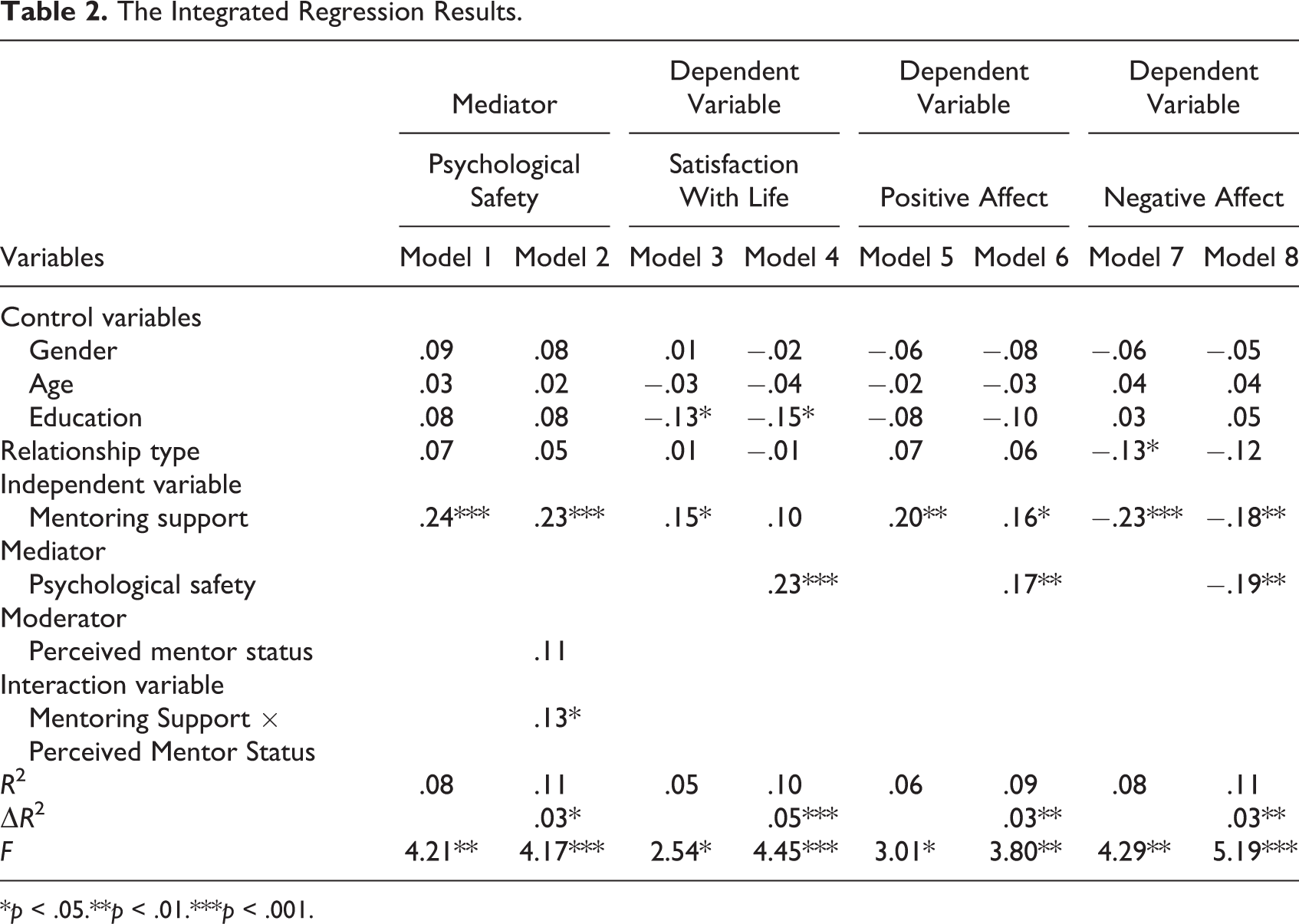
Hierarchical regression analyses were used to test our hypotheses. The results in Table 2 show that the extent of the mentoring support (independent variable) was significantly related to SWB (dependent variable; Hypothesis 1). Specifically, the extent of the mentoring support was positively related to the protégés’ SWL (β = .15, p < .05, Model 3) and positive affect (β = .20, p < .01, Model 5), whereas it was negatively related to negative affect after entering the control variables (β = −.23, p < .001, Model 7). Thus, Hypotheses 1a–c were fully supported.
The Integrated Regression Results.
*p < .05.**p < .01.***p < .001.
The Direct Effect of Mentoring on Protégés’ SWB Through Psychological Safety
We used the bootstrapping method that was proposed by Preacher and Hayes (2008) to test the indirect effect of the extent of mentoring support on the protégés’ SWB (Hypothesis 2). The bootstrapping method is conducted by repeatedly (usually thousands of times) sampling from the data set and estimating the indirect effect in each resampled data set. As a nonparametric resampling procedure, the bootstrapping method does not impose the assumption of normality on the sampling distribution and thus is suitable for medium or small sample sizes (Preacher & Hayes, 2008). According to this method, the indirect effect requires the following conditions to be satisfied (1) the independent variable is significantly related to the mediator variable; (2) after controlling for the independent variable, the mediator variable is significantly related to the dependent variable; and (3) the indirect effect of the independent variable on the dependent variable is significant by the examination of the bootstrapping method. The results in Table 2 indicate (1) the extent of mentoring support was significantly related to the protégés’ psychological safety (β = .24, p < .001, Model 1); (2) the protégés’ psychological safety was significantly related to SWL (β = .23, p < .001, Model 4), positive affect (β = .17, p < .01, Model 6), and negative affect (β = −.19, p < .01, Model 8) after controlling for the extent of the mentoring support; (3) the results from the bootstrapping method (N = 1,000) indicated that the indirect effects of the extent of the mentoring support on the protégés’ SWL (indirect effect = .08, 95% confidence interval [CI] was [.03, .15]), positive affect (indirect effect = .04, 95% CI was [.01, .07]), and negative affect emotions (indirect effect = −.04, 95% CI was [−.08, −.01]) were significant. As such, Hypotheses 2a–c were all supported, as the extent of mentoring support had significant indirect effects, through psychological safety, on protégés’ SWL, positive affect, and negative affect.
The Moderating Effects of Perceived Mentor Status
Hypothesis 3 proposed that the perceived mentor status moderates the relationship between the extent of the mentoring functions and psychological safety. The results in Table 2 show that, after controlling for the effect of the other variables on SWB, the β coefficient for the interaction term (the extent of the mentoring support by perceived mentor status) was statistically significant (β = .13, p < .05, Model 2). To further clarify the moderated effect of perceived mentor status, we examined separate simple slopes depicting the relationship between the extent of mentoring support and psychological safety. The results showed that the relationship between the extent of the mentoring support and psychological safety was strengthened when the perceived mentor status was high (β = .40, p < .001) rather than low (β = .10, n.s.). We demonstrated this interaction in Figure 1. These results verified Hypothesis 3.

Moderating effect of perceived mentor status on the relationship between the extent of mentoring support and psychological safety.
We also conducted additional analyses to test a possible moderated mediation model (Edwards & Lambert, 2007). The results indicated that no significant difference existed in the indirect effect (i.e., the mediating effect of psychological safety) when considering high or low perceived mentor status.
Discussion
The primary aim of this study was to examine how mentoring support affects protégés’ SWB. In support of our hypotheses, we found that the extent of mentoring support was significantly related to the protégés’ SWB, including SWL, positive affect, and negative affect. In addition, the indirect effect of the extent of the mentoring support on protégés’ SWB operates through the protégés’ psychological safety. Finally, perceived mentor status moderated the relationship between mentoring support and the protégés’ psychological safety in such a way that the relationship was stronger when the perceived mentor status was high. These findings offered several meaningful implications for mentoring, the SWB theory, and management practices.
Theoretical Implications
Our findings contribute to the mentoring and SWB literatures in three ways. First, by examining the direct relationship between the extent of mentoring support and the protégés’ SWB, the present study responded to Kao et al.’s (2014) call to extend the influence of mentoring on protégés’ well-being outcomes. As stated above, the prior research has widely confirmed the benefits of mentoring functions on protégés’ work domains; however, its impact on protégés’ well-being outcomes has been less examined. This study is the first empirical study to link workplace mentoring to protégés’ SWB. Our study enriches the mentoring literature by extending the benefits of mentoring functions to the life domain outside of work. Additionally, the positive association between mentoring support and protégés’ SWB also contributes to the SWB research by suggesting that mentoring as a unique support approach would be an important antecedent of employees’ SWL, positive affect, and negative affect.
Moreover, by investigating the indirect effect of the extent of the mentoring on protégés’ SWB through psychological safety, the current study goes one step further to answer how mentoring support affects protégés’ outcomes from a general interpersonal perspective. As noted above, although the prior studies have examined a number of the psychological mechanisms that underlie the association between mentoring and protégés’ outcomes, scholars have called for more research that investigates the process beyond the social exchange and social learning theories (Sun et al., 2014). The current study sheds light on the role of psychological safety in mentoring relationships. Consistent with the previous research, which has indicated that a supportive relationship is a significant antecedent of employee psychological safety (Edmondson, 1999), our results showed that one possible explanation for the increase in protégés’ perceptions of safety in interpersonal work contexts (i.e., psychological safety) is that the mentors provided various types of protection and help for protégé development within their organizations. Additionally, we found that the protégés’ psychological safety conveyed the benefits of mentoring to their positive evaluations of SWB. The indirect effects of mentoring on the protégés’ SWL, positive affect, and negative affect were .08, .04, and −.04, respectively, and were statistically significant (p < .05). Our results are in accordance with the previous studies that have shown that employees with high levels of psychological safety have more positive outcomes (e.g., creativity, voice; Kark & Carmeli, 2009). In summary, these findings provide a fuller picture of the dynamic process that underlie how mentoring support works.
Finally, by exploring the moderating role of the perceived mentor status, our study contributes to the growing research that has considered the boundary conditions for the effectiveness of mentoring from the perspective of mentors’ characteristics. Furthermore, our results showed that the association between the extent of mentoring support and the protégés’ psychological safety was stronger when the perceived mentor status was high (β = .40, p < .001). This finding is in line with the previous research, which has shown that individuals with high status often hold the potential influence on the psychological status and career advancement of other work group members (Tangirala & Ramanujam, 2008). Consequently, our results suggest that both the extent of the mentor support and mentor status should be simultaneously considered in the antecedents of protégés’ psychological outcomes.
Managerial Implications
Our findings offer several managerial implications for organizations, mentors, and protégés. First, we illustrated another reason to establish mentoring programs, as mentoring support can be beneficial to protégés’ SWB. In particular, in today’s society, millennial employees often suffer from an enormous amount of psychological stress, work–family conflict, and other life domain issues (Chen et al., 2017). Mentoring can be considered to be an effective approach to help protégés to gain and retain positive psychological states.
Furthermore, it is important for mentors to realize that they can do more than advance their protégés’ career development; they can also make significant contributions to their protégés’ SWB. Accordingly, organizations must design a reward and incentive system for mentors’ achievements with regard to mentoring protégés, as such a system could further enhance the mentors’ motivation to guide and help protégés (Chen et al., 2014).
Third, our results highlight the important role of protégés’ psychological safety in the formation process of SWB. Therefore, it is advisable that mentors provide more guidance and inclusiveness to increase protégés’ safety perceptions that relate to being themselves, so that they do not have to worry about interpersonal risk-taking in their organizations. Previous research has shown that leaders’ inclusiveness may enhance employees’ psychological safety (Chen et al., 2014; Nembhard & Edmondson, 2006). Moreover, it is suggested that organizations pay close attention to employees’ perceptions of safety and establish safe climates as part of the organizational culture.
Finally, our findings with regard to the moderating role of perceived mentor status suggest that the positive influence of mentoring is dependent on mentor status. It is better for HR managers and protégés to choose high-status employees to be mentors. Of course, due to limited resources, organizations cannot guarantee that every protégé will have a mentor with high status and power in formal mentoring programs. Therefore, it is suggested that protégés with low-status mentors establish other informal mentoring and social networking with high-status individuals who can have a positive impact on their careers and well-being.
Limitations and Future Research
Despite these findings, several limitations in the present study should be noted. The first potential limitation is the use of a self-report method to collect data, which increases the likelihood of a common method bias. Although it is common for participants to report data by themselves in the research on mentoring and SWB (Kao et al., 2014), multiple-source data and objective data should be considered in the future. Second, although we collected data twice at 6-month intervals, the nature of the current study was a cross-sectional design, which limited us with regard to testing the causal direction between psychological safety and the protégés’ SWB. Future studies should use a longitudinal design and experiment to better explore the above relationship. Moreover, as mentoring relationships can vary at different time points and result in different outcomes (e.g., protégés’ SWB), mentoring support at later time points should be measured and then controlled in the examination of the impact of mentoring support at Time 1 on protégés’ psychological safety and SWB in future longitudinal studies. The third potential limitation is with regard to the scales that are used in the current study, as their cultural validity has not been directly examined. All of the scales that are used in this research were developed in Western cultures; however, our samples come from Eastern culture. Thus, future research must assess the measurement equivalence by examining the cross-cultural validity of all of the scales. Finally, given that the samples were from line workers in manufacturing industry companies, we cannot be sure about the extent to which our findings are generalizable to other professions and industries. Future research should use more diverse samples to examine the generalization of our study.
The present study suggested several additional directions for future research. First, the data in the current research were gathered from formal mentoring relationships. As such, future research should investigate these hypotheses in informal mentoring relationships, as informal mentoring is naturally developed by mentors and protégés with mutual communication, interests, trust, and identification (Scandura & Ragins, 1993). Thus, it is speculated that high levels of psychological safety and SWB may be experienced for protégés with informal mentors. Additionally, our research was conducted in the Chinese context with a high level of power distance. Under this condition, individuals are more inclined to accept unequal power and respect authority (Chen et al., 2014). As such, the role of mentor status in organizations might be stronger in China than in other societies that are characterized by low power distance. As such, future research should examine the generalizations of our findings in other societies using cross-cultural studies (Hu et al., 2011).
Footnotes
Declaration of Conflicting Interests
The author(s) declared no potential conflicts of interest with respect to the research, authorship, and/or publication of this article.
Funding
The author(s) disclosed receipt of the following financial support for the research, authorship, and/or publication of this article: This study was supported by grants from the National Social Science Foundation of China (No. 15CGL030) and self-determined research funds of CCNU from the colleges' basic research and operation of MOE (CCNU17TS0004) awarded to the first author and Natural Science Foundation of China (No. 71402062) awarded to the second author.