



Abstract
In this study, we adopted the latent profile analysis (LPA) to examine whether the sexual identity management profiles relate to different occupational well-being including job satisfaction, emotional exhaustion, and depressive symptoms. A total of 225 Hong Kong Chinese full-time employees were recruited online. Four profiles were identified, namely, passive (n = 31), integration dominant (n = 81), hiding (n = 21), and balanced (n = 92). Results suggest that integration-dominant employees tended to report higher job satisfaction but lower emotional exhaustion and depressive symptoms. In contrast, employees with hiding profiles (i.e., high on counterfeiting and avoidance but low on integration) reported the lowest job satisfaction and highest emotional exhaustion and depressive symptoms. The limitations and implications of this study were also discussed.
The threat of job discrimination, stigmatization, and victimization causes many sexual minorities to conceal their sexual orientation at work (Croteau, Anderson, & VanderWal, 2008). For example, a study showed that 75% of 416 sexual minorities report being physically threatened after disclosure; that is, when these sexual minorities openly express their sexual identity, they experience increased victimization (D’Augelli & Grossman, 2001). Thus, sexual minorities constantly evaluate the situation and decide whether to disclose their sexual identity in the workplace, even though recent research has suggested that direct confrontation may indeed reduce prejudice and discrimination in the workplace (e.g., Martinez, Hebl, Smith, & Sabat, 2017). For sexual minorities who are not yet out at work, they often adopt different management strategies, such as integrating, counterfeiting, and avoiding (Woods, 1993), to manage their sexual identity. Numerous studies have postulated the possibilities of sexual minorities adopting multiple strategies in the workplace (e.g., Button, 2004; King, Mohr, Peddie, Jones, & Kendra, 2017). However, an empirical study that addresses the use of multiple strategies related to occupational well-being remains lacking. To address this issue, we adopted a latent profile analysis (LPA) to explore the nature of distinct groups that combine the use of sexual identity management strategies. Furthermore, we examined whether these profiles exhibit different levels of occupational well-being including job satisfaction, emotional exhaustion, and depressive symptoms.
Workplace Sexual Identity Management Strategies
According to minority stress theory (Meyer, 2003) and an invisible identity disclosure model (Ragins, Singh, & Cornwell, 2007), sexual minorities must consider various factors before disclosing their identity. Thus, before full disclosure, sexual minorities frequently adopt different strategies to manage their sexual orientation. Woods (1993) suggested three strategies for sexual minorities in managing their sexual orientation, namely, counterfeiting, avoiding, and integration. Counterfeiting is an active strategy that involves intentionally fabricating false heterosexual orientations, such as changing sex-specific pronouns when discussing a same-sex partner or lying about relationship details. Avoiding involves concealing an employee’s sexual minority identity and allowing others to assume a heterosexual identity. They avoid answering personal questions, shift the focus of conversations, or skip social events. Finally, integration refers to disclosing an employee’s true sexual identity to others in the workplace. They can intentionally leave clues that can be associated with their sexual orientation, explicitly disclose their sexual orientation, or perform certain sexual minority-related acts to enable their supervisors and coworkers to realize their gay or lesbian identities.
The adoption of these sexual identity management strategies relates differently to occupational well-being (Chaudoir & Fisher, 2010; Croteau et al., 2008; Ragins et al., 2007). Counterfeiting and avoiding strategies are associated with psychological distress and job dissatisfaction. Newheiser and Barreto (2014) suggested that people with stigmatized identity frequently conceal their identities from others to avoid bias or discrimination. However, such an action can result in a reduced sense of belonging, which can lead to social rejection.
Rejection or bias from coworkers in the workplace will minimize employees’ sense of job satisfaction and heighten their psychological distress given their restricted concentration at work. Furthermore, utilizing the integration strategy is typically associated with improved psychological well-being and elevated job satisfaction (e.g., Chan, 2016; Chrobot-Mason, Button, & DiClementi, 2001; Velez, Moradi, & Brewster, 2013). In particular, employees can feel increasingly “authentic” and result in enhanced psychological well-being (e.g., self-esteem) when they reveal their identities. This effect will be more salient when they understand that the work group is supportive and open to sexual identity issues. They can also receive support from other coworkers, thereby resulting in improved job performance and job satisfaction.
Sexual Identity Management Studies in Hong Kong
Sexual orientation remains being perceived as a sensitive subject in Hong Kong. In fact, the collectivistic culture background has made the revelation of sexual identity increasingly difficult when compared to other cultures (e.g., individualist). For example, Chung E. S. K, Zhang, Mak, and Pang (2015) proposed that, given the collectivist and Chinese cultural influence, sexual minorities in Hong Kong conceal their sexual identity because its disclosure will bring shame to the family; in the Chinese system, the family is considered the most important social unit. The lack of familial support and understanding renders the sexual minorities in Hong Kong vulnerable to psychological distress. In addition to the cultural context, the lack of legal protection contributes to the reluctance of sexual minorities in disclosing their true identity in the workplace. In 2018, the Government of Hong Kong Special Administrative Region has issued a code of practice against discrimination in employment based on sexual orientation. However, the code only aims to facilitate self-regulation on the part of employers and employees in eliminating discriminatory practices in employment. Thus far, legislation against discrimination based on sexual orientation remains lacking. Given the cultural factor and the lack of legal protection, sexual minorities in Hong Kong frequently conceal their sexual identity. A community study conducted in Hong Kong revealed that nearly 60% of Lesbian and gay employees have indicated that they were not open about their sexual orientation to their colleagues. Such a decision was due to their worry about how others evaluate them and the possibility of facing discrimination in the workplace (Vernon & Yik, 2012). For example, Lau and Stotzer (2010) recruited over 700 participants from self-identified sexual orientation minorities in Hong Kong. They found that approximately 30% of participants who were out at work reported experiencing sexual orientation-based employment discrimination within the last 5 years, whereas only eight percent of the concealed group experienced workplace discrimination.
LPA Approach
Sexual identity management is not merely a dichotomous decision between disclosing and concealing. In fact, researchers have speculated that sexual minorities may adopt various strategies in different situations (Button, 2004). For example, in a recent experience sampling study of lesbian gay bisexual workers, King, Mohr, Peddie, Jones, and Kendra (2017) reported that sexual minorities adopt different identity management decisions depending on the specific people with whom they were interacting with. Their study elucidated the variability of identity management decision in accordance with different work situations. In other words, sexual minorities usually adopt multiple management strategies in the workplace. A related yet unresolved issue is the outcome when employees adopt multiple sexual identity management strategies. For example, what will be the level of job satisfaction when a person adopts all three sexual identity management strategies? To address this problem, variable-centered analytic approach (e.g., regression or structural equation modeling) is inadequate because it can only estimate the relationship between using a particular management strategy (e.g., avoidance) and an occupational well-being indicator (e.g., job satisfaction). To better address this issue, we adopted the LPA to examine the effect of the combined use of strategies on occupational outcomes.
The LPA is used to identify the subtypes of related cases (i.e., latent profiles) from multivariate data. These profiles describe the organization of the variables within individuals (Lanza, Rhodes, Nix, & Greenberg, 2010). We believe that this statistical approach fits well in addressing the complexity of sexual identity management because it allows researchers to explore whether employees adopt different combinations of the sexual identity management strategies. To the best of our understanding, this is the first study to examine the use of sexual identity management strategy with LPA. The first objective of the present study is to examine the pattern of sexual identity management strategies used by sexual minorities in Hong Kong.
Latent Profiles and Occupational Well-Being
According to Wang and Hanges (2011), the strength of the LPA is the possibility of making a prediction or modeling the identified membership with variables of interest. In the present study, we examined whether the identified profiles exhibit different outcomes including job satisfaction, emotional exhaustion, and depressive symptoms. Although concrete hypotheses cannot be generated at this stage, we offer some speculations on the ways by which different hypothesized profiles will exhibit various outcomes. First, we speculate that employees who adopt a high level of integration but a low level of counterfeiting and avoidance (integration dominant) will have a strong feeling of authenticity and self-congruence. They may obtain additional support from coworkers and supervisors, especially when the work group is supportive and open to sexual identity issues (Ragins et al., 2007); this outcome may relate to higher job satisfaction but lower emotional exhaustion and depressive symptoms than other profiles. Second, employees who adopt primarily either counterfeiting (counterfeiting dominant) or avoidance (avoidance dominant) may report lower job satisfaction but higher emotional exhaustion and depressive symptoms than the integration-dominant profile. When employees rely on counterfeiting, they must fabricate a nonstigmatized identity and be cautious of not presenting information that contradicts the fabricated identity. Therefore, they will feel inauthentic, and this experience may result in low self-esteem. Similarly, when employees use avoidance in the workplace, they create a clear boundary between personal and business lives to elude references to their personal information. Social isolation will result in career-related cost, and this outcome is particularly true in the Chinese work context when close human relations or guanxi is highly valued (Chua, Ingram & Morris, 2008). These strategies will inevitably lead to high psychological strain and reduce their job satisfaction. However, we expect that employees who adopt counterfeiting and avoidance but low on integration will report the worst outcomes. The combination of counterfeiting and avoidance profiles resembles the following “passing” strategy proposed by Clair, Beatty, and MacLean (2005): Through avoidance and counterfeiting, individuals avoid being labeled as sexual minorities. Although these strategies are the most viable approaches to avoid discrimination, the inauthenticity and self-imposed detachment to the work group will lead to reduced job satisfaction and psychological well-being.
Based on the previous discussion, it is possible that the identified sexual identity management profiles will relate to occupational well-being differently. Thus, the second objective of this study is to empirically test how these profiles relate to occupational well-being indicators including job satisfaction, depressive symptoms, and emotional exhaustion.
Method
Participants and Procedure
Participants in this study were Hong Kong Chinese sexual minorities with a full-time job. Considering the sensitive nature of this study, a web-based online survey was created to allow these participants to remain anonymous when responding to the questionnaire. We advertised this study through different channels including posting messages at gay and lesbian Hong Kong forums on the Internet and mobile apps. We also advertised this study through personal connections. A total of 238 responses were received; among these responses, 13 were considered invalid because they either identified themselves as students or entered zero for their working duration, thereby disqualifying them from participating in this study. Therefore, 225 valid responses were considered.
Among the participants, 66 (29.3%) were gays, whereas 159 (70.7%) were lesbians. Their ages ranged from 17 to 49 years, with a mean age of 26.6 years (SD = 5.92). Nearly half (46.2%) of the participants have obtained a bachelor’s degree. The majority were working as professionals (32.9%), service and sales workers (22.2%), and clerical support workers (15.1%). Public administration, education, human health, and social work activities (35.6%) were the most common industries.
Measures
All scales were originally written in English. As our target participants were Hong Kong Chinese, we used Chinese as the language medium in constructing the questionnaire. Except the emotional exhaustion and depressive symptoms for which Chinese translated version were available, we had adopted the translation procedure outlined by Brislin (1970) to ensure the translation quality. In particular, the second author had first conducted the translation from English into Chinese. An individual with no prior knowledge of the study was asked to do the back-translation. The two authors in this study then considered the back-translated item and evaluate whether the back-translated version was comprehensible. The Chinese questionnaire was presented to five gay or lesbian employees and amendment was made according to the comments received from these participants.
Workplace sexual identity management strategies
Participants’ use of strategies to manage their sexual orientation in the workplace was measured by Sexual Identity Management Strategies Scale (Button, 1996). The scale accesses the use of the three management strategies, namely, counterfeiting (7 items), avoiding (7 items), and integrating (10 items). As this scale was originally designed for lesbians, the subject was changed from “lesbian” to “sexual minorities” so that it can be applied to both gay and lesbian respondents. Participants responded to a 7-point Likert-type scale ranging from 1 (strongly disagree) to 7 (strongly agree). Sample items include “I avoid co-workers who frequently discuss sexual matters” (avoiding), “To appear heterosexual, I sometimes talk about fictional dates with members of the opposite sex” (counterfeiting), and “in my daily activities I am open about my sexual minorities whenever it comes up” (integrating). Higher scores indicate greater use of the strategies in managing one’s sexual orientation in the workplace. In a previous study, the scale was significantly correlated with perceived climate for sexual minorities and sexual identity achievement (Chrobot-Mason et al., 2001). The internal consistency for current study was satisfactory, and the α coefficients of counterfeiting, avoiding, and integrating subscales were .81, .84, and .90, respectively.
Job satisfaction
Job satisfaction was measured by the scale developed by MacDonald and MacIntyre (1997). Sample item included “I feel close to the people at work.” The scale consists of 10 items and it was significantly related to job stress and danger of illness or injury. Participants responded to a 5-point Likert-type scale ranging from 1 (strongly disagree) to 5 (strongly agree). This scale was found to significantly relate to job control and job security. Higher scores indicate higher levels of satisfaction for current job. The Cronbach’s α coefficient of this scale was .88.
Emotional exhaustion
Participants’ emotional exhaustion at work was measured by the Emotional Exhaustion subscale in the Maslach Burnout Inventory (Maslach & Jackson, 1986). Nine items were used to measure emotional exhaustion. Sample item includes “I feel emotionally drained from my work.” Participants rated the frequency of experiencing exhausted emotion on a 7-point scale ranging from 0 (never) to 6 (everyday). This scale was found to significantly relate to job insecurity (Piccoli & De Witte, 2015). Higher scores indicate that participants experienced greater burnout in terms of emotional exhaustion. For current study, the internal Cronbach’s α coefficient was .93.
Depressive symptoms
Participants’ depressive symptoms were measured by a 10-item Chinese short form version of Center for Epidemiological Studies Depression Scale (CES-D; Lee, Ou, Chen, & Weng, 2009). Sample item includes “I did not feel like eating; my appetite was poor.” Participants rated the frequency of experiencing depressive symptoms on a 4-point scale ranging from 0 (none of the time) to 3 (most or all of the time: more than 4 days). Higher scores indicate that participants experienced depressive symptoms more frequently. This scale was found to significantly correlate with work–family conflict (Hao, Wu, Liu, Li, & Wu, 2015). Cronbach’s α coefficient was .87 in the present study.
Demographic information
Regarding participants’ background information, their age, gender, education level, occupation, industry, monthly personal income, working duration, and religion were asked at the beginning of the questionnaire.
Results
Descriptive Statistics
A correlation analysis was performed to examine the association between sexual identity management strategies and outcomes. Integration was positively related to job satisfaction (r = .29, p < .01) but related negatively to emotional exhaustion (r = −.25, p < .01) and depressive symptoms (r = −.25, p < .01). Avoiding was negatively related to job satisfaction (r = −.27, p < .01) but positively to emotional exhaustion (r = .35, p <.01) and depressive symptoms (r = .27, p < .01). Similar to avoiding, counterfeiting was negatively related to job satisfaction (r = −.16, p <.01) but positively to emotional exhaustion (r = .19, p < .01) and depressive symptoms (r =.21, p < .01). Table 1 presents the descriptive statistics and correlation results.
Descriptive Statistics and Correlation.

*p < .05. **p < .01.
LPA Procedure
We used Mplus Version 7.0 (Muthén & Muthén, 2012) to perform the LPA. Raw data were utilized as data input, and the maximum likelihood was adopted as the estimation method. Given that the number of latent classes was unknown and could not be estimated directly, we evaluated the fit of the two-class model and increased the number of latent classes systematically. We evaluated several fit indices including Akaike information criterion (AIC), Bayesian information criterion (BIC), sample size-adjusted Bayesian information criterion (ABIC), Lo–Mendell–Rubin (LMR) test, and bootstrap likelihood ratio test (BLRT) to determine the model fit. Despite the absence of an absolute criterion for evaluating the model fit, most researchers have preferred low AIC, BIC, and ABIC.
Six classes (i.e., two-class to seven-class models) were computed, and Table 2 lists the fit indices of the tested models. We initially studied the LMR and BLRT because they provided statistics for model comparison (Nylund, Asparouhov, & Muthén, 2007). A significant p value indicates that a model with k classes fits the data better than a parsimonious model with k − 1 classes. The parsimonious model is preferred for a nonsignificant p value. In our study, a nonsignificant LMR test statistic was found at the four-class model, whereas a nonsignificant BLRT statistic was found at the five-class model. Furthermore, when we observed the model’s AIC, the increase was only marginal after the four-class model. These statistics suggest solutions with a few classes. Nylund, Asparouhov, and Muthén (2007) suggested that the BLRT provides a better estimate for model selection in a person-centered approach. Thus, we decided to select the four-class model in this study. Table 2 presents the details of the latent profile analysis results.
Results of Latent Profile Analysis.

Class 1 (n = 31) was labeled as “passive” because participants were characterized by low use of all the three sexual identity management strategies. Class 2 (n = 81) was labeled as “integration dominant” because these participants reported high use of integration but low use of counterfeiting and avoidance. Class 3 (n = 24) was labeled “hiding” because participants utilized the counterfeiting and avoidance strategies but low integration in the workplace. Finally, Class 4 (n = 92) was labeled “balanced” because these participants utilized the three strategies. Figure 1 presents the mean scores of the management strategy of each identified profile. These results addressed Research Question 1: Sexual minorities could use either one strategy (e.g., integration dominant) as the primary means or they can use the management strategies in different combinations when they see fit.
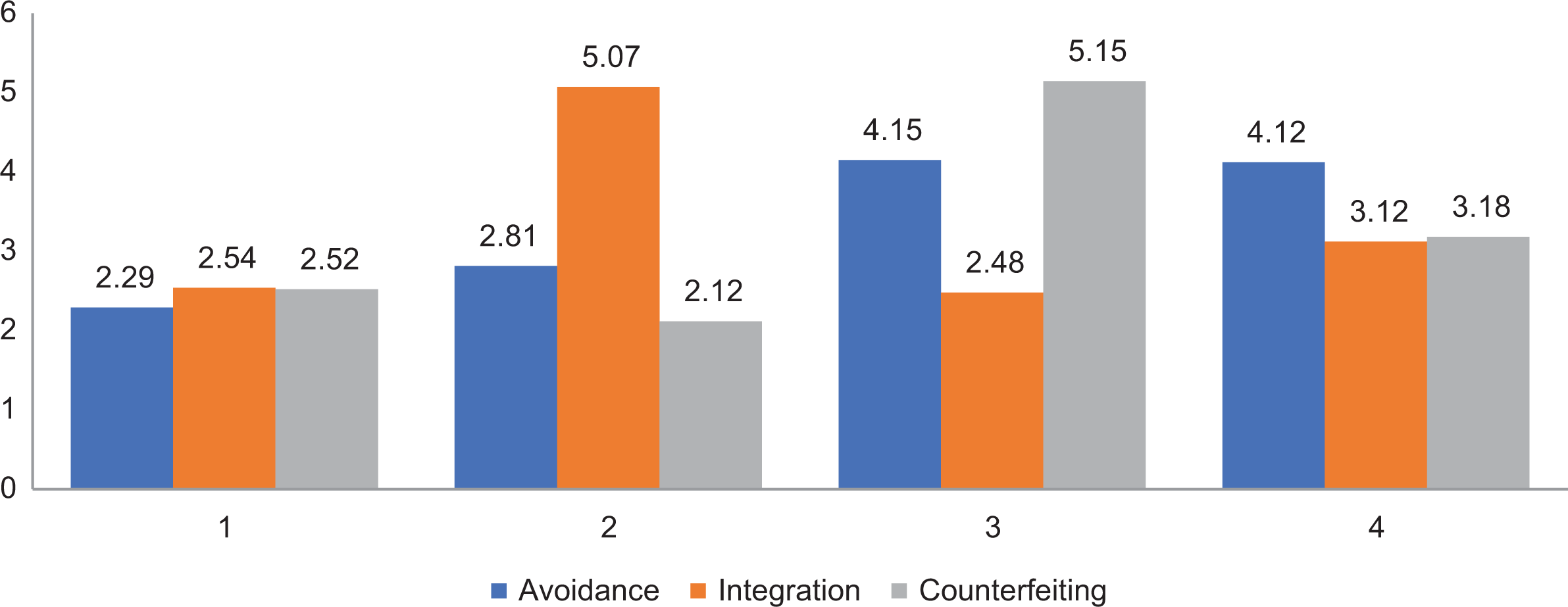
Latent profile analysis results. Class 1: passive (n = 31); Class 2: integration dominant (n = 81); Class 3: hiding (n = 21); and Class 4: balanced (n = 92).
Antecedents and Consequences of the Identified Profiles
In the correlation analysis, demographic information, such as age and gender, was related to the use of different sexual identity management strategies. Therefore, examining whether these demographic variables could predict the identified profiles would be interesting. Furthermore, we would examine whether these identified profiles exhibit different occupational well-being (Research Question 2). To address these questions, we adopted the multinomial regression to examine the relations of demographic information on the identified profiles and the automatic three-step method (DU3STEP) to examine the outcome of using these identified profiles.
In terms of antecedents, we found that age is not a salient factor in predicting the identified profiles. For gender, given membership in either passive or integration dominant, women were more likely to be in the passive profile than men. Given membership in either balanced or integration dominant and balanced or hiding, women were more likely to be in the balanced profile than men. Finally, given membership in either integration dominant or hiding, women were more likely to be in integration-dominant profile than men. The detailed results are listed in Table 3.
Multinomial Logistic Regression Analyses on Predicting Identified Profiles.

Note. Class 1 is passive. Class 2 is balanced. Class 3 is integration dominated. Class 4 is hiding.
*p < .05. **p < .01.
Finally, we examined whether differences emerge between the identified profiles on occupational well-being. In terms of job satisfaction, we found that integration-dominant profile reported higher job satisfaction than the balanced (χ2 = 23.76, p < .01) and hiding (χ2 = 5.89, p < .05) profiles. For emotional exhaustion, the balanced profile reported significantly higher emotional exhaustion than the passive (χ2 = 13.18, p < .01) and integration-dominant (χ2 = 12.46, p < .01) profiles. The hiding profile reported higher emotional exhaustion than the passive (χ2 = 5.71, p < .05) and integration-dominant (χ2 = 8.47, p < .05) profiles. The hiding profile showed significantly higher depressive symptoms than the passive (χ2 = 4.06, p < .05) and integration-dominant (χ2 = 11.01, p < .01) profiles. Finally, the balanced profile also reported higher depressive symptoms than the integration-dominant profile (χ2 = 6.54, p < .01). The detailed results are presented in Table 4.
Automatic Three-Step Results for Occupational Well-Being.

Note. Class 1 is passive. Class 2 is balanced. Class 3 is integration dominated. Class 4 is hiding.
*p < .05. **p < .01.
Discussion
In this study, we adopted the LPA to explore the nature of sexual identity management profiles and the relationship of these profiles to employees’ occupational well-being. Our findings provide empirical support to address the speculation that employees can use multiple management strategies in the workplace (e.g., Croteau et al., 2008; Ragins et al., 2007). In particular, except for the integration-dominant profile, other profiles exhibit a unique combination of the three identity management strategies.
In addition to portraying the common identity management profiles, we have extended the sexual identity management literature by examining the outcome of using different management strategy profiles. Employees with integration-dominant profile report better occupational well-being. This finding is consistent with earlier studies, which have adopted the variable-centered approach (e.g., Croteau et al., 2008). Croteau, Anderson, and VanderWal (2008) suggested that, by disclosing one’s sexual orientation in the workplace, employees will perceive reduced role ambiguity and minimize potential conflict with coworkers; this practice can also contribute to improved and highly genuine interpersonal relationships with others.
Compared with other empirical studies, new insights lie in other profiles with the mixed use of management strategies. Such results have not been systematically presented in the earlier study, thus providing useful information on the relationship between the management strategies as a whole and occupational well-being. Across the four identified profiles, we found that the participants with hiding profile (i.e., high avoidance and counterfeiting but low on integration) report the highest level of emotional exhaustion and depressive symptoms. As discussed previously, this hiding or “passing” strategy allows sexual minorities to conceal their sexual identity to others, and these strategies were typically detrimental to psychological well-being and job outcome. When employees utilize further avoidance and counterfeiting, they may be constantly distracted from their primary work task. We also speculated that, given that sexual minorities do not want to reveal their true identity, they may opt to deliberately detach themselves from other coworkers, thereby leading to reduced social support from their coworkers (Lane & Wegner, 1995). Additional research will be vital to empirically test these mechanisms to unveil how the use of these regulation strategies relate to poorer occupational well-being.
Interestingly, when we observed the outcome of the balanced profile (i.e., represented by using all three management strategies), we found that they report a lower level of job satisfaction but a higher level of emotional exhaustion and depressive symptoms than the integration-dominant profile. In fact, the outcome of using the balanced profile was comparable to the hiding profile. The identification of the passive profile in which participants did not actively use the three identified strategies was increasingly controversial. The results showed that, in terms of outcomes, the passive profile is similar to the integration-dominant profile because they have higher job satisfaction, as well as lower emotional exhaustion and depressive symptoms, than the hiding and balanced profiles. These findings provided a new perspective for understanding the outcome by appreciating the importance of the interplay of these strategies rather than considering each strategy independently. For example, our results suggested that using integration does not necessarily result in improved occupational well-being; instead, understanding whether the employees apply counterfeiting and avoiding along with integration is even more crucial: Based on our results, it was clear that counterfeiting and avoiding were considered sufficient to “offset” the positive integration strategy (e.g., balanced profile). These results challenged the assumption that “being out is universally good” (Chen-Hayes, 2005).
Limitations
This study has several limitations, and its results must be interpreted with caution. First, this study adopts the cross-sectional self-administered online survey for data collection. This approach did not allow us to delineate the cause and effect between the profiles of sexual identity management strategies and different occupational well-being variables. Moreover, common method variance can also affect observed associations (Podsakoff, MacKenzie, Lee, & Podsakoff, 2003). Thus, future studies should obtain data from other sources (e.g., coworkers’ data) for external validation. Second, we only recruited full-time working gays and lesbians in Hong Kong. Recent studies have suggested that bisexual (Arena & Jones, 2017) and transgender employees (Thoroughgood, Sawyer, & Webster, 2017) encounter different work conditions and discrimination experience when compared to gay and lesbian employees. Therefore, the findings in the present study may not be readily generalized to all sexual minority groups. Future studies must therefore include other sexual minorities groups to obtain a full picture of the ways by which different sexual minority groups adopt sexual identity management strategies. Besides, the experience of homophobia among gay men appears to differ significantly among countries as recently reported (Chard, Finneran, Sullivan, & Stephenson, 2015). Therefore, whether our findings could be generalized to other cultural group is not clear. Future study could thus include multicultural samples to explore the association between sexual identity management profile and occupational outcomes across different cultures. Third, our sample size was small (n = 225), thereby significantly limiting the statistical power. This problem was particularly important in the group comparisons, with some cells having a lower count (e.g., hiding). Finally, we did not directly assess the work climate or group acceptance. As discussed earlier, selecting management strategy is closely associated with the work environment, with more open and accepting environment encouraging the use of integration, whereas a less supportive environment encourages sexual minorities to use more concealing strategies. In addition, perceived organizational support can significantly influence employees’ being (e.g., Rhoades & Eisenberger, 2002). Therefore, the linkage between the management strategies and outcomes may be confounded by the work environment. To obtain a clear conclusion, future research could include assessing the work environment as the control and evaluating whether the profiles to outcome association still prevail even when the effect of the work environment is considered.
Implications
Based on our research, integration appears to be a beneficial strategy in managing an individual’s sexual identity. This outcome is especially true when they report minimal use of counterfeiting and avoidance. However, the benefit of disclosing their sexual identities depends largely on the work environment. In particular, when the organizational climate is more open and supportive to sexual minority employees, they will feel comfortable with disclosing their true sexual identities (Huffman, Watrous-Rodriguez, & King, 2008). However, disclosing an individual’s sexual orientation in a less supportive environment may not necessarily facilitate support from coworkers. Sexual minorities will rather perceive a strong necessity to protect themselves through concealments, such as using counterfeiting and avoiding strategies in the workplace, thereby eventually leading to poor psychological well-being and job outcomes (Button, 2004).
To support the sexual minority group, relevant organizational policy and government legislation intervention have become increasingly crucial to creating such an environment. These policies and regulations provide support to sexual minorities against unfair treatment from employers or associations on their hiring process, victimization, harassment, and other forms of discrimination in the workplace. As previously discussed, while a new code of practice has been recently proposed in Hong Kong, no formal legal support for the sexual minorities has been provided despite the growing urge for legislation against discrimination based on sexual orientation, sexual identity, and intersex status. These interventions can provide a friendly work environment for employees with sexual minority status and allow them to reveal their identities, thus contributing to improved health and job outcomes. Organizations must strive to establish support and ensure that individual members of the organization accept inclusive culture. For example, diversity training (e.g., Bezrukova, Jehn, & Spell, 2012) is a useful initiative for facilitating positive views toward the issue of sexual identity in the workplace, and high sexual orientation diversity will result in improved organizational performance (Cunningham, 2011).
In addition to organizational support, career counseling can help sexual minorities to adjust in the workplace. For example, Chung Y.B. (2001) provided a detailed framework that delineates coping strategies for sexual minorities. Based on this framework, counselors can help sexual minorities in evaluating workplace discrimination that they experience and work with their clients to locate appropriate coping strategies. These coping strategies include making a new vocational choice (e.g., finding an organization that is characterized by inclusive culture vs. taking a risk) or making enhanced work adjustment, either through identity or discrimination management. Our results revealed that profiles characterized by high counterfeiting and avoiding use result in low occupational well-being. Thus, it is reasonable to suggest the use of more proactive strategies, such as integration. However, Chung Y. B., Williams, and Dispenza (2009) presented that counselors must not overtly push their clients to adopt an additional self-affirming and assertive coping strategy (e.g., integration) because such an approach may not match with the clients’ identity development. In addition, in the Chinese cultural context where disclosure of sexual identity may result in rejection from family members, individuals must face higher risks of full disclosure. Therefore, counselors can help their clients to explore their options and allow their clients to understand the potential risks involved.
Recommendation for Future Study
Our study only provides a glimpse of the possibility of observing sexual identity management research with a different approach. We suggest that this analytic approach be applied to other related areas. For example, our study focuses only on identity management as a particular strategy for presenting an individual’s identity in the workplace (Croteau et al., 2008). Another important direction is to perceive sexual identity management through disclosure decision. For example, researchers (e.g., Clair, Beatty, & MacLean, 2005) have suggested various disclosure tactics, such as signaling, normalizing, and differentiating, that sexual minorities can use in revealing their sexual identity. Sexual minorities will likely use multiple disclosure tactics, and individual or environmental factors that predict such a decision and the outcome of adopting a particular combination of these disclosure tactics will be interesting to identify. Finally, sexual identity management is an ongoing process in which an employee must make a constant adjustment of the identity management strategies in response to the team or organizational changes. Therefore, understanding whether the identified profiles will be stable or will change across time will be theoretically important. To address this issue, we suggest that future research adopt latent profile transition analysis to examine the changes in profiles across time and evaluate potential factors, such as organizational climate change, that can affect profile transitions and outcomes.
Conclusion
In conclusion, our study is the first attempt to examine the relations between using sexual identity management strategies and outcomes through a person-centered approach. We expect that our results can provide readers a new perspective to understand the combined use of sexual identity management strategies and the relationship of these profiles with occupational well-being.
Footnotes
Declaration of Conflicting Interests
The author(s) declared no potential conflicts of interest with respect to the research, authorship, and/or publication of this article.
Funding
The author(s) received no financial support for the research, authorship, and/or publication of this article.