



Abstract
Researchers suggest contextual and personal factors may interact to predict career adaptability and that antecedents of career adaptability have received less research attention. Consequently, we examined the relationship between developmental leadership, career optimism, and career adaptability, and the potential moderating role of career optimism. Data were collected from workers pursuing an MBA program in leadership and other business courses in a Ghanaian University. Results showed that developmental leadership and career optimism relates positively to career adaptability. Finally, we observed developmental leadership relates positively to career adaptability for employees low on optimism but was unrelated to career adaptability for employees high on optimism. Together, the results suggest that although both developmental leadership and career optimism are beneficial for career adaptability, developmental leadership is particularly important, for less optimistic employees. We have discussed implications and limitations of our findings.
Computerization of jobs, along with constantly changing job demands and labor markets (Bimrose & Hearne, 2012; Fleigh-Palmer, Luthans, & Mandernach, 2009; Sylva, Mol, Den Hartog, & Dorenbosch, 2019), has contributed to creating a dynamic and decentralized work environment in modern organizations (Frese & Fay, 2001; Grant & Parker, 2009). These developments have created work settings requiring employees to deal with changing responsibilities and novel situations (Den Hartog & Belschak, 2007; Frese & Fay, 2001; Grant & Parker, 2009). To meet shifting career requirements and seize opportunities to excel, employees need to be adaptive, capable not only of coping with change but also of taking initiative in enhancing their fit to the changing work environment (Grant & Parker, 2009; Parker & Collins, 2010).
Proactive person–environment fit is a phenomenon that describes a wide range of work behaviors, including feedback inquiry (Ashford & Black, 1996; Ashford et al., 2003), feedback monitoring (Parker & Collins, 2010), and career initiative (Seibert, Kraimer, & Crant, 2001). Career-focused proactive person–environment fit can also involve proactively planning one’s career, extending one’s competences and skills, and consulting with one’s supervisor in order to maximize fit between oneself and one’s work environment (e.g., Tharenou & Terry, 1998). A psychological construct encompassing these important capabilities is career adaptability, a psychosocial resource that enables people to align themselves to their work (Savickas, 2013; Tolentino et al., 2014). Career adaptability has been linked with career satisfaction and self-rated career performance (Zacher, 2014), entrepreneurial intentions (Tolentino et al., 2014), and job search self-efficacy (Guan et al., 2013).
The benefits of career adaptability provide opportunity for identifying and examining potential antecedents. Previous studies show that positive psychological traits including hope, optimism, and resilience (Buyukgoze-Kavas, 2016); and conscientiousness, cognitive flexibility, and vocational environmental exploration (Chong & Leong, 2017) relate positively to career adaptability. Utilizing the social cognitive career theory (SCCT; Lent & Brown, 2019) as a framework, we contend that contextual and personal factors may have a direct or interactive effect on career adaptability. Specifically, the SCCT argues that contextual support, self-efficacy beliefs, and outcome expectations could directly or interactively predict career behavior. Furthermore, previous studies suggest that contextual and personal factors may interact to predict career adaptability (Tolentino et al., 2014). Consequently, in line with the SCCT and suggestions by previous researchers, we examine the direct and interactive role of developmental leadership (i.e., a contextual factor) and career optimism (i.e., outcome expectations or personal factor) on career adaptability in the Ghanaian context.
Theory and Hypotheses Development
Career adaptability and developmental leadership
Career adaptability represents a vital psychosocial capability that enables employees to anticipate, prepare for, and cope with changing work contexts (Savickas, 1997). Career adaptability facilitates self-preparation and proactive adjustment to changing work contexts (Chan & Mai, 2015). According to Savickas (1997), career adaptability is “the readiness to cope with predictable tasks of preparing for and participating in work role and with the unpredictable adjustments prompted by changes in work and working conditions” (p. 254). Career adaptability encapsulates three vital elements: “planful attitudes (i.e., developing values, skills, and abilities that fits one into relevant careers), self- and environmental exploration (i.e., searching for or aligning to a career or environment that fits one’s personal characteristics), and informed decision-making” about careers (Savickas, 1997, p. 254). Therefore, career adaptability comprises behaviors, competencies, and attitudes that might enable employees to fit well into changing work environments (Savickas, 2013). This conceptualization reveals that career adaptability could also be considered a form of proactive person–environment fit behavior (Parker & Collins, 2010), whereby employees anticipate, plan, and take actions independently to better adapt themselves to their work environments.
Zacher (2014), in a survey of Australian employees, found that career adaptability relates positively to career satisfaction and self-rated career performance. Further, Tolentino and colleagues (2014) found that career adaptability enhances entrepreneurial intentions. This may occur because being able to adapt to changing demands while planning ways to maximize opportunities inculcates in people the motivation and skills to succeed in changing environments (Savickas, 2013) and cope with emerging career concerns (Creed et al., 2009). Given these benefits, it is worthwhile to investigate ways to facilitate career adaptability.
Leadership might help employees to function more effectively in changing work environments. Research shows that empowering and contingent reward leadership behaviors relate more positively to resilient behaviors at work (Nguyen et al., 2016) and change-related outcomes (Ahearne et al., 2005; Pearce & Sims, 2002). Leadership behaviors that focus on the personal development and growth of employees, clarify work goals and expectations to employees, provide support, and encourage participation at work are more likely to enhance career adaptability and related phenomena (Bardoel et al., 2014; Harland et al., 2004; King & Rothstein, 2010; Luthans & Avolio, 2003). This study therefore focuses on developmental leadership behaviors as a predictor of career adaptability.
Developmental leadership represents a style of leadership, or a set of leader behaviors, that is/are aimed at developing and enhancing employees’ work-related knowledge, skills, and competences as well as facilitating their personal and career development (Zhang & Chen, 2013). Developmental leadership behaviors, such as mentoring, coaching, guiding, counseling, and providing performance feedback and developmental opportunities (House, 1996), might help employees to function effectively in the work environment. Apart from focusing on the individual, developmental leaders are development oriented, as they pay attention to differences among followers and discover what motivates them through careful observation, career counseling, performance feedback, delegation, and training (Bass, 1985) to enable them to perform in changing work environment.
Previous studies show that leadership behaviors are likely to help followers succeed in changing work environments. For example, Nguyen and colleagues (2016) showed that empowering and contingent reward leadership behaviors are associated with greater resilient behaviors (i.e., change adaptability, learning, and networking). Furthermore, Wang et al. (2017), in a survey of employees in the Netherlands, found that transformational leadership relates positively to adaptability. Together, these empirical evidence suggests that through behaviors such as providing performance feedback and coaching to increase the adaptive resources of followers, developmental leaders would make their followers feel self-efficacious (Higgins et al., 2010; Lawler, 1986) and therefore, more capable of handling tasks in dynamic work environments. Thus, we hypothesize that
Career adaptability and career optimism
Optimism is an inherent human tendency as people generally expect to experience positive rather than negative events in future (Sharot, 2011; Varki, 2009). Accordingly, Scheier and Carver (1985) defined generalized optimism as the inclination to expect positive outcomes in the future despite perceived obstacles and difficulties. Optimism is helpful in work contexts as it can stimulate the determination to pursue career goals (Brown & Marshall, 2001) and to adjust well to changing work environment (Carver et al., 2010). In the context of careers, we define career optimism as the positive expectations about one’s impending career growth (Rottinghaus et al., 2005) as well as the confidence about one’s ability to overcome work demands in changing work environment (Hennessey et al., 2008).
Career optimism and career adaptability are distinct constructs. Vocational psychology researchers differentiate the two constructs, as adaptivity (i.e., a stable, context-general, and trait-like psychological characteristic which involves the readiness and willingness to adapt to career change; Rudolph et al., 2017) and adaptability resources (i.e., the self-regulated psychosocial advantages for managing transitions and tasks; Hirschi et al., 2015). Following previous studies, we view career optimism as a personal indicator of adaptivity (Fang et al., 2018; Rudolph et al., 2017) and career adaptability as adaptability resources (Hirschi et al., 2015; Savickas & Porfeli, 2012).
Positive expectations facilitate goal accomplishment because they increase the confidence and effort of the individual (Bowlby, 1988). In the context of careers, the SCCT (Lent et al., 1994), a modification of Bandura’s (1986) social cognitive theory, is generally utilized to examine contextual, person, and behavior factors that have the potential to shape career development (Lent & Brown, 2019). According to the SCCT, person (e.g., self-efficacy and positive expectations) and contextual factors (e.g., social support) might enable individuals to construct their careers (Lent & Brown, 2019).
Positive expectation (i.e., career optimism) has been associated with job satisfaction, organizational commitment, and performance (Kluemper et al., 2009; Youssef & Luthans, 2007); and elements of adaptability including adjustment to college (Aspinwall & Taylor, 1992) and coping with unemployment (Wanberg, 1997). This suggests that career optimism is likely to facilitate career adaptability. Although some studies relate optimism to career adaptability, these come from nonwork contexts. For example, Aspinwall et al. (2001), in a survey of Australian university students, showed that trait optimism relates to career adaptability. Similarly, Rottinghaus and colleagues (2005) found that optimistic students were likely to experience greater career adaptability. However, recent evidence shows that optimism has the potential to influence career adaptability in work contexts. For example, Nguyen and colleagues (2016) showed that optimism relates more positively to resilient behaviors (i.e., a form of adaptability in the face of change) at work. Furthermore, optimism is more likely to stimulate employees to show commitment to change, cope with dynamic work contexts, and display positive behaviors at work (Kool & Dierendonck, 2012; Youssef & Luthans, 2007). Therefore, we hypothesize that:
Career optimism as a moderator
Although we have argued that developmental leadership is likely to support career adaptability, it may not do so for everyone. The effect of leadership behavior on followers may depend on follower characteristics (Howell et al., 1997; Shamir & Howell, 1999). Researchers suggest that individual characteristics (Tolentino et al., 2014) including adaptive readiness (Savickas, 2013), proactive personality, and optimism (Nguyen et al., 2016) might interact with leadership to influence employee outcomes. Consequently, we suggest that the developmental leadership may be beneficial to some than other followers. Therefore, it is worthwhile to investigate follower characteristics that may predispose followers to benefit or not from developmental leadership.
Developmental supports have been seen to enhance optimism, including career optimism (Garcia et al., 2015), but few studies have examined how the two interact. Nguyen and colleagues (2016) argued that optimism acts as a resource that can helps employees succeed regardless of leader assistance. Optimistic individuals possess adaptive resources, as they are flexible, view the future positively, and more inclined to see career difficulties as challenges rather than threats (Chang, 1998; Smith et al., 1993). This level of confidence enables optimists to handle potential work obstacles better than their counterparts who are low on optimism. Research shows that optimists, rather than pessimists, are more likely to continue gambling after unsuccessful attempts (Gibson & Sanbonmatsu, 2004). Conversely, pessimists are more likely to take performance feedback and developmental opportunities from their supervisors more seriously (Sweeny & Shepperd, 2010), leading them to experience less disappointments and negative affect in future. This suggests that leaders may be able to make more of a difference when providing developmental support to the more pessimistic members of their team. Nguyen and colleagues (2016) found that contingent reward leadership was more strongly associated with resilient behavior for pessimistic employees more than for optimistic employees. Consequently, we hypothesize that:
Method
Participants and Sample
Most African economies are categorized as emerging economies. In emerging economies, technology and competition have made work contexts dynamic more recently than was the case in western economies. Thus, research into organizational behavior phenomena such as leadership, optimism, and adaptability are important to discovering best practices for organizations in Africa, particularly adaptability as employees would have to adapt to changes in the career landscape. The presence of multinational organizations and other private businesses, the increasing use of technology to facilitate work, and heightened competition in Ghanaian organizations have contributed to creating a constantly changing work environment. Therefore, adaptability could help Ghanaian employees perform well in a Ghanaian work context that is technologically driven.
Our study comprised 210 workers enrolled in an MBA program pursuing courses in leadership and business who voluntarily completed a paper-based survey on developmental leadership, career adaptability, and career optimism. We did not offer participants compensation and they could withdraw from the study without a consequence. The sample comprised 64% males and 75% nonmanagers. Regarding education, 40% had a postgraduate degree, 53% had an undergraduate degree, and 6% had a diploma. The distribution of participants across the various industries was: public service (53%), banking (38%), consultancy (3%), health (2%), and 1% or less from nongovernmental organization, hospitality, construction media, and oil and gas. The mean age of participants was 32.49 years old (SD = 7.15), and mean tenure was 4.85 years (SD = 4.73).
Measures
Our measures were in English. Unless otherwise specified, all the scales used response options from 1 (strongly disagree) to 5 (strongly agree).
Developmental leadership
We assessed developmental leadership with 7-item from the measures of developmental leadership (House, 1998) and supervisory sponsorship (Wayne et al., 1999). Previous studies demonstrate validity of the scale, as it related positively to job satisfaction, affective commitment, career certainty, organizational identification, and organizational citizenship behavior; and negatively to bureaucracy (Rafferty & Griffin, 2006; Zhang & Chen, 2013). A sample item includes “My supervisor helps with my career development.” Confirmatory factor analysis (CFA) of the scale’s items revealed a good fit (χ2 = 31.23, df = 13, p = .003, comparative fit index [CFI] = .97, Tucker–Lewis index [TLI] = 96, goodness-of-fit index [GFI] = .98, and root mean square error of approximation [RMSEA] = .08). Previous research reported a reliability coefficient of .88 for the Developmental Leadership Scale (Zhang & Chen, 2013).
Career adaptability
We assessed the extent to which respondents adapt to their new work settings with the 11-item Career Adaptability Scale developed and validated by Rottinghaus and colleagues (2005). Rottinghaus and colleagues demonstrated the construct validity of this scale, showing that it related positively to conscientiousness, openness to experience, agreeableness, teamwork, leadership, and organizational management, but negatively to neuroticism. We reversed scored 2 negatively worded items on this scale. Sample item includes “I am good at adapting to new work settings.” CFA result showed a good fit (χ2 = 61.81, df = 41, p < .05, CFI = .91, GFI = .95, TLI = .88, and RMSEA = .05). Rottinghaus and colleagues reported a reliability coefficient of .85 for the career adaptability scale in their study.
Career optimism
We assessed career optimism with the 11-items scaled by Rottinghaus and colleagues (2005). Five items were negatively worded. We reversed scored these items prior to performing our analysis. A sample item includes, “I get excited when I think about my career.” CFA revealed a good fit (χ2 = 63.19, df = 38, p < .05, CFI = .95, GFI = .95, TLI = .92, and RMSEA = .06). Rottinghaus and colleagues (2005) reported a reliability coefficient of .87 for the Career Optimism Scale, and their career optimism construct is valid, as it related positively to conscientiousness, openness to experience, agreeableness, teamwork, leadership, contextual support and barriers, career preparing behavior, vocational identity, and career satisfaction, but negatively to neuroticism (Eva et al., 2020; Rottinghaus et al., 2005).
Results
Descriptive Statistics
As shown in Table 1, career adaptability is positively associated with developmental leadership (r = .22, p = .002) and career optimism (r = .16, p = .021). Finally, career optimism related positively to developmental leadership (r = .14, p = .046). However, none of the demographic factors (e.g., sex, age, and tenure) related to the main variables.
Descriptive Statistics, Zero-Order Correlations, and Reliability Coefficients of Study Variables.
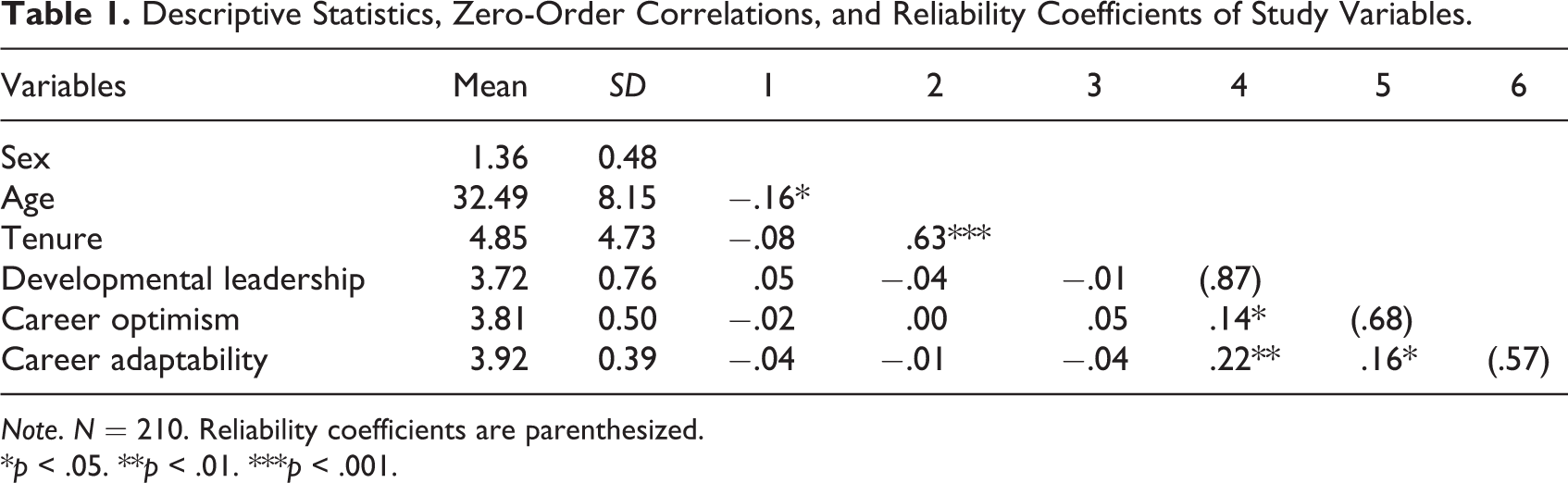
Note. N = 210. Reliability coefficients are parenthesized.
*p < .05. **p < .01. ***p < .001.
Unstandardized Effects of Developmental Leadership and Career Optimism on Career Adaptability.
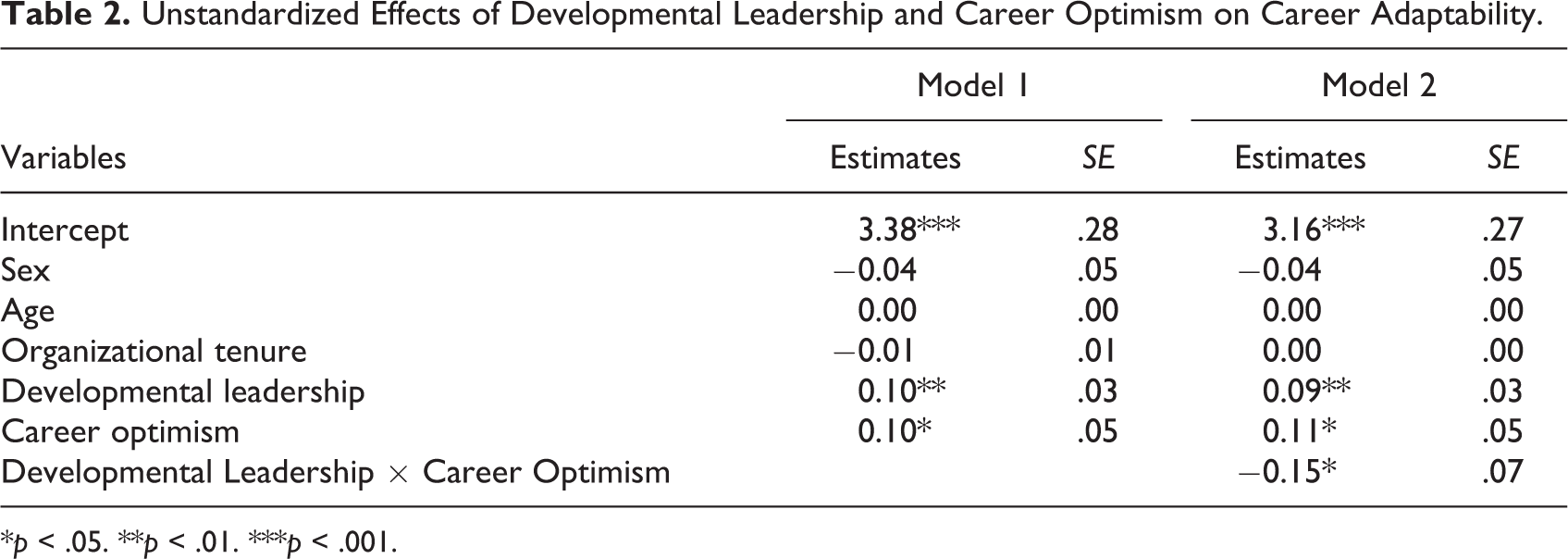
*p < .05. **p < .01. ***p < .001.
Prior to the data analysis, we screened the data set to ascertain the accuracy of the data set. We did not have any missing cases in our data set. Because we collected data from a single source, common method bias is a possibility (Podsakoff et al., 2003). We performed the Harman’s one-factor test to ascertain whether common method bias might be a problem. In this test, we performed exploratory factor analysis with unrotated principal axis factoring method using all the items measuring the key variables in the study. The extraction of one factor suggests the presence of common method variance or an indication that one-factor accounts for much of the covariance in the variables. We observed eight factors with eigenvalues greater than 1. Together, the eight factors accounted for 60% of the total variance, with variances ranging from a low of 4% to a high of 18% for each factor.
Testing Hypotheses
Prior to testing the hypotheses, we assessed the measurement model involving three latent constructs: developmental leadership, career adaptability, and career optimism. All the factors loaded onto their respective latent construct. For example, all the 7-item measuring developmental leadership loaded significantly onto the latent developmental leadership factor. CFA showed that the model fits the data to an acceptable level: χ2 = 675.19, df = 368, p < .001, CFI = .81, TLI = .79, RMSEA = .06.
We tested the hypotheses using path analysis in IBM SPSS AMOS Version 24. Prior to testing the model, the predictor (developmental leadership) and moderator (career optimism) were centered (Aiken & West, 1991). In the first model, we entered the main effects of developmental leadership and career optimism, and the covariates (e.g., sex, age, and organizational tenure), with the interactive term added in Model 2. Results in Model 1 shows that developmental leadership, β = .20, SE = .03, p = .003; and career optimism, β = .13, SE = .05, p = .046 relates positively to career adaptability, respectively. We found similar results in Model 2. Thus, our results support Hypotheses 1 and 2, respectively. Model 2 also showed that developmental leadership and career optimism interacted to predict career adaptability, β = −.14, SE = .07, p = .043.
To understand the effect of developmental leadership on career adaptability at the level of the moderator (i.e., career optimism), we followed the procedure suggested by Aiken and West (1991) using regression lines and effect variances to plot effects at standard deviation above and below the mean. As illustrated in Figure 1, developmental leadership related more to career adaptability particularly for respondents low on career optimism (simple slope, β = .33, SE = .09, p < .001) but was unrelated to career adaptability for respondents high on career optimism (simple slope, β = .04, SE = .10, p = .701).
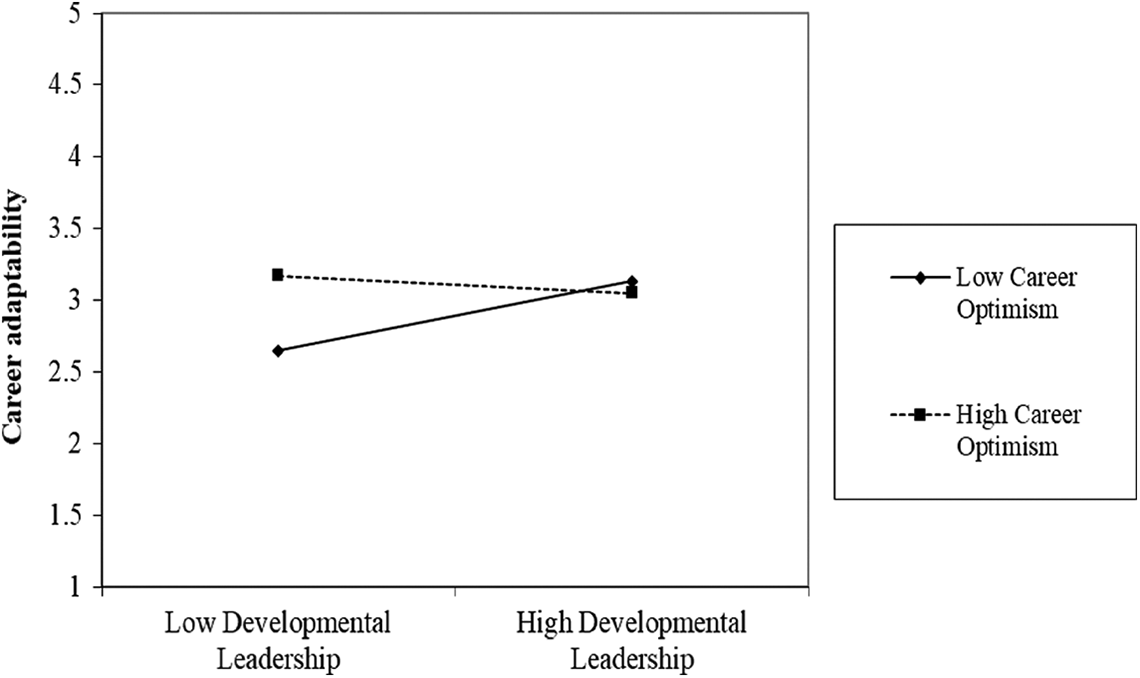
Career optimism moderates developmental leadership–career adaptability relationship, Model 2.
Discussion
Employees are more likely to succeed in their work if they can adapt to changes associated with their careers. Our results are consistent with the SCCT (Lent & Brown, 2019), as we showed that both developmental leadership and career optimism directly and interactively predicted career adaptability, suggesting that contextual and personal factors are important determinants of career behavior. Our results have important implications for research in the field of vocational psychology and practice in organizations.
Theoretical Contribution
Our expectation that developmental leadership relates positively to career adaptability was supported. This result is consistent with previous studies (Higgins et al., 2010; Lawler, 1986), suggesting that employees under developmental leaders are able to adapt to their work environment because of the empowerment they receive through the performance feedback, training and development, career counseling, and advice. Furthermore, the result shows that developmental leadership is an important contextual factor that might build adaptability resources in employees (Higgins et al., 2010).
Career optimism related positively to career adaptability, corroborating previous research (Aspinwall et al., 2001; Rottinghaus et al., 2005). We reasoned that because optimists are positive about the future, are resilient, and see work obstacles as challenges (Kool & Dierendonck, 2012; Nguyen et al., 2016; Youssef & Luthans, 2007), they are able to adapt to their work environment.
Finally, as expected, we note that developmental leadership relates positively to career adaptability for employees low on optimism and insignificantly to those high on optimism, corroborating previous studies (Rottinghaus et al., 2005; Tolentino et al., 2014). Specifically, our results show that developmental leadership enables people low on optimism to adapt to their work environment. We reasoned that because optimists are capable of coping effectively with career demands (Aspinwall et al., 2001), leveraging on their positive feelings and unshakable sense of confidence, and utilizing their competences (i.e., social and intellectual) to manage work-related changes (Fredrickson, Cohn, Coffey, Pek, & Finkel, 2008). Therefore, contextual support (i.e., developmental leadership) may not be beneficial to them.
Limitations and Suggestions for Future Research
We acknowledge that there are limitations associated with our study. First, we utilized cross-sectional data that prevent us from drawing causal conclusions. To ascertain the validity of the path model, longitudinal studies are preferred. While common method bias may be a problem, the Harman’s one-factor test results show that common method bias may play a relatively small role in our findings. Furthermore, we note that common method error tends to suppress moderation effects in cross-sectional data (Podsakoff et al., 2003), suggesting our effects may be stronger than reported. Notwithstanding this, we recommend the use of longitudinal designs and multisource data to rule out this effect in future research.
Further, this study was limited to workers in Ghana. There is the need for a cross-cultural study or samples from different sectors of the business environment to establish the differential effect of leadership and other factors on career adaptability because adaptability is bounded by social, institutional, and cultural context (Savickas & Porfeli, 2012). However, we feel this is a strength given the paucity of research on management phenomena in Africa.
Implications for Practice
Our findings may have relevant implications for organizational leaders and consultants who aim to maintain and increase employee career adaptability. Given that dynamic and technological nature of work in modern organizations, employers should see adaptability as an important recruitment and retention issue for employees. Our results indicate that developmental leadership helps employees to adapt to their careers and might help people low on optimism to adapt effectively to their work environment (Nguyen et al., 2016; Rottinghaus et al., 2005; Tolentino et al., 2014). Conversely, our results suggest that optimistic employees require less developmental leadership, perhaps because they already feel confident that they can manage their own career issues (Aspinwall et al., 2001).
Our study also has implications for employees. Optimistic employees are more adaptable than less optimistic ones, and developmental leadership is beneficial for helping less optimistic employees adapt to their work environment. Therefore, employers should exercise caution with regard to optimism-enhancing interventions, as these could result in unrealistic positive expectations and overconfidence (Icekson et al., 2014), leading optimistic employees to not benefit from the support developmental leaders provide, and hence affecting their adaptation to the work environment.
Finally, managers should design supportive work environments, that is, environment that encourages and supports career counseling, coaching, and mentoring, which have the potential to foster optimism among employees (Garcia et al., 2015; Lent & Brown, 2019; Rottinghaus et al., 2017; Spurk et al., 2015).
Conclusion
As the first to study the circumstances under which developmental leadership influences career adaptability in the African context, the findings have considerable management implications. Based on the outcome of our study, we suggest that organizations (especially those based in Africa) may benefit when leaders strive to empower their teams, especially the less optimistic members, because this has the potential to enhance adaptive and proactive forms of person–environment fit, such as career adaptability. However, further research is needed to confirm these findings in other settings, ideally utilizing more robust designs such as a longitudinal or a daily diary approach.
Footnotes
Author’s Note
Eric Delle may relocate to Ghana in July.
Declaration of Conflicting Interests
The author(s) declared no potential conflicts of interest with respect to the research, authorship, and/or publication of this article.
Funding
The author(s) received no financial support for the research, authorship, and/or publication of this article.
