




Abstract
Obtaining a doctorate offers various career options. This study takes a person-centered approach to identify interest profiles. Career goals (professorate, entrepreneur, etc.) were assessed at two time points (1-year interval) in a sample of doctoral students and doctorate holders from the STEM fields in German-speaking areas (NT1 = 2,077). Latent profile analysis revealed that a four-profile solution provided the best data fit: At T1, 33.0% of the participants aimed for a management position in industry, 16.9% pursued an academic career, 30.1% were interested in activities without leadership responsibilities, and 20.1% had a relatively flat career-goal profile. Latent transition analysis indicated that most changes occurred for those classified into the flat profile, while strong interest in a management career was very stable over time. Additionally, the attainment of the doctorate seemed to be a good predictor for profile membership: Doctorate holders were more likely to be clearly dedicated to an academic career.
Keywords
Gaining a deeper understanding of career-related interests and subsequent decisions is important for both theory and practice. In career research, there are different theoretical frameworks on career interests and development (e.g., Holland, 1997; Lent & Brown, 2013; Super, 1969), each of which put different contents and processes to the fore (for an overview, see Leung, 2008). As a common ground, most of them consider interests to be a major driver of career goals and achievement-oriented activities.
In social psychology and personality psychology, researchers have repeatedly acknowledged that different goals are salient within one person (see Austin & Vancouver, 1996; Kung & Scholer, 2020). While some of the goals a person pursues might be unrelated, others might either facilitate or compete with each other (see Fishbach & Ferguson, 2007). In career psychology, Holland’s (1997) theory of career choice is one that considers multiple vocational interests. Recently, concepts of multiple career orientations have been outlined by Rodrigues et al. (2013) and Bravo et al. (2015). They put into question Schein’s (1996) well-known idea of one single dominant career anchor that drives career-related decisions. In contrast to that view, Rodrigues et al. (2013) have suggested the coexistence of several orientations within one person (be it as primary and secondary or as primary combinations). Similarly, Bravo et al. (2015) have proposed and validated a multidimensional concept of career orientations that might coexist within an individual at a time that they consider as a main motivational starting point to better understand individuals’ career choices. But although being an implicit part of their lines of argumentation, neither Rodrigues et al. (2013) nor Bravo et al. (2015) presented person-centered modeling approaches to depict clusters of career orientations.
The presence of multiple goals within one individual is one explanation as to why goal setting does not always result in goal pursuit in the long run. While most career theories imply that the investigation of a single career goal is insufficient, most studies in vocational research focus on parameters averaged across the given sample (Hofmans et al., 2020). Additionally, most of these studies focus on adolescents. However, since the career decision-making process seems to be different for varying career stages and branches, some researchers suggest that different occupational fields in various contexts require separate theoretical (and empirical) considerations (Gerber et al., 2009).
The present study focuses on early career scientists as a specific group of interest. After completing their doctorate, professionals have to take their next career steps. Many of these early career professionals find themselves in an environment full of opportunities. They represent an in-demand group in the labor market and often have multiple and diverse employment opportunities inside and outside of academia (Auriol, 2010). While some might concentrate on one specific career goal, others might develop an interest in more than one career path and have a realistic chance of succeeding in whichever option they choose.
Past Research on Career Goals of the Highly Educated
A recently published article (Burk & Wiese, 2018) presented a model of motivational orientations that predicted the career goals of professorship and management. Their results (based on the larger survey that is also used in this article) indicate that these two career goals are fueled by different motives. Motivational factors that predicted the goal to become a professor were strong needs for competence, autonomy, and creativity. Aspiring to a management position was predicted by strong needs for power, income, and leadership. Although the authors mentioned the possibility that individuals might find two or more career goals similarly attractive, they did not investigate possible career goal patterns at the individual level. Moreover, they restricted their predictive models to only two options (i.e., professorship, management position). Erez and Shneorson (1980) investigated engineers pursuing a career in industry or academia. They found differences between these two groups in terms of Holland’s (1997) personality types and motivational characteristics. With regard to differences in personality types, academics scored higher on artistic interests and lower on enterprising interests than professionals in industry. They also found differences in motivation: Academics were motivated by opportunity for publication, challenge in theory development, flexibility in allocation of time, and occupational status. Industrials were motivated by challenge associated with the operation of the organization, authority to exert influence on others, and the prospect of high income. Sauermann and Roach (2012) investigated career preferences and how they changed over time in a sample of more than 4,000 doctoral students from a broad range of disciplines. The students were asked to rate various academic and nonacademic career goals. Although there were discipline-related differences, faculty positions with a focus on research were ranked most attractive. But interest in academic research declined over time, while other careers became more attractive.
With a few exceptions (e.g., Perera & McIlveen, 2018), however, most previous research has been limited to the investigation of career goals from a variable-centered perspective. Such a perspective on career goal selection and goal pursuit ignores that the underlying population might be heterogeneous and that different interest constellations might play a seminal role in career decisions (Hofmans et al., 2020). High-potential individuals in particular may be suited to several career paths and might be interested in a variety of careers.
The pursuit of career goals is not only shaped by interests but also by several personal characteristics as well as situational factors. One characteristic that has been associated with withdrawal from academic career goals is career insecurity, which is defined as the perceived (un)certainness to achieve self-defined career aims or to predict the vocational future (Höge et al., 2012). With regard to the academic path, there is a widespread consensus that a professorship career is characterized by relatively high insecurity due to, for instance, short-term contracts, high-performance requirements, and unclear career prospects (for more details, see Ortlieb & Weiss, 2018). Women tend to drop out of the academic path more often than men because of a perceived incompatibility between the demands to pursue an academic career and family-related remands (van Anders, 2004). At the background of these past findings, both psychological and sociodemographic person characteristics have to be considered when it comes to predict goal profiles as well as goal profile (in)stability.
Research Questions
To the authors’ knowledge, this study is the first to use a person-oriented approach to study the career goals of doctoral students and doctorate holders. Our aim was to complement the existing literature by considering multiple career goals simultaneously. As outlined above, the broad array of opportunity structures that doctoral students and doctorate holders face might give rise to multiple goals, but it is unknown whether this would be reflected in individuals’ goal systems. Therefore, we investigated career goal patterns of doctoral students and doctorate holders in greater detail. First, using latent profile analysis (LPA; Gibson, 1959), we analyzed whether career profiles can be identified and, if yes, which. We assumed the identification of various career goal profiles: We expected that there are individuals who clearly strive for a position in academia (reflected by interest in the professorship position and other research activities in academia). This is in line with the idea of a taste for science (Roach & Sauermann, 2010). Also, we expected to find a group of individuals who clearly want to transfer to an industrial setting. Since our target group consisted of highly educated individuals, we also anticipated a group of individuals whose career goals are driven by a greater interest in leadership responsibilities (either in industrial or academic settings) as well as a group of individuals with pronounced entrepreneurial interests. Finally, we assumed to identify a group of individuals who have not yet decided on their future career paths.
Second, we wanted to look at the early career scientists’ goals 12 months later. This allows investigation of both stability and changes of these career-goal profiles. Finally, we planned to take a first step toward exploring sociodemographic and psychological predictors of profile membership and changes.
Method
Data were drawn from a larger project on the career decisions of early career scientists (for further information, see Alisic & Wiese, 2020; Burk & Wiese, 2018; Claus et al., 2020; Lerche et al., 2020). The participants were doctoral candidates and doctorate holders from the STEM (science, technology, engineering, mathematics) fields who participated in a longitudinal survey. To be eligible, participants had to hold a doctoral degree while working in either academia or in an industrial setting or had to be studying for a doctorate for at least one year at the time of the first assessment. The project contains eight measurement points with a time interval of roughly six months between each measurement point. The data analyzed here relate to two of these measurement points: The first was assessed one year after the study start (referred to as T1) and the second one was about 12 months later (referred to as T2).
Study Description
We included all participants who participated at T1 and did not indicate having already achieved their career goals. The final sample consisted of N = 2,077 participants (60.3% men) for T1 and N = 1,536 participants for T2. Participants with data at T1 and T2 (N = 1,536) were included in subsequent latent transition analysis (LTA). All of the participants were from German-speaking countries. At T1, participants were between 24 and 50 years old (M = 31.4, SD = 4.0). Nearly one third had children (28.4% at T1 and 35.6% at T2); 51.1% were doctoral students at T1. Due to completion of their dissertation, the percentage of doctoral students was lower at T2 (30.8%). On average, at T1, doctorate students were 3.5 years into their doctoral program (SD = 1.5); doctorate holders held their doctorate degree for 4.9 years (SD = 2.8, range: 0–11 years). At T1, most of them (80.4%) did carry out scientific work (either in an academic or in a nonacademic environment).
Participants had to indicate their subject of study which then was clustered into one of the four categories: natural sciences, computer sciences, engineering sciences, and mathematics. Of all participants, the majority was located within the natural sciences category (50.0%), followed by engineering sciences (33.0%). Computer scientists made up about 9.3% of the sample. Only 7.7% were clustered into the mathematic category.
Career goals
To measure different career goals, we asked participants to rate different professions with regard to their individual strivings on a 6-point scale ranging from 1 (not at all) to 6 (very strongly). For the present analyses, we used the ratings for eight different career goals: “professorship” (MT1 = 2.4, SDT1 = 1.7; MT2 = 2.4, SDT2 = 1.7), “professorate at university of applied sciences” (MT1 = 2.2, SDT1 = 1.4; MT2 = 2.2, SDT2 = 1.4), “management position in industry” (MT1 = 3.9, SDT1 = 1.5; MT2 = 3.8, SDT2 = 1.6), “entrepreneurship” (MT1 = 2.8, SDT1 = 1.4; MT2 = 2.3, SDT2 = 1.4), “lecturer position” (MT1 = 2.6, SDT1 = 1.5; MT2 = 2.6, SDT2 = 1.5), “administration in nonprofit organizations” (MT1 = 2.3, SDT1 = 1.5; MT2 = 2.4, SDT2 = 1.5), “other research activities” (MT1 = 3.4, SDT1 = 1.7; MT2 = 3.4, SDT2 = 1.8), and “other activities in an industrial setting” (MT1 = 3.0, SDT1 =1.6; MT2 = 3.1, SDT2 = 1.6).
Career insecurity
Career insecurity was measured at T1 with a total of four items (three items by Höge et al., (2012) and one additional self-developed item) which had to be rated on a 6-point scale ranging from 1 (do not agree) to 6 (completely agree) at T1. A sample item is “I often wonder how my career will develop” (M = 3.6, SD = 1.2, α = .77). T1 scores were used to predict profile membership at T1 and profile changes at T2.
Control variables
For the logistic regression, gender (0 = male, 1 = female), parenthood (0 = no, 1 = yes), completion of the doctorate at the respective measurement point (0 = no, 1 = yes), and the participants field of study (natural sciences, computer sciences, engineering sciences, and mathematics) were included as control variables. Gender and parenthood were included because past research has outlined that women tend to leave the academic career path more often than men due to, for instance, parenting responsibilities (van Anders, 2004). Field of study was considered because there are discipline-related differences in employment prospects and cross-sector mobility across STEM fields (Auriol, 2010).
Analytical Approach and Missing Data Handling
All analyses were conducted using Mplus (Muthén & Muthén, 1998–2017). Our objective was to divide our sample into subgroups with distinct career profiles. For our analyses, we followed the stepwise approach as presented in Kam et al. (2016): We first compared several models for each measurement point using LPA in order to find the best profile solution for each measurement point before conducting LTA (for details on this procedure, see Nylund, 2007). Although separate LPAs for both measurement points are not needed before carrying out LTA, calculating separate profile models for both time points allows assessment of whether the extracted latent profiles are structurally similar at both time points. Moreover, it enables to compare the profiles that can be extracted when considering cases of those who participated at the respective measurement point with the resulting profiles from the LTA.
As a person-centered method, LPA considers the possibility that a set of attributes might be experienced differently and that attributes may have different implications in combination than when considered separately (Kam et al., 2016). Thereby, the person-centered approach complements variable-centered approaches. Whereas latent class analysis (LCA) was originally developed for binary indicators, LPA is a variant to be used for continuous indicators (Sturge-Apple et al., 2010). Both LCA and LPA are probabilistic methods that are used to identify subgroups within a specific population. The focus is on the relationships among individuals, and the goal is to classify individuals into distinct groups or categories based on their response patterns, such that individuals within a group are more similar than individuals in different groups. LCA and LPA assign individuals to latent classes on the basis of categorical and continuous variables, respectively. The main differences between LCA/LPA and the more prominent cluster analysis are that LCA and LPA are model-based and are probabilistic methods (for more details on person-centered approaches, see Hofmans et al., 2020).
We referred to several fit indices to assess how changes in the number of profiles affected model fit. In particular, we used Akaike’s (1987) information criterion (AIC), the Bayesian information criterion (BIC; Schwarz, 1978), and the adjusted Bayesian information criterion (ABIC; Sclove, 1987) to compare changes in data fit with a rising number of profiles. In the cases of the AIC, BIC, and ABIC, lower values indicate a better fit. We also considered entropy, which indicates – based on the individual’s estimated profile probability – how clearly distinguishable the profiles in a particular model are. Additionally, we carried out a Lo-Mendel-Rubin (LMR; Lo et al., 2001) test, which compares the fit of a model with k profiles with that of a model with k 1 profiles, and a bootstrapped likelihood ratio test (BLRT; McLachlan & Peel, 2000). These fit indices and likelihood-based tests are important indicators for the number of profiles that should be kept for the final solution. On the content level, one also has to make sure that the extracted profiles are qualitatively meaningful and that the number of individuals clustered into a respective profile is not too small (Berlin et al., 2014; Lubke & Neale, 2006). In summary, the decision on the number of profiles should be based on information criteria, likelihood-based tests, theory, the underlying research question, and parsimony as well as the contextual meaning of the profiles (Bauer & Curran, 2003; Nylund-Gibson & Choi, 2018). Our analyses were conducted with 600 and 1,200 random start value sets in order to replicate the best log-likelihood value.
Next, a latent transition model was specified. LTA models are a special case of a broader class of mixture models called Markov chain models (Collins & Lanza, 2010; Langeheine & Van de Pol, 2002). LTA builds on the LPA measurement model described above. Latent profiles were estimated separately for both time points, and all profiles for each time point t were regressed on the latent profile variables at time point t − 1. In summary, there is a latent profile variable at each time point, and the relationship between the profiles at different time points describes individual transitions in profile membership across time (Masyn, 2013). For both LPA and LTA, full information maximum-likelihood (FIML) estimation is used for missing data. FIML makes use of all data points to estimate model parameters under the assumption that data are missing at random (Graham, 2009). For the regression analysis, data sets with missing values on covariates were not considered.
Results
In the following, we will outline the central results of our analyses. More detailed information about dropout patterns and sociodemographic characteristics of the profiles are available from the first author by request.
Latent Profiles
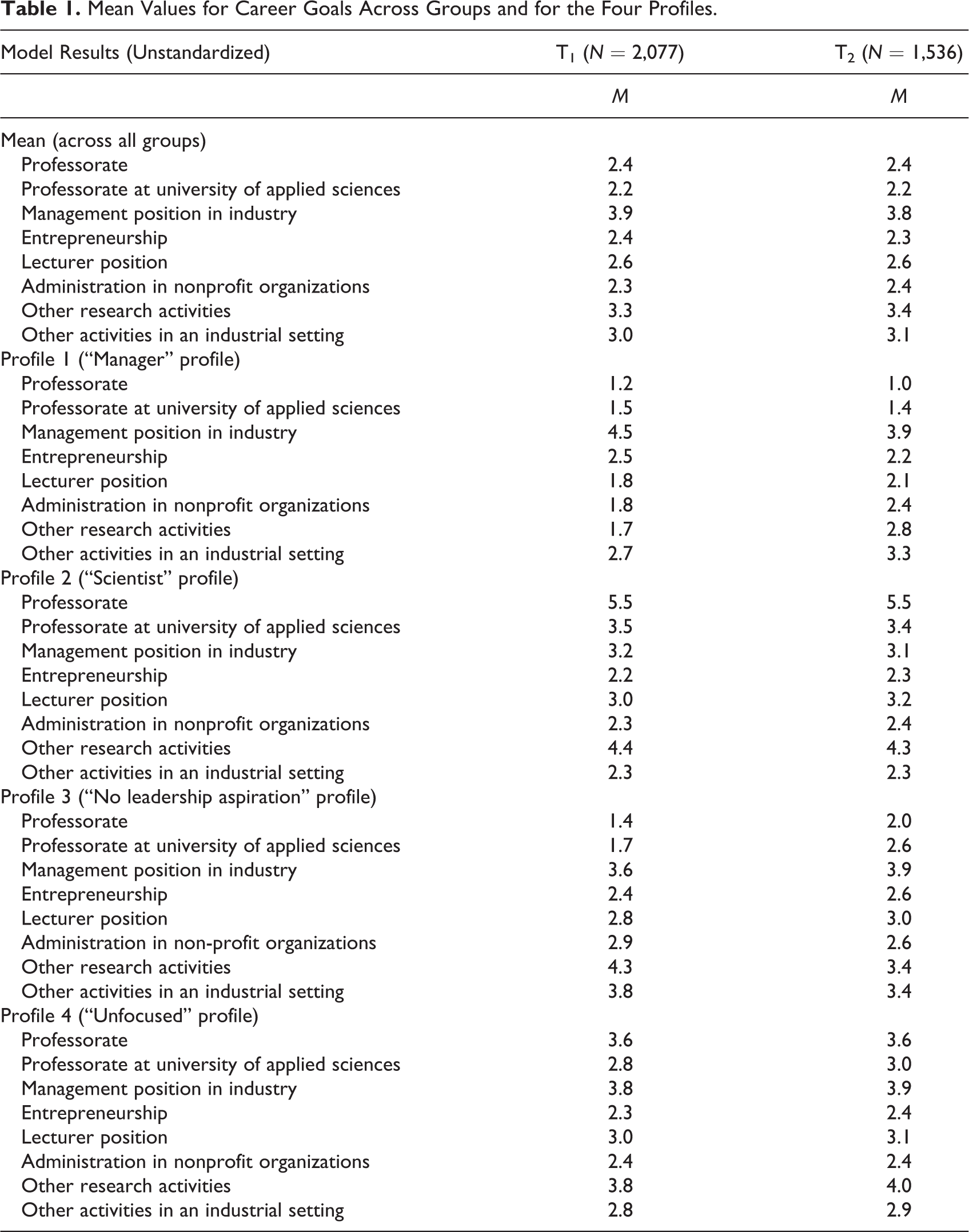
Models with one to five groups were estimated for each measurement point. We achieved structurally similar results using all available data and solely data from participants who participated at both time points. For the first measurement point, fit improved as the number of latent profiles increased. As model comparisons always indicated that the k class model offered a better fit than the k − 1 class model, neither the LMR test nor the BLRT allowed us to decide on the best class solution. Although fit indices did not clearly identify a best fitting model, we used all of the information discussed above (graphical courses of fit indices, likelihood information, and theoretical assumptions) to determine the most plausible number of profiles. We determined the four-profile model to be most appropriate. Individuals assigned to Profile 1 (π1 = 0.33, n ≈ 685) showed highest interest in a management position and demonstrated relatively little interest in all other career paths. In the following, we will refer to this profile as the “Manager” profile. Individuals assigned to Profile 2 (π2 = 0.17, n ≈ 350) had high scores on professorship and other research activities; hereafter this profile is referred to as the “Scientist” profile. Individuals who were grouped into Profile 3 (π3 = 0.30, n ≈ 625) showed interest in research activities and activities in the industrial context that did not involve leadership responsibilities. This profile is called the “No leadership aspiration” profile. Profile 4 (π4 = 0.20, n ≈ 417) represents individuals with relatively moderate scores on all items (hereafter the “Unfocused” profile). The chance of being classified correctly was above 80% for all profiles. Overall, we observed clear shape differences between the profiles (Morin & Marsh, 2015), which supports the adequacy of a person-centered approach.
The results at the second measurement point were structurally similar to those at the first measurement point. Again, fit increased with the number of latent class profiles. As with the first measurement point, we concluded that a four-profile model is most appropriate. Table 1 presents group means of career strivings for the four profiles at T1 and T2.
Mean Values for Career Goals Across Groups and for the Four Profiles.
LTA
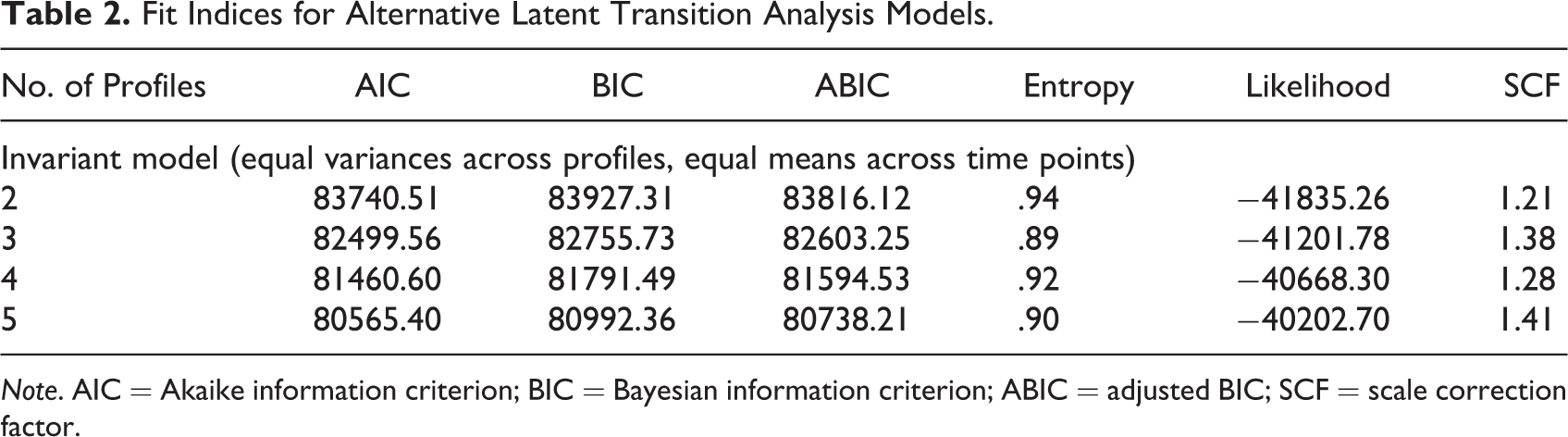
Having established a set of profiles, we used LTA to examine changes in profile membership over time. LTA allows for the estimation of the most likely combination of profile memberships at T1 and T2 on an individual basis. To evaluate the LTA models, we considered a variety of fit indices including AIC, BIC, and ABIC (see Table 2). Again, fit tended to reach a plateau at four profiles. The high entropy value indicates that assignment to these profile combinations was accurate for most participants. We compared these models with alternative models with freely estimated variances across time points. Again, the four-profile solution seemed to best represent our data. Mean value deviations from the overall mean for the final four-profile solution are depicted in Figure 1.
Fit Indices for Alternative Latent Transition Analysis Models.
Note. AIC = Akaike information criterion; BIC = Bayesian information criterion; ABIC = adjusted BIC; SCF = scale correction factor.
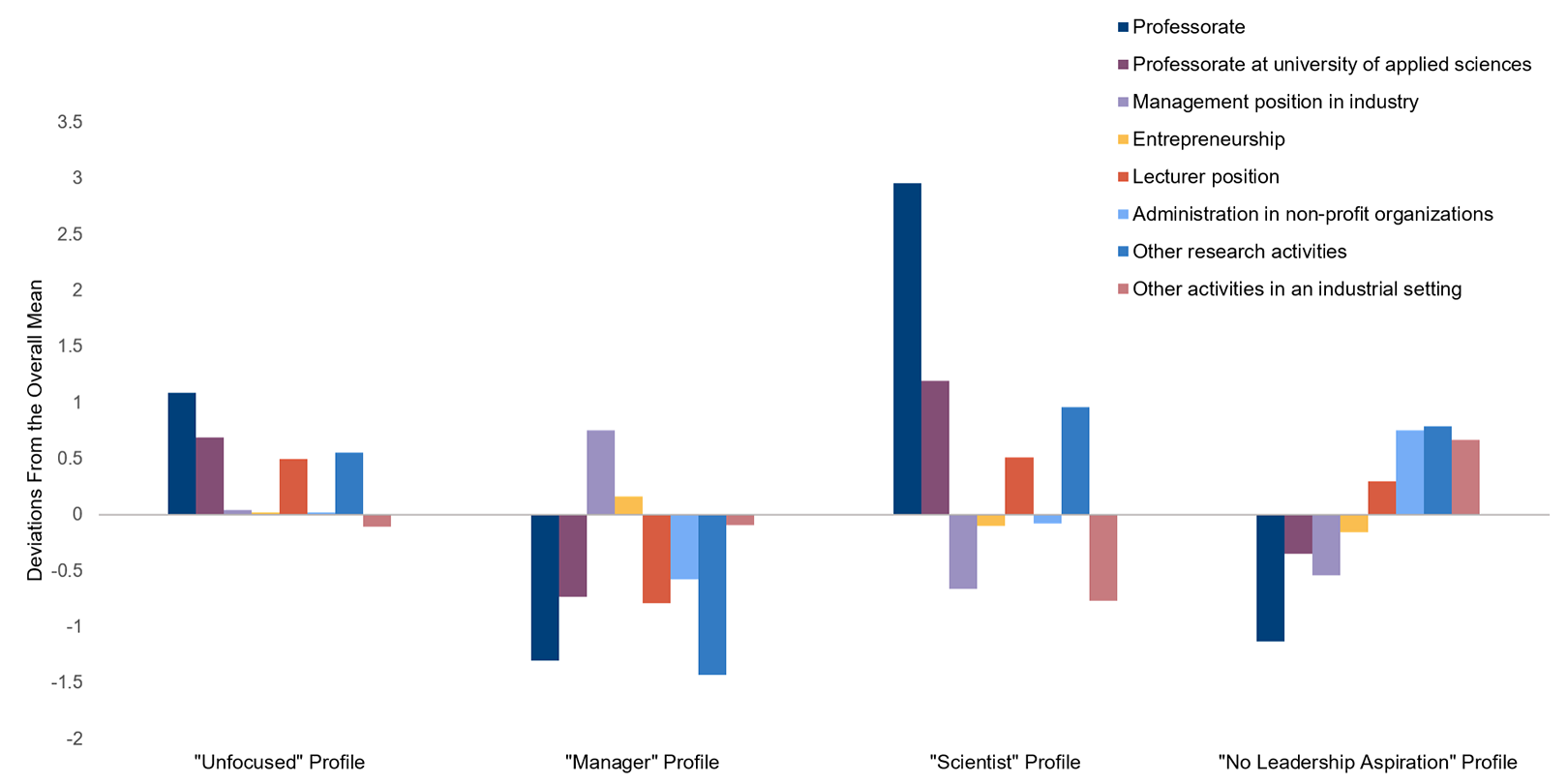
Final latent transition analysis model (four profiles).
While the majority was grouped in the same class for both measurement points, about 21.7% changed profiles. Most changes of profile belongingness at T2 involved people who were grouped into the “Unfocused” profile (transition probability: 50.4%) or the “Scientist” profile (transition probability: 25.0%) at T1. People first clustered in the “Unfocused” profile later shifted to all of the other profiles but mostly to the “No leadership aspiration” and the “Scientist” profile. People clustered in the “Scientist” profile at T1 mostly shifted to the “Unfocused” profile. The “Manager” profile turned out to be the most stable profile, that is, the profile with the least transitions over time. Also, we could not observe any changes from the “Manager” profile at T1 to the “No leadership aspiration” profile at T2.
Exploratory Analyses of Predictors of Profile Membership and Profile Changes
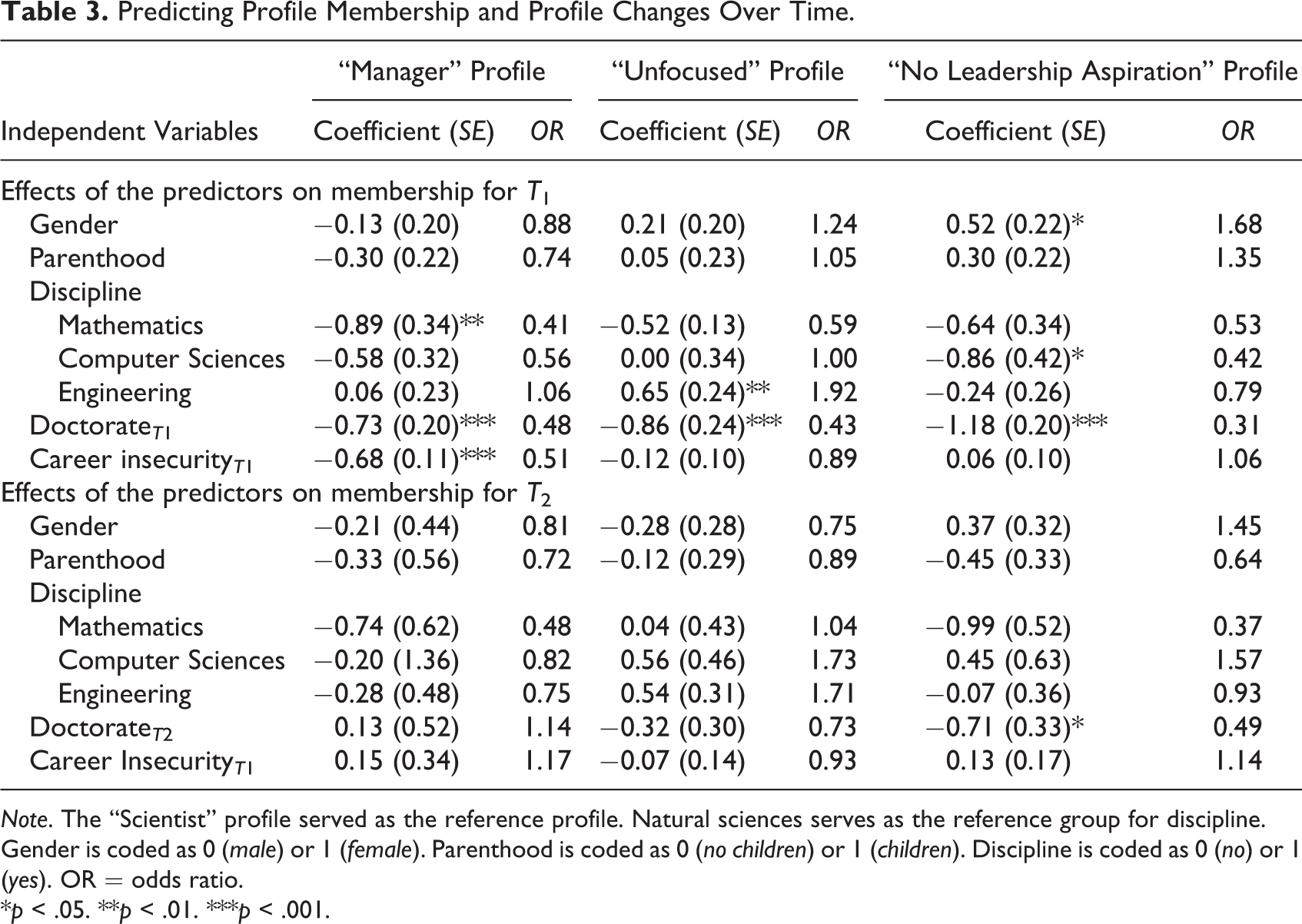
We included several sociodemographic and one psychological variable in our predictive model of profile membership and profile changes. In multinomial regression, one profile serves as a reference category and the likelihood of belonging to the other profiles is compared to the likelihood of belonging to the reference category. The “Scientist” profile served as the reference profile. The results of these analyses are presented in Table 3. We included gender and parenthood as predictors of latent profile membership at both T1 and T2. We also used academic discipline and doctorate at the respective measurement point as a predictor (for an overview, see “control variables” within the measurement section). In terms of psychological predictors, we used career insecurity to predict profile membership at T1 and profile changes at T2. We assumed perceived career insecurity to predict profile changes. We expected individuals belonging to a profile comprising the professorate as a career goal to report relatively high career insecurity and to relatively frequently change profile membership.
Predicting Profile Membership and Profile Changes Over Time.
Note. The “Scientist” profile served as the reference profile. Natural sciences serves as the reference group for discipline. Gender is coded as 0 (male) or 1 (female). Parenthood is coded as 0 (no children) or 1 (children). Discipline is coded as 0 (no) or 1 (yes). OR = odds ratio.
*p < .05. **p < .01. ***p < .001.
At T1, women were more likely than men to be classified into the “No leadership aspiration” profile compared to the “Scientist” profile. With regard to discipline, computer scientists were less likely to be grouped into the “No leadership aspiration” profile, whereas mathematics were less likely to be grouped into the “Manager” profile at T1. Participants from engineering profiles were more likely to be grouped into the “Unfocused” profile at T1. Doctorate holders were less likely to be classified into one of the three target profiles compared to the “Scientist” profile at T1. Additionally, they were less likely to transition to the “No leadership aspiration” profile at T2. Career insecurity only predicted profile membership at T1. People who experienced lower career insecurity were more likely to be clustered into the “Manager” profile at T1. In contrast to our expectations, career insecurity did not predict profile changes at T1.
Discussion
Our goal was to investigate the career goal profiles of early career scientists by extending previous career research in several ways. First, we analyzed career goals from a person-centered perspective. We were able to identify four meaningful profiles. Most participants were interested in multiple goals. Still, for some, a clear interest peak could be observed. This is in line with former research by Rodrigues et al. (2013) who investigated career preferences based on Schein’s (1996) idea of career anchors. They found that “people have more than one dominant orientation or have primary and secondary orientations, whereas others seem to have one clearly salient orientation” (p. 149). Second, we demonstrated that similar profiles existed across two time points, underlining profile validity. Third, in our additional exploratory analyses, we found both profile stability and changes in profile membership to be predicted by selected sociodemographic characteristics.
Our findings provide evidence for the heterogeneity of the career goals of doctoral students and doctorate holders. A four-profile – model best reflected the underlying data. As expected, the analysis revealed that the largest profile consisted of individuals who are highly interested in a management position. In addition – and in line with our assumptions – there was a class of individuals who are clearly interested in an academic career. This class comprised individuals aspiring for a tenured professorship but also other kinds of senior scientist positions. This supports the idea of a taste for science (Roach & Sauermann, 2010). The third profile was an unexpected one. Career-related interests in this profile are characterized by a stronger interest in research activities and in activities within industry but without any ambition for leadership positions. Lastly, Profile 4 is characterized by relatively moderate interest in all considered career paths.
The need for a person-centered approach became particularly obvious when looking at mean differences in single career goals. Most of our participants reported a strong interest in holding a leadership position in industry. If we consider this career goal in isolation, without accounting for the simultaneous endorsement of other career goals, we run the risk of underestimating the relevancy of other career goals for a substantial number of individuals. Dividing individuals who expressed interest in an academic research career into subgroups based on whether or not they aspired to a professorship provided a more detailed and accurate picture of predictors of class membership and changes in class. Our four-profile solution also implies that distinguishing only between aspirations to a career in academia and aspirations to a career in industry is not sufficient for describing individuals’ career goals or making predictions about their future career decisions.
Our longitudinal analyses revealed which shifts in profile membership were most likely. Our data only partly support the results of Sauermann and Roach (2012), who reported a general trend toward reduced interest in research activities over time. We found that people with an unfocused profile were most likely to change classes over time. But they were similarly likely to shift toward aspiring to a professorship or to a management career. Those who were classified into the “Scientist” profile at T1 and who changed classes at T2 did so without losing interest in research itself: They were still interested in research but at the same time gained interest in other career paths.
Gender predicted membership to the “No leadership aspiration” profile. Women were more likely to be grouped into this profile at T1. This is in line with previous research showing that women are less motivated to lead due to, for instance, traditional gender role beliefs or a lack of role models (Elprana et al., 2015). Unexpectedly, career insecurity did not serve as a strong predictor for profile belongingness and profile changes over time. The only substantial relationship could be observed for the “Manager” profile at T1 compared to the “Scientist” profile. Career insecurity might be a reason to not pursue an academic career in the first place but does not necessarily contribute to losing interest in the academic path. Our sample of early career researchers showed a low interest in entrepreneurial activities across all profiles. This is in line with past research showing that Germany records few entrepreneurial activities in international comparison (World Economic Forum, 2016).
Strengths, Limitations, and Future Research Prospects
To our knowledge, this is the first study to take a person-centered approach to the analysis of career goals. We did so by building on a large sample and by using data from two measurement occasions. Our results indicate that doctoral students and doctorate holders are a heterogeneous group with respect to career goal profiles. In contrast to our person-centered approach, previous research typically used a variable-centered approach and tried to predict one specific career goal at a time. Even though this might be helpful to reduce the complexity of analyses, it may not portray an accurate picture of the patterns of career goals held by highly qualified individuals. To gain a better understanding of how the career goals of this group are organized and unfold, it is critical to exploit the strengths of both variable-centered and person-centered approaches. Our study is the first step in this direction.
As with any research project, our study is not without limitations. First, LPA is a theory-driven as well as a data-driven approach. Although we were able to demonstrate that a four-profile model best fit the data, the exploratory nature of LPA and LTA should be kept in mind. We identified similar profile patterns at two time points separated by 12 months, but it is an open question as to whether our findings could be generalized beyond the current sample and context. However, as argued by Gerber et al. (2009), it might not be the goal to analyze careers over different career stages and contexts but rather gain more insight into a more specific group of interest. Further studies with different samples (e.g., doctoral students and doctorate holders from social sciences and humanities) are highly warranted.
Further, future research should investigate the factors that determine group formation in more depth. Due to our research method, we did not consider individuals who achieved their goals and also did not consider the achievement of single goals. Future research should investigate whether the achievement of interim goals changes overall career goal patterns. In our first exploratory analyses, we used a set of sociodemographic and psychological variables to predict profile membership. There are other possible predictors of profile membership and profile changes. Motivational orientations such as need for autonomy and achievement striving, which have been identified as important predictors of career goals in earlier studies (Burk & Wiese, 2018; Lindholm, 2004), should be considered. We used parenthood as a predictor of profile membership and profile changes, but family-related transitions (e.g., marriage, transition to parenthood) could serve as even more powerful predictors for career goal changes. Our sample contained too few participants who experienced these major transitions during the observation period to allow us to include them in our model. Additionally, it is important to investigate career outcomes of profile membership (i.e., goal achievement). Future research should explore whether the coexistence of multiple career goals is a sign of indecisiveness or – as outlined by previous research – may also reflect adaptability, in which case keeping several career options open would be a rational choice (Barak et al., 1975; van Vianen et al., 2009). The goal was to explore structural patterns of career goals in more depth. However, one has to keep in mind that, ultimately, career decisions are not only based on strong career-goal interests but also on other personal characteristics or situational opportunities and constraints as, for example, career shocks (Akkermans et al., 2018).
Implications for Career Research and Counseling
Our findings have research-related as well as practical implications. First, identifying profiles allows the examination of predictors of career decisions in more detail. Career research will benefit from increasing the use of person-centered analyses. Career decisions are often not straightforward and person-centered approaches account for the complexity of factors that determine career-related interests within individuals. Second, the profiles serve as a starting point for investigating goal-pursuit activities. Even though career decisions are not only interest-driven but also depend on situational factors (e.g., short-term contracts) as well as personal characteristics (e.g., self-efficacy beliefs and outcome expectations), additionally considering the possible coexistence of career goals might be of fundamental relevance for a better understanding of who leaves academia and who stays. This might be particularly important for understanding career decisions of individuals facing optimal personal and environmental conditions. Future research should build on goal-profile knowledge rather than averaging relationships between variables. Only then will it be possible to maximize the incremental benefits of supplementing variable-centered analysis with person-centered approaches.
The present results also inspire practical implications: Universities are struggling to retain their high potentials not only because of lacking interest in the academic path but also because of attractive alternative career options in industry (Roach & Sauermann, 2010). Therefore, in order to win these young talents in the long run, universities have to provide support and information on opportunities within the academic track. Our results are also relevant to career counseling. They underline that even highly educated individuals who have decided on an academic discipline and who have invested in completing a doctoral degree still face difficulties in choosing between career options. For many of them, this is not an easy task, and they might profit from assistance, for instance, by counselors and university programs aiming at supporting early career scientists. This assistance could be done by building networks with experts from various fields at early career stages (e.g., by providing mentoring programs). By doing so, young scholars could elaborate on different occupational fields of interests. Moreover, doctorate students and doctorate holders could benefit from trainings that allow (self-)reflection on skills and abilities that are specifically relevant for certain career paths. Assessment centers are one way to provide a guided and behavior-based examination of personal strengths and competencies.
Conclusion
In summary, from a content point of view, our study shows that it is promising to take a holistic perspective on individuals’ career goals rather than investigating one specific career goal at a time. From a methodological point of view, our study demonstrates that LPA and LTA can be successfully applied in empirical career research. Predicting career goal achievement can be modeled more accurately if the possible coexistence of multiple career goals is acknowledged. From a practical point of view, our results could be used in career counseling in university settings. Last but not least, employers might be more successful in recruiting highly educated employees if they know more about the multiple goals pursued by members of this applicant group.
Footnotes
Acknowledgment
This research was made possible by a grant to the third author from the Federal Ministry of Education and Research of Germany (Grant IDs: 16FWN009/19). We gratefully acknowledge this support.
Declaration of Conflicting Interests
The author(s) declared no potential conflicts of interest with respect to the research, authorship, and/or publication of this article.
Funding
The author(s) disclosed receipt of the following financial support for the research and/or authorship of this article: This research was made possible by a grant to the third author from the Federal Ministry of Education and Research of Germany (Grant IDs: 16FWN009/19).
