




Abstract
Thoughts about life after school can be frightening for college students. The uncertainty about employment expectancies can engender crippling anxiety, especially in a time of a major pandemic—COVID-19, and urgent attention is needed. This study, drawing on the self-determination theory, demonstrates preliminary protective effect of positive psychological capital (PsyCap) on employment anxiety among a relatively understudied group—graduating college students (Chinese sample = 546). It further illustrates the mediating mechanism of coping styles in this relation. Thus, the motivational impetus of PsyCap facilitates positive coping style (PCS) while diminishing negative coping style (NCS) which, in turn, hinders students’ employment anxiety. Furthermore, the results revealed that students’ internship experience strengthens the influence of graduating students’ PsyCap on their PCS, but that with NCS and anxiety was nonsignificant. This research proffers valuable insights on college students’ from-school-to-work transition for higher education institutions and career counselors, particularly in this turbulent labor market.
Keywords
The prospect of gainful employment postgraduation has remained a challenge for college students globally. Recent catastrophic events such as the 2008 financial bubble and the ongoing COVID-19 pandemic have effectively, however unfortunately, dimmed this prospect further. Statistically, working hours fell 14% globally, which is equivalent to 400 million full-time job losses (based on a 48-hr working week) in the second quarter of 2020 because of COVID-19 (International Labour Organization, 2020). Moreover, the organization projects that labor market recovery is uncertain. The Organization for Economic Cooperation and Development (2020) describes the current job crisis as one of the worst since the Great Depression (estimated to be 10 times worse than the 2008 financial crisis) and has the potential to morph into a social crisis. The youth, and women, are disproportionately worse off, the organization concluded. This prognostication has been supported by similar expert analyses (Yau & Tsang, 2020). Graduating students have come under intense anxiety from the potential of being unemployed after graduation.
Crises’ cohorts are fingered to be scarred for years or even decades. A longitudinal study in the UK found youth unemployment to predict a wage penalty in the magnitude of 12%–15% at age 42. This study was on graduate cohorts who entered the labor market in the late 1970s and early 1980s (Gregg, 2004). Subsequent studies have affirmed these findings. For instance, Clarke (2019) discovered that the “crisis cohort” who entered the world of work in the midst of the 2008–2009 financial crisis continued to face higher unemployment, lower pay, and worse job prospects up to a decade later, compared to other young people entering work before or after the downturn.
Mental health degradation is one of the effects of a highly labile labor market. Research indicates that young adults at college stage of development are prone to, and actually experience, an array of anxiety (Rith-Najarian et al., 2019). Anxiety has been defined by Malim and Birch (1998, p. 219) as “an emotion that is distressing.” Some of the consequences of student anxiety are school dropout, poor academic performance, impaired social functioning, and suicidal behavioral ideation (Rith-Najarian et al., 2019). Adding to the learning-related induced anxiety, the prospect of joblessness after graduation can even be direr for students’ anxiety. Academics suggest that targeted interventions including on-campus programs are important for mitigating the gnawing claws of anxiety (Autin et al., 2020; Rith-Najarian et al., 2019). For any such interventions to achieve their goals, insights into how anxiety processes are either nurtured or hindered are necessary. This study attempts to offer a robust preliminary attempt in this direction.
Some information is readily available on how managers and organizational behavior scholars approach well-being management at the job level. The common agreement is that proper configuration of organizational- and individual-level factors is necessary for a successful implementation of comprehensive preventative measures and/or treatment intervention for health deficiencies (Bakker et al., 2014). College students’ well-being in its configuration is no different from those of employees. Students’ mental health is impaired by factors at the school, home, and/or student level. Issues of students’ mental health have been explored at the universal, selective, and indicated levels (for review, see Rith-Najarian et al., 2019). However, literature on student anxiety indicates lack of assessment of the effect of graduating student-level characteristics on their employment anxiety. This study therefore explores how graduating college students’ positive psychological capital (PsyCap; i.e., a state-like personal resource of an individual’s positive mental development; Luthans et al., 2004) influences their employment anxiety.
College students are expected to be trained to be job-market-ready. A critical part of job acquisition is job search. The question is: How can institutions of higher learning promote college students’ self-efficacy, optimism, resilience, and hope for the task ahead, particularly in turbulent times? Likewise, in what way(s) can career counselors ready fresh graduates for the job market so they do not suffer ill-being especially in times like the ongoing COVID-19 pandemic? We believe that PsyCap plays a critical role in achieving this end. For instance, PsyCap is found to improve the quality of life and well-being (Santisi et al., 2020), even in difficult times (Zacher & Rudolph, 2020), and hinders ill-being (Mensah & Amponsah-Tawiah, 2016; Zhang et al., 2019). Specifically, undergraduate students high in PsyCap demonstrate high perceived willpower and the capacity to persevere in career pursuits (Cheung et al., 2020). Moreover, PsyCap intervention has proven potent in nurturing behaviors helpful to goal attainment, including employment (Georgiou & Nikolaou, 2019; Georgiou et al., 2019). To this end, PsyCap is contended to be a personal resource instrumental in the experience of graduating college students’ employment anxiety.
Therefore, we employ the self-determination theory (SDT; Deci & Ryan, 2008) to examine the influence of graduating students’ PsyCap on their employment anxiety. This theory is fertile for exploring relations between need-satisfaction motivational tendencies and growth and well-being (e.g., see Cordeiro et al., 2018). To explicate students’ PsyCap and employment anxiety link, we put forward that PsyCap would influence the coping strategies adopted by students in their job search in this volatile labor market. Because PsyCap is demonstrated to induce right attitude to goal pursuit (Georgiou & Nikolaou, 2019; Peeters et al., 2019), this will, in turn, determine graduating students’ anxiety levels. Also, students with industry experience through internship were expected to record a stronger PsyCap–positive coping style (PCS) relation, and a stronger negative relation between PsyCap and negative coping style (NCS), and PsyCap and employment anxiety.
Theoretical Premise—The SDT
SDT is a broad theory for explicating human motivation (Deci & Ryan, 2008). It is concerned with the volitional behaviors of people. People’s volition (willingness) to act indicates whether they are moved to action from within (internal motivation) or that they have internalized the values and merits of external pull (internalization). The central hypothesis is that elements that inspire and facilitate these behaviors underlie wellness and satisfaction. These elements are identified as the three universal psychological needs of humans—competence (i.e., to experience growth and attain an outcome), relatedness (i.e., to have a sense of belongingness), and autonomy (i.e., being willing in your actions). We argue that work serves as an important avenue in young adults’ life to demonstrate competence, to give to society and be given, and to have the capacity to be autonomous in one’s choices. So, the functional importance of work to integrity, growth, and quality of life is enormous and has been generally internalized. Therefore, the prospect of unemployment can be unnerving. Unemployment can shatter a person’s sense of competence, alienate them from society, and limit their ability to choose their actions and endorse them.
Individual differences exert a significant influence on how an individual deals with life’s events (Ryan & Deci, 2017), including the COVID-19 pandemic (Zacher & Rudolph, 2020). Deci and Ryan (2008) conceive individual differences in SDT as critical concepts at the individual level that either nourish or diminish efforts at needs’ (i.e., autonomy, competence, and relatedness) satisfaction. The authors intimate these as causality (i.e., initiation and regulation of behavior and the degree to which an individual is self-determined) and aspirations orientations (i.e., internal including affiliation, generativity, and personal development; and external such as wealth, fame, and attractiveness). This study focuses on the causality component of individual differences in SDT. We believe that causality orientation is influenced by an individual’s personal resources (Affum-Osei, Antwi, et al., 2019; Antwi et al., 2021). One’s self-regulation is key to success in life, including employment search. van Hooft et al. (2020) see job search broadly as a goal-directed, motivational, and self-regulatory process. PsyCap as a personal resource motivates individuals’ effective self-regulation toward resolute jobsearch behaviors (i.e., search intensity), generating higher interviews, offers, and employment (Georgiou & Nikolaou, 2019). More inspiring is the evidence that this state-like personal resource can be developed (Georgiou et al., 2019).
In line with this train of thought, a graduating student can react negatively or positively to the highly inconstant and incomplete labor market. Negative reaction can be NCS manifesting as negative job search strategies; then, the outcome very likely becomes heightened anxiety that is crippling, evoking suicidal ideations (Yau & Tsang, 2020). Such scathing anxiety debilitates the students’ overall wellness. However, the motivational process of engagement, sparked by individual resources, such as student PsyCap, may lead to positive behaviors described as PCS (effective and persistent job search behavior; Georgiou & Nikolaou, 2019; Georgiou et al., 2019;). Positive job search strategies, for instance, will engender students’ well-being by ameliorating negative outcomes of labor market turbulence via positive results like job interviews and offers due to creative job hunt methods (Georgiou & Nikolaou, 2019; van Hooft et al., 2020). Accordingly, SDT is adopted to assess the influence of PsyCap on graduating college students’ employment anxiety and the mediating and moderating roles of coping styles and internship experience.
PsyCap and Employment Anxiety Relation
Volitional behaviors are sustainable. Accordingly, they are found to be evoked by intrinsic motivation or internalization. These motivational drives are identified as underscoring individuals’ successes in their chosen pursuits. Extrinsic motivation, however, is proven to be broadly ill founded and can, in fact, have a countereffect (Ryan & Deci, 2017). This demonstrates that humans cannot be encaged to engage. To attract and sustain engagement, factors that foster sustainable volitional behaviors are crucial. Individual dispositional differences are essential for perception of individuals’ agency and volitional behaviors. College students’ PsyCap is considered in this study. The concept has been defined as a state of positive mental development (Luthans et al., 2004). Essentially, PsyCap is deemed as defining “who an individual is” and “who she or he can be” developmentally. “Who I am” is as, if not more, important than “What I know” (human capital) and “Who I know” (social capital), the authors project. It is plausible therefore that the concept has been marked as an asset to job search performance (Georgiou & Nikolaou, 2019).
People possessing high PsyCap—marked by self-efficacy (i.e., the confidence that one can successfully handle challenges), hope (i.e., positive attitude toward set goals), optimism (i.e., having positive attribution style and attitude), and resilience (i.e., capable of recovering quickly after facing hardship)—cope better in an uncertain and stressful environment (Zhang et al., 2019). For example, the hope dimension of PsyCap has been demonstrated to empower people to chart their own futures. That the more hopeful one is, the more optimistic and resilient she or he becomes. This indicates that the subconstructs of PsyCap are in constant interaction to determine a person’s collective development. Anxiety, seen as emotional distress (Malim & Birch, 1998), is brought about by uncertainty of outcome of an upcoming event. PsyCap, in effect, may significantly reduce anxiety about postgraduation employment expectancies. This is tenable as hopeful, and therefore, optimistic and resilient individuals may be better positioned to navigate the precarity of the current labor market with positive attitudes and behaviors.
As espoused above, work produces values for individuals and societies, and these values have been internalized in people. So, people are inspired by these internalized values to seek to work. However, SDT explicates further that choice and complexity are necessary for our psychological needs’ satisfaction (Deci & Ryan, 2008). Volatile labor markets reduce job seekers’ options while increasing the difficulty of getting a job. These elements of a labor market are anxiety-inducing. Limited choice set and high task difficulty may degrade one’s sense of autonomy and competence, respectively. Nevertheless, we argue that individuals with high PsyCap would fare better in this labor market and therefore exhibit less anxious behaviors because PsyCap mitigates incidence of psychological syndromes (Mensah & Amponsah-Tawiah, 2016; Zhang et al., 2019), but boosts well-being (Santisi et al., 2020). Consequently, PsyCap would provide an effective cushion against employment anxiety and significantly reduce its occurrence. Hence, we hypothesize that:
The Mediation Role of Coping Styles in PsyCap and Employment Anxiety Relation
Expectancies concerning future employment can greatly affect fresh graduates’ well-being. Personal resources are increasingly showing up as tremendous buffers to life’s shocks. However, the benefits of PsyCap for individuals do not just happen. It is interesting to learn that these benefits are possible because of the helpful adaptive behaviors individuals with high PsyCap adopt (Georgiou & Nikolaou, 2019; Zhang et al., 2019). These individuals avoid concentration on their weaknesses. Instead, they adopt a growth mindset by focusing on their strengths and developing new resources. These resources include competencies, and social and professional networks, and creating avenues that increase the options they have to choose from (Dweck & Leggett, 1988). These positive dispositions and behaviors are seen as PCS. PCS is found to strengthen the negative relation between PsyCap and stress (Zhang et al., 2019). On the other hand, graduating students who are high in PsyCap are less likely to exhibit behaviors that are counterproductive to attaining employment. Literature evidence attests to this assumption. For instance, Zhang et al. (2019) found that primary and secondary school teachers with high PsyCap are less inclined to use NCS in dealing with occupational stress. Therefore, students with high PsyCap are more likely to seek helpful, practical ways of taking on challenges such as going to job fairs, doing extensive research, taking up internships, and undertaking activities which build them up (Georgiou & Nikolaou, 2019). Based on this discussion, the following hypothesis is offered.
The Moderation Effect of Student Internship Experience on the Links Between PsyCap, Coping Styles, and Employment Anxiety
Uncertainties about future expectancies, as indicated, are anxiety-provoking. Most students spend all their college years without real-life work experience. This can make their school-to-work transition, particularly in this uncertain labor market, all the more anxiety-laden. One sure way to learn about the real world of work while in school is getting in the “thick of the action” through student internship opportunities. Internships are defined as the “practicum-based education experience that are seen as a valuable step in integrating classroom-based learning with real world exposure” (Chen et al., 2018, p. 89). The benefits of student internship are manifold: It bridges the worlds of classroom and workplace in the most praxis-oriented way, bestows hands-on experience of day-to-day industrial operation, clarifies students’ career expectations, and facilitates the formation of a lifelong valuable professional network of peers and mentors.
These benefits are found to nurture students’ employability (generally defined as “having the skills and abilities to find employment, remain in employment or obtain new employment as, and when, required” [Crossman & Clarke, 2010, p. 602]). As a consequence, graduating college students who are high in PsyCap with high internship experience may be expected to be less anxious about their future employment because these students are likely hopeful and optimistic about the future. The optimism and hope emanate from having a fair idea of what the future looks like (Madigan et al., 2019). A meta-analysis of job seekers showed that those who were optimistic engaged in effective job search behaviors and were more likely to gain employment (van Hooft et al., 2020). And that is what internship actually offers interns, thereby bolstering their confidence to face the future job market. With the employability effect of internship, and PsyCap nurturing the right disposition, we believe that student internship experience will strengthen the negative relations between PsyCap and employment anxiety. Therefore, we hypothesize that:
It is safe to reecho the popular axiom that when one knows better she or he does better. Internships open the demands of industry all up to students. Having observed firsthand the socioemotional dynamics of the workplace and what professionalism means, graduating students with high internship experience may be more likely to utilize efficient and context-appropriate job search methods. That is because internships as espoused above can enrich students with experienced mentors who guide them along their career paths (Crossman & Clarke, 2010). These may include guidance to create winsome resumes and proper conduct in before-, during-, and after-interview correspondence. This illustrates the extent of the power of “who you know” (social capital) (Affum-Osei, Asante, et al., 2019). Also, the expanded professional network means students with high internship experience have high probability of getting job-relevant information and leads. All this means that the graduating student with high internship experience is more likely to adopt PCS in this unstable labor market. In respect of this discussion, the following hypothesis is put forward.
Method
Study Context
Rising unemployment due to the higher education expansion in China has long been a topic of expert concern, especially among graduates of noncoastal regions, particularly the central belt (Li et al., 2014). The COVID-19 pandemic has greatly worsened this plight with 27 million job losses in urban centers by March 2020 (Liang, 2020), while an estimated 8.74 million fresh graduates entered the job market in summer, making the job prospects hopelessly bleak (Jingyi, 2020). The age range of 20–24 was among the groups hardest hit by the pandemic, causing them to resort to substance use and gambling or becoming suicidal (Yau & Tsang, 2020). In 2021, China’s economy is said to be the only major economy fast rebounding from the pandemic. However, Wang (2021) notes, graduates still “can’t find jobs.” As a coping mechanism, these graduates further their education hoping to expand opportunities but the author reasons the problem is being postponed instead. Therefore, readying graduates for the job market of today is an urgent task.
Participants and Procedure
Participants of this research consisted of final-year Chinese undergraduates from a major public university in China recruited via flyers on campus notices and in classrooms seeking participants in November 2020. The advertisement gave a brief introduction and explained the significance of the research project. Upon scanning the QR code to sign-up, participants were again informed about the purpose of the research and were assured of the confidentiality of their responses. The link/QR code to the online questionnaire was then sent to the students upon consent. After completing the electronic questionnaires, participants were rewarded with a 3 RMB HongBao (literally a “red envelope” which means a gift of money). The final sample (546) used for the study consisted of 200 (36.6%) males and 346 (63.4%) females. A little over half of the students were studying toward a degree in economics and management (51.8%). Most (80%) of them reported coming from economically comfortable household. Greater proportion (67.2%) were rural dwellers; the majority (74%) of them interned at least occasionally. A great percentage (91.4%) reported having academic achievement below 70%; also, more than half (59%) reported to be, in the least, much impacted by the COVID-19 pandemic.
Measures
Coping style
Chinese version of coping styles’ scale (Xie, 1998) consisting of 20 items, divided into two dimensions (i.e., PCS [items: 1–12; e.g., try to see the bright side of things] and NCS [items: 13–20; try to forget the whole event]), and rated on a 4-point Likert-type scale (1 = never to 4 = frequently), was used. Prior research found the scale adequately reliable and a valid predictor of burnout (Zhang et al., 2019; α [PCS = .82, NCS = .79]).
Employment anxiety
With the preamble “When I thought about getting employment after graduation in the last week…,” a seven-item Anxiety subscale (e.g., I experienced trembling [e.g., in the hands]) of the Chinese version of the 21-item Depression, Anxiety and Stress Scale (DASS-21) using a 4-point Likert-type scale (1 = did not apply to me at all to 4 = applied to me most of the time) was used (Lovibond & Lovibond, 1995). This scale has been shown to correlate with basic psychological needs and coping styles in expected directions and record sufficient reliability result (Novak et al., 2021; α = .84).
PsyCap
Chinese adaptation of the PsyCap questionnaire (Yu et al., 2012) consisting of four dimensions, self-efficacy (e.g., I am confident in my ability in dealing with problems), resilience (e.g., I can stay calm when facing difficult challenges in my schoolwork), hope (e.g., when facing problems, I can think of different ways to solve the problems), and optimism (i.e., I am optimistic about the future, even if my future development is filled uncertainties), was used. The scale composed of 24 items with each dimension having six items scored on a 4-point Likert-type scale (1 = strongly disagree to 4 = strongly agree). The scale shows adequate reliability and relates positively to mindful learning (Lin, 2020; composite reliability [CR] = .89).
Demographics
Students’ profiles measured were sex (1 = male and 2 = female), academic major (1 = economics, 2 = management, 3 = literature, 4 = science, 5 = engineering, 6 = law, 7 = pedagogy, 8 = history, 9 = agriculture, 10 = art, and 11 = others), household income (1 = poor, 2 = normal, and 3 = comfortable), internship (1 = rarely, 2 = occasionally, and 3 = often), academic records (1 = 30% and below, 2 = 31%–70%, and 3 = above 70%), place of domicile (1 = urban and 2 = rural), and COVID-19 effect (measured with one item: “How much has COVID-19 impacted your life?”—scores on 4-point Likert-type scale [1 = not much, 2 = somewhat, 3 = much, and 4 = a great deal). Results of students’ demographics have been reported under the participants’ section of methods.
Results
The data for this study were analyzed using SPSS Version 25.0 and AMOS Version 24.0. Data processing and analyses were carried out in four steps according to recent literature on multivariate data analyses using structural equation modeling (SEM; Hair et al., 2019).
Common Method Biases
To check the pattern of missing values, Little’s “missing completely at random” test was performed and was statistically nonsignificant (χ2 = 292.112, df = 341, p = .974). Accordingly, missing data were treated using the full information maximum likelihood per Enders and Bandalos’s (2001) recommendation. Further, common method bias (CMB) analysis was conducted to check the variance among all the observed items using Harman’s single-factor solution (Podsakoff et al., 2003). There was no single factor explaining (>50%) variance (Tehseen et al., 2017). The covariance between the variables was 16.18%, and the model fit for the single factor confirmatory factor analysis (CFA) model was poor (χ2/df = 7.310, standardized root mean square residual [SRMR] = .123, comparative fit index [CFI] = .823, Tucker–Lewis index [TLI] = .760, and root mean square error of approximation [RMSEA] = .108). These results demonstrate that CMB is not an issue in the data (Podsakoff et al., 2003).
Descriptive Statistics and Constructs’ Validity and Reliability
Constructs’ descriptive statistics and partial correlation analyses between psychological capital, coping styles (PCS and NCS), and employment anxiety were performed. The results of CFA showed good fit, χ2(3401) = 1,231, χ2-to-df index of 2.76, SRMR = .03, CFI = .96, TLI = .94, RMSEA = .05, as well as CFA loadings after item-level modification. The constructs’ discriminant validity was met with average variance explained (AVE) values being greater than maximum shared variance values. The observed AVE values were above .50, and the square roots of AVEs were greater than the interfactor correlation coefficients, indicating convergent validity of the constructs. Again, constructs’ CRs and items’ internal reliabilities (α) were examined as recommended by Hair et al. (2019). Constructs’ CR and items’ α met the recommended threshold (.70; Bagozzi, 1993; Hair et al., 2019). The results of partial correlation analysis showed that anxiety and NCS were significantly and negatively correlated with PsyCap and PCS (p < .001) but positively with each other (p < .01). PCS was significantly and positively correlated with PsyCap (p < .01; see Table 1).
Descriptive Statistics, Constructs’ Reliability and Validity, and Correlation Matrix.
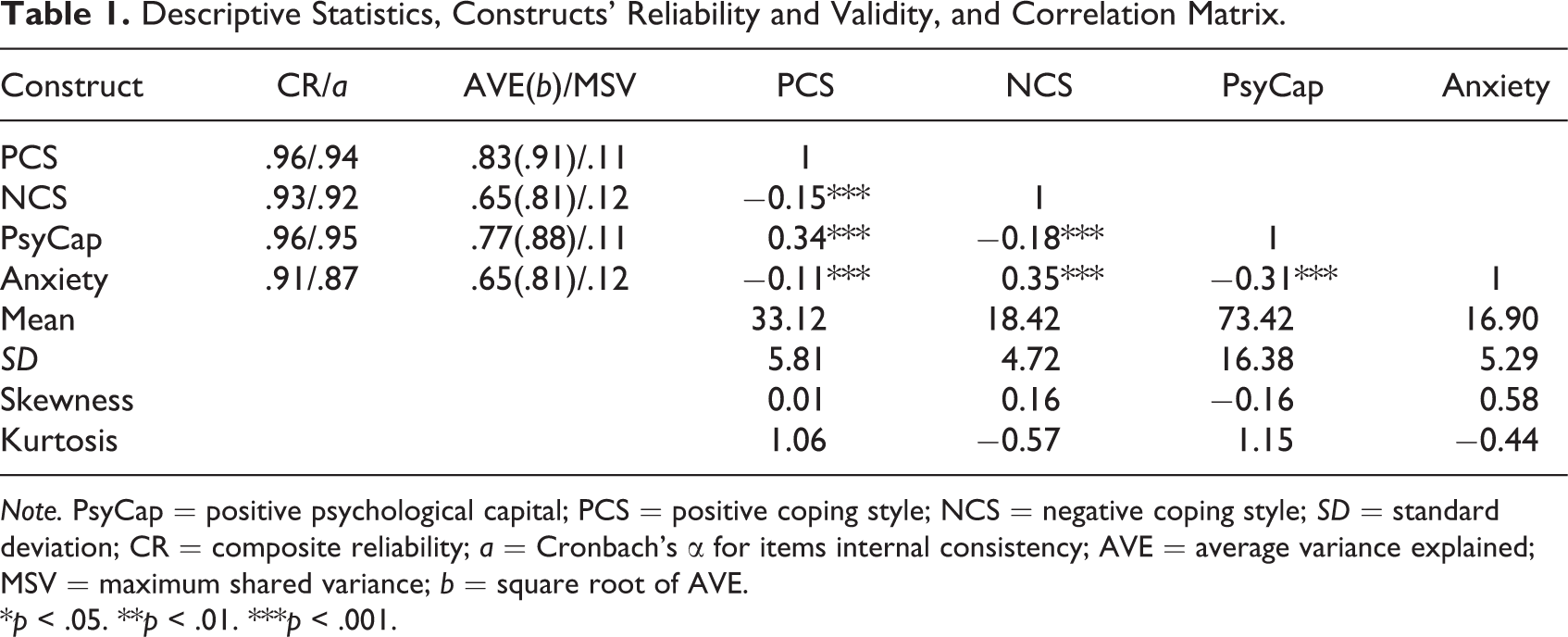
Note. PsyCap = positive psychological capital; PCS = positive coping style; NCS = negative coping style; SD = standard deviation; CR = composite reliability; a = Cronbach’s α for items internal consistency; AVE = average variance explained; MSV = maximum shared variance; b = square root of AVE.
*p < .05. **p < .01. ***p < .001.
Direct Effects
Second, SEM was used to examine the relationships between (i) PsyCap and anxiety and (ii) PCS and NCS and anxiety. In the model, academic major, sex, household income, academic records, internship experience, and COVID-19 effect were treated as control variables. The model fit indices were as follows: χ2 = 40.401, df = 18, p < .01, χ2/df = 2.244, RMSEA = .048, SRMR = .041, and CFI/TLI = .93/.83. From the model, PsyCap showed a significant negative effect on employment anxiety (b = −.24, t = −5.57, p < .001), NCS revealed a significant positive effect on employment anxiety (b = .33, t = 8.27, p < .001), and PCS indicated a significant negative effect on employment anxiety (b = −.06, t = −2.20, p < .05). The model explained 46% variance in the dependent variable (employment anxiety; see Table 2).
The Results of Direct and Indirect Effects’ Models.
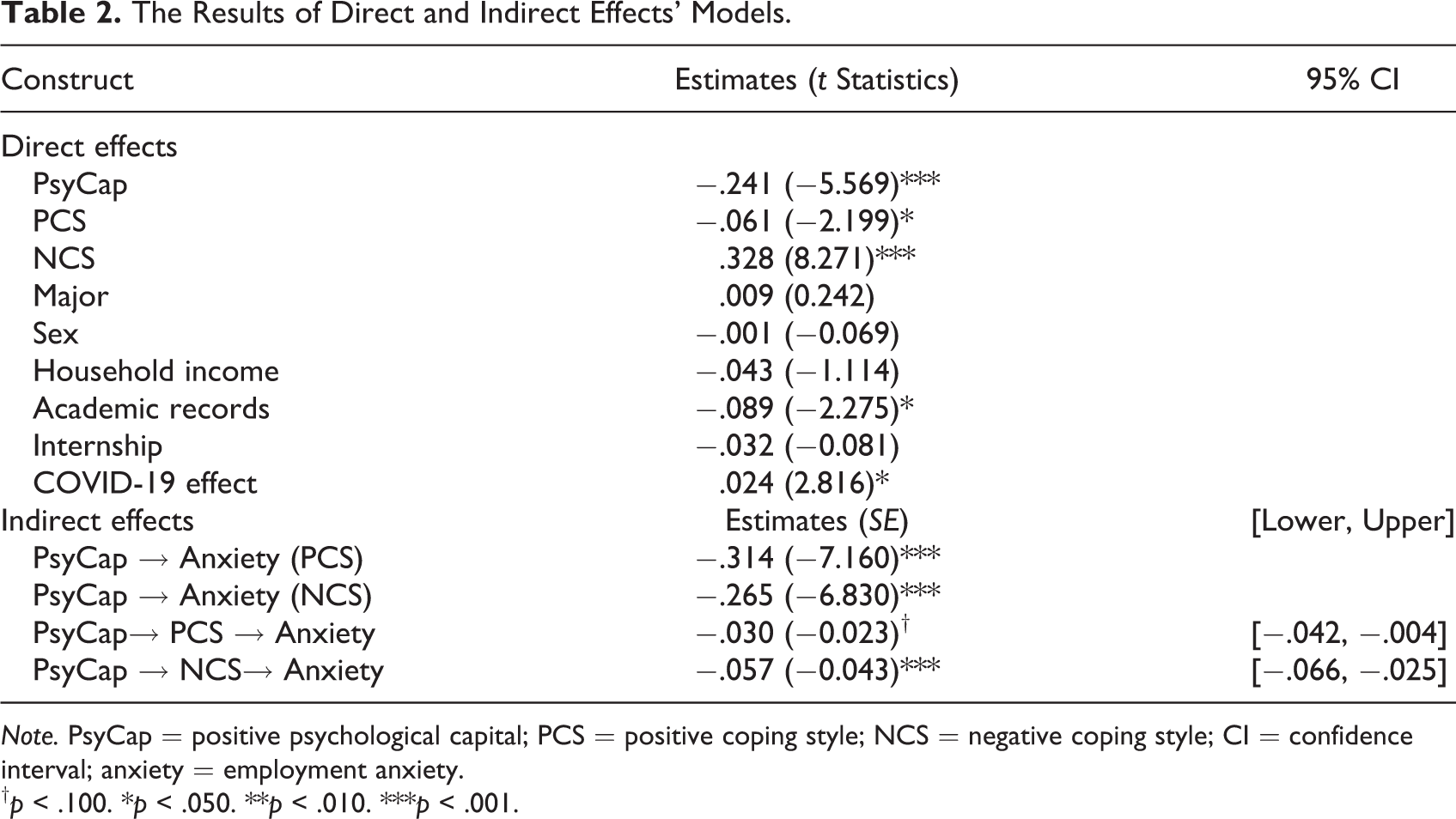
Note. PsyCap = positive psychological capital; PCS = positive coping style; NCS = negative coping style; CI = confidence interval; anxiety = employment anxiety.
†p < .100. *p < .050. **p < .010. ***p < .001.
Indirect Effects
Third, the indirect effect of PsyCap on employment anxiety with PCS and NCS as mediators was tested. Biased-corrected bootstrapped method with 95% confidence interval (CI) was used. The mediation model fit indices were as follows: χ2 = 10.747, df = 6, p > .05, χ2/df = 1.791, normed fit index (NFI) = .96, TLI = .90, RMSEA = .04, SRMR = .04, and CFI = .98. Path 1, that is, the mediating role of PCS in the relationship between PsyCap and employment anxiety was significant (β = −.030, SE = −.023, CI [−.042, −.004], p < .053). Path 2, that is, the mediating function of NCS in the relationship between PsyCap and employment anxiety, was supported (β = −.057, SE = −.043, CI [−.066, −.025], p < .001). Thus, the results indicate that PCS and NCS partially mediated the link between PsyCap and employment anxiety. To establish the nature of mediation, the direct effect in the PsyCap to employment anxiety path was examined after the mediation. And the result shows that the path remained significant, indicating partial mediations (see Table 2).
Moderation Mechanism
Lastly, a path model examining the moderating mechanism of students’ internship experience in the PsyCap and coping styles (PCS and NCS) and employment anxiety links was conducted. The model predicting the interaction effects fitted the data (χ2 = 123.367, df = 37, χ2/df = 3.33, NFI = .91, CFI/TLI = .94/.92, RMSEA = .03, SRMR = .04). A significant two-way interaction effect was found between PsyCap and internship experience on PCS (β = .115, SE = .228, t = 2.86, CI [.034, .21], p < .05); however, that between PsyCap and NCS was not significant (β = .028, SE = .195, t = 0.656, CI [−.055, .109], p > .05); and that between PsyCap and employment anxiety was also not significant (β = .024, SE = .478, t = .590, CI [−.049, .101], p > .05). Thus, for students with high internship experience (set at 1 SD above the mean), the positive relation between PsyCap and PCS is more likely to increase than students with low internship (set at 1 SD below the mean). The results of the significant interaction effect have been plotted and presented in Figure 1.
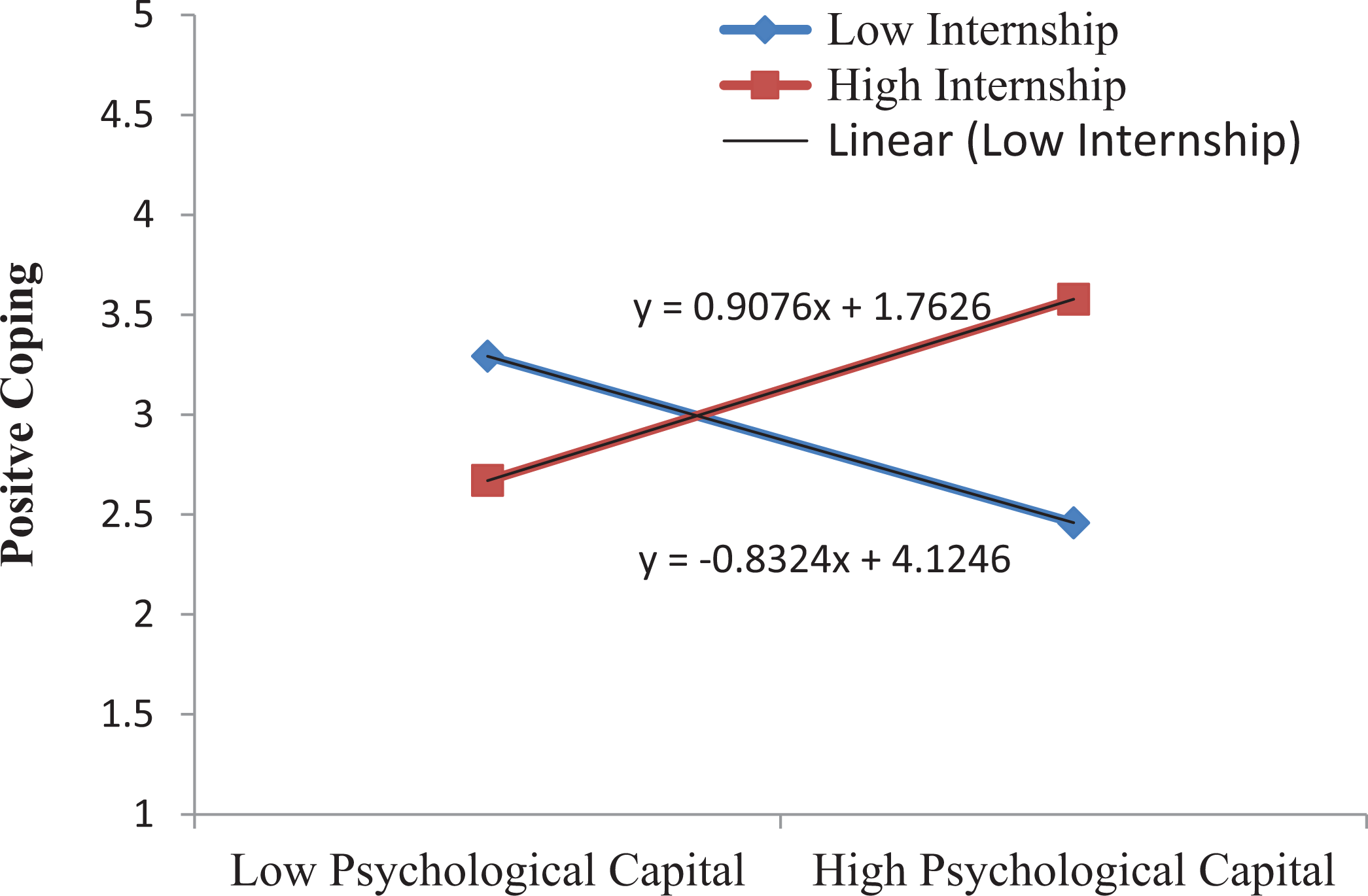
Student’s internship experience strengthens the positive relationship between positive psychological capital and positive coping style.
Discussion
This study tests the motivational pathway of well-being with a cross-sectional sample from Chinese college students. The literature review generated four working hypotheses. After empirical analyses of the data, Hypotheses 1 and 2 were fully supported, but Hypothesis 3 was not and Hypothesis 4 received partial support. The support for Hypothesis 1 implies that students’ PsyCap potentially inhibits college graduating students’ employment anxiety. This result is consistent with prior research which reports empirical evidence on the protective capacity of individuals’ PsyCap (Luthans & Youssef, 2007; Youssef & Luthans, 2007; Zhang et al., 2019). Again, the mediation analyses (i.e., Hypothesis 2) illustrate clearly that PsyCap nurtures PCS while inhibiting NCS (i.e., emotions, attitudes, and behaviors) in a way that checks anxiety. These findings are in accord with evidence in well-being studies that posit that PsyCap plays a protective function against ill-being (Mensah & Amponsah-Tawiah, 2016; Zhang et al., 2019). Essentially, PsyCap is found to be salient to individuals’ self-regulation (coping styles) which to an extent determines their well-being. Lastly, the results show students’ internship experience as moderating the relation between PsyCap and PCS but not that between PsyCap and NCS or that between PsyCap and employment anxiety. This finding is interesting, in that, it shows the interaction between PsyCap and internship experience as working to generate or promote PCS but not to reduce NCS, or even anxiety. It, however, supports the empirical findings of prior studies that PsyCap gives rise to positive behaviors, which consequently generate favorable outcomes (Georgiou & Nikolaou, 2019; Georgiou et al., 2019).
Theoretical Implications
Theoretically, the findings contained in this study have enlightening implications for the constructs and the theory deployed in the study. First, PsyCap as a motivational element seen as uniquely determining the well-being of individuals has been illustrated by the study. The findings strengthen the assumption of the SDT that individuals’ psychological need to be competent, to relate and be autonomous in their relations and actions determine well-being. That in attaining these ends, personal resources such as PsyCap serving as motivational, and therefore protective, agents function against physiopsychological malaise in this and other studies have been witnessed (Mensah & Amponsah-Tawiah, 2016; Zhang et al., 2019). Therefore, PsyCap demonstrably can be put forward as a potent state-like buffer for some of the elements of ill-being that eat away the health of individuals. This also goes to bolster the results found in other areas of human endeavor including the nursing and police services (Burke & Deszca, 1986; Cordes & Dougherty, 1993).
Second, the complex mechanism of the motivational pathway of positive engagement has been clearly supported by the mediation analyses where PsyCap promotes PCS which in turn orchestrates positive dispositional and behavioral tendencies that nurture better psychological health. Overall, assumptions of the SDT adopted to explore students’ employment anxiety given their PsyCap in the context of their enacted coping strategies have been, on a whole, supported. This buttresses the theoretical utility of the SDT and encourages researchers to adopt it in the exploration of individual well-being across different life spheres and circumstances.
Lastly, the interactive effects of internship experience in PsyCap and PCS relation confirm the popular axiom of when one knows better, she or he does better. These effects, from SDT perspective, reinforce the theoretical notion of SDT that complexity is central to the attainment of human psychological needs which by extension conditions individuals’ well-being. The interactive influence of PsyCap and graduating students’ internship experience on PCS is likely the result of the hypothesis that exposure diminishes complexity that is anxiety-inducing and fosters creativity (Antwi et al., 2019). Graduating students’ internship experience interacting with their PsyCap to regulate their coping patterns illustrates the theoretical assumption that with reduced complexity and the attendant buffered anxiety, individuals make moves with clear-headedness. Additionally, students with high internship experience are likely to develop a sense of competence in seeking and getting employment. These explain why students with high internship experience show a high propensity to enact PCS attitudes and behaviors. Ultimately, when people know and understand what the expectations are, they tend to do better and as a result are less likely to suffer ill-being.
Practical Implications
In terms of practice, the study’s results hold important pointers in employment anxiety management, especially in this pandemic. First, COVID-19 has been acknowledged as creating precarious labor market conditions for a generation of labor force transitioning from school to work (Autin et al., 2020). These conditions are deemed insidious to the well-being of those affected (Wanberg, 2012), impairing their mental health (Paul & Moser, 2009). Therefore, the evidence that PsyCap weakens employment anxiety is a positive signal to management of universities and other institutions of higher learning and to career counselors to take informed and decisive actions. That in times like this, individuals’ innate strengths may be the resources needed to make all the difference. The findings contained in this study enjoin management of institutions of higher learning and career counselors to actively attend to nurturing the positive psychology of students. For example, management of higher educational institutions, in close collaboration with positive psychologists, need to create on-campus positive psychology labs. The promulgation of on-campus positive psychology labs can help students develop the necessary state-like resources, particularly PsyCap which is found in this study to buffer against anxiety among graduating college students. These labs may complement the counseling and placement centers in most of our higher education institutions in helping students navigate the pressures of academic work and the uncertainty of work prospects after school, especially in this trying time. Evidence of training intervention developing PsyCap has shown impressive results on job seekers’ job search behaviors and outcome (Georgiou & Nikolaou, 2019; Georgiou et al., 2019).
Again, different schools and departments in universities, and other higher learning institutions, can purposefully seek out relevant cooperative relationships with industry. Resource persons from industry could be brought to the classroom to share what happens at the organizational floor with respect to practical and abstract topics students are learning. These relationships should extend to internship opportunities or arrangements for students to familiarize themselves with different workstations and job environments. With these arrangements, social and professional networks can be developed as a resource for future use. Wanberg (2012) intimates that in difficult times like the ongoing COVID-19 crisis, social networks are a great facilitator for employment. Moreover, students–industry practitioner pairing can facilitate mentorship and sharing. All these, in effect, will afford them an idea of what to expect from the job environment. Frequent exposure to the job environment will help students develop skills, capabilities, and social and professional networks they can fall on when they are out of school and looking for employment. These practical initiatives will help students manage their expectations and the anxiety that comes with uncertain future work expectancies. After all, students with internship experience are more employable than those without (Chen et al., 2018; Crossman & Clarke, 2010).
Also, professional career counselors can work with their clients, particularly those who just joined the workforce from school to develop their within-person resources such as positive psychological capital, self-efficacy, core self-evaluation, and mindfulness among others to help lower employment anxiety. Furthermore, vocational experts can highlight the benefits of taking up voluntary and internship works to build support systems and competencies needed to navigate the job market and allay anxiety (Madigan et al., 2019). Such a professional support system may improve coping efficacy which is beneficial to life satisfaction (Flores et al., 2020).
Limitations and Directions for Future Studies
Although this article provides a thorough analysis of the topic and offers important insights, the following limitations have been noted. First, this study is cross-sectional, so a longitudinal study that follows the participants across an extended period may provide deeper insight into the subject at hand. Also, data were collected via self-administered questionnaire. An in-depth interview or observational methods for data collection on-site by researchers may offer more unbiased and comprehensive results. Further, since this study focused on a relatively small sample of Chinese university students, its findings cannot be generalized. A more expansive, cross-cultural/country study would provide better contextual information taking into consideration differences among cultures, economies, and sociodemographic factors.
Footnotes
Declaration of Conflicting Interests
The author(s) declared no potential conflicts of interest with respect to the research, authorship, and/or publication of this article.
Funding
The author(s) disclosed receipt of the following financial support for the research, authorship, and/or publication of this article: This work was funded by Grant ZC304020924 from the ZJNU Postdoctoral Research Fund, and The Major Project of Positive Psychology of BJWF in 2020.
