



Abstract
The current study suggested and tested a model to investigate the associations between adolescent future expectations of work and education (AFE-WE; adaptive responses) and positive future expectations (PFE; adaptivity) through concern, control, curiosity, and confidence (adaptability resources) as well as the role of the gender. The data were gathered from 806 high school students (59% girls), recruited from eight different public schools in Gaziantep, Turkey. Structural equation model was used. The results showed that the PFE predicted the AFE-WE and concern, control, curiosity, and confidence. Yet, concern contributed to the AFE-WE, only and partially mediated the relationships between the PFE and the AFE-WE. The proposed model did not change across gender. These findings were discussed within cultural context and addressed implications for theory, research, and practice.
Keywords
Adolescence is a crucial period including some vocational developmental tasks such as making initial career decisions (Porfeli, 2008), thus encompasses many opportunities for self-exploration from the perspective of positive youth development (PYD). PYD focuses on enhancement and improvement of the strengths, skills, competencies, and potentials, instead of pathology; any problems, weaknesses, and incapacities of young people (Damon, 2004). PYD focuses on promoting five Cs—competence, confidence, connection, character, and caring, in young people’s lives to foster them developmentally and to reduce personal, social, and behavioral problems and risks, which means the development of the sixth C; contributions to self, family, and society (Lerner et al., 2005). Within this perspective, PYD aims to promote various developmental trajectories of young people, including career development (Hirschi, 2009), to prompt desired youth outcomes such as more prosocial behavior, better school performance, increased well-being, and life satisfaction as well as effective contribution to society (Durlak et al., 2007). Thus, PYD focuses on improving social and emotional competencies such as self-awareness, decision making, self-efficacy, and coping skills of young people, which contributes to new positive developmental results in youth, in turn. Considering these competencies are essential skills for career development also, enhancing career development of young people would support positive development of youth. Not surprisingly, preparing the youth for the working life is an essential part of PYD programs (Larson, 2000). This is critically important, especially considering global youth unemployment rates, which was reported as 11.8% (International Labour Organization [ILO], 2019). Besides alerting rates of unemployment, young people (aged 15–24) and adults in working life in low- or middle-income countries live in extreme or moderate poverty (ILO, 2019). Moreover, the World Economic Forum (2020) addressed social injustice and economic problems among global risks and the fact that youth unemployment will remain an important problem for the world. Considering these facts and the links between employment, in fact having a decent job, and mental health (Duffy et al., 2019), it will be a proactive step to explore adolescents’ future expectations of work and education (AFE-WE) and the related variables within the perspective of the PYD.
AFE-WE
Future expectations mean that one believes that a prospective life course or some specific events will occur in the future and are expressed as hopes and fears (Seginer & Schlesinger, 1998). Carver et al. (1994) stated that positive expectations “serve as the focal point for one’s energies in striving for the future” (p. 139). Accordingly, future expectations affect motivation, exploration, planning, and commitment to the goals (King & Gaerlan, 2014), which are necessary for higher education and career development (Seginer, 2008). It was underlined that adolescents having hopeful expectations from future are positively associated with PYD (Lerner et al., 2005). PYD involves internal and external developmental assets. While external developmental assets are related to young people’s ecological or social (i.e., contextual) assets, internal assets refer to individual-level assets, including commitment to learning (e.g., achievement motivation), positive values (e.g., self-care and helping others), social competencies (e.g., decision-making skills), and positive identity (e.g., having life purposes and being optimistic about the future; Benson et al., 2006). Thus, positive future expectations (PFE) are critical for promoting PYD (Schmid et al., 2011) and highly relevant to be examined in adolescence period (Hirschi, 2009).
To do this, McWhirter and McWhirter (2008) developed a scale, the Future Expectation Scale for Adolescents (FESA), measuring adolescents’ orientation of future expectations within specific domains such as family, health, career, and education. The research indicated that future expectations of young people mostly were related with career and academic outcomes such as having realistic future career plans, self-control beliefs over reaching career goals, and self-focused personal goals (e.g., McCabe & Barnett, 2000). In addition, AFE-WE were found associated with the aspirations and academic self-efficacy (e.g., McWhirter & McWhirter, 2008). In accordance with this, in Turkey which has relatively high young population (aged 15–24), 15.4% of the total population (The Turkish Statistical Institute [TUIK, 2021c]), Adolescent Profile Survey in 2008 and 2011 indicated that adolescents addressed their future expectations of work and education such as having a decent job (%27.2), lifestyle including happy and peaceful life and high income (17.5%), and a qualified education (17.1%), mainly. The most prominent challenges that Turkish adolescents perceived was unemployment (Şen, 2011). The previous work also indicated that adolescents in Turkey pointed out future expectations of work (Şimsek, 2012), mostly. Accordingly, the study of adaptation of the FESA into Turkish culture indicated the highest correlation between the total scale and the AFE-WE, compared with other dimensions (Tuncer & Bahadır, 2018).
These research findings can be better understood based on the youth statistics from Turkey. The unemployment rate for young people between 15 and 24 years was reported as 27.1%, while the employment rate showed 28.3% (TurkStat, 2021a). Youth unemployment rate increased by 9.3% within 7 years from 2014 to 2021 (TurkStat, 2021a). Even, unemployment rate of higher education graduates was 12.8% in 2020 (TurkStat, 2021b), somewhat implying difficulty in obtaining decent work for many young people, even if they obtained a bachelor degree. Specific to Gaziantep, the city where data were collected is located in the Southeastern Anatolia Region was declared the sixth greatest city of Turkey in terms of industry, trade potential, and agriculture and one of the pilot cities for initiating Industry 4.0 investment in Turkey (Ministry of Science & Industry and Technology, 2018). However, it was reported that the city has higher youth population and higher youth unemployment rate (Sönmez Didin & Özerkek, 2018) as well as problems such as pollution, lack of infrastructure, and potable water (İpekyolu Kalkınma Ajansı, 2015). In addition, the city has received exceptionally high Syrian refugee migration because of being located in Syrian border of Turkey (Ministry of Interior Directorate General of Migration Management, 2017). Thus, it could be inferred that this region of Turkey is particularly vulnerable to economic instability and few options for decent work. Moreover, although it was reported that Turkey has the characteristics of a mixture of both collectivist and individualist culture (Kâğitçibaşi, 1994), but still demonstrating more collectivist orientation (Göregenli, 1997), Gaziantep city could be assumed having the characteristics of a collectivist pattern, more. The field report about Gaziantep’s socioeconomic structure showing gender inequality, gender role socialization, education levels of people and families’ approach to education, social cooperation among people (Geniş & Adaş, 2011) somewhat pointed the characteristics of collectivist culture, including more power distance, less individualism, higher masculinity, uncertainty avoidance, long-term orientation (i.e., norms and traditions to handle the challenges of the present and future), and indulgence (i.e., people’s weak control over their desires and impulses; Hofstede, 2001). Hence, within this cultural context of adolescents along with aforementioned economic conditions in the country and the city, it would be critical to examine individual level of developmental assets of adolescents from PYD framework to prepare them proactively for the insecure world of work (Benson et al., 2006), which would also enable them to contribute to the society, ultimately (Lerner et al., 2005). Thus, this study specifically focused on work and education expectations of adolescents and the relevant variables associated, considering their influences on both the current and the future life of adolescents (Catalano et al., 2004). Paying attention to the influences and role of culture and societal contexts on future expectations (e.g., McWhirter & McWhirter, 2008), the study provides an evidence from a developing country with large youth population, particularly from a collectivist city in the southeastern region of Turkey.
The Role of PFE
Optimism and hope were reported as crucial elements of PYD programs (Catalano et al., 2004), producing positive beliefs and expectations for the future (Iovu et al., 2018; McWhirter & McWhirter, 2008) and positive future orientation (İmamoglu & Guler-Edwards, 2007). Within Turkish context, attitudes of individuals toward future were categorized under three aspects, including positive, anxious, and planned (Güler, 2004). People with a positive attitude approach life with positive expectations (İmamoglu & Guler-Edwards, 2007) and hence show higher levels of subjective well-being (e.g., Eryılmaz, 2011; Karakoç et al., 2013). Thus, this study hypothesized that PFE will have influence on AFE-WE (Hypothesis 1).
Career Adaptability as Possible Mediator
Career adaptability refers to psychosocial coping mechanisms to overcome vocational developmental tasks such as decision making, transitions such as from school to work or university, and work-related traumas such as unemployment (Savickas & Porfeli, 2012). Based on the career construction theory (CCT; Savickas, 2005), the importance of career adaptability has been commonly emphasized because of uncertainty in the world of work along with changing structure of career in this new era. Accordingly, the CCT underlines that career adaptability is a dynamic and evolving factor rather than a static personality trait or a maturation over time (Savickas, 2005).
Career adaptability has four adaptive resources, called as four Cs, concern (looking ahead and being prepared for the future), control (have a sense of control over the future), curiosity (exploring the self through investigating and experiencing environmental opportunities), and confidence (having self-confidence and efficacy beliefs to overcome challenges in constructing a career; Savickas & Porfeli, 2012). Concern is related to being future-oriented, planful, and preparedness (Savickas, 2005). The research linked control to decision-making skills, goal setting, and a sense of control (Hirschi, 2009). Lastly, confidence is related with self-esteem, self-efficacy, coping, and problem-solving skills (Soresi et al., 2012). Aforementioned, PYD focuses on promoting these competencies to prompt positive youth outcomes. More precisely, promoting four Cs of career adaptability could enhance five Cs (competence, confidence, connection, character, and caring) of PYD, especially competence and confidence dimensions, most probably through fostering self-regulatory skills in career development. Hence, the recent research has attached importance to career adaptability to support PYD (e.g., Chen et al., 2018; Santilli et al., 2018). Moreover, the previous findings indicated that having higher career adaptability has positive impacts on career decidedness, academic achievement, positive orientation toward to the future, and life satisfaction (e.g., Negru-Subtirica & Pop, 2016; Santilli et al., 2017), which were highlighted as the indicators of PYD (Chen et al., 2018). Thus, along with the characteristics of four Cs and considering positive associations between optimism, hope, and career adaptability (e.g., Buyukgoze-Kavas, 2014, Wilkins et al., 2014), as positive youth variables within PYD (e.g., Santilli et al., 2018), this study hypothesized that PFE will have influence on concern, control, curiosity, and confidence (Hypothesis 2).
Moreover, these adaptive resources have been tied to future expectations for adolescents (e.g., McWhirter & McWhirter, 2008). Adolescents with higher career adaptability were more future oriented (e.g., Wilkins et al., 2014) and perceived less internal and external career barriers (e.g., Soresi et al., 2012). Moreover, it was found that career adaptability has an influence on positive orientation toward future (e.g., Öztemel & Yıldız-Akyol, 2019). Thus, it was hypothesized that concern, control, curiosity, and confidence as adaptability resources will affect AFE-WE (Hypothesis 3).
Both theory and research outlined that adaptation occurs in a sequence that adaptive readiness triggers adaptability resources, which affects adapting responses, and finally raises adaptation results (Hirschi et al., 2015; Johnston, 2018; Savickas, 2005). While adaptive readiness refers to being proactive and flexible toward uncertain tasks and processes (such as optimism, positive attitudes), adaptability resources reflect self-regulatory psychosocial strengths and are operationalized by concern, control, curiosity, and confidence. Then, adapting responses infer performing adaptive behaviors in the case of adapting to changing situations is required. At this point, Hirschi et al. (2015) argued that career beliefs including assumptions and generalizations and perceived barriers about themselves and the world of work could be considered as adapting responses. Finally, adaptation results such as life and job satisfaction yield as a function of adapting behaviors. Based on this continuum, it may be plausible that PFE could be considered as adaptive readiness or adaptivity, career adaptability refers to adaptability resources by including its four Cs, and AFE-WE function as adapting responses. Thus, this study hypothesized that PFE (adaptive readiness) will affect career adaptability (adaptive resources), which ultimately affect AFE-WE (adapting responses), suggesting concern, control, curiosity, and confidence as mediator variables (Hypothesis 4), which was suggested before (Johnston, 2018), yet has been scarcely tested (e.g., Wilkins et al., 2014).
The Role of Gender
Gender differences in future expectations of adolescents regarding work and education, PFE, and career adaptability have been explored previously and the studies yielded controversial results. Some studies indicated no gender differences in future expectations (e.g., Tuncer & Bahadır, 2018). The others found higher level of PFE on the behalf of female students (e.g., Çiçek & Ünlü, 2019; Iovu et al., 2018) or male students (e.g., Çuhadar et al., 2019). The results regarding career adaptability were also inconclusive. The vast majority of studies indicated no gender differences in career adaptability (e.g., Hirschi, 2009). In addition, female students showed higher scores on concern, curiosity, and confidence (e.g., Ginevra et al., 2016). Some studies indicated higher career adaptability on the behalf of male students (e.g., Hou et al., 2012). Regarding PFE, the studies reported that girls showed more anxious attitudes toward the future, compared with boys (İmamoglu & Guler-Edwards, 2007) or no gender differences (e.g., Karakoç et al., 2013). Overall, despite that gender had equivocal relations with the study variables, it could be seen that many studies indicated gender differences either on the behalf of girls or boys with a close examination. Thus, this study hypothesized that the proposed associations among adolescents’ PFE, career adaptability (concern, control, curiosity, and confidence), and future expectations of work and education of adolescents would differ across gender (Hypothesis 5).
Method
Participants
The participants were 806 high school students (59% girls), recruited from eight different public schools in Gaziantep—a city from the Southeastern region of Turkey, by using convenience-sampling procedure; 88% of the participants perceived themselves in the middle socioeconomic status. The sample consisted of ninth (33%), 10th (26%), 11th (28%), and 12th (13%) grade students. Although the percentage of 12th graders seems low comparing to the other grade levels, it could be said that it was a success to reach them as they are preparing for the university entrance exam and it is difficult to include them to any research study (e.g., Karacan-Ozdemir, 2019).
Measures
PFE Scale (PFES)
The PFES (İmamoğlu, 2001) is a 5-item scale, developed to assess the level of positivity in expressing future expectations. Based on a 5-point Likert-type scale (1 = certainly disagree, and 5 = certainly agree), the scores range from 5 to 25. The sample items are, “I am optimistic about my personal future” and “I am optimistic about that I can do the things that I want to do in the future.” The validity was ensured with unidimensional factor structure of the scale and α value for internal reliability was reported as .85 (İmamoğlu & Güler-Edwards, 2007). The current study yielded an α value of .82.
The Career Adaptabilities Scale (CAAS)
The CAAS (Savickas & Porfeli, 2012) is a 24-item scale, consisting of four dimensions—concern (Items 1–6), control (Items 7–12), curiosity (Items 13–18), and confidence (Items 19 and 20). Based on a 5-point Likert-type scale (1 = not a strength and 5 = greatest strength), the scores range from 24 to 120. The validity with four-dimensional structure and reliability (concern = .83, control = .74, curiosity = .79, confidence =.85, and 92 for the whole scale) was ensured for the international form (Savickas & Porfeli, 2012). The Turkish CAAS-High School Student Form (Karacan-Ozdemir, 2016) verified four dimensions and αs indicated .69, .71, .82, and .80 for the subscales and .89 for all items. In the current study, αs displayed .81, .75, .83, and .82 for the dimensions, respectively, and .92 for the total scale.
The FESA
The FESA (McWhirter & McWhirter, 2008) is a 25-item scale, consists of five dimensions—work and education (10 items), marriage and family (four items), church and community (three items), health (four items), and children’s future (three items). Based on a 7-point Likert-type scale (1 = I do not believe this at all and 7 = I certainly believe this), the scores range from 25 to 175. All items begin with, “When I am an adult….” The validity was ensured with a five-factor solution and a correlation with hope and connectedness to self-in-the-future; αs displayed .88, .77, .78, .71, and .85 for the subscales, respectively, and .88 for the full scale. The Turkish adaptation of the scale verified four-dimension solution, namely, work and education (11 items), marriage and family (seven items), religion and community (three items), and health and life (four items), not including children’s future (Tuncer, 2011); α was reported as .93 for the whole scale, only. In accordance with the aim of this study, an 11-item subscale of work and education was used, only. Sample items include “I will accomplish what I want to do with my life,” “I will find good work,” and “I will achieve the level of education that I want.” In the current study, α score was found as .94.
Procedure
After institutional review board’s approval from Hasan Kalyoncu University and all official permissions from the Ministry of National Education were obtained, the paper-pencil survey was conducted on the schools in cooperation with school principals and counseling services, during regular classes. A consent form was provided and participation was voluntary. All participants were treated in accordance with the APA Code of Ethics. It took approximately 20 min to complete the survey.
Analyses
Prior to analyzing the model, missing data screening and assumption checks were conducted. Next, means, standard deviations, and bivariate correlations between study variables were explored. The distributions of AFE-WE did not approximate normality; although skewness (−1.07) and kurtosis (1.00) have acceptable values, the Kolmogorov–Smirnov statistic (p < .01) and the histogram and the stem-and-leaf plot showed nonnormal distribution. Thus, item parceling was conducted as a remedy (Matsunaga, 2008) by applying a three-parcels-per-factor approach to the work and education subscale of the FESA. Similarly, this approach was adopted for each subscale of the CAAS, which were treated as mediator variables in the current study. Thus, creating three parcels per latent construct was assumed to prevent estimation bias, ensure identification as well as increase the changes of proper solutions (Matsunaga, 2008). On the other hand, five items of the PFES were included to the analysis without applying item parceling because of the small number of items. As an alternative strategy for nonnormal distribution of data, bootstrapping was used, also (set at 5,000; Cheung & Lau, 2008).
Structural equation modeling (SEM) was conducted to examine the direct and indirect relationships among the variables. A sample size of 806 is considered good for the purposes of SEM (Kline, 2011). The SEM process includes a two-stage modeling approach: (a) testing a measurement model to evaluate whether all constructs freely correlate and (b) testing the structural model to test hypothesized relationships among constructs (Schumacker & Lomax, 2010). Thus, a six-factor measurement model was tested by using confirmatory factor analysis to confirm the estimated associations between the observed indicator variables (PFE, concern, control, curiosity, and confidence) and the latent construct (AFE-WE). Model fit was assessed with the normed χ2 for large samples (χ2/df < 5; Schumacker & Lomax, 2010), the comparative fit index (CFI > .95), goodness-of-fit index (GFI ≥ .95), root mean square error of approximation (RMSEA values < .06), and the standardized root mean square residual (SRMR values ≤ .06; Hu & Bentler, 1999). After confirming the measurement model, mediating effects of adaptability resources (concern, control, curiosity, and control) on the relations between adaptive readiness (PFE) and adaptive responses (work and education future expectations) were explored. For this, a bias-corrected bootstrapping technique (set at 5,000) with 95% confidence interval (CI) was employed and CI excluded zero to assume significant mediation effect at the .05 level (Shout & Bolger, 2002). Finally, it was examined whether the hypothesized mediation model was invariant across gender. As a preliminary analysis, a Mann–Whitney test of significance was conducted to examine gender differences on AFE-WE. Then, the free model (where all main paths were freely estimated) and the constrained model (where all main paths were constrained to be equal) was compared to check the model invariance. Because χ2 is sensitive to sample size, ΔCFI (below .01) was sought to determine the equivalence of all paths across (Cheung & Rensvold, 2002). All analyses were done by using IBM SPSS 22.0 and AMOS 19.0 software (Arbuckle, 2009).
Results
Preliminary Analysis
Descriptive statistics and correlations for indicator variables were presented in Table 1. The internal reliabilities of variables (N = 806) were all above .75, which implies acceptable α level (Nunnally & Bernstein, 1994). The bivariate correlations among the subscales of the CAAS—namely, concern, control, curiosity, and confidence ranged from .73 to 91, implying large correlations. The correlation coefficients of the PFE with concern, control, curiosity, and confidence ranged from .47 to .57 and with the AFE-WE was .56, which were all moderate. The correlation coefficients of concern, control, curiosity, and confidence with the AFE-WE ranged from .33 to .42, which were also, all moderate.
Mean, Standard Deviations (SDs), and Intercorrelations.
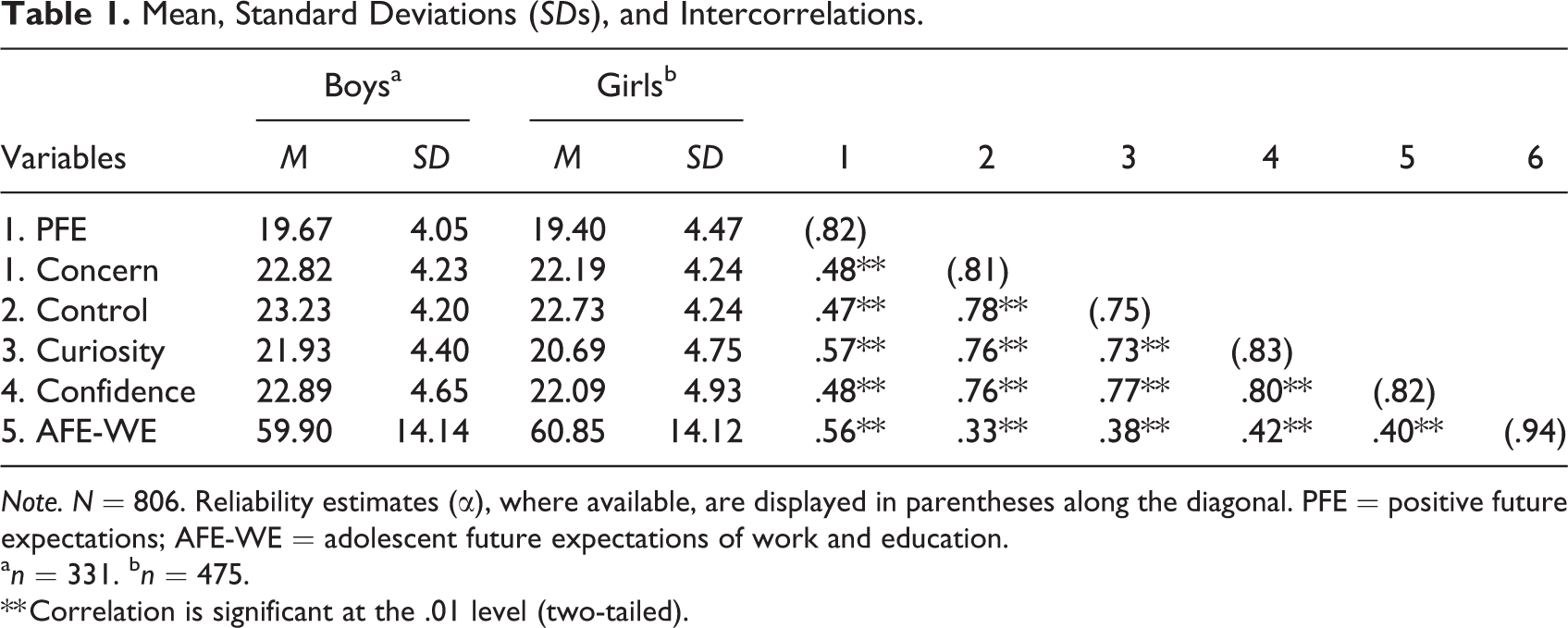
Note. N = 806. Reliability estimates (α), where available, are displayed in parentheses along the diagonal. PFE = positive future expectations; AFE-WE = adolescent future expectations of work and education.
an = 331. bn = 475.
** Correlation is significant at the .01 level (two-tailed).
Measurement Model
Prior to testing the mediation model, the measurement model was checked by conducting a six-factor confirmatory factor analysis, firstly. The results indicated goodness of model fit (χ2/df = 2.73, CFI = .970, GFI = .949, RMSEA = .046, and SRMR = .034). The correlations found in the measurement model confirmed those positive associations: between the PFE and the AFE-WE (.63) as endogenous variable, between the PFE and concern (.45), control (.64), curiosity (.39), and confidence (.58) as mediator variables, and between mediator variables and the AFE-WE (.37, .46, .27, and .43, respectively). Thus, these associations established Baron and Kenny’s (1986) prerequisite for testing mediation models.
Structural Model
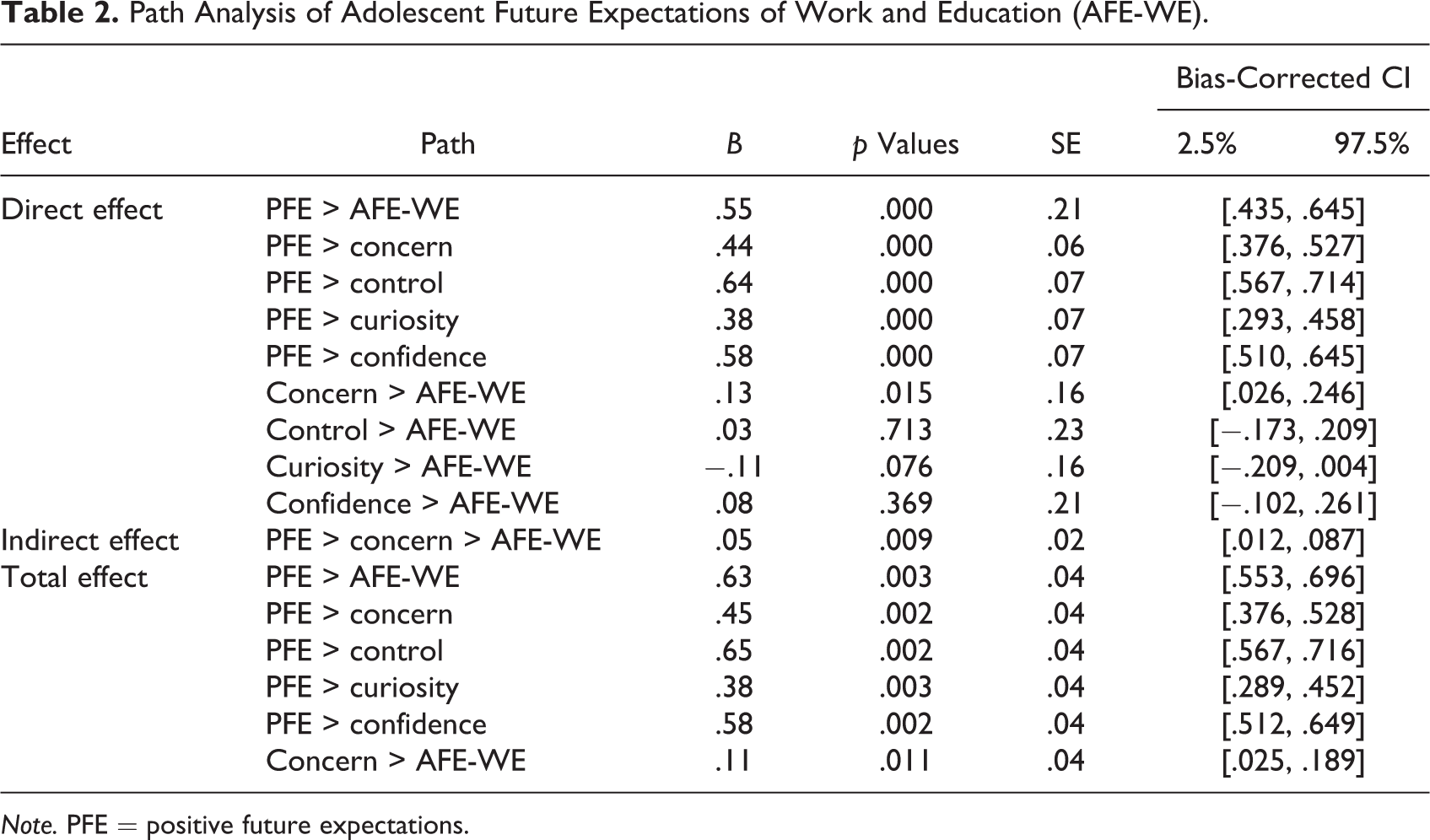
After ensuring the measurement model, the structural model was tested to examine the relations between the PFE, concern, control, curiosity, confidence, and the AFE-WE. In this model, concern, control, curiosity, and confidence served as mediator variables (Figure 1). The suggested model fitted the data well (χ2/df = 2.64, CFI = .972, GFI = .951, RMSEA = .045, and SRMR = .034.). Table 2 represented the direct, indirect, and total effects of the PFE and concern, control, curiosity, and confidence on AFE-WE. As seen in Table 2, the results indicated a significant impact of the PFE on the AFE-WE (B = .55, SE = .21, p < .005), which supported Hypothesis 1. Similarly, the PFE also had a significant impact on the concern (B = .44, SE = .06, p < .005), control (B = .64, SE = .07, p < .005), curiosity (B = .38, SE = .07, p < .005), and confidence (B = .58, SE = .07, p < .005), supporting Hypothesis 2. However, only concern had a significant impact (B = .13, SE = .16, p < .05); control (B = .03, SE = .23, p > .05), curiosity (B = −.11, SE = .16, p > .05), and confidence (B = .08, SE = .21, p > .05) have nonsignificant influence on the AFE-WE, which partially supported Hypothesis 3. Moreover, the model explained 42% of the variance in the AFE-WE.

The proposed mediation model. Note. Parcels of concern, control, curiosity, confidence, and AFE-WE were indicated as P. PFE = positive future expectations; AFE-WE = adolescent future expectations of work and education. shows nonsignificant paths.
Path Analysis of Adolescent Future Expectations of Work and Education (AFE-WE).
Note. PFE = positive future expectations.
Testing for Mediating Role
Before testing mediation relationships, the model was modified by removing the direct paths from control, curiosity, and confidence to the AFE-WE and fitted the data slightly better (χ2/df = 2.61, CFI=.972, GFI = .951, RMSEA = .045, and SRMR = .034). As can be seen in Table 2, concern partially mediated the relation between the PFE and the AFE-WE as bootstrap result was significant and bias-corrected CI with lower and upper value was entirely higher than zero (Shout & Bolger, 2002); B = .05, 95% CI [.012, .087], p < .05, which somewhat supported Hypothesis 4. This indicates that those who possess higher levels of positive feelings about their future tended to be more concerned about their future, which in turn contributed to their work and education future expectations.
Multiple Group Analysis
A multigroup model was tested to investigate whether the hypothesized mediation model differs across gender. Firstly, the unconstrained model with all direct and indirect paths freely estimated was tested and the fit indexes indicated: χ2(314) = 599.051, RMSEA = .034, and CFI = 969. Secondly, the fully constrained model was tested and the fit indexes were χ2(334) = 628.388, RMSEA = .033, and CFI = 968. In a comparison of the models, the CFIs difference test (ΔCFI) did not reveal group difference (ΔCFI = .001) since it was smaller than .01 (Cheung & Rensvold, 2002). Thus, the findings suggested that the associations among study variables supported by the mediation model did not differ across gender, not supporting Hypothesis 5.
Discussion
The Relationships Among Study Variables
The purpose of the current study was to explore the predictors of future expectations of work and education (AFE-WE) in a sample of Turkish adolescents. The results showed that PFE had a significant effect on AFE-WE and concern, control, curiosity, and confidence, supporting Hypotheses 1 and 2. Consistent with the current findings, the existing literature underlined the relationships between optimism and adolescent future expectations (e.g., Iovu et al., 2018; Tzenis, 2019) as well as between positive beliefs about the future and work and education-related variables such as success, motivation, and career planning (e.g., King & Gaerlan, 2014). In addition, considering that optimism refers to positive outlook and orientation toward future (Carver et al., 1994), the current results were consisted with the previous work indicated its significant relations with career adaptability (e.g., Buyukgoze-Kavas, 2014; Santilli et al., 2017).
On the other hand, contrary to expectations, concern had a positive impact on the AFE, only; yet control, curiosity, and confidence did not, which somewhat supported Hypothesis 3. Inconsistent with the current results, the existing research indicated that having sense of control over the future (e.g., Kerpelman & Mosher, 2004), curiosity (Ginevra et al., 2016), and confidence (e.g., Iovu et al., 2018) were found related with education and career expectations. Several explanations could be done why concern predicted the AFE-WE, only. First explanation could be the fact that the hierarchical nature of career adaptability resources based on CCT, which suggests that career concern reveals first and control, curiosity, and confidence consecutively appears later (Savickas & Porfeli, 2012). Concern dimension of CAAS (Savickas & Porfeli, 2012) includes the questions regarding the future, such as “Thinking about what my future will be like.” This dimension is related with being future oriented, looking ahead, forward thinking, and preparedness (Savickas, 2005), which all are related with future expectations of work and education. Career concern was identified as the predictor of adaptability responses (e.g., Hirschi et al., 2015), which might affect attitudes and expectations for career future, supporting the current findings. This result could be more plausible within cultural context, considering high youth unemployment rate in Turkey as well as in the city where data collected (Sönmez Didin & Özerkek, 2018) and accordingly the fact that Turkish adolescents addressed having a decent job as the first and most important expectations from the future (Şen, 2011), which might result in looking ahead more than anything. Second, control is attached to decision-making skills, autonomy, and independence (Savickas, 2005), which are not completely supported within a collectivist culture (e.g., Hofstede, 2001). Aforementioned, data were collected from a more collectivistic region of Turkey, which could provide an explanation for this result. Furthermore, several studies indicated that parents, significant others, and social environment have significant roles and effects on adolescents’ future career decisions and life in Turkey (e.g., Karacan-Ozdemir, 2019). Moreover, considering very competitive education system which requires to pass a centralized university entrance exam, unemployment rates (TurkStat, 2021a), and depression among high school students, especially among those who prepare university entrance exam in Turkey (e.g., Yildirim et al., 2007), adolescents might have thought that their expectations of future exceed their control. Third, it was reported that curiosity, which is related with self and environmental exploration, hence attached to being inquisitive (Savickas, 2005) might cause negative feelings or beliefs about the future when adolescents have low levels of hope (Tzenis, 2019). Similarly, the previous research indicated that curiosity was positively related with career decision-making difficulties of adolescents due to the lack of readiness (Karacan-Ozdemir, 2019), implying that when adolescents had higher level of inquisitives for the future or explored their options more they felt not ready for the future, which resulted in higher level of career decision-making difficulties. Especially, the difficulties or lack of opportunities to access decent work options in the region where data collected could explain irrelevancy of curiosity with the AFE-WE for this sample, also. Last, Turkish adolescents had low esteem scores on confidence dimension of CAAS, self-esteem, and self-efficacy beliefs (Karacan-Ozdemir, 2019). In addition, self is represented by public components mostly in collectivist cultures (Markus & Kitiyama, 1991), which might result in no effect of confidence on the AFE-WE. Hirschi et al. (2015) inferred that components of career adaptability might have differential effects on outcomes of interest, which was ensured in the current study. Hence, the results implied that PFE (e.g., optimism) and concern (looking ahead and being related with the future) could be seen as individual developmental assets to foster adolescents’ positive education and work expectations from future, thus positive career development, as a crucial part of PYD (e.g., Hirschi, 2009).
The Mediating Roles of Career Adaptability Resources
This study explored the mediation roles of concern, control, curiosity, and confidence as adaptability resources on the associations between the PFE and the AFE-WE. Results of the study indicated that concern partially mediated these relationships, only, somewhat supporting Hypothesis 4. This finding inferred that youth who endorse PFE are more concerned about their future—in other words, they look ahead, and hence have PFE of work and education more. Thus, these findings somewhat supported a sequence of adaptation outlined in CCT (Savickas, 2005) by demonstrating that adaptivity (having PFE) contributed to adaptability resource (concern), which in turn affected adapting response (having PFE of work and education). Hirschi et al. (2015) suggested that career adaptability resources place between aspects of personality (like optimism), which represents adaptivity capacities and the forms of adapting attitudes or behaviors, which was justified by the current findings. In addition, career adaptability was found related with positive attitude toward the future, career optimism, and work expectations (e.g., Ginevra et al., 2016; Öztemel & Yıldız-Akyol, 2019). Thus, it could be explained from PYD framework (Benson, 2007) like that changes in the internal developmental assets such as optimism triggered looking ahead—that is concern as the first dimension of career adaptability referring to psychosocial coping skills (Savickas, 2005), which could be both associated with competence dimension—one of the five Cs of PYD. In turn, this sequence produced desired youth outcomes such as positive work and education expectations from future, which is also associated with PYD (Lerner et al., 2005; Schmid et al., 2011). Thus, the current results contribute to the well-established literature on positive development of youth, which aims promote positive outcomes for young people by fostering their academic, career, and social development (Catalano et al., 2004), by providing evidence for positive career development of youth (e.g., Hirschi, 2009).
The Model Difference Across Gender
In the current study, it was also examined whether the hypothesized model differed across gender. The results yielded no differences among the proposed associations according to gender, which was consistent with the previous work that showed no gender differentiation on future expectations adolescents (e.g., İmamoğlu & Güler-Edward, 2007; Karakoç et al., 2013; Tuncer & Bahadır, 2018). However, contrary to this finding, some studies showed that adolescent girls had higher levels of positive expectations of work and education (e.g., Çiçek & Ünlü, 2019; Iovu et al., 2018). With regard to career adaptability, the literature indicated controversial results also; higher career adaptability on the behalf of girls (e.g., Coetze & Harry, 2015; Ginevra et al., 2016) or no gender differences (e.g., Hirschi, 2009; Karacan-Ozdemir, 2019). The current finding could be explained by the fact that control, curiosity, and confidence did not mediate the proposed relations, and the remaining variables of the model are all related with the future. Considering the future means to overcome a highly competitive university exam and increasing unemployment rates for Turkish youth, this might result in no gender differences on the model.
Limitations, Implications, and Future Research Directions
There are some limitations of the current study. First of all, the study relied on data collected from a cosmopolite city in the Southeastern region of Turkey, which could be considered as more collectivist than individualistic. Thus, this would limit the generalizability of the findings to whole Turkish youth, especially considering that Turkey demonstrates a mixture of both collectivist and individualist culture (Kâğitçibaşi, 1994), and it is also stated that collectivistic patterns can be seen more, yet not all patterns of collectivistic orientation (Göregenli, 1997). Secondly, small or no relationships in the mediation model could be attributed to generally higher scores on the CAAS, which can cause restricted range difficulties in data and as a result smaller relationship (Goodwin & Leech, 2006). Thirdly, using self-reported data can result in common method bias, which might lead to spurious effects on observed relations and constructs due to the measurements (Podsakoff et al., 2003). In addition, the variables are related in this study, it is suggested to be cautious to make causal inferences. Fourthly, to test the relationships between adaptivity (PFE) and adapting responses (future expectations of work and education) through adaptability resources (concern, control, curiosity, and confidence), additional variables for adaptivity such as person-related factors should be investigated. Finally, within the PYD perspective, this study only examined individual-level assets as aforementioned, yet future research should add ecological assets such as family (e.g., social support) and systemic factors (e.g., education system) to examine positive career development of adolescents.
Despite these limitations, on the other hand, the current findings have theoretical, research, practical, and clinical implications. Theoretically, this study empirically evaluated the relationships among a career adaptation model based on CCT with a sample from a collectivist culture. This study also evidenced the importance of being future oriented and optimistic for the future expectations of work and education for the youth who have discouraging conditions such as a competitive education system and uncertainty of employment in the future, like the current sample. In this sense, the findings contributed to PYD literature, which takes account of both personal and sociocultural variables to prepare adolescents for the future (Lerner et al., 2005) by addressing the role of positive career development (Hirschi, 2009). In other words, the career adaptation model tested in this study indicated that supporting career development of adolescents (their optimism and concern—future orientation, as a dimension of career adaptability) would promote positive future work and education expectations, which is the essential for PYD (Durlak et al., 2007). In addition, promoting career development competencies of young people will serve to support the five Cs model of PYD to some extent, as aforementioned (e.g., Santilli et al., 2018).
For research, this study tested the mediating role of career adaptability and yielded that concern was mainly mediated the relationships among adaptivity and adapting responses. Thus, the future research can explore the mediation role of career adaptability resources with different variables within different cultural contexts. For practice, the findings of this study suggest implementing programs to foster optimism and positive attitudes toward the future as well as being future-oriented, planned, and prepared, considering that hopeful expectation about the future has a significant role on PYD (Lerner et al., 2005). Furthermore, focusing on improving career awareness and hope of youth would support their career engagement in future (Baksi & Joshi, 2014), which would be crucial considering that almost one in four adolescents in Turkey was pessimistic about the future, especially about unemployment (Şen, 2011). It would be a proactive step that school counseling departments provide these kinds of support, by responding to the previous findings also. For example, the previous work evaluated the school counseling curriculum in Gaziantep, the city where the current data collected, showed that the curriculum included the interventions regarding curiosity, mostly. The interventions regarding the dimension of career adaptability followed it. However, there were few programs and interventions regarding confidence and control (Karacan-Ozdemir & Ayaz, 2020). The programs were mainly based on trait-and-factor approaches, yet career education programs to improve decision-making skills (control), self-efficacy feelings, and problem-solving skills (confidence) were missing (Karacan-Ozdemir & Ayaz, 2020). Accordingly, the current results also implied the need for programs to enhance a sense of control and confidence of Turkish adolescents in practice. The study also addressed some certain clinical implications, finally. Considering the associations between mental health and employment, especially with having decent work (Duffy et al., 2019), the current findings implied the need for supporting positive characteristics such as optimism and looking ahead for having positive expectations from the future. In addition, the most effective PYD programs, which included parts for supporting career development of young people, in fact (Larson, 2000), yielded positive outcomes, such as well-being and life satisfaction (Benson et al., 2004), which are crucial for mental health. Thus, supporting career development of youth through fostering optimism, hope, and positive expectations for the future by increasing their skills, competencies, and positive self-beliefs in clinical practices would promote mental health of youth. This would be critically important especially considering the cultural context that calls for supporting positive career development of youth because of high youth unemployment rates and that young people are mostly pessimistic about the future, like the current sample. In sum, supporting youth’s PFE of work and education will have a protective role in the life of students according to a PYD perspective.
Footnotes
Declaration of Conflicting Interests
The author(s) declared no potential conflicts of interest with respect to the research, authorship, and/or publication of this article.
Funding
The author(s) received no financial support for the research, authorship, and/or publication of this article.
