



Abstract
While prescriptions based on anecdotal data and theoretical accounts of career sustainability abound, empirical research has been hampered by the lack of a scale to measure career sustainability. Thus, the primary purpose of this study is to develop and validate a new measure of career sustainability. In Study 1, we relied on Chin, Li, Jiao, Addo, and Jawahar’s framework to develop a measure of career sustainability. We then conducted two studies to provide preliminary construct validity evidence. In Study 2, we show that scores on Career Sustainability Scale are related to career plateaus and career satisfaction in predictable ways. In Study 3, we show that career sustainability is positively related to psychological well-being, and this relationship is stronger for gig workers who are freelancers than for conventional workers. We discuss implications for research and practice and hope that our new measure facilitates empirical research on career sustainability.
Keywords
Career sustainability is an emerging construct that has significant theoretical significance as well as practical value (De Vos et al., 2018). Arthur et al. (1989) conceptualized a career as “the evolving sequence of a person’s working experience over time.” Drawing on this conceptualization, De Vos and Van der Heijden (2017) defined career sustainability as the “sequences of career experiences reflected through a variety of patterns of continuity over time, thereby crossing several social spaces, characterized by individual agency, herewith providing meaning to the individual.”
Careers unfold in a dynamic and an unpredictable economic environment, and consequently, sustainability of careers has become an increasingly salient concern for individuals, organizations, and societies (Lawrence et al., 2015). For individuals, sustainable careers ensure a steady source of income and satisfaction of needs, and disruptions could be costly in terms of loss of livelihood and stress. Consider the retail sector undergoing transformations due to the rapid growth of e-commerce or the hospitality sector being affected by the platform of Airbnb (Zervas et al., 2017). These disruptive changes have consequences for the individuals working within them, as their jobs are likely to change or even disappear, making some competencies obsolete while raising the need for new competencies (Quendler & Lamb, 2016). Together, these consequences might challenge the career sustainability of many workers. Organizations desire a competent and well-trained workforce as individuals who fail to upskill and maintain currency will reduce competitiveness and may even threaten organizational survival. Societies are interested in ensuring its citizenry is contributing to the society at large through productive use of labor as high levels of unemployment or underemployment reduces tax base, straining a nation’s support systems (e.g., welfare, retirement; De Vos et al., 2016). Thus, career sustainability is of practical relevance to individuals, organizations, and societies.
In addition to its practical relevance, career sustainability has garnered the attention of researchers as evidenced by the increased attention devoted to career sustainability in academic journals (e.g., Anseel, 2017; Veld et al., 2016) by way of special issues (e.g., 2020, Journal of Vocational Behavior) and symposiums on the topic at major academic conferences (e.g., 2019 Annual Meetings of the Academy of Management). However, the construct of career sustainability is still in the very early stages of development. Indeed, our understanding of the construct is evolving, and researchers are yet to reach consensus on what the construct entails and how to measure it (Chin et al., 2019a; Chin et al., 2019b; McDonald & Hite, 2018).
Consequently, there is currently no measure of career sustainability. Yet, there are several studies that measure constructs ostensibly related to career sustainability and based on study results suggest implications for career sustainability. For instance, studies on career shocks (e.g., Blokker et al., 2019), employability (e.g., Hirschi, 2012), meaningful work (e.g., Steger et al., 2012), and young professionals (e.g., De Vos et al., 2018) discuss implications for career sustainability, even though these studies did not directly measure the career sustainability construct because at the present time no measure exists.
The primary purpose of this study is to fill this void by developing and validating a measure of career sustainability. In Study 1, using data collected from three separate samples, we developed a 12-item Career Sustainability Scale. We then conducted Studies 2 and 3 to gather initial evidence of construct validity of the scale. We trust that our newly developed measure will facilitate research on career sustainability, enabling the cumulative accumulation of knowledge about the construct itself as well as its antecedents and consequences.
Career Sustainability
As stated earlier, career sustainability is defined as “sequences of career experiences reflected through a variety of patterns of continuity over time, thereby crossing several social spaces, characterized by individual agency, herewith providing meaning to the individual” (De Vos & Van der Heijden, 2017). To develop a scale, we first reviewed the existing literature to identify extant models or theoretical frameworks of the construct, career sustainability. Through our review, we identified two such frameworks, the first developed by Newman (2011) and the second by De Vos et al. (2018).
De Vos et al. (2018) based on earlier work (e.g., Van der Heijden & De Vos, 2015) proposed a conceptual model of sustainable careers suggesting three groups of indicators of a sustainable career, namely health, happiness, and productivity. According to these authors, health encompasses both physical and mental health and refers to the dynamic fit of the career with one’s mental and physical capacities. Happiness concerns the dynamic fit of the career with one’s values, career goals, or needs regarding work–life balance or personal growth. And, productivity involves strong performance in one’s current job as well as high employability or career potential (Heijde & Van der Heijden, 2006). They argue that the notion of a dynamic person-career fit in terms of health, happiness, and productivity is at the core of sustainable careers. Their conceptual model is based on deductive reasoning, and the core concepts (i.e., health, happiness, and productivity) are described in such a manner that each could be operationalized in different ways. For instance, how does one operationalize mental health—is it the presence of positive features (e.g., psychological well-being, for instance), absence of negative features (e.g., depression), or both? Likewise, productivity is a broad construct, and it is unclear whether productivity is viewed from the perspective of self or as rated by others. A more practical concern with De Vos et al.’s (2018) model is that according to these authors, career sustainability encompasses indicators that are on different metrics. For instance, physical health is a physiological state whereas mental health is a psychological state. Likewise, happiness indicates affect whereas productivity is an outcome. Given that the indicators reflect different metrics, it is challenging to develop a measure, that is on the same metric, to adequately capture their conceptualization of career sustainability.
A second framework for studying sustainable careers was offered by Newman (2011). Newman (2011) combined theories of adult development and career development and offered a generally recognized definition of sustainable careers, proposing that a sustainable career should show three prominent characteristics, “renewal, flexible and integrative.” Renewability implies the ability to refresh, to extend, and to be available indefinitely. The renewability feature of careers prevents burnout, and renewable career practices provide periods of time for consolidation, reflection, rethinking, and retooling. Flexibility means easily shaped and reshaped, adaptable, agile, and capable of change, a necessary feature to ensure career sustainability. Integrity and integration imply completeness, wholeness, consistency between values and actions, and connectedness. Newman’s framework was also derived deductively but by taking a retrospective perspective of the working lives of mature adult workers.
Another distinction between De Vos et al.’s (2018) and Newman’s (2011) conceptualizations of sustainable career is that one is hedonic and the other is eudaimonic. The hedonic approach focuses on happiness, defining well-being in terms of pleasure attainment and pain avoidance (Kahneman, 1999). The eudaimonic approach, on the other hand, relates to meaning and self-realization where well-being is seen as the full functioning of the person (Ryan & Deci, 2001) with the focus on resources and strengths and on life meaning, authenticity, and purposefulness (Waterman et al., 2010). We argue that De Vos et al.’s (2018) conceptualization is more hedonic because of its focus on positive affect, whereas Newman’s model that focuses on meaningful functioning is eudaimonic. We posit that Newman’s (2011) framework appears to be more pragmatic as it reflects a deeper, self-expressed need for self-actualization derived from sustaining careers. In addition, Newman’s framework was derived deductively through a retrospective perspective of the working lives of mature adult workers. Thus, their framework is grounded in the cumulative work experiences of working adults.
After an extensive literature review, Chin et al. (2019b) built on Newman’s (2011) model and extended this framework by adding a fourth factor, resourceful. They argued that, given the rapidly changing business landscape littered with mergers, acquisitions, bankruptcies, and layoffs, resourcefulness is central to maintaining a sustainable career. This reasoning reveals the imperative to avoid job loss by fully utilizing one’s resources, thereby ensuring a stable source of income now and in the future. In addition, Chin et al.’s (2019b) framework implicitly acknowledges that career sustainability is both a property of careers and of the people embedded in those careers positing an interactional perspective. Thus, while some careers are sustainable, such as those of accountants, others may not be as sustainable, such as careers of production workers, reflecting career sustainability as a property of the career. On the other hand, an accountant who does not continuously update their skill set and maintain currency may find themselves unemployable in the future. Production workers who fail to upskill may find their jobs disappearing whereas a production worker who learns how to operate automated machines used in modern manufacturing environments may find their career to be sustainable.
This interactive perspective of career sustainability along with its comprehensive nature makes Chin et al.’s (2019b) framework particularly suitable for our study to form the basis for developing an operational measure of career sustainability. The scale we developed is based on the following conceptual definitions of the four dimensions that characterize a sustainable career as defined by Chin et al. (2019b). Flexibility dimension indicates the holding of a flexible, adaptable attitude that enables individuals to continuously learn tasks, seek new opportunities, and remain open to new opportunities. The renewable dimension reflects the extent to which careers provide the opportunity for individuals to reassess capabilities, update skills, and rebrand oneself to continuously maintain a sustainable career. The integrative dimension characterizes the extent to which employees can critically evaluate, integrate, and absorb disparate information and knowledge acquired in their current jobs to further develop their careers. The resourceful dimension embodies the vital importance of using resources well to maintain a good standard of living and ensuring employment opportunities in the future.
Study 1
We used the three-stage scale development procedure recommended by Hinkin (1995) and Schwab (1980) to develop a new scale to measure career sustainability. Specifically, the steps are item generation, scale development, and scale evaluation. As indicated earlier, we used Chin et al.’s (2019b) career sustainability conceptualization to develop a multidimensional scale to measure the dimensions of resourceful, flexible, renewable, and integrative. In all, we used three independent samples to facilitate the scale development process.
Stage 1—Item Generation Stage
In Stage 1, content validity is an important concern, and items are generated to ensure high content validity (Hinkin, 1995). Content validity is defined as the degree to which a particular measure reflects a specific intended content domain (Hinkin, 1995). To accomplish Step 1, a sample of 75 part-time master of business administration (MBA) students from Zhejiang University of Technology (Sample 1) who were employed full-time in manufacturing organizations was recruited. Participants were employed in a variety of capacities such as automated machine operators, production floor supervisors, office managers, accountants, supply chain managers, and quality control technicians. Thus, the sample comprised of blue-collar, clerical, professional, and managerial employees. Of the 75 participants, 49 were female. A majority of them were in the 30–40 years age-group (40%) and had between 6 and 10 years of work experience (49%).
Participants were presented with the conceptual definition of the construct (Chin et al., 2019b), specifically the definitions of the four dimensions of career sustainability. Participants were asked to write as many statements as they could that reflect standing on each of the four dimensions. Participants wrote 40 statements for flexible, 29 for renewable, 30 for integrative, and 21 for resourceful dimensions, yielding a total of 120 statements. Ten students from this sample were recruited to review these statements, and after eliminating redundant and unclear statements, 39 statements remained (flexible—10 statements, renewable—12, integrative—8, and resourceful—9). Next, a team of three PhD scholars used the card sort procedure to classify these statements. They were given the definitions of the four dimensions of career sustainability and were asked to classify statements into categories. Each scholar individually classified the 39 statements. The statements were classified into four categories, and statements placed into each category were further classified into four subcategories. To assess reliability of the classification at the dimensional level, we computed intraclass correlation coefficient (ICC) as .86, .81, .83, and .86. Overall ICC for classification into subcategories (16 subcategories) was .81. ICC values between .75 and .9 indicate a good level of reliability (Koo & Li, 2016). The authors then read statements classified into the subcategories and wrote an item to capture the sentiment of statements in that subcategory, resulting in a 16-item scale.
Stage 2—Scale Development Stage
To refine our 16-item scale, we recruited a second sample consisting of 846 workers in Guangdong Province and Guangxi Province of China (Sample 2). The participants employed full-time in a variety of industries such as real estate, manufacturing, information technology, and business services in different organizational levels responded to the 16 items. Data collected from this sample were randomly split into two smaller samples, 367 and 479.
In the sample consisting of 367 participants, 197 were female. A majority of them were in the 20–30 age-group (51%) and had between 1 and 5 years of work experience (58%). Data from this sample were subjected to an exploratory factor analysis (Hinkin, 2005). First, we examined the correlation matrix for each of the 16 items. All the items significantly correlated at or above .46 with their corresponding factor, which demonstrates that each item is representative of and measuring aspects of the same factor and are all suitable to be retained further (Hinkin, 2005). After examining these correlations, we conducted an exploratory factor analysis using principal axis factoring with direct oblimin rotation. We followed Tabachnick et al.’s (2007) guidelines, that is, items with loadings less than .33 should be omitted, and we omitted four items from the 16-item scale. The results of exploratory factor analysis indicated four principal factors of career sustainability (eigenvalues = 4.17, 1.42, 1.14, and 2.52, respectively; variance percentage = 34.80%, 11.83%, 9.52%, and 21.00%, respectively; Cronbach’s α = .86, .86, .82, and .85, respectively; cumulative variance percentage = 77.14%). According to Lawshe (1975), the minimum score of content validity ratio, to retain an item as content valid, is .75. Therefore, all the 12 items were retained. These items are reported in Table 1. Sample items are as follows: resourceful—my career makes me feel happy because I use my resources well, flexible—my career gives me a lot of flexibility, renewable—my career enables me to rebrand or reposition myself, and integrative—my career enables me to critically evaluate information obtained from different sources. Respondents indicated their level of agreement with each item on a 6-point Likert-type scale (1 = strongly disagree to 6 = strongly agree). Factor 1 was labeled resourceful, Factor 2 as flexible, Factor 3 as renewable, and Factor 4 as integrative in line with Chin et al.’s (2019b) conceptualization of career sustainability.
Item Factor Loadings and Reliability of the Career Sustainability Scale.
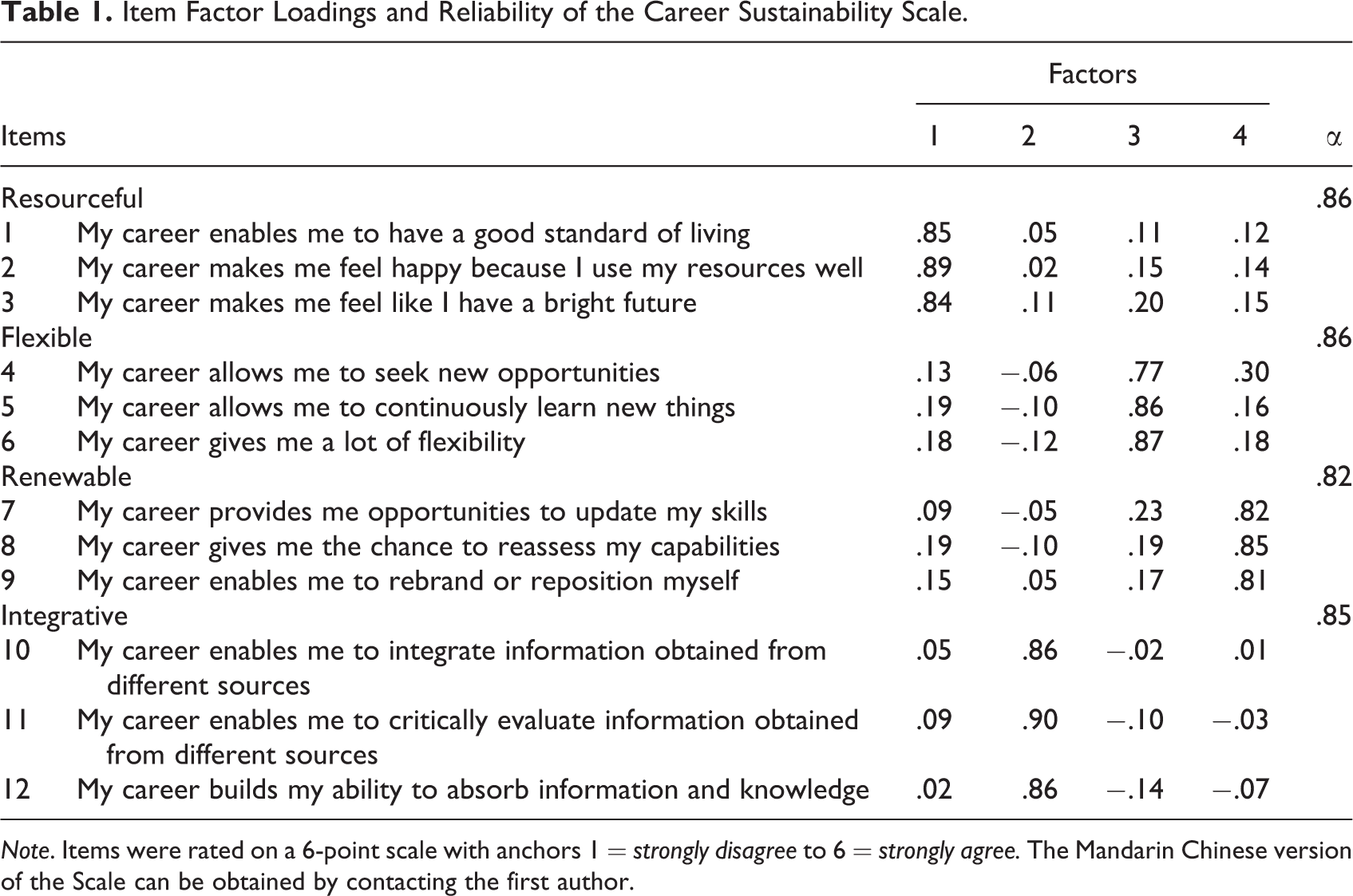
Note. Items were rated on a 6-point scale with anchors 1 = strongly disagree to 6 = strongly agree. The Mandarin Chinese version of the Scale can be obtained by contacting the first author.
Stage 3—Scale Evaluation Stage
To examine the structure of this newly created Career Sustainability Scale (Hinkin, 1995), a confirmatory factor analysis (CFA) was conducted using the second half of the split sample described earlier. This sample included 479 participants, of whom 292 self-identified as female. A majority of them were in the 20–30 age-group (50%) and had between 1 and 5 years of work experience (57%). Data from this sample were subjected to a CFA using AMOS Version 23.0. We tested a four-factor model structure (i.e., resourceful, flexible, renewable, and integrative), and this model fit the data well (x2/df = 2.98, CFI (comparative fit index)=.97, RMSEA (root-mean-square error of approximation) = .06). Factor loadings, dimension level reliabilities, and average variance extracted are reported in Table 2.
Confirmatory Factor Analysis of the Career Sustainability Scale (Sample 2, Study 1).
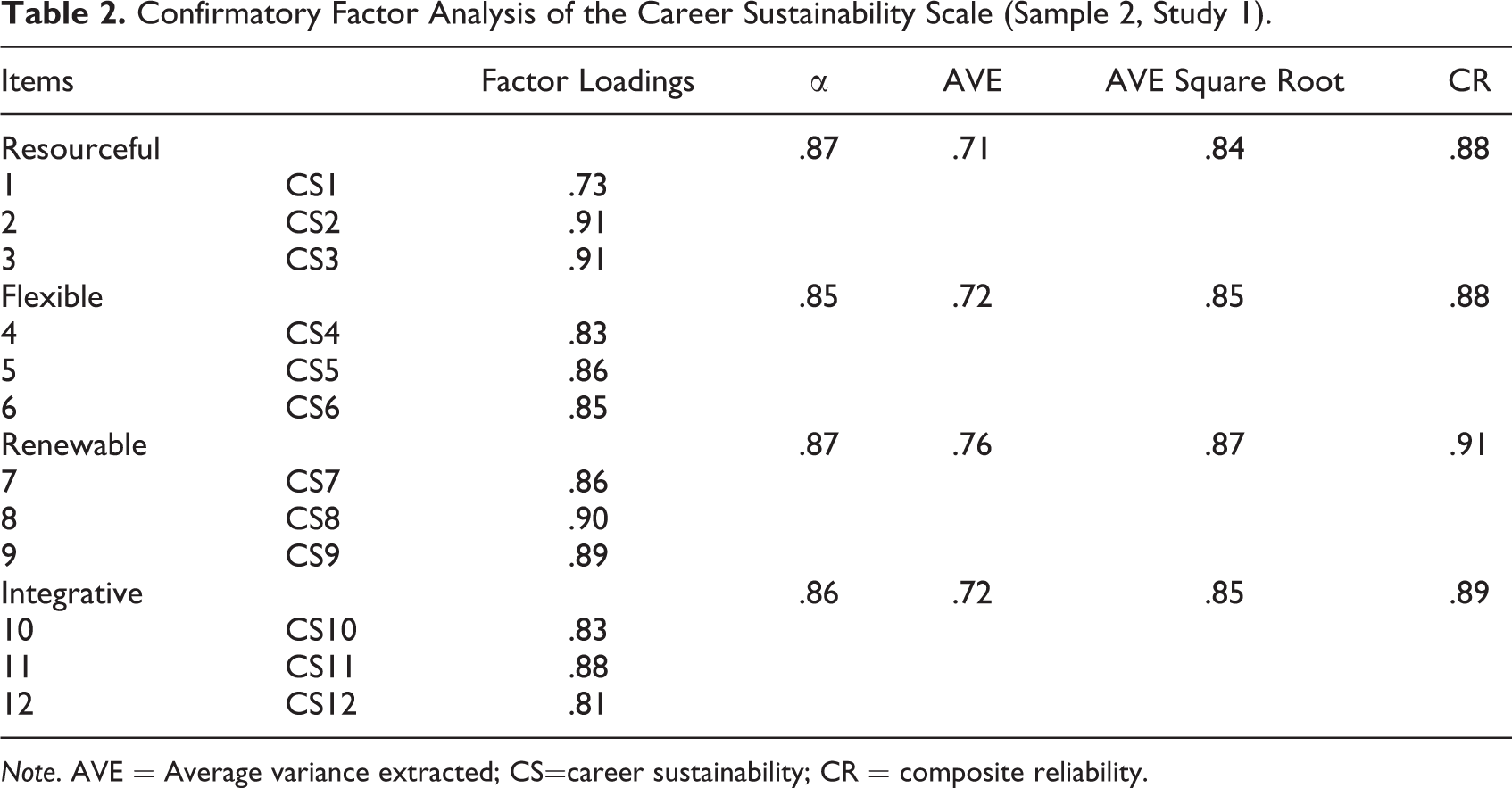
Note. AVE = Average variance extracted; CS=career sustainability; CR = composite reliability.
To further examine the factor structure, we collected data from another sample (Sample 3). Sample 3 consisted of 197 part-time MBA students in Beijing Normal University and who were employed full-time in a variety of positions in local manufacturing and service organizations. Of the 197 participants, 102 self-identified as female, and the majority were in the 20–30 age-group (65%). Using data from this sample, we once again examined the four-factor model structure, and CFA results revealed that the four-factor model fit the data better (x2/df = 1.89, CFI = .98, RMSEA = .06) than a three-factor model where the factors resourceful and flexible were collapsed (x2/df = 9.81, CFI = .79, RMSEA = .21); a two-factor model where the factors resourceful, flexible, and renewable were collapsed (x2/df = 15.08, CFI = .65, RMSEA = .27); and one-factor model (x2/df = 22.47, CFI = .46, RMSEA = .33). These findings show that our newly created four-factor scale (i.e., Career Sustainability Scale) fit the data well. In this way, we constructed a new 12-item Career Sustainability Scale.
Establishing Construct Validity of the Career Sustainability Scale
Construct validity refers to the degree to which a scale measures what it claims to or purports to measure (Cronbach & Meehl, 1955). One approach to establishing construct validity is the development of a nomological network of the construct. A nomological network defines a construct by illustrating its relation to other constructs and behaviors. If the expected patterns of relations emerge with other constructs, then evidence has been accumulated in support of construct validity of the construct (Cronbach & Meehl, 1955).
To establish construct validity of our Career Sustainability Scale, we specified constructs related to career sustainability and empirically tested the expected pattern of relationship. We conducted two studies, Studies 2 and 3. In Study 2, we correlated career sustainability with job content plateau and hierarchical plateau, and career satisfaction, expecting career sustainability to be negatively related to career plateaus and positively to career satisfaction.
Study 2
Career Sustainability and Career Plateaus
Career plateaus are a growing concern (Salami, 2010), and they have negative consequences for employees (Hurst et al., 2016) and organizations (Hofstetter & Cohen, 2014). Scholars (e.g., Bardwick, 1986) have identified two types of career plateaus: hierarchical (or structural), which relates to employees’ vertical movement in organizations, and job content plateau, which occurs when employees master their current positions and become bored.
Since most employees seek challenging and meaningful jobs in which they can continue to learn and develop their skills (e.g., McEvoy & Blahna, 2001), reaching a job content plateau is undesirable and stressful (Allen et al., 1999). It is associated with negative work attitudes such as decreased job and career satisfaction, which progress to reduced job performance, absenteeism, and voluntary turnover (Salami, 2010; Wang et al., 2014; Xie et al., 2015). Hierarchical plateau is a stage in a person’s organizational career where future promotions are no longer likely (Ferrence et al., 1977; Lapalme et al., 2009). Hierarchically plateaued employees feel less marketable (Veiga, 1985), cope by exhibiting withdrawal behaviors, such as absenteeism (Elsass & Ralston, 1989), and working fewer hours, and are less committed to the organization (Near, 1980).
Individuals who feel high levels of career sustainability are unlikely to experience career plateaus because the core dimensions that comprise career sustainability, such as being flexible, renewable, and resourceful, and the ability to integrate knowledge and experience will enable them to navigate environments such that they find current jobs exciting and perceive future career prospects. Therefore, we expect career sustainability to negatively relate to job content and hierarchical plateaus.
Career Sustainability and Career Satisfaction
Career satisfaction measures the extent to which individuals believe their career progress is consistent with their goals, values, and preferences (Seibert & Kraimer, 2001). While frequently considered as a facet of work satisfaction along with job satisfaction, career satisfaction differs from job satisfaction in that it pertains to one’s overall experiences with the entire career over a period of time. Career satisfaction is the most prevalent measure of subjective career success (Hall & Chandler, 2005). Because individuals who feel their career is sustainable are likely to be satisfied with their career progress and future prospects, they are likely to report higher levels of career satisfaction.
Method
Sample and Procedure
We recruited participants using the online platform Amazon Mechanical Turk. Previous studies have shown that online crowdsourcing platforms, such as Amazon Mechanical Turk, are a reliable source of high-quality and representative data (Peer et al., 2017). We also implemented several procedures to reduce the risk of response bias (Podsakoff et al., 2012). First, the survey was only available for respondents with an overall approval rating above 95%. Second, the survey was accompanied by a short description explaining the purpose of the research and assuring confidentiality. Third, two attention checks were embedded within the survey to ensure response quality.
We received 206 completed surveys. After removing participants who failed one or both attention checks (Huang et al., 2015) or completed the survey in an unrealistically short or long time (for a similar approach, see Ferris et al., 2018), the final sample included 152 participants, all U.S. citizens. The average age of the participants was 37.42 years (SD = 9.50), and 41% were female. The average organizational tenure was 9.56 years (SD = 8.37). In terms of education, 54% had a bachelor’s degree, 38% had a high school degree, 5% had a master’s degree, and the rest had professional degrees.
Measures
Career sustainability
The Career Sustainability Scale was translated into English using the back-translation method by individuals who were proficient in both English and Mandarin Chinese. The 12 items comprising the scale are reported in Table 1. Respondents used a 6-point scale with 1 (strongly disagree) to 6 (strongly agree) to respond to the items. Cronbach’s α was .91 for the scale.
Career plateau
The 12-item scale developed by Milliman (1992) was used to measure job content plateau and hierarchical plateau. Job content plateau and hierarchical plateau are measured with six items each. A sample item used to measure job content plateau is “I am challenged by my job (reverse-scored),” and a sample item used to measure hierarchical plateau is “I expect to advance to a higher level in my company in the near future (reverse-scored).” Respondents used a 5-point scale with anchors 1 (strongly disagree) to 5 (strongly agree) to respond to the items. Milliman (1992) reported Cronbach’s αs of .90 for the Hierarchical Plateau Scale and .87 for the Job Content Plateau Scale. In a sample of bank employees from Pakistan, Shabeer et al. (2019) reported Cronbach’s α values of .72 and .75, respectively, for these scales.
Career satisfaction
Career satisfaction was measured using the five-item Career Satisfaction Scale (Greenhaus et al., 1990). Respondents indicated their level of agreement (1 = strongly disagree, 7 = strongly agree) with each of the statements, prefaced with the stem “I am satisfied with”: success I have achieved in my career, success I have made toward meeting my overall career goals, progress I have made toward meeting my goals for income, progress I have made toward meeting my goals for advancement, and progress I have made toward meeting my goals for developing new skills. Greenhaus et al. (1990) reported a Cronbach’s α of .88. Jawahar and Liu (2017) using data collected from a diverse sample of working adults from Midwestern United States reported an α of .95 for the Careers Satisfaction Scale.
Results
Means, standard deviations, and correlations between study variables are reported in Table 3. As expected, career sustainability was negatively related to job content plateau (r = −.38, p < .01) and hierarchical plateau (r = −.32, p < .01) supporting Hypothesis 1. In support of Hypothesis 2, career sustainability was positively related to career satisfaction (r = .41, p < .01). Results offer some evidence of convergent and discriminant validity for the Career Sustainability Scale (Cronbach & Meehl, 1955).
Means, Standard Deviations, and Correlation Between Study 2 Variables.
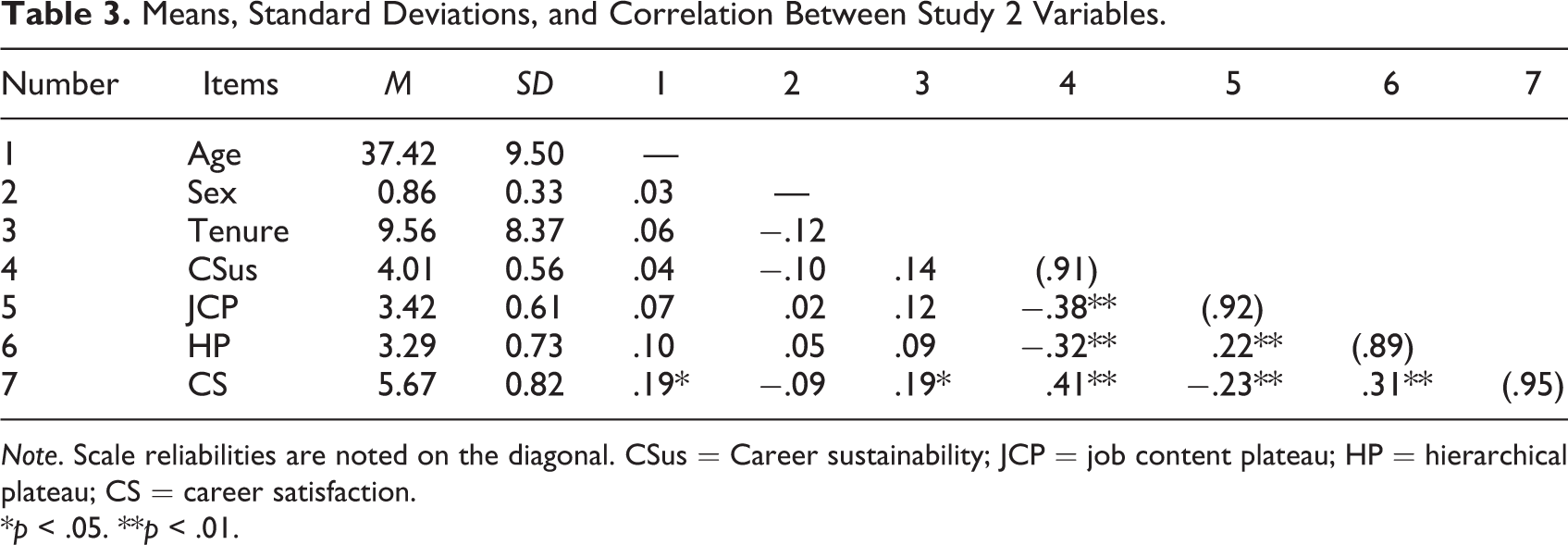
Note. Scale reliabilities are noted on the diagonal. CSus = Career sustainability; JCP = job content plateau; HP = hierarchical plateau; CS = career satisfaction.
*p < .05. **p < .01.
Study 3
Results of Study 2 conducted with U.S. citizens offer evidence of convergent and discriminant validity for the Career Sustainability Scale. As the scale itself was developed with Chinese samples, we wanted to also marshal construct validity evidence with data collected from China by testing a moderated model in which career sustainability served as an antecedent. In this study, we tested whether career sustainability relates to three dimensions of psychological well-being. Further, we tested whether these relationships are moderated by type of worker, proposing a stronger relationship for gig workers versus traditional workers. The rationale for these expected relationships is presented below.
Career Sustainability and Psychological Well-Being
Psychological well-being consists of positive relationships with others, personal mastery, autonomy, a feeling of purpose and meaning in life, and personal growth and development (Ryff, 1989). Psychological well-being is attained by achieving a state of balance affected by both challenging and rewarding life events (Dodge et al., 2012).
In recent years, scholars have called for more comprehensive exploration of the intricate connections between modern career concepts and employees’ well-being (Don & Duffy, 2008), especially psychological well-being (Kossek et al., 2014; Li, 2018). For instance, scholars have proposed that employees’ career sustainability–related strategies help boost their positive career experiences as their careers unfold (Torrey & Duffy, 2012). Such experiences will facilitate psychological well-being (Kossek et al., 2014). Therefore, it follows that employees who perceive career sustainability will feel that they have mastery over their environment and have a sense of autonomy and believe in personal growth. In response to calls to investigate the relationship between career sustainability and psychological well-being (e.g., Li, 2018), we hypothesize:
The Moderating Role of Type of Worker
The gig or shared economy is one of the most fascinating work-related trends in recent decades (Calo & Rosenblat, 2017; De Menezes & Kelliher, 2017). A positive feature of the sharing economy is that employees are believed to enjoy far more freedom and flexibility at work, thereby enjoying greater control over their work–life balance (Bamber et al., 2017). This flexible working arrangement with a high degree of autonomy seems to be particularly appreciated by younger employees. The increasing popularity of gig work embodies the rise of a new, more entrepreneurial generation with ambition to manage their own careers.
On the other hand, the drawbacks of sharing economy include a lack of stable employment, alternating experience of overqualification and underqualification, and generally promoting feelings of career insecurity. Indeed, gig workers often worry about the lack of insurance and pensions benefits. From this perspective, gig economy has shifted the burden of financial risks from employers to employees (Friedman, 2014) and could prove to be detrimental to the sustainability of careers of gig workers.
Juxtaposing these positive and negative consequences of gig economy questions our understanding of the traditional employer–employee relationship and models we hold about the career development of employees. From an employee’s perspective, the rise of gig work indicates a salient decline in the number of full-time job vacancies and mounting work stress; nonmanagerial factory workers who merely needed to perform simple, repetitive manual tasks in the past are forced to exert effort in learning modern, more multifaceted knowledge for better mastering the state-of-the-art mechatronic software and completing highly complex computerized tasks (Chin & Rowley, 2018; Koekemoer et al., 2018). However, this gig phenomenon also promotes the implementation of agile job arrangements and flexible work hours—which elicit a more self-oriented way of thinking (i.e., a protean career orientation) in developing and sustaining careers.
Therefore, in this new gig era, the constantly escalating job demands coupled with the burgeoning nonconventional employment relationships may result in a variety of new career challenges or opportunities that are very likely to moderate the positive relationships between workers’ perception of career sustainability and psychological well-being. Gig workers who perceive their careers to be sustainable are likely to experience higher levels of psychological well-being than gig workers who do not feel that their careers are sustainable. In contrast, conventional workers’ career sustainability perceptions are unlikely to vary as much as career sustainability perceptions of gig workers, and consequently, career sustainability’s relationship with psychological well-being will be weaker for conventional workers. Thus, we expect the relationship between career sustainability and psychological well-being to be stronger for gig workers relative to conventional workers. Therefore, we posit:
Method
Participants and Procedure
Participants were employees of large manufacturing organizations in two well-known industrial cities (i.e., Dongguan and Guangzhou) in Guangdong Province and one (i.e., Wuzhou) in Guangxi Province of China. Before commencing the survey, our research team organized in-depth interviews with several human resources professionals, operational/production managers, and frontline production workers from the original equipment manufacturing firms in those cities to ensure the appropriateness and readability of scale items used to measure the study constructs.
We collected data in two waves, with each wave separated by 6 weeks (Podsakoff et al., 2012). At Time 1, the survey was distributed to 1,000 employees. Participant’s career sustainability was measured. Gig employment (conventional worker or gig worker)–related information was obtained from organizational records. Gig workers in our sample were online freelancers, also called macro-workers, who tend to work on larger, more complex projects performed over longer periods of time. Online freelancing often requires specialized, professional skills. Examples of online freelancing tasks are graphic, software, and architectural design; video production; data analytics; public relation and marketing services; business plan development; or legal advice. Gig workers use online freelancing platforms on which they publish their profiles including their qualifications, work experience, skills, and testimonials from previous clients. The manufacturing organizations in our sample had contractual arrangements with these gig workers and negotiated pay and other contractual arrangements with these workers.
Of the 1,000 employees, 975 employees participated in the survey. Six weeks later, we administered the second survey to measure environmental mastery, autonomy, and personal growth. After matching these surveys, we had both surveys from 661 employees (Sample 4). In our sample, 46.6% of participants were gig workers and 57.5% were male.
Measures
The scales for measuring independent variable (i.e., career sustainability) and dependent variables (i.e., environmental mastery, autonomy, and personal growth) had a 6-point Likert-type scale format with anchors ranging from 1 (strongly disagree) to 6 (strongly agree). Except career sustainability, all other measures were originally developed in English but converted to Chinese. To ensure the quality of our translation, the back-translation process suggested by Cady et al. (1977) was used.
Career sustainability
We used our newly developed scale designed and tested in Studies 1 and 2 to measure career sustainability.
Type of worker
Type of worker was measured as a binary variable (0 = conventional worker and 1 = gig worker).
Employees’ psychological well-being
We used the Employees’ Psychological Well-Being Scale developed by (Ryff, 1989, Ryff and Keyes, 1995) to measure environmental mastery at workplace (α = .85), autonomy at workplace (α = .82), and personal growth at workplace (α = .85). Kallay and Rus (2014) in a sample of Romanian employees reported that Cronbach’s αs of over .70 for all dimensions of Ryff’s (1989) Psychological Well-Being Scale. This widely used scale has been translated into other languages such as Romanian (Kallay & Rus, 2014) and Chinese (Chan et al., 2019).
Control variables
We controlled for demographic characteristics of the respondents, namely gender, marital status, age, and tenure.
Results
Table 4 presents the means, standard deviations, correlations between study variables, career sustainability, gig versus conventional employment, environmental mastery, autonomy at workplace, and personal growth at workplace. The results show that career sustainability is positively related to employees’ environmental mastery at workplace (r = .38, p < .01), autonomy at workplace (r = .42, p < .01), and personal growth at workplace (r = .40, p < .01). Additionally, type of work is positively related to employees’ environmental mastery (r = .16, p < .01), autonomy (r = .29, p < .01), and personal growth (r = .22, p < .05).
Means, Standard Deviations, and Correlation Between Study 3 Variables.
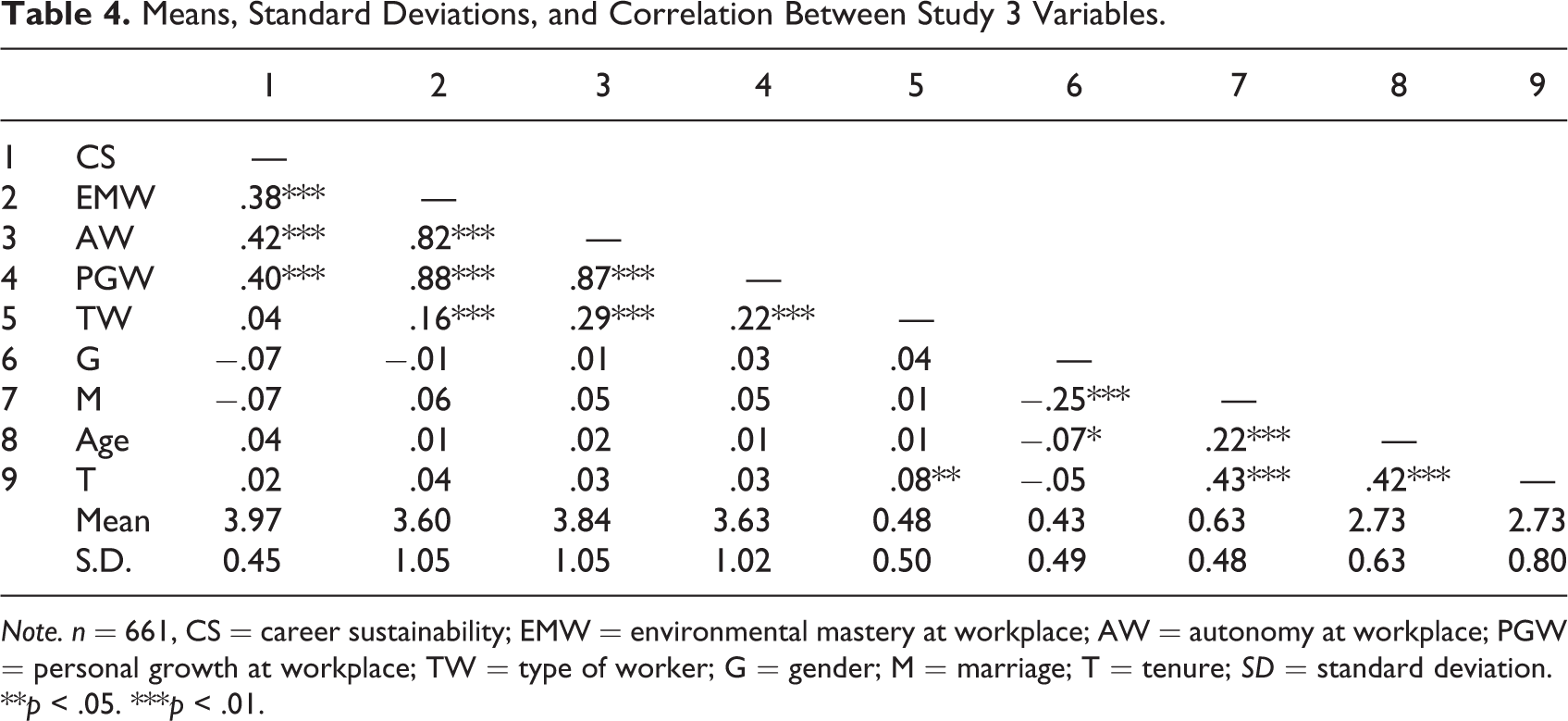
Note. n = 661, CS = career sustainability; EMW = environmental mastery at workplace; AW = autonomy at workplace; PGW = personal growth at workplace; TW = type of worker; G = gender; M = marriage; T = tenure; SD = standard deviation.
**p < .05. ***p < .01.
CFA
CFA was conducted to examine the distinctiveness of our variables, career sustainability, environmental mystery at workplace, autonomy at workplace, and personal growth at workplace. Gig economy was not included in the CFA because this variable is observed instead of latent in nature. Our CFA results revealed that the four-factor model fitted significantly better (χ2/df = 2.53, CFI = .98, TLI (Tucker-Lewis index) = .97, RMSEA = .04) than all six constrained models in which any two of the four factors were combined. Additionally, we employed the Harman single-factor test (Podsakoff & Organ, 1986) to evaluate whether a single factor would account for a large part of the variance of all items in our model. A single-factor model showed poor fit to the data (χ2/df = 28.88, CFI = .51, TLI = .45, RMSEA = .21). These results indicate that constructs measured in this study are distinguishable.
Hypotheses Testing
We used moderated hierarchical regression to test our hypotheses. In Step 1, we entered control variables, gender, marital status, age, and tenure. In Step 2, we entered career sustainability and type of work (conventional coded as 0 and gig coded as 1). In Step 3, we entered the interaction of career sustainability and type of work. We conducted three such hierarchical moderated regressions, one for each dependent variable, autonomy, environmental mastery, and personal growth. Results are shown in Table 5.
Results of Moderated Hierarchical Regressions of Study 3.
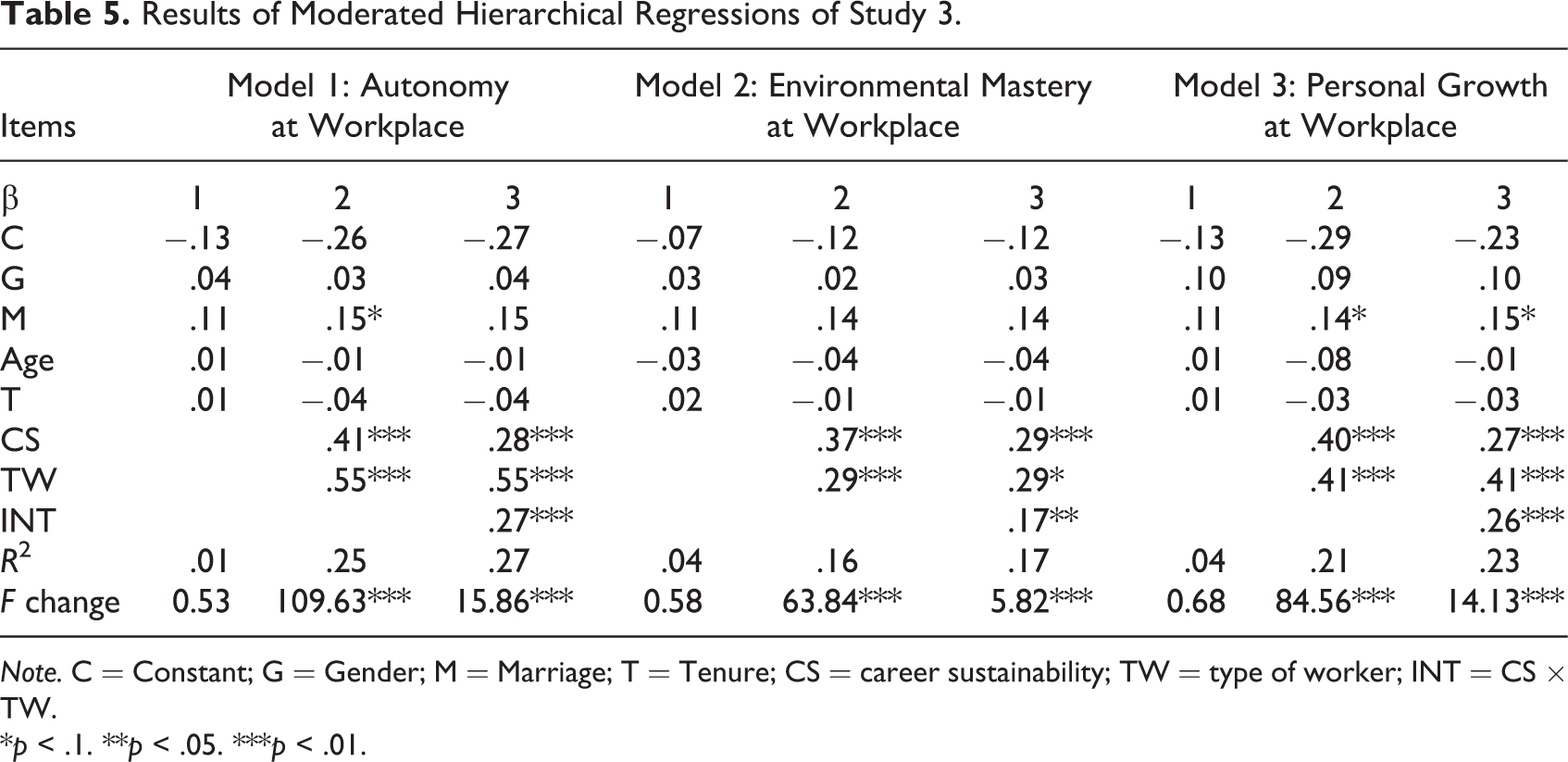
Note. C = Constant; G = Gender; M = Marriage; T = Tenure; CS = career sustainability; TW = type of worker; INT = CS × TW.
*p < .1. **p < .05. ***p < .01.
In Model 1 of Table 5, with autonomy at workplace as the dependent variable, marital status was the only control variable significantly related to autonomy (β = .15, p < .1); career sustainability (β = .41, p < .01) and type of worker (β = .55, p < .01) entered in Step 2 were positively related to autonomy. The interaction entered in Step 3 was significant (β = .27, p < .01) such that the relationship between career sustainability and autonomy was stronger for gig workers relative to conventional workers. As recommended by Cohen et al. (2003), we plotted a simple slope analysis as shown in Figure 1 where the relationship between career sustainability and autonomy was stronger for gig workers (β = .54, p < .01) than for conventional workers (β = .01, p < .01). These results support Hypotheses 3a and 4a.

Moderating effect of type of worker on the career sustainability–autonomy relationship.
In Model 2 of Table 5, with environmental mastery at workplace as the dependent variable, career sustainability (β = .37, p < .01) and type of worker (β = .29, p < .01) were positively related to environmental mastery. The interaction entered in Step 3 was significant (β = .17, p < .05) such that the relationship between career sustainability and environmental mastery was stronger for gig workers than for conventional workers. As shown in Figure 2, the relationship between career sustainability and environmental mastery was stronger for gig workers (β = .46, p < .01) than for conventional workers (β = .12, p < .01) supporting Hypotheses 3b and 4b.
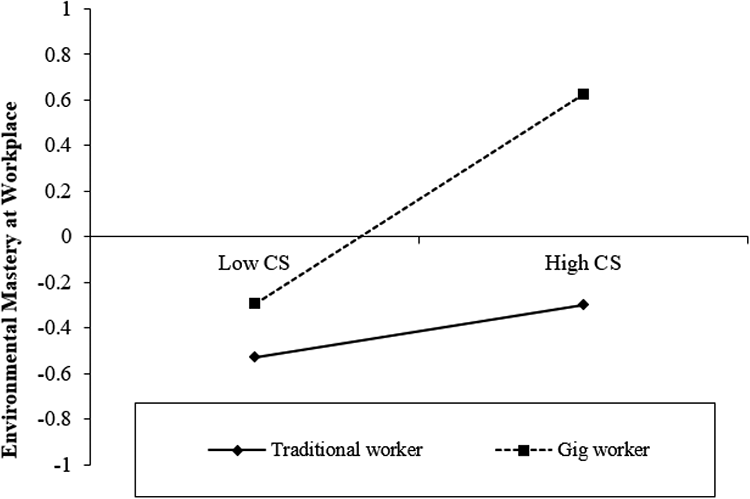
Moderating effect of type of worker on the career sustainability–environmental mastery relationship.
With personal growth at workplace as the dependent variable, career sustainability (β = .40, p < .01) and type of work (β = .41, p < .01) were positively related to personal growth. The interaction entered in Step 3 was significant (β = .26, p < .01) such that the relationship between career sustainability and personal growth was moderated by type of work. Again, we followed Cohen et al.’s (2003) recommendation and performed a simple slope analysis to illustrate the moderating effect of type of work on the association between career sustainability and personal growth. As shown in Figure 3, the relationship between career sustainability and personal growth was stronger for gig workers (β = .53, p < .01) than for conventional workers (β = .01, p < .01) supporting Hypotheses 3c and 4c.

Moderating effect of type of worker on the career sustainability–personal growth relationship.
Discussion
Career sustainability is an emerging concept that has garnered the interest of researchers and practitioners alike. Indeed, given the changing business landscape characterized by mergers, acquisitions, furloughs, and layoffs, career sustainability is a goal of working adults. While prescriptions based on anecdotal data and theoretical accounts of career sustainability abound, the lack of an established scale has hindered systematic accumulation of knowledge on the construct. Therefore, the primary purpose of this manuscript was to develop a scale to measure career sustainability. Following Hinkin’s (1995) methodology, we first developed a scale using data collected from three separate samples from China. Next, we conducted two studies, one with data from United States and the other with data from China to provide preliminary evidence of construct validity for the scale.
Contributions to Theory and Research
The primary contribution of this study is the development and validation of a scale to measure career sustainability. Following Hinkin’s scale development protocol, we developed a new measure of career sustainability using three independent samples. This is an important contribution as it fills the void created by the absence of an empirical measure of career sustainability (Chin et al., 2019b; De Vos et al., 2018; McDonald & Hite, 2018).
Second, we conducted two studies (Studies 2 and 3) to provide preliminary evidence of construct validity for the scale. In Study 2, we theorized that individuals who believe their careers are sustainable will be able to navigate the work environment in such a manner as to avoid being plateaued. In addition, a belief that one’s career is sustainable could be expected to enhance satisfaction with one’s career. As expected, career sustainability was negatively related to career plateaus and positively related to career satisfaction.
In Study 3, we posited that career sustainability will positively influence psychological well-being such that people who feel that their careers are sustainable will report higher levels of psychological well-being. In addition, we proposed that the relationship between career sustainability and psychological well-being will be moderated by type of worker, whether a gig worker or a worker in a traditional employment relationship. Gig workers in our sample were online freelancers who had contractual arrangements with organizations (who participated in Study 3) and worked on complex projects requiring specialized, professional skills. Gig workers who are confident that their careers are sustainable are likely to experience higher levels of psychological well-being relative to conventional workers who do not experience the same level of risks and rewards as gig workers. As expected, the relationship between career sustainability and indicators of psychological well-being was stronger for gig than for conventional workers.
While we focused on the consequences of perceptions of career sustainability, future research should investigate antecedents of career sustainability. For instance, research should examine whether personality characteristics (e.g., proactive personality), competencies (e.g., career adaptability), work behaviors (e.g., job crafting), and contextual factors (e.g., perceptions of support) influence perceptions of career sustainability.
Practical Implications
Results of our studies show that individuals who perceive career sustainability are less likely to feel plateaued as well as enjoy higher levels of career satisfaction. Relative to conventional workers, gig workers who are freelancers report higher levels of psychological well-being when they perceive their careers are sustainable. Thus, there are benefits to perceiving higher levels of career sustainability.
Our measure speaks to what contributes to perceptions of career sustainability offering avenues to influence career sustainability. Specifically, perceptions of flexibility, renewability, integrativeness, and resourcefulness contribute to career sustainability. Flexibility dimension indicates the holding of a flexible, adaptable attitude that enables individuals to continuously learn tasks, seek new opportunities, and remain open to new opportunities. The renewable dimension reflects the extent to which careers provide the opportunity for individuals to reassess capabilities, update skills, and rebrand oneself to continuously maintain a sustainable career. The integrative dimension characterizes the extent to which employees can critically evaluate, integrate, and absorb disparate information and knowledge acquired in their current jobs to further develop their careers. The resourceful dimension embodies the vital importance of using resources well to maintain a good standard of living and ensuring employment opportunities in the future. Our results have clear implications for counseling as focusing on these four characteristics will enable one to enhance career sustainability.
Conclusion
Lack of a psychometrically sound measure of career sustainability has hindered research on career sustainability, a construct not only of theoretical significance but of tremendous practical importance. In Study 1, we developed a measure of career sustainability. In Studies 2 and 3, we offered preliminary support for the construct validity for our newly developed measure. In these studies, we showed that scores on career sustainability relate to established measures of career plateaus, career satisfaction, and psychological well-being in predictable ways. Future research should investigate antecedents of career sustainability. We hope that our new measure will facilitate research on career sustainability.
Footnotes
Acknowledgement
This paper is supported by Zhejiang Province Taiwan-related research project(No. W202005).
Declaration of Conflicting Interests
The author(s) declared no potential conflicts of interest with respect to the research, authorship, and/or publication of this article.
Funding
The author(s) received no financial support for the research, authorship, and/or publication of this article.
