



Abstract
Mentoring is a valuable resource that enhances outcomes like career success. Applying conservation of resources theory, we examine the interaction effects of workers’ management aspirations and lengthy career interruption(s) on the mentoring-career success relationship. Utilizing 259 older professional workers, we test these relationships with both cross-sectional and time-separated data. Although the pattern of results was similar when comparing the cross-sectional data to the time-separated data, we found that relationships were stronger within the cross-sectional data, resulting in the support of two additional hypotheses. With the time-separated data, we found evidence of a three-way interaction. Specifically, mentoring is more valuable for the perceived career success of workers with higher management aspirations who had not experienced a lengthy career interruption than it is for workers with higher management aspirations who had experienced a lengthy career interruption or for workers with lower management aspirations regardless of whether they had experienced a career interruption.
Keywords
Introduction
Mentoring is defined as a relationship between a more experienced mentor and a younger, less experienced protégé for the goal of assisting the protégé’s career (Ragins & Kram, 2007). For protégés, mentoring has been shown to consistently contribute to a variety of beneficial outcomes such as career success (e.g., Allen et al., 2004). However, despite the abundance of research on mentoring, scholars have noted that several unresolved issues remain in mentoring research broadly that could affect relationships, such as the mentoring-career success relationship (Bozionelos et al., 2016). For example, one issue is that the mentoring literature lacks an overarching theoretical framework to drive future research (Janssen et al., 2016). For instance, Eby and colleagues (2008) noted that there could be additional, undiscovered moderators in some of the relationships between mentoring and outcomes. However, it becomes increasingly difficult to determine which moderators should be investigated without a systematic theoretical framework to drive this research. Another issue is that most of the mentoring research to this point has relied on cross-sectional research designs. A major limitation of cross-sectional studies is that relationships between variables can be inflated due to priming and consistency effects. This limitation is of particular concern for the mentoring-career success relationship due to meta-analytic evidence suggesting that some of the smallest but statistically significant effect sizes for mentoring exist in the mentoring-career success relationship (Eby et al., 2008).
In this paper, we frame our research around these aforementioned issues and contribute to the mentoring-career success literature in three important ways. First, we contribute to the literature by introducing conservation of resources theory (COR) as a theoretical framework that can help drive future mentoring research related to career success. COR is a motivational theory that posits that people are motivated to gain resources that can help them achieve their goals and/or protect current resources from loss (Halbesleben et al., 2014; Hobfoll et al., 2018). COR has also proven useful in other streams of research as a framework for understanding career success (Spurk et al., 2019). Because mentoring provides career and psychosocial support, it is a particularly valuable resource for helping protégés achieve their career goals and overcome resource loss in the workplace. Second, we contribute to the literature by utilizing COR to guide the conceptualization of two potential moderators, namely, management aspirations, defined as an individual’s desires and intentions to move into management positions in an organization (Litzky, 2002), and lengthy career interruptions where individuals experience long-term unemployment (being out of the workforce for six months or longer). Lastly, we examine whether differences exist in the strength of our hypothesized relationships between mentoring and career success based upon whether our variables are measured cross-sectionally or at different points in time. By measuring our variables twice at two points in time, we can investigate whether priming and consistency artifacts exist for these relationships and run test-retest reliability checks for these variables.
Mentoring and COR
Mentoring has been shown to be related to career success (Eby et al., 2008). These effects have been found when mentoring is measured as either (a) the presence of a mentor(s) in one’s career or as (b) mentoring behaviors received from a variety of mentors over time. Several meta-analyses published from 2004 to 2008 examined career outcomes from mentoring (e.g., Allen et al., 2004; Eby et al., 2008; Ng et al., 2005). As summarized by Chandler et al. (2011), these studies collectively substantiated that beyond effects of individual factors (e.g., demographics), mentoring has positive, albeit small, effect sizes on objective (e.g., promotions, salary) and subjective (e.g., perceived career success) measures of career success.
Mentoring is generally seen as a broad-based resource providing two functions to protégés: career and psychosocial. Career functions prepare protégés for hierarchical advancement within the organization and include resources such as coaching, sponsorship, visibility in the organization, and protection of the protégé. Psychosocial functions build upon trust, intimacy, and interpersonal bonds that enhance the protégé’s personal growth, identity, self-worth, and self-efficacy. These latter functions often include resources such as counseling, friendship, acceptance, confirmation, and role modeling (Ragins & Kram, 2007).
Because mentoring involves interpersonal relationships, mentoring research has heavily focused on the nature of these relationships, such as how mentoring relationships are formed and the quality and frequency of interactions. For example, research has shown that a mentor’s involvement in the initiation of the relationship matters (Scandura & Williams, 2001) as well as personality or attitudinal differences or similarities between the mentor and protégé (Turban & Dougherty, 1994). Similarly, research examining moderators has primarily focused on factors that can influence the quality or effectiveness of the mentoring relationship, including longevity of the mentoring relationship (Sharma & Rani, 2018), gender of the protégé (Kwan et al., 2015), and traditionality (Wu et al., 2019).
Unfortunately, as the mentoring literature has expanded over the years, it has lacked a consistent theoretical framework (Janssen et al., 2016). For example, in the mentoring-career success literature alone, researchers have utilized signaling theory (Ramaswani et al., 2010), social capital theory (Gara Bach Ouerdian & Mansour, 2019), and social learning theory (Bozionelos et al., 2011) among other theoretical approaches. Interestingly, although mentoring has been touted as a valuable resource, it has not yet been analyzed with a resource-based theoretical lens. In this paper, we present COR as a theoretical perspective to guide mentoring research and evaluate potential moderators.
According to COR, individuals are motivated to acquire new resources (Hobfoll, 1989). However, the value of any resource acquired is predicated on whether that resource facilitates goal achievement, helps facilitate the acquisition of other vital resources, and/or halts resource loss (Halbesleben et al., 2014). Mentoring has been theorized to be a resource that can help workers achieve the self-images they have set for themselves in their career (Hunt & Michael, 1983) and help them obtain career success (Turban et al., 2017). However, because workers have different career goals, such as management aspirations, or encounter different resource losses such as can occur through a career interruption, a resource like mentoring may be of more or less value for the career success of various individuals.
Management Aspirations as a Moderator
Management aspirations is defined as an individual’s desires and intentions to move into management positions in an organization (Litzky, 2002) and has been shown to be a strong predictor of attaining managerial roles (Tharenou, 2001). Workers’ aspirations for pursuing management positions vary widely from person to person. For example, a CareerBuilder (2014) survey of employees in a variety of occupations found that 66% of U.S. workers sampled had no aspirations for advancing into management while the rest had varied managerial aspirations ranging from first-level supervisor to mid-level manager to executive or even CEO.
To date, research on management aspirations has been somewhat sparse and focused on managerial attainment. As such, research has primarily focused on how individual, lifestyle, and/or work-life issues influence an individual’s aspirations for pursuing management (e.g., Litzky, 2002). While aspirations capture one’s commitment and motivation for achieving some goal or end state (Hart, 2016), resources provide the means to obtain that end state (Hobfoll, 2002). Workers with differing aspirations perceive work-related resources differently based upon whether those resources adequately facilitate, align with, or even thwart the fulfillment of those goals. Using managerial aspirations as a perceptual lens for analyzing mentoring’s influence on people’s career success suggests that managerial aspirations may represent a boundary condition that can strengthen mentoring’s value for career success.
Arguably, those with higher management aspirations could benefit most from mentoring received from senior managers. Those with higher management aspirations would be more attuned to the importance of mentoring for advancement in their career because advancement is something those with higher management aspirations value or a goal they are pursuing. Similarly, the organizational advancement mentoring can facilitate is likely to be more valued and produce a greater resource gain for those with higher aspirations. Accordingly, individuals with higher management aspirations would possess a higher level of motivation to self-initiate strong relationships with mentors to promote their organizational advancement.
Overall, mentoring prepares protégés for hierarchical advancement, a career goal for some. As such, we expect that the resource of mentoring will be more beneficial in terms of both perceived career success and attainment of managerial positions for those with higher management aspirations. Conversely, for those with lower management aspirations, the resource of mentoring will be less beneficial because the career support and growth provided by mentoring facilitates the procurement of a resource that is less valuable and less sought after by those with lower aspirations. Thus, we hypothesize:
The relationship between mentoring received and perceived career success will be stronger for those employees with higher management aspirations.
The relationship between mentoring received and management attainment will be stronger for those employees with higher management aspirations.
Lengthy Career Interruptions as a Moderator
According to COR, some resources take on greater meaning when individuals face some type of resource loss (Hobfoll, 2002). One valued resource for most adults is employment, and when people experience a lengthy career interruption, they experience a resource loss. Career interruptions can come in many forms, reflecting negative and positive experiences such as termination, parental leave to begin a family, dealing with personal or family medical issues, or simply taking a break to rejuvenate.
Career interruptions are typically characterized as a type of adverse “shock” in one’s career. In this vein, some research has found that career interruptions frequently are involuntary, reflecting job loss from organizational restructuring or personality clashes (Reitman & Schneer, 2005; Schneer & Reitman, 1997) and can negatively impact earnings (e.g., Ng & Feldman, 2014), management level attained in one’s career (Schneer & Reitman, 1997), and career satisfaction (Reitman & Schneer, 2005). Similarly, research has found that voluntary career interruptions, particularly those taken to start a family or take care of family members, also negatively impact earnings (Theunissen et al., 2011) and one’s career trajectory (for a review see Bian & Wang, 2019). Overall, career shocks have been found to negatively influence the career development process (Bright et al., 2009) and can influence perceived employability (Blokker et al., 2019). However, research has shown that supportive relationships help people persevere through adverse circumstances (e.g., Caza & Milton, 2012). For example, scholars have suggested that workers experience more career resilience, insight, and identity when they have a stronger relationship with their managers, particularly managers who utilize coaching, provide feedback, and discuss development and career-related issues (London, 1985; Noe et al., 1990).
Correspondingly, we would argue that for individuals who experience a lengthy career interruption, the resource of mentoring will be valuable both as these individuals navigate the interruption and after they return to the workforce and attempt to get their career back on track. For example, mentors can provide information about job opportunities, place the individual in touch with valuable social networks, help individuals gain visibility and exposure in their occupations, serve as sponsors, and support individuals' self-esteem in the transition process. For career interruptions involving pregnancy and childcare, mentors can assist the protégé in staying “in the loop” in the organization, maintaining contacts with managers in the organization, and occasionally enlisting the protégé in special projects for the organization during the career hiatus. Furthermore, we posit that the resource of mentoring will hold more value in terms of career success for those who experienced resource losses inherent in a career interruption than those who have not experienced the same resource losses.
The relationship between mentoring received and perceived career success will be stronger for those employees who have had a lengthy career interruption.
The relationship between mentoring received and management attainment will be stronger for those employees who have had a lengthy career interruption.
Three-way Interaction
Lastly, we investigate the potential for a three-way interaction between mentoring received, management aspirations, and lengthy career interruptions on career success. COR emphasizes that some resources are more valuable when they facilitate goal achievement (Halbesleben et al., 2014; Hobfoll, 2002; Hobfoll et al., 2018). To this end, we have previously argued that for workers with higher management aspirations, mentoring can be a particularly beneficial resource in helping them achieve success. However, we also recognize that when some individuals experience a lengthy career interruption, it is not uncommon for them to alter their career goals and modify their career pathways (Hirschi, 2012). For example, individuals seeking management positions will often work longer hours, travel more, and spend additional time building relationships with key figures in the organization (Markham et al., 1987; Wentling, 1996). However, after some high-aspiring individuals experience a lengthy career interruption, they may no longer be able to or even want to pursue management roles in order to meet other priorities in life and will thus temper their former managerial aspirations (Hite & McDonald, 2003; Litzky & Greenhaus, 2007). Similarly, others may choose to “opt out” of competition tournaments for managerial roles because of their desire to pursue other interests outside of work or to have more time with family (Hoobler et al., 2014; Powell & Butterfield, 2013). In other words, because aspirations can change over time due to one’s changing circumstances (Greenhaus et al., 2000), mentoring may become a less valuable resource for those once high-aspiring individuals who have experienced a lengthy career interruption than it is for those high-aspiring individuals who have not experienced a lengthy career interruption. In the same token, we would argue that low-aspiring individuals are less likely to benefit from mentoring regardless of whether they experience a lengthy career interruption or not because they lacked interest in managerial advancement to begin with. In sum, we posit that the resource of mentoring will be most valuable for the career success of those higher-aspiring workers who have not experienced a lengthy career interruption.
Mentoring received will interact with management aspirations and career interruption to influence career success such that the mentoring received-career success relationship will be strongest for high-aspiring individuals who have not experienced a lengthy career interruption.
Mentoring received will interact with management aspirations and career interruption to influence management attainment such that the mentoring received-career success relationship will be strongest for high-aspiring individuals who have not experienced a lengthy career interruption.
Method
Participants and Procedure
We recruited mid-to later-stage managerial-professional employees using Qualtrics. The use of older participants helps us better ascertain the effects of mentoring over one’s career in relation to career success. More specifically, older professional workers have had maximum time and opportunity to receive mentoring assistance in their career, experience a lengthy career interruption, achieve their management goals, and subjectively evaluate their career success. Participants in our research had to be at least 45 years of age, have a bachelor’s degree, not work in secretarial-type roles, and have a career in a corporate setting with at least 50 or more employees (allowing more opportunities for career growth and management potential). We also collected a similar mix of men and women for our sample, which is particularly beneficial since research has shown that gender can influence management aspirations (Powell & Butterfield, 2003).
Because most of the previous mentoring research has utilized cross-sectional research designs, we collected data on mentoring and career success at two points in time, separated by a two-week gap. Collecting our data at two different time points allowed us to test for priming and consistency effects that could overinflate relationships between these variables when measured simultaneously. It also allowed us to conduct test-retest reliability checks for these measures, whereas no such checks have been previously conducted to our knowledge. Although a longer interval would have been preferred, particularly for conducting test-retest reliability checks, because of the type of respondents we were using (piece-rate ghost workers), we were concerned about subject attrition during the survey interval. Thus, we settled on the 2-week interval as a useful but not perfect compromise.
At Time 1, we had 431 individuals who met our initial screening questions complete our survey. At Time 2, we resampled the 431 respondents and received 298 completed surveys for a 69% response rate. Of the 298 responses, we eliminated all individuals who were retired, working part-time, or had less than five years of full-time work experience, leaving our final sample at 259 participants. Participants were primarily male (61%), ranging in age from 45 to 72 (average age of 55). While all participants had a bachelor’s degree, some participants also had a master’s degree (25%) or a more advanced degree such as a doctoral degree (9%). By age 45, approximately 40% of participants reported having no children, with the rest of the 156 participants having between one and nine children (M = 2.08, SD = 1.13). Participants had varying years of full-time work experience ranging from five years to 51 years, with an average of 29.87 years. Over the course of their career, participants reported working primarily in staff-type positions (64%) versus line-type positions (36%). A little more than half of our sample had relocated at least one time during their career for career/job reasons (52%). We also asked participants what type of employers they have primarily worked for throughout their career. The vast majoring of employees reported working for for-profit organizations (72%), with the rest working for nonprofits (7%) government (12%) or educational institutions (9%). Regarding their organization’s market scope, 16% of participants reported working for a local organization, 24% for a regional organization, 23% for a national organization, and 37% for an international organization. As for early-career managerial aspirations, 27% of participants had no managerial aspirations, 21% had supervisory aspirations, 24% had middle management aspirations, 24% had executive management aspirations, and 4% aspired to be CEO. Lastly, 42% of participants reported experiencing at least one lengthy 6-month or longer career interruption.
Measures
Perceived career success
We assessed perceived career success at Time 1 and Time 2 (test-rest reliability: r = .76) utilizing Turban and Dougherty’s (1994) four-item measure. The first three items ask participants about how successful they and others feel their career has been. These items were assessed on a 5-point scale ranging from 1 (considerably below average) to 5 (considerably above average). The fourth item asks participants to consider their career progress relative to their age. This item was assessed using a 5-point scale ranging from 1 (very behind schedule) to 5 (very ahead of schedule). Cronbach α was .86 at Time 1 and .85 at Time 2, which are both consistent with Turban and Dougherty’s (1994) α of .87.
Management attainment
We assessed highest management level achieved at Time 1 and again at Time 2 (test-rest reliability: r = .79) by asking participants about the highest job level they have achieved during their career. Consistent with prior management attainment research, we utilized four broad categories to capture the different levels of management (Hurley-Hanson et al., 2005). Responses were given on a five-point scale. 1 – “CEO-Firm managing partner (most senior executive in the firm)," 2 – “Senior executive management-or the equivalent on the professional or technical ladder (but not CEO); " 3 – “Middle management-manager of managers-or the equivalent on the professional or technical ladder; ” 4 – “First level management-manager of employees-or the equivalent on the professional or technical ladder ”; and 5 – “Non-management/individual contributor (including entry-level)." For ease of interpretation, we reverse scored our measure such that higher scores represent higher managerial attainment and lower scores represent lower attainment.
Mentoring received
Mentoring received was assessed at Time 1 and Time 2 (test-rest reliability: r = .71) using Dreher and Ash’s (1990) global eighteen-item measure. This scale captures mentoring received as it relates to a broad range of mentoring functions (i.e., career, psychosocial, protection). We asked participants to consider their professional career and asked, “To what extent has a mentor or have mentors…” Sample items include: “Given or recommended you for challenging assignments that present opportunities to learn new skills.” Responses were assessed using a 5-point scale ranging from 1 (not at all) to 5 (to a very large extent). Cronbach α was .96 at both Time 1 and Time 2, which are both consistent with Dreher and Ash’s (1990) α of .95.
Management aspirations
Our measure for management aspirations was assessed at Time 1 by asking participants, “Relatively early in your career, what was the highest job level to which you aspired?” Responses were assessed using the same five-point scale we used for management attainment. As with management attainment, we reverse scored the results such that higher management positions aspired to equate to higher scores.
Lengthy career interruptions
For lengthy career interruptions, we asked participants at Time 1, “Since initiating your post-college, professional career, how many lengthy (e.g., 6 months or more) career interruptions have you experienced?” Using a six-month criterion to classify a career interruption as lengthy aligns with the U.S. Bureau of Labor Statistics’ definition of long-term unemployment, which they define as being at least 27 weeks or approximately six months unemployed. We used binary coding similar to Ramaswami and colleagues (2010) in that we coded responses with a “0” for those who reported never having experienced a lengthy career interruption and a “1” for those who have experienced one or more 6-month career interruptions.
Control variables
We controlled for gender (coded 0 for female respondents and 1 for male respondents), number of years of full-time work experience, and total number of children respondents had by the time they had reached 45 years of age. Because number of children was positively skewed and included many participants who reported not having any children, we normalized its distribution by taking the square root. These variables can play a key role in determining or accounting for our dependent and moderator variables because career aspirations and interruptions can be influenced by gender and how many years one has worked. Also, it seems clear that for many (particularly women), the demands of a managerial/professional career can conflict with parenting and can require opting out of the labor market for varying periods of time.
Results
Means, Standard Deviations, Correlations, and Reliabilities.
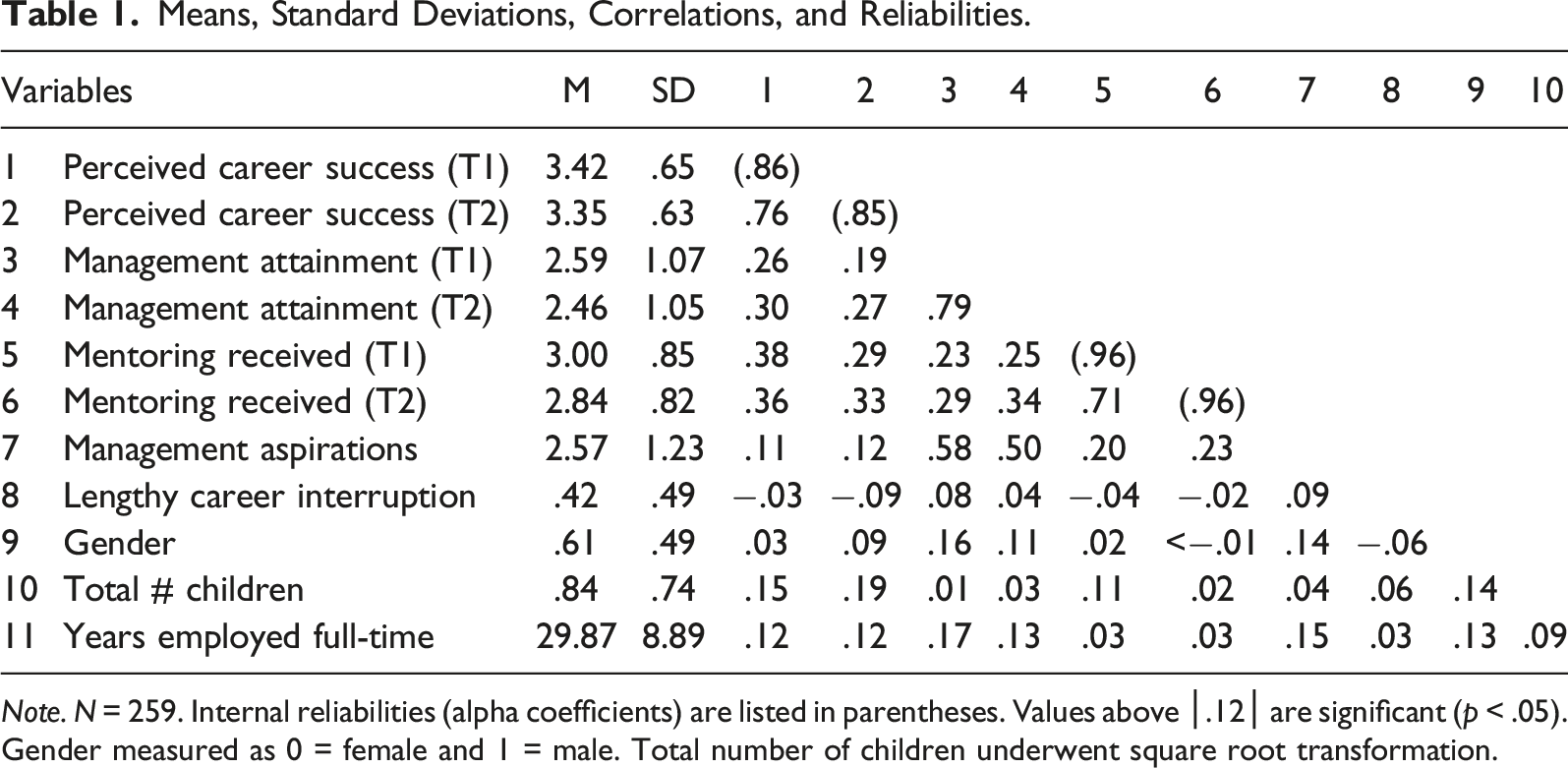
Note. N = 259. Internal reliabilities (alpha coefficients) are listed in parentheses. Values above │.12│ are significant (p < .05). Gender measured as 0 = female and 1 = male. Total number of children underwent square root transformation.
Hierarchical Regression Analysis with Time-Separated Data
Results of Hierarchical Regression Analyses using Time-Separated Variables.
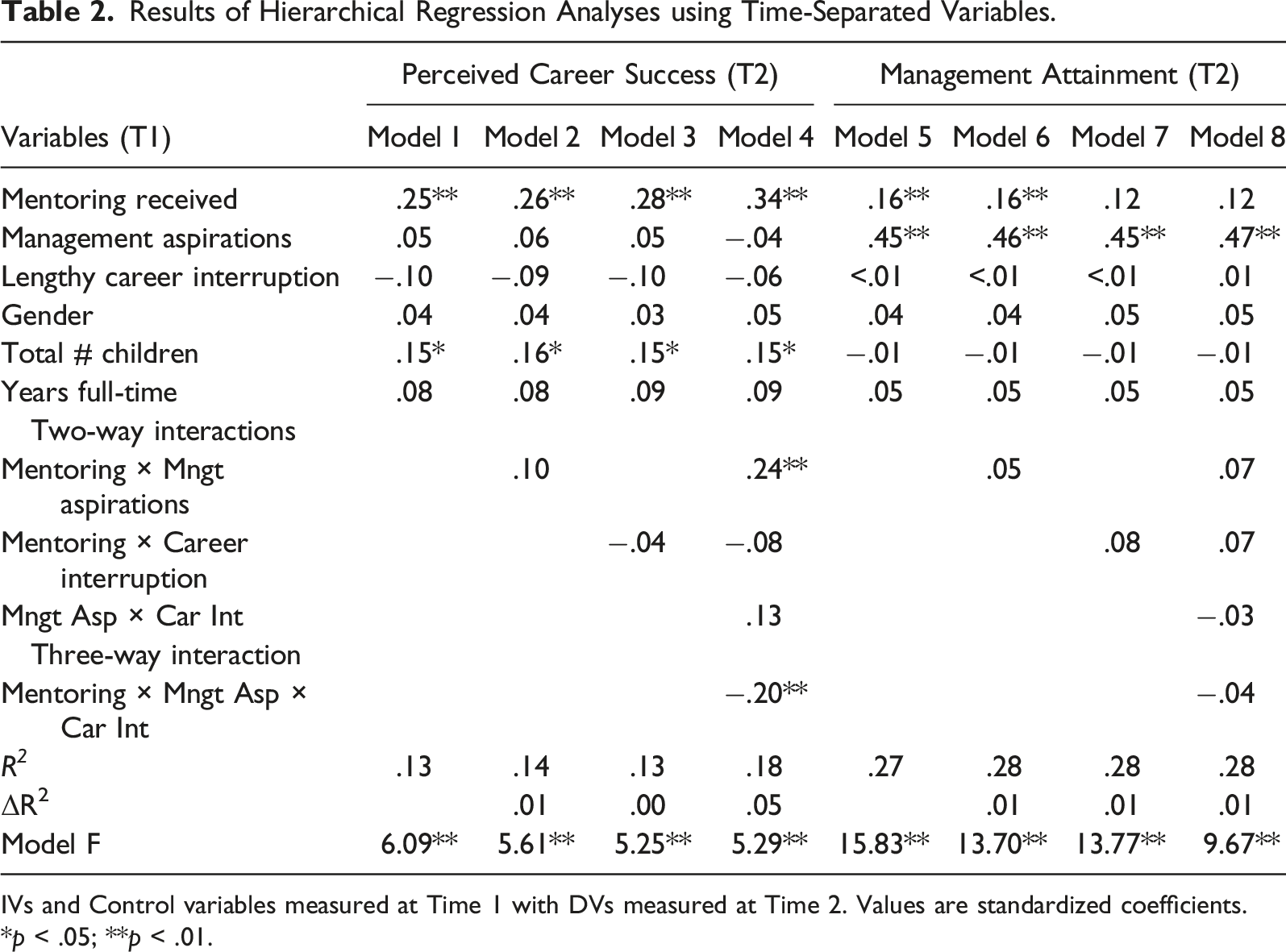
IVs and Control variables measured at Time 1 with DVs measured at Time 2. Values are standardized coefficients.
*p < .05; **p < .01.
Models 1 and 5 represent base models and provide further evidence that mentoring received is positively related with both perceived career success (β = .25, p < .001) and management attainment (β = .16, p = .004), and that management aspirations is positively related with management attainment (β = .45, p < .001). Models 2 and 6 include the interaction effects of mentoring received with management aspirations on career success and management attainment, respectively. Results from Models 2 and 6 indicate that management aspirations does not moderate either the mentoring-perceived career success relationship (β = .10, p = .114) or the mentoring-management attainment relationship (β = .05, p = .339), providing no support for H1 or H2.
Similarly, results from Models 3 and 7 indicate that there is no interaction effect of mentoring received with lengthy career interruptions on either perceived career success (β = −.04, p = .570) or management attainment (β = .08, p = .253), providing no support for either H3 or H4. Lastly, we tested for potential three-way interactions with Models 4 and 8. Results indicate that there is a significant three-way interaction between mentoring received, management aspirations, and lengthy career interruptions on perceived career success (β = −.20, p = .008), plotted in Figure 1, but not management attainment (β = −.04, p = .547). The latter finding provides no support for H6. The three-way interactive effect of mentoring received with management aspirations and lengthy career interruption on career success using time-separated data.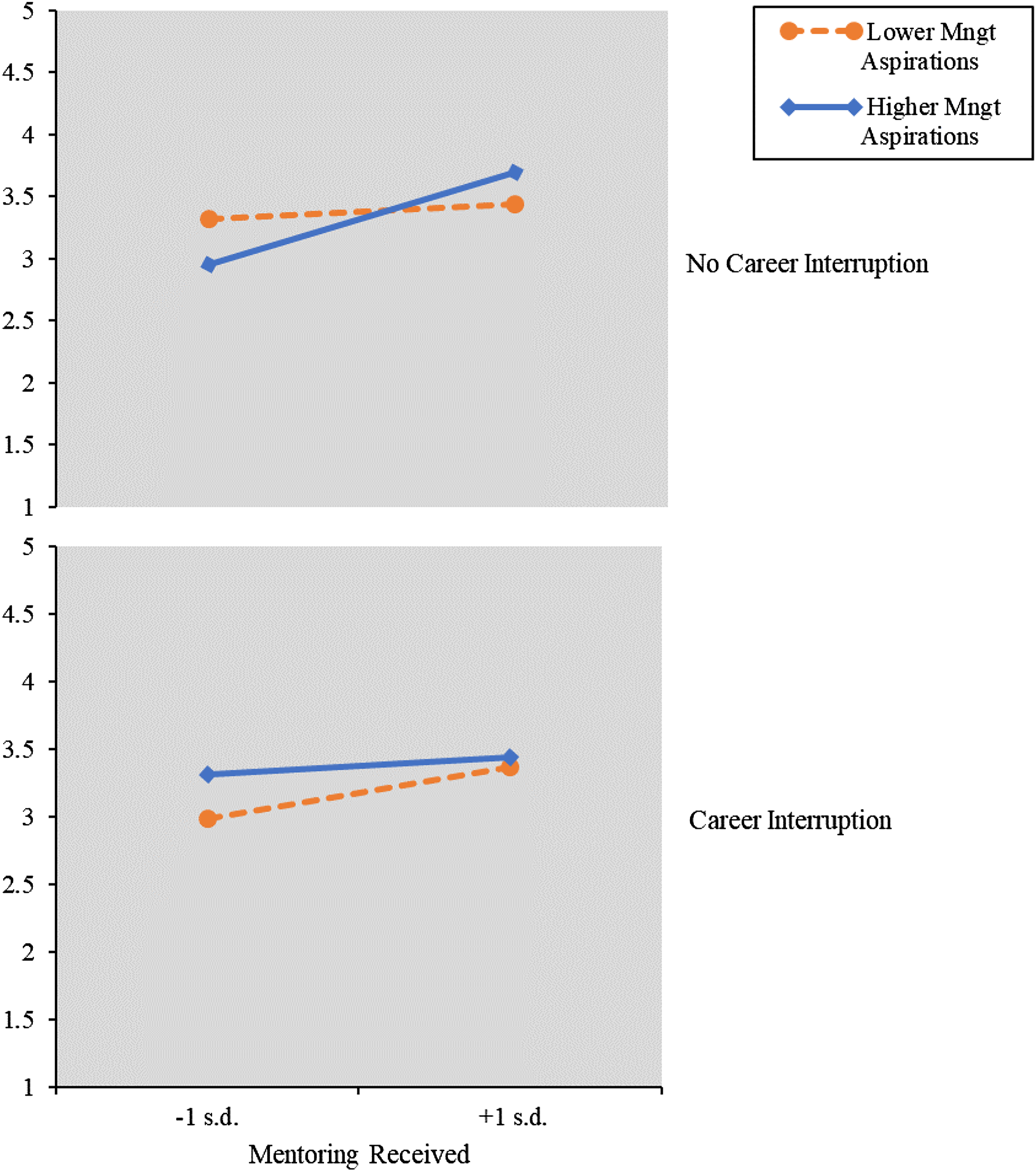
We probed the significant three-way interaction using simple slopes analysis. The analysis shows that mentoring is related to perceived career success for individuals with higher management aspirations who have not had a lengthy career interruption (b = .44, t = 4.99, p < .001). Conversely, mentoring received was not related to perceived career success for those who have higher aspirations and have experienced a lengthy career interruption (b = .07, t = 0.76, p = .448), or for those with lower management aspirations who have experienced a lengthy career interruption (b = .23, t = 1.89, p = .060), or for those with low management aspirations who have not experienced a lengthy career interruption (b = .07, t = 1.00, p = .321), providing support for H5.
Hierarchical Regression Analysis with Cross-Sectional Data
Results of Hierarchical Regression Analyses with Cross-Sectional Data.
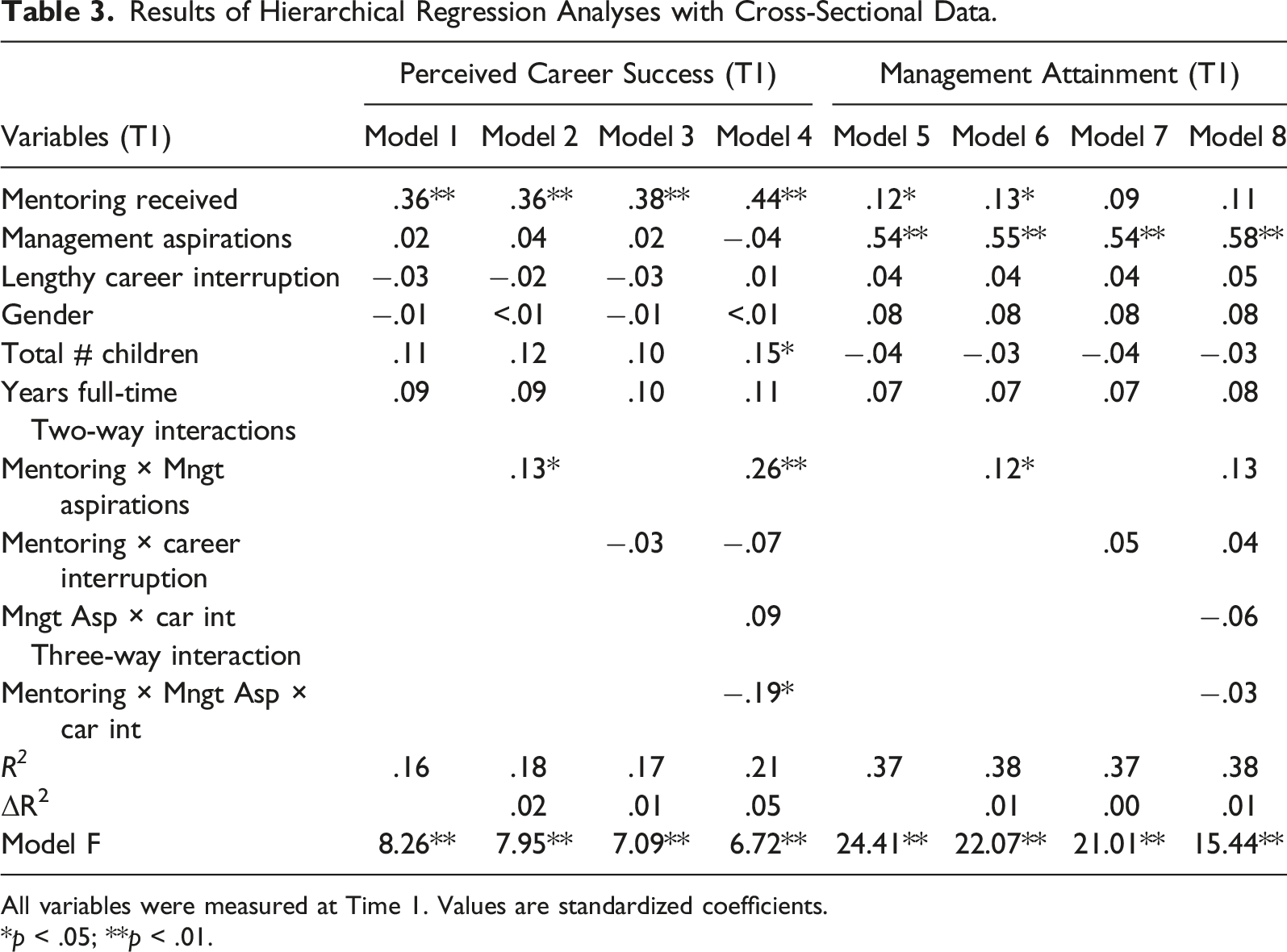
All variables were measured at Time 1. Values are standardized coefficients.
*p < .05; **p < .01.
Discussion
As the mentoring literature has expanded over the years, several issues have also arisen. Such issues include the lack of a systematic theory driving mentoring research (Janssen et al., 2016) and that most of the mentoring research to date has been conducted with cross-sectional research designs. Regarding the lack of consistent theory throughout the mentoring literature, we presented COR as a resource-based theoretical framework to help drive future research on the mentoring-career success relationship and examine potential moderators for this relationship. On the one hand, COR posits that resources like mentoring are more valuable when they help individuals attain their goals and aspirations (Hobfoll, 2002). Workers' management aspirations can be quite varied in that one worker might have little to no aspirations for management while one’s coworker might aspire to become an executive or CEO. Arguably, people who aspire to become managers have conceptualized career paths they want to follow. In support of COR, we found that for higher-aspiring workers who have not experienced a lengthy career interruption, the relationship between mentoring received and perceived career success is stronger regardless of whether our variables of interest were collected at the same time or whether they were collected at different points in time.
On the other hand, COR also posits that resources like mentoring are more valuable when they help individuals overcome resource losses (Hobfoll, 2002). Unfortunately, we did not find that the resource loss of a lengthy career interruption moderated the relationship between mentoring received and career success. However, one potential explanation for this nonsignificant effect could be that during a lengthy career interruption, workers become physically separated from the workplace and their mentors for an extended period of time. As such, those relationships are less likely to be consistently nurtured or can be cut off completely because they are no longer working together or because priorities changed for the individual who is experiencing the interruption. Also, if the mentor has not experienced the same type of career interruption, s/he may not feel capable or confident in knowing how to support the individual effectively. Another potential explanation could be that many individuals do not perceive a career interruption as a resource loss. For example, some literature has suggested that career interruptions may not be detrimental to career satisfaction because they allow workers to align work with personal values better, and the interruption allows people to reassess their career expectations (Greenhaus et al., 2000). Despite not finding a significant moderating effect, perhaps by examining other resource losses within the workplace, such as not getting a particular promotion or not getting assigned to a particular project or team, may be better aligned with the career-related resources that mentors can provide.
As for the cross-sectional issue in mentoring research, we tested our hypotheses using both time-separated and cross-sectional data to see if priming and consistency artifacts would overinflate the results for the cross-sectional relationships relative to the time-separated results. While the overall pattern of results was similar across the data, the findings were consistently stronger with the cross-sectional data, resulting in the support of two additional hypotheses that were not supported with the time-separated data. This finding is especially important because meta-analyses have shown that the relationship between mentoring and career success is relatively small (but significant). Because the cross-sectional results appear inflated, we are left to wonder how accurate these previous findings are within the mentoring literature.
Practical Implications
From a practical standpoint, our findings have important implications for workers and organizations. Researchers have suggested that understanding an employee’s management aspirations could be used for initial job placement (Rynes et al., 1988). We agree with this assertion; however, beyond providing a better fit for employees, understanding an employee’s aspirations could also allow organizations to utilize resources more effectively, such as formal mentoring relationships. Many organizations have instituted formal mentoring programs with varying degrees of success. Perhaps these programs would be more effective if they were specifically utilized to groom and help those employees with higher management aspirations. Arguably, the career benefits associated with mentoring would be more appreciated and have a greater impact on those pursuing managerial roles. Furthermore, understanding the types of conditions mentoring is more likely to be utilized could perhaps help eliminate some of the “dysfunctional” mentoring relationships, especially within formal mentoring relationships, by aligning mentors with those who can best utilize those resources.
Moreover, because mentoring specifically provides career and psychosocial support, we would not suggest that mentoring only happens for those with higher aspirations who have not experienced a career setback. Rather, our findings suggest that there may be other circumstances where individuals may benefit from mentoring relationships. Accordingly, managers should consider other circumstances or demands where mentoring may be particularly helpful.
Lastly, because aspirations influence career trajectories and outcomes, there is an important role mentors and career coaches need to play to help protégés and clients reach clarity about their career aspirations and help them to not underestimate their potential. This will be particularly important when mentoring promising female talent. The issue here is that women may be making self-imposed biased assessments regarding their ability to pursue high-level managerial careers. Here, we encourage mentors and career coaches to draw on theories like those of Correll (2004). This theory emphasizes the constraining effects of cultural beliefs about gender on the self-imposed career aspirations of women. Thus, women may be facing two biasing forces in the workplace – those imposed by senior decision makers, and those that are self-imposed.
Limitations and Future Research
As we mentioned previously, one limitation of many studies that examine management aspirations is that the participants are often college students or recent college graduates who lack work experience (Litzky, 2002). While our sample was older and had more work experience, we recognize that there are also limitations associated with our study. For example, we asked workers to retroactively report both their mentoring received and their management aspirations early in their career. While we assumed that management aspirations and management attainment are positively correlated due to goal achievement, it is also possible that participants cognitively readjusted their reported aspirations based on their actual attainment. Likewise, their reports of mentoring received may be affected by memory inaccuracies. Accordingly, future research could use a longitudinal approach to verify the relationship between management aspirations and attainment, where new workers report their management aspirations and are then tracked throughout their career to determine attainment of aspirations and how or when those aspirations changed. Similar approaches could be utilized for capturing mentoring received longitudinally. Another limitation of our study was the use of single-item measures for assessing two of our predictor variables (management aspirations and career interruptions) and one of our outcome variables (management attainment). Despite this limitation, assessing these measures in this way is not without precedent as Powell and Butterfield (1981, 2003, 2013) used a single-item measure to assess management aspirations, and Ramaswami and colleagues (2010) measured career interruptions with a single item. Similarly, for career outcomes like management attainment or number of promotions, asking participants to self-report with a single question is common practice (e.g., Turban & Dougherty, 1994) Future research could look to develop better measures for assessing these variables. Future researchers might also consider other potentially relevant control variables, such as familial obligations and conflicts.
Another limitation of our study is that we analyzed lengthy career interruptions broadly in terms of whether or not participants have experienced a lengthy career interruption. We have noted that career interruptions can reflect both gains and losses, negative shocks, as well as positive opportunities. For example, a positive career interruption could be leaving work to go back to school or acquire advanced training to help further one’s career. This type of career interruption differs in effect on one’s career relative to a lengthy career interruption that results from familial obligations (Theunissen et al., 2011). Based upon how we collected data on this variable, we could not delve deeper and classify what type of career interruption participants experienced. As such, future research could explore this variable further to examine whether there are types of interruptions that require particular or additional resources to navigate the interruption and the return back to work.
Lastly, future research could use other screening variables like years of full-time work experience rather than or in addition to age. We specifically used age as our screening variable since we focused on individuals in the mid to later stages of their career age-wise. One drawback to this approach is that some participants had less full-time work experience or started their career much later than others of the same age. Future research could better tease out whether the timing of the career interruption (earlier or later in one’s career) or the hierarchical level of the individual when the interruption occurred differentially affects career-related outcomes.
In conclusion, our results highlight the value of COR as a theoretical framework in the mentoring literature. We found that for workers with higher management aspirations who had not experienced a lengthy career interruption, mentoring is more valuable in terms of career success than it is for those with lower management goals and/or those who must manage a lengthy career interruption in their career journey. Our results also highlight that method variance can be an issue in the mentoring literature and that future research should use longitudinal-type research designs when examining mentoring’s influence on career success.
Footnotes
Declaration of Conflicting Interests
The author(s) declared no potential conflicts of interest with respect to the research, authorship, and/or publication of this article.
Funding
The author(s) received no financial support for the research, authorship, and/or publication of this article.
