



Abstract
Career indecision is a substantial challenge for multicultural adolescents in South Korea. This study investigated the role of acculturation stress in adolescents and their parents in multicultural families on career decisions in South Korea. Perceived career barriers by adolescents and career-related behaviors of their parents were included as mediators. Using national panel data from 1695 cases longitudinally collected over the 3 years, the mediation analysis was conducted. The results showed that acculturation stress experienced by both adolescents and parents negatively predicted the adolescents’ career decisions. In addition, a sequential mediation effect of parental career-related behaviors and adolescents’ career barriers was found in the relationship between parental acculturation stress and adolescents’ career decisions. These results highlight the importance of acculturative stress experienced by families, and not just by individuals, in understanding the career development of multicultural adolescents. The implications of this study’s findings are discussed.
Keywords
A multicultural family is the term particularly used in South Korea to describe a family comprised of a foreign national or non-citizen immigrant who has acquired South Korean nationality by marriage according to the country’s immigration policy (Park et al., 2018). Since the 1990s, many foreign workers have started coming to Korea due to rapid economic growth. In addition, as the number of international marriages increased with globalization, it has accounted for approximately 10% of the total number of marriages in Korea since the 2000s, and children from multicultural families accounted for approximately 6% of all births in 2020 (Korea Census Bureau, 2021). The increase in multicultural families creates the social need to understand their unique challenges and improve their well-being.
Acculturation stress, in particular, plays an important role in the development of adolescents from multicultural families. The Family Stress Model (FSM; Conger et al., 2010), which suggests that disadvantaged socioeconomic status affects children over the course of their life via its effects on parents, has been used as a useful framework in understanding how acculturation stress experienced by parents leads to detrimental outcomes on a range of developmental domains of children (Lorenzo-Blanco et al., 2016). This framework has been widely applied to research on mental and behavioral health (Lee et al., 2013), yet there is a gap in the extant literature on career development. Considering the mutual influence of acculturative stress in a parent–child relationship, it is of utmost importance to identify the potential mechanisms of family dynamics in career development among adolescents from multicultural families. Thus, this study attempted to extend the applicability of the FSM to career research by examining the role of acculturation stress perceived by parents on the career development of adolescents from multicultural families, which could help to develop effective intervention model for their future civic participation.
Adolescents from multicultural families live in various environments depending on the circumstances they face, but many experience psychological distress caused by financial hardship, lack of opportunities, discrimination, and prejudice at school and in society. In particular, poor academic performance, a lack of motivation for learning, and difficulties in peer relationships due to multicultural characteristics such as parental nationality and different appearances can be risk factors for school adjustment (Park et al., 2018). A recent report highlighted that the proportion of bullying cases in schools, against adolescents from multicultural families, continued to increase from 5.0% in 2015 to 8.2% in 2018 (Choi et al., 2021).
Adolescence is a critical period of life for career development, as it is characterized by identity exploration and heightened instability (Vondracek et al., 2019). The delay in making decisions for long-term learning, to align personal needs of physical or psychological fulfillment with career advancement opportunities, could prevent progress toward adulthood (Vondracek et al., 2019). One of the detrimental factors that may affect the career development of adolescents from multicultural families is acculturative stress. Acculturative stress refers to the mental and emotional challenges associated with being an immigrant or ethnic minority (Berry, 2006). Adolescents from multicultural families are particularly vulnerable to the stressor since they are exposed to the conflicting sets of cultural values of their parents of foreign origins as well as the mainstream society (Sirin et al., 2013). Extant literature has indicated that acculturative stress may occur when adolescents are pressured to conform to the traditions and cultural norms of their parents or coaxed to abandon the cultural identity and values of the parent’s country and assimilate into the mainstream culture. Heightened states of acculturative stress have been reportedly associated with perceived career barriers (Jeon, 2021). Adolescents from a multicultural family with a high level of acculturative stress may be disengaged from the host culture possibly due to discrimination, contributing to the lack of self-understanding, lack of motivation to get career-related information, and increased perception of financial difficulties (Franco et al., 2019). Eventually, this could impede a clear understanding of career options that adolescents can utilize to reflect on their career decisions (Kim & Ra, 2015).
The role of parents’ acculturative stress on their children’s psychological concerns has also been emphasized (Choi & Dancy, 2009), aligning with previous research, which reported an association between children’s acculturative stress and their mental health outcomes, such as depression, anxiety, and somatic symptoms during adolescence (Sirin et al., 2013, 2019). Although adolescents’ individual factors (e.g., personality and self-efficacy) may still highly influence their behavioral and mental health, family dynamics should also be taken into account to understand the onset and maintenance of certain mental health concerns since stress occurring due to the specifics of the parent–child relationship can contribute to the deterioration of symptoms. Prolonged stress and limited resources associated with a parental role lead to physical as well as mental exhaustion (Gillis & Roskam, 2019). Parents from multicultural families struggle to determine proper parenting methods for their children aligned with the norm of the host culture. The lack of a support system, either from society or from individual social capital, could further increase the stress and burden of parenting.
Parental stressors from multicultural families likely have a negative effect on children. For example, the levels of parents’ acculturative stress were associated with the anxiety symptoms of their children in immigrant families in the U.S. (Leon, 2014), and acculturative stress of Mexican-origin immigrant parents was associated with internalizing problems among the youth (Calzada et al., 2019). The FSM posits acculturation stress perceived by parents plays an important role in adjustment problems of adolescents directly and indirectly via disrupted parent–child interaction (Miller & Csizmadia, 2022). Based on the propositions of the FSM, we hypothesized that parental acculturation stress would have direct and indirect effects on career barriers perceived by adolescents.
First, parents’ acculturation stress may directly affect adolescents’ perception of career barriers. Parents in multicultural families face cultural adjustment between their original culture and the host society, and often experience acculturation stress, partly caused by discrimination, alienation, and marginalization imposed on them. Despite public policies and services for multicultural families along with an improved social climate promoting multiculturalism, parents in multicultural families experience a serious level of discrimination in daily life (Chung & Lim, 2016). For instance, discriminant and hateful expressions toward one’s country of origin, culture, or racial identity are pervasive in society and exist even in publications and educational materials created by the government (Jun, 2019). International marriage ads often violate the human rights of the person directly involved with discriminatory and misogynic expressions describing personal information in detail (e.g., appearance, height, and weight). Furthermore, perceived workplace discrimination and lack of opportunities due to several factors including, but not limited to, language barrier, insufficient social support, and unfamiliarity with the system of the host country detrimentally affect general family functioning and financial status (Gassman-Pines, 2015). Such experiences of parents have an immediate impact on their children. When adolescent children are repeatedly exposed to the struggle of their parents against discrimination and foreigner objectification, they may be conditioned to expect deprivation in their future occupations as well (Constante et al., 2021). Consequently, adolescents in multicultural families recognize several barriers to career development, including racial discrimination, lack of finances, and lack of education opportunities, especially when their parents struggle with acculturating to the host culture (Lim, 2021).
It is also plausible that the parents’ acculturative stress, interwoven with language barriers and interpersonal isolation, depletes resources that can otherwise be used for the career guidance of their children. Parental behaviors toward the child have been documented to affect the subsequent educational and vocational choices of adolescents (Turner et al., 2003). Parents are among the most important reference groups when adolescents face career-related issues. Positive outcomes in children’s career development have been reported when parents actively help their children make career decisions through self-understanding in areas such as interests, aptitudes, personalities, and values, as well as an understanding of the nature of the work (Turner & Lapan, 2002). Conversely, the perceptions of educational and career barriers in children increase with the lack of career-related parent support (Raque-Bogdan et al., 2013). This could eventually lead to delays and misunderstandings in career decision-making.
As noted above, whereas previous research on career development in adolescents from multicultural families has paid more attention to individual factors such as self-efficacy (Betz & Hackett, 2006), this study suggests a broader perspective by including social contexts such as the family dynamics of acculturative stress. This study aimed to explore the role of acculturative stress of parents and their children, during adolescence, on the career development of adolescents from multicultural families, using data collected across three consecutive years. More specifically, we hypothesized that students’ acculturative stress measured in year 1 would predict career decisions in year 3, and this association would be mediated by career barriers in year 2. We also speculated that there would be a direct effect of the parents’ acculturative stress in year 1 on career barriers in year 2, and that this relationship would be indirectly associated with parental career-related behaviors in year 2.
Method
Participants
Using a retrospective secondary analysis, this study used longitudinal data from the Multicultural Adolescent Panel Survey (MAPS) collected by the National Youth Policy Institute (NYPI), a Korean governmental agency, in South Korea. To track the long-term development of multicultural youths, the Institute established a panel of nationwide multicultural youths and their parents from 2011 and conducted a longitudinal survey for a total of 9 years until 2019. Individual families were selected based on stratified random sampling from 4452 adolescents in multicultural families attending 2537 elementary schools in 16 cities and provinces across the country. Trained interviewers visited each household and conducted the survey with informed consent to increase its validity. The final sample for the analyses consisted of 1695 families.
Demographic Background.

Instrument
Acculturation Stress of Students at T1
The revised version of the Social, Attitudinal, Familial, and Environmental Acculturative Stress Scale for Children-Short Form was used to measure the adolescents’ acculturation stress levels (Hovey & King, 1996). The scale was originally developed to measure the acculturative stress of immigrants or other minority groups and translated into Korean (Nho, 2000). The revised questionnaire consists of nine items reflecting the adolescents’ experiences of acculturation stress, such as “I get stressed when other people joke about the culture of my foreign parents’ country,” “Living in Korea is stressful,” “People force me to act like a Korean,” and “I am ignored because my parents are foreigners.” Each item is scored on a four-point Likert scale: (1) strongly disagree, (2) disagree, (3) agree, and (4) strongly agree. A higher score indicates a severe level of acculturation stress. The nine items were grouped into three factors using item parceling. The internal consistency (i.e., Cronbach’s alpha) of the Korean version of the measure reported by Nho (2000) was .76; in this study, the internal consistency was .89. In addition to Cronbach’s alpha, the maximal reliability of the scale was .91. The item parceling method and maximal reliability are described in the Data Analyses section.
Acculturation Stress of Parents at T1
The parents’ level of acculturation stress was measured using eight items selected from the Acculturative Stress Scale for International Students (Sandhu & Asrabadi, 1994) and translated by Lee (1996). These items capture the major factors contributing to the acculturative stress of immigrant adults, such as perceived discrimination, homesickness, fear, guilt, perceived hatred, and stress due to change. Examples of the items include “I am treated differently from Koreans in my social life,” “Koreans have a prejudice because I am from a foreign country,” “I am withdrawn because I am from a foreign country,” and “I feel like I am from low social status because I am from a foreign country.” Five-point Likert scale was used to score each item: (1) strongly disagree, (2) disagree, (3) neither agree nor disagree, (4) agree, and (5) strongly agree. A higher score indicated a higher level of acculturation stress. The eight items were grouped into three factors via item parceling. The internal consistency of the Korean version of the measure reported by Kim and Jung (2020) was .88; in this study, the internal consistency was .86. In addition to the Cronbach’s alpha, the maximal reliability of the scale was .90.
Career Barriers at T2
Career Barrier Scale was developed and validated by Hwang et al. (2005) to measure aspects of lack of self-understanding (three items), lack of access to career information (three items), and financial difficulties (three items) in the context of career development. Example items included “I don’t know myself well, so I don’t know what to do in the future,” “I don’t know about the different types of jobs,” and “I don’t think I can get the job I want because of my poor family background.” Each item is scored on a four-point Likert scale: (1) strongly disagree, (2) disagree, (3) agree, and (4) strongly agree. A higher score indicated a higher level of career barriers. Composite scores for each factor were used as indicators in this study. The internal consistency reported in the original study was .90; in this study, the internal consistency was .80. In addition to Cronbach’s alpha, the maximal reliability of the scale was .87.
Parental Career-Related Behaviors at T2
Parental career-related behaviors in this panel were measured based on a questionnaire originally developed by Dietrich and Kracke (2009), and the measure was translated into Korean and validated by Cho et al. (2013). The original study reported three factors: support (i.e., advising or providing related information for a child’s career development), interference (i.e., forcing children to consider parents’ thoughts in career exploration and preparation), and lack of involvement (i.e., indifference to the child’s career development). Example items include “I encourage my children to seek out information about careers that interest them,” “I want my children to do what I think when they decide on a career path (reverse scored),” and “I am not interested in my child’s career path (reverse scored).” The composite scores of each factor were used as indicators of interference, and a lack of involvement was reverse scored. Each item is scored on a four-point Likert scale: (1) strongly disagree, (2) disagree, (3) agree, and (4) strongly agree. A higher score indicates a higher level of parental career-related behavior. The internal consistency reported in the original study was .90. In this study, the internal consistency was .63, and the maximal reliability of the measure was .72.
Career Decision at T3
Career decisions were measured using (Lee & Han, 1997) Career Attitude Questionnaire developed. The original questionnaire consisted of five factors: career decisions, career purpose, confidence, preparedness, and independence. This study employed a career decision factor that included four items. Examples of the items include “I’ve never thought about my career path after graduation, so I’m at a loss as to what I’m going to do (reverse scored),” “I don’t know if this will change later, but I’ve decided what I want to do first,” and “It is difficult to decide which career path to take (reverse scored).” Each item was used as an indicator and scored on a four-point Likert scale: (1) strongly disagree, (2) disagree, (3) agree, and (4) strongly agree. A higher score indicated a higher level of career decisions. The internal consistency of the career decision factor reported in the original study was .88. In this study, the internal consistency was .84, and the maximal reliability of the measure was .85.
Procedure
IRB approval for this study was obtained from the authors’ affiliated institution. The source of the data was public (i.e., data retrieved from the Korean governmental organization; NYPI), and analysis of the data would not make the data individually identifiable. The data were provided to researchers after an evaluation of the NYPI with ethical considerations in this study.
Statistical Analysis
R, version 4.1.2 (R Core Team, 2013), was used for all analyses. Descriptive statistics and Pearson’s correlations were calculated to identify the relationships among the variables. The assumption of normal distribution was based on absolute skewness and kurtosis values less than 3 and 7, respectively (West et al., 1995). The measurement and structural models were analyzed. Model fit was examined using the Tucker–Lewis index (TLI) and root mean square error of approximation (RMSEA), as they represent model parsimony and are less affected by the sample size (Hu & Bentler, 1999). TLI values greater than .90 (Hu & Bentler, 1999) and RMSEA values less than .05 (Browne & Cudeck, 1992) are considered to be an acceptable fit. The statistical significance of indirect effects was determined by the bootstrapping result, in which 0 was not included between the lower and upper bounds in the 95% confidence interval (Bollen & Stine, 1992).
Items on the unidimensional scale were grouped through item parceling. Item parceling reduces the number of indicators by using the composite score of the items. It has been known to improve model fit and increase the probability of a normal distribution (Bandalos & Finney, 2001). In terms of reliability, this study employed Cronbach’s alpha and maximum reliability. Maximal reliability (Raykov et al., 2016) is a weighted estimate of the correlation that a factor is expected to have with itself over repeated administration.
Results
Descriptive Statistics
Means, Standard Deviation, and Correlations of Study Variables.

Note. AS_St, acculturation stress of student at Time 1; AS_Pt, acculturation stress of parents at Time 1; CB_St, career barriers of student at Time 2; CRB_Pa, parental career-related behaviors at Time 2; CD_St, career decision at Time 3.
*p < .05, **p < .01.
Measurement Model
A confirmatory factor analysis was conducted to analyze whether the measurement model of the 16 indicators properly constructed each latent variable, such as acculturation stress of students and parents, career barriers, parental career-related behavior, and career decisions. The measurement model was found to be suitable for the data (χ2 = 572.87; df = 94; TLI = .93; CFI = .95; RMSEA = .06), and the factor loadings of indicators explaining the latent variables were within the range of .65–.91 for acculturation stress of student, .69–.92 for acculturation stress of parents, .59–.85 for career barriers, .41–.80 for parental career-related behaviors, and .69–.80 for career decision at the significance level of .001.
Structural Model
The relationship between each latent variable and its indicators was found to be adequate according to the measurement model. Subsequently, a structural model that defined the relationship between the constructs was explored. As shown in Figure 1, the result indicated that the model was a good fit for the data (χ2 = 539.82, df = 97, TLI = .93; CFI = .94; RMSEA = .06). When estimating the indirect effects in 1000 samples drawn from the raw data by random assignment, three paths (i.e., labeled ab, cb, and deb) were identified to be statistically significant at the level of .05 since 0 was not included in the confidence intervals (Table 3). The direct effect of students’ acculturation stress on career barriers was β = .17 (p < .01). The direct effects of parents’ acculturation stress (β = .14, p < .01) and parental career-related behaviors (β = −.10, p < .05) on carrier barriers were significant. The effect of career barriers on career decisions was also significant, as expected (β = −.48, p < .01). However, the direct effect of parental career-related behaviors on career decisions was not significant (β = −.01, p > .05). The indirect effect of students’ acculturation stress on career decisions via career barriers was β = −.08 (p < .01) and β = −.07 (p < .01) when the path started from the parent’s acculturation stress. Finally, the indirect effect of parental acculturation stress via parental career-related behaviors and career barriers was also significant (β = −.01, p < .05). Structural model; effects of parent and child acculturation stress on career decision via career barrier and parental career-related behaviors. Parameter Estimates of the Model. Note. AS_St, acculturation stress of student at Time 1; AS_Pt, acculturation stress of parents at Time 1; CB_St, career barriers of student at Time 2; CRB_Pa, parental career-related behaviors at Time 2; CD_St, career decision at Time 3.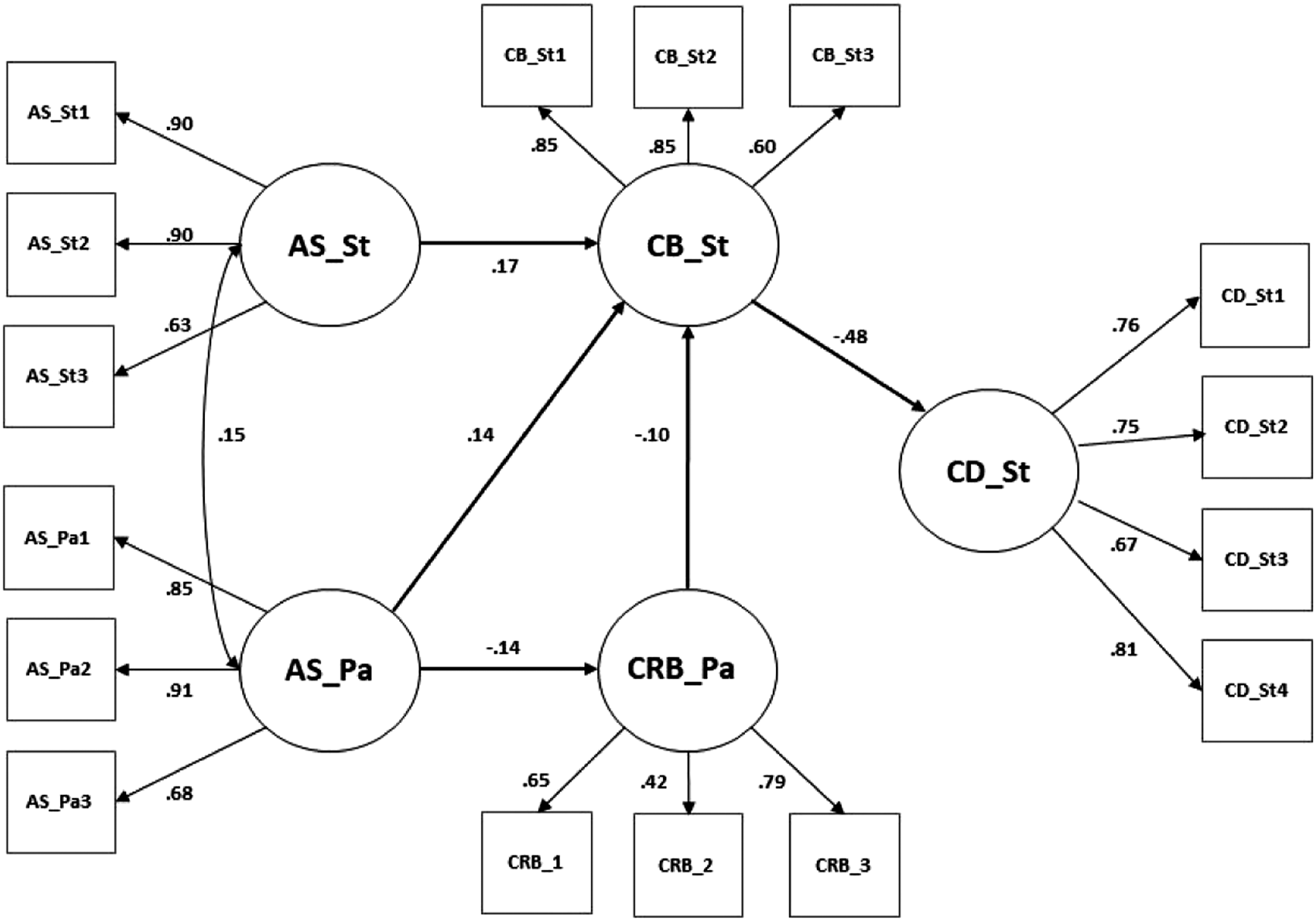

Equivalence Constraint Model Comparison.

Discussion
This study examined the effect of acculturation stress of parents and children on career decision-making through career support and career barriers based on longitudinal data. We confirmed that the acculturation stress of not only adolescent children but also that of their parents predicted career decisions. Parents’ acculturative stress predicted adolescents’ career decisions through two routes.
The first route is via career barriers perceived by adolescents. The higher the acculturation stress of parents, the greater the career barriers perceived by their adolescent children, which in turn led to a low level of career decision-making. Perception of career barriers is a social cognitive construct (Lent et al., 1994), that can be formed through social learning (Bandura, 1977). The beliefs and attitudes of children toward the work world are often shaped by their parents’ work experiences (Barling et al., 1999). In multicultural families, parents’ experiences of acculturative difficulties can also influence the career barriers perceived by their adolescent children. Observing parents of foreign origins struggling with marginalized experiences may lead adolescents to perceive the host society as unfavorable, contributing to the recognition of greater career barriers.
Another path through which parents’ acculturation stress influences children’s career decisions is through the supportive behavior of the parents. Previous studies on the career development of multicultural adolescents have reported the facilitative effects of career-related modeling and learning opportunities provided by parents on their children’s career goal setting and self-efficacy (Choi, 2021; Keller & Whiston, 2008). However, parents under acculturation stress may find it challenging to provide their children with appropriate career-related assistance such as emotional and informational support. They may not be fully aware of the career support behaviors that are effective in the Korean society. Furthermore, parents of multicultural adolescents often have limited time and financial resources to provide career guidance to their children because they often have precarious jobs and lack helpful social networks (Chung et al., 2016).
In addition to the indirect effects of the parents’ acculturation stress on their children’s career decision-making, acculturation stress experienced by the adolescents themselves also predicted their career decisions. Previous studies have identified the stress associated with cultural adaptation to be an important source that impedes career development in various ways (Franco et al., 2019; Reynolds & Constantine, 2007). Multicultural adolescents have reported lower levels of understanding of the self and the professional domain, which are important bases for career decision-making, than non-multicultural adolescents (Fabio et al., 2013). Those who have limited cultural adaptation ability are likely to have lower career decision-making efficacy (Patel et al., 2008). A recent study conducted in Korea also showed that adolescents from multicultural families experience unclear career values, anxiety about future careers, and low self-esteem (Lee, Yang, & Lee, 2021).
In this study, the acculturative stress of multicultural adolescents predicted their career decisions mediated by the perception of greater career barriers. Several inferences may be made as to why acculturation stress leads one to perceive career barriers. First, the acculturative stress of adolescents from multicultural families negatively affects their academic motivations and achievements (Cokley & Chapman, 2008), which serves as a barrier to achieving their desired career goals. Another explanation concerns discrimination, alienation, and marginalization experienced as part of acculturative stress. Such experiences may make one perceive future career opportunities as limited (Holloway-Friesen, 2018). If internalized, these experiences can also lead to a negative self-concept and low self-esteem (Claudat et al., 2016), which detrimentally affects the cognitive appraisal of contextual factors such as socioeconomic status.
These findings indicate that the family system should be considered to fully understand the career development of multicultural adolescents and to design interventions for them. Interventions for multicultural adolescents are essential, such as improving the ways of coping with acculturation stress and career barriers and empowering them by increasing personal control. For example, Stebleton (2007) emphasized career counseling practices that recognize the role of contextual factors (e.g., country of origin and family’s socioeconomic status) and address discrimination and injustice in order to empower the personal agency of African immigrant college students. Along with such interventions for adolescents, it would be equally important to provide resources for parents of foreign origins, helping them deal with their own acculturation stress and learn parenting behaviors that facilitate their children’s career development.
Limitations of the Study and Future Research
This study has several limitations. First, the data from different time points were used to reflect the sequential model (i.e., acculturation stress in both groups at Time 1, parents’ career-related behaviors and children’s career barriers at Time 2, and children’s career decisions at Time 3). However, the analysis was cross-sectional, and longitudinal analyses could not be used because of the complexity of the proposed model. Thus, caution should be exercised when inferring causal relationships. Second, the data in this study were collected before the COVID-19 pandemic. Since the COVID-19 pandemic began, global societies, including South Korea, have observed more prejudice and discrimination against foreigners (Lee, Cho, & Jung, 2021), which might have powerful effects on psychosocial adjustment, including career development, of members of multicultural families. Thus, further research on multicultural families after the COVID-19 pandemic is required to reflect these changes. Finally, systematic error due to common method variance, also referred to as common method bias, could have been involved in this study’s results. As the unique response patterns of the participants (e.g., response style, social desirability, and priming effect) could be reflected in the results, future studies may consider adopting a research design that allows different data sources to minimize the common method variance.
Implications
Notwithstanding the aforementioned limitations, this study’s findings have academic and practical implications for the field of career psychology. First, this study’s findings extend the scope of the FSM (Conger et al., 2010) by identifying the role of parents’ acculturation stress on career development. The FSM has been mainly adopted to illustrate how acculturative stress perceived by parents hinders parenting, resulting in the mental health concerns of their children. This study’s findings that the effect of parents’ acculturation stress can be extended to children’s career concerns via various paths indicate that the FSM can be a useful framework to understand the role of family system on career development of adolescents. This study also indicated that the career development of adolescents from multicultural families should be understood at the family level, as opposed to the individual being the primary focus. Self-identity of adolescent, which greatly influences on career interest and career choice, is shaped by immediate social context especially in the collectivistic culture (e.g., South Korea) as well as multicultural families (Kenny & Bledsoe, 2005; Savickas, 2019).
The present findings have future implications for career practice. Career interventions for multicultural adolescents should be tailored to reflect their acculturation experiences. Interventions focusing on coping with career barriers would be effective because they are proximal factors in career-based decisions. However, the content of career barriers may differ for non-multicultural adolescents, considering that the perception of career barriers is affected by acculturation stress. Thus, the culture-specific contents of career barriers may need to be selected to make the intervention more relevant. In addition, interventions that focus on acculturation stress may be useful. Helping them not to internalize stereotypes and prejudices and develop personal agency in dealing with unfair treatment and discrimination can be beneficial. Although it is beyond the scope of the current study, focusing on the personal strengths of multiculturalism such as openness to others can be one strategy to help them embrace their identities and develop self-efficacy (Fowers & Davidov, 2006). There has been a call for shift from a deficit-based to a strength-based approach to better understand the developmental trajectories of adolescents who were exposed to different cultural systems (Davis et al., 2021; Motti-Stefanidi & Coll, 2018). These kinds of effort to foster and appreciate their unique family backgrounds, in addition to dealing with the environmental acculturation stress, can improve their resilience. Furthermore, intervention for parents is critical. Parents of foreign origins can benefit from interventions to facilitate cultural adaptation, similar to their adolescent children. Furthermore, the intervention for developing effective parenting skills that support the career development of their children would have additional benefits, not just by improving the children’s career decisions but also by enhancing general family functioning.
Footnotes
Declaration of Conflicting Interests
The author(s) declared no potential conflicts of interest with respect to the research, authorship, and/or publication of this article.
Funding
The author(s) received no financial support for the research, authorship, and/or publication of this article.
