



Abstract
The 1991 restructuring of Massachusetts system of higher education is explained and analyzed using McLendon’s “Policy Stream Model of Decentralization Agenda Setting,” a revised Garbage Can model, which proves useful insofar as the case is placed in its historical context. Public higher education in Massachusetts has suffered as a “second class” citizen next to its prominent private counterparts and is often subject to the whims of politicians. The 1991 restructuring can be explained by public higher education’s historical relationship with Massachusetts’ state government and the political environment of the late 1980s and early 1990s. The 1991 restructuring is an intrinsically interesting historical case of governance reform given its political nature, the scope of the reform, and the possible lessons that can be gleaned from it that may inform our understanding of agenda setting for higher education governance reform and governance reform in general.
Keywords
States have been reorganizing their higher education systems since the 1960s—a trend that has continued until today. More than 100 separate initiatives to reorganize, reform, or restructure higher education governance were considered in the 1990s by state governments. These reorganization efforts have taken different approaches: from centralization to decentralization, further regulation to deregulation, and from funding controls to administrative controls (McLendon, 2003; McLendon & Ness, 2003). These changes have often been explained based on economic pressures, changing public attitudes, corporate restructuring, efforts to reinvent government, and other emerging trends (MacTaggart, 1996a). Osborne and Gaebler’s 1992 book, Reinventing Government: How the Entrepreneurial Spirit Is Transforming the Public Sector began a movement that had a strong influence on policy makers seeking to reform higher education governance. Employing the reinventing government theme, these changes were often explained based on the growth in the size, complexity, and cost of higher education and of state budgets (Berdahl, 1971). However, little empirical work has been done to actually determine how and why states restructure their higher education governance structures (McLendon, 2003).
States play an important role in public higher education governance (Richardson, Bracco, Callan, & Finney, 1999) by providing resources, regulations, consumer advocacy, or guidance through steering. These roles are apparent in the different types of systems that exist. For example, federal and consolidated systems are statewide structures that govern all levels of higher education. Segmented systems govern institutions organized by institutional types. Unified systems have one type of institution under a unified board while other institutions have their own board (Richardson et al., 1999). Similarly, campus-level boards govern single institutions (McGuiness, 2003).
Restructuring from one type of system to another can lead to one of three conditions: “improvement, dysfunction, or instability” (Novak, 1996, p. 24). Centralization of higher education governance is often done in an effort to improve higher education for the students, taxpayer, and institutions. However, restructuring state systems of higher education can also lead to institutional infighting, campus management intrusion by governance leaders, and a loss of unity in the higher education community. According to Novak, these “dysfunctional structures also make it difficult to attract or retain good individuals for system, coordinating agency, or campus administration positions” (1996, p. 25), which can lead to a condition of instability within the state. Restructuring state systems of higher education plays out in the political arena, which can lead to conflicts and instability, and “seriously undermine higher education, lower the confidence of supporters, frighten away current and new leaders among both governing boards and administrators” (MacTaggart, 1998, p. 26).
Higher education restructuring may appear as a rational process with the goal of improving the efficiency or performance of the institutions of higher education. However, Volkwein (1986) argues that the type of governance structure generally does not have significant effects on educational quality. This point was further substantiated in later research by Volkwein and Tandberg (2008). There is little empirical evidence that restructuring results in educational improvement although the process itself can be costly (Heller, 2003).
In the end, it has been argued that, efforts to restructure state systems of higher education are usually politically motivated, often with the intent of making the system at least appear more accountable. Such restructuring efforts highlight the tension between state governments and a university’s or a system’s desire for autonomy, its power to govern without outside controls (Berdahl, 1997). An institution’s level of autonomy is “obviously limited at the very least by the need to seek funds from the state” (p. 10), which can give states an advantage when they propose changes in the governance structure.
The frequent effort on the part of states to restructure their higher education governance structures, and the political nature of these efforts, lead to questions about how and why these efforts arise. As McLendon (2003) notes, such effort
Raises important questions about the nature of public policymaking to reform the campus–state regulatory relationship, questions to which scholars have paid surprisingly little attention. . . . Alternately stated, no systematic research has examined the earliest stage of policymaking, a stage known as agenda setting, in states that have restructured their higher education systems in the direction of greater campus autonomy. (p. 482)
And we would argue no systematic research has examined the agenda-setting stage in states that have restructured their higher education systems in the direction of greater or lesser campus autonomy. Agenda-setting research is plentiful in the academic domain of political science (i.e., Kingdon, 1995; Baumgartner & Jones, 1993; Jones, 1994; Carmines & Stimson, 1989; Schattschneider, 1975; Gandy, 1982), however, very little attention has been paid to agenda setting in the public policy domain of higher education.
As indicated earlier, the governance of public institutions is subject to the machinations of politicians and policy makers, and public higher education in Massachusetts is no exception and, in fact, political maneuvering over public higher education in that state is rightly considered a “blood sport.” Public colleges and universities in Massachusetts often see themselves as second-class citizens next to their private counterparts. Politicians often capitalize on this status to use these institutions for political gain and often use the restructuring of public higher education governance as the vehicle for their political maneuvering.
This study analyzes the 1991 restructuring of higher education governance in Massachusetts by applying Michael McLendon’s (2003) application of Kingdon’s (1995) “Revised Garbage Can model of agenda setting,” which McLendon calls the “Policy Stream Model of Decentralization Agenda Setting,” and by utilizing a historical approach. The 1991 restructuring is an intrinsically interesting historical case of governance reform given its political nature, the scope of the reform, and the possible lessons that can be gleaned from it that may inform our understanding of agenda setting for higher education governance reform and governance reform in general.
Utilizing McLendon’s application of Kingdon’s model provides a means to determine if the factors McLendon describes are at play in the case of the 1991 Massachusetts restructuring. The purpose of this study is to better understand higher education governance restructuring and the Massachusetts case in particular. Until recently, the Revised Garbage Can model had not been applied to the agenda-setting process for higher education within the states. Use of this model also allows us to produce any alternative explanation or alterations to the model and further the process of theory development. McLendon (2003) calls for more research to understand how the Revised Garbage Can Theory can illuminate the state legislative policy process with respect to higher education decision making and to understand the “political antecedents of state higher education governance reform” (p. 170). This study combines both of these suggestions.
This study attempts to extend McLendon’s (2003) work in that it applies Kingdon’s Revised Garbage Can model to a new context and a different form of governance restructuring than what McLendon analyzed. The primary question guiding this analysis is “To what extent does McLendon’s application of Kingdon’s model adequately explain how higher education governance restructuring rose to the top of the Massachusetts’s governmental agenda?” An additional question includes “Who were the primary actors who caused the issue to achieve prominence and what was their relative influence?”
Method
Leslie and Novak (2003) state “that further study via the case method may help clarify both the interactive quality of instrumental and political factors and the circumstances under which governance reform emerges on states’ agendas” (p. 117). In addition, McLendon (2003) suggests that there is a need for the use of theory in public policy making and state higher education restructuring efforts because theory development “is a crucial step in the process of building a body of social scientific understanding about a focal interest” (McLendon, 2003, p. 97).
This study employs these suggestions using a qualitative research design (Creswell, 1994) and a historical case study analysis. We utilize a theory-driven, historical case study approach and apply McLendon’s application of Kingdon’s Revised Garbage Can model (Kingdon, 1995; McLendon, 2003) to the 1991 governance restructuring of public higher education in Massachusetts.
In addition to scholarly works, sources included planning documents, blue-ribbon reports, newspaper articles, and semistructured interviews of people involved in this case. We conducted 10 semistructured interviews with 10 policy actors in Massachusetts who were active at the time of the restructuring. All of the interviews were conducted by telephone. The initial group of interviewees was selected based on a review of the case in published research and newspaper articles. In addition, the initial group of interviewees was asked to identify other individuals who might offer additional insights. Interviewees represented a former governor, state agency heads, institutional officials, and members of the legislature. The interviews generally lasted, on average, 45 min in length. The interviews were tape-recorded and transcribed and interview notes were also were taken. The semistructured interview protocol contained eight questions that corresponded to the various dimensions of McLendon’s (2003) framework discussed below. Information gathered through interviews were triangulate with information gathered from scholarly works, planning documents, blue-ribbon reports, and newspaper articles (Lincoln & Guba, 1985). The information collected from the interviews were transcribed, coded, combined with information from other sources and then all of the data were classified into patterns based on McLendon’s framework. The 1991 restructuring is then placed within the historical context of public higher education and governance restructuring in Massachusetts.
Policy Stream Model of Decentralization Agenda Setting
The Garbage Can Model describes the choice process of organized anarchies, which are organizations with problematic preferences, unclear technology, and fluid participation (Cohen, March, & Olsen, 1972). Cohen et al. (1972) developed the original model in an effort to explain the decision-making process of colleges and universities. In this model of organized anarchy, organizations frequently look for problems to fit their solutions. Cohen et al. argue that some actors within these types of organizations have preconceived solution preferences and in an effort to implement those policies search for problems that may justify their preferred solutions. This differs from a rational perspective that conceptualizes decision making as linear and therefore the solution would follow the problem. In addition, with organized anarchies, the complexity of some situations, and the speed at which decisions must be made, may force some actors to make decisions with incomplete information and without well-developed preferences. As Zahariadis (1999) explains, in discussing decision making in government, “time constraints force politicians to make decisions without having formulated precise preferences” (p. 75). When an organization’s technology is unclear, its members may not understand the processes of the organization, thus past experience serves as the main guide for future actions. Fluid participation indicates that the amount of time and energy devoted to the organization or problems within the organization varies greatly among participants.
Kingdon (1995) applied these definitions and adjusted Cohen et al.’s (1972) original model to fit the federal government’s policy-making process (which he defined as “organized anarchy”) and developed the Revised Garbage Can Model. Kingdon based his revised model on an analysis that included 240 interviews with federal policy makers in an effort to explain how issues within health and transportation rise to the top of the national agenda. Kingdon’s explanatory model shows how alternatives are explored and how problem solutions come together in “streams” and are then coupled together by a policy entrepreneur who takes advantage of a window of opportunity. Kingdon argues that there are three generally independent streams flowing through the agenda-setting space of the federal government. These include the problems stream, the policy/solutions stream, and the politics stream. The agenda-setting process occurs when solutions flowing in the federal garbage can converge, or are coupled, with the problems and politics streams. An issue gets on the agenda when “a problem is recognized, a solution is available, and the political climate makes the time right for change” (Kingdon, 1995, p. 93). Kingdon defines this coupling moment as a “window of opportunity.” For an issue to make the agenda, a “policy entrepreneur” must seize the window of opportunity and bring attention to his or her pet problem or solution to get the issue on the agenda at the opportune time. Kingdon’s model has received considerable attention and has been applied to, among other areas, policy innovation and diffusion, foreign policy, health policy, judicial behavior, social movements, and general cross-cutting agenda-setting discussions (Baum, 1998; Durant & Diehl, 1989; Meyer & Staggenborg, 1996; Mucciaroni, 1992; Mumper, 1987; Sabatier, 1999; Walt, 1996; Zahariadis, 1999).
McLendon (2003) offers a new application of the Revised Garbage Can Model by applying a comparative case study approach, with competing theoretical models, in an effort to better understand state higher education policy making. McLendon compared three theoretical models in three separate cases (Arkansas, Illinois, and Hawaii) of governance decentralization agenda setting. The three models included Rational-Comprehensive, Incremental, and the Revised Garbage Can. The Rational-Comprehensive model emphasizes linear decision making through the systematic collection and analysis of information with the goal of maximizing solutions to public policy problems. Policy makers identify problems by deciding on goals and identifying the most efficient means of accomplishing those goals through a rationale systematic process (MacRae & Wilde, 1979; McLendon, 2003; Simon, 1957). Incrementalism conceptualizes governmental agenda setting as a continuous series of steps without an obvious beginning or ending. Policy makers make small changes over time to address perennial problems without ever “solving” the problems. Policy makers emphasize political considerations with only minimal attention to identifying actual solutions to the policy problems (Cobb & Elder, 1983; Lane, 1983; McLendon, 2003).
McLendon found that in each of his three case studies the process of governmental agenda setting for higher education decentralization most resembled Kingdon’s Revised Garbage Can model. In each case, there was an easily identifiable policy entrepreneur who was able to harness problems and politics within the respective states to advance the decentralization solution. The result of his analysis is a grounded conceptual model of higher education decentralization, the “Policy Stream Model of Decentralization Agenda Setting” (McLendon, 2003, p. 511). His conceptual model is displayed in Figure 1 below. McLendon (2003) and others define higher education governance decentralization as the devolution of decision authority from the state to more local levels of campus control (MacTaggart, 1998; Marcus, 1997).
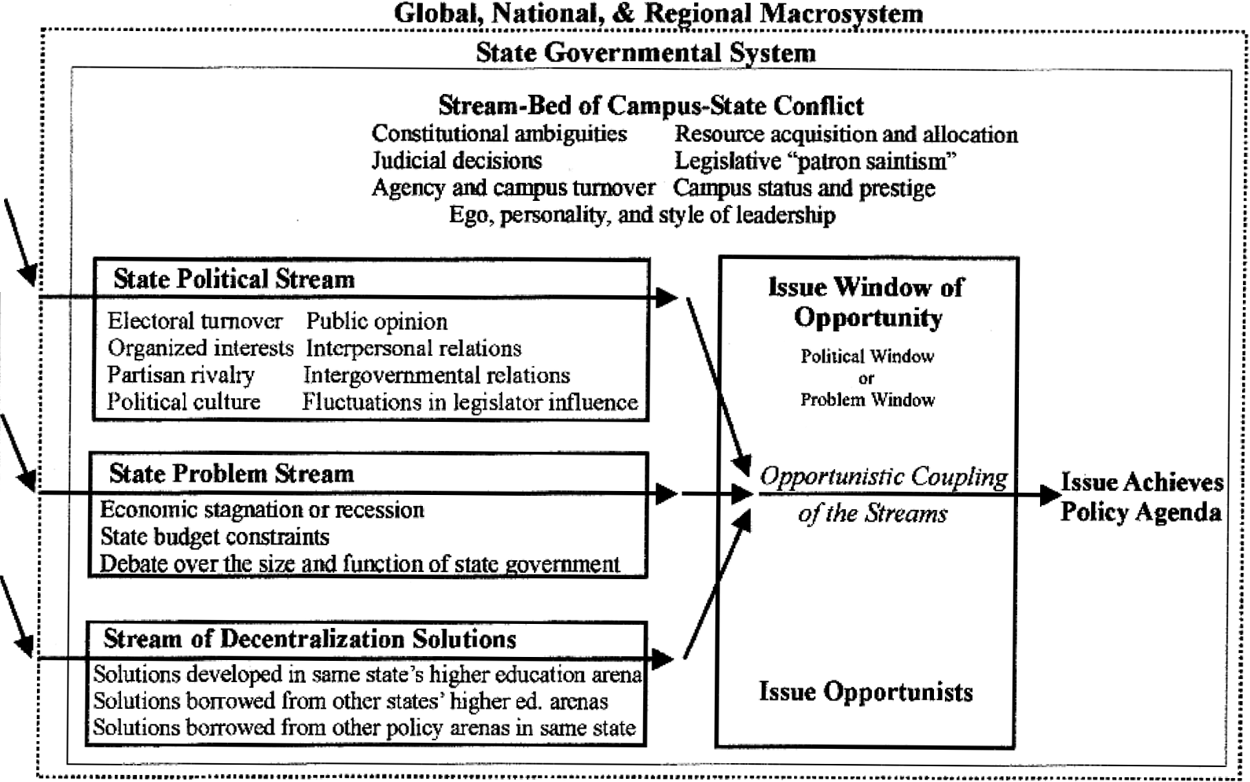
A policy stream model of decentralization agenda setting
McLendon’s application of the Revised Garbage Can model places state government in the context of regional, national, and global macrosystems, each of which may have some influence on state higher education reform by providing flows of stimuli into the state’s garbage can. McLendon’s application accounts for the particular conditions arising in state government and higher education. His application highlights the various sources of tension between public institutions of higher education and state agencies by placing the various streams (the political, problem and solutions streams) within a streambed of campus–state conflict. A number of stressors cause strain such as constitutional ambiguities, resource constraints, turf battles, and clashes in ego, personality, and style of those in leadership at either the campus or state level (McLendon, 2003).
Flowing through the state problem stream are various problems that higher education decentralization solutions may become attached to, such as state economic stagnation, budget crisis, and debate over the size and function of state government or the public bureaucracy. These issues would normally be considered “conditions” but are elevated to the status of “problems” when a powerful political figure champions them. Any of these problems, if severe enough, may cause a window of opportunity to open. There are three ways in which solutions become part of the stream of decentralization solutions: they are imported from another state; they may be developed in and imported from another area of state government (e.g., public education or health care); or they may develop within higher education itself (McLendon, 2003).
McLendon (2003) explains that existing decentralization solutions become linked with problems of statewide scope during brief opportunities, or “issue windows.” There are two types of issues windows: one that opens in response to issues that arise in the state political stream (e.g., conflicts between elected officials and partisan rivalries) and others that arise in the state problem window (e.g., state economic decline) when a policy maker deems a condition serious enough to be considered a problem and, as such, in search of a solution. When one of these windows opens, an issue opportunist can attach the solution of decentralization to the problem and force higher education decentralization onto the agenda (McLendon, 2003).
Higher Education in Massachusetts
Three trends permeate the history of higher education in Massachusetts: the strength and prominence of private higher education, the “second class” status of public institutions, and the high level of interaction of public higher education with politics of the state. Even nonelite private higher education has enjoyed a comparative advantage over public higher education (Freeland, 1992). As former Governor Michael Dukakis explained in discussing why public higher education seems to be especially political in Massachusetts,
Well, I think because we started out with a very strong network of non-public institutions. When I was a kid the University of Massachusetts was know as “Mass Aggie;” it was an agricultural school. Then it became Massachusetts State College. And then, of course, it became the University of Massachusetts in the 1960s based in Amherst, a long ways from Boston. And then the medical school came along in ’63 or ’64. For a long time it was a real stepchild of the system. I don’t think that is the case any longer. But we have certainly treated it as a stepchild off and on over the course of many years now. (M. Dukakis, personal communication, October 15, 2008)
As Dukakis indicates, Massachusetts was a latecomer to public higher education, even in comparison to much younger states of the American West, especially in terms of research institutions. 1 The University of Massachusetts (UMass) was not formally established as a state university until May 6, 1947 when the legislature authorized its creation, in part due to the influx of returning veterans and the incentives provided by the G.I. Bill (Freeland, 1992). 2 Despite its late arrival and despite the state’s reluctance to support it, UMass has demonstrated great ambition to catch up with its counterparts from other states.
By the 1960s, public higher education in Massachusetts lacked any formal unifying structure. The University of Massachusetts, the state colleges, and the community colleges had individual boards but there existed no statewide coordinating or regulatory board over all of public higher education. Public education—at all levels—was regarded as a “mess” (Bastedo, 2003, p. 44). The Boston Globe in 1961 opined that “public education is at its worst at the collegiate level . . . is not really ‘a system’ but a tangled historic legacy still without an overall plan” (quoted in Bastedo, 2003, p. 45). Furthermore, the system of public higher education served a minority of Massachusetts students. According to Stafford and Lustberg (1978), in 1950 only 10% of statewide enrollment was in public institutions and this, which only grew to 16% by 1960 at a time when the national average was 59% of students attending public institutions (Bastedo, 2005).
To address the problems with education in Massachusetts, the state legislature created a commission to issue recommendations, resulting in the Willis-Harrington Act, which created the Board of Higher Education (BHE) in 1965 (Bastedo, 2005). This board would “determine the location and mission of new institutions, set academic program priorities, and allocate resources” (Bastedo, 2003, p. 45) but it was almost immediately ineffective and unstable. Governors and/or legislators made proposals to change the system of higher education on a regular basis (at least 17 different proposals were drafted in the 1970s) due to dissatisfaction with the system (Bastedo, 2005).
There was also dissatisfaction among the campuses with the system. State colleges, wishing greater autonomy and the right to grant doctoral degrees, felt constrained. The Willis-Harrington Act had fueled the sense of competition among institutions by bringing them into one system and creating a “status conflict” that exists even until today (Bastedo, 2003, p. 48). The Act had defined mission roles but of course could not legislate institutional ambition. UMass wanted to be able to measure up to the large Midwestern and Western state universities but was constrained by the ambivalence of state leaders. However, this turned out to be a relative “golden age” for UMass. A “golden age,” because of the belated political support for public higher education in Massachusetts, the dramatic growth of the sector, and the influx of resources to the campuses. This was followed by a decline in state support due to a declining economy and a lack of public enthusiasm for public higher education, both of which would significantly challenge the institutions moving forward (Freeland, 1992).
Conflict in the system came to a head in 1974 when Democratic Governor Michael Dukakis, not known for his support of public higher education, proposed a budget cut of 30% to the system over the objections of new UMass president Robert C. Wood (Bastedo, 2005). Wood and Dukakis battled in the public eye and in court, as the governor did not allow UMass to occupy the new medical school in Worcester, impounded building funds, and would not allow Wood to fill vacancies. This battle between Dukakis and Wood escalated and became personal. Wood attempted to win support through friendly legislators but eventually Dukakis would win out by replacing trustees with his supporters. Wood did himself no favors by micromanaging campus affairs and renting high-cost office space in Boston for his office and he received a vote of no confidence from the faculty. Wood made a short and unsuccessful gubernatorial bid against Dukakis and resigned as president in 1977.
A new governance structure appeared in the form of the Reorganization Act of 1980 as the result of “backroom politics” in the legislature that took the higher education community by surprise. This new system, headed by a Board of Regents (BOR), which replaced the Board of Higher Education, now had greater authority and control over institutions of higher education. According to Daphne Layton (a university administrator in Massachusetts and member of the blue-ribbon commission that developed the Saxon report discussed later) this restructuring effort was executed “in haste, with little public debate” (Layton, 1992, p. 10) during a period of economic retrenchment. The 1980s were characterized by scandals, political infighting, and economic difficulties for the BOR and the campuses. During this period, the BOR did not assert itself and failed to produce a statewide master plan or any important policy initiatives. Almost from the beginning, the new BOR was dysfunctional.
Massachusetts Higher Education 1981-1991 and Application of the Policy Stream Model of Decentralization Agenda Setting
The period leading up to the 1991 restructuring clearly resembled several of the stimuli embedded in the Streambed of Campus–State Conflict and in particular the State Political Stream. These include agency and campus turnover; ego, personality, and style of leadership; resource acquisition and allocation; public opinion; electoral turnover; and others. Flowing in the State Problem Stream were consistent debates about the size and function of state government and the Board of Regents (BOR) in particular and a significant economic downturn. In addition, a report on public higher education, called the Saxon Report, presented a solution that continued to flow in the Solutions Stream until an Issue Opportunists, in this case Governor Weld, took advantage of the stressors in the Political Stream and the Problems Stream and combined them with the Saxon Report to radically restructure higher education governance in Massachusetts.
Although the initial period following the creation of the Board of Regents (BOR) was relatively calm, the board was deemed by many to be dysfunctional because institutions continued to lobby directly to the state for funds. James R. Martin, an insurance executive was appointed by the governor to be the first chair of the BOR and John Duff, the president of the University of Lowell, as the first permanent chancellor (in the UMass system the chancellor oversees the entire system and the various presidents are the campus level “CEOs”). Duff turned out to be a “president’s chancellor” (Crosson, 1996) and was a strong advocate for higher education.
The BOR quickly set a precedent for a hands-off approach to governance. They were forced to delegate extensive powers to the trustees of individual campuses so that the BOR could establish itself. More damaging still was that competition over resources and programs continued. Therefore, the BOR had failed in its two most important roles, controlling institutions and serving as a buffer between the state government and the institutions. The BOR’s unwillingness to assert itself may have been a major contributing factor to its ultimate demise (Crosson, 1996).
Within 4 years, everything was turned on its head. In December 1985, Duff resigned when it was discovered he had solicited donations from Regents for the House Speaker’s reelection campaign (Bastedo, 2005). The now reelected Governor Dukakis 3 formed a search committee for the vacant Chancellor position. The Governor appointed the dean of the Harvard Education School, Paul Ylvisaker (who had been one of Dukakis’s professors at Swarthmore), as the head of the committee. The House education committee chairperson, James Collins, who had been a strong opponent of the Reorganization Act of 1980, quickly made it public that he wanted to serve as the new chancellor. Collins was an advocate for public higher education and particularly liked the UMass system. Two camps were quickly formed: those for Collins and those against his possible appointment (Bastedo, 2005).
The stage was set for significant infighting. The former Governor King appointees supported Collins for the chancellorship while Governor Dukakis and his appointees opposed his selection. As Dukakis had started filling vacancies in the BOR, their deliberations became a source of great conflict with the controversy surrounding the replacement of Duff and the BOR erupted into open confrontation. Those who opposed Collins derided him for not having an academic background and no doctorate. They even leaked his unimpressive law school transcripts to The Boston Globe. But these attacks on Collins’ ultimately backfired, as state legislators began to see them as insults to their position and abilities (Bastedo, 2005).
The search went from bad to worse as the House Speaker, George Keverian, announced that he would hold up the bill that would raise the chancellor’s pay unless Collins was made a finalist. Collins was eliminated in the final round but this did not stop the Collins camp. During the July board meeting, they refused to vote for any of the finalists and forced a stalemate. Then a Collins supporter moved to accept nominations on the floor and abolish the search committee. The motion passed and Collins was subsequently nominated and appointed with eight votes. This took Dukakis completely by surprise. Gerard Indelicato, Dukakis’s education advisor and liaison to the Regents, failed to inform Dukakis about the status of the search and convinced the regents of Dukakis’ support of Collins. He had done this to appease the Collins’ faction in an effort to ensure himself the position of president at Bridgewater State College (Bastedo, 2005).
Dukakis took this turn in events very seriously. First, he did not see Collins as a qualified candidate and second, and more important, Dukakis was a presidential candidate and could not allow himself to be outplayed (Hogarty, 1988). Dukakis replaced the Regents chairman and instructed the new chairman, Edward Lashman, to remove Collins. Lashman did as he was instructed and offered Collins a 90-day contract, which Collins refused. Lashman subsequently refused to negotiate any further. Lashman then went on an extended vacation, which gave Dukakis the needed time to appoint three new Regents. The Regents then removed Collins and appointed the head of academic affairs for the New Jersey system, Franklyn Jenifer, as the new chancellor.
The confrontation had crossed from political to personal. Crosson (1996) explains the nature of this scandal:
It was clearly a confrontation between the governor and legislature. Collins had been the choice of the legislative leaders and their friends on the BOR, and he had the active support of key labor unions. All three groups were infuriated at Dukakis’s interference. (p. 82)
Hogarty (1988) further indicates that the ramifications of Dukakis’s actions were dire:
The relationship of the Board of Regents to the other institutions within in the system was damaged; and its struggle for autonomy was lost. The agency’s credibility was not only weakened, but the legitimacy of its governance was undermined . . . The viability of the Board of Regents itself was called into question. (p. 35)
This scandal happened in the midst of other equally troubling events. A male college president tried to pay off a male student (with US$10,000) that he was accused of seducing and another president was caught falsifying entertainment expense reports (Crosson, 1996). Indelicato was made president of Bridgewater State College but was soon forced out of office and served 2.5 years in prison for defrauding the state adult education funds. Two other presidents were also found to be guilty of mishandling finances (Bastedo, 2005). These allegations caused many within the state to call for the BOR to exercise greater control over the colleges (Crosson, 1996). The BOR was reeling from these events.
Beginning in 1986, Jenifer inaugurated a new era for the BOR. He approached the position differently than Duff and started the BOR in a new direction. Jenifer brought with him the New Jersey perspective on higher education governance, which was much more intrusive and active than what Massachusetts had thus far experienced. He dramatically increased the size of the BOR and declined the appointment of several presidents based on the grounds of affirmative action. He also made increasing demands of the colleges for such things as planning documents, reports, budget requests, and data. Jenifer had six major goals he wanted to accomplish: first, develop a new long range plan for higher education; second, design new approaches to funding higher education; third, focus on student retention and graduation; fourth, determine ways to be more cost effective; fifth, develop a minority fellowship program; and sixth, formally assess the systems’ strengths and weaknesses (Jenifer, 1989a). As these demands increased so did the workload of the colleges as did the animosity between the BOR and the colleges (Crosson, 1996). These demands ensured that the debate over the size and function of BOR continued to be present in the State Problem Stream.
The BOR did not fare much better with the legislature under Jenifer. Many legislators were still angry because of what happened to Collins and reflected that anger onto Jenifer. They were also dissatisfied with many of the BOR policies in regard to the state and community colleges. Jenifer, significantly contributed to several of the stimuli contained in the Streambed of Campus–State Conflict (i.e., ego, personality, and style of leadership) and flowing through the State Political Stream (i.e., interpersonal relations). And, as mentioned earlier, ensured that the debate over the size and function of the BOR remained alive and well in the State Problem Stream.
Dukakis needed to find a new chairman for the BOR who could restore its credibility and appointed former U.S. Senator Paul Tsongas in 1989. This appointment pleased both the legislators and the college and university leaders. Unfortunately, the looming financial crisis plagued Tsongas’s tenure as chair (Bastedo, 2003).
The UMass system quickly became dissatisfied with a now active BOR. The chancellor’s office reported that presidents were bypassing the chancellor’s office and appealing directly to the BOR, thus eroding their autonomy by an overly involved board. In 1988 UMass President Knapp and the trustees asked David Saxon to chair a blue-ribbon commission on the future of the University of Massachusetts. The Saxon Commission reported that the BOR was negatively affecting the University of Massachusetts. The commission recommended that UMass be removed from the BOR’s control, that the University of Lowell (later renamed UMass–Lowell) and Southeastern Massachusetts University (later renamed UMass–Dartmouth) be placed under the UMass system, and that the UMass system be given its funding through a single line-item lump sum. However, these recommendations did not correspond with the intentions and overall plans of Dukakis who had been attempting to use both the University of Lowell and Southeastern Massachusetts University as key components of his regional economic develop strategy. As he explains,
Well, it was interesting. I was very, very concerned about it and quite resistant to it, primarily because I had spent an enormous amount of time as governor trying to revive the regional economies of the state, which notwithstanding Boston’s success and high tech success and this kind thing, continued to do badly. And I saw both Lowell and what we call Southeastern Massachusetts University as very important parts of that regional economic development strategy. And I spent a lot of time helping those schools, persuading the legislature to invest a lot of money in them and so on. The regions looked upon these two universities as being their universities, and the concern I had, and that a lot of people had, was that they would be swallowed up into a large university system and lose their special identity and their special relationship to the people in the communities in their region. (M. Dukakis, personal communication, October 15, 2008)
Jenifer reacted to the Saxon report by issuing his own report reaffirming the need for the BOR and recommending that the UMass–Boston campus be removed from the UMass system and placed under its own governing board (Jenifer, 1989b). Neither report initiated significant responses but the Saxon report did set the stage for future efforts to unseat the BOR (Bastedo, 2003) and continued to flow through the Solutions Stream waiting for an Issue Opportunists to maximize its agenda-setting potential. Likewise the Saxon report garnered significant attention precisely because it was David Saxon who chaired the commission that wrote the report. As Dukakis explains, even though he did not necessarily agree with the conclusions of the report, he respected the author:
I had met with David [Saxon], and have a lot of respect for him. He was chair of the trustees at MIT at one point and I have a lot of respect for him. I spent a lot of time with him before I left office and listened to him. . . . I think his presence and his leadership in that task force report probably had a real impact. (M. Dukakis, personal communication, November, 2008)
The campuses in Massachusetts had a strong desire for autonomy, prevalent throughout the history of public higher education in the state. This desire for autonomy was especially evident with UMass and influenced them to commission the Saxon Report. The desire for autonomy was a definite factor in the reorganization that was to happen in 1991. J. Gill (personal communication, April 21, 2004), former chancellor of the Board of Higher Education, emphasized the critical importance of institutional autonomy in Massachusetts and pointed out that it is as much a cultural factor (stemming from the historical preference for private higher education in Massachusetts) as it is a political or policy matter.
Despite the differences between the BOR, the legislature, and the colleges and universities, Massachusetts higher education and the state in general enjoyed a significant and short lived period of growth and prosperity in the early and mid-1980s. This time was dubbed the “Massachusetts Miracle” (Hogarty, 2002, p. 42) but this period did not last, highlighting another aspect of McLendon’s model, the State Problem Stream. By 1987, the economy began to slide and by 1989, when Dukakis returned from his failed bid for the White House, the state was in a financial crisis. Higher education took a disproportionate amount of the state budget cuts. Between 1988 and 1991, state appropriations dropped by 33% (even adjusted for inflation; Bastedo, 2005). This reduction was made even worse because annual cuts were often followed by further midyear budget rescissions (Crosson, 1996). Before spring semester 1989 began, more than 1,400 students who had been admitted to a state college were told not to enroll, and for the following fall semester, approximately 9,000 admissible students were rejected and 1,100 courses were cancelled (Bastedo, 2005).
The BOR declared financial exigency. Campus trustees followed suit and terminations and layoffs of employees and courses began. Every campus experienced huge cuts to their operating budgets. To help alleviate the financial crisis, the BOR approved large tuition and mandatory fee increases. Many leaders and faculty in the colleges and universities felt that the BOR could have done more to defend higher education against the budget cuts, which caused most institutions to circumvent the BOR and appeal directly to the legislature. The legislative and executive branches were also dissatisfied with the BOR because they felt that the BOR could have used the financial crisis to close programs and institutions that were failing instead of evenly distributing the cuts. They were also angered by the BOR’s approval of the large tuition and fee increases. (Bastedo, 2003; Crosson, 1996).
During this period of retrenchment, many again questioned the value of public higher education in Massachusetts. Echoing the sentiments often heard in the state, The Boston Herald (1991) opined,
Fat, lumbering, expensive to feed, one of the most sacred cows in Massachusetts is the state-subsidized network of colleges and universities . . . If Governor Weld is in earnest about reducing government spending, let him take a pair of pruning shears to the overgrown ivy choking the state’s budget. In the land-grant states of the Midwest and West, it may have required taxpayer dollars to promote excellence in higher education. That was never the case in Massachusetts . . . Where is the need for Framingham State College or the University of Lowell or Middlesex Community College? Do Massachusetts taxpayers really need to maintain the costly glut of state-supported schools? (Quoted in Bastedo, 2005, pp. 57-58)
Consistent with McLendon’s model (Agency and Campus Turnover—Streambed of Campus–State Conflict), what finally set the stage for the fall of the BOR was a dramatic change in leadership in the late 1980s and early 1990s. In 1989 Jenifer accepted the presidency of Howard University and took with him six other senior-level administrators. In 1991 Republican William Weld took over as governor and later that year Tsongas left the board to seek the presidency of the United States (Crosson, 1996).
Weld advocated for “reinventing government” and was no fonder of public higher education than Dukakis had been and he made it very clear, even before he was elected, that he intended to make changes to the way higher education was functioning. Acting as an Issue Opportunist, Governor William Weld resurrected the Saxon Report and put it back on the state policy agenda (D. Layton, personal communication, April 15, 2004). He proposed the changes in the system, which gave UMass more autonomy and merged other campuses under the control of the UMass executive but reduced the size of the executive’s office (Bastedo, 2005). In January the BOR had commissioned a task force of private citizens to investigate the administration and organization of public colleges and universities in Massachusetts. The report concluded that institutions should be granted more autonomy and that communication at all levels should be improved, among other things, but it did not call for the elimination of the BOR (Task Force, 1991). This report had little influence.
Immediately following his election, Weld hired a law professor from Northwestern University, Deborah Ramirez, to produce a report on higher education in Massachusetts in an effort to further validate the recommendations made by the Saxon Report. His report called for the closing of four or five public colleges, combining the five university-level boards into one system-level board, and cutting scholarships and other programs. In the spring of 1991, Weld produced legislation written by the Joint Committee on Education, Arts, and Humanities calling for the elimination of the BOR (Bastedo, 2003).
With the resignation of Jenifer and Tsongas, there was no one left to advocate for the BOR and the legislators did not hear from anyone advocating for the survival of the BOR. UMass was able to get the attention of both the executive and legislative branches and advocate for greater autonomy. Dukakis argues that UMass saw the reorganization as both an opportunity to increase their autonomy but also their ability to directly impact policy makers. He indicated that “I suspect . . . that there were forces within the university in Amherst that saw this as a way to expand, strengthen, certainly expand, the influence of the university with the state house.” (M. Dukakis, personal communication, October 15, 2008)
The public, never a great supporter of public higher education, was also growing even more dissatisfied with the state’s higher education system. In the end, eliminating the BOR was done with almost no resistance (Crosson, 1996). As Dukakis further explains, “Well, I left office. Weld came in and the plan for including them as part of the total university UMass system proceeded and I think in retrospect it hasn’t been bad.” (M. Dukakis, personal communication, 2008). Therefore, the turnover in executive leadership, the economic stagnation/recession, the ongoing debate over the size and function of the BOR, and the public opinion of the BOR, combined together to create an Issue Window of Opportunity. Weld, acting as an Issue Opportunist, was able to capitalize on this Window of Opportunity by grabbing the Saxon Report from the Solutions Stream. As Dukakis indicates, many regarded the new system as an improvement over the existing board. D. Layton (personal communication, October, 2004) noted that bringing the university campuses together into one system was a positive move. She commented that,
I think having worked in that office over the ensuing decade I saw a tremendous amount of growth in the UMass over that time. Now part of it is that we were at a nadir in the early ’90s coming out of the budget crises and in some ways you could say there was nowhere to go but up. But there was a sense that having come together with sort of one board speaking for the five and with one president over time there was a bit of a stronger voice for the university and the campuses. And the campuses that benefited the most were the campuses that were integrated in, particularly the Southeastern Massachusetts University, which became UMass–Dartmouth. It was very, very good for that institution. (D. Layton, personal communication, October, 2004)
However, she also acknowledged that many would argue that it was not good for UMass–Amherst, the flagship because it would be required to share more of its resources with the other campuses in the newly restructured UMass system.
The passage of the higher education reorganization bill provided for a strong executive branch leader, decentralized authority for the UMass system, and a new coordinating agency (see Figure 2). The state’s entire education system, from elementary to higher education, was now under one leadership of the Secretary of Education. Higher education was coordinated by the Higher Education Coordinating Council (HECC), which had governing-level authority over the state and community colleges and coordinating authority over UMass. Under the bill, each campus received a separate line item appropriation instead of giving the HECC fiscal authority. The bill brought all state universities under the control of the UMass president’s office. It also greatly reduced the staff and funding of the HECC when compared to what the BOR enjoyed (Bastedo, 2003).
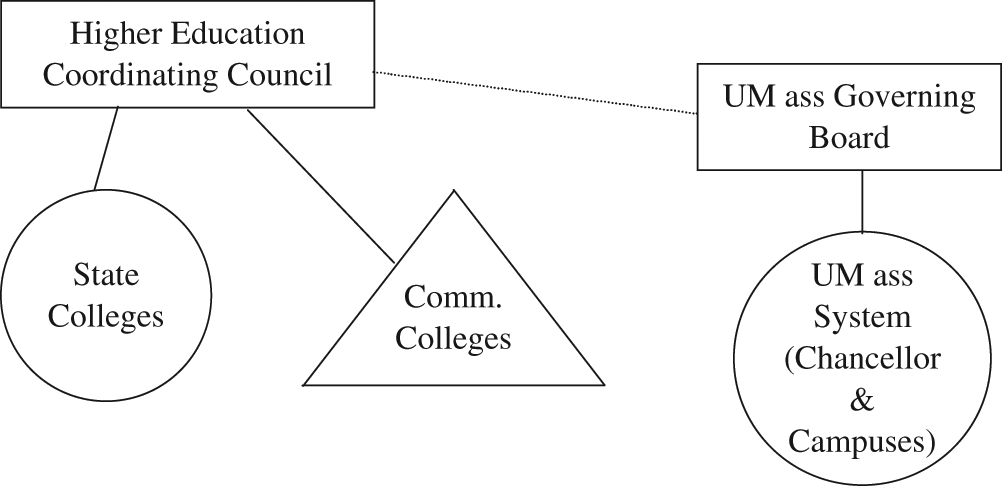
Higher education coordinating council, 1991
Discussion of Findings
While the events described in this article describe a case of restructuring or reorganizing more than one of decentralization per se, we found that many of the elements McLendon (2003) included in his model (see Figure 1) were also evident in this case study. Furthermore, we found that an increased emphasis on the effects of the political history of the state was helpful in understanding the antecedents of the restructuring. Within Massachusetts’s tumultuous political climate and contentious public higher education sector, most of the issues, problems, and conflicts highlighted by McLendon’s model were evidenced in the case study. The economic recession and the debate over the size and function of the BOR, flowing in the State Problem Stream, combined with executive turnover in the Political Stream, opened the window of opportunity. The solution developed in the state’s higher education arena with the Saxon Report and Weld served as the Issue Opportunist who was able to link the problem and the politics with the solution at the precise moment to get the issue on the agenda and ultimately passed.
Streambed of Campus–State Conflict
Within the Streambed of Campus–State Conflict, there were multiple stressors that lead to intense campus–state conflict and set the stage for the ultimate change. Perhaps most influential was Agency Turnover. The BOR had recently turned over its entire leadership including the chancellor (Franklyn Jenifer) and the BOR chair (Paul Tsongas) leaving no one to advocate for the BOR and creating conditions ripe for change. Within the streambed there were major clashes of egos, personalities, and leadership styles. Jenifer’s intrusive style had not only put him at odds with the campus presidents but also with the policy makers of the state. This lack of appeal among the political elite contributed to another major source of conflict, Resource Acquisition and Allocation. The lack of support for public higher education meant that it received the first and most extensive cuts during the economic recession. There was little support for public higher education in Massachusetts, which created tense conflicts.
The lack of recognition and support was also reflected in another stressor, Campus Status and Prestige. While all of public higher education was looked on as having second-class status, UMass was constantly battling to be seen in another light. They aspired to receive the same respect as other major public flagships but ultimately received little support among policy makers. An ever-present stressor in Massachusetts is the campuses’ desire for autonomy, which led UMass to commission the Saxon Report.
State Political Stream
Flowing through the State Political Stream were a number of factors that helped to create a climate conducive to change. First, Weld was elected governor. Although he and the previous governor, Michael Dukakis, both held similarly negative views toward public higher education, Dukakis did not want abolish the BOR. With his election and his reinventing government platform, Weld was in a position to make changes to the structure of the state’s government. Although they were organized into two separate camps, the public college and university presidents were the only major organized interests. The public presidents, especially the UMass president, were all in support of the reorganization plan. The “tumultuous” political climate, including Jenifer’s intrusive style and poor relations with the legislature, set the stage for the reorganization (Crosson, 1996). Public opinion also factored into the equation as public higher education never enjoyed much favor with public at large and the public expected more out of the BOR.
State Problem Stream
Flowing through the State Problem Stream were a number of conditions that helped create an environment conducive to change but the one condition that Weld elevated to the level of a problem was the economic recession, an era of “savage economic decline” (Crosson, 1996, p. 74). Weld was able to capitalize on the situation by advocating for the reinventing of state government. Public higher education was an easy target because of a lack of support and the BOR was regarded as ineffective.
State budgets constraints were a natural outgrowth of the economic situation. Massachusetts public higher education had to compete with many, and frequently powerful, state agencies for scarce public dollars. During the economic crisis public higher education received drastic cuts, further weakening its ability to produce positive results. The budget cuts also exposed the inability of the BOR to make hard decisions. The economic and budgetary situation fed the ongoing debate over the size and function of state government. Massachusetts was continually debating whether they needed a public sector of higher education, given the strength of private higher education in the state.
Stream of Decentralization Solutions
Flowing in the Solutions Stream was the Saxon Report. The report recommended the consolidation of the university campuses and the devolution of some of the authority of the BOR to the university. At the time of the report, no one in the governor’s office or in the legislature paid much attention to it. It was not until Weld took office, a couple of years later, that it got any attention.
Issue Window of Opportunity and Issue Opportunists
Although many issues and conditions created an environment suitable for the restructuring of the BOR, the economic crisis opened a window of opportunity. The economic decline forced people to consider alternatives to the current organizational structure. At the same time, floating in the Solution Stream was the Saxon Report calling for the restructuring on the BOR. Weld then served as the Issue Opportunist. He was elected having campaigned on a reinventing government platform. He saw public higher education as an area that needed reinventing and was able to resurrect the Saxon Report to support for his plan. Shortly after he was elected, he quickly capitalized on the Window of Opportunity and the Saxon Report to restructure the BOR. Our finding that the governor acted as the Issue Opportunists is consistent with the findings of McLendon’s (2003) analysis, which revealed that in each of the three state cases he studied, the Governor played a key role in affecting the climate and structure of the agenda-setting process. McLendon, Deaton, and Hearn (2007) also found that state higher education governance reform is significantly more likely to happen early in a governor’s term. Pulling these results together, McLendon and Ness (2003) found in their national survey of state higher education governance reform that the governor was highlighted as one of the most significant political actors in state higher education governance reform and that gubernatorial turnover was one of the most significant events leading to governance reform.
Conclusion
This case study provides some evidence that the policy stream model of agenda setting has the potential for wide application in regard to state higher education governance reform. It also provides evidence that McLendon’s adaption (2003) of Kingdon’s original model (1995) may be particularly useful in understanding all forms of state higher education governance restructuring and not just decentralization. This is a significant contribution as it may mean that we are one step closer to developing a unified theory of state higher education governance restructuring.
The Massachusetts 1991 higher education governance restructuring, as viewed through the lens of McLendon’s application of Kingdon’s model, highlights the importance of a policy entrepreneur or issue opportunist. In this case, the entrepreneur was the governor, which is consistent with past findings that have highlighted the importance of the governor in governance restructuring. The blue-ribbon report also played an important role as it provided Weld with a politically viable solution. Blue-ribbon commissions and their reports have at times been seen as ineffectual or as ends in and of themselves (Johnson & Marcus, 1986). The problem was generated within and highlighted by the higher education sector, especially by the University of Massachusetts system. Furthermore, multiple factors came together to make the circumstances right for restructuring to make it onto the state’s agenda and ultimately passed. The factors included economic decline, political opportunism, the traditional role of public higher education in the state, conflicting personalities among the political and higher education elite, and the general political climate.
This case study exemplifies that political motivations often serve as the impetus for higher education governance restructuring rather than purely rational decision-making processes. In this case, the actors were using the opportunity to restructure the state higher education governance system as a way to gain some sort of political capital. For state policy makers, restructuring the governance system may be seen as an easy way of appearing to do something about public higher education (even though the evidence tends to indicate that governance restructuring has little to no effect of the outputs or quality of public higher education). It is a much simpler and more visible action than dealing with any root cause over which policy makers may have little to no control. Qualitative studies, historical analysis, and models such as McLendon’s are therefore very useful tools in trying to understand the reasons why states choose to restructure the higher education governance systems.
This case study extends McLendon’s work in that McLendon’s model was applied to a new context and a different form of governance restructuring. In addition, we took historical approach to understand the unique historical context of politics and higher education in Massachusetts. However, we found that many of the elements included in McLendon’s (2003) model were evident in this case study of the 1991 Massachusetts restructuring of its higher education governance system. The model provided for a fairly effective way of understanding the political process of governance restructuring and also the agenda-setting process. McLendon’s model takes into account the unique processes of state higher education governance restructuring while also accounting for both the political and higher education–related issues that may affect whether or not a state will restructure its higher education governance structure.
We also found that it was important to take into account the cultural (as McLendon’s model highlights) and historical influences on the higher education governance restructuring agenda-setting process. The Massachusetts’ process was deeply affected by past restructuring efforts, the historical position of public higher education in the state, past administrations, and the historic conflict between public and private higher education.
Models, such as McLendon’s (2003), can be used to explain snapshots in time but if proper historical work is not done, especially in state-level policy and politics research, scholars may not appreciate the unique historical and cultural attributes of the case they are investigating. For example, it is jarring in today’s context to read that as recently as 3 years ago policy makers and leaders of private institutions advocated that Massachusetts eliminate its public system of higher education or that former Governor Mitt Romney had forced former Democratic state legislator William Bulger out of the presidency of UMass. Yet, read in the context of the low enrollment in public higher education (compared to private higher education) and the political problems the system has experienced, this type of news makes more sense. In some instances, such as the Massachusetts governance restructuring, political actions are related to the historical and cultural attributes of the state that have much to do with such things as when the state was settled and who settled it (Elazar, 1984). Massachusetts is the home of the first private American institution of higher education (Morison, 1936/1964), which set a precedent for long-standing and strong support of private higher education. Likewise, Massachusetts has been a relatively politically liberal state and therefore much of its state budget and energy is focused on other spending priorities in part because it has been able to lean on its private higher education sector instead of supporting public higher education.
We hope that by taking a combined theoretical and historical approach to the investigation of the 1991 Massachusetts higher education governance restructuring we have been able to more fully explain the process and why it happened. In the end, we recommend the further application of McLendon’s model to investigate state governance restructuring, as it appears to accurately account for many of the important elements that motivate higher education governance restructuring and decentralization in particular. However, we also recommend if McLendon’s model (and other models like it) is used to explain political processes related higher education, that scholars do their historical homework to understand and report what may, in part, be the impetus of the political action or inaction.
Footnotes
Declaration of Conflicting Interests
The author(s) declared no potential conflicts of interest with respect to the research, authorship, and/or publication of this article.
Funding
The author(s) received no financial support for the research, authorship, and/or publication of this article.