



Abstract
The increasing prevalence of diagnoses for autism spectrum disorder (ASD), now one in 68 children according to the National Institutes of Health (NIH), presents a number of policy implications. In particular, many of these children become eligible for special education services under the Individuals With Disabilities Education Act (IDEA). Given the specialized expertise and resources required of local education agencies (LEAs), how do they respond to this implementation challenge? In May 2015, an online survey was distributed to various governmental and nongovernmental actors in three Virginia localities to measure the extent of collaboration in local autism policy networks. The findings suggest that these networks are driven by autism-related information, and that nonprofit organizations act as intermediary organizations that bridge disparate stakeholders. The results contribute to our understanding of fragmentation across policy subsystems, with the focus here on education policy, and the implementation challenges related to a rapidly changing policy issue.
Introduction
The U.S. Centers for Disease Control and Prevention (CDC) and the National Institutes of Health (NIH) currently report the prevalence of autism spectrum disorder (ASD) to be approximately one in 68 children (Centers for Disease Control and Prevention, 2015). The American Academy of Pediatrics (AAP) strongly recommends early intervention or therapy to treat some of the developmental delays autistic children often experience, including delays in expressive and receptive communication, speech, and motor skills (NIH, 2015). For those children who receive an early diagnosis, they will initially encounter assistance from health service providers and, depending on each individual’s developmental needs, may continue to receive various types of health or developmental services as they age (Pitney, 2015). However, these children are also likely to become eligible for various special education services required under the Individuals With Disabilities Education Act (IDEA), for which the responsibility of implementation is largely shouldered at the local level by local education agencies (LEAs). Therefore, as the number of children with an autism diagnosis increases, it presents a unique challenge for local governments and LEAs that are required to provide additional education services under the federal IDEA guidelines.
Do LEAs collaborate with other organizations and stakeholders in the community to gather information, expertise, and resources to enhance their capacity to fulfill IDEA guidelines? The existing research on state and local government, as well as current work on education policy, suggests that public–private partnerships are key to public service delivery (Ansell, Reckhow, & Kelly, 2009; Clingermayer & Feiock, 2001; Feiock & Scholz, 2010; Goldsmith & Eggers, 2004; Manna, 2014; Manna & McGuinn, 2013; Meier & O’Toole, 2001, 2003; Reckhow, 2012). More specifically, approaching these partnerships through the lens of a policy network is a useful framework by which scholars and practitioners can understand the collaborative relationships that may exist in the implementation of autism-related policy at the local level. Rhodes (2008) describes policy networks as sets “of formal institutional and informal linkages between governmental and other actors structured around shared if endlessly negotiated beliefs and interests in public policy making and implementation” (p. 426). Given the extent to which autism connects to many existing policy areas, these networks may involve organizations from multiple policy subsystems; that is, communities of actors involved in program delivery or policy implementation. If so, which organizations are the key stakeholders, and what are the barriers (if any) to collaboration?
To answer these questions, in May 2015, an online survey was distributed to various governmental and nongovernmental education and healthcare stakeholders in three Virginia localities: Charlottesville, Richmond, and Roanoke. Respondents were asked to identify stakeholders with whom they collaborate, across multiple measures, to meet the needs of children on the autism spectrum. Social network analysis (SNA), a useful method for analyzing the social or governing interactions between actors (see Newman, 2010), is employed to analyze the survey responses and the interconnections between governmental and nongovernmental organizations as they relate to autism-related policy. This work contributes to our understanding of fragmentation among the many organizations involved in the implementation of public policy, particularly as it relates to education policies aimed at a rapidly growing autistic population in public schools.
Fragmentation in Autism Politics
The story of autism and its relation to public policy begins as many issues of public policy do, that is, with the discovery of a new issue and conflict over problem definition (Kingdon, 1995). While a comprehensive history of autism politics is beyond the scope of this article, the disagreement about the causes, diagnoses, treatments, and representation of autism has been a key feature of this issue’s place in the public sphere (Orsini, 2012).
In The Politics of Autism, Pitney (2015) provides a comprehensive overview of how the scientific identification and understanding of autism has changed over the past 100 years. He notes that the conflict surrounding autism first began in the mid-20th century with Leo Kanner’s research on autism and its possible causal connections to parenting style, the latter of which gained steam as a common misperception and was later refuted by Bernard Rimland’s work on the neurological foundations of autism. The conflicts surrounding the definition of autism shifted to disagreements about the most effective and appropriate treatment approaches, as well as autism’s place within a broader disability rights movement. For example, in a comparative study of autism as a policy image in different policy systems, Baker and Stokes (2007) find that the process of issue definition in the United States involves a variety of competing interests. In the past few decades, the push for autism-related policy reforms has intersected with the disability rights and neurological diversity movements, which has aimed to shift the focus from a “medical model” to an “educational” or “social model” of assistance for individuals with disabilities (Bumiller, 2013; Orsini, 2012).
The politics and policies surrounding autism are often fragmented across multiple governmental jurisdictions and policy areas, which Pitney (2015) attributes in part to the history of autism and its changing definitions:
Autism is a “pervasive developmental disorder,” which means that it affects most areas of a person’s life. It is also a pervasive policy issue, straddling health, education, scientific research, insurance regulation, and civil rights, among other issues. No government agency has exclusive jurisdiction over all of these areas. (p. 9 emphasis added)
Although health policy is a critical area through which the rising rates of autism diagnoses are being addressed, particularly as they relate to health insurance coverage for individuals on the autism spectrum (Bouder, Spielman, & Mandell, 2009; Chatterji, Decker, & Markowitz, 2015; Ritchey & Nicholson-Crotty, 2015), the focus here is on how state and local governments are primarily experiencing this challenge via public education (Bumiller, 2013; Pitney, 2015; Steuernagel, 2005). The IDEA of 1990, a revision of the initial Education for All Handicapped Children Act of 1975, was created during a wave of policy reforms geared toward assisting and creating accommodations for individuals with disabilities, including the Americans With Disabilities Act (ADA). The IDEA requires that any state receiving federal funding for special education provide students with disabilities a “free appropriate public education.” The implementation of the IDEA falls squarely on LEAs, which are required to administer a range of educational services for children who are eligible for special education. To qualify for services, a child must receive an assessment from specialists that involves a wide variety of areas, including “health, vision, hearing, communication abilities, motor skills, and emotional status” (Pitney, 2015, p. 67). Once a child completes the educational assessment process and becomes eligible for special education services, the school district is responsible for several IDEA requirements.
First, special education students are to be taught in a least restrictive environment (LRE), which means that whenever possible, special education students are to be incorporated in classrooms with non-disabled students. Second, schools are also required to design and implement an individualized education program (IEP), whereby educational goals are designed to accommodate each student’s specific needs, with a plan of action to be carried by teachers, administrators, school psychologists, and therapeutic specialists. While the third requirement under IDEA is a state-specific program to manage interventions for infants and toddlers with developmental delays, LEAs are only responsible for assessing the eligibility of students for autism-related K-12 educational services. This, of course, is separate from the role medical providers play in evaluating autistic children and adults for health-related needs, such as those related to speech, occupational, and physical services (Pitney, 2015). In short, there are many organizations with which an autistic child may come in contact, and that may create incentives for the diversity of organizations to collaborate and build bridges across different types of policy areas to meet the full needs of the child.
The implementation challenge presented by the rising rates of autism diagnoses, and the extent to which existing policy must respond, has precedent in other areas. For example, in their discussion of immigration federalism, Swain and Yetter (2014) argue that states and localities were forced to adapt existing policies to the considerable growth in their immigration populations during the 1990s. Similarly, Ritchey and Nicholson-Crotty (2015) note, “[t]hose diagnosed with autism are the fastest growing population of special needs children in the United States” (p. 76). This study focuses on the extent to which LEAs enhance their capacity to meet the needs of this growing special needs population by partnering with other governmental and nongovernmental organizations, particularly given the autism-related expertise and resources required.
Education and Local Policy Networks
Although the design and delivery of education has historically been carried out at the state and local levels, federal mandates have had considerable influence in setting local policy agendas in education politics (Manna, 2006, 2010; Reed, 2014). When local governments and school districts set out to meet federal and state policy guidelines, Meier and O’Toole (2003) note that, “[s]uccessful policy implementation requires school districts to work with parents, local elites, and other governments to acquire sufficient resources and solve educational problems” (p. 692). These public–private partnerships in local education are described by Stone and colleagues (2001) as “hyper-pluralistic” and made up of a “complex set of policy subsystems” (pp. 47-49), meaning that there can be many organizations from diverse areas of expertise involved in the implementation of local education policy. For example, this hyper-pluralistic environment is illustrated by the variety of agencies and advocacy groups in state reading policy networks (Young, Lewis, & Sanders, 2010) and the role of charitable foundations and community groups in urban education reform networks (Reckhow, 2012). This is consistent with the line of thought about the necessity of public–private partnerships in local education policy given the pressures of federal and state mandates and the loss of local discretionary power (Galey, 2015; Henig, 2013), a pattern also perceived by officials in local government (Bowman & Kearney, 2012). These shifting institutional arrangements, and the growing burden on public bureaucracies to carry out various intergovernmental mandates, create a ripe environment for the development of local policy networks.
An expansive literature exists that connects state and local efforts to address various policy problems with public–private partnerships built and managed in policy networks (Agranoff, 2007; Agranoff & McGuire, 2003; Lewis, 2011; O’Toole, 1997; Robinson, 2006). Here, the focus is on the potential role of policy networks in addressing issues related to the needs of children on the autism spectrum. Although these networks may ultimately involve service providers, and perhaps give the network a service delivery component, in this study they are considered policy networks because of the implementation responsibility state agencies and LEAs have under the IDEA guidelines. Although a comprehensive overview of the policy networks literature is beyond the scope of this article, some examples of scholarly applications of policy networks include agriculture watershed management (Lubell & Fulton, 2008), marine protected areas (Weible, 2005; Weible & Sabatier, 2005), national estuaries (Schneider, Scholz, Lubell, Mindruta, & Edwardsen, 2003), land-use planning (Gerber, Henry, & Lubell, 2013; Henry, Lubell, & McCoy, 2011), and economic development (Lee, Lee, & Feiock, 2012). For example, networks of local emergency managers, state agencies, local governments, businesses, and nonprofit organizations frequently collaborate in disaster preparation and recovery efforts (Bowman & Parsons, 2013; Robinson, Eller, Gall, & Gerber, 2013). These emergency management networks, and the diversity of participating actors that assist localities, may not be unlike ones we might find in autism policy networks. For example, state agencies, nongovernmental organizations, and research organizations may collaborate to varying degrees with LEAs to help them build capacity to meet the needs of their special education populations. In other words, it may take a network to raise a child.
One of the key themes from policy networks research is that the nature of many policy challenges, particularly those encountered by resource-strapped localities, necessarily requires the involvement of a diverse group of actors or stakeholders (Lewis, 2011; Robinson, 2006). The fragmented nature of autism politics, and the likely constraints of LEA capacity under federal IDEA requirements, presents similar implementation challenges found in previous work on policy networks. This suggests that local autism policy networks, if they exist, will cross jurisdictional boundaries (e.g., federal, state, local) and policy subsystems (e.g., education, healthcare, social services), which, again, are communities of actors involved in the creation or implementation of public policy. However, given existing federal education mandates, and the close ties between state and local governments in implementation (Manna, 2006, 2010), the data instead may suggest that LEAs handle special education services for children on the spectrum “in house,” that is, directly by state or local agencies. Therefore, evidence in support of the hypothesis below will be the presence of policy networks of governmental and nongovernmental actors that collaborate on the issue of autism.
Although collaboration in policy networks can assume many forms, which range from frequent communication to in-person meetings to personnel sharing (Robinson & Gaddis, 2012), previous research suggests that collaboration among disparate stakeholders across jurisdictional and policy subsystem boundaries is often organized around the need for information or advice in policy implementation. In other words, these networks leverage expertise from participants to address an issue that is “technically and legally complex” (Weible & Sabatier, 2005, p. 196), ultimately creating functionally interdependent networks. For example, Meier and O’Toole (2001, 2003) find evidence of superintendents responding to resource and informational constraints by building collaborative networks, as measured by the frequency of interaction with other local, state, and business leaders, to improve student performance on an array of standardized examinations in Texas school districts. This characteristic is similar to the environment Pitney (2015) describes regarding the complex cross section of education and health actors involved in screening, diagnosing, and designing developmental plans for children on the autism spectrum. In a sense, meeting the federal IDEA guidelines for special needs students necessarily requires LEAs to gather expertise and information about autism, which may create a network that prioritizes information over other available resources. 1 Therefore, evidence in support of the second hypothesis will be a larger, more diverse network when collaboration is measured by a search and/or provision of autism-related expertise, relative to other collaborative efforts.
Given the expected cross section of actors involved in addressing the needs of autistic children, and the premium placed on information by implementing organizations, what types of networks might exist? It is important to note that previous work draws a distinction between bridging and bonding ties within networks (Ansell et al., 2009; Burt, 1992; Henry et al., 2011; Lubell, Robins, & Wang, 2014), with the former referring to tie formation that can span the entirety of a network and the latter referring to tie formation in dense clusters of actors in a network. Bridging ties are often associated with an efficient transfer of information between a diverse set of actors in a network, while bonding ties are often associated with an insular and repetitive flow of information (Berardo & Lubell, 2016; Leifeld & Schneider, 2012). To that end, Lubell, Scholz, Berardo, and Robins (2012) suggest that “bridging rather bonding capital may provide both more effective and more sought-after relationships in policy networks” (p. 363). That is, policy networks often organize around a large number of weak ties that connect disparate stakeholders. For example, Robinson and colleagues (2013) find evidence of the importance of bridging ties cross a broad range of groups in local emergency management networks, while Schneider and colleagues’ (2003) study of the policy networks developed under the National Estuary Program suggests that networks can facilitate collaboration and information sharing across organizational and governmental boundaries, with intermediary stakeholders playing a central role to bridging ties and exchanging key information. Therefore, if local autism policy networks contain a number of bridging ties, the data will show these networks possess low proportions of potential ties (density), reciprocal directed ties (reciprocity), and closed groups of ties (transitivity; Newman, 2010). The next hypothesis reflects this expectation:
Relatedly, organizations that can bridge multiple governing and geographic boundaries are key to collaboration and problem solving within a policy network (Leifeld & Schneider, 2012; Lubell, 2013; Lubell et al., 2014). In the education sector, changes in educational localism, or the historic local and insular control of education policy (Reed, 2014), have created opportunities for intermediary organizations to shape modern education policy (DeBray, Scott, Lubienski, & Jabbar, 2014; Galey, 2015). Thus, when local governments face the challenges brought about by the intersection of federal and state mandates, this presents an opportunity for collaborative efforts. For this reason, we might expect LEAs to enhance their capacity to carry out IDEA guidelines for autistic children by relying on help from intermediary nonprofit organizations, which would make these actors central in any local policy network. Although previous research suggests that governmental actors, namely LEAs, are active brokers in public education networks (Meier & O’Toole, 2001, 2003; O’Toole & Meier, 2004; Song & Miskel, 2005; Young et al., 2010), meaning they initiate and facilitate network collaboration, the expertise and advice needed for implementation may not come from governmental actors. Instead, nongovernmental actors may be essential. Therefore, evidence for the final hypothesis will be policy networks with nongovernmental organizations, not LEAs, possessing high degrees of network centrality.
Data and Method
The hypotheses are tested using data from a network survey of respondents from various governmental and nongovernmental stakeholders across different policy subsystems. Three localities in Virginia were selected as cases in this study: Charlottesville, Richmond, and Roanoke. Because the purpose of this study is to examine the existence and scope of local autism policy networks, the three metropolitan statistical areas (MSAs) included in the analysis were selected based on variation in population size. Without any a priori assumptions about the size or scope of these networks, population size was used as a proxy to select MSAs with differences in the size of the potential pool of organizations and stakeholders involved in the policy network. In other words, larger metropolitan areas, all things being equal, were expected to have a higher number of governmental agencies, school districts, nonprofit organizations, and research organizations—all of which are possible participants in the local policy networks of interest in this study. Table 1 presents population estimates for the three cases, as well as a few additional education-related similarities and differences.
Descriptive Statistics of Cases, by MSA.

Virginia Department of Education, academic year 2010-2011. The “ability to pay” composite index, ranging from zero to one, measures each locality’s ability to pay costs of education, and is calculated using “true value of real property, adjusted gross income, and taxable retail sales,” and weighted so that the average local share of education costs equals 0.45 (Virginia Department of Education, 2016). The autism percentage is calculated as the average number of students on the autism spectrum as a percentage (out of 1) of the total enrollment of full time students. MSA = metropolitan statistical area.
The three cases clearly vary in population size, with the Richmond MSA being the second largest (excluding the Washington, D.C.–Northern Virginia area) in Virginia. Second, consistent with previous work that documents considerable variation in the resource capacity of local governments and LEAs to implement education policy (Manna, 2006, 2010; Meier & O’Toole, 2001), Table 1 shows that the three localities differ in the number of school divisions managed, per pupil spending, and the typical ability of localities within the MSA to shoulder local education costs. The latter is calculated by the Virginia Department of Education (VA DOE) as a composite index, ranging from zero to one, that is intended to measure local fiscal capacity with respect to education (VA DOE, 2016). Finally, although local-level data on the prevalence of autism are unavailable, the IDEA requires states to report the percentage of students classified on the autism spectrum who are eligible for special education services. 2 Finally, it is important to note that although the focus on three localities in Virginia may certainly limit the extent to which the findings are generalizable to other state and local policy environments, theoretically and methodologically interesting single-state studies can still illuminate aspects of political and policy environments that may go undetected in a larger study (Nicholson-Crotty & Meier, 2002).
Network Survey Recruitment and Design
Given the absence of prior knowledge of participants involved in these networks, constructing a survey recruitment list of possible respondents from a diverse set of organizations presented a challenge. A respondent recruitment list was constructed by first conducting web searches of all local education agencies (LEAs) in each of the aforementioned MSAs to identify various teachers and administrators responsible for special education, all of whom are likely to be involved in school-level implementation of the IDEA guidelines for autistic students. Similar web searches were then conducted to identify local autism-related groups, organizations, and health service providers within each MSA. Using this approach, at least two respondents from each identified organization or stakeholder were added to the respondent recruitment list. In addition, selected respondents from universities within or proximate to the three MSAs, and that have specialized centers related to autism, were added to the recruitment list. Finally, to account for state government participation in these local networks, selected respondents from the Virginia departments of Education (VA DOE) and Aging and Rehabilitative Services (VA DARS) were included in the recruitment list. The former is responsible for state-level enforcement of IDEA guidelines in public education, while the latter is responsible for helping autistic individuals and others with disabilities transition from the public education system to adulthood. The final totals for the respondent recruitment lists for each MSA were 32 in Charlottesville, 58 in Richmond (includes one state agency official), and 53 in Roanoke (includes two state agency officials).
Survey respondents were contacted via email and recruited to complete a 15- to 20-min online network survey during the summer 2015, for which they were offered a small monetary incentive. 3 Respondents were informed multiple times that the purpose of the survey was to gather information about the frequency and type of interactions among organizations and stakeholders in the community that play an active role in addressing the education and health needs of children on the autism spectrum. The survey consisted of 17 items, of which about a third gathered information about a respondent’s specific position, years with the organizations, years of experience working with autistic children, and perception of the organization’s primary goals. 4 The remainder of the survey items asked respondents to identify stakeholders with which their organization interacts across several types of collaboration, as well as report their attitudes about the state of collaboration around the goal of meeting the education and health needs of autistic children. The overall response rate was 42%, and disaggregated response rates in the three MSAs were 42% in Charlottesville, 28% in Richmond, and 56% in Roanoke. A list of organizations represented in the overall sample, along with the number of respondents and organization response rates from each locality, is presented in Table 2.
Respondent Organizations, by Locality.

Note. Total number of individual respondents and response rates by organization type are listed with each locality. LEA = local education agency; NGO = nongovernmental organization; RO = research organization/university; SGO = state government office.
Local policy networks, and the collaboration among their participants, were measured in several ways. First, in the absence of prior knowledge of network participants, I followed Henry, Lubell, and McCoy’s (2012) recommendation and implemented a hybrid name generator network survey. The hybrid approach first exposes respondents to a general prompt that informs respondents that they will be asked to identify names of organizations with which they collaborate, which in this survey appeared as “The next set of questions will ask you to identify organizations and stakeholders in the community with which you collaborate to better meet the education and health needs of children on the autism spectrum.” While using this approach only would be consistent with a “free-call” name generator, the hybrid approach also provides respondents with examples of types of stakeholders without providing specific names (Henry et al., 2012, p. 440), which in this case appeared as “For example, these stakeholders may include private or nongovernmental organizations, as well as governmental (local, state, federal).” Respondents were encouraged to identify as many organizations as they thought appropriate given each type of collaboration.
Second, to obtain different measures of collaboration in the policy network (Henry et al., 2011; Robinson & Gaddis, 2012), respondents were asked to identify organizations or stakeholders that provide their organization with (a) “useful data or information” and (b) “financial resources” in meeting the needs of children on the autism spectrum. 5 Each organization mentioned by a respondent is coded as a directional network tie (Kolaczyk & Csárdi, 2014; Newman, 2010), which connects the main respondent (ego) to each network participant (alter) mentioned by the respondent. These network relationships are used to examine the existence and structure of local policy networks, as well as the extent to which the structure changes across dimensions of collaboration.
Finally, respondents were also asked to report their perceptions of the state of collaboration among organizations and stakeholders in the community regarding the issue of autism. Using similar survey items implemented in recent work on local education networks (Ansell et al., 2009; Reckhow, 2012), respondents were first asked to report specific roadblocks, if any, to collaboration between organizations in the community regarding meeting the needs of children on the autism spectrum. This item was followed by asking respondents to identify specific steps to improve collaboration. Respondents provided open-ended responses to these questions that, when combined with the hybrid name generator approach and measures of collaboration mentioned above, provide a more comprehensive examination of the collaborative interactions in local autism policy networks. The findings from these surveys are discussed in the following section.
Findings
Although prior work on policy networks utilizes multiple theoretical perspectives to explain the interactions of governing institutions and organizations (Lubell et al., 2012), the purpose of the current research is to first explore what types of local autism policy networks, if any, actually exist. Previous research suggests that the implementation environment faced by LEAs will produce policy networks that connect public and private stakeholders across various levels of collaborative relations. The structure of a local policy network organized around the issue of autism is likely to depend on the motivations of relevant stakeholders and the costs of collective action (Berardo & Lubell, 2016; Leifeld & Schneider, 2012; Lubell, 2013).
The first hypothesis is tested by graphing directional ties to construct policy networks for each locality, with the organization nodes weighted by the number of times the organization is mentioned by respondents. In other words, the larger organization nodes are calculated as “authority vertices” within the network (Kleinberg, 1999; Kolaczyk & Csárdi, 2014), which in this case are organizations frequently mentioned as collaborative partners in the provision of data/information and financial resources. 6 Figure 1 presents the policy networks in each locality, with the left column (a) displaying networks constructed from the “data or information” measure of collaboration and the right column (b) displaying networks constructed from the “financial resources” measure of collaboration. For the purpose of providing a more straightforward visual interpretation of the networks in light of the aforementioned hypotheses, organizations are categorized by color and shape: Governmental organizations are represented by black nodes (triangles = state government offices, circles = LEAs, diamond = federal government offices), and nongovernmental organizations are represented by gray nodes (circles = nonprofit organizations, triangles = research organizations/universities). 7

Collaboration in local autism policy networks.
There are several important findings from Figure 1. First, the policy networks in all three localities consist of a clear cross section of governmental and nongovernmental actors involved in meeting the needs of children on the autism spectrum, consistent with the first hypothesis. As indicated by the color and shape diversity of nodes, this cross section includes nonprofit organizations, LEAs, state government agencies, and research organizations (e.g., colleges/universities). For example, the largest nodes in the Charlottesville data and information network are three nonprofit organizations (gray circles): the Virginia Institute of Autism (VIA), the Piedmont Regional Education Program (PREP), and the Charlottesville Regional Autism Action Group (CRAAG). VIA is a private nonprofit organization geared toward assisting autistic students with education and service-oriented programming for children and young adults, while PREP is a similarly purposed public regional organization that connects parents and LEAs with relevant information to support students with a variety of disabilities. CRAAG, however, is one of many regional “action groups” supported by Commonwealth Autism, a statewide nonprofit organization that, per the organization’s website, aims to “build the capacity of the autism service provider network through partnership and collaboration.” One of the ways it attempts to do this is by creating regional groups that seek to build collaborative working relationships with relevant local stakeholders, including LEAs, parents, health providers, and nonprofit organizations, to improve the services available to individuals on the autism spectrum.
Although the data and information network in Richmond clearly involves a similar cross section of participants, this network appears to be dominated by governmental organizations, evidenced by the clustering of state agencies (black triangles). For example, the most frequently mentioned state government agencies in the collaborative network belong to the VA DOE and VA DARS. Richmond’s place as the central governing hub of the state likely contributes to the role these state agencies play in collaboration within the network, relative to the other localities, a finding consistent with previous research on other local governing networks (Bowman & Parsons, 2013). In the Roanoke data and information network, the cross section of network actors from various subsystems is also apparent from the diversity of node shapes and colors in the graph. A variety of governmental and nongovernmental actors play a role in seeking and providing information about autism in the Roanoke Valley, though the largest nodes in the network belong to nongovernmental organizations (gray circles): Blue Ridge Autism and Achievement Center (BRAAC), Commonwealth Autism, and Carilion Clinic.
The networks plotted in Figure 1 also provide support for the second hypothesis; that is, given the informational and resource constraints faced by local governments and LEAs in meeting federal IDEA guidelines, actors in public education will seek out autism-related information within the network from those perceived to have relevant expertise. A few characteristics of the networks plotted in Figure 1 reveal this pattern. First, the nodes for LEAs (black circles) in all localities are small relative to the nodes for organizations with various specializations in autism. For example, the largest node in the Richmond network belongs to a research organization (gray triangle), Virginia Commonwealth University (VCU), which houses the Autism Center for Excellence (ACE). Nongovernmental organizations with similar expertise in Charlottesville and Roanoke (VIA and BRAAC, respectively) are the most frequently mentioned collaborators with respect to the provision of useful data and information related to the needs of children on the autism spectrum. Second, one of the most frequently cited resources among respondents in all localities is the VA DOE’s Technical Training and Assistance Centers (T/TACs). This is an effort by the state to provide teachers and administrators with specialized training and access to experts in various aspects of special education, including autism. The VA DOE organizes these regional training opportunities through colleges and universities across the state, and specifically through universities with centers specializing in autism. For example, the relevant T/TACs in these localities are facilitated through the autism research group at the University of Virginia’s Curry School of Education in Charlottesville, ACE at VCU in Richmond, and the Virginia Tech (VT) Autism Clinic in the Roanoke Valley.
The search for information among LEAs in these networks is made even more clear when the networks constructed from the “data and information” question are compared with the networks constructed from the “financial resources” question, which are plotted in the right column (b) of Figure 1. The structure of the policy network clearly changes when collaboration is measured by the provision of resources. First, the central actors are no longer a cross section of different types of organizations in the community; instead, governmental organizations (black diamonds, triangles, circles), specifically those in state government, play a more visible role in providing resources to community organizations to meet the needs of children on the autism spectrum. For example, in addition to general mentions of state government, respondents identify the following state departments as sources of financial support: Health (VA DH), Education (VA DOE), Behavioral Health and Developmental Services (VA DBHDS), and Aging and Rehabilitation Services (VA DARS).
Second, there are fewer stakeholders and network ties, suggesting a sparser network and limited financial capacity. In fact, many respondents indicated in their open-ended responses that collaboration is often difficult because various organizations within the community are competing over such a small pool of monetary resources. For example, one respondent provided a common attitude from multiple organizations, “Time and funding. Inadequate funding for local and global programs at all levels.” A respondent from an LEA echoed a similar point, “I believe that funding continues to be a barrier. In our community, with limited resources, we struggled to have the necessary supports to serve students with autism.” A respondent from a prominent nonprofit organization noted that, “too many organizations view providing these services as a competition.” While a small pool of resources may hinder collaborative efforts within these networks, and is a topic for further investigation in future research, 8 what is clear is the efforts of LEAs to seek information from relevant experts in the community to better meet the needs of autistic students. Given that autism represents a burgeoning, and often complex, policy area that involves multiple subsystems (Pitney, 2015), the findings above are consistent with previous research that links issue complexity with informational or advice-oriented policy networks (Leifeld & Schneider, 2012; Weible, 2005; Weible & Sabatier, 2005).
Given the cross section of stakeholders from multiple policy subsystems included in these local autism policy networks, as well as the apparent collaboration around the need for information, the third hypothesis draws from existing research (Berardo & Lubell, 2016; Berardo & Scholz, 2010; Lubell et al., 2012; Robinson et al., 2013; Schneider et al., 2003) and expects that the networks will be low in density and involve a number of bridging ties. In a recent review of policy networks research, Lubell and colleagues (2012) describe bridging structures as, “. . . measured in terms of the number of actors that your network partners can contact . . . and a preference for popular partners” (p. 363). A bridging tie in these networks, for example, might involve Organization A seeking information on autism from Organization B, perhaps due to the latter’s well-known expertise in the community, to assist children on the spectrum (e.g., if Organization A is an LEA). The key to this bridging relation is that neither organization will share many collaborative partners outside of that primary interaction, nor will the relationship contain anything additional in the way of transitivity or reciprocity. To test the third hypothesis and capture the extent to which the local policy networks are in fact low in density and possess some characteristics of a bridging structure, measures of density, transitivity, and reciprocity are calculated for each network are presented in Table 3.
Policy Network Characteristics, by Locality and Measure of Collaboration.

Whether the networks are defined by (a) the proportion of all possible collaborative ties present in the network (density), (b) the proportion of closed transitive relations (transitivity), or (c) the proportion of organizational dyads with a reciprocated directed tie (reciprocity; Kolaczyk & Csárdi, 2014; Newman, 2010), it is fair to conclude that the network measures in Table 3 provide some support for the third hypothesis. The three network statistics range from zero to one, with higher values indicating greater degrees of density, transitivity, and reciprocity. These values suggest that the policy networks are indeed quite open and sparse, with very few organizations sharing sets of mutual partners. Although more work is certainly needed, these characteristics are indicative of local autism policy networks that bridge multiple policy subsystems, and include a variety of governmental and nongovernmental actors that may not otherwise cross paths despite their shared interests in assisting those on the spectrum. It should be noted that there is a notable difference visually and statistically between the collaborative network of information sharing and the one based on the provision of financial resources. The bulk of resources funneled via the latter networks are essentially provided by a single source, state government, while the data and research about autism in the former networks originate from a variety of nongovernmental organizations.
If the above measures provide some evidence of the bridging nature of these networks, the final question is as follows: Which organizations act as the bridging structures within the policy network? Recall that the final hypothesis draws from current research on intermediary collaborative organizations (Lubell, 2013; Lubell et al., 2014; Schneider et al., 2003), particularly those in public education (Ansell et al., 2009; Galey, 2015; Meier & O’Toole, 2001, 2003), that work to connect disparate stakeholders. When LEAs are faced with meeting federal IDEA guidelines, there is an opportunity for them to enhance their capacity by reaching out and collaborating with intermediary organizations that may gather and share useful information about various special needs populations in public schools. To identify which organizations act as intermediaries, measures of betweenness centrality are calculated for the three policy networks, with collaboration based on seeking data and information. The organizations with the highest degrees of betweenness centrality are plotted in the center of each network target graph in Figure 2, and organizations with lower degrees of betweenness centrality are plotted farther from the center.
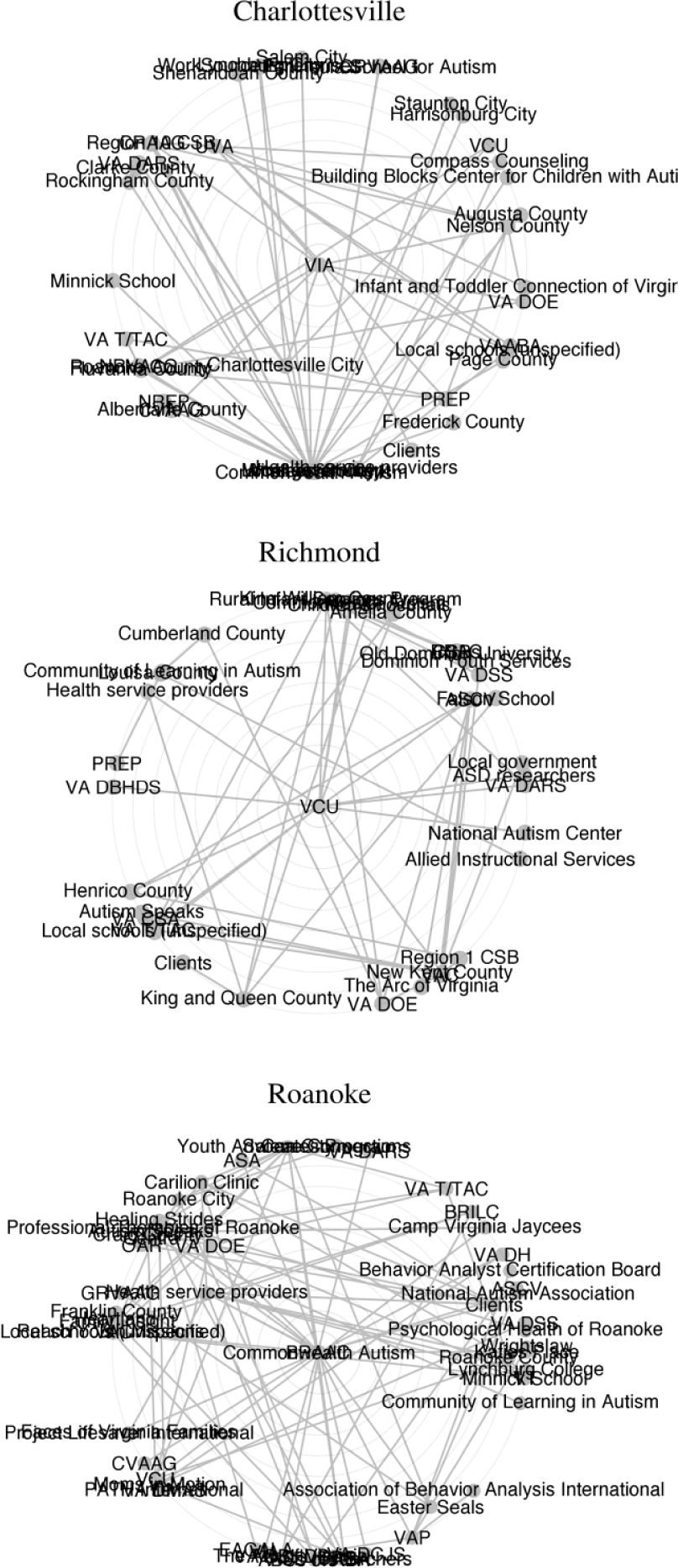
Central actors in local autism policy networks.
Because betweenness centrality measures, in this case, the extent to which organizations lie at the center of the shortest informational path that connects all organizations in the network (Newman, 2010), it is an ideal measure to use to identify potential intermediary organizations within the policy networks. And, in fact, plotting the organizations in each network by their level of betweenness centrality provides a clear picture of which organizations bridge disparate stakeholders to better meet the needs of children on the autism spectrum. For example, in Charlottesville, the key intermediary is VIA, a private nonprofit organization that provides innovative educational strategies for students on the spectrum and, in addition to functioning as a private school itself, often works with LEAs to implement similar strategies. In Richmond, the key intermediary organization is VCU, which is likely due to its widely recognized ACE as well as its role as a central hub of the VA DOE’s T/TAC. Therefore, any LEA in the Greater Richmond Region that needs information about educational or behavioral strategies to meet federal IDEA guidelines is likely to seek out autism-related expertise from VCU. In fact, VCU is one of the few organizations identified as an important collaborative partner across all localities in the sample.
Finally, the Roanoke policy network appears to have two central intermediary organizations: BRAAC and Commonwealth Autism. BRAAC fulfills a similar role as VIA in Charlottesville because, in addition to functioning as a private school, it collaborates with health service providers, parents, state agencies, and LEAs to develop and implement strategies to assist individuals on the autism spectrum and help transition them into adulthood. In some cases, LEAs may fulfill IDEA guidelines by specifically placing students at BRAAC to ensure their educational and health needs are being met. Commonwealth Autism, however, plays a more active role statewide by creating and supporting regional “action groups” that are explicitly designed to foster collaboration at the local level between all relevant stakeholders to better meet the needs of those on the autism spectrum.
Overall, the findings suggest that local autism policy networks consist of a diverse group of organizations from multiple policy subsystems. Collaboration appears to be organized within information- or advice-oriented networks, at least compared with networks where collaboration is simply defined by the provision of financial resources. Finally, in contrast to prior work (Song & Miskel, 2005; Young et al., 2010), the central nodes that tie information sharing interactions together do not appear to be LEAs aiming to meet federal and state mandates, but intermediary nonprofit organizations that can funnel expertise for the purpose of meeting the needs of children on the autism spectrum.
Conclusion
The rise in the prevalence of autism, and its classification as a “pervasive developmental disorder” (Pitney, 2015), connects it to a number of existing areas of public policy. One of the key policy subsystems through which this population will receive assistance is K-12 public education. For example, the IDEA requires that any state receiving federal funding for special education provide students with disabilities, including those diagnosed with autism, a “free appropriate public education.” If, as Ritchey and Nicholson-Crotty (2015) suggest, “[t]hose diagnosed with autism are the fastest growing population of special needs children in the United States” (p. 76), this presents a policy challenge for LEAs that may face constraints in autism-related expertise and resources to effectively meet IDEA guidelines. Do LEAs respond to this challenge by collaborating with other governmental and nongovernmental organizations in policy networks to enhance their capacity in policy implementation?
Based on data collected from an online network survey of governmental and nongovernmental stakeholders connected to issues related to the needs of individuals on the autism spectrum in three Virginia localities, the findings communicate several features of local autism policy networks. First, these policy networks include a cross section of organizations from a number of policy subsystems (e.g., education, health, social services) and, second, collaboration among network participants appears to be driven by a need for information from autism experts in the community. Third, the policy networks possess characteristics of low density structures with bridging ties that connect different actors across the network (see Berardo & Scholz, 2010; Lubell, 2013). Finally, consistent with existing work on intermediary organizations in education policy (Galey, 2015), a small set of nongovernmental organizations exogenous to LEAs function as bridges that funnel information from diverse sources.
The diversity of organizations within local autism policy networks reinforces the notion that the public–private environment in local education is indeed “hyper-pluralistic” (Stone et al., 2001, pp. 47-49), which may have some implications for various services provided to individuals on the autism spectrum. First, state and local agencies have implementation responsibility under the IDEA guidelines, and the ubiquitous nature of nongovernmental organizations in these networks does raise questions about what accountability mechanisms, if any, are in place to ensure appropriate services for autistic children and young adults. To what extent is collaboration in these policy networks focused on establishing common standards of care for all involved organizations, and who or what enforces these standards? Although public–private partnerships may indeed be a necessity for LEAs to enhance their capacity to meet the special needs of this population, it is critical for policy networks to evolve to enhance trust, communication, and accountability in the management of any good (Berardo & Scholz, 2010; Feiock & Scholz, 2010; Lubell et al., 2014; Ostrom, 1990). Second, although a pluralistic environment necessarily involves a diversity of organizations, not all organizations are central to the collaborative process. For example, not every LEA in the three localities is mentioned as a collaborative partner, and even some of the LEAs involved in the policy networks in Figure 1a appear to be peripheral actors in the network. Understanding the factors that contribute to collaborative partnerships in these networks and the processes that might produce more active roles for all LEAs, where the majority of children on the spectrum receive services, will be key to future research and policy recommendations.
There are, however, some caveats to the data and analyses presented here. First, although a hybrid network survey is implemented in the survey (Henry et al., 2012), the lack of prior knowledge about the potential participants in the network resulted in missing a few key stakeholders in each locality, and thus, respondents from these organizations were not recruited. For example, in the Roanoke policy network, Carilion Clinic is a private nonprofit health organization mentioned by several respondents as an important source of autism-related information and advice. One way to correct this problem in future iterations of this research is to utilize both hybrid- and roster-oriented network surveys to capture a more representative sample of stakeholders in the network.
Second, previous work highlights the importance of information-driven collaboration in policy networks (Weible & Sabatier, 2005), which certainly finds support in these analyses, but it is important to note that collaborative efforts between local governmental and nongovernmental actors can take on different forms (Agranoff & McGuire, 2003; Feiock & Scholz, 2010; Henry et al., 2011; Robinson & Gaddis, 2012). For example, in the open-ended responses, a few respondents mentioned Special Education Advisory Committees (SEACs), which are organized at the local level and consist of various stakeholders connected to meeting the needs of children on the autism spectrum. These may not function as environments for gathering expertise, necessarily, but instead function as opportunities to share ideas and brainstorm solutions to common challenges. Capturing the dynamics of collaboration in these types of institutional environments will be key to future research.
Finally, the network data analyzed here do not measure performance or policy outcomes, nor capture how autistic individuals at various ages connect with or experience these policy networks. However, one can easily imagine how the organizations and services an autistic child experiences while connected (to varying degrees) to the public education system differ considerably from those a young adult on the spectrum may experience while transitioning from a K-12 education to college, employment, and housing. For example, one of the research organizations in the Roanoke Valley network, Virginia Tech, administers the Stepped Transition in Education Program for Students (STEPS) program, which helps autistic students transition into a college environment at whatever institution of higher education a student decides to attend. Because measuring outcomes is critical to understanding the effectiveness of the policy networks described here, future research must capture how individuals on the autism spectrum experience these networks at different developmental stages.
Overall, the findings contribute to the ongoing study of policy networks, local governance, and education policy. For example, Manna (2014) argues that scholars need to (a) improve existing measures of state and local government capacity, (b) apply broader theoretical or conceptual frameworks to understanding public policy, and (c) frequently compare education politics with other policy subsystems. The current research takes an initial step toward all three goals. First, measuring collaborative efforts in local policy networks of LEAs, nonprofit organizations, and other community stakeholders may provide a valuable scholarly lens through which we can understand state and local capacity to address new and uncertain implementation challenges. Second, given that autism is potentially a subsystem-spanning policy issue, of which the response is fragmented across multiple levels of government and public–private sector boundaries, the cross section of disparate actors in local autism policy networks presents an opportunity to compare how different policy sectors approach a common issue. As the incidence of autism diagnoses increases, the intersection of these subsystems will become more important.
A fruitful area of future work will extend the current research to examine the process of tie formation autism policy networks; that is, what motivates collaboration in these networks? Existing policy network theory offers a few possibilities. First, organizations may seek to collaborate with others that share similar autism-related policy beliefs (Gerber et al., 2013; Henry et al., 2011; Weible, 2005; Weible & Sabatier, 2005), such as the social and medical models of disability (Bumiller, 2013; Orsini, 2012), or similar professional identities that might result in collaborative clusters of organizations that self-identify with certain fields, such as education, health, or social services (see Robinson et al., 2013, for a discussion of collaboration and professional identity). Second, organizations may form certain types of collaborative ties in a network based on a perceived threat of lack of cooperation, otherwise known as the “risk hypothesis” in the ecology of games framework (Berardo & Lubell, 2016; Berardo & Scholz, 2010; Lubell et al., 2014), which may have some relevance in autism policy networks given the challenges of managing autism services across a diversity of governmental and nongovernmental organizations. Finally, a transaction cost theory of policy networks highlights institutional opportunity structures (Fischer & Sciarini, 2016), which are “venues where actors can communicate without incurring significant costs” (Leifeld & Schneider, 2012, p. 732), as keys to facilitating collaborative partnerships. These can take the form of collaborative meetings or training workshops, such as the T/TACs by the VA DOE, and may play a powerful role in forming and sustaining collaboration in local autism policy networks. A policy networks approach is uniquely designed to make sense of such governing arrangements, and future research will benefit from exploring these theoretical frameworks to better understand collective action on this rapidly evolving policy issue and construct relevant policy recommendations.
Footnotes
Appendix
Acknowledgements
I thank Ann Bowman, Scott Robinson, Michael Orsini, Kristin Bumiller, and the Southern Political Science Association conference panel for their helpful comments on this project. I also thank my research assistant, Aubrey Teague, for help with recruiting survey respondents and coding responses.
Author’s Note
An earlier version of this article was presented at the annual meeting of the Southern Political Science Association, San Juan, Puerto Rico, January 7 to 9, 2016.
Declaration of Conflicting Interests
The author(s) declared no potential conflicts of interest with respect to the research, authorship, and/or publication of this article.
Funding
The author(s) disclosed receipt of the following financial support for the research, authorship, and/or publication of this article: This project was funded by a faculty research grant from Roanoke College.