



Abstract
School choice has emerged as the linchpin of President Trump’s urban education reform plan, but it remains unclear how school choice policies will shape the educational experiences of the most underserved student groups, particularly English learners (ELs). Using quantitative data from one large urban school district, we examine EL participation in a system of school choice. Specifically, we investigate the extent to which never, current, and former ELs enroll in a nonzoned school. We find significant differences in the likelihood that students across these groups engage in school choice, raising important questions about whether school choice reforms are accessible to current ELs.
School choice has become a prominent and popular school reform strategy, particularly when it comes to efforts to improve urban schools. Indeed, on the campaign trail, then presidential candidate Trump expressed his goal that “every single inner-city child in America who is today trapped in a failing school have the freedom—the civil right—to attend the school of their choice” (Trump, 2016). Given the demographics of urban areas in the United States, many of the students that will be affected by these school choice reform efforts come from immigrant families. According to 2015 estimates, 15.8% of the population in urban areas is foreign-born (U.S. Census Bureau, 2015). Moreover, schools outside of traditional immigrant gateway states have faced sudden sharp increases in students from immigrant families as these families have settled in “new destination” states (Massey & Capoferro, 2008; Millard, Chapa, & Burillo, 2004; Wortham, Murillo, & Hamann, 2002; Zúñiga & Hernández-León, 2005). The education of students from immigrant families is no longer just a concern in cities such as Los Angeles, New York, and Chicago, but is also salient in new destination cities across the country.
Alongside this demographic shift, the English learner (EL) population is rapidly growing. In just under a decade (2002-2011), there was a 7.3% increase in the number of ELs in public schools (National Center for Education Statistics [NCES], 2014). During the 2013-2014 academic year, 14.1% of the students in urban public schools were classified as ELs (NCES, 2016). Educating ELs has gone from being a concern for a handful of states to quickly mushrooming into a national issue, particularly in urban areas where school choice reforms have the potential to proliferate.
Simultaneously, researchers have begun to take a different approach when studying ELs that accounts for the instability in the EL subgroup over time. For many years, educational researchers treated EL status as dichotomous: non-EL and EL. However, recent research has demonstrated the importance of further parsing out the data into three categories: (a) current ELs, those who are presently classified as EL students; (b) never ELs, those students who have never been classified as an EL; and (c) former ELs, those who were ELs, but met English proficiency requirements and were reclassified as fluent English proficient, thereby exiting EL status (Hopkins, Thompson, Linquanti, Hakuta, & August, 2013; Saunders & Marcelletti, 2013). For example, Saunders and Marcelletti (2013) demonstrated the importance of accounting for former ELs in study designs because there are pronounced differences between the achievement levels of former and current ELs. We argue that these differences may also be present in other areas, such as the extent to which never, current, and former ELs participate in systems of school choice.
It remains unclear whether school choice reforms will expand educational access and equity for current and former ELs, whose families arguably face linguistic, cultural, and economic barriers that may make it more difficult for them to engage in the school choice process. Given that school choice has emerged as the linchpin of the Trump administration’s urban education reform plan, it is increasingly important to gauge whether school choice has the potential to expand or constrain educational opportunity for these students. One way to do so is to examine the extent to which the parents 1 of current and former EL students are utilizing existing systems of school choice. Using quantitative data from one large urban school district, we employ descriptive statistics and binary logistic regression to address the following research questions:
This article makes several important contributions to the research literature. First, whereas there is a robust and long-standing literature examining school choice, there is very limited extant literature that investigates how ELs specifically are interacting with school choice, a critical omission given the rising numbers of ELs. As a second contribution, we seek to build upon the prior literature that has begun to document important differences between never, current, and former ELs (e.g., Hopkins et al., 2013; Saunders & Marcelletti, 2013). The fact that the data allow us to disaggregate never, current, and former ELs provides for a much more nuanced analysis that has the potential to better inform the way school choice policies could be improved to meet the needs of these different groups of students.
Conceptual Framework
Barriers to School Choice for ELs
Previous scholarly literature has demonstrated that linguistic and cultural barriers inhibit many parents of ELs from becoming involved in their children’s schools in ways that align with traditional parent involvement frameworks (e.g., Epstein, 1990, 1995), which place “undue emphasis on school-based involvement, the priorities of educators, and cooperation that assumes shared goals and a level playing field for all” (Auerbach, 2007, p. 253). These obstacles to parent involvement are arguably applicable when considering whether parents are able to readily engage in a system of school choice (Mavrogordato & Stein, 2016).
Perhaps most evident is the potential for language to make it more difficult for the parents of ELs to be involved in schools in traditional ways. For example, it may be challenging for the parents of ELs to communicate with school staff (Oakes & Lipton, 2006; Quezada, Diaz, & Sanchez, 2003; Valdés, 1996; Vera et al., 2012). When considering the presence of a language barrier in a system of school choice, parents of ELs may find it difficult to use formal sources of information regarding schooling options for their children due to language barriers (Sattin-Bajaj, 2014). For example, “state department of education websites and school report card documents are often challenging to decipher for native English speakers, let alone those from different language backgrounds” (Mavrogordato & Stein, 2016, p. 1035). They may also find it challenging to interact with monolingual English speaking school staff if they visit the school.
A second concern is that the parents of ELs, many of whom are immigrants, 2 may not yet possess much cultural familiarity, literacy, and navigability regarding the American school system. Consequently, they may be unfamiliar with the often hidden expectation for parents to participate in the specific parent involvement activities that have been privileged and deemed legitimate, such as attending parent–teacher conferences and chaperoning field trips (Auerbach, 2007; Haynes, Phillips, & Goldring, 2010; López, 2001; Sattin-Bajaj, 2014; Stanton-Salazar, 2001). Moreover, scrutinizing school quality or questioning educators’ expertise may go against cultural norms for many immigrant parents (Bernhard, Freire, Pacini-Ketchabaw, & Villanueva, 1998). Although the literature has clearly found that immigrant parents care deeply about their children’s education and have high educational aspirations for them (Chavkin & Gonzalez, 1995; Delgado Gaitan, 1994; Suárez-Orozco & Suárez-Orozco, 2009), the challenges posed by cultural differences may make it more difficult for these parents to engage in schools in traditional ways. When applying this finding to a school choice framework, it is evident that immigrant parents may not yet understand the array of choices available to them outside their child’s zoned school. The idea of shopping around to decide between public education options may be completely unknown, particularly considering that these school choice options are often not overt. For example, Sattin-Bajaj (2014) reported that there were “philosophical differences” between how Latino immigrant parents and their more affluent White peers approached the school choice process (p. 131). Specifically, Latino immigrant parents did not believe it was in their purview as parents to oversee or even participate in their high school children’s school choice decisions, instead trusting their children to do so “with minimal oversight” because they were confident in their children’s ability to make the best decision about which school to attend (Sattin-Bajaj, 2014, p. 135). This approach to engaging in school choice—one that relies heavily on children to make decisions—is also supported by literature that asserts that children often serve as the cultural bridge between immigrant parents and the host country (Coll & Magnuson, 2005; McQuillan & Tse, 1995).
Finally, immigrant families tend to reside in neighborhoods that are segregated with regard to race, income, and English language fluency (Iceland & Scopilliti, 2008). Immigrants who live in segregated communities may be presented with fewer opportunities to connect with dissimilar peers. Although living in a neighborhood that is comprised of other immigrant families may help insulate residents by mitigating economic risks and providing strong social and cultural resources, it can also restrict information sources, adversely affecting parents’ knowledge of what schooling options are available to their children, the quality of these options, the process by which one enrolls their child, and so on. Much of the research on school choice indicates that parents from different backgrounds rely heavily on their social networks to inform school choices (e.g., Bell, 2009; Holme, 2002; Horvat, Weininger, & Lareau, 2003; Schneider, Teske, Roch, & Marschall, 1997), but it is important to recognize that parents’ social networks vary in terms of the types of information they convey. For example, Bell (2009) found that “middle-class parents’ social networks put them in contact with a higher proportion of nonfailing, selective, and tuition-based schools than did poor and working-class parents’ networks” (p. 202). Thus, while the parents of ELs may use their social networks in the same way as their more advantaged and affluent counterparts, this may result in a very different set of schools in their choice set. In sum, the literature suggests that the parents of ELs may face different barriers to engaging in a system of school choice.
Although charter schools tend to enroll a disproportionate number of students of color (Frankenberg & Lee, 2003; Wells, Holme, Lopez, & Cooper, 2000), recent research has found that ELs do in fact enroll at a lower rate than their non-EL peers in some contexts. For example, ELs are consistently underrepresented in charter schools in the states of New York (Buckley & Sattin-Bajaj, 2011) and Massachusetts (Multicultural Education, Training & Advocacy, Inc, 2009). However, there is limited research about EL participation in other choice options, such as open enrollment and magnet school programs, even though these forms of choice continue to outpace charter schools. Haynes and colleagues (2010) examined factors that influence Latino parents’ participation in magnet schools in Nashville, Tennessee, by comparing mean responses across different racial groups, noting differences between Latino parents’ educational backgrounds, socioeconomic status, and their social networks when compared with their White and Black peers. However, the dataset employed for this analysis was small, consisting of only 15 Latino parents, limiting the scope of the analysis. Sattin-Bajaj (2014) conducted an in-depth multiyear investigation that examines the experience of immigrant students and their parents as they navigated the mandatory high school choice system in New York City. This work makes an important contribution by unpacking the assumptions around how parent involvement, educational beliefs, and resource access shape the way families choose schools. Despite these contributions, there remain a number of holes in the literature. There is little, if any, research that uses large-scale quantitative data to model how EL students are participating in school choice.
Overcoming Barriers to School Choice: Community Cultural Wealth
All too often, the educational research on ELs and their families employs a deficit orientation that places judgment or assigns blame to the immigrant community, which often does not possess access to the same set of resources as more privileged groups such as White native English speakers. A discussion of the barriers the parents of ELs face when engaging in a system of school choice should also consider the steps these parents have taken to overcome these barriers. Thus, we turn to community cultural wealth, a framework which helps foreground the strengths and assets of ELs and their families. Community cultural wealth consists of an “array of knowledge skills, abilities and contacts possessed and utilized by Communities of Color to survive and resist macro and micro-forms of oppression” (Yosso, 2005, p. 77). This framework highlights several forms of capital that communities of color, such as the vast majority of the families of ELs, develop and use in spaces where they are marginalized (Huber, 2009; Yosso & García, 2007).
Perhaps the most salient form of capital when considering school choice is navigational capital, which is used to “maneuver through institutions not created with Communities of Color in mind” (Yosso, 2005, p. 80). Specifically, navigational capital consists of the individual, family, and community strategies, characteristics, and agency that are used to negotiate the educational system (Arellano & Padilla, 1996). When considering school choice, navigational capital may include strategies such as asking a bilingual friend or relative to help translate when visiting a prospective school, leveraging social networks to get information on which schools of choice are welcoming environments for EL students or have strong bilingual programs, or attending workshops on school choice hosted by a community agency that serves immigrant families to learn more about the schooling options they have for their child and unpack the process of enrolling in a nonzoned school. In sum, community cultural wealth in the form of navigational capital may help the families of ELs find their way into and through the complex school choice system.
Background
School Choice as an Urban Education Reform Strategy
School choice plans have become a cornerstone of many urban education reform plans in districts across the country, but their purpose has arguably shifted over time as the focus has moved from integration to accountability. Policies that infused school choice into the public school system initially began as a means of addressing court-ordered desegregation during the civil rights era.
Magnet schools and busing programs emerged in urban school districts across the country during the 1970s and 1980s. Districts opened magnet schools, which have a specialized curricular focus or employ a particular instructional method, in an effort to attract parents into inner-city schools and promote voluntary desegregation as opposed to busing children to achieve racial balance (Goldring & Smrekar, 2002).
During the past two decades, a different form of public school choice has grown in popularity: charter schools. Charter schools have become the most rapidly growing sector of schools of choice (Orfield, 2013; Siegel-Hawley & Frankenberg, 2013). As is the case with other public schools, charter schools are publicly funded. However, unlike traditional public schools, charter schools receive considerable autonomy from traditional educational regulations because they “operate outside of the direct control of conventional school districts and are under the authority of a quasi-contract, or ‘charter,’ granted by a public body” (Buddin & Zimmer, 2005, p. 351). This autonomy is meant to encourage innovation and improved learning opportunities for students.
One other long-standing public school choice program with less visibility is intra/interdistrict open enrollment plans, in which students choose to attend nonzoned traditional public schools within or outside their district of residence. More than 40 states have approved legislation allowing open enrollment plans and these programs actually serve more students than any other type of school choice program (Education Commission of the States, 2014; Reback, 2008). Despite the popularity of open enrollment plans, these policies have received much less scrutiny in the research literature and are less often the subject of heated public discussion than other forms of school choice.
These different forms of public school choice are arguably put into place for different reasons. For example, the premise upon which magnet schools were originally put into place was to encourage integration along racial, socioeconomic, and linguistic lines, thereby providing the most marginalized and isolated students with the ability to use choice to access classrooms and schools that serve more advantaged students, and at the same time better prepare more advantaged students to live in a multicultural society (Orfield, 2013). The premise behind charter schools and open enrollment plans relies more on market theory, which suggests that when there are multiple providers of education, schools will have to compete for students, and this competition will spur improvement across educational sectors in the form of efficiency and innovation (Carlson, Lavery, & Witte, 2011). Market theory suggests that this competition will prompt schools to change and improve in an effort to attract students (Chubb & Moe, 1990; Friedman, 1962).
Research on the Effectiveness of School Choice Reforms
Several decades of research demonstrate that school choice does not consistently result in an expansion of educational opportunities or improved student outcomes. Researchers have uncovered that parents from different backgrounds participate in school choice at varying rates. For example, whereas 17% of Latino students enrolled in magnet and charter schools in 2010, 24% of Black students did (Gastic & Salas Coronado, 2011). Winters (2014) found evidence of a statistically significant and meaningful EL enrollment gap between traditional public and charter schools across every grade level in New York City. Moreover, students classified as ELs who enter charter schools in New York City tend to have a higher level of English proficiency than their counterparts in traditional public schools (Winters, 2014).
Researchers assert that this variation in enrollment can be explained in part by differences in access to resources that are used in the choice process (see, for example, Smrekar & Goldring, 1999; Teske, Fitzpatrick, & Kaplan, 2007). School choice systems are very complex to navigate, particularly for students whose families face linguistic, cultural, and social barriers (see, for example, Haynes et al., 2010; Mavrogordato & Stein, 2016; Sattin-Bajaj, 2014). Researchers have also found differences across demographic characteristics in parental preferences for school characteristics such as school proximity and student-body composition (see, for example, Bell, 2007; Bifulco, Ladd, & Ross, 2007; Hastings, Kane, & Staiger, 2009). Moreover, some researchers argue that students of color encounter a tension when considering attending a school of choice; they find an inherent conflict between selecting a school of choice that would signal elevated status, such as a competitive gifted and talented magnet program, and demonstrating solidarity with their fellow students of color by remaining in their neighborhood school, which shapes their willingness to engage in school choice (Cuero, Worthy, & Rodríguez-Galindo, 2009).
The differences in access to resources and variation in parental preferences, as well as the fact that many students of color have to balance status and solidarity when considering engaging in school choice often result in student sorting across schools (Harris, 2015; Smrekar, 2011). This sorting process is more severe when schools of choice isolate choosers from nonchoosers as charter schools do. Researchers have shown how charter schools result in segregation (see, for example, Frankenberg, Siegel-Hawley, & Wang, 2010; Miron, Urschel, Mathis, & Tornquist, 2010). These findings raise questions about the equity of school choice systems and their ability to enhance educational opportunities, especially for the most marginalized students, such as ELs.
In addition, there is mixed evidence regarding the impact of schools of choice on student achievement, with some studies pointing to schools of choice leading to better outcomes than traditional public schools and other studies showing them performing the same or worse (see, for example, Bifulco, Cobb, & Bell, 2009; Harris, 2015; Imberman, 2011; Zimmer, Gill, Booker, Lavertu, & Witte, 2012).
Context of the Study
The large urban school district in this study introduced school choice in the form of magnet schools in the mid-1970s in response to a court order to desegregate. The district now has more than 100 magnet schools that include program themes such as college and career readiness, fine arts, International Baccalaureate, language immersion, language programs, Montessori, STEM (science, technology, engineering and mathematics), single gender college preparatory, and gifted and talented. The district began operating charter schools in the mid-1990s, and it currently operates more than a dozen charter schools. In addition, the district has open enrollment whereby students can apply to transfer to any school within the district if it has space available, though transportation is not provided. The district provides detailed information on the school choice program in English and Spanish, and school choice overviews in Vietnamese and Arabic. Moreover, the district hosts a series of open house fairs for parents to get information on schools that have space available.
The district in our study has long served a large EL student population. Over the last decade, the EL population has been roughly 30% of the student population, amounting to approximately 65,000 students in the 2015-2016 academic year. The district is required by the state to provide bilingual programs for students in prekindergarten through elementary school for students who speak a home language that is spoken by 20 or more students, districtwide, in any single grade. Because of the large Spanish-speaking population, the district has provided bilingual programs in Spanish for several decades. More recently, the district has expanded bilingual programming in Arabic, Vietnamese, Mandarin, Urdu, and Nepali. Students who are classified as ELs beyond elementary school are typically serviced through an English as a second language program (ESL). Because of the large EL student population and the long-standing school choice program, this district is an ideal setting for this study.
Research Methodology
Data
We used a rich longitudinal dataset, which combined student-level data with other valuable data sources that were tied to each student’s educational experience and outcomes. The dataset includes information on more than 300,000 students across seven school years (2006-2007 to 2012-2013). Our analysis relied primarily on data from 2011-2012, the most recent year of complete data available. Because the dataset does not have a variable that captures former EL status, we used the prior years of data to determine which students were in fact former ELs but were labeled as non-ELs in 2011-2012. For example, a student who is labeled as non-EL in 2011-2012, but was originally an EL and then reclassified in 2008-2009, is recoded as former EL for the purposes of our analysis. We also used several lagged variables that rely on the data from the 2010-2011 school year, so students must have been present in the dataset in both 2010-2011 and 2011-2012 to be included in our sample. We dropped students with missing data, students whose race and gender could not be accurately identified by the dataset, and students who lacked lagged test scores because they were in a nontested grade in the previous year (only students in Grades 3-11 take the state standardized test). Our final sample for the descriptive portion of the analysis (Research Question 1) included complete data for 94,776 students. Because Research Question 2 investigated the extent to which attributes of a student’s zoned school were associated with choosing to enroll in a nonzoned school, we only included students who chose to attend a nonzoned school in the 2011-2012 school year or were attending their zoned school. In other words, we dropped students who were in a nonzoned school, but made the choice to attend that school prior to 2011-2012 (nonnew choosers). We did this because for this group of students, the lagged zoned school data from 2010-2011 did not align with when the decision to leave the zoned school was made. Thus, in our second research question, we only analyzed the 65,377 students who faced the decision of whether or not they wanted to continue attending their zoned school in the 2011-2012 school year.
Variables
The dependent variable in our multivariate analysis in Research Question 2 is a binary indicator of whether or not the student is enrolled in any type of nonzoned school in the 2011-2012 academic year (value of 1) or the student is enrolled in the zoned school (value of 0). We were intentionally broad with this variable—our goal was to examine engagement in any form of public school choice within the district as opposed to examining specific types of schools (e.g., magnet, charter).
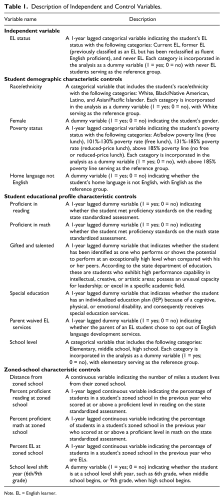
The independent variables central to this analysis are a series of binary indicators that capture whether or not a student is a current EL student or a former EL student, where the reference group is students who have never been classified as an EL. It is important to disaggregate former ELs from current ELs because the extant literature has established that former ELs tend to be more advantaged than their peers who are current ELs, with regard to parent education level, English proficiency level upon entering school, and academic performance in elementary school (Greenberg Motamedi, Singh, & Thompson, 2016; Lindholm-Leary & Hernández, 2011; Saunders & Marcelletti, 2013; Thompson, 2017). We posited that these advantages may also factor into whether or not these students engaged in school choice. In addition, we included a series of control variables to attempt to isolate the influence EL status has on choosing a nonzoned school. Table 1 summarizes the independent and control variables that are used in the analysis.
Description of Independent and Control Variables.
Note. EL = English learner.
Analytic Method
To answer Research Question 1, we conducted descriptive analyses that explored differences in the usage of school choice and how such differences relate to EL status. We began by examining how rates of choosing a nonzoned school differed across never EL, current EL, and former EL students. In conjunction with this, we also compared the demographic and educational profile characteristics to see if there are any important differences between these groups that may suggest differences in the ability to participate in school choice. We tested for statistical significance of group differences by performing t tests of the equality of means for each pairwise group. 3 We conducted tests for the equality of variance for each pairwise group, and in instances where the null hypothesis of equal variance was rejected, we implemented Welch’s t tests.
Our second research question investigated whether EL status is related to the probability of enrollment in a nonzoned school. To determine an individual student’s probability for enrolling in a nonzoned school, we estimated a set of binary logistic regression models that built in the control variables, first including student demographics and educational profile, and then adding characteristics of each students’ zoned school.
We used a bivariate response outcome variable to model the dependent variable, Yi, where

We estimated the probability of observing Yi = 1 for student “i” through the use of a latent variable approach. The model is as follows:

Study Limitations
There are several limitations worth noting. First, the data for this study were only from one district, and the data did not include choice options that were not authorized by the district (e.g., charter schools authorized by the state) or private schools, so we were unable to capture the full choice landscape in our analysis. Second, we did not have a measure for parents’ education level, which is an important determinant for participation in school choice (Haynes et al., 2010). Third, our analysis relied on parents’ revealed preferences because of the nature of the data; thus, we do not know with certainty what the reasoning behind parents’ choices was. Finally, we were not able to perfectly identify which students were former ELs because students who previously attended school in another district and were reclassified before enrolling in the district we studied were indistinguishable from students who were never ELs.
Results
Research Question 1: Descriptive Analyses
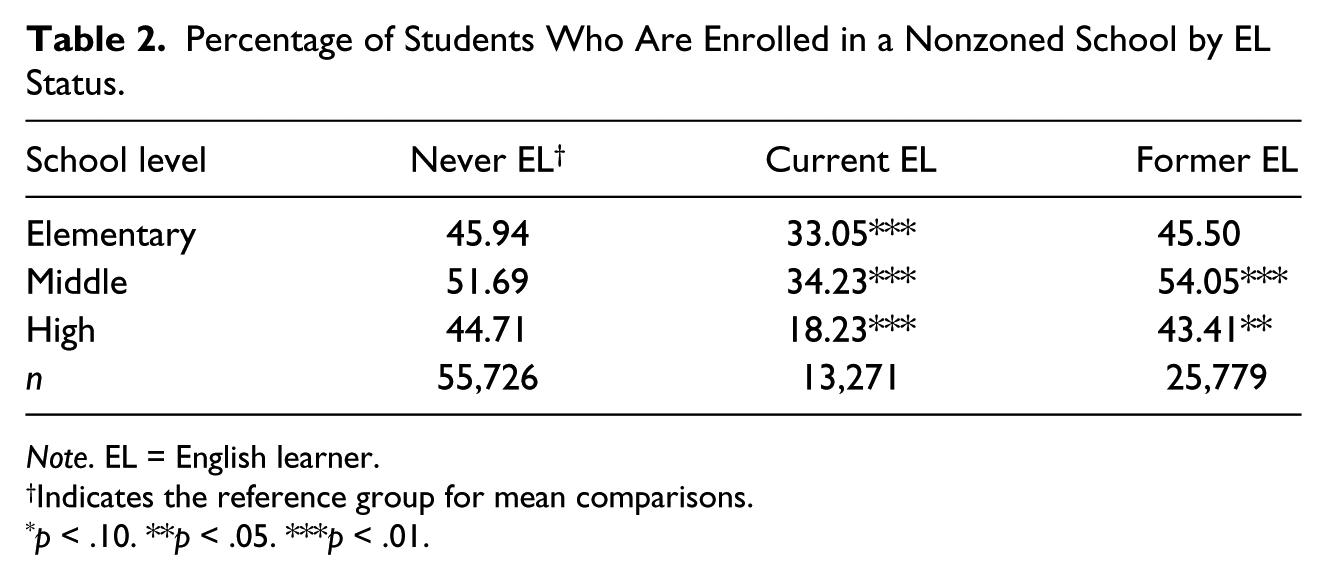
We compared chooser rates in 2011-2012 across EL status and results are provided in Table 2. Across all school levels, students who were current ELs attended a nonzoned school at a significantly lower rate than their peers who were never ELs. For example, among students in elementary school, 45.94% of students who were never ELs attended a nonzoned school, whereas only 33.05% percent of students who were current ELs did (p < .01). The differences in choosing a nonzoned school between never and current ELs grew across school level. For students in high school, only 18.23% of current ELs attended a nonzoned school, whereas 44.71% of their never EL peers did (p < .01). The differences between never and former ELs, while statistically significant for middle and high school, are less pronounced. Interestingly, former ELs outpaced never ELs in attending a nonzoned school in middle school (54.05% vs. 51.69%, respectively, p < .01). This initial comparison of choosing rates across never, current, and former ELs provides preliminary evidence that it is in fact important to disaggregate between never, current, and former ELs in our subsequent regression analysis.
Percentage of Students Who Are Enrolled in a Nonzoned School by EL Status.
Note. EL = English learner.
Indicates the reference group for mean comparisons.
p < .10. **p < .05. ***p < .01.
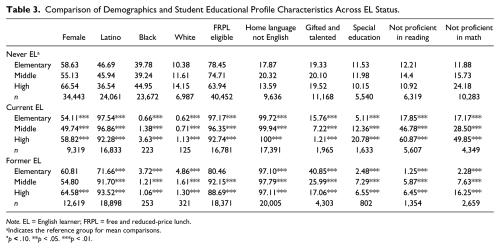
It could also be the case that the differences in choosing a nonzoned school across never, current, and former ELs are due to other systematic differences between the groups. For example, it could be that current ELs are poorer students than never ELs, and it is their socioeconomic status that is in fact driving their lower rate of choosing a nonzoned school. To investigate this possibility, we examined the differences in demographics and student educational profile characteristics between never, current, and former ELs. These results are presented in Table 3. Current and former ELs were significantly more likely to be Latino than their never EL peers across all grade levels. For example, in elementary school, 46.69% of never EL students were Latino compared with 97.54% of current ELs and 71.66% of former ELs. In addition, current and former ELs are significantly more likely to qualify to receive free or reduced-price lunch than their never EL peers, with current ELs being the most economically disadvantaged of the group.
Comparison of Demographics and Student Educational Profile Characteristics Across EL Status.
Note. EL = English learner; FRPL = free and reduced-price lunch.
Indicates the reference group for mean comparisons.
p < .10. **p < .05. ***p < .01.
Table 3 also reveals some interesting trends when looking at gifted and talented and special education status across never, current, and former ELs. The rate of current ELs classified as gifted and talented sharply declined between elementary (15.76%), middle (7.22%), and high school (1.21%). The opposite trend is true when looking at current ELs with special educational needs in elementary (5.11%), middle (12.36%), and high school (20.78%). This is likely an artifact of the criteria used to reclassify students as fluent English proficient. To be reclassified, EL students in this state are required to demonstrate proficiency on a state-approved English reading assessment. Therefore, as EL students progress through school, those who are gifted and talented are more likely to exit the current EL subgroup and become former ELs, whereas the students who have special educational needs are more likely to remain classified as ELs. The same explanation applies when the rate of current ELs not proficient in reading and math appears to increase as students move through school.
Research Question 2: Binary Logistic Regression Results
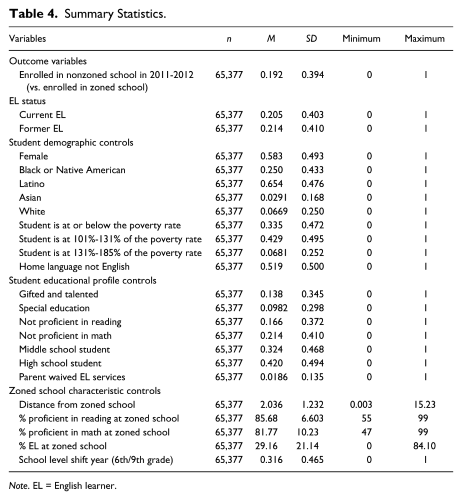
We utilized regression techniques to see how relationships between EL status and choosing a nonzoned school change once we controlled for student characteristics and attributes of a student’s zoned school. Summary statistics for variables included in this analysis are presented in Table 4.
Summary Statistics.
Note. EL = English learner.
Table 5 provides the results of the series of nested logit models we estimated, where the estimates reported are in the form of the odds ratio. A coefficient that is greater than one indicates that a particular covariate is associated with an increase in the likelihood of choosing a nonzoned school, whereas a coefficient less than one corresponds to a decrease in the likelihood while all other variables are held constant.
Logit Results.
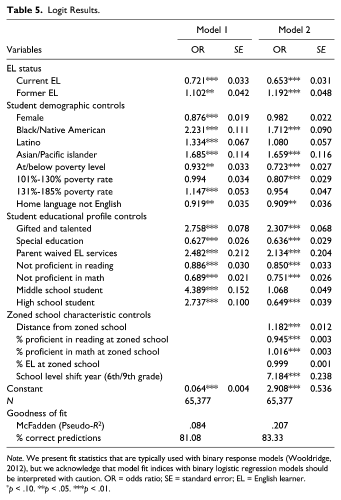
Note. We present fit statistics that are typically used with binary response models (Wooldridge, 2012), but we acknowledge that model fit indices with binary logistic regression models should be interpreted with caution. OR = odds ratio; SE = standard error; EL = English learner.
p < .10. **p < .05. ***p < .01.
For example, looking at Model 1, the likelihood of enrolling in a nonzoned school in 2011-2012 for current ELs was 0.721 times (p < .01) what it was for students who were never ELs, holding other factors constant. In other words, the parents of current ELs were approximately 28% (1 − 0.721 = 0.279) less likely than the parents of never ELs to choose a nonzoned school when controlling for demographic and educational profile characteristics. This relationship held as zoned school characteristic regressors were introduced to Model 2. Conversely, former ELs are 1.102 times (p < .05) more likely to enroll in a nonzoned school than the never EL reference group in Model 1. This coefficient increased in both magnitude and significance in Model 2 to 1.192 (p < .01) once zoned school characteristics were included.
A few control variable coefficients warrant discussion. The estimate for parent waived EL services is significant (p < .01), and the magnitude is rather large at 2.482 in Model 1 and 2.134 in Model 2. Thus, students whose parents waived EL services were more than twice as likely to enroll in a nonzoned school for their child. Because waiving EL services requires taking intentional steps to opt out, it may be the case that parents who waive EL services possess more knowledge about navigating the school system, feel more empowered to make decisions about their child’s education, are more inclined to advocate on behalf of their child, demonstrate more involvement in their child’s education, and are more critical about how their child is being serviced.
Students who were not proficient in reading and math were less likely to enroll in a nonzoned school, and these differences were significant across Models 1 and 2. It is also evident that gifted and talented students were more than twice as likely to be choosers. We see the opposite effect for special education students—their likelihood of becoming a chooser was approximately 0.63 times that of students without special needs. These numbers may demonstrate that students who are considered gifted and talented have more choices because they have access to academically competitive magnet programs, whereas students with special needs may face choice constraints due to not as many schools providing the support services they need.
It is worth taking a moment to explain the estimates for middle and high school, both of which are significant and large in magnitude in Model 1. Parents of middle school students were 4.389 times more likely to choose than parents of elementary school students, and parents of high school students were 2.737 times more likely to choose. This is most likely an artifact of sample design—we dropped students who were in Grades K-2 from the analysis because they did not have reading or math standardized test scores at these grades, so the number of new choosers in elementary school is low.Moreover, the estimate for middle school is most likely larger than the estimate for high school because of the sample design—students who were at a nonzoned school in the previous year were excluded from the sample, so high school students who were at a nonzoned middle school are excluded. This could make it look like fewer high school students attended a nonzoned school. These large impacts disappear in Model 2 most likely because of the inclusion of the school level shift variable.
The zoned school characteristics seem to be less important when it comes to a student’s probability of attending a nonzoned school, though the fit of the model is much better when this vector of variables is included. Although they are almost all significant, most of the differences in probability are rather small in magnitude with odds ratio estimates that are all very close to 1. The one exception is distance to zoned school—each additional mile that the student lives away from the zoned school is associated with an 18% increase in likelihood of attending a nonzoned school, which makes intuitive sense. The school level shift year indicator is also rather important signaling that parents are approximately 7 times more likely to choose a nonzoned school when their child is at a natural point of transition between schools such as going from elementary to middle school.
Discussion and Implications
This study provides a snapshot of one aspect of the school choice process: The act of choosing to attend a nonzoned public school. This analysis is not concerned with trying to determine whether students who attended schools of choice have better outcomes than their peers in traditional public schools or whether school choice spurs competition between schools that leads to innovation. Instead, we focus on understanding a more basic question—whether or not the parents of current and former ELs are participating in school choice at the same rate as their peers whose children were never ELs.
Descriptive results revealed that the parents of current EL students enrolled their children in a nonzoned school at a much lower rate than their peers who were parents of never and former ELs. These differences appear to be particularly pronounced in high school where less than 20% of current EL students were enrolled in a nonzoned school, whereas never and former EL students were enrolled more than twice as much. The regression analysis allows us to examine whether other characteristics such as family income could be driving these differences; if the current EL population is also systematically poorer, this may explain why current EL students enroll in a nonzoned school at a lower rate. However, our analyses revealed that current EL status continued to be negatively related to a students’ probability of enrolling in a nonzoned school even when netting out the effects of race/ethnicity, family income, and many other control variables. This suggests that the district’s system of school choice may not be as accessible or attractive to the parents of current ELs.
This finding is particularly troublesome given the context of the study. The district we studied has a long-standing tradition of school choice, having embraced magnet schools and open enrollment plans decades ago. Moreover, the district has been home to ELs, particularly those with roots in Mexico, for many years. This district has taken steps to remove linguistic barriers for parents. For example, the district translates much of the information on school choice into Spanish, and to a lesser extent Vietnamese and Arabic. The district also has a multitude of bilingual Spanish-speaking staff who are present in schools across the district as well as in central office. Prior research has documented that bilingual staff play an important role in the school choice process, serving as “information agents, opening up social network space for Latino families and helping to feed more information into pre-existing tightly knit social networks” (Mavrogordato & Stein, 2016, p. 1058). Although the district could improve how they cater to the parents of ELs, particularly parents who speak a language other than Spanish, the steps that it has already taken likely put it ahead of other districts when it comes to making school choice more accessible to this group of parents. In school districts that are not as geared toward serving ELs or are only just beginning to implement school choice policies, it is likely the case that the gaps in enrolling in a nonzoned school across EL statuses would be even more pronounced.
Another important finding of this study is the striking difference between the way the parents of former and current ELs engaged in school choice. Unlike current ELs, former ELs enrolled in nonzoned schools at rates similar to or even exceeding their never EL counterparts. After controlling for other characteristics in the regression analysis, former ELs were 19% more likely to enroll in a nonzoned school than never ELs. This result is somewhat surprising because one would expect that the parents of former ELs would face linguistic and cultural barriers to accessing school choice that their never EL counterparts do not face. However, it may be the case that former ELs have particularly involved parents who not only help students meet the requirements to be reclassified as English proficient, but also are more likely to seek out a nonzoned school for their child. Although the reasons behind the differences in choosing rates between current and former ELs are unclear, this finding lends additional credence to the importance of disaggregating never, current, and former ELs when evaluating the impact of different types of education policies. It also suggests that it is important for policymakers to recognize that parents should not be treated as a monolithic group when designing and implementing new school choice policies.
Our findings have important implications for policymakers designing systems of school choice as well as practitioners implementing school choice on the ground. It is evident that there is work to be done to make school choice more accessible and navigable for the families of current ELs. One way to do so is to consider whether there are ways the current school choice system can better draw upon the community cultural wealth of current ELs and their families. Prior work demonstrates that immediate and extended family, close friends, and other trusted individuals carry substantial weight when Latino students and their parents are making educational decisions (e.g., Perez & McDonough, 2008; Stanton-Salazar & Dornbusch, 1995; Tierney & Auerbach, 2005).
Therefore, it might be wise to consider models that take a more communal instead of individualistic approach to informing parents about school choice. Parent liaisons are well positioned to assist in this effort. Researchers have noted that parent liaisons have become more important in recent years because they connect the families of ELs to school reform efforts (Martinez-Cosio & Iannacone, 2007). Furthermore, parent liaisons are able to both validate parents’ cultural resources while “decoding the culture of power” by making the hidden curriculum pervasive in schools more visible and available (Martinez-Cosio & Iannacone, 2007, p. 356). Many districts, including the district in this study, already have parent liaisons on staff, but too often their work focuses largely on addressing issues, concerns, or complaints from parents and community members as opposed to serving as cultural brokers who helps parents and school staff build a partnership that serves to further their children’s education.
Another way to make school choice more accessible for the parents of current ELs is to make concrete policy changes to the system so that the most marginalized students are positioned at the center of the reform rather than being on the periphery. As Yosso (2005) explained, one form of community cultural wealth communities of color have developed is navigational capital, which allows people of color to maneuver through institutions that were not built with them in mind. If the system was designed in such a way that it prioritized current EL students, school choice may become more accessible to these students and their families. Moving away from unregulated choice to a system of controlled choice is one alternative that may move toward this goal. Controlled choice programs “oversee the assignment of students to schools with equity in mind and typically provide additional supports to children and families from disadvantaged backgrounds” (Cobb & Glass, 2009, p. 262). Specifically, they consider different student and school characteristics to balance school enrollments by race, family income, or achievement (Cobb & Glass, 2009). The district studied used to have a controlled choice magnet school program that strived to maintain 65% Black and Latino representation in magnet schools (citation masked to protect district confidentiality). However, the district abandoned this controlled choice program in the mid-1990s after being sued because White students were denied admissions to two of the district’s vanguard magnet programs on the basis of race (citation masked to protect district confidentiality). Many other districts have moved away from race-conscious controlled choice programs, particularly since the 2007 Supreme Court ruling in Parents Involved in Community Schools v. Seattle School District.
Some districts have opted to continue controlled choice through race-neutral assignment plans, which consider factors other than race such as family income and achievement indicators when assigning students. The district studied in this article could reintroduce controlled choice, but instead of making assignments based on race, they could consider whether or not the student is a current EL. Doing so would systematically prioritize this group of students and may increase the likelihood that their parents will engage in school choice. Parents of current ELs may be more inclined to enter the educational marketplace if it is evident that there are seats set aside for ELs in high-demand schools, and they may be more likely to feel comfortable sending their children to one of these nonzoned schools if there is a greater concentration of other current EL students attending.
Conclusion
This study raises important questions about whether or not the parents of never, current, and former ELs are readily able to access and engage in systems of school choice. Future research is required to better understand and unpack why current ELs are less likely to enroll in a nonzoned school than their never and former EL peers. For example, interviewing parents of current EL students who are attending both zoned and nonzoned schools could help shed light on the barriers that these parents face in accessing school choice and how some parents have overcome these barriers. In addition, researchers could identify schools that have been successful in attracting large numbers of nonzoned current EL students and investigate why their parents chose these schools as well as whether these schools took steps to make the choice process more accessible to this population. As school choice reforms continue to proliferate, it will be increasingly important to unpack the assumptions embedded in the market model to better understand how a reform that is touted as a means of expanding educational equity may be operating unequally across different groups of parents, particularly those who have been traditionally disenfranchised and marginalized, such as current ELs.
Footnotes
Acknowledgements
We want to thank the education research consortium that provided data access for this project. In particular, we wish to acknowledge Ruth López Turley, Holly Heard, Sandra Alvear, and Shauna Dunn. We would also like to thank the research staff from the school district included in our study. Finally, we appreciate the thorough and helpful feedback we received from the anonymous reviewers.
Authors’ Note
All opinions expressed in this article represent those of the authors and not necessarily the institutions with which the authors are affiliated. All errors in this article are solely the responsibility of the authors.
Declaration of Conflicting Interests
The author(s) declared no potential conflicts of interest with respect to the research, authorship, and/or publication of this article.
Funding
The author(s) disclosed receipt of the following financial support for the research, authorship, and/or publication of this article: Support was provided to Madeline Mavrogordato by the Education Policy Center at Michigan State University. Funding for Julie Harris was provided by a grant from the U.S. Department of Education’s Institute of Education Sciences to Michigan State University’s Economics of Education Program for doctoral training (R305B090011).