



Abstract
In the United States, adult and workforce education (AE) seems to be located, simultaneously, both everywhere and nowhere in particular. Ongoing shifts in national economic demands and changes in requirements for training and education have brought learning in the adult years into the federal public policy arena. Sometimes referred to as lifelong learning, AE has proven to be a somewhat vague concept as a basis for federal policy formulation, but its existence signals an important federal locus of responsibility for learning in adulthood. This historical examination of the AE policy domain offers a review of the formulation, and more specifically how AE policy has been framed, where AE policy originated, and its progression over time. Primary U.S. legislative documents, federal agency reports, and federal white papers spanning the years 1862 to 2014 were reviewed to present a survey of the AE policy area.
Although adult and workforce education (AE) have deep historical roots like any other form of education, unlike the more monolithic K12 and postsecondary sectors, AE’s institutions have historically tended to be more flexible and temporary, reflecting the diversity of social and political life addressed within educational policy related to the education and training of adults. AE policy has, by and large, been reactionary to economic crises and downturn, and has often been intended to serve as a stimulus for the economy. Paying close attention to the national development of AE from a public policy standpoint, legislative frameworks, and rationale at federal level is an essential component in better understanding the current state of adult education in the United States. Given the shifting nature of policy discourse and the emerging challenges for AE policy—particularly as leaders try to address the rapid changes in the social, economic, environmental, and political spheres—a survey to assess the historical policy trajectories of AE in the United States is warranted.
Although Houle (1968) had already made the point that the U.S. federal government historically has not consciously developed systematic and coordinated AE policy, it may be possible to examine the trajectory of the historical development of national-level policies to discern the values and intentions, convictions and principles, prompting the evolution of AE policy. In the United States, educational policy related to K12 schools, colleges, and universities has primarily been developed and controlled by community interests locally, and by the states acting either directly or through the boards which they created. The more recent shift from primarily locally determined policies and state-driven policy for K12 and postsecondary education to more federally determined policy marks a change in the locus of U.S. educational policy authority, a change which continues to be hotly debated. Historically speaking, however, a federal interest in AE was firmly established in the early 1900s, and many of the strongest and largest programs in the policy area were created by the federal government or have long been supported by it, which distinguishes AE educational policy nationally from the rest.
For all its merits, AE scholarship in the United States has not developed a broader policy research agenda. Academic literature regarding AE policy consists primarily of historical reviews (Milana & McBain, 2015; Stubblefield & Keane, 1994), some insightful academic reviews applying various theoretical perspectives to detect ideological and political trends (Belzer, 2003; Hayes, 1999; Hill, 2010; Rose, 1999; Wilson, 2009), limited federal white papers and reports through the Department of Education (ED) (ED, Office of Vocational and Adult Education, 2008, 2013b) and some independent organizations (Eyre, 2013; Lumina Foundation, 2013). Even though the AE policyscape is highly fragmented and buried within a variety of legislative documents making it difficult to locate and more systematically analyze, our aim is to offer some insight into how AE policy has shifted in location, framing, density, and intensity over time. Here, we update descriptive historical recounts, and in contrast to the sociopolitical academic commentary, we focus our review on the U.S. legislative documents themselves. The purpose was to trace the paths of U.S. federal-level AE policy as they have been codified and implemented, and apply some theoretical concepts to further elaborate those developments.
Document Selection
For this policy review, U.S. legislation that historically informed the development of the AE polity and policy area was reviewed, spanning the years 1862 to 2014. The primary legislative documents reviewed are listed in the Appendix section. Literature about AE policy and documents published by the U.S. Department of Education about AE policy supplemented the review. For the purposes of this examination, we found it necessary to pay attention to public policies that target adult learners independently from the learning sites or parts of the education systems in which they participate (Milana & Nesbit, 2015), meaning a variety of policy foci were examined as they influence adult learning (e.g., adult basic education, vocational education, training and development, workforce development, etc.). Thus, U.S. legislative documents that established educational programming for adults were selected, regardless of the federal agency that was responsible for their implementation.
Purpose and Questions
For the purpose of our policy review, AE is considered to be a public policy domain rather than an academic field or specialized area of educational practice (Milana & Nesbit, 2015). The investigation presents how the AE policy domain has been formulated over the decades in the United States, in particular how AE policy has been framed, where the policy originated, and its progression over time. To identify the locus of policy, the origins of decision-making authority regarding AE policy must be outlined. Consequently, a series of basic but fundamental questions relevant to AE policy are examined: Within which agencies has AE been historically located? What purposes has AE been intended to serve? How is AE policy framed? What have the major shifts been in AE policy over time? This assists in locating and defining the AE policy area, which may be conceptualized as policy subsystems interacting in combination to maintain and support AE educational policy.
Operationalization of Concepts
A policy domain is constituted of different societal and political wills and drives expressed by multiple actors to develop, instrumentalize, interpret, and govern policy through multiple sites and scales. Therefore, it is necessary to locate the actors, sites, and scale of the polity that determine AE policy: The environment in which policy volition, or making and acting on decisions, plays out. For the purpose of this policy analysis, identifying the polity and its policy will assist in locating the actors across levels and spaces as the main agents in policy formation within a multitiered system of governance.
Borrowing from Milana and Nesbit’s (2015) edited book on global AE policy work, we begin with their definition, where adult education refers to “all practices and processes that consider adults to be pedagogical subjects, independently of age, responsibilities, educational attainment or socioeconomic conditions, and the venues in which such practices take place” (Milana & Nesbit, 2015, p. 1). Education stresses “the intentionality, by adults as social actors, to create the conditions for them to extend and develop their knowledge, skills, judgements, and sense-making actions and capacities” (Milana & Nesbit, 2015, p. 1). Although it is difficult to locate an official national definition, adult and continuing education in the United States as understood by the federal government generally comprises adult literacy and education up to secondary school levels, adult vocational training, and noncredit postsecondary schemes supported by federal programs (ED, 2008).
Employing a generous AE definition, federal employment and training programs were funded at just over US$17 billion in the Financial Year 2014 federal budget. By way of comparison, in 2013, it was estimated that U.S. employers spent over US$450 billion on training, overwhelmingly for their own employees (U.S. White House, 2014). Although the majority of learning and training in adulthood takes place within and is provided by the private workforce, AE legislation and policy provide for a broad spectrum of educational programming and practices that are carried out by governments, not-for-profit organizations, and other private institutions. AE legislation is also created as a measure of regulation in response to the economic and social dynamics that are shaping the circumstances of adult learning and employability.
A couple of conceptual and procedural considerations guide our investigation. First, our examination is derived from the federal instruments developed by the polity within the broader policy field (e.g., U.S. legislative documents). Because AE policy cuts across a number of federal agencies and governmental organizations, the term polity describes the interrelated governmental systems that become the political context and setting for AE policy. Second, policy development is conceived of here as ongoing changes that are indicative of the broader policy area as a whole, and not just specific pieces of legislation (Martens, Rusconi, & Leuze, 2007). Accordingly, our review of AE policy encompasses more than one legislative act or educational program, referring instead to the interrelated legal and administrative activities that are thematically related to the policy area of AE.
Policy Concepts and Terms
A few policy concepts and terms—including locus/location, or where the policies originated, framing, density, and intensity—will be employed throughout our historical recount and description of U.S. AE policy development. Policy refers to a course of action, as guiding principles and procedures that influence and determine present and future decisions by the polity. Policy denotes the extent of legislation, regulatory developments, and the instrumentalization of educational programs within the AE policy area (Martens et al., 2007). As such, AE policy has been constructed through joint political action, as a product of multiagency and multilevel governance. The notion of governance, then, captures the coordination of mutual interdependencies among a variety of AE political actors and their arenas of influence.
Policy focus and framing are essential components of AE provision and include the legislative frameworks and rationale used to develop a public policy stand. Framing outlines the parameters of policy and processes, which authoritatively defines and allocates for educational values to adult education in the name of public interest at local, regional, and national levels (Easton, 1965). Policy density refers to the extent to which the identified policy area is addressed by governmental activities. In contrast to policy density, which merely considers the breadth and differentiation of legislative activity, policy intensity reflects the relative depth and/or generosity of educational policies. Substantial policy intensity indicates the level as well as the scope of policy developments. The level refers to the setting of particular policy instruments, but is also defined by the scope of initiative. Policy intensity also refers to financial, personnel, and organizational resources made available to the administrative authorities in charge of implementation (Martens et al., 2007). The next section will follow the historical trajectory of U.S. AE policy evolution, noting shifts in policy location, density, intensity, focus, and framing.
U.S. Adult Education Policy History
Public education, both compulsory and adult, began to be institutionalized in most Western countries in the late 1800s. Adult education emerged in the form of educational and social programming in response to civil society and economic needs, and the recognition at the federal level that the economic interests and growing social inequalities needed to be addressed (Milana & Nesbit, 2015). In the United States, federal AE initiatives are known to have existed in various states as early as the mid-1800s.
(1850s-1950s) AE to Improve Defense and Economy
Military
Federal expenditures for AE-related purposes started with providing instruction in mathematics and military skills to soldiers of the Continental Army in the mid-1800s. This was done using the General Welfare clause in the U.S. Constitution (Section VIII, Article 1). This modest effort marked the beginning of federal attention to providing funds for the education of persons employed by the national government. During the 1800s, military special service schools were established (Perry Area Convention and Visitors Bureau, 2007). Since World War I (1914-1918), the military service has played a leadership role in developing programs, curricular materials, and special instructional techniques for education of marginally educated adults. During World War II (1939-1945), 300,000 illiterate men were inducted into the U.S. Army and enrolled in an intensive education program to bring their skills to at least the fourth-grade level. A similar program, “Project 100,000,” was initiated in 1969. The curriculum and assessment techniques developed for these military programs were later widely adopted and adapted by civilian educational programs throughout the country (U.S. Department of Defense [DOD], Assistant Secretary of Defense [Manpower and Reserve Affairs], 1969). The General Educational Development (GED) tests, used in the United States and Canada, were first developed in 1942 by the DOD in cooperation with the American Council on Education (Washington, D.C.) and the state of New York. These provisions for adult education and remediation through the U.S. military became one of the foundational cornerstones of adult education in the United States.
1800s
In 1862, the Morrill Act established educational institutions in each state to educate communities in agricultural practices, military tactics, home economics, and practical mechanical arts. For most states, this was the beginning of state higher education institutions. Most of these institutions also created extension services, which were funded as a mechanism to pass along new scientific techniques along to farmers and workers at the community level. In 1887, this initiative was expanded with the Hatch Act, which funded agricultural experimental stations. In 1890, the Morrill Extension Act was passed, further expanding the initiative. In 1906, the Adams Act provided direct federal payments to states for the purpose of providing vocational education. In 1914, the U.S. federal government passed the Smith-Lever Bill, which was also aimed to improve agricultural work and make it profitable (ED, Office of Vocational and Adult Education, 2013b; Stubblefield & Keane, 1994). These initial vocational education, extension, and higher education acts laid a foundation for publicly available education to the U.S. adult population for the development of skills with the intent of improving agriculture and the economy.
Early 1900s
The Smith–Hughes Vocational Act (1917/1919/1924) promoted vocational agriculture to train people “who have entered or are preparing to enter upon the work of the farm.” In the year of 1917, the Board of Vocational Education was created (Stubblefield & Keane, 1994). In 1918, and again in 1920, the Vocational Rehabilitation Act was passed, which intended to rehabilitate soldiers discharged from service after World War I and provide training to assist their return to the workforce. The Federal Emergency Relief Administration was created in 1930 (and renewed in 1940) to ameliorate the economic effects of the Great Depression (ED, Office of Vocational and Adult Education, 2013b). All of these federal initiatives are prime examples of how educational policy in the United States, and especially AE policy, has been the result of converging national economic and social interests in response to shifting economic and social circumstances. The very birth of AE programs was in the effort to better prepare adults to participate in the changing economies of the time, and to facilitate employment transitions so adults could find work and remain economically productive.
Immigration
Federal funds for literacy programs were made available in 1918 with passage of the U.S. Immigration Act, which assisted public schools in providing English language, history, government, and citizenship programs for candidates for naturalization. The federal role in these activities was limited to providing candidates with information about the availability of programs and providing schools with textbooks and other curriculum materials (U.S. Immigration Act, 1918). This act is representative of another cornerstone in U.S. AE policy, providing for the education and preparation of immigrants to be “assimilated” into the national economy, including language courses, civics courses, and eventually various forms of vocational preparation as well. All of these were established with the purpose of improving economic productivity and social integration of newly arrived Americans.
Federal employees
The Government Employees Training Act (GETA) of 1958 formalized procedures and funding patterns for providing educational services for government employees (GETA, 1958). This area is another foundational piece within the AE polity and policy volition. Programs for professional, administrative, and technical employees were the initial focus of government training activities. In addition, by Executive Order in 1972, affirmative action was required to extend these efforts and ensure equal employment opportunities within the federal service, and encouraged development of training programs to improve educational and technical skills of employees at the lowest levels of the federal service to facilitate advancement into more financially rewarding positions.
Postwar initiatives
Houle (1968) wrote, “The United States has traditionally prided itself on being a practical nation, and its statesmen have been concerned with the economic development of the country” (p. 177). The reactionary political and economic motivation behind most of the U.S.’s AE policy continued over the course of decades. In 1944, President Roosevelt presented an Economic Bill of Rights to the American people (http://www.ushistory.org/documents/economic_bill_of_rights.htm), communicating that every individual has the right to a useful and remunerative job in an atmosphere of economic security. To insure this right, Roosevelt’s advisors set as the nation’s postwar economic goal, “full, and stable national productivity, income and employment” (ED, Office of Vocational and Adult Education, 2013b, p. 90). Within the postwar economy, the framing of policy emphasized that literacy and other forms of education and training would be necessary to assist adults in successfully (re)integrating themselves into the “new economy.”
The Servicemen’s Readjustment Act of 1944, popularly known as the GI Bill, provided educational benefits that in 7 years resulted in the enrollment of nearly eight million returning veterans in higher education, public schools, and vocational schools. In addition to stemming the influx of veterans into the job market, the benefits opened higher education to the masses, providing financial support for all, regardless of family origin and economic circumstances (Ravitch, 1983). The more than two million veterans who attended colleges and universities broke the age barrier and also demonstrated that adult students had academic promise in higher education (Stubblefield & Keane, 1994).
In 1946, the U.S. Commissioner of Education appointed a Director of the project for literacy education to measure adult literacy in the U.S. population, to create materials suitable for adult literacy education, and to train adult literacy teachers. In the early 1950s, there was a growing interest in AE, so the Office of Education established an Adult Education section. Staff positions in the AE section included personnel with experience in AE, civil defense, lifelong learning programs, and adult literacy. The section’s long-term objectives outlined the following: help Americans become more aware of the importance of lifelong learning and how it can aid in solving many of their problems; assist in identifying national trends and problems that have implications for AE; encourage educators and the public generally to accept AE as an integral part of regular educational programs; help bring about greater clarity of purpose and policies, more communication and cooperation among AE groups, and better coordination among public and private agencies in the use of resources (ED, Office of Vocational and Adult Education, 2013b). The AE section gave special attention to statistics, education of the aging, literacy, Adult Basic Education (ABE), community development, education for public affairs, leisure time education, and human relations education (ED, Office of Vocational and Adult Education, 2013b). In the 1950s, the AE community and segments of the philanthropic community sought to shape the field, establish it as an educational domain, and give it direction, similar to the Carnegie legacy in establishing learning opportunities for the public (English, 2005).
In response to the Cold War, federal legislation proliferated regarding the advancement of technologies and sciences of the time in the name of national security. Most of the legislative focus remained with the K12 systems, but policy was continuously framed promoting education as a crucial mechanism for developing and maintaining a highly skilled and knowledgeable workforce in the name of national security and economic competition. Embedded within the broader social discourse of the Cold War, education and training at all levels were viewed as a national priority and with a sense of urgency.
Policy trends overview
This initial era of adult education legislation is marked by an emphasis on ensuring economic progress and postconflict reconstruction, which drives the framing of AE policy in utilitarian and pragmatic terms. However, because of the multiple needs of overlapping social and economic sectors affected by this tumultuous phase in the nation’s history, the focus of ensuing policies is rather diffuse given competing domains the federal government is attempting to address. Considering the federal government’s apparent intent to establish itself as the primary locus for the initiation and supervision of AE policy at the national level, the policy density seems consequently fairly expansive for the time period, as the government attempted to bridge several policy domains through AE legislation. However, given the incipient and undefined character of AE policy, particularly during its first five decades of development, resource and financial allocation seems to point to an initial lack of intensity of policy actions, albeit compensated by distinctly formulated priorities.
(1960s-1990s) The Era for Remediation and Equalization for Economic Opportunity
Up until the 1950s, the point of departure for the majority of AE legislation had been equalization for economic opportunity and productivity and remediation for basic education. In the second era of U.S. policy, in addition to the primary economic focus of AE policy, social matters and policies also came into focus in the AE policy area. In 1961, President Kennedy reemphasized the nation’s need to increase investment in its human resources, and spoke of the connection between improvement in AE nationally and increased productivity and technological change (ED, Office of Vocational and Adult Education, 2013b). Although Kennedy’s social propositions were interrupted, AE policy continued forward with Lindon Johnson’s “War on Poverty” initiatives. Federal legislation resulted in new capital resources and a new direction for AE and corresponding federal growth programs. With passage of the Economic Opportunity Act (EOA) in 1964, and ABE legislation established in Title II B of EOA, set the stage for the federal government’s initiative in addressing adult illiteracy. The 1964 act marked an important shift in AE policy that would influence legislation in the coming decades. In 1966, Congress passed legislation removing AE from the Office of Economic Opportunity (OEO) and vested authority for the program in the U.S. Office of Education (ED), relocating the federal authority for AE. This program provided appropriations to the states to conduct adult basic and secondary-level programs for persons 18 years of age and above; it also provided for staff development and demonstration projects (Stubblefield & Keane, 1994).
1960s
The Adult Education Act (AEA) of 1966 is considered to be the federal legislation that formally established Adult Education in the United States. The legislation framed AE as programming to help people older than the age of 16 years to improve their educational attainment to help them become more economically independent. According to Section 302 of the 1969 AEA, SEC. 302. It is the purpose of this title to expand educational opportunity and encourage the establishment of programs of adult public education that will enable all adults to continue their education to at least the level of completion of secondary school and make available the means to secure training that will enable them to become more employable, productive, and responsible citizens.
In Section 303 of the 1969 revision of the AEA, the following definitions were provided: (a) The term “adult” means any individual who has attained the age of sixteen; (b) The term “adult education” means services or instruction below the college level (as determined by the Commissioner), for adults who—(1) do not have a certificate of graduation from a school providing secondary education and who have not achieved an equivalent level of education, and (2) are not currently required to be enrolled in schools.
According to the act, (c) The term “adult basic education” means adult education for adults whose inability to speak, read, or write the English language constitutes a substantial impairment of their ability to get or retain employment commensurate with their real ability, which is designed to help eliminate such inability and raise the level of education of such individuals with a view to making them less likely to become dependent on others, to improving their ability to benefit from occupational training and otherwise increasing their opportunities for more productive and profitab1e employment, and to making them better able to meet their adult responsibilities.
Throughout the next decade, the federal government used AE in the service of distributive social justice to address a crisis in race and class through the War on Poverty. AE policy took on a more civil rights–oriented dimension in addition to the historical economic and vocational emphasis. Legislation aimed to heighten national consciousness concerning the need to improve economic and educational conditions of disadvantaged adults. A major force and factor in these policy developments was the Civil Rights Movement, which demanded an end to social, political, and economic discrimination and redress of inequities suffered by its victims. The 1964 EOA created a host of new resources for helping families escape the cycle of poverty, including several new ED programs. This new direction of federal policy may be understood best in the context of the Kennedy and Johnson eras as part of an antipoverty program—the Acts of 1964, 1966, and 1968 (AEA, 1966; EOA, 1964; Elementary and Secondary Education Act Amendments [ESEA], 1968). The federal government took up the charge of providing a means to basic literacy education and remediation for adults that was not occurring at the state level.
As part of the Elementary and Secondary Education Act (ESEA) of 1967, the National Advisory Council on Education Professions Development was tasked with appraising the nation’s existing and future personnel needs in the field of education, including the area of AE, and to amend and extend Title V of Higher Education Act (HEA; 1965), marking a more official integration of AE policy within overall U.S. educational policy architecture. The amendment included an extension on which teaching professions were to be included for support, extending teacher fellowship programs to include graduate education for preschool, adult, and vocational education personnel (ESEA, 1968).
The 1968 Title V Extension of Adult Education Programs also made it possible for private and nonprofit agencies to participate in AE programming, and Title VII Bilingual Education Programs also included language programs for adults, especially parents of children participating in bilingual programs. Also of note, Title I Amendments to the Vocational Education Act of 1963 created the National Advisory Council on Vocational Education. The purpose of this section was to pay the federal share of the cost of the establishment or expansion of ABE programs to be carried out by local educational agencies and private nonprofit agencies (ED, Office of Vocational and Adult Education, 2013b).
1970s
The Office of Education Appropriation Act of 1971 further funded the AEA. Generally, AE was addressed under “Supplementary Educational Centers and Services” for adults with basic educational deficiencies. In 1972, legislation was passed to improve the cultural relevancy of education, and mandated programming to address social inequalities in schooling. The act included programs on culture, ethnicity, on assisting marginalized communities, and to meet the needs of minority groups. Within the 1972 Amendments, the act authorized the establishment of the Bureau of Occupational and Adult Education, which was to be responsible for the administration of the Vocational Education Act of 1963, and all legislation relating to vocational, technical, and occupational training in community and junior colleges, and any other act related to vocational, occupational, AE, and career education. A Community College Unit was also established, which was to have the responsibility of coordinating all programs which affected or could benefit community colleges (ED, Office of Vocational and Adult Education, 2013b). This act expanded provisions for vocational education and officially brought AE programming through Community Colleges under the federal educational umbrella (ED, Office of Vocational and Adult Education, 2013b). With each of these acts and amendments, although located within several pieces of legislation, the scope of the AE policy area was expanding, and the depth and detail of AE programming increased in complexity.
Again in the 1970s, the 1966 AEA was amended, providing special emphasis to be given to Adult Basic Education (ABE) programs, except where such needs were shown to have been met at the state level. It provided that special assistance be given to the needs of persons with limited English proficiency by providing a bilingual adult education program instruction in English and, to the extent necessary to allow such persons to progress effectively through the AE program, in the native language of such persons. The amendment provided for the implementation of AE and ABE programs for immigrants to meet existing needs, including programs of instruction of adult immigrants in basic reading, mathematics, development, and enhancement of necessary skills, and promotion of literacy among adult immigrants for the purpose of enabling them to become productive members of American society. Educational programs were also established for the elderly, to improve American Indian adult education, and for refugees from the Vietnam War. The amendment also authorized programs and activities to develop occupational and related skills for individuals, particularly programs authorized under the Comprehensive Employment and Training Act of 1973 or under the Vocational Education Act of 1963.
Between 1968 and 1978, the 1966 AEA was amended 5 times, continuing to increase the density and intensity in the AE policy area. In 1974, President Ford signed amendments further contributing to the depth and breadth of AE policy. Again in the mid-1970s, federal aid for AE was increased and included congressional passage of an omnibus education bill, and funding and programs were further expanded again in 1978. The Education Amendments Act of 1978 (EA, 1978), included the Community Schools and Comprehensive Community Education Act of 1978, which defined and codified Community Education Programs within federal legislation. This established federal involvement with Community Education with the intent of establishing, expanding, and operating community education programs. During the decade, AE basic state grants increased from US$31 million in 1968 to US$81 million in 1978 (ED, Office of Vocational and Adult Education, 2013b), not only representing an increasing density in AE policy initiatives, but also increasing intensity through growing state and federal commitment to AE through resources, infrastructure, and support.
The 1972 Learning to Be: The World of Education Today and Tomorrow report of the International Commission on the Development of Education (UNESCO, International Commission on the Development of Education, 1972) introduced a reconceptionalization of AE education policy to a wider audience of educators, policy makers, and interested citizens. Internationally, policy leaders called for “lifelong education” to be adopted as the master concept and framework for planning coherent, integrated education systems throughout the life span. In a rapidly changing world driven by science and technology, it was concluded that extending education past compulsory schooling and creating a new pedagogy to encompass continual learning throughout adulthood was necessary. In response, the newly coined term lifelong learning (LL) was introduced to U.S. legislation when then-Senator Walter Mondale introduced the LL Act as an amendment to the 1976 HEA. Within the movement for LL reform, however, AE policy began to more closely resemble a broad array of social services in support of basic adult learning and skills development than an intentionally coordinated “lifelong learning system” (Kurland, 1976).
1980s-1990s
In 1979, the U.S. Senate approved a bill establishing a separate cabinet-level ED, further consolidating and centralizing U.S. educational policy authority. Although undergoing significant reorganization, AE continued to develop depth in the 1980s. In 1983, President Reagan announced the Adult Literacy Initiative, which was to have the ED conduct a series of national meetings to increase AE awareness and promote cooperation among AE programs in eradicating adult illiteracy. The initiative also called for increased funding, a National Ad Council awareness campaign, establishment of a national literacy project, and recommended developing and testing new adult literacy programs, materials, and methods (ED, Office of Vocational and Adult Education, 2013b).
In the 1980s, the workforce and unemployment crisis became the catalyst for educational policy action. As industries shifted and layoffs become more common, a discourse around the retraining of adult workers through national education efforts came to the fore. In addition, according to a 1986 government study on literacy, approximately one of every eight Americans could not read (ED, Office of Vocational and Adult Education, 2013b), and an adult literacy crisis was also declared. The ED, in concert with Congress and the states, worked to address “the crisis.” The 1982 federal Job Training and Partnership Act (JTPA) was introduced as the predecessor of the Workforce Investment Act (WIA) of 1998. This law used federal funding to implement programs that prepared youth and unskilled adults for entry into the workforce and provided employment-related services for disadvantaged individuals. The U.S. House of Representatives held a hearing in 1986, titled “Oversight on Illiteracy in the United States.” Throughout his two terms, Reagan signed two resolutions enabling the Adult Literacy Act to continue. In 1988, National AE Programs, Training of Homeless Adults, and Workplace Literacy Partnerships were added to federal appropriation.
In September 1989, President George H. W. Bush and the 50 state governors convened an Education Summit, and for the first time, AE was explicitly included among the national education goals. In 1991, the National Literacy Act was signed by President Bush, AE programs were expanded, and the National Institute for Literacy (NIFL) was established as an interagency agreement among the Secretaries of the ED, Department of Labor (DOL), and the Department of Health and Human Services (DHHS). National Workforce Demonstration Programs were created to support partnerships between education organizations, business and industry, labor organizations, and private industry councils, intended to serve adults who needed to improve their literacy skills to improve job performance.
The 1991 National Literacy Act expanded the scope and funding for the AE. Gateway Grants were created and required states to fund at least one competitive, 2-year grant to a public housing authority for literacy programs and related activities for residents. The intention of this provision was to assist a greater number of adults by creating educational opportunities closer to home (National Literacy Act, 1991). The Even Start program projects were required to provide participating families with an integrated program of early childhood education, adult literacy training, and parenting education.
The 1992 National Adult Literacy Survey (NALS) established five levels of literacy in the following areas: prose, document, and quantitative, and revealed that 47% of adults scored at Levels 1 and 2, or below levels needed to function at a minimum standard of proficiency (Jenkins & Baldi, 1999), providing evidence that AE programming was still an area of high need in the United States, and that decades of AE policy and programming were still unable to meet the needs of underserved adult populations in the United States.
Policy trends overview
This second era of AE policy was marked by a significant increase in the scope, density, and intensity of AE programming in the United States, which established AE in its own right. The relocation of AE programming to the Office of Education and its integration within broader educational policy and legislation also marked a shift in focus and framing toward improved social inclusion and greater support for learning beyond conventional schooling. An overview of the Educational legislation of the 1960s and 1970s reveals a slow but steady progression of federal legislation to cope with the emerging complexity and issues of society within a rapidly changing economy.
(Late 1990s-2014) The Era of Agency Integration and Accountability
In the late 1990s, U.S. legislators, the ED, and AE leaders recognized that adult educational programming needed to be coupled with job training and streamlined with postsecondary education. They acknowledged that an expanded scope was needed for adults to not only improve literacy skills but also obtain postsecondary education, work skills certification, and other industry recognized credentials. Based on the need to expand adult education and training programs beyond traditional adult basic education (ABE), federal legislation and state action plans were drafted to address workforce and workplace needs. Linking workforce development programs and AE aimed to provide an opportunity for dual enrollment in literacy and job training, which was intended to enhance learners’ prospects for employment (ED, Office of Vocational and Adult Education, 2013b).
The 1998 Workforce Investment Act (WIA, 1998) began a major reformation of the diversified and complex AE delivery system. The stated WIA (1998) purpose was “To consolidate, coordinate, and improve employment, training, literacy, and vocational rehabilitation programs in the United States.” The NLA and AEA were replaced in 1998 with the passage of the Adult Education and Family Literacy Act (AEFLA) under Title II of WIA. AEFLA became the primary federal funding source of AE to provide states with monies to provide basic education services. The integration of AE funding within WIA reflected a growing emphasis on linking literacy, education, and employment services. The DOL also replaced the JTPA, and many of the previous workforce programs were converted into competitive grant programs that states could apply for. The federal government required state-level and local-level Workforce Investment Systems to be established.
The WIA initiative was framed as providing workforce investment activities, through statewide and local workforce investment systems, to improve the quality of the workforce, reduce welfare dependency, and enhance national productivity and economic competitiveness. Much of the architecture and programming for AE was subsumed under the WIA umbrella in an effort to bring workforce programming and educational programming closer together. Title II of WIA was named the Adult Education and Family Literacy Act (ED, Office of Vocational and Adult Education, 2013b), with the purpose framed as creating partnerships among the federal government, states, and localities to provide AE and literacy services. The 1998 act also authorized and created the National Institute for Literacy, which provided national leadership regarding literacy, coordinated literacy services and policy, and served as a national resource for AE and literacy.
WIA also aimed to foster greater interagency cooperation with common clients and program funding issues, leading to a major shift in the provision of education and training. The key concept of the bill was to create a new One-Stop delivery system driven by the needs of each Service Delivery Area (SDA) as determined by the local Workforce Investment Board (WIB). Required partners were identified for provision of services in each SDA, and AE programs were incorporated as a piece in the delivery of One-Stop services. The legislation provided states the opportunity to submit a single unified plan that would address coordination of activities for employment and training, AE, and Perkins Vocational Education programs. The One-Stop concept was to provide and make available information about and access to a wide array of job training, education, and employment services for “customers” at a single neighborhood location.
The purpose of the shift was to promote individual responsibility and personal decision making through the use of Individual Training Accounts, which allowed adult “customers” to purchase the training they determined best for them. This market-driven system was created to enable customers to obtain the skills and credentials they needed to succeed in their local labor markets (https://www.doleta.gov/USWorkforce/wia/Runningtext.cfm). Of nearly equal importance was the mandate that AE programs partner with the local workforce development system. These shifts in federal AE strategy were heavily entangled with welfare and employment issues, and stemmed from the pendulum motion between federal and state relations regarding responsibility for educational and social issues, and the continued expansion of nontraditional policy actors.
1998 WIA legislation also mandated the creation of a performance accountability system to assess the effectiveness of states in providing services to ensure an improved return on the investment of federal funds in AE programming. Unlike previous accountability measures, which made local programs accountable to their state agencies, Title II of WIA made states accountable to the federal ED in a systematic way.
21st Century
The upgrading of education as a national priority under George W. Bush administration’s 2001 No Child Left Behind Act, which emphasized accountability, standards, measurement, and interoperability, did not leave AE policy untouched. AE also became subject to incremental standardized measurements, notions of core curriculum, and program performance requirements. Primarily Republican-led efforts worked to trim AE down to job-readiness programs managed by state and local governments, in preference for implementation in partnership with local workforce development agencies, educational institutions, and employers. The increased emphasis on more centralized national standards, measurement, and program requirements led to the formalization of reporting for AE program success indicators and measures. A great deal of variation existed among states when it came to partnering relationships for AE programming, but the accountability system became standardized nationally (Belzer, 2003). Despite this push for centralization and national conformity in some areas, there was a simultaneous emphasis on state- and local-level fiduciary responsibility for educational initiatives and policy implementation.
In 2002, partaking in the Partnership for Reading, the then Office of Vocational and Adult Education supported a first review of adult literacy research. The initiative launched Student Achievement in Reading (STAR), a project aimed at improving systemic reform of basic literacy, classroom instruction, and teachers’ professional development (ED, Office of Vocational and Adult Education, 2013b). The legislation also extended efforts to create interlocking curricular standards between K12 and AE.
The 2006 Carl D. Perkins Career and Technical Education Act (Perkins Act, 2006) was enacted with the goal of transforming Career and Technical Education (CTE). The act authorized a competitive CTE Innovation and Transformation Fund establishing competitive funding to increase the number of high-quality career academies to expand effective CTE programs across the country. The ED initiative incentivized innovation at the local level and aimed to support system reform at the state level, and the “Career Pathways” initiative was born.
In 2008, the Higher Education Opportunity Act (Public Law 110-315; Higher Education Opportunity Act [HEOA], 2008) was also enacted to reauthorize the 1965 HEA. The 1,200-page bill introduced new federal reporting requirements, new grant programs for higher education institutions and college students, and initiatives to reduce the overall cost burden of a college education. The act’s college cost-related disclosure and reporting requirements were extensive, facilitating the creation of college affordability transparency lists. The law also reflected efforts at aligning institutional standards and accreditation standards, requiring greater institutional transparency and disclosure, to help ensure the availability of information regarding the quality and integrity of degree programs. Provisions were also made for programs to improve Teacher Professional Development, also to assist in the alignment of standards and education quality across K20 systems.
HEOA (2008) also required states to maintain appropriations for higher education that are at a minimum equal to their previous 5-year appropriations average, and arranged to withhold College Access Challenge Grant funds from the states that failed to do so. The law also rewarded colleges and universities, in the form of additional Pell Grant aid, for limiting tuition increases. This provision reflected an interesting shift toward greater accountability of states to the federal government in the arena of HE policy. The law also changed requirements regarding who can qualify for Pell Grants, Supplemental Educational Opportunity Grants, and the Federal WorkStudy Program, and authorized model and demonstration programs for the development and expansion of more inclusive models for transition and postsecondary education programs for adult learners.
Policy trends overview
At the turn of the century, the third era of AE policy development denotes a process of maturation in policy domain integration, with policy objectives coalescing into intricate, complex, and multifaceted legislation located in connected poles within the AE bureaucracy. The focus and framing of the new legislation reflected the human capital development view that the economic needs of the country were undeniably tied to the success of education and employment programs in helping youth and adults become employable. Out of this philosophical orientation, emerged a dense and tightly interlaced mesh of policy priorities that integrate large-scale programming encompassing adult and higher education with career- or workforce-oriented auxiliary initiatives into a seemingly coherent approach to unifying them under the umbrella of economic competitiveness and modernization. As AE legislation grew ever more complex and integrated over time, the intensity of policy implementation mechanisms increased in tandem, expressed through elaborate formulas for the allocation of human resources, administrative structures, and financial envelopes.
Career Pathways, Workforce Innovation and Opportunity Act (WIOA), and Recent Initiatives
On September 27, 2007, Executive Order 13445 “Strengthening Adult Education” (Executive Order, 2007) was issued by George W. Bush, calling for the establishment of an Interagency Adult Education Working Group within the ED. The Working Group was ordered to identify and review Federal programs that constitute programs of adult education to increase their effectiveness, efficiency, and availability and measure and evaluate their performance, to minimize unnecessary duplication, to identify gaps in the research about effective ways to teach adult education for postsecondary readiness. Following this Presidential Order, the Obama administration passed a number of acts related to AE, and as the precursor of the 2014 WIOA, the federal government began further integrating AE and workforce development infrastructure through the outlined “Career Pathways” model, which initially appeared in the 2006 Carl D. Perkins CTE Act (Perkins Act).
In the Strategic Plan for Fiscal Years 2011-2014, Goal 1 was outlined in the area of Postsecondary Education, CTE, and Adult Education to “Increase college access, quality, and completion by improving higher education and lifelong learning opportunities for youth and adults” (p. 8). Continuing the systematic efforts at the federal level to cultivate an infrastructure and better integrated systems for the delivery of AE programming. In April 2012, a joint letter was issued by the U.S. ED, the DOL, and the DHHS that formed a Federal partnership articulating a joint commitment in promoting the use of “Career Pathways” to assist youth and adults in acquiring workforce skills and industry-recognized credentials through better alignment with employers of education, training and employment, and human and social services (DOL, 2016). The purpose of the initiative was to strengthen the U.S. workforce development system through innovation in, and alignment and improvement of, employment, training, and education programs, and to promote individual and national economic growth. Similar to the 1998 policy shift of the One-Stop Services, the introduction and further development of Career Pathways has also contributed to a significant shift in AE policy framing and focus, and relocated authority primarily within the DOL.
The 2014 WIOA, with the full title “To reform and strengthen the workforce investment system of the Nation to put Americans back to work and make the United States more competitive in the 21st century,” consolidated job training programs under 1998 WIA and streamlined the process with the intent of allowing clients to receive needed services earlier. The act also pushed those providing WIA services to collaborate more closely with the Vocational Rehabilitation programs to improve services for people with disabilities, merging them into a single funding stream. The Wagner-Peyser Act was also amended and reauthorized AE programs and programs under the Rehabilitation Act of 1973. The various job programs were authorized for 6 years, and required to record and report how many people obtained new jobs through their participation in the programs.
In terms of impact on AE programming in the United States, WIOA (2014) is on par with the formal establishment of adult education with the 1966 AEA, and the major shifts entailed in the 1998 WIA. WIOA reformed the workforce development system, with the intent of providing critical support services to workers who want to develop the necessary skills for quality employment and to employers who need skilled workers to compete. In 2016, a renewed Career Pathways Joint Letter was issued, which was signed by 12 federal agencies (DOL, 2016), with the intent to cooperate, expand, and strengthen the partnership that was established in 2012 Career Pathways Joint letter.
Title II of WIOA revised the Adult Education and Family Literacy Act (AEFLE) and extended the authorization of appropriations through fiscal year 2020. It replaced requirements for a performance accountability system, and mandated participating agencies to require eligible providers to demonstrate measurable goals for participant outcomes and other specified program elements. Needless to say, while most AE programming across the spectrum is still primarily the responsibility of states, the dictates of legislation and federal requirements for funding continue to proliferate and mandate greater centralization of standards, accountability, evidence-based programming and practices, and enhance overall federal oversight.
Policy trends overview
The policy volition was to strengthen the U.S. workforce development system through innovation in, and alignment and improvement of, employment, training, and education programs, and to promote individual and national economic growth. Similar to the 1998 policy shift of the One-Stop Services, the Career Pathways initiative also contributed to a significant shift in policy framing and focus, with the intent of creating improved career paths: integrated education and training, recognized postsecondary credentials, registered apprenticeship programs, sequential education and training, and workplace skills.
Discussion of Policy Development
AE policy is the result of a complex, uneven, and multilayered set of cross-cutting processes and loci of interaction that assign value (social and economic) to the education and training of adults across time and geography. While the primary purpose of our review was to conduct a comprehensive historical survey of policy development, (re)formulation, and expansion over time, we also applied policy analysis concepts to the historical description to illustrate the permutations of policy interests that coalesce into concrete legislation via framing, focus, location, density, and intensity of policy agency. A historical review of the development of the AE policy area reveals how multiple actors (e.g., federal agencies, states, nongovernmental organizations, and local providers) come together to exercise authority and allocate resources, but also how conventional cultural understandings and norms regarding the purpose, function, and scope of AE are codified and translated into national and state infrastructure for educational programming.
Framing and Focus
Policy volition, or the framing and articulation of political will of multiple actors (Torres, 2013), involves the broader interpretations, mediations, and enactments across the polity. The framing of AE national policy volition is the articulation of collective decisions about normative education processes that are to be put into action at various levels by multiple actors (Ball, 2012). Historically speaking, when it comes to the compensatory and developmental educational functions for adults, in the U.S AE policy has principally been a product of federal governance and political will. Explicit governmental statements about the education of adults have been continuously developed at the federal since the early 1900s and programming related to AE were instrumentalized into programming to address social problems, and more recently adult education has been strongly contextualized within economic development and the welfare state.
Federally formulated AE policy for state governments has consisted of political responses to events such as the Great Depression, World War II, shifts in economy, as well as the cumulating data on adult skill levels in the United States, which continually renew public interest in further developing AE policy to improve national investments in skills upgrading of the adult population to remain economically competitive. U.S. federal AE policy has generally acknowledged that the process of accomplishing personal, social, and professional development occurs throughout the life span, and hence has been concentrated on building programs and services that support such a process toward national and individual economic stability and productivity. This framing of federal policy has translated the notion of adult and lifelong learning into an active tool for the reform of education and social systems to tackle market mandates and shifts in local, national, and international economies. Federal-level AE policy volition, essentially, resides at the crossroads of social and economic policy as much as it does educational policy.
From inception, AE policy has been framed in terms of helping adults become more economically independent. The more recent integration of AE with the workforce development system at the federal level, starting with the 1998 WIA and the recent 2014 WIOA, has been a major change in federal AE policy framing. This 21st-century integration under WIA demarcates a philosophical shift, which was also reflected in the relocation of AE policy beyond the sole purview of the ED, and embedded it within the broader national framework referred to as “welfare reform.” With the passage of WIA, AE was subsumed within the workforce development system, where it became an instrument (known as Title II) within a broader social welfare reform agenda. This reframing has had a significant impact on the definition of actual and potential adult learners, and on the services that they would require and be allowed to access. AE has been predominantly formulated and framed within the workforce development system, emphasizing the economic and social drive behind AE policy. Linking the AE policy arena more explicitly with workforce development programs fundamentally transformed the AE polity, policy dynamics, purpose, and scope. With the integration of AE policy within workforce initiatives, and the new emphasis on the alignment of postsecondary, career, technical, and other educational and workforce systems to create career pathways, federal AE policy volition and framing have become almost monolithically embedded within welfare economics and the human capital development paradigm. In moving away from the humanistic and civic-minded initiatives in the second era that were aimed as broader social inclusion, social justice and lifelong participation, the third era has returned to a more utilitarian and pragmatic approach to adult learning, narrowing its purposes to vocational preparation for economic participation.
Throughout the 1990s, AE polity actors recognized that adult literacy programs needed to be coupled with postsecondary education and training for adults to obtain work skills certification and industry-recognized credentials to maintain and increase national productivity in a changing, technology-based world economy. At the turn of the century, educational policy focus began to shift toward getting people into postsecondary education, providing some bridges between compulsory and secondary education, and postcompulsory education and training (ED, Office of Vocational and Adult Education, 2013b). Also, the increased emphasis on CTE in policy framing is significantly affecting adult education, postsecondary education, developmental education, and higher education in the United States, indicating the prioritization around preparing more youth and adults for success in college and career (ED, 2014). The 2006 Perkins and 2014 WIOA acts reflect an increasing emphasis on vocational preparation in postsecondary and higher education, and less attention to more humanistic philosophical understandings of AE.
Although the notion of adult and lifelong learning is part of mainstream national policy dialogue and discourse, AE policy initiatives and strategic goals for education reform have primarily remained a mechanism for improving other national economic and social goals. Although AE is present in a wide variety of forms in federal legislation, reflecting the need for and value of learning in adulthood and the importance of establishing AE policy, the improvement of education for the adult population remains fairly ad hoc and is not adequately or systematically reflected within broader national education reform and the development of policy agendas.
Location of Systems and Actors of the AE Polity
In the United States, educating children and higher education are chiefly the responsibility of states, local governments and institutions, with limited federal-level involvement and centralization (Schmidt, 2008). However, federal attention to adult and continuing education mostly grew in support of compensating adults who missed out on their basic compulsory schooling (Rose, 1999). AE policy is usually mandated and subsumed under general federal education policies, but it has only been marginally included within the mainstream development of comprehensive national educational reform frameworks.
Federal educational policy formulation results in concrete programmatic decisions about and justification for federally funding AE programs, which are subsequently carried out at the state and local levels. The national policies are enacted in the name of global competition, but the scale of policy and implementation remains unquestionably locally situated (Belzer, 2003). In some ways, AE policy is more centralized than other domains of educational policy in the United States, as a substantial amount of AE policy originates at the federal level and is funded by federal flow through dollars. Paradoxically, the plurality of agencies and actors involved creates a loosely organized amalgamation of systems that lack coordination and clarity in administration and execution, though WIOA legislation aimed to improve system coordination.
The need to better coordinate AE policy in the executive branch has long been recognized. The administration of AE within the federal polity lacks a definitive architecture of governance. Today, the Division of Adult Education and Literacy falls under direction of the Office of Career, Technical and Adult Education (OCTEA) within the ED. Currently, though, five different federal agencies administer similar AE services, making it difficult to ascertain the structure and strategy behind AE policy. Each of the federal agencies—Departments of Education, Labor, Health and Human Services, Defense, and Justice—apportion AE funds and implement AE services according to federal directives and legislation. Within the five federal agencies that carry out AE policy, 11 major federal programs are designated to improve adult literacy through ABE, adult secondary education (ASE), and English as a second language (ESL) services (ED, 2008).
Individual states partner with both the federal and local governments to implement AE programming. The varying levels of each of the systems that enact AE policies are somewhat, but not completely, autonomous. Although the movement of federal AE policies is top-down—from ideation as statutes down to their implementation when program managers and instructors act on them—states, program managers, and practitioners are not merely receivers of the policy. Because AE initiatives are ultimately the responsibility of the states, the responses of state leaders are shaped by the local political context and state-level capacity and political will with regard to AE policies (Belzer, 2003).
Federal allocations to states through the various acts (Perkins, WIA, WIOA and HEA) are the province of the ED, which among other functions, also disseminates research and directs national attention to key educational issues (ED, 2012). These activities lever governmental and institutional decisions about AE, and are becoming increasingly instrumental in nationally aligning content standards and assessment procedures across states, educational sectors, and institutions. With the authorization of the WIA in 1998 and the WIOA in 2014, the federal AE polity has required greater interoperability and coordination between federal agencies to reduce duplicate services and to restructure funding streams. Integrating AE policy into the federal workforce initiatives also symbolically served as a relocation of policy development back toward a DOL emphasis.
Policy Density and Intensity
The 1964 AEA officially codified the AE policy area at the federal level. Throughout the 1960s, the federal role in AE deepened by contributing to substantially increased density and intensity of policy. All of these legislative developments represent the increased density of AE policy, as well as policy intensity. The 1960s and 1970s signified an era of concentrated development in the federal policy architecture supporting adult learning of a variety of forms. The 1979 creation of the federal cabinet of the ED marked the further formalization of the AE polity, and increased depth and breadth of AE policy. This was significant, in that it showed greater intensity and density policy post World War II aimed at addressing the increasing complexities of social and economic life experienced by adults in the United States. The 1972 education amendments represented developments in AE policy that demonstrated increased attention to a diversity of demographics and populations in need of AE, and the increased federal capacity to support and implement AE programming.
The density of AE policy continued to increase throughout the 1990s with the integration and expanded scope of policy aims. AE policy returned to building on the 1960s-1970s initiatives, and federal legislation and state action plans were drafted to address workforce and workplace needs (ED, Office of Vocational and Adult Education, 2013b). The nation’s investments in AE (ABE, ASE, and ESL) continued to grow during the first decade of the 21st century, increasing policy intensity. Using the Obama administration’s 2020 goal, the ED developed a Strategic Plan, which outlined National Outcome Goals for Postsecondary Education, CTE, and AE. In the early 2000s, a series of legislation represented another historic push in increasing the scope, depth, density, and intensity of AE policy nationally, similar to the 1960-1970s era. The series of acts symbolized a renewed commitment in policy to social inclusion and civics-based educational programming.
Although it can be said that federal AE policy has undergone a renewed stage of increased density over the past decade, or at least significant reorganization, the intensity and fiscal resources have not kept pace, leaving the localized impact of the federal directives to be determined. As can be seen in the pattern of legislative development over time, policy change tends to vacillate between periods of increased density and intensity, followed by periods of reorganization, reduction, and the (re)framing and focus tend to be in response to the social and economic demands of the time.
Conclusion
Considerable responsibility for leadership and finances regarding the education of adults in the United States has been located and prioritized at the federal level, warranting closer investigation. This historical survey presented how the federal-level AE policy domain has progressed over the decades, in particular how AE policy has been framed, where the policy originated, and its growth in density and intensity. Looking at the codified values regarding the education of adults in the form of federal legislation assists in comprehending the relationship between institutional arrangements and nationally valued educational outcomes for adults. The benefit of a historical examination of AE policy development is gaining a clearer understanding of how AE legislation has evolved as a mechanism for regulating adult learning in response to economic dynamics and social circumstances of the day. This historical survey provides an updated context and serves as a stepping stone toward more systematic analyses of AE policy in the United States, an endeavor the present authors intend to pursue as the next phase of their continued research of this policy domain.
Footnotes
Appendix
U.S. Legislation Relevant to Adult Education Policy History.
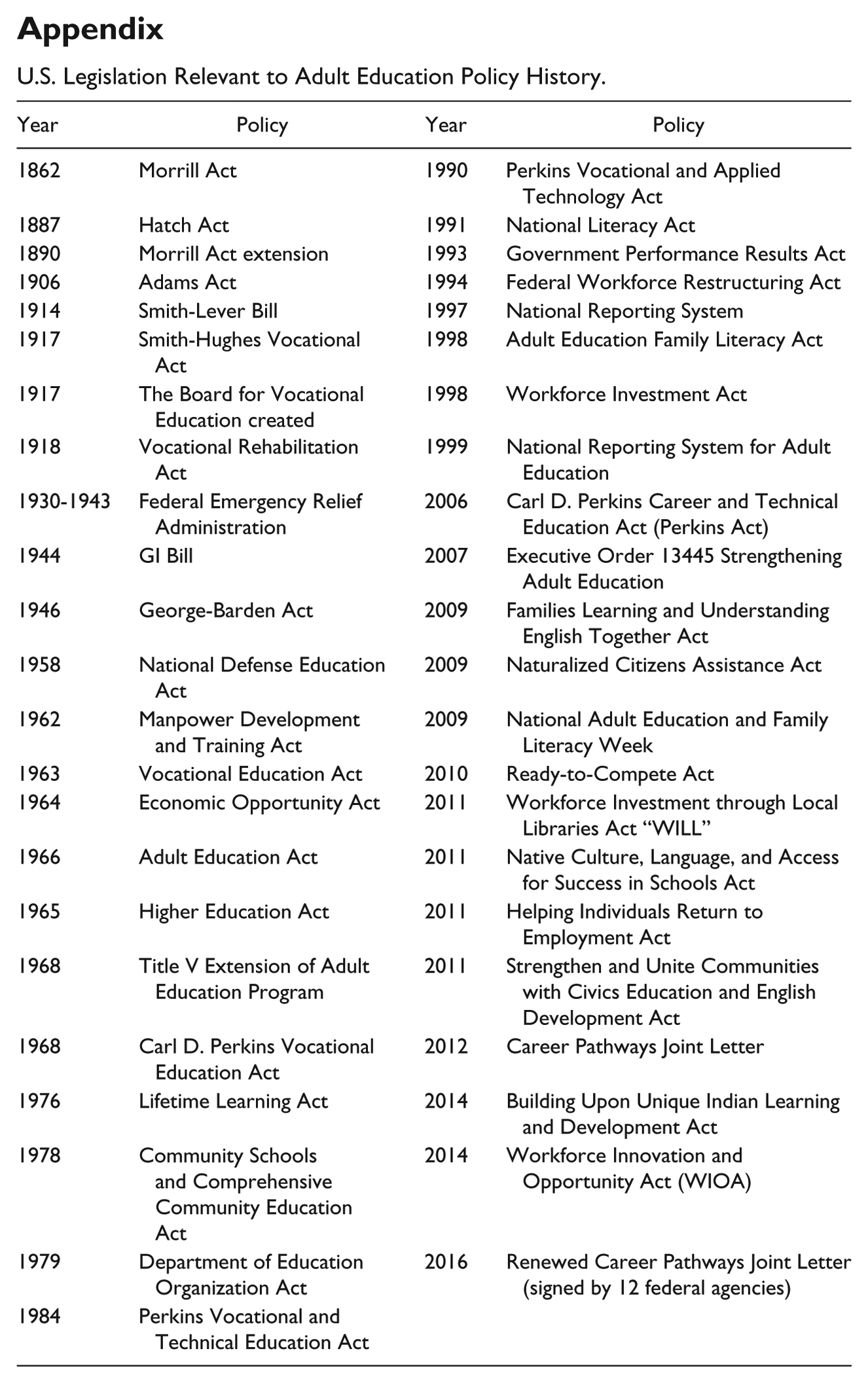
| Year | Policy | Year | Policy |
|---|---|---|---|
| 1862 | Morrill Act | 1990 | Perkins Vocational and Applied Technology Act |
| 1887 | Hatch Act | 1991 | National Literacy Act |
| 1890 | Morrill Act extension | 1993 | Government Performance Results Act |
| 1906 | Adams Act | 1994 | Federal Workforce Restructuring Act |
| 1914 | Smith-Lever Bill | 1997 | National Reporting System |
| 1917 | Smith-Hughes Vocational Act | 1998 | Adult Education Family Literacy Act |
| 1917 | The Board for Vocational Education created | 1998 | Workforce Investment Act |
| 1918 | Vocational Rehabilitation Act | 1999 | National Reporting System for Adult Education |
| 1930-1943 | Federal Emergency Relief Administration | 2006 | Carl D. Perkins Career and Technical Education Act (Perkins Act) |
| 1944 | GI Bill | 2007 | Executive Order 13445 Strengthening Adult Education |
| 1946 | George-Barden Act | 2009 | Families Learning and Understanding English Together Act |
| 1958 | National Defense Education Act | 2009 | Naturalized Citizens Assistance Act |
| 1962 | Manpower Development and Training Act | 2009 | National Adult Education and Family Literacy Week |
| 1963 | Vocational Education Act | 2010 | Ready-to-Compete Act |
| 1964 | Economic Opportunity Act | 2011 | Workforce Investment through Local Libraries Act “WILL” |
| 1966 | Adult Education Act | 2011 | Native Culture, Language, and Access for Success in Schools Act |
| 1965 | Higher Education Act | 2011 | Helping Individuals Return to Employment Act |
| 1968 | Title V Extension of Adult Education Program | 2011 | Strengthen and Unite Communities with Civics Education and English Development Act |
| 1968 | Carl D. Perkins Vocational Education Act | 2012 | Career Pathways Joint Letter |
| 1976 | Lifetime Learning Act | 2014 | Building Upon Unique Indian Learning and Development Act |
| 1978 | Community Schools and Comprehensive Community Education Act | 2014 | Workforce Innovation and Opportunity Act (WIOA) |
| 1979 | Department of Education Organization Act | 2016 | Renewed Career Pathways Joint Letter (signed by 12 federal agencies) |
| 1984 | Perkins Vocational and Technical Education Act |
Declaration of Conflicting Interests
The author(s) declared no potential conflicts of interest with respect to the research, authorship, and/or publication of this article.
Funding
The author(s) received no financial support for the research, authorship, and/or publication of this article.