



Abstract
Despite the central role schools have played in the resettlement of refugees, we know little about how principals, teachers, parents, and staff at community-based organizations interpret and negotiate national immigration policy and state education policies. Combing critical discourse analysis (CDA) and actor-network theory (ANT), we capture how these actors work together and against each other to enact supports with regard to these newcomer students. Data includes a 36-month ethnography of refugee networks in Arizona. We argue that policies around English language acquisition and academic support further isolate refugee students and diminish their formal learning experiences in the United States.
Keywords
Introduction
More than half of the world’s 21.3 million refugees are under the age of 18 years. Since 1975, roughly 3 million refugees have resettled in the United States—37% are school-aged children between 5 and 18 years, and an estimated 1.2 million refugee youth attend schools across the United States. Refugees are distinct from other ethnic minority groups because of their interrupted education, high levels of experienced trauma, and uncertain citizenship status (Dryden-Peterson, 2016). Refugees are also distinct from other immigrant groups and on average have less overall education and English language training (Dryden-Peterson, 2011). Although refugee youth also suffer from poor mental and physical health (McBrien, 2005), many speak multiple languages, come from families and communities rich in cultural assets and resources (He, Bettez, & Levin, 2017), and are eager to learn once resettled in the United States (Koyama, 2015).
U.S. school districts, though, are challenged to serve refugee youth under existing policies and programs steeped within global discursive climates that demonize migrants, in general, and refugees, specifically. Refugees have been metaphorically referred to as “‘swarms’ and ‘marauders’ who threaten to ‘flood’ Western countries in an attempt to ‘sponge off the welfare system’” (Esses, Hamilton, & Gaucher, 2017, p. 87). In the United States, the federal government has reduced refugee admissions and put forth a series of Executive Orders aimed at stopping the entry of travelers and refugees from particular countries deemed “dangerous” by the administration. Such discourses and actions construct refugees as “threatening national goals” (Aleinikoff, 2017, p. 3). Yet, contrary to national policy rhetoric and actions, the U.S. Refugee Act of 1980, Public Law 96-212 states that refugee youth should be enrolled in schools as soon as possible, usually within the first 30 days of their arrival. Although refugee resettlement agencies are accountable for meeting the mandates of the Refugee Act, refugee children are often denied access, opportunity, and quality school opportunities.
Barriers to refugees’ legal right to attend public schools is of particular concern in states such as Arizona, where the Governor continues to support a ban on Muslim refugees and much of the state’s populace supports nativism and protectionism. Several Arizona laws, including Senate Bill 1070, allow any law enforcement official to determine the immigration status of an individual during a routine stop, detention, or arrest (for a discussion of Arizona anti-immigrant legislation, see Campbell, 2011). Understanding how schools and school districts in Arizona enact policies that function to marginalize, assimilate, or accommodate refugee youth offers an important window to understanding broader national and international efforts to support the well-being and resettlement of refugees.
Drawing on a 36-month ethnography of refugee networks in Arizona collected between December 2013 and January 2016, we examine how formal school actors (such as, principals and teachers), parents, and staff at community-based organizations (CBOs) make sense of and negotiate national immigration policy and state education policies. Framed by critical discourse analysis (CDA), bolstered with the conceptual resources of actor-network theory (ANT), we trace how policy actors, in and out of schools, work together and against each other to enact policy. Because the actors are drawn together from disparate organizations with varying aims, resources, and motivations, they selectively appropriate state policies to meet their needs. Capturing the shifting and precarious moments of authority, consensus, and contestations in policy and politics across Arizona, we demonstrate how specifically the policies around English language acquisition and academic support, in fact, further isolate the refugee students and diminish their formal learning experiences in the United States.
Critically Examining and Interrogating Policy
We situate this study within Critical Policy Analysis (CPA; Diem, Young, Welton, Mansfield, & Lee, 2014; Dumas, Dixson, & Mayorga, 2016). CPA departs from traditional “what works” orientations to policy studies and instead explores how policies reproduce or challenge prevailing societal and educational inequities (Diem et al., 2014; Webb & Gulson, 2015). Whereas prior policy studies investigated questions of policy implementation (Odden, 1991), CPA explores how actors appropriate and variably enact policy and how these enactments influence the distribution of policy resources, values, and knowledge (Ball, 1995; Levinson, Sutton, & Winstead, 2009; Werts & Brewer, 2015). Levinson et al. (2009) make important distinctions between official, often government-generated, policy and informal policy by conceptualizing policy as an ongoing sociocultural “practice of power” (p. 767). They demonstrate how policy circulates in multiple directions and becomes fragmented and localized into activities and practices that construct nonauthorized policy. Actors creatively appropriate policy, adapting and selectively incorporating particular policy elements and practices, creating new norms overtime that ultimately change local policy. The aim of CPA then is to analyze how power is embedded in these collective practices, which sustain or interrupt status quo social and material relations of power.
In general, CPA offers more expansive notions of policy texts and policy actors. In fact, those, such as teachers and school administrators, who in previous policy studies would have been seen as policy implementers, are resituated as policy makers in CPA. Several studies in educational leadership exemplify this perspective. Focusing on the ways in which educational leaders act explicitly and purposefully as policy actors, Carpenter and Brewer (2012) conceptualize leaders as “savvy participants,” able to navigate complex policy networks. According to this work, leaders are local policy makers even as they are constrained by resources, government structures, and external accountability policy. Similarly, Spillane et al. (2002) envision principals as “mid-level managers,” who selectively negotiate and mediate district accountability policy. They show how principals’ sense making of district accountability policy is part and parcel of their roles as mediators or intermediaries between the district central office and schools. Koyama’s (2014) conceptualization of principals as bricoleurs resonates with the work of Spillane et al. (2002) and further situates principals as active, although unofficial, local policy makers who make sense of and negotiate policy at the school level.
CPA includes investigation into a constellation of texts that are inherently partial and political. It highlights the multiplicity of texts, such as white papers, political inquiries, media reports, websites, administrative guidelines, and curriculum statements (Taylor, Rizvi, Lingard, & Henry, 1997). In her critical analysis of the role character education policies play in perpetuating inequality in Ontario, Canada, Winton (2013) observes these texts are often “written to generate support for the ideas they propose” (p. 162). Moreover, policy texts animate and are animated by multiple policy actors. In contrast to traditional notions of an “iron triangle” of policy makers, which includes interest groups, executive agencies, and congressional representatives, CPA interprets policy makers broadly to include journalists, researchers, community organizers, teachers, and young people (DeBray, Scott, Lubienski, & Jabbar, 2014).
Informed by the literature in CPA, we examine how policy actors, in and out of schools, make meaning of, and appropriate, immigration and state education policies that affect refugee students. We are especially interested in how policies participate in the reproduction, or narrowing, of school and educational opportunities for refugee youth in the United States. Following Levinson et al. (2009), we trace “the ways that creative agents interpret and take in elements of policy, thereby incorporating these discursive resources into their own schemes of interest, motivation, and action” (p. 779). These creative acts of policy appropriation offer insight into how policy actors re-contextualize policies through creative practices of interpretation, enactment, and translation (Braun, Ball, Maguire, & Hoskins, 2011). We thus consider the policy actors in our study to be informal, rather than official, policy makers.
Considering and Utilizing CDA and ANT
Our application of CPA combines CDA and select conceptual resources of ANT. We follow Fairclough (1993, 1995) in approaching CDA from the perspective that language, an irreducible part rather than an encompassing equivalent to social life, is dialectically linked with other elements of the social (c.f., Gee, 1991). Through this lens, we situate language as a social practice, a mode of action that mutually shapes and is formed through the social. We consider the ways in which language works within, and because of, power relations. Linkages between texts, such as education policy, and practices are mediated by discourse, by which we mean, systems of meaning-making that condition what is sayable, thinkable, and knowable within particular social contexts (Fairclough, 1995). We assume power is inflected in discourses, which “construct certain knowledge as legitimate, while delegitimizing other knowledges” (Foucault, 1980, p. 405). The purpose of CDA then is to reveal the “opacity” of discourse (Fairclough, 1993, p. 135). As noted by Tenorio (2011), “critical analysis raises awareness concerning the strategies used in establishing, maintaining and reproducing asymmetrical relations of power as enacted by means of discourse” (p. 184). We trace multiple elements of discursive policy events, including most prominently, the policy texts, as well as the enactment of policy in the schooling of refugee children.
To help frame our CPA, we utilize key concepts of ANT, which can be best understood as a related set of material semiotic frameworks, rather than a singular theory. ANT, according to Latour (2005), guides examinations of how things, people, and ideas come to be connected into larger units, called networks, to perform actions. We do not aim to reconcile the different treatments of language materials, discourses, and social practices between ANT and CDA but rather to draw on ANT-inspired concepts, such as “uncertainties,” “factishes,” and “qualculations” to describe both “the messy discursive practices of relationality and materiality of the world” (Law, 1986, p. 2) in the enactment of policy and also to document policy actors’ strategies for managing the controversies and uncertainties in policy enactment.
ANT is particularly useful in exploring controversies that are sources of uncertainty. In this article, we critically explore the precariousness of applying existing district policy to a unique group of newcomers, refugees. Uncertainties begin with the emergent nature of the refugee student population, which is continually being formed and reformed. They continue with confusion and doubt about what academic services the refugee students need, and further, who will provide them. Throughout the study, there are attempts to reconcile the doubts around the matter of facts, or more aptly the “matters of concern,” which Latour (2005) says are distinguishable from matters of fact because they emerge from, and are embedded in, political maneuvering.
Policy actors make sense of, and decide how to appropriate, policy by engaging in “qualculation,” a process described by Callon and Law (2005) through which arithmetic and qualitative elements are latched together in acts of calculation. Through qualculation, somewhat abstract phenomena, such as the languages spoken in refugee homes and the migration records, are rendered coherent and calculable. The attributes, themselves, are examples of what Latour (2010) calls “factishes,” convenient and necessary combinations of fact and fetish, which are embedded in sense making and evaluation. In this study, for example, school and organization staff create factishes as they work to assess, and in some cases, promote refugee students’ readiness for learning English and receiving educational supports, namely, tutoring. They also engage in qualculation to promote their own tutoring programs. Employing the notion of “factishes” (Latour, 2010), or those things that are uncertain and potentially disputed, allows us to critically examine, and highlight, the varied and often contentious interactions and discourses between state and district education policies—and the people hired to interpret and enact them.
Gathering and Analyzing Data
Situating the Study
During the study, an average of 900 refugees were resettled annually in Southern Arizona. Of those who resettled, 50% were under the age of 24 years, and approximately 350 became students each year in Desert Unified School District (DUSD). In addition, there were between 771 and 1,104 refugee students enrolled in DUSD, a large district in Southern Arizona with approximately 48,000 students, 62% of whom were identified as “Hispanic” with the majority of Mexican heritage, but also with origins in the countries of Honduras, El Salvador, and Guatemala. The refugee students came from 52 different countries, with the majority hailing from Bhutan, Somalia, or Iraq. Of the 89 schools in the district, all but 10 had at least one refugee student. Two high schools had the greatest percentage of refugee students; 22% of the total refugee students attended one, and 10% attended the other. At the time the study began, 38% of the total population of refugees had been attending a school in DUSD for 3 years or less. Smaller districts adjacent to DUSD, private schools, and some charter schools, in the aggregate, enrolled nearly 200 refugee students annually, as well. Most of the refugee students had experienced limited, interrupted formal educations or had even had no formal education prior to being enrolled in schools in these Southern Arizona districts. All but a handful were enrolled in English Language Development (ELD) courses.
Aim of DUSD’s Refugee Services Department was to integrate refugee youth into schools and help refugee families’ transition to living in Southern Arizona. During the study, the Department comprised a director, 10 to 11 full-time student–family mentors (referred to as mentors in this article) and one part-time administrator. Together, they provided a range of educational and social supports. The educational services, such as assistance with school registration, tutoring, and language support were geared to counteracting refugee youth’s initial limited English language ability and intermittent schooling. Social supports included, but were not limited to, translating school information for parents, transporting family members to medical appointments, securing mental health services for youth, and providing programs in citizenship and adult English as a second language (ESL). These bridged the voids created by disrupted family networks, poor mental and physical health services in resettlement camps, and ethnic cultural neighborhood segregation.
Data Collection Overview: Policy Contexts and Actors
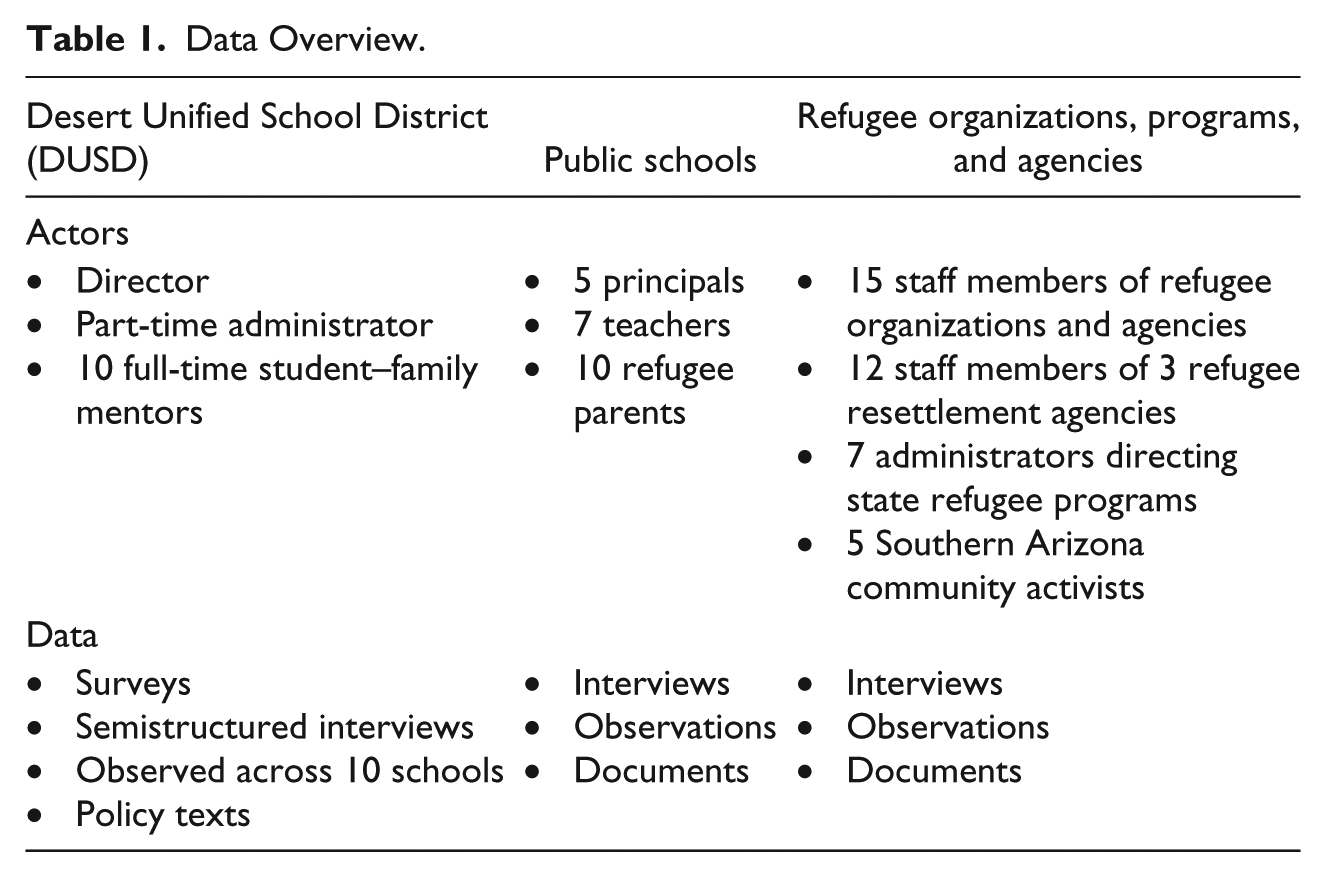
Data represented in Table 1 was collected between December 2013 and January 2016 by Koyama, who, during the study volunteered as an ESL tutor at two different refugee support organizations; served on advisory council for the Hub, a refugee tutoring center; and participated on the strategic planning board for refugee education in Arizona. She also attended staff meetings and events held by the Refugee Support Department in a Southern Arizona school district that we refer to in the study with the pseudonym, DUSD. Being immersed in the field for over several years, Koyama reached the outsider–insider position of ethnographer and found that she needed another researcher, Chang, a fellow anthropologist, to bring less familiar eyes to the interpretation and analysis of the data. Together, we explored what theoretical tools would provide the greatest analytic reach for understanding the relationships between power, politics, and the school experiences of refugee youth. We selected two of the most influential texts associated with our inquiry: The Arizona Refugee Resettlement Statewide Strategic Plan (Strategic Plan) and Arizona’s Proposition 203, the English Language Education for the Children (State of Arizona, 2000). Both texts significantly informed the kinds of policy talk and practice that emerged as sayable and knowable (Fairclough, 1995) throughout ethnographic data collection.
Data Overview.
Data were managed, coded, and analyzed using the software program QSR NVivo 10.0. First-level a priori coding was done according to a set of codes developed by Koyama and three other researchers. These etic codes, which are labeled as “parent nodes” in NVivo, were developed from the initial survey data, and emic codes were added after the first few interviews were transcribed. Parent nodes were also made to denote descriptive identifying information, such as demographic information, policy, names of documents, and agency information. One “parent” or hierarchical top node was “policy.” Child nodes included but were not limited to “reproduction,” “resistance,” “play,” “appropriation,” “text,” and “unofficial.” Put together, for instance, a piece of data about teachers not following Proposition 203, an antibilingual education policy, was coded with the following nodes: Proposition 203 (parent), policy (parent), resistance (child), and play (child). It was then linked to other instances of resistance to other policies with what are referred to in NVivo as “relationship nodes,” so that during data analysis, similar resistance across policies in the study could be gathered and compared. Koyama and Chang co-analyzed the data as part of their ongoing discussions about CPA and also as a primer for what they anticipate will be a future shared study of education policy.
Making and Unmaking Educational Opportunities for Refugee Students
In our findings, we discuss how policy discourses of belonging and othering evident in the two district policies that most directly affected the daily schooling of the refugee students—the Strategic Plan and Arizona’s Proposition 203—construct and deconstruct refugee youth. We acknowledge that there existed broader policies in DUSD which also informed the schooling of the refugees, but relevant elements of them, we found, were often present in the two policies on which we focus. We also examine on how DUSD policy actors, and those working in CBOs, enact services for refugee youth within these uncertain discursive contexts and also work to achieve their organizational priorities.
Policy Discourses of Belonging and Othering
Themes of “belonging” and “othering” (Grove & Zwi, 2006; Weis, 1995) emerged in our analysis. Discourses of belonging drew on languages of empowerment, acceptance, and community building and were apparent in the Arizona Refugee Resettlement Statewide Strategic Plan (Strategic Plan). By contrast, stigmatization, exclusion, and deviance constituted discourses of othering and were palpable in Proposition 203, the English Language Education for the Children in Public Schools. Othering discourses organized actors, objects, and practices that effectively othered refugees (along with already othered Black and Brown young people) as exceptions to normalized White, English-speaking, students in the United States.
The Strategic Plan reflects a 5-year planning guide for educating refugees in Arizona. In 2015, the team, composed of 18 members, including representatives from local school districts, refugee resettlement agencies, local refugee support organizations, the universities and colleges, and former refugee students, assembled recommendations and guidelines for preK-12 refugee education. Below are example goals from the recommendations: 2.A. Increase the level of safety and belonging of refugee students so that they are ready and able to succeed in the classroom Strategies:Develop programs in schools to better understand, support, and integrate refugee students . . . increase refugee student participation across the schools 4.D. Increase refugee student directed activities in schools and in the community at large by 30% Strategies: Establish feedback loops (conducive to limited English abilities and/or low levels of literacy) for all refugee students within their ELD programs/classrooms and larger school communities 6.E. Increase awareness of refugee populations resettled in Arizona among the general population by 35% Strategies: Build bridges between refugees and the public through media and community events
As apparent in these selected objectives, the Strategic Plan constructs a discourse of belongingness for refugee youth and draws on metaphors of “community” and “build[ing] bridges.” The Strategic Plan also includes extra-academic and socio-emotional issues, such as “safety,” “belonging,” and “support.”
In the Strategic Plan, belongingness emerges as a “matters of concern” (Latour, 2005) within a broader political effort to integrate refugee students into schools. These explicit references contribute a dual policy-making focus that aims to address refugee students’ academic and material needs, while simultaneously attending to cultural attitudes and perceptions that mediate the flow of policy resources. This belongingness discourse resists the tendencies to frame refugee youth as “vulnerable” and lacking agency; a point underscored by explicit mentions of refugee youth directed activities. Within this narrative, refugees are constructed as school contributors and future leaders, while members of the school community are invited to better understand and support these newcomers.
Yet, in constructing a discourse of belonging, the Strategic Plan also leaves interpretive uncertainties. Perhaps motivated by implicit compulsions to quantify the potential effectiveness of the Strategic Plan, the document renders refugee youth services coherent and calculable through acts of “qualculation” (Callon & Law, 2005)—combining qualitative dimensions of refugee school experiences with quantifiable statistics, such as a “30%” increase in refugee student directed activities and a “35%” increase in “awareness” of refugees among the general population. Exactly how these statistics are calculated and, perhaps more importantly, what kinds of “activities” and “awareness” are invoked here are loosely defined.
These uncertainties emerge as particularly problematic given broader state level discourses not directly targeted at refugee youth, but similar “othered” populations, namely, Spanish-speaking students. In 2000, Arizona voters overwhelmingly supported Proposition 203, English Language Education for the Children in Public Schools. It mandates a 4-hr block of “English-only” or Structured English Immersion (SEI) instruction on students who are “English Language Learners (ELL).” SEI, which was adopted in three states, including Arizona and which has not been shown to be effective in English language acquisition (López, McEneaney, & Nieswandt, 2015), reflected changes in The Bilingual Act, which not only eliminated the use of the word “bilingual” but directed national “English only” discourses at the nearly 85% of Spanish-speaking students in Arizona.
Proposition 203 discursively excludes the subjectivity of “bilingual” from state educational discourses. Multilingual students are stigmatized by their racial, ethnic, linguistic, and cultural backgrounds and flatly rendered through imposed and aspirational subjectivities of “ELL.” Here, English as the “leading world language for science, technology, and international business, thereby being the language of economic opportunity” (State of Arizona, 2000) is assumed as a given “fact.” Mandating 4-hr blocks of SEI emerges as a convenient “factish” to align with this ostensibly objective reality. This requirement runs contrary to recent studies of SEI that illustrate intensified student experiences of isolation, stigmatization, and limited accessibility to required subject matter (Gándara & Orfield, 2012; Wright, 2005). Yet, like the uncertainties within a discourse of belonging, this othering discourse leaves policy mandates open to interpretation. As we demonstrate, refugee youth are not exempt from the linguistic, social, and emotional othering practices that Proposition 203 legitimates and mobilizes.
In sum, competing policy discourses of belonging and othering reflect the contested discursive terrain within which DUSD policy actors make meaning of refugee youth. Policy actors selectively appropriated these discourses and enacted novel practices to fulfill their organizational tasks, whether this was within schools, or in community-based organizational settings. Next, we interrogate the practices associated with SEI and tutoring respective to each of these organizational contexts and highlight the fluidity and degree of play through which educational actors “make” policy through everyday practice.
Learning and Not Learning in SEI
Policy actors, including refugee mentors, teachers, principals, refugee service providers, and parents, grappled with how best to implement SEI instruction under Proposition 203. Their narratives reveal how SEI organized schooling in ways that rendered refugee youth “invisible” and further isolated them within school and community contexts.
The theme of “invisibility” emerged from narratives that refugee mentors communicated. The following excerpt from a DUSD Refugee Services Department staff meeting focuses specifically on how the ELD block isolates and obscures refugee students:
Well, it looks like they’ve [DUSD] again counted African nationals as African Americans . . . Yep, African refugees are coded as African Americans, so 20% of the data on African Americans is really [on] refugees . . . You’d think they might say: “Hey, why are all these African Americans in ELD?”
We’re not even worth counting.
Not everybody is for our kids . . . . They show up as African Americans. Fine . . . . There’s no reason to talk about refugees for them.
Jan and Dante identify how DUSD renders African refugees as incoherent and incalculable and merges refugees with convenient racial and ethnic categories. In this way, African refugee students are constructed as policy subjects not worthy of attention. Yet, Jan’s frustrated observation that “We’re not even worth counting” combined with Dante’s acknowledgment that “Not everybody is for our kids” reveals how refugee mentors associate calculability and care. From the perspective of the mentors, what is not calculable does not elicit policy attention. Instead, through acts of qualculation, DUSD integrates African refugees with African Americans—already othered school subjects, or what Delpit refers to as, “other people’s children” (Delpit, 2006).
These convenient instances of qualculation and acts of constructing factishes also emerged in how mentors interpreted learning opportunities for refugees in relation to Spanish-speaking students. Following Dante’s observation, Tam, the Director, elaborated,
I know. I know. But, we’re used to the undercounting . . . And we’ve worked like this, on this before . . . the ELD issue, well it’s an issue, we know . . . .
It isn’t only the undercounting and miscounting . . . the Spanish-speaking bias in all of the schools, in ELD makes refugees invisible anyway . . . they don’t exist . . . .
Yeah, the numbers [of refugee students] are too small to make a big dent . . . . The kids get pushed off with a bunch of Spanish kids most of the day . . . They get no individual help. (Field notes, January 29, 2015)
According to the mentors, exclusive ELD practices imposed on Spanish-speaking students, and legitimated by broader policy discourses of othering, are considered a “Spanish-speaking bias in all the schools.” References to this bias reveals a broader “effect” of othering discourses rooted in histories of White supremacy, which position minoritized communities against each other in a struggle over insufficient and seemingly finite resources (Gillborn, 2005; Stovall, 2016). What is particularly striking is how mentors turn to numbers as a way of explaining inequitable learning opportunities. The lack of support for refugees can be explained by “the numbers” that are “too small to make a big dent.” These allusions to numbers minimize a politics of othering and assume that sufficient numbers would change the material contexts of schooling for refugees. It is a convenient “factish” that overlooks state disinvestment in Black and Brown youth, who comprise a majority of students attending public schools (Maxwell, 2014; Stovall, 2016). Notably, Tam’s reference to “undercounting” refers to DUSD policy guidelines for categorizing students as refugees, which include residence in the United States for less than 3 years; school-aged when arrived; and under the age of 18 years. Collectively, these convenient qualculations create hard bounded categories that DUSD blurs in the actual implementation of ELD services, when it becomes more convenient to integrate refugee youth with Black and Brown students. As Sara put it, “ELD makes refugees invisible anyway . . . they don’t exist” (emphasis added). DUSD appropriates ELD in ways that make such blurring possible.
Although visibly “seen,” refugee students’ needs, as well as their assets, hopes, and aspirations, remain unknown—and often, not worth knowing. One ELD teacher, who is Spanish–English bilingual, explained, It’s a whole different thing now . . . used to be more, just Spanish speaking kids. Now I’ve got it all in here . . . the refugee kids, especially the ones from Somali, seem lost, I mean lost in a big way not just in class. What is this place to them? Why are they here? They must be wondering . . . . (Interview, January 29, 2015)
This ELD teacher appropriates discourses of othering to legitimate the social distance between himself and refugee students. Refugee students are “lost in a big way” for not understanding a second language they have never spoken (Spanish), which they are asked to draw on to help them learn a third (English). In this way, refugee youth endure what one refugee mentor articulated as a “double disadvantage, language wise”: not speaking English or Spanish (Interview, DUSD Refugee Mentor, March 24, 2015).
The absence of classroom-based efforts to get to know refugee students or to demand additional resources for them stemmed also from school leadership. Echoing this ELD teacher’s sentiments, the principal at the same school shared, “The teachers are stressed. The kids are stressed. It’s just too challenging—too many moving parts, so to speak. Too many languages . . . . And honestly, I’m not sure it’s the best way to teach English” (Interview, Principal, January 29, 2015). The principal tacitly selected discourses of othering that naturalize schools as sites that induce stress for teachers and students. Recognition of inadequate resources in this case did not mobilize new leadership actions. In school contexts with “too many moving parts,” refugees, and their educational futures, are positioned as a negative externality that no one can address.
Finally, refugee mentors and parents corroborate these concerning othering practices and discourses. Speaking at a quarterly meeting of organizations across the state that serve refugees, a resettlement caseworker and substitute teacher explained, We know that the four-hour ELD classes really isolate refugee kids . . . . [It] goes against the whole idea of integration . . . They live in apartment clusters [with other refugees] . . . They go to school for most of the day with other refugees, most of whom they can’t even talk to . . . . (Field notes, Refugee Service Providers Quarterly Meeting, March 24, 2015)
Similarly, Awad, a refugee parent from Somalia, worried that his child was spending so many hours each day with other refugees and Spanish-speaking students. He wanted his child, Amina, to learn English and to be “more accepted in America” than he was. Awad explained, She needs English, good English . . . Amina sits with her friends all day, talking Somali, some Arabic, Somali. In Chemistry and Math, she doesn’t talk at all. Nothing. She doesn’t know English . . . They aren’t making her ready . . . She only has Somali friends. No Americans. (Interview, December 16, 2014)
He continued by explaining that even with his “good English,” it was difficult for him to make friends and connections outside of the refugee committee. For Awad, making friends with American-born children was equally important to learning English. Awad creatively appropriated discourses of othering to advocate for the inclusion of his daughter in school settings with people “other than refugees.” They, he said, would be “accepted as Americans someday.”
“Benevolent Othering” and Organizational Accountability
The mentors’ concerns about refugee students also emanated from their organizational realities and the accountability mandates they needed to meet to sustain funding. In this section, we develop the concept of “benevolent othering,” which we understand as a discourse that constructs refugee youth as in need of and largely unresponsive to educational services that only legitimated school actors can provide. Benevolent othering combines research on paternalistic “helping discourses” for racialized groups (Villenas, 2001, p. 7) with research on refugees as “others”—as deviant, atypical, not one of “us” (Grove & Zwi, 2006, p. 1936). Such discourses also position othered refugees as lacking agency and needing assistance (Olsen, El-Bialy, Mckelvie, Rauman, & Brunger, 2016). We describe how actors within competing tutoring service providers—including the DUSD Department of Refugee Services and the Hub, offered by a refugee resettlement agency—enacted practices associated with a kind of benevolent othering discourse. Although less explicitly nativist than prevailing othering discourses (e.g., Proposition 203), benevolent othering materialized a similar disregard for the educational futures of refugee youth. Instead, and as we aim to illustrate, benevolent othering animated practices that performed organizational efficacy and legitimacy, even as these organizations failed to authentically outreach, engage, and educate refugee youth.
The mentors enacted a discourse of benevolent othering in their day-to-day work with refugee youth. The DUSD Department of Refugee Services offered afterschool tutoring throughout the school year and held a 6-week summer math tutoring program, called the Math Academy, Mondays through Thursdays, 9 a.m. to 2 p.m., at a DUSD school. In total, 40 refugee students enrolled in the 2015 Math Academy. When the mentors were asked why, despite low enrollments and attendance, they continued the Academy, Leonidis, one of the mentors, stated, “The children need this. They are so far behind . . . So we do times tables, arithmetic, division over and over again . . . memorizing” (Field notes, July 23, 2015). Observational field notes confirmed that the mentors used repetitive, didactic, teacher-centered pedagogies and students would often write nothing on their papers. Another mentor, Jan, also explained that the refugees in the summer program were the “newest in the country” and had “the greatest needs” (Field notes, July 23, 2015). “Who?” she asked would help these children. In her mind, they needed the Math Academy—and they needed her. Refugee youth, constructed through a deficit lens, materialized a complementary and necessary subject position: that of the benevolent tutor savior.
Contrary to Jan’s assumptions that only the mentors could tutor the youth, several churches, a handful of community groups, and a refugee resettlement agency offered free tutoring to refugee youth. The Hub, the largest of these tutoring programs was centrally located, became well established, had regular Monday through Friday evening hours, and offered tutoring and academic support to 40 to 60 youth per evening. These middle and high school students received one-on-one or small group tutoring across all subjects, including mathematics, English, the sciences, and history. Although the larger religious-based resettlement agency with which the Hub is affiliated explicitly engaged in benevolent othering practices, the Hub did not. In fact, during the volunteer orientations, warnings were given about inappropriately acting like “saviors.”
Notably, the majority of students who came for tutoring at the Hub attended schools in a district adjacent to DUSD, the Mountain School District (MSD). Students from DUSD were not among the students utilizing the tutoring center. According to the Hub tutor coordinator, DUSD unlike the MSD did not have a partnership with the Hub and actually discouraged their students from getting support at the Hub. She stated, It’s sad, really sad. We have all of these good things here for them, for free and we are open every evening just for students . . . . They can get help in any subject and we have computers and resources for them too . . . . We’ve heard that Tam [The DUSD Refugee Support Department Director] and the refugee mentors only want their kids to get help from them. Really limiting. Not right at all. (Interview, February 12, 2015)
Another volunteer concurred; when he had suggested one of his soccer team mates, a refugee attending a DUSD school, come for tutoring at the Hub, the student was told by a mentor that it was not for DUSD students. What emerged was a system of fragmented and segregated tutoring services, which positioned refugee youth and families in contexts of misinformation that perpetuated DUSD and the Hub as necessary (and benevolent) providers.
The territorial behavior exhibited by the mentors reflected their interpretation of DUSD accountability and funding mandates. According to Jan, DUSD needed the “contact hours” to fulfill their department’s funding and grant tracking obligations (Field notes, July 23, 2015). At the quarterly Refugee Service Providers meeting of individuals representing school districts, resettlement agencies, and organizations supporting refugees across Arizona, Tam announced that DUSD Tutoring programs would be initiated at the large apartment complexes where refugee families live. Echoing themes of benevolent othering, the Director added, “We go there already. They trust us . . . . It’s relationships that already exist . . . We want to ensure that these students get what they need, from people, us, who they trust” (Field notes, March 24, 2015). The Director’s repetitious reference to “us” as tutors that refugee youth find trustworthy, implicitly excluded other groups as legitimate tutors and positioned DUSD as the source of knowledge and expertise. Conveniently, visiting refugee families where they lived also increased the “contact hours” that were necessary for sustaining their department.
Interpreting “contact hours” as a “factish” offers insight into the mixed political interests encoded in something as seemingly benign and transparent as tutoring services. When asked to elaborate on this announcement, the Director explained, . . . Part of it is that we need to show the numbers, make the numbers as part of grant tracker, which you know marks how we are increasing graduation rates and academic achievement. We need to show, and we do, that we are meeting our accountability measures in contact hours . . . especially when it comes to academic supports . . . . Tutoring is the main way we do this, other than assisting students during the school day. You know we already have tutoring twice weekly afterschool and the summer Math academy. The tutoring program in the apartment complexes are just one more way to offer academic support, and to connect with the families. . . . (Email to Koyama, March 28, 2015)
Tutoring programs at apartment complexes represented a convenient and necessary means for the DUSD Refugee Services Department to meet their accountability mandates and sustain their funding. Moreover, mandates “to show the numbers” operate as an official gloss of the department’s effectiveness; an opportune “factish” that translated pedagogical learning moments into quantifiable outputs with assumed educational benefits for refugee youth. In April and May, the apartment-based tutoring sessions were held twice a week during the evening. Shortly thereafter, the DUSD Refugee Services Department determined there was not enough interest in at-home tutoring services and no longer sent mentors to the apartment complexes to provide evening tutoring.
The Hub mirrored a similar political maneuvering process, but one less constrained by funding and grant tracking tools. A handout available at the Hub outlined their efforts to provide adequate educational and academic supports to refugee youth, especially newcomers. A volunteer leader spoke of the many social and academic challenges refugees faced and added: “Unfortunately, there are not sufficient afterschool and weekend programs to support refugee youth in their studies, social integration, confidence-building, and civic engagement” (Handout, March 2015, p. 1). These claims, adamantly refuted by the mentors and Director of the DUSD Department of Refugee Services who, as noted, offered afterschool and summer tutoring, worked to position the Hub as the sole legitimate tutoring provider. Ironically, in a competitive struggle over “contact hours,” refugee youth are left underserved and further marginalized.
Concluding Thoughts and Implications for CPA
We have illustrated the multiple and often, contradictory ways in which policy actors take up policy discourses of belonging and othering. Formal school actors, namely teachers and administrators, engaged in acts of qualculation and constructing factishes in ways that rendered refugees invisible and isolated. Although the EDL program served as a convenient mechanism for sorting students, it represented a concrete instantiation of a broader othering discourse. Meanwhile, refugee mentors positioned refugees as highly visible, but often, in need of saving. This creative appropriation of policy discourses effectively perpetuates existing asymmetrical power relations. Sadly, much of what we documented and analyzed leaves refugee youth invisible in, and at the edges, of schools.
More broadly, though, our analysis of policies that affect the schooling of refugee youth identifies new theoretical tools for scholars interested in CPA. Our application of CDA and ANT advances CPA’s interest in shifting the object of policy studies from implementation to inequity; tracing how power is constituted in and through policy discourses and local actors’ everyday efforts. We traced how school actors drew on tacit othering discourses and normalized schools as sites of exclusion, isolation, and stress, often attributing status quo relations to rational question of insufficient “numbers.” We also illustrate how actors creatively appropriated elements from belonging and othering discourses to organize tutoring services that did little to support refugee youth and, instead, functioned to ensure their organization’s fiscal stability. This messy and fragmented picture of seemingly common sense and benevolent services—such as English language instruction and tutoring—illustrates how CDA and ANT can reveal competing relations of power within policy processes. Moreover, by analyzing the various junctures and spaces in which local actors mediate policies, we aim to build on efforts to not only critique policy but also advocate for equity (Diem et al., 2014). We see CDA and ANT as tools that can support CPA’s stated interest in making theory relevant to the cultural and material realities of the subjects of our research and advancing concrete efforts to promote educational equity.
Finally, our critical policy study informs several recommendations for school districts wishing to understand and address the needs of refugee youth. First, we encourage districts to make an inventory of existing policies and the actors who are required to enact them. From our work, we know that there are multiple interpretations and enactments of policy across districts, and making these transparent can help reduce the duplication of services and contestations between departments. Relatedly, we encourage districts to make clear and public the responsibilities of staff roles across the district, so that school administrators and staff, as well as CBOs and parents, will know where to find resources. Finally, we follow others (Bajaj & Bartlett, 2017; Scanlan & López, 2012) in recommending that assets-based curriculum and pedagogy can improve the education of all students, but especially those, like refugees, of minority linguistic and cultural backgrounds, even within constraining policies and noninclusive discourses.
Footnotes
Declaration of Conflicting Interests
The author(s) declared no potential conflicts of interest with respect to the research, authorship, and/or publication of this article.
Funding
The author(s) received no financial support for the research, authorship, and/or publication of this article.
