



Abstract
With U.S. classrooms increasingly characterized by linguistic diversity, policies mandating teacher training around English learning have proliferated. Recent federal oversight prompted Massachusetts to implement an initiative to endorse its 70,000+ teachers in Sheltered English Immersion (SEI). While policy research has productively emphasized teachers as policy interpreters within such initiatives, almost no research exists on the role teacher educators play in the policy interpretive process. Therefore, this study documents how teacher educators across Massachusetts interpreted and operationalized the SEI endorsement policy. Drawing on document and interview analysis, findings highlight key experiences, contextual factors, and ideological dispositions that informed participants’ policy interpretations. Instructors navigated tensions between their own goals to affirm linguistic diversity and the monolingual orientations produced through the state’s recently overturned English-only policy. These findings demonstrate the affordances of examining the role of language ideologies in policy interpretation, with implications for large-scale language policy initiatives and educational policy interpretation more broadly.
Keywords
Federal and state policies have placed increasing emphasis on teacher preparation to address the growing linguistic diversity of U.S. classrooms. While most states offer a specific teaching license for English as a second language (ESL) and/or bilingual education, the potential benefit of preparing all educators to teach students for whom English is a second or additional language (henceforth emergent bilinguals) has been gaining recognition (López et al., 2013; Samson & Collins, 2012). Thus, some states are beginning to mandate at least some coursework in teaching linguistic diversity as a core component of general teacher preparation, licensure, and professional development. These policies extend a history of initiatives seeking to “close the achievement gap” between emergent bilinguals and their English-dominant peers by focusing on teacher preparation policy. Such policies are largely predicated on the assumption that the educational marginalization of emergent bilinguals is not related to widespread official or de facto monolingual education policies and practices, but rather the result of inadequate teacher training (Arias & Faltis, 2012).
Recent Massachusetts language policy shifts provide an illustrative case of this phenomenon. In Massachusetts, bilingual education was effectively banned through a 2002 voter referendum (Guo & Koretz, 2013; Moore, 2008). The resultant policy legislated a statewide model of English-only Sheltered English Immersion (SEI), requiring that “with limited exceptions, all public school children must be taught English by being taught all subjects in English and being placed in English language classrooms” (Galvin, 2002, p. 1). Thus, the state’s interpretation of SEI necessitated all that teachers (ESL specialists and general education teachers alike) be able to “shelter” English-only instruction for emergent bilinguals at all levels to learn effectively across their schooling experience.
In 2011, the U.S. Department of Justice (DOJ, 2011) held Massachusetts in violation of the Equal Educational Opportunities Act (EEOA), not for its restrictive English-only language policy, but rather for “not mandating adequate training” (p. 1) for its teachers. Optional SEI trainings had been offered since 2002. However, the DOJ argued that the state’s choice to require SEI programming meant that all teachers (i.e., non-ESL certified general education teachers) must be trained in the model to ensure adequate implementation. This focus on teacher training meant that the state could redress its federal civil rights violation by implementing a statewide SEI endorsement requirement while leaving its English-only education mandate in place.
Although the English-only policy was officially overturned in 2018, the SEI endorsement remains a requirement for teachers across Massachusetts (Massachusetts Department of Elementary and Secondary Education [DESE], 2019a, 2019b). As the SEI model itself continues to grow in popularity across the United States—with variations of “sheltered” programming offered in all 50 states (Johnson et al., 2018)—the intricacies of Massachusetts’ SEI policy and its implementation provide insights for U.S. language policy and for large-scale teacher training initiatives more broadly. In relation to such initiatives, educational policy research has documented how teachers themselves play a major role in determining how policies are enacted in the classroom (e.g., Menken & García, 2010; Perryman et al., 2017). However, less attention has been paid to the significant role played by teacher educators such as university course instructors or district-approved teacher trainers. These teacher educators hold a key position as policy interpreters, authoritatively communicating with teachers about language policies and their implementation (de Jong, 2008; Moore, 2012). The role of these policy interpreters is encoded into the Massachusetts SEI endorsement initiative, with teachers mandated to receive endorsement through state-approved curricula, delivered primarily by state-approved course instructors. Therefore, the purpose of this study is to ask the following questions: (1) How have SEI course instructors acted as policy interpreters in operationalizing the Massachusetts SEI endorsement initiative? (2) What experiences, contextual factors, and/or dispositions appear to inform these policy interpretive approaches? and (3) What language ideologies are exemplified, reproduced, and/or disrupted through these approaches?
Theoretical Framework
Critical Policy Analysis (CPA)
Traditional approaches to policy analysis generally involve analyses that are largely descriptive, with less attention paid to the process by which policy is interpreted by individual actors (Ball, 1994; Gowlett et al., 2015). As this study aims to situate policy within a larger theoretical framework of interpretation, I draw upon the field of CPA (Diem & Young, 2015; Yanow, 2007). CPA aims to explore policies within larger theoretical contexts, examining the ideologies and social contexts that inform policy (Young & Diem, 2017). This exploration generally draws on qualitative data generation to foreground perspectives of those involved in policy making as situated in a specific context to allow for the generation of a more thorough explanatory framework of policy in action (Hornberger, 2015).
The CPA approach is ideal for the study of policy interpretation in a complex policy environment (Levinson et al., 2009), particularly as CPA aims to “discover and/or question the complexity, subjectivity, and equity of policy” while highlighting both “the intended and unintended consequences of the policy implementation process” (Diem et al., 2014, p. 1084). This design challenges the view of policy making as a linear, deliberate, unbiased process (Young & Diem, 2017). When applied specifically to language policy, a CPA approach necessarily intersects with scholarship in Critical Language Policy (CLP), which draws on similar traditions of critical theory while emphasizing how language policy is always affected by political forces and power dynamics (Tollefson, 2006). This study aligns with previous work in CPA and CLP in taking up a qualitative, constructivist approach (deLeon & Vogenback, 2007) within a case study methodology (Baxter & Jack, 2008; Yin, 2014) in which the Massachusetts SEI endorsement initiative serves as a policy case.
Language Ideologies
The study of language ideologies compliments CPA in prioritizing the ideological underpinnings of language and its use (González, 2005; Razfar, 2006; Rosa & Burdick, 2017; Silverstein, 1979, 2004). As Massachusetts was under a mandated English-only education law during the implementation of this initiative (2002–2017), an analysis of the SEI endorsement initiative must account for the role of monolingual ideologies, which describes an ideology through which a certain group of language practices become idealized (Bacon, 2018). Monolingual language ideologies undergird the logic by which languages become bounded, namable entities such as English, Mandarin, and so on (Gramling, 2014), and also delimit what is considered as permissible within a given language, as certain dialectal features are framed as undesirable deviations from an idealized, standard form of the language (Delpit & Dowdy, 2008; Lippi-Green, 2012). Monolingual language ideologies do not draw their effectiveness from being an accurate reflection of actual language practices—which have always been characterized by multilingualism (de Jong, 2008)—but from socially constructed ideas of what language practices should look like within a given nation or institution (J. S. Y. Park, 2008). In this way, monolingual language ideologies facilitate the construction of language hierarchies based on proximity to idealized language features. Research in linguistics, having established the legitimacy and rule-governed nature of all naturally varying dialects (Reaser et al., 2017; Rickford, 1999), refutes the idea that one language variety can be linguistically “superior” to another in an objective sense. Instead, sociolinguistic perspectives highlight how supposed hierarchies of language generally map onto preexisting class and racial biases (Baker-Bell, 2013; Flores & Rosa, 2015; Godley et al., 2015; Rosa & Flores, 2017). In this way, monolingual language ideologies facilitate social, material, and institutional benefits for those whose language use is viewed as “ideal” through these biases, while disadvantaging those whose language use is constructed as aberrant (Achugar, 2008; DeBose, 2007; Skutnabb-Kangas, 1996).
Literature Review
Language Policy Interpretation and SEI
Policy research has extended top-down notions of policy implementation to examine how policies are interpreted by individual actors or groups (Gowlett et al., 2015; Perryman et al., 2017; Spillane et al., 2002). Recent scholarship in language policy has, therefore, called for a focus on researching policy as an interpretive process wherein key stakeholders play an active role (e.g., Yanow, 2007). Across this scholarship, there has been a broadening from the focus on implementation, which can still imply a linear process, toward a focus on appropriation, a term Johnson (2011) used “to highlight the creative ways that language policy agents put a policy into action” (p. 269). This notion of creative appropriation is central to examining the ways in which these policy agents (e.g., teachers) work both with and against policies across contexts.
Recognition of this key role of policy interpreters has led to a growing body of research on how teachers and local district actors interpret, implement, and/or appropriate language policy (Arias & Wiley, 2013; de Jong et al., 2005; Hara, 2017; Heineke, 2015; Johnson, 2011; Menken & García, 2010; Sampson, 2019). This literature generally focuses on how teachers facilitate or disrupt these policies based on their own ideological stances and teaching contexts (de Jong, 2008; English & Varghese, 2010; Palmer & Snodgrass Rangel, 2011; Stritikus & Garcia, 2003). Hopkins (2016), for example, explored the dynamic interplay between teacher beliefs and language policy, documenting how district policy, administration, and teacher training initiatives shape, and are shaped by, the ideological stances of teachers in regard to language education.
SEI mandates offer a particularly productive space to explore language policy interpretation as such mandates are often geared primarily toward general education teachers (e.g., math, science, or general elementary teachers), rather than only those who choose to specialize in language education (e.g., ESL or bilingual education teachers). These general educators are usually not required to have or to gain substantial expertise in teaching emergent bilinguals before entering the classroom. Therefore, SEI endorsement coursework plays a key role in how such individuals, who represent a majority of the nation’s teaching profession, come to interpret and implement language policy. However, while teaching emergent bilinguals requires a complex understanding of language, culture, policy, and instruction (Lucas & Grinberg, 2008; Lucas & Villegas, 2011), scholars have critiqued SEI endorsement policies for prioritizing only the technical aspects of making English-only content comprehensible (Viesca, 2013), instilling a limited understanding of the principles of second-language acquisition (Arias & Wiley, 2013), and promoting one-size-fits-all approaches to language learning (Wright & Choi, 2006). Such approaches often fail to capitalize on or maintain students’ heritage languages (Cline & Necochea, 2004) and generally limit teachers’ access to learning about the full range of methods available for teaching emergent bilinguals (Montaño et al., 2005; Olivos & Sarmiento, 2006; C. C. Park, 2014; Ulanoff, 2014).
It is important to note the differences across states that have implemented variations of SEI within mandated English-only educational contexts (e.g., California, Arizona, and Massachusetts; see McField, 2014, for an overview and discussion of these contextual nuances). In documenting the implementation of SEI mandates across such spaces, however, scholars have drawn attention to the importance of local policy actors, particularly those who work to subvert language policies they view as restrictive (de Jong, 2008; Newcomer & Collier, 2015; Wright & Choi, 2006). Marschall et al. (2011), for example, borrow Lipsky’s (1980) concept of “street-level bureaucrats” to highlight the power of local actors in interpreting SEI policies. Likewise, Gort et al. (2008) documented ways in which three districts resisted Massachusetts’ SEI mandate, concluding that SEI “does not have a fixed meaning but will necessarily be socially constructed within each context by the beliefs, experiences, and histories of the individuals involved” (p. 41). This literature points to the agency of policy interpreters in operationalizing language policy.
Language Ideologies and Educational Policy
A growing body of this policy interpretive research has examined teacher beliefs in regard to language, particularly within university coursework (García et al., 2016; Lucas & Villegas, 2011; Palmer & Martínez, 2013; Valdés et al., 2005). Across this research, teacher education around language diversity is considered a deeply ideological endeavor (Faltis & Valdés, 2016). Particularly relevant are ideological tensions between the lived experiences of a mostly monolingual teaching force and increasingly multilingual populations of students (Banes et al., 2016; Farr & Song, 2011; Jimenez-Silva et al., 2012).
Thus, much of the research on teacher language ideologies addresses the role of monolingual language ideologies in maintaining restrictive language policies (English & Varghese, 2010; García et al., 2012; Rodríguez-Castro et al., 2016). Poza and Viesca (2018) documented how such policies intersect with racialized, nativist discourses that drive districts toward English-emphatic assessment policies and erode support for bilingual education programming and pedagogies. Banes et al. (2016) examine teacher self-reflexivity as a method by which to broaden language ideological orientations, demonstrating the complexities through which language ideologies are informed by individuals’ previous experiences and beliefs. However, monolingual language ideologies are also shown to be mediated by institutional ‘filters’—particularly the training teachers receive around state language policies—that influence how teachers enact their beliefs about language in classroom settings (Bacon, 2018). These findings call for a deeper examination of the instructors who play a key role in communicating the state’s language policies to teachers.
SEI mandates offer a constructive space to explore these language ideological dynamics. In particular, studies of Arizona’s implementation of English-only education and SEI have demonstrated the complex interactions between language ideologies, state certification requirements, and classroom implementation (e.g., Arias & Faltis, 2012; Lillie et al., 2010; Moore, 2014; Newcomer & Collier, 2015; Rios-Aguilar et al., 2012; Wright & Choi, 2006). Such research highlights the key role played by teachers as language policy interpreters while documenting how teachers enact various interpretations of SEI mandates based on their understanding of language policy and ideology. However, what informs these teachers’ understanding of policy remains less clear within the research. Moore (2012) pointed to the importance of SEI instructors as teacher educators in informing teachers’ perspectives on language teaching, yet few studies have engaged teacher educators directly. As Faltis and Valdés (2016) assert, “Little is known about how teacher educators advocate for and think about language . . . or about the instructional practices favored for preparing teachers to teach in linguistically diverse classrooms” (p. 553, emphasis added). If research is showing that educators often hold problematic beliefs around linguistic diversity (e.g., Fitzsimmons-Doolan et al., 2017; Flores & Rosa, 2015; Lippi-Green, 2012), we must ask what role their teacher education and professional development has played in instilling, sustaining, or disrupting these ideas. In SEI endorsement initiatives, teacher educators play a particularly important role as intermediaries between state-generated policy mandates and teachers’ implementation of these initiatives. Thus, the goal of the present study is to explore the Massachusetts SEI endorsement policy through the lens of its policy interpreters—SEI course instructors—to document the role their policy interpretive and language ideological approaches played in determining how this policy was implemented across the state.
Method
Data Sources
The first data source for this study consisted of official policy documents related to the SEI endorsement initiative, its development, and standards for the state-approved curriculum for endorsement, written between the years of 2012 and 2016 (the pilot and statewide rollout period for the initiative). These documents, publicly available through the Massachusetts DESE, provide overviews of SEI-related requirements for educators and administrators, standards covered in the courses themselves, and processes for agencies to become state-approved providers of the SEI endorsement courses.
As with many educational policies, the SEI endorsement policy does not exist as a whole in one specific document. Rather, the policy is an assemblage of laws, licensure requirements, and communiqués from the DESE. This necessitated an analysis of multiple documents from multiple sources to fully analyze the policy (see Table 1) which I collected through Altheide and Schneider’s (2013) method of progressive theoretical sampling. While not intended to yield a comprehensive corpus of all documents related to the SEI initiative across the state (which exist in many iterations across the state’s 404 school districts), the goal of this document collection will be to build a sample sufficient to achieve what Altheide and Schneider (2013) called “conceptual adequacy” (p. 36) by collecting a representative sample of policy documents that would outline the initial framing of the policy (Johnson, 2011; Ricento, 2006).
Policy Document Sources.

Note. DESE = Department of Elementary and Secondary Education.
The second data source consisted of transcripts from semi-structured interviews with SEI course instructors. As semi-structured interviews constitute an established method of data collection by which to gain insight into policy interpretation (Chock, 1995; Hoffman, 1995; Yanow, 2007), I designed an interview protocol covering key areas of interest to my research questions and concepts that were highlighted in my reviewed literature: (a) personal/institutional background, (b) course instruction, (c) policy context, and (d) beliefs around language. I piloted the interview protocol with two experienced SEI course instructors who were not participants in the larger study and revised the wording of questions based on these instructors’ feedback.
Participant recruitment was guided through purposive sampling (Miles et al., 2014), limited to individuals who had served as instructors for the SEI course. As previous research documented the importance of the type of institution providing the SEI endorsement course (Moore, 2012), I tracked participants’ institution types (district, university, private provider) while recruiting interviewees to maintain a broad range of institutional affiliations (see Table 2). I located prospective participants through publicly available state databases of approved course providers, university course listings, school district websites, and recommendations from members of professional ESL associations in Massachusetts. A total of 33 participants representing 20 different institutions across four main regions of Massachusetts agreed to participate in the study (of 42 potential participants approached).
Participant Variables Definitions and Overview.

Note. SEI = Sheltered English Immersion; ESL = English as a second language; MA = Massachusetts. Values in the “Years Higher Ed.” row include only the 12 participants who taught in higher ed.
Participant demographic characteristics aligned with the general teaching population of the state (DESE, 2015)—most participants identified as White (n = 27, 81%) and, in all but two cases, as female. Although fully acknowledging the limitations of broad, binary categories of “White” and “people of color” (see Table 2), I do not report more specific race/ethnicity as doing so could compromise confidentiality in a sample drawn from a relatively small and interconnected network of SEI course instructors. For similar reasons, I do not identify specific languages spoken beyond English. However, within participants who identified as bilingual (n = 20, 60%), Table 2 does indicate those who reported experiencing ESL instruction in their own schooling (n = 8, 24%). All participants had ESL certification and/or a master’s/PhD in a relevant field (i.e., linguistics, second-language acquisition), and had more than 2 years of K-12 teaching experience (maximum = 30 years). I also tracked the number of times participants had taught the SEI course in question, with the majority of participants (n = 21, 64%) having taught the course 7 or more times. Combined, this group of participants had taught the course 218 times, reaching approximately 2,500 teachers across the state. While this sample of participants captures a broad geographical and institutional range of contexts, it is important to note that my chosen method of policy analysis (outlined below) is intended to focus on the specific experiences of this group of participants, rather than necessarily making generalizations about the way the mandate was implemented across the state as a whole.
Data Analysis
My analytical approach (see Figure 1) was informed by Altheide and Schneider’s (2013) qualitative media analysis. For both policy documents and interviews (referred to collectively as “texts”), I began by applying general identification codes to sort texts by document or demographic characteristics (see Figure 1). I then applied deductive codes derived from my research questions and my literature review on monolingualism, English-only, and SEI policies, which were designed to highlight sections of the data relevant to the policy itself (policy codes), language (language codes), particular groups or individuals (person codes), or the course as a whole (course codes). During the coding process, I identified additional emergent codes based on emergent topics and patterns within the data that I had not previously identified as deductive codes (Charmaz, 2014), using code mapping to track the generation and consolidation of these emergent codes (Anfara et al., 2002). The result of this analysis was an initial schema of coded excerpts to be drawn on for the next phase of the analysis.
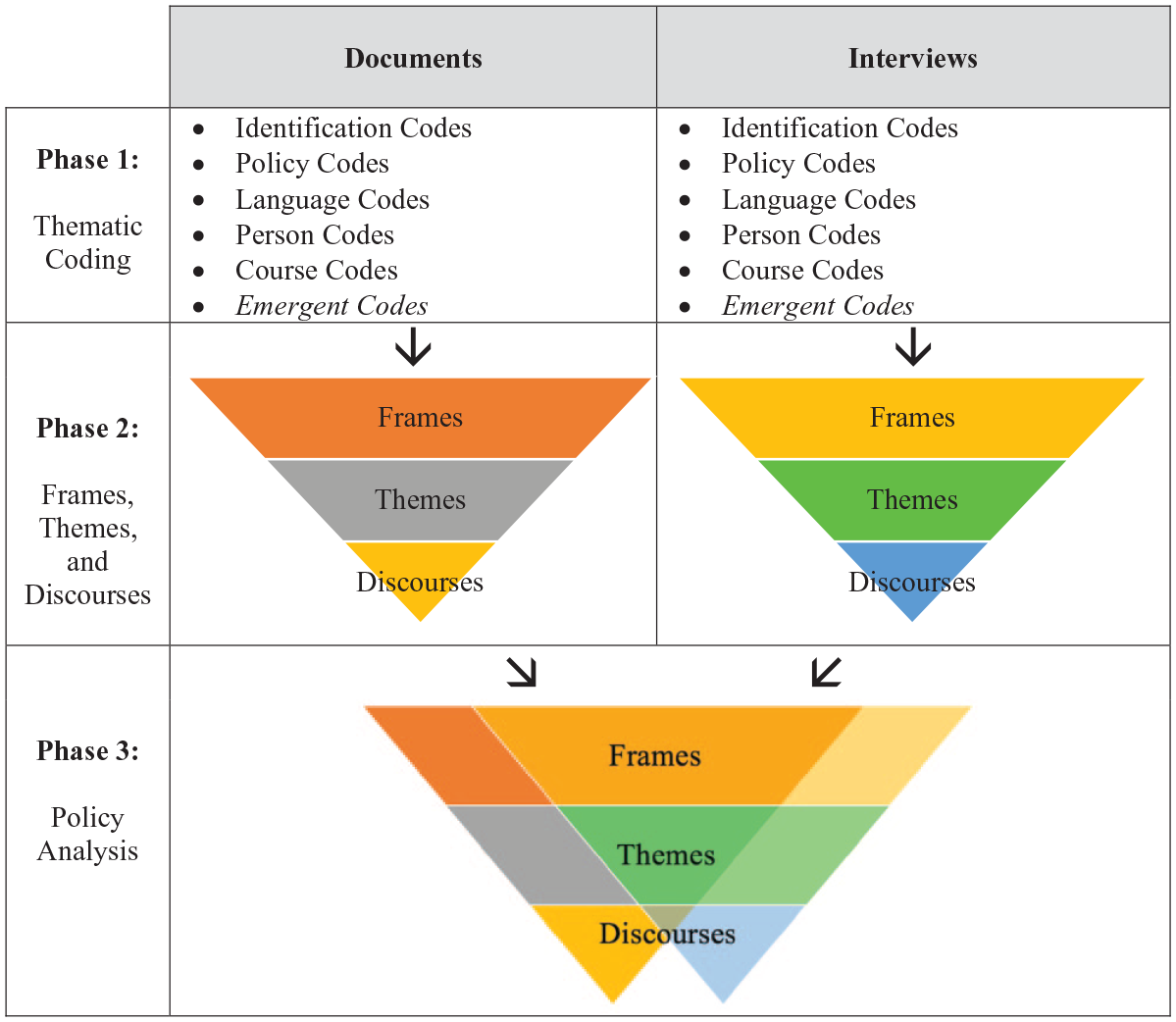
Data analysis.
The second phase of analysis involved analyzing intertextual patterns, similarities, and differences across texts (Blommaert, 2013; Johnson, 2015). I expanded on this use of Altheide and Schneider’s (2013) method in my analysis, utilizing their framework of frames, themes, and discourses as a secondary coding schema for both policy documents and interviews (see Figure 2). I draw on Altheide and Schneider’s (2013) framework to differentiate the terms as follows: Frames set a focus, parameter, or boundary for discussion of a policy that delimits “what will be discussed, how it is discussed, and above all, how it will not be discussed” (pp. 51–52). Themes refer to topics addressed in policy discourse—recurring issues present across multiple documents or discussions of an issue. Finally, discourses relate to how issues are discussed, or “parameters of relevant meaning that one uses to talk about things” (Altheide & Schneider, 2013, p. 53). These can include specific terms, phrasing, or grammatical structures used to discuss topics.

Frames, themes, and discourses (adapted from Altheide & Schneider, 2013) in relation to ideologies.
In Phase 3, I analyzed how frames, themes, and discourses overlapped in ways that reflected particular language ideologies to influence how the policy was developed and interpreted. Generating reports for each thematic category derived from the initial coding process, I brought together topically related sections of data drawn from several different interviews and policy documents. In analyzing these reports, I grouped the codes thematically to begin answering my research questions around (1) how instructors operationalized the course, (2) their justifications for changes to the course, and (3) how particular language ideologies were maintained, reproduced, or disrupted across the policy and its interpretation.
Data Reporting and Terminology
I report the findings of this analysis below. Documents are labeled with conventional APA (American Psychological Association) author/date citations, and participants are labeled with a randomized number (01–33) attached to their primary institutional affiliation: University (UNI), district (DIS), or private (PRI) course providers. For clarity, I use the term instructors to refer to the participants and teachers to refer to the K-12 educators enrolled in their courses. Although participants often reference these teachers as their “students,” for clarity, I reserve the term students to reference K-12 pupils. Participants and policy documents mainly referred to these students as ELLs (English Language Learners) in accordance with their designation by the state. I use the term ELLs when referencing participants’ discourse or policy documents but use the term emergent bilinguals in my own discussion of students. While I use this term for its asset-based framing (García & Kleifgen, 2018), it should be noted that it is unlikely the students referred to in this study will “emerge” as bilingual, or maintain their existing bilingualism, under the SEI educational model they are receiving (Gort et al., 2008; McField, 2014; Wright, 2005).
Findings
The results of this analysis highlight a trajectory of policy design, interpretation, and appropriation (Johnson, 2013). In particular, these results reveal how problems/solutions were constructed across the initiative, reflecting Shao and Gao’s (2018) observation that “any specific language policy, first and foremost, must construct/produce a problem as being of a certain type and then claim to address it. Simply put, a policy claims to solve a problem it constructs” (p. 3). In reporting these results, I begin with the analysis of policy documents themselves (Part 1) to establish the policy’s foundational framing and problem construction. Next, based on the policy interpretive and language ideological frameworks that inform this study, I report variations in how participants interpreted the purpose of the course (Part 2) and explore how these interpretations manifested within participants’ discussions of executing the course (Part 3). Finally, to offer possible explanations for this variation, I document reasons participants discussed as facilitating or inhibiting their adaptations of the course (Part 4). Together, these findings illustrate the ways that participants’ policy interpretation both aligned with and deviated from the problem construction/solutions of the policy itself (see Table 3). The final discussion section groups these findings together into frames, themes, and discourses to highlight how monolingual language ideologies are maintained, reproduced, or disrupted across the SEI endorsement policy and its interpretation overall.
Findings Overview.
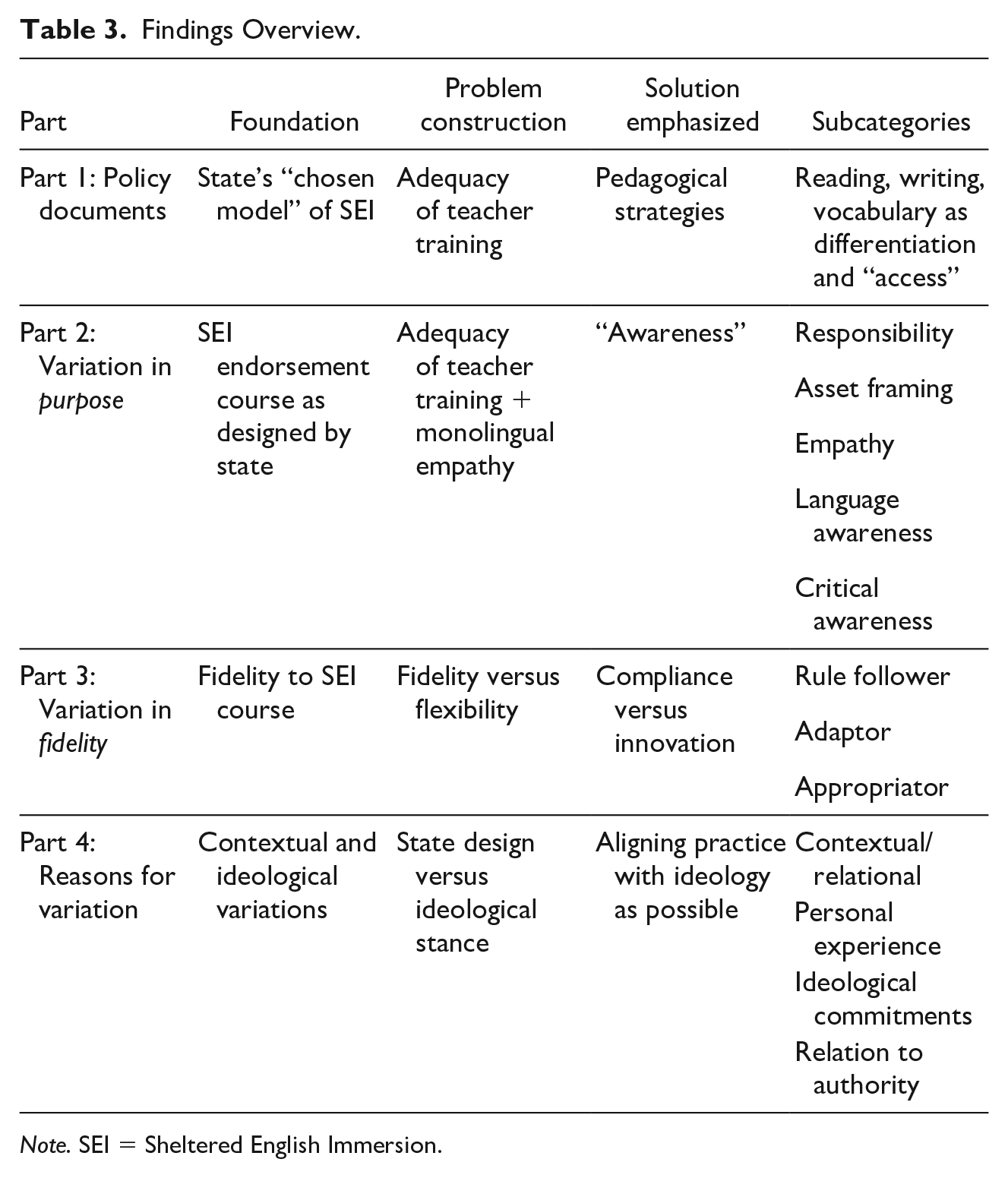
Note. SEI = Sheltered English Immersion.
Part 1: Policy Documents—Framing Violations and Compliance
Analysis of documents from the state and the DOJ, Civil Rights Division, demonstrated that the initiative was framed, almost in entirety, by a letter from the DOJ on July 11, 2011. This framing (a) produced a particular definition of SEI in Massachusetts that affected statewide interpretation and implementation of the SEI mandate and (b) reaffirmed the federal embrace of an English-only SEI policy as “theoretically sound” (DOJ, 2011a, p. 10)—two key features that reverberate throughout the SEI endorsement policy’s implementation. The letter notified DESE that the state was failing to fulfill its obligations under the EEOA “by not requiring [teachers] to receive . . . SEI training” (DOJ, 2011a, p. 2). The DOJ letter repeatedly referenced Question 2 and “the SEI program Massachusetts has chosen to implement” (DOJ, 2011a, p. 2) referencing Chapter 71A of Massachusetts law outlining the state’s SEI, English-only education mandate under which all teachers became responsible for SEI implementation. The department did not take issue with the SEI mandate itself but emphasized that the model could only be interpreted as such if teachers were required to be trained in SEI (the state had previously offered such training as optional). The DOJ (2011a) argued that the time has come for [Massachusetts] to fulfill its EEOA obligations by mandating that all SEI teachers [i.e., all general education teachers] complete the training needed to shelter content instruction appropriately so that the State can implement its SEI program model effectively. (p. 11)
The state responded almost immediately, and less than 2 months later, the DOJ published another letter “applaud[ing] the proactive efforts of the Commissioner of Education and the board to enact a regulation to ensure that teachers are adequately prepared to teach ELL students the academic subjects they need to be successful” (DOJ, 2011b, p. 1, quoting Thomas E. Perez, Assistant Attorney General for the Civil Rights Division). Analysis of Massachusetts Board of Elementary and Secondary Education (BESE) meeting minutes between 2011 and 2012 revealed the steps proposed, and subsequently undertaken, to achieve this turnabout in DOJ discourse: (a) a unanimous vote to grant the Commissioner of Education authority to draft regulations for an SEI endorsement course (BESE, 2011, September), (b) a preview of an initiative called RETELL (Rethinking Equity and Teaching for English Language Learners; BESE, 2011, December), (c) an opening of this initiative for a period of public comment (BESE, 2012, February), and (d) board approval of the RETELL initiative (BESE, 2012, June). In its entirety, the RETELL initiative included the state’s adoption of the World-Class Instructional Design and Assessment (WIDA) English Language Development standards (used in 39 state education agencies; WIDA, 2019). However, the core component of the RETELL initiative involved an ambitious initiative through which teachers across the state would be trained and endorsed in SEI instruction.
Thus, with the state’s issue framed, from the onset, as one of inadequate teacher training, the state was able to redress its civil rights violations by mandating such training. The prioritization of training must be emphasized here, as (a) there was no mechanism put in place to monitor any degree of execution (the DOJ letter made mention of such monitoring, but it was not put in place), (b) there was no need to demonstrate any degree of improvement in student educational outcomes, and (c) the state was not required to make any broader policy changes to the English-only mandate itself. Thus, the entirety of compliance by which the state was able to redress its EEOA violation was to put in place a system to more systematically train its teachers in the state’s chosen form of SEI instruction.
Throughout its implementation, the DESE description of RETELL remained largely unchanged from the 2012 description: The RETELL initiative represents a commitment to address the persistent gap in academic proficiency experienced by ELL students. At the heart of this initiative are training and licensure requirements for the Sheltered English Immersion (SEI) Endorsement, which core academic teachers of ELLs and principals/assistant principals and supervisors/directors who supervise or evaluate such teachers must obtain. (DESE, 2012, 2019b, p. 7)
Across policy documents, the “persistent gap” is generally left undefined or traced back to the “underserved” nature of ELLs in the state—a circular reference to the undertrained teachers. In this way, the initiative framed teacher training as the primary mechanism by which to address the state’s shortcomings around serving its emergent bilingual students.
The course itself
The SEI course was designed as an add-on endorsement to an existing teaching license for general educators (i.e., non-ESL certified teachers of elementary education, science, history, etc.). In its most basic form, the SEI endorsement course consisted of 45 hr of coursework on second-language acquisition, English language development, best practices for SEI, and socioemotional/sociocultural competencies for teaching emergent bilinguals (DESE, 2014, 2019b). The state designed its course with input from the DOJ, and rolled the course out to teachers across the state between 2013 and 2016. During this time, university teacher preparation programs were required to submit SEI course syllabi to the state for their licensure programs to result in teacher SEI endorsement, and provisions were also put in place for private contractors to become state-approved course providers (DESE, 2012). In addition, private providers were also contracted to deliver the course based on the state’s formatting.
In many ways, such a course represents a significant effort to train the entirety of a state’s teaching force to work with emergent bilinguals, well beyond the required hours of coursework general educators must undertake on this subject in the majority of U.S. states. However, from a CPA perspective, it is also important to examine how this training was undertaken, and what sorts of assumptions undergirded the effort. Analysis of the course participant and facilitator manuals (DESE, 2013, 2014) demonstrates a particular set of strategy-emphatic discourses that remain in the state’s current SEI endorsement requirements (DESE, 2019b). The course, as described above, was designed to cover theoretical, social, and practical components of teaching English learners. However, in terms of hours spent, 31 hours (72%) of the 43 hours of instructional time were allocated to strategies for vocabulary, reading, writing, and differentiation (these were categories specifically referenced in the DOJ letter, 2011a); 3 hours (7%) were dedicated to “culture;” and 1 hour (2%) to second-language acquisition theory. The remaining eight instructional hours (18%) addressed state policy and SEI/WIDA standards, with 2 hours reserved for presentations of final capstone assignments.
Thus, there is a consistent framing across documents—from the DOJ letter, to the state documentation around the initiative, to the course materials themselves—in which adequate teacher training is taken up as the main issue in the state’s shortcomings in serving emergent bilingual students. The documents define adequate training in terms of a particular set of SEI strategies for reading, writing, and vocabulary learning. This knowledge is subsequently presumed to enable teachers to more effectively teach academic content, in English, for students who were in the process of learning the language.
The policy document trajectory presented a consistent narrative: Adequacy of teacher training remained framed as both the problem and solution for emergent bilinguals in the Massachusetts context. Thus, the implementation of the SEI endorsement course would allow Massachusetts to redress its DOJ citation while, in theory, improving the educational experience of emergent bilinguals across the state through a strategy-emphatic course design. To reiterate Shao and Gao (2018), such a trajectory illustrates how a language policy “claims to solve a problem it constructs” (p. 3). After the course was approved by the DOJ and DESE, the next step involved recruiting SEI course instructors who would be trained to deliver the course with fidelity across district, university, and private provider capacities statewide. The remaining sections highlight these course instructors and the complex roles they played, and continue to play, as policy interpreters, implementing, adapting, and ultimately ushering the policy from its constructed form to its target audience of the state’s 70,000+ teachers.
Part 2: Variations in Purpose—Strategies Versus Awareness
When asked how they would explain the purpose of the SEI endorsement initiative, participants demonstrated a high degree of knowledge of the state policy background. Their articulations of the initiative’s goals aligned almost exactly with the state’s RETELL policy narrative itself. As participant (02-PRI) exemplified, In my understanding . . . we have the increasing [number of] EL students [and] we’re not serving them as well as we could across the state . . . The other [issue] is the Department of Justice Office of Civil Rights. The state got into trouble with their EL practices, and the state needs to come into some sort of compliance, and using this requirement for the SEI endorsement for all classroom and content teachers was a way to do that.
Across participants, the initiative was understood as a redress in which the notion of compliance played a key role. Some understood this compliance emphasis as filtering down to teachers’ perceptions of the course, causing the course to be framed among teachers as “Okay, check mark . . . back to business as usual” (30-UNI), or “this is a thing I have to show up to and sit through” (16-UNI), or even nicknaming the RETELL initiative as “RE-HELL” (23-UNI). Thus, for some instructors, the compliance-oriented framing of the course became belittling to teachers.
Teachers are smart. They know when they’re being fed a bad class . . . If it’s just going to be a checklist of things that we want teachers to get done, and it’s not going to be meaningful and valuable, then it’s just going to breed resentment. (16-UNI)
Therefore, both in an effort to “win the teachers over” (28-DIS) and based on their own professional judgment, instructors sought to expand the purview of the course, which ultimately took on a more language ideological framing, as explored below.
As previously discussed, the state’s course emphasized specific pedagogical strategies. However, when instructors were asked about their personal goals for the course, they tended to downplay strategies in favor of what they often described as “awareness.” Instructors generally maintained the importance of teachers learning specific strategies for teaching students deemed ELLs. However, they also asserted their recognition that teachers were unlikely to use, or even remember, the specific strategies themselves. “Did I really care if they walked away with those state strategies as much?” 08-DIS expressed, “No, not really. I think that [my goal] was an awareness of who our population is and what their needs are.” The ways participants defined this awareness varied, as did the degree to which they prioritized specific forms of awareness from a language ideological perspective. To explore this variation, I report the types of awareness below, grouped by participants’ stated priorities around: (a) responsibility, (b) asset framing, (c) empathy, (d) language awareness, and (e) critical awareness.
Responsibility
The initial understanding instructors wanted teachers to walk away with was a sense of “collective responsibility” (25-PRI) for students deemed ELLs. Across the sample, the instructors emphasized that this notion was usually a new realization for the state’s general educators. As 04-PRI described, The biggest thing I ran into in [my district] was teachers who always were like, “It’s not my job. I’m not the ESL teacher,” when in reality, every student in the school is everyone’s responsibility.
Instructors asserted that teachers’ awareness of this collective, legally mandated responsibility for emergent bilinguals would have a major impact on students’ experiences. One recurrent theory of change was that, once there is a mind-set shift, the strategies will fall into place, rather than the other way around—that, “Once you have the mind-set that ‘I am in charge of the student’, the strategies are the easiest part” (04-PRI). In this way, instructors saw instilling collective responsibility as the crux of the initiative.
Asset framing
More specific than a generalized sense of responsibility for students was a form of awareness that involved asset-based mind-sets around students deemed ELLs, their capabilities, and having them in the classroom. Beyond instilling the basic sense of collective responsibility, instructors also described a shift away from what they deemed the pervasive “deficit orientations” (16-UNI) around teaching ELL students. Instructors diagnosed deficit orientations as pervasive across the teaching force, which they linked to teachers’ own language backgrounds and schooling experiences.
For my [teacher] population in particular, these [deficit discourses] are very much a part of the fabric of their own K-12 schooling, because overwhelmingly they’re English-dominant monolingual, and definitely come in with some long-standing ideas that if you don’t speak English that you’re a problem to be solved. (15-UNI)
Other participants added a wider critique of “our ethnocentric culture” in which many “look at [knowing a second language] as a disability” (19-DIS) in the case of students deemed ELLs. Many instructors framed their personal goal for the course as shifting this mind-set with the larger goal of shifting the problematic historical trajectory of deficit views toward linguistic diversity in the state at large.
Empathy
Instructors’ main avenue toward instilling an asset-based awareness involved building empathy among monolingual general education teachers toward their bilingual students. To 19-DIS, the course was “written for a very narrow audience . . . [of] white . . . monolingual teachers.” For this audience, generating “some degree of empathy is really what [the course] is all about” for 05-PRI. Thus, a recurring notion of generating empathy among monolingual teachers combined the above dispositions of responsibility and asset-based views by appealing to teachers’ notions of the difficulties their students were likely facing in schools. Participants theorized this lack of empathy as stemming from the fact that a monolingual teaching force had not experienced the same difficulties as their students who were in the process of learning English. The “native English speakers,” 30-UNI theorized, “all, obviously, read and write well enough to go to [this university]. So, they haven’t struggled with these activities [as ELLs have].” Although there were varying perspectives as to how to generate monolingual empathy, there was persistent agreement about the need to generate such empathy. As summarized by 05-PRI, “I really felt like if teachers just had more awareness and desire to support English learners, then I was happy.”
Language awareness
Beyond ideological dispositions, a small number of participants discussed the need for specific forms of language awareness among teachers. In some ways, this reflected the phenomenon of monolingual empathy in that, for these presumptively monolingual instructors, the notion of language was described as “invisible.” 27-UNI articulated her main goal for the course as “I really want language to become visible to [the teachers] . . . that they actually can see the language in that class of text, and they also can see the language that their students produce and understand,” which she sought to achieve “through a strong focus on language [awareness]” in her course. For these instructors, language awareness went beyond specific strategies recommended by the state, to an awareness of why specific strategies would work in specific cases, or within “specific language systems that make up [different disciplines]” (29-UNI). This was reflected in 31-DIS’s goal for the course, for teachers “to be more aware of the language of the content they’re teaching. And to have strategies to both identify that language and figure out how to teach it explicitly.”
Critical awareness
“Critical awareness” (16-UNI) combined dispositions of responsibility and empathy toward a specific goal of understanding inequity between students deemed ELLs and their non-ELL peers. As 27-UNI described, her goal for the course was for teachers “to have some critical perspectives” around the intersections of race, language, and prejudice as they affect ELLs and their predominantly White, monolingual teachers.
Sometimes people tend to think that being “color blind,” or assuming that there is some possibility of neutrality, neutrality is ideal. And so I want to sort of expel that notion . . . if they can step outside of their shoes, or at least recognize that their culture and language does inform them and kind of prejudice them in ways that are unavoidable. (27-UNI)
Similarly, 15-UNI hoped her teachers would bring a critical awareness to analyze the “inconsistencies” by which bilingual education programming was becoming “being very appealing to middle class white monolingual families, but somehow a detriment when it comes to larger populations of color” in local policy discourse.
For some, this critical awareness was mentioned as facilitating broader advocacy. From 16-UNI’s course, she hoped her teachers had “formed an identity as a teacher activist and an advocate.” When asked to define this role, she explained that [teachers] are not seeing themselves simply as implementing methods and skills or pedagogical tools, but that they’re also positioned to advocate for their emerging bilingual students, and also all students who represent anything beyond the white upper middle-class expectations of schools. (16-UNI)
Thus, the purpose of the course, for these instructors, extended beyond “adequate training for SEI” (DOJ, 2011b, p. 1) toward helping inspire teachers to advocate around a range of issues around educational inequity.
Part 3: Variations in Fidelity—“Rule Followers,” Adaptors, and Appropriators
As reported above, participants had a range of personal goals for the course. However, the state prioritized fidelity of implementation. State syllabi and mandated trainings were a key conduit of messaging the importance of consistency. As 31-DIS described, “in the trainings, they were always [saying], ‘You may not change the [course] at all . . . They were really intense about it.” 13-PRI described her training as essentially providing scripting for each part of the course, in that “every slide had a script, and that slide is supposed to be [displayed for a certain number of] minutes.” For 06-DIS, the training “really instilled this kind of fear in us.” This emphasis on fidelity created a tension for instructors. This tensions between “sticking to the script” (01-PRI) and pedagogical innovation recurred throughout the sample. While some instructors thought they were “going rogue” (33-DIS) by deviating from the script, they did so in ways that, in their view, made the course more effective. Others either grew to understand the need for fidelity across the state or simply enacted the role of “rule follower” (05-PRI). I explore these variations in fidelity below, grouping participants by the degree to which they articulated their practices as aligning with or deviating from the state’s design: (a) “rule followers,” (b) adaptors, and (c) appropriators (Johnson, 2011).
Rule followers
05-PRI, who characterized herself as “a serious rule follower,” described her approach to the course as having “followed the state curriculum with fidelity. We used their slides, their handouts, and all of that.” Participants in this category made frequent reference to a looming external authority, making appeals to “the state,” “DESE,” or, as 17-DIS exemplified, the fact that “It’s a serious mandate [by the] Department of Justice” which influenced her to “follow what I’m supposed to do, exactly.” However, even in contexts with little state oversight, those in the rule follower category changed little about the course. 20-DIS had become the lead instructor for her district and described herself as feeling “complete autonomy to do whatever it is that I need to do,” but still made no changes to the state’s course in her district.
All participants discussed initial reluctance to adhere to the state’s regulations in such detail. Many saw utility in the course providing a “common language” (14-UNI) for educators across the state. Thus, 19-DIS grew to “understand, to an extent” (19-DIS) the reasons behind the initiative’s prioritization of fidelity. “I [eventually] bought into what they were attempting to do,” reflected 21-DIS. “If you’re gonna do a large scale [initiative] like this, you really need it to be something that you can carry through consistently through every district to every teacher” (21-DIS). Most, however, described a consistent tension between the pressure they felt to adhere to the states course and their own professional judgment, or the needs of the teachers in their courses.
Adaptors
Adaptors made subtle changes to the course. The most frequently cited adaptation was the amount of “time [spent] on a particular approach” (12-UNI) as a response to teachers’ needs. Others supplemented the course strategies with methods from their own practice. 06-DIS recalled repeating “over and over” that the course strategies were “[just] one example of how to do it” encouraging teachers to “get the idea behind the strategy and make it work for you.” As the course was not necessarily differentiated for student age range, 18-DIS insisted, “you have to supplement [the strategies]” or teachers would “leave saying, ‘This is a crock of shit’” (18-DIS).
Adaptors, therefore, sought ways to personalize the course to increase teacher “buy-in” (18-DIS) to a course many were reluctant to attend. This required instructors to conduct additional research on “who is going to be in my class so that I can bring in some examples that are relevant to [their districts]” which 25-PRI found made the course “much more real to them.” However, these adaptors emphasized that they still “make sure that everything in the course itself was addressed, [that] nothing was omitted” (32-DIS). Adaptors often felt they were “going rogue” (33-DIS) by including even minor innovations, and there was a consistent notion of needing to hide the changes they were implementing. Even due date changes were viewed as a reportable offense by 19-DIS, who stated, “I hope you’re not going to report to the state on me, but I was feeling very flexible with deadlines” to make the course less stressful for her teachers.
Appropriators
Appropriators extended the content of the course. The most frequent changes involved broadening the language theories represented in the course, including sociocultural perspectives (23-UNI), critical literacy (11-PRI), or translanguaging (16-UNI). 10-UNI connected her theory emphasis to “thinking about where I struggled [as an ESL teacher] . . . because I had this handful of ESL strategies, but when the strategies ran out or didn’t work, I didn’t have a framework to fall back on” (10-UNI). Others emphasized the ideological dynamics of language. These instructors wanted teachers, particularly those who had grown up comfortable with English, to reflect on their own linguistic privilege. 30-UNI assigned teachers to write about their experiences learning additional languages. As she described, she would often need to point out that “none of you are listing that you had to learn the language” which helped teachers to unpack the differences between their experiences and those of their students.
The most significant changes involved additions to course content itself. These extensions were generally driven by a recognition of the U.S. political climate.
Especially since [U.S. President] Trump was elected. I feel like there’s a lot more to talk about refugees and DACA, [so] I’ve added that in . . . The state [course] had this little section on varying populations [of ELLs]. That used to be kind of dry when I taught it, but now I feel like that’s something they really need to understand if they’re going into schools. (07-UNI)
For these instructors, the course provided “an entry point to have those conversations and discuss things that . . . wouldn’t be as natural” (07-UNI) in other courses. Thus, the course became a gateway into a range of topics instructors felt were important for teachers to engage with, extending the notion of support for emergent bilinguals beyond linguistic considerations.
Part 4: Reasons for Variation—Contextual, Experiential, Ideological, and Relational
Context
Previous research posits that institutional contexts largely determine instructors’ ability to adapt state-mandated courses. To a degree, my findings aligned with Moore (2012), who found that universities afforded more flexibility around implementing mandated SEI coursework. However, this was inconsistent across participants in the present study. While those who reported the broadest adaptations were all in universities, not all university-based instructors, nor even most, engaged in this level of adaptation. Participants who worked across multiple contexts described feeling more autonomy in university contexts. However, their implementation remained largely aligned with the state’s directives, justified through the same consistency arguments as in other contexts. “I haven’t changed any of [the syllabi or assignments],” said 16-UNI when comparing the state with the district course, “because the consistency [of the course] is key across everyone, because it’s leading to an endorsement.”
The notion of “leading to an endorsement” was repeated among university faculty, demonstrating how the state’s influence extended even to university settings. As the SEI course had become mandated for all preservice teachers, and these courses were subject to state approval, as 22-UNI described, faculty were “very worried that if we didn’t do it exactly how they said that we wouldn’t get approved [as an official course provider],” jeopardizing the university’s accreditation for providing teacher licensure. Thus, while university faculty are positioned as having more academic freedom, participants made clear that “people don’t want to exercise their academic freedom enough to endanger someone’s endorsement” (14-UNI). In other words, the university context appeared to be necessary, but not sufficient, for generating substantial innovations within the course.
Personal experiences
Among participants, personal experiences appeared more determinative than institutional contexts in their decision making. Some discussed their strategies-emphasis in relation to past teaching. 14-UNI recalled having “felt so helpless” trying to help a particular student as a new teacher. She wanted her teachers “to have enough [strategies] in their toolkit, so when that kid walks in, they’ll be ready” (14-UNI). Others justified their asset-emphasis through reflections on their own monolingualism. “I’m monolingual myself,” reflected 19-DIS, “but what drives me is [my students] that are gifted enough to speak a language other than English . . . so I always try to make [asset-based perspectives] the foundation for the course.” Monolingualism was also cited in 30-UNI’s prioritization of critical awareness. “I’ve never had to survive in a language other than English,” she reflected, which drove her to prioritize reflexivity, “both for myself and the teachers . . . who can float through this world [of ESL] but haven’t ever really been faced with it” (30-UNI).
Reflections on monolingualism set up a contrast across participants’ own school experiences. Most had experienced English-only education. 04-PRI had “never worked [or learned] in a . . . non-English-only setting,” and therefore expressed she “wouldn’t know what it would take . . . to support teachers in [a bilingual education] environment.” Instructors who had gone through ESL education themselves, or had family members do so, often integrated these narratives into their approaches. For 13-PRI, her personal identification as “bicultural, bilingual, [and] from a different country” was always “at the forefront” of her teaching. This inspired her to emphasize issues of race and culture in her course, topics that were “never not on my radar screen [as a person of color].” Similarly, 09-PRI connected bilingual advocacy to a grandfather who had immigrated to the United States “at a time where, if children spoke Spanish in schools, they were hit with rulers.” The generational effects of this discrimination driving this grandfather to “raise his own children to only speak English” inspired 09-PRI to take a leadership role in the SEI initiative and in advocating for bilingual education.
Ideological commitments
Some instructors had ideological commitments they referenced as driving their approach to the course. Often, commitments related to participants’ professional knowledge base. 22-UNI, for example, mentioned having “studied with some really brilliant researchers who studied English learners, who would have [said], ‘English-only instruction is ridiculous.’” Such commitments led some to problematize the state’s embrace of the SEI model and even the entire concept of SEI as an educational method. 23-UNI felt she could not even “tolerate the name” of SEI. “Sheltered from what?” she asked, “Content? Challenging language?” For her, the underlying premise of SEI was flawed, in that “when you take out the complexity of the language, you take out the complexity of the idea.” Those with similar stances knew they were pushing back against the state’s course, but for 16-UNI, her personal commitments made the decision to do so an easy one.
If I’m not being true to the needs of the students in front of me, then I might as well not be there. As far as I’m concerned, the students in front of me need to know about the assets of bilingualism, and they need to know about what our state is doing wrong. So, it’s not something I feel intimidated by. (16-UNI)
Some participants also discussed explicit social justice or activist orientations in their work. 31-DIS felt “a commitment to working towards equity and justice in general” and 16-UNI had “always had a political activist stance, as a teacher” which she was “always going to incorporate into any class I teach.” Some mentioned having been emboldened to make more modifications to the course by what they described as a political context of nationalist and anti-immigration rhetoric in the United States. 09-PRI felt that the course material “may have been appropriate in 2012-2013 when they were developed,” but felt the course rang hollow “for the critical moment that we occupy [today].” Thus, ideological commitments around language and policy inspired participants to bring lenses of multilingualism, equity, and social justice to their course implementation.
Relation to authority
Various relations to authority also mediated participants’ implementation of the course. Some felt the reputation of their institutions insulated them from state oversight. At 10-UNI’s university, “Teachers were . . . doing responsible work in their classrooms and getting jobs and going out of their way to try to get additional licenses.” In that context, she felt the state gave them “a long leash” (10-UNI). 14-UNI felt her district’s “high performing” designation led to less pressure than may have been put on neighboring districts, particularly around the English-only mandate.
Districts that have underperforming schools have had more oversight from the department . . . My district is high performing . . . [So] there wasn’t as much feeling like the state was going to be scrutinizing us [because] we weren’t a [school with a low state ranking].
Thus, once again, institutional flexibility seemed to be less determined by type of institution (UNI, DIS, or PRI), than by the relation to state authority that a particular institution inhabited.
Some took a more individual, oppositional stance to authority, with commentary such as “Well, you can write whatever you want on that [syllabus], but I’m not teaching some of that because that’s crazy” (22-UNI). However, others relied on a particular “political savviness” (10-UNI) as a key component of their policy interpretive work. 10-UNI noted that this savviness involved knowing how to “work with policies and work around policies a little bit.” Other participants collected data if they ever needed to explain their course modifications. Conducting her own surveys within her course, 25-PRI “felt confident [that] if I was ever questioned, I had enough evidence to substantiate why I had made those decisions.” For some, however, it was simply a personal stance around their own professional authority to provide the best instruction for their teachers. “I just felt like I was hired for a reason—to know my shit,” quipped 20-DIS. “If I know what [my district’s] teachers need, then I felt like it was my duty to actually provide that and change [the course] for them” (20-DIS).
Thus, the findings of this section point to particular conditions that facilitate participants’ flexibility when it comes to the course. While type of institutional setting does play an important role, a more complete picture is offered through examining the role of institutional contexts in relation to personal experience, ideological commitments, and relations to authority. These findings help to explain the degree to which participants were able to adapt the course around their own personal and professional goals. These findings suggest particular ways in which language ideologies are affecting (and being affected by) policy implementation and power dynamics within this initiative, which are explored throughout the discussion below.
Discussion
This piece has analyzed the Massachusetts SEI endorsement policy, the endorsement course itself, and the role of course instructors as policy interpreters. This analysis highlighted variations in how instructors interpreted and operationalize the SEI endorsement initiative alongside their justifications for doing so. These juxtapositions between policy and implementation (see Table 3) offer insight into how language ideologies are reproduced, maintained, or disrupted through the policy interpretive process. Below, I discuss the specific ways monolingual language ideologies manifested across the policy itself and its interpretation by course instructors, organized by frames, themes, and discourses undergirding the policy, its implementation, and the dynamics of power therein (see Figure 3).
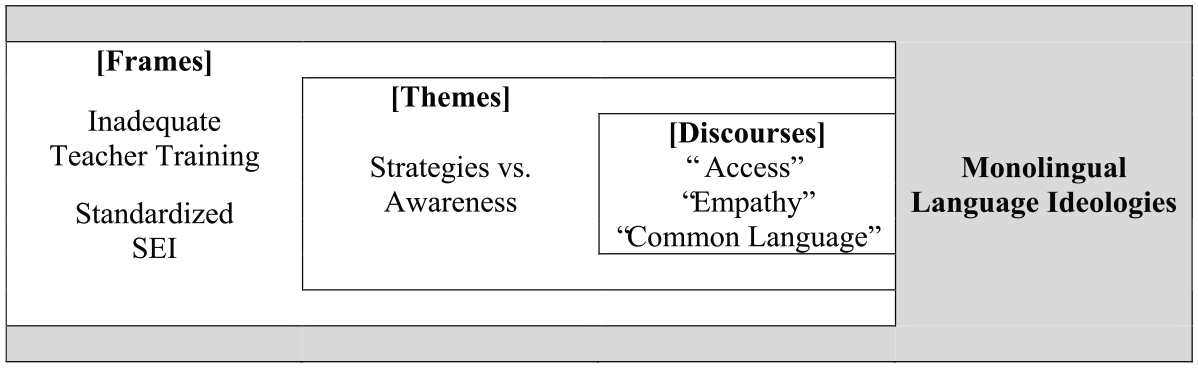
Frames, themes, and discourses (adapted from Altheide & Schneider, 2013) in relation to monolingual language ideologies.
Frames—What Can Be Talked About: Adequate Training and Standardized SEI
Both the policy and its implementation established a clear framing of “adequate teacher training” (DOJ, 2011b, p. 1) as the state’s operative issue. This framing overshadowed a host of other topics generally connected to educational policy, such as student outcomes, curriculum, funding, assessment, or any degree of larger civic purpose of the initiative (Shirley, 2017). This is not to underplay the importance of teacher training but to highlight how the initiative demonstrated an almost uncanny degree of focus on a single topic compared with the usual complexities of large-scale educational and language policy change (Datnow et al., 2002; Johnson, 2013). Although the achievement of emergent bilinguals is a complex issue, the frame of inadequate teacher training exemplifies how a policy can be written to construct its own problem, then claim to have solved it by its own metrics (Shao & Gao, 2018).
Policy exerts power over constraining outcomes through such framing. Most notably, the framing of inadequate teacher training left little room to problematize the SEI policy itself. Thus, a secondary framing was the federal embrace of SEI as “theoretically sound” (DOJ, 2011a, p. 10), which carried over to the state’s policy and the course itself. When coupled with the state’s English-only mandate, this framed SEI as the way to teach emergent bilinguals—rather than one model out of many. The participants in this study had knowledge of the variety of program models available for teaching emergent bilinguals, but the SEI course itself left little room for exploring these alternative program models, much less for equipping teachers with the skills to implement bilingual pedagogies. Thus, what was meant to be a skill-building initiative simultaneously narrowed those skill sets, as the range of available models for teaching emergent bilinguals was replaced with SEI as a “one size fits all” approach (Wright & Choi, 2006). These findings corroborate the impact of policy framing on the range of solutions that are made relevant or foreclosed in the policy interpretive process (Altheide & Schneider, 2013). Such findings also demonstrate the circular reinforcement of monolingual language ideologies from policy, to teacher training, to constraining the professional knowledge base around a mandated set of English-only pedagogical orientations. Through such a cycle, the power of trained ESL and bilingual education professionals to regulate the profession, are significantly curtailed.
Themes—What Is Talked About: Strategies Versus Awareness
Thus, the framing was solidified—SEI as a theoretically sound statewide model, with teachers inadequately prepared to implement the model (DOJ, 2011a). Demonstrating how frames delimit the range of themes that can be made relevant as solutions within a given policy (Altheide & Schneider, 2013), the themes of strategies and awareness were prioritized across the SEI endorsement policy and its implementation. Strategies were the primary thematic focus within the policy documents and the course itself. This focus established strategies as the key lever by which to reform teacher training, while instructors viewed awareness as equally, if not more, important. These two themes were negotiated within varying degrees of fidelity to the state’s course itself across rule followers, adaptors, and appropriators.
There were recurring tensions in instructors’ ability to balance or re-prioritize these themes, mediated by the degree to which they felt they had the institutional flexibility to enact a personal/ideological stance around the course. Still, both themes accommodated to the needs and ideological dispositions of monolingual teachers (Banes et al., 2016; Farr & Song, 2011; Jimenez-Silva et al., 2012), whose significant need and unfamiliarity with the topic at hand drew a high degree of attention from instructors. Notably, none of the participants pushed back substantially against the overall framing of teachers as both the problem and solution to the state’s struggles to address the needs of emergent bilinguals, reiterating the power of policy framing in delimiting the range of approaches to solving a policy issue. These findings not only reiterate the importance of initial policy framing in delimiting the themes that can be addressed (Shao & Gao, 2018) but also point to the accommodation and reinforcement of monolingual language ideologies, as explored further below.
Discourses—How Issues Are Talked About: Access, Empathy, and “Common Language”
The specific discourses employed across strategies, awareness, and varying degrees of fidelity exemplified the discursive maintenance of monolingual language ideologies (Achugar, 2008; J. S. Y. Park, 2008). One example was the consistent reference across the policy documents, the course itself, and instructors’ implementation to the need to provide access for emergent bilinguals. As Allan (2008) has explored in relation to gender in higher education, the term access actually reinforces a certain group’s positioning as outsiders; one only needs access to something if they are already positioned as existing outside of it. This notion challenges the process by which access becomes analogous “with the attainment of equity” (Allan, 2008, p. 70) as opposed to reforming a monolingual curriculum that does not center or sustain students’ existing linguistic resources (Menken, 2006; Paris & Alim, 2017). The power dynamics involved in establishing who belongs within the fold of mainstream education still presumes a monolingual, English-speaking student as the “norm” around whom curriculum is designed, and despite the SEI mandate’s avowed emphasis on “rethinking equity” (DESE, 2012) for emergent bilinguals, little seems to have been accomplished to shake this language ideological foundation.
A second discursive reinforcement of monolingual language ideologies involved the prioritization of monolingual teacher empathy. Such an emphasis presumes and centers the experience of a monolingual audience of teachers, particularly those who had not experienced ESL education themselves. While this is largely an accurate linguistic profile of the state’s teaching population (and that of the United States overall), such an emphasis is self-reinforcing in disempowering the enduring population of teachers who identify as bilingual (Athanases et al., 2015). Moreover, participants repeatedly reported drawing on the experiences of teachers who had experienced ESL to provide insight for monolingual teachers. Thus, bilingual experience in the course was primarily used in service of generating monolingual empathy. Conversely, a lack of monolingual empathy was considered a normal state for teachers. Instructors’ discourse positioned this lack of empathy as an excusable, understandable issue to be gently probed through exercises in reflexivity, thus reinforcing monolingual language ideologies and the power dynamics of bilingual populations’ expectations to accommodate to monolingual norms.
Finally, another recurrent discourse was the notion of the SEI endorsement having helped to instill a “common language” (14-UNI) across the state around managing the state’s growing linguistic diversity. Aside from the phrase, a common language, having literal monolingual connotations, this discourse illustrates a more profound, ideological impact of the initiative: The common language established among the state’s 70,000+ general education teachers, many of whom had no prior training in teaching emergent bilinguals, was estableished through the lens of English-only SEI. Thus, even as the state begins to allow schools and districts to implement a broader range of program models (DESE, 2018), they have done so only after the near entirety of the state’s teaching force has been trained in English-only SEI. This process instilled SEI as the presumptive model, or “the road of least resistance” (32-DIS), assuring that any alternative model will be an uphill battle to implement. As the SEI endorsement remains a requirement within new set of laws (DESE, 2019a, 2019b), it will continue to exert power as the core form of teacher preparation that shapes the common language around pedagogical approaches for emergent bilinguals for the foreseeable future.
Implications
This research holds implications for language policy, policy interpretation, and language ideologies more broadly. First, in addition to the importance of teachers as policy interpreters, this study demonstrates how teacher educators also play an important and largely underexplored role in policy interpretation. Massachusetts designed a statewide initiative through a course prioritizing pedagogical strategies; instructors, in turn, made substantial contributions to the initiative by (a) differentiating these strategies for their target audiences and augmenting the course, and (b) prioritizing awareness as a core component of teacher preparation. These contributions, and those of SEI instructors across the state, made substantive impacts on the training of over 70,000 educators, which will affect the educational experiences of even higher numbers of emergent bilinguals across the state.
Still, when analyzing frames, themes, and discourses across both the policy and its interpretation, it becomes apparent that the broader frames, language ideologies, and power dynamics remained largely consistent across the initiative. While the field of policy interpretation has made substantial contributions in highlighting the agency of policy interpreters, this study suggests that policy framing does, in fact, impactfully limit range of possibilities for interpretation. Policy interpretation, it appears, is not only a matter of individuals with particular ideological dispositions exercising those views on policy. Instead, the framing of a policy itself also carries an ideological authority that interacts with, and in many ways governs, individual interpretations of policy. Such dynamics illustrate the need to interrogate a policy’s underlying language ideological foundation in setting the parameters for policy interpretation. Thus, future research on the interplay between language policy interpretation and the boundaries delimited by policy itself merits further exploration.
Language ideological examination is also necessary in regard to the role of instructors themselves. The findings of this research demonstrate how personal, experiential, and ideological dispositions play a key role in determining how coursework is interpreted and implemented across a variety of institutional contexts. Participants’ own awareness and self-reflexivity around the ideological dynamics of their work provided important insight into their own role as policy interpreters. Still, even among those who considered themselves as “going rogue” (33-DIS) based on their ideological commitments, few can be said to have substantially endeavored to shift the underlying ideological framing of the initiative itself. Further research might explore the power dynamics through which even those with the most academic freedom tend to self-govern to keep teacher preparation coursework largely in alignment with the state’s priorities, despite their disagreements with these priorities on both professional and ideological levels.
Conclusion
It is important to conclude by noting that, when asked if the state was better off having had the SEI endorsement initiative, all participants saw some degree of overall positive influence. “We’re not in closets anymore,” said 08-DIS, in reference to her previous experience as an ESL teacher sharing a janitor’s closet as an “office.” As an enduring influence, 07-UNI lauded the fact that “We are no longer allowed to just ignore a course in English Language Learners in our [teacher] preparation programs.” Likewise, 15-UNI could never imagine “reverting to a time when you could become a licensed teacher . . . and never have taken a class on working with linguistically diverse students.” Overall, the Massachusetts SEI endorsement initiative reflects many of the tensions between mandating a large-scale initiative, while enabling flexibility and contextual responsiveness. The most gainful moments of the initiative appear to have surfaced when instructors created ways to break through the course’s framing as an “add on” or “checkbox” to establish linguistically responsive teaching as a core component of the profession. While instructors credited the initiative for mandating a space to have these conversations, it was largely the instructors’ resourcefulness and ingenuity of implementation that positioned the initiative for any degree of success. As Massachusetts ushers in an era of increased flexibility in language programming—and as bilingual and dual-language education programming becomes more popular in the United States more broadly—there will be an enduring need to explore educators’ agency in policy interpretation and in the continued maintenance or disruption of monolingual ideologies in U.S. schooling.
Footnotes
Acknowledgements
The author would like to thank C. Patrick Proctor, Anne Homza, Rebecca Lowenhaupt, and Kara Mitchell Viesca for their insights on earlier versions of this work.
Declaration of Conflicting Interests
The author(s) declared no potential conflicts of interest with respect to the research, authorship, and/or publication of this article.
Funding
The author(s) disclosed receipt of the following financial support for the research, authorship, and/or publication of this article: This research was supported in part by The International Research Foundation for English Language Education (TIRF).
