




Abstract
This article explores the hypothesis that the wellsprings of the recent upswing in new conservative movements such as the Tea Party can be found in the socio-spatial context within which individuals are socialized. Non-urban forms of space possess certain social and structural characteristics that can shape styles of moral cognition that in turn lead to conservative predispositions within the personality structure of the individual. Suburban and exurban spaces tend to provide a context for new conservative world-views as a result of the ways social interaction shapes the moral-cognitive style of individuals. Dogmatic moral cognition is shaped by constrained forms of socialization that affect the ways individuals conceive their world and distort certain epistemic capacities. When activated by different forms of social threat or social change, they will be more inclined to turn to conservative movements and ideologies that express their insecurity and social anxieties that are themselves produced by the world-views within which they feel comfort and security.
Introduction
To what extent are the forms of social and political consciousness that we possess grounded in the material forms of life that we inhabit? Is there really anything tangible in the Marxian thesis that a causal connection exists between ‘base and superstructure’? Perhaps more to the point, can we detect some kind of causal mechanism that links the way people think about political ideas and the attitudes they possess, as well as their personality system, with the material forms of life of any given society? One of the central tenets of classical Marxian theory, something held also by the proponents of Frankfurt School critical theory, has been that such a connection exists and is highly operative in the understanding of the genesis and persistence of reactionary political ideologies. According to this thesis, the subjectivity of subjects is formed by social structure and is not to be seen as an arbitrary form of consciousness or simply as a personal point of view, opinion, or set of subjective attitudes. The rise of grassroots conservative groups throughout the latter half of the twentieth century provides us with a challenge, in this regard. In this article, I would like to explore this thesis in a more nuanced way in order to explain the rise of a new conservative disposition in American politics, in particular that of the Tea Party.
The emergence of the Tea Party as a forceful and, for the time being, politically successful grassroots conservative movement has drawn the attention of social scientists interested in the contours of American conservatism. Limiting the analysis to structural interests does not adequately capture the nature of these movements. Skepticism of elites, intellectual and otherwise, a rage against the redistributional state, anxiety about (illegal) immigration, and a desire for localism are all dimensions of this new conservative mentality. But there is also a more reactionary, even authoritarian bent motivating these movements and their beliefs about the state, the economy, and other social groups in American society. This ‘new conservatism’ (Thompson, 2007) has a more parochial nature derived from the particular moral-cognitive structures that they employ in interpreting and evaluating their world. If looked at in this way, inquiring into the social psychological dimensions of this new conservative ideology takes us to the heart of the processes of socialization and ego-formation that shape these kinds of moral cognition and, ultimately, ideology itself. The thesis I want to defend here is that there are particular ways that the socio-spatial environment individuals inhabit makes them susceptible to certain ways of thinking that lead to a more conservative ideological identification. More specifically, my hypothesis is that suburban/exurban forms of life create an environment for just such ideological identifications – the Tea Party and other grass roots conservative movements and groups have their origins in non-urban space for a reason.
Indeed, what is interesting about the Tea Party is not their ideological platform, but rather the quickness with which they were generated and organized as well as the extraordinary homogeneity of their belief system. What this would seem to suggest is that there is something about certain strata of American society that predisposes individuals to feel outraged at specific of political institutions, social policies, and social groups. It is clear that as economic inequality threatens the quality of life for working people and middle-class and petit bourgeois groups stagnate or worsen, these conservative values begin to strengthen. 1 Forms of social threat are generally associated with acute spikes in conservative self-identification (Fromm, 1941; Rickert, 1998; Wilson, 1973) but it does not answer the question of the mechanisms that produce these reactions. I believe that the rise of this kind of conservative ideology is a reaction generated by certain styles of moral cognition; in other words, they are the product of the ways that individuals come to grasp, understand, and evaluate their world. These styles of moral cognition produce certain world-views that get expressed as political and ideological frames of interpretation and opinion. My thesis is that these are world-views that are produced in a very systematic and predictable way, and that much of this can be explained by the socio-spatial domain of non-urban forms of life in which these individuals are socialized.
The reason for this lies in the forms of socialization (or, seen another way, under-socialization) that occurs in certain kinds of social space. Because of the socio-structural character of non-urban spaces, specific constraints on interaction play a crucial role in ego-formation. From this point of view, it can be seen that the Tea Party is merely a more recent manifestation of latent conservative predispositions that have their origins in the spatial context of where and how people live their lives. Central to this hypothesis is the question of how spatial structure can affect forms and patterns of socialization which then lead to patterns of moral cognition that produce ideological responses in politics. The social theory of moral cognition – as opposed to the genetic and neuro-based theories of moral cognition (Greene, 2005; Mikhail, 2011) – maintains that individuals react to the world due to the particular ways they frame it by utilizing the normative value systems they acquire from the social relations that constitute them. These value systems guide their knowledge of the way things should be but they also, as I will argue here, affect epistemic capacities or the ways they process knowledge in general. Moral cognition, then, is a particular way of understanding the world not based on reasoned world-views but rather based upon value-orientations that are ingrained within the individual and affect emotive, evaluative, and epistemic capacities. To this end, ideological self-identification is an expression of deeper forms of moral cognition that are themselves shaped strongly by various forms of socialization (Thompson, 2011).
Social scientists interested in the genesis of conservative politics and ideology should turn some of their attention to the geographic dispersion of ideologies. At the center of my approach is an emphasis on the specific ways that these movement conservatives think or, to put it more technically, the particular ways that their moral cognition operates. Whereas some researchers have argued that the Tea Party evinces a relation between economic threat and racial attitudes leading to an activated authoritarian personality (Stoner and Lybeck, 2011), and others have focused on the Tea Party as an expression of a return to civic religious discourse (Hickel, 2011), I will argue that we need to understand these political reactions in terms of the particular kind of moral cognition that generate these world-views. A deeper understanding of the generation of conservative views and ideology therefore needs to be seen as rooted in the ways that individuals are socialized, and the ways that social actors are socialized can be explained by the socio-spatial constraints placed on them in their personality development.
The emphasis on personality is important because we need to see that there are certain social-environmental conditions that can affect the ways that individuals cognize and feel about certain moral and political themes. This goes against much of the literature that sees conservative ideology as simply a matter of social attitudes or belief systems to which people tend to subscribe. On this view, conservative attitudes are not the result of the personality structure of individuals, but reactions to particular situations (Feldman and Stenner, 1997; Peterson et al., 1993). But I think that these forms of moral cognition are strongly shaped by the kind of constrained socialization that is characteristic of non-urban forms of life. The nature of constrained socialization is itself produced by certain structural characteristics of social space. In contrast to the views of those like Arendt (1958) and de Certeau (1984), who see space as open to personal expression and the potential to create new forms of solidarity, I see certain kinds of spatial structure as having a strong effect on shaping social relations and, in the end, moral cognition. To dismiss this view as deterministic is mistaken; rather, we need to confront the ways that space strongly shapes socialization norms through routinizing certain kinds of experience, forming the basis for the conservative personality. The highly routinized, structured and rule-governed nature of modern capitalist life needs to be examined and its effects on the personality system and social consciousness of individuals deepened. This, I will argue, is what is most salient in explaining and understanding Tea Party ideology: not simple conservative ideas, but a rage against the deliberative forms of politics that would force them to modify their strong ideological views, or the deeply ingrained normative conception of their world.
In broad terms, there is consistent empirical evidence for a strong association between national voting patterns and the urban/suburban/exurban divide, suggesting that the less ‘urban’ an area is, the more its residents choose conservative political candidates (Fischer, 1978; Gainsborough, 2001; Gimpel and Karnes, 2006; Lang and Sanchez, 2006; McKee and Shaw, 2003). Unfortunately, there is scant data collected at the finer level of regional typology, but what we can see from the data that does exist is that a clear pattern emerges between how people vote and their residential distance from urban centers. The divide between urban and non-urban areas does indeed suggest that the further one moves from an urban center, the more conservative the individual’s voting preferences become (Lang and Sanchez, 2006). When we break down voter preferences by the county level instead of the usual state level, we find that votes for liberal candidates are skewed toward urban and metropolitan areas. This can be seen especially for national political office, as in the 2000 and 2004 US Presidential elections (see Figures 1 and 2). This suggests that theorization is needed if we are to understand these patterns. What I will argue here is not that voters of a particular persuasion simply move to non-urban areas, but that non-urban spaces play an active, indeed causal, role in the production and maintenance of such values.
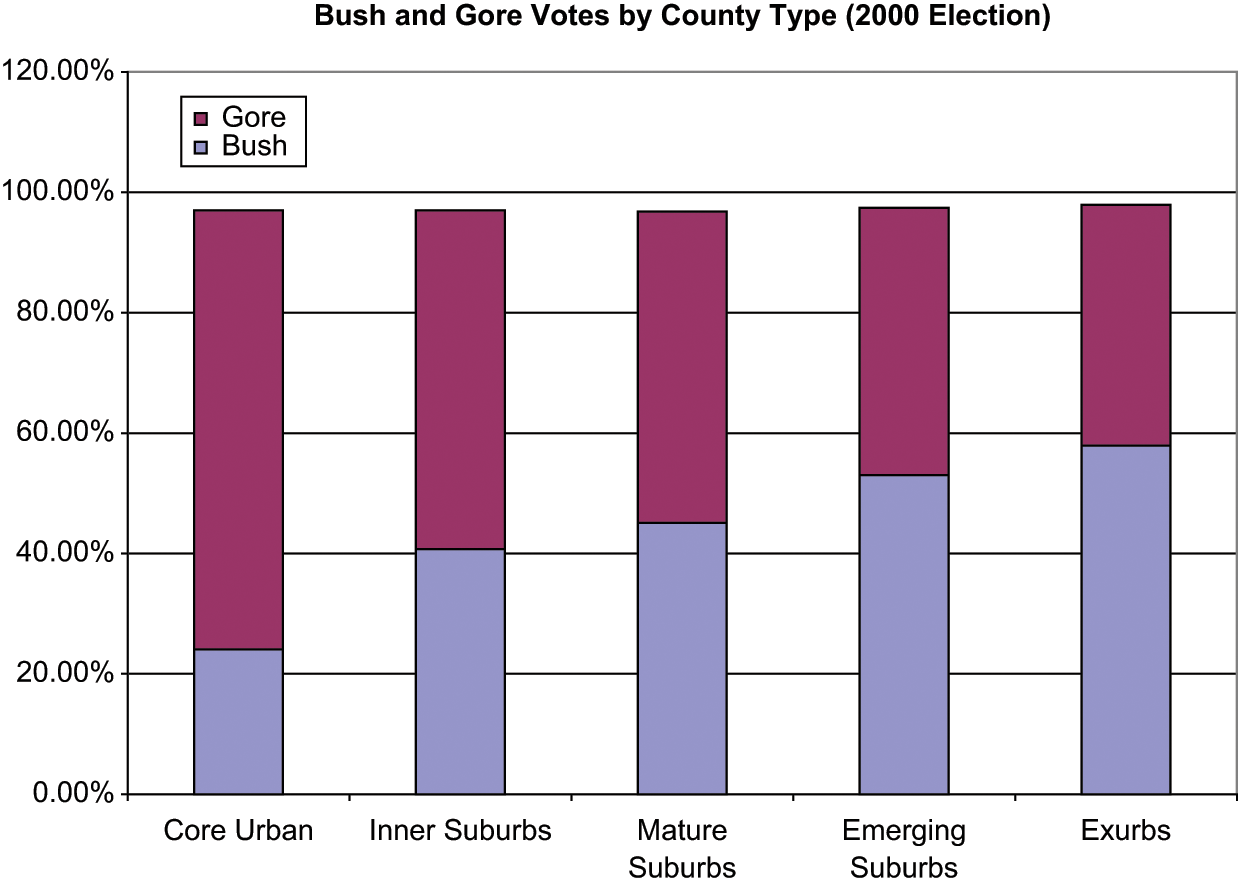
2000 Presidential Election results by county-type (data source: Lang and Sanchez, 2006)

2004 Presidential Election results by county-type (data source: Lang and Sanchez, 2006)
Although Tea Partiers are a small proportion of the electorate, there is evidence that their numbers are drawn from the Republican party more broadly and they tend to be white, male, and over the age of 40 (Williamson et al., 2011). But if we see these statistics about the Tea Party in a larger context and take into consideration the forceful way that Tea Party ideology is an amplification of conservative themes from the past several decades of American politics, we can see that they can have a strong effect of reorienting mainstream Republican politics as well as more ‘middle of the road’ conservatism. Far from being taken as extremist, the message of Tea Partiers, in one form or another, may resonate with many Americans. My argument is that the non-urban forms of life in which many Americans live will predispose them to this particular brand of movement conservatism, paving the way for many of their ideas to gain more widespread support.
Spatial Form, World-Views, and Political Consciousness: A Basic Model
When I refer to ‘socio-spatial structure’ I mean the particular ways that social and spatial environment is able to constrain or encourage certain different forms of socialization. This is defined as how people interact, with whom they interact, in what contexts, what kinds of practices they engage in, and so on. Socialization is an active process, building the normative world-views as well as epistemic capacities of citizens. Spatial form is a structural domain that strongly shapes the socialization process of individuals by channeling certain forms of social integration. Individuals are shaped within these social environments. Their egos, their sense of self, their sense of the world, and their understanding of different kinds of norms are all deeply shaped in these contexts. Therefore, over time these contexts create a system of value-orientations or ‘world-views’ which are the frames that individuals apply to the world. World-views operate as normative concepts about how the world ought to be structured, how it ought to work, what is right versus wrong, and so on. They are the evaluative and cathectic frames that individuals utilize to order their world, to be able to fit themselves within the normative behaviors and practices that constitute their relations with others and with themselves. Finally, political consciousness or ideological identification is the expression of these world-views with respect to the way that power should be distributed, what kinds of political institutions are seen as legitimate, what kinds of social policies should be enacted, and so on. Therefore, individuals’ ideological beliefs can be deeply linked with the kinds of world-views they possess which are, in turn, deeply affected and shaped by the particular socialization process through which they have been individuated.
Space is therefore seen, in this view, as a container giving shape to social relations and, by extension, to the formation of the personality structure of individuals. The reason I emphasize categories of cognition as opposed to the realm of practices is that I see the development or lack of development of cognitive capacities as linked to the ability to call into question the legitimating power of moral concepts which fuse us to the social order as a whole. In this sense, we are speaking about the mechanisms of what Parsons (1951) referred to as a ‘socializing effect’ where the ‘integration of ego into a role complementary to that of alter(s) in such a way that the common values are internalized in ego’s personality, and their respective behaviors come to constitute a complementary role-expectation-sanction system’ (Parsons, 1951: 211). This means seeing the nature of social integration as a crucial mechanism in the formation of political consciousness because it itself rests upon the structure of moral world-views that are acquired through the process of socialization, one shaped strongly by socio-spatial structure. The moral-cognitive component to this is that this structure of the role-expectation-sanction system derives its normative power from the extent to which individuals develop forms of consciousness that are synchronized with that system. To put it more simply, emphasis must be placed not merely on the extent to which practices are constrained and shaped by space, but by the ways that forms of socialization and socialization norms can limit or expand the domain of ‘social consciousness’ defined as the ability of individuals to possess public reason, call into question their ingrained normative ideas about the world and the values and belief systems to which they subscribe, and open up this secure domain of legitimacy to critical reflection and possible revision. In this sense, socio-spatial form has a significant impact on types of public reasoning and the formation of a bedrock of moral and political categories that orient individual and group behavior and belief.
If the conservative mind utilizes certain kinds of moral cognition, then we need to ask about the ways that spatial structures can enhance, reproduce, even create, shape, and reinforce these forms of moral cognition. The world-views that an individual possesses can find their genesis in any number of variables, but the pattern of political conservatism and non-urban forms of life can be addressed by looking at what I call ‘public reasoning contexts’. To understand this theory, we need to understand how moral and political world-views themselves operate and how these world-views themselves lead to particular kinds of political consciousness or, to put it more technically, forms of moral cognition that lead to certain political ideologies. The model I propose is summarized in Figure 3.
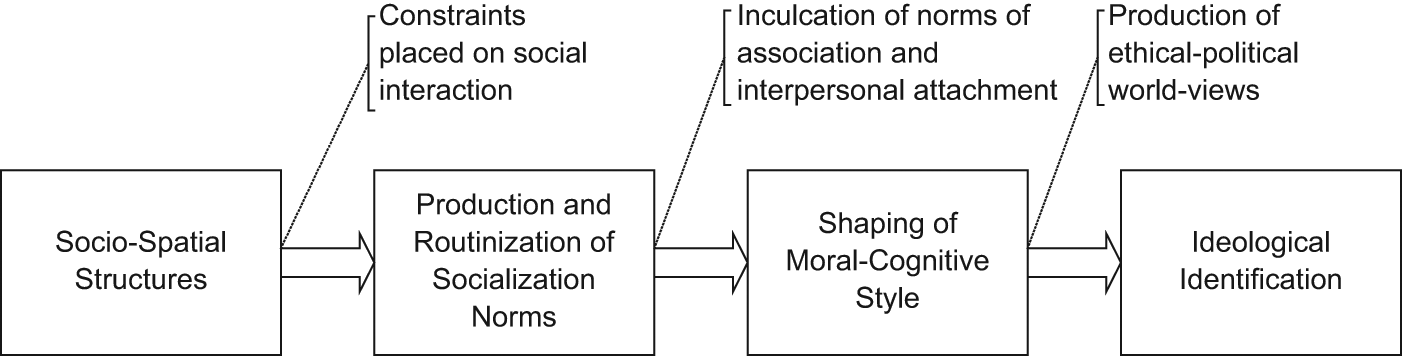
Basic model of spatial forms and ideological identification
Properties of Socio-Spatial Structures
At the core of what I call ‘socio-spatial’ structure are the ways that spatial form can promote or constrain certain forms of association and socialization. This can be seen on multiple levels, but the key element to explore here is the way that spatial forms are able to affect two crucial variables: association and heterogeneity. Rather than seeing a crude dichotomy between cities and suburbs, focus ought to be placed on the nature of socio-spatial form and the ways these formations can affect levels of association and degrees of homogeneity. Spatial forms of life that detach people from one another, that are designed with instrumental or functional imperatives in mind, that are unable to promote integration and social encounters with some sense of frequency will have deformative effects upon social consciousness and the capacities and sensibilities of individuals. The socio-spatial domain refers not only to the structures of the built environment, but also the ways that class and race are structured through space (cf. Stiglitz, 1977) as well as other kinds of spatial distribution of cultural life. Divisions of this type can have deleterious effects not only on the social and moral consciousness of individuals (Thompson, 2009a,b) but on their civic attitudes as well (Bickford, 2000; Young, 1999). The relation between the world-views of the new conservative mind (of which the Tea Party is merely an example) and these forms of defective social consciousness are the very reason for the larger aggregation of conservative voting preferences in non-urban areas.
The reasons for this need to be explored. For the sake of simplicity, I will point out what I see to be two very basic, ideal-typical forms of socio-spatial structure: open and closed. Each of these is defined primarily not by the symbolic or aesthetic nature of the space (Kohn, 2003), but by the various ways it is able to constrain or promote specific forms of social interaction. These forms of social interaction constitute the socialization contexts that shape, create, and/or maintain certain kinds of world-views in the minds of individuals. In this sense, we will be able to make the connection between the socio-spatial domain and the realm of moral cognition and the personalities of individuals. The very nature of structure is important here because structures are, in fact, defined by the ways in which they either promote or inhibit certain forms of action and behavior. In this sense we can isolate the ways that these forms of spatial structure can shape individual and collective action.
The basic distinction between open and closed socio-spatial structures lies in two different characteristics: (i) the promotion of either centripetal or centrifugal patterns of social interaction; and (ii) the degree of presence of either homogeneity or heterogeneity in terms of those with whom individuals interact. Open spaces promote centripetal patterns of social interaction. Frequent interactions that are not only instrumental or role-oriented (as in dealing with supermarket clerks, waiters, or other kinds of economic interaction) but that are oriented toward more substantive social interaction (as in political debate, public forums, cultural life, and so on) are characteristic of open spaces. Urban areas generally are able to support these kinds of interaction in their spatial design, but this can also be replicated in non-urban areas. The principle feature of an open structure is that the social interaction becomes, in some way, unavoidable and frequent. Open structures promote and facilitate social interaction and, as a result, individuals become exposed to more consistent kinds of socialization outside of the family and tight peer groups as well as formal institutions, such as work and school. These structures encourage the active participation of individuals in terms of their interaction with others, a key element to the formation of moral-cognitive and epistemic capacities that shape political attitudes and ideological formation.
Closed socio-spatial structures, by contrast, are defined by their centrifugal force: they disperse people, they discourage interaction and dialogue. Instead, they encourage isolation and separateness through distanciation in time and space (Giddens, 1986; Harvey, 1985). Social interaction within closed structures is difficult, unlikely to occur, and marked by anomic individualism (Sennett, 1974). In contrast to open structures, closed structures are unable to promote a significant level of social interaction. Individuals tend to become isolated in smaller peer groups. They interact in more traditional or formal settings, such as the family, the workplace, or school, and these commonplace and routinized forms of interaction generally pose no challenge or threat to their ingrained belief systems. These kinds of association do not bring to the fore the agent’s powers of social or moral reasoning and instead, individuals become deeply invested in the set of norms and beliefs that are reinforced by their immediate community.
Chronic exposure to such forms of association – dominant in family, school, and work spaces – can weaken and under-develop the spheres of consciousness. And it is here that we can begin to see the connection between the spatio-structural forms and forms of association. Areas where closed structures predominate (i.e. many American suburbs) will see a proliferation at many levels of closed spatial structures. The home tends to be dominated by inactive forms of association, planning of suburbs tends to utilize closed structures (e.g. how streets are planned), and there also tends to be a lack of truly public space. This will give rise to certain contexts of reasoning: certain ways that the people within that community come to self-consciousness of their world-views. These world-views can either be challenged, as in complementary-active forms of association, or they can simply be confirmed or be tacit in nature.
But open spaces must also promote heterogeneity of interaction. Since group-affiliation is an important factor in the formation of world-views, spaces that restrict the kinds of interactions and the kinds of people who can interact in dialogical forms of interaction will be more likely to promote what I will call dogmatic forms of cognition leading to more stubborn, and many times simplistic, understandings of the world. This is because one’s categories of social and moral cognition and experience are logically more limited in spaces that consistently restrict new encounters and force some kind of questioning and challenge to ingrained forms of behavior and thought (Sennett, 1970). The more limited the forms of group-affiliation become, the more entrenched forms of moral cognition will also become and, by extension, the more invested people will become in those more limited, more familiar senses of self and world. Homogeneity therefore can encourage a more limited sense of self and world thereby promoting more limited forms of moral cognition as well as epistemic capacities when it comes to dealing with others, evaluating the values of those different from oneself, and even transforming one’s own world-views or general understanding of the world. When combining the socio-spatial variables of levels of social interaction and degree of heterogeneity, we arrive at the very mechanism that shapes forms of moral cognition. I call these ‘public reasoning contexts’, and they are at the heart of the link between the socio-spatial environment and political consciousness.
Public Reasoning Contexts, Moral Cognition, and Political Consciousness
The process of forming political consciousness is not simply the result of absorbing the views of others, nor is it merely the result of arbitrary personality or attitudinal variables. In many ways, it is the result of an active process of certain kinds of socialization that have the power to shape the frames we use to understand and evaluate the world. This socialization is therefore also a process of ego-formation and it is very much the product of the kinds of interactions that individuals are used to encountering (Thompson, 2009a). A public reasoning context is a particular kind of social interaction that one frequently encounters in everyday life. It is defined by the dynamic interaction of the levels of (i) social interaction and (ii) social heterogeneity and diversity as described above. The importance of intersubjective forms of association, as Mead points out, is that they provide ‘form[s] of behavior in which the organism or the individual may become an object to himself’ (Mead, 1962: 138). The result of this act of ‘self-objectification’ is the capacity to deal with others in a more ‘democratic’ way, since they must be able to call into question certain forms of behavior, values, norms, institutions, cultural patterns of life, and so on which predominate in their community. Lack of this self-objectifying capacity leaves the individual with cognitive frames that limit this capacity for democratic deliberation and thinking. Instead of calling into question certain opinions or conceptions about the world, they are more likely to rely on familiar frames of reference and feelings about what is right or what makes them feel secure in their conception of the world. As Young points out, ‘To be reasonable is to be willing to change our opinions or preferences because others persuade us that our initial opinions or predispositions are incorrect’ (Young, 2000: 25). Figure 4 outlines a typology of different public reasoning contexts.
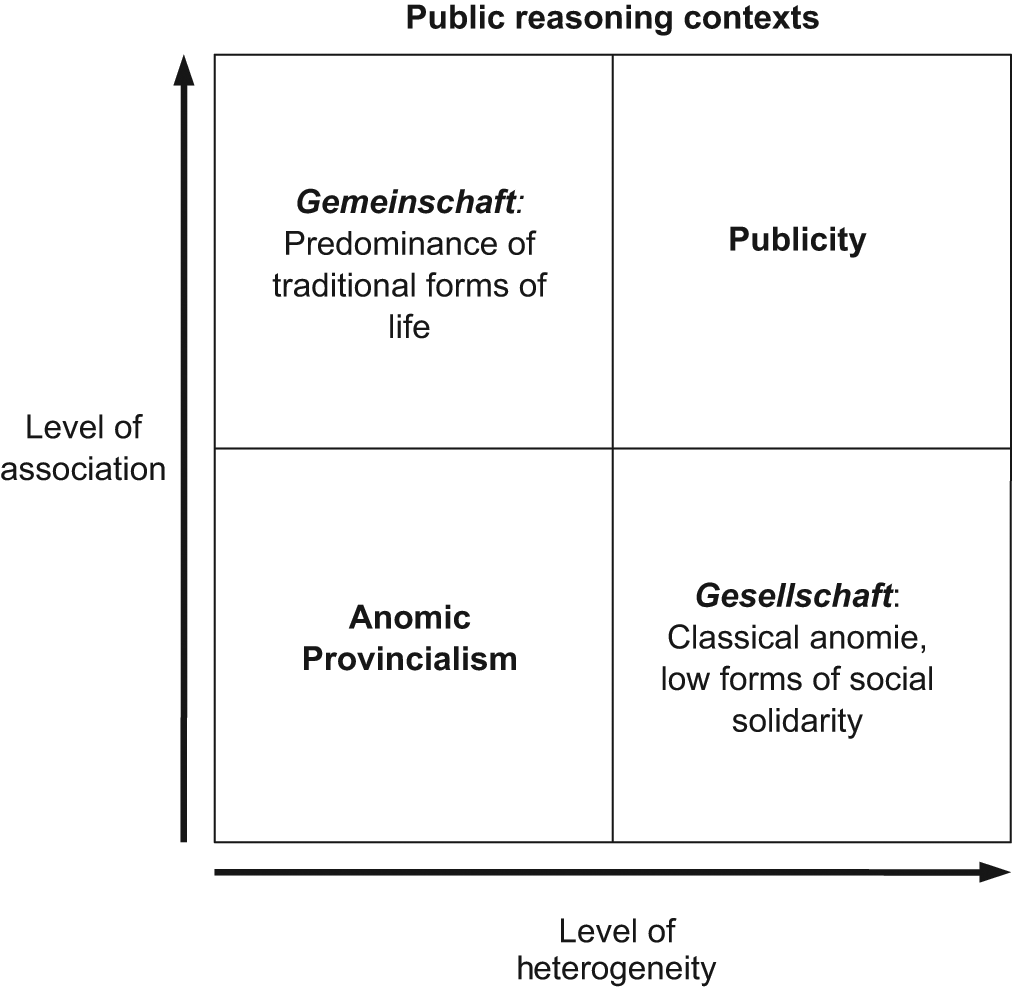
Ideal-type matrix of public reasoning contexts
Public reasoning contexts are defined by their levels of heterogeneity and levels of association, respectively. This takes on political import once we see that central to this process is the construction of moral value systems – the way individuals code their world of power, authority, legitimacy, social acceptance, toleration, fear, and so on. Thus, forms of public reason are most importantly shaped by two factors – levels of association and levels of heterogeneity among members of their environment – since they shape the ways that individuals think through their world, construct what is familiar, learn about others, develop epistemic capacities for social reasoning, and so on. But both variables must be taken in tandem; it is not enough to have high levels of association among homogenous groups (which can tend to produce Gemeinschaftliche forms of consciousness) or much heterogeneity without high levels of association (which can tend to produce Gesellschaftliche forms of anomie, lack of trust, and social solidarity). 2 Suburban/exurban and other kinds of non-urban space tend to inhibit both of these dimensions through frustrating access to public space (Kenyon, 2004; Kohn, 2004) and also by segregating groups spatially by class and race/ethnicity. 3 Therefore, there is no reason to fall into the crude dichotomy between cities and suburbs. Rather, we can see that over-developed urban centers can be just as alienating as some suburban and exurban communities. The crucial difference is not the alienative effect but rather the ways that moral cognition is shaped in those respective environments.
Traditional communities that have high degrees of association but which lack heterogeneity lead to higher levels of group conformity in terms of what people see as legitimate as well as in their styles of moral cognition. Higher levels of association without diversity can lead to bounded communities not interested in deliberation with non-members of that community, and in-group sentiment can become more pronounced and a fear or distrust of outsiders can result. This can lead to more defensive and conservative attitudes and values about community and family life, and epistemic problems with conflictual deliberation and discourse (Thompson, 2011). This can be characteristic of rural or urban areas (rural Amish communities or urban Hasidic Jewish communities are respective examples), but is not limited to ethnic or religious communities (Simmel, 1957b). When there are higher levels of heterogeneity but low levels of association, interaction between different members of different communities can be constrained, limiting or narrowing the experiential frames of citizens. The result can be a withdrawal from public life and a fraying of social solidarity. Moreover, forms of interpersonal social conflict which can lead to deeper levels of shared understanding about political concerns are also hampered and limited (Baumgartner, 1988), leading to an increasing emphasis on personal interests at the expense of an emphasis on more common and shared political interests. This is what thinkers such as Simmel (1957a) and Wirth (1938) feared with the rise of modern forms of urbanism and its alienative effects on social life.
Higher levels of association and heterogeneity would lead to what I call publicity: a social context which allows for a consistent challenging of one’s views, a consistent need for rational debate in defending those views, and a constant interaction with heterogeneous groups and individuals that has the power to expand an individual’s horizon of moral and intellectual understanding. 4 Here I use ‘public’ as a term to differentiate it from ‘communal’ (Gemeinschaftliche) and ‘associational’ (Gesellschaftliche) forms of social organization. Forms of public reason that are most robust come from those contexts where spatial forms allow for high levels of association as well as high levels of heterogeneity. Publicity, in this sense, is a context where the fullness of one’s public reason can unfold. Access to ‘others’, higher levels of associational life – all can expand the opportunities with frictive forms of deliberation and, in the end, lead to a more robust capacity in such individuals for self-objectification. Lastly, low levels of both association and heterogeneity – usually characteristic of suburban areas and diffuse rural ones – can be seen to evince what I call ‘anomic provincialism’: a severe form of interpersonal detachment from public association outside of the domains of the family and certain institutions (e.g. school and work environments) that leads to profound social dislocation and a form of anomie that seeks refuge in the self and what is familiar. This is distinct from classical forms of anomie that were seen as the products of complex forms of the division of labor as well as dense urban centers (Durkheim, 1984; Wirth, 1938). Instead, anomic provincialism makes the ego depend more on what is known and what is routine, and therefore invests much in these institutions, practices, and moral concepts.
A deeper mechanism of public reasoning contexts is their ability to shape several important categories crucial for the development of the personality structure of individuals. These are diversity, conflict, anomie, and type of group-affiliation (Thompson, 2009b). Each of these must be taken in turn. Diversity of interaction means the extent to which individuals are capable of interacting with those different from oneself. It means interacting with an ‘other’, one who does not share the same conceptions, experiences, world-views, political and economic interests, and belief and value systems. Closed spatial structures are able to prevent this kind of diversity in interaction not only from the relative (or complete) lack of public space for interaction, but also from the segregated nature of urban versus suburban housing (Massey and Denton, 1993; Oliver, 2001). This lack of interpersonal interaction at the level of difference can promote racial categories and stereotypes, but it can also secure provincial forms of thinking preventing broader forms of recognition and inclusion. Diversity also refers to different points of view, or different value or belief systems. When individuals are prevented from being exposed to diverse belief and value systems, they will be more prone to attitude congruence with their peers and members of their community. This strengthens the sense of security that those narrow world-views can provide. Threats to those world-views are seen as ego-threats and they can therefore evoke sharp reaction and retrenchment within those belief or value systems.
Conflict is an even more important category. The importance of conflict in social as well as individual ego-development cannot be overstated. When I use the term ‘conflict’, I do not mean violent or in some way threatening forms of confrontation but forms of sociation where individual interests and world-views confront one another. Conflict is generally seen as dividing segments of any population, but this is generally not the case. More likely, as Georg Simmel pointed out in his analysis of the phenomenon, ‘Conflict (Kampf) itself resolves the tension between contrasts. The fact that it aims at peace is only one, as especially obvious, expression of its nature: the synthesis of elements that work both against and for one another’ (Simmel, 1955: 14). In this sense, conflict gives the individual a stronger sense of self; it develops in tandem with challenges to the way he thinks, reflects, and forms his identity. Lacking conflict, one seeks privacy in order to avoid the public realm which can be a place of conflict. Therefore, conflict performs an integrating task: the individual becomes more integrated into social life through certain forms of conflict and antagonism. In avoiding these forms of conflict, the individual becomes detached from the pulse of public life (Baumgartner, 1988; Greenhouse, 1992). He does not wish to engage it, to enter into it, but rather to shun it creating a more atomized society as well as a deeper sense of anomie within the subject himself (Sennett, 1974). 5 Another response is to form tighter, more ideologically cohesive in-groups that can serve to protect the world-views of like-minded individuals, creating an even greater tendency for group polarization (Sunstein, 2000, 2002).
Anomie is generated from forms of life that prevent social interaction, at least social interaction that is meaningful in the sense that people are able to exchange conceptions about the world they live in and learn from others. Although it was traditionally aimed at urban life and the modern division of labor found there, it has become more likely a suburban phenomenon where people live in suburban areas but generally work far from home. The separation of work from home is an important attribute of anomie. The combined negative effects on public life from segregation, work–home dichotomization, and the lack of public space and public life means that individuals necessarily recede into the realm of privacy. Political concerns within closed structures also tend to focus on more narrow interests such as personal property concerns which give the social and cultural characteristics of closed structures a hook in material interests. 6 This detachment from others is not absolute; rather, what happens is that individuals form narcissistic senses of self where their social relations also become linked by what is familiar to them – closed structures lead us not only to avoid public life, but also to forms of self which are alienated from public life and become under-socialized, lacking the capacities needed for public life.
This has an important impact on group-affiliation. These forms of self will seek protection but also a reflection of themselves with others who share similar world-views. As a result, group-affiliation becomes tighter, limiting itself to the known. Relations need to be personal; the impersonal (i.e. public) is shunned and feared (Sennett, 1971). The maintenance of certain world-views can therefore be maintained by homogenous kinds of group-affiliation. Disruptions in the ways of life, in the world-views held in common by such communities, will be seen as existential threats and, many times, provoke strong personal and communal reaction. When individuals are prevented from diverse forms of interaction, unaccustomed to conflict and challenging the self and its predispositions, and relate to one another in ways shaped by anomie and alienation, we begin to see a more genuine picture of the self that emerges within suburban space. Suburban life can erode the democratic capacities of citizens because they contain, or better yet, are specifically designed around the notion of closed social space. This is very different from mid-nineteenth-century urban planning which placed a primacy on public space. The result of this is a set of spatio-structural constraints upon forms of interaction and intersubjectivity which then lead to a limiting of interpersonal consciousness. The specific character of interpersonal consciousness, as I argued above, therefore leads to an under-developed or mal-developed reflexive consciousness thereby rendering public consciousness either non-existent or so underdeveloped as to be almost practically useless. Lacking these forms of public consciousness, public reason too becomes impossible and, with time, democratic capacities of open discussion, public debate, toleration, and inclusiveness are all undermined.
But how can these public reasoning contexts affect or shape political consciousness? More to the point, can the thesis that those public reasoning contexts more likely found in non-urban areas lead to the production of conservative political values and voting preferences be supported? The explanation is bivariate, since prolonged social and public interpersonal detachment characteristic of anomic provincialism (e.g. much of suburban, exurban, and rural life) tends to lead toward feelings of avoidance-attachment because these individuals tend to see the world as being uncaring and cold, and a preference for hierarchical forms of life; the family and church, for example, therefore become comforting (Weber and Federico, 2007). The social world and the moral order of their immediate environment therefore become crucial as a shield from difference and change which they see as threatening. The same can also be said for rural, Gemeinschaftliche public reasoning contexts which tend to produce anxious-attachment feelings that express a need to protect the individual from the dangers of whatever exists outside of their known environment (Weber and Federico, 2007). Conservative world-views therefore become an expression of deep, almost existential fear, since for both the Gemeinschaft and the anomic provincial public reasoning contexts, individuals will tend to view others and alternative world-views outside of their belief system as threatening to the moral order that they have internalized. Willingness to question, examine, and especially revise that moral order and belief system therefore becomes less likely not only because these individuals will tend to avoid those places where they will confront threats to their world-views, but also because non-urban space offers little in the way of interaction and heterogeneity (whether ideological or otherwise) to serve as oppositional to ingrained belief systems. There is less chance of conflicting interaction which might force one to question lifestyles, moral categories, and hence certain political ideas and value-systems.
Avoidance of these kinds of conflict therefore becomes a central tendency of non-urban life – indeed, one brought about by the very way space is structured in much of non-urban life – and an antipathy toward urban areas or those spaces where such conflict will be encountered becomes coupled with the maintenance of the very value systems being protected (Baumgartner, 1988; Greenhouse, 1992; Thompson, 2006). The need to ensure social conformity can lead to prejudicial opinions about those who are ‘different’ and threaten perceived moral and social cohesion, leading not only to conservative political attitudes and beliefs, but even in more extreme cases, toward right-wing authoritarian attitudes as well (Feldman, 2003). Indeed, social conformity therefore becomes not simply an option for each to decide for himself, but rather becomes reflected in political views about the world as a whole. 7
Seen in this way, spatial forms which frustrate association through distanciation, spatial separateness, lack of public space and so on will tend to produce individuals with less experience of associational life which itself can retard or prevent the development of forms of social reasoning. The frames produced within these social contexts tend to be shaped more by immediate family ties or a few familiar groups where familiarity and homogeneity tend to be preferred. But even more, space affects the social psychological domain by either limiting or enabling particular forms of interpersonal interaction and thereby shaping values and attitudes at a much deeper level within the individual, leading to certain conservative political predispositions. This occurs because, at its very base, conservative political values are in many ways expressions of normative understandings about the world which are formed and reproduced by constrained interaction. The more ingrained particular understandings of race, ethnicity, class, family structure, and hierarchical relations of power and dominance become, the more they become part of the social-psychological complex of the individual. The more they become part of that individual’s social-psychological complex, the more likely they are to conform to those value systems. Questioning them therefore becomes fearful since the individual would need to reconstruct crucial elements of his world-view – moral and otherwise. Conservatism and non-urbanism become not so much causally necessary or inevitable as much as a likely outcome. In any case, empirical literature on voting behavior, political attitudes, and political values seems to show such patterns.
To the extent that social space can have an impact upon the epistemological competence of individuals with respect to public reason, we can begin to see that much of non-urban space can foster and maintain conservative political attitudes and beliefs, since integral parts of democratic practice are the extent to which individuals are capable of calling their custom-bound world into question; the extent to which individuals are able to accept ‘others’ as equal and worthy of respect and inclusion; and the insistence that individuals not be bound to their ideas but be open to persuasion through rational discussion to change their preferences or validate them accordingly.
Fluid versus Dogmatic Moral Cognition and the Formulation of World-Views
But how does all of this explain the conservative personality? In my view, what Wilson (1973) referred to as the ‘conservative syndrome’ can be more adequately understood as the product of a dogmatic style of moral cognition where there is, on the part of the individual, a fear of having to deal with social change and, more fundamentally, a change in the familiar way in which the world works and is ordered. When I refer to moral cognition, I mean the ways any given individual or group ‘thinks through’ the world and comes to code it in normative terms. The more cemented a system of moral cognition is within an individual or group, the more likely conservative ideology will be found. Since moral cognition is a result of forms of socialization, we can speak of certain causal factors producing certain kinds of world-views that see certain forms of life as legitimate and others as deviant. This is because moral cognition refers to the way that an individual evaluates, in a normative sense, the social world around him; it refers to the ways of thinking that are used to come to terms with the world and different approaches to it.
My suggestion is that we see the new grass roots conservative movements as an expression of dogmatic styles of moral cognition and that this is largely the product of closed socio-spatial structures that predominate in non-urban American life. These movements, such as the Tea Party, evince latent authoritarian tendencies, simplistic world-views, antipathy for elites and complexity in social analysis, and, most distinctively, a rage against what they perceive as non-deserving groups that enter American life (Williamson et al., 2011). When it comes to the new conservative personality, what is central is the extent to which there is a search for solutions to social problems – especially during times of economic threat – that seek to revive the past as a solution to the pathologies of the present, what Viereck (1963) once called the ‘rootless nostalgia for roots’. This is another crucial element of Tea Party ideology, but it is also shared by other new conservative movements that look for salvation from the present in terms of religion, or traditional forms of community or family life.
For the sake of simplicity, I will discuss two basic styles of moral cognition: fluid and dogmatic. 8 In fluid forms of moral cognition, an individual is able to tolerate differing understandings and interpretations of the world. He is able to see issues from differing perspectives, is willing to depart from and critically examine his own internalized value-orientations, and is also able to consider revising his own world-views in light of new evidence and better reasons. An individual who approaches the world with a dogmatic cognition style is less likely to consider the ideas of others and more likely to need to assert what he believes to be true, to insist on it being taken as correct, and to see the norms that he has been socialized into as being intrinsically correct. Dogmatism, in this case, refers to the fact that individuals are unwilling, or even unable, to see the reasons for what they believe as subject to critique or to debate. They are more likely to see their own value-orientations, and hence their own world-views, as being objectively correct and therefore deviations from it as being pathologies of a good society or good form of life. People with a dogmatic style of moral cognition are also more likely to be prone to forms of ego-threat and social threat, since they are more likely to feel threatened by a changing world and by other groups that they are not used to affiliating with. They will bolster certain traditional forms of the social status quo (Jost et al., 2003). They are also more willing to support the principles of economic conservatism, such as ‘free’ market capitalism. These principles not only form a dimension of what they consider the social status quo, but also they express certain kinds of authoritarianism that ‘rightfully’ punishes groups that do not work hard or contribute ‘properly’ to society (Sidanius and Pratto, 1993).
The relation between world-views and these kinds of moral-cognitive styles becomes clear when we see how individuals deal with social change and forms of threat. The general theory of conservative political belief is that it is a theory of resistance to change, but this does not call into question the deeper personality and cognitive mechanisms that cause such a reaction. Forms of social insecurity or ego-threat are related to conservative and, at times, authoritarian belief systems (Duckitt and Fisher, 2003). This gives us some insight into the relationship between non-urban space and the production and reinforcement of conservative world-views. Grassroots conservative movements such as the Tea Party that emphasize the need for smaller government, support for radical tax cuts, for ‘free’ markets, and so on, are all expressions of a rage against the changing social order where white, working, middle, and upper-middle class segments of the population are feeling a decay in their standards of living and a renewed air of economic insecurity. Similarly, economic conservatives have been able to attach their interests to those of moral conservatives by framing conservative economic policy as directly affecting families, bridging a crucial gap between economic and social conservative blocs (Meagher, 2006). This in turn activates strong expressions of anti-intellectualism that are hostile to the very activity of the intellect itself. As Hofstadter rightly describes it, ‘intellect examines, ponders, wonders, theorizes, criticizes, imagines.... Intellect evaluates evaluations, and looks for the meanings of situations as a whole’ (Hofstadter, 1962: 25). In this sense, the conservative mind will tend toward control, order, and simplicity in order to compensate for the disorienting world of change it experiences.
Although this is the case, the dogmatic style of moral cognition should not be construed as referring only to epistemic motives. Rather, it denotes a more general approach to the world and to the ways that the normative understanding of the world is ordered within the individual’s consciousness. Recall that the dogmatic style of moral cognition is the product of being socialized in very specific ways. Public reasoning contexts such as anomic provincialism and traditionalist (Gemeinschaftliche) forms of association will tend to narrow the powers of moral cognition. Lack of conflict, exposure to anomic provincialism, lack of diversity in social interaction, and bounded forms of group-affiliation will lead to a kind of conservatism that is skeptical of outside views and resistant to change to the social and moral order, and that perceives social and ego-threats from these kinds of changes. Since closed socio-spatial structures tend to promote homogenous group-affiliation, in-group sentiment will be enhanced as certain social changes – such as immigration, changing demographic patterns, and so on – begin to threaten what they deem to be secure forms of social life and interaction. This also applies to the increased social insecurity and status anxiety that comes with times of economic change and recession. Hence, we should begin to see the genesis of these political movements as contained in the world-views that can be produced by certain kinds of socialization shaped by spatial constraints.
From a political point of view, dogmatic styles of moral cognition are able to express themselves in several core aspects of Tea Party populism. Dogmatic moral cognition can lead to an increase in authoritarian tendencies within the personalities of such individuals by increasing their desire for favoring their own in-group at the expense of out-groups such as immigrants, lower classes, and other disadvantaged groups (Pratto et al., 1994). Dogmatic moral cognition can also put pressure on epistemic capacities to evaluate, seek out, and incorporate information that directly contradicts or calls into question the belief system that they have come to adopt (Gaines et al., 2007; Kahan, 2007; Koehler, 1993; Lavine et al., 2005; Lord et al., 1979). This can lead to a ratchet effect where certain ideological views and moral-cognitive styles intersect to produce world-views that can persist beyond the particular period of social threat or social change by becoming embedded in certain cultural ways of thinking and evaluating the world. These epistemic problems make belief systems particularly difficult to change and they can have transformative effects upon the political culture more broadly. Liberal social policy, evidence for environmental decay, sociological explanations of racial and other kinds of inequality, and other pathologies of modernity therefore fail to enter into the epistemic, let alone moral, understanding of the world by Tea Partiers and their ilk.
Conclusion: The New Conservative Disposition
If my hypothesis is correct, then we must consider that conservative political ideology, of which the Tea Party is simply a more acute expression, is not simply explicable in structural terms (i.e. class), ascriptive terms (such as race or gender), or in purely psychological terms (i.e. as personality disorder or syndrome) alone. Rather, it is the result of certain kinds of moral cognition that promote certain world-views – forms of moral cognition that are shaped by the constrained forms of socialization characteristic of certain public reasoning contexts which are themselves produced by certain social-spatial variables. The central problem, then, is to see the new conservative disposition as a distinctly social phenomenon, as a product of certain kinds of socialization. In many ways, we need to see the new conservative personality as one who is not only threatened by the prospect and reality of social change, but at a deeper level also unable to cognize alternative ways of dealing with these problems and to tolerate the new kinds of social policies that might be needed to effect change.
The notion that suburban and exurban life erodes democratic life and capacities within individuals needs to be seen as a very strong variable in understanding the genesis of new conservative movements. Tea Partiers are no exception to this reality, but the concern needs to be broadened to see that the proliferation of non-urban life in the latter half of the twentieth century has had a profound effect on the political culture of American life. More specifically, if the mechanisms of socialization and moral cognition I have explored in this article have any merit, then we can expect to see a persistent, if not increasing, conflict of political culture and interests between urbanized metropolitan areas and the newer suburbs and exurbs. Traditional theories such as deliberative democracy in contemporary democratic theory will be insufficient to overcome these differences on their own. A more radical rethinking of space, place, and the nature of socialization in American life will need to be considered if a more democratic, inclusive, and rational political culture is to emerge.