



Abstract
Many scholars associated the recent transformation of Turkish democracy with the rise of a new bourgeois class and the neoliberal restructuring of the world economy. Using a social property relations approach, I provide a critique of the readings of Turkish modernity based on the fall and the rise of bourgeois agency. Revealing the non-capitalist origins and the protracted capitalist transformation of Ottoman and Turkish modernization, I conclude that the reformulation of the main pillars of Turkish modernity today is an expression of the recent consolidation of capitalist property relations.
Keywords
Introduction
It has been more than 20 years since Çağlar Keyder, in his seminal study State and Class in Turkey, famously noted the ‘impossible rise’ of Turkish bourgeoisie. Keyder argued that given the lack of strong international connections and heavy reliance on state subsidies, the Turkish bourgeoisie was robbed of its revolutionary potential. It simply hid behind a ‘cozy statism’, failing to challenge the normative foundations of a bureaucratized social order (Keyder, 1987: ch. 9). Twenty years later, the tide seems to have turned against Keyder, with the bourgeoisie now getting rid of its state-tailored straitjacket, seeking to reap the opportunities in a globalizing world economy and consequently transforming the state/society relations. The long-expected Turkish bourgeoisie, indeed the bourgeoisie proper, thus seems to have finally arrived and found its echo in the academic literature.
A case in point is the association of the recent democratization of the political and social life in Turkey with the rise of a new bourgeois class. It is widely acknowledged that Turkey has been undergoing a radical social transformation since the 1980s, the last 10 years of which, under the Justice and Development Party (AKP) governments and with the initiation of the EU accession process, have been particularly decisive (Keyman, 2010). Significant changes in civil–military relations and serious attempts to resolve the long-lasting Kurdish question have been associated with the emergence of a new conservative bourgeois class and the neoliberal restructuring of the world economy. In this conception, the neoliberal reorganization of world economy is assumed to have cracked the hard shell of the Kemalist state, allowing the rising bourgeois class to transform the political-cultural space (Gülalp, 2001; Keyder, 2004; Keyman and Koyuncu, 2005). Limiting the direct involvement of the state and state elites in the material dimension of social life, neoliberalism has served the interests of the thus far excluded segments of society, creating new ‘political opportunity structures’ and ‘opportunity spaces in the market’ (Eligür, 2010; Yavuz, 2003). As a result, the connection between Kemalist secularism and claims for cultural homogeneity has unraveled, leading to the replacement of older hierarchies of the Kemalist state by the ‘horizontally-articulated relations’ of a ‘state-making project from below’ (Atasoy, 2009). Given their strong links to the global economy and their embrace of the globalized discursive frames of democracy and human rights, ‘devout’ business communities (Gümüşçü and Sert, 2009) succeeded in ‘hegemonically linking civil society with political society’ (Tuğal, 2009) and moderated the radical elements within the ruling Justice and Development Party (AKP) (Pamuk, 2008b).
In its bare bones, then, the underlying argument is this: the novelties in democracy in Turkey are different expressions of the same phenomenon, namely the rise of a new bourgeoisie buttressed by the neoliberal restructuring of the world economy. This is problematic on three grounds. First, this way of putting the problem rests on a priori assumptions about historical agency. The bourgeoisie, now strong and mature enough, becomes the agent of progress and rationality, executing its ‘historic mission’ of transforming the society in its own image. The implication is that the question of under exactly what societal and temporal circumstances the bourgeoisie may play a transformative role is muted by a generic rise of the bourgeoisie. Second, based on the relative strength of contending classes, commercial expansion and integration into the world market may engender different outcomes, hence not necessarily leading to the ‘rise’ of bourgeoisie, or to democratization. The rise of a progressive capitalist class simply triggered by commercialization and world market integration thus assumes away the fundamental problem of the transformation of social relations as the basis of political and cultural change. Third, associating democratization with the rise of a new bourgeois class alone is founded upon a highly contested and idealized conception of bourgeoisie derived from Western European history. Revisionist scholars convincingly argue that neither in England nor in France, the alleged archetypal examples of bourgeois revolutions, did the bourgeoisie embrace the full expansion of democratic rights. Rather, in the course of capitalist transformation and industrialization, the bourgeoisie sometimes pushed to reform the state and to make the regime more liberal, but sometimes took a totally opposite stance, turning the alleged liberal institutions of this era into the defenders of conservatism and privilege, especially when they felt on the back of their neck the breath of working classes, peasants, and artisans (Blackbourn and Eley, 1984; Brenner, 1989, 2003; Chibber, 2005; Comninel, 1987).
All combined, this forces us to go beyond ahistorical conceptions of social change and to save the bourgeois agency from the pitfalls of rationalist assumptions. In this regard, this essay seeks to specify the relational-temporal context in which the bourgeoisie have ‘risen’ and sought to consolidate liberal conceptions of rule in Turkey. It will be contended that what marks the ‘rise’ of Turkish bourgeoisie in the last 10 years is a rapid process of primitive accumulation and the consequent depoliticization of the decisions concerning production and social reproduction. With direct producers separated from their means of production and key state institutions effectively isolated from popular pressures, relations of appropriation are sufficiently differentiated from political processes and subjected to rules of reproduction in an ‘independent’ economic sphere. Members of the Turkish bourgeoisie are now able to exercise power through ‘economic’ means such as money and property and thus no longer have an immediate interest in the continuity of authoritarian forms of rule. It is under these relational circumstances that the Turkish bourgeoisie has tended to break its contradictory alliance with bureaucratic cadres and formulate a liberal re-organization of state–society relations. 1
State Formation, Transformation, and the Bourgeoisie
The bourgeoisie is the paradigmatic agent of modernity. Without the bourgeoisie’s appeal to universality, its passion for progress and drive for rationality, modernization is either incomplete or has to take a ‘defensive’ path. In this respect, the history of modernity is assumed to be the history of the rise of bourgeoisie. Many scholars emphasized this point from different angles, portraying European industrial development as one of cultural transformation and institutional innovation driven by the bourgeois class. They suppose that transformation of property rights, elimination of internal barriers to trade, provision of infrastructure and credit, and technological change led to the gradual rise of the bourgeoisie. The bourgeoisie, once unfettered from institutional and cultural constraints, accumulated wealth, maximized profits, increased productivity, and integrated hitherto fragmented markets, which led to the formation of nation-states and democratic institutions (Chirot, 1977; Dahrendorf, 1967; Huntington, 1968; North, 1981; Rostow, 1960).
The analyses of state formation in Europe further reinforce the same association between the bourgeoisie, capitalism, and democracy. The ‘men of commerce’, argues Barrington Moore (1966: 13), became ‘the chief carrier of what was eventually to be a modern and secular society’ in England, whereas the relative strength of the aristocracy, the peasantry, and the bureaucracy caused the bourgeoisie to deviate from the original path to modernity in such countries as Germany and Russia. Charles Tilly’s account of state formation implicitly concurs with this view. According to Tilly, war-making and preparation for war forced states with commercialized economies in Europe, such as France, to develop representative institutions as a result of their bargaining with commercial classes. Meanwhile, in the agrarian economies of Europe, the ruling elites resorted to coercive means to extract from their peasant subjects the resources needed for war. As such, the degree of commercialization and the presence or the absence of commercial classes explains the variation in difficulty in taxation and the divergent routes to state formation (Tilly, 1990). Immanuel Wallerstein’s conception of state formation too builds on the presumed relation between the bourgeoisie and democracy. The hierarchical division of labor in the ‘world-system’, so the argument runs, allowed the bourgeoisie in the core European countries to develop more democratic forms of labor control than their counterparts in the periphery (Wallerstein, 1980). In a similar vein, Arno Mayer’s and Sandra Halperin’s analyses of state transformation in Europe operate within the parameters of the same bourgeois paradigm, but, unlike other scholars, they postpone the constitution of proper bourgeois rule in Europe to the post-1945 period. They argue that the presumed aberration from bourgeois rule was the rule, rather than the exception, throughout Europe in the 19th century. That is, the bourgeoisie was not rising; on the contrary, the old regime was so firmly entrenched in the economic, political, and cultural establishment of the day that the bourgeoisie eventually ‘feudalized’ (Halperin, 1997; Mayer, 1981).
The model of European development based on the rise of the bourgeoisie is also used by many theorists as the basis of comparison for analyzing the contemporary development in the Third World. According to analysis informed by Dependency Theory, the development of bourgeoisie in the periphery occurred under the auspices of international capital or the colonial state; thus the domestic bourgeoisie is too weak and dependent on foreign centers of accumulation for its own social reproduction. The bourgeoisie in the periphery, consequently, does not seek to transform its own society. It either forms an alliance with pre-capitalist social forces for the continuity of the relations of dependence between the core and the periphery as part of an international bourgeoisie or it leaves the leadership of the developmental project to a state bourgeoisie (Alavi, 1972; Amin, 1976; Evans, 1989; Sunkel, 1973). In either case, the result is that democratic practices do not take root in the third world, with democratic demands repressed under the conditions given by the requirements of capital accumulation in the core (Cardoso, 1980; Cardoso and Faletto, 1979; O’Donnell, 1988; Portes, 1985).
The Weberian approaches to the non-Western world also highlight the absence, weakness or the non-national character of the local bourgeois classes as the cause of the underdevelopment of modern economic and political institutions (Bergere, 1986; Chibbar, 1967; Lazreg, 1976; Weiss, 1991). Weber’s ‘patrimonial state’ together with his rather culturalist account of non-Western ‘irrationality’, is often cited to account for the dominance of a gigantic state apparatus over a ‘traditional’ society and the lack of social differentiation within non-Western societies. For example, the ‘over-developed’ state and the ensuing ‘strong state tradition’ in the Middle East is blamed for the difficulties in developing modern institutions and for preventing the development of a strong bourgeois class (Springborg, 1990; Turner, 1984). Islamic reaction to novelty and innovation (Lewis, 1988), Islamic law of inheritance, and the lack of a concept of corporation in Islamic societies (Kuran, 2004) are also assumed to have inhibited the rise of a commercial class in the Middle East, thereby contributing to keeping civil society weak. Under such circumstances where the bourgeoisie is premature, the bureaucratic cadres become the agent of change through ‘revolutions from above’ (Trimberger, 1978), another reason for the underdevelopment of liberal economic and political institutions in the non-Western world.
All combined, these competing approaches to modernity are underlined by the association of the bourgeoisie with capitalism and liberal democracy. As the world market expands, increasing commercial relations give rise to and transform capitalism on the shoulders of a rising bourgeois class, which in turn shapes the trajectory of political and cultural struggles over state-making and state-transformation. The bourgeoisie respond to opportunities in a growing market, breaking the fetters of the old regime, becoming the agents of a new order based on liberal democracy. There are deviations from the rule as a result of the mode of integration into the world market or cultural and political trajectory of a given society. Nevertheless, the general paradigm that the bourgeoisie is the agent of modernity remains unscratched.
Three implications follow these analyses. First, capitalism is assumed to be a phenomenon ever-present in the act of exchange, whose seeds are dropped and spread by bourgeois classes, once the institutional, cultural, and pre-capitalist impediments to the bourgeoisie’s ‘rationality’ are removed. This reduces capitalism to commercial expansion; thus the fundamental problem of the transformation of class relations that creates capitalist society is assumed away through a generic rise of the bourgeoisie. The coming into being of a new social force obscures the social struggles over the coming into being of a new society (Wood, 1991: 7).
Second, with the bourgeois agency loaded with rationality and progressiveness and driven by commercialization, the relational context in which the bourgeoisie operates is read through essentialization of other factors, such as geography and culture. That is, the bourgeoisie derives its logic of operation not from its relation to other classes, but from presumptions about agency itself, its location in the world economy, or its culture. The result is that the socially structured logic of the bourgeoisie is replaced by a logic produced a priori to its historical context. As such, the theory creates a history conforming to its presuppositions, but hardly corresponding to any actually existing pattern of historical development. 2
Unraveling the association between the bourgeoisie and capitalism draws one’s attention from a bourgeoisie inherently geared towards liberal democracy to the historically specific conditions under which the bourgeoisie may lead to liberal democracy. The third implication, therefore, is a call for going beyond the assumption that the more the trade, the more powerful the bourgeoisie and the stronger the institutions of liberal democracy, and specifying the historical and relational context in which the bourgeoisie may support a democratic route to modernity.
It is the contention of this article that this relational context would be one in which the bourgeoisie no longer relies on the political and juridical institutions for its own immediate social reproduction. For, it is only when the dominant classes cease to have a material stake within the state and start to exercise power through ‘impersonalized’, that is ‘economic’, means such as money and property that they may support the democratic reorganization of state–society relations. In other words, it is only when decisions over relations of production and reproduction are effectively sealed off from political/popular pressures that democracy would not threaten the dominant property relations and the mode of appropriation.
Then, the burden of the social scientist lies in providing a satisfactory explanation of the historico-political transformation, during which (a) jurisdiction, administration and coercion have become separated from the personal power of the dominant class who now exercise control over society through ‘economic’ forms of power, (b) direct producers have been divorced from their means of production and forced to sell their labor-power to property-owners only through ‘economic’ compulsion, and (c) the social-property regimes have been structured in such ways that personal/political/moral relations no longer play the dominant role in accessing surplus. This is the story of the constitution and consolidation of capitalist property relations in Turkey.
A Social Property Relations Approach to Turkey’s ‘Great Transformation’
The point of departure for the proposed analysis of Turkish modernity is that a mode of production is not an abstract ‘economic’ structure that exists independently of or only externally interacts with the social, the political, and the cultural. Rather, it materializes in and through specific social relations, particular political/cultural forms and inter-subjectivities. It is indeed a ‘definite mode of life’, a particular way of societal organization that manifests itself in specific property relations maintained by a particular form of domination and social power, all structured through political and cultural struggles for access to or control over the means of reproducing society (Wood, 1995: 24).
From this perspective, capitalism can no longer be defined as some economic phenomenon which ‘social and cultural phenomena … trail after … at some remote remove’ (Thompson, 1965: 84). Rather, capitalism itself is based on the reorganization of politico-cultural relations and the nature of social power in hitherto inexperienced ways that the ‘economic’ in the end becomes conceivable as a ‘separate’ sphere, ‘disembedded’ from its former social and political content. At the heart of the ‘economic’ rests the historically unprecedented characterization of labor as commodity – a social process built upon a ‘great transformation’, indeed a politico-cultural revolution. Thus conceived, the transition to capitalism is not to be explained in any merely ‘economic’ form of social change, that is, external economic penetration, integration into the world market or production of commodities, but to be studied with respect to the changes in and struggles over the political and ideological re-organization of a given society (Brenner, 1977: 39; Polanyi, 2001; Sayer, 1987, 1991).
It is only when capitalism is relegated from its ‘meta-cause’ status to the level of social relations that one begins to grasp the historical complexity of the relation between modernity and capitalism beyond economistic and deterministic assumptions (Lacher, 2006: 29). An anti-determinist history, however, in no way means the randomization of historical agency; nor does the open-endedness of class struggles imply the arbitrariness of history. Conceiving the mode of production as a social phenomenon allows history to be conceptualized as a ‘structured process’, a process that has its own regularity and rationality shaped by ‘determinate relations’ institutionalized in historically-specific surplus extraction regimes, i.e. regimes of property (Thompson, 1995: 67–68). Here the determination is not a theoretical construct, but an outcome of past social struggles built into the prevailing property regimes. As determination is pulled to the level of human relations, history gains an open-ended, processual and contextually-bound character (Wood, 1995: ch. 3). One implication of this is that the history and the logic of capitalist development in Turkey can no longer be derived only from the internal logic of capitalism, that is, its continuous drive to commodification and self-valorization, but must be explained through an inquiry into the contextual possibilities and limits posed by the regime of property to the generation and the spread of capitalist social relations. This is a departure from the idea of ‘capital unfolding itself’, to ‘capital as a real historical relation’ and ‘process’, which brings in its train drastic implications for a re-periodization of capitalism in Turkey (Thompson, 1995: 85).
It is on this theoretical ground that I seek to provide a new historical materialist interpretation of the democratization of politico-cultural space in Turkey. Locating the politico-cultural struggles within the constitution and consolidation of capitalist property relations, the article will argue that it was only when the politico-cultural was sufficiently redefined so as to create an independent ‘economic’ sphere of surplus extraction that the bourgeoisie found it possible and in its interest to play the liberal democratic role in Turkey. Indeed, liberal democracy would have been impossible in any other context but the historically specific property relations of capitalism.
Different modes of life, hitherto ‘embedded’ in various forms of moral, political and communal regulation, is subjected to competition in a ‘non-political’ market place under capitalism. The constitution of a contractual relation between the dispossessed ‘free’ producers and the propertied appropriators leads the economic ‘need’ to be the main determinant of the transfer of surplus from the former to the latter. This signals the differentiation of the ‘moment of domination’ from the ‘moment of appropriation’, heralding the differentiation of class power from state power institutionalized through the political and cultural construction of an ‘independent’ ‘economic’ sphere of production and reproduction (Wood, 1981).
The alleged independence of capitalist property is surely a formal one, ultimately secured by extra-economic power, as any other property form. Nonetheless, acknowledging the common political essence of different property forms should not obscure the variation in the degrees of political power involved in the immediate processes of production and appropriation. It is, after all, this recognition that allows one to de-naturalize capitalist property and to differentiate among historically specific property forms. To quote Marx, ‘in each historical epoch, property has developed differently and under a set of entirely different social relations’ (Marx, 1976: 174) and it is only under capitalism that property, stripped of its ‘former political and social embellishments’, ‘receives its purely economic form’ (Marx, 1991: 755).
The consequent schism between the economic and the political made it possible for the first time in history to think of democracy only in a narrowly defined political sphere with no significant implication on the distribution of social and economic power. Confining democracy to a distinct political sphere abstracted from the relations of exploitation and economic power, capitalism made thinkable and expandable (but not necessarily realized) a political space in which all subjects enjoy formal equality while leaving intact the relations of exploitation associated with capitalist property. This is in stark contrast with earlier forms of popular power and democracy. In ancient Athens, for instance, political and economic power were so inextricably fused that when the common people obtained political rights, they would be liberated from the most common forms of economic exploitation as well (Wood, 2012).
The relation between capitalist property relations and liberal democracy is an ambiguous as well as a structural one. The political differentiation of the bourgeoisie from the state on the basis of the constitution of an independent sphere of surplus appropriation is a precondition to the constitution of liberal democracy. However, the mere separation of the political from the economic no way guarantees the expansion of democratic rights and institutions. For ‘liberalism, not democracy, has been the historical rallying cry of the bourgeoisie’ (Bromley, 1994: 167). Regardless of the success of their political differentiation from the state, the bourgeoisie have no problem operating within relatively unrepresentative electoral systems and limited democratic institutions, for example in such countries as Japan, South Korea, and Taiwan (Wood, 1991: 174). Thus, this essay does not underestimate or take for granted the social struggles that enable state–society relations to embark on a liberal democratic path. Put differently, the specification of the relational pre-conditions conducive to the consolidation of liberal democracy should not lead one to trivialize the social struggles over the democratization of liberal civil society. Nevertheless, it is equally important to reveal the historical transformation and the specificity of the relational context in which these struggles take place. The transition from politics without democracy towards democracy without politics requires some explanation, which the bourgeois paradigm fails to provide.
In what follows, I attempt to clarify the relational pre-conditions to the radical state transformation in Turkey. Building on a critique of the approaches that take capitalism as given from the 19th century on, based on the presence of a commercial and then an industrial bourgeoisie, I provide a history of capitalism in Turkey in terms of the gradual and crisis-ridden transformation of the late Ottoman ‘political society’ into the ‘economic society’ of 21st-century Turkey. What underlies my argument is the recognition of the uniqueness of, and qualitative difference brought about by, the consolidation of capitalist property relations as the basis of a new form of rule, that is, liberal democracy, in Turkey after the 1990s. In this context, the market becomes an ‘imperative’ for social reproduction, that is, private property is, by and large, economically maintained through constant reinvestment, and wage labor becomes the only means to workers’ social reproduction (Wood, 1999). As such, society is no longer steered through political relations and status, but through an ‘independent’ economic sphere of exchange and appropriation. Once this formal separation of the political from the economic is constituted and normalized, the bourgeoisie may seek to break its former alliances with other social classes such as the bureaucracy, as direct political and coercive force is no longer required to press forward its economic agenda.
The ‘Commercial Bourgeoisie’ and the Non-Liberal Ottoman Modernity
Identifying a starting point for capitalism is a highly contentious issue. 3 However, the debate on the transition to capitalism in Turkey has been dominated by a single approach: the World System Theory (WST). There are variations in interpretation and application within this particular approach, and there are also weak objections from outside on the grounds that the WST does not pay enough attention to the local dynamics of the Ottoman Empire (Atasoy, 2005: 13; Göçek, 1996: 17–18; Insel, 1984). However, there is literally no divergence from the WST’s particular understanding and periodization of capitalism. That is, it is almost unanimously assumed that capitalism in Turkey took root once the Ottoman Empire was ‘incorporated’ into the ‘capitalist world economy’ in the 19th century. The increasing commercialization of the Ottoman economy led to the rise of a ‘commercial bourgeoisie’, thereby displacing the classical Ottoman system of managing bourgeois agency and the economy. The result was an increasing incompatibility between an economy characterized by the ‘dominance of the capitalist mode of production’ and a non-capitalist political structure (Islamoğlu and Keyder, 1987: 62). 4 This mismatch was further reinforced by the peripheral status of the Ottoman Empire in the world economy, which culminated in the formation of a bourgeois class whose interests rested primarily in capital accumulation in the core countries, rather than in the Ottoman market.
Tanzimat reforms are seen in the literature as the political and cultural response of the Ottoman elites to contain and appease these ungovernable capitalist elements. In response to the economic, political and military repercussions of the relations of a capitalist market economy, reformers hoped to revive the Empire by introducing novel forms of rule, such as the creation of a modern Ottoman subject, modern institutions, and private property rights. However, given the ‘disinterestedness’ of the commercial bourgeoisie in Ottoman unity, a consequence of the ‘peripheral mode of integration’ of the Ottoman Empire into the world economy, the Ottoman attempt at ‘political and cultural modernity’ eventually failed (Kasaba, 1988). The cumulative radicalization of the Ottoman and Turkish modernities that prioritized national duties and responsibilities over individual rights is thus seen in the light of the absence of a proper bourgeoisie.
In sum, the capitalist world economy was the prime mover. As it expanded, it pulled the Ottoman Empire into its orbit, activating the dormant bourgeois elements in such ways as to support capital accumulation at the core. However, the emergent bourgeois class, bastardized by a process of peripheralization, did not seek to liberalize the political and cultural space and transform societal relations as it did in the core countries. Consequently, the forms of labor control remained by and large unchanged 5 and the political organization of society became even more authoritarian – all in conformity with the peripheral status of the Ottoman Empire in the capitalist world economy.
One particular concern emerges with respect to the portrayal of the nineteenth century Ottoman Empire to be a part of the capitalist world economy. It is presumed that commercial expansion and the ensuing accumulation of wealth in the hands of a commercial bourgeoisie would have been able to transform the societal relations into a capitalist path, if the bourgeoisie had just behaved like their counterparts in the core of the capitalist world economy. As such, the bourgeoisie in the Ottoman Empire did not seek to execute its ‘historic mission’ just as a result of its positioning in the periphery. The implication is that the a priori assumptions about bourgeois agency are reproduced in these accounts with a mere geographical twist. That is, they ascribe a pre-given and geographically-determined behavioral pattern to the bourgeoisie in order to account for the lack of capitalist development and the failure of liberal politics. The ‘progressiveness’ of the metropolitan bourgeoisie is simply complemented by the ‘disinterestedness’ of the peripheral bourgeoisie. The result is a geographic determinism underpinned by ahistorical presumptions about bourgeois agency, neglecting the class-structured character of Ottoman underdevelopment and its illiberal modernity (cf. Brenner, 1977: 39; Wolf, 1982: 79; Wood, 1999: ch. 1).
Thus conceived, the 19th-century Ottoman Empire was not even slightly capitalist. And the Ottoman modernization was neither led by, nor was a reaction to, the supposedly ungovernable capitalist elements. Instead, it was a project of rationalization primarily developed by the bureaucratic cadres in order to overcome their conditions of comparative backwardness in the face of rival projects of geopolitical accumulation in the international system. The Ottoman ruling class developed political and intellectual responses to its conditions of backwardness, which sought to create a new society and new subjectivity without undermining the foundations of their own power – indeed, a society in their own image. Without shifting the basis of societal power from the political to the economic, they attempted to create a new order based on bureaucratization of the state, centralization of taxation, institutionalization of private property, and creation of a new Ottoman subject. The Ottoman modernization was an outcome of struggles and led to conflicts between bureaucracy, sultans, local notables, ulema, peasantry, and merchants over non-capitalist forms of appropriation. The state office and state-allocated lands eventually remained and were re-asserted as the main access to surplus, 6 and feeble attempts to create an ‘economy’ and forms of capitalist sociality failed in the face of societal resistance. 7
Competitive state-building and nation-building within the Empire occurred in this non-capitalist context (Hoffmann, 2008); so did the political institutionalization of new notions of freedom, citizenship, and secularism. 8 As such, the 19th-century Ottoman modernization did not, and perhaps could not, institutionalize individual rights and freedoms abstracted from the relations of political domination and the state. Instead, the ‘impersonality of capitalist subject’, that is, his absolute right to use and dispose of private property unfettered by wider social and political duties, was cumulatively substituted in the Ottoman re-imagining of citizenship and religion for novel political subjects whose rights and equality were constantly redefined in line with the changing requirements of an ‘impersonalized collective’, the general welfare of the state, and the ‘nation’. 9
In short, the attempts to institutionalize novel subjects and individual liberties from the Tanzimat era to the Young Turks had nothing to do with the exigencies of a domestic capitalism, but rather hinted at an alternative project of rationalization that attempted to produce forms of capitalist sociality on a selective basis without undermining the existing political hierarchies and social alliances that secured the power of the bureaucratic elite. As a result, despite massive increases in commercialization and deeper integration into the world market, relations of production and reproduction remained essentially the same, that is, the political and moral basis of Ottoman economy continued in a different non-capitalist form. 10 The failure of Ottoman reformers to advance liberal rights and freedoms and to constitute a horizontally-articulated public space, therefore, was not a result of the disinterestedness of a commercial capitalist class in Ottoman unity or of the peripheral mode of integration into the world economy. Rather, the relations of production and reproduction were never abstracted from the political and moral processes of surplus appropriation in the Ottoman Empire, so that a liberal route into modernity became almost impossible to follow.
The Industrial Bourgeoisie and the Non-Liberal Turkish Modernity
In many accounts of Turkish modernity, the weakness or the peripheral character of a nascent industrial bourgeoisie vis à vis a strong state bureaucracy accounts for the continuity of the illiberal character of Turkish modernity in the Republican period. It is assumed that the crisis of the liberal world economy in the 1930s and its international regulation in the post-war period provided the material foundations for the continuity of the state-led economy. This, in turn, further strengthened the hands of the military and civil bureaucracy that occupied the key positions within the Kemalist state. The industrial bourgeoisie remained largely dependent on the state for subsidies and tariff protection; thus they did not seek to enlarge the scope of political and cultural liberties. As a consequence, the Kemalist institutionalization of national sovereignty, secularism, and its own political, cultural and religious preferences that shaped the public space and framed the content of struggles over inclusion and exclusion to the state, remained largely intact from the early Republican period through the 1980s. To recap, the weaker the bourgeoisie, the stronger the state, hence the illiberal character of Turkish modernity (Heper, 1985; Keyder, 1987; Mardin, 2006b,c; Sunar, 1987). 11
This is unconvincing for two reasons. First, the assumption that if the state had not been dominant the bourgeoisie would have been the forerunner of the constitution and expansion of a civil society founders on historical evidence. There are several instances when the Turkish bourgeoisie itself did not seek to, or even reacted against the policies that could indirectly empower civil society against the bureaucracy. For example, as Kuruç (1987: 88–89) notes, the newly emerging industrial bourgeoisie reacted in 1931 to the policies that conditioned the protection in the internal market to the bourgeoisie’s ability to sell in the international market. 12 Statist as it may seem in the first instance, Mustafa Şeref, the minister of economics of the era, attempted to enhance productivity growth in the private sector through this policy, which could have in the long run mitigated the bourgeoisie’s dependence on the state. This policy backfired in the face of bourgeois resistance organized in and through the Türkiye Iş Bankası Group, which forced Mustafa Şeref’s resignation and the overhaul of the economic policy in conformity with bourgeois interests (Tekeli and Ilkin, 2004: 217–218). Another example is the struggle over the allocation of investment incentives and the function of the State Planning Organization (SPO) in the 1960s. After the 1960 coup d’état, the newly-established SPO attempted to restructure the private sector based on a new set of investment incentives such as export rebates, import tax concessions, and public provision of investment goods to the private sector. All of these were intended to lead to productivity growth in the private sector and to serve developmental objectives. The industrial bourgeoisie, through its representatives in parliament, fiercely reacted against this plan that could have ended its dependency on the state in the long run. The result was a return to the easy subsidy regime of the 1950s without much concern for improving market competitiveness: only 17.9 percent of the total subsidies received by firms between 1968 and 1980 was invested in accordance with developmental directives (Milor, 1989: 255–256). In short, to remain dependent on state-generated rents simply was easier and more profitable for the bourgeoisie than becoming dependent on the market. The bourgeoisie jealously preserved their privileged access to public resources (Cizre and Yeldan, 2005: 391), jeopardizing the expansion of civil society and the constitution of a horizontally organized public space. 13
Second, as capitalists sought to reap the benefits of a politically protected market and politically provided subsidies, peasants too took the advantage of being the electoral majority to obtain politically constituted prices for their products. 14 Since 1950, the peasantry had gained access to state-provided cheap and long-term agricultural credits, 15 which gave them the opportunity to buy/rent agricultural machinery without getting into too much debt. In this respect, the intensification of credit relations between the state and the peasantry not only increased peasant production and their standards of living, but also protected them against relations of usury. Combined with the state provision of floor prices to the peasantry, 16 the peasant property was actually strengthened throughout the so-called import substitution period. Consequently, industrialization in urban areas and mechanization in agriculture did not divorce peasants from their means of production; thus the relations of production in the countryside remained by and large unchanged. Indeed, the only transformation prior to the 1960s seems to be one of further consolidation of peasant property: The number of owner occupied farms increased 30 percent between 1952 and 1963 while landlessness declined from 16 percent to 10 percent of the rural population between 1950 and 1960 (Keyder, 1987: 131). Correlatively, labor productivity in agriculture between 1890 and 1960 increased not more than 60 percent in 70 years (Pamuk, 2008a: 392). Equally important, even when internal migration began to transform the urban landscape, peasants moved to cities without losing their land. This resulted in an upward pressure on urban wages, 17 which removed from consideration the possibility of a fully capitalist re-organization of society.
Given the persistence of peasant property – the peasantry still constituted 55 percent of the Turkish population in 1980 – combined with working-class radicalism organized in the Confederation of Revolutionary Labor Unions (DISK) which found further voice in the political arena through the Republican People’s Party of the 1970s (Mello, 2010), Turkey appears to have transformed only partially throughout the alleged state-led economy period. It is true that especially after the 1940s the state and society, through the Republican era, started to emerge as two distinct spheres, 18 with private property being no longer under the threat of public confiscation or arbitrary taxation (Boratav, 2004: 95). Also, the institutional foundations of a capitalist society were to a certain extent set in place – for example, the introduction of the Civil Code, the special privileges facilitating the private accumulation of wealth, the political regulation of workers’ rights to organize and strike, and the modernization and dissemination of the institutions of education and measurements of time (Ahmad, 2009: 188; Timur, 2001: 93). Nevertheless, it is equally true that social reproduction was only partially dependent on the market until the 1980s. The peasantry, the bourgeoisie, and the working class used the state as an instrument of income equalization. A capitalist market was under construction but social reproduction remained, by and large, a matter of political mobilization, rather than economic competition. The resultant lack of competitiveness in international markets was mitigated only through the availability of cheap external finance, which further postponed the restructuring of the ruling coalition in a fully capitalist fashion. Turkish society was neither a non-capitalist nor a capitalist society. It was a society in transition, which became only partially subjected to the ‘economic’ rules of reproduction. 19 Such a society could hardly be a breeding ground for horizontally articulated relations and could hardly give birth to liberal interpretations of democracy and sovereignty.
A New Bourgeoisie or Capitalist Modernity a la turca?
The hunt for the long-awaited bourgeoisie and ‘entrepreneurial spirit’ seems to have finally come to a happy end after the 1980s. As mentioned earlier, many scholars embraced the rise of a new bourgeois class alongside the neoliberal restructuring of the world economy as an explanation for the recent reformulation of the main tenets of the Kemalist state, namely its statist secularism, democracy, and sovereignty. The globally linked bourgeoisie finally crossed swords and proved its maturity against the strong bureaucratic cadres, with the creation of new ‘opportunity spaces’ for popular mobilization, following the neoliberal restructuring of the world economy. This laid the foundations of a more horizontally organized society. This indeed suggests a ‘bourgeois hegemony’ with its political and cultural implications in Turkish society. That is, the long-protracted rise of the bourgeoisie is finally materializing, resolving the conundrums of a statist past, and opening a new page for the democratic consolidation of state–society relations.
The theoretical underpinnings of these approaches suffer from the same weaknesses as those explaining the failure of the bourgeoisie: an ahistorical identification of the bourgeoisie with democracy, on the one hand, and the rise of the bourgeoisie and a retreat of bureaucratic cadres as a culmination of the changes in the world market conditions, on the other. As such, the approaches to the recent transformation of state–society relations beg the question more than they solve it. They tell us nothing, or hardly anything, about the fundamental problem of the transformation of relations of production and reproduction that made possible in the first place the ‘rise’ of the bourgeoisie and the associated political and cultural change. Then, the burning question still lingers in one’s mind: Would the new (Islamic) bourgeoisie ever ‘rise’ without the transformation of societal relations based on the processes of dispossession and commodification of labor? 20 Would the democratization of political and cultural life, however limited, ever happen if the economic policy-making was not depoliticized, that is, ‘liberalized’ from popular pressures? All this points to the consolidation of capitalist property relations in Turkey in the last 20 years.
Since the latter half of the 1990s, Turkey has witnessed an immensely rapid period of dissolution of peasant property driven both by neoliberal market reforms and non-market means. Starting from the 5 April decisions taken in the aftermath of the 1994 financial crisis, and accelerating by a series of standby agreements with the IMF after 1999, the state ceased to provide support for buying at floor prices, input subsidies, and subsidized credits to agricultural producers. Instead of buying agricultural products at politically-constituted prices, the state provides only temporary income support to peasants, expecting them produce highly demanded goods in the world market at competitive rates (Aydın, 2005: 158–159). Besides the erosion of the amount of state support, 21 the income support took a temporary and depoliticized character, increasingly exposing peasants to the imperatives of market competition, thereby precipitating the divorce of peasants from their means of production – land. Equally to the point, the long-lasting war in Eastern Turkey is estimated to have forced people from 3,500 Kurdish villages to migrate to big cities throughout the 1990s. Yoked together, from the end of the 1980s through 2010, the share of employment in the agrarian sector decreased from 51 percent to 24 percent, 15 percentage points of which was recorded only in the last ten years. 22 Similarly, Aydın notes that the peasantry have exhausted traditional survival strategies in the face of neoliberal policies since the 2000s and the dissolution of small peasant family farms, which came to constitute the backbone of Turkish rural society, is almost completed (Aydın, 2010: 152).
Besides the elimination of the political forms of state support, two key institutional and legal changes put in place since 2000 are worth special emphasis. The first one is the law concerning the Unions of Agricultural Sales Cooperatives (UASCS). This law provided the legal basis for the privatization of factories and production units belonging to farmers’ organizations. With state support withdrawn and such income-generating institutions privatized, the ability of farmers’ organizations to extend credit, provide facilities, and organize their members is substantially diminished. Given the increasing inability of peasants to organize against neoliberal policies, the Agrarian and Seeds Laws passed in April and October 2006, respectively, have further contributed to the commodification of land and labor in the Turkish countryside. Recognizing intellectual property rights in agricultural crops and seeds, these two complementary laws have not only deprived the peasantry of the traditional seed varieties used for centuries, but also precipitated the dissolution of peasant property without peasants losing access to their own land. That is, in the midst of the insecurities created by the impact of liberalization policies, the independent-looking farmers turn into ‘contract farmers’, increasingly producing crops demanded by agro-industrial corporations in exchange for information, credits, seeds, and other inputs. This ‘contract farming’ has put the agribusiness firms in a position to determine the conditions of production and impose the type, quality, and quantity of production over the remaining segments of rural population. All combined, the subsistence-based, communal and political regulation of production have been rapidly fading away in the Turkish countryside, with the consequence that even the remaining independent-looking peasant farmers have lost their autonomy, becoming increasingly subjected to the imperatives of capital accumulation (Aydın, 2010; Keyder and Yenal, 2011). With large portions of the peasantry dispossessed and those who remain subordinated to the market discipline on their own land, the rapid dissolution and subjection of one of the main politically reactionary classes – peasants – to the depoliticized, that is ‘economic’, ways of ordering society are underway.
The bourgeoisie also continued to reproduce itself through the state until the late 1990s. 23 As a response to the declining export competitiveness and rising real wages, the state liberalized the capital account in 1989 to finance its deficits. The holding banks became the central benefactor of the state borrowing practices. Lured by high interest rates, these banks, almost all of which were parts of holding companies with industrial bases, made profits by purchasing government securities and exploiting the difference between the exchange rate and the interest rate. That is, they first obtained funds on international markets as credit denominated in dollars, converted this into Turkish lira, and then loaned to the government at high interest rates. It does not require great foresight to predict that an increasingly high proportion of profits were obtained in the non-productive – that is, financial – activities associated with holding of government securities. There was eventually only little need for re-investment in the absence of market competition – an indicator of the stagnation of investment levels throughout the 1990s. 24 Indeed, prior to 1994, Turkey did not have anti-trust legislation at all that could induce competition against cartelization and monopolization. 25 Furthermore, the privatization of state economic enterprises took place only very slowly until the 2000s. 26
This continued until the conclusion of the standby agreement with the IMF in 1999. The reform program was based on the reorganization of holding companies in such a way as to promote a ‘productive capital-based accumulation’ through increasing competitiveness in the international market. As Oğuz (2008: 118) rightly notes, this signaled a radical departure from the previous pattern of accumulation based on the redistribution of profits through the state towards a mode of accumulation based on increasing labor productivity. 27 The introduction of a series of reforms and institutions, especially after the 2001 crisis with banking reform and the deregulation of the energy and telecommunication sectors, further reinforced the tendency towards subjecting the private sector to the rules of competition in an increasingly internationalizing market. Concomitantly, the same period witnessed the centralization of the decision-making power in the executive branch of the state together with the creation of ‘independent’ economic institutions such as the Competition Board and the Privatization Administration. 28 All this pushed economic decision making beyond popular pressures, thereby rendering market the immediate means to the bourgeoisie’s social reproduction. 29
The result is the consolidation of capitalist property relations for the first time in Turkish history. In addition to the violent crush of militant working class movement after 1980, the relations of production and reproduction have been further sealed off from popular pressures and the peasantry has been by and large dispossessed since the 2000s. An ‘economic society’ which the bourgeoisie can manage through ‘economic’ compulsion eventually looms on the horizon. By the same token, the bourgeoisie in Turkey no longer needs the support of the civil/military bureaucracy for their immediate reproduction. With private property secured and reproduced competitively in a ‘non-political’ market, capitalists may now seek to shape the form and function of the state apparatus and challenge the bureaucratic privileges in a liberal democratic fashion. Vertical relations can be replaced by depoliticized, that is, horizontal relations and the new forms of sovereignty, secularism, and citizenship can be imagined. These novel forms of power, governance, and subjectivity cannot be fully explained by the EU accession process or the privatization of public institutions or the rise of a new fraction of bourgeoisie per se without an inquiry into the internal social transformation and the historical specificity of the recent consolidation of capitalist property relations. This involves the emergence of a state dedicated solely to the maintenance of economic rules of reproduction and the constitution of the new impersonalized citizen, which I would name the new Ottoman subject – a subject inspired by the Ottoman imperial past, while being deeply rooted in the ‘empire of civil society’ (Rosenberg, 1994). These are the birth pangs of capitalist modernity a la turca.
Conclusion
More than 40 years ago, Barrington Moore (1966: 418) in his magnum opus ‘The social origins of dictatorship and democracy’ used an aphorism to point to a ‘tendency’ in world historical development: no bourgeoisie, no democracy. It appears that Moore’s dictum was turned into an ‘iron law’ in the hands of the students of Turkish modernization. This essay argues that explaining the history of Turkish modernity by a teleological notion of ‘failure’ or ‘rise’ of bourgeoisie shaped by world market conditions turns a blind eye to the transformation of class dynamics and property regimes. This results in ahistorical conceptualizations of bourgeois agency, thereby failing to answer the question of under exactly what societal and institutional circumstances the bourgeoisie may play a transformative role. Historicizing the struggles over material production and social reproduction in Turkish society, I suggest that what rests at the heart of the novelties of Turkish political life today is the rapid transformation of Turkish society based on the consolidation of capitalist property relations. As the moment of coercion is sufficiently distanced from the moment of surplus appropriation, a depoliticized space of exploitation looms on the horizon, which makes thinkable for the first time in Turkish history a horizontally articulated public space and a transnationally defined space of accumulation, unbounded by the hitherto prevailing conceptions of nationhood and religion/ethics. No one whispers anymore about the ‘just’ price for peasants’ products, the politically negotiated subsidies for the bourgeoisie, and the socially sanctioned wages for the working class. The political, moral, and social demands are legitimate only insofar as they further accelerate the accumulation of capital. As the economic is separated from the political, a new society and a new mode of life are coming into being.
Explaining the novelty of the recent political attempts at resolving the long-lasting societal problems, however, in no way implies the full fruition of a liberal democracy in Turkey. In many ways the authoritarian practices that prohibit the liberal expansion of political and cultural rights are still in place. The past prevalence of authoritarian forms of rule as well as the temporal context in which capitalist social relations are being consolidated by and large shape the course and content of negotiations among societal actors, setting the limited texture of liberal democracy in Turkey. The cause of Turkey’s limited exposure to liberal democracy is the bourgeoisie’s move to establish the ‘independence’ of the market in such a competitive global context, based on the political and cultural resources of an authoritarian past. This does not lead us to repudiate the politico-cultural novelties of the last decade, but to further question the validity of the association of democracy with capitalism and the bourgeoisie.
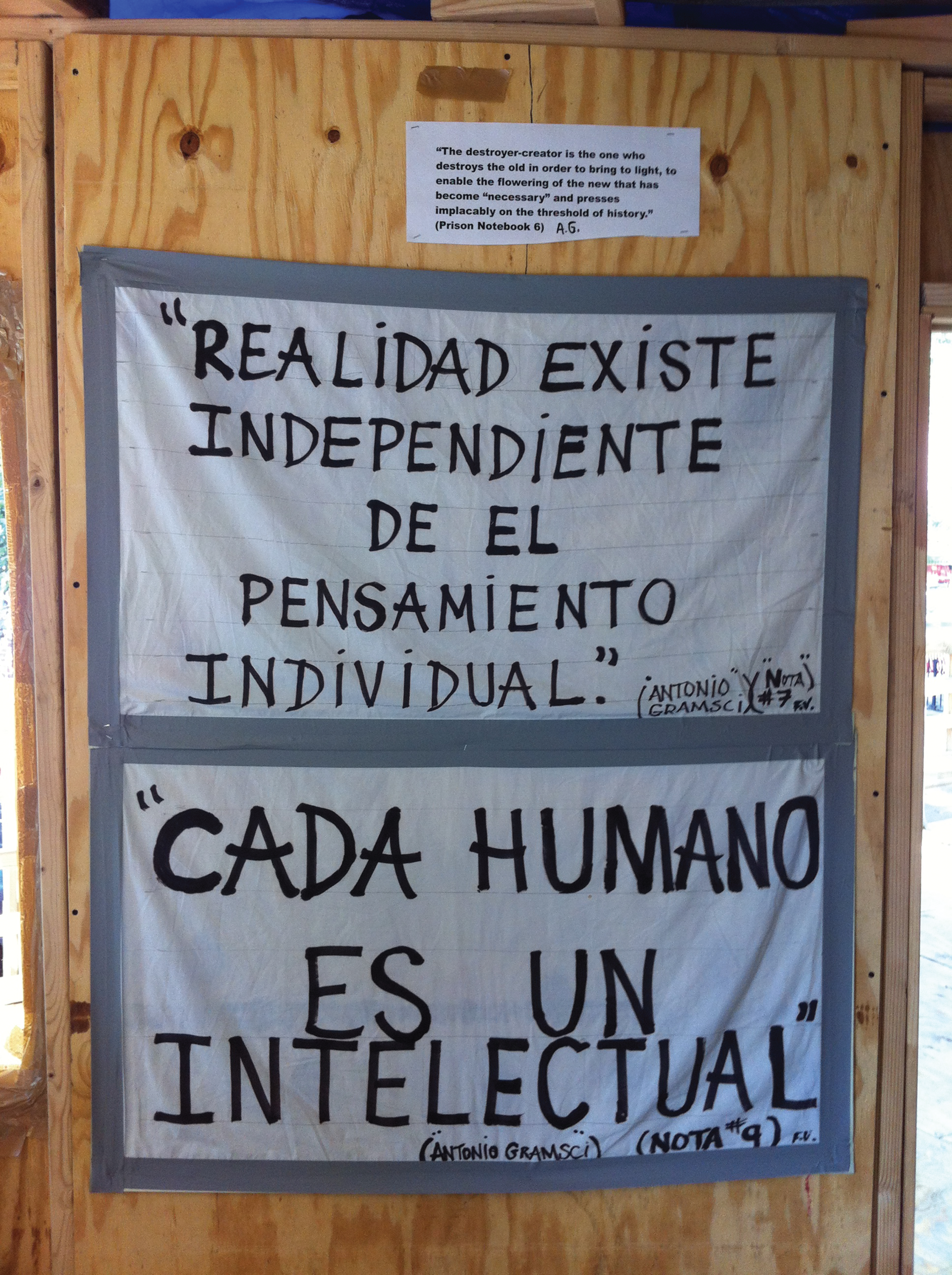
Overleaf: A work in public space by Thomas Hirschhorn produced by DIA Art Foundation New York, located at Forest Houses, The Bronx, New York City, Summer 2013. Photo credit: David Fasenfest.
Footnotes
Acknowledgements
I am grateful to Hannes Lacher who provided extensive feedback on an earlier version of this paper. I also thank to Zehra Arat, George Comninel, and Barbara Calvo for suggesting many valuable clarifications. The usual disclaimers apply.