



Abstract
This essay seeks to contribute to the development of an African-centered sociological approach to examine Africana lesbian, gay, bisexual, transgender, queer, and intersexed identities and performances. While sociologists using the most progressive approaches outline the Western hegemonic nature of Africana peoples’ perceptions of gender and sexuality, neither approach allows sociologists to view the relationship between social formations, human consciousness, and cosmological patterns. African-centered social scientists and social theorists typically determine that Africana lesbian, gay, bisexual, transgender, queer, and intersexed identities and performances are outside of Africana humanity. Within this essay, the author relies upon the Kemetic Anunian cosmology and personality constructs as sources through which to develop an African-centered framework to explain the multiple expressions of Africana gender and sexuality. This model considers that one’s gender and sexuality are contained within and inseparable from one’s higher-self that animates one’s existence. This work, then, opens the door for further theory development and praxis in the emerging field of African-centered sociology and African-centered gender and sexuality studies within the discipline of Africana studies.
Keywords
Since all that exists is only a manifestation of the absolute reality which goes beyond time and space, that which is in the realm of time and space (humans, spirits, gods, angels, neters) are all bound by its laws. (Ashby, 1997: 34)
Introduction
This essay seeks to contribute to the development of an African-centered sociological approach to examine Africana 1 lesbian, gay, bisexual, transgender, queer, and intersexed (lgbtqi) identities and performances. Taking a cue from Muata Ashby (1997) that forces comprising existence inform the social-experiential realm, this essay attempts to introduce sociologists to the possibilities of a Kemetic model of the cosmological interactive self to examine Africana gender and sexuality. While sociologists have taken seriously the business of transforming the ways African descended people think about and perform gender and sexuality, they have done so through Black cultural nationalist, positivist, intersectional, and relational approaches. Although sociologists using the most progressive approaches outline the Western hegemonic nature of Africana peoples’ perceptions of gender and sexuality, neither approach allows sociologists to view the relationship between social formations, human consciousness, and cosmological patterns. This essay proposes an African-centered sociological approach that uses the Kemetic Anunian cosmology and personality constructs through which sociologists can interpret the multiple expressions of Africana gender and sexuality.
African-centered thought, with its variations in nomenclature, 2 definitions, and usage is defined for the purpose of this work as the utilization of an African worldview as a lens of analysis (Azibo, 2001; Carroll, 2008). According to Kobi Kambon an African worldview is ‘a distinct conceptual-operational orientation to reality (or the Universe or Cosmos)….’ (Kambon, 1998: 120), reflecting the force of unity inherent within the universe. African-centered writers, therefore, attempt to examine continental and diasporan African phenomena from within an African worldview framework. The objective is to reinvigorate a continental and African diasporan collective consciousness through which Africana peoples can begin to define themselves and create their reality in relationship to the ordering patterns inherent within the universe (Asante, 1988, 2003; Azibo, 2001; Carroll, 2008; Kambon, 1998). Valorization of hegemonic Western assumptions about social reality is neither applicable nor necessary.
African-centered social scientists and social theorists typically determine that Africana lgbtqi identities and performances are outside of Africana humanity (Akbar, 1981; Asante, 1998, 2003; Azibo, 1989; Welsing, 1991). This essay is therefore also a corrective to the predominant African-centered assumptions that not only dismiss lgbtqi social experiences, but also silence the potential academic contributions of African-centered lgbtqi scholars in the area of African-centered gender and sexuality studies. This work, then, opens the door for further theory development and praxis in the developing field of African-centered sociology and African-centered gender and sexuality studies within the discipline of Africana studies.
As an attempt to develop an African-centered sociological approach, this essay does not propose that a cosmological interactive self-framework provides a definitive rationale for the existence of lgbtqi experiences among Africana people. Nor does this essay seek to negate that regardless of one’s identity and sexuality, one can create and maintain unhealthy relationships and life threatening choices that may need to be reconsidered. Furthermore, this work does not attempt to prove that same sex desire and gender identity existed in ancient Kemet in the particular ways in which Africana people in the 20th and 21st centuries create and perform these realities. This work is, however, a humble venture towards developing cosmological interpretations of Africana phenomena through an African-centered sociological lens.
A brief review of Western categories of gender and sexuality that Black sociologists and African-centered writers use to interpret lgbtqi experiences comprises the first portion of this essay. The review also highlights the need for an African-centered sociological approach and outlines the challenges that a cosmological approach may solve. The second section of the essay builds upon the first section in that it demonstrates the way African-centered theorists use cosmology to discuss Africana peoples’ thoughts and behaviors, providing rationale for the possibilities of a cosmological self-framework. The remaining portions of the essay outline a cosmological interactive self-framework. Using the ancient Kemetic origin and structure of the universe and by extension, the human personality within Kemetic psychology, this essay concludes with a detailed discussion of the model’s implications for interpreting Africana lesbian, gay, bisexual, transgender, queer, and intersexed experiences.
Gender and Sexuality in Western Discourse
Normative Western assumptions about gender are that femininity and masculinity are constructions at best and biologically organic at worst (Crooks and Baur, 2005; Fausto-Sterling, 1993; Lorber, 1994). This section briefly reintroduces concepts that Black sociologists, African-centered social scientists, and social theorists often incorporate within their interpretations of Africana gender and sexuality; they may challenge these concepts as well. Gender, then, has been defined as the ‘psychological and sociocultural characteristics associated with our sex’ (Crooks and Baur, 2005: 46). Biological research suggests, however, that masculinity is an organic behavior for biological males and femininity is the innate property of anatomic females (Crooks and Baur, 2005; Fausto-Sterling, 1993). However, according to Lorber (1994), what the West defines as feminine and masculine are socially created categories used to influence how anatomical females and males must think and behave for the sole purpose of organizing social roles and behaviors in maintaining patriarchy. Therefore one’s gender identity – how one chooses to perceive oneself within the spectrum of masculinity and femininity – can challenge these constructed categories if one feels or thinks about oneself in opposition to or across supposedly normative gender assumptions; one can transgress gender because one performs gender (Collins, 2005; Halberstam, 1998; Lorber, 1994). Transgender identity and performance and intersexed bodies demonstrate this contention. When one feels other than one’s biological sex and then identifies, performs, and even aestheticizes oneself in ways that counter typical gender performance associated with his or her biological sex, one is therefore transgender (Crooks and Baur, 2005). On the other hand, if one is born intersexed, that is, with both ‘male and female’ biological characteristics, parents and doctors choose a sex and the resulting gender expectations (Crooks and Baur, 2005; Fausto-Sterling, 1993).
Defining the terms lesbian, gay, bisexual, and queer are also important for interpreting the review that follows and the Kemetic model of the cosmological interactive self. Demystifying these terms is also important for an African-centered readership that typically collapses these designations under the term ‘homosexual’. Moreover, although most readers are familiar with the colloquial definitions of the terms ‘lesbian’ and ‘gay’, it is important for readers to understand that these terms originate within the late 20th-century gay liberation movement discourse. Although carrying historical denotations, the terms lesbian and gay challenge the late 19th-century Swiss development of the term homosexual and the diagnosis of the homosexual as pathological (Foucault, 1990; Jagose, 1996). The radically disruptive, yet categorical terms lesbian and gay, then, describe same sex desire and behavior and simultaneously encompass the intellectual attractions, the psychological attractions, and the emotional attractions, intimacies, and relationships between persons of the same sex (Crooks and Baur, 2005). Furthermore, these terms suggest an identity and a way of being in the world (Jagose, 1996).
The terms ‘bisexual’ and ‘queer’ counter the binary relationship between a normative heterosexuality and lesbian/gay identity, challenging the idea that both designations are the only possible attractions and identities. Bisexuality as identity, lifestyle or attraction does not suggest sexual activity with simultaneous multiple partners; it suggests that one’s intellectual, emotional, psychological, and sexual attractions – identity and lifestyle – are not bound by the other’s biological sex and/or gender performance and identity (Shuster, 1987). The term queer, however, challenges normative categories of masculinity, femininity, and heterosexuality. Although some lesbian, gay, and bisexual persons self-identify as queer, even non-same-sex desiring persons can identify as queer (Jagose, 1996). According to Jagose, identifying as queer means ‘[d]emonstrating the impossibility of any “natural” sexuality [;] it calls into question even such apparently unproblematic terms as “man” and “woman”’ (Jagose, 1996: 4). To be transgender, as well, means that one feels and in many instances, does what queer proposes.
Black Sociological Approaches
Since the early 1970s, several Black oriented sociologists have continued to write about non-heterosexual performance and identities among Africana peoples. Although influenced by the breadth of Western interpretations of gender and sexuality, Black sociologists interested in gender and sexuality center their discussions on interpreting complex functions of these categories within the lives of African descended people in America in particular. The brief review that follows finds that Black sociologists writing within this area tend to rely upon a Black cultural nationalist, positivist, intersectional or relational approach to examine Africana gender and sexuality in accordance with or in contrast to the varying ways Western assumptions and definitions actualize gender and sexuality.
Sociologists anchored within a Black cultural nationalist tradition posit that Africana gender and sexual identity and performance must remain consistent with the ways in which African and diasporans have historically performed masculinity and femininity. Black cultural nationalism, in its various manifestations across time and space, encourages African descended people in America to challenge Western cultural values through the reclamation of African cultural, aesthetic, and historical consciousness (Carmichael and Hamilton, 1967; Karenga, 1971). Any identity and performance that does not exude this objective deviates from ‘normal’ Africana values and promotes gender identity crisis (Hare and Hare, 1989, 1993). While the literature is unclear about what exactly defines Africana masculinity and femininity in substantive terms, biological males must not be passive and feminine (Welsing, 1991). Furthermore, theorists relying on this approach also conclude that the state engineered ‘homosexuality’ to control African descended peoples’ procreative potential (Hare and Hare, 1989, 1993; Welsing, 1991). In the final analysis, homosexual behavior exhibits a crisis of identity that threatens the stability and survival of Africana families (Hare and Hare, 1989, 1993; Welsing, 1991).
Relying on a positivist sociological approach, Robert Staples (1973, 1982, 2006) seeks to present, in plain terms, how Africana women and men perform gender and sexuality in the manner in which he observes the phenomenon. He urges readers and other Black sociologists to remain unbiased about the choices that Africana peoples make about their gender performance and sexual preference (Staples, 1982). The dominant theme within the breadth of Staples’s writings is that Africana gender and sexuality are not innately bound to biology. Similar to more progressive Western interpretations of gender and sexuality mentioned above, Staples finds that one can choose how one performs gender and sexuality (Staples, 1982, 2006). He further contends that because same sex intimate experiences can occur within continental African educational spaces, American prisons, sports teams, and other same sex institutions, one’s choice may be influenced by one’s social environment (Staples, 1982). It is also important to note that Staples does not appear to view Africana lesbian, gay or bisexual sexuality as aberrant behaviors.
An intersectional perspective is the most predominant approach within Black oriented sociological lgbtqi discourse. Patricia Hill Collins (2005) asserts that European male enslavers during the colonial period constructed categories of race, class, gender, and sexuality through which contemporary Africana peoples continue to perceive normative ideals of gender performance and sexuality. An intersectional examination of Africana gender and sexuality considers, then, that the lived experiences of race, class, gender, and sexuality result from categories and ideologies that elite European colonial men created to uphold patriarchy (Collins, 2005); gender and sexuality are therefore ideologically driven social constructions in which ‘European’, ‘male’, and ‘heterosexual’ become the normal and desirable designations (Collins, 2005). Africana people, then, strive to exist according to these designations as a means to challenge the West’s racist idea that Africana women and men are hypersexual (Collins, 2005). Borrowing from the perspective of poet-activist Audre Lorde, Collins proposes that moving towards an ‘authentic’ Africana gender and sexuality requires that Africana people are honest about how one feels within one’s body, irrespective of how masculinity, femininity, and sexuality operate within the American social political milieu. Similar to Staples’s perspective, one can choose gender performance and sexuality on their own terms.
Anthony J. Lemelle, Jr (2010) continues Collins’s discussion in his ‘Black Male Homosexual Gender Trouble’. In accord with Collins, he too suggests that heterosexuality is hegemonic (Lemelle, 2010). However, Lemelle relies on a relational approach to interpret this phenomenon. He writes ‘[r]ather that explaining social hierarchy as caused by past conditions – for example, it began with slavery – I am concerned with how hierarchies are produced in situations where representations are deployed to establish fleeting situational hegemony. Then at the root of the organization of race, gender and class inequalities are social actors’ (Lemelle, 2010: xii). From this perspective, individuals perform normative social notions of gender and sexuality, even when they attempt to transgress them. Reinforcing the hegemony they seek to challenge, many African descended gay men, for example, adopt performances and identities that mimic Western normative ideas about gender and sexuality (Lemelle, 2010); in this way, gay relationships do not challenge normative heterosexual ideologies. Given Lemelle’s interpretation, gay men of African descent have a tough time performing queerness and disrupting the very performances that heterosexuality defines.
This brief review of literature reveals that Black sociological discourse may in fact uphold many Western derived categories and the attending consciousness these terms engender. A Black cultural nationalist approach fails to define, in clear terms, the possibilities of a sexuality that reflects an African orientation, while a positivist approach only allows researchers to report findings because of the researchers’ objective posture. Specifying alternative ways for being gender and doing sexuality are not a priority among writers using an intersectionality and relational approach, although these writers force readers to reconsider how Western constructions of race, class, gender, and sexuality limit Africana peoples’ expression of gender and sexuality and operate as oppressive ideologies. Black sociological approaches, then, do not foster scholarship that relates the social world to a larger cosmological whole and therefore does not directly contribute to an African-centered sociology.
The Abnormal Homosexual in African-centered Discourse
African-centered social scientists, social theorists, and psychologists do not routinely write about lgbtqi identities and performances within the larger context of bringing about social justice for Africana peoples. When they do write about lgbtqi issues, however, the major conclusion is consistent with the very hegemonic heterosexist ideologies that several Black oriented sociologists seek to disrupt (Collins, 2005; Harris, 2009; Hunter, 2010). Similar to Black cultural nationalist sentiments, the most prominent African-centered admonitions declare that ancient and traditional African gender and sexuality, regardless of cultural grouping, is biologically based and gender roles are tied directly to specific social, economic, and political orders (Asante, 2003). According to this perspective, sexual identity and gender performance in all African groupings did not deviate from traditional African roles and if ‘homosexuality’ did exist, it was an anomaly (Asante, 2003; Ashby, 1997, 2000).
African-centered theorists also propose contemporary proscriptions for optimal psychological human functioning and healthy relationships for Africana communities on the one hand, and national development through the reconstitution of contemporary Africana families according to ancient and traditional African family structures on the other (Akbar, 1981; Asante, 2003; Azibo, 1989; Welsing, 1991). Similar to the late 19th-century Swiss diagnosis, the mainstream African-centered perspective, then, is that gender and sexual identities, performances, and desires that are other than heterosexual for biological males and females falls outside of normal, natural and healthy behaviors (Akbar, 1981; Asante, 1988, 2003; Azibo, 1989; Nobles, 2006). In fact, these suboptimal designations emerge from the appropriation of European debased sexual propensities (Akbar, 1981; Asante, 2003; Azibo, 1989; Welsing, 1991). These assumptions, then, denounce the purposeful lives of Africana lgbtqi persons, especially if one does not place all intellectual work in the service of the broader African-centered agenda, which may include lgbtqi persons, but not their immediate issues and concerns (Asante, 1988, 2003). Therefore, African-centered writers fail to consider that gender, performance, and sexuality may be inseparable from the very patterns within the universe that African-centered social scientists and theorists define as a necessary orientation through which to create an Africana social reality.
An African-centered sociology in the area of gender and sexuality moves researchers towards attempting to use African cultural values and/or worldview as a lens for analysis in creating categories beyond Western interpretations of the body and identity. In doing so, researchers (re)introduce ways of thinking about how social phenomena are also expressions of patterns comprising the universe that are embedded within an individual and collective unconscious, whether one is aware of this process or not (Bynum, 1999). Africana gender and sexual identity and performance are no longer understood in accordance with and in contrast to hegemonic heterosexuality. Using cosmology as a lens within African-centered sociology to interpret Africana gender and sexuality supplants all Western consciousness about Africana gender and sexuality in the main, even if one finds the categories lesbian, gay, bisexual, transgender, queer, and intersexed useful explanatory terms. This approach is not evident within the previously reviewed Black sociological literature.
A Kemetic cosmological interactive self-framework seeks to challenge African-centered misconceptions and contribute to an African-centered sociological approach to examine Africana gender and sexuality. African-centered discourse that promotes that social worlds are extensions of the oneness of existence occurring at the onset of creation and the forces continuously comprising and sustaining existence, necessarily informs the creation of a cosmological interactive self-framework. In doing so, the model considers that the self is part of a larger social network that extends beyond phenomenal experiences (Bynum, 1999). The self is simultaneously contained within and inseparable from one’s higher-self that animates one’s existence. The remainder of the essay is therefore concerned with fleshing out the contours of a Kemetic model of the cosmological interactive self as a contribution towards an African-centered sociology. A brief discussion of cosmology within African-centered thought follows.
Significance of Cosmology within African-centered Thought
A discussion about cosmology and its relationship to African and diasporic people’s thoughts and behaviors is impossible without clearing intellectual space around the use and definition of cosmology. In attempting to define cosmology in a way that sets the template for serious consideration of its applicability in African-centered theory development, this writer finds useful the definition of cosmology employed by spiritual practitioner Ra Un Nefer Amen who suggests that: First, [cosmology] provides an ordered and unified (synthetical) view of who and what is God, [human beings] and the forces that administrate and sustain the world. No understanding of a subject can take place without an ordered and unified presentation of its whole and parts. Second, cosmology (like all blueprints and maps) provides a framework that guides thinking and action through the vast array of seemingly unrelated life situations to the successful identification and attainment of the goal of living. It achieves this by showing how all events in a person’s life are integrally related to his/her destiny. Through it is revealed the spiritual value of each and every event in a person’s life. (Amen, 1990: 47)
Cosmology not only describes the origin and structure of the universe, but the nature of reality and the possible ways that one can begin to view the universe, including the human condition. What this definition suggests is that not only can human beings perceive that there is an order to the universe, but one can also interpret the order of the universe to guide and understand human experiences, even those that seem simple, insignificant, and mundane. In this way, every experience is a purposeful extension of the order of the universe. Amen’s definition, then, opens the intellectual path to view a direct relationship between the structure and origin of the universe and African people’s thoughts, behaviors, and experiences in the world, including destiny.
African-centered theorists rely extensively on African cosmology to explain Africana people’s thoughts and behaviors, especially in the African-centered social sciences. Informed by their readings of ancient Kemetic, Dogon, Yoruba, and other African cosmological narratives, African-centered psychologists propose that ancient and traditional Africans conclude that the origin and structure of the universe emerges from one source, and that this source unifies and sustains all phenomena in existence. On the one hand, for Kambon (1991: 131), the origin of the universe and all of existence persists in accordance with the principle of the ‘oneness of being’. On the other hand, for Azibo (2001: 424), the world and the phenomena comprising the world are ‘an interconnected and interdependent edifice, [and that] all things in the universe are interconnected and independent; [the universe and all things within it originated] by the Divine (Supreme Being, etc)’. Whether consciously or unconsciously, then, Africana people’s thoughts and behaviors are a projection and reflection of a supreme unifying source of existence. Likewise, Africana people’s thoughts and behaviors, while seemingly independent, separate, and different expressions, are interconnected and interdependent on each other and other entities, bound to the principles of the origin and structure of the universe.
Kemetic Cosmology: Anu Interpretation
It is within this African-centered tradition that this writer develops an approach for interpreting same sex desire and varying gender identities and performance. By way of example, this work considers a Kemetic model of the cosmological interactive self. In doing so, the Anunian (On, Heliopolis) cosmology in circulation within oral tradition circa 40000 BCE among the Nile Valley inhabitants takes precedent within this work, as it predates any other Kemetic narrative, including its reinterpretation as the Men Nefer (Memphite) narrative, which Shabaka reintroduces within the 25th Dynasty (Ashby, 2000; Carruthers, 1984). The Anunians scribe explanations about the structure and origin of the universe on the walls of merikuts (pyramids) just prior to 5000 BCE (Ashby, 2000). Given this chronology, the Anunian version may be the oldest ‘documented’ conceptualization of the universe. It is therefore not the intention of this writer to valorize ancient African civilizations to counter Western ideas about the value and anteriority of Greek civilization. Nor is this writer privileging Kemetic written text over any other African written or oral texts. Written Kemetic documentation is only one source through which contemporary diasporan Africans are able to investigate ancient ways of thinking and being in the material world. This point is important because the Anu’s writings represent the most ancient African expressions available about the deepest truths regarding the universe and its relationship to humanity.
Exhaustive interpretations of cosmological sources are limited herein. Interpretations of the Anu cosmology within this article are primarily grounded within the writings of Ra Un Nefer Amen and Muata Ashby in particular because both writers not only theorize about cosmology, but practice aspects of Kemetic philosophical systems. This point is significant because Amen and Ashby view the phenomenal-social world from the perspective of one who has been initiated into the esoteric nature of the Anu philosophical system, and in so doing, reads and experiences the material-social world as a reflection of the unconscious realm (Amen, 1990, 1994; Ashby, 1997, 2001; Bynum, 1999). It should also be noted that the author has also participated in an in-depth year-long initiation into the Kemetic esoteric system and therefore finds similarities between Ashby’s and Amen’s interpretations and the author’s esoteric relationship to the Kemetic cosmological system. Below, then, is a cursory review of Amenian and Ashbian interpretations of Anunian cosmology as foundation for defining a cosmological interactive self.
Anu conceptualization of the source of existence is the first concept under review. Many writings on this topic suggest that the Anunian concept for the source is Nu. Varying descriptions demonstrate the comprehensiveness of the concept. First, Nu is oneness and unconscious consciousness. Allen (1988: 4) writes that Nu is the ‘Primeval Waters, [which] reflects the Egyptians’ concept of the universe as a limitless ocean of dark and motionless water, within which the world of life floats as a sphere of air and light’. Second, Nu is all-encompassing. It is through Nu that the universe emerges, persists, and returns (Ashby, 2001). This point is significant because it considers that Nu is an ever present source. In sum, then, Nu is unconscious oneness with infinite potential to not only become and sustain existence, but interact with existence.
Modifications of Nu emerge through a creating force that the Anu conceptualize as Ntr. As the source of existence is both unconscious oneness and potential, Anu cosmology expresses that Ntr resides within Nu and creates out of Nu, extending Nu and itself as existence. According to the cosmology ‘Nothing existed in heaven or in earth, no plants, no creeping things, and no places before I [Ntr] created them out of NU, the primeval water’ (Abarry and Asante, 1996: 14). Ntr, therefore, is a force originating within Nu that brings forth time and space where awareness and experience are now active and in motion (Amen, 1994). Reviewing Ntr is important because every later creation is an independent entity, yet an interrelated and interdependent projection of Nu and Ntr, although all creation still resides within Nu.
Ntr is bound to a cyclical process of creation. When Ntr creates itself out of Nu, it is done so according to four moments of time (Amen, 1990, 1994; Ashby, 1997, 2001). Ra-Atum, literally meaning the hidden life-force, is the term the Anu use to describe this creative cycle (Amen, 1990, 1994; Faulkner, 1969). The cosmology describes Ntr bringing itself into existence as the first movement in the creative cycle. The narrative reads ‘These are the words that [Ntr] spoke after [s/he] had come into existence. I came into being in the form of Khepera, and I was the creator of what came into being, I formed myself out of the primeval matter, and I formed myself in the primeval matter’ (Abarry and Asante, 1996: 14). Another passage describing three continuous moments reads ‘I am Kheperi in the morning, and Ra at noonday, and Temu in the evening’ (Ashby, 2000: 74). Khperi, therefore, is symbolic for the moment of coming into existence. Ra reflects the effervescent, dynamic moment of existence, while Temu is the moment of decline, a movement towards the Duat, the fourth moment of time, and corollary to Amenta and Nu (Bynum, 1999). As the deepest recesses of Nu, all in existence returns to the Duat (Bynum, 1999; Ashby, 2000, 2001). Taken together as the initial pattern of creation, the four moments of time are the creative process through which Ntr not only creates itself, but through which Ntr continuously projects itself and Nu as/in all of existence.
An interrelated matrix of creative forces emerges during Ntr’s act of creation. The Anu define this matrix as the Ntru (Amen, 1990). For the purpose of clarifying this process an extensive excerpt is necessary. The cosmology reads: I could not find a standing place. Therefore, I worked a charm from my heart. I found my standing place in Maat and created all my attributes. I was alone, for I had not yet spit out Shu or Tefnut. Neither did there exist another who worked with me. I made a place in my own heart by my own will and created the multitudes of things which came into being of births, from out of the things which came into being of their births…. Shu and Tefnut, Geb and Nut give birth to Ausar, Heru-Khent-an-Maati, Set, Auset, Neb-het. In turn, their own offspring gave birth and increased the population. (Abarry and Asante, 1996: 14)
In this instance of creation, the forces described above are not yet considered part of the phenomenal realm, but part of an interlocking template that is a spiraling manifestation of the potential of Ntr and Nu. It is well documented that the Anu also refer to this matrix as a collective ba (Akbar, 1994; Ashby, 2000). The collective ba become the spiritual forces not only comprising the universe, but informing the quality and character of interactions within the universe, including later and continuous projections into the phenomenal realm (Amen, 1990, 1994). Closer examination of the Ntru is necessary backdrop for this discussion of a cosmological interactive self.
It is also through Ntru Maat that Ntr projects itself and Nu in/as the spiritual realm. The cosmology reads again, ‘I could not find a standing place. I found my standing place in Maat and created all my attributes’ (Abarry and Asante, 1996: 14). According to the passage, Maat, then, is the spiritual force that is a direct extension of Nu’s potential to reflect itself as existence. The act of projection, then, is Ntr’s creative process, reflecting a complementary opposite entity in/as existence. Maat, then, is the spiritual force governing, if you will, on the one hand, unification of the Ntru, Ntr, and Nu and on the other hand, the continuous connectivity and relationship between the Ntru. To summarize, every spiritual force depends on, attracts to, and connects with a compliment(s).
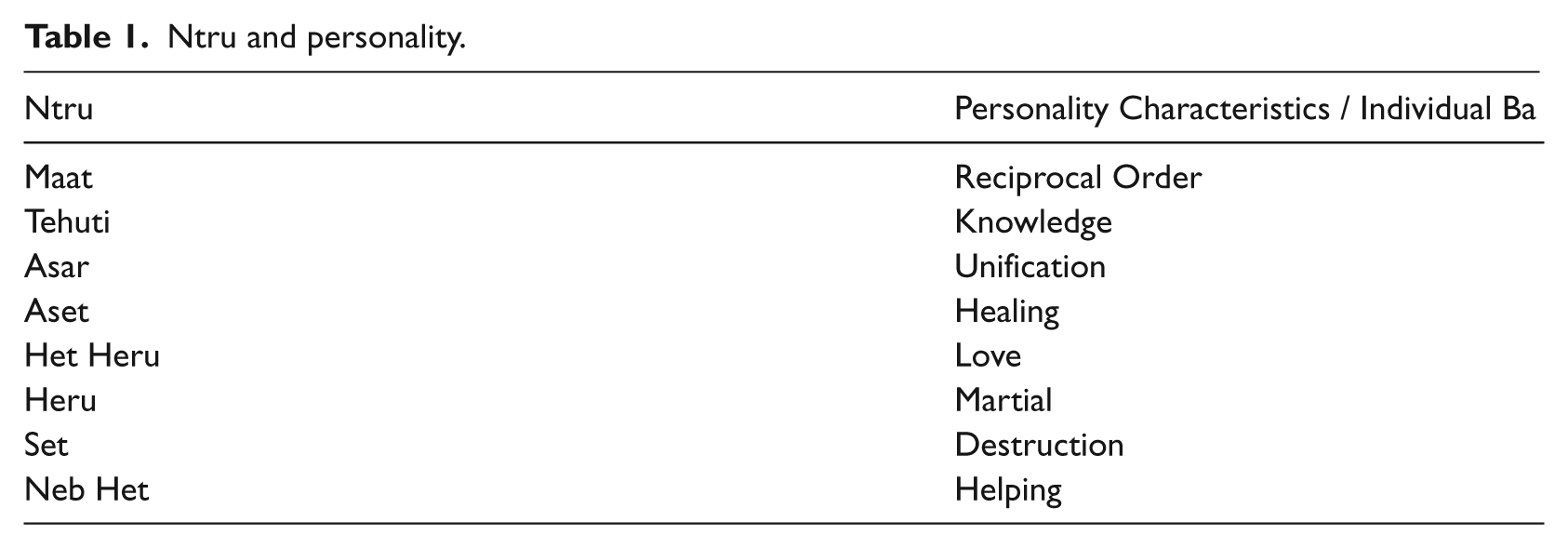
The Ntru comprising a collective ba are therefore complimenting qualities in Nu. The compliments of Shu, the potential of air, and Tefnut, the potential of moisture, emerge after the principle of Maat (Amen, 1990, 1994; Ashby, 1997, 2001). Maat’s opposite is Nu and simultaneously Tehuti. Although the Anu cosmology does not mention this force, later Kemetic cosmologies reference Tehuti as the force of ‘knowing’ the workings of Maat (Amen, 1990, 1994). Geb and Nut, the complementary potential of earth and sky accordingly, emerge into Ausar, Heru-Khent-an-Maati, Set, Auset, and Neb-het. Asar and its opposite Auset are the spiritual forces of the potential of unification and healing accordingly (Akbar, 1994). Heru is the potential of martiality and Het Heru, another later conception, is unconditional love (Amen, 1990, 1994). Divisive ego and destructive impulses equates Set and its opposite is Neb Het, a collective helping force (Amen, 1990, 1994). Collectively, then, the spiritual forces are independent, yet complementarily interrelated and interdependent.
The final part of this overview of the cosmology explores the phenomenal realm. The cosmology reads that ‘in turn, their own offspring gave birth and increased the population’ (Abarry and Asante, 1996: 14). This passage is a metaphor for how Ntr continuously manifests Ntru out of Nu to create an experiential reality. Ashby (2001: 52) conveys that ‘[t]he objects of the phenomenal universe, the sun, stars, planets, trees, animals and all living beings, arise out of the primeval ocean’. Put another way, from out of Nu, Ntr projects the qualities of the spiritual forces Shu, Tefnut, Geb, Nut, Ausar, Heru-Khent-an-Maati, Set, Auset, and Neb-het, according to the cosmology, in/as planets and planetary formations, astrological entities, galaxies, seasons, weather, bodies of water, animal and plant life, cities, housing, and economic and political infrastructures (Akbar, 1994; Amen, 1990; Ashby, 2001; Bynum, 1999). Even human cultural grouping formations, human engineered technology, and individual and collective human thinking and behaving are manifestations of the same spiritual forces (Akbar, 1994; Amen, 1990; Ashby, 2001; Bynum, 1999). As an ongoing process, Ntr creates this realm in accordance with cycles of becoming, existing, and setting out of Nu in the same manner in which Ntr creates itself and the spiritual forces; what humans witness, experience, and create, emerge in and out of existence according to the same cyclical process. Given the literature, this writer agrees with Amen (1990: 50) when he writes that ‘all that we have been, now, are and can ever be, are modifications of the Subjective Being [or Nu]’.
Kemetic Personality
The Kemetic cosmology provides structure for exploration of a Kemetic self. This section of the essay relies on interpretations about the components of the personality from African-centered psychologists, psychiatrists, and spiritual practitioners to explore the relationship between the inner workings of creation and a comprehensive system of self. The intention herein is to seriously consider the significance of the role of cosmology in shaping the human condition. A Kemetic model of cosmological interactive self, then, requires one to view the self as a spiritual force(s) comprising existence projected into the phenomenal realm. The Kemetic personality becomes a framework for a later analysis on gender identities and performance and sexuality.
The human condition exists in accordance with the cosmological structure. Major themes within the cosmology render the self to be in constant interaction with the forces comprising existence through the major components of the personality. Although researchers writing about Kemet psychology suggest that seven to nine elements comprise the Kemetic interpretation of human personality, this writer explores four of the central components relevant to the purpose of this article. Components of self include the Ntru (ba and higher self), ab (storehouse of unconscious awareness), ka (thoughts, desires, and emotions), meshkenet (destiny), and kht (biological body), all of which are indivisible from the spiritual realm (Ashby, 2000).
The most significant component of the self is all-encompassing. Anunians refer to this component of the personality as the individual ba. Often referred to as each human’s higher self, each ‘individual ba’ is a direct projection of the characteristics and temperaments of at least one Ntru in the spiritual realm (Ashby, 2000). Directly influencing the core attributes of the person in whom the projection embodies, the individual ba influences the person’s overarching motivating thoughts, feelings, and performances. The bas can also be understood as the dominant expressive overall force that animates one’s life and purpose. It is important to note here that one is usually unaware of this quality, as this influential relationship is unlike conscious embodiment of spirit, deities, or what the West incorrectly refers to as possession. According to the Kemetic perspective, what each human being performs in the phenomenal realm is nothing more than varying ‘dramatizations’ of how the force expresses itself in/as time and space. The second component of the self then is the ab, the unconscious mind that stores memories – beyond conscious awareness – of each ba induced feeling, thought, and performance that occurs within the phenomenal realm (Bynum, 1999).
Table 1 indicates the independence and interrelationship of each Ntru in the phenomenal realm. The significance of this scheme is that each human being that is a projection of Ast, for example, often thinks, feels, and performs as a healing force in the phenomenal realm and often interacts with and is attracted to interdependent opposites and vice versa, all of which perform mini continuous interchanges comprising what some refer to as the ‘drama’ of life.
Ntru and personality.
The third component of the self is the ka. The Anu define the ka as the ego aspect of the personality (Amen, 1990, 1994; Ashby, 1997, 2001). The ka is the element of the personality through which the ba expresses itself as conscious human thoughts, feelings, desires, and performances. It expresses personal distinguishable qualities, such as particular desires, passions, fears, and esteem which influence intricate, personalized thoughts, desires, and performances; in other words the ka is conscious awareness that reflects the overarching qualities of each ba in, however, a personalized and seemingly individual localized performance.
The ka is furthermore the aspect of the personality that creates ongoing experiences in the phenomenal realm based upon those experiences that have been stored in the ab. For the Anu, each person cycles through time and space with the potential of experiencing the four cyclical macro moments of time. However, even if a person does not live beyond the age of three, for example, the person exists in the phenomenal realm in accordance with this cycle. Likewise, the Anu suggest that each human being has the potential to cycle into the phenomenal realm enumerable times because each ka is both the reflection of the quality of a Ntru and the result of the continued reciprocal effect of performances in the phenomenal realm. In sum ‘[the] mind [ab] is seen as the source of incarnation (coming into being) because it contains the desires and illusions [ka] which compel a human being to be born to pursue the fulfillment of those desires’ (Ashby, 2000: 124). The fourth component, then, is meshkenet. Defined as destiny, meshkenet is the ‘individual’ life purpose, which is a direct reflection of the spiritual force of the ba played out through the ka over many lifetimes, all of which the ab stores and cyclical reciprocity mediates.
The final component for the purpose of this article is the kht. As that which the other aspects of the personality are embodied within, the kht is the densest expression of the personality in the phenomenal realm. According to Ashby (2000: 125), the kht ‘refers to the solid aspect of a human being (bones, skin, blood, sense organs, etc)’. The Anu consider the ba, ab, and ka as intangible forces, which one can come to know by examining one’s own feelings, thoughts, and performances. In contrast, the kht is a primary vessel through which Ntr projects Nu and Ntru into time and space. On the one hand, the body can be understood as a necessary site through which varying Ntru can act in/as the phenomenal realm, whether one is aware of the process or not. On the other hand, the body as ‘flesh’ is the direct projection of Geb, the potentiality of earth and therefore density, structure, and stability; the kht therefore provides density, structure, and stability through which Ntru can have experiences in/as existence.
Defining a Cosmological Interactive Self: Implications for Africana Lesbian, Gay, Bisexual, Transgender, Queer, and Intersexed Identities and Performances
The Anu cosmology and personality serve as a foundation for defining a cosmological interactive self as framework to interpret lgbtqi identities and sexualities. The framework, however, also considers the significance of Western sociological concepts of gender and sexuality. This is significant because biological sex, gender, and sexuality are concepts and experiences that can provide a familiar reference through which to discuss the Kemetic model. Interwoven within our framework below, then, is further analysis of the cosmology and personality alongside considerations of biological sex, gender identity and sexuality. The Kemetic model of the cosmological interactive self includes the following components: unlimited potential of the body, non-gendered beingness, and Maatian attraction.
Unlimited Potential of the Body
All bodies are necessarily, significantly, and directly linked to the source of existence. The first principle of creation is Nu; it is oneness and simultaneous unlimited potential. Reconsiderations of restricting biological sex (anatomical and chromosomal sex) to only male and female bodies may therefore be warranted. The two seemingly predominant bodies, that which the West refers to as female and male, project the Maatian force of complementary, independent and interdependent opposites, which undergird the structure through which creation continuously comes into the spiritual and phenomenal realms. However, Nu exists prior to Maat and subsumes and engulfs all in existence; as all bodies house Ntru, and oneness and unlimited potential are sources of existence, biological categories for sex must include intersexed persons as having viable, permissible and therefore divine bodies; for intersexed bodies have characteristics of both male and female biology. This consideration is of utmost importance because 17 of 1,000 births are of intersexed beings coming into the phenomenal realm (Fausto-Sterling, 1993). A cosmological interactive self-framework claims a body has the potential to emerge in the phenomenal realm expressing biological characteristics that are limitless, as the source of existence is unlimited potential and possibilities.
The personality also determines the sex of each body. As vessels for the ba, ka, and ab, bodies emerge in the physical realm to ensure that the esoteric portions of the personality have experience based upon not only the overarching qualities of the ba, but the interrelated experiences of the ka and ab. This process is bound to complementarity, the cycles of time and destiny (Amen, 1990, 1994; Ashby, 1997, 2001). Take for example a manifestation of an anatomical female body residing in the physical realm. While it is impossible to be precise about the reason for this particular body existing without a past life regression-reading, general assumptions can be made about the body given a cosmological interactive self framework. First, given that all creation comes into the phenomenal realm in accordance with the cycles of time, it is very possible that the ba, working through the stored experiences of feelings, thoughts, and desires, was housed in either an anatomical female, male, or intersexed body in at least one previous lifetime. Second, during this previous experience(s), for example, the ab stores thoughts and feelings, memories of, say, how the ego, acting through the body, viewed itself. Third, since Maat requires that all creations, including experiences and impressions housed in the ab, have complementary opposite qualities, the ka cycles through the phenomenal realm within a new anatomical body that will be different (opposite) from a previous body including the possibility of a different sex, stature, shape, hue, complexion, density, metabolism, etc. The point here is that one with a female body could very well have had another opposite body in a previous life based upon the particular thoughts, feelings, and desires stored within the ab (Amen, 1990, 1994; Ashby, 1997, 2001).
Non-gendered Beingness
A cosmological interactive self framework requires that the ba takes precedence in reconsidering gender and gender identity. Egyptologists, Kemetic spiritualists and Afrocentrists alike discuss the Ntru in relationship to static biological sex categories and gender assumptions (Amen, 1990, 1994; Akbar, 1994; Ashby, 1997, 2001). This perspective is rational given that the symbol of each Ntru is either male or female, even when animals represent the Ntru. However, a rereading of the symbolism of Ntru Asar may provide new insight into the possibility of a cosmological interactive self reconsideration of gender and gender identity.
Asar is the Ntru that represents the force that is the potential for human thoughts and behaviors in the phenomenal realm to reflect knowledge and application of the structure of the universe. Accordingly, Asar represents the human potential for unification with the spiritual realm. However, from a Western perspective, the Kemetic symbolism of Asar seems biologically male and masculine. Examination of Asar wearing the white Atef (crown) with arms crossed and holding crook and flail, signifies seemingly masculine qualities of leadership and justice (Mess and Salim, 2003). Moreover, Asar’s facial structure has seemingly male features. Given the visual symbolism of Asar, it seems that what the Anu propose is that the most optimal human functioning within the physical realm is that which is defined as male and masculine.
The symbolism of Asar, however, transcends gender and biological distinctions. The white Atef (crown), the crook, and flail seem like masculine adornment, from a Western perspective, but these symbols convey the human effort it takes to recognize one’s ba characteristics through their thoughts, feelings, and desires – ka – and discover one’s destiny in relationship to one’s ba (Ashby, 2001). The white Atef signifies that purity (lightness) of mind is key for leading a life in accordance with one’s overarching qualities (Mess and Salim, 2003); and the crook and flail represent that it takes cultivation and persistence to develop and sustain an intuitive perspective in fulfilling one’s life purpose and destiny (Mess and Salim, 2003). Asar’s adornments are not masculine imagery; they are non-gendered. Egyptologists and the like may have relied on a masculinist and patriarchal gaze to interpret Kemetic symbolism. Therefore, if one can render the accentuating adornment of Asar’s male body as non-gendered, what then is the significance of Asar’s presentation as male in the imagery? Asar is also a metaphor for the meaning and significance of male leadership within Dynastic socio-political governance. The use of the male body as a symbol was relevant for Kemetic social order, but insignificant for contemporary use of the symbol within African-centered interpretations.
The example of Asar provides a model for defining the ba as the primary sociological characteristics that the West describes as gender. Reviewing Table 1, the qualities of the Ntru are creative experiential energies that form the core of the psychological qualities that the West refers to as masculinity and femininity. That is to say, given the unlimited possibilities of the body, a biological female may house the ba of Asar or the ba of Heru, a vigilant force. Likewise an intersexed body or biological male may house the ba of Aset, a nurturing force, or the ba of Het Heru, a loving force. The ka of the biological female may feel, think, and perform a type of masculinity, according to Western assumptions, while the ka of an intersexed person or biological male may feel think and perform a type of femininity. In both examples, either ka may in fact feel and think and therefore identify with the opposite biological sex, defining oneself as one feels and thinks and therefore performing what the West would consider a myriad of identities and performances from transgendered to androgyny. What this framework also proposes is that in whatever way the ba moves one to feel, the feeling is part of one’s destiny and one should be able to adorn oneself as well in accordance with how one feels. At this juncture it is important to remind the reader that the ka, however, determines the particular body the ba, ab, and ka inhabit. The point here is that gender identity and performance from the perspective of a cosmological interactive self framework claim that all beings are inherently non-gendered and that the source of identity and performance is primarily the ba, a projection of at least one force comprising the spiritual and phenomenal realms. All identities and performances are an individual expression of a Ntru.
Maatian Attraction
The idea that sexual attraction is initially an attraction between bodies (and testosterone and estrogen) is not a feature of the cosmological interactive framework. As Ntr relies on complementary opposites or Maat to create the spiritual realm and by extension the phenomenal realm out of oneness and unlimited possibilities, sexual attraction within this model is the creative potential of complementary opposite bas. Returning to Table 1, Aset is the complementary opposite of Asar, for example. Likewise, Set, the force of destruction, is the complementary opposite of Neb Het, the force of helping and rejuvenation. However, Set is also the complementary opposite of Asar, the force of unification. Further, as each ba is the complementary opposite of Nu or oneness and potential, the complementary opposite of Asar can also be itself. Interpreting the cosmology from this perspective, then, defines complementary opposites as neither insular nor static, but replicated continuously. Bas can vacillate between varying complementary opposite projections, including itself, given that all creation is interconnected and interdependent projections of oneness and potential. These attributes bind the bas together and determine which bas interact with each other, inherently creating further oneness and unlimited potential in interacting with each other. Therefore, as each being is a ba, what the West refers to as sexual attraction is the potential of complementary opposite bas to also experience and create oneness and unlimited possibilities through their attractions and interactions. However, oneness and unlimited possibilities in the phenomenal realm may not always be optimal or healthy expressions of the ba. Given that all feelings, desires, and experiences are stored in the ab, the ba will always attract its complementary opposite, but the ka could very well mete out what one would consider suboptimal or unhealthy experiences in recompense; all is bound to Maat.
Sexual attraction and sexual interactions are purposeful beyond the arousal experienced and the temporary happiness that it seems to cultivate (Ashby, 2005). Sexual attraction can be the gateway to extend or increase the oneness of and possibilities within the phenomenal realm. Many African-centered scholars adhere to this principle in their call for Africana people to participate in so-called heterosexual procreative practices to multiply and sustain the nation (Clarke, 2000; Hare and Hare, 1989, 1993; Welsing, 1991). On the other hand, given that all kas have accumulated varying experiences effecting hopes, fears, desires, passions, and self-esteem, which in most instances have inhibited one from becoming aware of the ba within oneself, sexual attraction and sexual interactions can occur for the purpose of healing each other’s ka (Williams, 2010). Healing in this instance can occur consciously or unconsciously, moving one towards oneness with the ba by reducing the accumulations of experiences within the ab that hinder the ka from a conscious awareness of the working of the ba’s life purpose and destiny (Williams, 2010). Thinking about attraction in this way challenges the normative definition of sexual attraction by calling into consideration the intellectual, psychological, and emotional connections of opposites for the purpose of attempting to achieve a sense of oneness and potential of the ba.
Same sex desire functions in the same capacity. If any ba can inhabit any body of any biological sex and bas attract their complementary opposites in accordance with the accumulations of feelings, thoughts, and experiences in the ab, then what the West refers to as lgbtqi identities and experiences are normative possibilities. A cosmological interactive self-framework finds that all forms of same sex desire – lesbian, gay, bisexual, and queer identities – also occur for complementary bas to experience and create oneness and unlimited possibilities through their attractions and interactions. Same sex desire is expressive of and bound to the source and foundation of both realms.
Critiques of same sex desire abound, however, and are necessary in the same way as criticism of any unhealthy relationships are productive. The most penetrating and pervasive critique about same sex attractions, however, are that they are based on biological needs, especially when these attractions occur in segregated boarding schools, jails, and prisons (Asante, 1988). While this writer does not support coercive and manipulative exchanges between bas in any capacity, as mentioned above, each ka experiences reality not only as an expression of a ba, but in response to optimal or suboptimal action, attracting either optimal or suboptimal experiences in return. Therefore same sex desire seemingly occurring amongst isolated and confined biological sexes can either be optimal or suboptimal in relationship to each being’s ka and ab and the experiences that the ka endures.
This framework unapologetically asserts that same sex optimal attractions can undoubtedly be intellectual, psychological, and emotional connections of complementary opposites and can furthermore serve the purpose of healing the ka, in the same manner as mentioned above. By way of an example, this writer offers a personal account of complementary bas in action. This writer’s ba is Sekhmet, a Ntru identified within the Men Nefer cosmology as the force of destruction and rebuilding, the complementary opposite of Ptah, the force of creation. Het Heru, the force of love, is also a complementary opposite of Sekhmet (Ashby, 1997). The West may perceive the somewhat forceful and aggressive performance of Sekhmet’s energy as less feminine, although the Men Nefer reference to Sekhmet is always she. Nonetheless, even before this writer was given the name Sekhmet during initiation as an expression of the individual ba, feeling other than biologically female and performing with mannerisms that appear less feminine from a Western perspective, felt normal, natural, and comfortable. Moreover, most intellectual, psychological and emotional connections – so called sexual or intimate – typically occur with biological females whose ba is Het Heru. In every relationship with Het Heru, healing of each ka occurs according to its fullest potential, seeking wholeness between the ka and ba. For example, learning how to temper criticisms and frustrations through discernment as well as learning to love and trust others after a lifetime of continuously, suddenly losing immediate family members is always this writer’s path to healing; this process is an experience that the force of love, Het Heru, teaches. From Sekhmet, Het Heru learns how to confront suppressed trauma that hinders the capacity to love fully, honestly, and openly. Although the duration and specificity of each relationship varies, the broader potential of each relationship between Sekhmet and Het Heru remain consistent given each ba, ka, and ab. The point here is that lgbtqi identity and desire, if understood in the framework of a cosmological interactive self, can be purposefully divine and unquestionably a part of one’s destiny.
Conclusion: Moving Towards an African-centered Sociological Framework
Honest bodies strive to treat the mental, spiritual, and physical aspects of being as interactive and synergistic. No one element becomes privileged over others. Because honest bodies as described by June Jordan rejoin the mind, soul, and body, they become in one sense free. Starting with the mind, by interrogating one’s own individual consciousness, is essential (Collins, 2005: 283).
An African-centered sociological approach to examine Africana lesbian, gay, bisexual, transgender, queer, and intersexed realities is a radical possibility for generating critical interpretations that transcend Western concepts and ideologies about the body, masculinity, femininity, and sexual desire. More specifically, the Anu origin and structure of the universe and the cosmological-centered human personality provide keen insights for moving Black sociologists in the area of Africana gender and sexuality towards using an African-centered sociological approach. Agreeing with Collins’s (2005: 283) reminder about an honest body, the author encourages Black sociologists in the area of Africana gender and sexuality and African-centered social theorists to take into account that interpretations of lgbtqi realities can include the ‘mental, spiritual and physical aspects of being’. Concepts of an unlimited potential of the body, non-gendered beingness and Maatian attraction take the experiences of lgbtqi people to an entirely new plane. An African-centered sociological approach queries the researcher to think about social beings as:
A projection of the source of existence that is non-gendered, but inherently filled with oneness and unlimited potential.
A projected entity that has particular overarching qualities that determine macro-experiences in accordance with the ebb and flow of complementary opposites.
A body that is an expression of complementary opposites, oneness, and unlimited possibilities.
A being that has sexual attractions for the purpose of slowly moving towards healing from the feelings, thoughts, and experiences housed within the ab and thereby limiting its impact on the ka, regardless of biological similarities or differences.
Always on a path to understand the ba self, life purpose, and destiny regardless of so-called gender, gender identity, and performance or same sex desire.
If sociologists and African-centered social scientists and theorists begin to define social beings in this way, readers of these analyses may begin to feel free enough in their bodies to recognize that she or he is nothing more, nor less, than a cosmological being.
Footnotes
Acknowledgements
This work is dedicated to the ongoing struggle for the emancipation of our consciousness from a three-dimensional reality. Medase (thank you) to Karanja Keita Carroll, Linda F. Williams, Deanna Prentice, and Felicia Webster for their critical comments on versions of this work.
Funding
This research received no specific grant from any funding agency in the public, commercial or not-for-profit sectors.