



Abstract
In recent decades, sports franchises have exploited their privileged relationship to the state in order to expand the scope of their local monopoly powers. This article examines efforts by the owners of the United Center, the home arena of the Chicago Bulls and Chicago Blackhawks, to eliminate competition from local peanut vendors. The owners benefited from court rulings rejecting the legitimacy of government intervention in local markets at the same time that they successfully lobbied municipal politicians to intervene on their behalf by passing anti-vendor legislation. This story not only offers a case study in how teams’ monopolistic privilege has extended to concessions markets, but also contributes to a broader understanding of how the neoliberal state works to minimize risk and maximize profitability for large-scale real estate investments like sports arenas. The methodological approach is interdisciplinary, drawing on legal and business history, urban geography and sociology, and radical political economy.
Introduction
When the United Center opened its doors on Chicago’s Near West Side in 1994, the new state-of-the-art arena offered the ultimate in fan experience. Chicago Bulls season-ticket holders suffering through the first of Michael Jordan’s many retirements could at least take solace in the ‘carbon dioxide-powered condiment dispensers’, the ‘computerized heating and cooling system’, or any other of the United Center’s many accoutrements ‘designed to pamper paying customers’ (Borden, 1996: 17). But for fans who had relished the traditional feel of the old Chicago Stadium, where the Bulls made their first three championship runs of the 1990s and where the Chicago Blackhawks hockey team had recently brought home a conference championship in 1992, something more than Michael Jordan was missing from the new arena. Peanuts, the snack food of choice for thousands of fans, had simply disappeared. Fans could not buy them inside, and the vendors from whom they used to buy them outside the old Chicago Stadium had vanished.
The disappearance of peanuts from the United Center might seem like the logical outcome of professional franchises’ efforts in recent decades to cater to fans with a taste for luxury. As economist Robert Baade (1996) explains, by the 1980s the desire to identify new sources of revenue and adapt to growing income inequality among fans had led team owners to covet new, classier arenas, where luxury box suites leased for hundreds of thousands of US dollars a year. According to Baade, the upward redistribution of wealth in the United States which began in the late 1960s (and accelerated in subsequent decades) also coincided with greater demand among fans at the top of the socioeconomic ladder ‘for the luxury seats and amenities that are critical to the financial success of the new generation of stadiums’ (1996: 7).
While some members of this elite clientele may have preferred caviar to peanuts, the disappearance of the latter was not about falling demand. After all, the United Center continued to offer low-brow concessions like hot dogs and watered-down beer. In fact, Bulls owner Jerry Reinsdorf and Blackhawks owner Bill Wirtz (the two jointly owned the United Center) waged an aggressive campaign against the mostly African-American peanut vendors in an effort to monopolize local concessions sales. Using a prohibition on food brought into the arena from outside, the team owners wiped out the livelihoods of local vendors who had sold to fans for decades. When the peddlers fought back by mounting a legal challenge, Reinsdorf and Wirtz benefited from a prevailing judicial logic that prioritized monopolists’ freedom to operate unhindered by state intervention. At the same time, the team owners convinced local politicians to push through a municipal ordinance barring the vendors from around the arena. The legislation ensured the elimination of economic competition regardless of the opinion of the courts and criminalized the presence of local workers who threatened the image of the United Center as a comfortable environment for moneyed fans.
The recent history of peanuts at the United Center provides a micro-economic and micro-historical case study of how professional sports franchises have exploited their relationship to the state in order to expand their already extensive monopoly powers. When state intervention offered a means by which to solidify the arena’s new concessions monopoly, Reinsdorf and Wirtz welcomed such intervention with open arms, despite having paid their lawyers to argue in court that allowing the state to get involved on behalf of the vendors would violate the arena owners’ ‘right’ to maximize revenues. This ideologically inconsistent business strategy capitalized on what political economists describe as the state’s increasing willingness at the end of the 20th century to act as a guarantor of profitability, predictability, and risk reduction for private firms (Galbraith, 2008; Harvey, 2005).
Monopoly Power and Professional Sport in the United States
The role of monopoly power in the US sports business has drawn considerable scholarly attention because of the special protections from antitrust policy enjoyed by professional leagues. Since the Supreme Court handed down a 1922 ruling granting Major League Baseball an exemption from antitrust action that might have prevented certain league mergers, American courts as well as the Justice Department have taken what economists James Quirk and Rodney Fort (1999: 134) describe as a ‘hands-off position’ regarding anti-competitive behaviors by sports leagues. Labor economists and lawyers have published extensively on how leagues have limited the mobility and earning power of players through mechanisms such as amateur drafts and salary caps (Fort, 2003; Leeds and Von Allmen, 2002; Staudohar, 1996), and while the emergence of players’ unions during the second half of the 20th century placed limits on these practices, leagues and teams have long enjoyed unchallenged monopoly power in other regards. For example, the government-sanctioned cartel structure of professional sports, which allows leagues to unilaterally restrict the creation of new franchises, has maintained an artificially high demand for teams in North American cities. The ‘exclusive territorial franchise’ granted to team owners by their respective leagues has not only shielded them from price competition, but has also made it easy for them to use the threat of relocation to extract massive public subsidies for new facilities (Quirk and Fort, 1999: 118).
Taken together, existing scholarship confirms that the professional sports industry has long embodied the cynical tendency of American political and economic elites to flaunt ‘free-market’ ideology at the same time that they welcome regulation that guarantees the profitability of big business. This scholarship has, however, paid scant attention to recent efforts by teams to restrict access to concessions markets, and little has been written about the local struggles over market access sparked by such efforts. Recounting the battle over peanuts around the United Center reveals how the professional sports business has profited from the resurgence of a culture of corporate impunity in which monopolies and oligopolies embrace both ‘free-market’ dogma and government intervention, depending on which has the preferred impact on their bottom line.
To reiterate, monopolistic practices were nothing new in the sports business when Reinsdorf and Wirtz got rid of the vendors from the sidewalks around the arena. However, the purge signaled more than a simple continuation of the privileged market position enjoyed by leagues and teams for most of the 20th century. It marked a calculated effort to expand the boundaries of franchises’ market dominance. Before the luxury arena and stadium boom of the late 1980s and 1990s, independent concessions vendors remained outside the reach of teams’ monopoly power, and the predatory tactics used to remove them from venues like the United Center signaled the creep of franchises’ anti-competitive behavior beyond the realms of players’ salaries and local franchise rights. The narrative that follows confirms that the recent business history of professional sports supports the conclusion of Foster et al. (2011: 2) that the power of monopolistic and oligopolistic firms ‘is demonstrably stronger in the opening decades of the twenty-first century than ever before’.
Of Food Bans and ‘Free-Market’ Monopoly
In 1985, after a stint in the Peace Corps, Charlie Beyer returned to Chicago without much of a plan. The only thing he knew for certain was what he didn’t want: a suit and a nine-to-five job. So, pretty much on a whim, he decided to try his luck as an independent peanut vendor on the sidewalks surrounding Wrigley Field. The gig ended up lasting over a decade, during which he sold peanuts and programs to fans outside of Wrigley, the old and new Comiskey Parks, Soldier Field, and Chicago Stadium. According to Beyer, the old Chicago Stadium – the home of the Bulls and Blackhawks before the construction of the United Center – offered vendors the best access to potential customers relative to the city’s other big-ticket sports facilities. ‘The thing about the Stadium was that it was the most liberal of any of the places’, Beyer remembers. ‘There we were standing right by the entrance doors at each of the gates. I still remember when I first saw that I went, oh my goodness now this is amazing, being allowed to do this – this is incredible’ (interview with Charlie Beyer, 2011). 1
The other peanut vendors working the gates of Chicago Stadium tended to come from backgrounds different from that of Beyer, who was white and college-educated. Most of the 50 or so peddlers who sold peanuts were African-American (Joravsky, 1995a; Strausberg, 1995). ‘People definitely saw me as a novelty’, Beyer recalls, ‘and people definitely said, “What are you doing out here?”’ (interview with Charlie Beyer, 2011). Most of the black vendors came from poor neighborhoods on the west and south sides of Chicago. Some had few if any employment options aside from vending, some sold peanuts in order to supplement other wages, and in a few cases, the vendors were elderly men who used the cash from their sales to pad meager social security checks. Vendors could pull in a few hundred US dollars before a game on a good night, and generally worked at multiple venues (interview with Charlie Beyer, 2011; Joravsky, 1995b).
In the late 1980s, structural shifts in the professional sports business began to threaten the vendors’ position outside of Chicago’s stadiums and arenas. As economists Roger Noll and Andrew Zimbalist (1997: 8) point out, up until the 1980s, the vast majority of pro teams’ revenues came from ticket sales, ‘with minor additional amounts collected from concessions, publications, and in-stadium advertising’. However, things began to change during the 1980s as teams focused on transforming their venues into all-inclusive entertainment zones for fans with the resources to buy not just tickets, but a total experience that included gourmet food and limited edition souvenirs. As a result, concessions revenues shot up for teams with new facilities. For example, in 1989, concessions sales at the Charlotte Hornets’ new arena approached US$4 million, more than five times the take at older venues like the Portland Coliseum (Quirk and Fort, 1992). Data tabulated by Financial World magazine shows that venue-related revenues for the Bulls and Blackhawks, of which concessions sales made up a significant chunk, skyrocketed after the United Center opened (Table 1).
Venue-related revenues for the Chicago Bulls and Chicago Blackhawks, 1992–6.
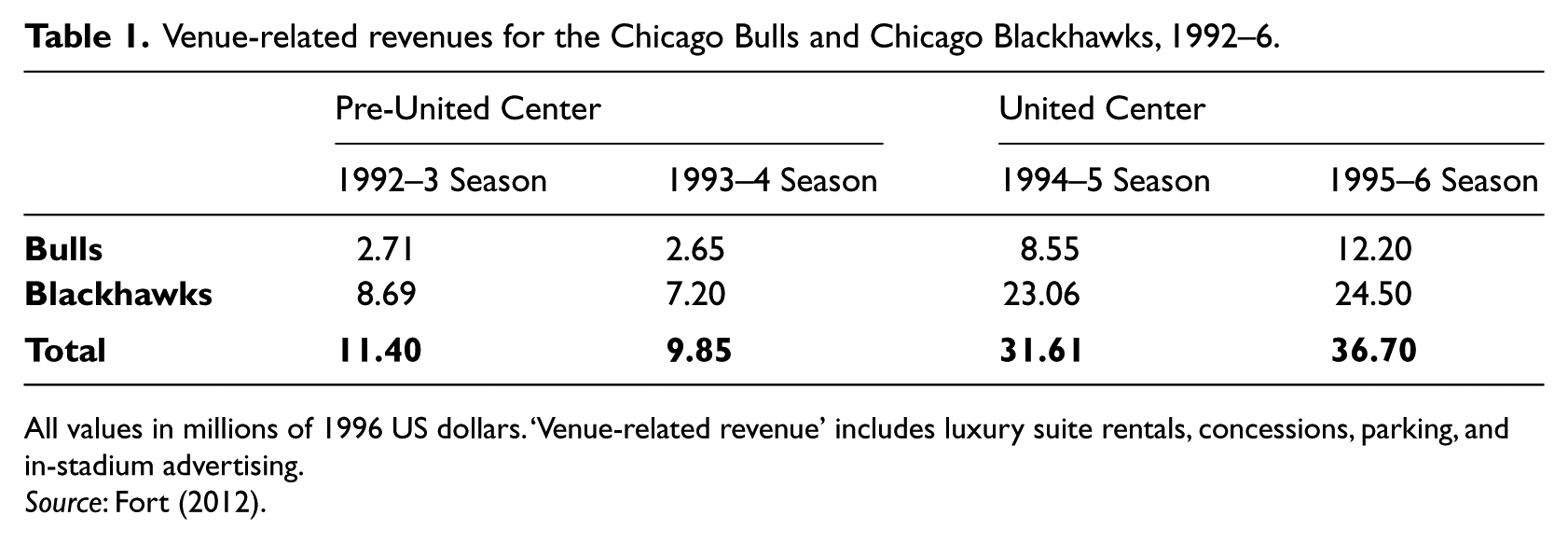
All values in millions of 1996 US dollars. ‘Venue-related revenue’ includes luxury suite rentals, concessions, parking, and in-stadium advertising.
Source: Fort (2012).
In cities like Chicago, Denver, and Pittsburgh, the heightened stakes of concessions sales sparked efforts by stadium owners to eliminate competition from independent street peddlers (Barnes, 1995; Simpson, 1996). Vendors in Chicago first felt the squeeze outside of Wrigley Field in 1988, right after the Cubs installed lights and began playing a limited schedule of night games, which increased the surrounding neighborhood’s cachet as a trendy hangout. Soon after Wrigley’s lights went on, the local alderman mounted a public campaign against the vendors, claiming that they were ‘harassing’ Cubs fans. By 1990, the City Council had passed an ordinance barring the sale of concessions on public streets and sidewalks in the ward containing the historic stadium (Hanania, 1989; Spielman, 1990).
While the vendors continued to work the gates of Chicago Stadium during the late 1980s and early 1990s, other venues shut them out. In 1993, two years after the new Comiskey Park opened on Chicago’s south side, the City Council passed an ordinance that banned all forms of peddling on public property within 1000 feet of the facility. Local officials alleged that the vendors presented a ‘safety hazard’ by impeding foot traffic (Davis, 1993). The vendors’ only recourse was to try to sell peanuts to cars exiting the nearby off-ramps of the Dan Ryan Expressway, but this proved largely unsuccessful. By the end of 1993, the peddlers around Comiskey were finished (interview with Charlie Beyer, 2011). Soldier Field, the home of the National Football League’s Chicago Bears, came next. In April 1994, ‘at the request of downtown community groups and businesses’ intent on eliminating competition during World Cup matches held at Soldier Field, the City Council created a no-peddling zone encompassing most of the Loop and Near South Side, an area that included the historic football stadium (Davis, 1994).
When the City Council initiated the purge from the sidewalks in the Loop, the United Center was only a few months away from opening, and the vendors sensed that their days selling outside of Bulls and Blackhawks games were numbered. Mark Weinberg, who sold an alternative fan program called The Blue Line outside of Chicago Stadium before Blackhawks games, remembers the vendors who peddled outside the other venues commenting on how they had been, in his words, ‘fucked’ by the various ordinances (interview with Mark Weingberg, 2011). 2 They predicted that once the Bulls and Blackhawks transitioned to the new facility, the teams would move to push them out. ‘The pattern had already been established’, Beyer recalls. ‘Lights at Wrigley, vending ordinance; new stadium at Comiskey, vending ordinance’ (interview with Charlie Beyer, 2011). In their mind, it was only a matter of time.
The Bulls and Blackhawks proved the vendors right, but instead of an anti-peddling ordinance, the teams instituted a ban on all outside food items in the United Center immediately after it opened in 1994. The fact that the old Chicago Stadium allowed fans to bring in peanuts purchased outside, combined with the relatively cheap prices offered by street vendors, had ensured a steady stream of business for the peddlers before 1994. While some fans continued to purchase peanuts from the vendors and sneak them inside, the food ban discouraged most of them, and the peddlers’ revenues plummeted. Thornton Elliott, one of the elderly African-American men who peddled peanuts outside the arena, packed up for good not long after the ban went into effect. ‘I guess most fans figured, what’s the use of buying peanuts if you have to sneak them in?’, Elliott told Chicago Reader reporter Ben Joravsky (1995b). ‘I used to make $300 at a Blackhawks game. That first preseason game I made $40. The next game I made $22. It wasn’t worth it’ (Joravsky, 1995b).
Because he peddled programs rather than peanuts, the food ban didn’t cut into Weinberg’s sales the way it did those of the peanut vendors. Nevertheless, the ban irked Weinberg, who viewed it as Reinsdorf and Wirtz ‘stepping on people who were powerless’ (interview with Mark Weinberg, 2011). Weinberg was even more of an anomaly amongst the vendors than Beyer. Raised in Highland Park – the same affluent north side suburb where Reinsdorf lived – Weinberg graduated from law school at the University of Chicago, and went to work for Katten Muchin Zavis, a high-powered Chicago law firm. However, he walked away from the firm to pursue what, by that time, had morphed into an all-consuming passion: lambasting the dismal performance of Chicago Blackhawks management and in particular the questionable business practices of owner Bill Wirtz. In 1991, Weinberg started publishing The Blue Line, which contained spoof advertisements and merciless satires of Wirtz. One issue from 1995 featured a cartoon depicting Mr Peanut handcuffed, escorted at gunpoint by arena security (Figure 1).
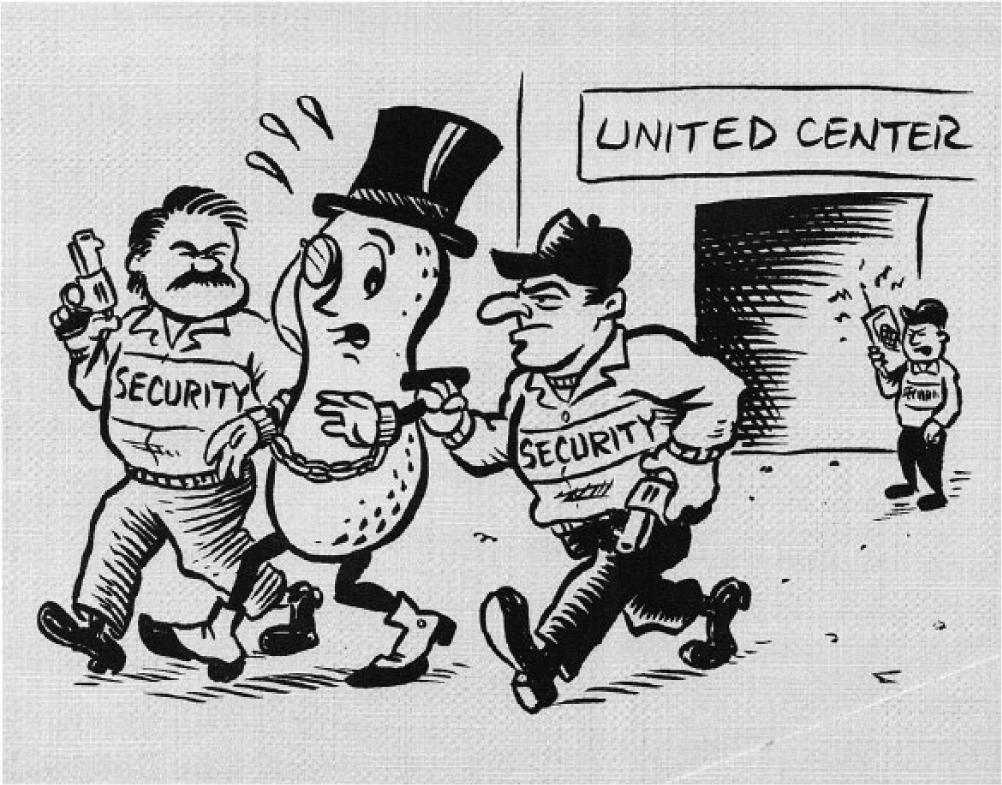
Mr Peanut gets the boot from the United Center.
Weinberg’s response to the food ban didn’t stop there. Even though fans could still bring The Blue Line into the United Center, he couldn’t stomach the fact that Reinsdorf and Wirtz had stomped out the livelihoods of a group of men trying to scrape by. So, in September of 1995, after convincing 18 of the peanut vendors who had worked outside of the United Center to sign on as plaintiffs, Weinberg filed suit against United Center ownership, alleging that the food ban constituted a violation of the Sherman Antitrust Act’s provisions against ‘predatory’ monopolization. The suit called for a preliminary injunction against the ban and demanded that the United Center pay damages to cover what vendors claimed amounted to over 500,000 US dollars in lost income (Elliott v. United Center, 1996).
The success of the plaintiffs’ suit depended on more than simply proving that the United Center had established a monopoly on food concessions, since, according to the Sherman Act, a monopoly does not in and of itself warrant intervention. To warrant legal action, a monopolist must ‘maintain or enhance monopoly power improperly’ through ‘exclusionary, anticompetitive, or predatory conduct’ (Elliott v. United Center, 1996). In other words, the US government has accepted the existence of monopolies so long as they result from ‘fair’ competition in which one firm comes to dominate a particular market by offering a product that consumers prefer to that of competitors, rather than by using coercive methods such as political favors or collusion. The government sanctions the former type of monopoly as ‘innocent’.
Weinberg and the plaintiffs argued that the monopoly on concessions established by the ban was not ‘innocent’ since it deliberately established a barrier to entry that had nothing to do with consumer preference. They contended that the monopoly actually harmed consumer welfare by preventing Bulls and Blackhawks fans from taking part in the longstanding ‘tradition’ of purchasing peanuts on their way to games. They also pointed out that the arena constituted an ‘essential facility’ for the sale of peanuts in Chicago. Sherman prohibits proactively denying a competitor use of a facility – even in the case that the firm denying access owns the facility – ‘that cannot reasonably be duplicated and to which access is necessary if one wishes to compete’ (Elliott v. United Center, 1996). Weinberg and the plaintiffs insisted that the United Center qualified as such a facility, and by extension that the owners were prohibited from taking direct or indirect measures impeding vendors’ access to United Center patrons. Initially, they appeared to be on strong footing regarding both claims. It seemed clear enough that the vendors had gone out of business not because of their inability to offer a competitive product, but rather because of a United Center policy that erected an artificial barrier between the peddlers and fans. Moreover, precedent already existed for treating sports arenas as essential facilities (Fishman v. Wirtz, 1981).
Despite the seeming strength of the vendors’ claims, Rebecca Pallmeyer, the district court magistrate judge who first considered the suit in February 1996, denied the request for a preliminary injunction and, in turn, rejected each of the legal rationales offered by Weinberg and the plaintiffs. According to Pallmeyer, the ban did not single out peanut vendors in a ‘predatory’ fashion, since it applied to ‘food’ in general rather than peanuts alone. With regard to the ‘essential facilities’ argument made by Weinberg, Pallmeyer insisted that she found no ‘reason to conclude that, regardless of the popularity of peanuts at the game, professional sports games are the only places that peanuts can be sold or consumed’ (Elliott v. United Center, 1997). In theory, she reasoned, the vendors could sell their snacks in other, unspecified locations within the city. Diane Wood, one of the two judges who subsequently upheld Pallmeyer’s findings when the case reached the Seventh Circuit Court of Appeals in 1997, added that since the United Center announced that it would not sell peanuts inside, Reinsdorf and Wirtz were not actually engaged in the peanut market. ‘The United Center is obviously not monopolizing the market for peanuts’, Wood explained, ‘it is staying strictly out of the peanut business’ (Elliott v. United Center, 1997). But even had the arena continued to sell peanuts, the courts reasoned, the ban would be no different than the long-accepted practice of movie theaters confiscating candy purchased outside. While both Pallmeyer and Wood acknowledged that the ban posed real difficulties for the peddlers, they agreed with the defendants’ attorneys that these hardships constituted a non-discriminatory outcome of the team owners’ ‘legitimate desire to maximize profits’ through ‘operating the United Center as a business’ (Elliott v. United Center, 1996).
Even if the opinions written by Pallmeyer and Wood made sense in the abstract, the assumptions underlying them bordered on the preposterous. In particular, Pallmeyer’s suggestion that ‘access to United Center fans is simply not essential to peanut sales’ exemplified the dissonance between her legal reasoning and the reality faced by the vendors (Elliott v. United Center, 1996). In theory, the peanut vendors had the ability to set up shop on any public street corner in Chicago. But, as the plaintiffs argued, the tradition of vending peanuts outside sporting events meant that there was no conceivable way that Chicagoans passing a random street corner constituted a market comparable to hungry basketball and hockey fans. Unlike a convenience store near the arena, which could plausibly survive despite the food ban since its customer base would extend beyond United Center patrons, the vendors’ depended on a market made up exclusively of sports fans walking into the arena. The fact that vendors quit the enterprise altogether after the ban went into effect confirmed this. Perhaps access to United Center ticket holders was not ‘essential’ to sell a bag of peanuts on a random street corner, but the vendors absolutely needed this access in order to sell enough inventory to make a living.
The notion that the food ban failed to meet the standard of ‘predatory’ business practices specified by Sherman because it did not target peanuts explicitly also proved a stretch. Pallmeyer’s opinion noted that ‘the policy not only discourages peanut sales; it also discourages new businesses that might cater to hungry Bulls fans – popcorn vendors, hot dog stands, doughnut shops, and convenience stores are a few examples’ (Elliott v. United Center, 1996). Putting aside the fact that doughnuts have never been a game-time choice of American sports fans, this logic ignored the particular history of the concessions market around the old Chicago Stadium. In fact, Justice Wood acknowledged that ‘peanuts are the only food sold directly outside the United Center to United Center patrons’ (Elliott v. United Center, 1997). Neither the courts nor the defendants offered any evidence to suggest that the food ban would have an impact on any other vendors or local businesses, and anyone who attends sporting events knows that fans like peanuts because they can tote them through the gate and to their seats with much more ease than other common fan favorites like hot dogs and cotton candy. In reality, the chances were slim that a victory for the vendors would set some sort of viral precedent for the larger community of food concessionaires.
The judges also adopted a narrow perspective in agreeing that since Reinsdorf and Wirtz decided not to sell peanuts inside the United Center, they could not be accused of monopolizing the peanut business. By this reasoning, the monopoly over the concessions market resulted from a combination of ‘historic accident’ and ‘business acumen’, rather than ‘improper’ predation over competitors (Elliott v. United Center, 1997). Weinberg and the vendors tried to pre-empt this reasoning by designating the market in question as that for ‘food concessions’ in general rather than peanuts alone (Elliott v. United Center, 1996). The judges pushed this aside, ignoring the fact that customers who previously purchased peanuts outside the arena now either had to go without food during games or purchase a different type of snack inside the United Center. It is impossible to determine which outcome predominated, but it seems safe to say that the latter occurred with some frequency. Even if, as Wood claimed, the team owners ‘stayed strictly out of the peanut business’, the fact that they remained squarely in the larger concessions market meant that the ban helped them absorb business previously competed for by the vendors. In the end, the courts sent the message that the owners’ desire to maximize profits by any means necessary trumped the vendors’ right to compete in a market where consumers still wanted their wares.
This small story – literally peanuts – was about something much bigger. The legally sanctioned impunity of owners like Reinsdorf and Wirtz coincided with the American judiciary’s reversion after 1970 to the unapologetic defense of monopolists’ ‘freedom’ to maximize profits at the expense of competitors, employees, and consumers. As legal scholar Rudolph Peritz (2000: 12) notes, pre-New Deal enforcement of federal competition policy tended to favor efforts by business to crush organized labor. In the decades following passage of the Sherman Antitrust Act in 1890, judges used antitrust law primarily to ‘protect the property of “individual” employers from threatening “hordes” of employees’, treating unions as a restraint on trade and rejecting complaints by workers about the anti-competitive practices of dominant firms. The few anti-business rulings that actually stuck, such as the one that ordered the breakup of Standard Oil in 1911, proved isolated concessions to public outcry rather than trend-setting decisions. With the onset of the First World War and the government’s increasing support of trade associationalism among business (but not labor), the tendency among policymakers to turn a blind eye towards anti-competitive behavior increased, as did the related belief in monopoly power as an important component of an efficient and profitable industrial economy. In this context, ‘it was not private property rights but rather the “public interest” that required restraint’, and so antitrust action against concentrated capital remained mostly a fantasy of activists convinced that ‘the new industrial and financial empires amounted to a gross perversion of the American dream’ (Peritz, 2000: 58). According to economist Edward Herman (2009: 82), by the 1920s pro-business forces in the federal government had ‘virtually ended anti-trust enforcement’.
The carte blanche enjoyed by monopolists eroded somewhat as a result of the Great Depression. Widespread economic suffering and the failure of price controls to stimulate the economy fueled an emerging consensus that the majority’s interest in economic equality should trump the right to unrestrained profitability, as well as the belief that ‘citizens should be able to call upon political processes to referee fairness in economic relations’ and ‘to free them from the oppressive effects of private collectives with great economic power’ (Peritz, 2000: 113). While the onset of the Second World War and the return to a planned wartime economy stymied the most proactive efforts by the Roosevelt administration to check the continued growth of monopoly power, the postwar emphasis on driving growth through widespread access to consumption (at competitive prices) led the federal government to maintain a relatively adversarial stance towards corporate concentration. Between the end of the World War II and the late 1960s, it was not rare for courts to block horizontal mergers viewed as inimical to consumer welfare, though on the whole antitrust enforcement failed to stymie the steady increase in the concentration of capital during the immediate postwar period. Nevertheless, Herman (2009: 82) insists that, when compared to the first half-century of competition policy in the US, the ‘mildly progressive enforcement’ of antitrust law that characterized the 25 years following World War II constituted a ‘golden age’.
To be sure, this ‘golden age’ was far from revolutionary, as federal judges in the quarter century after the war refrained from sweeping anti-monopoly action and often repeated longstanding beliefs that market domination signaled just reward for good business acumen. Moreover, punishments meted out by the courts for anti-competitive practices rarely had much of an impact, either because they lacked teeth (in the case of paltry fines, for example) or because they left open other avenues for business to accrue additional power (e.g. by not banning ‘vertical’ mergers of companies operating in different industries) (Herman, 2009). However, the fact remains that, relative to their pre-New Deal predecessors, the postwar courts proved more willing to entertain the possibility that market domination posed legitimate problems for the public. One of the most illustrative examples of this break had to do with the postwar courts’ concern over ‘coercion’: the use of extra-market (i.e. non-economic) strategies or ‘grossly unequal bargaining power’ to force the hand of consumers, competitors, or small businesses (Peritz, 2000: 203). For example, in cases like Klor’s v. Broadway-Hale Stores (1959) and Simpson v. Union Oil (1964), the courts rejected the legality of efforts by monopolists to dictate the specific terms on which local retailers could sell their (i.e. the monopolists’) products, and generally defended the rights of small-business owners to operate independently of larger firms (Peritz, 2000: 203–4). Even though this tendency often took the form of judges’ antiquated appeals to Jeffersonian democracy, it signaled that the nation’s highest legal institutions had started to take seriously the need to place limits on the political and economic power of private firms.
The economic crises of the 1970s provided an opening for reactionary critics of postwar competition policy to push the pendulum back towards the protection of individuals’ ‘freedom’ to maximize their personal wealth. A new vanguard of antitrust scholars at the University of Chicago, most notably Richard Posner and Robert Bork, began to popularize theories of competition that aligned seamlessly with businesses’ assault on redistributive economic policy. Posner and Bork argued that monopoly inherently represented the natural and legitimate outcome of ‘free-market’ competition since, according to their logic, market dominance signaled consumer preference for the monopolist’s product. Echoing neoclassical economics, they also insisted that, rather than engendering artificially high prices, monopoly firms inevitably reduced costs by streamlining production under a single entity, that ‘barriers to entry’ represented a fiction of progressives’ imagination, and that markets remained open to all competent competitors. Ignoring a long history of coercive practices by monopoly firms, these theorists assumed that monopoly necessarily represented the outcome of free-market competition, and never had anything to do with the power of firms to influence policy decisions for their own benefit. Thus, ‘the barriers to entry that constituted the basis of conceptions of monopoly power were abolished by fiat at the level of pure theory’ (Foster et al., 2011: 30). For Posner and Bork, any efforts by the government to interfere in the marketplace threatened individual liberty by placing limits on the ability of a person or firm to accumulate ad infinitum.
As noted by Foster et al. (2011: 13), this interpretation exploited the ‘ambiguity of competition’, ignoring the ‘opposite ways in which the concept of competition is employed in economics and more colloquial language’. Posner, Bork, and their adherents distorted the definition of ‘free-market competition’ offered by neoclassical economists who shared their commitment to the virtues of wealth maximization. Milton Friedman, the high priest of American neoclassical economics, explicitly rejected the notion of ‘competition’ as ‘personal rivalry, with one individual seeking to outdo his known competitor’, insisting that ‘free markets’ depended on a situation in which ‘no one participant can determine the terms on which other participants shall have access’ (Friedman, 1962: 119). In other words, for Friedman, monopoly was the legitimate outcome of freely ‘competitive’ markets only if it resulted from the merit of a firm’s product and the efficiency of its production practices, but not if it resulted from active efforts by the firm to sabotage its competitors. By contrast, the Chicago School legal theorists arbitrarily expanded their definition of ‘competition’ to include the latter, positing an anything-goes view of the marketplace. 3
It would be an oversimplification to argue that the Chicago School’s stance on antitrust was politically regressive just because it embraced large firms, and that the postwar paradigm that it replaced was more progressive simply because it often viewed large firms as a threat to economic freedom. Joseph Persky (1991) points out that despite popular conceptions to the contrary, even economists on the left have failed to reach a consensus as to whether or not ‘big’ inherently equals ‘bad’, especially when it comes to the debate over economic efficiency. Radical scholars like James Livingston (2011: 20–1) insist that, contrary to the pronouncements of die-hard anti-monopolists, ‘larger enterprises are almost always more efficient than small business because they can impose a division of labor – because they can divide tasks, make people specialize and so increase outputs without increasing inputs of capital or labor’. Livingston (2011) argues that the tendency of many progressives to overlook this fact stems from the endurance of empirically unsupported anti-monopoly positions articulated by turn-of-the-century Populists, and that such acceptance bleeds into ignorance of the fact that small and independent businesses often entail their own inequities, such as unpaid family labor.
Even if we accept Livingston’s compelling argument, we also have to keep in mind that the Chicago School’s new doctrine on competition policy had to do with much more than economic debates about the relationship between firm size and efficiency. In encouraging a framework that sanctioned predatory and coercive activity as part of legal ‘competition’, scholars like Bork and Posner endorsed an economic model in which political power played as much or more of a role in a firm’s success than traditional economic indicators like efficiency and production quality. Within this model, large firms with the capital necessary to influence political and judicial decision-making did not have to best competitors by developing better manufacturing processes or offering up superior products and services. Instead, they could rely on strong-arm tactics – collusion, preferential treatment from courts, political lobbying, etc. – to ensure that they never had to risk defeat within a genuinely free market.
By the 1980s, the reactionary positions of the Chicago School had gained wide purchase within the American judiciary, and large firms had hired small armies of economists and lawyers hostile to antitrust law to help with defense against possible antitrust action. Ronald Reagan and George Bush ‘aggressively dismantled’ antitrust enforcement by cutting funding for the Justice Department’s Antitrust Division and replacing its leadership with cronies sympathetic to the Chicago School (Herman, 2009: 82). On the whole, the gutting of antitrust enforcement continued under Clinton, despite the high-profile case against Microsoft during the 1990s. According to Herman (2009), merger transactions approved by the US government during 1997 alone amounted to over US$1 trillion. By the time the peanut vendors took their case to court, the American legal and political establishment viewed antitrust policy as an anachronism.
Unfortunately for the vendors, some of the country’s most ardent defenders of the Chicago School sat on the Seventh Circuit Court of Appeals. In fact, Posner himself served as Chief Justice of the court during the 1990s. While Posner did not weigh in on the peanut case, the judges who did simply replicated his equation of coercive tactics with smart and legally justifiable business practices. For Pallmeyer and Wood, the fact that the food ban served the economic interests of the United Center was enough to conclude that it had been instituted for ‘valid business reasons’ (Elliott v. United Center, 1996). Since, in their mind, protecting market ‘freedom’ proved synonymous with protecting individual firms’ ability to maximize their wealth, there was virtually nothing that the arena owners could do that would violate antitrust law.
Not surprisingly, Pallmeyer, Wood, and the other district and circuit court judges who heard the case did their best to avoid the issue of consumer welfare, since fans who wanted to buy peanuts outside the United Center were clearly disadvantaged not only by being deprived of a product that they wanted, but also by having to replace it with more expensive concessions from inside the arena. The fact that some fans tried to sneak peanuts into the arena even after the ban went into effect proved that the vendors’ disappearance had little to do with a sudden fall in demand. In stark contrast to the theory of the Chicago School antitrust scholars, the United Center’s monopoly power did not represent the outcome of consumer preference for the outrageously priced concessions available inside. At one point in her opinion, Pallmeyer flippantly noted that, ‘to the court’s knowledge, the unavailability of peanuts had not, in this amazing basketball season, apparently deterred attendance at Bulls games’ (Elliott v. United Center, 1996). This simply avoided the question at hand since the vendors had not argued that the food ban harmed consumer welfare within the market for tickets; their suit dealt specifically with the market for food concessions in and around the arena. The effort to equate the high spirits of Bulls fans in general with the impossibility of predatory business practices on the part of United Center ownership, like the rest of the judicial reasoning applied to the vendor issue, signaled that the courts refused to conceive of a such a profit-generating entity as anything but a marvel of ‘free-market competition’.
The treatment of the vendors’ suit by the courts encapsulated the larger transition within the American judiciary back to the more or less unconditional commitment to serving the interests of big business, and to ensuring that appeals for economic justice no longer threatened firms’ alleged ‘right’ to unlimited profits. Judges sanctioned the business practices of Reinsdorf and Wirtz under the increasingly dominant assumption that the unregulated concentration of economic power represented a natural, efficiency-maximizing, and generally beneficial result of ‘free-market competition’, even though their theoretical definition of ‘competition’ contradicted that of economists who allegedly shared the same commitment to unfettered accumulation. But the courts’ endorsement of Reinsdorf and Wirtz’s efforts to monopolize the local concessions market represented only one piece of a larger system of state support for the United Center’s market domination. As the history of municipal politics around the arena demonstrates, the team owners would prove much less allergic to government intervention in the concessions market when such intervention strengthened their own market position.
The 1000-Foot Ordinance: State Intervention as Risk Reduction for ‘Free-Market’ Monopoly
The ultimate outcome of the vendors’ suit remained in question until the US Supreme Court refused to hear an appeal by the plaintiffs in March 1998 (Elliott v. United Center, 1998). Faced with a potentially protracted legal struggle and some uncertainty as to whether or not the vendors might eventually stumble across a sympathetic judge during the appeals process, Reinsdorf and Wirtz solicited the help of local officials to ensure that the vendors could never return, regardless of the ultimate outcome of the antitrust case. In September 1995, just days after Weinberg and the vendors filed their initial suit, Walter Burnett, Jr, the newly elected alderman of the 27th Ward (which contained the United Center) introduced an ordinance banning licensed street vendors from within 1000 feet of the arena. As in the case of the new Comiskey Park, arena ownership and city officials cited pedestrian congestion and concerns over vendors forcing fans to walk in the street, and the City Council promptly passed the ordinance (Kirby, 1995). While Weinberg and Beyer tried to organize the vendors to place pressure on the City Council to reverse the decision, their efforts quickly stalled. The passage of the ordinance meant that, even if the courts struck down the food ban, the vendors would still be out of work, and Reinsdorf and Wirtz would enjoy an indefinite and uncontested monopoly over all food and souvenir concessions in or around the arena.
Of course, this was Chicago, where no political favor goes unpaid. Alderman Burnett later confessed that United Center officials ‘tried to make it look like it wasn’t just greed … but it was clear from the beginning that what they really wanted was the peddlers’ business … I’ve never been pushed so hard on anything in my life’ (Carpenter and Nicodemus, 1998). In exchange for introducing the ordinance, Burnett asked that the United Center offer concessions jobs in the arena to a few of his constituents (interview with Walter Burnett, Jr, 2011). 4 Reinsdorf and Wirtz agreed to dole out the positions.
So, while the courts provided the United Center with antitrust immunity, local politicians provided a legislative safety net that protected the owners’ interests in the unlikely event that a rogue judge had the temerity to overrule the Seventh Circuit. The ordinance also extended the scope of the existing anti-vending measures, since it affected not only the peanut vendors, but also those selling souvenirs outside the United Center. In the courts, Reinsdorf and Wirtz’s counsel maintained – and the judges graciously accepted – that since the concessions monopoly resulted from ‘non-predatory’ (i.e. ‘free-market’) business practices, the government had no right to interfere. However, when the vendors mounted a legal challenge, the team owners bribed local officials to pass legislation ensuring that the vendors could not compete. This inconsistent relationship to the state’s regulation of market activity had everything to do with the fact that, as the vendors argued in their antitrust suit, the United Center’s monopoly was not the ‘innocent’ outcome of Friedman’s ideal ‘free-market’ competition, in which firms allegedly triumph over competitors by virtue of superior products and more efficient production. Rather, Reinsdorf and Wirtz recognized that, given fans’ preference to pay less for peanuts, the vendors posed a legitimate competitive threat. Even the Tribune, the establishment mouthpiece of Chicago, had difficulty coming to terms with the contradiction. Lambasting the ordinance, the paper opined, ‘for examples of the sort of enterprise that economists extol and politicians praise, it would be hard to beat the men and women who sell peanuts … outside the United Center’ (Chicago Tribune editors, 1995).
But the anti-peddling ordinance was not the result of local politicians’ inability to recognize the competitive virtues embodied by the vendors. Rather, it was the predictable outcome of an increasingly regressive politics of urban growth in cities like Chicago (Logan and Molotch, 1987). Since the 1970s, municipal governments had radically expanded efforts to insulate private real estate investment from risk. Contrary to the rhetoric of proponents who touted its potential to regenerate the tax base of the post-industrial city, this socialization of risk through policies such as gargantuan tax-breaks and the issue of municipal bonds to help with private construction projects has more often than not perpetuated fiscal crisis and channeled resources away from state-run programs for ordinary residents. As the government handouts have flowed into the coffers of business, political and economic elites have justified the assault on the rest of the population with what David Harvey (2010: 10) calls ‘a lot of rhetoric about individual freedom, liberty, personal responsibility and the virtues of … the free market and free trade’.
Moreover, the work done by the state for Reinsdorf and Wirtz involved not only passing the ordinance, but also enforcing it. The peddlers, who had to pay the city for their yearly operating license, now faced fines of up to US$200 and possible arrest if they braved selling their wares around the arena. They received no reduction in licensing fees despite the fact that the city had deemed their primary markets off-limits, and police were in ample supply on game nights to enforce the ordinance if need be (City of Chicago, 2012a). The police patrolling the area around the stadium thus became a publicly funded security force tasked with enforcing an ordinance for the benefit of a private business. In this way, the ordinance captured not only the contradiction between corporate welfare and prevailing ‘free-market’ ideology, but also the increasing tendency of dominant firms at the end of the 20th century to ‘resort to coercive legislation and policing tactics’ whenever something or someone stood in the way of their efforts to maximize returns (Harvey, 2006: 26).
While it is difficult to know the degree to which the anti-peddling politics of United Center ownership contributed to increased returns on arena concessions, the ordinance and food ban certainly coincided with significant price hikes on items sold inside. According to data collected by Team Marketing Report, the cost of a typical basket of concessions for a family of four at a Bulls game rose by just under 19 percent during the first five seasons of the United Center’s operation when measured in constant US dollars (Figure 2). While correlation does not equal causation, we know that increased demand leads to higher prices. Furthermore, we have good reason to believe that one of the effects of pushing the vendors out was to increase the demand for concessions inside, and following this logic it seems reasonable to argue that the ordinance and food ban help enable Reinsdorf and Wirtz to jack up prices.
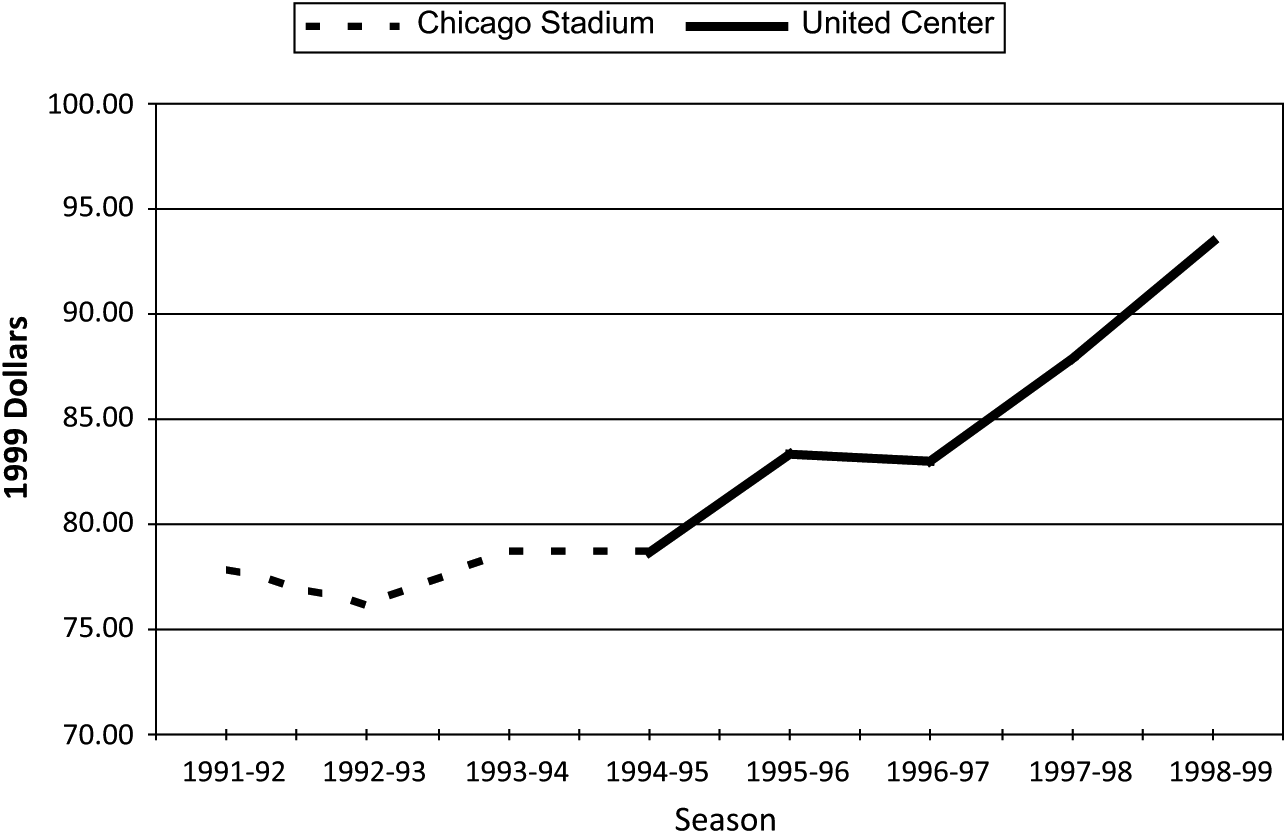
Price for a typical family basket of concessions at a Chicago Bulls game, 1991–9.
In the local context of Chicago, anti-peddling ordinances at stadiums passed in the 1990s constituted part of the effort by the mayoral administration of Richard M. Daley to retool the Loop and surrounding neighborhoods as attractive sites of investment for the leisure and hospitality industry. The massive flow of investment intended to transform downtown into a world-class ‘cultural destination’ brought with it demands from tourist-intensive industries for the city to adjust the local ‘business climate’ in their favor (Street, 2007). This meant making it impossible for small-time competitors like street peddlers to access the throngs of tourists, suburbanites, and urban yuppies making their way to the Loop for a day of culture and cuisine. As Figure 3 shows, the anti-peddling ordinances at Chicago’s stadiums helped comprise a much larger project during the 1990s of clearing vendors from neighborhoods and attractions with a high volume of tourist traffic. This not only affected sites in or on the periphery of the Loop like the Maxwell Street Market and the Field Museum, but also a cluster of gentrifying north side community areas around Wrigley Field.
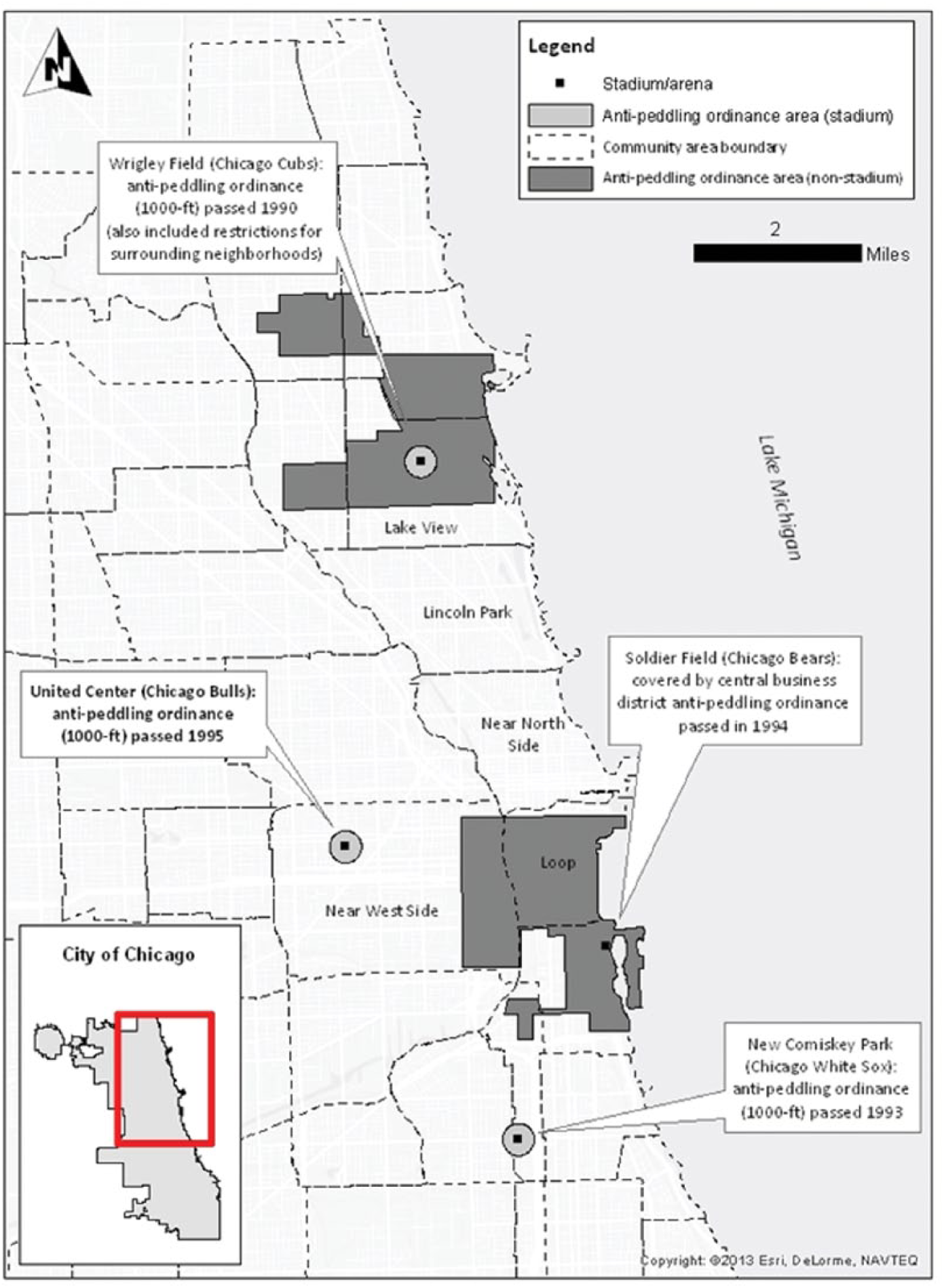
Anti-peddling ordinances on Chicago’s north side.
The transformation of Chicago’s municipal code into a staunchly anti-peddling document marked a stark departure from the policies of the populist administration of Harold Washington during the 1980s. According to the Tribune, Washington ‘encouraged food vendors to set up their stands along the State Street Mall’ and initiated the licensing of local street entertainers (Davis, 1986). While some saw peddlers as a welcome part of Chicago culture, Daley saw them not just as pesky competition for big business, but also as a threat to a growth-friendly image. In addition to backing franchise owners’ war against food vendors, he waged a high-profile campaign during the early 1990s against independent newsstand operators, many of whom sold papers and magazines in the Loop. He claimed that it was his desire to ‘clean the city’ that led him to back the passage of a 1991 ordinance limiting the number of newsstands within the city and imposing steep licensing fees that put many stands out of business (Spielman, 1992).
Daley’s equation of pushing out the vendors with ‘cleaning’ the city alerts us to the fact that the peddling bans around attractions like the United Center functioned as more than a simple revenue-maximization strategy. They also played an important role in transforming the space around arenas and stadiums. During the 1980s and 1990s, many franchises that occupied urban arenas or stadiums had ‘an intense desire to get out of inner-city neighborhoods’ and bring their operations closer to what market studies indicated were increasingly suburban fan bases (Euchner, 1993: 11). But cities like Chicago, which had become increasingly dependent on the expansion of the urban tourism and entertainment economies, were desperate to keep these teams around. While critics questioned the tangible economic impact of sports venues, Chicago helped engineer public subsidies and tax breaks in order to prevent franchises like the White Sox and Bulls from moving to the suburbs. But once the teams secured the subsidy deals and committed to remaining in blighted areas within the city limits, they had to confront the economic reality that placing well-to-do white ticket holders in close proximity to poor neighborhood residents – especially poor black neighborhood residents – might not be good for business. As urban sociologist Robert Beauregard (1993: 178) explains, images of poor blacks in cities like Chicago have ‘repelled’ suburban whites who look fearfully on them as symbols of crime, moral laxity, and a ‘culture of poverty’.
These issues were undoubtedly on the mind of Bulls and Blackhawks ownership, as the United Center sat in the middle of the west side ghetto, right across the street from the notoriously deteriorated Henry Horner Homes public housing project. The owners’ first move was to surround the facility with acres of surface parking so that it was, in the words of urban planner Rachel Weber, ‘easy in, easy out’ for fans coming in from the suburbs and the Loop (Eight Forty-Eight, 2011). Weber describes the facility as a ‘kind of fortress’, noting that the ‘sea of parking lots … was intended to make suburban fans feel more “comfortable”’ (Eight Forty-Eight, 2011). Thus, getting rid of the mostly black vendors reinforced the parking buffer, and ensured what urban theorist Mike Davis has described in a different context as ‘a seamless continuum of middle-class work, consumption, and recreation’ in which white fans could watch black players without having to interact with inhabitants of the African-American slum surrounding the arena (Davis, 1990: 212). As Charlie Beyer explains, vendors, especially black ones, ‘were seen as riffraff’, and the owners wanted ‘to get rid of the riffraff’, ‘clean up’, and make the area ‘spiffy clean’ (interview with Charlie Beyer, 2011). Tellingly, as shown in Figure 4, the 1000-foot radius around the arena coincided more or less with the area covered by the surrounding lots, providing fans parking there with a ‘hassle free’ path to the gates.
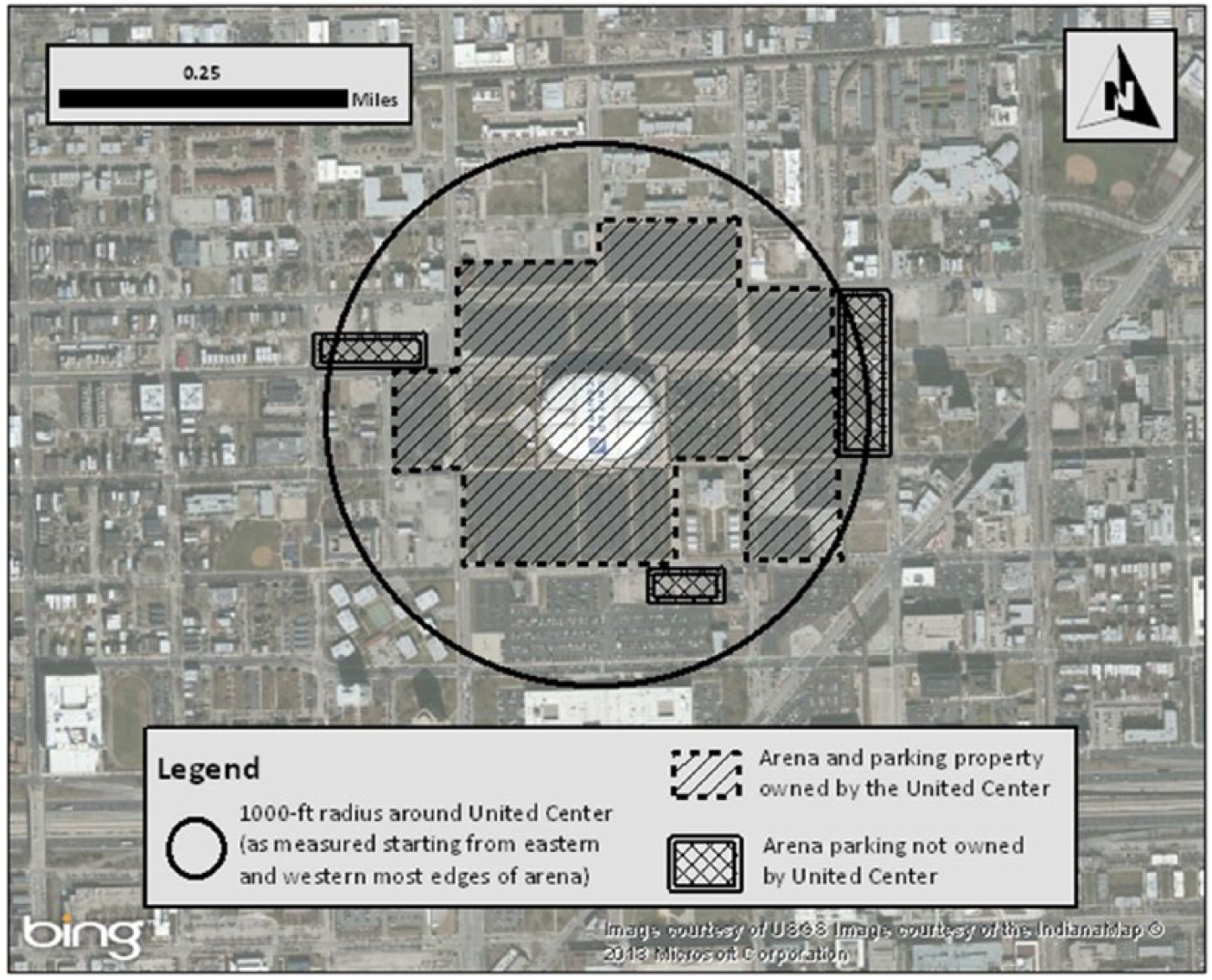
Geography of United Center anti-peddling ordinance.
Whether in the context of ‘cleaning’ the environs around the arena or preventing vendors from undercutting high concessions prices inside, at its core the ordinance aimed to further shield Reinsdorf and Wirtz from the risk of investing in a new facility. The bottom line was that the peddlers threatened the owners’ ability to maximize venue-related revenues, and protecting vendors’ right to market access mattered less to the owners and their allies on the City Council than ensuring the United Center’s profitability. Most would be hard pressed to find a better example of Harvey’s (2003: 96) dictum that, ‘though the abstract theory of capitalism (including its neo-liberal variant) appeals all the time to the ideals of competition, capitalists covet monopoly powers because they confer security’.
Conclusion
After the 1000-foot ordinance wiped out the peanut vendors for good, Weinberg managed to continue selling The Blue Line until the late 1990s. Even though arena officials and local police continued to harass Weinberg and Beyer (Beyer began peddling the program with Weinberg after the peanut ban), the special protections for the sale of printed material under the First Amendment helped them skirt the ordinance. The partnership ended in the late 1990s, when Weinberg walked away from publishing the program. However, Weinberg wasn’t done trying to irritate Wirtz, and he returned to the sidewalks around the United Center in 2000 to sell Career Misconduct (Blueline, 2000), a book he wrote chronicling Bill Wirtz’s notorious history of corruption. Despite attempts by the police to forcibly remove Weinberg for violating the anti-vending ordinance, Weinberg successfully sued the City of Chicago in 2002, securing his right to peddle the muckraking exposé. Ironically, after losing in district court, Weinberg actually won his appeal in the Seventh Circuit based on the assertion of his First Amendment rights (Weinberg v. City of Chicago, 2002). Weinberg’s newfound luck in dealing with the Seventh Circuit might have had to do with the fact that Justice Wood did not hear the case, but more likely, what won the day was the fact that he framed the case as the government infringing on his individual freedom of speech, rather than as a group of team owners trying to protect their profits at the expense of the ‘little guy’. Within the Seventh Circuit, anyway, claims to individual freedom gained traction when they didn’t pose a direct threat to the revenues of people like Reinsdorf and Wirtz.
Weinberg’s victory nonetheless resonated far beyond the United Center, as entire professional sports leagues saw the case as a threat to their teams’ ability to control the space around their respective facilities. As a result, officials from several leagues filed amicus briefs in support of the city’s appeal to the Supreme Court, contending that, if for no other reason, barring vendors of all types from around professional sports facilities remained a priority ‘because terrorists masquerading as vendors could strike outside the stadium’ (Pantagraph editors, 2003). Apparently, the Supreme Court felt it had better things to do than protect the nation from Al-Qaeda operatives gone undercover as peanut vendors, since it refused to hear the city’s appeal.
In the end, the story of the owner’s purge of vendors from the sidewalks around the United Center reveals how the state worked to guarantee the profitability of the professional sports business at a moment defined by increasing economic polarization among fans and heightened paranoia among team owners about the racial landscape around their arenas and stadiums. As political and economic elites paid extensive lip service to the sanctity of ‘free markets’ unhindered by state intervention, team owners like Reinsdorf and Wirtz tolerated ‘competition’ only insofar as it justified predatory behavior and minimized investment risk. When it did not, the owners quickly enlisted the aid of government officials all too willing to help them snuff out their competitors in the name of whatever flavor-of-month excuse sounded best.
Footnotes
Acknowledgements
Many thanks to Charlie Beyer, Walter Burnett, Jr, and Mark Weinberg for agreeing to be interviewed for this project (and to Mark for inspiring the title). I would also like to thank Will Brucher, Pier Dominguez, Elliott Gorn, Lindsay Goss, Oddny Helgadottir, Wen Jin, Gosia Rymsza-Pawlowska, and Derek Seidman for commenting on earlier drafts. Finally, a big thank you to Ben Joravsky for his advice and encouragement, and to John Logan and Rachel Franklin of Brown University’s Initiative in Spatial Structures in the Social Sciences (S4) for their continued support of my research.
Funding
This research received no specific grant from any funding agency in the public, commercial, or not-for-profit sectors.