



Abstract
This article describes the structural characteristics and socioeconomic effects of the neoliberal model that was implemented in Mexico at the beginning of the 1980s. Employment conditions, informal and precarious labor, and poverty generated by neoliberalism are analyzed. The article examines how the economic crisis has been dealt with through macroeconomic policies and social development by the Mexican Government. The characteristics of the public welfare system and the social policies that have been used during this neoliberal period are scrutinized. The program Oportunidades (Opportunities) as the primary national effort made by the government to combat extreme poverty is examined in detail. It has a social policy focus and is assistance-based which has yielded public financing at a high cost with limited poverty reduction. It is proposed that there are intrinsic limitations to these kinds of policy, leading to an increase in fragmented and ineffectual programs.
Introduction
In Mexico, poverty is essentially a structural problem. There is a lack of socioeconomic opportunities and access to resources for a large part of the population. This has created a situation in which the well-being of Mexicans has been negatively affected by multiple situations of exploitation, exclusion and discrimination. Existing public policies are inadequate to guarantee human, social and economic rights and they have failed to promote the well-being of the majority of citizens. The lack of coherent public policies has led to a complex configuration of poverty, unemployment, informal labor, precarious labor and social vulnerability.
Poverty is characterized by economic, demographic, cultural, social and political factors. Economic growth is necessary to reduce poverty, but it is insufficient in and of itself. Social policy issues are complex because they are connected to diverse factors. There is often a failure to understand that poverty is multi-dimensional and there has been insufficient coordination among social institutions. This lack of coordination can help to explain the lack of poverty abatement, in spite of the fact that there have been increases in public spending for social services in certain countries. Poverty is not only an economic condition characterized by insufficient family and individual income but has other dimensions, including ethnicity.
Social policy does not define itself. Rather, it is developed in relation to the predominant economic model used and the diverse demand structure of local populations. Social policy is not the only determinant of a population’s well-being; economic and public politics and policy are also important variables. While they are not often defined as social factors, they can have a greater impact than social policy. Public policy is understood as the sum of social policies interrelated with other institutions such as education, which have a direct effect on local and national economies. Heterogeneity, territorial and social inequality, demographic structures and dynamics, as well as cultural diversity are fundamental analysis factors for social policy planning and development.
Contemporary economic and social policies stem from these factors and they have led to a complex situation of helplessness, poverty and growing social vulnerability. The anti-crisis policies developed by the Mexican State have their roots in the general economic policies of the federal government and the Bank of Mexico. They fall within the rubric of neoliberalism and have focused on macroeconomic equilibrium. These policies have not been able to restrain an increase in poverty and hunger; nor have they limited the deterioration in the quality of available jobs. Thus, there have been no social policies innovative enough to alleviate the structural effects of the crisis. The impact of the 2008-2010 economic crisis and its subsequent effects on poverty rate increases, labor informality and precarious work conditions, unemployment and social vulnerability are analyzed in this article. The article looks critically at contemporary public policies that have sought to mitigate the effects of the crisis.
Methodology
This article will situate Mexico’s economic crisis and its social effects in a national and regional context. Subsequently, two analytical and methodological dimensions will be utilized which allow one to understand the effects of the crisis on general well-being, employment, salary deterioration, and informality. In short, by using a multi-dimensional approach, the following methodology provides a good description of poverty conditions in the country:
A description is provided of the socio-economic characteristics, structures and effects of the neoliberal policies that have been implemented. In addition, a brief reconstruction of the social-historical installation of neoliberalism in Mexico is given in order to analyze the deterioration of employment conditions and the subsequent increase in poverty generated by these macroeconomic policies.
The analysis also focuses on the development of social policies put into practice by the government. The article examines the current well-being of the Mexican population and the social policies adopted during the neoliberal period. The program Oportunidades (Opportunities) has been the principal tool used to combat extreme poverty nationally. It is conceived as a targeted public-assistance program.
Poverty measurement is a polemical topic. In Latin America, at least three criteria have been employed to measure poverty. The first is ‘the poverty line’ which defines poverty by household members who have per capita incomes below the necessary minimum to satisfy basic needs. Another approach to poverty measurement has been ‘the unsatisfied basic needs’ one. Here, poverty is defined by the lack of financial ability to meet housing, nutritional, medical and educational needs. Finally ‘the integrated method’ has been used. This method combines the two prior ones. The co-existence of the first two procedures determines structural or chronic poverty. In addition, there are three different types of poverty, according to the poverty line and other variables:
Nutritional Poverty is defined by a household’s inability to meet basic food needs even if all income is used.
Basic Needs Poverty includes households with sufficient income to meet basic nutritional needs but not enough to cover necessary medical and educational needs.
Household Poverty includes families which can meet basic food needs but are unable to afford the regular consumption patterns of the population. The things which are lacking can include medical needs, education, clothing, housing and transportation. This is the case even if total household income is utilized to try to meet family needs and acquire what is necessary (Ornelas Delgado, 2006).
The persistence of economic poverty is partly a result of rapid urbanization and its subsequent impact on the lack of infrastructure and basic services. However, this failure to reduce economic poverty has not affected other favorable factors of social and human development such as the hope for a better life, improved infant and adult mortality and a reduced illiteracy rate. Recent demographic transformations have placed new demands on social policies. In particular, changes in the population’s age structure and a subsequent increase in the economically active population have created important challenges for governments, families and individuals.
In November 2010, new guidelines were established in Mexico to identify and measure poverty using a multi-dimensional approach. This was achieved through the publication of the document Methodology for Multidimensional Poverty Measurement in Mexico [Metodología para la medición multidimensional de la pobreza en México]. It was published in accordance with Article 36 of the General Law of Social Development by the National Council for the Evaluation of Social Development Policy (Consejo Nacional de Evaluación de la Política de Desarrollo Social – CONEVAL). This methodology takes into account diverse factors such as per capita income, household educational levels, access to basic health services, the quality and availability of housing, as well as the ability to meet basic housing services and nutritional needs. Social cohesion levels are also used. The stated goal of the new methodology is to enhance ‘the study of poverty by complementing the well-established income poverty tradition with a new perspective that also takes social rights and spatial patterns into consideration.’ The study’s authors further state that a person is in poverty if they lack well-being and social rights. The new methodology allows for a three-pronged analysis; first, there is a focus on well-being ‘in terms of the necessities that can be acquired through the population’s monetary resources’. Secondly, poverty is tied to ‘the individual’s fundamental social rights’. Finally, the third ‘is determined by relational and community aspects that are expressed territorially’ (CONEVAL, 2010: 25). This new methodology is a significant advance in poverty measurement. However, it also has diverse methodological, conceptual and operative limitations. As a result, it has been the object of a great deal of criticism (Boltvinik, 2009a, 2009b; Damián, 2010).
Neoliberal Restructuring, the Economic Crisis, and Increasing Poverty
The economic crisis of 1982 was a crisis of petroleum and external debt that ultimately led to difficult economic and structural adjustments. The resulting changes were known as ‘The Pact’ which marked the beginning of an economic cycle characterized by the defense of the minimum salary. The structural adjustments of the 1980s had enormous social repercussions and poverty grew significantly in both urban and rural areas. The economic paradigm shifted, and neoliberal policies were further strengthened during the Salinas De Gotari presidency (1988–94). Economic growth began to be defined by the free market and the structural integration of the Mexican economy with the USA through NAFTA.
Other relevant policies that were implemented in the 1980s and continue to be important today involved the national financial system. The central government granted the Bank of Mexico greater autonomy to avoid manipulation by unscrupulous politicians. The peso became a free-standing currency at the same time that the government increased federal monetary reserves to give greater financial security to the national currency. Agricultural policy was radically changed. Previous policies based on food security and government support to peasants were replaced with ones that focused on the construction of an agricultural export sector composed of medium and large producers. Macroeconomic policies also shifted their focus onto policies that benefited large companies, often granting them significant fiscal credit and support. This trickle-down approach had regressive repercussions for most of the population.
Beginning in 1988, the principal objectives of macroeconomic policies shifted towards containing inflation and reigning in external debt. Inflationary controls affected national growth and monetary policies tended to be regressive, leading to low inflation but also causing relatively low GDP rates. These low GDP rates (2% to 3% annually) became felt in the constant deterioration of the purchasing power of the minimum wage (today, it is a mini-salary). This provides a partial structural explanation for the lack of poverty reduction even though the federal government has constantly invested in social spending. The topic of the Federal Reserve fund is also controversial. Reserves have been systematically increased to the point that today the fund has reached an historic high of US$150.8 billion. The argument in favor of the large reserve fund has been that it has given economic stability to the country and new confidence to investors while maintaining economic stability. Nevertheless, there have been arguments that the large reserve fund has come at a high cost since these resources could have been utilized to spur GDP growth.
In the case of the external debt, the central government has opted for policies minimizing risk. These strategies led to a decrease in the external debt (in dollars or euros) while most of the government’s funding has come from an internal debt in Mexican pesos. One of the principal methods used to finance the government’s needs has been to invest social security retirement funds (Afores) in national bonds. Currently, 80 percent of government bonds are held by pension funds. According to the National Commission for the Pension System (CONSAR), Mexican pension funds administered 1.654t pesos in the first trimester of 2012. This figure represents 11.5 percent of the GDP (this is equal to US$110b, the highest amount in Latin America). This policy of government financing through workers’ pension funds is highly controversial, especially since it represents a lack of investment in companies that generate economic growth.
Fiscal policies favoring large companies mean that the State has forfeited millions of pesos of tax money that might otherwise have been used to fortify social policy or to strengthen infrastructure. For example, according to the Ministry of Finance (Secretaría de Hacienda y Crédito Público – SHCP), fiscal credits increased to 730.8m pesos between January and September 2011. Furthermore, according to the Superior Audit Office of Mexico (ASF), there was a decrease in federal corporate tax revenues of 495.8b pesos between the years 2001 and 2005. These corporate tax credits have been an important support to large Mexican and transnational corporations operating in the country. Indirectly, these credits have led to the expansion and internationalization of these companies. The economic crisis has favored the merger processes of Mexican corporations globally. According to the Principal Tax Auditor, at least half of the 25 transnational Latin American corporations in the world were Mexican in 2011 (La Jornada, 2011).
The contemporary financial crisis spread from the USA to Mexico in 2009. In that year, the GDP fell to -6.5 percent. There was a recovery to 5.5 percent annual growth in 2010 and again to 3.9 percent in 2011. In spite of this growth, the crisis led to a significant increase in poverty, especially nutritional poverty. During this period, the national poverty rate increased from 21.7 percent to 24.9 percent. In addition, there was deterioration in the quality of available jobs and a subsequent increase in informal sector employment (CONEVAL, 2011).
The macroeconomic policies of the Mexican government focused on inflationary controls both before and during the crisis. This was true even during 2009, when the crisis had the greatest impact on the economy. Macroeconomic federal policies remained immobile and no anti-cyclical structural policies were implemented. It is also true that Mexico’s macroeconomic policies have been implemented in a dogmatic manner. They have sought only to maintain stable indicators without focusing on GDP growth. In other words, the stability of the financial and banking system has been given preference over encouraging economic growth. The Mexican State has stayed within the comfort zone of using pension funds as a low-risk financing source. This is even more controversial if one considers that the government’s other primary funding source is the state-run petroleum company, PEMEX. In 2011, PEMEX provided 18 percent of GDP. Nevertheless, PEMEX revenues are insufficient to maintain federal spending needs and generate the sustained economic growth required to meet the social demands of the country.
Economic growth has had limited effect on job creation. The exhaustion of the import substitution model and the adoption of free-market strategies marked a turning point in economic sector composition and urban employment in the country. Two important factors developed in the labor market during the long period of growth that began in the 1950s and continued until the end of the 1970s. Firstly, agriculture lost its relative importance to industrial employment. Secondly, there was a constant increase in salaried employment. In contrast, during the 1980s and 1990s, the labor market experienced significant changes in the structure, composition and quality of available jobs.
Contrary to the stated goals of its proponents, this economic restructuring accentuated the trend of labor market segmentation by promoting sector salary differentials and labor specialization. The 1980s marked a profound and integral change and this process has been accentuated in recent years. Governmental policy adjustments had direct consequences for the labor market. These adjustments led to an increase in unemployment and labor deregulation causing deterioration in job quality. In addition, there was a general trend of heavy industry suffering a decline at the expense of the service sector. These new policies were much welcomed by large companies. They began to substitute indefinite contracts with other, more flexible and less expensive forms of employment. In general, there followed a decline in industrial salaried employment and a subsequent increase in marginal activities such as independent or self-employment. Unemployment, growing labor informality and labor precariousness are in large part directly linked to the insertion of national economies into a global one. In this sense, they embodied the contradictions of globalization.
In Mexico, the medium-term effects of the crisis have been reflected by an increase in precarious employment. Since the 1990s, the labor market has been characterized by a lack of productive job creation, a decline in job quality, an increase in labor informality and a growing wage gap between skilled and unskilled workers. There has also been a significant gender-based income gap for both skilled and unskilled workers. A notable increase in self-employment during the last three decades can be observed. This is a result of the reduction and privatization of the public sector as part of the process of economic restructuring.
The unemployment rate fell from 6.7 percent in 1995 to 2.5 percent at the end of that decade. Since then, it has increased steadily. In 2010, the unemployment rate was 6.2 percent due to the economic crisis (Figure 1). Furthermore, the percentage of employees earning the minimum salary, which is an indirect indicator of the working population being unable to meet basic food needs, fell from 20.7 percent in 1995 to 11.7 percent in 2009. However, the following year (2010), that number increased to 13 percent of workers. It has remained steady ever since that time (INEGI, 2011a, 2011b).
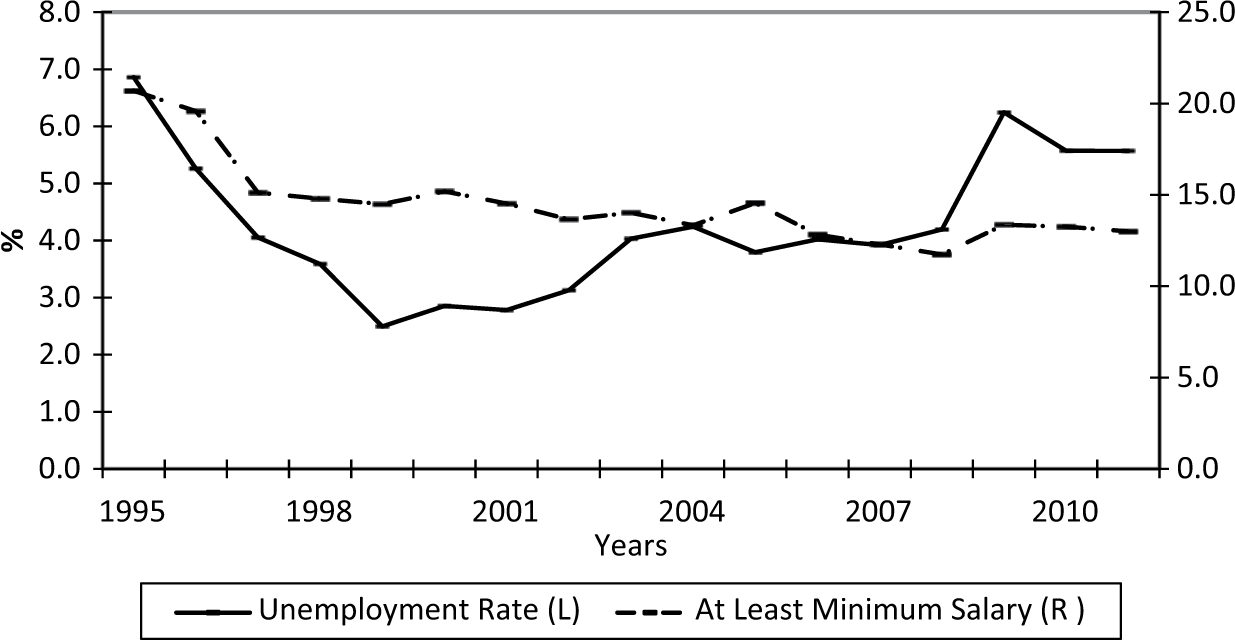
Mexico. Evolution of Unemployment and Percentage of Employed Earning at Least Minimum Wage, 1995–2011.
Salaried labor in highly urbanized areas showed sluggish employment growth according to the statistics from the Employment National Survey (Encuesta Nacional de Empleo-ENE) and the Occupation and Employment National Survey (Encuesta Nacional de Ocupación y Empleo-ENOE). Salaried labor grew from 65.5 percent in 1995, to 68.2 percent in 2000, dropping to 67.2 percent in 2010. Meanwhile, self-employment moved from 17.4 percent, to 16.8 percent, to 18.9 percent during the same time period. The population of informally employed people grew from 9.1 million to 12 million in a decade. This is an increase of 32 percent. The so-called informal sector, which is represented by jobs outside of the social security, fiscal and formal labor systems, has had particularly important and sustained growth from 2008 to 2012. While formal unemployment has shown a slight decline during that period, the number of informal jobs has grown notably. This has led to a situation of absolute economic and social vulnerability for workers in this sector and their families. Paradoxically, all this has occurred during a period of relative stability and economic growth.
According to data from the 2011 XV Annual Human Labor Rights Report in Mexico, which was produced by the Center of Reflection and Labor Action (Centro de Reflexión y Acción Laboral - CEREAL), there were three jobs created in the informal sector for every job created in the formal one during the previous five years. Every day, approximately 645 Mexicans joined the unemployment ranks and around 1,400 entered the informal economy sector. In other words, 77 of every 100 Mexicans are unable to find and participate in formal employment (El Economista, 2012). According to data presented by the Institute of Economic Research at the Autonomous University of Mexico (UNAM), there are around 14 million people working in the informal economic sector. This is due to the fact that during the last 16 years, about 316,000 jobs have been created annually while about 1,200,000 people come of age and seek to enter the labor force each year. The number of workers in the informal sector is at an historic high and it is almost equal to that of the 18 million employees that have formal jobs (Más por Más, 2012).
In addition to labor precariousness and informal sector growth, the purchasing power of salaries has eroded by almost a third since 1970. Data from the National Survey of Household Income and Expenses (Encuesta Nacional de Ingresos y Gastos de los Hogares - ENIGH) show that 30 percent of the poorest people in the country (percentiles I to III) had a purchasing power increase of 0.7 percent and their share of the national income went from 7.8 percent to 8.5 percent. However, this group’s slight improvement appears to have been due to remittances and financial transfers. In addition, the richest 10 percent of the population increased their purchasing power by 2.6 percent. Their assets made up 36.3 percent of the national wealth, as opposed to 33.6 percent in 1983. Nevertheless, 60 percent of the population saw a 3.3 percent decrease during the same period (El Universal, 2011). Furthermore, the International Labour Organisation reported that average salaries in Mexico declined by 2.6 percent in 2008 and by 5 percent in 2009. In contrast, salaries in Brazil and Argentina rose by 3.2 percent and 12.4 percent respectively, in 2009.
Mexico is characterized by large social and regional contrasts. They are due to economic disparities, a high concentration of productive activities and an unequal urbanization process. The coexistence of highly developed regions with underdeveloped and marginalized ones has created a secular situation of structural heterogeneity. The economic models and policies adopted by the government have had limited success in dealing with this problem. As a result, the poverty phenomenon has become increasingly complex and persistent among certain groups or specific segments of society.
Extreme poverty continues to be fundamentally a rural problem. Nonetheless, urban poverty tends to be highly concentrated and it appears to be growing. It tends to affect regions and groups unequally depending on age, occupation, ethnicity and gender. Boltvinik and Damián (2001) examined the evolution of poverty and criticized the subsequent social policies that underestimated the sensitive nature of poverty increases and extreme urban poverty. Most social policy makers have assumed that poverty is primarily a rural problem and this has had significant implications for the programs, policies and practices utilized. Boltvinik and Damián (2001: 21) were particularly critical of the priorities of the Zedillo government. They argued that ‘the fight against extreme poverty in rural areas occurs to the detriment of the fight against urban poverty and to less extreme or moderate poverty throughout the country.’ Their observations identified enormous academic and political consequences, especially in light of the rapid urbanization process that the country had experienced, the conditions of persistent poverty that wide population sectors faced, and the growing increases in social program spending. Many of these programs have had slow and failed results. Sara Gordon states that: In Mexico, poverty and the related issue of social exclusion is an old problem. This is true in spite of the fact that well-being is a constitutional right and a programmed regimen stemming from the 1917 Revolution and that all political forces in the country agree that there is a need for a productive economic system capable of providing employment, education and health services to the whole population. However, the country has been unable to build a stable economic model capable of poverty reduction, creating equal opportunities and assuring minimum well-being for the wider population. Assistance-based strategies and redistribution programs have had limited relative success in alleviating poverty, but social inequality has increased. (Gordon, 1997)
This was particularly true after the economic crisis of 1994–5. At that time, around a million jobs were lost each year. Since then, poverty has remained a persistent problem, in spite of the fact that the economy experienced moderate growth post-crisis and there have been multiple poverty abatement social programs. Household poverty clearly has a multi-dimensional structural component composed of diverse factors and problems.
By employing the multi-variable analysis method discussed above, CONEVAL discovered that in 2010, 20.6 percent of the population had limited access to education, 31.8 percent lacked medical services, 60.7 percent were outside of the social security system, 15.2 percent had inadequate housing, and 16.5 percent were completely homeless. In particular, the lack of education, access to healthcare and social security led to a situation of social exclusion in which families were unable to independently overcome their poverty. This broad societal disenfranchisement, in which families lack access to the most basic services, represents a failure on the part of the State to provide the minimal social requirements that are the government’s legal and moral responsibility.
Mexico is not the only country that has failed to provide services to its population and which has displayed erratic social policies during the last three decades. However, it stands out among other Latin American countries in terms of its high poverty levels and poor service delivery. This situation was aggravated by the most recent economic crisis. CONEVAL demonstrated that during the first stage of the crisis, poverty increased in the nation from 44.5 percent to 46.2 percent of the population. In absolute terms, this number represents 48.8 and 56.0 million people, respectively.11 The number of people living in extreme poverty declined marginally, going from 10.6 percent to 10.4 percent. Nevertheless, in absolute numbers, there was actually an increase, going from 11,674,700 to 11,713,000 people. According to CEPAL (2009: 59) and Castillo Fernández (2011), income distribution in Latin America showed relative advances during the last decade, even during the crisis of 2007 and 2008. Mexico was a double exception to this rule. Firstly, Mexico was the only country that showed a clear tendency of income distribution deterioration. Secondly, Mexico actually experienced the highest regional growth of the number of people living in poverty. In fact, due to income distribution deterioration, ‘Only in Mexico did the situation worsen, as the poverty rate rose by 3.1 percentage points between 2006 and 2008, reflecting the first effects of the economic crisis that began in late 2008’ (CEPAL, 2009: 16).
Figure 2 illustrates the trend of nutritional, basic needs and household poverty during the last two decades. It can be observed that nutritional poverty, which is defined as the inability of families to meet basic nutritional needs even if all household income is used, grew the most during the crisis period. It went from 37.4 percent in 1996 to 13.8 percent in 2006, and rose to 18.8 percent in 2010. Of course, this is the most serious type of poverty. Basic needs poverty, which is defined as the inability to meet nutritional needs and cover necessary expenses like health and education, decreased from 46.9 percent to 20.7 percent then increased to 26.7 percent in 1996, 2006 and 2010, respectively. Household poverty, which is the highest and most structurally based, is defined as families that are unable to afford the regular consumption patterns of the population. The things that are lacking can include medical needs, education, clothing, housing and transportation. This is true even if total household income is utilized to try to meet family needs and acquire what is necessary. Household poverty declined from 63.9 percent in 1996 to 44.6 percent in 2006 and then experienced an increase to 51.3 percent of the population in 2010. All three poverty types increased after 2006 as a result of the increasingly neoliberal economic policies put into place by the new government, the effects of the economic crisis on unemployment, the decline in both job quality and income, and the application of financially expensive social policies which were erratic and had limited results.
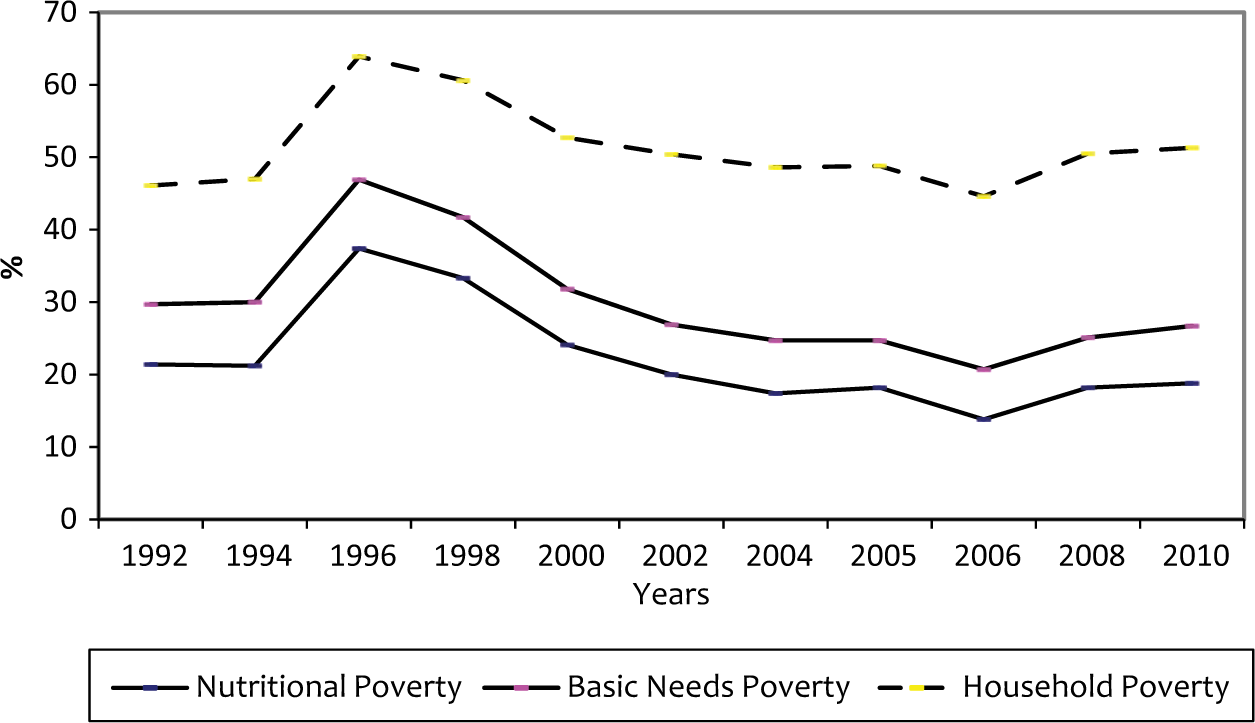
Evolution of Poverty in Mexico, 1992–2010.
In spite of this increase in poverty, there was, paradoxically, also an increase in the population that is not poor and not vulnerable. This group has above-average income and full access to services. In other words, there has been an increase in the consolidated middle-class, going from 18 percent to 19.3 percent of the population. In absolute numbers, there was an increase from 19.7 to 21.8 million people. The states that contributed to this increase were Mexico City with 30.5 percent, Jalisco with 21.1 percent, Mexico State with 18.6 percent and Nuevo Leon with 37.8 percent. It is important to keep in mind that these are also the areas with the highest levels of industrial development and services. Furthermore, they contribute the most to the national GDP. They have not followed the same trends of unequal development that are clearly seen in other areas during times of crisis. This marginal growth of the middle class is consistent with the general trends seen throughout Latin America. However, there is still a debate regarding the thresholds and/or criteria used to define both social class and mobility. It is safe to say that part of the group identified as middle class also falls under the label of relative poverty.
The poverty data presented by CONEVAL (2011) has tenacious footholds at the regional or state level. For example, 13 states had poverty rates of 50 percent or higher in 2010. They were: Campeche 50.0 percent, Chiapas 78.4 percent, Durango 51.3 percent, Guerrero 67.4 percent, Hidalgo 54.8 percent, Michoacán 54.7 percent, Oaxaca 67.2 percent, Puebla 61.0 percent, San Luis Potosí 52.3 percent, Tabasco 57.2 percent, Tlaxcala 60.4 percent, Veracruz 58.3 percent, and Zacatecas 60.2 percent. The majority of these states (except Guerrero, Hidalgo, Michoacán and Puebla) had increases in poverty rates between 2008 and 2010. These states are not highly industrialized and they have an important peasant agricultural sector. Furthermore, Chiapas, Guerrero, Hidalgo, Michoacán, Oaxaca, Tlaxcala and Veracruz all have large indigenous populations. Here, it is clear that poverty is primarily a rural (peasant) and indigenous phenomenon.
In 2010, the state with the highest number of people living in poverty was Mexico State, with a total of 6.5 million people in that situation. This is the most populous state in the nation and it provides 10 percent of the national GDP. In addition, it has a diversified economy, and strong industrial and service sectors. However, it also has an important peasant agricultural sector and a large indigenous population. It shares one of the largest urban municipal areas in the world with Mexico City, which also has an enormous population and the highest concentration of urban poverty in the nation.
Poverty in rural areas increased from 62.4 percent to 64.9 percent between 2008 and 2010. Urban poverty increased from 39.1 percent to 40.5 percent during the same period. Without any doubt, the highest rates were centered among the rural and indigenous population, with rates increasing from 75.9 percent to 79.3 percent. Extreme poverty was highest in four states: Chiapas with 32.8 percent or 1,652,500 people, Guerrero with 28.8 percent or 1,046,000 people, Oaxaca with 26.6 percent or 1,035,600 people and Veracruz with 18.1 percent or 1,203,300 people. Extreme poverty has increased in each of these states except Oaxaca in recent years.
Public Social Welfare Policies to Combat Poverty
In Mexico, public-assistance programs are carried out through government spending and programs that are part of a group of public institutions managed by the federal government. The four following government ministries are responsible for social welfare: Social Development, Education, Health, and Social Welfare. Nevertheless, all these agencies manage programs that are strongly paternalistic and bureaucratic, which is typical of the Mexican political system. These programs often restrict the effective participation of their beneficiaries, provide little or no program orientation to participants, are highly onerous, and have had erratic positive outcomes. Past experiences of administrative development and political party posturing have contributed to weakening Mexican society’s ability to participate in and make responsible decisions regarding development initiatives. These precedents allow for the identification of program limitations, including their design and their lack of application of any coherent social policies that have had substantive impact on poverty reduction in the country.
Mexican social policy has its roots in principles of institutionalization that were developed during the first decades of the 20th century. In this framework, social policy was highly paternalistic and purely assistance-based. Since then: Social policy has not been voluntary, rather obligatory because it is a fundamental element to achieving social justice regarding resource distribution, responsibilities and opportunities. Since the administration of President Lázaro Cárdenas at the end of the 1930s and the early 1940s, the Mexican government has explicitly recognized its responsibility to assist the poorest groups of our society and it has understood that social policy is a central element of the public resource social distribution process (Sobrino and Garrocho, 1995, cited by Massé Narvaez, 2002).
Since then, especially beginning in the 1970s, the Mexican state has implemented a series of actions and programs aimed at giving direct and focused attention to the population living in poverty. During the 1970s and into the mid-1980s, specific plans were developed to provide programs and support to poverty abatement social policies in Mexico (Massé Narvaez, 2002). Until 1982, social policies did not support a completely national, universal and widely applied program designed to assist people in poverty. Some of the early programs were the Integrated Rural Development Program (PIDER) which began in 1973, The Program for Attention to Depressed and Marginalized Areas (COPLAMAR), The Mexican Nutritional System Program (SAM), the creation of Branch 26, and the Solidarity and Progresa program (PRONASOL) which later was transformed into the Opportunities Human Development Program (Oportunidades). The first program was one of production support that was implemented in the southern region of the country. The second one was focused on improving living conditions for the population, especially in terms of health and nutrition. The SAM program focused on poverty abatement in rural areas through agricultural extension and support. PRONASOL was the immediate predecesor to Oportunidades. They are basically the same but with some adjustments in the support, coverage and development structures.
Normally, social and public policies are planned and executed by governmental institutions. As a result, the State is given the responsibility of providing for citizens’ basic needs, particularly those of health, nutrition, education and housing since they contribute to the well-being and development of individuals in the population. However, in reality there are many challenges to developing social policy. Generally, it is assumed that social policy ‘can only be made by the public sector’. At the same time, a social policy vision cannot solely be determined by mere governmental decree if it is to meet the demands of contemporary society. The public should also be involved if social policy is to meet the needs of the collective good. The public is a greater stakeholder than the State and it needs to be involved in multiple aspects of civil society. In any case, social policy has been subordinate to the predominant economic model including its dynamics and contradictions.
The Political Constitution defines and enshrines distinct aspects of social rights. In particular, it highlights the ‘Right to Work’ and it states: ‘All people have the right to dignified and socially useful employment.’ Subsequently, ‘To that effect, job creation and social organization for work will be promoted.’ The Constitution also goes on to establish that ‘Generally, minimum wages should be sufficient to meet the normal needs of a head of household socially, culturally and to provide for the compulsory education of children’ (Boltvinik and Damián, 2003: 103). In addition, it recognizes basic and specific educational, health and housing needs and states that all Mexicans should have access to these things.
The Constitution and its regulatory legislation specifically provides for social rights. It states that all citizens have the right to a preschool (recently added), primary, and junior high school education. Education is declared to be obligatory, free and provided by the State. The right to health care is also established in the Constitution although this is under the regulatory operation of The General Health Care Law. The Constitution recognizes the right to safe and dignified housing as well and this falls under the regulatory supervision of The Federal Housing Law. But, as Boltvinik and Damián (2003: 105–106) point out, ‘Neither the Federal Housing Law nor the General Health Law assure that health and housing needs are met given that the State is not statutorily obligated to provide these rights.’ Thus, ‘both laws actually weaken constitutional rights.’ The authors recognize that beyond the limitations of social rights that are explicitly recognized by legislation, ‘many are simply dead letters.’
Fighting poverty has been a governmental social policy priority since the end of the 1980s. The 1970s were characterized by strong governmental intervention in both the economy and social policy. The presidential administrations of 1970–76 and 1976–82 sought to increase employment rates and improve relative salary redistribution. In fact, this was a fundamental part of an agenda to improve the social welfare of the population. In spite of the rhetoric, efforts to form and implement social policies based on the principles of social solidarity, universalism, and general social welfare needs were not entirely successful during this period. As mentioned above, the change in the economic paradigm at the end of the 1980s and into the 1990s superimposed itself on a social welfare system based on social solidarity and universalism. The free market began to be seen as the key to social welfare. According to Massé Narvaez (2002), ‘neo-liberal economic policy was incompatible with the financing of social assistance to the poor. It focused on the adoption of selective poverty programs instead of ones that were integrated, innovative and universal. This meant that the notion of social rights was abandoned in favor of selective and discretionary programs.’
The 1995 economic crisis led to an increase in both rural and urban poverty in Mexico. Since then, the government has somewhat modified its strategy to fight the growing decline in living conditions for the population. Social policy was restated in terms of criteria that would have a greater reach. Among other things, the government opted to eliminate ‘universal tortilla subsidies’ and in its place, it increased the financing of ‘a new investment in human capital’ through the Progresa program (Wodon et al., 2003). The Progresa program had a stated objective of supporting families living in extreme poverty conditions. It was based upon the goal of trying to create and improve social welfare conditions in the short, medium and long term for program participants (Campos, 2003).
The program had an ‘innovative’ focus in the sense that it made ‘cash transfers to poor rural households only if the children attended school and the family regularly visited local health clinics’ (Wodon, 2003). The program specifically tried to promote an improvement in participants’ living conditions. It offered basic health and nutritional coverage as well as the opportunity for children to attend school. Its focus was directed at fighting extreme poverty. In spite of the program’s natural limitations, it adopted a focus that distinguished itself from prior ones that were purely assistance and crisis-based.
During the last three presidential administrations, the trend in social welfare has been the proliferation of assistance-based programs focused on fighting diverse forms of poverty. These programs have been institutionalized through the creation of the Social Development Secretariat (SEDESOL). This office is charged with social welfare development and it has been regulated through The General Law of Social Development that was passed in 2004. Article 1 of this law specifically ‘Guarantees the full exercise of the rights enshrined in the Political Constitution of the United Mexican States, assuring the complete population’s access to social development’ (http://www.diputados.gob.mx/LeyesBiblio/pdf/264.pdf, consulted 1 November 2013). This law regulates programs that are focused on and compensatory for the fight against diverse types of poverty. The National Council for the Evaluation of Social Development Policy (CONEVAL) was founded in 2006 as part of the institutionalization process of these types of programs and was mandated by the General Law (http://web.coneval.gob.mx/Paginas/principal.aspx, consulted 1 November 2013). This organization was established as part of the federal administration to evaluate social and poverty reduction programs.
Throughout the 2011 Evaluation Report on Social Development Policy (CONEVAL, 2011), one can observe the fragmentary nature of social policies aimed at improving living conditions and fighting poverty. In 2004, there were a total of 89 programs and actions that had an original budget of 72.1b pesos. By 2011, the budget had grown to 692.0b pesos, shared between 272 programs. It could be argued that the tripling of resources, organizations and strategies should translate into a significant reduction of poverty. However, it appears that these resources are not necessarily well directed since this program proliferation has achieved limited success (Figure 3).
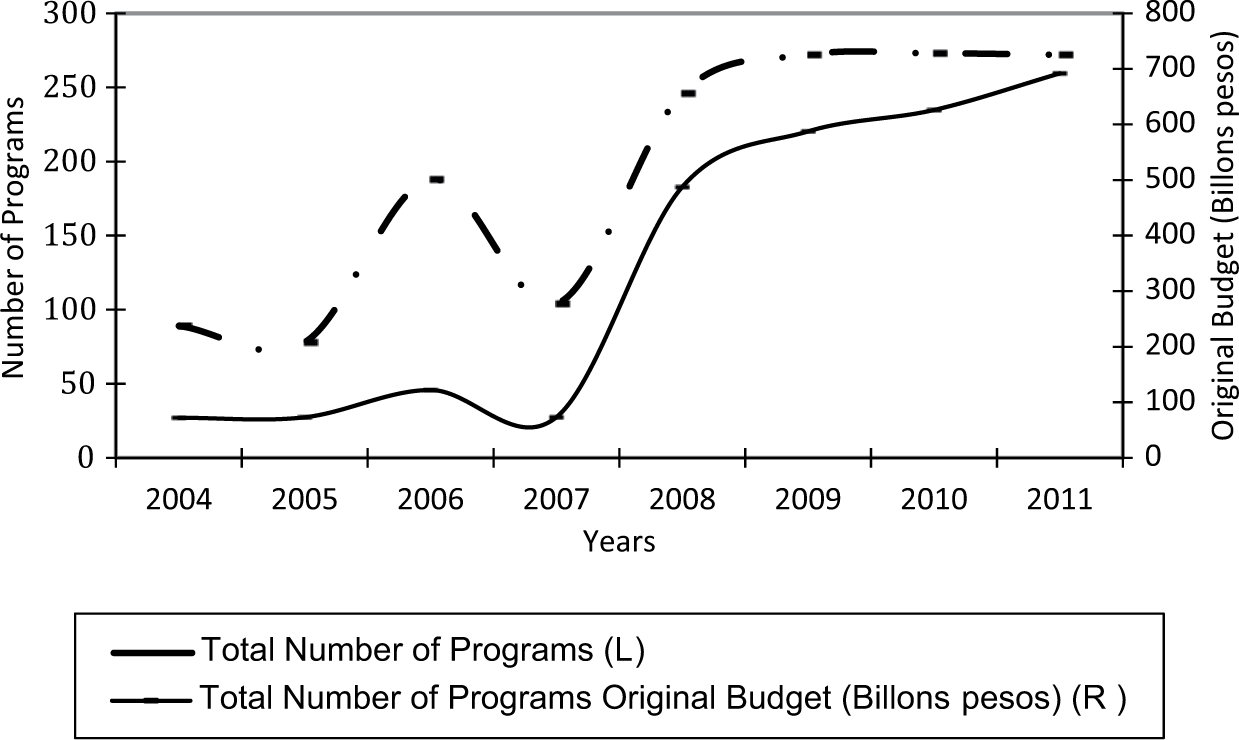
Mexico. Total Number of Social Development and Poverty Reduction Programs with Respective Budgets, 2004–2011.
The programs identified in the CONEVAL Inventory are quite diverse and they are supposedly aimed at combating distinct types of poverty. Nevertheless, there is a very unequal resource distribution among the different programs. For example, in 2010 there was a total of 94 education programs and actions, 56 dedicated to social welfare, 40 health programs, 27 aimed at environmental issues, 19 anti-discrimination programs, 19 work-related, 9 focused on housing, and only 5 nutrition programs. However, the percentage of the population lacking access to good nutrition was 24.9 percent in 2010. This was actually 3.2 percent higher than in 2008. This is the only negative social indicator that increased in 2010 and there were 4.2 million more people suffering from malnutrition than in 2008. (CONEVAL, 2011: 26, translated by Kristi Bradley-Tamayo)
Also according to the CONEVAL report: In general, the diverse programs and actions utilized to face the multiple challenges of social development in the budget are adequate. Nonetheless, it is not always clear that having many programs translates into improved public policy […] an analysis of the CONEVAL Inventory sheds light on the fact that there is great dispersion and a potential lack of coordination among federal programs and if one includes local government programs, the problem increases. (CONEVAL, 2011: 87, translated by Kristi Bradley-Tamayo. Emphasis added.)
The most common types of assistance that the majority of these programs provide are training (59 programs), technical assistance (37 programs), health services (32 programs) and campaigns of social welfare promotion (23 programs). In spite of the fact that there is a proliferation of programs, there is clearly duplicity and a juxtapositioning of their methods and objectives. There is a proliferation of ‘micro-programs’ whose results are temporary, so that: These social development programs are more effective at protecting the population from adverse structural events than creating permanent employment. Social development policy has some social protection programs but they are insufficient to strengthen the population’s incomes in the face of the type of circumstantial reductions that occurred in 2008–2010 in the nation. Due to the absence of these mechanisms and in light of recent crises (financial, rising food prices and increasing energy costs), programs like Oportunidades or generalized energy subsidies not specifically aimed at the poor have been favored. (CONEVAL, 2011: 43, translated by Kristi Bradley-Tamayo)
Oportunidades is the most important federal program used to combat extreme poverty in Mexico. It was formally created in the year 2000 and it was substituted, with a few modifications, for the Education, Health, and Nutrition Program (Progresa) that had been implemented in 1997. It is a nationwide program that currently includes rural, urban and metropolitan zones and is located in 97,437 towns and cities. Oportunidades is an inter-institutional program which has the participation of The Secretariat of Public Education (SEP), the Ministry of Health (SSA), the Mexican Institute of Social Security (IMSS), the Social Development Secretariat (SEDESOL) and state and municipal governments. The program provides educational, health, and nutritional support as well as income assistance to its participants. In this sense, it has a wide structure to provide attention to participants and it places special emphasis on groups that are demographically vulnerable as well as socially and territorially isolated. Furthermore, it provides special support to women and girls (SEDESOL, 2011).
In terms of its operation, Oportunidades has a multi-sector organizational structure with multi-tiered functional levels managed by the National Coordination Program Group. This group is composed of participants from the SEP, SSA, SHCP and SEDESOL, as well as a Technical Board. The undersecretaries of participant agencies sit on the Board along with representatives from the IMSS and the Office of the Secretary of Auditing and Administrative Development (SECODAM). This multi-sector and interagency coordination is perhaps one of the innovative characteristics of the program and it is probably one of its strengths as well. At the state level, there are representatives from a state coordination agency and a technical coordination agency through which federal and state employees work together. At the local level, there are Community Promotion Committees that also participate. These committees are composed of at least three beneficiary spokespersons. They serve as a support to the health, education and watchdog functions of the program. There is also a municipal liaison to the program whose central role is one of support and coordination to manage the program at the local level and, in general, to facilitate logistics.
Oportunidades is the program having the greatest impact on poverty in Mexico. It has a direct effect on the immediate conditions of the adult, juvenile and infant population, particularly in regard to education for young participants and the long-term expectations of an improvement in social conditions for future generations. Nevertheless, the program has had limited impact on developing and improving the skills needed for future workforce participation. This is because the program is primarily focused on children who are incorporated in the basic education system and are not yet close to entering the job market. In addition, due to the demands of the labor market, the level of training offered by the program is insufficient to obtain well paid jobs, especially in light of the free market economic model and the resulting devaluation of human capital.
The program’s central objective is the development of capabilities and skills, or at least that is what is stated. It has a very complex operative structure. Co-responsibility is a central part of the program and it implies community and family involvement and active participation in the development process. The program currently operates in 32 states and it reaches 5.8 million families. Participants receive free health, nutritional and educational services. After the 15 years that Progresa and Oportunidades have been operating, it remains unclear if they have achieved their objectives of combating extreme poverty, increasing the skills of the population and providing basic development opportunities in the context of greater social resources. Boltvinik (2008) points out that it is certainly true that: in order for the OP (Oportunidades Program) to have the desired effect in the reduction of poverty for the next generation, it would have to provide two necessary conditions: 1) substantially raise the educational level of the beneficiary population without diminishing that of non-participants; and 2) the absolute highest level of education reached must translate into well-paying jobs. (Emphasis in original.)
It is here that the program’s failure becomes evident. ‘In terms of an improvement of the life conditions of children in relation to their parents no important effects have been found as a result of Oportunidades, regarding increased salaries, participation in the formal labor force and the ability to enter skilled professions’ (Rodríguez and Freije, 2008: 20, cited in Boltvinik, 2010). Thus, the achievements of the Oportunidades Program ‘are erroneous’. The basic skills training that the program provides is insufficient for a full integration into productive activities and, thus, insufficient to overcome poverty. There is an attempt to overcome this limitation with the ‘Live Better’ (Vivir Mejor) strategy. This initiative promotes high school and advanced education and it seeks to develop employment skills to improve labor competency. This strategy was implemented in April of 2008. Some of its objectives are to create ‘equal opportunity conditions’ as well as to reduce poverty and social marginalization in rural and urban environments. It focuses on the most vulnerable groups: women, indigenous people, senior citizens, disabled people and people in conditions of extreme poverty.
Conclusion
In Mexico, social policy suffers from numerous pitfalls in its attention to the population. Furthermore, it is limited by the structural factors of the free market economic model. Social policy makers face limitations due to territorial disparities, social and demographic heterogeneity, and cultural and ethnic diversity. Social policy is impeded by the persistence of certain political and social control tactics, bureaucracy, and paternalistic policies that tend to distort and complicate social program operations. The recent political changes tied to increasing democracy in the country and a subsequent increase in citizens’ participation have created the need to develop newer, far-reaching social policies that have the capacity to face the many social demands of society.
The neoliberal economic model adopted at the beginning of the 1980s has led to a complex situation of helplessness and growing social vulnerability. Unemployment, job informality, deteriorating work conditions, poverty and social inequality have become serious challenges to the public and social policy agenda. Neoliberalism is rife with limitations and contradictions that negatively affect development and the promotion of coherent social policies and opportunities. In addition, the favorable evolution of certain social welfare indicators has resulted in regional and social disparities. Consequently, the concept of social welfare presents a strategic problem if one takes into account the demographic, economic, social and political dimensions that must be addressed. It is important to realize that ‘under the regime of neo-liberal Mexican capitalism, it will be difficult to eradicate poverty since economic policy needs to be reoriented to achieve sustained growth, job creation and improved income distribution simultaneously’ (Ornelas Delgado, 2006: 109).
Recent economic dynamics have demonstrated a growing structural weakness in terms of job creation. It is now determined by new forms of employment and a new adoption of technologies that limit job creation and promote deteriorating labor conditions for less-skilled workers. In the current economy, this social debt is almost irresolvable due to an increase in the working-age population and the current economic model’s limited ability to create ‘formal’ employment. This has led to a subsequent rise in job informality, precarious labor, and salary deterioration. These challenges do not only pertain to the quantity of jobs created but also to their quality. Thus, the priority for social policy and policy-makers is to integrate the adult population into a more productive labor force before it grows too large and the problems of economic dependency deepen. However, this is a two-fold challenge; it implies not only absorbing the oversupply of workers into the labor force but incorporating new workers into it as well (Castillo Fernández, 2011).
Normally, the problems associated with poverty are intimately related to the capacity of the State to implement and carry out timely and efficient national and regional development policies. The co-existence of marginalized and highly developed zones highlights the structural heterogeneity that exists today and the limitations of current economic and political models to address this issue. It is also important to take into account the fact that existing social policy strategies are limited by bureaucracy, technocrats, paternalistic practices, and a lack of standardized practices. In addition, many programs are characterized by their unclear orientation and objectives. All of these factors are obstacles to the ability of national and regional development policies to operate effectively.
The policies used to fight poverty have not achieved their stated objectives, or at least they have not achieved them in a timely manner. This is especially true for programs that are focused on diminishing the gaps among regions and mitigating the existing inequality of basic service coverage among people living in poverty and extreme poverty. Existing policies are far from achieving integrated services with universal coverage. This is due to their centralized focus, as well as the need to require improvements in program outcomes. (Some examples would be: reducing the gap in basic social infrastructure, creating equal opportunities and access to education and health care services, focused and timely social expenditures, etc.). A greater control of resource distribution is required in order to avoid waste and ensure adequate administrative efficiency. Poverty and social marginalization are at critical levels among the indigenous population and there is a need to place greater emphasis on policies and programs that serve this sector. It is essential to reduce this demographic, economic and social gap.
The future economic structure and demographic distribution are both fundamental aspects upon which public policies and actions must focus on in the short and medium-term. The most fundamental challenge lies in improving the services and delivery system of governmental development programs. This is due to the fact that in all environments there continue to be irregularities in program application. It is necessary to have a better focus on, and definition of, the demographic criteria used by economic and social development programs. There is also a need to avoid program duplication and to promote improved governmental and sector coordination of those working on national development (federal, state, and local government agencies as well as non-governmental organizations). There continues to be a large number of programs that provide fragmented, discontinuous, highly onerous and erratic coverage in terms of their results, time limits and inadequate focus. It is essential to reevaluate and redefine the relevancy and effectiveness of these programs, as well as their ability to create services that lead to improvements in the social welfare of the programs’ beneficiaries.
Footnotes
Funding
This research received no specific grant from any funding agency in the public, commercial, or not-for-profit sectors.