




Abstract
This article conceptualizes economies of spectatorship through a case study of the Sturgis Motorcycle Rally (SMR). Economies of spectatorship produce spectacular diegeses as commodities sold to spectators and sponsors. They develop through a dialectical process of progressive decontextualization as their diegeses are cross-marketed with discrepant products and services to reach new markets. Progressive decontextualization leads to diegetic incoherence that threatens the realization of profit. As an economy of spectatorship, the SMR produced an outlaw biker themed diegesis replete with vicarious action and consumable character gambles. The SMR progressively decontextualized as it cross-marketed its outlaw diegesis with establishment corporate, religious and political themes. The resulting diegetic incoherence threatened profits and required the SMR’s producers to make significant investments in order to stabilize its flow of spectators and sponsors. Conceptualizing such inherently negating processes is critical to understanding the commodification of spectacle in mature capitalism.
Keywords
Introduction
Mature capitalism, theorized by Guy Debord as the age of the integrated spectacle, is marked by an erasure of boundaries separating culture and commodities. 1 Critical theory has framed this effacement primarily as the spectacularization of commodities, in which commodity-images circulate as capitalism’s most immediate and potent ideological legitimation. The culture industry that produces spectacular commodities has long been analyzed in terms of the ‘dialectics of enlightenment’ (Adorno and Horkheimer, 1972); a source of ideology and legitimation that negates autonomous subjectivity in modernity. In Debord’s own words, spectacle is ‘ideology par excellence’ (2006 [1967]: ¶ 215; see also Halnon, 2004; Jay, 1993; Kennedy, 2009; Worrell, 2009). The spectacularization of commodities occurs when their surface images are split off and absorbed into spectacle. Reduced to their ideological function, spectacularized commodities are not so much economic objects of consumption as political objects of legitimation.
Late capitalism is marked not only by this spectacularization of commodities but also by the commodification of spectacle. This article explores this other side of spectacle, in which products of the culture industry are exchanged and consumed as commodities in and of themselves. Emphasizing the industry in Adorno and Horkheimer’s (1972) concept of the culture industry, we conceptualize spectacle and spectacular cultural products as dominant commodities in their own right; as one of mature capitalism’s leading growth industries and an increasingly important source of profit. 2 Keeping with Debord’s Marxist lineage (Best and Kellner, 1997; Gotham and Krier, 2008; Jappe, 1999; Worrell, 2009), this article subjects cultural manifestations of spectacle to materialist analysis and emphasizes the economics of spectatorship over the society of spectacle. While others dwell upon political implications of the society of spectacle, we theorize the political economy based upon spectatorship. In mature capitalism, spectacles have become predominant commodities that are produced, exchanged and consumed within economies of spectatorship. In this article, alterations in what we term spectacular diegesis (projected cultural content within spectacle, its narrative reality 3 ) are caused by dynamics internal to the economy of spectatorship (and not the other way round). Our economic focus leads us to explain changes in spectacular diegeses, including the integration of diverse corporate, political and religious elements, as ancillary to profit extraction. Thus, rather than focusing upon spectacle as a late stage of capitalism (Debord, 1988, 2006 [1967]), a contested realm of politics (Gotham, 2002, 2012; Kozinets, 2002; Langman, 2012; Lundskow, 2012) or a consumer culture exploited for marketing and advertising (Gottdiener, 2001; Ritzer, 1999, 2013; Schouten and McAlexander, 1993, 1995), we conceptualize economies of spectatorship as relatively autonomous economic circuits whose dynamics are primarily determined by their own cycles of production, exchange, and consumption.
This article contributes to critical theories of spectacle in several ways. First, we develop disciplined terminology (essentially Weberian ideal types) to describe and analyze geographically and temporally bounded economies of spectatorship. Our concepts were refined through case analysis of one concrete instance of such an economy that manifests dynamics consistent with Debord’s integrated spectacle: the Sturgis Motorcycle Rally (SMR). The material specificity and clear temporal and spatial boundaries of the SMR render visible the complex developmental processes and inherent contradictions hidden beneath sweeping generalizations of spectacle as a universal ideological system or stage of capitalism.
Second, economies of spectatorship extract profit by commodifying a unique spectacular diegesis, a privatized legend that spectators pay to see and sponsors pay to be seen within. In our case, the predominantly upper middle-class desire for spectatorship in a spectacular diegesis so famously degraded as the SMR seemed counterintuitive. To account for it, we refine Goffman’s (1967) theory of action to explain spectators’ desire for the Sturgis legend. As the Sturgis Motorcycle Rally became increasingly infused with outlaw biker legend, organizers produced and marketed the diegesis as consumable character gamble: an opportunity for law-abiding consumers to find action by playing outlaw biker. Selling action and ‘ephemeral debasement’ also predominates in other economies of spectatorship that produce narratives associated with the violence and machismo of the rural working class – for example, the National Association of Stock Car Racing (NASCAR).
Third, we conceptualize the dialectical, self-negating dynamic inherent to economies of spectatorship as progressive decontextualization. Strategies pursued to maximize profits within economies of spectatorship inevitably lead to diegetic incoherence as increasingly unrelated spectators, sponsors, and cultural content are layered upon the original commodified legends. The progressive decontextualization of spectacular times, locations and themes reaches a crisis point when the commodified diegesis becomes so muddied that profitable spectatorship is threatened. In our case, as organizers and promoters of the SMR sought to maximize profit from spectators, they coupled the Rally to law-abiding corporate, religious and political themes that contradicted its outlaw biker legend. This progressive decontextualization produced a level of diegetic incoherence that required active maintenance and capital investment by Rally organizers in order to stabilize declining attendance and sustain the circuit of profit. 4
The concepts deployed in this article are ideal types that were refined during the course of a multi-year comparative case study of the economic structure of American motorsports spectacles. 5 Our case materials include our own field observations and the analysis of documents gathered from city officials, rally organizers, motorsports customer experience professionals, local business leaders, motorsport event attendees and local residents during site visits to motorsport spectacles in five US states (Virginia, South Dakota, Kansas, Iowa and Florida). The Sturgis Motorcycle Rally is among the oldest and largest mega-spectacles (Best and Kellner, 1997; Kellner, 1995), which by the time of our study had reached a point of total commodification and complete integration of commercial, political and religious themes. Analyzing the SMR enabled us to develop and refine ideal type concepts and conceptualize the developmental dynamics of economies of spectatorship in the age of the integrated spectacle. Though not emphasized in this article, comparative motorsports cases such as NASCAR, Grand Prix racing, dirt-track racing and other motorcycle events confirmed and delimited the generalizability of the ideal types we develop.
We begin by tracing the historical development of the SMR’s commodity: its spectacular diegesis themed with outlaw biker legend. We then explain spectators’ desire to see and sponsors’ desire to be seen within outlaw biker culture as an action filled consumable character gamble. After 1980, the SMR achieved near total commodification as its diegesis was exploited by highly diverse corporate sponsors and vendors. In addition, as the SMR entered Debord’s age of the integrated spectacle divergent religious and political themes were overlaid upon its outlaw biker legend. We argue that such progressive decontextualization and diegetic incoherence is not unique to the SMR, and we conclude by conceptualizing such contradictory processes as inherent to economies of spectatorship.
The Origins of the Sturgis Diegesis: From Legacy Motorcycling to Outlaw Biker Legend
At present, the town of Sturgis, South Dakota has achieved near global brand recognition as the site of motorcycle legend, conjuring images of tattooed bikers in leather amidst crowds of roaring Harley-Davidsons. Today, the Sturgis Motorcycle Rally annually draws up to 500,000 participants who spill over from downtown Sturgis (population 6000) into campgrounds and motels throughout Meade County and the greater Black Hills region. Tracing its roots to 1937, the Rally began as a series of dirt-track motorcycle races and Black Hills ‘gypsy’ rides that exploded into a mass ‘outlaw biker’ spectator event in the mid-1960s.
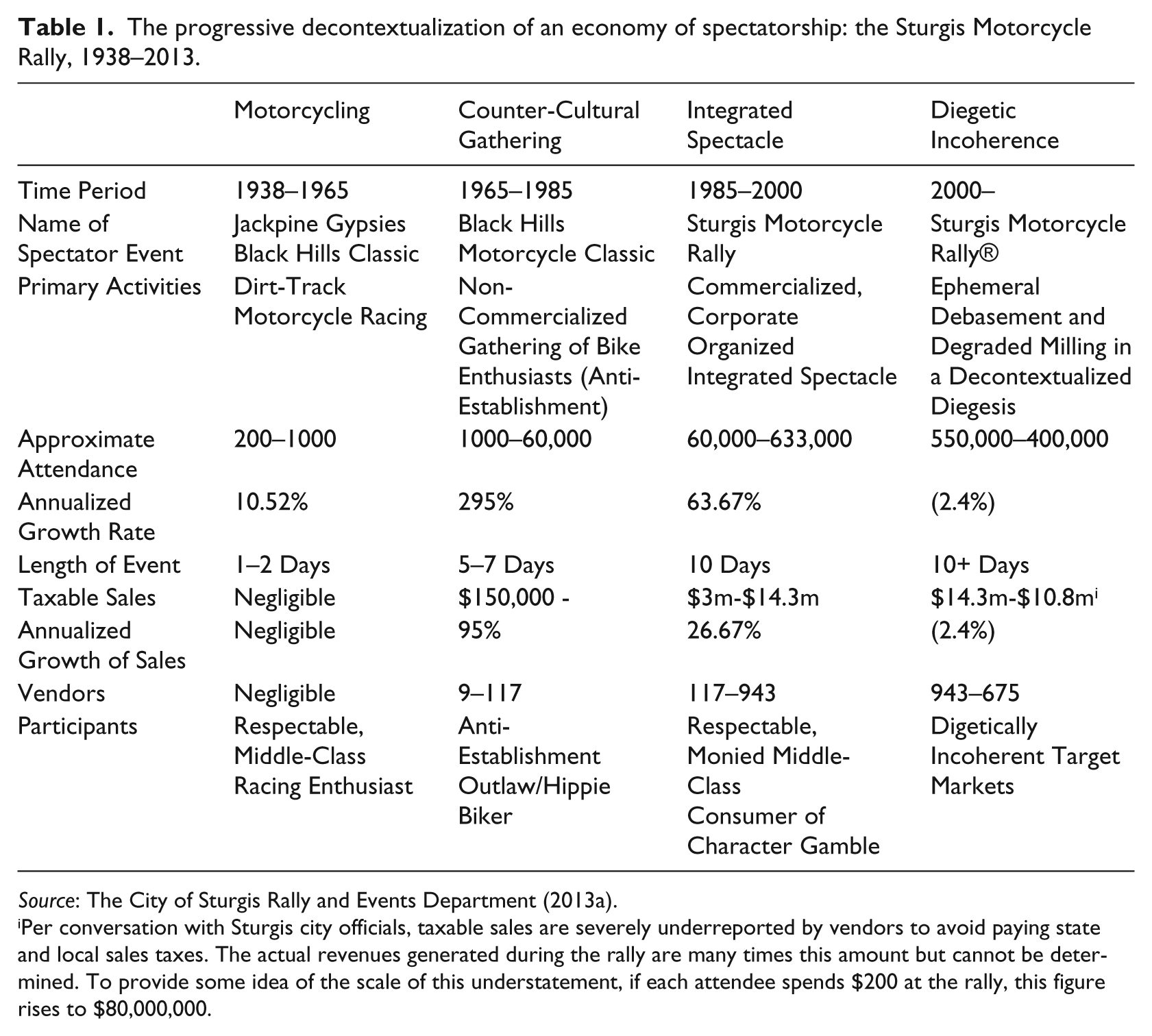
The Sturgis Motorcycle Rally originated in the Black Hills Motorcycle Classic (BHMC), a weekend race sanctioned by the American Motorcycling Association and hosted by an official club, the Jackpine Gypsies (see Table 1). Unlike typical ‘on brand’ elements of the Rally today, this early event mirrored the traits of legacy motorcycling culture of the early 20th century, in which respectable, remarkably ‘square’ middle-class participants joined formal clubs that were more akin to civic associations than outlaw gangs (Williams, 2009; Wooster, 2010). The BHMC grew slowly for three decades, attracting fewer than a thousand spectators to a wholesome, family oriented celebration of motorcycling (American Motorcycling Association, 2002). In short, BHMC weekends manifested high levels of active participation in an intimate setting with people bonded together by shared enthusiasm for racing and motorcycle touring – more a society than a society of spectacle.
The progressive decontextualization of an economy of spectatorship: the Sturgis Motorcycle Rally, 1938–2013.
Source: The City of Sturgis Rally and Events Department (2013a).
Per conversation with Sturgis city officials, taxable sales are severely underreported by vendors to avoid paying state and local sales taxes. The actual revenues generated during the rally are many times this amount but cannot be determined. To provide some idea of the scale of this understatement, if each attendee spends $200 at the rally, this figure rises to $80,000,000.
The mid-1960s marked a turning point of the transition of the BHMC into the Sturgis Motorcycle Rally. Fueled by prominent representations of outlaw biker culture in the popular media of the day, the event gradually shifted away from dirt-track motorcycle racing to become a counter-cultural gathering. This new mass of rally-goers largely ignored the formal Jackpine Gypsy dirt-track racing 6 in order to engage in a form of movie-induced tourism (Connell, 2012; Kim and Richardson, 2003; Riley et al., 1998), playfully immersing themselves in the alternative biker lifestyles that they had seen depicted in newly popular outlaw biker films.
Economies of spectatorship emerge by producing a spectacular diegesis that fascinates spectators, holding their attention long enough to extract profit. The spectacular diegesis of outlaw bikers that was produced by the SMR was rooted in the outlaw biker activity of the mid-20th century. 7 Just after World War II, a wave of motorcycle clubs was founded outside of the governing norms of the American Motorcycle Association (AMA). In the 1950s, these ‘outlaw’ clubs became notorious for disrupting AMA sanctioned events, causing civil disruption and challenging civil authority. News reports spread the infamy of outlaw bikers (Reynolds, 2000; Shellow and Roemer, 1966) while a new genre of biker-themed cinema became widely popular. Especially important was the 1969 film, Easy Rider, that depicted motorcycle touring as an expression of the rising youth movement. To young people disenchanted with establishment values, the outlaw/hippie biker embodied countercultural desire for freedom in an authoritarian world. These films and media sensationalism about alleged outlaw biker activity fueled hysterical notoriety and a ‘moral panic’ over outlaw bikers (Cohen, 1980; DeYoung, 1998; Reynolds, 2000; Yates, 1999). Over time, the moral panic subsided but the ‘legend’ of the outlaw biker remained.
By the 1970s, the legend of the outlaw biker had become firmly established as the spectacular diegesis of the SMR, and drew new types of rally-goers who desired an experience of countercultural lifestyle that they had seen on screen (Schembri, 2009). These new spectators were younger, and as images from the period clearly depict, dirtier and hairier than members of the legacy motorcycling clubs. Collared shirts, dress slacks and dresses were replaced with collarless and often sleeveless T-shirts (the better to display tattoos), denim jeans, leather vest and jackets, engineer boots, skull caps and bandanas as the de rigueur rally costume, a clear case of the tribalization of consumption (Antonio, 2000; Cova and Cova, 2002). Clad in the regalia of outlaw bikers, the spectators increasingly became part of the spectacle, so that the Rally began to mirror a classic Bakhtinian carnival (Bakhtin, 1968; Krier and Swart, 2012; Langmann and Ryan, 2009) marked by sexualized play, unfocused interaction, drinking, brawling, and milling along Main Street or camping rough in the Sturgis City Park. Gazing upon each other, imaging themselves within the spectacular diegesis of the outlaw biker, while participating in consumption rituals (McCracken, 1986), rally-goers transformed what had been a gathering of motorcyclists focused upon the ride into a ‘society of spectacle’ both analytically and temporally congruent with Debord’s 1967 essay. Debord’s society of the spectacle was defined by consumption of a spectacular diegesis: spectators mimicked its content while psychologically identifying with the imaginary images projected before them; images that stupefied them while picking their pockets.
Rally attendance and its economic output grew dramatically during this period. Attendance swelled at an annualized growth rate of 295 percent, from 1000 to 60,000; the length of the rally increased to a full week; and the rally spread outside the city limits and into neighboring towns to accommodate the increasing crowds. Rooted in the sale of its spectacular diegesis, the SMR became a full-scale, diversified economy as temporary vendors set up to cater to the needs of rally-goers. Taxable revenues grew at a 95 percent annualized rate, from $150,000 to $3,000,000.
Unlike the BHMC legacy cyclists, these new rally-goers were not bonded by cross-cutting social ties, deeply shared community or political interest. Instead, they shared little more than a desire to purchase access to a spectacular diegesis replete with media disseminated images of an outlaw biker counterculture. By the end of the 1970s, the legacy motorcycling enthusiasts of the BHMC had been supplanted by spectators who were no longer motorcycle club members or outlaw bikers, but consumers purchasing access to the outlaw biker diegesis at the SMR.
The Sturgis Diegesis as Commodity: Spectator’s Desire and Consumable Character Gambles
Economies of spectatorship produce profit by commodifying unique diegeses that spectators pay to see and within which sponsors pay to be seen. 8 Like all commodities in late capitalism, the value of spectacular diegeses are conditioned by the willingness of spectators to buy them. Without spectators’ desire to see and to be seen within its diegesis, an economy of spectatorship collapses.
On the surface, the spectacular diegesis of outlaw biker legends does not appear to be very desirable or valuable. It seems counterintuitive that lawful citizens with respectable middle-class habitus and significant disposable incomes would desire to see and to be seen within a diegesis so famously degraded as the Sturgis Motorcycle Rally. What value (in the common rather than Marxist vernacular) do consumers realize in their attendance at Sturgis? What value (in Marxist terms) is realized through the production of this particular spectacular diegesis?
To explain the value of the outlaw biker diegesis, we draw upon Erving Goffman (1967), a sociologist not typically associated with critical theory. 9 To Goffman, ‘action’ occurs when a person voluntarily assumes risk in chancy situations, those that involve potential losses and gains that are consequential and fateful. Many scenes of action place physical bodies at risk, but the most important type of action places social reputations or ‘character’ at risk. Positive character traits – bravery, courage, intelligence, persistence, poise – can only be socially realized when openly displayed in risky situations. To Goffman, only character that has been gambled has value because it is ‘visible’ and socially real.
While action was unavoidable among pre-modern people who were faced with dangerous, difficult work tasks that provided ample opportunity to display character, action has been lost to most modern workers. Except for a few high ‘action’ occupations (military, police, firemen, high-rise construction, stock-trading), most modern jobs have become too safe and mundane for action. This lack of opportunity for action is not accidental but structurally necessary to modern capitalist existence: modernity domesticates and administers existence in safety-conscious public spaces, Taylorized workplaces, and ‘nanny-state’ social welfare. While the often-repressed desire for risky, fateful situations remains, it is displaced from work-life onto the after-work world of leisure (Goffman, 1967; Lyng, 1990). Hence, opportunities for action become valuable.
Goffman’s theory of action accounts for spectator fascination with the outlaw biker lifestyles and images of the SMR diegesis. In contrast to Debord’s spectacle, where leisure is unserious, temporary relief from boredom and vicarious stimulation that quickly fades, Goffman’s concept of action presents modern leisure as extremely serious and played for high stakes; see Celsi et al. (1993) for a discussion of ‘high-risk leisure consumption’ through skydiving. Since leisure is ‘where the action is’, modern people – like rally-goers at Sturgis – use leisure to search for and consume valuable prepackaged action that simultaneously tests and displays character.
While the habitus of lower and working-class people fits the outlaw biker diegesis of the SMR and its corporate partner, Harley-Davidson, demographic analyses of Harley-Davidson buyers and motorcycle rally-goers reveals a predominance of white-collar workers (Thompson, 2012). 10 Like the ‘real life’ of Thurber’s character Walter Mitty, the work of these well-to-do occupants of offices and desks lacks a narrative of action. These are precisely those that figure so prominently among the consumers of ready-made action at motorcycle rallies because they highly value opportunities to purchase action by playing at outlaw biker in their leisure time.
Goffman noted that many moderns consume action through ‘ephemeral ennoblement’, temporarily occupying high-prestige settings typically occupied by elites (or at least by social classes higher than one’s own). Action comes from ‘fancy milling’ within these spaces, proving positive character traits (daring, intelligence and presence of mind) by successfully managing the role distance required to pass as someone normal to that setting. What seems clear in our study of motorsports spectacles, however, is that action is found not only from reaching up, but also from slumming down. Thus we propose that ephemeral debasement is an equally applicable mechanism by which moderns seek action, one that more clearly captures the consumable character gamble that results from degraded milling at contemporary motorcycle rallies. In ephemeral debasement, action is found by demonstrating the prowess necessary to temporarily abandon middle-class norms, successfully navigating role distance and to simulate potentially disreputable identity characteristics. While spectacles that stage diegeses infused with ephemeral ennoblement have proliferated in recent years (all-inclusive upscale resorts, cruise-lines and spas), the rapid growth of Sturgis and other motorcycle rallies suggests that the market for ephemeral debasement has expanded even faster. For Sturgis rally-goers and a growing number of other spectators, the purchase of temporary disreputable identities stands alongside fancy milling as another source of action. 11
Consumer desire underlies SMR’s transformation from a participatory social event into a producer and purveyor of outlaw biker diegesis. The SMR diegesis scripted a disreputable character for paying rally-goers to playfully enact; one that allowed them to display the dark character virtues that could not otherwise be realized in post-industrial employment. The SMR, NASCAR and highly-sexualized carnivalesque settings like Mardi Gras produce diegetic scenes of ready-made action, commodified character gambles marketed to and particularly valued by upper middle-class spectators. Thus, Goffman’s concept of ‘action’ explains why SMR’s spectators desired ephemeral debasement with sufficient intensity to immerse themselves at high cost in the Sturgis diegesis. 12
Marketing the Sturgis Diegesis to Spectators and Sponsors
A spectacular diegesis becomes a commodity when it is produced for sale in a consumption market. Beginning with appealing content often originating in the cultural commons (Boyle, 2003), producers transform narratives into commodities by producing and selling them to spectators and sponsors, transforming public domain content into trademarked property. Producers generate revenues from spectators primarily by charging admission to view the diegesis, though substantial secondary revenues are typically generated from parking, lodging, food, beverages, merchandise and premium access. In addition, producers generate revenue from sponsors by charging cross-marketing licensing and advertising fees for the right to appear within the diegesis.
To effectively stage the diegesis for a growing market while profitably servicing the assembled crowds, producers of the SMR made extensive capital investments in the infrastructure of spectatorship. During this period, the City of Sturgis and Rally organizers designated prime real estate along Sturgis’s main street and traffic corridors as marketing space for vendor stalls. The City of Sturgis facilitated this commercialization in a variety of ways, providing vendor manuals, city vending regulatory guidelines, Internal Revenue Service assistance, and State Department of Revenue information to small businesses participating in the Rally.
Rally organizers also worked to ensure that massive crowds of rally-goers maintained an ongoing experience of immersion in the produced diegesis. Property developers constructed massive campgrounds, music venues, grandstands, stages, and subsidiary infrastructure of parking lots, cafeterias, snack shops, bathrooms. New biker bars were constructed, open only during the weeks of the Rally and saturated with outlaw theming, including names like Broken Spoke, Easy Rider, One Eyed Jacks; the Knuckle, and the Full Throttle. City officials closed Main Street to automobile traffic, transforming downtown into a rumbling showcase of chopped bikes congruent with iconic images of the Rally (preferential motorcycle parking at most Rally venues served the same function). Corporate marketers and event promoters installed temporary signage, street banners and store facades that repeated outlaw biker imagery. In meme-like fashion, imagery from biker outlaw cinema, especially Easy Rider and The Wild Ones, appeared in saloons, restaurants, campgrounds and gas stations, and were echoed in the costuming, leather and chains hawked by Rally vendors and worn as a uniform by milling crowds. Imitating scenes from outlaw biker films, some venues allowed motorcycles to be ridden inside, permeating the atmosphere with rally-themed sounds, vibrations and exhaust.
Like other economies of spectatorship (Mardi Gras, NASCAR, Collegiate and Professional Athletics), sponsorship revenues were essential to the SMR. 13 The earliest and most important sponsor of the SMR was Harley-Davidson Motorcycles, Inc., a corporate brand whose profits were tied to intensive commodification of the same outlaw biker diegesis as the SMR. 14 In 1969, the Harley-Davidson Corporation had been absorbed by conglomerate American Machine and Foundry (AMF) who treated the motorcycle manufacturer as a ‘cash cow’, draining money from the division while under-investing in new technology and innovative design. While other motorcycle brands swept the US market (Honda, Suzuki, Husqvarna and Yamaha) by selling efficient, comfortable, reliable, and powerful transportation, Harley-Davidson’s uncomfortable, poor-handling, low-powered machines lost market share (Austin et al., 2010; Reynolds, 2000; Schembri, 2009). 15 After a leveraged buyout in the early 1980s, Harley-Davidson’s owners recast the firm to cash in on its strongest asset: public association of the brand with popular, mostly cinematic, portrayals of outlaw bikers. Harley-Davidson reformulated into a marketer of branded apparel and motorcycles consciously styled as facsimiles of the choppers and bobbers ridden by iconic cinematic outlaw bikers (Schembri, 2009). The Sturgis Motorcycle Rally was central to Harley-Davidson’s rebranding: in the early 1980s Harley-Davidson released a bike ‘in honor of the historic Sturgis motorcycle rally’ and took out a trademark on the ‘Sturgis’ name (US Patent and Trademark Office, 1982). From this period to the present, Harley-Davidson intensively projected its brand into the SMR diegesis, annually occupying the premium vending space at the Rally (a large multi-trailer display on the high-traffic intersection along the main cruising route through town).
The SMR sponsorship also allowed Harley-Davidson to feature Sturgis Rally footage, images and activities in its advertising and promotional activities throughout the year and on its website. Harley-Davidson augmented its marketing effort by managing ‘customer experience’, ensuring the ongoing association of the brand with ‘cool’ outlaw biker diegeses like the SMR (and to a lesser degree Daytona Bikeweek and the annual rally at Laconia). In 2012, Harley-Davidson’s annual report disclosed that 23 percent of the company’s revenues were derived from non-motorcycle sales of parts, accessories, branded merchandise, branded apparel and revenues from cross-marketing license agreements that placed the Harley-Davidson’s brand on a surprising array of consumer products (including fountain pens, teddy bears and underwear). Managers of Harley-Davidson, as sponsors of the SMR, paid for their branded products to be seen within the outlaw biker themed diegesis, forming a ‘subculture of consumption’ (Schouten and McAlexander, 1993, 1995; Schouten et al., 2007), or ‘brand community’ (McAlexander et al., 2002; Muniz and O’Guinn, 2001) in which rally-goers practiced ‘consumption as play’ (Holt, 1995: 8). The success of this cross-marketing for Harley-Davidson was reflected in its dominant 57 percent share of the large displacement motorcycle market in the USA (Harley-Davidson Annual Report, 2012).
Other sponsors paid to promote their brands by merging them into the Sturgis Rally. Many of these brands were similar to Harley-Davidson in that they were so closely aligned with the outlaw biker legend that their presence intensified the SMR diegesis. Victory Motorcycles, a division of Polaris Industries that manufactures Harley-Davidson-like motorcycles, was a recurring sponsor of the Rally. Jack Daniel’s Whiskey sponsored a variety of venues within the SMR, explaining the fit between their brands and the Rally as follows: ‘Jack Daniel’s Tennessee Whiskey … has stood for authenticity, Americana, Independence and freedom. And that’s exactly why Jack Daniel’s is proud to be part of the annual Sturgis® Motorcycle Rally’ (City of Sturgis Rally and Events Department, 2013). FX’s Sons of Anarchy, a television series that reproduced ‘legendary’ outlaw biker images and narratives, has become an official sponsor of the SMR. Sonny Barger, the infamous leader of the Hell’s Angels, reinforced the diegetic coherence of the 2002 SMR while he exploited it for gain by promoting his new brand of beer (Sonny’s Lean and Mean Lager) while selling copies of his newly published biography during the Rally (Horsey, 2002).
Dialectical Development of the Sturgis Diegesis: Progressive Decontextualization in Economies of Spectatorship
In economies of spectatorship, organizers maximize profit by growing the size of audiences and expanding the network of sponsors paying cross-marketing licensing fees. In initial stages of growth, organizers reach culturally related spectators and sponsors by stretching the original diegetic content. Eventually, organizers must seek target markets further afield to sustain growth. Reaching these culturally distant spectators and sponsors requires production of less coherent narratives that introduce new themes, images and legends that obscure the original content. Thus, economies of spectatorship develop in a dialectic process that we term progressive decontextualization. Beginning with a focused diegesis produced for a culturally coherent market of spectators and sponsors, the growth imperative forces organizers to produce internally inconsistent cultural content to reach audiences from distant market segments and to sign sponsors from diverse industries. As economies of spectatorship integrate sundry elements, the produced narrative loses its coherence, reducing its audience appeal by destabilizing spectator’s desire. Just as a coin debased with impurities diminishes in value, so too does a fully commodified diegesis.
The progressive decontextualization of spectators, sponsors and diegetic content was evident as the SMR grew. Spectatorship at the SMR increased from 60,000 attendees in 1985 to 633,000 attendees in 2000, an annualized rate of growth of 65 percent (see Table 1). After 1985, the expansion of spectatorship incorporated market segments of high-dollar spectators that were culturally distant from the low-dollar outlaw biker diegesis of the SMR. These new spectators were disproportionately ‘off brand’ middle-class professionals, women, younger riders, families, and minorities. Such demographically diverse rally-goers were unified by their high disposable incomes, their desire to see the Sturgis diegesis and their willingness to spend thousands of dollars purchasing factory-chopped bikes and outlaw costuming essential to the Sturgis scene. To make these highly profitable rally-goers comfortable, SMR organizers and City officials began regulating those activities most directly congruent with the outlaw biker diegesis. Unpaid rough camping by ‘hippie freeloaders’ in city parks was officially suppressed in 1984, and public drinking and overt public nudity became heavily regulated during the ensuing decade. As a form of progressive decontextualization, these new regulations increased spectatorship and profit flows by cleaning up the ‘outlaw’ content of the Sturgis diegesis to make it more palatable to middle and upper middle-class spectators.
SMR organizers inked cross-marketing licensing agreements with sponsors increasingly off brand from the outlaw biker themes of Sturgis. 16 Revenues from commercial vendors and corporate sponsors increased from $3m in 1985 to $14m in 2000, an annualized growth rate of 26 percent (see Table 1). 17 The number of vendor licenses grew even more rapidly from 117 in 1985 to 943 in 2000, an annual growth rate of 47 percent. Some new sponsors and vendors were consistent with the leather, skin and steel imagery attributed to legendary outlaw bikers. On-brand sponsors and vendors included tattoo artists, body painters, motorcycle parts and accessories, motorcycling apparel and insurance, carnivorous food and low-brow alcohol. But, an increasing group of vendors sold ‘off-brand’ products and services to the rapidly diversifying demographic of rally-goers. Many of the sponsors who signed sponsorship agreements paid to display brands and icons at the Rally that had little connection with outlaw biker theming. The Sturgis Economic Development Corporation, the Sturgis Chamber of Commerce, and the South Dakota Department of Tourism were prominent Rally sponsors, signaling intensive injection of legitimate state-business coalitions into the outlaw biker diegesis. Corporate sponsors who paid to be seen within the diegesis of the SMR included Ford Motor Company, Sony Electronics, GEICO, AMSOIL, PakMail, Budweiser, South Dakota Lottery, Coca-Cola, Knowlogy, Pork – The Other White Meat, and Alltel. SMR organizers indicate that these diverse sponsors ‘found the Sturgis Motorcycle Rally to be a productive investment and one on which they proudly place their brand’ (City of Sturgis Rally and Events Department, 2009). Marketing managers of Sony Corporation believed that their SMR Sponsorship would not only ‘lure bikers from checking out fast rides to our sponsor booth filled with the latest electronics’ but would ‘build a brand connection with attendees’ (City of Sturgis Rally and Events Department, 2009).
Professional marketing firms were hired by Sturgis city officials to facilitate the diverse commodification of the SMR and to manage the SMR’s increasingly complicated corporate sponsorship contracts and cross-marketing licensing agreements. Prior to 1992, these contracts had been administered by not-for-profit agencies – the local Chamber of Commerce or its subsidiary, the Black Hills Motor Classic Board (BHMCB). The BHMCB was reincorporated as the for-profit Sturgis Rally and Races, Inc. to better ‘plan, organize and promote the rally and races and return significant tangible financial benefits to the residents of Sturgis’ (US District Court: District of South Dakota, 2000). The City of Sturgis changed promotional firms three times, with each succeeding contract written to better realize returns to interested parties. For example, in 2013, the City of Sturgis terminated its contract with Motoring USA, Inc., in order to put rally publications out for bid and regain control over vendor leases on city owned properties (Ganje, 2013; Holland, 2013). Highlighting the goal of profit expansion to a global audience, city officials sought a new agent that better ‘matched the City’s long-term goals in marketing the Rally; one with global reach for the development of one of the world’s leading lifestyle brands – at one of the world’s most well-known events, the Sturgis Motorcycle Rally’ (Ganje, 2013). Additionally, the City of Sturgis Rally and Events Department produced an Official Sturgis Motorcycle Rally Magazine and the Schedule of Events Pocket Guide, as well as a widely circulated Rally Visitor Information CD, which promoted the Rally to diverse audiences with advertising space sold to diverse sponsors.
Politics, Religion and the Sturgis Diegesis in the Age of the Integrated Spectacle
Progressive decontextualization of the SMR diegesis also occurred through the integration of sponsors and thematic elements drawn from politics and religion. Such diegetic thickening of economies of spectatorship was anticipated by Debord in 1988, when he revised his already bleak theory to herald capitalism’s descent into an even darker era: the ‘integrated spectacle’. 18 Debord (2006 [1967]) had always conceived of the society of spectacle in political terms: spectacular images redoubled alienation, leaving viewers unenlightened and distracted from the real conditions of social life. As individuals cathected strongly with their consumer brands – automobiles, home appliances, clothing and favored forms of entertainment – they became progressively distracted, socially estranged, and politically impotent (Debord, 2006 [1967]: ¶ 28). Debord added the adjective ‘integrated’ to his concept of spectacle to highlight the synthesis of consumer oriented ‘diffuse spectacles’ with ‘concentrated spectacles’ that serve as political theology (Debord, 1988: ¶ 4). Consequently, the integrated spectacle floats ‘above real society’, combining the pacification and distractions of consumer capitalism with the ideological power of religion and politics. Hence, the consumer economy in the age of the integrated spectacle is always also ideological since political and religious themes are overlaid upon and blended within profitable diegetic content.
To Debord, even oppositional politics and revolutionary actions were flattened into images that safely and impotently circulated within the integrated spectacle, generating profit at particular moments but nowhere organizing effective political opposition to the system. This helps account for the counterintuitive integration of conservative religion and politics into economies of spectatorship like the outlaw biker themed diegesis at Sturgis. The liberatory qualities of spectacular consumption have often been noted (see Firat and Venkatesh, 1995), but the SMR diegesis was closer to authoritarian politics and ‘repressive desublimation’ (Marcuse, 1964) than to ‘liberatory postmodernism’. Leftist politics and liberatory symbolism rarely appeared at the SMR or related motorsports events like NASCAR, monster truck rallies, or other motorcycle rallies, but these venues featured imagery and symbolism of right-leaning politics. Significant military presence infused the Sturgis Rally, including flyovers by military aircraft, veterans’ rides, a traveling facsimile of the Vietnam War Memorial, and memorials to Iraq/Afghanistan war casualties. American flags festooned public streets, private campgrounds, and biker apparel. Pro-American slogans such as ‘Try Burnin’ this one, Asshole’ and ‘These Colors Don’t Run’ appeared on T-shirts and bumper stickers while right-leaning acts such as Ted Nugent, Toby Keith, Charlie Daniels and Molly Hatchet dominated music venues. Images and candidates from the Republican Party, the South Dakota Tea Party, and The Young Obama Haters appeared within the Rally diegesis. In 2007, the Sturgis Motorcycle Hall of Fame officially inducted the ‘Bush Bike’, a customized chopper, complete with the preamble of the US constitution, commissioned by the Republican National Committee to commemorate G.W. Bush’s 2004 campaign (Maverick, 2007). The rally annually incorporated a ‘Governor’s Ride’ in which state and local politicians dressed up, without consciously registered irony, as outlaw bikers to ride with celebrities and music artists to Mount Rushmore, the ur-monument of American imperial power.
A tableau portrait of political integration at Sturgis occurred during the 2008 rally, when Republican candidate for President, John McCain gave the ‘Tribute to the Vets’ speech at the Buffalo Chip Campground. McCain’s campaign was struggling at this time, and while Sarah Palin drew large crowds to her campaign events, McCain’s were noticeably smaller. Thus his campaign staff sought already assembled audiences; in this case, the assembly gathered for the Kid Rock concert on the Wolfman Jack Memorial Stage at the Buffalo Chip campground. His glamorous power-elite wife Cindy introduced him by claiming that her husband was ‘the only man who can keep us free’. After he received the microphone, McCain then famously offered her up to the raucous crowd as a competitor in the Miss Buffalo Chip beauty pageant (a notorious wet T-shirt / banana licking / strip contest) with the comment, ‘With a little luck she could be the only woman ever to serve both as First Lady and Miss Buffalo Chip.’ Below are some vivid quotes from this speech which capture the ultra-establishment McCain covering himself in outlaw biker theming:
not long ago a couple hundred thousand Berliners made a lot of noise for my opponent. I’ll take the roar of 50,000 Harleys any day … I recognize that sound … it’s the sound of freedom. we’re not gonna pay $4 a gallon for gas because we’re gonna drill offshore and we’re gonna drill now … and we’re gonna drill here and we’re gonna drill now. My opponent doesn’t wanna drill … he doesn’t want nuclear power, he wants you to inflate your tires. you’re the heartland of America and you’re the heart and soul of America … you provide the men and women who serve our military. (beckychr007, 2008)
Following Debord, most critical theorists have viewed spectacle primarily through the lens of politics, and would interpret McCain’s stumping as confirmation of spectacle’s ideological power. The cultural phrasing that permeated motorsports spectacles – free-grace Christianity, neo-conservative politics (pro-military, anti-welfare state) and neo-liberal economics – does serve an ideological function in that it encouraged spectators to recast global capitalism’s hazards as character proving lifestyle choices. 19 Unlike progressive politics which encourage risk pooling and the organized reduction of chance (Amidon and Sanderson, 2012), right wing politics places risk and chance squarely upon the shoulders of individuals. The parallel to Goffman’s concept of action is unmistakable: the spectacular diegeses of motorsports encouraged spectators to voluntarily reject safety and security in multiple regions of life (religion, politics, work, consumption), while embracing risks to mind, body and bank account. Motorsports and other contemporary spectacles of ‘action’ allowed spectators to pretend that they were voluntarily choosing the risks and meta-anxieties forced upon them by global capitalism (Žižek, 2009).
However, on balance, our observations at Sturgis lead us to conclude that ideological considerations were secondary to money-making. The SMR diegesis was primarily determined by economic forces (the desire for profit) rather than political forces (the desire for ideological control), especially after action seeking consumers had supplanted countercultural rally-goers. As an economy of spectatorship, what appears as ideological theming within the SMR was the unintended byproduct of profitable diegetic production (cf. the arguments of Bonilla, 1988; Endres and Ferrar, 2002; Gottdiener, 2001; Gottdiener et al., 1999). Organizers incorporated commercial, political and religious motifs into the diegesis to enhance profits rather than to induce ideological control. Whatever ideological power McCain’s appearance may have generated was immediately dissipated by other ideologically discrepant events produced by the Sturgis Buffalo Chip staff for consumption by paying spectators: ‘Women of Wrestling’s Wringing Wet and Wild Throwdown,’ Buffalo Chip’s ‘Fake Orgasm’ contest, ‘Homemade Bikini’ contest, ‘Beers and Burps’ contest (‘how loud can you blast a burp out … while still keeping the important stuff down?’), midget bowling (‘toss Short-Sleeved Sampson down the greased-up lane’), or ‘Beer Belly’ contest. Our field observations lead to the conclusion that political appearances are not ontologically distinct from these other, profit motivated events. In contrast to many readings of Debord, the cultural content of economies of spectatorship like Sturgis was materially, not ideologically, determined.
In the age of the integrated spectacle (Debord, 1988), not only political elements but also religious themes blend into spectacular diegeses. In recent times, religious imagery, leadership, and practices have become commonplace at sporting events, political gatherings, military exercises and other public settings, conceptualized by Ritzer (2005) as the re-enchantment of consumption. As a hedonistic spectacle themed with outlaw biker imagery, however, Sturgis seemed an unlikely forum for religiously themed images and activities. Amidst the conspicuous, posed sinning of rally-goers, ascetic matters of faith were at least mildly out of place, if not jarringly discrepant. Mundane religious integration occurred in the background of the rally, as local churches in Sturgis hosted a variety of biker events including pancake breakfasts and special services. Additionally, the largest private venue at the Sturgis Rally, the Buffalo Chip Campground, prominently displayed a fifty-foot tall, metal fabricated ‘battlefield cross’ at its main entrance.
The Sturgis Rally was a hotbed of more pronounced religious activity, to the considerable profit of Rally organizers. Described as a ‘modern-day Sodom and Gomorrah’ and ‘Vanity Fair’ by the Dakota Baptist Convention, this group nevertheless spent $10,000 for vendor space at the 2009 rally, and recorded 125 professions of faith (conversion experiences), which was described by one mission volunteer as ‘not a bad day’s work in hell’ (Christian Index, 2009). In addition to such delegations from mainstream Christian denominations, numerous specifically biker-themed evangelical ministries purchased vendor space and were observed selling religiously themed merchandise while passing out literature. These ministries included the Wheels of Faith Motorcycle Ministry, Hog Wild for Jesus Ministry, Soldiers for Jesus Motorcycle Club (‘Ride with Jesus’), Jesus Loves Bikers, Motorcycle Ministry (‘Reaching Out to the Depressed, Oppressed, Addicted, Convicted and Just Plain Lost’). Apart from official ministries, many rally-goers purchased and displayed T-shirts or patches sewn onto leatherwear that implicitly or explicitly connected them with Christianity (crosses, bible quotes, ‘Jesus Saves’) or to Christian biker clubs.
In classic cross-marketing fashion, the motorcycle themed devotional literature distributed by biker ministries blended together Christian iconography with outlaw biker imagery. For example, multiple variants of a ‘Biker’s Prayer’ appeared in ministry materials, including the following taken from their websites:
Jesus A Biker? Let’s look at the facts. He had long hair and a beard. He hung around regular people, not the church types. The government did not care for him. (Bikers for Christ: Orange County Chapter, undated) 60 miles an hour with the wind in my face, hands up on the grips and my feet up on the pegs going down the road for a ride somewhere … I say a biker’s prayer … For me it’s not about the chrome, the leather, or the steel. It’s all about connection to something beautiful and real when you’re balanced on two wheels. (Bikers for Christ: East Bay Chapter, undated) If Jesus appeared today in the flesh he would be here, parked right next to you on his motorcycle … He would be seen on his motorcycle at biker rallies telling others what he told you. Jesus loves bikers because he is one of us … Get on your ride and follow him. (Jesus the Biker, undated)
This cultural mash-up of Jesus and chopper riding bikers not only inspired Christian ministries, but generated devotional commodities in the form of artwork, music and even ‘Jesus as Biker’ action figures that were sold at the Rally, biker websites and eBay. The Freedom Rider Action Toy was molded in the form of Jesus as an outlaw biker astride a chopped cruiser with robes flowing, helmetless but with a crown of thorns (see Figure 1), and was ‘inspired by the thought of what Jesus might do in modern times’. The description further stated that the action figure symbolized Jesus’s message as ‘I Am Freedom’ (eBay, undated) – a reformulation of the gospel in terms consistent with the outlaw biker legend, the newly formulated brand slogan of the City of Sturgis, and all three elements of the current integrated spectacle: the free-market neo-liberalism of global capitalism, the political ideology of the Tea Party and the free-grace theology of Christianity.
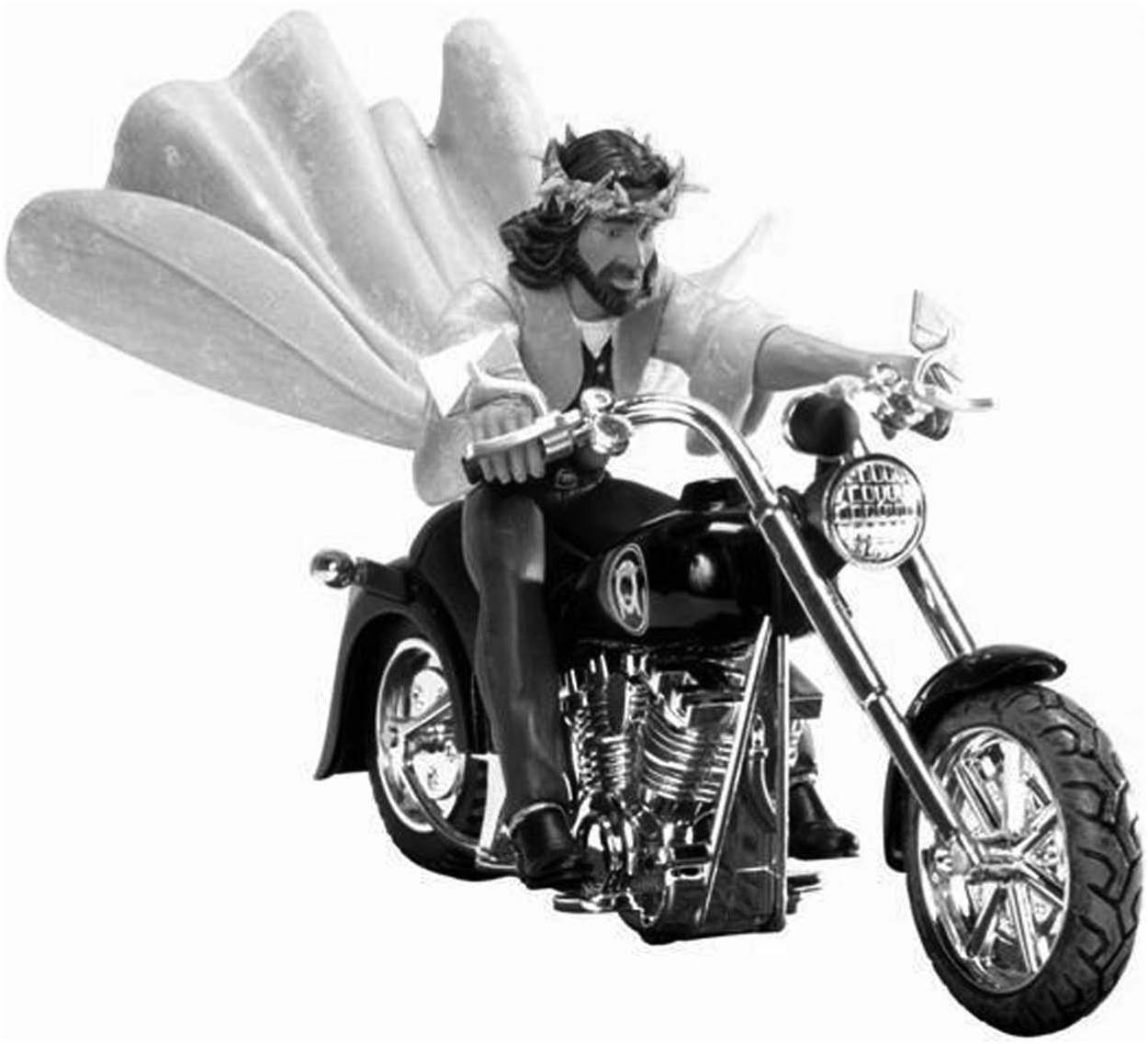
Jesus in the Sturgis diegesis: ‘Jesus as biker action figure’.
Progressive Decontextualization, Diegetic Incoherence and Diegetic Maintenance
As economies of spectatorship decontextualize, the produced diegesis loses coherence and destabilizes spectators’ desire. Like a hurricane, the SMR grew as spectators and sponsors circulated about the ‘eye’ of its outlaw biker diegesis, absorbing ever more distant and inconsistent spectators and corporate sponsors. Spectacular diegeses possess a certain degree of elasticity and organizers of the SMR attempted to stretch its outlaw biker tropes to accommodate discrepant corporate sponsors and commercial vendors. In 2012, this led to strange pairings of biker outlaws and legitimate cross-marketed partners like casualty insurance, massage services, homeopathic health aids, soft drinks, home electronics, pharmaceuticals, and the History Channel. Carnivalesque commercial activities entirely unrelated to the outlaw biker legend were also incorporated within the Rally: greased midget bowling, machine gun demonstrations, zip lines, and atonal performances by aging 1980s hair bands. Atop this already discrepant commercial content, SMR organizers layered additional, highly discordant themes of ‘law and order’ politics and religious salvation.
Such progressive decontextualization of a founding diegesis is inevitable as organizers integrate ever more divergent corporate tie-ins, cross-marketing agreements, political ideologies and religious themes. Consistent with Ritzer’s (2007) ‘globalization of nothing’ thesis, progressive decontextualization is also temporal and spatial. As economies of spectatorship develop they sprawl out over calendars and maps until they appear everywhere at all times. For example, NASCAR attracted spectators and profit flows year-round from virtually (literally ‘virtually’) all locations on its digital platforms including Raceview 360, iRacing, and the Speed Channel. Similarly, the two-week SMR generated nearly continuous, nearly global ‘doubles’ in streaming videos, online images, cable television programming and websites, as well as in copycat rallies deploying Sturgis brands and imagery. These McDonaldized (Ritzer, 2013) rallies reproduced Sturgisesque outlaw biker diegeses across North America and Europe. For example, Jay Allen, a self-proclaimed ‘pioneer in the art of motorcycle entertainment’ (Jay Allen, undated), also owned major Sturgis venues, the Broken Spoke Saloon and the Broken Spoke Campground. Allen also operated Broken Spoke Saloons in other biker-themed locations like Daytona Beach and Laconia, each reproducing images and narratives drawn from Sturgis. Allen developed a traveling version of the Sturgis diegesis, The Jay Allen Road Show, that produced outlaw biker diegeses sold to spectators throughout the USA. Allen was the principle organizer of the 2012 Iowa Grand Rally, a ready-made Sturgis-style motorcycle rally staged at a NASCAR track in Newton, Iowa. This rally featured many of the same performers and celebrities featured at Sturgis (including cast members from FX Network’s Sons of Anarchy series) and was timed to capture spectators and sponsors en route to and from the Sturgis Rally. A similar McDonaldized Sturgisesque diegesis was produced by the owner of the Sturgis Buffalo Chip campground, who staged a travelling version of his campground’s regulated raunch called the ‘Sturgis Road Show’ (held in April 2011 in Hershey, Pennsylvania). Finally, the towns of Sturgis, Mississippi and Sturgis, Kentucky have each cashed in upon the notoriety of the SMR by staging small-scale simulations of the outlaw biker diegesis, demonstrating the relevance of Baudrillard’s most famous concept to spectacular economies (Baudrillard, 1983; Krier and Swart, 2012).
As economies of spectatorship progressively decontextualize they draw in spectators, sponsors and content in a self-negating developmental process that results in diegetic incoherence. Diegetic incoherence proceeds as the founding images and legendary narratives that launched spectatorship and sponsorship are lost amid a swirling kaleidoscope of unrelated products, decontextualized activities and diversified locations. At the SMR, excessive promotional tie-ins, brand elasticity, unrelated carnivalesque activities, and dispersed McDonaldized reproductions of the Rally threatened the audience appeal and value of its underlying commodity: the outlaw biker diegesis. As it became stretched and incoherent, spectator desire to view and be viewed within the diegesis eroded, destabilizing the spectatorship and the sponsorship revenues that were predicated upon it.
Diegetic incoherence is inevitable in mature spectacular economies. To counteract it, producers of spectacular diegeses engage in ongoing maintenance, active management, and reinvestment to restore profits to the economic circuit. 20 At Sturgis, declining attendance at the Rally in the 2000s prompted organizers and civic leaders to increase capital investments to reassociate the Rally with the outlaw biker brand and restore coherence to the Rally’s activities. These efforts to restage the authenticity (MacCannell, 1973) of the Sturgis Brand included contemporary fabrication of legacy motorcycling T-shirts, ‘retro’ souvenirs and the future construction of a ‘Sturgis Experience Museum’ intentionally designed to reconnect the visual space of the Rally with its historic ‘aura’ (Goss, 2004; Rickly-Boyd, 2012). In recent years, the degradation of the ‘authentic’ Old West built environment of Sturgis as the themed backdrop of the Rally required diegetic maintenance. Main street buildings had been bulldozed by developers to increase vending and parking space to accommodate larger crowds and more diverse vendors, motorcycle themed street signage, cobblestone walkways, Old West and biker public art. Sturgis officials increased regulation of absentee-owned downtown buildings, specifying that facades be maintained to restore and maintain the town’s ‘Old West’ appearance. Owners of the Buffalo Chip Campground, the Broken Spoke campground, the Full Throttle Saloon and other Rally venues erected facades, fittings and furnishings that reinforced both Old West and outlaw biker theming diegetically consistent with the Rally.
Such active maintenance in response to diegetic incoherence parallels Gottdiener’s (2001) writings on theming and Ritzer’s (2005, 2007) theses on ‘re-enchanting a disenchanted world’ and ‘globalization of nothing’. In economies of spectatorship, spectacular themes do not just enchant commodities, they are the primary commodities produced and sold. In other words, spectacular diegeses are more than just theming or enchantment that fuels the sale of commodities produced elsewhere, but are commodities in and of themselves that generate profit through sponsorship and spectatorship.
Retranslated into Ritzer’s (2005, 2007) terms, spectacular diegeses possess the power of enchantment, attracting paying spectators and sponsors seeking to market other goods to them. Progressive decontextualization forces managers of economies of spectatorship to travel a road that begins with an enchanted diegetic ‘something’ and moves toward ‘nothing’, a consumption market that is decontextualized, incoherent and disenchanted. In economies of spectatorship, growth of spectators and sponsors requires the incorporation of ever more diverse and off brand commercial, political and religious motifs into an originally enchanted diegesis. Managers of spectacular economies do not traverse a random walk of enchantment, but actively intervene to maintain the coherence and value of the enchanted diegesis, thereby forestalling full decontextualization, disenchantment and nothingness.
Conclusion
This article has conceptualized economies of spectatorship that produce diegetic content for sale to spectators and sponsors, marking late capitalism’s increasing commodification of spectacle. Spectacular cultural products have emerged as dominant commodities in their own right, a growth industry and an important source of profit. As one of the largest and longest running mega-spectacles, the Sturgis Motorcycle Rally provided bounded case materials that enabled clear conceptualization of the structure and dynamics of economies of spectatorship. The Rally’s outlaw biker diegesis drew spectators ripe for commercial exploitation, attracting ever expanding audiences seeking action through consumable character gambles. As the spectators and sponsors at Sturgis decontextualized, commercial, political and religious elements were cross-marketed with legends of outlaw bikers. The resulting diegetic incoherence threatened the circuit of profit, leading rally organizers to control cultural content, regulate the built environment and make extensive capital investment to maintain diegetic coherence and profit flows.
Economies of spectatorship have grown dramatically in recent years, as industries and local communities have responded to globalization and deindustrialization. In the USA, local growth coalitions (political leaders, development agencies, business groups) have increasingly turned to spectator events as engines of economic development (Delaney and Eckstein, 2003; Swenson, 2010). 21 Recognizing that an economy of manufacturing is unlikely to return and thrive, they have pinned their hopes for new jobs and prosperity upon economies of spectatorship. Economic development of spectatorship often involves financing massive privately owned infrastructures with public dollars. We confirm the findings of other social scientists who study publicly financed sports stadiums and entertainment venues: the economic benefits promised to the public in these types of ventures are rarely realized (Delaney and Eckstein, 2003; Fellrath, 2009; Swenson, 2010; Thornton, 2012). Furthermore, the private interests that promote and build these facilities are often consolidated in power relationships that lie outside of democratic decision making processes. Arranged with little public input or awareness, these financing deals escape public oversight and accountability.
While poor returns to public investment in spectator events was partly due to expropriation of profits by private owners, our study points to another, more profound, reason for the disappointing economic impact from spectacular development. Just as Marx explained the falling rate of profit in mature industries due to rising organic composition of capital, with machinery and other fixed capital investments overwhelming the profit making capacity of living labor, we see a similar process under way in the economies of spectatorship we studied. The organic composition of spectacle – investments in infrastructure, marketing, promotion and diegetic maintenance – is increasing as this region of the economy matures. While massive growth in information technology has equipped spectators with micro-scale spectacle delivery devices, producing diegeses for these spectators requires enormous capital outlays for physical, broadcast and digital infrastructure as well as large promotional budgets in order to break through the crowded spectacular field. The immense competition for spectators’ bodies and eyeballs, and the scale of capital investment necessary to deliver profitable diegeses to spectators, means that even after a half-decade of diegetic maintenance and heightened capital investment, profit flows at Sturgis, NASCAR and other motorsports spectacles remain stalled.
Conceptualizing such dialectical dynamics and self-negating contradictions of economies of spectatorship adds materialist nuance to Debordian cultural studies. Economies of spectatorship produce a diegetic commodity whose audience appeal and value is destabilized as it is scaled for mass spectatorship and sponsorship. Mapping the evolving circuitry of revenue and profit at Sturgis revealed that developmental dynamics of spectacular economies have little to do with external political pressures or heroic local activism, but instead hinge upon internally generated economic contradictions.
Footnotes
Acknowledgements
The authors are grateful for the insightful comments, criticisms, and suggestions of Tony Smith, Mark Worrell, George Lundskow and the anonymous reviewers of Critical Sociology. In addition, they wish to thank Iowa State University and Augustana College for granting faculty development leaves in which to carry out this research.
Funding
This research was supported by the Augustana College Artist and Research Fund (ARAF).