



Abstract
In cities around the world, environmental concerns have spurred urban activists to organize alternative forms of settlement. Here, we assess efforts by one ecovillage in the Pacific Northwest to change their lifestyles in accordance with ecological principles. Drawing from the concepts of restitution and the political-economic opportunity structure (PEOS), we find that ecovillagers intend to mitigate the antagonism between humans and nature, but they face limitations from the larger urban and political-economic contexts. As such, this study describes the routine practices and experiences of urban ecovillagers as an example of the micro-level dynamics and tensions implied in metabolic rift theory.
Keywords
Introduction
The processes that lead to environmental problems operate on multiple scales, ranging from the machinations of the global economy to the everyday actions of ordinary people (Watson and Zakri, 2001). Consequently, resolving these problems would require human society to make changes in our relationship with the environment at both the macro- and micro-levels. At the macro-level, structural changes could entail revaluing the environment, heavily regulating multinational corporations, or radically reorganizing the global economy (Clark and York, 2005; Faber, 2008; Wright, 2010). At the micro-level, individuals and households would need to rethink the way their lifestyles and identities are shaped by and organized around the practice of consumption (Schor and Thompson, 2014). In this paper, we make an attempt to address these multiple scales by looking at an alternative environmental movement emerging in cities and rural areas around the world, the ecovillage (Ergas, 2010; Gillman, 1991; Kirby, 2004; Litfin, 2014). In particular, we assess how efforts by members of an urban ecovillage in the US to change their lifestyles in accordance with ecological concerns fit into the larger structural context utilizing Marx’s theory of metabolic rift, as developed by Foster (1999, 2000).
Theoretically, the work of the ecovillage is framed as a real world example of restitution, an under-theorized concept first developed by Foster, Clark, and York in The Ecological Rift (2010). This concept originates from Justus von Liebig, a 19th-century soil scientist whose work influenced Marx, and more specifically means ‘giving back to the fields the conditions of their fertility’ to ensure ‘the permanence’ of soil fertility (Foster, 2000: 153). We use restitution more broadly to mean restoring any interrelated metabolic processes that capitalism has created a rift between, including humans’ relationship to nature, human economic relations between each other, and the antagonism between town and country.
We argue that the antagonism between town and country, or the rift in the soil nutrient cycle caused by estranged urban human waste and rural food production, is a crucial concept in discussions about restitution. If we focus on the notion of transforming the town-country antithesis, we can develop a theoretically elegant, yet practically imaginative, approach to solving modern environmental problems. People have written fictional and utopian stories about recombining town and country, 1 but real alternatives for cities need to be assessed if we are to create socially just environmental change (Agyeman et al., 2003; McClintock, 2014; Sbicca, 2012, 2014; Wright, 2010). Indeed, there are examples within the United States of urban projects underway that attempt to reintegrate farming into community life (Sbicca, 2014).
We extend this budding line of research, focusing on the example of an urban ecovillage, a communal living and garden space, in the Pacific Northwest. We use this example to illustrate the possibilities for restitution in what Marx (1977 [1967]) identified as the antagonism between town and country. Ecovillagers do face economic constraints due to capitalism, and, at the same time, many of their community values and goals run counter to capitalist goals of accumulation. According to the theory of metabolic rift, it is the conditions of capitalism that create rifts to begin with and hinder full restitution. Here, we endeavor to describe some of the constraints ecovillagers face in a capitalist context by outlining steps that urban ecovillagers take towards restitution and some of the challenges they confront in this process. Thus, the work of urban ecovillagers must be contextualized within what Pellow (2007) has called the political-economic opportunity structure (PEOS). We explore this concept in greater detail below. Here, we briefly highlight that while ecovillagers are able to mitigate aspects of the human and environment rift, they face limitations from the surrounding city and larger political-economic context.
While some people have written on the concepts of restitution and PEOS, they have either looked specifically at problems with agrarian capitalism (Wittman, 2009), macro-structural theoretical issues (Clement, 2011a; Foster et al., 2010), urban agriculture broadly (McClintock, 2009), or at one particular site of urban agriculture (Clausen, 2007, 2009). Applying these concepts to an empirical case study, we highlight not only opportunities for local action but also obstacles in the path toward positive environmental change.
We have two objectives with this paper. First, we aim to further the theoretical understanding of restitution and how it actually begins to take shape on a micro and local scale. Second, situated within the notion of the PEOS, we attempt to articulate specific limitations and possibilities some activists face towards mitigating the human-environment rift. We begin by defining the ecovillage movement and then turn to a discussion of metabolic rift theory with attention to specific rifts the ecovillagers confront. With this conceptual background, we move to our empirical findings to describe examples of how ecovillagers contend with some of the larger issues by working toward restitution in their day-to-day activities.
The Ecovillage Movement
Ecovillages, a specific form of intentional community, are relatively new phenomena. An intentional community is defined as ‘a group of people’, usually at least five individuals, including some not related by blood, marriage, or adoption, ‘who have chosen to live together with a common purpose, working cooperatively to create a lifestyle that reflects their shared core values’ (Kozeny, 1995: 18; Smith, 2002). Communitarians, or individuals who live in intentional communities, may inhabit a suburban home, an urban neighborhood, or rural land in a single residence or in a ‘cluster of dwellings’ (Kozeny 1995: 18). Intentional communities encompass collectives spanning from religious communes to urban housing cooperatives, of which an ecovillage is one type (Herring 2002; Smith 2002).
Robert Gilman formally coined the term ‘ecovillage’ in the early 1990s in reference to combining ecological design with a community-building design (p. 10). As the prefix ‘eco’ implies, ecovillages are created with an intent towards sustainable, environmental living. Ecovillagers may utilize green building techniques, constructing buildings that are made from earthen materials, and situate housing units around green space for subsistence gardening. Villages are purposefully laid out to maximize utility from the environment and to foster community interaction (Gilman, 1991; Kirby, 2004; Litfin, 2014).
Smith (2002) compiled a list of communities from 1990 to 2000 referencing prominent community directories. He found that ecovillages are among the fastest growing types of intentional communities in the United States, where more recorded intentional communities reside than in all other countries in the world combined (Smith, 2002). The directories are not complete as many communities refuse inclusion; thus a definitive number of communities is difficult to calculate. In 1990, there were eight ecovillages recorded in the listing, but by 2007 one source referenced 900 such communities in the United States alone (FIC, 2007).
Because of ecovillages’ rapid growth, ecovillagers’ outspoken critique of capitalist accumulation and consumerism, and unconventional living arrangements (Walker, 2005; Litfin, 2014), some scholars define these networked groups of individuals as a burgeoning social movement (Schehr, 1997; Kirby, 2004; Ergas, 2010). While some ecovillages constitute prefigurative social movements in that they only attempt to live their political vision of the future, especially rural ecovillages that disengage with larger communities, some urban ecovillagers engage in more confrontational social organizing (Boggs, 1977). Specifically, at the ecovillage we investigate, several members are involved in a project to design city ecovillage zones and codes. We investigate this urban ecovillage to illuminate ecovillagers’ steps towards restitution within a small city by utilizing Foster’s (2000) outline for metabolic restoration. Moreover, we make connections between urban and environmental scholarship to highlight the political-economic context that structures the project of restitution within a capitalist city.
Metabolic Rift Theory and the Political-Economic Context of Restitution
According to metabolic rift theory, capitalist agriculture consists of a chain of exploitative relationships between town and country, landowner and worker, and worker and soil. Capitalist agriculture is exploitative in its relationship to the soil because the goal of large-scale production is short-term profit over long-term subsistence (for a more detailed discussion of these assertions see Marx and Foster, 1999, 2000; Magdoff et al., 2000; Clark and York, 2005; Clement, 2011b). In this view, the landowner has no relationship with the soil because laborers work it, and laborers have an estranged relationship to the soil because their commands come from the landowner.
In this light, Marx’s concept of metabolic rift describes ‘the material estrangement of human beings within a capitalist society from the natural conditions which formed the basis for their existence’ (Foster, 2000: 163). Drawing on the finding from 19th-century German soil chemist Justus von Liebig that large-scale agriculture diminishes soil nutrition and necessitates imported fertilizer in order to remain productive, Marx argued that a ‘rational’ agricultural system is based on ‘restitution’. Human waste is an integral aspect of soil nutrition. However, such waste began its separation from the soil during the industrial revolution. Capitalist for-profit mass-production created a demand for human labor that pulled people from rural areas, where they worked the land, into urban industrial centers. This led to the importation of food from the country and disrupted nutrient cycles. Concentrations of human waste in urban centers turned into pollution rather than fertilizing the soil, which resulted in an antagonistic relationship between town and country. As such, the town is the consumer of nutrients while the country is the producer.
According to Foster’s interpretation of Marx (2000: 169), in order for restitution to occur to mend the metabolic rift, the associated producers, or the collective of laborers and free farmers who own their means of production, must rationally plan agriculture to eliminate the antagonism between town and country. Foster specifies that eliminating the antagonism between town and country includes three processes: first, the integration between industrial and agricultural production, second, a more even dispersal of the population between town and country, and finally, the return of waste from both human and industrial production and consumption to the soil as nutrients (p. 169). However, Foster does not go into detail about what each step towards restitution actually looks like.
In the following study, we outline these steps by looking at a case of an urban ecovillage, which we explore to illustrate not only the possibilities for but also challenges to restitution. 2 Moreover, we aim to further the theoretical understanding of restitution and how it begins to take shape on a local scale. Indeed, based in metabolic rift theory, we frame the space for restitution within the larger political-economic context of an urbanized capitalist society. Prominent urban scholarship has discussed the maneuverability of social movements in capitalist cities. In particular, growth machine theory (Logan and Molotch, 1987), which drew from Harvey’s (1982) work on the tension between the use value and the exchange value of land in modern urban society, demonstrates how local political and economic elites constrain the patterns of land use in and around the city. In the pro-growth context of American cities, maintaining the use value of land (i.e. the ways land can satisfy basic human wants and needs) is secondary to the pursuit of exchange value achieved through land use intensification projects (e.g. the construction of commercial centers). Meanwhile, even though priority is given to the exchange value of land, the tension between land’s use value and exchange value is not uniform across time and space. Indeed, as evident with the ecovillage case study, there are spaces in which environmental movements can pursue restitution and prioritize the use value of land. Nevertheless, there are still limitations to and structural constraints imposed on the project of restitution. Thus, drawing from the work of critical urban scholars, we frame the possibilities for and limitations to restitution pursued by ecovillagers in terms of the PEOS of an urbanized capitalist society.
To elaborate on the context in which ecovillagers work toward restitution, we draw on the notion of the political-economic opportunity structure first discussed by Pellow (2007; see also Clement, 2011a; cf. McClintock, 2014). Pellow argues that the prevailing view in social movement literature, i.e., the political process model, or simply political opportunity structure, cannot adequately explain the diversity and status of environmental activism around the world today. As a concept, the political opportunity structure prioritizes the state as the main institution in which social movements use conventional political means to carry out their agenda for change. Nevertheless, according to Pellow, an analysis of environmental activism must acknowledge the symbiotic relationship between political and economic forces that characterize capitalism and how these forces shape activism. Thus, as an alternative, the PEOS emphasizes that activists’ responses to environmental change are shaped by the broader political-economic context. Stated differently, environmental activists, including urban ecovillagers, cannot simply seek out and create opportunities for change independently of the constraints imposed by the larger political-economic structure of an urbanized capitalist society. To make connections between Pellow’s concept and the notion of restitution in metabolic rift theory, we draw from the urban growth machine literature. This latter framework provides a conceptual foundation for understanding the political-economic structure in which ecovillagers work towards restitution, ultimately with an emphasis on the use value of land.
Case Selection and Analytic Method
This particular site was chosen because it is located within an urban area. While some ecovillages are located in rural areas where residents choose to disengage more with national political-economic structures, this group actively works to establish lifestyle changes within a city. Sites like these challenge city and nature dichotomies that inform traditional urban development policies (Čapek, 2010). Urban ecovillages represent an attempt to mitigate what Marx called the antagonism between town and country because they bring components of the ‘country’ to the ‘town’ (Marx cited in Foster, 1999). More specifically, urban ecovillagers grow their own food and utilize their own waste as fertilizer in the city, thus breaking down the town and country dichotomy within the limits imposed by the town. The first author conducted ethnographic research at an urban ecovillage to explore the dynamic interplay between the ecovillagers’ relationships within the village and their outward relationships with the larger urban community.
For triangulation purposes, the first author conducted semistructured, in-depth interviews, participant observation, and analyzed written community materials. The first author stayed at the ecovillage in the summer of 2007 and interviewed 24 adults who had lived there; a total of 27 adults lived there at the time. After the first author’s stay, she continued to visit the community about once a month for the next 6 months. Interviews were recorded and later transcribed, and field observations were jotted down in a field notebook and typed up at the end of each day. Interviews lasted anywhere from 45 minutes to 3 hours, and questions focused on personal values, everyday actions including work and play, relationships with the surrounding city, and reasons for living in an ecovillage.
The ecovillage population is constantly changing but is consistently a multigenerational community. The interviewees’ ages ranged from 19 to 77 years with a mean age of 36 years. Fifteen interviewees were female, and nine were male. Every interviewee was white, mostly Western European ethnics, a few Eastern Europeans, and a few individuals who claimed to have small parts of Native American ancestry. About 70 percent of these specific ecovillagers come from middle-class backgrounds and choose to live without the luxuries that postindustrial life affords. Of the 24 people I spoke with, 12 had lived there for at least a year or more.
The first author investigated interview data, field notes, and some written materials, including a welcome pamphlet, 3 in order to locate ecovillagers’ collective steps towards restitution. The analysis was done in three general steps. First, we determined recurring themes from interview subjects’ responses to questions regarding ecovillage community values, personal values, their understanding of dominant cultural values, and problems they see both in the ecovillage and dominant culture. Then, we evaluated how this understanding of values translates into everyday action by examining responses individuals gave to questions regarding what a typical day looks like, what a typical day might look like if they did not live at the ecovillage, and how individuals feel the ecovillage is affected by its location in a city. Finally, we utilized the first author’s observations in her field journal to confirm, disconfirm, and contextualize interviewees’ responses to questions. Through these responses and notes we disentangled the ecovillagers’ most prominent goals and how they understand these goals translating into everyday action within the confines of an urbanized capitalist society.
Findings
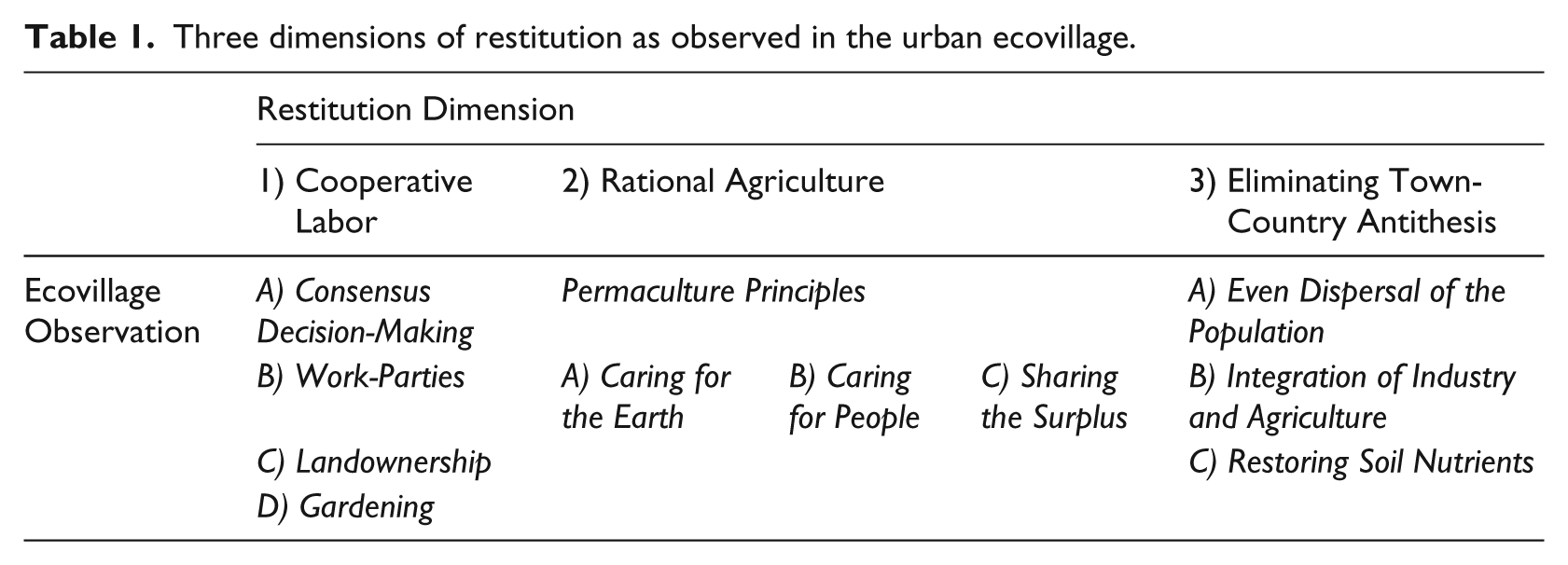
In this section, we utilize Foster’s (1999, 2000) interpretation of Marx’s concept of metabolic restitution to locate the role of associated producers in creating a rational agriculture system, thereby attempting to alleviate the antagonism between town and country in a capitalist economic context. We explore three metabolic rift concepts – cooperative labor, rational agriculture, and eliminating the antagonism between town and country – and attempt to elaborate on these concepts in their respective sections with real examples from a group of individuals’ everyday lives (see Table 1 for a summary). We follow the examples of successes and internal contradictions within the ecovillage with a section on the PEOS to highlight the challenges they continue to face as a result of living in a capitalist society that constrains their ability to fully realize non-exploitative human and nature relations.
Three dimensions of restitution as observed in the urban ecovillage.
Cooperative Labor or ‘Associated Producers’
Suitably, Marx’s idea of cooperative labor, or associated producers, is inspired by his study of communes, of which an ecovillage is a variation. Marx defines free farmers, or a cooperative of farm labor (used interchangeably with associated producers), as individuals who own their labor and collectively utilize the land for food production. In a cooperative labor system of production, there is no chain of exploitation. Free farmers can more easily establish a relationship with the soil, compared with laborers in a capitalist system of agriculture, because they take no orders from an owner. Laborers work their own soil and reap the benefits of their harvest (Foster, 2000: 165). At the ecovillage, villagers attempt to work cooperatively by making decisions through consensus, having village-wide work parties to clean up the property, and growing their own vegetables for personal and collective consumption. A main obstacle villagers face towards becoming free farmers is landownership, which is a feature of the unequal tension between the use value and the exchange value of the city (Harvey, 1982; Logan and Molotch, 1987), which we describe in more depth below.
Consensus Decision-Making
Ecovillagers attempt to relate to each other nonhierarchically by having regular village meetings and practicing consensus decision-making. Meetings are held to discuss community issues, grievances, and collective solutions, and consensus is practiced at meetings to ensure that everyone’s voices are heard. Consensus is a form of decision-making that requires groups to come to solutions that everyone in the group can agree on. In some cases, groups decide to come to modified consensus because not everyone can agree on a solution. In these situations, some individuals choose not to allow their personal feelings to interfere with the group’s decision-making process and may choose to step aside. Emily, an older resident, describes how issues are addressed at the ecovillage:
The way that works is we just get a notice out about the topic, when and where the meeting is, and anyone who cares just shows up, expresses their opinion, or hopefully, runs by consensus. Which, I’m really surprised at how well it has worked. As soon as we started using consensus, I thought we would get bogged down by all the details like what color the paint should be, but it hasn’t worked out that way. People are really mature here, I’d say, and they understand. Although, they haven’t been formally trained in the process … some of us have, some haven’t … The general trend is that people understand that you only block for highly principled reasons, and … you are flexible and you always look for the third way. All those things that make consensus work. People seem to have a handle on that here … I’m pretty impressed with [our] collective ability to come to solutions.
Issues are not always perfectly resolved in these meetings. In the interviews, individuals are split in their assessment of the villagers’ decision-making process. Some individuals believe the process works out well, while others feel that their village mates do not always adhere to group solutions. Hannah, a young woman who has lived on the property for over a year, voices her frustration with the decision-making process:
It seems to me that there are a few people that are really interested and involved half the time and most of the time they’re the ones that take initiative so they’re the ones that end up making the decisions. Often there is a group effort made and there’s an effort made to communicate so if anybody has something to say then they’re welcome to say it. But, there have been many occasions where people felt passed up and wonder how things happened when they didn’t know about it … So, we’re learning. It’s all a process. And with people changing constantly that doesn’t help the process grow.
Work Parties
Although inconsistent, ecovillagers sometimes have weekend work-parties where community members come together to clean and beautify the community. Essential to cooperative labor is the coming together of associated producers and, through non-wage and collaborative labor, collectively maintaining the land. They work for hours taking care of things for the village including chopping wood, collecting fruit, discarding unsightly debris, building things, and weeding. Afterwards, community members enjoy a large meal and talk together.
The first author participated in a work party that constructed the driveway from the street to the woodshop. The workday began early, and individuals were free to participate as little or as much as they wanted. By lunchtime, two community members had prepared a meal that consisted of a green salad picked from the garden, quinoa, and a curry (we discuss the quinoa and curry in more depth in the challenges section). Everyone sat around a lawn table near the garden to talk and enjoy the meal together. After an hour of talking and relaxing, individuals got back to work in order to complete the project.
Land Ownership
In urban ecovillages, a major hurdle in the path towards restitution concerns the unequal tension between the use value and the exchange value of city land (Harvey, 1982; Logan and Molotch, 1987). More will be said about this structural obstacle below. Nevertheless, modern landownership, as a condition of exchange value, obstructs ecovillagers’ abilities to be free farmers. There are two property owners who live at the ecovillage, Jamie and her son Ralph, and one woman who more recently bought into the property, Emily. Jamie and Ralph bought the five parcels, where the ecovillage sits, as a business venture 28 years ago. Although once aspiring entrepreneurs, they no longer desire their positions as landlords and encourage others to buy into the property. Only one resident has had the funds available to do this. The owners pay a mortgage on the property and must ask residents for rent, thus reproducing capitalist economic relations by exchanging money and paying the bank. Although most decisions regarding community matters are made by the community as a whole, this landowner/renter situation interferes with their vision of relating to each other in a nonhierarchical manner. When times become hard, the landowners, as participants in economic institutions, face decisions about whether or not to sell parts of the property. Ralph expressed his dislike with being a landlord:
I don’t know who should own this place. I don’t like being a landlord. I would like to sell off a portion of the property to get rid of my debt so I can just write. Ideally, I would love to sell it to the people in the triplex, but they don’t have any money. I’m trying to find cool people who will buy into it. The rent from tenants almost pays the mortgage, taxes, and insurance, but I cover the rest in the form of credit cards.
Paying a mortgage is an obstacle for the other villagers as well. Many ecovillagers must work in the city to pay for the land that they live on. Seventeen respondents spend some amount of time away during the day obtaining money for living expenses. If paying rent was not a necessity, villagers could devote more time to nurturing their community. While most of the working ecovillagers have jobs that do not contribute to pollution or land exploitation, such as working as a nanny or an intimacy coach, others work for industries that do contribute to environmental degradation. One individual confided that she works on an assembly line to create large neon signs for other businesses.
Gardening
At the ecovillage, many ecovillagers care for and harvest their own portion of the collective garden. Produce from the garden is used for subsistence purposes and is often shared during community potlucks and gatherings. Because the purpose of the garden is subsistence, ecovillagers are committed to finding ways to keep the garden productive. Some strategies that ecovillagers use to maintain their garden include the creation of swales, or deep and narrow ditches between each garden plot that hold water well after the rainy season, rain catchment tubs for watering, personal, food scraps compost and chicken manure from their chicken coop to fertilize the soil. In addition, many ecovillagers utilize a technique for subsistence agriculture called permaculture, which we describe in depth in the section below.
Rational Agriculture
Ecovillagers subscribe to their own version of what Marx called rational agriculture, or sustainable food production. Marx believed that the only way to restore metabolism between human beings and the earth is for associated producers to create a rational agriculture. Rational agriculture, as defined by Liebig, applies the principle of restitution, ‘by giving back to the fields the conditions of their fertility’ to ‘ensure the permanence’ of the soil (Foster, 2000: 153, 165, 169, 170). Ecovillagers follow a similar doctrine aimed at permanent agriculture called permaculture.
Permaculture, coined in the 1970s by Bill Mollison and David Holmgren, means, ‘consciously designed landscapes which mimic the patterns and relationships found in nature, while yielding an abundance of food, fiber and energy for provision of local needs’ (Holmgren, 2004). In Holmgren’s (2004) book on permaculture, he goes on to describe it: ‘people, their buildings and the ways they organize themselves are central to permaculture. Thus the permaculture vision of permanent agriculture has evolved to one of permanent culture’ (p. xix). Holmgren identifies three key principles of permaculture: ‘1. care for the earth; 2. care for the people; and 3. set limits to consumption and reproduction, and redistribute surplus’ (p. 1).
On the ecovillage property, there live a couple of permaculture teachers. Of the 24 interviewees, 11 mention taking a permaculture class at some point. Emily, an ecovillage resident, teaches permaculture at a rural ecovillage not too far from the city she lives in. When the first author asked her about her political beliefs, Emily closely paraphrases Holmgren’s principles:
Uh, permaculture. I’d call that somewhat of a political view, which is that we all need to become more sustainable where we are in order to protect the outlying areas. And, um, the foundation for permaculture is care for the earth, care for the people, and share the abundance. It’s very simple.
Some ecovillagers have a more complex understanding of permanent agriculture, somewhat akin to Marx’s theory of alienation. They express the interrelated nature of each of the three principles written by Holmgren. Carol, a young mother and dome dweller, defines sustainability as encompassing the earth, personal relationships, and community:
Sustainability is living in a way that enhances the quality of life for not just humans but for other species as well. So a given area or land base can maintain health or increase in health over time. Biodiversity would increase for instance, or at least stay stable and not decrease. Sustainability in interpersonal relationships means that a relationship can continue, that when there’s conflict there’s a way to resolve the conflict. That goes for whole communities that [when] there’s conflict in the community, there’s a way for the community to resolve that and continue on with each other, and people don’t have to leave.
Sustainability in this view is multidimensional with interrelated processes, including means of sustaining interpersonal relationships, community ties, and environmental integrity. On that note, from the first author’s observations and conversations with ecovillagers, we were able to identify actions that ecovillagers took to ensure the three permaculture principles in their everyday lives. Here we describe those in greater detail.
Caring for the Earth
Growing food for subsistence is one of the many ways ecovillagers attempt to care for the earth. Ecovillagers also express the importance of land stewardship, as in the case of a young man named Ears:
I have been working the land a little bit at the office. You know, there’s a little courtyard. I sometimes, at the beginning of the summer, I tinkered around with trying to grow different things at the office. My cucumbers didn’t make it because it was too cool in the office. We have southern facing windows, but it didn’t work out. So, even though I work in a pretty technological environment, I still try to keep that connection with the land. Especially there because, I mean that’s where I spend most of my time. And I feel like it’s honoring that piece of land to try to be, to live by my value of being a steward to the land no matter where I am.
Another way ecovillagers attempt to care for the earth is by avoiding excessive consumption. A critique of consumerism came out in about half of the interviews. Individuals distinguish themselves from other Americans by saying things like, ‘I’m not a consumer.’ A young woman resident explains the draw of the ecovillage for her:
Probably the culture was like the final decision why I moved here. I just liked the people, and the mentality was a lot different than that of the Midwest, which was much more bourgeois in a lot of a ways. It’s [the Midwest] very materialistic and middle class but contained in a certain box almost.
Caring for People
In order to sustain their cooperative labor and nourish community relationships, ecovillagers cared for each other in varying forms. Ways in which they cared for each other included having regular community meetings, consensus decision-making, sharing food, having community potlucks, and having dispute resolution sessions. Ecovillagers also cared for people by trade. A few individuals specialized in what they called integrative intimacy, which involves getting at the root causes of individuals’ emotional disturbances and finding ways to reintegrate their wounded parts. Further, some ecovillagers practiced a form of therapy and/or dispute resolution called co-counseling. In this type of dispute resolution, each participant takes turns fully expressing her/his emotions while the other person listens and is supportive. A large minority of villagers expressed the importance of emotional wellness and expression. In her critique of American society, an integrative intimacy coach on the property discussed her issue with our culture:
Not having feelings. You’re not supposed to have feelings. You’re not supposed to cry or even be ecstatically happy because it’s upsetting to whoever’s around. It would disturb someone or distract them from what they’re thinking about or it might make them feel uncomfortable if you have big emotions.
Sharing the Surplus
Food sharing took many forms, and encapsulated Holmgren’s third permaculture principle, sharing surplus. Community meetings were ceremoniously potlucks that enticed villagers with community interaction and food. Another avenue for food sharing came from one community member who located a local bakery that gave away bread at the end of each day. He brought extra bread back to the community to share.
While permaculture advocates espouse caring for others and sharing the abundance, the permaculture courses that Emily helped arrange at the rural ecovillage cost a considerable amount of money. For almost a month’s worth of courses, housing accommodations, and food, the price for the courses were on sliding scale between US$1800–2600. Some individuals could work out some work-trade instead of paying the full amount, but for someone on a budget who may have debt or other expenses, taking a month off of work and paying a thousand dollars for a few courses would be out of the question. The fact that nearly half of our interviewees were able to attend these courses speaks to their level of affluence. Consequently, teaching these courses is how Emily received a paycheck, which she needed for daily expenses. Thus, in a market economy, permaculture as a practice may be inaccessible to poorer members of the community, ironically undermining the caring and sharing aspects of the message.
Eliminating the Antagonism between Town and Country
Foster identifies three things that need to happen in order to eliminate the antagonism between town and country (2000: 169, 175). First, associated producers must change the dispersal of the population in both urban and rural areas to a more even dispersal. Second, an integration of industry and agriculture must occur. Finally, associated producers must restore the soil by recycling human and industrial waste for soil nutrition. In this section, we explore how ecovillagers go about doing each of these three things while also discussing limitations they face.
Even Dispersal of the Population
The ecovillagers alone cannot contribute to a more even dispersal of the population between the city they live in and the surrounding rural areas. They are restricted by urban zoning laws, codes, and land rent. This, in fact, represents a structural challenge in their path towards restitution, as discussed below. However, they do attempt to change urban living arrangements in order to facilitate a more sustainable use of resources. The design of the ecovillage, co-housing, and community resource sharing allow ecovillagers to utilize fewer resources individually and maximize efficiency with the resources they do use without increasing total resource use. 4
The ecovillage is designed to foster less resource use and community. Housing is situated around the perimeter of the property and workspaces in the center. This design forces individuals to interact with each other during work because gardening and building are done in close proximity, and all community tools are located near workstations. Many dwellers on the property utilize shared common areas. The five dome dwellers share a dome support house that has a living room, kitchen, and bathroom. Similarly, tent dwellers share a covered outdoor kitchen, bathroom, and living room near the community center. Houses on the property usually house between two and four people. These co-housing situations facilitate community while requiring villagers to share resources. Resource sharing is more efficient than single occupant residencies because similar amounts of things are needed, but they sustain more people. As in the example of the dome dwellers, five people share one kitchen, which necessitates only one set of pots, pans, and dishes. Whereas, if each of these dome dwellers lived alone, they would each need their own sets of these kitchen items.
Integration of Industry and Agriculture
Ecovillagers attempt to transform city relationships beyond the immediate ecovillage. In this particular ecovillage villagers grow food in the middle of a city. The village sits between a neighborhood, to the east, and industry, to the west. Ecovillagers also create a microcosm of this living situation within the ecovillage where they live, grow food, and have a woodshop area for building purposes. We use the word industry in two senses: 1) general business activity and 2) energy devoted to a work task.
The business activities surrounding the ecovillage include, but are not limited to, an ice-cream factory, retail services, restaurant services, automobile repair, and manufacturing plants. Ecovillagers attempt to make their city more sustainable by changing the physical landscape of an urban neighborhood block. The block is consciously designed with dwellings around the perimeter and gardens in the center so that people can come together in the middle to work and socialize. Villagers bring subsistence gardening to the city, thus incorporating aspects of the country in their city. Gardening and building are both done on the property, creating a microcosm of the integration between agriculture and industry. Finally, villagers repurpose waste, like wood and metal scraps, they scavenge from local industries and dumpsters to make their homes.
Industry also refers to any work individuals devote to a task. In this case, industry can mean building earthen dwellings on the ecovillage property, growing food, building solar fruit driers, and any number of things to which ecovillagers devote their energy. Many dwellings on the property were built by ecovillagers, with the exception of one house that sits on the eastern side of the property. Ecovillagers build icosahedral huts, cob houses, and scrap wooden homes. Moreover, villagers devote many hours to their gardens, situated between their homes.
Restoring Soil Nutrients
Ecovillagers make use of their waste to ensure soil fertility. In particular, compost is central to this end. Ecovillagers compost food scraps, weeds, human urine, chicken manure from their coop, and wood chips from the woodshop. However, compost cannot be haphazardly thrown into a pile and left to rot. Individuals must care for compost by exposing it to the right amount of sun, allowing worms to work through it, mixing an adequate amount of food and yard waste, and turning it every so often so that different parts of the pile are exposed to the air. Ecovillagers throw their food scraps into five gallon buckets, and empty them into the compost when the buckets become full. Male visitors are also encouraged to urinate in the compost.
At the eco-fair, Ears participates in a humanure project. Humanure is a combination of the words human and manure. 5 The idea is to create composting toilets with saw dust and worms that adequately rid human waste of toxins and turn it into a viable plant fertilizer. This project literally returns human waste to the soil as nutrients.
Challenges from the Political-Economic Opportunity Structure
In the above analysis, we outline steps that urban ecovillagers take towards restitution. Nevertheless, as previously mentioned, transforming the town-country antithesis, for instance, is a project that urban ecovillagers cannot realize on their own. This was briefly addressed when discussing the issues of landownership and the even dispersal of population. Here, we further elaborate on challenges returning to the concept of the PEOS (Pellow, 2007; see also Clement, 2011a) and, drawing on critical urban scholarship, argue that there are two interrelated structural obstacles in the path towards restitution. On the one hand, the first obstacle has to do with the intimate connection between modern urban areas and capitalism (Anderson, 1976; Harvey, 1982). On the other hand, the second concerns the conflict between the use value and exchange value of land in a capitalist city (Logan and Molotch, 1987). Thus, in the context of ecovillages, the analysis of these obstacles comes from an environmentally-informed interpretation of the urban growth machine.
With respect to the first obstacle, Harvey (1982) argued that alienation from the means of production, displacement from the land, and population concentration in urban centers are interrelated characteristics of capitalism. Therefore, under capitalism, people are driven into urban areas, thereby being deprived of access to the land. Harvey argues, in particular, that landownership and rent are two mechanisms that ‘prevent labourers from going back to the land and so escaping from the clutches of capital’ (pp. 381–2). These institutions discourage the dispersal of population beyond urban sprawl and the development of new farming communities. Anderson (1976) also recognized that there is a limit to the dispersal of the population under capitalism, writing: ‘Decentralization, outside of urban sprawl, is not profitable’ (p. 190). As such, in the context of this paper, landownership and the development of private property, in general, should be seen as a structural obstacle to the restoration of the metabolic rift (see also Clement, 2011b).
According to the urban growth machine, the types of land uses in a capitalist city are largely determined by the exchange value of urban land. Therefore, American cities, especially, are growth machines, characterized by dense, high-intensity land uses that increase aggregate rents and create wealth for the elite (Logan and Molotch, 1987: 50). To be clear, Logan and Molotch do not explicitly acknowledge the consequence of this structural dimension for urban agriculture, which is generally unsuccessful as a result of it. Despite the use value of urban agriculture, food production in cities does not generate rents that competing land uses do. This tension is, at times, dramatically played out in American cities when community gardens are bulldozed in the face of a relatively well-organized social movement (e.g. von Hassell, 2002; see also Sbicca, 2012, 2014). Such a struggle was portrayed in the documentary The Garden, in which a battle for a farm in South Central Los Angeles was lost despite widespread support and attention from celebrities and politicians like Daryl Hannah, Danny Glover, and Dennis Kucinich.
Aside from rent, there are additional costs for most people who live at the village that produce economic obstacles for ecovillagers. While many of them obtain free food via personal gardens, food stamp programs, low-income community food boxes, dumpsters, and fruits and vegetables gleaned from neighborhood fruit trees and gardens, many of them still purchase some food from the grocery store and local farms’ community supported agriculture (CSAs). The quinoa and curry served after the work party are examples of how villagers still participate in larger structural economic conditions, as these foods are likely imported to the United States from other parts of the world. Additionally, space constraints in the village limit the types and amounts of food that can be produced. Ecovillagers in turn must purchase some foods from grocery stores. While ecovillagers do not sell the produce from the village, they do trade with some local farms and ecovillages nearby to obtain milk, some meat, and chicken manure.
The notion of the PEOS also emphasizes the way participation in the ecovillage is influenced, at least in part, by class. Class dynamics in the US may preclude the possibility for some individuals to live in the ecovillage to begin with, as many ecovillagers, though not all, benefit from class privilege and its accompanying cultural capital. A political-economic opportunity that many ecovillagers have is the privilege of coming from middle-class backgrounds, as 70 percent of these ecovillagers report middle-class upbringings. This has allowed many of them the time to pursue higher education – Bachelor’s and in some cases Master’s degrees. In addition, many of them have had the luxury of time to travel around the United States to other ecovillages to learn earthen building techniques and to take permaculture courses, which often cost quite a lot of money (even though some ecovillagers are only able to participate in these courses as a result of sliding-scale prices and work-trade). One notable exception was an elderly man who received disability benefits from the state and had grown up in foster care. He lived in a small room and paid nothing for rent except for what he traded in work.
Conclusion
Our contribution to the literature on the metabolic rift is that we map out what each step towards restitution might actually look like on a micro-scale within the limits of capitalism by examining a case of an urban ecovillage. We examine restitution, the concept of restoring sustainable human and environment relations, through three dimensions highlighted in metabolic rift theory (see Table 1) and argue that the associated producers (or a collective of labor) must rationally plan agriculture and must mend the antagonism between town and country. Our research describes each step in more depth to provide a fuller picture of the restitution process. Ecovillagers make decisions based on consensus, form work parties, and practice permaculture, a type of rational agriculture with three principles that implicitly address the different forms of alienation: within and between individuals and society and our relationship with nature. While ecovillagers alone cannot eliminate the town-country antagonism, they do manage to more efficiently organize the space that they occupy and integrate waste into agriculture and their own building needs. Although there are checks against the landowner situation on the property, the ecovillage property is under a mortgage owned by three people who live there. While most decisions are made by consensus, when it comes to monetary matters, property owners have the final say.
On that note, the ability of the ecovillage to achieve restitution is limited by structural constraints. To elaborate on these limitations, we draw on Pellow’s notion of the political-economic opportunity structure (PEOS). Based in the PEOS, we find that ecovillagers have more success in mending human-nature relations within the confines of their own village even though some laws confine their internal activities. They have less success and experience more structural barriers when they attempt to mend the rift outside of this space. For example, they are able to utilize their own waste, compost, in their gardens to nourish the soil where they grow their own food. Outside of the village, they may have some success in utilizing industrial waste or garnering some resources from dumpster-diving, like day-old bread or bits of cardboard and wood used for building materials, but they are still confined by the laws and economic norms of the larger society. In particular, many businesses padlock their dumpsters to keep divers out as a means to nudge them to pay for those resources. Further, laws such as urban zoning influence the village’s internal structure. Specifically, there are zoning laws that restrict land use by regulating how many adults may live in a particular space. Portions of the ecovillage sit on parcels zoned for single resident land use. Zoning laws restrict the use of grey water for gardening purposes as well. They are still subject to eminent domain laws where their land could be seized in the name of state development, neighboring industrial pollutants can contaminate their soil, and they are still subject to land rent, or a mortgage. Because their work does not operate on an accumulation-based model, they have difficulty accessing enough money to pay the mortgage. The very land they live on is in constant threat of being taken away. In addition, they are limited by what they can reasonably grow in the small space to which they have access.
Despite these constraints, ecovillagers are able to mitigate pollution from waste, grow much of their own food, and are persistent in their goals. In this way, our case study of an urban ecovillage demonstrates not only the limitations imposed by the political-economic structure but also the differences and similarities between the various forms of urban-based environmental action, in particular the growing experience of urban agriculture as an alternative food network. McClintock (2014), for instance, describes urban agriculture from two contrasting perspectives: on the one hand, according to many scholars, urban agriculture represents practical spaces of resistance against and a radical alternative to the agro-industrial food system; on the other hand, while the emergence of urban agriculture can be seen as a response to the void left by the weakening social safety net in the wake of neoliberalism, many advocates of urban agriculture frame their work, either explicitly or implicitly, in terms of individualism and entrepreneurialism, two virtues which are consistent with the broader neoliberal agenda. While the members of the urban ecovillage may present a more systematic critique of capitalist forces, their participation and motivation are indeed influenced in a manner similar to that described by McClintock. Indeed, as discussed above, many ecovillagers engage in a prefigurative social movement with the aim being to achieve a personal and individual transformation rather than to engage in a discussion about reorganizing larger political-economic structures (e.g., Liftin, 2014).
Moreover, most ecovillagers in this community are white and middle-class. These aspects of their identities afford villagers privileges that other movement actors may not have, like access to permaculture courses, university education, and travel to different communities around the U.S. These privileges also afford ecovillagers the choice of downward mobility on their own terms, potentially as part of prefigurative social movements. Because we have data limited to one small, local ecovillage and our results cannot be generalized to all ecovillages or prefigurative social movements, many questions remain. How could ecovillage practices reach a scale significant enough to bring about ecological or social change? Would we indeed see restitution if people engaged in these practices on a greater scale? Is restitution, as conceived of by Marx, a socially desirable goal? Does a greater portion of the population want to participate directly in agricultural labor? We hope future research on these questions will consider not only the concept of restitution that we have developed here but also the ways in which the larger political-economic context influences the actual practices of restitution, either with the ecovillage example or other alternative environmental movements.
Footnotes
Funding
This research received no specific grant from any funding agency in the public, commercial, or not-for-profit sectors.