




Abstract
Environmental protection is presumed to damper economic growth and media accounts of resource extraction often portray trade-offs between jobs and the environment. However, there is limited evidence that environmental protection universally costs jobs and heavily polluting industries provide few jobs in comparison to environmental impacts. Therefore, how has media discourse contributed to the taken-for-granted division between the economy and the environment? This paper uses the Keystone XL pipeline controversy as a case of the symbolical conflict between supporters of growth and conservation to explore the role of ideology and power in media discourse. I use frame analysis of newspaper articles to explore the representations of labor and the environment and how hegemonic ideology legitimizes resource extraction. My analysis reveals binary framing that constructed the pipeline as a political controversy over the trade-off between the environment and the economy, which made conflict between workers and environmentalists sensible, and silenced alternatives.
Introduction
During the summer of 2011 over 1,000 people were arrested outside of the White House protesting the proposed expansion of the Keystone XL pipeline that would transport tar sands oil from Alberta, Canada to refineries on the Gulf Coast in Texas (Johnson and Frosch, 2011). Environmentalists, Occupy Wall Street activists, indigenous peoples and Midwestern ranchers mobilized in an attempt to stop the pipeline, which they claimed would pollute the environment, threaten surrounding communities and perpetuate reliance on fossil fuels. Prominent NASA climate scientist James Hansen (2012) said building the pipeline and the subsequent burning of tar sands oil would be “game over for the climate.” On the other hand, business groups and several construction unions actively supported the project’s approval. The Laborers International Union (LIUNA) left the Blue-Green Alliance, a coalition of unions and environmental groups, because some members of the coalition supported delaying the project for further environmental review or outright opposed the pipeline’s construction (Restuccia, 2012). The pipeline then emerged as a contentious national issue in the 2012 election because President Obama had the final decision to approve the project.
The Keystone XL pipeline is an indicative case of the contested politics around resource extraction but also unique in how the pipeline’s approval has expanded from a bureaucratic decision-making process to a national political issue and become a symbolic conflict between advocates for environmental protection and proponents of economic growth. Resource extraction projects are typically promoted as a source of jobs and economic growth, which frames environmental protections as costing jobs. Divisions between the environment and the economy are often discursively and symbolically constructed in the media through worker and union support for development projects. Disputes between workers and environmentalists have received heightened media attention that contributes to common-sense assumptions of class divisions around the environment and capitalist growth ideology (Goodstein, 1999; Gramsci, 1971; Matthews, 2010) – although worker support for industry is not necessarily a reflection of anti-environment or pro-business views, but rather that workers have few other opportunities to make a living (Schnaiberg, 1980). The labor versus environment dichotomy helps to legitimize unbridled economic growth by silencing alternatives and reproduces capitalist hegemony by presenting workers as the victims of environmental protection and aligned with industry. Reliance on ideology to maintain legitimacy may also be heightened during moments of crisis and political cycles – thus Keystone XL emerged as a prominent issue during a presidential election and rising concern about climate change (Bell and York, 2010; Gaventa, 1982).
However, the dominant “jobs versus the environment” frame obscures how capitalism depletes natural resources – the very means of production – and pollutes the environment in ways that exploit workers and disproportionately places the working class and communities of color at risk while corporations profit (Brulle and Pellow, 2006; Foster, 1999). Capitalism creates a metabolic rift in which the ecological conditions on which society and the economy rely are degraded and depleted (Foster, 1999). There is limited evidence that environmental protection leads to job loss at the aggregate level, although there can be negative local and company-level impacts (Goodstein, 1999; Smulders et al., 2011). Invisible in the dominant labor verus enviornment binary is the US labor movement’s history of concern about environmental issues and moments of collaboration with the environmental movement (Dewey, 1998; Gould et al., 2004). The Keystone XL pipeline controversy occurred during a period of increasing attention to green jobs, clean energy, and economic inequality as well as expanding union-environmentalist collaboration, which could have disrupted the hegemonic discourse around disputes over resource extraction. Several labor unions actually supported delaying Keystone XL’s expansion (Savage and Soron, 2011).
In this paper I explore how news media coverage of the Keystone XL pipeline constructs the relationship between the environment and the economy and reproduces, or contests, divisions between jobs and the environment. I use Keystone XL as a case of protest around environmentally hazardous development and conflict between economic growth and environmental protection to examine how common sense assumptions about class, labor and the environment are reinforced through discourse and the media, particularly how these representations legitimize resource extraction. I take Freudenburg’s (2005) call to examine the implications of discourse and media in reinforcing economic and environmental inequalities and naturalizing “privileged accounts” that divert attention from injustices. To do so I draw on theories of power, ideology and hegemony, and a critical qualitative and interpretive approach to frame analysis and case selection to assess how articles about Keystone XL in The Washington Post, The New York Times and The Wall Street Journal during a wave of protests from 2011 to 2012 frame the relationship between the economy and the environment, and present unions, environmentalists and corporations. I expand the literature on blue-green relations that is primarily case studies of coalitions and conflicts to consider how labor versus environment divisions are discursively created by examining how media framing produces the contested politics around the Keystone XL pipeline as a newsworthy event in ways that may legitimize or challenge industry power and capitalist growth ideology.
Background on the Keystone XL Pipeline
The Keystone XL pipeline is a proposed project by TransCanada, a Canadian oil company, to extend an existing pipeline to carry crude oil from the tar sands in Alberta, Canada, 1,700 miles to refineries in the Gulf Coast of Texas. The Keystone pipeline became a federal issue and discussed in the 2012 presidential election since the decision to permit the project rested with the Obama administration and the US State Department because the pipeline would cross international borders. Keystone XL remained undecided after the 2012 presidential election and continued to be a national political issue as Republicans, and a few Democrats, pushed for the pipeline’s quick approval and environmentalists pushed for the pipeline to be blocked. Resistance to the pipeline’s construction initially arose in local communities amongst ranchers and indigenous peoples. Then in 2010 national environmental groups mobilized to block the pipeline’s permit, arguing that the pipeline would create environmental risks from leaks and lead to extraction and consumption of fossil fuels that will contribute to climate change. A group of environmental organizations, led by 350.org, identified Keystone XL as a strategic issue that could be a catalyst for the climate change movement (Russell et al., 2014). A wave of environmental protests in 2011 and 2012 – including rallies, sit-ins and civil disobedience – garnered media attention and helped push the issue onto the national political agenda. Meanwhile, industry groups, such as the American Petroleum Institute, Republican politicians and several construction unions, advocated the pipeline’s approval and challenged Obama’s ability to request further environmental review. In 2010 TransCanada had signed a Project Labor Agreement with four construction unions – the Teamsters, Plumbers, Operating Engineers and Laborers – for work building the pipeline, which drove union support for the project (Brecher, 2014).
The pipeline became a key question in debates around climate change and was a strategic and symbolic issue for environmentalists, as well as the oil and gas industry and Republican politicians, that came to represent Obama’s environmental legacy. The national attention and media coverage turned a potentially narrow concern into a broader political issue and ideological conflict, which makes the media representations of labor and the environment particularly relevant for shaping public debate and opinion. Keystone XL also became a significant problem for union-environment relations and a challenge to labor environmentalism because of the public conflicts between environmentalists and unions as well as divisions amongst unions around an issue symbolic of broader energy and climate politics (Brecher, 2014; Sweeney, 2013).
Theoretical Framework and Literature Review
Ideology, Power and Discourse
I draw on theories on power, ideology and language to make sense of how the contradictions of captialism and environmental degredation are resolved and legitimized. Cultural assumptions, discourse and ideology legitimize extractive industries and shape how people interpret job loss and environmental pollution. Antonio Gramsci argued that the ruling class creates popular consent for the dominant system through ideology, culture and daily practices (Birchfield, 1999). Hegemony legitimizes the status quo and unequal power relations through civil society, culture and language (Magnan, 2007). Ideology obfuscates material and social relations and conceals the contradictions of capitalism. Ideology becomes engrained through common sense and everyday practices through which people come to identify their interests with those of the ruling class while internalizing subordinate social positions and naturalizing exploitation (Gramsci, 1971).
György Lukács also asserts the role of ideology in sustaining capitalist relations, but his focus on a true consciousness that can assess reality fails to address how ideology is autonomous from class relations and the ways in which culture shapes perceptions. For Gramsci the working class is not simply duped by false consciousness and ideology; rather, common sense becomes culturally meaningful through language, religion and folk culture that shape how people understand the world (Ives, 2004). Thus, language produces consent by making class inequalities seem common sense, obfuscating the ways power operates, and constraining articulation of alternative ideas (Carroll and Ratner, 1996; Gramsci, 1971). I use Gramsci’s theory about hegemony and language to explore how the media produces common sense assumptions about jobs versus the environment and the ways in which power and alternatives are rendered invisible.
Gramsci’s theory of hegemony has also been developed by Lukes (1974) in his three dimensions of power model that conceptualizes how power operates through domination and creates compliance for unequal social relations through acquiescence. Power occurs in observable ways through decision-making and agenda-setting, but also in what Lukes (1974) calls the third dimension of power, in which cultural meanings, socialization and social arrangements shape people’s expectations, desires and norms. Domination can be unobservable and unconscious, but also exercised consciously and knowingly by groups and institutions in power. Lukes’s conception of power also looks at the ways inequalities become naturalized and people misrecognize the origins and operations of power (Swartz, 2007).
Environment, Capitalism and Labor
Ecological Marxist theory points to the ways capitalism both exploits labor and degrades the environment. Foster (1993) contends that through the concept of metabolism Marx theorized the complex interdependent processes between society and nature under capitalism that impoverish both labor and land, destroying the ecological conditions necessary to reproduce the means of production. O’Connor’s (1988, 1998) “second contradiction” of capitalism theory also examines how the material ecological conditions necessary for the economy are degraded and depleted by capitalism, leading to economic and ecological crisis. Increasing consumption and extraction not only exhausts natural resources but also coincides with cuts in labor through mechanization and new technologies.
Yet workers are often the staunchest supporters of the extractive industries that exploit their labor and pollute their communities, and have had tenuous relationships with the environmental movement. The communities and workers that rely on resource extraction are the ones that gain jobs and wages but also face the environmental and occupational hazards of polluting industry (Gould et al., 2004). How do extractive and dirty industries maintain legitimacy when they exploit workers and degrade the environment? Industry can create legitimacy through jobs and economic gain, but how does the treadmill of production keep moving forward even if few workers gain jobs and society faces ecological crisis?
In part industry is legitimized through material gains – jobs, wages and economic growth – for at least select groups of workers and communities, along with the real, and perceived, threat of job loss. Schnaiberg (1980) argues in his classic treadmill of production theory that capital, labor and the state have an entrenched interest in perpetuating capitalist growth that provides profits, jobs and political support. Obach (2004a) contends that for much of the 20th century labor’s political agenda had been largely pro-growth and even, at times, directly anti-environment. Conflicts between the labor and environmental movements have arisen around a supposed trade-off between jobs and the environment as well as cultural, class and political differences (Adkin, 1998; Estabrook et al., 2000; Rose, 2000; Zoller, 2009). Industry and regional level job loss does contribute to localized conflicts between unions and environmentalists, especially when heavy polluting industries, such as mining and chemical production, are also highly unionized. Workers are not simply duped by capitalist ideology, as their fears of environmental protection are shaped by the realities of job loss and the history of mainstream environmental groups neglecting economic and class issues. Energy issues have been particularly divisive, including nuclear energy, coal, and drilling in the Arctic National Wildlife Refuge (Adkin, 1998; Dewey, 1998; Estabrook et al., 2000; Logan and Nelkin, 1980; Obach, 2004b). Thus, the Keystone XL pipeline is part of a long history of disputes over energy and infrastructure projects (McAdam et al., 2010).
Legitimacy is also maintained through ideology and perceptions of jobs versus environment trade-offs. Case studies of resource extraction conflicts also show how job losses are exaggerated by industry and amplified in the media, while declining employment is more often due to economic restructuring, trade policy and mechanization (Freudenburg, 2005; Freudenburg et al., 1998; Goodstein, 1999). Freudenburg (2005) finds that heavily polluting industries actually employ very few people compared to their levels of pollution, and if highly polluting companies reduced their jobs to pollution ratio then environmental protection could be achieved without costing jobs. Freudenburg, Wilson and O’Leary (1998) show that national timber harvests have increased since the 1940s while employment in the industry has declined. Some empirical research has shown that environmental protection has little aggregate negative impact on employment and can even create jobs, including in industrial and construction occupations – although there can be losses at the firm and local level (Goodstein, 1999; Meyer, 1992; Potier, 1986). Resource extraction also produces social and spatial inequalities as communities near projects suffer from ecological destruction and poverty (Austin and Clark, 2012). However, industry can also bring economic benefits, especially during resource booms.
During moments of contention and crisis around environmental problems corporations and the state may use ideology to re-assert their dominance and legitimacy (Habermas, 1984). Bell and York (2010) show how coal mining companies in Appalachia actively construct a community economic identity tied to mining and an assumed reliance on coal, despite dwindling employment and economic benefits. Through cultural identities, ideology and economic reliance, communities in mining regions often feel dependent on extraction (Gould et al., 2004). Foster (1993) argues that contention over logging and conservation in the Pacific Northwest arose in a context of economic restructuring and conflicts were driven by single-issue conservation concerns of environmentalists that ignored class, narrow business unionism, and active “divide and conquer” strategies of industry and the state. Ironically, job loss and environmental degradation can actually increase support for the treadmill system because these dislocations and disruptions are framed as being caused by a lack of development and policy constraints on the economy (Gould et al., 2004).
Resource extraction is also legitimized through ideologies of nationalism, progress and masculinity that are intertwined with dominant notions of labor and work. Scott (2010) shows how ecologically and socially destructive mountain top-removal mining in Appalachia is legitimated through discourses and symbolism of masculinity, whiteness, progress and citizenship that construct coal mining as necessary for the community. She argues that mining is not simply an economic practice but is shaped by culture, symbolic meanings and discourses that are intertwined with racial, masculine and national identities. Through interviews and analysis of popular media, Scott (2010) shows how mining is valorized as entry into the moral community for male workers marked by family-supporting wages and physical labor using technology to transform the earth. Bridge and McManus (2000) find that mining companies maintain legitimacy for polluting practices by co-opting the discourse of environmental sustainability and modernization.
The labor versus environment dichotomy simplifies the complex interactions between ecological and economic systems, and workers and environmentalists, and often the particular local struggles over jobs and the environment are projected onto the economy and workers at large (Goodstein, 1999; Mazza, 1990). Case studies on blue-green coalitions and conflicts have revealed that relationships between unions and environmentalists are not simply determined by economics but are shaped by ideology, framing, local history, political climate and the strategies of activists and corporations (Audley, 1995; Dreiling, 1997; Foster, 1993; Gordon, 1998; Mayer et al., 2010; Rose, 1997). Labor unions are not monolithic and have challenged the treadmill of production and advocated for ecological issues in collaboration with the environmental movement, which has presented a more fundamental critique of growth politics and dominant socio-ecological relations (Dewey, 1998; Gordon, 1998; Gottlieb, 2005; Obach, 2002). In the early 1970s progressive unions and environmental organizations pushed for occupational and environmental health and safety protections and, after a period of limited collaboration and conflict through the 1980s, formed coalitions against free-trade and NAFTA in the late 1990s (Dreiling, 1997). Unions and environmentalists have used frames of social justice, corporate accountability, and health and safety to build cross-movement coalitions, particularly around toxics and occupational hazards (Mayer, 2009; Mayer et al., 2010). However, unions and environmentalists have struggled to maintain coalitions that often emerge around specific issues and involve leadership and not rank-and-file members, which then dissolve when economic interests clash with environmental goals and cultural differences remain unresolved.
In the early 2000s, several large unions and environmental organizations created the Blue Green Alliance to advance green job creation and mitigation of climate change (Obach, 2004b). Unions have contested the jobs versus environment binary by framing climate change as a social justice issue and promoting just transition that provides displaced workers with resources, training and other job opportunities (Daub, 2010; Mayer, 2009; Mayer et al., 2010). The notion of a “green New Deal” has been a way for unions to collaborate with environmentalists on advancing traditional union goals of job creation through infrastructure projects and industrial policy. Environmental justice advocates have also promoted the concept of a just transition for workers who are displaced by the impacts of environmental regulation (Bullard, 2000).
Media Framing, Power and the Environment
The media is an important site to explore how dominant ideologies and discourses are reproduced and shape how people understand society and the environment. Approaches to the media and discourse analysis drawing on theories of ideology, power and hegemony emphasize the taken-for-granted ways in which dominant ideology is reproduced through language and cultural frameworks that shape how issues are understood and talked about. Scholars have explored how media framing supports hegemonic ideology and capitalist social relations (Antilla, 2005; Boykoff and Boykoff, 2007; Landriscina, 2012; Martin, 2004). Levy and Egan (2003) contend that the mass media contributes to people’s often-distorted sense of the benefits they gain from capitalism and provides ideological legitimacy for status quo economic relations and inequality. McChesney (2007, 2008) argues that the power and concentration of the global media industry has been a factor in the development and dominance of neoliberal capitalism. In particular, newspaper discourse can reproduce hegemonic assumptions that economic growth is needed for jobs while silencing alternatives (Martin and Oshagan, 1997).
Frame analysis is a major sociological approach to studying media and social movements that builds upon the work of Erving Goffman but also extends his analysis to issues of power and ideology. Scholars have used framing to analyze how news media representations shape popular understanding of social issues (Entman, 1993; Gamson and Modigliani, 1989; Gitlin, 1980; Springer, 2010; Wright and Reid, 2011). Entman (1993) argues that framing is about selecting details of perceived reality and making them salient through text to promote a particular definition or solution to a problem. The frames employed in a news story encourage a particular way of interpreting events and emphasize what is relevant and irrelevant, which can leave out alternatives and reproduce dominant ideology (Gitlin, 1980). Gamson and Modigaliani (1989) argue that issues are presented in the news through interpretive packages and frames that give meaning to the issue. A frame is not necessarily pro or con, but rather how the issue is made relevant and meaningful in ways that opposing sides may actually agree upon. Thus, opposition to an issue is often still within the bounds of the dominant frame.
Framing is a process of struggle shaped by resources and power in which social actors negotiate meanings, identities and grievances, often through the news media (Gamson, 1992; Snow, 2004). Hajer and Versteeg (2005) contend that through discourse analysis scholars can reveal how social actors struggle to define problems and exercise power in attempting to frame issues. Still, frames can be disrupted and contested as journalists, social movements, politicians and the public exercise agency in negotiating frames (Goffman, 1974).
Approaches drawing on hegemony, ideology and discourse analysis emphasize how power operates through media by shaping what is possible to say and the hegemonic assumptions that are embedded in language (Clare et al., 2013). How social actors construct frames and the efficacy of these framings is intertwined with broader discourses, ideologies and political contexts (McAdam et al., 2010). Journalists interpret events through existing culture schemas and attempt to report on issues in ways that will resonate and be meaningful to audiences.
Researchers have explored how news is created according to the demands and routines of the media industry (Tuchman, 1978; Vliegenthart and van Zoonen, 2011) and how journalists and editors select stories, sources and write articles in ways that shape how issues are represented (Carvalho, 2005). Newspapers try to present events in appealing ways, which often involves creating controversy. News representations tend to fall into official definitions and narratives, and follow the journalistic norms of balance through quotes from officials and spokespeople, which often reduces an issue to two sides and gives preference to expert opinion (Tuchman, 1974). Other researchers have focused on the political economy of the news industry and how ties between media companies and the elite, corporate consolidation, profit demands, and political views and biases of newspaper owners shape how issues are reported and framed (Dreier, 1982). Newspapers themselves are businesses that are driven by profit motives and shaped by the ideological positions of newspaper owners and editors.
Media coverage shapes public understanding of nature and environmental politics and is influenced by powerful actors, particularly corporations, industry and politicians, who have the resources to promote their views and legitimize their positions with scientific experts. Freudenburg (2005) argues that privileged accounts from the elite, such as the wealthy, industry, and technical experts, and dominant discourses naturalize and legitimize unequal access to environmental resources and disproportionate exposure to pollution. Macnaghten and Urry (1998) contend that when people do not have a direct interaction with an environmental issue their views are more influenced by the media. While few people may be directly impacted by job loss in extractive industries from environmental protection, the media coverage of these disputes may play a strong role in shaping public perceptions. Powerful industries, especially the fossil fuel industry, and the elite attempt to manipulate press coverage, fund their own research and experts, contest contrary scientific claims and engage in knowledge-shaping processes (Antilla, 2005; Bonds, 2011). Corporations and politicians have greater access to the media and scientific experts, and Brulle (2014) has shown how foundations and donors fund anti-climate change organizations that question global warming. Levy and Egan (2003) examine corporate political strategies around climate change and the ways in which corporations actively shape public dialogue through public relations campaigns and interviews in the media in order to contest science and to present companies as advancing the public interest.
Labor versus the environment framing is often emphasized in media representations of environmental and energy issues, which presents unions and environmentalists as opponents while obscuring corporate power (Adkin, 1998; Dewey, 1998; Estabrook et al., 2000). Foster (1993) contends that the historical processes and industry interests that created ecological crisis in the Northwest old growth forests were overlooked in mainstream news coverage while collaboration between unions and environmentalists were largely ignored; leading to public impressions that the conflict was simply a division between the environment and jobs. Dunk (1994) and Cooper (1992) both found that the jobs versus the environment framing dominates media coverage of resource use controversies. This framing emphasizes labor support for extractive projects and constructs the perception of universal working class support for industry, which legitimizes the necessity of growth (Buttel et al., 1984; Foster, 1993; Gramling and Freudenburg, 1994). The media often overlooks alternative forms of job creation and the varied environmental stances and attitudes of labor leaders and rank and file union members (Logan and Nelkin, 1980). However, conflictual media coverage also captures the tensions in blue-green relations when workers in polluting industries face job loss and perceive a threat to their livelihoods. All too often environmentalists have done little to address the economic concerns of workers.
The jobs versus the environment frame is a rhetorical tool often employed by corporations and politicians during controversies over environmentally hazardous development which politicizes conflicts and legitimizes pro-extraction policies. Corporations developing contested extraction and energy projects, and supportive unions, turn to media and public opinion campaigns in order to win political and popular support (Gedicks, 1998; Mix and Waldo, 2014). Both activists opposing new extractive projects or infrastructure and companies and politicians supporting them often politicize these projects in order to pressure decision-makers. Assumptions of a trade-off between jobs and the environment render corporate claims about job loss from environmental protection legitimate, while placing blame on environmentalists rather than corporate cost-cutting.
Methodology
The Case of Keystone XL
In this paper I focus on the controversy to permit the Keystone XL pipeline as a contemporary emblematic case of the contested politics around resource extraction and environmentally hazardous development. I define Keystone XL empirically as a series of events, which are then represented in the media and constructed into a coherent issue. Yet the pipeline is also a theoretical construct as I emphasize theories about environmental political economy and ideology to explore relationships between labor, class and the environment, and conceptualize Keystone XL as a “case” of contentious politics and economy versus environment tensions (Ragin and Becker, 1992). The controversy around Keystone XL is emblematic of jobs versus the environment conflicts around energy and resource extraction, but Keystone XL is also a distinct and exceptional case given the symbolic importance and political salience of the issue that emerged from a particular historical conjuncture of a presidential election, economic recession and mobilization around climate change. Therefore, examining Keystone XL is productive for theorizing about labor and the environment and the ways that hegemonic ideology shape discursive framing of environmental issues, but cannot necessarily be generalized to all similar conflicts that vary across time and space.
Data
I collected 214 articles from The New York Times (77), The Washington Post (82) and The Wall Street Journal (55) by searching for the term “Keystone XL” in the ProQuest Newsstand database. I selected articles from 1 May 2011 to 1 December 2012, which covers the summer of 2011 when major protests against the pipeline started and the pipeline became a national issue through the 2012 presidential election campaign. I only selected news articles, excluding opinion pieces and editorials, because I am interested in how the pipeline was represented through the journalistic eye in supposedly objective news articles and in order to compare similar texts. I removed articles that were not relevant and only made passing reference to Keystone XL – I kept articles that had at least a paragraph about Keystone XL and were about issues related to the pipeline.
These three publications were chosen because I want to examine how national mainstream newspapers cover conflicts between unions and environmentalists. The three publications are prominent elite newspapers and national newspapers of record that shape opinion, political attitudes and public debate, and represent the national dialogue about the pipeline, rather than particular local debates (Althaus and Tewksbury, 2002; Boero, 2007; Springer, 2010). These papers also provide variation in political positions and scope of coverage. The Washington Post and The New York Times are considered more liberal, and The Washington Post is focused on national politics in Washington, DC, while The Wall Street Journal is focused on business. Also of note is that The Wall Street Journal has published op/eds, editorials and opinion pieces denying climate change (Abrams, 2014), and is owned by Rupert Murdoch’s multi-national news conglomerate News Corporation, whose outlets provide more coverage of climate skepticism (Feldman et al., 2011). Murdoch himself is a powerful, vocal and large financial supporter of business interests and libertarian and right-wing politics (Arsenault and Castells, 2008). Global media conglomerates did not own the two other newspapers – The Washington Post was owned by the local DC Graham family until 2013 and The New York Times is owned by the New York Times Company. Both The Washington Post and The New York Times feature opinion columns from a range of political views, and have carried considerable, although cyclical, coverage of climate change (Boykoff, 2007; McComas and Shanahan, 1999). If divisions between the economy and the environment emerge amongst the more liberal newspapers, this may indicate the dominance of capitalist growth ideology.
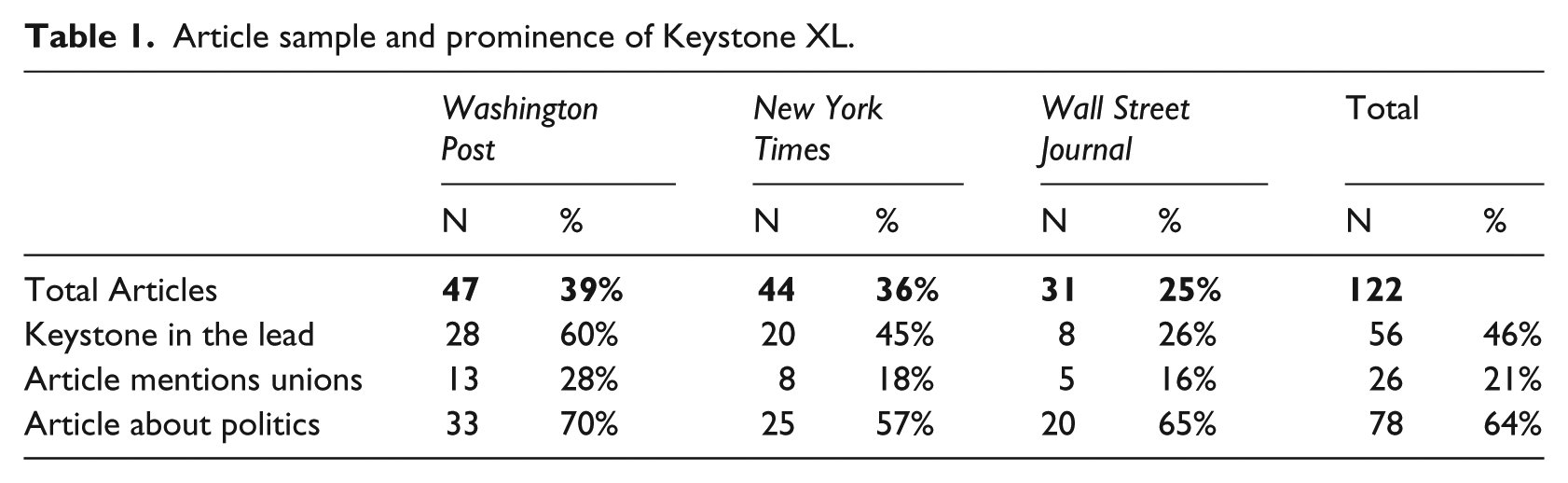
I create a sample of articles in order to generate a manageable dataset for close reading and qualitative analysis by randomly selecting every other article, one-half, from each of the three newspapers (108 articles). I am not attempting to create a representative sample for statistical generalizations, but rather capture how Keystone XL is being talked about in these prominent national newspapers. I want to capture variations and how the discourse may have changed and responded to events over time. Thus, I select half of the articles from each newspaper, which allows me to capture a majority of articles from each paper to assess variation and dominant themes within and across newspapers. I then create a theoretically driven sample of articles from the full 214 that mentioned unions (26 articles) in order to capture how unions were discussed in relation to the pipeline and how labor issues fit within the broader discourse. Thus, the final sample was 122 articles – the 108 randomly selected and an additional 14 that were not randomly chosen but discussed unions.
Methods
I use a qualitative approach to frame analysis and analytic induction to code the articles and develop theoretically meaningful themes from the text. My analysis was guided by a theoretical sensitivity to labor and class issues as well as my background knowledge about Keystone XL and experience with the protests and the labor movement. I conducted a detailed qualitative analysis of the language and framing in the articles – what Gamson and Modigliani (1989) call the condensing symbols of a media frame. I examine language and rhetoric, particularly metaphors, exemplars, catchphrases, depictions and visual images, used to construct frames and render a social problem legible in ways that resonate with broader cultural meanings. I explore how frames draw upon tacit knowledge, taken-for-granted assumptions, ideology and cultural contexts. I also examine the types of sources, facts and quotes being used in the articles, which are indicative of how a frame is constructed and what groups are advocating for issues (Gamson and Modigliani, 1989). I am interested in who is speaking for different positions – particularly who is quoted in articles – and which voices are given salience, and which are left out. The same journalists wrote many of the articles focused on Keystone XL; therefore the framing could reflect the journalists’ particular interpretations. However, this also indicates that Keystone XL was an important enough issue to have a regular beat with dedicated journalists.
I first identified if the Keystone XL pipeline was mentioned in the lead of the article to assess whether the article was focused on the pipeline or if it was connected to another issue (see Table 1). I assessed if the article was broadly about politics (about two-thirds of the articles) and counted the articles that specifically mentioned unions (about one-quarter of the sample but only 12% of all the articles on Keystone XL). I then conducted a detailed reading of the articles to find preliminary open codes and themes at the level of sentences and phrases within the contextual meaning of surrounding text and the entire article. In an initial reading I identified codes related to politics and policy, the economy, and environmental impacts and movements. I then re-analyzed all of the articles applying the 45 preliminary codes.
Article sample and prominence of Keystone XL.
I then analyzed how these preliminary open codes were connected and related into broader analytical axial codes. I identified 21 axial codes (see Table 2) that clustered into four major themes that comprise the dominant frames – political controversy, creating jobs and economic growth, promoting the national interest, and environmental risk. My axial codes involved how the pipeline was described as a political liability for Obama, the regulatory review process, the potential environmental impacts on surrounding ecosystems from pipeline leaks, the potential for jobs and economic growth, and oil resources and prices. I record the frequency of codes and frames by article, not within articles, thus I count the number of articles that contain a particular frame. An article contains one of the four frames if it had at least one of the related codes. My frames are not mutually exclusive and articles can have multiple frames and codes, but I assess the salience and prominence of codes to determine the dominant framing. I present emblematic quotes indicative of the themes, which allows the reader to make their own assessments.
Dominant frames and codes in newspaper articles on Keystone XL.

Analysis
In the sample of news articles, the pipeline was presented as a conflict and a trade-off between the economy and the environment, and workers and environmentalists, through four dominant frames: the pipeline as a political controversy, creating jobs and economic growth, promoting the national interest, and environmental risks. The pipeline itself was not necessarily the primary news event – it was only mentioned in the lead of about half the articles – but it was relevant because of its connection to broader political and economic issues, and made meaningful through a jobs versus environment frame. Overall, the Keystone pipeline was more frequent in the two more liberal publications, The Washington Post and The New York Times, but the consistency of binary framing across the newspapers, regardless of political leanings, reveals the strength of the labor versus environment and political controversy frames. A majority (64%) of the articles were focused on politics, and Keystone XL was a secondary but related issue as it effected the 2012 presidential election. The most frequent frame that emerged was the pipeline as a political controversy (72% of the articles), which fit within a broader narrative about the presidential election, unemployment, weak economic growth and national security. Thus the pipeline emerged as a newsworthy topic that went beyond technical issues (Hoffbauer and Ramos, 2014; Tsoukas, 1999; Young and Dugas, 2011).
Quotes selected from proponents of the pipeline, mainly business leaders, industry spokespeople, politicians and national union leaders, rather than rank-and-file members, constructed the economic growth and national interest frames through factual statements and taken-for-granted assumptions about labor versus environment. These views of elites and experts reflect what Freudenburg (2005) calls “privileged accounts” as well as how journalistic norms of reporting balance and relying on official statements can produce conflictual binaries and recreate dominant narratives (Tuchman, 1974). The active assertion of pro-industry framing by corporate leaders and construction union leaders is also indicative of corporate public relations strategies to shape public dialogue through media campaigns and news interviews (Levy and Egan, 2003).
National survey data has found fairly strong public support for the pipeline along with distinct differences across political party lines that reflect the politicization of the issue. Polls are not necessarily true representations of public sentiment but are indicative of what issues are salient, and polls are constitutive of what is deemed “public opinion” in the press, which has implications for political campaigns and policy-making. A Pew poll in September 2013 found 65% of Americans supported building the pipeline and 30% opposed. Opinions were divided along partisan lines as half of Democrats opposed the pipeline and 81% of Republicans supported it. Interestingly, the poll found greater concern about other forms of energy extraction – 49% opposed fracking and 58% supported expanding renewables while only 34% supported expanding fossil fuels (Pew Research Center, 2013). Attitudes about Keystone XL might be particular to the pipeline issue and how the issue has been framed, and not solely a reflection of more general concerns about renewable energy, resource extraction and climate change.
Economy versus Environment
Framing of the Keystone XL pipeline was embedded in the taken-for-granted logic of capitalist growth in which resource extraction is necessary for economic well-being, national security and job creation. These assumptions were unquestioned and left out potential economic alternatives. Over two-thirds of all the articles framed the pipeline around creating jobs and economic growth through themes of creating jobs in a weak economy, growing the economy, and addressing rising gas prices. In turn, stopping the pipeline to protect the environment was presented as directly costing jobs and a loss for workers. Framing the pipeline as creating jobs, rather than an environmental risk, appears to coincide with public perceptions – opinion polls reported low public support for blocking the pipeline and belief that the pipeline would generate employment. A 2012 Washington Post poll found that 83% of respondents thought the pipeline would create jobs and about half believed the pipeline would not hurt the environment (Mufson, 2012a).
The economy versus environment binary was produced through business and union support based on job creation and energy security, while environmentalist opposition was driven by concerns about environmental risks, as exemplified in this New York Times article.
The State Department concluded last month that the project, Keystone XL, would cause minimal environmental impact if it was operated according to regulations, and the operator, TransCanada, has said the nearly 2,000-mile line would create 20,000 jobs in the United States. Opposition groups around the country, though, said the federal study did not consider the effects of a major spill, while supporters said the nation’s economy had continued to worsen, making Keystone XL all the more crucial. (Johnson and Frosch, 2011)
The frame of economic growth allows readers to make sense of the claims about creating 20,000 jobs as newsworthy even though no sources or documentation are offered. The reader is reminded of the worsening economic conditions and thus the “crucial” urgency to create jobs. Meanwhile, opposition claims about environmental risks from oil spills are contested by an official report.
The job benefits of the pipeline were only contested seven times in the data – six of which were in The Washington Post. One article mentions a report by the Cornell Global Labor Institute that conducted an independent economic analysis and questioned the job creation claims (Mufson, 2012b). The report found that the company’s job projections were not substantiated and estimates of indirect jobs were flawed (Skinner and Sweeney et al., 2011). Instead, the study claimed the pipeline would not be a major source of jobs, and estimated the pipeline would only create 2,500 to 4,650 temporary construction jobs, and that much of the construction materials would come from outside of the US. However, these figures and alternative views were rarely mentioned. Job creation from the pipeline was largely accepted as fact, yet renewable energy, although scarcely discussed, was contested as a failure through the example of a failed solar energy project. Green jobs were negatively framed as a political maneuver – favoring union workers over environmentalists – and inefficient government policy (Eilperin, 2011b).
Political Controversy and Class Divisions
The oppositional framing and jobs versus the economy trade-off constructed the pipeline as a political liability and symbolic test for President Barack Obama because he had to determine the “national interest” and choose between environmental protection and economic development. Roughly two-thirds of the articles were focused on the political decisions and implications of the pipeline as the decision rested with the Obama administration and was presented as a symbol of the divisions within Obama’s support base in the upcoming 2012 election. Keystone XL is an exceptional case of a politicized pipeline, and thus the political controversy framing might be more prominent than for coverage of other less politicized pipelines. The focus on Obama’s decision created a simplistic causal narrative that helped garner more attention for the issue (Cormier and Tindall, 2005; Hoffbauer and Ramos, 2014). The trade-off is represented in this Wall Street Journal excerpt: “proponents, including powerful Republican lawmakers, said it would create jobs and bolster energy security. Environmentalists attacked the line for a host of reasons, including worry over spills” (Welsch, 2012). The pipeline also supposedly divided Democrats (Solomon, 2011).
The political controversy frame relies on unquestioned class divisions and labor-environment tensions, which constructed Obama’s choice as splitting his supporters and an implicit choice between union or environmentalist backers. “Middle-class” voters were concerned about unemployment and gas prices, while liberal environmentalists wanted more action on the environment. The discussion of class is indicative in the following excerpt about Obama’s reelection in The Wall Street Journal.
Barring an increase in support from working-class voters, “this is going to be a very difficult election for [Mr. Obama] to win.” Union officials said some workers could blame Mr. Obama for high gasoline prices, while industrial unions opposed several trade agreements, including one with South Korea last year. The president’s opposition of the Keystone XL pipeline for environmental reasons also angered some building trades unions. (Maher and Trottman, 2012)
A union leader claimed that Obama’s reelection depended on increasing support amongst the working class, which portrays Obama’s delay of Keystone XL as a political liability. The politicalization of Keystone XL demonstrates how environmental issues become sites of contestation and are articulated through tropes and cultural schemas that make the issue meaningful and accessible, and become a proxy for larger political and cultural divides (DiMaggio, 1997).
Environmentalists were also depicted in the articles as leading active and boisterous protests against the pipeline in contrast to union support. Environmentalists were described as both radicals and wealthy liberals who could secure favors from Obama. This excerpt from The Washington Post is indicative of coverage on the protests.
Labor unions also have endorsed it as a source of jobs. But the fierce resistance from grassroots environmental activists – more than 1,250 were arrested in demonstrations outside the White House in late August and early September – and from some influential donors has helped make it a defining environmental question for the Obama administration. (Eilperin, 2011c)
This excerpt illustrates how unions are portrayed as endorsing the project while “grassroots” environmental activists are represented as having led “fierce resistance” against the pipeline including civil disobedience. The mention of powerful donors implied that Obama’s response might have been due to influence and money, which draws on perceptions of upper-class environmentalists with wealthy donors. Pipeline supporters were also quoted framing Obama’s decision to postpone the pipeline as a favor to environmentalists, rather than a decision based on merit.
Unions were only mentioned in 26 articles (about a quarter of the sample), but the presence of unions strengthened the dominant framing of political controversy and economic growth by constructing workers as vehement defenders of the pipeline which universalized the interests of the oil and gas industry and created a compelling story of conflict. The emotion of both labor support and environmental opposition raised the pipeline as an urgent issue, particularly framing Keystone XL as a decisive environmental test for Obama and “fork in the road,” thus the pipeline became a “high-profile political headache” (Eilperin, 2011c). The discourse of a binary and political controversy also made union support for the pipeline logical, and unions were consistently presented as aligned with industry and opposed to the environmental movement. This framing reinforces hegemonic assumptions about the divisions between the environment and the economy and workers’ shared interest with industry. When quotes were included in the articles that did not use the oppositional framing, they were typically discussed later in articles and presented along with quotes that contested these alternative claims.
The use of quotes from union leaders strengthened the economy versus environment binary and presented the pipeline as being in the public interest by providing evidence of worker support. Consequently, environmentalists were positioned as being anti-working class. A quote by a union president in a Wall Street Journal article is an emblematic example:
Terry O’Sullivan, general president of the Laborers’ International Union of North America, said the move would “inflict a potentially fatal delay to a project that is not just a pipeline, but is a lifeline for thousands of desperate working men and women. The [Obama] administration chose to support environmentalists over jobs – job-killers win, American workers lose.” (Solomon, 2011)
The decision to delay the pipeline is framed as a binary – win or lose, environmentalists or jobs. Thus, rejection of the pipeline permit is presented as hurting workers who are in direct competition with the environment and a political favor for environmentalists.
Unions were represented as defenders of the pipeline, which in turn presented the pipeline and the company as being pro-worker and promoting the common good, rather than increasing profits. A union official commended the company’s labor practices in the following Washington Post quote:
Brent Booker, who directs the union’s [Laborers’ International Union of North America] construction department, said the project will provide “thousands of jobs” to his members. “Our members are in dire need of paychecks,” he said in an interview, adding that TransCanada has agreed to provide “middle-class wages” and health insurance for pipeline workers. (Eilperin, 2011c)
This excerpt demonstrates how media framing constructs labor and management as being united since the company would not only provide jobs, but good jobs. Thus, readers are asked to understand the pipeline as a “dire” cure for unemployment during the recession. These claims are made more legitimate coming from a worker rather than the company and through language of American middle-class mythology.
The use of violent language and war symbolism was common, particularly in statements by unions, and presented environmentalists and unions as being in an active struggle, despite statements only representing a narrow segment of the labor movement that could secure jobs on the pipeline, primarily four construction unions that represent only 13% of organized labor in the US (Sweeney, 2013). In the above quote from O’Sullivan, delaying the pipeline was said to be “fatal” and the metaphor of a lifeline was used to describe the pipeline. Environmentalists are made meaningful as being anti-worker, and by stopping the project they were letting “desperate working men and women” die and were “job-killers” (Solomon, 2011).
The economy versus environment division does not provide an option for negotiating the interests of unions and environmentalists. Environmentalists are positioned as the source of divisions, not unions who oppose environmental regulations, and stopping the pipeline becomes the cause of unemployment, not the financial crisis or corporate profits. Consequently, when news articles use the frame of creating jobs and economic growth, readers are asked to understand the meaning of environmentalists as people who oppose economic growth. At the same time, unions become meaningful as organizations that oppose environmental regulations.
Silent in this dominant framing is how environmentalists and some unions jointly opposed the pipeline’s rapid approval and used alternative frames of green jobs and sustainable development. Six of the largest unions in the US from both service and industrial sectors supported Obama’s decision to delay approval of the pipeline in order to conduct further environmental review, including the United Autoworkers (UAW), Service Employees International Union (SEIU), United Steelworkers (USW) and Communications Workers (Natural Resources Defense Council, 2012). Several service, healthcare and transit unions went even further and actively opposed the pipeline’s construction and participated in protests (Swift, 2014). Two transit unions issued a statement in 2011 opposing the pipeline and calling for green jobs instead of fossil fuel industry jobs: “We need jobs, but not ones based on increasing our reliance on tar sands oil” (ATU and TWU, 2011).
The unions who opposed Keystone XL would not directly gain jobs for their members on the project – although construction of pipelines could use steel made by USW members. For these unions, opposing Keystone was part of their broader approach to environmental politics and climate change, and efforts to build blue-green coalitions to revitalize the US labor movement. These unions envision climate change as a social justice issue that will have detrimental effects on working-class communities, but also critiqued the pipeline for giving profits to powerful, and often anti-union, corporations. Supporting Obama was also a strategic political decision to avoid creating conflict amongst Democratic Party supporters and to show a unified front for Obama entering the presidential election. Coalitions were also a tactic to gain environmentalist support for policies that would benefit the industries their members work in; mainly transit, education and healthcare. However, the mainstream media appears to focus on the most vocal unions that would directly benefit from an environmentally-hazardous project like Keystone XL, which amplifies the locally disruptive impacts of environmental protection.
The interests of unions and the labor movement are not singular or unified, and internal conflicts amongst unions arise around environmental issues. Opposition to the pipeline by some unions and environmental groups created tensions and divisions between unions and within labor-environment coalitions. The Laborer’s Union left the Blue-Green Alliance in reaction to environmentalists and other unions campaigning against Keystone XL (Restuccia, 2012). The AFL-CIO did not take a stance on the issue because of the divisions within organized labor, and unions typically remain silent on issues affecting the industry of other unions, which allows construction and industrial unions to drive environmental politics at the AFL-CIO (Sweeney, 2013). The tensions and conflicts between unions around Keystone XL did gain some media attention, but primarily in alternative publications (McAlevey, 2012).
Jobs versus environment divisions are not purely discursive and ideological – four construction unions were promised jobs on the pipeline through Project Labor Agreements with TransCanada and collaborated with the oil and gas industry to promote the project (Sweeney, 2013). Construction jobs were particularly enticing in the context of the post-recession construction and housing slump. Construction unions, particularly LIUNA, have supported green jobs and work in renewable energy, yet they are still willing to take “dirty” jobs, especially when there is not a robust alternative plan for creating comparable good green jobs. However, the emotional and dire framing by construction unions reflects how these unions are actively engaged in promoting Keystone XL, rather than simply taking jobs on the project. The binary framing does capture some of the political tensions around the pipeline. The conflicts around Keystone XL demonstrate the limits of blue-green coalitions built around economic interests, such as green jobs, that do not foster deeper solidarity and a counter-hegemonic critique of fossil fuel driven capitalist growth and alternative visions of economic development and social justice.
Promoting the National Interest
Claims about job creation were often presented along with other themes of increasing oil production, enhancing US competitiveness and promoting energy security, which framed the pipeline as advancing the national interest while implicitly presenting opposition as dangerous for the country. The national interest frame also further politicized the pipeline and turned the pipeline into a national-level issue. This excerpt from The New York Times shows how jobs and energy security were linked: “America desperately needs jobs, and that the oil would be coming from a friendly nation” (Johnson and Frosch, 2011). The oil would come from Canada, “a friendly nation,” which tacitly juxtaposes Canada with oil-rich Muslim and undemocratic countries in the Middle East and Africa.
The frame of promoting the national interest constructed the pipeline as a necessity for the country during a period of international turmoil and economic recession. A Washington Post article offers a rich example of this frame in a quote from a union leader.
But the project’s advocates – including United Association general president William Hite, whose union represents plumbers and pipefitters in North America – said it would employ thousands of Americans while supplying oil from a close ally. “It’s a job engine for the country at a time when we need the jobs, and until we do something else, we need the oil,” Hite said in an interview. “I don’t see how we can turn it down.” (Eilperin, 2011a)
The quote framed the pipeline as being in the general interest with language of “we” and “the country” and created urgency by referring to the “need” for jobs and oil while asserting that the country cannot turn the project down.
Promoting the national interest and energy security rely on American patriotic discourse, nationalist ideology and anti-Islamism to make the pipeline meaningful as a domestic priority that will restore the economy and increase US independence from unstable authoritarian and Muslim regimes. Environmental opponents are thus construed as deviants who oppose economic growth and national security, while industry and pro-pipeline unions uphold American patriotism and the broader interests of the nation. The frame also has ideological power by addressing liberal concerns about reducing reliance on foreign oil to avoid wars over fossil fuels (Hoffbauer and Ramos, 2014; Molotch, 1979).
Pipeline Opposition – Environmental Risks
The pro pipeline frames of creating jobs and economic growth and promoting the national interest were largely uncontested and were pitted against less salient claims about harming ecosystems. Opposition to the pipeline was presented primarily through the frame of the pipeline as an environmental risk, which relied on themes of a threat to habitat and water, accelerating climate change, a contested route, and pipeline spills. Climate change was a substantial critique of the pipeline but claims about threats to habitat from pipeline spills were more readily contested by business claiming the pipeline would be safe or re-routed around sensitive areas. In the newspaper representations of the opposition there was a lack of social and economic justice critiques and opposition was only rarely presented with a counter-frame of critiquing corporate power. Conflicts of interest – insider lobbying and improper contracting – were rarely mentioned despite controversy over TransCanada’s lobbying and the State Department contracting the environmental review to a company connected to TransCanada (Eilperin and Mufson, 2011). This Washington Post excerpt is representative of how environmental opposition was framed.
The Society for Conservation Biology has also questioned whether the administration has sufficiently scrutinized the fact that the proposed pipeline and ones connected to it tracked the migration route for the endangered whooping crane, which could leave the bird vulnerable to toxic oil spills as well as polluted water near the extraction sites. (Eilperin, 2011a)
Environmental opposition did address broader environmental and public health concerns, but the media coverage often focused on the particular impact to near-by landowners (Eilperin, 2011c). The implicit class divisions over the pipeline were challenged by the resistance of rural landowners and Nebraskan Republicans who presented a white, blue-collar and middle-class opposition. Yet this counter-frame of local opposition was not very frequent and was presented in only about a quarter of the articles. Opposition to the pipeline was also from other social movements, particularly civil rights groups and service-sector unions, but this was largely left out of the coverage (NAACP, 2011; Natural Resources Defense Council, 2012).
Alternative forms of energy and job creation were mentioned once, and seven articles actually presented renewable energy as a failure. Pipeline opponents rarely articulated an alternative economic plan, but the exception was a quote in The Washington Post that raised the possibility of green jobs.
“The proponents of this pipeline would be wiser to invest instead in job-creating clean energy projects, like renewable power, energy efficiency or advanced vehicles and fuels that would employ thousands of people in the United States,” [Harry] Reid wrote. (Eilperin, 2011b)
The quote provides evidence that opponents to the pipeline did consider employment issues and contested the pipeline as a necessity for job growth, but this perspective was left out of the dichotomous framing.
Environmental organizations and unions have actively promoted green jobs and sustainable development, but this alternative discourse is silenced in these mainstream newspapers (Fletcher, 2013). On the other hand, the alternative press and leftist blogs have covered labor, as well as indigenous and civil rights, opposition to the pipeline (McGowan, 2012). An alternative framing is indicative in this statement by Sierra Club Executive Director Michael Brune: “The President stood up to Big Oil and rejected the Keystone XL tar sands pipeline. If Republicans in Congress were genuinely concerned about jobs they would have passed the jobs package last fall. If they were genuinely concerned about building America they would pass a clean transportation bill,” (Sierra Club, 2012). However, the limited economic framing of the opposition in the mainstream press may also reflect environmental organizations’ lack of attention to class issues and critiques of capitalism that they articulate publicly to the press.
Statements included from pipeline proponents addressed opposition claims by arguing that the pipeline was safe and state-of-the art, the pipeline would be re-routed around sensitive habitats, and that the tar sands will be extracted with or without Keystone XL, thus the greenhouse gas emissions are inevitable. Opposition to the pipeline rarely denied climate change but instead presented the pipeline as a necessity and a safe and reliable source of energy. Thus, the opposition did not deny environmental concerns but rather diverted attention and drew on the language and concerns of environmentalists about public health and safety (Molotch, 1979).
Conclusion
This analysis integrates and applies theories on power and ideology (Gramsci, 1971; Lukes, 1974), media framing (Antilla, 2005; Boykoff and Boykoff, 2007; Gamson, 1992; Martin, 2004), and “privileged accounts”(Freudenburg, 2005) to a contemporary and exceptional case of labor-environment conflict. I show how divisions between the environment and the economy are discursively reproduced as common sense in media accounts that privilege corporate and elite voices which obscure corporate power and create challenges for bridging economic and environmental justice. I emphasize the discursive, cultural and ideological aspects of power that operate by constraining what is deemed possible and imaginable. Examining news coverage can uncover how social inequalities, exploitation of labor and human domination of the environment are legitimized through discourse and ideology which shapes what facts are deemed relevant and what social actors hold newsworthy opinions (Carvalho, 2007; Freudenburg, 2005). Much of the existing literature on blue-green relations relies on case studies using interviews and ethnography of coalitions and conflicts focusing on the implications for environmentalists and trade unionists; I expand this analysis to examine how these divisions are discursively constructed and become taken-for-granted in the public media in ways that constrain environmental politics. The framing of unions versus environmentalists reproduces capitalist growth ideology, which renders claims about economic benefits legitimate, and alternative forms of job creation and cross-movement politics invisible. As Lukes (1974) points out, corporate power relies on the “third dimension of power” and the pervasiveness of hegemonic language that shapes how social problems are talked about and how inequalities become taken-for-granted.
I also extend the labor-environment literature to show how these divisions are not only relevant for unions and environmentalists but are interconnected with broader political conflicts, class conflict and nationalism. In my national newspaper data, the Keystone XL pipeline was a political controversy because the decision to permit the project was framed as a trade-off between promoting economic growth and the national interest with protecting the environment. This division was reinforced and made logical by conflicts between unions and environmental organizations. What could have been a narrow dispute between several constructions unions and environmentalists became a nationally newsworthy issue and political controversy through a compelling conflictual narrative (Hoffbauer and Ramos, 2014).
Media coverage of Keystone XL shows that environmental protection continues to be framed as a cause of job loss that hurts the struggling working class (Foster, 1993; Freudenburg et al., 1998; Mazza, 1990). Statements selected from union leaders were complicit in the jobs versus economy frame employing violent, impassioned language – rhetoric that would have been less effective from business spokespeople and provided the appearance of grassroots support. The pipeline then became a liability for Obama because he had to choose between his union and environmentalist political bases. Union support for Keystone XL came to symbolize Obama’s struggle to garner support amongst the white working-class since white male pipeline workers are threatened by the environmental movement and ignored by politicians in Washington.
Capitalist growth ideology and economy versus the environment trade-offs appear all the more hegemonic because unions are presented as the proponents of development and the consistencies across liberal and conservative newspapers. The vehemence of union attacks on environmentalists presented across all three newspapers produces a powerful ideological frame that delegitimizes environmentalist opposition to the pipeline and shows the hegemony of capitalist growth ideology as well as the active participation of some unions in reproducing the jobs versus environment discourse. Union support for a project with potential jobs for their members is not surprising; but the predictability and strength of the jobs versus environment framing reveals how corporate power is unnoticeable as the extraction of resources is naturalized as a necessity for workers’ livelihoods and upper-class environmentalism is a cultural assumption.
Frames of economic growth and labor versus environment divisions were also linked to nationalism by presenting the pipeline as advancing the national interest and protecting energy security. Building the pipeline was framed as a project that would advance US energy independence and reduce reliance on hostile Muslim and authoritarian countries. Union-environmental disputes around Keystone XL then became connected to wider concerns about global conflict and the rising power of oil-rich Muslim and leftist countries, particularly Venezuela. Pro-pipeline arguments about the safety of new technology and the need for new oil resources also resonate with an American cultural imaginary around modernization, domination of nature and expansion. In this framing environmentalists are positioned as anti-American, a threat to national security, and opposed to modernity and new technology. Yet the frame of upper-class environmentalists is also linked to a long history of classism and elitism in the mainstream US environmental movement that has overlooked workplace issues and how workers connect to the environment through labor (DeLuca and Demo, 2001; Gottlieb, 2005).
The focus on economic growth and national security in the “privileged accounts” of statements by corporations, conservative politicians and pro-growth unions helps industry maintain legitimacy by evading scrutiny for detrimental environmental practices, public health risks and labor exploitation. As other scholars have shown (Bell and York, 2010; Gaventa, 1982), capital may rely on ideology to maintain legitimacy during moments of ecological, political and economic crisis. Keystone XL arose as a public issue during a period of dwindling legitimacy for the fossil fuel industry driven by public concerns about pipeline leaks, climate change and a weak economy as well as a presidential election cycle. In 2010 to 2012 the US economy was struggling with high rates of unemployment, particularly in the construction industry recovering from the housing crisis, which made the appeal to jobs all the more enticing and legitimate. There were also several high profile pipeline leaks in Michigan and Arkansas (Frosch, 2013), which threatened the image of safety, security and cleanliness that the fossil fuel industry wanted to promote. By asserting capitalist growth ideology and linking the pipeline to nationalism and job creation, the dominant framing reinforced industry authority, which leads readers to understand oil extraction as necessary for protecting American workers and the nation.
The lack of counter frames also points to what Lukes (1974) calls the “second dimension of power” in which certain issues – such as alternative job creation for pipeline workers and anti-pipeline unions – are not included on the agenda. Corporate power also arises from the ability to make claims, shape knowledge and control media attention (Bonds, 2011; Spector and Kitsuse, 2001), and my analysis of Keystone XL shows how environmental justice activists, local communities and blue-green coalitions lack access to shaping mainstream media accounts. Depictions of conflict between environmentalists and workers were dominant despite some activists trying to create an alternative environmental justice discourse that frames mitigation of climate change and green jobs as a way to protect both workers and the environment (Adkin, 1998; Dewey, 1998; Estabrook et al., 2000). Environmental groups who sparked public attention to the Keystone pipeline were unable to present a counter frame to address unions’ concerns about jobs, despite attempts to link halting Keystone XL to social justice and to build cross-movement coalitions (Valtin, 2015). The absence of environmental justice framing demonstrates how the effectiveness of social movement communications is constrained by news coverage and the power of industry and politicians to influence media representations (Anderson, 2009). Future research using interviews and ethnography could explore how environmentalists understood and framed the pipeline, and the ways in which media coverage represented their positions.
The jobs versus environment binary constructs workers and environmentalists as opponents while unions are aligned with capital, despite only a small number of unions actively supporting the pipeline – namely LIUNA and other construction unions. The unions and civil rights groups that supported Obama’s delay of the pipeline permit, and even participated in protests, were largely invisible in the labor versus environment framing. Six large unions issued a statement with several environmental organizations supporting Obama’s delay of the pipeline for further environmental review (Natural Resources Defense Council, 2012). Since then, unions of nurses, domestic workers and transit workers have voiced outright opposition to the pipeline’s construction (Swift, 2014). Also ignored in the dominant framing is how young environmental and Occupy activists participating in Keystone XL protests are struggling with economic dislocation and are often involved in anti-capitalist and environmental justice movements (Stephenson, 2014).
Dividing the powerful labor and environmental movements ultimately protects the status quo (Freudenburg et al., 1998). As Zoller (2009) contends, the maintenance of divisions between unionists and environmentalists relies on ideology and discursive power, which shape the ways people understand their interests in relation to political controversies. This representation of unions and environmentalists may also contribute to public perceptions of self-interested unions and upper-class environmentalists, particularly for the general public for whom the media provides their primary source of information about environmental issues and labor unions (Schmidt, 1993). However, the vehement responses against the pipeline from union leaders are not simply ideological constructions but are deeply held emotions and beliefs, which labor-environmental coalitions must actively struggle to overcome. Counter hegemonic movements must contest the inevitability of capitalist growth and jobs through resource extraction while also providing workers with real and meaningful alternatives for good jobs.
Footnotes
Acknowledgements
I would like to thank Celine-Marie Pascale for her guidance in helping me develop the concept, theory and methods for this paper. I received valuable feedback and comments on drafts from David Pellow and Alejandro Baer that helped to refine my analysis. I also want to thank the anonymous reviewers for their useful and thorough comments.
Funding
This research received no specific grant from any funding agency in the public, commercial, or not-for-profit sectors.