



Abstract
The aim of this study is to evaluate the relationship between the two assessments of subjective placement in the social structure – class identification and subjective social placement – in a top-to-bottom social hierarchy. In this article, the focus is on the association between working-class identity and subjective social placement. The source material is derived from the International Social Survey Programme from 2009 and 2012. The analysis reveals that women who identified with the working class to a higher extent located themselves towards the lower strata compared to their male counterparts, a result indicating that the female class structure may be more polarized than that of males. The results imply a need for more research concerning how women and men relate their objective class position to social status, as well as the relationship to different outcomes, such as subjective well-being and social justice.
Introduction
Compared to those in other Western countries, the class structure in Sweden is perceived as more polarized and as having a greater impact on people’s subjectivities (Wright, 1997). From a comparative perspective, the correlation between objective class position and class identity has proven to be strong in Sweden (Cigéhn, 1997; Karlsson, 2005; Wright, 1997). This can be seen as a paradox, since Sweden is one of the most equal countries in terms of income distribution and redistribution (Palme, 2006). Compared to other Western countries (such as the USA), Sweden is characterized as a society within which class effects are exercised primarily through work – that is, a work-experience-centred view of class (as opposed to a consumption-centred view; Wright, 2007). The impact on class on (working-) class identity has been explained by a history of a strong labour movement, manual workers’ trade unions, vital class politics, and other strong working-class institutions in Sweden (Ahrne et al., 1995; Cigéhn, 1990). Further, the Swedish context is characterized by strong unions, which greatly reflects the class structure (Kjellberg, 1983).
Another way of placing oneself in the social structure can be noted when using the variable called subjective social placement. Interest in the measure of subjective social placement (status) as a predictor of health and well-being has increased in recent decades. Empirically, when establishing one’s own position on the social scale, the tendency is to place oneself in the middle of the stratification system, irrespective of objective circumstances such as objective class (Kelley and Evans, 1995; Oddsson, 2010). Other studies have revealed differences in subjective social status, whereby income, occupation and education are the most vital (Adler et al., 2000).
Some claim that the political articulation of class in Sweden has been replaced by a process of de-articulation, in which class as a concept is becoming less significant in the political discourse (Svallfors, 2004). As for Swedish working-class women, the younger segment of the working class holds a weaker working-class identity compared to their older counterparts (Bengtsson et al., 2012). At the same time, women and the younger part of the population are overrepresented in the working class (especially in service-sector jobs), and tend to have short-term contracts, lower incomes, etc. If there is an ongoing de-articulation of class as a concept in the political sphere (especially regarding the concept working class), it is important to highlight how different categories relate their class identity to social status. Following weaker working-class identity among women and the younger part of the population, this study will explore the relationship between class identity and subjective social status, with particular attention to working-class identity according to gender and age.
This article aims to add to prior research about social identity by comparing the two aspects of self-placement in the stratified system of Sweden: (a) class identification, an individual’s own perception of belonging to a particular social class; and (b) subjective social placement, an individual’s own perception of placement in a top-to-bottom social hierarchy (status perception). The purpose of comparing class identity and subjective social placement is to examine two different aspects of self-identification, whereby class identity has an explicit class connotation and subjective social placement is more open to capturing other factors important for people’s estimation of their position in society’s order (e.g. status). The desire to compare these two aspects of self-placement also arises from the small efforts that have been made to thoroughly analyse and compare how subjective class and status perceptions relate to each other, especially in the Swedish case.
Among the efforts made to compare these two subjective placements, Hoffmeyer-Zlotnik and Krebs found that Germans assigned themselves rather differently on the categorical scale (class) compared to the open ranking scale (status), and that the labels used on the categorical scale were vital for the category chosen (Hoffmeyer-Zlotnik and Krebs, 2000). By comparing how individuals locate themselves on two different scales – class and status – this study can shed light on the different meanings individuals give each subjective position, as well as on the relationship between these positions. These two ways of studying self-identification also correspond to the two approaches concerning class and identity: a collective process of class (class identity) and a hierarchical process of class (subjective social placement) (described in a separate section). The overarching goal is to combine these two approaches in order to understand the meaning of subjective class for distinct groups of individuals. The questions to be analysed in this study are: What is the relationship between class identity and subjective social placement? Does a working-class identity correspond to a lower-rank position? Does class identity have different effects on subjective social status for men and women? Does class identity have different effects on subjective social status for younger and older individuals?
Comparative research regarding subjective social placement has shown that income has a stronger impact on subjective social placement in countries with higher levels of income inequality than it does in more egalitarian ones (Andersen and Curtis, 2012). The high correlation between class/class identity and a low level of income inequality therefore makes an analysis of the association between class identity and subjective social placement especially fruitful in studies of the Swedish population. Moreover, since the interactive effects of class identity and gender are among the central questions to be addressed in this article, the comparatively high correspondence between Swedish women’s class position and class identity, on the one hand, and the degree of their economic autonomy, on the other, also makes an analysis of the Swedish population particularly productive.
Class Identity in Sweden
There is a perception that working-class identity among the working class is decreasing in many Western societies as a result of changes in the class structure and a more disorganized working class (but see Roberts, 2011). According to the supposedly weak correlation between objective and subjective class cited by some critics (Clark and Lipset, 1991; Kingston, 2000; Pakulski and Waters, 1996), previous studies regarding the relationship between objective class (e.g. occupation) and class identity in Sweden have shown a continuing, but diminishing, effect of class on identity (Bengtsson and Berglund, 2010; Cigéhn, 2001; Karlsson, 2005; Leiulfsrud, 1983).
In the longer term, self-identification as working class has increased among the Swedish working class as well as decreased over the last 20 years (Karlsson, 2005). In 1993, the proportion of working-class people who identified themselves as working class was 45 per cent, while in 1997 it was 60 per cent. In 2000, the proportion of working-class people who identified themselves as working class was about 52 per cent, while in 2008 it was 44 per cent. An alternate explanation for the perception that the working class is decreasing (Roberts, 2011) is that the correlation between objective and class identity follows the conjectural situation (Karlsson, 2005). Above objective class position, the influence of class background (parents’ occupational status during childhood) has been shown in many studies concerning class identity in Sweden (Cigéhn, 1997, 2001; Oskarson, 1994; Wright, 1997).
The higher degree of middle-class identification among women has been the object of much research, as women tend to place greater emphasis on their partner’s class than their own when answering questions about subjective class (but see Baxter, 1994). Although some studies lend support to the greater importance of partner’s class for women’s class identity (Cigéhn, 1997; Wright, 1997), later studies have shown that class identity among Swedish women is more closely associated with the woman’s class position than with her husband’s (Edlund, 2003).
Regarding age, a previous study has shown that the sense of belongingness with a social class was stronger among the elderly segment of the population (65+) than among the younger group (Bengtsson and Berglund, 2010). A Swedish study from 2005 (Karlsson, 2005), as well as Bengtsson and Berglund in 2010, found that the working-class identity differed between the younger and older segments of the population; the results indicated that younger workers (aged 20–25 years) identified with the working class to a lesser extent. A great deal of prior research has focused on the working population, while little is currently known about class identification among those outside the labour market.
The supposed weak connection between objective and subjective class location can be explained by the fact that people generally talk and think about class in ways that differ from the academic definition (Archer and Orr, 2011). However, when individuals were asked what they believed constituted different classes (education, income, parents’ class, occupation and/or status), people’s perceptions and the academic definition (in general occupation) were found to be remarkably interrelated (Cigéhn, 1999; Karlsson, 2005). The vast majority see class as a meaningful concept and can separate the factors that constitute it (e.g. occupation) from those related to it (e.g. status).
Different Approaches to Class Identity and Subjective Social Placement
Theoretically, the concepts of class identity and subjective social placement (status) depart from somewhat different forms of stratification. Generally, class identity refers to individuals’ perception of themselves as members of different social classes and involves both a cognitive and an affective component (but see Wright, 1997; Centers, 1949). On the other hand, subjective social status generally refers to individuals’ perception of themselves as below or above others in the social hierarchy, and does not represent a certain dimension for demarcation (such as class for class identity).
The significance of class identity has been, and still is, an often-discussed subject in the field of social science. For critics, one major position is the decline in the relationship between class and lifestyle, and the attenuation of class identification (Pakulski and Waters, 1996). According to these critics, class identification has perhaps been the most problematic aspect of class analysis, due to an absence of class identity or a weak correlation between objective class position and class identity (Clark and Lipset, 1991; Kingston, 2000; Pakulski and Waters, 1996). At the same time as this line of research has been questioned, class analysis, including class identification, has seen a rebirth in the last two decades (Archer and Orr, 2011).
For those who still see class as a meaningful social concept and class identification as a vital part of one’s social identity, two different schools have crystallized: one ‘traditionalist’ and one ‘culturalist’ class approach (Bottero, 2004). In traditional class analysis, class is treated as a collective process whereby class identities emerge as collective and organizing agents in people’s lives (e.g. influencing people’s behaviour in a collective sense). As Centers argued, for example, class identity includes the norms and values of a social position and, as such, can be treated as a catalyst for objective class (Centers, 1949). Contrary to the traditional class analysis, culturalist class approaches perceive class as more of a hierarchical process, whereby class identities emerge through people comparing their own social and cultural practices with those of others, or comparing ‘people like us’ with ‘people not like us’ (Crompton, 1998; Crompton and Scott, 2000; Devine and Savage, 2000; Reay, 1998b). In this cultural approach to class, the ambivalence of class identity is seen as a key element in class analysis and is surrounded by a willingness of people to belong to an ordinary ‘average type’ group of people rather than those above or below themselves (Savage, 2000). This ambivalence can be expressed as distancing oneself from the working class (Skeggs, 2000). Following the culturalist approach, even an absence of class identification or a dis-identification with a class is part of this hierarchical process (Skeggs, 2000). The vital difference between the two approaches is that the traditional approach treats class identity as a collective and organizing principle, and the culturalist approach treats class identity as an individualized hierarchical differentiation (Bottero, 2004). Even if the culturalist approach rejects the organizing principle of class, it perceives class identities as produced by, and reproducing, class inequalities.
Reference group theory holds that people make judgements based on their own experiences and those of their families, friends, etc., rather than on society as a whole or on abstract verities (Evans et al., 1992; Runciman, 1966). Reference group theory is applicable to people’s perceptions of their own position in the stratification system, whereby people identifying with the same class constitute a normative reference group: ‘it is plausible to interpret their self-assigned “class” as implying a choice of a normative reference group’ (Runciman, 1966: 164). Following Runciman, the reference group will be the benchmark for measurement with other groups in society, and will have implications on whether individuals perceive themselves and others as having high or low status. As a result, people compare themselves to others of similar or slightly higher status and see themselves as having middle or slightly lower status. By the same token, people believe their class to be larger than it actually is (Evans et al., 1992). In this aspect, Runciman’s perception of class also has similarities with the previously described cultural approach and the concept of subjective social placement. Even if the tendency is to place oneself in/around the middle of the stratification system (Kelley and Evans, 1995; Oddsson, 2010), the study by Hoffmeyer-Zlotnik and Krebs (2000) revealed that a third of the population chose another position. The German study also showed that whereas the categorical scale (class identity) follows more objective affiliations, the self-ranking scale seems to follow more socio-psychological processes for demarcation (Hoffmeyer-Zlotnik and Krebs, 2000). The way individuals perceive the social structure of society, their positions in comparison with others (friends, family, co-workers), and their perceptions of their future positions are seen as vital components of subjective status (Evans et al., 1992; Lindemann, 2007; Rose, 2006). Further, comparing the categorical and self-ranking scales, individuals who identify with the working class tended to spread more widely over the 10-point scale (Hoffmeyer-Zlotnik and Krebs, 2000). One plausible reason for this wider spread among individuals identifying with the working class may be the heterogeneity of the working class, e.g. the division of the traditional working class into sectors highly divided along skills (high/low), salary (high/low) and more/less secure employment contracts (but see Roberts, 2011). Following this, we expect to find a higher tendency to spread more widely over the scale among individuals with a working-class identity than among those with a middle-class identity (Hypothesis 1).
Hoffmeyer-Zlotnik and Krebs did not conduct any analyses regarding which categories of individuals with a working-class identity tended to locate themselves more towards the bottom, compared to those locating themselves higher in the social structure. The difference in status location among individuals holding a working-class identity can be explained by gender segregation on the labour market in Sweden, where women are overrepresented in working-class positions – mainly service-sector jobs (e.g. shop assistants, baristas) – and healthcare occupations (e.g. nursing assistants) (Ahrne et al., 1995; Anker, 1998; Alexanderson and Östlin, 2001). These jobs (in both the private and public sectors) tend to pay less, be less secure, be more exposed to market forces, and are not traditionally regarded as part of the working classes even if they are typically organized within LO (the Swedish Trade Union Confederation).
Although Sweden is characterized as a gender-egalitarian society in many respects, the gender gap in workplace authority is comparatively high (Wright, 1997), there is a higher proportion of short-term contracts among females in working-class positions (Håkansson, 2001), and a higher proportion of female workers perceive that they have no influence over their work situation (Statistics Sweden, 2012). Further, there is a status difference, not unique to Sweden, in the occupations held by female compared to male workers – for example, in the healthcare sector (Crompton, 1989) – a factor that is thought to influence a lower perceived status among women of working-class identity. Following the more cultural approach to class, studies have revealed that a working-class identity can be a more ‘spoiled identity’ for women whilst, historically, a male working-class identity has had a more positive association (Reay, 1998a). Following this more cultural approach to class, a working-class identity is seen as a less positive identity among women and is thought to be reflected in gender difference in placement on the self-ranking scale. The difference on the self-ranking scale should also be found between women who identify with the working class compared to women who identify with all other class categories. Here, women with a working-class identity are expected to locate themselves to a greater extent towards the bottom of society, compared to men with a working-class identity as well as compared to women identifying with all other social classes (Hypothesis 2).
A lower degree of establishment on the labour market and more movement between education and work among younger individuals can result in fewer reflections on differences according to social class in general, and in relation to one’s own position within the class structure (Bengtsson et al., 2012; Karlsson, 2005). When looking at different pictures of where most people are located in their society’s stratification system, previous studies have shown that younger individuals perceived their society as less skewed compared to their older counterparts (Karlsson, 2014). A second scenario, in line with a post-modern view, is that more of the factors important for social identity are based on consumption rather than working life (Clement and Myles, 1994; Lloyd, 2012). As a consequence, younger workers identifying with the working class to a greater extent relate their social position (subjective social placement) to their opportunities as consumers (household income level) rather than to their working conditions and/or working life. As people’s perceptions about their social position are also thought to be influenced by their predictions of future social status positions, status maximizing, this phenomenon is thought to be reflected to a higher extent among the younger part of the population (as a consequence of more forward-looking years) (Lindemann, 2007; Yamaguchi and Wang, 2002). If younger individuals hold a somewhat different perception of their own class position and of society’s stratification system in general, and are more prone to status maximizing, the contradiction between the categorical label (class identity) and the open ranking scale (subjective social placement) is expected to be greater for the younger part of the population. Here, younger individuals with a working-class identity are expected to locate themselves to a lesser extent towards the bottom of society compared to older individuals with a working-class identity (Hypothesis 3).
Data and Method
The data were collected within the frames of the International Social Survey Programme (ISSP) in 2009 (Module ‘Social Inequality IV’) and 2012 (Module ‘Family and Changing Gender Roles IV’). In these surveys, a representative sample of the Swedish population between 17 and 79 years old were asked questions concerning attitudes towards equality and social justice (2009) and attitudes towards care, gender roles and social policy (2012). In 2009 the gross sample consisted of 2000 individuals, and with a response rate of 57 per cent the data set resulted in a working sample of 1137 individuals. In 2012 the gross sample consisted of 1995 individuals, and with a response rate of 54 per cent the data set resulted in 1060 individuals. The variable report for the 2009 survey declared that no severe bias or other deviations were found in the Swedish sample (GESIS 2012/307). According to the variable report for the 2012 survey, women were overrepresented (54 per cent of the sample, compared to 51 per cent of the total population) and men underrepresented (46 per cent, compared to 49 per cent of the total population) (GESIS). Although the variable reports declared no severe bias, one should be aware of the risk involved in a lower response rate among the less educated, individuals with no or low income, individuals outside the labour market, and so on (but see Chang and Krosnick, 2001). If this is the case for these surveys, one can expect that the individuals missing from the data are mainly those who place themselves lower on the social scale and those who identify with the lower and working classes. In order to gain more statistical power, the two data sets have been merged and handled as one. The results in this paper are derived from descriptive methods (calculating percentages), while the model of subjective social placement applied general linear regression (GLS). In order to make the regression models comparable, only employed (or self-employed) individuals were included (Models I through III).
Variables
The following variables are used in the analysis, starting with the two main variables and followed by the independent variables.
Class identity
The question about class identity used in the questionnaire was as follows: ‘Most people see themselves as belonging to a particular class. Please tell me which class you would say you belong to.’ Related to the theoretical aspect of class identity, the way questions are posed arguably captures only the cognitive aspect (how individuals place themselves in different classes) and not the affective component (Wright, 1997).
Another drawback of the question is that the alternatives in 2009 and 2012 survey are not fully comparable with each other. In 2009 the question was followed by the alternatives lower class, working class, lower middle class, middle class, upper middle class and upper class, while in 2012 the alternatives were lower class, working class, middle class, upper-middle class, upper class and don’t know. In 2012, 7 per cent chose a don’t know alternative, with younger individuals (aged 17–29) overrepresented (10 per cent) but with no difference between women and men. The absence of a don’t know and/or don’t identify with a social class alternative in 2009 is especially troublesome, as previous studies have shown that when such alternatives are used, individuals outside the labour market (young people and the unemployed) were represented, indicating a connection between class identity and work situation/establishment on the labour market (Karlsson, 2005).
When asked about their class identity in 2009, 1119 of 1137 respondents (98 per cent) placed themselves in a position in the class structure (Table 1). In 2012, 1045 of 1060 respondents (99 per cent) answered the question; excluding the ‘indifferent’, 92 per cent located themselves in the class structure. The respondents from the 2012 survey with a don’t know alternative are hereafter treated as missing cases.
Subjective class position in Sweden 2009 and 2012 (per cent).
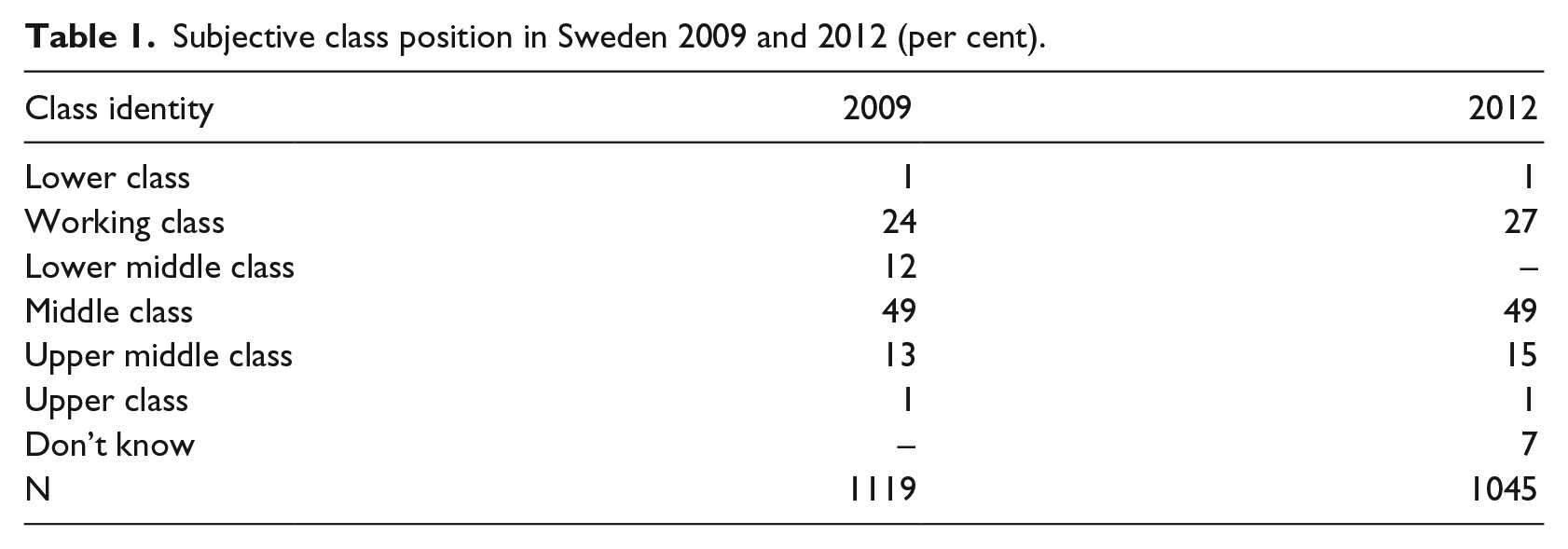
The working class and middle class are the two most prominent social classes used (Table 1). A small proportion identifies with the two marginal classes (lower and upper class), which is in accordance with previous findings about class identity in Sweden as well as other Western countries (Evans et al., 1992). In comparison with a previous study by Bengtsson and Berglund, this study found similar proportions of individuals identifying with the working class and middle class (Bengtsson and Berglund, 2010). According to gender and working-class identity, 21 per cent of the female respondents and 27 per cent of male respondents identified with the working class in 2009, corresponding to 28 per cent and 27 per cent, respectively, in 2012. One plausible reason for the lower proportion of females with a working-class identity in 2009 can be the inclusion of a lower middle class alternative, in which women were overrepresented. In 2009, and according to age, the difference in working-class identity was largest between the youngest (17–29) and the oldest (65–79) groups, 21 and 29 per cent, respectively; whereas in 2012 the lowest working-class identity was held among individuals aged 30–49 years, 22 per cent, compared to 32 per cent among the elderly (65–79).
In the descriptive analysis and the forthcoming general linear regression analysis, the original six-category subjective class variable is recoded into three categories: (1) working class (lower and working), (2) middle class (lower middle and middle), and (3) upper middle class (upper middle and upper class).
Subjective Social Placement in Society
The question about subjective social placement has similarities with the MacArthur Scale of Subjective Social Status (SES ladder) (Adler et al., 2007). The difference is that whereas the MacArthur Scale identifies the factors important for distinguishing oneself in society (comparing one’s current situation to others’ regarding money, education and job), the question used here does not refer to any specific factors for demarcation. The question about subjective social placement in society includes a 10-degree scale (lowest 1 to highest 10).
In 2009, 1125 of 1137 respondents (99 per cent) placed themselves in a position in the stratification system; the same proportion in 2012 was 95 per cent, and there was no significant difference in subjective social position between the two years (Table 2). The results partly support what previous studies have found, that most people place themselves in the middle of the stratification system (Kelley and Evans, 1995; Oddsson, 2010). Taking the two years together, about 50 per cent of the Swedish population locate themselves in the middle or slightly higher (5 and 6). Almost every other respondent placed themselves above the middle category (7–10), while only 13 per cent located themselves below the middle (1–4). Even though people all over the world tend to see themselves as being in the middle of the stratification system, the Swedish population to a higher extent located themselves near or in the top strata (Evans et al., 1992; Evans and Kelley, 2004).
Subjective social placement in Sweden 2009 and 2012 (per cent).
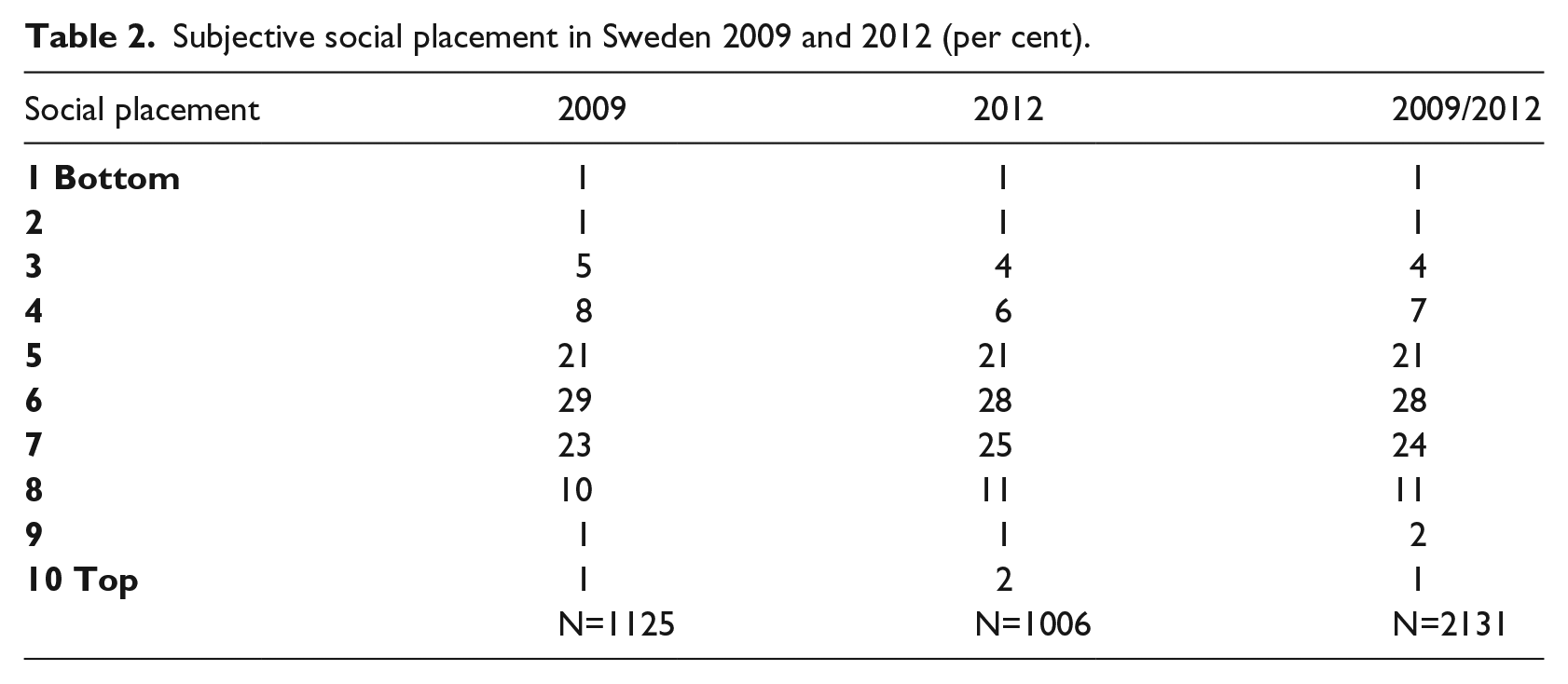
In the analysis of subjective social placement in descriptive analysis, 1–4 is defined as bottom, 5–6 as middle and 7–10 as top. In GLS regression, the original scale is used.
Individual-level predictors
The age categories used in this study are 17–29, 30–49, 50–64 and 65–79 years.
Educational level is classified as primary school, vocational school, academic secondary school and university.
Individual monthly income is divided into three categories: under SEK 22,000, SEK 22,000-31,999, and SEK 32,000 and over.
Objective class is measured with the Swedish socio-economic classification of occupations (SEI). The categories used are manual worker, assistant non-manual, intermediate non-manual, professional and self-employed/farmer (farmers comprised eight of the 196 individuals in this category).
Since the focus here is on the relationship between class identity and gender, and on class identity and age for subjective social placement, the interactive terms class identity by gender and class identity by age were added to the model. In the regression model, each of the variables constituting the interactive terms was included (Brambor et al., 2005).
Findings
The Relationship between Class Identity, Other Categories and Subjective Social Placement
Class identity is highly associated with where in the social structure individuals locate themselves. Among individuals who identify with the working class, 33 per cent locate themselves in the bottom segment of society, whereas the same proportion among individuals with a middle-class identification is 6 per cent (Table 3). As outlined in Hypothesis 1, the tendency to spread more widely over the scale was found among individuals with a working-class identity (see standard deviation in Table 3). Levene’s tests verified that the differences in the variances between the groups (working class vs. middle class, and working class vs. upper-middle class) are statistically significant. For individuals who identify with the working or middle class, the modal type of subjective placement is in the middle segment of society. For individuals with an upper-middle identification, the modal type of placement is at the higher stratum (83 per cent). The correlation between class identification and subjective placement is 0.5 according to Spearman’s rho.
Different groups’ estimation of their subjective social placement in Sweden. Row percentage, Mean, and Standard Deviation.

= p<.001. **= p<.01. * p<.05.
For gender, men and women place themselves to almost the same extent in the three subjective social positions (Table 3). As in previous studies, no difference was found between Swedish men and women regarding where they locate themselves in this social hierarchy (according to the mean; Goldman et al., 2005; Lindemann, 2007). In terms of age, the results reveals that individuals aged 17–29 to a higher extent locate themselves in the higher stratum compared to all other age groups.
Continuing with educational level, 20 per cent of individuals with primary school as their highest educational level locate themselves in the lower stratum, similar to individuals with a vocational education (19 per cent). For individuals who had completed academic secondary school or a lower level the modal placement is in the middle stratum, whereas the modal type for individuals with university as their highest educational level is in the higher stratum (52 per cent). These results are in accordance with previous studies on the effect of education on subjective social placement (Lindemann, 2007). In terms of social class, 23 per cent of the manual workers estimate their social position in the lower stratum; the same proportion place themselves in the higher stratum (Table 3). The subjective position follows the social-class categories; moving from manual worker to the professional or upper-level category, the tendency is to estimate a higher social position. As for class identity, a tendency to spread more over the scale was found among manual workers (see standard deviation in Table 3). For income, the results align with previous research: the higher the income, the higher the subjective social placement (Lindemann and Saar, 2014).
From the variables included in the analysis (Table 3), the highest proportion of individuals estimating their social position in the lower stratum is found among those with a working-class identity, revealing the high impact class identity has on subjective social placement. These results are also in accordance with previous findings regarding factors that are important for subjective placement (education and income).
Does the Effect of Class Identity on Subjective Social Status Depend on Gender and Age? If class identity is said to have a somewhat different meaning for men and women, and for the younger and older segments, it is relevant to relate class identity to subjective social placement using the other variables described in the method section.
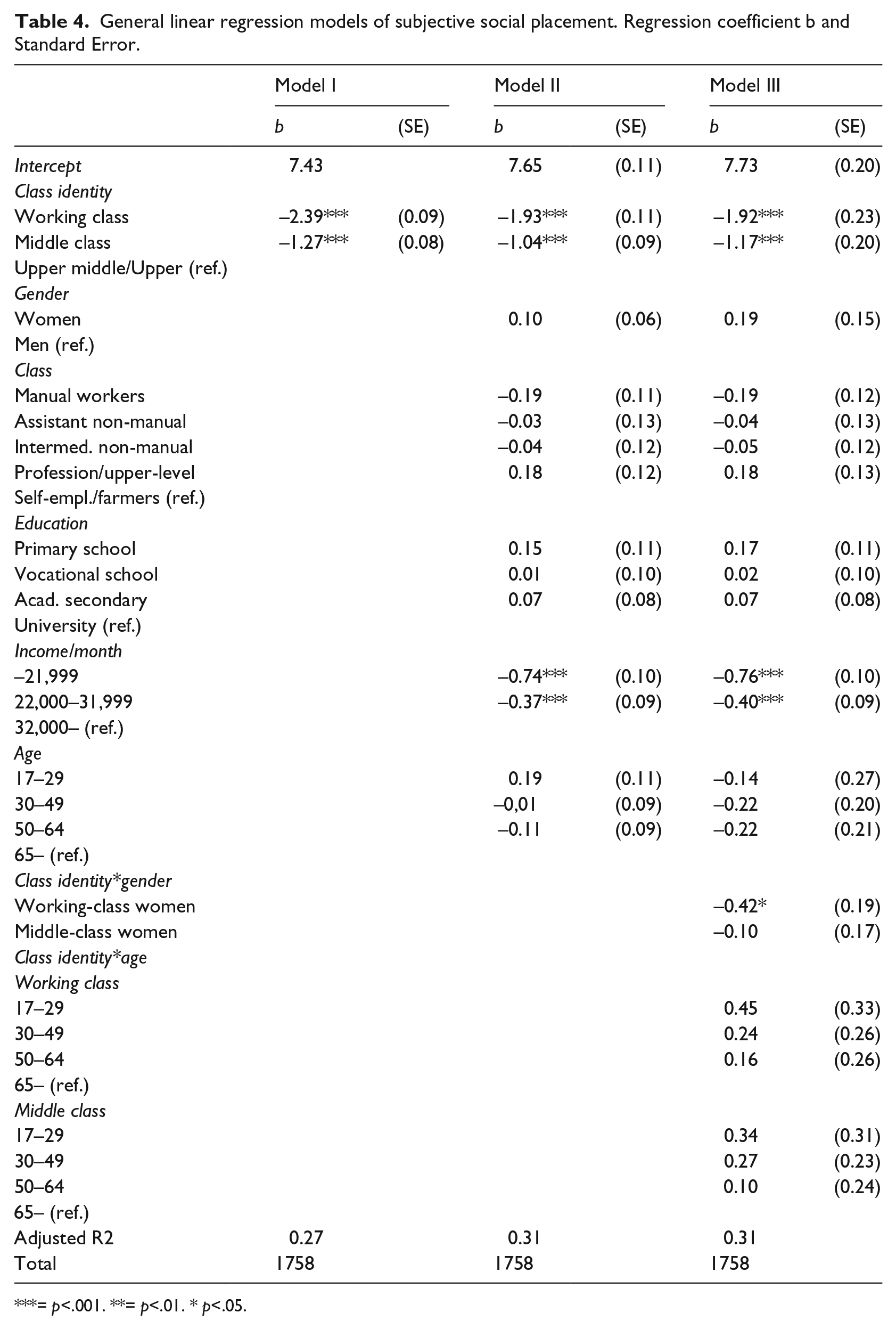
As expected, class identity is highly associated with subjective social placement and alone explains 26 per cent of the variation in subjective position (Model I, Table 4). Even after controlling for other factors, the analysis shows that a working-class identity is related to lower subjective social placement (Model II, Table 4). Regarding gender, the difference in status perception is very small and the effect is non-significant, whereas age reveals a significant effect whereby younger individuals (aged 17–29) locate themselves higher on the subjective scale (Modell II, Table 4). As demonstrated in previous studies (Goldman et al., 2005; Lindemann, 2007; Lindemann and Saar, 2014), there is an association between income and subjective social status, with individuals with lower and middle incomes placing themselves lower on the status scale than those with higher income do. Among the other factors involved in the analysis, and in accordance with previous studies (Lindemann, 2007), the results reveal a relationship between social class and subjective position, whereby individuals holding a manual worker position locate themselves lower on the status scale. In contrast to what previous studies have found, educational level did not make any considerable contribution to self-placement in the social-stratification system (Evans and Kelley, 2004; Lindemann, 2007). Given that many of the factors included in the model are correlated (income, education, social class, and class identity), however, the associations of class identity and income are most significant for the difference in subjective social status.
General linear regression models of subjective social placement. Regression coefficient b and Standard Error.
= p<.001. **= p<.01. * p<.05.
Since the focus of the analysis was to examine the effect of class identity by gender and age, the interactive terms were included in the analysis (Model III, Table 4). In accordance with the hypothesis, the results confirm that the effect of class identity on subjective status depends on gender, and that women identifying with the working class place themselves lower on the status scale (H2) (b = −0.42 p < 0.05) than working-class men do. As we know, working-class women less often identify with the working class (Karlsson, 2005; Wright, 1997), and the results presented here indicate that those who do place themselves lower on the status scale. The estimated marginal mean of the subjective social status shows lower subjective social placement among women identifying with the working class than the corresponding estimated marginal mean for men (Figure 1).
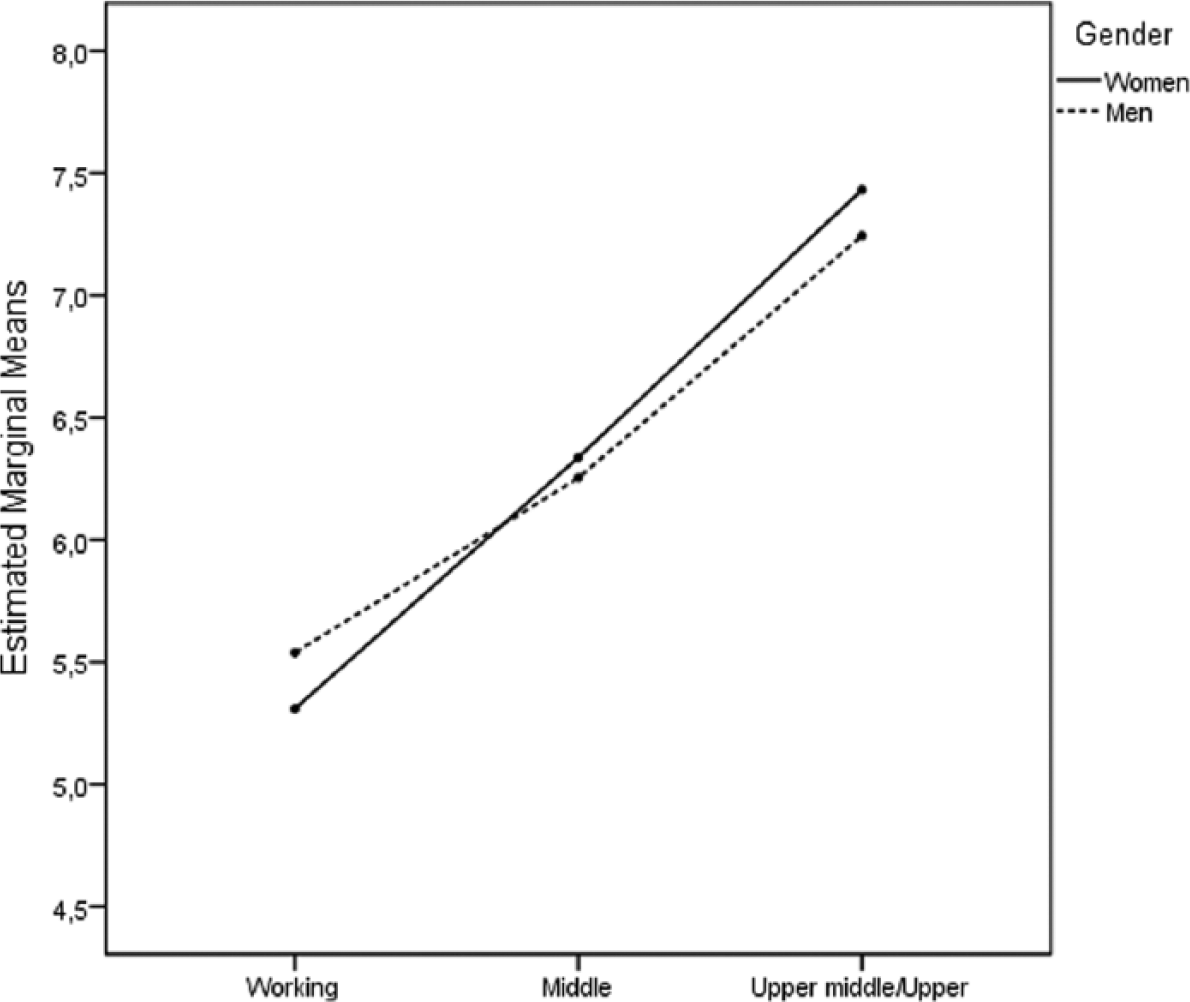
Estimated marginal means of subjective social placement, class identity by gender.
As for gender, interactive terms for class identity and age groups were included in the analysis. Contrary to what was predicted in our hypothesis (H3), the analysis revealed a non-significant effect of class identity between age categories. However, the results show a tendency among the youngest individuals (aged 17–29) of working-class identity to locate themselves higher on the status scale.
As expected, a working-class identity is associated with lower placement on the subjective social status scale. The result of women identifying with the working class and placing themselves lower on the status scale, and the non-significance of age, will be further discussed in the following section.
Conclusion
Previous research has revealed that most individuals locate themselves in the middle of the status scale (Kelley and Evans, 1995; Oddsson, 2010). In accordance with previous findings, the results conducted here show that the majority of the Swedish population locate themselves in the middle of the social structure; however, certain major deviations were also noted. The analysis showed that class identification has a clear association with people’s understanding of their own position in the social structure of society. Working-class identification is highly correlated with a bottom-/middle-segment placement, while upper-middle-class identification is highly correlated with a top-segment placement.
Regarding gender, the relevance of class identity appeared to be even more prominent, with women with a working-class identity locating themselves lower on the status scale than did the men (H2). The analysis did not find support for the hypothesis (H3) that younger individuals identifying with the working class locate themselves towards the bottom of society to a lesser extent compared to the elderly (as a consequence of status maximizing and different perceptions of class). This implies that individuals base their estimation of their social position on their current and future positions in similar ways, suggesting an enduring salience of social class for status perception, irrespective of age. Taken together, these findings support the position that the view of class in Sweden is more work-experience-centred compared to the situation in other Western countries. Finally, the non-significance of age can also be explained by the small numbers included in the final model (Table 4).
What do these results indicate in a wider sense, and how can we both theoretically and methodically understand the differences in class identity and subjective social placement? The main conclusion is that class identity and subjective social placement are two measures of the same latent phenomenon: a hierarchical classification of one’s position in the social structure. The results also show that when we give ourselves a class identity, it is not a meaningless label but rather a placement in the social hierarchy and one that has a somewhat different meaning for men than for women. In the more cultural approach to class, a working-class identity is seen as a less positive identity among women, causing a distancing from the working class (Reay, 1998a; Skeggs, 2000). This may certainly be one vital reason why women do not identify with the working class to the same extent as do working-class men, but it cannot fully explain women’s tendency to locate themselves lower on the social scale. As this study has argued, the lower placement on the status scale among women identifying with the working class must also relate to the occupations these women hold, compared to working-class men (Ahrne et al., 1995; Anker, 1998; Alexanderson and Östlin, 2001), and to the status accorded these occupations (Crompton, 1989). The results also show a slight tendency among women with a middle-class or upper-middle-/upper-class identity to locate themselves higher on the social scale compared to their male counterparts. Taken together, these results indicate that the female class structure can be more polarized than the male class structure. This implies a need for more research concerning how women and men relate their objective class position to social status, as well as the relationship of objective class position to different outcomes, such as subjective well-being and social justice.
Among the studies concerned with factors important for class identity or those using class identity as a controlling variable, the common feature is the use of a set of predefined class categories from which the respondents can choose. A commonly stated drawback of using predefined class categories for studying class identity is that all of the respondents need to have similar perceptions of the class system and/or are forced to choose from the given categories (Evans et al., 1992; Goodman et al., 2001; Singh-Manoux et al., 2003). As a way to overcome this difficulty, previous research has used an open ranking scale (‘subjective social status’) to capture individuals’ class identity (Evans et al., 1992; Kelley and Kelley, 2009). However, this can also present a problem when a status scale is used to capture subjective social placement or as a way to study class identity. We cannot fully know how individuals perceive and comprehend social status in their society when they answer such a question, nor can we know whether they have similar perceptions regarding class identity. As subjective social status position seems to follow a variety of factors beyond objective characteristics (income, education), such as comparisons with family and friends (Lindemann, 2007; Rose, 2006), aspirations for future social position (Yamaguchi and Wang, 2002) and perceptions of the social structure of society (Evans et al., 1992), these factors seem even harder to grasp (Hoffmeyer-Zlotnik and Krebs, 2000). More rigorous research is needed to account for these socio-psychological processes – especially when it comes to understanding the lower subjective status among women with a working-class identity, where qualitative methods might be particularly useful.
Another question for further research is whether the relationship between class identity and subjective social status depends more on household factors (partner’s class position, partner’s educational level, household income) than on the individualistic characteristics studied here. The results so far confirm a lower social placement among Swedish women with a working-class identity; the next step will be to compare these results with both those in countries whose residents hold a similar, work-experience-centred view of class, and with those in countries in which a more consumption-centred view of class is common.
Footnotes
Acknowledgements
The research project is part of the activities at the Centre for Demographic and Ageing Research at Umeå University. Thanks to colleagues and to three anonymous reviewers for comments on previous versions of the article.
Funding
This research received no specific grant from any funding agency in the public, commercial, or not-for-profit sectors.