




Abstract

The task of this introduction to “critical management” is twofold. First, it presents a short overview of what management actually is, outlining four different perspectives on management, while the second part delivers a critical-analytical overview of recent articles published on critical management in the journal Critical Sociology between 1989 and today. The first part starts by highlighting the difference between management and “critical” management. In doing so, it also distinguishes between four perspectives on management (see Table 1).
Four Versions of Management Studies.

Before getting into the details of these four perspectives on management the question “what is management?” (Magretta, 2012) should briefly be addressed. Ever since Fayol’s (1841–1925) six functions of management – planning, organising, staffing, directing, coordinating, and controlling – and even more so since Frederick Winslow Taylor’s (1856–1915) short book on “scientific management”, they and their entourage of affirmative writers (e.g. Ford, Ackoff, Drucker, Chandler, Porter, Jack Walsh, Peters, Kotter, Hamel, Handy, Herzberg, Kanter, Mayo, Mintzberg, Weick, etc.) have sought to give management the appearance of being mathematical, logical, engineering-like, rational, and even scientific.
It has been Taylor’s (1911) The Principles of Scientific Management that more or less single-handedly invented management while giving it the appearance of being scientific. Taylor did this by introducing two forms of division of labour inside companies: the first is his classical (horizontal) division of work into minute work tasks. Perhaps even more important has been Taylor’s second (vertical) division because it destroyed the craft knowledge of workers about how to make things, placing this knowledge firmly into the hands of those who now organise and manage the manufacturing process: management.
Through that, management gained widespread acceptance and ideological legitimacy. But Taylor’s so-called “scientific management” reads – at least in parts – like an ideology. Especially when he writes that a worker is
too stupid properly to train himself […] [and that a worker] shall be so stupid and so phlegmatic that he […] resembles [the] mental make-up of the ox [and that a worker must be kept] so stupid that the word “percentage” has no meaning to him [and finally workers are so stupid that even a] gorilla [can] become a more efficient pig-iron handler than any man can be. (Taylor, 1911: 23, 21, 14)
In short, just a few lines from the famous book on “scientific management” show the ideological character of Taylor’s work.
In other words, the founding texts of management (Fayol and Taylor) did not deliver a new science but provided ideology informing (sic!) countless managers, supporting their invented and deeply ideological belief in management’s superiority over workers, ox, and gorilla. But Taylor’s ideological pamphlet also shaped the thinking for crypto-academic management writers when producing ideological knowledge – e.g. “knowledge in the service of power” (cf. Therborn, 1988). To sustain and legitimise management’s perceived superiority over workers, ox, and gorilla, rafts of Taylor’s ideological entourage – those called academics – have been working diligently for a century now on “knowledge-creation” in the world’s roughly 12,000 business schools (Economist, 2014). Almost on a daily basis they invent ever more sophisticated ways to ideologically legitimise management. Yet despite the appearance, their knowledge creation was – and is – by no means scientific.
What drives such a rather voluminous knowledge creation can be analysed by applying what German philosopher Habermas once outlined in his Knowledge and Human Interests (1968/1987). Habermas called one interest of knowledge creation the empirical-analytical interest. This version of knowledge is dedicated to control. Today, it remains the dominant approach inside traditional management studies (TMS). The ideological need to legitimise and sustain management is most clearly expressed in Managerialism (Klikauer, 2013; Clegg, 2014; Jaros, 2014) and its flagship journals. Apart from the infamous “airport copies” (Reader’s digest-like pamphlets such as Peters and Waterman’s Search for Excellence, 1982 or Finkelstein’s more recent Superbosses, 2016), TMS, in its semi-scholarly version, is largely “journal science”, that is, a 7,500-word production divided into the positivist hallucination of science as “abstract→literature→facts→conclusion”. But beyond that, journal articles also give performance management brownie points and make or break carriers (Chandler, 2016). Under the eternal “publish-or-perish” ideology, management academics are forced to publish in so-called “top-tier” or “5-star” journals such as those listed in Table 2.
Traditional Management Studies Journals.

Next to traditional management studies (TMS) and to carve out a new niche, the field of TMS saw the emergence of Critical Management Studies (CMS) during the late 1990s. Largely as a system-supportive critique of traditional management studies (TMS), a second field of management studies opened up. This is the field of Critical Management Studies (criticalmanagement.org), establishing itself since approximately the mid-1990s when Alvesson and Willmott published their “On the Idea of Emancipation in Management” (1992a), as well as an edited volume entitled Critical Management Studies (1992b). Perhaps the chosen place for their 1992 article – Academy of Management Review – set the tone of CMS, indicating that CMS is part of management standard’s canon (Klikauer, 2011, 2015b, 2016a). Since then, CMS has set itself up as a management-sustaining critical feedback loop in support of TMS. While CMS has not established its own journal, examples of typical CMS journals are listed in Table 3.
Critical Management Studies Journals.
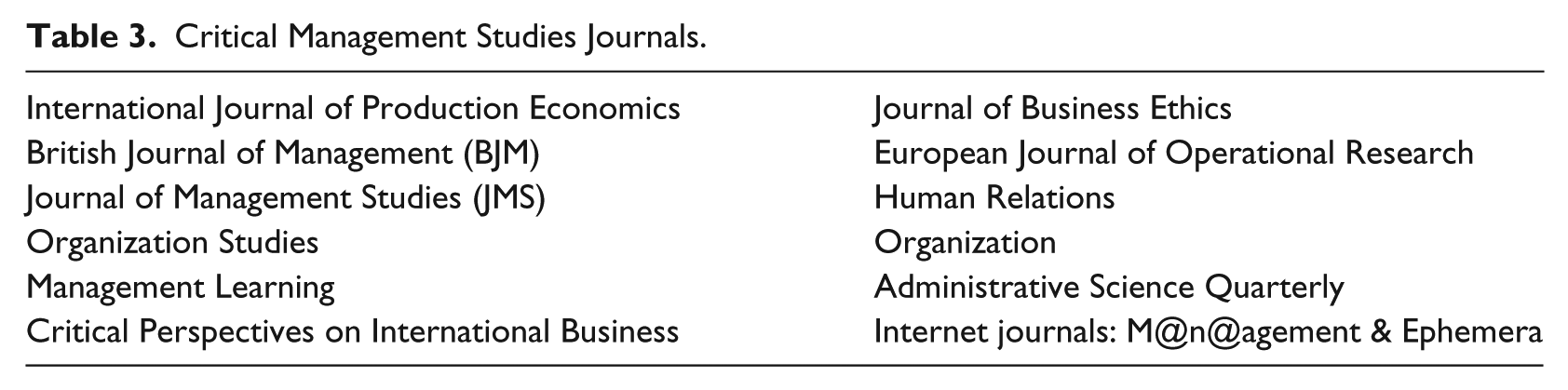
Once placed in the aforementioned Habermas framework, CMS can be seen as having firmly locked itself in the hermeneutical sphere of seeking to understand and interpret management. This is exemplified in what CMS writers call “sensemaking” (Alvesson and Willmott, 2012) and “reflexive methodology” (Alvesson and Skölberg, 2000). A more recent and typifying publication is, for example, Alvesson and Sandberg’s (2013) “Has Management Studies Lost Its Way?”, implying that management studies (TMS) is inherently good but lost its way while we (CMS) are here to put you (TMS) back on track. CMS lives by offering a system-corrective and system-stabilising critique to management studies (TMS).
CMS likes to present itself to TMS as an enlightened force that is able to identify some of the shortcomings of TMS in order to improve the latter. In line with protecting and improving management is one of its more recent CMS publications, which asked: “why do professionals willingly comply with Managerialism?” (Alvesson and Spicer, 2016). The hidden transcript is the assumption that there is some sort of reason why those – otherwise innocent and truly well-meaning – managers comply with some sort of alien and evil form of management: Managerialism. That the vast majority of managers “lives and breathes” Managerialism, fostering the ideology while enhancing domination over workers on a daily basis, escapes CMS’ hallucinogenic belief in the good manager.
Hallucinations like these are also expressed in Alvesson and Willmott’s (2003) Studying Management Critically and their four-volume set Critical Management Studies (Alvesson and Willmott, 2011). In both editions (2003 and 2011), CMS tends to claim that it originated, at least in parts, in the Frankfurt School of critical theory. But what CMS actually writes is quite distant from the spirit of the Frankfurt School of critical theory (Klikauer, 2015c). To cut a rather longish story short, critical theory is “the attempt by a group or a class to emancipate themselves from particular oppressive social conditions” (Deranty, 2016: 36). Critical theory’s telos is universal emancipation. By contrast, CMS’ telos is:
micro-emancipation,
the production of better managers,
good management,
[the] shap[ing of] organisations to become fairer, and the idea that
management’s social engineering can be balanced. (Klikauer, 2015c: 207)
Having outlined the “critique-supplying” function of CMS for traditional management studies (TMS) and somewhat clarified the difference between CMS and CMT, the last two approaches of the study of management are “critical management theory” (CMT) and what might be called Marxist management theory (MMT). CMT and MMT are dedicated to what Habermas calls a “critical-emancipatory” version of social theory. Both are approaches that challenge management and its entourage of affirmative writers (TMS/CMS). To varying degrees – CMT somewhat less so than MMT – MMT has a somewhat stronger focus on the political economy of management. Meanwhile, to a certain degree CMT tends to place a stronger emphasis on non-economic factors. Nonetheless, both remain highly challenging to the TMS/CMS team by, for example, placing management in a “domination-vs.-emancipation” dichotomy. Overall one might acknowledge that CMT works more in the tradition of the Frankfurt School of critical theory (Adorno, 1973; Marcuse, 1966; Horkheimer, 1937/1972) while MMT follows more the theoretical tradition of Labour Process Theory (Braverman, 1974; Burawoy, 1979; Knights and Willmott, 1989; Marglin, 1974; Thompson and Smith, 2010). Typical journals for CMT and MMT are listed in Table 4.
Critical Management Theory and Marxist Journals.
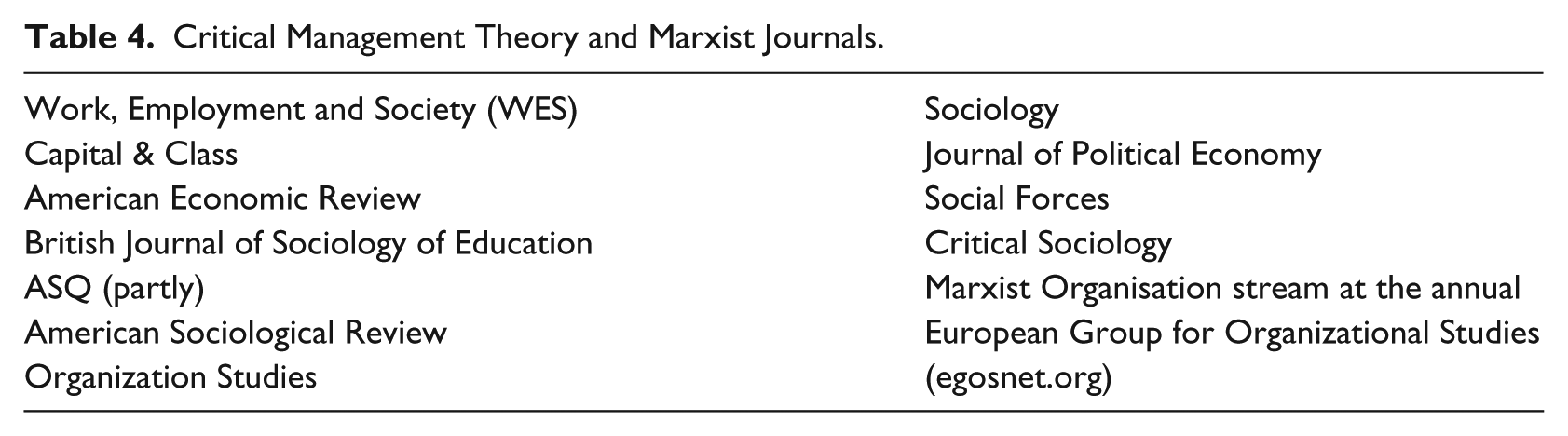
In summary, today’s field of management studies remains clearly dominated by traditional management studies (TMS). Within a substantial critique of management (TMS) as issued by CMT and MMT one finds Critical Management Studies (CMS). At times, it appears as if CMS’ quest for “good management” mirrors a “Giddensian” (1998) hallucination of a “third way” between capital/management and a non-exploitative future that lies beyond capitalism. Together, TMS and CMS build the core of the vast majority of publications on management. Meanwhile at the outer fringes of management studies, one finds “critical management theory” (domination-vs.-emancipation) and Marxist management theory (political economy and Labour Process Theory).
While it may appear that the “CMS–CMT” difference is merely semiotic, the distinction between “s” (studies) and “t” (theory) is rather substantial. For one, CM“S” sees itself as a “study” of management with the task of producing “better management”. By contrast CM“T” sees itself as working in the tradition of the Frankfurt School of critical theory viewing management as an institution of domination. CMT is not a “study” (e.g. CMS) but has a theoretical-philosophical background. This can be found in:
Horkheimer’s traditional and critical theory,
Adorno’s negative dialectic,
Adorno and Horkheimer’s (1944) mass deception,
Marcuse’s one-dimensional society,
Habermas’ communicative action, and
Honneth’s recognition theory. (Honneth, 1995; Klikauer, 2016c)
Crucially, CMT seeks the end of domination, working towards emancipation while CMS sees itself as being part of management “studies”, with the task of critically informing traditional management studies in order to establish an enlightened form of management: good management rather than bad management. Perhaps the difference between CMS and CMT/MMT and real Marxism is still best described by nothing other than the communist manifesto (Marx and Engels, 1948). One might like to paraphrase one of the manifesto’s core messages:
Critical Management Studies is, inside management studies at least, respectable; Critical Management Theory and Marxism is the very opposite.
In conclusion, like in many other academic fields, management studies shows that those who support the status quo of management and capitalism (Benson and Kirsch, 2010) have been given access to the intellectual and academic power centres (e.g. positions in business schools) while those mildly critical (CMS) are kept at a safe distance, yet still inside the centre of business schools (Klikauer, 2016c). The further one moves away from an outright pro-management and pro-capitalism stance, the more critique one finds. The following hypothesis emerges: the more critique the less power and the less critique the more power. As a consequence and on the downside, CMT and MMT are kept at the fringes of management studies. When showing how all this works as a “2×2” matrix, the following picture emerges (see Figure 1):

The Matrix of Four Versions of Management Studies.
On the left hand side of Figure 1 (shaded) one finds traditional management studies (TMS), which is intimately linked to today’s rather established critical-interpretive feedback loop of CMS. While TMS sustains domination, CMS (lighter shading) wants better domination in the form of more enlightened managers: soft domination rather than outright domination. Within the established version of management studies, TMS is dedicated to control while CMS (lighter shading) is devoted to the understanding of management. The fine line between TMS and CMS indicates a move towards an interpretive-hermeneutical enterprise. While the shaded areas indicate the established versions of management studies, the non-shaded areas indicate a fringe existence. The zigzag line between TMS/CMS on the one hand and CMT/MMT on the other indicates what might be seen as the real dividing line that runs through today’s management studies. It shows the border between “control and understanding” (TMS/CMS) on the one hand and the “critical-emancipatory” approach of CMT and MMT. The latter two seek to overcome domination while working towards emancipation. This coincides with much of what is written in Critical Sociology as the second part will show.
Critical Management inside Critical Sociology
To illuminate Critical Sociology’s writings on management, five articles and one book review essay have been assembled into this e-special. Michael Useem (1989) starts with a term hardly ever used by TMS/CMS, namely “the consolidation of managerial control” in many large corporations. To some extent, this challenged management’s traditional hold on power when “ownership groups” became more influential. Pushing management aside, these groups began to “exercise greater influence on company policies and practices” (Useem, 1989: 7), thereby entering the traditional domain of management – something TMS seeks to preserve and CMS seeks to improve.
Useem argues that “the re-emergence of ownership power [was] redirecting company political action toward more narrowly defined issues of specific company interest”, which “undercut general business consensus and demobilised political action” (Useem, 1989: 7). Political action is something that TMS rejects as it seeks to present management as an engineering-like and value-neutral institution while it simultaneously de-politicises management. Meanwhile CMS acknowledges that organisational politics exists but it seeks to reduce it towards mere “office politics” and/or favours the use of organisational politics to improve management.
Sabine Mader, Just Mields and Birgit Volmerg (2007) take a critical look at the way “New Public Management” has been introduced in Germany as a management strategy that is characterised by extended flexibility in work performance and objectives. The authors argue that “control of processes is replaced by control of results”, reflecting on Managerialism’s move towards MBO (management by objectives). While management retains control, it shifts responsibility towards individuals for fulfilling the aims in the contracted area. With this shift, many public entities such as schools, universities, hospitals, etc., no longer place children, students, and patients at the centre. Instead, these institutions follow what is known as an “as-if” ideology, namely the belief that they need to operate “as-if” they were profitable companies.
This heralded not only the move towards Managerialism but also the age of “The Entrepreneurial Self” (Bröckling, 2015). It cemented managerial control while divesting responsibility away from management under the common managerial maxim of “blame others” when things go wrong and take credit when things go right (Schrijvers, 2004). But this also marked a severe shift within organisational culture, “within the public administration but also between the administrative body and the newly founded, independent enterprises” (Mader et al., 2006: 127) – e.g. the “Privatisation of Everything” (Mandell, 2002; Dorfman and Harel, 2013). Based on “expert interviews”, Sabine Mader and her team conclude that these new forms of public management – Managerialism – have stern “consequences for employees [and for the] organization” (Mader et al., 206: 127)”.
Warren Smith (2008) focuses on the aforementioned Critical Management Studies. In particular he notes the “internal debate” within CMS, which is – almost for any academic field – “in-itself” (Kant) no great surprise. Like many scholarly fields there “are disagreements over its objectives and methods” within CMS. At times, CMS sees itself being torn between empiricism/positivism and a critical-hermeneutical interpretation of management. But for Smith’s key question – a positive sense as to what it [CMS] should be for? – CMS has, more or less, answered this since it is, to a large extent, a system-corrective auxiliary for traditional management studies. CMS has been given its assigned place and is valued by TMS as it helps TMS to create “good managers”. But Smith also raises a more fundamental question, namely, when “engaging with management [in] a radical approach [does CMS lead to] participation in the business school” (Smith, 2008: 15)? The answer to that was perhaps best provided by one of North America’s greatest, namely Upton Sinclair, who once said:
it is difficult to get a man to understand something, when his salary depends upon his not understanding it! (1935/1994: 109)
This delivers much of the answer to Smith’s question as most, if not all, business school academics prefer the safe and – promotion-enhancing – secure haven of TMS or nowadays CMS. CMS has increasingly become acceptable throughout the management study spectrum as it avoids understanding the role of management as a key stabilising and, above all, deeply ideological institution of capitalism. It no longer remains the case that “it is rather difficult to reconcile the CMT/MMT approach with business schools” (Smith, 2008: 15). For CMS, such reconciliation has never been a problem. Smith concludes that “this conflict” [between business schools and CMS] needs to be discussed because “left unaddressed” this conflict undermines CMS’ “viability”. Since Smith’s article in 2008, this initially assumed conflict – if there ever was a conflict between TMS and CMS – has been solved through the thorough integration of CMS into the canon of TMS and business schools. While Smith’s initial question may indeed have inferred some high hopes for CMS, the field has since proven to be no more than a mildly critical appendage to traditional management studies.
As a consequence, Smith’s initial proposition – “the nature of their [TMS-vs.-CMS] (dis)engagement” is no longer a disagreement at all. Instead, it is a meticulous integration. In other words, Smith’s “reconciliation” has ended in favour of TMS and perhaps also in favour of CMS as an accepted sideshow of TMS. Perhaps it is just as George Orwell’s narrator says at the end of Nineteen Eighty-Four: “… it was all right, everything was all right, the struggle was finished. He had won the victory over himself. He loved Big Brother. THE END” (1949/1989: 311).
While CMS might no longer – if ever – be seen as a management-challenging version of critique, the neo-liberal world of capitalism, business, Managerialism, and management lives on largely undeterred by the machinations of CMS. And they live on with “the strange non-death of neoliberalism” (Crouch, 2011) and Managerialism. But management under neo-liberalism is also the theme discussed by Raewyn Connell (2010). Based on an Australian case study, Connell argues that the “conflict between intellectuals and the holders of power is called into question in neoliberal global capitalism”. For the labour process at a business organisational level, this means that “the practices of […] managers bring a neoliberal order into being” (Connell, 2010: 777). Yet this occurs with one fundamental difference: much of the advances of the neo-liberal ideology and its political programme (anti-union, privatisation, destruction of the welfare state, etc.) have occurred through democratic elections engineered by corporate mass media, thereby securing “The Spectacular Achievements of Propaganda” (Chomsky, 1991; Smythe, 1977). Many have argued that neo-liberalism’s electoral triumph and hegemonic ideology started to enter the political arena with the election of Margaret Thatcher and Ronald Reagan. But before that, neo-liberalism had its very own coup d’état, engineering a trial run in Chile with the Godfather of neo-liberalism, Hayek (1978), voicing strong support for Augusto Pinochet’s Villa Grimaldi (Ensalaco, 2000: 93).
While the triumph of neo-liberalism in politics still depends on the engineering of elections, at the workplace Managerialism has never depended on democracy. Neo-liberalism’s “evil twin brother” of Managerialism is introduced as a non-democratic top-down affair into a staunchly anti-democratic institution – management – based on management’s self-assigned belief in the managerial prerogative, its self-invented right of management to manage, and its beloved “command-and-control” ideology (Taylor, Fayol, Ford, etc.). While workplace democracy and even industrial democracy remains a constant theme of CMT and MMT, democracy is virtually unmentioned by TMS and appears as a diminished side issue in CMS. Apart from two notable chapters – “Corporations, Democracy and the Public Good” (Barley, 2011) and “Whence Democracy?” (Johnson, 2011) – in Sage’s CMS handbook (2011), neither Alvesson and Willmott’s (2011) Critical Management Studies four-volume set nor Prasad et al.’s (2016) more recent Routledge Companion to Critical Management Studies have much to say about industrial democracy.
Meanwhile, Managerialism has also reached one of the birthplaces of European parliamentary democracy, namely France, as Michel Chauvière and Stephen S. Mick (2013) outline in their review essay. The authors start with non-TMS and non-CMS themes as outlined in Martin Parker’s Against Management (2002). Beyond that, they note that “much of the French critique of new Managerialism revolves around the spread of evaluation logics, tools, and a supporting ideology, not just to influence organizational performance, but also, and perhaps most importantly, to exert control over organizational actors” (Chauvière and Mick, 2013: 142). Set against the intensification of managerial control under Managerialism, Chauvière and Mick conclude that “the French critique has sharpened [our] perspective in a dramatic and convincing fashion through its relentless review of almost every conceivable facet of the managerial imperative” (Chauvière and Mick, 2013: 142). One of these core facets of managerial ideologies today is undoubtedly Managerialism.
The thematic article on Managerialism (Klikauer, 2015a), starts by noting that “Managerialism is a deeply ideological project transcending its traditional management location when entering into society” (Klikauer, 2015a: 1103). I argue that there is a “possible definition of Managerialism” – “Management + Ideology + Expansion = Managerialism” (cf. Clegg, 2014) – but I also distinguish(es) Managerialism (anti-democratic) from Neo-Liberalism (semi-democratic). A sharp critique of Managerialism leads to the development of some “early signposts for a future critical theory of Managerialism”. He concludes with an “emancipatory note on what lies beyond Managerialism” (Klikauer, 2015a: 1103), namely post-managerial living (e.g. Gibson-Graham et al., 2013).
This ends the overview of current articles on critical management in the journal Critical Sociology.
In conclusion, the study of management can be examined from different angles as different knowledge-creating interests shape each of those perspectives outlined above. The first angle is that of traditional management studies (TMS). This continues to dominate the field of management studies. It creates knowledge less “about” management but more “for” management, as its interest is to be found in control. Adjacent to TMS is the field of Critical Management Studies (CMS), which has successfully established itself as the junior partner of TMS delivering a system-stabilising crypto-critique on management. Its research interest is twofold: first, it follows a mostly hermeneutical-interpretive approach in an attempt to semi-critically re-evaluate what TMS and management do; the second task of CMS is to inform TMS on its more obvious fallacies. It does this without ever seriously challenging management and capitalism.
Lastly, there is critical management theory (CMT) with, and interest in, emancipation and ending domination. Since management is inherently anti-emancipatory and based on domination – without domination via “command-and-control” there is hardly any management possible – critical management theory is extremely system destabilising for TMS and CMS. Overall, the entire field of a management-challenging “critique” can be divided into two, separated by inextricably linked parts. The first part is critical theory (CMT) dedicated to the heritage of the Frankfurt School of critical theory. The second part is the Marxist variant (MMT) of critique with a somewhat stronger emphasis on labour process theory and political economy. As the above outlined examination of articles published in Critical Sociology has shown, the journal remains dedicated to a knowledge-creating approach that seeks to end domination while working towards emancipation.
Footnotes
Funding
This research received no specific grant from any funding agency in the public, commercial, or not-for-profit sectors.